
Roland Collins, Artist
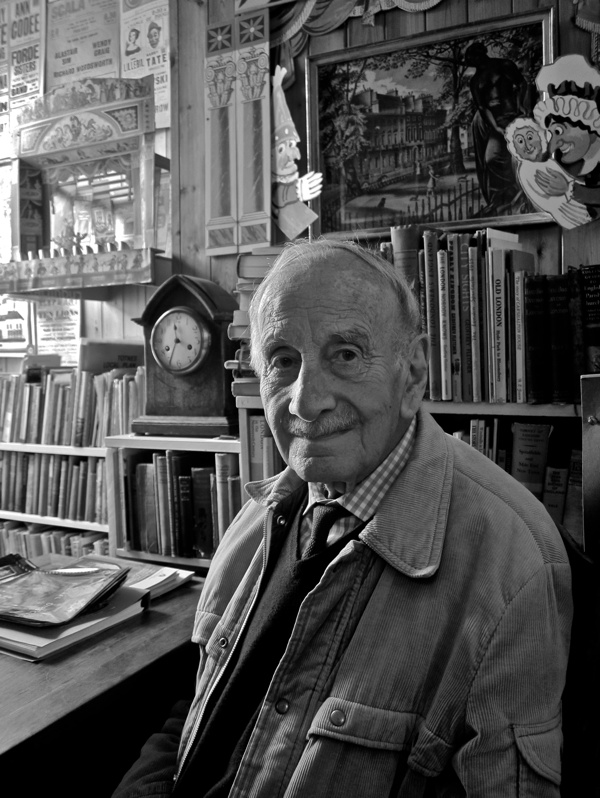
Roland Collins
Ninety-four year old artist Roland Collins lives with his wife Connie in a converted sweetshop south of the river that he has crammed with singular confections, both his own works and a lifetime’s collection of ill-considered trifles. Curious that I had come from Spitalfields to see him, Roland reached over to a cabinet and pulled out the relevant file of press cuttings, beginning with his clipping from the Telegraph entitled ‘The Romance of the Weavers,’ dated 1935.
“Some time in the forties, I had a job to design a lamp for a company at 37 Spital Sq” he revealed, as if he had just remembered something that happened last week,“They were clearing out the cellar and they said, ‘Would you like this big old table?’ so I took it to my studio in Percy St and had it there forty years, but I don’t think they ever produced my lamp. I followed that house for a while and I remember when it came up for sale at £70,000, but I didn’t have the money or I’d be living there now.”
As early as the thirties, Roland visited the East End in the footsteps of James McNeill Whistler, drawing the riverside, then, returning after the war, he followed the Hawksmoor churches to paint the scenes below. “I’ve always been interested in that area,” he admitted wistfully, “I remember one of my first excursions to see the French Synagogue in Fournier St.”
Of prodigious talent yet modest demeanour, Roland Collins is an artist who has quietly followed his personal enthusiasms, especially in architecture and all aspects of London lore, creating a significant body of paintings while supporting himself as designer throughout his working life. “I was designing everything,” he assured me, searching his mind and seizing upon a random example, “I did record sleeves, I did the sleeve for Decca for the first Long-Playing record ever produced.”
From his painting accepted at the Royal Academy in 1937 at the age of nineteen, Roland’s pictures have been distinguished by a bold use of colour and dramatic asymmetric compositions that reveal a strong sense of abstract design. Absorbing the diverse currents of British art in the mid-twentieth century, he refined his own distinctive style at his studio in Percy St – at the heart of the artistic and cultural milieu that defined Fitzrovia in the fifties. “I used to take my painting bag and stool, and go down to Bankside.” he recalled fondly, “It was a favourite place to paint, especially the Old Red Lion Brewery and the Shot Tower before it was pulled down for the Festival of Britain – they called it the ‘Shot Tower’ because they used to drop lead shot from the top into water at the bottom to harden them.”
Looking back over his nine decades, surrounded by the evidence of his achievements, Roland is not complacent about the long journey he has undertaken to reach his current point of arrival.
“I come from Kensal Rise and I was brought up through Maida Vale.” he told me, “On my father’s side, they were cheesemakers from Cambridgeshire and he came to London to work as a clerk for the Great Central Railway at Marylebone. Because I was good at Art at Kilburn Grammar School, I went to St Martin’s School of Art in the Charing Cross Rd studying life drawing, modelling, design and lettering. My father was always very supportive. Then I got a job in the studio at the London Press Exchange and I worked there for a number of years, until the war came along and spoiled everything.
I registered as a Conscientious Objector and was given light agricultural work, but I had a doubtful lung so nothing much materialised out of it. Back in London, I was doing a painting of the Nash terraces in Regent’s Park when a policeman came along and I was taken back to the station for questioning. I discovered that there were military people based in those terraces and they wanted to know why I was interested in it.
Eventually, my love of architecture led me to a studio at 29 Percy Studio where I painted for the next forty years, after work and at weekends. I freelanced for a while until I got a job at the Scientific Publicity Agency in Fleet St and that was the beginnings of my career in advertising, I obviously didn’t make much money and it was difficult work to like.”
Yet Roland never let go of his personal work and, once he retired, he devoted himself full-time to his painting, submitting regularly to group shows but reluctant to launch out into solo exhibitions – until reaching the age of ninety.
In the last two years, he has enjoyed a sell-out show at a gallery in Sussex at Mascalls Gallery and an equally successful one in Cork St at Browse & Darby this spring. Suddenly, after a lifetime of tenacious creativity, his long-awaited and well-deserved moment has arrived, and we are witnessing the glorious apotheosis of Roland Collins.
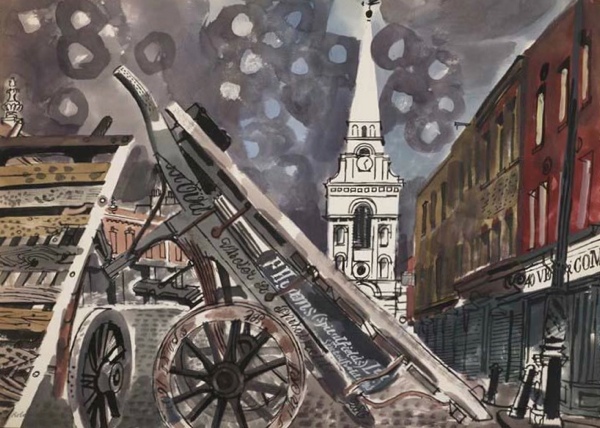
Brushfield St, Spitalfields, 1951-60 (Courtesy of Museum of London)
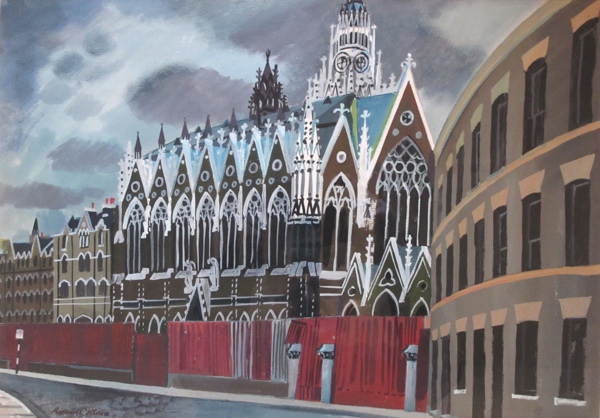
Columbia Market, Columbia Rd (Courtesy of Browse & Darby)
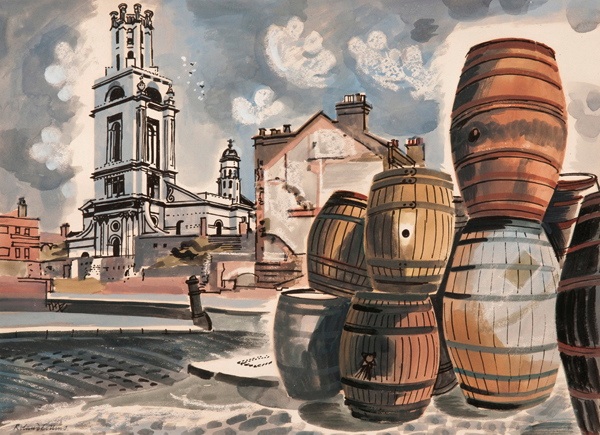
St George in the East, Wapping, 1958 (Courtesy of Electric Egg)
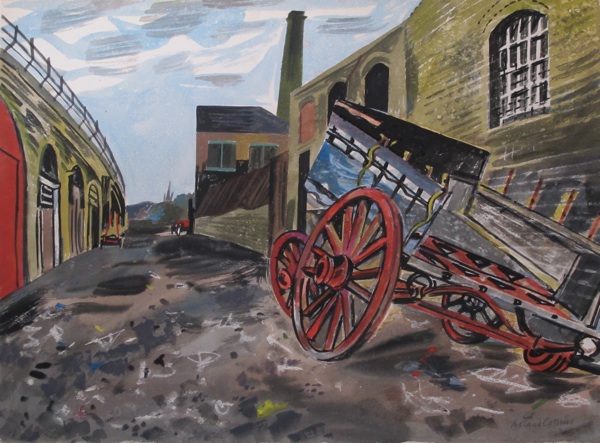
Mechanical Path, Deptford (Courtesy of Browse & Darby)
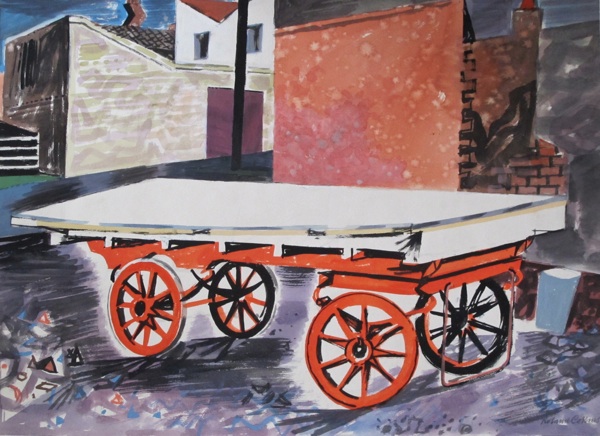
Fish Barrow, Canning Town (Courtesy of Browse & Darby)
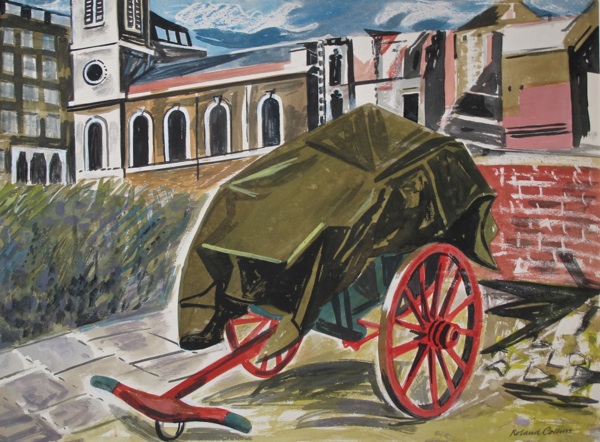
St Michael Paternoster Royal, City of London (Courtesy of Browse & Darby)
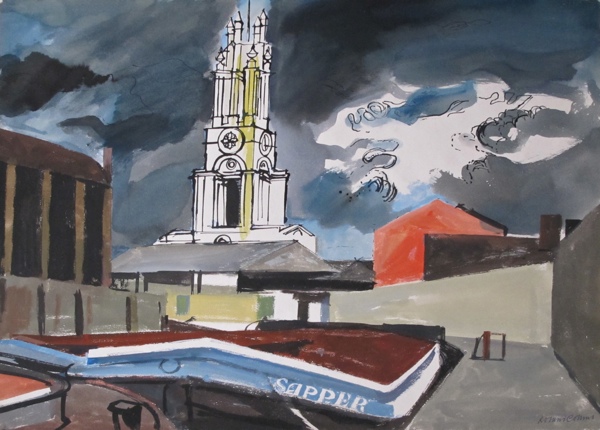
St Anne’s, Limehouse (Courtesy of Browse & Darby)

St John, Wapping, 1938
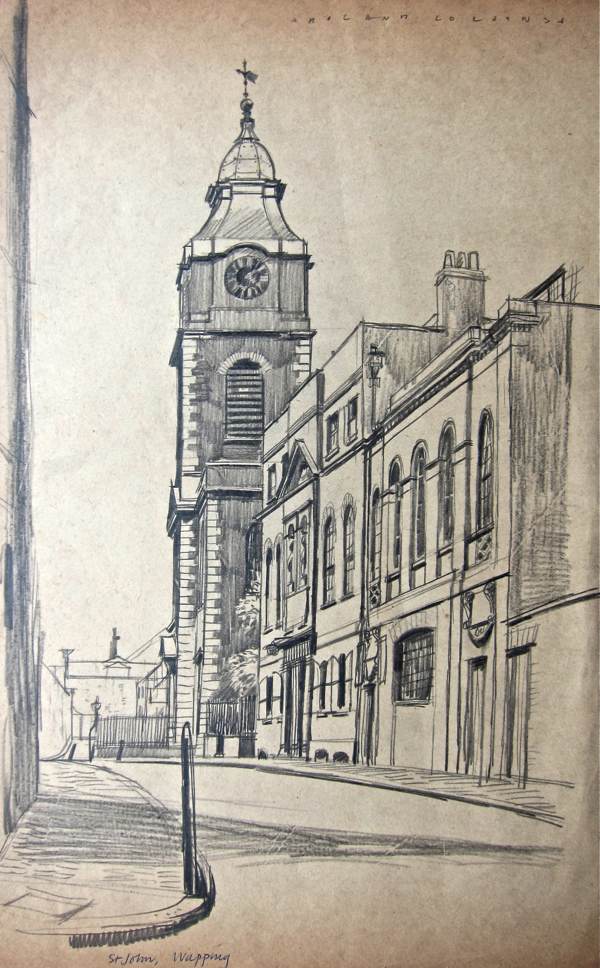
St John, Wapping, 1938
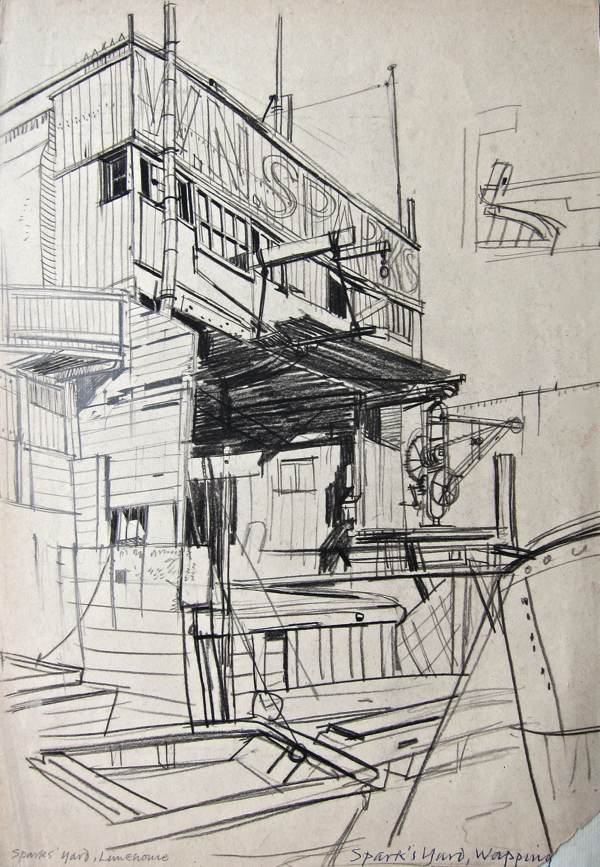
Spark’s Yard, Wapping
Images copyright © Roland Collins
You may also like to take a look at
Matt Walters, Human Statue

Did you ever walk through the Spitalfields Market and feel the lightest touch upon you, as if the ghost of some long-departed market porter were reaching out across time? Very likely that was Matt Walters, the human statue, who has been standing on a box in the market for the last five years and become the catalyst for the long-running drama that takes place each weekend in the narrow passage between the Creperie and Les Bobrow ‘s Wood ‘N’ Things novelty shop.
As visitors arrive in the Spitalfields Market, walking from the new development into the old building and enjoying the historic ambience, including the bronze figure of a man in flat cap, they are sometimes shaken from their reverie by a tap on the head from the living statue. The innocent hilarity thus engendered has become an attraction in its own right and you will regularly find a small crowd assembled here with cameras at the ready to record the never-ending amusement as a stream of unwitting newcomers are bamboozled in similar fashion.
The mysterious and slightly sinister charisma of the human statue is one of enduring fascination to adults and children alike. Most people are more than willing to enter into the light-hearted complicity required, with the rare of exceptions of little ones that become gripped with abject terror and big ones whose dignity is affronted by such unwarranted mischief. Yet, succumbing to the pull myself – like some latter-day Don Giovanni – I arranged a private assignation with the statue and he favoured me by breaking his customary silence.
“My father a was an Orthopaedic Surgeon and General Practitioner, but I left school after I flunked all my O levels. Then I lasted a couple of months studying catering until the craze of robotic dancing came in, and I found I was good at it and I could make a living out of being a robot.
After about ten years of doing that, I saw my first human statue in Paris and by then I’d had enough of being a robot. It was at Fontainbleu and I couldn’t understand why all the French were staring at this statue in a flowerbed, so I went up to touch it and she grabbed me – scared the living daylights out of me! I literally came back and – although I didn’t know how – I decided I was going to do it. I had a booking as a robot at a night club but I turned up and said, ‘I’m going to be a human statue.’ So I got my make-up on and painted myself up and stood in the foyer for two and a half hours and that was that. It didn’t go too well, as the club owner didn’t notice me and thought I’d gone home. But after two and a half hours my calves were killing me, so I dropped the character and stepped off my plinth, and the whole club freaked out – ‘Bloody hell, it’s alive!’
That was fifteen years ago, so I have been doing this for twenty-eight years now. It’s really hard to stand still, it takes a lot of core strength and you have to breathe quite shallowly. I’m looking around for who to pick and you can always tell who’s comfortable by the way they walk towards you. I lower my heartbeat while I’m standing, my pulse goes down to twenty-eight and I feel very relaxed. It nearly killed me in November though, because I had blood clots in my lungs and the doctor said it might be from standing still such a long time. But I am fully recovered and you know, ‘Worse things happen at sea!’ I hope I’ll be doing it for a few years yet, because no-one can see my age under the make-up. The oldest human statue is in the Ramblas in Barcelona – he is seventy-four and he looks like the perfect statue of a wizened old man.
I love what I do and there is the freedom of choosing your hours. Each day, I start at 11:30am and finish about 7:00pm with a few breaks in between. A policeman said to me, ‘Every time you touch someone, technically you are assaulting them.’ but people understand that it’s harmless. I’m very lucky with the comments I get, people say, ‘I’ve never seen anything as good as that.’ I’m at the top of my tree. I’m not begging, I’m a performer and people choose to put money in the tin or not. You always give your best performance and let people take as many photos as they like, whether they give you something or not.
Before the recession, business was really good. I had thirteen people working for me at one time – training them up, breaking them in and teaching them how to apply their make-up. I’d have four or five corporate events each week and at least one wedding each weekend. In the early days, I did the opening of every new Specsavers, that’s three hundred and sixty shops. And I did all the openings for Hotel du Vin too, for a while we were synonymous. It was a successful business until it all came crashing down around me and now I am a solo street entertainer – doing Spitalfields each Sunday, South Bank on Monday, Kingston on Thursday or Friday, and Wimbledon on a Saturday. It all depends where I’m racing – I used to do ultra-marathons but now I do cycle racing. My other passion is bird watching, I’ve seen the Peregrine Falcons at St Paul’s and at the Barbican. Half my ear is listening to birdsong and the other half is listening to people around me – you get so much more attuned when you are silent.
I dress up as a Chimney Sweep generally, but if it gets hot I paint myself white all over like a Sandstone Figure. I only do that if there’s a shower because otherwise it takes six boxes of baby-wipes to remove the make-up. I have great skin because I’m always exfoliating. I do other colours as well, so if there’s a corporate logo I can spray it on my body with a stencil and match up the colour. I also do a Roman Centurion, Stars & Stripes for 4th July, and Verdigris, and I do a Torch Bearer with a real flaming torch for night-time. I don’t wear gold or silver, I make myself up to look like a real bronze statue. I was Planet Hollywood’s human statue at the Trocadero for eight years. I was there for the Olympics and I’m going back for four or five days a week this summer. They regard it as a kind of subliminal advertising because people get involved with my act and then they go into the restaurant.
Nowadays, there’s all these people down in Covent Garden with masks which I regard as cheating. In my time, there used to be the Doggy Man who sat in a cat basket, Duncan the Silver Gladiator and the Leaning Man, who had his shoes nailed to a board and could lean forty-five degrees. There were four of us lined up, so you had to work hard to earn your money but I enjoyed the competition.
I’ve been in Spitalfields for five years. I came here just after it had been redeveloped and I dropped one of my cards off at the market office, and they rang me up and I have been here ever since. When I started, the owner of the cafe came out and said ‘I love what you do, you can have a free coffee in my cafe anytime.’ The security guards are very protective and the stall holders are very friendly too. You’d think people would suss out what I’m doing by now, but there’s always a mass of new people coming through and I’ve had tourists returning each year to find me. The glass roof keeps the rain off and it’s sheltered here, unlike Covent Garden where I was exposed to the cold and snow. I love Spitalfields, it’s a great place to be a statue.”


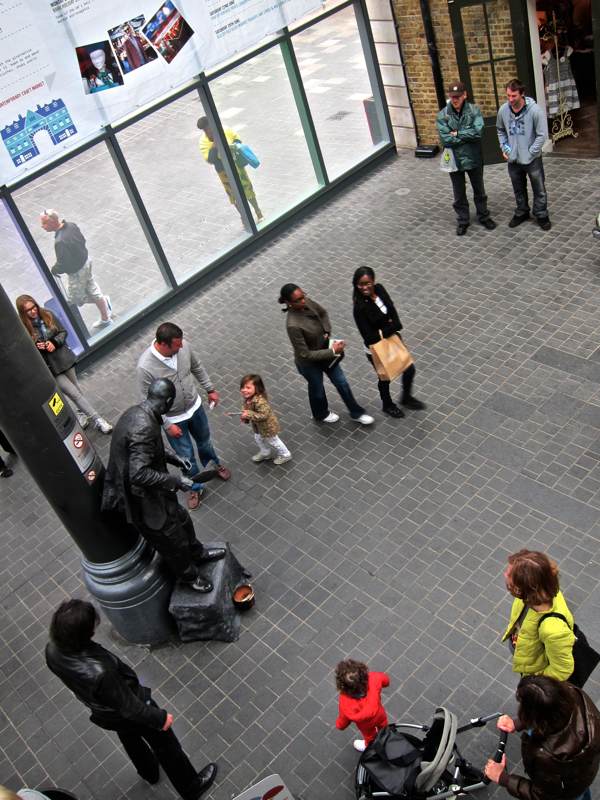


Matt Walters, Human Statue

Don Giovanni and the Statue by Alexandre-Évariste Fragonard, c. 1830-35.
You can book Matt Walters, the Human Statue, through Mechanical Fracture
You may also like to read about
At Charles Dickens’ Childhood Home
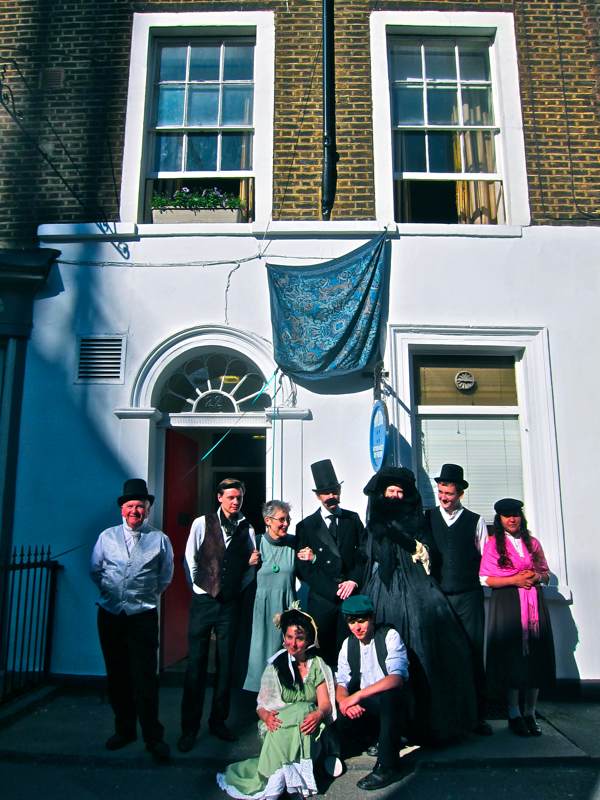
A gathering of Dickensians
Yesterday, I turned away from the throng of Saturday shoppers in Oxford St to seek the quiet streets of Fitzrovia, where around a hundred people met outside 22 Cleveland St for the unveiling of a new plaque upon Charles Dickens’ childhood home. Originally known as 10 Norfolk St, Dickens lodged here with his parents as a child, during 1815 and 1816, before his father’s imprisonment for debt, returning in adolescence, from 1828 until 1831, as he began to make his own way in the world.
Until recently, it was widely understood that the only one of Dickens’ places of residence to have survived in London was in Doughty St, Bloomsbury, but Ruth Richardson uncovered the existence of his childhood home in Fitzrovia while she was researching the history of the Cleveland St Workhouse, as part of a campaign to save it from demolition. This discovery led her to compare the distinctive regime and circumstances at the Cleveland St Workhouse with that described in ‘Oliver Twist’ and she realised that Dickens had used this workhouse just a few doors from his childhood home as the template for the one in his novel. Richardson tells the compelling story of her detective work in Dickens & the Workhouse and the success of her research led to a Grade II listing for the building, thereby ensuring its survival.
A key discovery for Richardson was the calling card that Dickens produced to gain employment as a shorthand writer while resident here. When she contacted the owner of the only-known copy of the card, Dan Calinescu of the Toronto branch of the Dickens Fellowship, he asked her why there was no plaque upon the building and, when she told him that there was no money for a plaque, he offered to pay for it. Thus I found myself shaking hands with Mr Calinescu yesterday, amidst a diverse crowd of fans – many in historic garb – that gathered to celebrate Dickens and consider the influence of this immediate environment upon the nascent writer.
Living in lodgings here above a grocer’s shop, young Dickens learned to read and write, and suffered the domestic insecurity brought about by his father’s gambling. Returning after his father’s imprisonment, Dickens learnt shorthand here and sought to establish his independence, applying for a reader’s ticket at the British Museum from this address. For the five years that he lived in this street, Dickens could not ignore the presence of the workhouse upon his doorstep – as the fate that he struggled to avoid – and the impression it made upon him inspired one of his greatest novels.
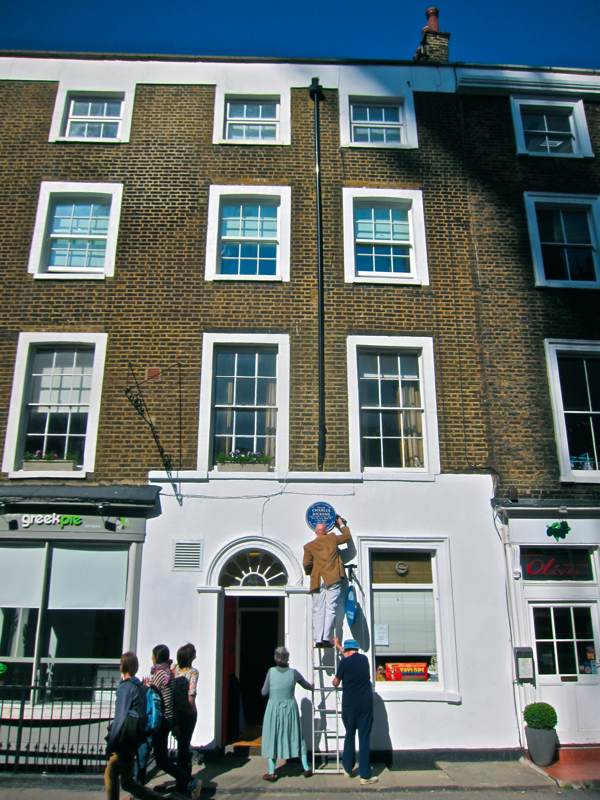
Preparing for the unveiling.
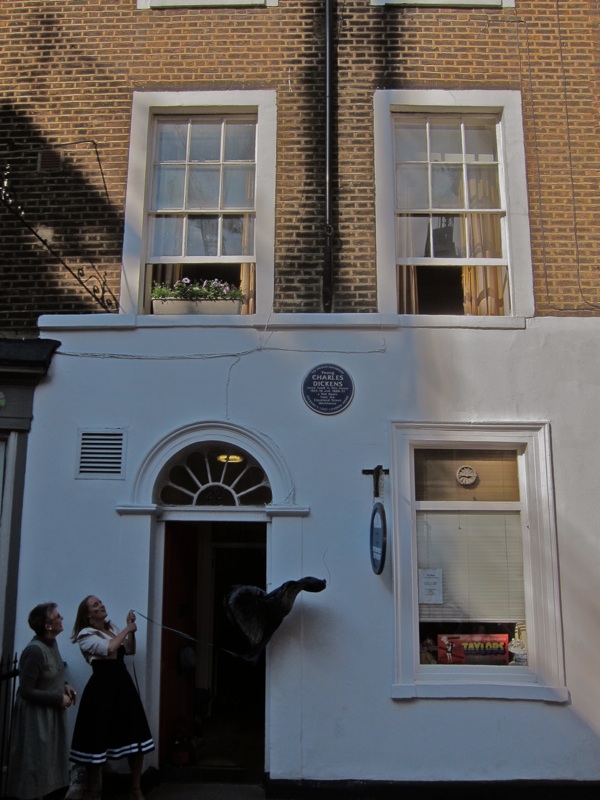
Lucinda Dickens Hawksley, Dickens’ great-great granddaughter, pulls away the cloth..
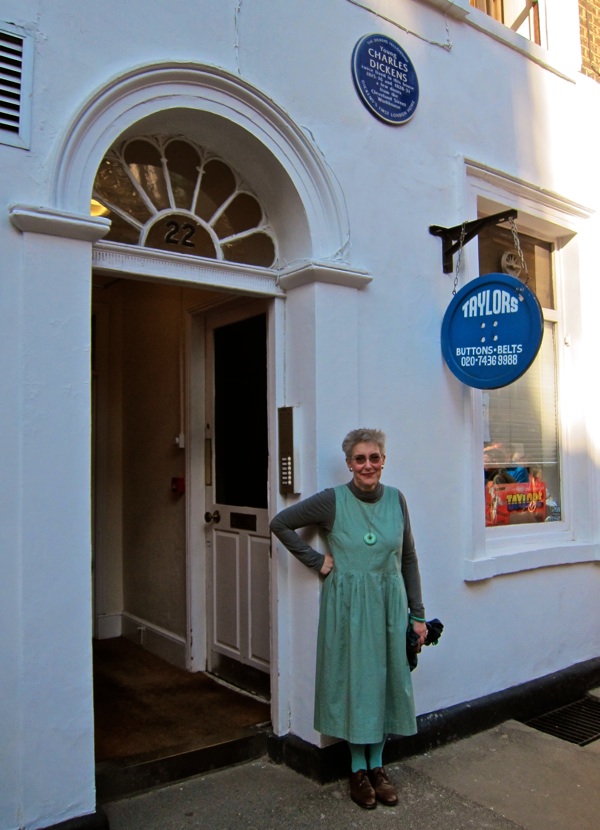
Ruth Richardson
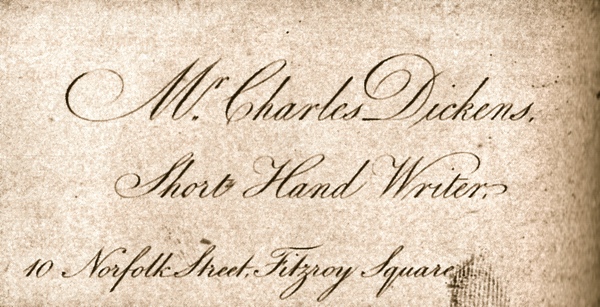
Dickens’ calling card while resident in Fitzrovia. (reproduced courtesy of Dan Cilanescu)
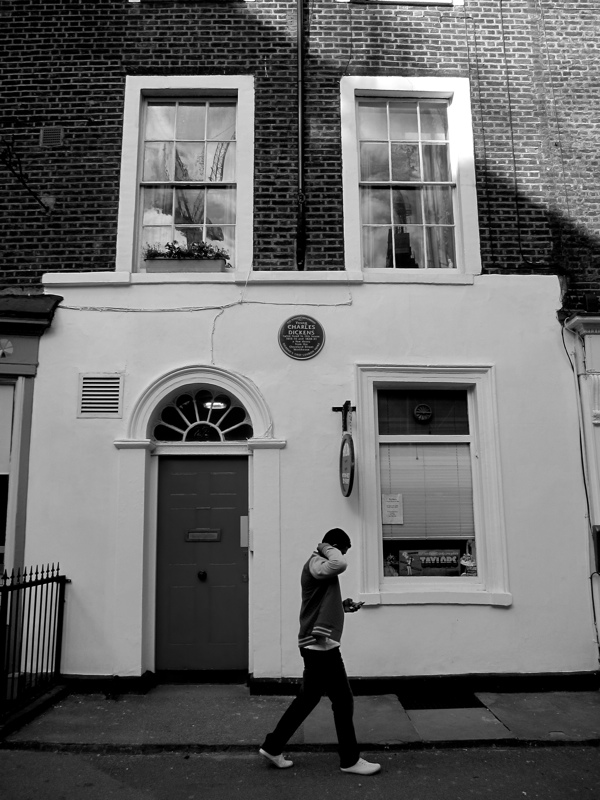
The door where Charles Dickens once walked in.
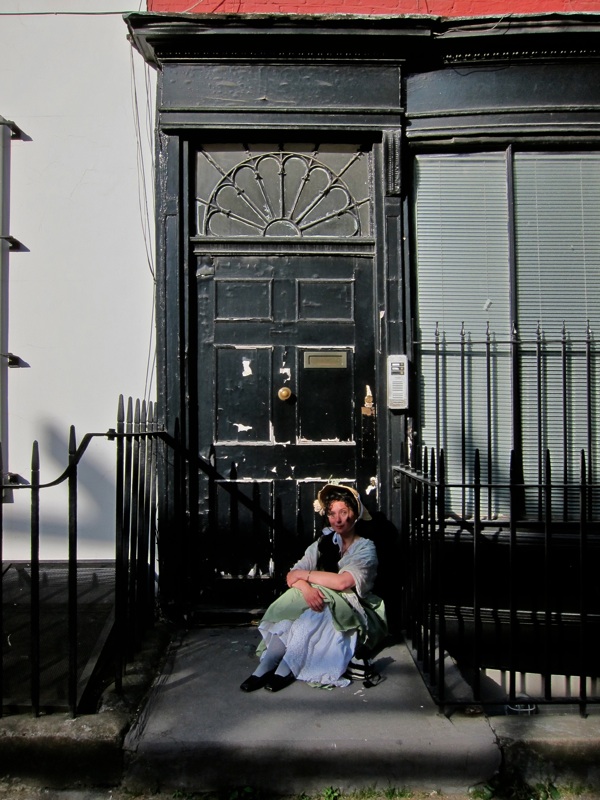
Jennifer Emerson as Dolly Varden.
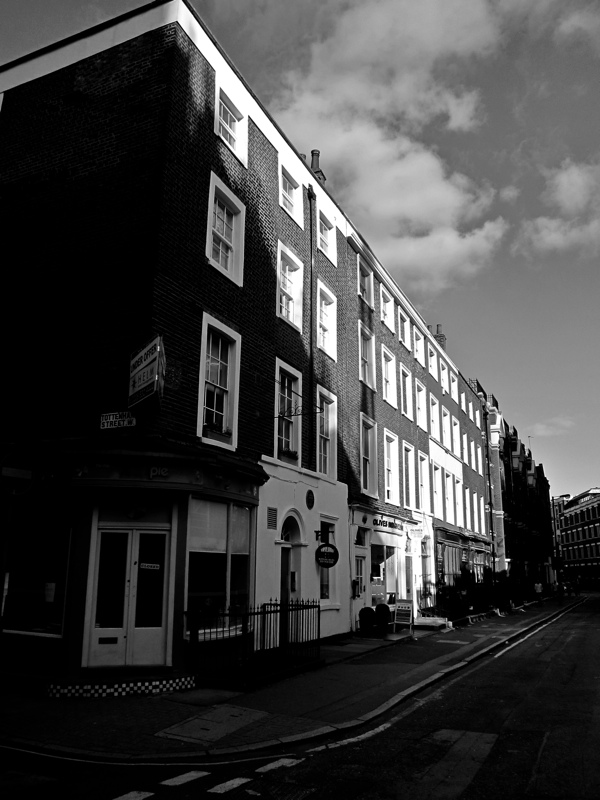
Cleveland St, with Dickens’ childhood home at number 22 – originally 10 Norfolk St.
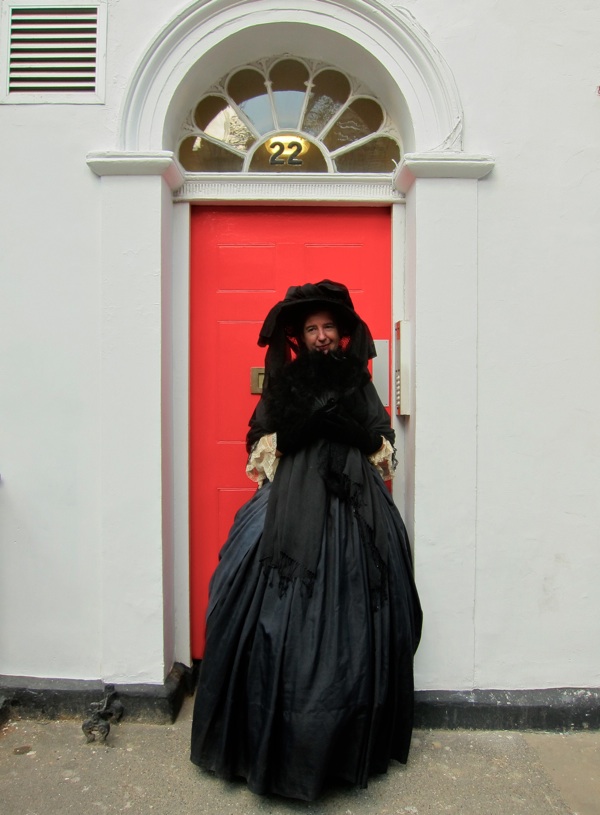
Jane Wildgoose as Lady Dedlock
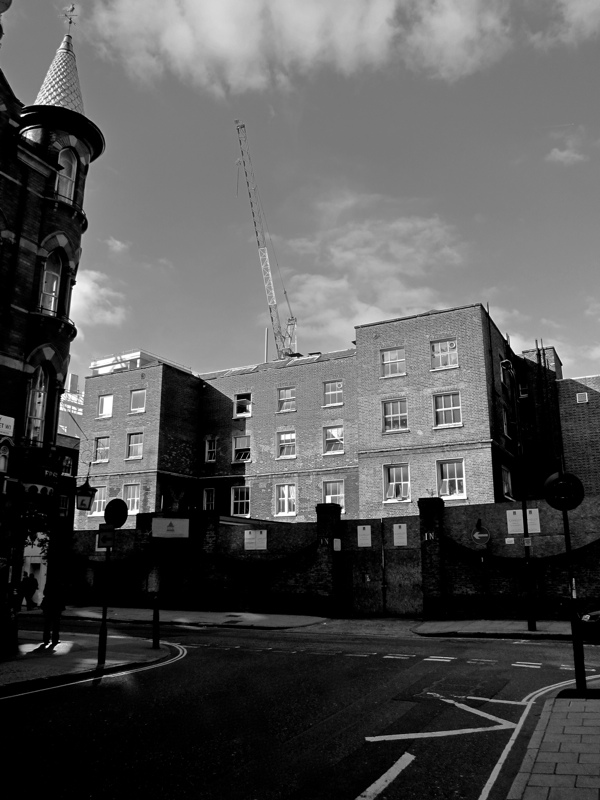
The Cleveland St Workhouse that served as the inspiration for the workhouse in Oliver Twist.
[youtube GT9V5ppkHUs nolink]
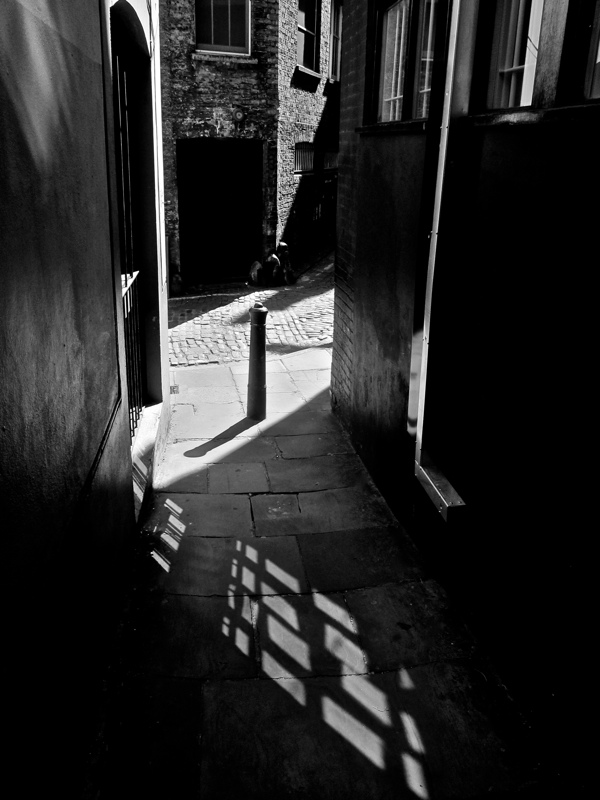
In Fitzrovia
You may also like to read about
Charles Dickens at Park Cottage
Charles Dickens in Limehouse & Shadwell
Roland Collins’ Photographs
For a spell in the sixties, while Roland Collins was working as a commercial artist for the Scientific Publicity Agency in Fleet St, he had access to a darkroom which enabled him to develop his own photography, and he produced striking and imaginative photoessays – exploring different aspects of London life. Today, it is my pleasure to show this selection of Roland’s evocative images of the East End and the City, published for the first time since their original appearance. And next week, I am looking forward to introducing you to his paintings of the territory.

Fairground on the Hackney Marshes.


Salvation Army prayer meeting in the Lea Bridge Rd.

In Petticoat Lane.

In the East India Dock Rd.

Porters at Billingsgate.

Spirits are high as a porter is hoist onto his own shellfish barrow by his sixteen stone son.

A porter makes a bit extra on the side, street trading in boots and shoes.

The Monument.

View from the top of the Monument.

Looking down Eastcheap from the Monument.

Fish shop by the Monument.

Visitors at the top of the Monument.

The shadow of the Monument cast upon King William St.

Relief upon the Danish Embassy at Wellclose Sq at the time of demolition – now removed to Belgravia.

In Albury Rd, Rotherhithe.
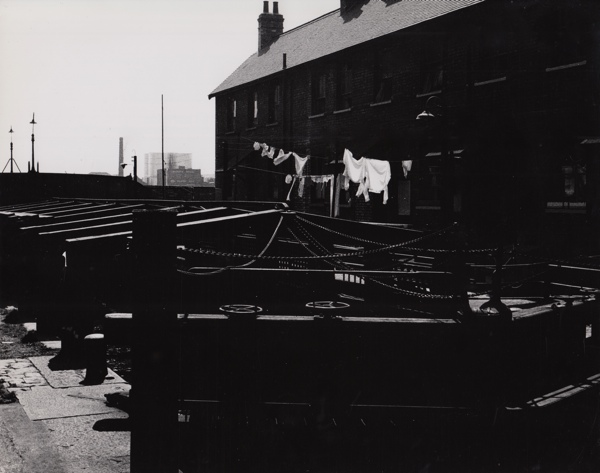
At Limehouse Basin.
Photographs copyright © Roland Collins
You may also like to take a look at
Dennis Anthony’s Petticoat Lane
In Old Soho With Leslie Hardcastle
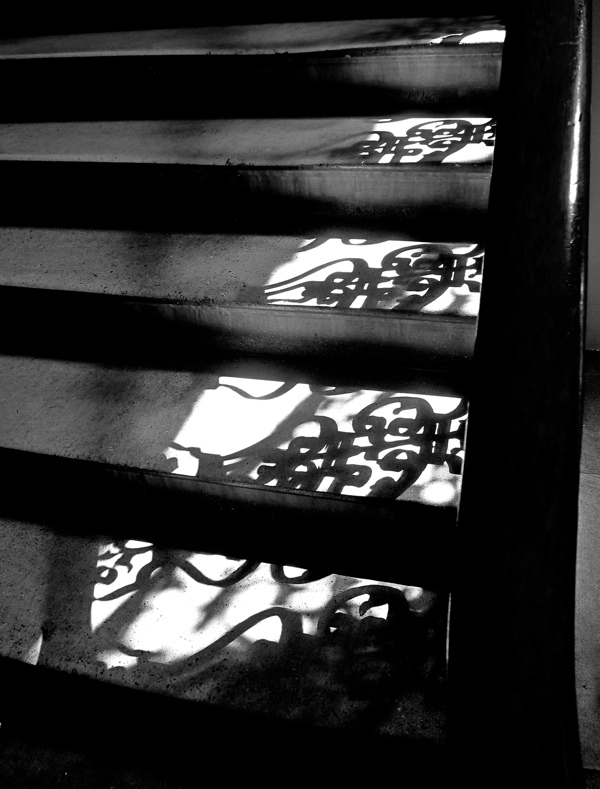
At the House of St Barnabas-in-Soho
There are some people who have the ability to transform a place that is familiar, by showing it to you through their eyes and revealing it anew. One such person is Soho resident Leslie Hardcastle. “There’s the Soho you see when you go out for the night and there’s the quiet Soho of people living their daily lives,” he informed me, by way of introduction to our afternoon stroll around the territory.
A man of redoubtable character, Leslie had already cooked eleven stews and seventeen shepherd’s pies that day, in order that he and his wife Wendy might have them in reserve, set against the expediency of all the social and professional demands upon their time, living at the heart of such a lively milieu as that to be found in Soho.
“Under the table, we’ve got Dorothy L. Sayers,” he announced to me as we sat in the tower of St Anne’s Soho, where the renowned crime writer was once church warden and her ashes are now interred beneath the floor. This is the headquarters of the Soho Society, an organisation which has unified the diverse communities and fought for more than thirty years to preserve the identity of Soho by saving the old buildings, keeping the craftsmen and small businesses and the independent shops, and by creating the Soho Housing Association to provide homes to local residents. “There were all these people who had lived here for years and didn’t know each other, but had the same problems, and they were brought together by fighting against those who wanted to pull the place down and put up an office block.” Leslie explained, “Thelma Seears booked a room in Kettners Restaurant for thirty and one hundred and fifty people turned up, and the Soho Society was born.”
We climbed the ladder to the view the clock by Gillett & Co of 1884. Leslie discovered the pieces of it among twenty-five years of pigeon debris when the church permitted the Soho Society use of the space. Amazingly, all the bits were found except one and Leslie delighted to tell me that, when he rang up Gillett & Co, they still had it in stock.“We’ve got 40,000 clocks around the world and someone’s got to take care of them,” they told him. Here we also found the names of W.Collinson, Gravemaker, 1833 and I.Fox, 1822 incised upon the panelling. Mr Fox gained notoriety as the priest who burnt the coffins and dumped the bodies in a corner. Turning our minds from this macabre thought, we peered out to the grass below were people thronged, enjoying the sunshine. As we left the precint, Leslie told me that the reason you step up two metres to the churchyard was on account of the forty thousand bodies piled there.
As we walked out into the street, he pointed out the site of the former eighteenth century Watch House, now superceded by CCTV cameras at street corners, observed from a central control room at the Trocadero. “We’ve got fifty-three pubs in Soho,” he boasted as he put his best foot forward up the pavement. It was the first of many of the blessings of Soho life that I was to learn from Leslie that afternoon.“Mozart gave a concert in this street,” he added, for good measure, as we turned a corner.
“My uncle had a toy shop in Newport Place,” Leslie admitted, stopping to catch his breath and revealing how Soho first became irresistible to him as a boy, “He was an actor who appeared in almost every film of his era, for five minutes. As a child, I loved to come up from Croydon and give him a hand with his stock-taking, anybody who was anybody in British Cinema came to visit him in his shop.”
“My mother and father were on the stage and split up.” Leslie continued, “My mother was in ‘No, No, Nanette’ at the Royal Theatre Hull and it got bombed, so I left alone in the black-out, and crossed the country and came back to London.” Leslie’s first job was in Soho in 1943 at British Lion Films and he has lived in Soho since 1960.
As we turned into Soho Sq, now ravaged by trenches for the construction of Crossrail, Leslie delighted to evoke its former incarnation as King’s Sq, lined by the mansions of aristocrats and by embassies, scenes of social entertainments upon a extravagant scale where Casanova was once a guest. “Sixty-seven Members of Parliament have lived in Soho,” Leslie told me as we crossed the lawn.
By now, we were at St Barnabas-in-Soho, a magnificent eighteenth century dwelling built for the wealthy plantation-owning Beckford family, and still retaining its fancy plasterwork and panelling of 1754. As Soho became less fashionable in the nineteenth century, this became the Offices of the Metropolitan Board of Works where Joseph Bazalguette planned the London sewer system. Dickens was a frequent visitor and may have based the house of Dr Manette in ‘A Tale of Two Cities’ upon the House of St Barnabas. As the area declined further, the building became a shelter for homeless families with as many as five hundred people in residence. One can only wonder what they made of the affluent architecture of former days.
“I was married here in 1947,” confided Leslie, as we drifted through the empty rooms and entered the hidden garden, seeking the cool of the nineteenth century chapel, “I was walking past one day and came in to ask, but we had to get permission from the Bishop of London because it is not consecrated. Fortunately – as we didn’t have much money – it is quite small, so we all went next door to an Italian cafe for our wedding breakfast.”
We crossed through Meard St towards Berwick St Market and along Peter St where a famous old brothel had gone.“They took the building down and you could just see the stairs,” Leslie recalled,“I wondered how many men had walked up and down that staircase.” Indicating another piece of new construction, Al Jolson had a Kosher Deli there,” he said.
By now, we were in need of refreshment and I followed Leslie up a creaky stair to a tiny dining club with harsh acoustics where, in the mid-afternoon, literary gents with red faces and white hair, sporting bow ties and tight collars, were chattering like magpies and roaring like hyenas at each other’s jokes while quaffing red wine. “This room was last decorated in 1840,” said Leslie in disappointment as I grew accustomed to the din. Making hasty retreat, we confronted the site of the former police station in Broadwick St, recently demolished. “We were the only village with two hundred and fifty policemen sleeping over every night,” Leslie commented, turning melancholy now at the site of destruction upon such a scale.
Our destination was the Georgian terrace in Great Pulteney St where Leslie has lived since 1963. “Hadyn composed his symphonies and Polidori wrote ‘The Vampire’ here,” he said, as he searched for his key. “In 1970 , it was sold to a property developer who wanted to demolish it but we wouldn’t leave,” he explained as we climbed the crooked staircase, “We got the lawyer who defended Nelson Mandela and we won. From that the Housing Association was formed and this building is now twelve flats with new homes built at the back.”
Hours had passed as we tramped the dusty streets and I had learnt more about Soho than I could cram into my notebook or this article. “I sometimes wonder why I go on beefing about Soho?” Leslie mused, thinking out loud, but he had already answered the question with his own passionate monologue that had filled the afternoon so pleasantly.
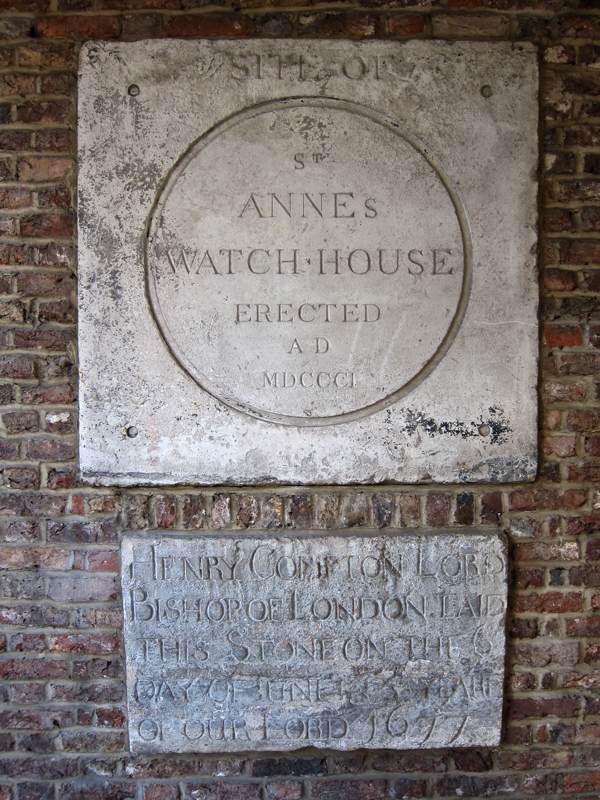
Old Compton St is named after Henry Compton.
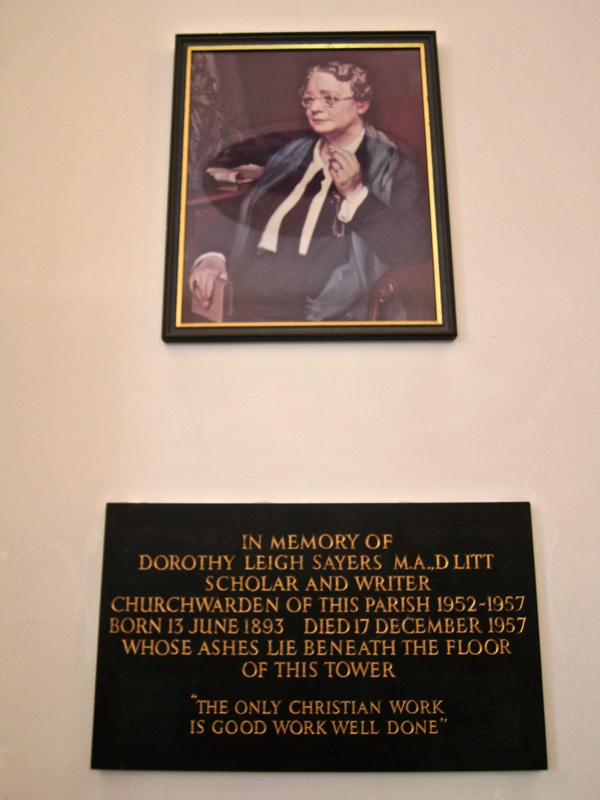
In the tower room of St Anne’s, Soho.
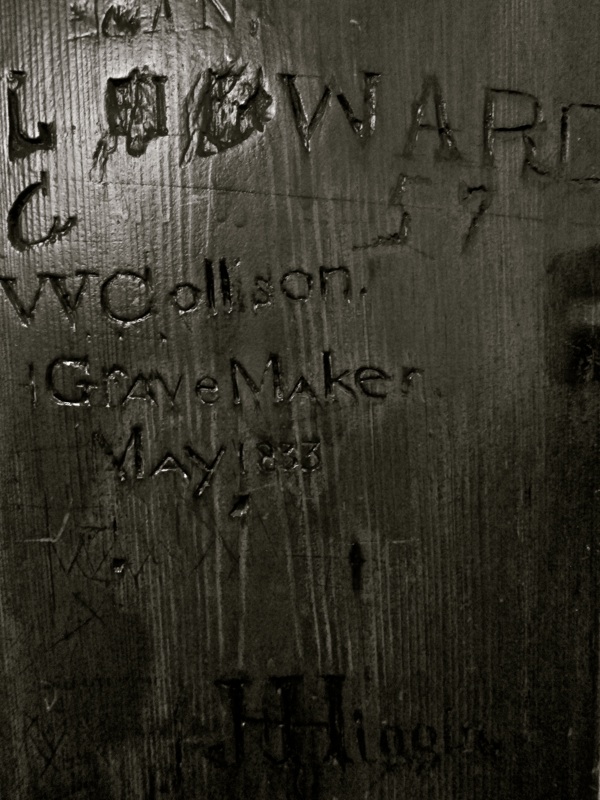
In the clock room of St Anne’s, Soho.
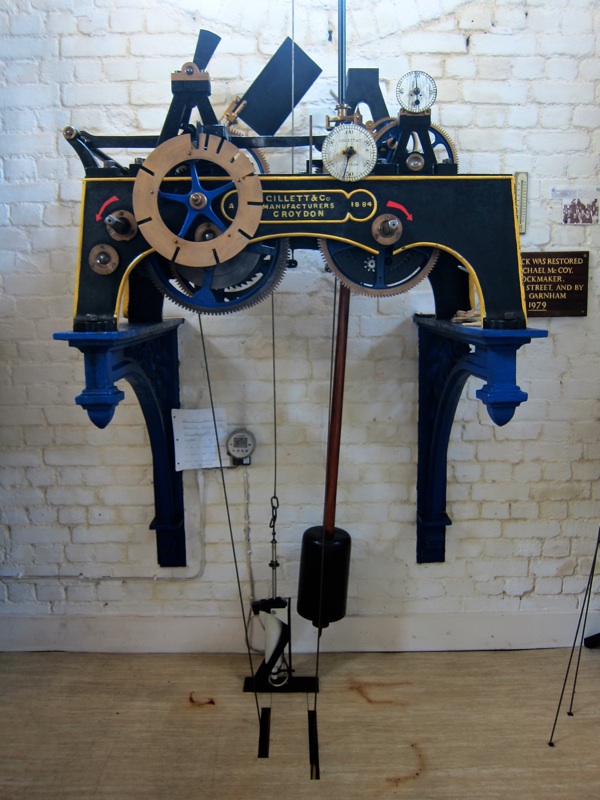
“We’ve got 40,000 clocks around the world and someone’s got to take care of them,” said W.Gillett & Co when Leslie rang to get a replacement part for this clock from 1884.
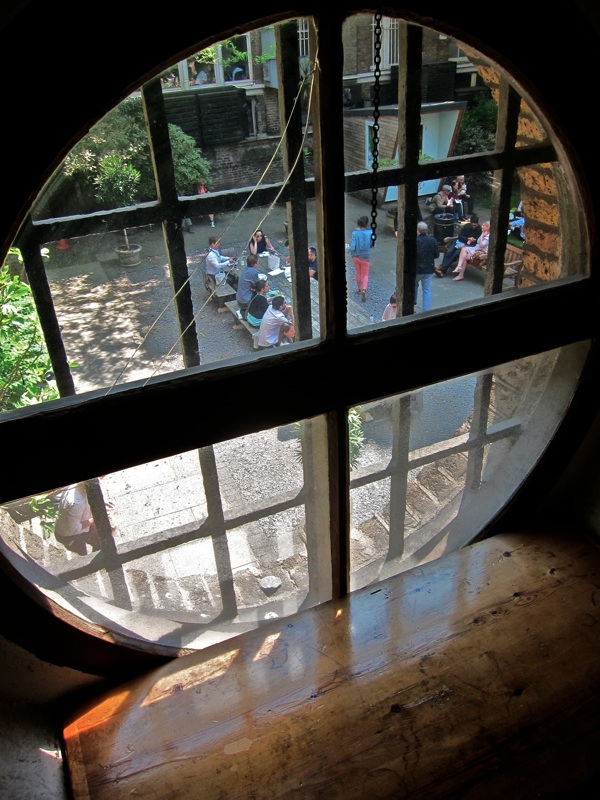
Looking down upon the churchyard.
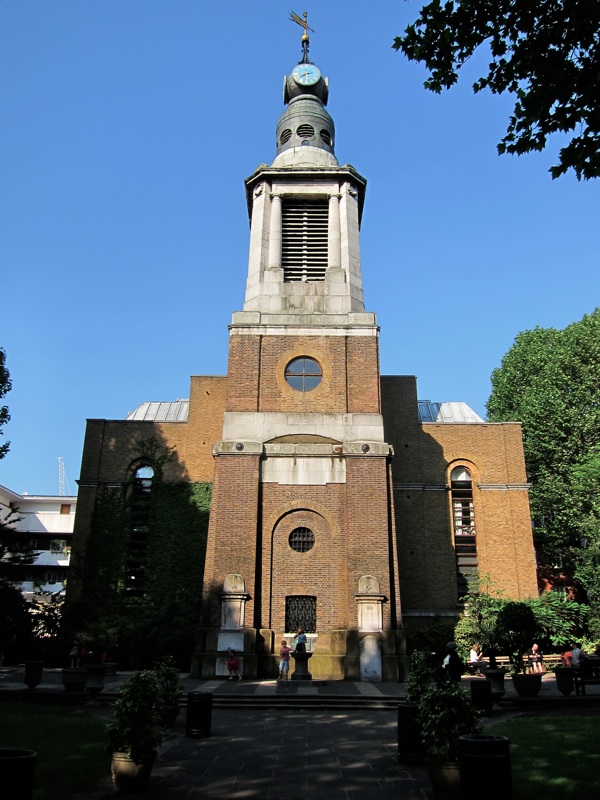
St Anne’s, Soho.
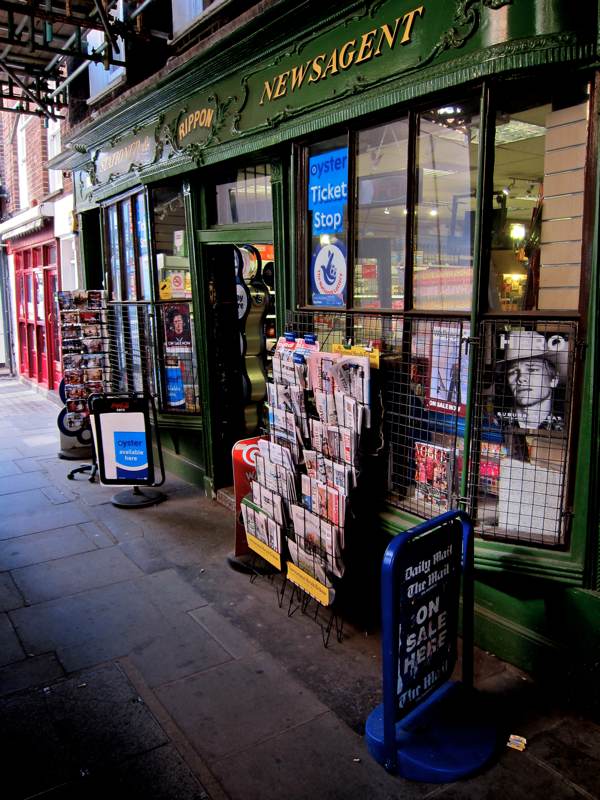
Eighteenth century shopfront in Dean St.
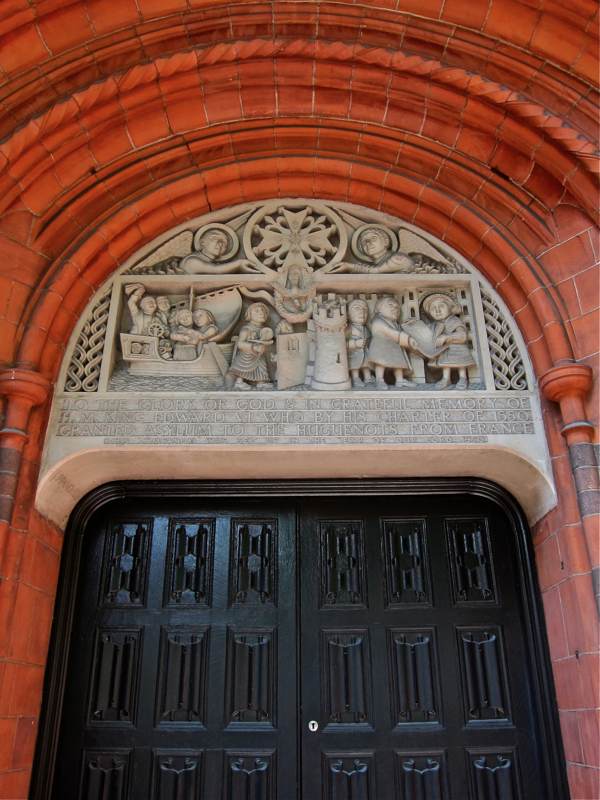
Sculpture telling the story of the Huguenots at the protestant church in Soho Sq.
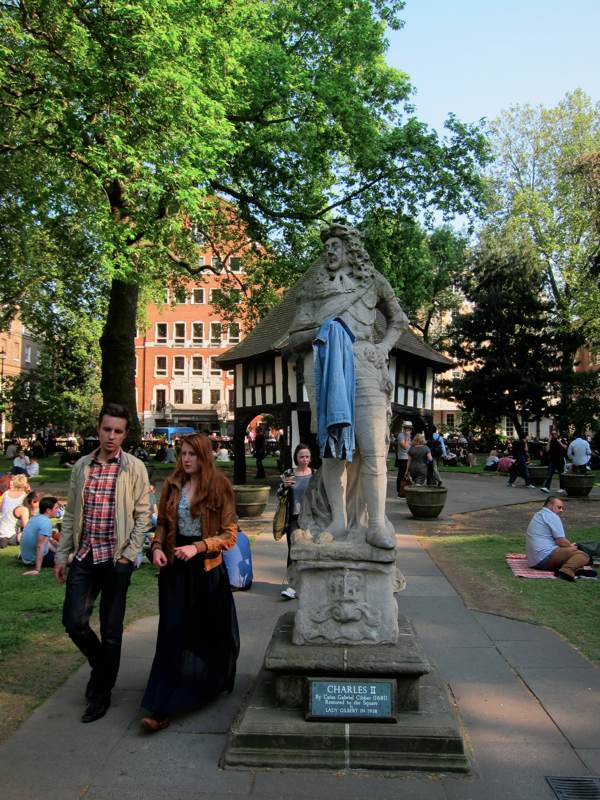
“Excuse me! Is this your coat?” – Charles II sculpted by Caius Cibber in Soho Sq, 1681.
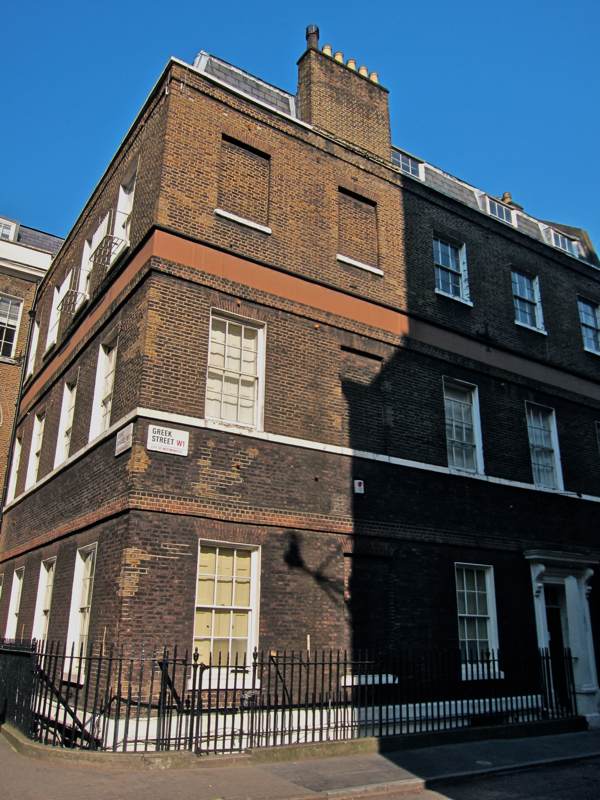
House of St Barnabas-in-Soho where Bazalguette planned London’s drains.
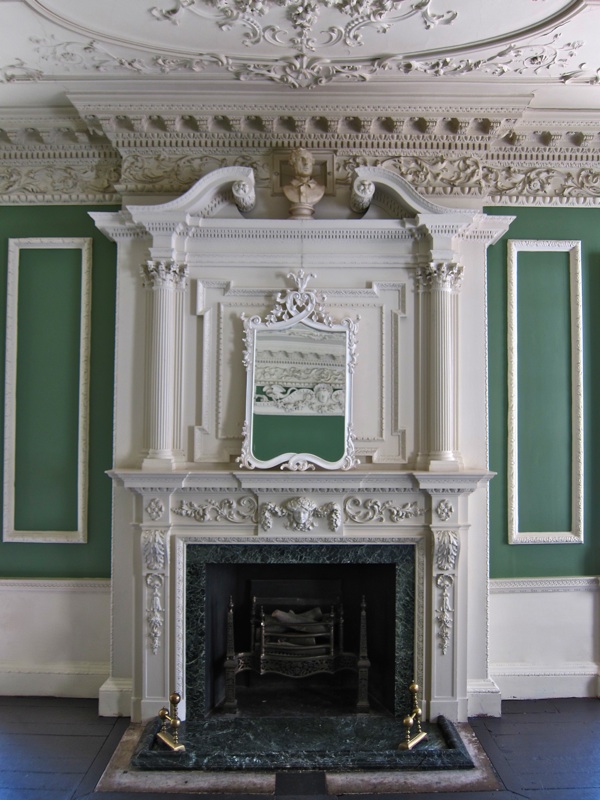
Bust of Henry Munro from the Bethlem Hospital in Spitalfields who founded the House of Charity.
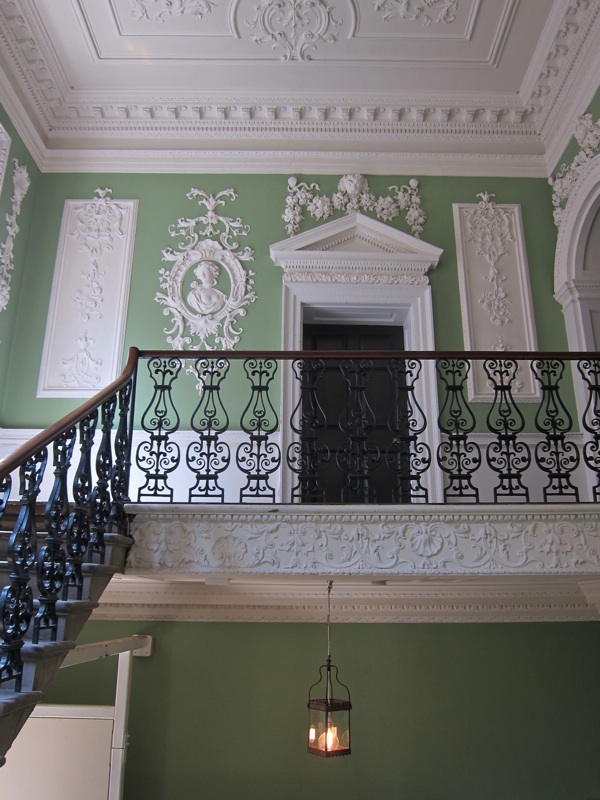
Plasterwork from 1754 and metal prop to guard against the effects of Crossrail excavations.
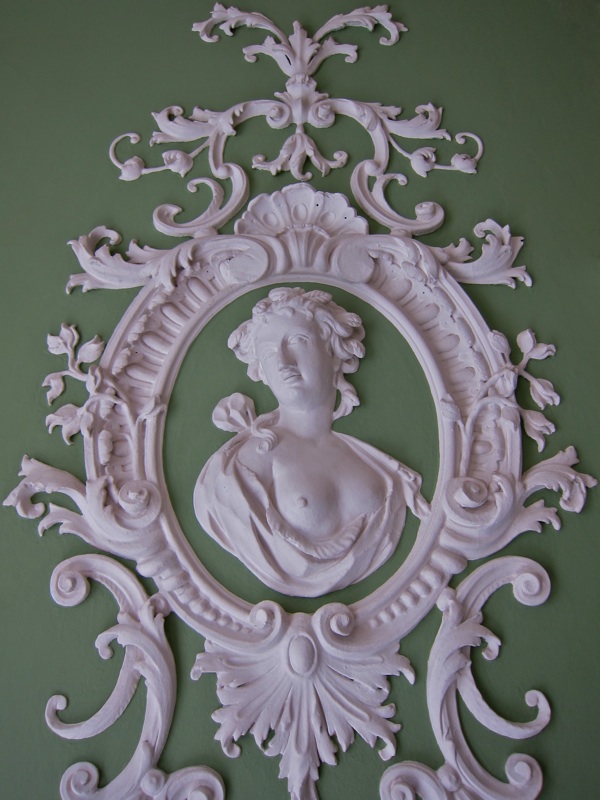
“Soho has always been a naughty place.”
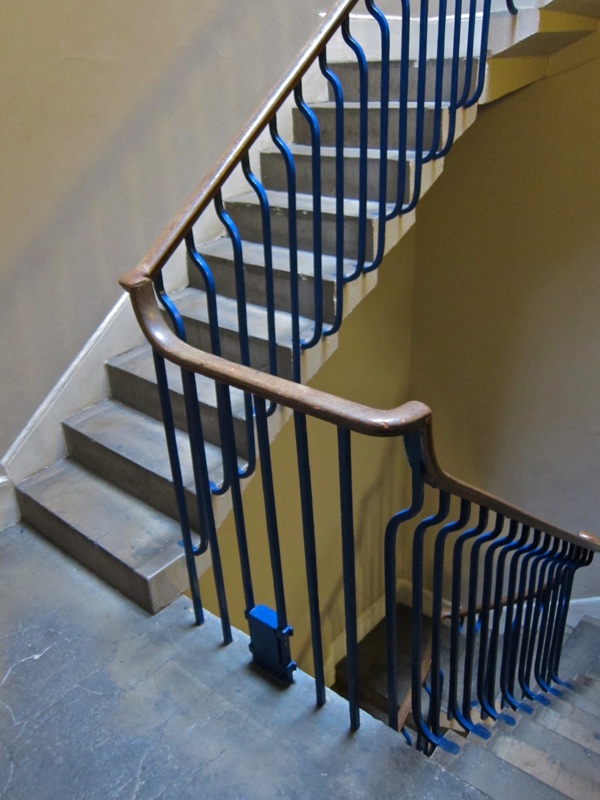
Back stairs at the House of St Barnabas with bannisters designed to accommodate crinolines.
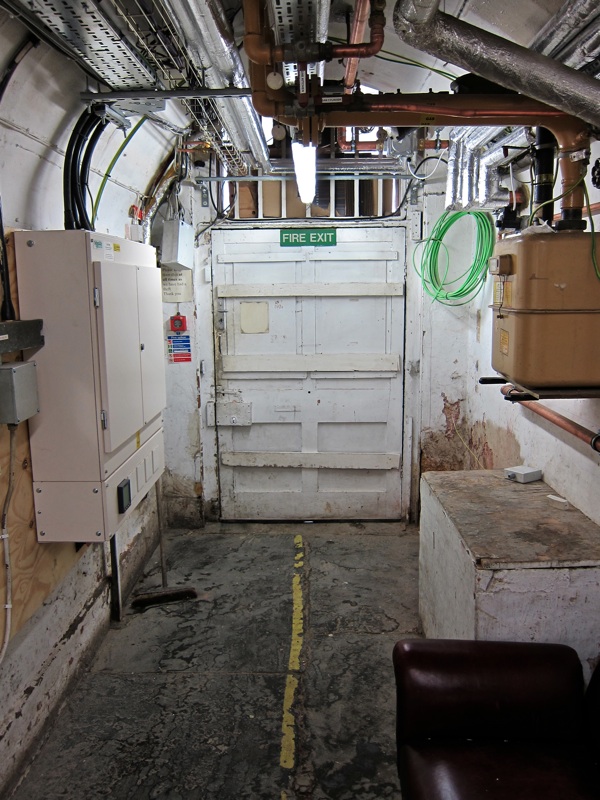
The original front door of the House of St Barnabas on the original ground floor of 1720, which became the basement once the ground level of Soho was raised two metres by 1740.
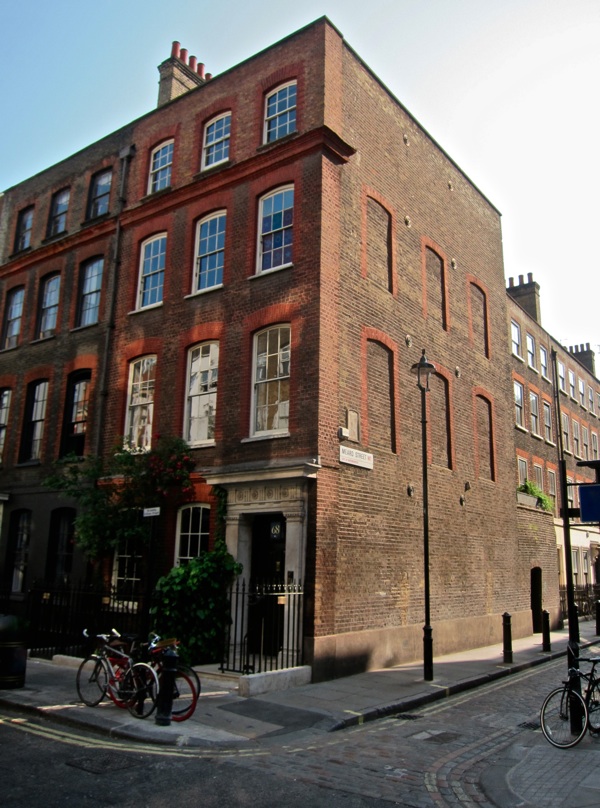
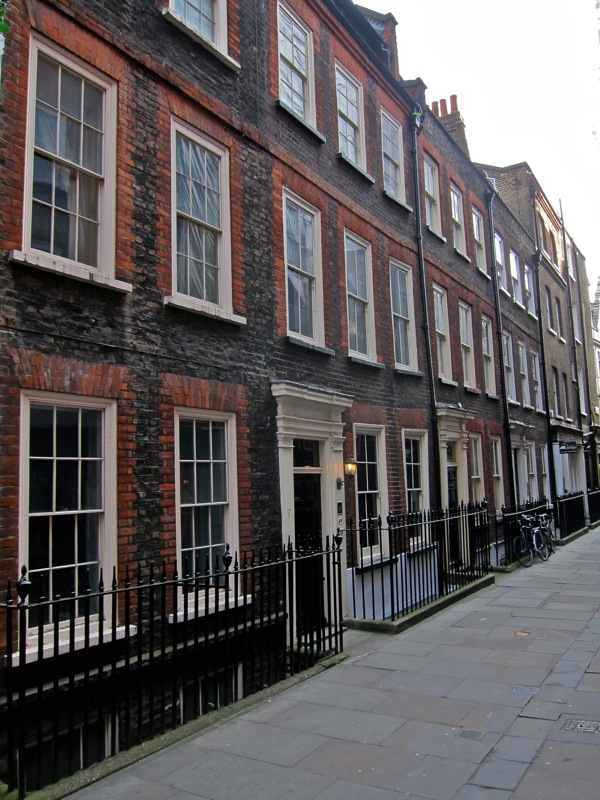
Eighteenth century house on the corner of Meard St and Dean St.
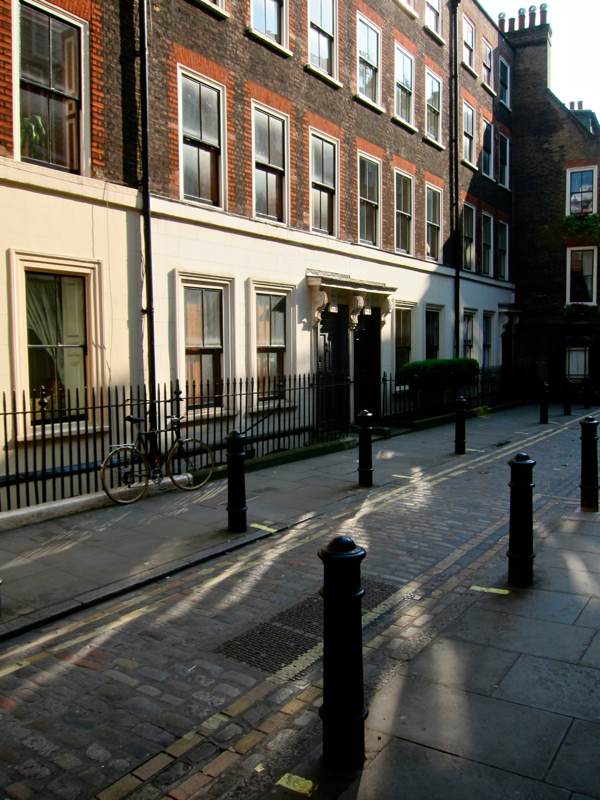
The landowners disagreed upon the alignment of the terraces where their properties met in Meard St.
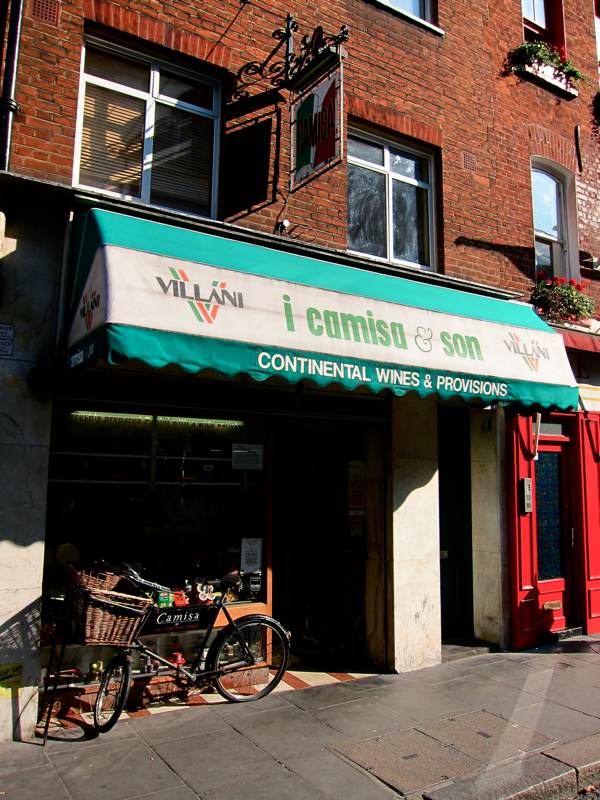
Camisa, a Soho landmark.
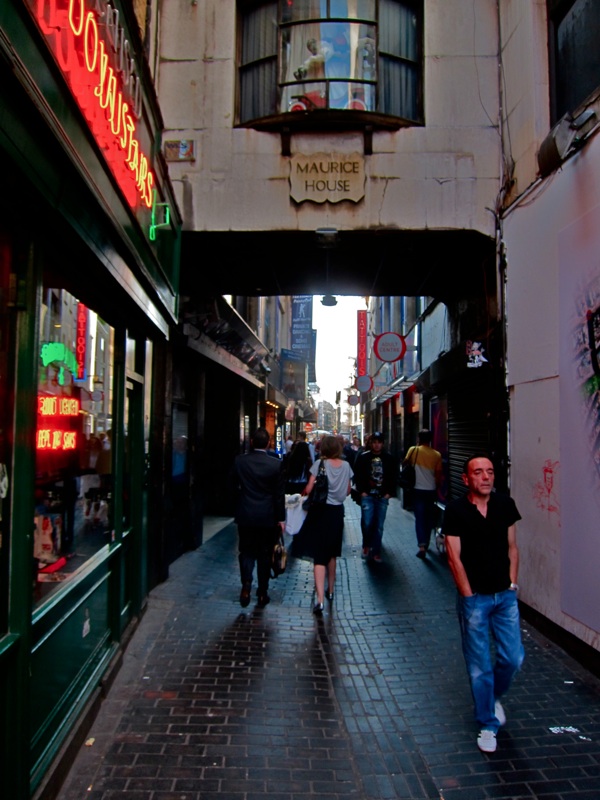
Walker Court where the Soho Society wants a preservation order upon the sex shops before classy boutiques take over.
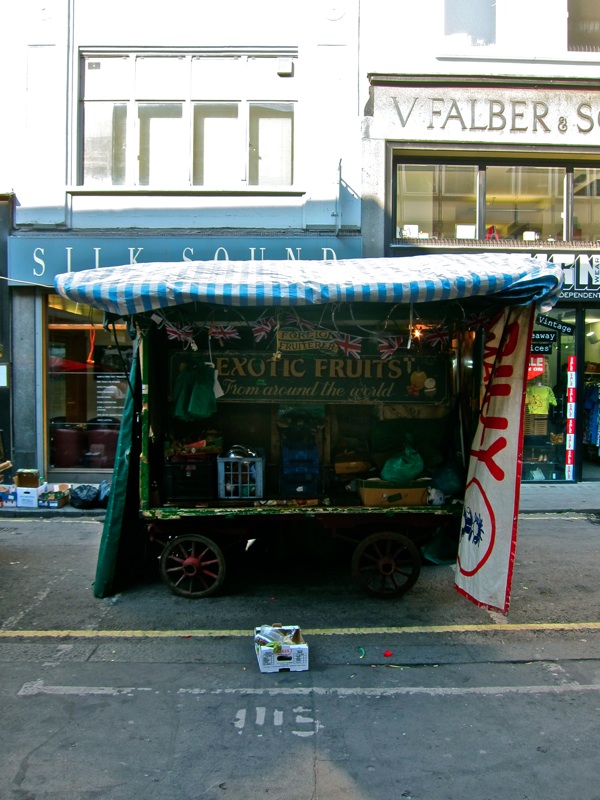
In Berwick St Market.
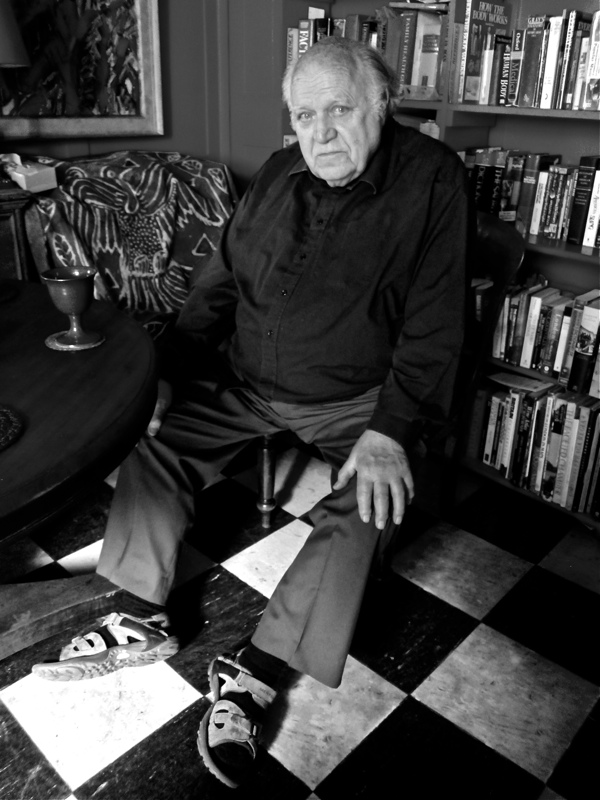
Leslie Hardcastle, long-term Soho resident.
Terry Scales, Painter

Terry Scales
Terry Scales has lived for more than fifty years in a quiet back street in a forgotten corner of Greenwich where the tourists do not stray. To find him, I wandered through narrow thoroughfares between modest old terraces that splayed off at different angles with eccentric geometry, just like lines upon a protractor, to reach the park at zero degrees Longitude.
In the front room, Terry’s wife, Cristiana Angelini, was painting and he ushered me past. “She has the best room, but I have the best light,” He whispered with a sly grin as he led me quickly into his crowded studio overlooking the garden. There, among a proliferation of handsome pictures of boats upon the Thames that are his forte, Terry showed me the first oil painting that he did at art school – an accomplished still life in the manner of Cezanne – and a fine pencil drawing of him in his teens by Susan Einzeg. A portrait that is recognisable seventy years later on account of Terry’s distinctively crooked aquiline nose and feverish youthful energy.
I know of no other painter so well placed to paint scenes of the Thames as Terry Scales since, alongside his natural facility with the brush, he is able to draw upon a lifetime’s experience, growing up in a family that made its living upon the river for generations and then working in the Docks himself. “Because of the strikes, people think that dockers were all muscle and brawn, but we had men who left solicitors’ offices to work in Docks. It has to do with the independent lifestyle, you were never working for just one company, you were working all over the shop.” Terry assured me, eager to dispel the notion of dockers as an unsophisticated workforce, “Among that vast body of men, there were many very talented people.”
“They discovered I was a professionally trained artist and asked me to draw portraits,” he revealed, showing me his work for the National Dock Labour Board magazine in the fifties, “but my senior colleagues were very suspicious and conservative. I grew a beard after two years in the Docks and they were all scandalised!”
Terry’s work is the outcome of an intimate relationship with his subject, both the working life of the river and its shifting climate. “Most of the subjects of my paintings have gone now,” he confessed, casting his eyes fondly around the gallery of maritime scenes that surrounded us, evoking the vanished world of the Docks with such vibrant presence. I was fascinated to learn how Terry had combined his employment as a docker with his artistic endeavour – so that each fed the other – and he obliged by telling me the whole story.
“I was born in 1932 in St Olave’s, Rotherhithe, and my family lived in that area for as long as anyone knew. My mother’s people came over from Ireland in the eighteen-fifties after the potato famine, and they were called O’Driscoll which they changed to Driscoll. On both sides, my family worked in the Docks, and my father was a ganger in the Albert Docks and a lighterman. A hundred years ago, they were very adventurous, with my grandfather travelling to Australia and America, taking ships here and there, and picking up work. On my father’s side, they were all dockers in Bermondsey working on the grain wharfs near Cherry Gardens Pier – the lightermen’s stopping point where they changed barges.
I was evacuated to Seaton in the West Country which opened my eyes to the splendour of landscape and I returned after the war with a broad Devon accent to live in one of the prefab villages in Bermondsey. After a good schooling in Devon, I was sent to school in Rotherhithe which was appalling – there was a complete lack of discipline and I learnt absolutely nothing. The Labour government brought in a scheme where pupils that were talented but not academic could go to a college and learn a craft. So, at the age of thirteen, I applied to Camberwell School of Art and was accepted. And when I arrived there it was like heaven, because we had the best painters in England teaching us and, being thirteen I took it very seriously indeed – there was Victor Pasmore, Keith Vaughan, John Minton, William Coldstream and members of the Euston Rd Group.
I think the teachers must have appreciated that I was such a serious student because, by the age of sixteen, I had sold paintings to all the staff and William Coldstream bought a canal scene of mine. So I was doing very well as a student artist. Keith Vaughan, John Minton and Susan Einzig, they were the Neo-Romantic group and they took me under their wing. But the members of the Euston Rd Group taught me to draw because they were keen on observation, so I owe my drawing ability to them. There was an ideological war going on between their subdued English Realism and the Neo-Romantics who were influenced by Picasso and Matisse.
I was the youngest in my year and, when we graduated in 1952, I had to do National Service so I applied to the RAF. A Jazz musician called Monty Sunshine told me I should be a telephonist because it was the cushiest job. So I applied to do signals in the Far East, but they sent me to work at East India Docks and I was able to live at home. By the time I was demobbed all my friends were teaching, but I didn’t fancy that, as I was only twenty-one, so I took a job at a publicity studio in Fleet St that did posters for Hollywood films and I became a background artist. Once, I painted a brooding sky with lightning as the background to the poster for ‘The Night My Number Came Up’ but after they had put a great big aeroplane on it, and the stars’ faces, and the title, you could hardly see any of my work! I was paid a very low wage, the painters who did the stars’ faces got the top money with the lettering artists below them, so I realised it would be a long time before I earned any money.
I was ambitious, so my father said to me, ‘This is peanuts – why don’t you come and work in the Docks? You could build up your bank balance.’ In 1955, I took a docker’s brief at number one sector, Surrey Docks, and over a five year period I worked every wharf from Tower Bridge to Woolwich. In the summer, once the Baltic Sea thawed, I worked on the timber ships. They came with huge cargoes and every strip had to be manhandled into barges. I worked quite hard, earned very good wages and had no accidents.
One day, I finished early after unloading a ship of Belgian chocolates, so I decided to go over to Camberwell and see my old teachers. I dropped in on the Foundation Course and they said, ‘Thank God you’ve turned up because one of the tutors has been taken ill! Can you take the class?’ And afterwards, they said, ‘Can you come back tomorrow?’ Prior to that, I had an exhibition at the South London Gallery and I continued painting while I was working at the Docks. I painted a whole exhibition once during an eight week strike.
I knew the Welfare Officer at the Surrey Docks and I said, ‘I’m going to leave to teach.’ He said, ‘Teaching is a very insecure profession, you shouldn’t give up the Docks.’ But the Docks closed ten years later and I stayed teaching at Camberwell in the Fine Art Department for the next thirty years, until I retired in 1990 to concentrate on my own work.
The appeal of painting the Thames for me is not just because of my personal background, but because the river has space. In London, you are aware of being closed in yet when you see the Thames it has a grandeur, and when the tall ships are there you feel the magnificence of it. You get changes of light and, although I’ve often been prevented from finishing paintings because of surprises, like breaks in the weather or the sudden appearance of smoke, it always adds something. You start to paint a ship on a Monday, it rains on a Tuesday and it’s a different ship there on the Thursday – but if you are a landscape artist seeking qualities of light, ambiguity has to be part of it.”

Terry in his studio, sitting with the first painting he ever did at art school. “A man who paints puts his heart on the wall and in that painting is the man’s life” – John Minton, 1951.

Bert and James, Barges, Prior’s Wharf, 1990

Hungerford Bridge

View from the Festival Hall

Pier at Bankside

Red Tug passing St Paul’s

Shipping off Piper’s Wharf, 1983

Greenwich Peninsula.

The ‘John Mackay,’ Trans-Atlantic Cable Layer, Enderby’s Wharf, 1979

Mike Canty’s Boat Yard, 1988


Terry with his shed that he constructed entirely out of driftwood from the Thames.
Paintings and drawings copyright © Terry Scales
London Lore at Dennis Severs’ House
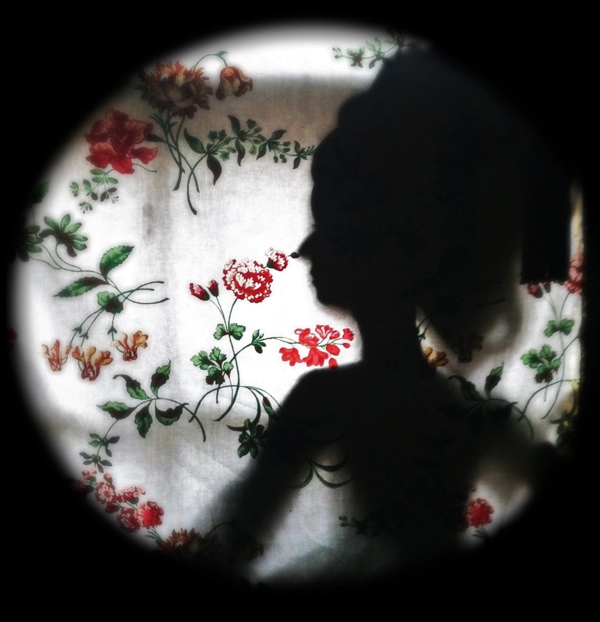
Mysterious forces are at work at the former Empire Pipe Factory in Hoxton where sculptor Richard Sharples is contriving boxes that contain moving figures and even apparitions – conjuring the world of mythology and superstition, and ensnaring it like a genie in a bottle, just so that you may enjoy the opportunity of sticking your nose in and taking a peek. These are the preparations for the London Lore exhibition by the Museum of British Folklore at Dennis Severs House in Folgate St which opens on Friday 14th June.
Once a familiar sight upon the London street, Peep Shows or Raree Boxes manned by itinerant performers were recorded in the capital as early as the fifteenth century. In the days before cinema, those in search of innocent entertainment could pay a penny to peer through the peep hole and be transported by the vision beyond, either of a newsworthy event or a royal occasion, or a celebrated scene from fiction. By pulling strings to move scenery and opening slits in the box to admit light, the shimmering mirage appeared to animate with its own life, while the attendant read a description elucidating the meaning of the spectacle thus revealed.
In a similar vein, the boxes placed in each of the rooms at Dennis Severs’ House will dramatise the customs, characters, rituals and legends of the capital. Mixing history with myth, they include evocations of Spring-Heeled Jack, The Queen’s Remembrancer and Henry Croft, the road-sweeper who founded the Pearly Kings & Queens. You can also expect miniature tableaux of the Fire of London, Doggett’s Coat & Badge Race, the Annual Clowns’ Service in Dalston and the legend of Bleeding Heart Yard. All accompanied by ethereal harmonies created by sound artist Richard J. Lockley-Hobson of the Hauntological Society.
Naturally, the method and the means cannot be revealed here – you must visit Folgate St and take a peek through the lenses into the infinite darkness captured within these boxes to discover for yourself the hallucinations of old London that transmogrify.
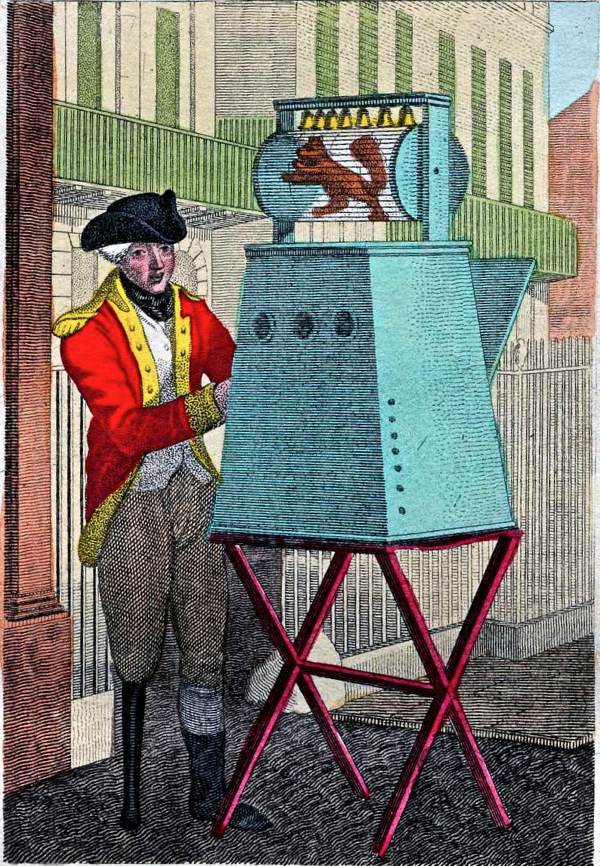
A veteran of the Napoleonic war makes his living at Hyde Park corner as Showman in 1812.
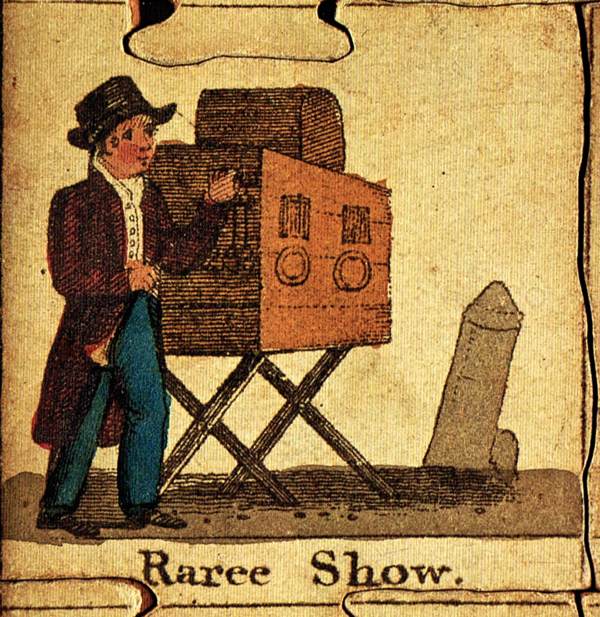
From a jigsaw puzzle of the Cries of London, c.1820
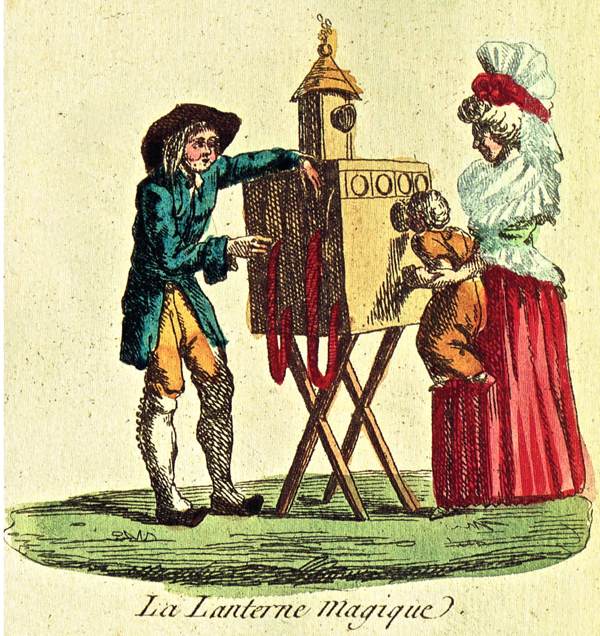
French illustration of a mother lifting up her child to peep show, c.1820
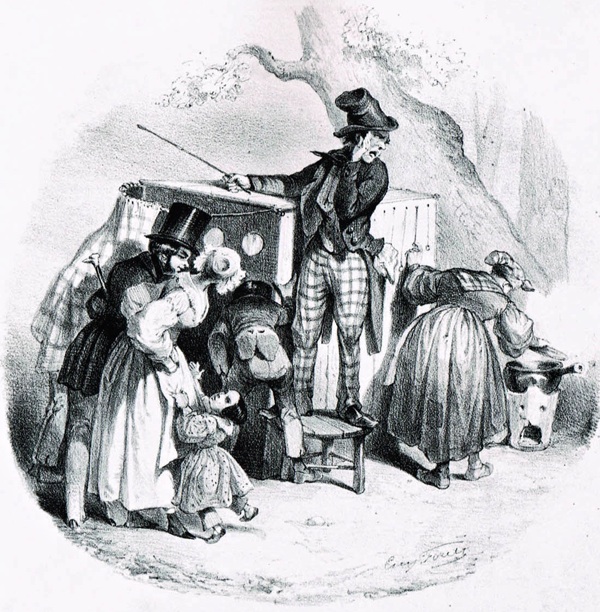 Illustration by Eugène Hippolyte Forest, c.1840
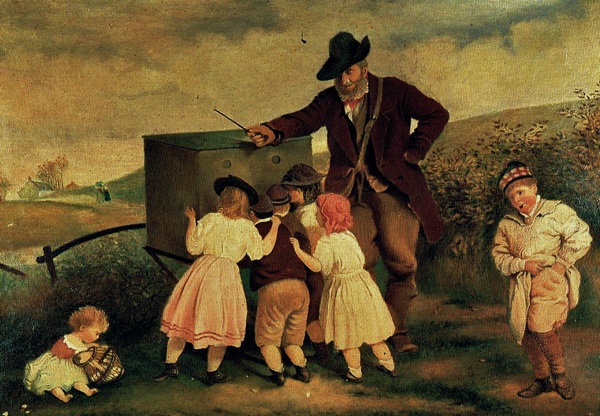
The peep show, anonymous oil painting, c. 1840
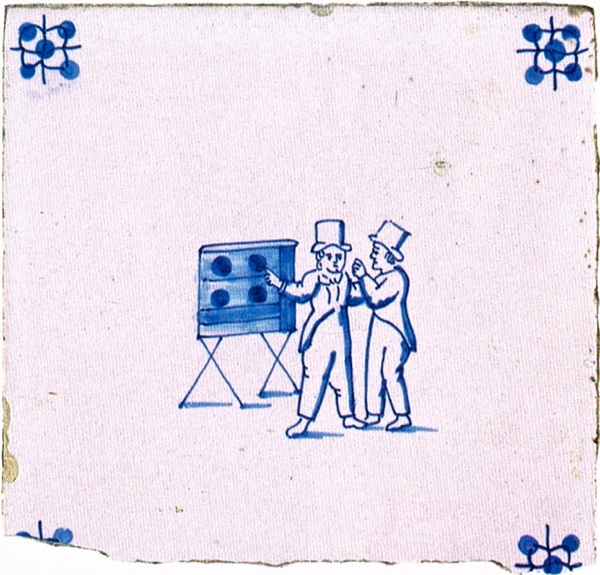
Delft tile illustrating a peep show, c. 1840
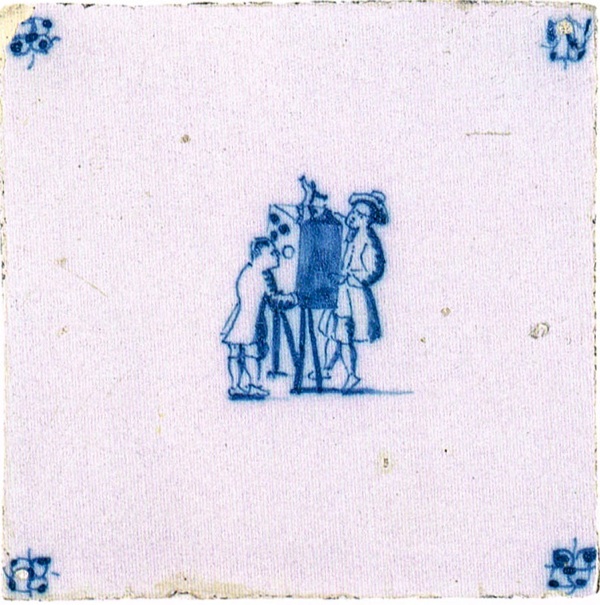
Delft tile illustrating a peep show, c. 1840
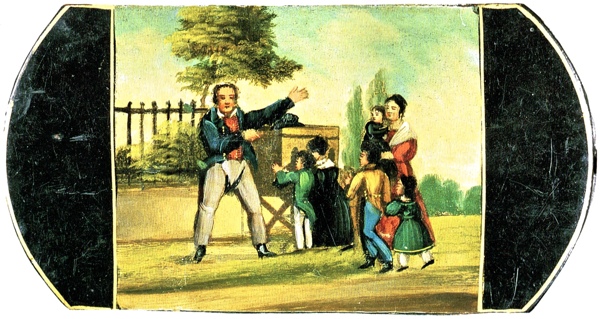
Painting of a peep show upon a paper maché cheroot case, c.1860
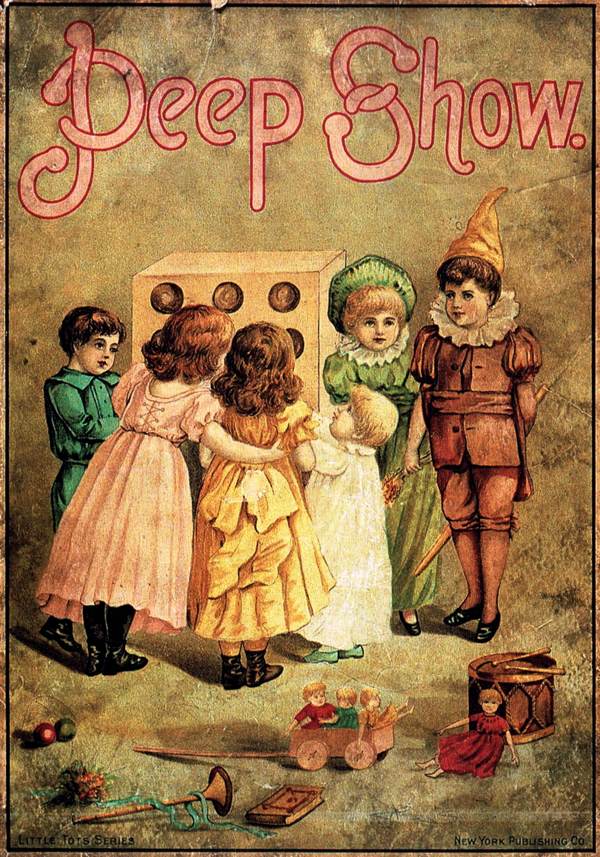
Cover of American children’s book, 1890.

The Children’s Peep Show, 1890.
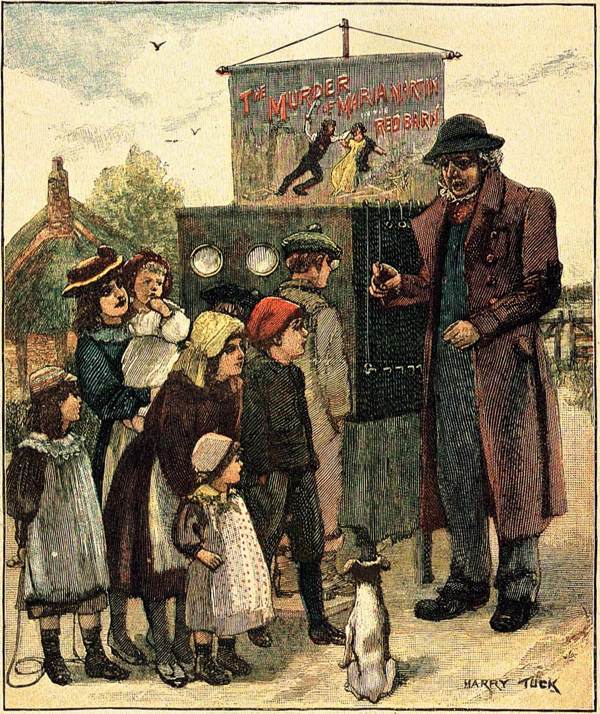
Engraving by Harry Tuck, 1894.
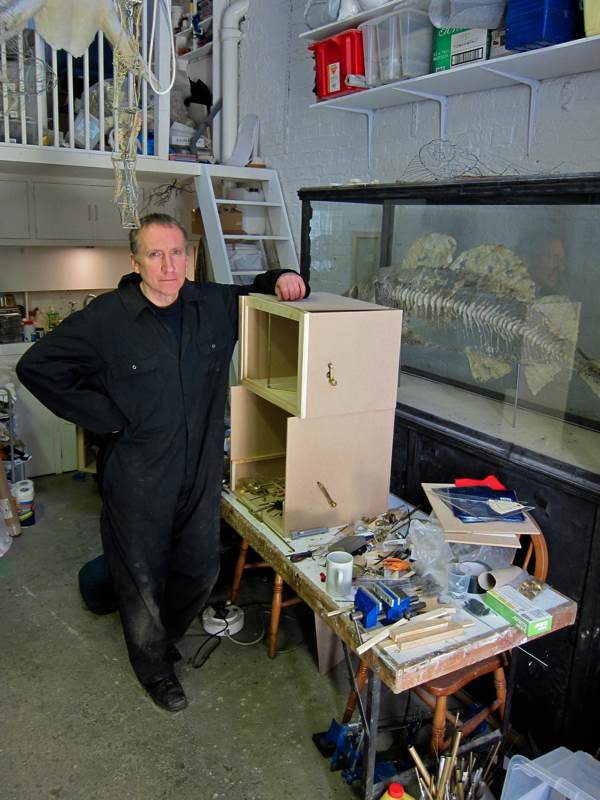
Sculptor Richard Sharples, Peep-Show-Maker of Hoxton.
Illustrations of peep shows courtesy Richard Balzer
There are special opening times for London Lore which runs from 14th June – 5th July: Wednesdays & Fridays, noon – 4pm. Normal opening times at Dennis Severs’ House – Sundays, noon – 2pm & Mondays, noon – 2pm. Dennis Severs’ House, Folgate St, E1 6BX
You may also like to read about
Simon Costin, the Museum of British Folklore
and these other stories about Dennis Severs’ House
Mick Pedroli, Manager at Dennis Severs’ House












