
Bandele “Tex” Ajetunmobi, Photographer
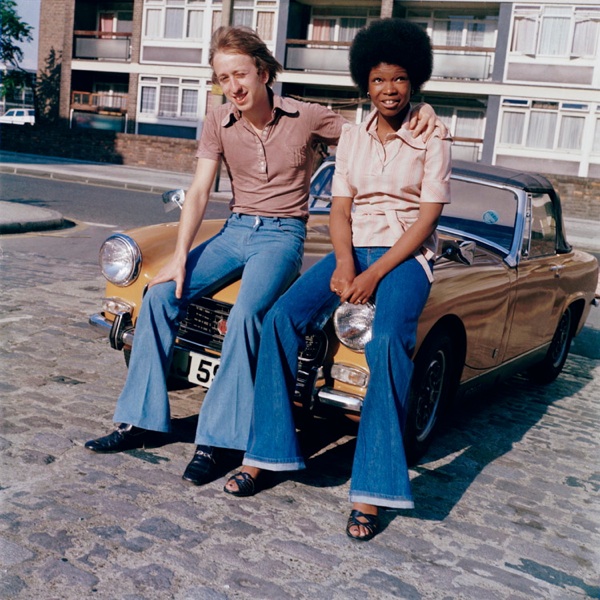
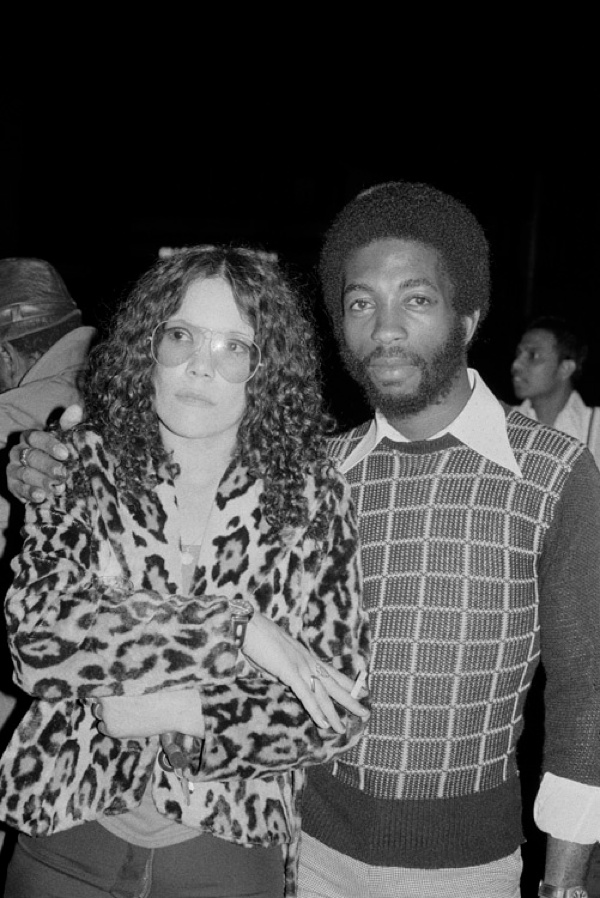
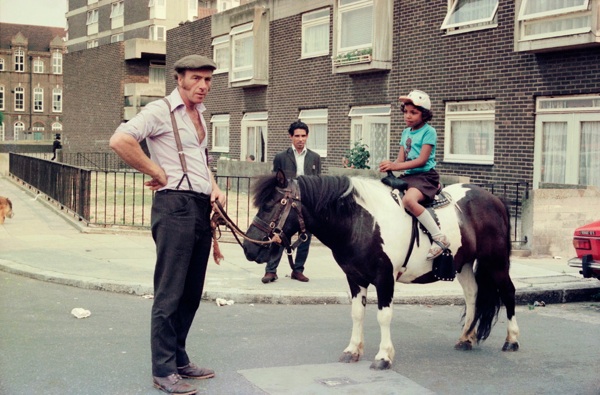
Bandele Ajetunmobi – widely known as Tex – took photographs in the East End for almost half a century, starting in the late forties. He recorded a tender vision of interracial cameradarie, notably as manifest in a glamorous underground nightlife culture yet sometimes underscored with melancholy too – creating poignant portraits that witness an almost-forgotten era of recent history.
In 1947, at twenty-six years old, he stowed away on a boat from Nigeria – where he found himself an outcast on account of the disability he acquired from polio as a child – and in East London he discovered the freedom to pursue his life’s passion for photography, not for money or reputation but for the love of it.
He was one of Britain’s first black photographers and he lived here in Commercial St, Spitalfields, yet most of his work was destroyed when he died in 1994 and, if his niece had not rescued a couple of hundred negatives from a skip, we should have no evidence of his breathtaking talent.
Fortunately, Tex’s photographs found a home at Autograph ABP where they are preserved in the permanent archive and it was there I met with Victoria Loughran, who had the brave insight to appreciate the quality of her uncle’s work and make it her mission to achieve recognition for him posthumously.
“He was the youngest brother and he was disabled as well but he was very good at art, so they apprenticed him to a portrait photographer in Lagos. It suited him yet it wasn’t enough, so he packed up and, without anything much, left for England with my Uncle Chris.
Juliana, my mum had already come from Nigeria and, when I was born, she lived in Brick Lane but, after a gas explosion, we had to move out – that’s how we ended up in Newham. When I was a child, we didn’t come over here much – except sometimes to visit Brick Lane and Petticoat Lane on a Sunday – because we had moved to a better place. I understood I was born in Bethnal Green but I grew up in a better class of neighbourhood.
I knew that she didn’t approve of my uncle’s lifestyle, she didn’t approve of the drinking and probably there were drugs too. They were lots of rifts and falling out that I didn’t understand at the time. When everything became about having jobs to survive, she couldn’t comprehend doing something which didn’t make money. In another life, she might have understood his ideals – but we were immigrants and you have to feed yourself. She thought, ‘Why are you doing something that doesn’t sit comfortably with being poor?’
He did all this photography yet he didn’t do it to make money, he did it for pleasure and for artistic purposes. He was doing it for art’s sake.He had lots of books of photography and he studied it. He was doing it because those things needed to be recorded. You fall in love with a medium and that’s what happened to him. He spent all his money on photography. He had expensive cameras, Hasselblads and Leicas. My mother said, ‘If you sold one, you could make a visit to Nigeria.’ But he never went back, he was probably a bit of an outcast because of his polio as a child and it suited him to be somewhere people didn’t judge him for that.
He used to come and visit regularly when we lived in Stratford and there are family pictures that he took of us. His pictures pop out at me and remind me of my childhood, they prove to me that it really was that colourful. He was fun. Cissy was his girlfriend, they were together. She was white. When Cissy separated from her husband, he got custody of her children because she was with a black man – and her family stopped talking to her. She and Tex really wanted to have children of their own but they weren’t able to. They were Uncle Tex and Aunty Cissy, they would come round with presents and sweets, and they were a model couple to us as children. To see a mixed race couple wasn’t strange to us – where we lived it was full of immigrants and we were poor people and we just got on with life, and helped each other out.
He used to do buying and selling from a stall in Brick Lane. When he died, they found so much stuff in his flat, art equipment, pens, old records and fountain pens. He had a very good eye for things. Everybody knew him, he was always with his camera and they stopped him in the street and asked him to take their picture. He was able to take photographs in clubs, so he must have been a trusted and respected figure. Even if the subjects are poor, they are strutting their stuff for the camera. He gave them their pride and I like that.
He was not extreme in his vices. He died of a heart attack after being for a night out with his card-playing friends. He lived alone by then, he and Cissy were separated. But he was able to go to his neighbour’s flat and they called an ambulance so, although he lived alone, he didn’t die alone.
I thought he deserved more, that he was important. I just got bloody-minded. It wasn’t just because he was my uncle, it’s because it was brilliant photography. He deserved for people to see his work. There were thousands of pictures but only about three hundred have survived. Just one plastic bag of photos from a life’s work.”
Tex was generous with his photographs, giving away many pictures taken for friends and acquaintances in the East End – so if anybody knows of the existence of any more of his photos please get in touch so that we may extend the slim yet precious canon of Bandele “Tex” Ajetunmobi’s photography.
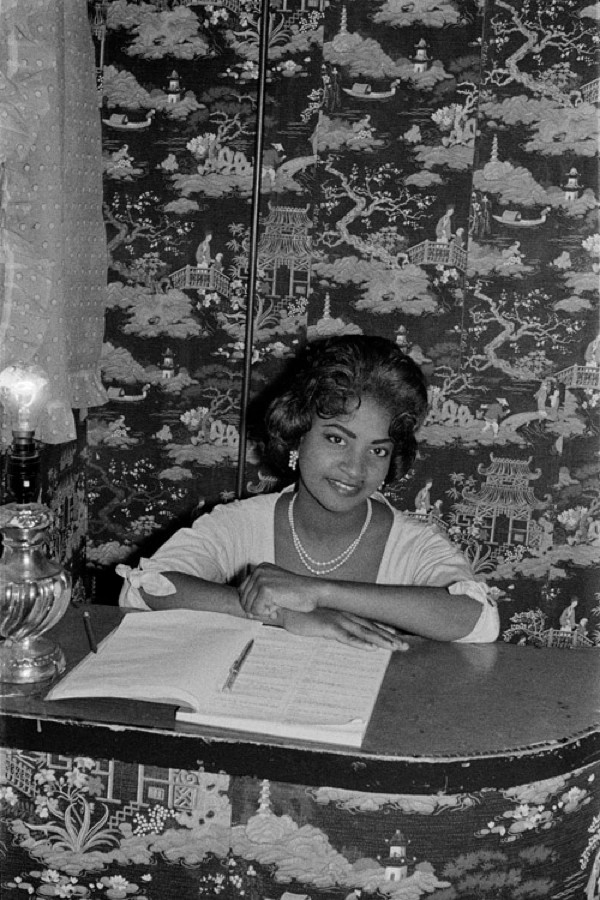
Whitechapel night club, nineteen-fifties
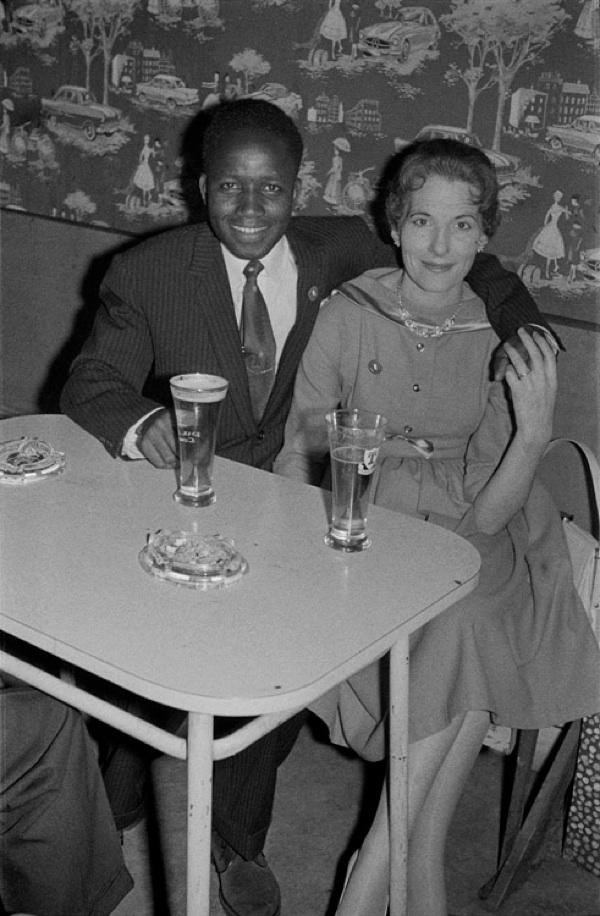
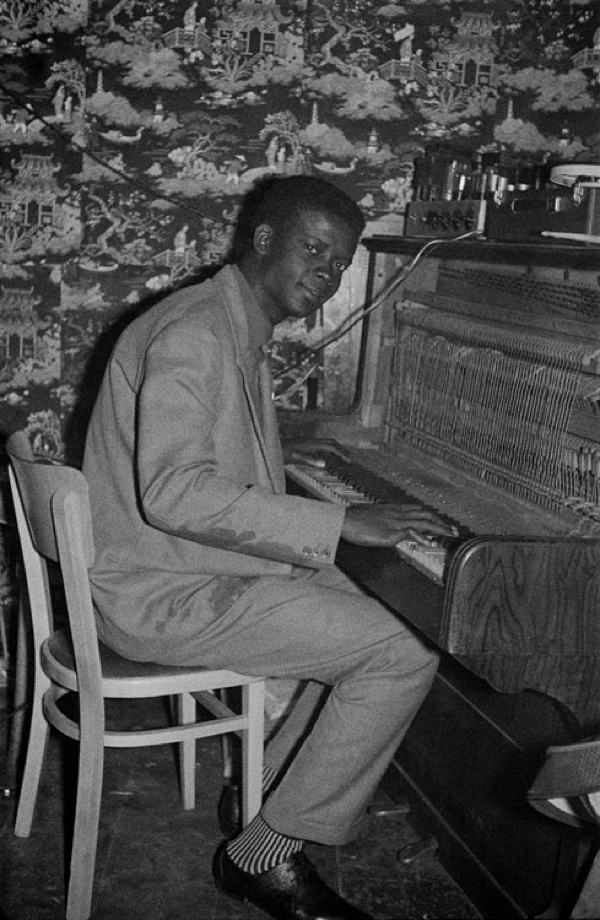
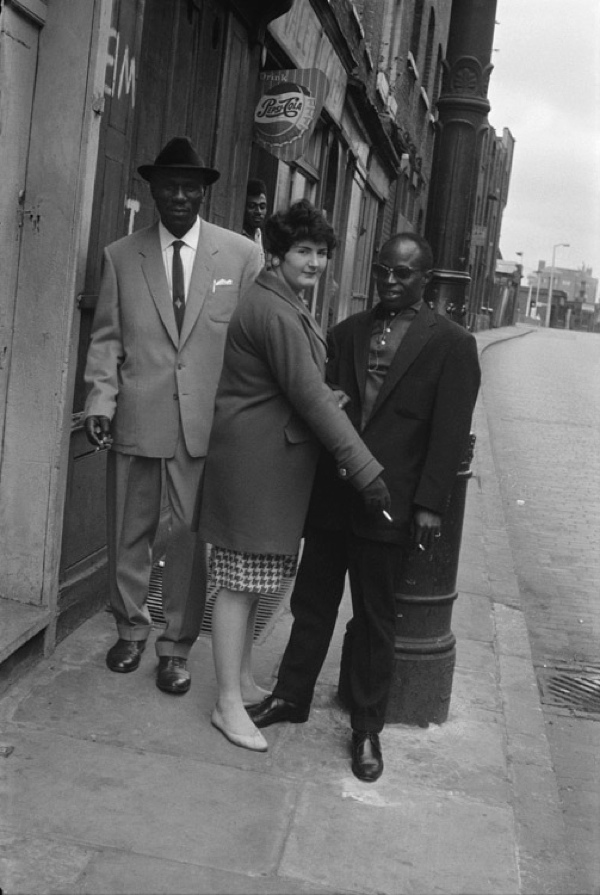
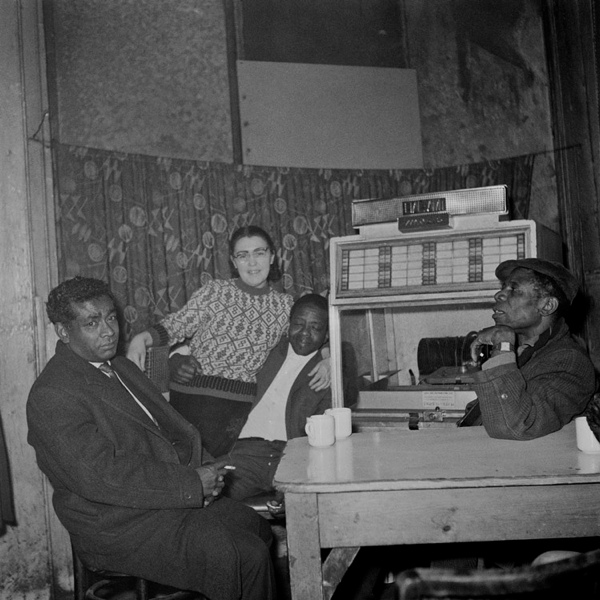
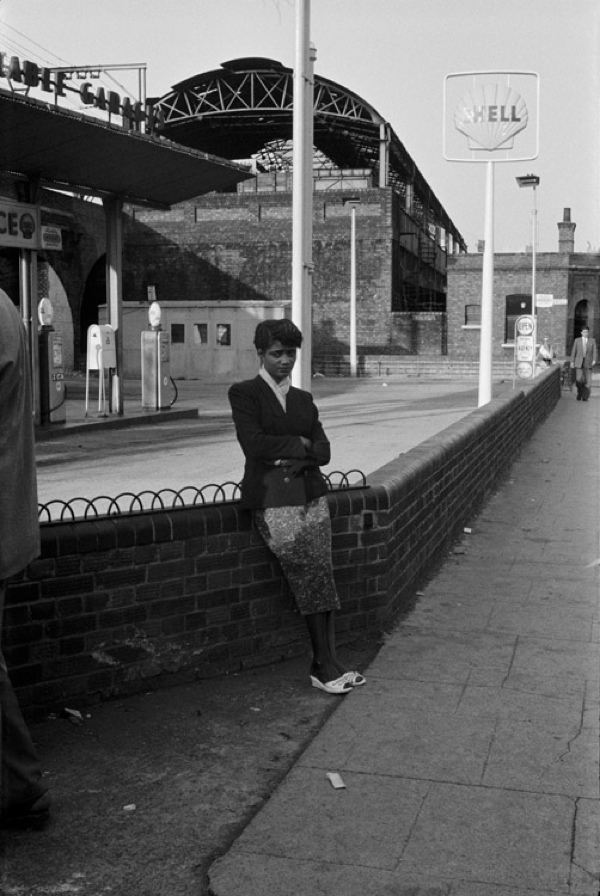
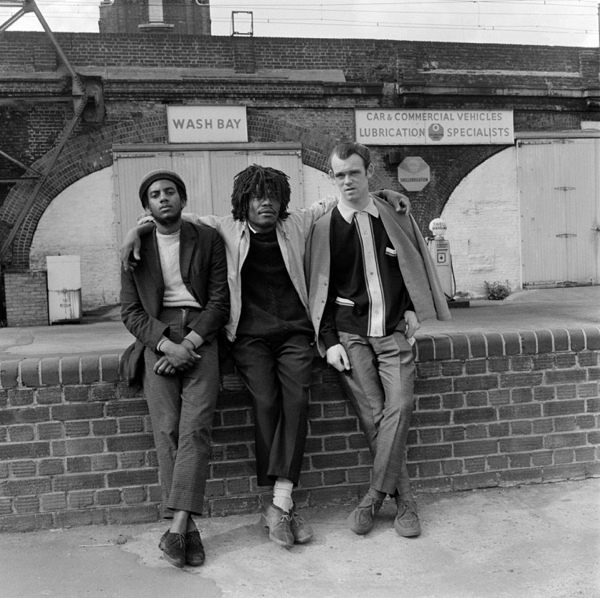
East End, nineteen seventies
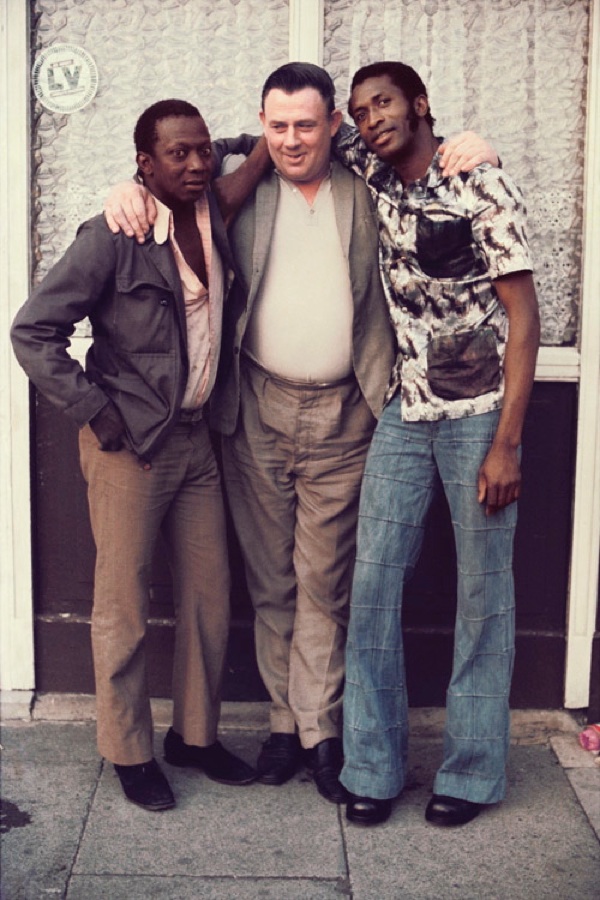
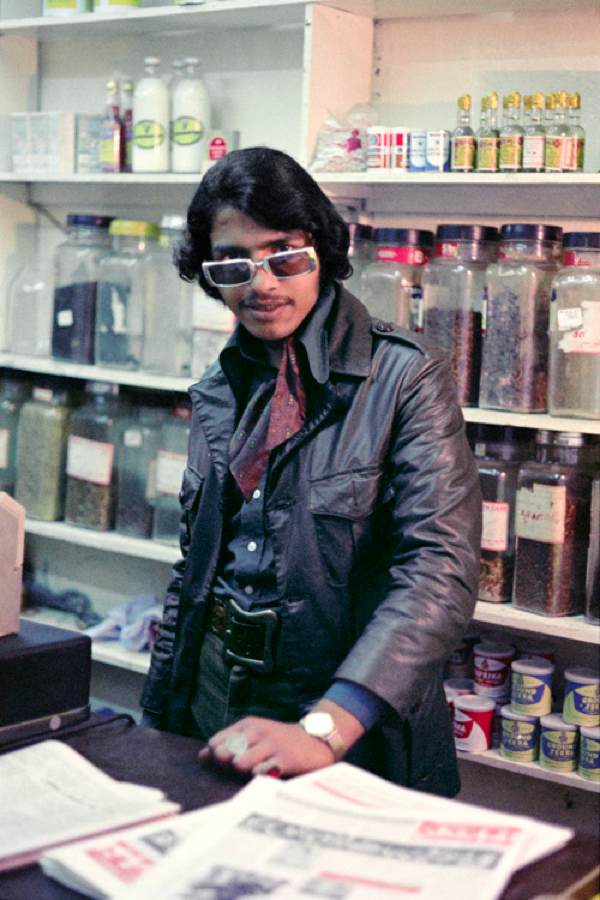
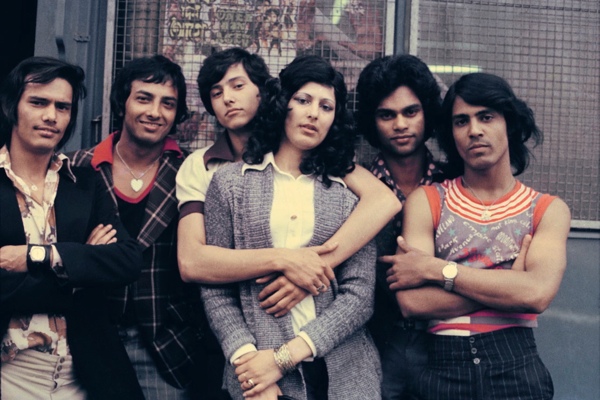
On Brick Lane, seventies
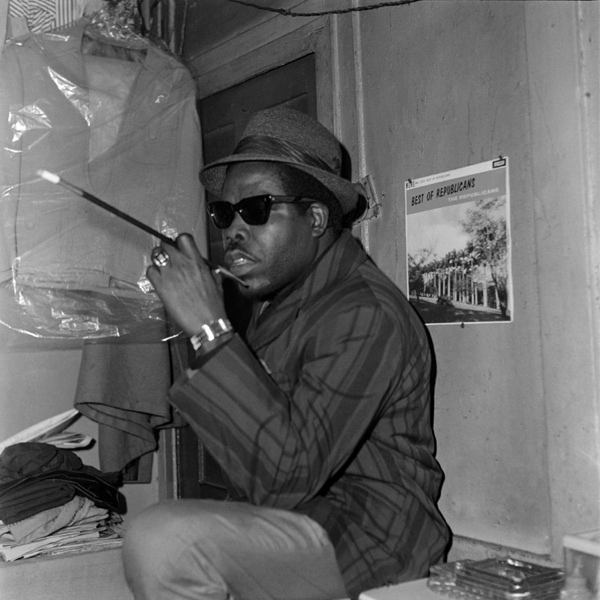
Bandele “Tex” Ajetunmobi, self portrait
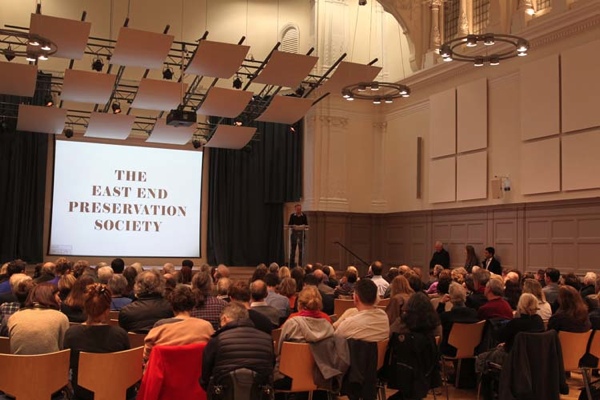
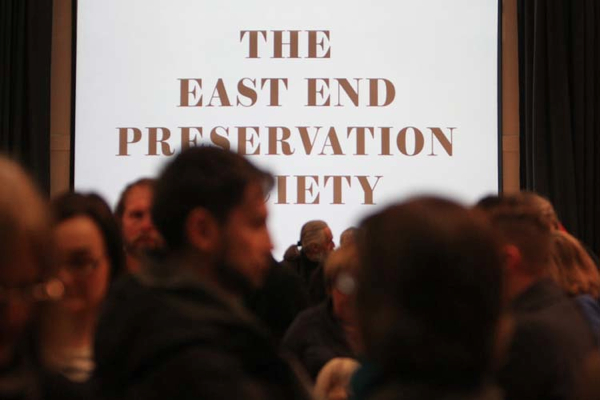
The East End Preservation Society Launch
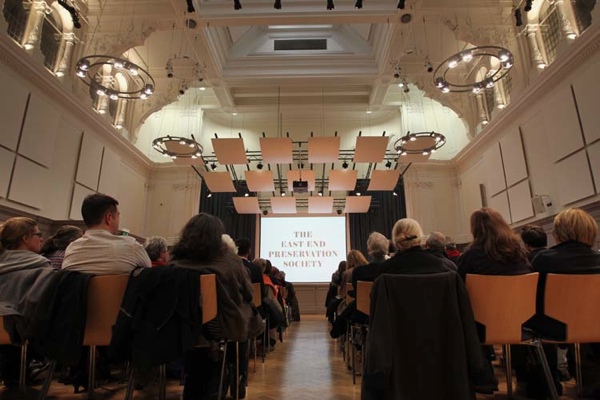
Main Hall at the Bishopsgate Institute, 27th November
In recent years, as I found myself writing the same story about the loss of old buildings in the East End, its repetition dishearterned me.
First, there was the threat to demolish the Jewish Nursing Home in Underwood Rd and, in spite of a petition and widespread opposition, it went ahead. Then, there was the proposed redevelopment of the Spitalfields Fruit & Wool Exchange which was rejected twice by the elected members of Tower Hamlets Council but Boris Johnson, Mayor of London overturned the decision. And most recently, the overbearing housing project that will entail razing the Queen Elizabeth Children’s Hospital in Hackney has been given the go-ahead, again by the Mayor, ignoring the wishes of the local community.
Yet The Marquis of Lansdowne was the joyous exception, in which a campaign was successful in articulating the strength of public feeling and the consequent refusal of permission by Hackney Council for the demolition of the building was sufficient to save it. This example gave me hope and inspired the notion that it might be possible to bring everyone together to fight these battles more effectively.
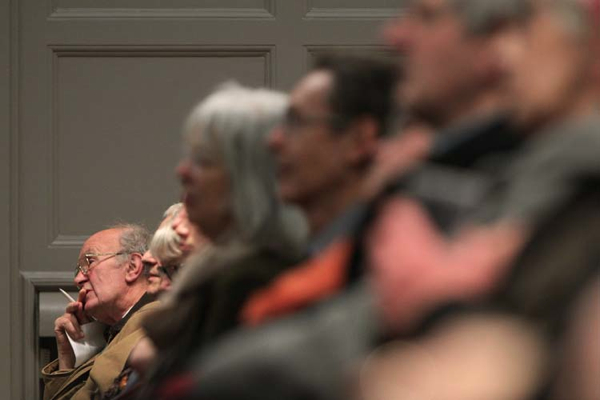
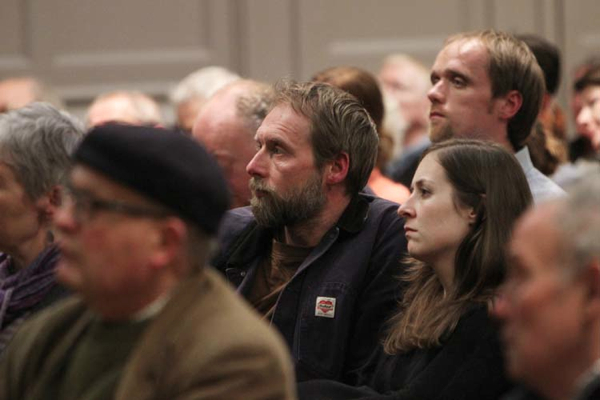
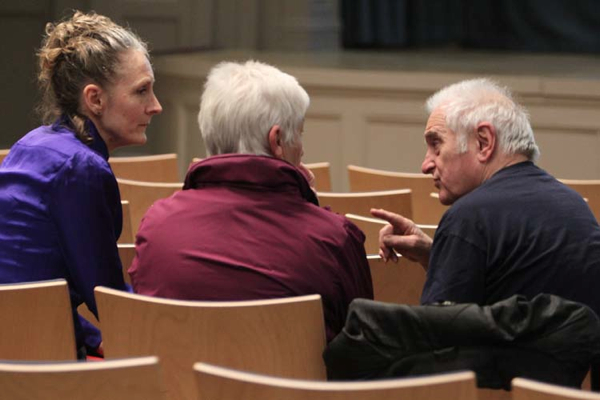
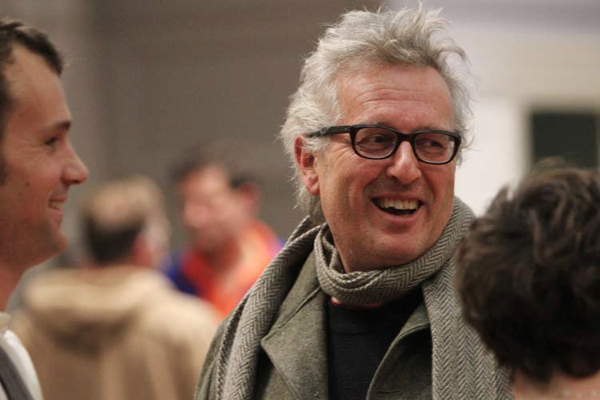
It was a hope that was kindled into something larger last week, as an excited crowd packed the Main Hall of the Bishopsgate Institute for the launch of The East End Preservation Society. Spitalfields Life Contributing Photographer Simon Mooney was there to capture the drama of the night and Contributing Filmmaker Sebastian Sharples made the films which accompany this feature.
Dan Cruickshank, Architectural Historian & long-term Spitalfields resident, gave the inugural address and William Palin, ex-director of SAVE Britain’s Heritage, delivered an illustrated historical survey of buildings lost and saved in the East End. Beyond this, Marcus Binney reported on the fate of the Spitalfields Fruit & Wool Exchange, Matt Johnson & Brad Lochore reported on the looming outsize developments in Shoreditch, Lucy Rogers reported on the proposed demolition of the former Queen Elizabeth Children’s Hospital and, rounding off the evening, Saif Osmani reported on the monster scheme for Whitechapel.
The drama of the event came from the fact that no-one knew what anyone else was going to say. And, once we in the audience learned of the breakdown in the democratic process that will permit large-scale, destructive plans to be imposed upon the East End if we do nothing, there was an accumulating sense of horror as the list of imminent developments became apparent. Yet this was counterbalanced by the realisation that each of the reports by the different speakers shared a common thread, whether Dan Cruickshank speaking of the loss of eighteenth-century weavers’ cottages or Saif Osmani revealing that the future development plan for Whitechapel, of over one hundred pages, does not include a single mention of the Bangladeshi people.
The common thread was that of a respect and affection for the East End and its people, and how this culture has become manifest in the evolution of the built environment that we inhabit today. On this fundamental point, all the existing conservation groups are in accord, from The Friends of Christ Church Spitalfields to The Friends of Queens Market, and from The Friends of the Old Spotted Dog to The Friends of Arnold Circus. So now we must come together to support each other’s campaigns, swelling the numbers and making ourselves heard to preserve what we hold dear in the East End.
It is my hope that, in future, when I find myself writing stories about old buildings under threat, they will be accounts of how The East End Preservation Society saved them.
[youtube bQ32VbdfYcI nolink]
Willam Palin summarises his introductory speech for The East End Preservation Society
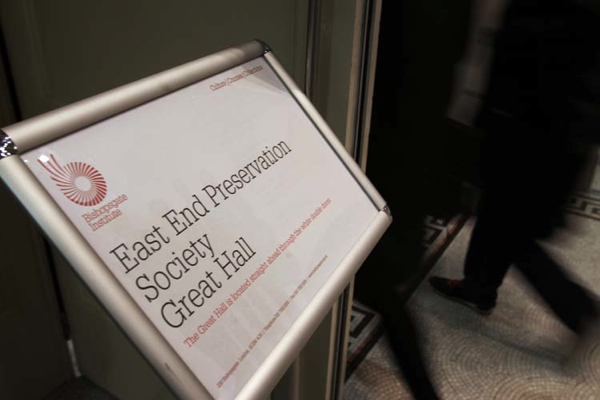
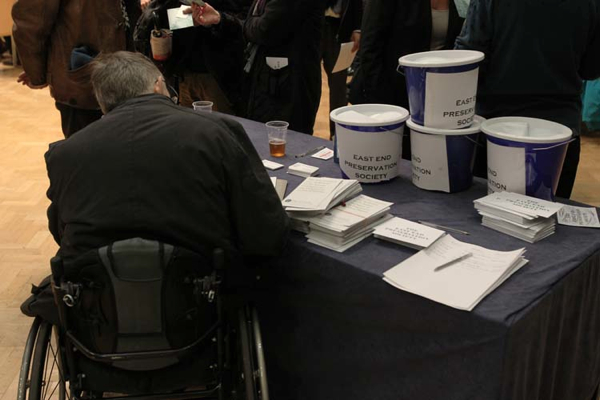
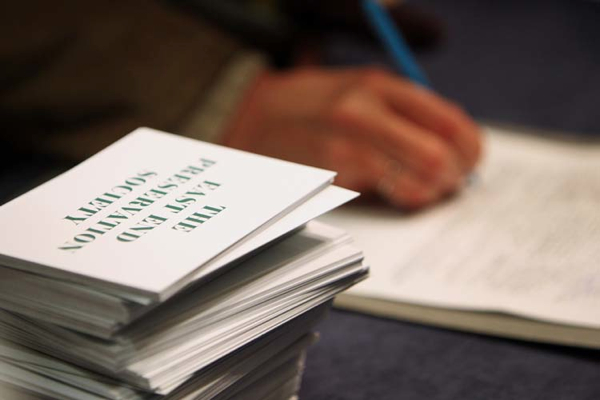
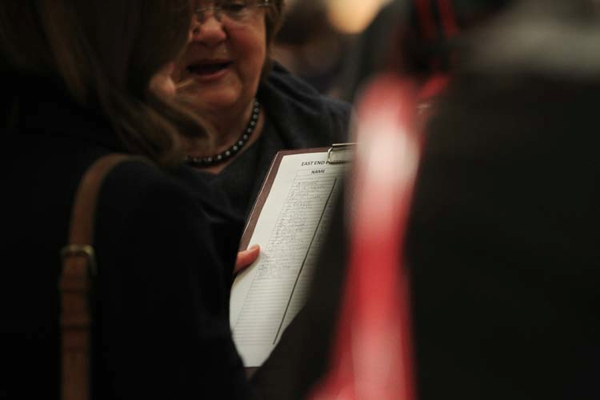
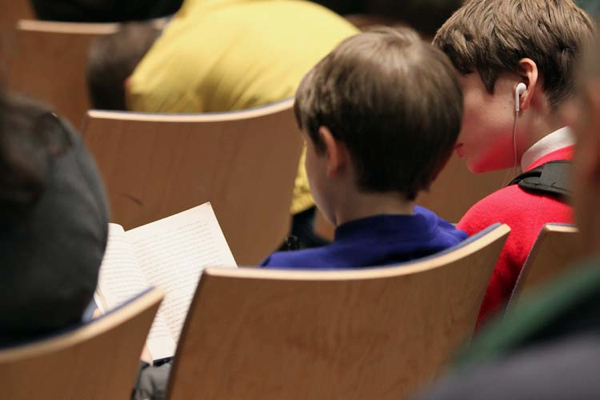
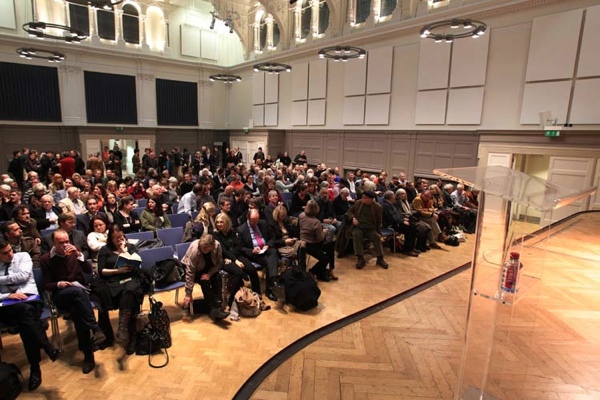
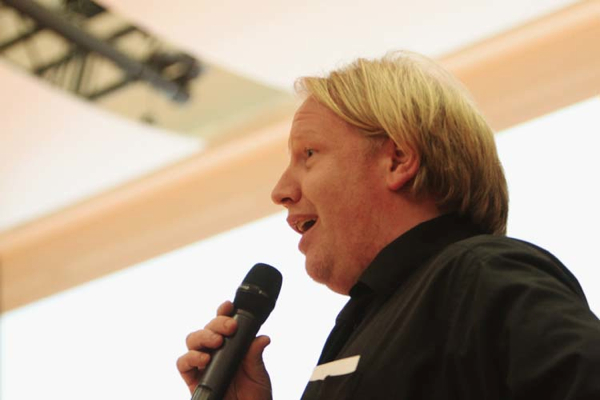
Archivist Stefan Dickers welcomes The East End Preservation Society to the Bishopsgate Institute
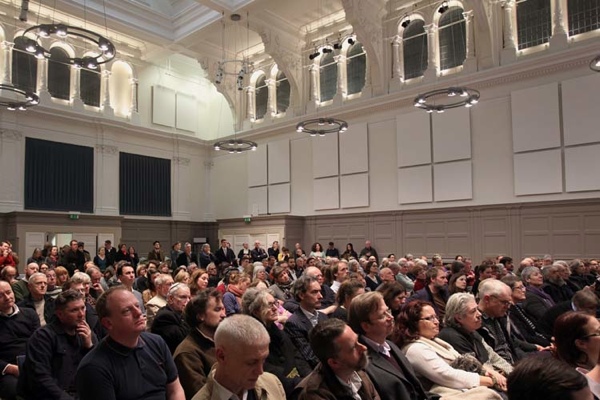
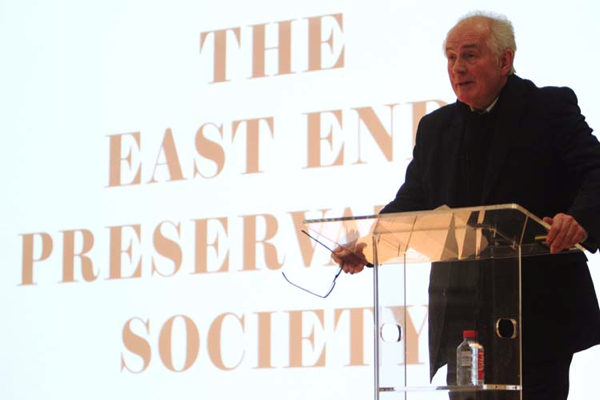
Dan Cruickshank makes the inaugural address

Clive Bettinson of the Jewish East End Celebration Society
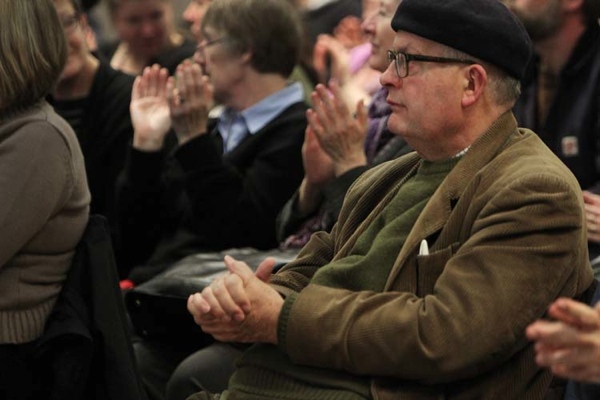
Bob Rogers of the East London History Society
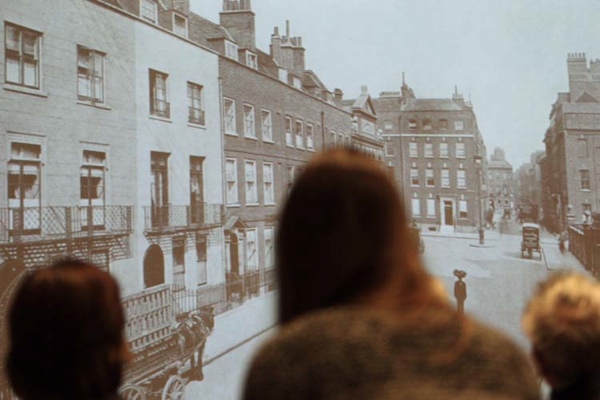
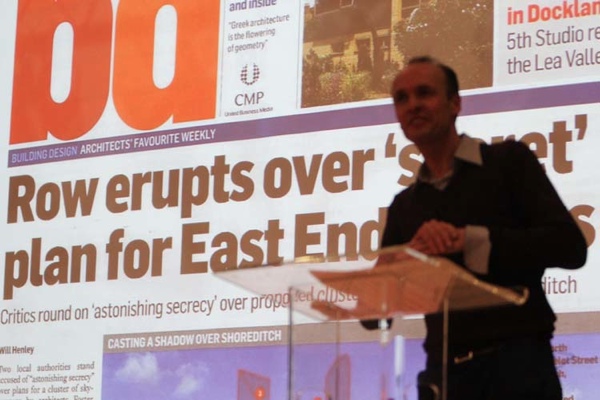
“This is not just a debate about what kind of places we want our cities to be, but about who controls the process of change. Is it you – that is local people and communities – or is the developers, with their short-term interests, aided by highly-paid planning consultants and supported by the Mayor? The East End Preservation Society is about wresting back control and the fight-back starts tonight.” Will Palin
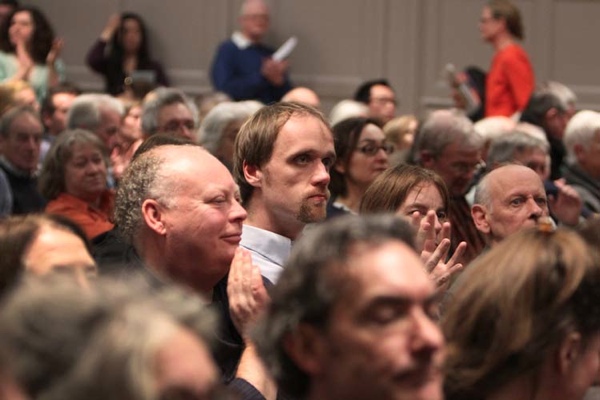

Marcus Binney founder of SAVE Britain’s Heritage on the loss of the Spitalfields Fruit & Wool Exchange
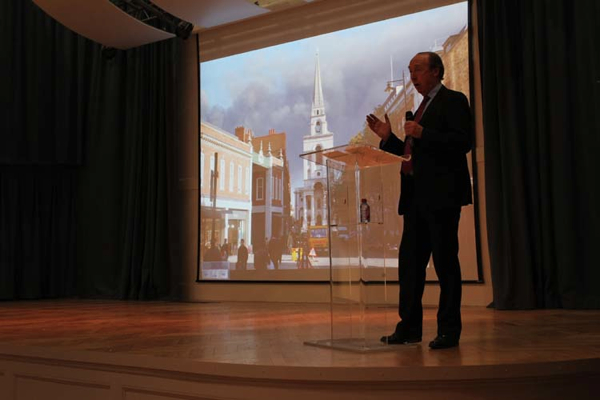
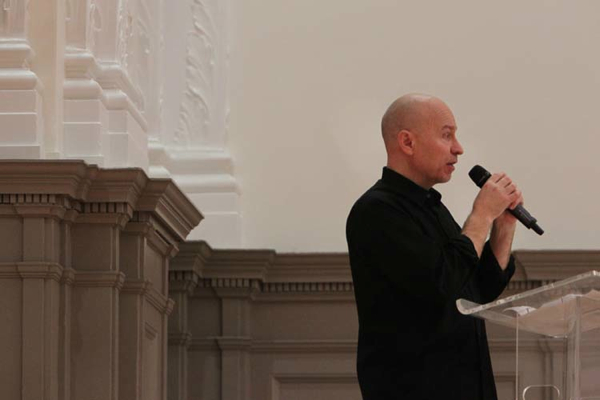
Matt Johnson speaks of the threat of the Bishopsgate Goodsyard development to Shoreditch
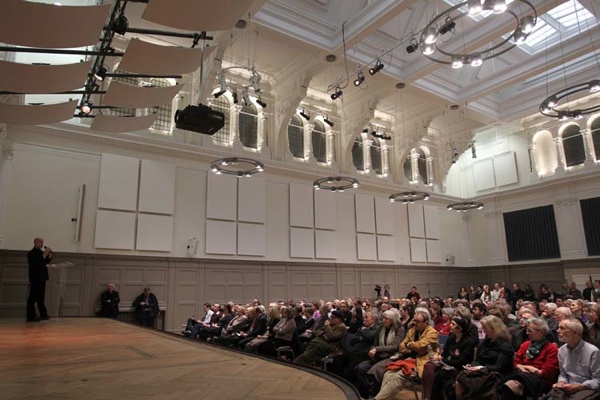
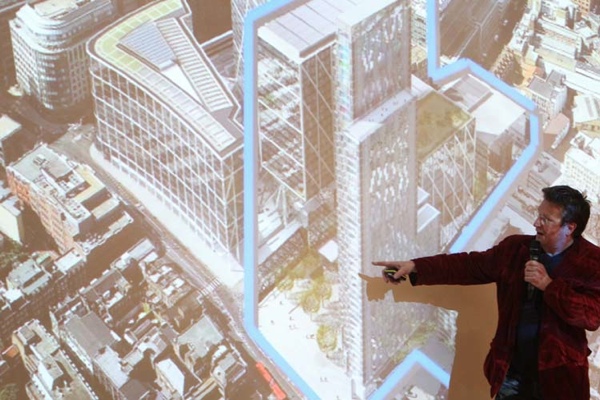
Brad Lochore speaks of the encroaching towers from the City of London into Shoreditch
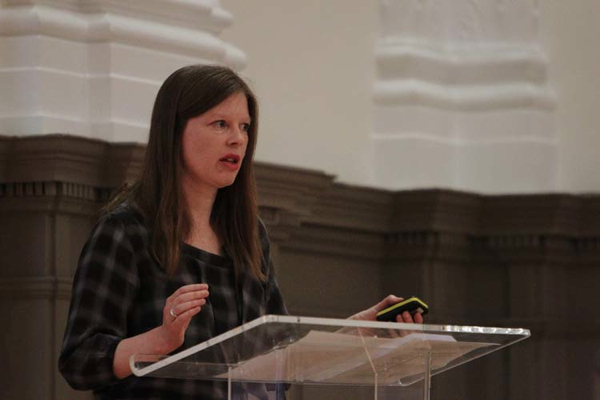
Lucy Rogers explains the crisis with the former Queen Elizabeth Children’s Hospital
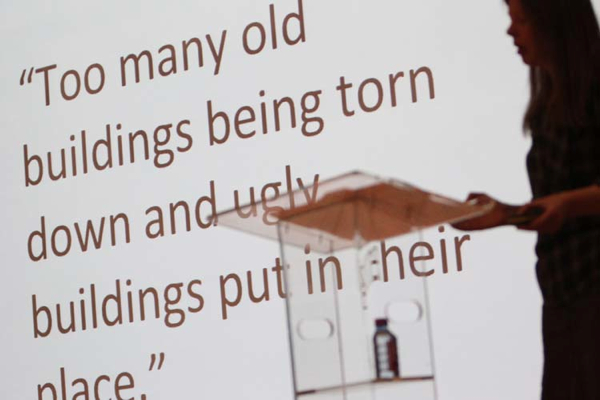
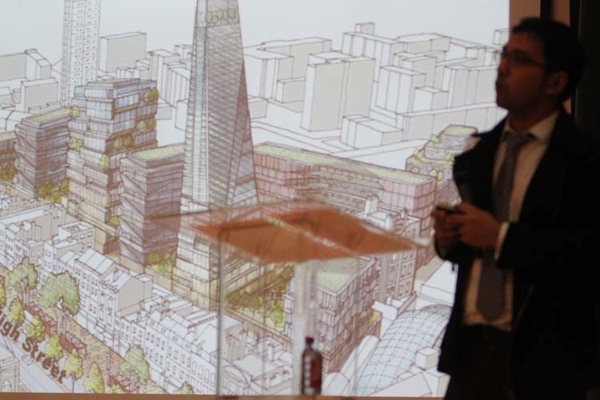
Saif Osmani of the Friends of Queens Market reveals the overbearing development for Whitechapel
Photographs copyright © Simon Mooney
[youtube R-ZpZG8JfuI nolink]
Dan Cruickshank’s Inugural Address for The East End Preservation Society
“It should now be possible to protect our historic buildings, to maintain and improve our conservation areas, to represent and reinforce traditional communities and to create and sustain well-balanced new communities – ones that build on the rich and inclusive cultural tradition of East London.
But it seems that all these worthy expectations will not be realised without drastic, radical action. East London has reached a critical time in its long and rewarding history. Massive new developments such as the one proposed for Bishopsgate Goodsyard (which includes a series of towers from twenty-eight to five-five storeys in height) threaten to overwhelm adjoining conservation areas and infrastructure, cast shadow over communities and cause irreparable damage to established areas which have a strong character.
There is no strong evidence that developers are actually acting on opinions expressed through the consultation process – and the feeling is that the welfare of many is to be sacrificed for profits for a few.
The sound and handsome nineteen-twenties London Fruit & Wool Exchange in Spitalfields is to be largely demolished for a scheme which includes no housing, and which entails the destruction of the popular local pub, The Gun, and the eradication of the important late seventeenth-century street, Dorset St. The site could hardly be more sensitive, located in a conservation area, and opposite Nicholas Hawksmoor’s Christ Church, one of most moving historic buildings in London.
After much debate and local opposition, the scheme was originally rejected by Tower Hamlets Council – a victory for community action and local democracy – but the Mayor of London intervened and, after acting as judge and jury, overturned the local authority’s decision and granted development consent. An alternative scheme – drawn up by local groups and which kept the important existing buildings and street pattern, which built on the history of the site – which proposed some housing and which would have created local employment – was dismissed out of hand.
This story represents a collapse of local democracy, and a cynical disregard of local people and opinion. So much for democracy when it comes to the protection and enhancement of East London! So much for the opinions of local communities! So much for history!
To me, it is obvious that an East End Preservation Society is needed a) to gather and represent local opinion b) to help East London people stand together c) to give them a voice and make that voice count (to ensure it is not only heard but also that it is acted upon) and d) to reveal and promote an urban vision which is not governed by short-term and personal profit, but which evokes and embraces more worthy and more communal aims – and which enshrines the spirit and character of East London.
Our opinions – the opinions of ordinary Londoners – matter, and must not be cast aside by corporations or corporate politicians. United we stand, divided we fall.
If we become a coherent pressure group, national and local politicians and planners will be obliged to listen to us. We have much to lose but – if we stick together – much to gain.”
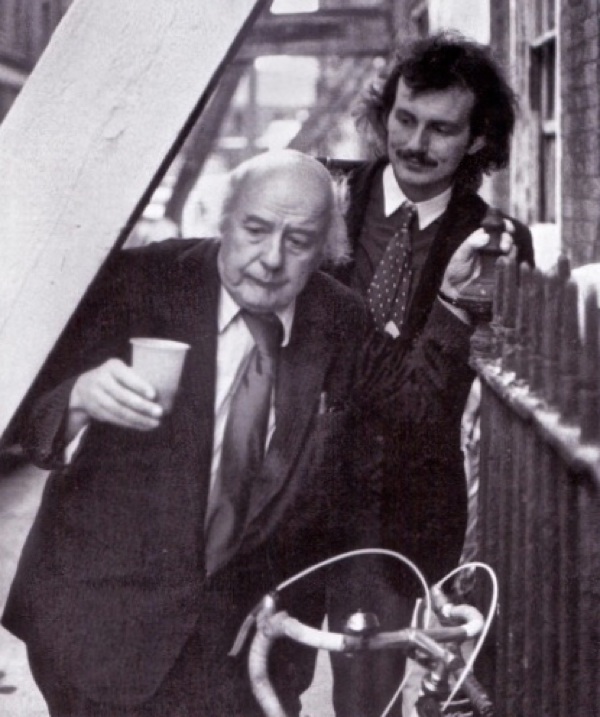
Dan Cruickshank with John Betjeman on a visit to Elder St during the battle to save the eighteenth century houses from demolition by British Land in 1977
Thanks to David Pearson for designing the typographic logo and Truman’s Beer for providing refreshment to The East End Preservation Society
If you would like to join The East End Preservation Society and be kept in touch with the society’s plans please email eastendpsociety@virginmedia.com
You may also like to read about
The East End Preservation Society
Remembering The Queen Elizabeth Children’s Hospital
The Pub That Was Saved By Irony
Row Over Demolition at the Geffrye Museum
So Long, Spitalfields Fruit & Wool Exchange
So Long, Mother Levy’s Nursing Home
Dorothy Annan’s Murals At The Barbican
Two years ago, I wrote this appreciation of Dorothy Annan’s ceramic murals adorning Fleet House in Farringdon St which was due for demolition and now I am happy to report that these wonderful pieces have been moved to a new location in the Barbican – where they lighten a gloomy passage and bring joy to thousands every day, both residents of the estate and visitors to the arts centre alike.
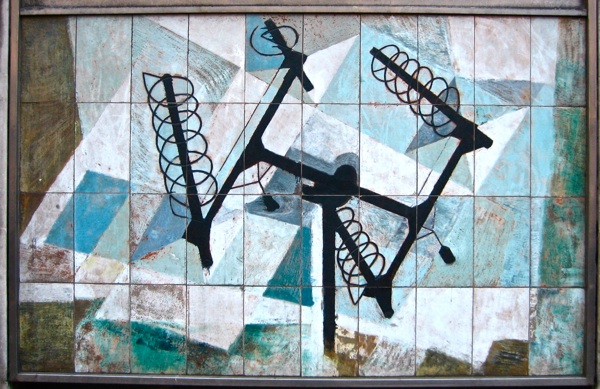
1. Radio communications and television
Wandering down under Holborn Viaduct two years ago, I was halted in my tracks by the beauty of a series of nine large ceramic murals upon the frontage of Eric Bedford’s elegant modernist Fleet House of 1960 at 70 Farringdon St. Their subtle lichen and slate tones suited the occluded November afternoon and my mood. Yet even as I savoured their austere grace, I raised my eyes to discover that the edifice was boarded up and I wondered if next time I came by it should be gone. Just up from here, there were vast chasms where entire blocks had disappeared at Snow Hill and beside Farringdon Station, so I was not surprised to discover that the vacant Fleet House was next to go.
Each of the murals was constructed of forty bulky stoneware panels and it was their texture that first drew my attention, emphasising the presence of the maker. Framed in steel and set in bays defined by pieces of sandstone, this handcrafted modernism counterbalanced the austere geometry of the building to sympathetic effect. Appropriately for the telephone exchange where the first international direct-dialled call was made – by Lord Mayor of London Sir Ralph Perring to Monsieur Jacques Marette, the French Minister of Posts, Telegraphs and Telephones in Paris at 11am on 8th March 1963 – these reliefs celebrated the wonders of communication as an heroic human endeavour. In 1961, the General Post Office Telephonist Recruitment Centre was housed there at Fleet House and they paid telephonists £11 week, plus a special operating allowance of six shillings and threepence for those employed on the international exchange.
These appealing works, enriching the streetscape with a complex visual poetry, were created by Dorothy Annan (1908-1983) a painter and ceramicist with a Bohemian reputation who, earlier in the century, produced pictures in a loose post-impressionist style and was married to the sculptor Trevor Tennant. Although her work is unapologetic in declaring the influence of Ben Nicholson and Paul Klee, she succeeded in constructing a personal visual language which is distinctive and speaks across time, successfully tempering modernism with organic forms and a natural palette.
It was the abstract qualities of these murals that first caught my eye, even though on closer examination many contain figurative elements, illustrating aspects of communication technology – motifs of aerials and wires which are subsumed to the rhythmic play of texture and tone, they offered a lively backdrop to the endless passage of pedestrians down Farringdon St.
Once a proud showcase for the future of telecommunications, Fleet House had been empty for years and was the property of Goldman Sachs who won permission this summer to demolish it for the construction of a ‘banking factory.’ I feared that the murals might go the same way as Dorothy Annan’s largest single work entitled ‘Expanding Universe’ at the Bank of England which was destroyed in 1997. Yet although Fleet House itself was not listed, the City of London planning authority earmarked the murals for preservation as a condition of any development. And today, you can visit them at the Barbican where they have found a sympathetic new permanent home, complementing the modernist towers, bringing detail and subtle colour to enliven this massive complex. The age of heroic telephony may have passed but Dorothy Annan’s murals survive as a tribute to it.
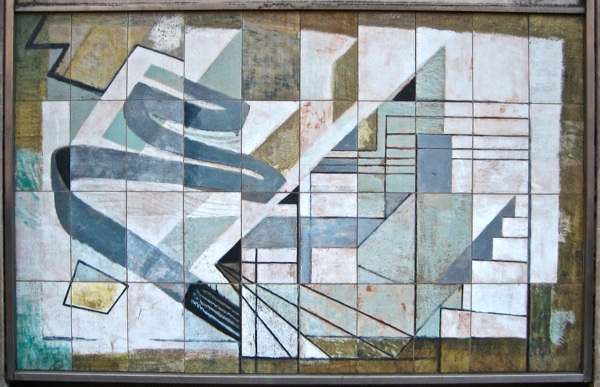
2. Cables and communication in buildings
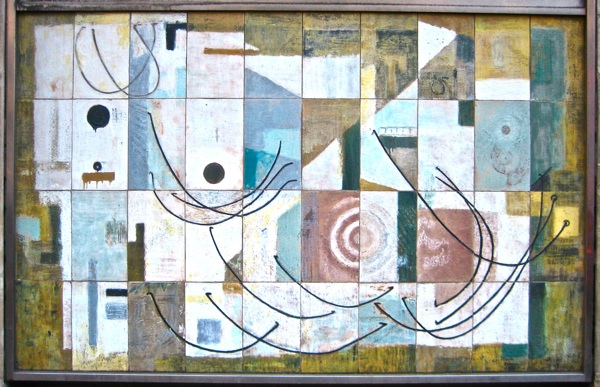
3. Test frame for linking circuits
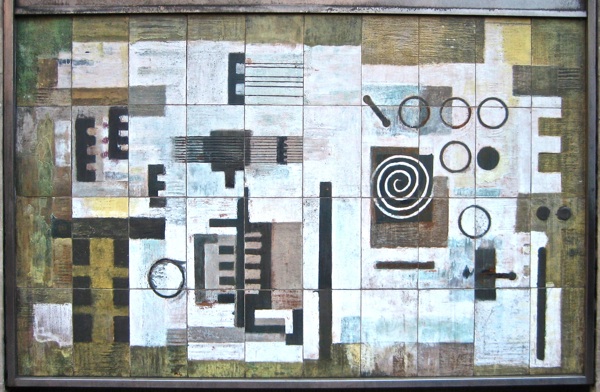
4. Cable chamber with cables entering from street
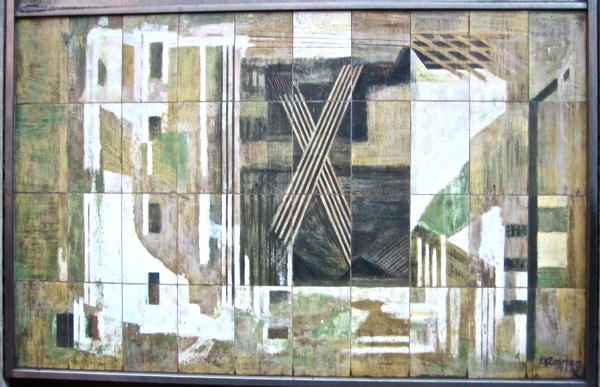
5. Cross connection frame
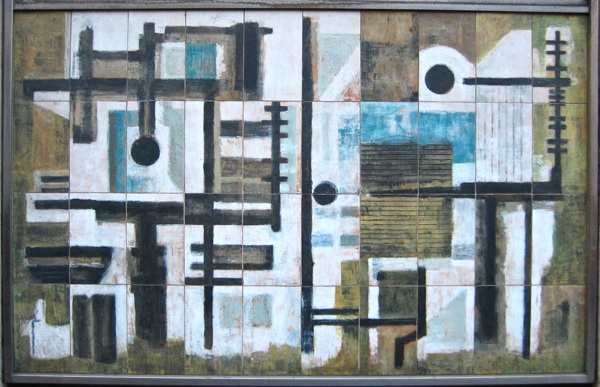
6. Power and generators
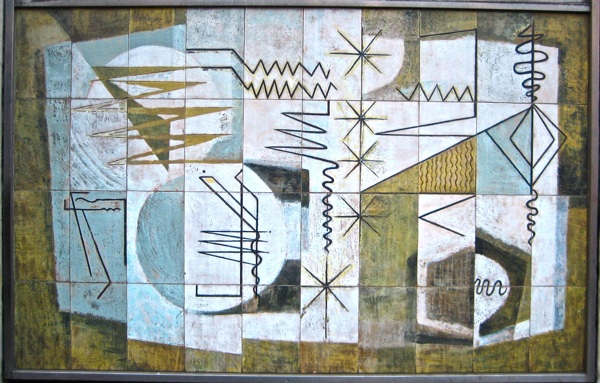
7. Impressions derived from the patterns produced in cathode ray oscilligraphs used in testing
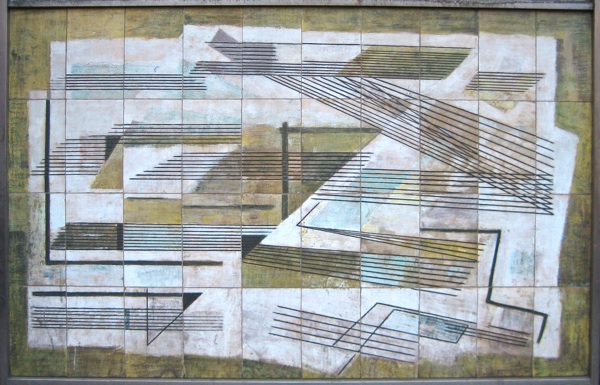
8. Lines over the countryside
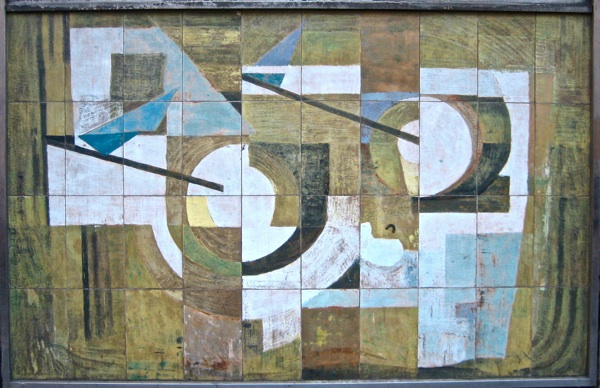
9. Overseas communication showing cable buoys
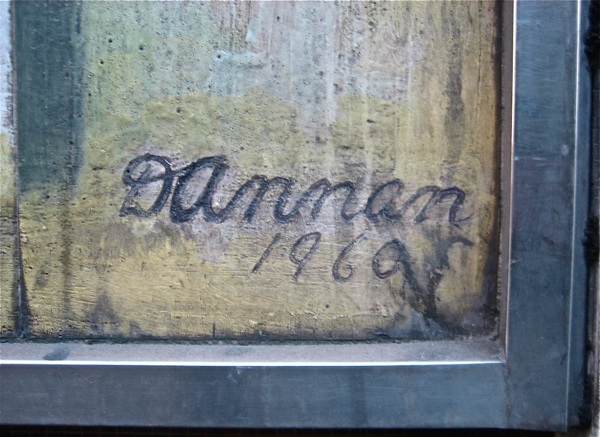
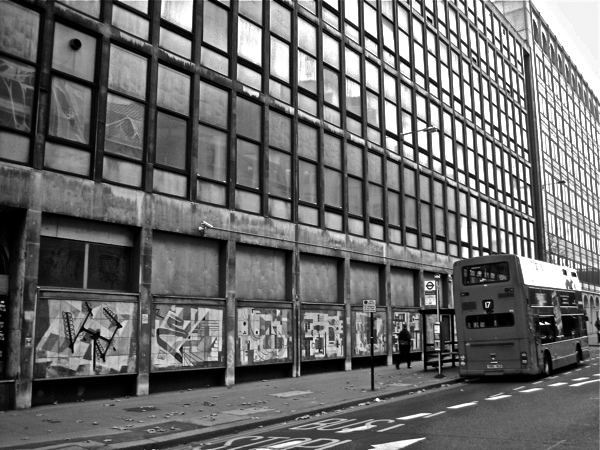
Dorothy Annan’s murals upon Fleet House, Farringdon St, November 2011
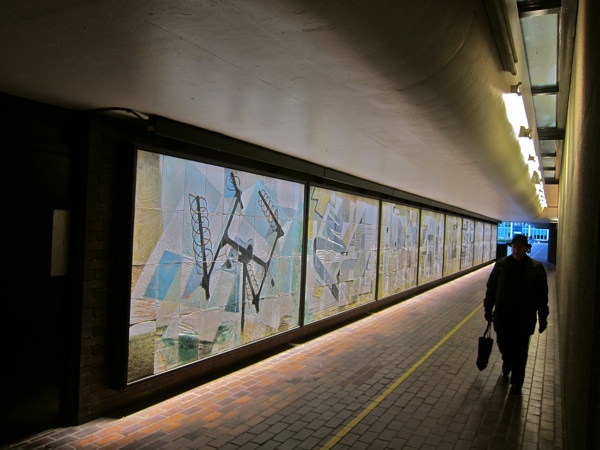
Dorothy Annan’s murals at the Barbican Centre, November 2013
You might also like to take a look at
Philip Lindsay Clark’s Sculptures in Widegate St
Fifty People Of East London By Adam Dant
This week, Martin Usborne launches Hoxton Minipress to publish collectable art books about East London and it is my pleasure to preview his second title – Fifty People of East London by Adam Dant, to which I have contributed a brief introduction that is reprinted below.
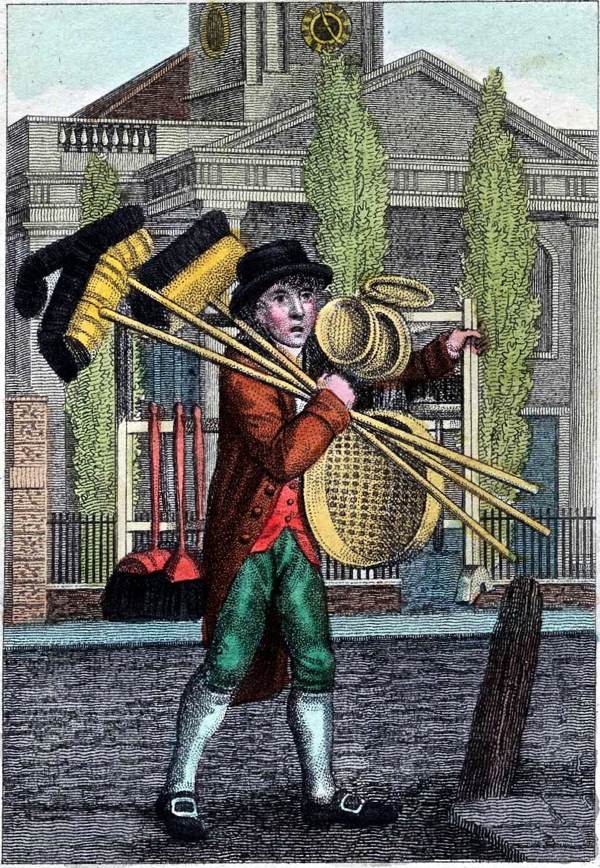
Seller of Hair Brooms by William Marshall Craig, Shoreditch 1804
Adam Dant is the latest in a venerable tradition of artists stretching back more than five centuries who have portrayed the infinite variety of human life in our great metropolis in prints, chapbooks, and upon playing cards – creating sets of images commonly known as the “Cries of London,” featuring street traders and hawkers.
Spirited representations of the redoubtable female watercress sellers of Shoreditch abounded throughout the eighteenth and nineteenth centuries, and in 1804 William Marshall Craig depicted a vendor of brooms struggling heroically beneath the burden of his stock outside St Leonard’s Church, while in 1812 John Thomas Smith drew William Conway of Bethnal Green who walked twenty-five miles every day to sell metal spoons throughout the City.
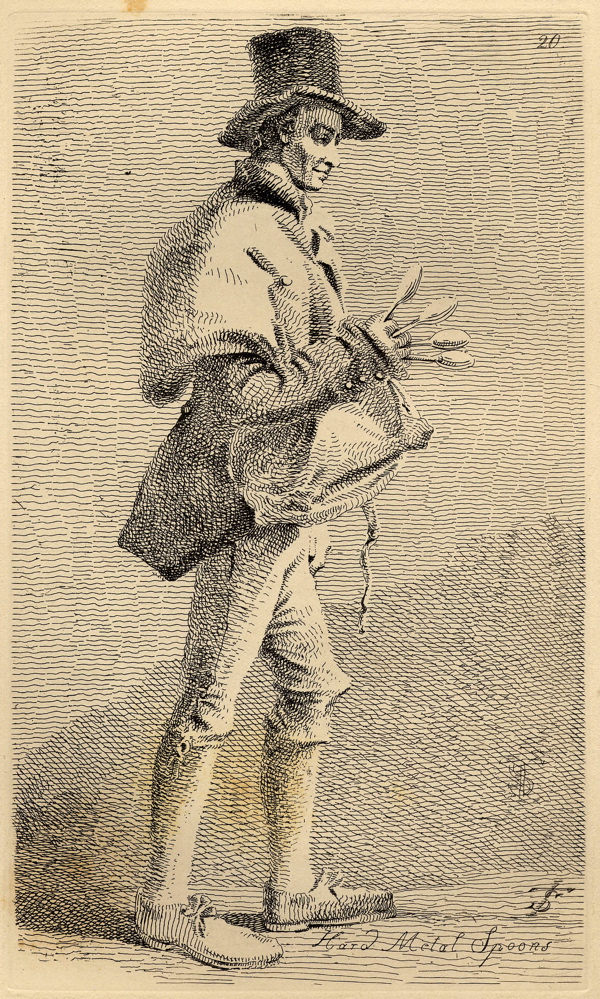
William Conway, Spoon Seller of Bethnal Green, by John Thomas Smith 1812
Yet for Adam Dant, two hundred years later, the precise nature of commerce undertaken by many of his subjects is less overt, though it is readily apparent that many are on the hustle in some way or other, but I must leave it to you to resolve for yourself the intriguing question of what exactly these Londoners of our own day are selling ….

App Billionaire

Barge Dwelling Fantasist

Countrified Urbanite

Nigerian Shoe Seller

Well Off Art Student

Hoxton Elderly

Creative

Flower Market Shopper

Suburban Street Artist

Illustrations copyright @Adam Dant
Archive Images courtesy Bishopsgate Institute
Click here to buy your copy of 50 PEOPLE OF EAST LONDON by Adam Dant direct from Hoxton Minipress
You may also like to take a look at Adam Dant’s other cartoons
Soerditch by Dant (Chapter One)
Soerditch by Dant (Chapter Two)
Soerditch by Dant (Chapter Three)
Soerditch by Dant (Chapter Four)
Soerditch by Dant (Chapter Five)
Soerditch by Dant (Chapter Six)
And his maps
Map of the History of Shoreditch
Map of Shoreditch in the Year 3000
Map of Shoreditch as the Globe
Map of the History of Clerkenwell
Map of the Journey to the Heart of the East End
Map of the History of Rotherhithe
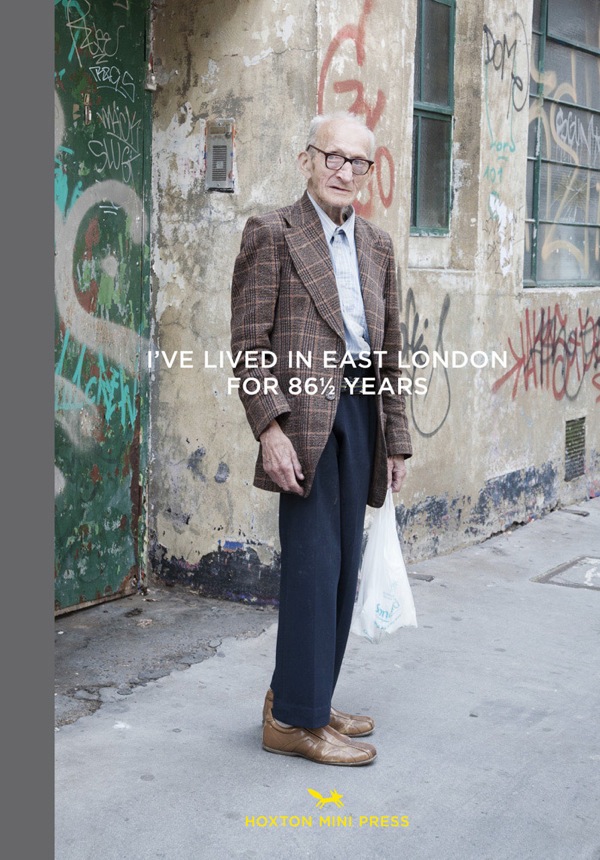
Today, Martin Usborne launches Hoxton Minipress to publish collectable art books about East London and it is my pleasure to preview his first volume – the ultimate edition of his collaboration with Joseph Markovitch entitled I’ve Lived In East London For Eighty-Six & A Half Years.
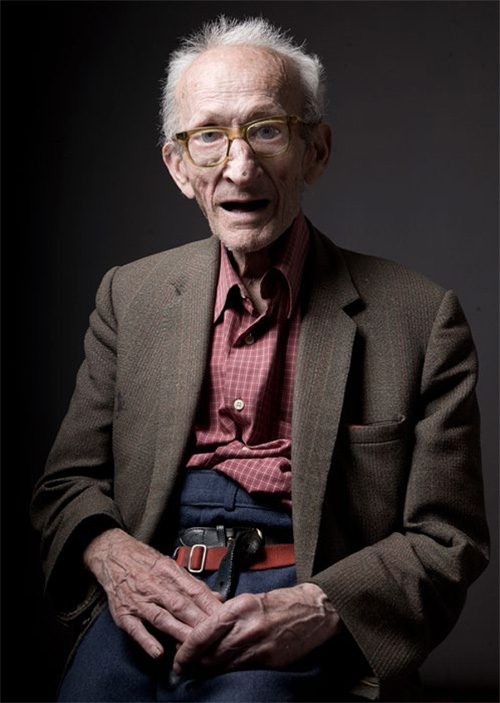
Words by Joseph Markovitch & Photographs by Martin Usborne
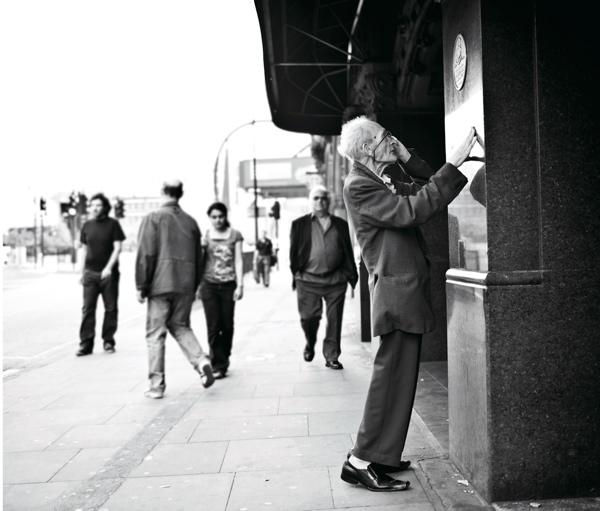
“This is where I was born, right by Old St roundabout on January 1st, 1927. In those days it wasn’t called a hospital, it was just called a door number, number four or maybe number three. The place where I was born, it was a charity you see. Things were a bit different back then.”

“In the old days, when a man went to see the opera he had on a bowler hat. If you were a man and you walked in the street without a hat on your head you were a lost soul. People don’t wear hats any more … but they wear everything else, don’t they?”
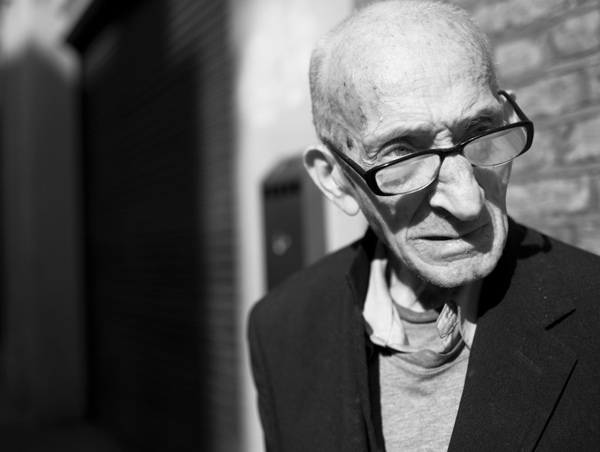
“I worked two years as a cabinet maker in Hemsworth St, just off Hoxton Market. But when my sinuses got bad I went to Hackney Rd, putting rivets on luggage cases. For about twenty years I did that job. My foreman was a bastard. I got paid a pittance. The job was alright apart from that. If I was clever, very clever, I mean very very clever, then I would like to have been an accountant. It’s a very good job. If I was less heavy, you know what I’d like to be? My dream job, I’d like to be a ballet dancer. That would be my dream.”
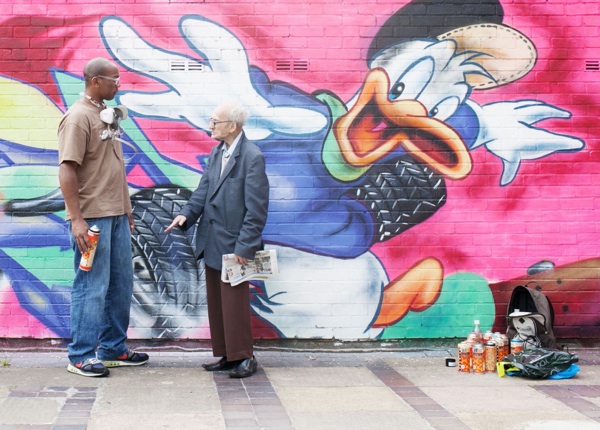
“A lot of young kids do graffiti around Hoxton. It’s nice. It adds a bit of colour, don’t you think?”
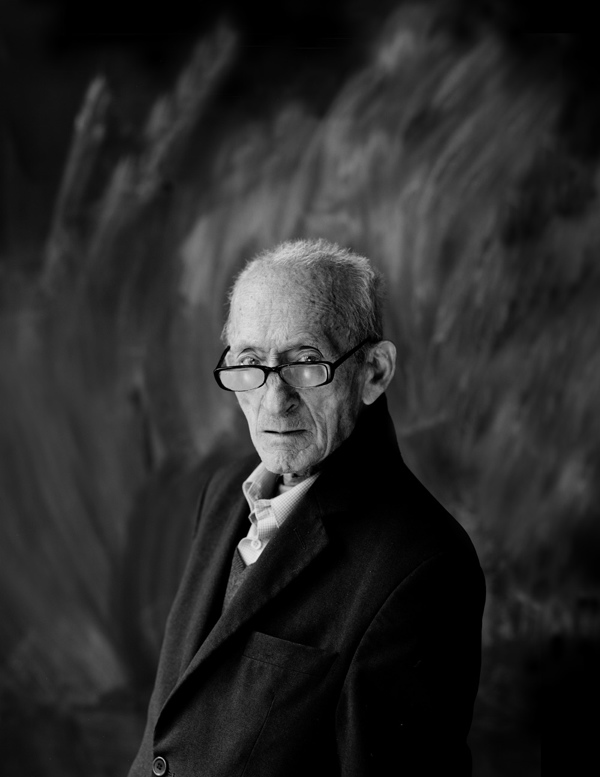
“When I was a kid everyone was a Cockney. Now it’s a real mix. I think it’s a good thing, makes it more interesting. Did you know that I stand still when I get trouble with my chest? Last Saturday, a woman come up to me and said “Are you OK?” and I said, “Why?” She said, “Because you are standing still.” I said, “Oh.” She said she comes from Italy and she is Scots-Canadian, and do you know what? She wanted to help me. Then I dropped a twenty pound note on the bus. A foreign man – I think he was Dutch or French – said, “Mate, you’ve dropped a twenty pound note.” English people don’t do that because they have got betting habits.”
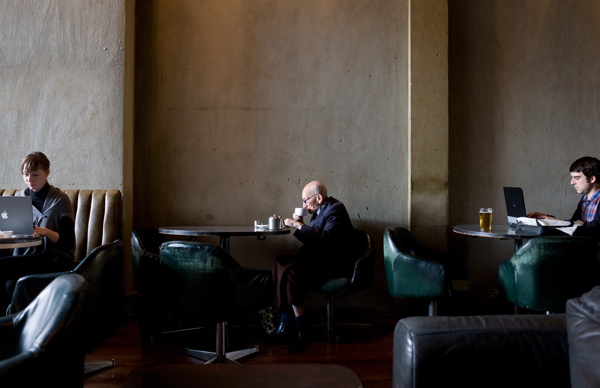
“My mother was a good cook. She made bread pudding. It was the best bread pudding you could have. She was called Janie and I lived with her until she died. I wasn’t going to let her into a home. Your mother should be your best friend. Our best memories were going on a Sunday to Hampstead Heath Fair”
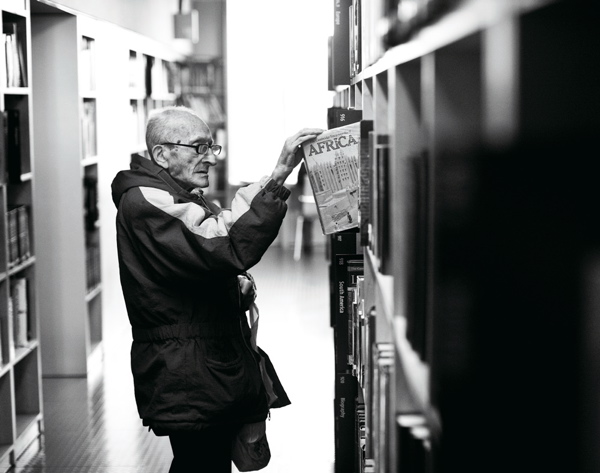
“I like to go to the library on Monday, Tuesday and … Well, I can’t always promise what days I go. I like to read about all the places in the world. I also go to the section on the cinema and I read a book called “The life of the stars.” But I only spend thirty per cent of my time reading. The rest of the time, I like to sit on the sofa and sit quite a long way back so I am almost flat. Did you know that Paul Newman’s father was German-Jewish and that his mother was Hungarian-Catholic? You know Nicholas Cage? He is half-German and half-Italian. What about Joe Pesce? Where are his parents from? I should look it up.”
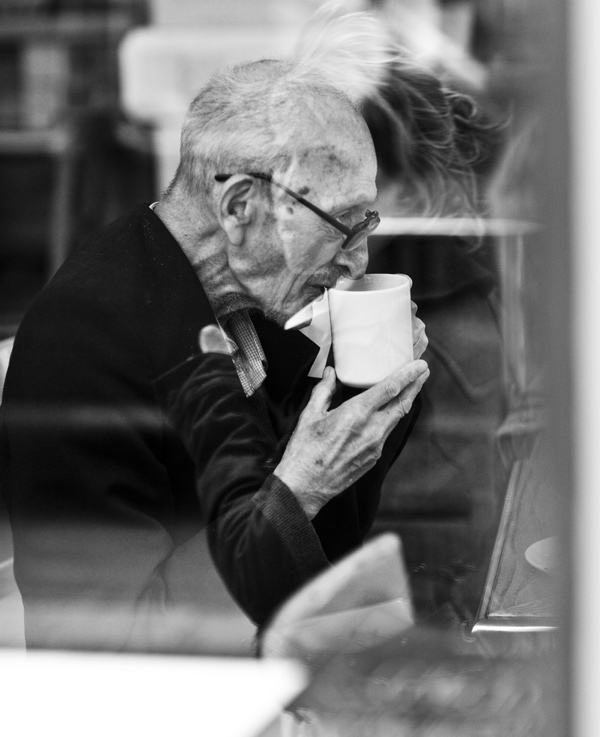
“I’ve never had a girlfriend. It’s better that way. I have always had very bad catarrh, so it wasn’t possible. And I had to care for my mother. Anyway, if I was married, I might be dead by now. I probably would be, if you think about it. I would have been domineered all my life by a girl and that ain’t good for nobody’s health. I’m too old for that now. I would like to have had a girlfriend but it’s OK. You know what? I’ve had a happy life. That’s the main thing, it’s been a good life.”
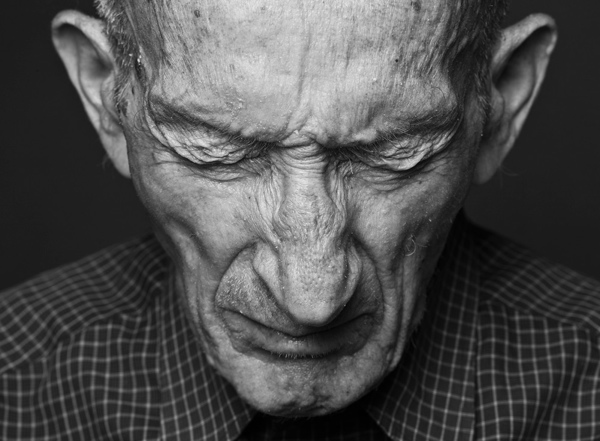
“If I try to imagine the future. It’s like watching a film. Pavements will move, nurses will be robots and cars will grow wings…
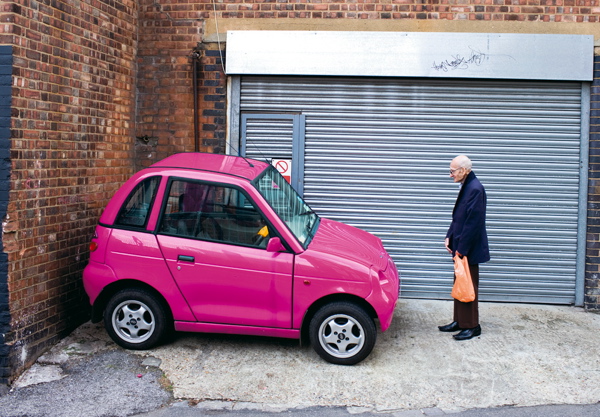
…you’ve just got to wait. There won’t be any cinemas, just computers in people’s homes. They will make photographs that talk. You will look at a picture of me and you will hear, “Hello, I’m Joseph Markovitch.” and then it will be me telling you about things. Imagine that!”
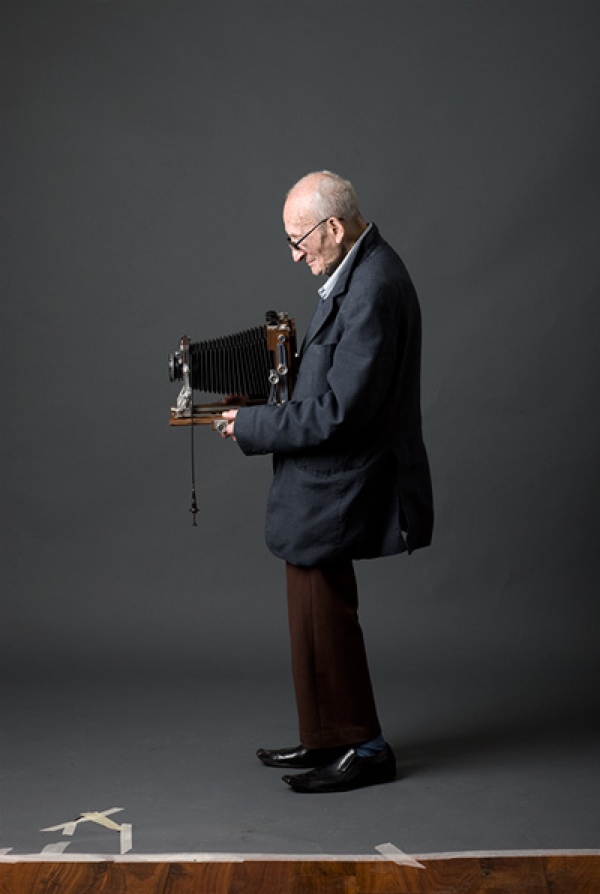
“I’ve seen the horse and cart, I’ve seen the camera invented, I’ve seen the projector. I never starved.”
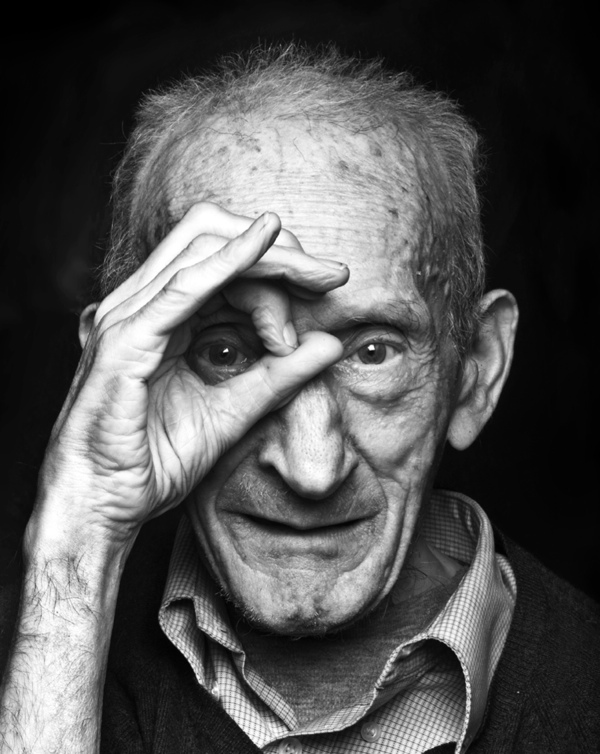
“Lots of things make me laugh. Fruit makes me laugh. To see a dog talking makes me laugh. I like to see monkeys throwing coconuts on men’s heads, that’s funny. When you see a man going on to a desert island and he is stranded the monkeys are always friendly. You think the monkey is throwing things at your head but really he is throwing the coconuts for you to eat.”
Photographs copyright © Martin Usborne
Click here to get your copy of I’VE LIVED IN EAST LONDON FOR EIGHTY-SIX & A HALF YEARS direct from Hoxton Minipress
Row Over Demolition At Geffrye Museum
On the day of the launch of The East End Preservation Society, I tell the story of how the Geffrye Museum came to be founded as the outcome of a row over the proposed redevelopment of the Ironmongers’ Almshouses in the Kingsland Rd a century ago.
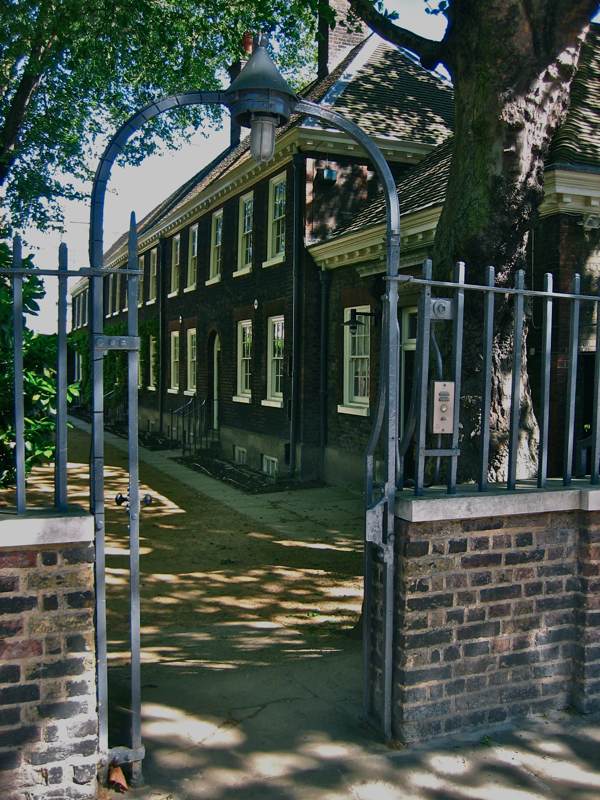
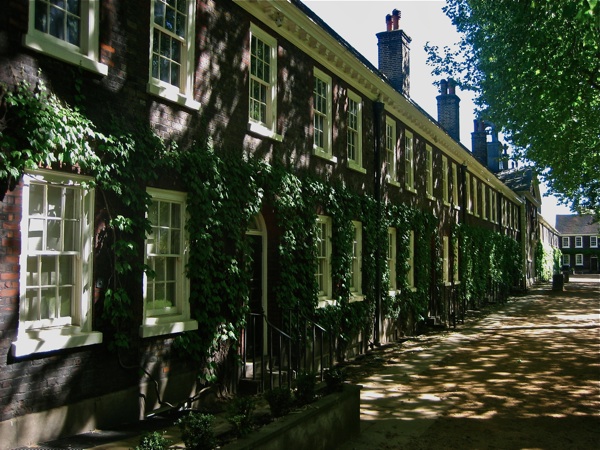
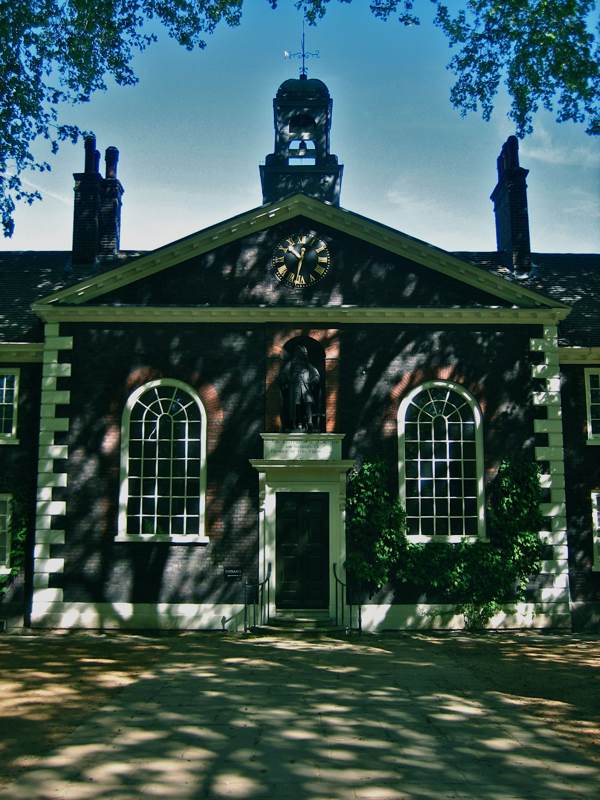
The Geffrye Almshouses – obvious potential for redevelopment?
Discovering a dusty, hundred-year-old file of letters labelled ‘Ironmongers’ Almshouses’ in the archive of the Society for the Protection of Ancient Buildings in Spital Sq recently, revealed to me the long struggle that took place a century ago to save the buildings which house the Geffrye Museum today.
It was a curious experience – both heartening and disappointing in equal measure – to recognise that history repeats itself, as the same arguments are used to justify sacrificing the past, requiring tenacious conservationists to jump through endless hoops to avert destruction of important edifices. How many of the best-loved old buildings only exist today thanks to the efforts of long-forgotten campaigns to save them.
There were once many ancient almshouses to the East of London but, as the city spread and streets were built around them in the nineteenth century, many were sold by their charities and moved beyond the capital. In fact, the two notable remaining examples – Trinity Green in Whitechapel and the Geffrye Almshouses in Haggerston both owe their survival – at least in part – to the intercession of the Society for the Protection of Ancient Buildings.
Perhaps it was because of its wide lawn facing the busy Kingsland Rd that the Geffrye Almshouses continued as a secluded haven for its senior residents long after others in the vicinity had gone. Yet at the end of the nineteenth century – as today in the East End – rising land values became a threat to these venerable buildings of the school of Wren that enshrined an important social endeavour within a gracious aesthetic.
The first hint of the approaching storm came in January 1893, when the Almshouses’ trustees applied to the Charity Commission seeking permission to spend capital upon necessary repairs and were refused. “The Commissioners would suggest the desirability of selling the site of the present Almshouses … to secure the necessary balance of income and expenditure,” came the reply. Yet five years later, the Commissioners reluctantly granted permission and the Almshouses’ future appeared secure.
But in 1899, the Shoreditch Vestry wrote asking if the Ironmongers’ Company had considered selling the site and supplemented their enquiry with a veiled threat of compulsory purchase. They intended to demolish the almshouses to construct an Electricity Generating Station on the site. Only the intervention of the Society for the Protection of Ancient Buildings and the National Trust won assurances from the Ironmongers that they would not sell the Almshouses, and the Power Station was built nearby in Pitfield St. “To replace this sweet and peaceful spot with hideous works is an act of vandalism unworthy of a vestry which has hitherto been in the van of progress,” wrote Septimus Buss, Vicar of Shoreditch.
By now, the Ironmongers had acquired an appetite to realise the monetary value of their property and in 1906 they placed a notice in The Times advertising the site for sale to developers. They signed a provisional agreement with the Peabody Trust for £24,000 who planned to build tenement housing and – as with Mother Levy’s Nursing Home in Underwood Rd last year – Peabody had no interest in retaining or integrating the historic buildings occupying the site. This was in spite of a large petition by local people who wanted the open green space preserved as well as the Almshouses.
Permission from the Charity Commission was required for the sale to go ahead and, in response to objections from preservation groups, they held a public enquiry. Justifying the case for demolition, the Ironmongers claimed a Surveyor had concluded “no expenditure short of rebuilding would put the buildings in a suitable condition as regards accommodation and sanitation.” As part of the case for relocation, they reported that dead cats were frequently thrown over the Almshouses walls and the old women complained of the horrible sights that were to be seen in the houses in Maria St adjoining.
Arguing for preservation, Edwin Lutyens gave the case for the quality of the architecture and Dr Bryett, Medical Officer for Shoreditch revealed that out of six hundred and fifty-one acres in the borough, less than six were open land dedicated to public use. And, following the precedent of the Trinity Green Almshouses, which C.R. Ashbee of the Guild of Handicraft in Bow had campaigned to save ten years earlier, the Commission refused permission for the sale.
The Ironmongers Company demanded an appeal in the Court of Chancery to which opponents were not admitted but where the report of the surveyor, appointed by the Attorney General, was read out. W.D. Caroë wrote, “Architecturally, I consider these almshouses an object lesson in how such buildings should be dealt with. It would be difficult to better them. I have little doubt that when erected they were considered as among the best of their class.” In spite of this, the Court granted that Ironmongers’ appeal had been successful and they were free to sell the property to Peabody, thus introducing more high-density housing to an area already over-populated.
In the event, London County Council used its powers to buy the site of the Almshouses, lobbied by the Parks Committee. Their primary concern was to provide open space as a public amenity, creating children’s playgrounds and opening the site in 1912, without any plan for the use of the buildings. In 1911, a petition for a crafts’ museum had been presented to the Council, signed such luminaries as William de Morgan, Edwin Lutyens, Walter Crane, Richard Norman Shaw and Lawrence Alma-Tadema. The presence of the furniture industry in Shoreditch at that time made it an ideal location for such an enterprise and, displaying artefacts loaned by the Victoria & Albert Museum, the Geffrye Museum first opened its doors in the former Ironmongers’ Almshouses on 2nd January 1914.
It was touching to read the emotional, hand-written correspondence of those who fought over nearly twenty years to save the Geffrye Almshouses, struggling to raise money to further their case and often admitting disillusion, continuing even when they believed their cause was lost. “Two charming old almshouses in the Kingsland Rd are now for sale and likely to be destroyed. I’m afraid it is hopeless to try to save them but that is for you to decide,” wrote one passionate correspondent, enclosing a cheque for the fighting fund in August 1906. “I fear there is little probability of our being able to save the buildings,” confirmed Thackeray Turner, Secretary of the Society for the Protection of Ancient Buildings in September 1906.
Yet it was the enlightened vision and moral courage of those campaigners that ultimately led to the creation of the Geffrye Museum, and – as we approach the centenary of its opening in a few weeks time – I can only wonder what they might have made of the irony of this year’s battle in a similar vein to prevent the Geffrye itself from demolishing the Marquis of Lansdowne, an historic building in its own possession.

The Ironmongers’ Almshouses, 1714

The Daily Chronicle, February 2nd 1899
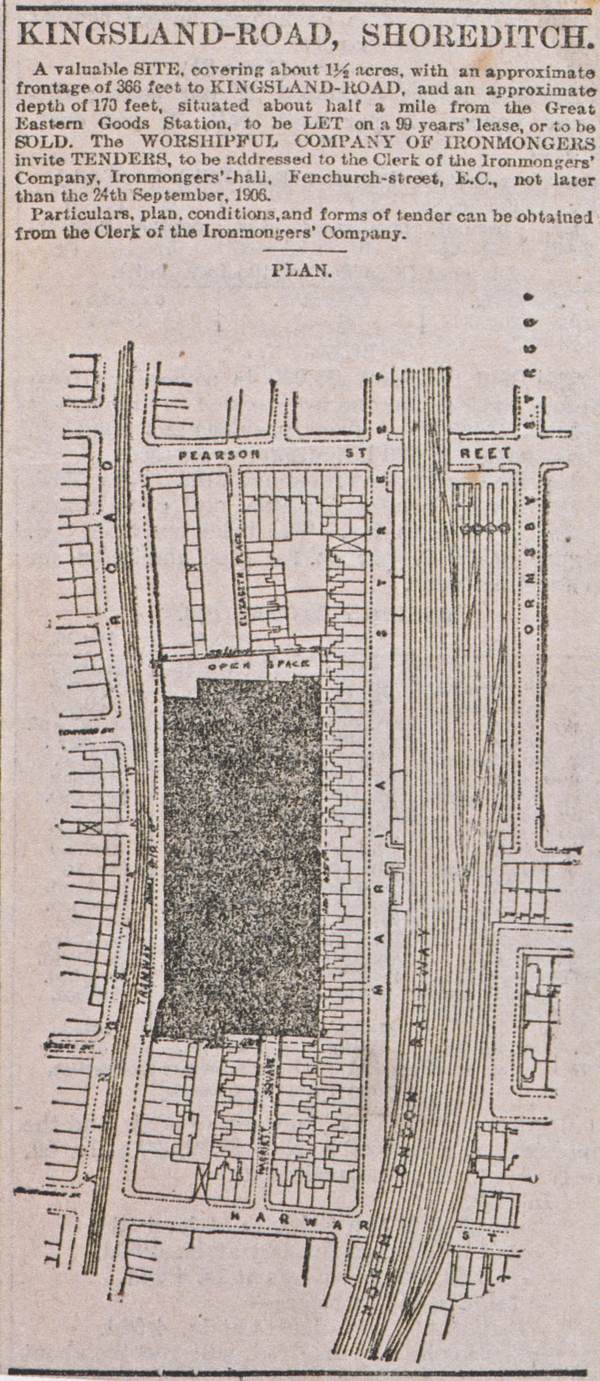
Prime redevelopment opportunity in the heart of bustling Shoreditch as advertised in The Times, August 23rd 1906
Archive material courtesy of The Society for the Protection of Ancient Buildings
Launch of The East End Preservation Society in the Main Hall at the Bishopsgate Institute tonight, Wednesday 27th November 6:30pm
You may also like to take a look at
The East End Preservation Society
Letters from the Archive of The Society for the Protection of Ancient Buildings
Remembering The Queen Elizabeth Children’s Hospital
The Pub That Was Saved By Irony
So Long, Spitalfields Fruit & Wool Exchange
So Long, Mother Levy’s Nursing Home
So Long, Abdul Mukthadir
This is a sad week in Spitalfields as I must report to you the tragic death of Abdul Mukthadir – known as Muktha. In recent years, Herb & Spice Curry Restaurant in White’s Row, where Muktha worked as a waiter, became a popular destination with people coming to be regaled by his famous storytelling abilities. He always waved to me as I passed and I shall not be able to walk down White’s Row without thinking of him there.
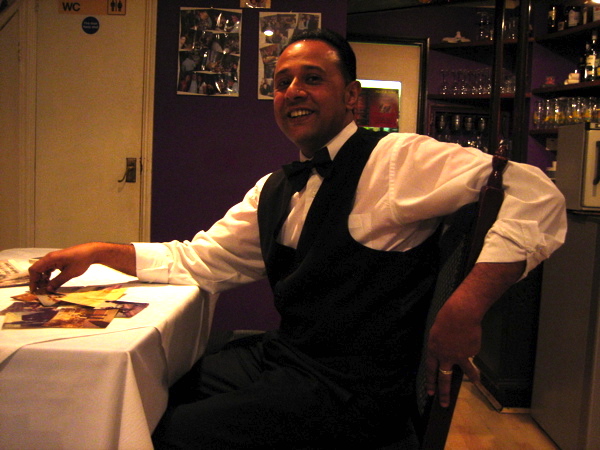
The charismatic Abdul Mukthadir – widely known as Muktha – was a born storyteller, blessed with a natural eloquence. As I quickly discovered when I sat down with him in the brief stillness of the afternoon, while the last diners emptied out of Herb & Spice Indian Restaurant in Whites Row. The businessmen were still finishing off their curry in the other half of the restaurant, whilst in a quiet corner Muktha produced a handful of old photographs and discreetly spread them out on the table to begin. Our only interruption was a request for the bill and once it had been settled, in the silence of the empty restaurant, Muktha’s story took flight.
“I came to Spitalfields in 1975 when I was ten years old. My father got married one day when he went back home to Bangladesh, it was an arranged marriage. At the time I was born, he was working in this country. He didn’t see me until two years later when he came back again and stayed for three months. I have another two sisters, and a brother born here.
My father missed his family, so once he got his British citizenship and he had the right to stay in this country, he made a declaration to bring us over and my mother had a big interview at the British consul in Dhaka. When we came we had nowhere to stay, my father shared a room with three others in Wentworth St. The other gentlemen moved into the sitting room and gave one room for us all to live there. After three weeks my father went to the GLC office in Whitechapel (where we used to go to pay the rent), and they gave us a one bedroom flat in the same street without a bathroom, and a loo in the passageway shared by two households, for £1.50 a week. My father earned £55 as a presser in the tailoring industry, and supporting a family on it was really difficult. On Saturday, he gave us each 10p and we used to go to the Goulston St Public Baths. They gave you a towel, a bar of soap and a bottle of moisturiser, and you could change the bath water was often as you liked. Six hundred people used to line up. It was very embarrassing for the Asian ladies, so one day my mother called all the ladies in the building into our flat. She said, “We can buy a tin tub so we can bath ourselves at home.” Everyone contributed, and they bought a long tin bath and took it in turns. But there was no hot water, so they worked out a rota, eight ladies put their kettles on at the same time. They put the bath up on the flat roof, and sent the smallest boys round to collect all the kettles and fill the bath. Only the women could do this.
We were not allowed to play outside alone, because of the racist movement. The skinheads used to prowl around the area. We could not go out to play football in the Goulston St playground until after the English boys had gone home, but even then we had to watch out for their return – because anyone might come and snatch our ball or beat us up. One day, my mum came out swearing at them in Bengali, “Leave my boy alone! Let them play!” We had that sort of problem every week, and for us that was the only playground we had. Although we were not allowed out after dark, we used to go to Evening Classes in Bengali on Saturday and Arabic on Sunday. At that time, there was a man who went round with a sack and if he found anyone, he would capture them and ask for a ransom. There were one or two incidents. One day he pounced upon our neighbour’s daughter as she was coming from Arabic. He caught her and tried to put her in the sack and carry her away. She was screaming and we were all at home, everyone came outside and I saw. We saw this three or four times. Between the English kids and the man following us to rape or take us, fourteen was very tough. My people were scared in those days. At that time you couldn’t even go out, it wasn’t safe.
We had to move because they were expanding the Petticoat Lane Market, it was really famous then. So the GLC offered my dad a flat in Limehouse but my father thought it wasn’t safe because there were no other Bangladeshis. Then he refused Mile End, even worse for a Bangladeshi family. Finally, he was offered a flat in Christian St off Commercial Rd. It had four bedrooms and a bathroom, and he fell in love with it. This was in 1979, after the six of us had lived in a one bedroom flat for four years. He was over the moon. I can remember the day we moved. He moved all the furniture in an estate car in five or six trips.
That was how we lived in England in those days. It was tough but it was fun and everyone was more sincere, people spoke to each other. No-one worked on Saturday and everyone used to invite each other round, saying “Come to my home next Saturday, my wife will cook!”
I have hundreds of stories because this is my playground. I belong here, I have so many memories, where I played and where I practised football. If I see a mess in this street, I clear it up because it matters to me. I am a poor man, if I was a millionaire I would do something here – but I am just a waiter, working to pay my mortgage.”
The first of Muktha’s family came to Britain in the nineteen-forties to work in the Yorkshire cotton mills and he married an English woman, a sailor lured by tales of Tower Bridge, the miraculous bridge that rose up to let the ships pass through. And when he returned to East Pakistan, crowds followed him shouting, “He comes from England. Wow!” They nicknamed him “Ekush Pound” because he earned £21 a week as a foreman at a cotton mill in Keighley, and at the request of the mill owner he sponsored eight men to return with him. Thus Muktha’s father and uncle came to Britain, setting in train the sequence of events that led to Muktha working in Herb & Spice Indian Restaurant in Spitalfields serving curry to City businessmen.
A waiter from the age of fifteen, Muktha was distinguished by a brightness of spirit that made him a popular figure among his regular customers, who all hoped that he might join their table at the end of service and enchant them with his open-hearted stories. He became enraptured to speak of Spitalfields, because the emotional intensity of his childhood experiences bound him to this place forever, it was his spiritual home.
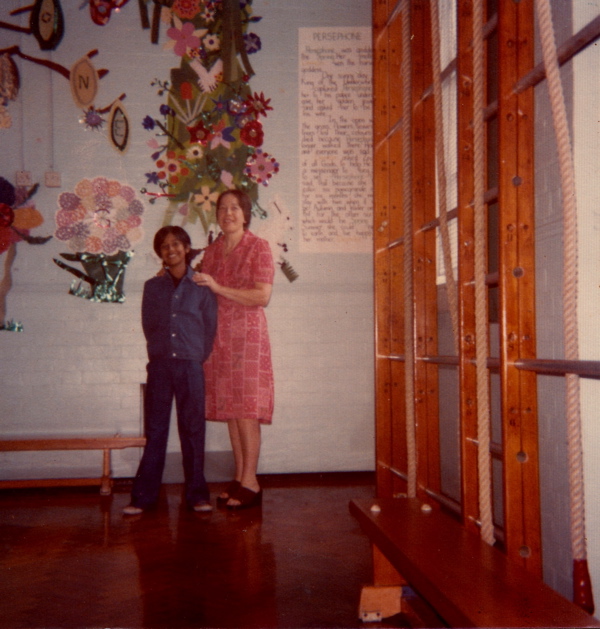
Muktha with his beloved teacher Miss Dixon, “She was like a mother to me.”
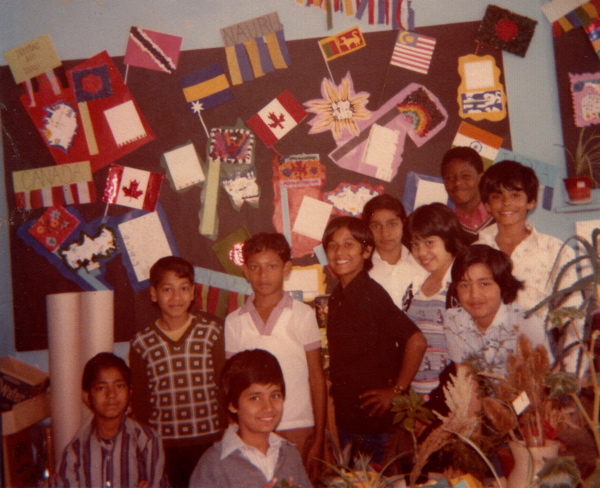
Muktha (centre) with his class at the Canon Barnett School in Commercial Road, 1976.
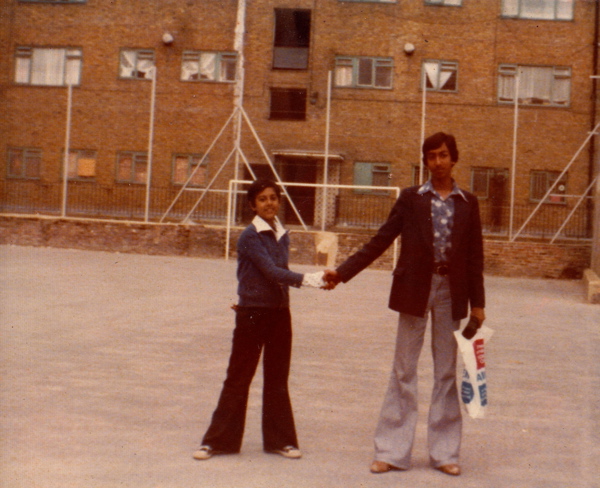
Muktha at the Goulston St playground, with his friend Sukure who became a pop singer and is currently one of the judges of the Bangladeshi X Factor.
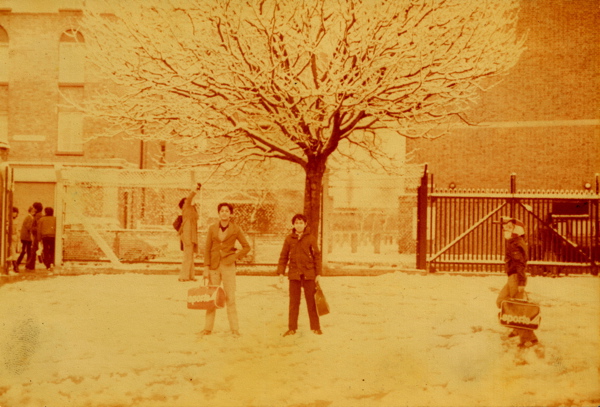
Muktha recalls that the winter of 1979 brought thirteen weeks of snow. (He stands to the left of the tree.)
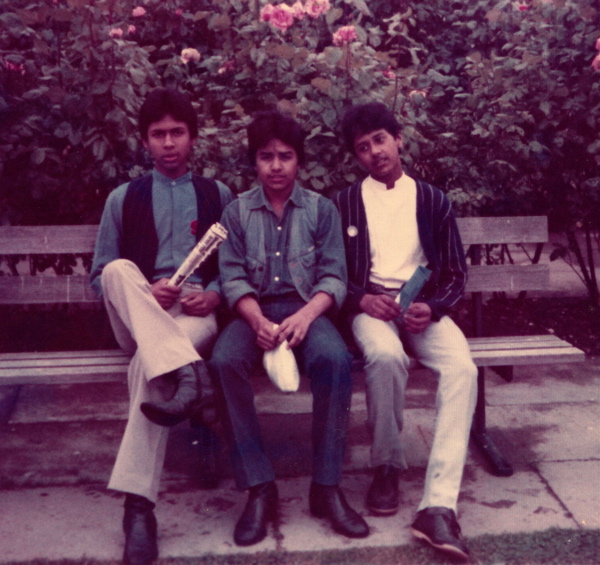
Three friends sitting in the rose garden in Christian St – from left Akthar, Hussein and Mukthar.
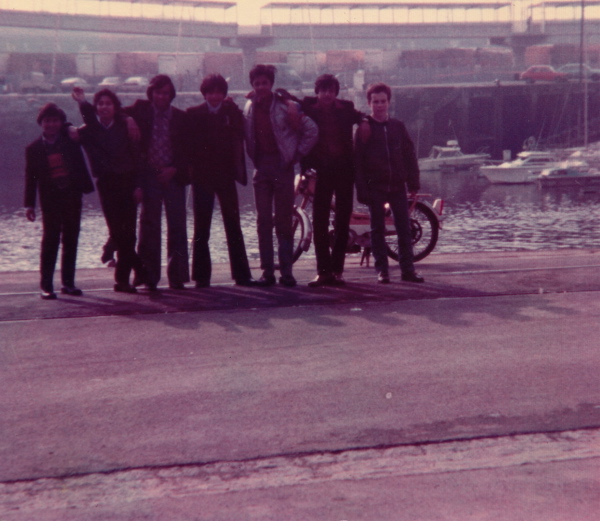
On a day trip to France from the Montifiore School, Vallance Rd in 1980. (Mukthar is in the pale jacket)
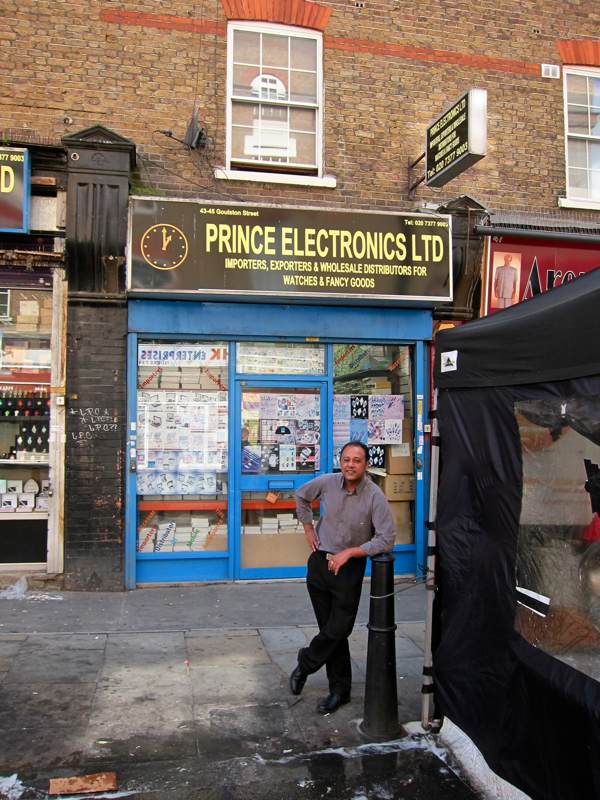
Abdul Mukthadir in Goulston St outside the flat where he grew up
You may also like to read about












