
The Hounds Of Hackney Downs

Please support our crowdfund to publish this splendid book

“A beautiful book about Hackney Mosaic Project will be the best reward for all the people who have worked on the mosaics, bringing their achievement to a wider public and giving them the recognition they so well deserve.”
Tessa Hunkin

I was among the first to admire these canine masterpieces created by Hackney Mosaic Project under the presiding genius of Tessa Hunkin when they were installed on Hackney Downs. Tessa’s design took inspiration from the canine users of the park and proud owners were lining up at once to identify their pets immortalised upon the wall.


The mosaic artists’ names

I was also there when the second instalment of Hackney Mosaic Project’s series of portraits of the dogs of Hackney Downs was installed. When I asked Tessa how it was possible to find so many different ways of portraying dogs in mosaic, she replied that it was simple – the infinite variety of the dogs provided the inspiration.


The mosaic artists
THE HACKNEY MOSAIC PROJECT is seeking commissions, so if you would like a mosaic please get in touch hackneymosaic@gmail.com
Bluebells At Bow
Thanks to more than seventy readers’ contributions we have raised over £5000 since we launched our crowdfund last Saturday.
Click here to learn about our crowdfund to publish this splendid book

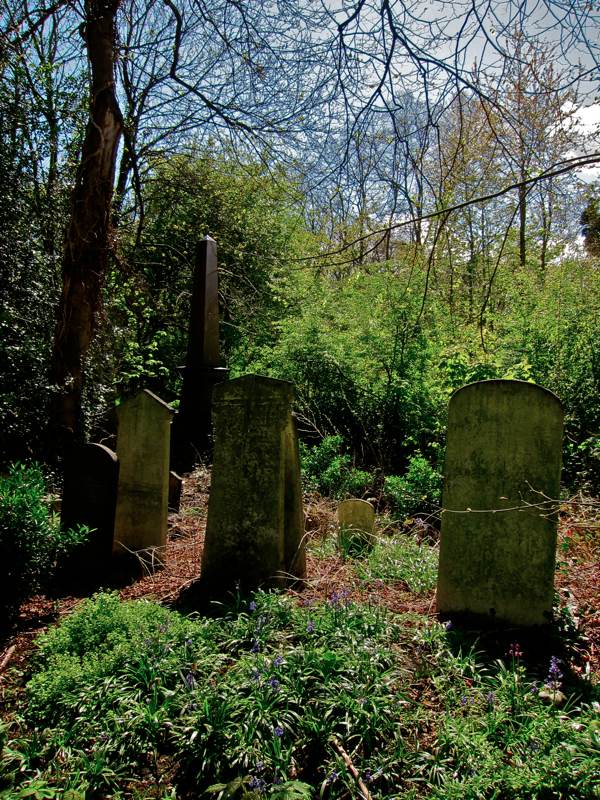
With a few bluebells in flower in my garden in Spitalfields, I was inspired make a visit to Bow Cemetery and view the display of bluebells sprouting under the tall forest canopy that has grown over the graves of the numberless East Enders buried there. In each season of the the year, this hallowed ground offers me an arcadian refuge from the city streets and my spirits always lift as I pass between the ancient brick walls that enclose it, setting out to lose myself among the winding paths, lined by tombstones and overarched with trees.
Equivocal weather rendered the timing of my trip as a gamble, and I was at the mercy of chance whether I should get there and back in sunshine. Yet I tried to hedge my bets by setting out after a shower and walking quickly down the Whitechapel Rd beneath a blue sky of small fast-moving clouds – though, even as I reached Mile End, a dark thunderhead came eastwards from the City casting gloom upon the land. It was too late to retrace my steps and instead I unfurled my umbrella in the cemetery as the first raindrops fell, taking shelter under a horse chestnut, newly in leaf, as the shower became a downpour.
Standing beneath the dripping tree in the half-light of the storm, I took a survey of the wildflowers around me, primroses spangling the green, the white star-like stitchwort adorning graves, a scattering of palest pink ladies smock highlighting the ground cover, yellow celandines sharp and bright against the dark green leaves, violets and wild strawberries nestling close to the earth and may blossom and cherry blossom up above – and, of course, the bluebells’ hazy azure mist shimmering between the lines of stones tilting at irregular angles. Alone beneath the umbrella under the tree in the heart of the vast graveyard, I waited. It was the place of death, but all around me there was new growth.
Once the rain relented sufficiently for me to leave my shelter, I turned towards the entrance in acceptance that my visit was curtailed. The pungent aroma of wild garlic filled the damp air. But then – demonstrating the quick-changing weather that is characteristic of April – the clouds were gone and dazzling sunshine descended in shafts through the forest canopy turning the wet leaves into a million tiny mirrors, reflecting light in a vision of phantasmagoric luminosity. Each fresh leaf and petal and branch glowed with intense colour after the rain. I stood still and cast my eyes around to absorb every detail in this sacred place. It was a moment of recognition that has recurred throughout my life, the awe-inspiring rush of growth of plant life in England in spring.




You may also like to read about
Find out more at Friends of Tower Hamlets Cemetery Park
Easter Procession In Stepney
Thanks to more than sixty readers’ contributions we have already raised over £3,800 since we launched our crowdfund last Saturday.
Click here to learn about our crowdfund to publish this splendid book
Here are some contributor’s comments –
Hoping you make the target as I’d love to buy the book, the mosaics are just so wonderful. Good luck! X
– Alexandra
What a wonderful project! It’s sixty years since I left London to live in the Isle of Man, but I’m very happy to support the creation of these beautiful panels for Londoners to enjoy.
– Valerie
My Granddad lived on a narrowboat on the River Lee at Hackney for about 20 years then moved into the land as he got older and remained in Hackney until he passed away. I am sure he would have loved seeing this.
– Lee
I have admired the beautiful mosaics of Tessa Hunkin for several years now and am particularly happy that they will be recorded for posterity in one of The Gentle Author’s handsome books.
– Gilbert
Adding magic to the city. Thanks Tessa for all the craft and graft behind these magical creations !
– Oliver
These mosaics are beautiful. We’re happy to help.
– Dianne
Thank you for endeavouring to share the beauty of these mosaics with the world!
– Jennifer
Excellent idea and will make a beautiful book.
– Annie
Great project (actual mosaics and book)and look forward to the ‘Women at Work in the East End.’
– Rosie
This book will be a great testament to Tessa’s lovely work.
– Gilly
I’m so inspired by the mosaics I’ve seen. Will be in London next month and hope to visit more of them.
– Carol
I am delighted about this project and very much hope to read the book in due course.
– Sara
Delighted you are doing a book on these beautiful projects.
– Dorothy
Best wishes and luck with this wonderful project.
– Julia
It’s a privilege to be able to support Tessa’s work!
– John
Good luck with this most interesting project.
– Claire
Another beautiful book idea. Thank you.
-Anne
Delighted to support this wonderful project.
– Anne
Wish I could give more, but am only a poor widow woman whose roof is giving out! Tessa’s work is wonderful. Very exciting that it might be taken up in other places.
– Jenny
I love the mosaics done by Tessa’s team and can’t wait to see the book!
– Jill
Every time I visit my daughter in Hackney I pass by one of these marvellous murals. Beautifully designed and put together I can only imagine how inspirational they are for those who make them and who are able to see them every day. All power to the Gentle Author.
– Arabella
Such wonderful work, and such a great project!
– Vivienne
What a wonderful idea to publish a book celebrating Tessa Hunkin’s Hackney Mosaic Project. These community mosaics are a wonderful life-enhancing addition to London life.
– Jenny
Click here to learn about our crowdfund to publish this splendid book

Every Easter, George & Dunstan, donkeys at Stepney City Farm enjoy an outing when they join the Parishioners of St Dunstan’s for the annual procession around the vicinity on Palm Sunday – and, one year, Contributing Photographer Colin O’Brien & I joined the enthusiastic throng on a cold and grey spring morning.
Walking down from Whitechapel, Colin & I followed Stepney Way, which was once a path across the fields used by worshippers when St Dunstan’s was the parish church for the whole of Tower Hamlets. St Dunstan founded it in 952 and it stands today as earliest surviving building after the Tower on this side of London.
At the old stone church, we discovered the wardens were eager to show us their ancient silver, a mace and a staff, with images of St Dunstan, the Tower and a Galleon referring to the days when this was the parish of seafarers. Once, all those who were born or died at sea were entered here in the parish register.
Curate Chris Morgan led off across the churchyard along the fine avenue of plane trees, swinging incense and followed by church wardens, sidesmen, George & Dunstan the donkeys, members of the parish and a solo trumpeter, with the Rector Trevor Critchlow bringing up the rear.
Anyone still nursing a hangover from Saturday night might have been astounded to be awoken by the sound of a heavenly host, and parted the curtains to discover this rag tag parade. Yet it was a serious commemoration of Christ’s entry into Jerusalem in which the streets of Stepney became transformed into the Via Sacra for a morning.
They marched through the empty terraced streets, past the large development site, turned left at the curry restaurant, passing the pizza takeaway and the beauty parlour, before turning left again at the youth centre to re-enter the churchyard. Then there was just time to pet the donkeys before they filed into the church to warm up again and begin Sunday morning prayers. And this was how Easter began in Stepney.

St Dunstan with his metalworkers’ tongs on top of the seventeenth century mace

A galleon upon an eighteenth century staff is a reminder St Dunstan’s was the parish of seafarers

Tower of London upon the reverse of the staff

Sidesmens’ batons from the era of George IV

Julian Cass, Sidesman

Jenny Ellwood, Sidesperson, and Sarah Smith, Parish Clerk

Trevor Critchlow, Rector of St Dunstan’s


Curate Chris Morgan leads the procession


Photographs copyright © Estate of Colin O’Brien
You may also like to read about
Nativity Procession In Spitalfields
Easter Flowers At St Dunstan’s
The Mosaic Makers Of Hackney
Thanks to readers’ contributions we have already raised over £2,800 since we launched our crowdfund on Saturday. Below you can read about the very first Hackney Mosaic Project mosaic created in 2012.
Click here to learn about our crowdfund to publish this splendid book

Next time you are walking up Shepherdess Walk in Hoxton and you pass that sinister tunnel with the worn flagstones, leading under the shabby nineteenth century terrace, I recommend you take courage and pass through it to the park at the other end where a wonderful surprise awaits you.
Artist Tessa Hunkin and around one hundred and fifty people worked for two years to create an elaborate set of mosaics in Shepherdess Walk Park. These breathtakingly beautiful pieces of work are destined to become an attraction in their own right – drawing people from far and wide to this corner of Hoxton – but before the crowds arrived, I had the pleasure of going over to admire them in the company of Tessa and couple of the stalwart mosaic makers, as they contemplated the completion of their mighty task which has transformed an unloved part of the park into an inspirational spot.
Taking the lyrical name of Shepherdess Walk as a starting point, the first mosaic portrays the shepherdesses that once drove their sheep through here when Hoxton was all fields. Next to this, a double wall panel illustrates park life throughout the seasons of the year in the East End while, underfoot, a pair of pavement mosaics show the wild flowers that persist, all illustrated in superb botanic detail. The quality of execution and subtle sense of colour in Tessa Hunkin’s designs combine with humorous observation of the detail of the social and the natural world to create works of lasting value which residents of Hoxton can enjoy for generations to come.


Ken Edwards
“That’s my little rabbit, I named him ‘Randy.’ I’ve been coming here for over a year but, the first time, I thought it was something I wouldn’t be able to do. Yet Tessa showed me how to do it and I’ve been coming ever since. We work each Wednesday and Thursday afternoon, and every other Saturday when the youngsters from the Estate come to help. Even when you are not here, it’s what you think about. I live over in Well St and I walk here. Coming here, it helps with your sanity. We talk, we laugh, we joke. I love coming here, it’s very therapeutic, it’s a family atmosphere. I was a painter and decorator before and when you paint a flat that’s it, but this work that we’ve done is going to be here long after we’ve all gone and that’s very important to me.”


Katy Dixon
“I joined the summer before last. I am an artist and maker and I believe that art can heal people. We work as a group and enjoy the art of conversation together, and I imagine that’s how people would have worked on mosaics a long time ago in Pompeii. We like to listen to music while we work but it’s not always easy to find music that we can all agree upon. We tend to listen to reggae because it has an earthy quality.”


Tessa Hunkin
“We’ve made a little bit of Carthage here in Hoxton. I was inspired by the Roman mosaics of North Africa. It was my idea, I’ve been making mosaics for twenty-five years and I started working with people with mental health problems. I like working with groups of people on large compositions that they can be proud of. Mosaic-making is very time-consuming and laborious, so it seemed a good idea to work with people who have too much time, for whom filling time can be a problem. Also, I’m very interested in the historical precedents and that gives the work another dimension. This project started in July 2011 and it was going to be for six months but, when we came to end of the first mosaic nobody wanted the empty shop that is our workshop, so we just carried on.”


Nicky Turner
“When Tessa showed me the work, I thought it was interesting and I wanted to try but, originally, it was only going to be until the end of the year and now I’ve been here two years. I live in Stratford, two bus rides away, but I come two or three times a week. It’s always different here, so I never get bored. I worked on the borders, and I get satisfaction and self-esteem from doing this work.


Work in progress on the new Pitfield St mosaic, celebrating the former Hoxton Palace of Varieties

Nicky shows off his rings.

Ken with the poem he wrote about the mosaics


Katy with one of the sheep she will lead to the ceremony on Thursday, dressed as a shepherdess

The old tunnel from Shepherdess Walk that leads to the mosaics in the park.

Click on this image to enlarge

Click on this image to enlarge
Spring At Spitalfields City Farm
Click here to learn about my crowdfund to publish this splendid book
Contributing Photographer Rachel Ferriman has been documenting the seasons at Spitalfields City Farm

At last, the spring that we all been yearning for has indubitably arrived and Spitalfields City Farm is open to east enders seeking solace, young and old waiting in eagerness to reacquaint themselves with Nature.
It was my pleasure to be greeted at the farm gate by development manager Jamie Morrish who kindly took me on a ramble around the precincts. With his worn tweed jacket and white beard, he looks the very picture of a rural retainer yet he revealed he is fascinated by the urban cobbled roads traversing the site, remnants of the streets that once stood where now are fields. ‘They tell a story of what used to be,’ he explained, ‘and I think that’s important.’
Already the vegetable patch at the farm is full of life, with lines of Swiss Chard flourishing, and potatoes, beetroot, onions and broad beans on the way. ‘As an experiment we are trying out a variety of different vegetables to see which things work,’ Jamie explained proudly. ‘It’s a bit of fun because when you see all these coloured leaves, it’s really attractive. We’re going to have an amazing array this year and we’re going to be producing salad boxes for local people.’
I was very impressed by the way rainwater is collected on the roof of a shed and drains along the gutters to pipes which run underneath the vegetable patch, automatically watering the plants. Jamie led me into a polytunnel where shiny green lettuces flourished in the humid moist atmosphere. Outside, the crab apples were heavy with pink blossom and, despite the late frosts, a plum tree had already developed hundreds tiny green fruit covering the branches. ‘It’s going to be good year for fruit,’ Jamie exclaimed in delight. ‘We’re in a warm pocket here.’
‘We’re going to plant a long border for bees and birds,’ he continued introducing a new idea and showing me a rectangle of bare soil. ‘We focus a lot on production for humans to eat and now we are going to pay attention to the needs of bees and birds. This is going to be a perennial bed and will take a few years to mature.’
A loud chorus of birdsong accompanied our ramble, interrupted only by the trains of the East End London line passing close by on their journey between Whitechapel and Shoreditch High St.
Jamie introduced me to a pair of handsome Buff Orpington chicks only a few weeks old. ‘One was born with splayed legs, so we splinted his legs together,’ Jamie admitted protectively. ‘When he hatched, he couldn’t balance, he kept tipping over and falling on his back, but Emma took care of him by bandaging his legs and, now his legs have straightened, he’s fine. He’s grown quite big.’
Thus I present my evidence to you, should you require it, that – after a few stumbles – spring has truly arrived in Spitalfields.

Crab apple in flower


Beatrix lost her right ear but survived a dog attack as a lamb in Surrey six years ago

Sarah, one of the volunteers


Buff Orpington chicks at five days old

One of the Buff Orpington chicks, around two weeks old


Patricia watering


Tess with freshly harvested Chard leaves


Tanya & Tess in the potting shed


Bella, the farm cat, dozes in the warmth of a polytunnel


Holmes, the kune kune pig, emerges for spring


Photographs copyright © Rachel Ferriman
Cover design by Friederike Huber
Since 2012, I have followed the exemplary work of Tessa Hunkin’s Hackney Mosaic Project which has been responsible for some of the most witty and imaginative mosaics of recent years.
Please help me publish a handsome hardback monograph this autumn to honour the work of the hundreds of local people who have come together over the past decade to contribute their time and creativity to this magnificent collective endeavour to beautify Hackney.
Click here to support TESSA HUNKIN’S HACKNEY MOSAIC PROJECT
In a bold reinvention of the classical tradition, designer Tessa Hunkin has assembled a passionate and diverse team of makers, creating dozens of breathtaking mosaics that have become cherished landmarks, celebrating community and elevating the streets of East London.
Hackney Mosaic Project has led the contemporary renaissance of the art of mosaic and this inspirational collection will reveal the scope of their phenomenal achievement for the first time, ranging from modest pieces in private gardens to expansive murals and pavements in public parks.
I want this book to take the story of Hackney Mosaic Project to the widest audience and inspire a flowering of community mosaics across the land.
The book will include high quality photographs of all the major mosaics, an interview with Tessa Hunkin outlining the nature of the project, commentary on the background to each mosaic by Wendy Forrest, illustrations of the working process by which the mosaics are created, a map showing the locations of the mosaics, and the names of everyone involved.
Click here to support TESSA HUNKIN’S HACKNEY MOSAIC PROJECT
All money raised will go towards the design, printing and promotion of the book and income from sales will go to towards publication of our next title Women at Work in the East End by Sarah Ainslie next year. We print within Europe on paper from sustainable sources and have established relationships with booksellers and distributors, locally and nationally.

The launch of the Shepherdess Walk Mosaic

A panel of the Shepherdess Walk mosaic
At the launch of the Hounds Of Hackney Downs mosaic
A panel of the Hounds of Hackney Downs mosaic

The playground shelter on Hackney Downs

Hackney Mosaic Project at London Zoo

Mural on Somerford Grove Estate

Pavement in Regent’s Park

Tony Armstrong Jones’ East End

Click to book for my tour of Spitalfields this Saturday 12th April
Click to book for my tour of Petticoat Lane on Saturday May 2nd
Click to book for my tour of the City of London on Sunday 18th May
Tony Armstrong Jones (1930-2017) is remembered today as Lord Snowdon, husband to Princess Margaret, yet – before all that royal hullabaloo took over his life – he was a jobbing photographer in his twenties and took these photographs of the East End, as published in his book LONDON in 1958.

Cheshire St

Sclater St Market, Sunday Morning

Bomb site, St Mathias School, Bethnal Green

Rathbone St Market, Canning Town

Rathbone St Market, Canning Town

Garage hand, Stepney

The Magpie & Stump, Cable St

The Railway Tavern, West India Dock Rd – open 6am to 8am

Cafe in East India Dock Rd

Wens Cafe, Bethnal Green

Tattoo parlour

Tower of London

Smithfield Market

Christmas in Cable St

Pub in Cable St

Juke Box Dance

Deuragon Arms, Hackney

Bethnal Green Rd
Photographs copyright © Estate of Tony Armstrong Jones
You may also like to read about


