
Ahmet Kamil, Shoe Repairer

“I always trust my work”
One of the most popular characters around Newington Green in recent decades has been Ahmet Kamil. His modest repair shop is firmly established as a local hub where everyone is constantly popping in and out to get news, exchanging the time of day and having their shoes mended while they are about it too. At the end of a fine seventeenth century brick terrace, tucked in beneath a green awning, Ahmet’s premises have not changed for as long as anyone can remember.
Winter is the busy season for Ahmet and rainy days in summer can send people into his shop too, so I took advantage of yesterday’s sunshine to pop over to Newington Green and have a chat with him while the business was quiet. Possessing a soulful charisma and a generous spirit, Ahmet spoke his thoughts to me as he continued with his work and I enjoyed my morning in the peace of his beautiful workshop, offering a calm refuge from the clamour of the traffic outside heading up to Stoke Newington.
“This is a family business, we’ve been here about thirty years – maybe more. My father Sattretin Kamil started it up and passed it onto me, his son. Then I took over and now my son, Tevfik Kamil, will follow me. He hasn’t fully taken over yet but he will do so. He tried other things but he’s not been happy with them, so now he’s got interested in this and has decided to do it.
My father Sattretin made shoes by hand in Cyprus, he learnt it when he was only twelve years old and, after he came to this country at thirty-five, he couldn’t get a job so he decided to make shoes here. But he was advised that mending shoes might be easier and more profitable. He had four shops – in New Cross, Charlton, Hornchurch, and this one, all run by the family. After my father retired, we cut back to just this and the one in Charlton. When my son takes over, he’ll be here and I’ll be in Charlton.
I was twenty-five when I decided to give my father a hand and the business just stuck on me – he didn’t push me into it. Because everything’s done by hand, the more you do, the more you like it. Over the years there has been no real competition. If you trust the quality of your work there will never be any competition. I do everything by hand and my work is quality. There are chains with fifty or hundred branches where they do poor quality shoe repair and key cutting, and charge more money. My customers often complain to me about them. I always trust my work.
Shoes are getting more expensive and people’s habits are changing with time. They’re taking more care of their shoes, not throwing them away and getting a new pair – so there is a tendency to repair. Also, there’s a lot of secondhand shops popping up and people are buying old shoes, but the leather dries out and comes away from the sole, and stilleto heels get brittle and smash – and, as a consequence, they are bringing them to me. There’s a healthy future in it, yet there are easier jobs than this in which you can make better money. I’ve always thought of shoe repair alongside dry-cleaning, those shops make more money for less work. We are under pressure with the rent that is constantly going up and the price of materials, but we try to keep the service as cheap as we can.
Not many people will do shoe repair, you have to be fully committed and make good quality shoe repairs, and the work grows on you. But it’s the most difficult job you can do. It’s dirty and it’s hard work. While I was playing football until the age of thirty-five, I never had any aches and pains, but now standing still I get back ache. It’s midday and I’ve been working since nine o’clock – see how dirty my hands are. I work six days a week all year round. I’ve never had a Saturday off in thirty years. I’d like to go and watch the football, but instead I listen to it on the radio and watch the highlights.
You make a lot of friends. I’ve met a lot of people doing this work and many of my customers call me by my name. I’ve just recently been in hospital for an operation for ten days and my son was running the shop, and everybody was coming round, asking about me, ‘Where is he?’ So they are not just customers. Every year I take four weeks off in August and go back to Cyprus. When I come back again, everyone brings in their shoes. They say, ‘We wouldn’t take them anywhere else.’ They tell me, they wait until I come back because of the friendship. That’s the bond I have with my customers.”


“Because everything’s done by hand, the more you do, the more you like it”

“I’ve never had a Saturday off in thirty years”


“It’s midday and I’ve been working since nine o’clock – see how dirty my hands are”

“You make a lot of friends”


At the end of a fine seventeenth century brick terrace, tucked in beneath a green awning, Ahmet’s premises have not changed for as long as anyone can remember.
Shoe Repairs, 52 Newington Green, N16 9PX
You may also like to read about
The Mosaic Makers Of Hackney Downs

You may recall my friends the Mosaic Makers of Hoxton, led by artist Tessa Hunkin, who created the beautiful murals in Shepherdess Walk and Pitfield St last year. Now they have moved up to Hackney Downs, establishing their workshop in the pavilion and applying their magical talents to decorating an open air theatre in the children’s playground.
Already one panel is complete and I discovered Tessa and her team hard at work to fulfil their ambition of covering the entire theatre with mosaic by the autumn. Inspired by a trip to Jordan, Tessa revealed to me that her design is “loosely based upon Roman hunting scenes, but without the blood.” Each of the mosaic makers undertakes to create one of the animals and Tessa’s role is to unify their contributions into a harmonious whole. Up here at the top of Hackney, upon what was once an ancient piece of common land, it makes complete sense to come upon these fearsome wild creatures rendered in such magnificent timeless style.
Stalwarts from Hoxton, Nikky Turner and Ken Edwards were there to greet me as I entered the workshop where the mosaic makers sat around a large table, joined by new members as the enthusiastic band has grown. A hush of concentration prevailed, broken only by the incessant snapping of terrazzo being cut to size, rather like that of a band of squirrels cracking nuts. Two days a week you will find them there in the pavilion on Hackney Downs, and every other Saturday afternoon when anyone is welcome to lend a hand. “Being here in the park, we’ve had a quite a lot of local people come to join us,” Tessa admitted, “people between jobs or off work for some reason – and lots of Italians, mosaic is a magnet for Italians.”
Even as I sat with the mosaic makers, a man on a bicycle leaned in to deliver his verdict on the work so far. “If that mosaic was a meal, it’d be from a Michelin starred restaurant,” he declared authoritatively and cycled off down the path, leaving the makers to continue with their work in placid silence.
It has been inspiring to see Tessa Hunkin’s skilfully wrought mosaics come to fruition in recent years, enriching the environment of the East End with their lyrical imagery – and rare to come across works of art that successfully combine such a sophisticated aesthetic flair with a genuine popular appeal. Even with only one panel finished, it is already possible to deduce how spectacular the entire work on Hackney Downs will be and now I cannot wait to go back after the summer and see it complete.


Ken Edwards made the lion

Design for a side panel

Gabi made the leopard

Design for a side panel

Nikky Turner made the monkey

Design for the back wall by Tessa Hunkin
You may also like to read about
John Stow’s Spittle Fields, 1598

To pass the time while awaiting the arrival of Bob Mazzer’s Underground from the printers for next week’s launch on Thursday 12th June, I visited the Bishopsgate Institute yesterday to study the 1599 copy of John Stow‘s Survey Of London.
It was touching to see the edition that John Stow himself produced, with its delicate type resembling gothic script, and sobering to recognise what a great undertaking it was to publish a book four hundred years ago – requiring every page of type to be set and printed by hand.
Born into a family of tallow chandlers, John Stow became a tailor yet devoted his life to writing and publishing, including an early edition of the works of Geoffrey Chaucer who had lived nearby in Aldgate more than a century earlier. In Stow’s lifetime, the population of London quadrupled and much of the city he knew as a youth was demolished and rebuilt, inspiring him to write and publish his great work – a Survey that would record this change for posterity. Consequently, on the title page of the Survey, Stow outlines his intention to include “the Originall, Antiquity, Increase, Modern estate and description of that citie.”
Yet in contrast to the dramatic changes he witnessed at first hand, John Stow also described his wonder at the history that was uncovered by the redevelopment, drawing consolation in setting his life’s experience against the great age of the city and the generations who preceded him in London .
SPITTLE FIELDS
There is a large close called Tasell close sometime, for that there were Tasels planted for the vse of Clothworkers: since letten to the Crosse-bow-makers, wherein they vsed to shoote for games at the Popingey: now the same being inclosed with a bricke wall, serueth to be an Artillerieyard, wherevnto the Gunners of the Tower doe weekely repaire, namely euerie Thursday, and there leuelling certaine Brasse peeces of great Artillerie against a But of earth, made for that purpose, they discharge them for their exercise.
Then haue ye the late dissolued Priorie and Hospitall, commonly called Saint Marie Spittle, founded by Walter Brune, and Rosia his wife, for Canons regular, Walter Archdeacon of London laid the first stone, in the yeare 1197.
On the East side of this Churchyard lieth a large field, of olde time called Lolesworth, now Spittle field, which about the yeare 1576 was broken vp for Clay to make Bricke, in the digging whereof many earthen pots called Vrnae, were found full of Ashes, and burnt bones of men, to wit, of the Romanes that inhabited here: for it was the custome of the Romanes to burne their dead, to put their Ashes in an Vrna, and then burie the same with certaine ceremonies, in some field appoynted for that purpose, neare vnto their Citie: euerie of these pots had in them with the Ashes of the dead, one peece of Copper mony, with the inscription of the Emperour then raigning: some of them were of Claudius, some of Vespasian, some of Nero, of Anthonius Pius, of Traianus, and others: besides those Vrnas, many other pots were there found, made of a white earth with long necks, and handels, like to our stone Iugges: these were emptie, but seemed to be buried ful of some liquid matter long since consumed and soaked through: for there were found diuerse vials and other fashioned Glasses, some most cunningly wrought, such as I haue not seene the like, and some of Christall, all which had water in them, northing differing in clearnes, taste, or sauour from common spring water, what so euer it was at the first: some of these Glasses had Oyle in them verie thicke, and earthie in sauour, some were supposed to haue balme in them, but had lost the vertue: many of those pots and glasses were broken in cutting of the clay, so that few were taken vp whole.
There were also found diuerse dishes and cups of a fine red coloured earth, which shewed outwardly such a shining smoothnesse, as if they had beene of Currall, those had in the bottomes Romane letters printed, there were also lampes of white earth and red, artificially wrought with diuerse antiques about them, some three or foure Images made of white earth, about a span long each of them: one I remember was of Pallas, the rest I haue forgotten.I my selfe haue reserued a mongst diuerse of those antiquities there, one Vrna, with the Ashes and bones, and one pot of white earth very small, not exceeding the quantitie of a quarter of a wine pint, made in shape of a Hare, squatted vpon her legs, and betweene her eares is the mouth of the pot.
There hath also beene found in the same field diuers coffins of stone, containing the bones of men: these I suppose to bee the burials of some especiall persons, in time of the Brytons, or Saxons, after that the Romanes had left to gouerne here. Moreouer there were also found the sculs and bones of men without coffins, or rather whose coffins (being of great timber) were consumed. Diuerse great nailes of Iron were there found, such as are vsed in the wheeles of shod Carts, being each of them as bigge as a mans finger, and a quarter of a yard long, the heades two inches ouer, those nayles were more wondred at then the rest of thinges there found, and many opinions of men were there vttred of them, namely that the men there buried were murdered by driuing those nayles into their heads, a thing vnlikely, for a smaller naile would more aptly serue to so bad a purpose, and a more secret place would lightly be imployed for their buriall.
And thus much for this part of Bishopsgate warde, without the gate.

A copper coin from the Spitalfields Roman Cemetery that I wear around my neck

Bishopsgate Ward entry by John Stow in his Survey of London


Monument to John Stow in St Andrew Undershaft
Archive images courtesy Bishopsgate Institute
Photograph of Stow’s monument copyright © Colin O’Brien
You may also like to read about
At H Brettell & Sons Ltd

Rob Brettell, fifth generation in the family wood-turning business
Contributing Photographer Alex Pink & I made a trip over to Forest Gate recently to visit H Brettell & Sons Ltd, one of the East End’s most venerable wood working companies, founded in 1830 in Haggerston by Henry Brettell, a descendant of a long line of Huguenot cabinet makers.
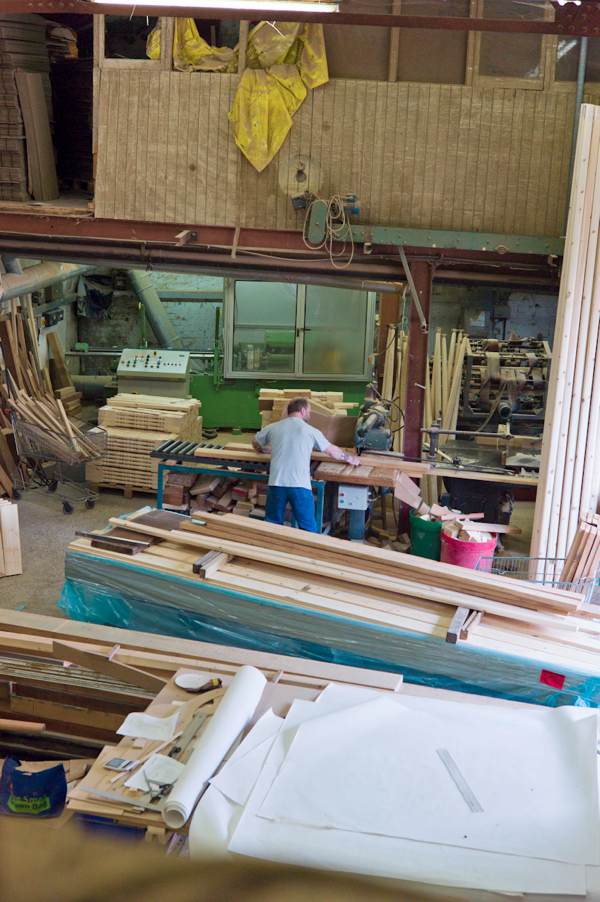
“What I am known for is square wood turning,” announced Rob Brettell – the current incumbent – once he had led us through the large and picturesque ramshackle factory, with ivy growing through the roof, and up into the loft where he stores the precious examples of his handiwork. At first, I thought Rob might be having me on, as I always understood that wood turning was – by its very nature – round. Yet I discovered I was mistaken, as Rob produced finely-turned banisters and spindles that were square – it was a style I recognised from seventeenth century staircases. “Everyone asks how we do it?” he informed me before I had the chance to open my mouth, “but I’m not going to tell you.”
Unable to pursue this line of enquiry, I commented upon the extravagant greenery intruding through the ceiling. “We call that the hanging gardens of Brettells,” Rob quipped amiably, casting his restless eye around the stockroom and lifting a mallet with a disproportionally long handle, rather like a polo stick. It was a hammer for beating out copper stills in the distilling industry, I learnt. Grabbing an ash stake of arcane design that appeared to be an oar without a paddle, Rob explained that this was a lever used by the Ministry of Defence for prising heavy cargo out of aeroplanes, giving us a vivid demonstration.
Boxes of handmade mallets, shiny and round, drew our attention next and took Rob back to his childhood. “I started at nine in my school holidays,” he admitted to me, “sweeping up the woodchips and banging mallets together, for pocket money. At twelve, I was turning spindles but I had to stand on a box to set up the rotary knife.” The lathe that Rob learned on was acquired by the company in 1916 and is still in use today.
Before the use of plastic became widespread, there was hardly any endeavour that did not require a product made by Brettells. Jewellers used beech handled engraving tools, sat upon traditional three-legged stools and filed rings on wooden bench pegs. Glass merchants cut glass with diamond-tipped cutters in rosewood handles. Brewers used rattan long-handled floggers. The Royal Navy platted rope with Lignum Vitae fids. The Post Office used boxwood date stamps. Pubs had beech lemon boards and rosewood beer pump handles. Judges had wig stands. Morticians used mallets. Wilkinson’s needed sword scabbards. Ronson required lighter bases. And so it went on.
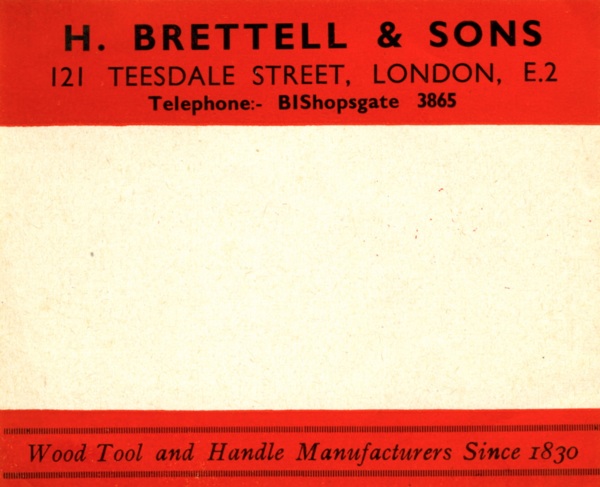
The first Henry Brettell began making tool handles out of scrap timber acquired from the sawmill, where he had workshop in the corner of the yard, in Haggerston. In 1912, his son who was also called Henry, bought a former bakery in Teesdale St, Bethnal Green. Manufacturing for the Ministry of Defence in two wars, Brettells thrived by producing chair legs and table legs throughout the twentieth century. Moving to Forest Gate after the Teesdale St factory was compulsorily purchased for demolition in the fifties, Brettells acquired more rotary lathes and moved over towards the production of stair parts as the furniture industry waned. Today their work is increasingly bespoke, turning spindles to order and specialising in elaborate serpentine wooden hand rails and scrolls created with an expertise no-one else can match.
“I think I’m very lucky – I enjoy working and doing stuff that most people can’t do,” Rob confessed to me proudly, “I have an appetite for a challenge, I say ‘yes’ to a job and then I have to work out how to do it. I can do anything except make a lot of money.”

Henry Brettell who founded the company around 183o, pictured with his second son Will – “They used to throw chisels each other in competition over who would take over the company from their father”


Ellen, Henry junior, James and Henry Brettell senior


Henry James Brettell “Everyone’s got all their fingers here, except grandfather”


Goldstein Hand Turning Lathe

James Bretell




Rob Brettell – “What I am known for is square wood turning”

Square-turned spindles


New photographs copyright © Alex Pink
H Brettell & Sons Ltd, 20-24 Chestnut Avenue, Forest Gate, E7 OJH
You may also like to read about
Discovering the sixteenth century figures of Old King Lud & his sons recently, that once stood upon Ludgate yet are now forgotten in an alley of Fleet St, made me think more closely of the gates that once surrounded the City of London.
So I was delighted to come upon this eighteenth century print in the Spitalfields Market for a couple of pounds with the plangent title “The City Gates As They Appeared Before They Were Torn Down.”
Printed in 1775, this plate recorded venerable edifices that had been demolished in recent decades and was reproduced in Harrison’s History of London, a publication notable for featuring Death and an Hourglass upon the title page as if to emphasise the mutable, ever-changing nature of the capital and the brief nature of our residence in it.

Moorgate (demolished 1761)

Aldgate (demolished 1761)

Bishopsgate (demolished 1760)

Cripplegate (demolished 1760)

Ludgate (demolished 1760)

Newgate (demolished 1767)

Aldersgate (demolished 1617)

Bridgegate (demolished 1762)

The City Gates As They Appeared Before They Were Torn Down, engraved for Harrison’s History of London 1775

Sixteenth century figures of King Lud and his sons that formerly stood upon Ludgate, and stowed ever since in an alley at the side of St Dunstan in the West, Fleet St
You may also like to take a look at
Catalogue Of Destruction

Bulldozers move in on the Queen Elizabeth Children’s Hospital
Recently – as I walked down Cheshire St – I discovered a great hole on the south side, where the week before there had been an unbroken run of nineteenth century buildings between Brick Lane and the Pedley St bridge.
Meanwhile, demolition of the much-loved Queen Elizabeth Children’s Hospital in Hackney Rd has commenced, in preparation for replacing it with a disproportionate building of inferior design that has been approved without any significant public consultation. Later this year in Spitalfields, we also anticipate the demolition of the Fruit & Wool Exchange – against the unanimous wishes of the local council in a scheme pushed through by Mayor of London, Boris Johnson.
Yet this is only the beginning of the destruction that is impending because, like a hungry dog taking bites from a cake, great chunks of the East End are vanishing fast. So I asked Contributing Photographer Simon Mooney to make a survey of just a few of the buildings that are being destroyed, under threat of imminent demolition, or at risk, to highlight the crisis that is at hand.
All around us, characterful nineteenth or early-twentieth century buildings, constructed of brick and stone with featured craft elements, are being replaced with low-quality generic structures designed to maximise profit, to the detriment both of the environment and the quality of life for those destined to inhabit them. Most disappointing is to see proud nineteenth century edifices which embody social purpose replaced by cheap-jack commercial developments that erase the memory of past altruistic endeavour.

Only the facade of the Queen Elizabeth Children’s Hospital will survive in a monster development pushed through without any significant public consultation.


Sunflower frieze upon the oldest part of the hospital constructed in 1874

Georgian terrace in Sun St currently being demolished after years of neglect with only the facade retained

Neglected window frames and fascias in Sun St


When the demolition starts shortly, the Gun pub will be destroyed and the central part of this facade is all that will remain of the Spitalfields Fruit & Wool Exchange designed by in 1927 by Sydney Perks

The new development will replace both Fruit & Wool Exchange and the multi-storey carpark behind


The brick work of the Fruit & Wool Exchange harmonises with the Spitalfields Market next door

In Toynbee St, a terrace of shops with workshops above neglected for decades by Tower Hamlets Council. A consultation for redevelopment, replacing these with a much larger building that straddles the site as far as Commercial St, took place in 2011


Silwex House, Quaker St. A remarkable nineteenth century stable and horse depot containing horse lifts descending to the railway line at the rear


Travelodge is currently undertaking consultation to reduce this building to a facade with a large hotel of generic design behind it. Planning application will be submitted imminently. Click here to see the proposal


113-114 Bethnal Green Rd, a rare pair of eighteenth century weavers’ houses that have suffered many years of neglect


Dignified nineteeth century furniture factory that has been left to rot in Great Eastern St


Warehouses of 1878 in Blossom St destined for demolition as part of a huge development by British Land that will consume this entire block if it goes ahead


Eighteenth and nineeenth century terrace in Bishopsgate threatened by the British Land scheme

The former Nicholls & Clarke art deco showroom in Bishopsgate is at risk

London Chest Hospital is to be sold to developers


Photographs copyright © Simon Mooney
Follow the East End Preservation Society
Facebook/eastendpsociety
Twitter/eastendpsociety
Click here to join the East End Preservation Society
You may also like to take a look at
Remembering The Queen Elizabeth Children’s Hospital
So Long, Spitalfields Fruit & Wool Exchange
Come To Bob Mazzer’s UNDERGROUND!

Less than a year ago, I published the work of an unknown photographer by the name of Bob Mazzer, yet the response to his extraordinary pictures from the hundreds of thousands of readers who have seen them in these pages has now brought him widespread acclaim.
As a result of this huge wave of enthusiasm, and the personal generosity of a number of Spitalfields Life readers in particular, we are able to publish a magnificent large-format two hundred page hardback of Bob’s tube photography entitled UNDERGROUND for £20, coinciding with the opening of his debut London exhibition at the Howard Griffin Gallery, 189 Shoreditch High St.
Please join me in a celebration of this glorious moment, because I want you to be the first to see the show.
Come to the launch of Bob’s book and the opening of his exhibition on Thursday 12th June from 6-9pm. On the night, you can visit the Howard Griffin Gallery – which has been fitted with tube seats in anticipation of the event – and join Bob in the covered yard next door where he will signing books and we will be serving complimentary Truman’s Beer.
To add to the festivities on this tremendous night, buskers and street performers will be performing.


CLICK HERE TO ORDER A COPY OF BOB MAZZER’S UNDERGROUND FOR £20
You may also like to read about


