
A Brief History Of Bishopsgate Goodsyard
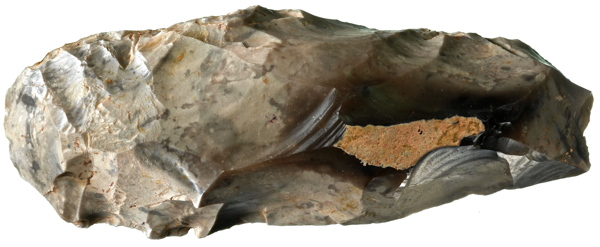
Mesolithic tranchet adze discovered at Bishopsgate Goodsyard
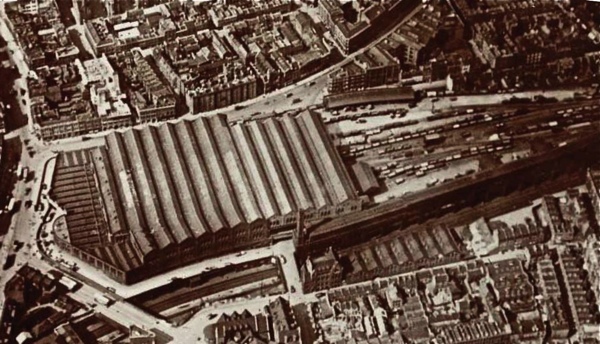
Bishopsgate Goodsyard c.1910
There are many continuities that run through time in Spitalfields, yet the most disturbing is the history of brutal change which has been wreaked upon the neighbourhood over centuries.
The Hospital of the Priory of St Mary – from which the name Spitalfields is derived – was established in the eleventh century as a refuge for the homeless, conveniently one mile north from the City of London which sought to expel vagabond and beggars. Then Henry VIII destroyed this Priory in the sixteenth century and seized the ‘Spital fields which he turned over to usage as his Artillery Ground.
In the eighteen-thirties, the Eastern Counties Railway, cut across the north of Spitalfields to construct Bishopsgate Station on Shoreditch High St, pushing families from their homes to seek new accommodation in the surrounding streets. The overcrowded area to the north became known as the Nichol, notorious for criminality. While to the south, in the courtyards beyond Quaker St, old houses built when the silk industry thrived in Spitalfields were rented out at one family per room. Clusters of black streets on Charles Booth’s Descriptive Map of London Poverty vividly illustrate the social consequences of this drastic redevelopment.
The situation was exacerbated in Spitalfields when the City of London objected to traffic from the London Docks congesting their streets and hundreds more homes were demolished when Commercial St was cut through to carry goods directly to the terminus in Shoreditch High St. Finally, in the eighteen-seventies when the railway was extended south to Liverpool St, an entire residential neighbourhood area to the west of Spitalfields was also obliterated.
It was only at the very end of the nineteenth century, when the Boundary Estate was constructed as Britain’s first social housing, that any attempt was made to ameliorate the human damage of this unbridled series of large-scale developments. Upon the cusp of the next imminent wave of violent change, in which tall towers threaten to put the Boundary Estate into permanent shadow, it is sobering to contemplate the earlier history of the area that is now known as the Bishopsgate Goodsyard.
The paradox of redevelopment is that it confronts us with our past, when excavations for new buildings uncover evidence of history – such as the Bishop’s Sq development that resurrected thousands of plague victims in Spitalfields. In Shoreditch, exploratory work for a proposed forty storey tower has uncovered the Shakespearian theatre where Henry V was first performed and, at the Bishopsgate Goodsyard, preparatory demolition drew attention to John Braithwaite’s elegant viaduct constructed in the eighteen-thirties. In both cases, the outcome is an unholy yoking of conservation and shopping, with Shakespeare’s theatre due to become a heritage feature in a mall and the Braithwaite’s arches set to provide retail units for brands, and both serving as undercrofts to gargantuan towers.
Recent excavations by Museum of London Archaeology Service discovered more than seventy pieces of Mesolithic struck flint, mostly to the west of the Bishopsgate Goodsyard site, suggesting early human occupation towards the banks of the River Walbrook. Ermine St, the Roman road north from the City of London followed the line of Bishopsgate and Shoreditch High St, and burials of this era have been uncovered upon either side of the roadway, just as along the Appian Way in Rome. While a medieval settlement grew up along Shoreditch High St and around Holywell Priory, the land further to the east lay open until the mid-seventeenth century. Yet prior to this, the brick quarries that gave the name to Brick Lane existed there as early as the fourteenth century.
Between 1652 and 1682, the Bishopsgate Goodsyard site was quickly built over a with a mixture of dwellings and small trades as the city expanded. The brick quarries that created the materials for development were eventually filled in with debris from the Fire of London, as streets were laid out and prosperous middle class suburban dwellings were constructed – coinciding with the rise of the lucrative silk industry locally. Discovery of delft tiles, marbles, wine bottles and clay pipes testify to the domestic life of the residents of this newly-built neighbourhood, while analysis of cesspits tells us they ate duck, chicken, mutton, herring, plaice, flounder and cod. Evidence of small-scale industry reveals the presence of sugar processing, glass and iron working, pottery, distillation and the textile trade.
Thus a whole world grew up with streets and yards, taverns, shops, warehouses and workshops – one that was wiped away nearly two centuries later. Today, it is too easy to look at the empty site of the former Bishopsgate Goodsyard and assume that there was never anything before the railway came through. Yet, as we contemplate the next wave of redevelopment, we should do well to contemplate the society that once flourished in this place and how the previous development erased it, that we may draw lessons from the long-term destructive outcomes of these great impositions upon Spitalfields.
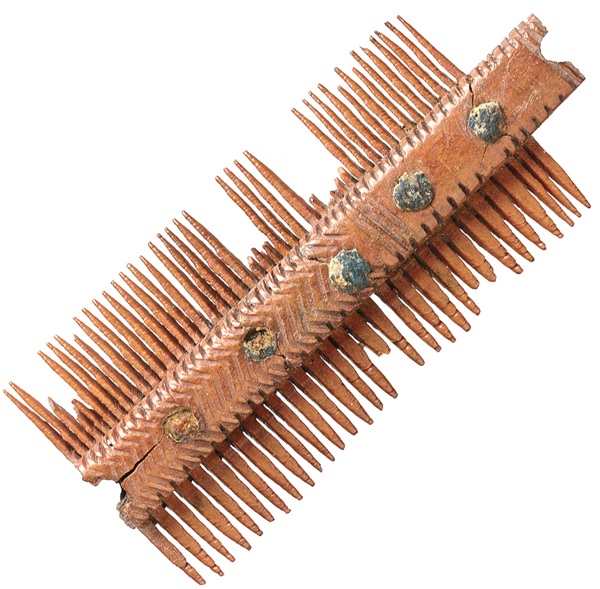 Saxon antler and bone comb discovered at Holywell

Excavation of a brick quarry at the Bishopsgate Goods Yard, close to Brick Lane
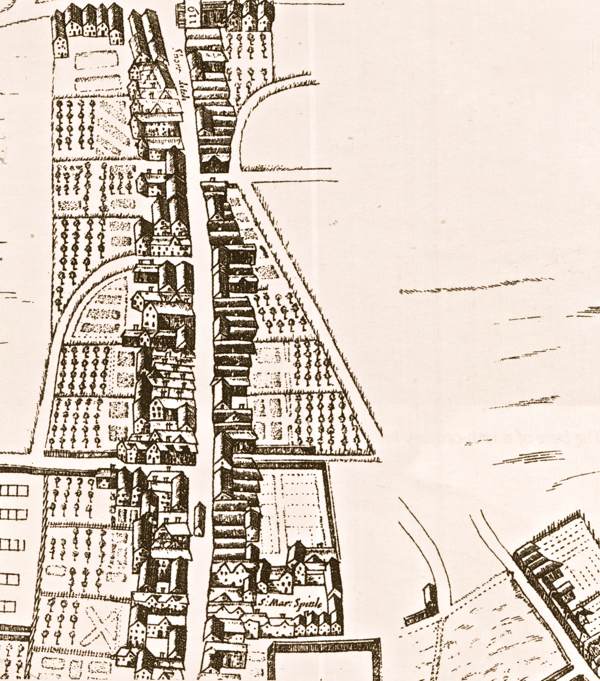
On Faithorne & Newcourt’s map of 1658, the site of the Bishopsgate Goodsyard is open fields
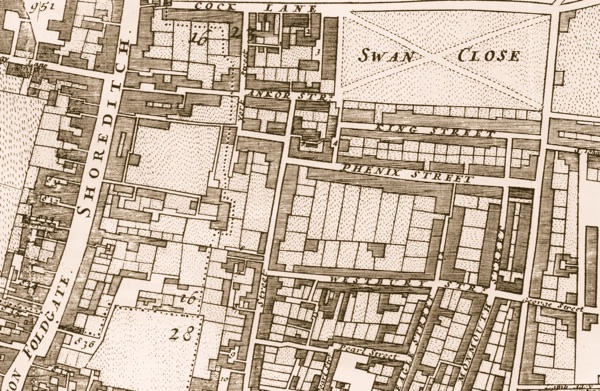
By Morgan’s map of 1682, suburban development has filled the site
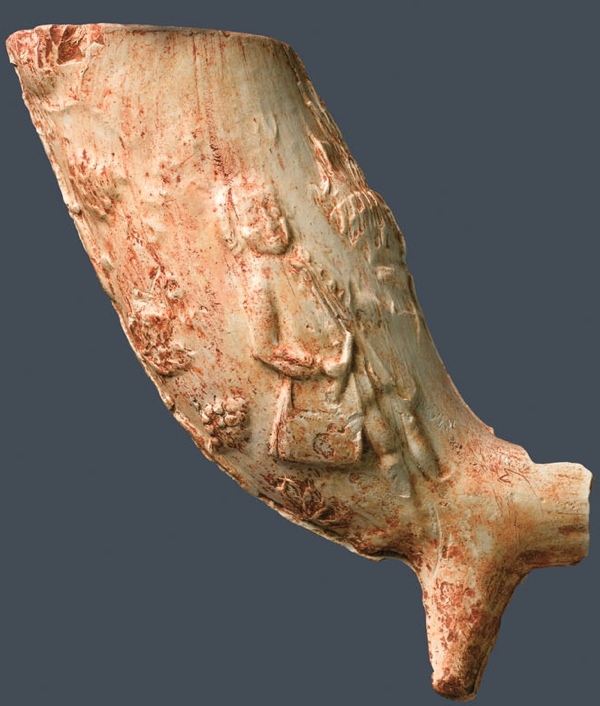
Pipe bowl depicting Admiral Vernon, who introduced the daily ration of grog to the navy
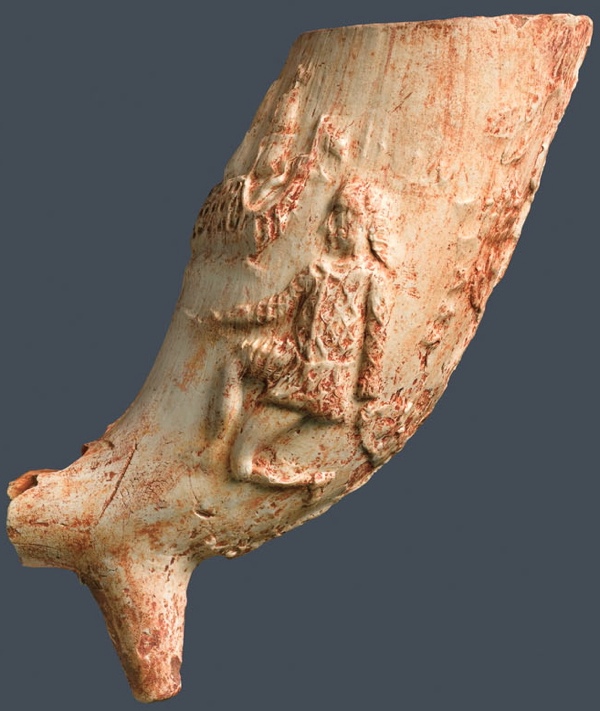
Pipe bowl depicting Don Blas de Leso, Portuguese governor of Panama kneeling in surrender to Admiral Vernon
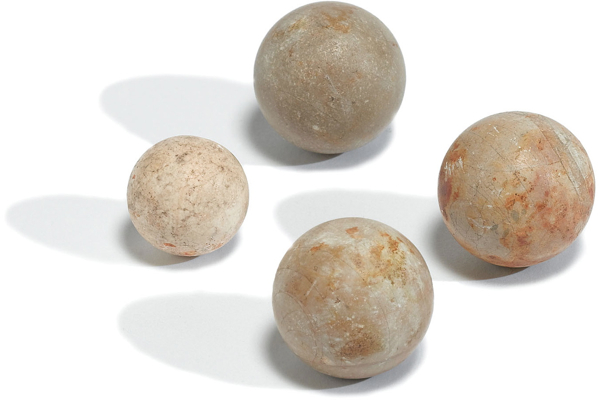
Eighteenth century marbles from the Goodsyard
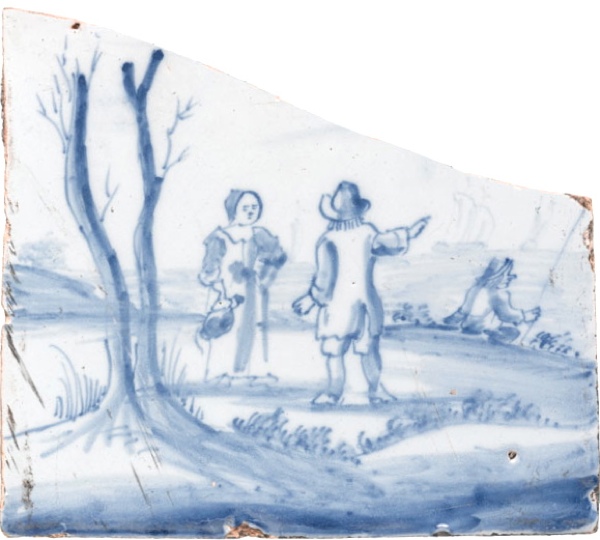
Eighteenth century tin-glazed tile made in London
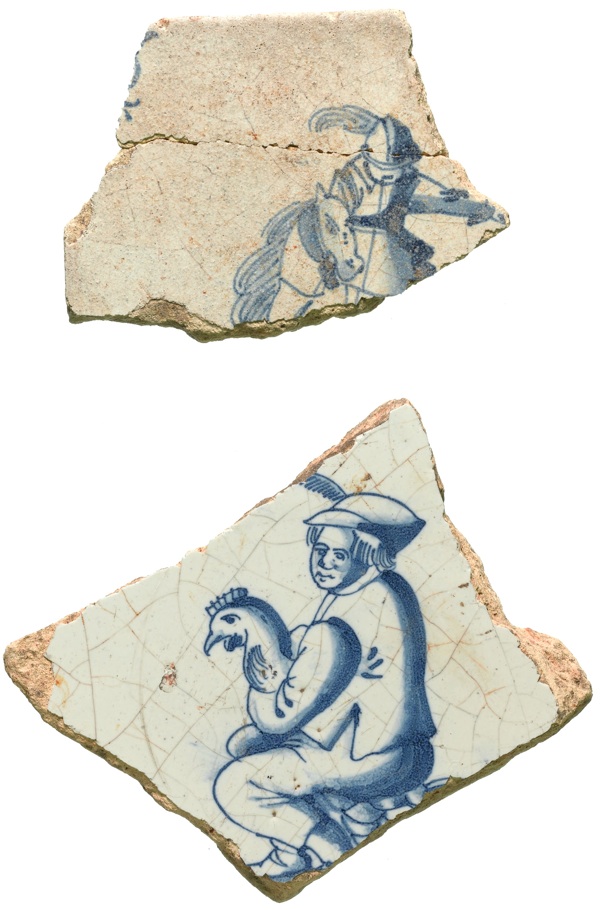
Mid-seventeenth century Dutch tin-glazed tiles from Bishopsgate Goodsyard, showing a mounted military figure and a man with a cockerel

Eighteenth century tin-glazed tile made in London
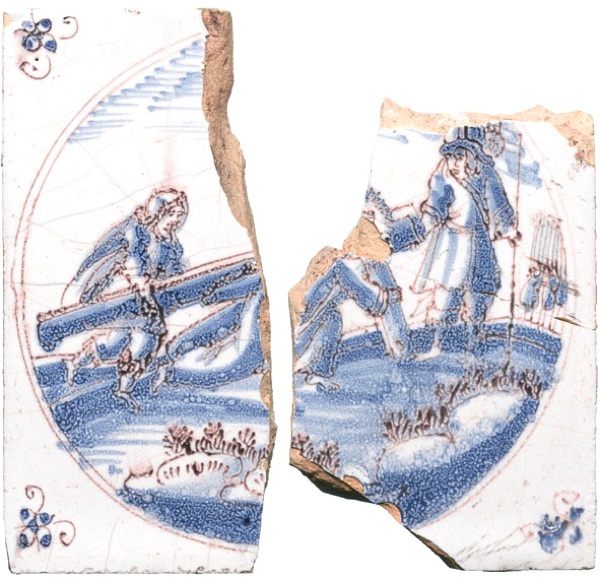
Eighteenth century Dutch tile of crucifixion scene
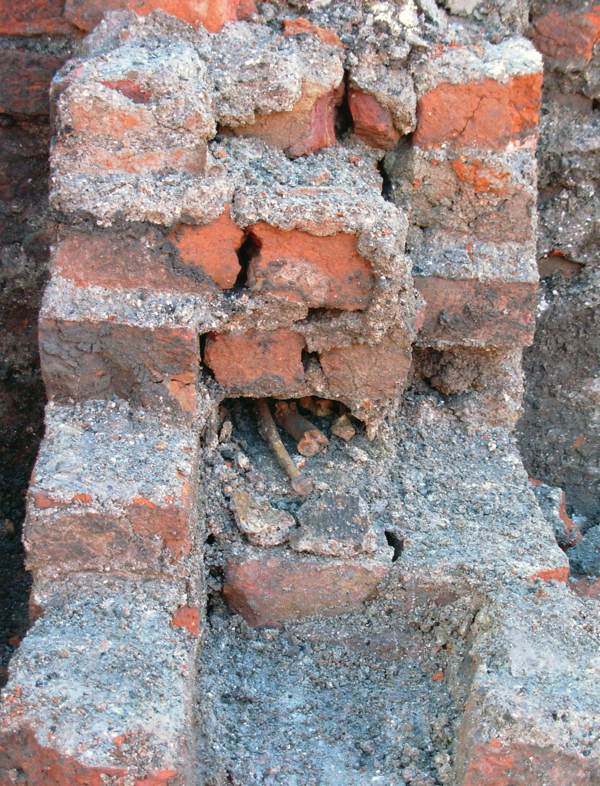
Witch box – animal bones in a wooden box concealed in an eighteenth-century fireplace upon the Bishopsgate Goodsyard site
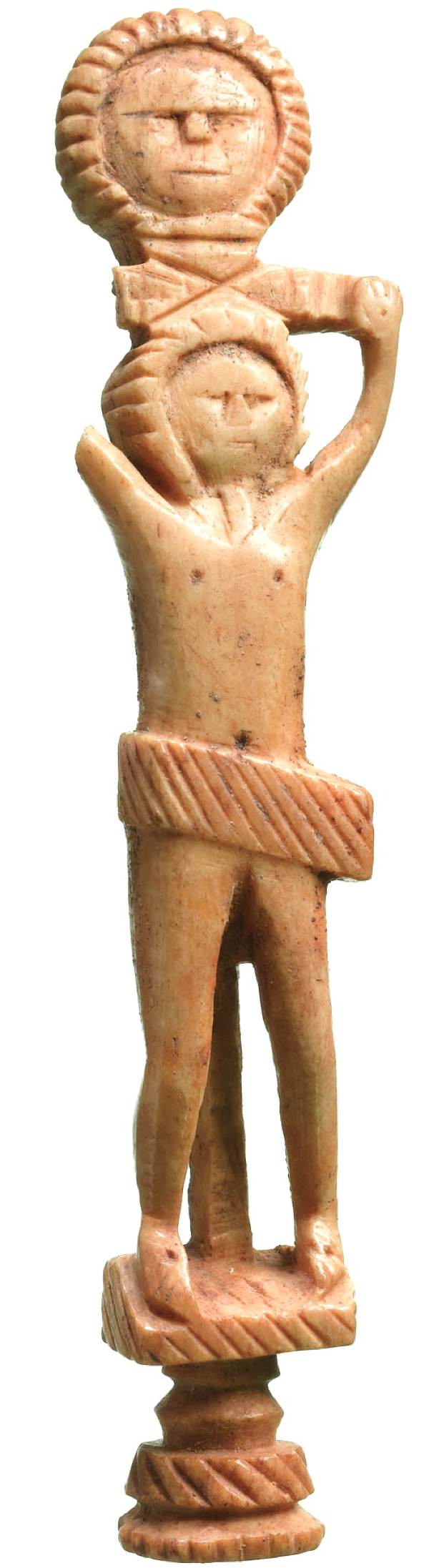
Unusual post-medieval bone crucifix with sun above, discovered at Bishopsgate Goodsyard, possibly the work of a Napoleonic prisoner of war
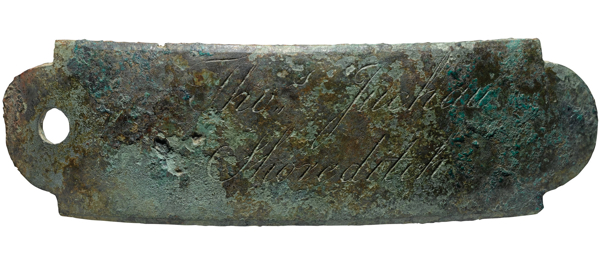 Copper plate inscribed ‘Thos Juchau Shoreditch’ – Juchau was a celebrated bare-knuckle boxer born in 1739, said to have been the ‘hero of a hundred fights,’ who became British champion until defeated by William ‘the dyer’ Darts of Spitalfields in the first ever outdoor heavyweight boxing match in 1777. He died in Bateman’s Row in 1806.

Bishopsgate Station, photograph courtesy of National Rail Museum
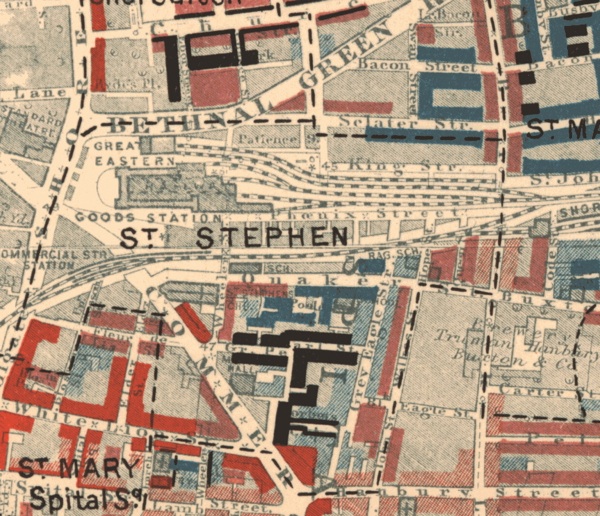
Charles Booth’s Descriptive Map of London Poverty 1889 courtesy of LSE Library
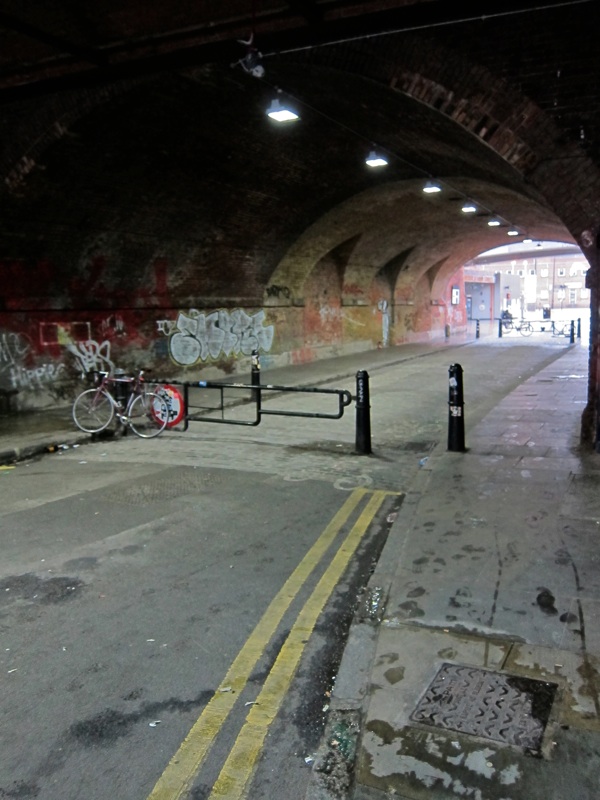
“The Arches – a long street under a railway which carried the mainline to Liverpool St Station and ran from Commercial St to Club Row … there the pros would practise to mouth-organ acompaniment, night after night, until they had copied the Yanks most intricate steps.” Bud Flanagan, My Crazy Life 1961
Archaeological photographs copyright © MOLA
‘Tracks Through Time, Archaeology and History from the London Overground East London Line’ is available from Museum of London Shop
You may also like to read about
The Spitalfields Nippers Are Coming!
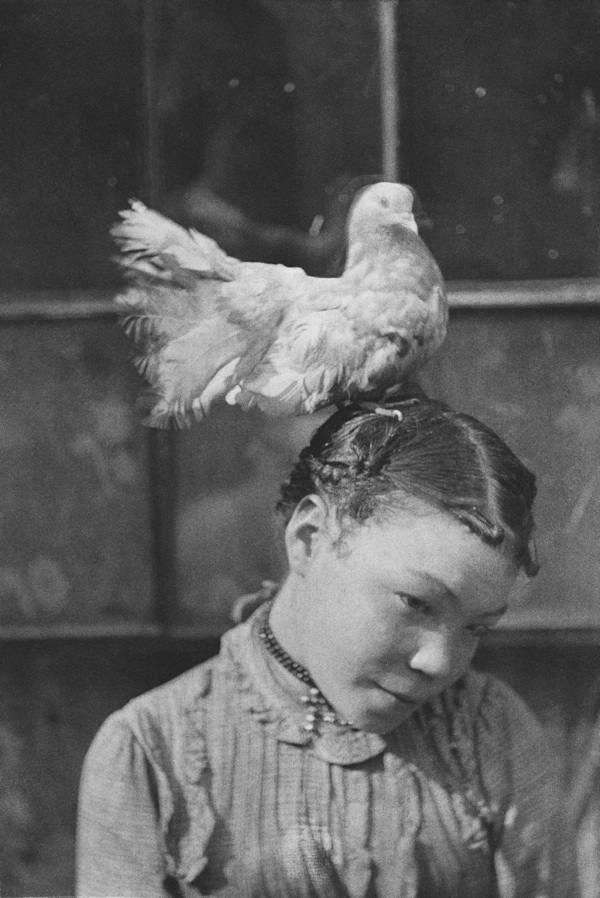
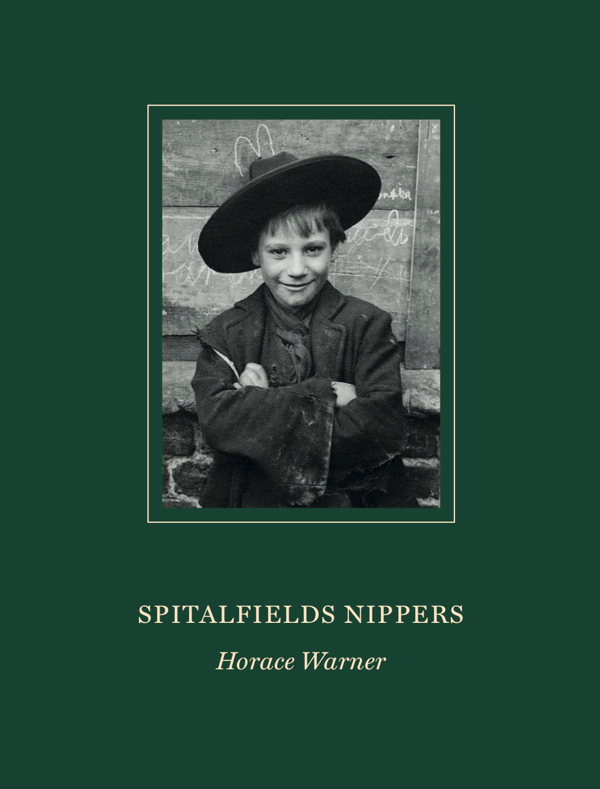
Although the publication of SPITALFIELDS NIPPERS – the book of portraits by Horace Warner taken in Spitalfields around 1900 – is not until the beginning of November, today I am announcing the launch on Tuesday 4th November at 7:30pm in the Great Hall at Bishopsgate Institute, so that readers may have first chance to reserve their tickets for this free event which are now available by clicking here.
This will be the first reveal of many of Horace Warner’s pictures taken in Spitalfields over a century ago and, in an illustrated lecture, I shall be introducing the photographs, explaining the circumstances of their creation and giving the biographies of those children we have been able to trace in public records.
It has been my privilege to be entrusted by Horace Warner’s grandson, Ian Warner McGilvray, to publish the definitive book of Spitalfields Nippers which has been funded by you, the readers of Spitalfields Life. Accompanied by an extensive introduction and an index of biographies, this volume reunites those photos sold to the Bedford Institute in 1913 with those in the Spitalfields Albums that remain in the possession of the family and have never been seen publicly before.
This unique collection of pictures revolutionises our view of Londoners of the turn of the nineteenth century, by bringing us startlingly close and permitting us to look them in the eye. Horace Warner photographed some of the poorest people in the East End, creating compassionate images that gave human dignity to his subjects and producing great photography that is without parallel in his era.
I hope you will join me on such a memorable evening to celebrate the work of Horace Warner.
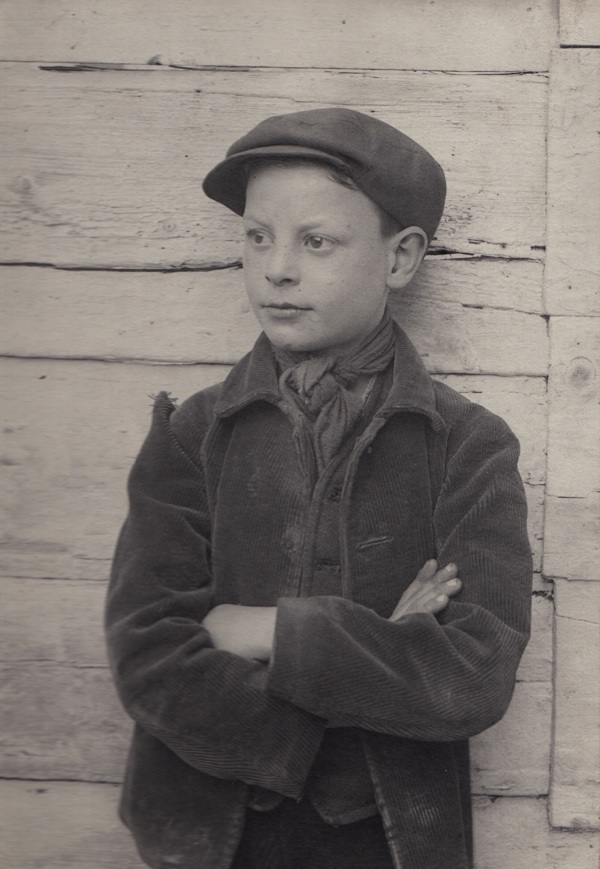
Walter Seabrook was born on 23rd May 1890 to William and Elizabeth Seabrook of Custance St, Hoxton. In 1901, when Walter’s portrait was taken by Horace Warner, the family were living at 24 & 1/2 Great Pearl St, Spitalfields, and Walter’s father worked as a printer’s labourer. At twenty-four years old, Walter was conscripted and fought in World War One but survived to marry Alice Noon on Christmas Day 1918 at St Matthew’s, Bethnal Green. By occupation, Walter was an electrician and lived at 2 Princes Court, Gibraltar Walk. He and Alice had three children – Walter born in 1919, Alice born in 1922 and Gladys born in 1924. Walter senior died in Ware, Hertfordshire, in 1971, aged eighty-one.
All Publication Rights in these Photographs Reserved
Click here to pre-order a copy of SPITALFIELDS NIPPERS by Horace Warner
You may also like to read about
Pubs Of Wonderful London
As soon as I sense the evenings closing in, I get a powerful urge to seek out a cosy corner in an old pub and settle down for the autumn nights to come. There are plenty of attractive options to choose from in this selection from the popular magazine Wonderful London edited by St John Adcock and produced by The Fleetway House in the nineteen-twenties.

The Old Axe in Three Nuns Court off Aldermanbury. It was once much larger and folk journeying to Chester, Liverpool and the North used to gather here for the stage coach.

The Doves, Upper Mall, Chiswick.

The Crown & Sceptre, Greenwich – once a popular resort for boating parties from London, of merry silk-clad gallants and lovely ladies who in the summer evenings came down the river between fields of fragrant hay and wide desolate marshes to breathe the country air at Greenwich.

At the Flask, Highgate, labourers from the surrounding farms still drink the good ale, as their forerunners did a century ago.

Elephant & Castle – The public house was once a coaching inn but it is so enlarged as to become unrecognisable.

The Running Footman, off Berkeley Sq, is named after that servant whose duty it was to run before the crawling old family coach, help it out of ruts, warn toll-keepers and clear the way generally. He wore a livery and carried a cane. The last to employ a running footman is said to have been ‘Old Q,’ the Duke of Queensberry who died in 1810.

The Grenadier in Wilton Mews, where coachmen drink no more but, at any moment – it would seem – an ostler with a striped waistcoat and straw in mouth might kick open the door and walk out the place.

The Spaniards in Hampstead dates from the seventeenth century and here the Gordon Rioters gathered in the seventeen-eighties, crying “No Popery!”

The Bull’s Head at Strand on the Green is an old tavern probably built in the sixteenth century. There is a tradition that Oliver Cromwell, while campaigning in the neighbourhood, held a council of war here.

Old Dr Butler’s Head, established in Mason’s Avenue in 1616. The great Dr Butler invented a special beer and established a number of taverns for selling it, but this is the last to bear his name.

The grill room of the Cock, overlooking Fleet St near Chancery Lane. It opened in 1888 with fittings from the original tavern on the site of the branch of the Bank of England opposite. Pepys wrote on April 23rd 1668, “To the Cock Alehouse and drank and ate a lobster and sang…”

The Two Brewers at Perry Hill between Catford Bridge and Lower Sydenham – an old hedge tavern built three hundred years ago, the sign shows two brewer’s men sitting under a tree.

The Old Bell Tavern in St Bride’s Churchyard, put up while Wren was rebuilding St Bride’s which he completed in 1680. There is a fine staircase of unpolished oak.

Coach & Horses, Notting Hill Gate. This was once a well-known old coaching inn, but it still carries on the tradition with the motor coaches.

The Anchor at Bankside. With its shuttered window and projecting upper storey, it enhances its riverside setting with a sense of history.

The George on Borough High St – one of the oldest roads in Britain, for there was a bridge hereabouts when Roman Legionaries and merchants with long lines of pack mules took the Great High Road to Dover.

The Mitre Tavern, between Hatton Garden and Ely Place. It bears a stone mitre carved on the front with the date 1546. Ely Place still has its own Watchman who closes the gates a ten o’clock and cries the hours through the night.

The George & Vulture is in a court off Cornhill that is celebrated as the place where coffee was first introduced to Britain in 1652 by a Turkish merchant, who returned from Smyrna with a Ragusan boy who made coffee for him every morning.

The Bird in Hand, in Conduit between Long Acre and Floral St, formerly a street of coach-makers but now of motorcar salesmen.

The Old Watling is the oldest house in the ward of Cordwainer, standing as it did when rebuilt after the Fire, in 1673.

The Ship Inn at Greenwich got its reputation from courtiers on their way to and from Greenwich Palace and in 1634 some of the Lancashire Witches were confined her, but now it is famous for its Whitebait dinners.

The Olde Cheshire Cheese – the Pudding Season here starts in October.
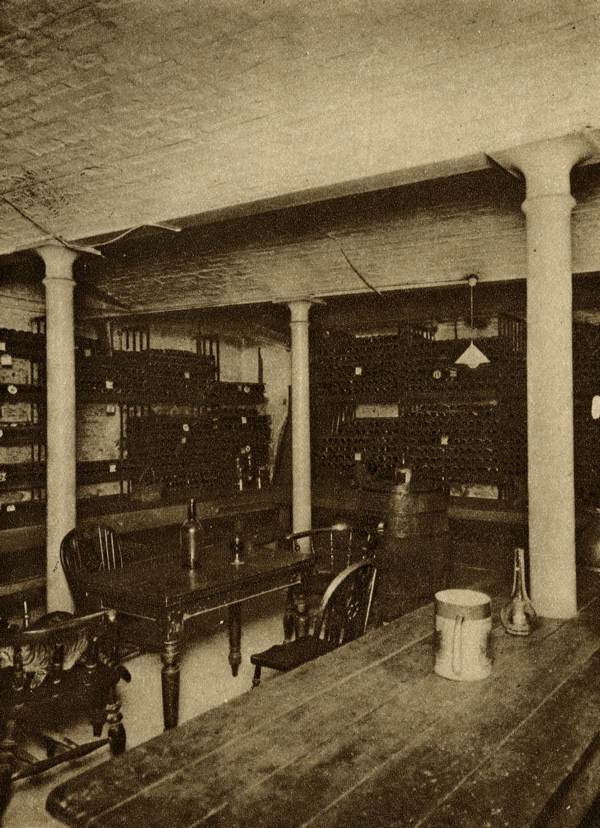
The Cellar Bar at the Olde Cheshire Cheese

The Chop Room at the Olde Cheshire Cheese

The Cellar Cat guards the vintage at the Old Cheshire Cheese. Almost under Fleet St is a well, now unused, but pure and always full from some unknown source. To raise the iron trap door which keeps the secret and to light a match and stoop down over this profound hole and watch the small light flickering uncertainly over the black water is to leave modern London and go back to history.
Images courtesy Bishopsgate Institute
You may like to take a look at
The Taverns of Long Forgotten London
Alex Pink’s East End Pubs Then & Now
The Gentle Author’s Next Pub Crawl
The Gentle Author’s Spitalfields Pub Crawl
The Gentle Author’s Dead Pubs Crawl
The Gentle Author’s Next Dead Pubs Crawl
Happy 75th Birthday Halal Restaurant!
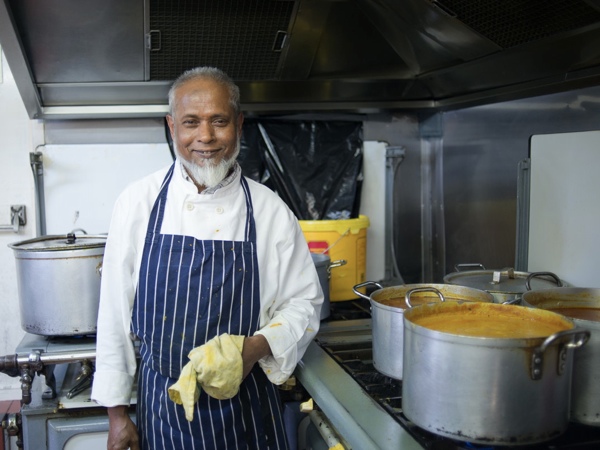
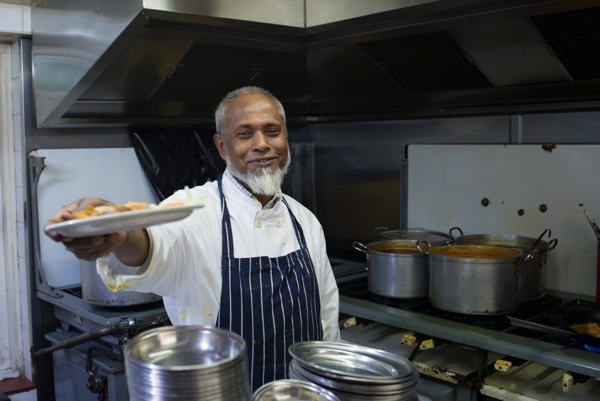
Asab Miah, Chef at the Halal Restaurant, has been cooking for forty-four years
This week, the Halal Restaurant – the East End’s oldest curry house – celebrated its seventy-fifth birthday and so Contributing Photographer Sarah Ainslie & I went along to share in the festivities.
We were summoned to the former Hostel for Indian Seaman, situated in an eighteenth century house on the corner of Alie St and St Mark St, at eleven thirty in the morning for a luncheon party attended by the Halal Restaurant’s most loyal customers. The early hour was because – such is the popularity of this beloved institution – there were to be two lunch sittings that day in order to fit in everyone who wanted to join the birthday celebrations.
In 1939, the Halal Restaurant was born when Mr Jafferi opened up the mess of the Indian Seamen’s Hostel to all and, even today, it is still distinguished by plain canteen decor and a small unpretentious menu of favourite dishes. Yet this has proved to be a winning combination, especially among diners from City who have made the Halal Restaurant their home from home.
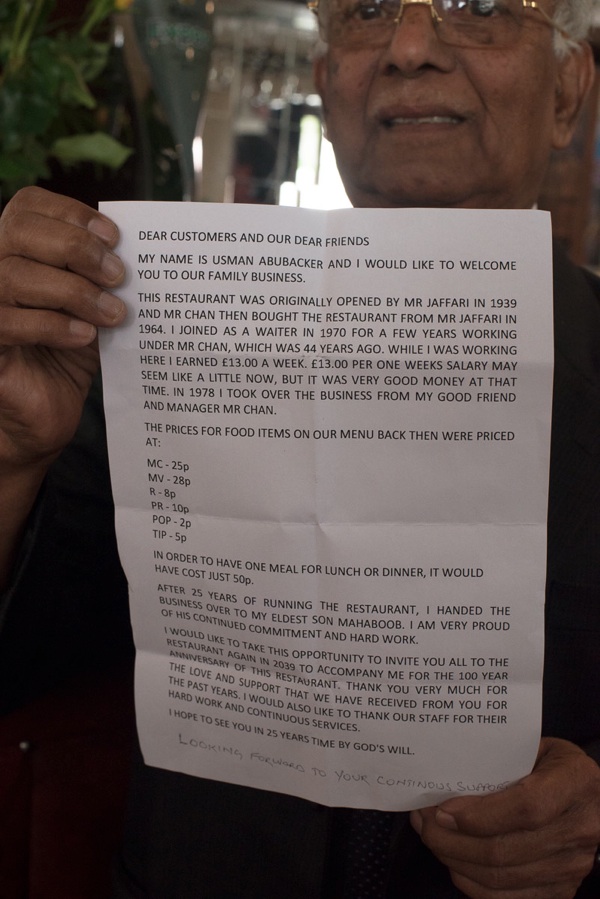
We were greeted by proprietor Mahaboob Narangoli, all smiles and his eyes shining with excitement to introduce us to his father, Usman Abubacker, who began working here as a waiter back in 1970 before taking over in 1978. The whole family were gathered on this proud occasion to welcome a restaurant-full of customers, all of whom are known by their first names, twice.
Curry-hound Guy Morgan confessed he first ate here in 1965 and never looked back. He recalled those early days when customers walked through the kitchen to reach the tiny dining room. “You could see and smell the pots of curry cooking,” he told me, growing enraptured at the thought. As excited guests filled up the restaurant, all had similar stories to tell and were proud to declare how long they had been coming. For many of these workers, this has been the consistent element in their working lives as, over the decades, they have changed jobs, companies have amalgamated and the City has changed beyond recognition, yet the menu and the food at the Halal Restauarant have remained reassuringly constant.
Eager to set proceedings in motion, Mahaboob made a generous speech of welcome, greeted with affectionate applause from the hungry diners. Then the waiters leapt into action and everyone was tucking in to starters comprising samosas and chicken tikka with popadoms and chutney. Next, one of the long-term customers made a speech of appreciation which culminated in a “Hip-Hip-Hooray for the Halal Restaurant!”
A hush fell as Usman Abubacker stepped forward to give the main speech, recalling with a quiet dignity how he started there in that same room, forty-four years ago, earning thirteen pounds a week. Yet even his involvement was predated by the most senior customer, Maurice Courtnell, who has been dining there for sixty-six years. Usman Abubacker concluded his speech by inviting everyone to return for the hundredth anniversary in 2039 and I, for one, hope to be there.
In the restless city, where restaurants come and go, it is an inspiration to come upon this joyful exception where one family have cultivated an open-hearted relationship with their customers that is reciprocated and enduring – establishing the Halal Restaurant as one of London’s cherished culinary landmarks.
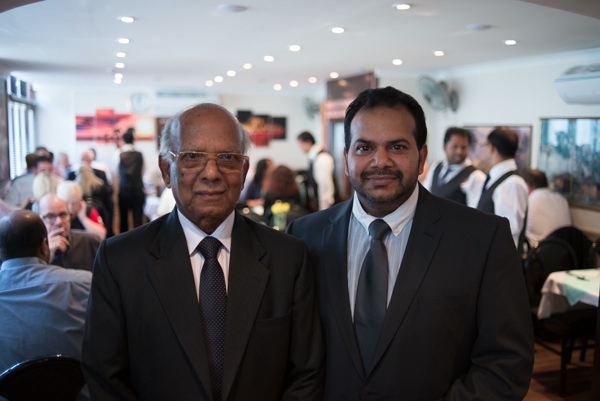
Usman Abubacker and his son Mahboob Narangali
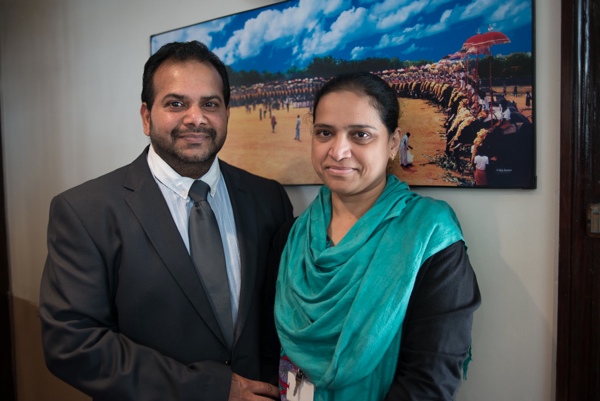
Mahaboob and and his wife Shahina
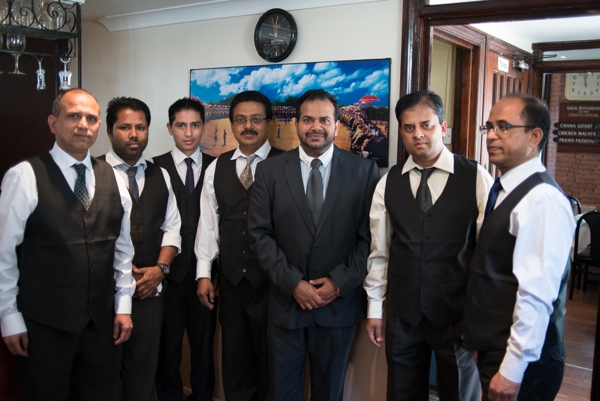
Mahaboob and the waiters

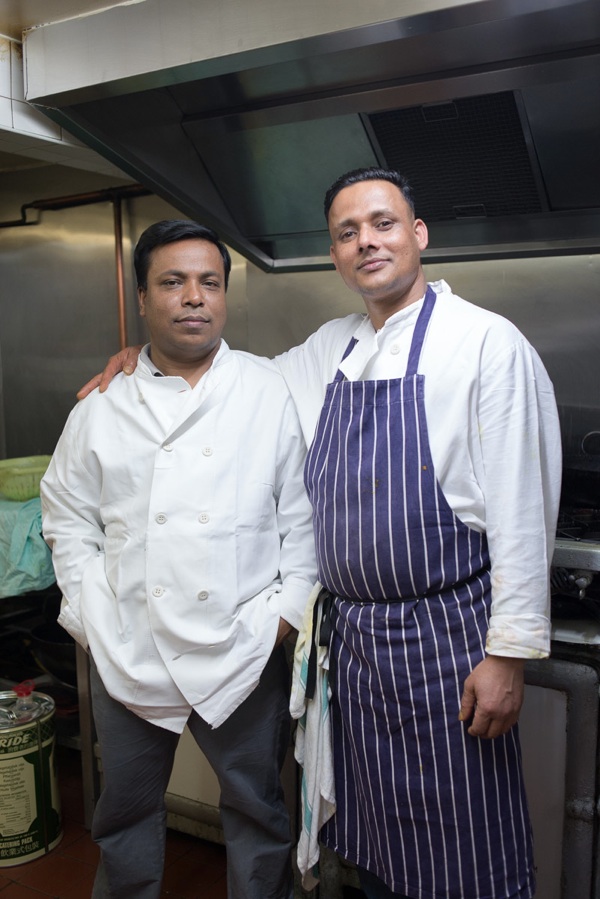
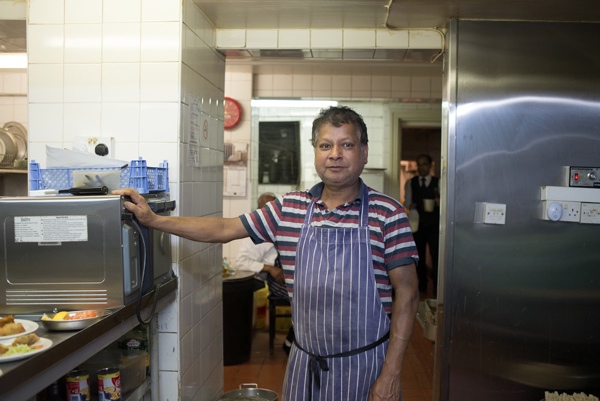
Mahaboob and the cooks
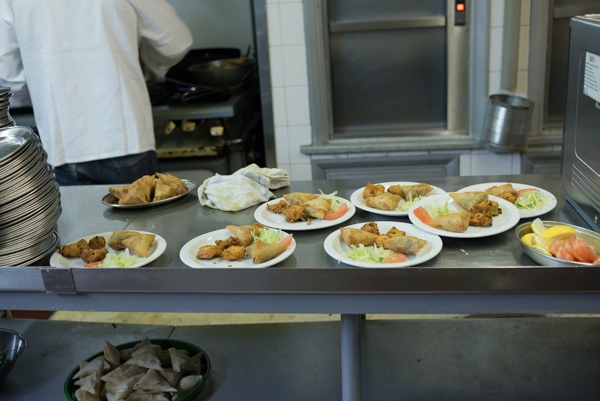
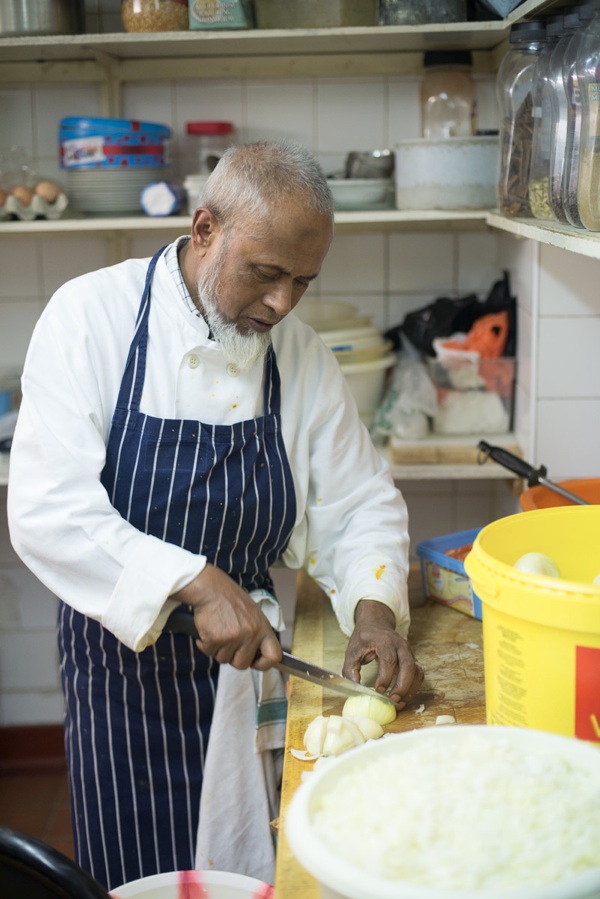
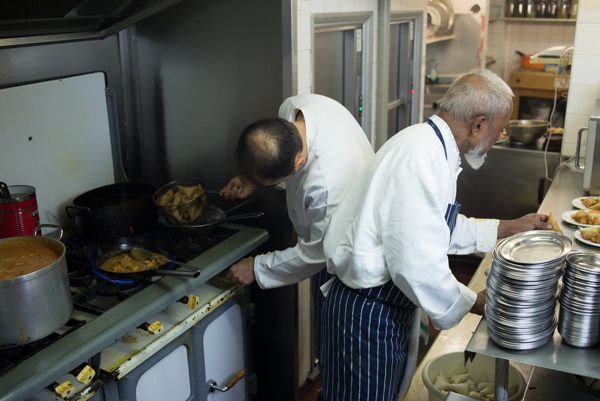
Asab Miah cooks everything freshly every day
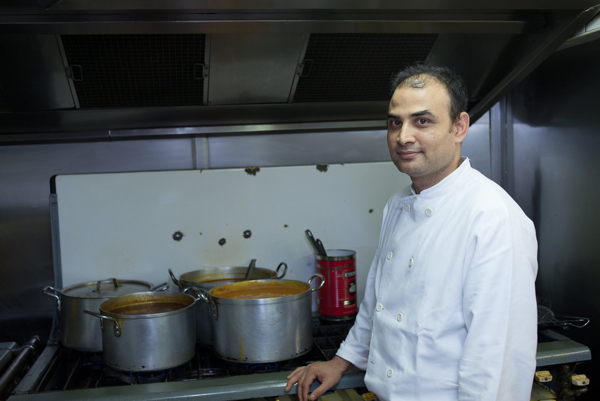

Usman Abubacker makes his speech to the assembly
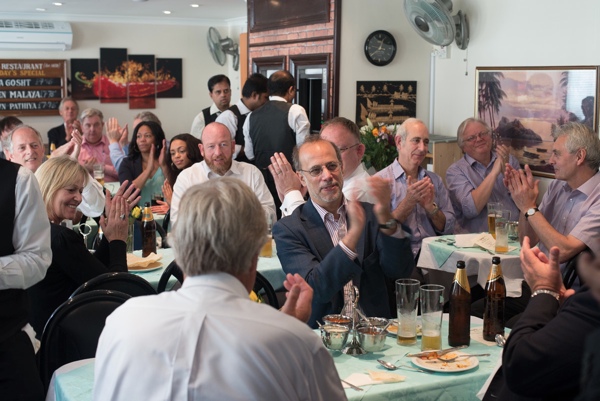
Three cheers for the Halal Restaurant!
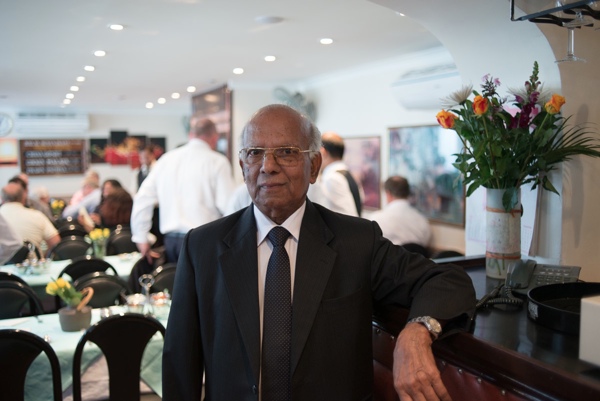
Usman Abubacker began working here as a waiter in 1970 and took over in 1978
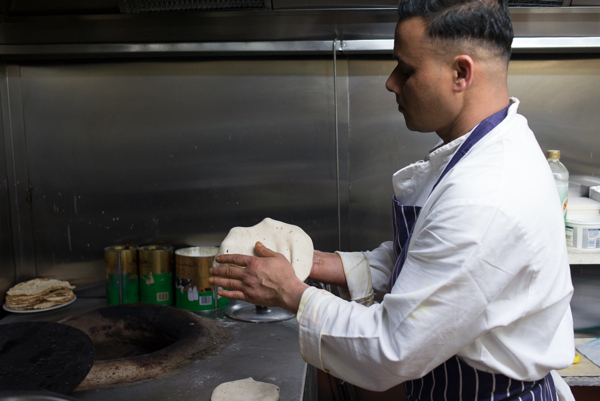
Making naan bread
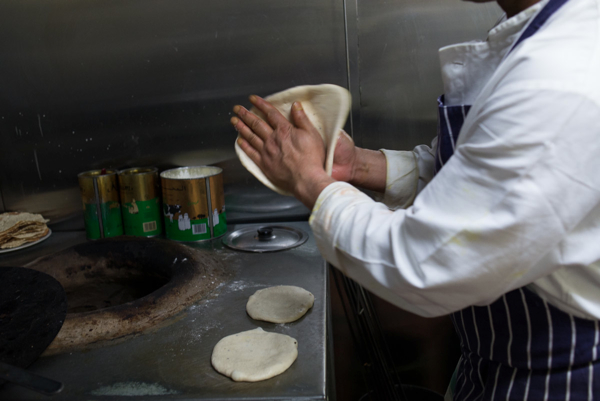
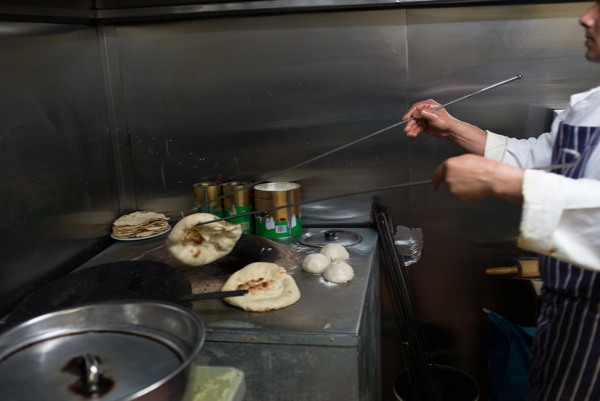
Extricating it from the clay oven
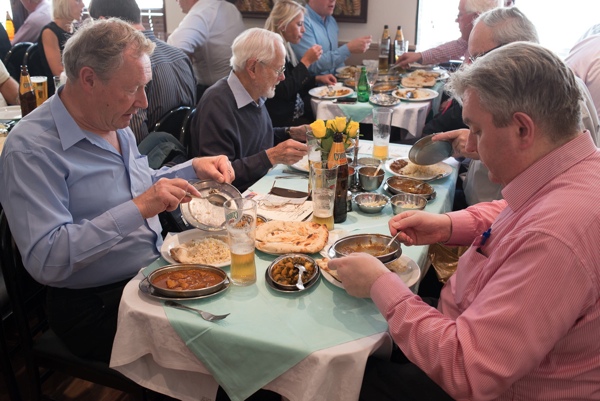
Diners tuck in
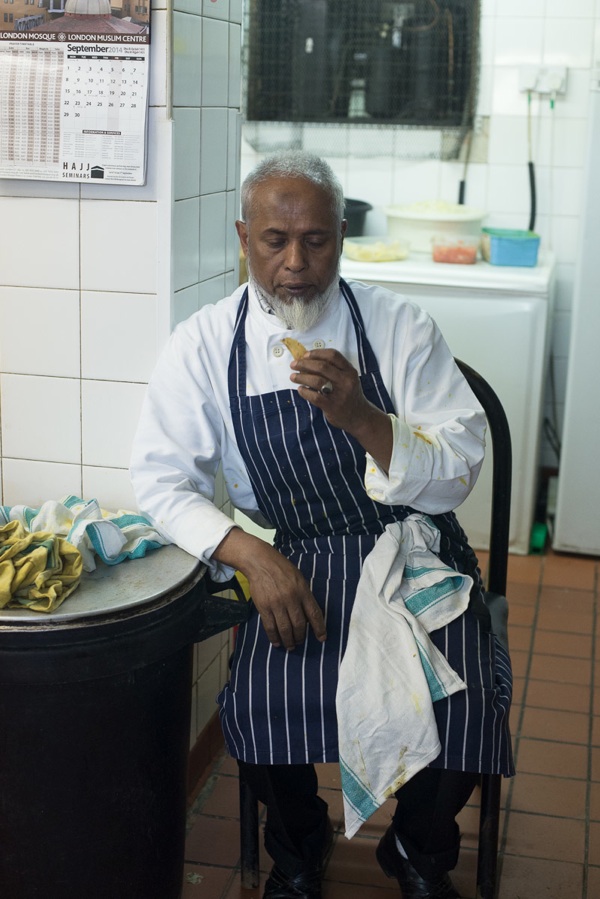
Asab Miah takes a moment to relax and enjoy a samosa before the second lunch sitting
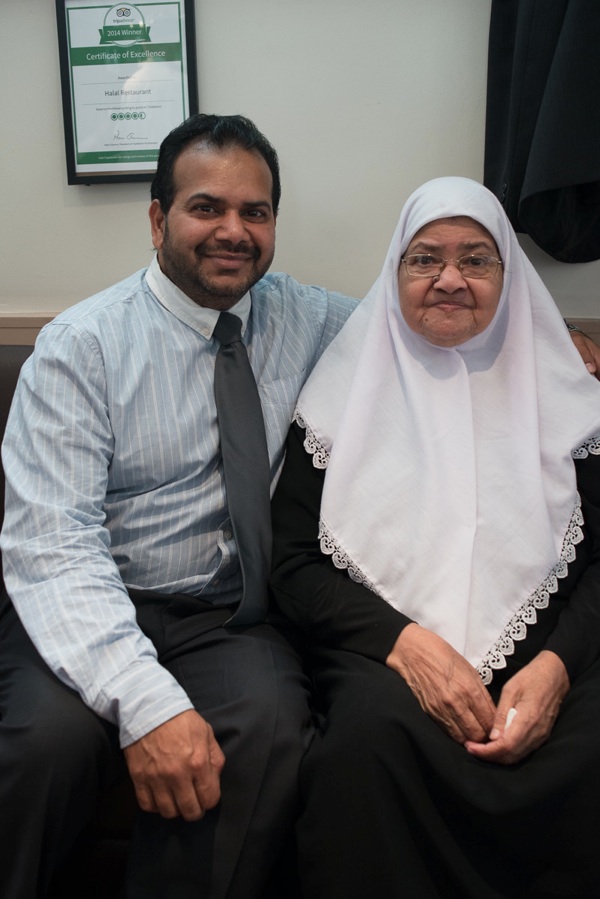
Mahaboob and his mother, Aleema

The family behind the Halal Restaurant
Halal Restaurant, 2 St Mark St, E1 8DJ 020 7481 1700
You may also like to read my original feature
and take a look at
Wonderful East End
It is my pleasure to publish these evocative pictures of the East End (with some occasionally facetious original captions) selected from the popular magazine Wonderful London edited by St John Adcock and produced by The Fleetway House in the nineteen-twenties. Most photographers were not credited – though many were distinguished talents of the day, including East End photographer William Whiffin (1879-1957).
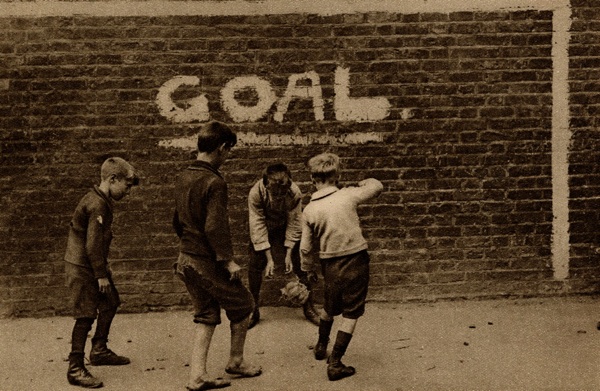
Boys are often seen without boots or stockings, and football barefoot under such conditions has grave risks from glass or old tin cans, but there are many urchins who would rather run about barefoot.
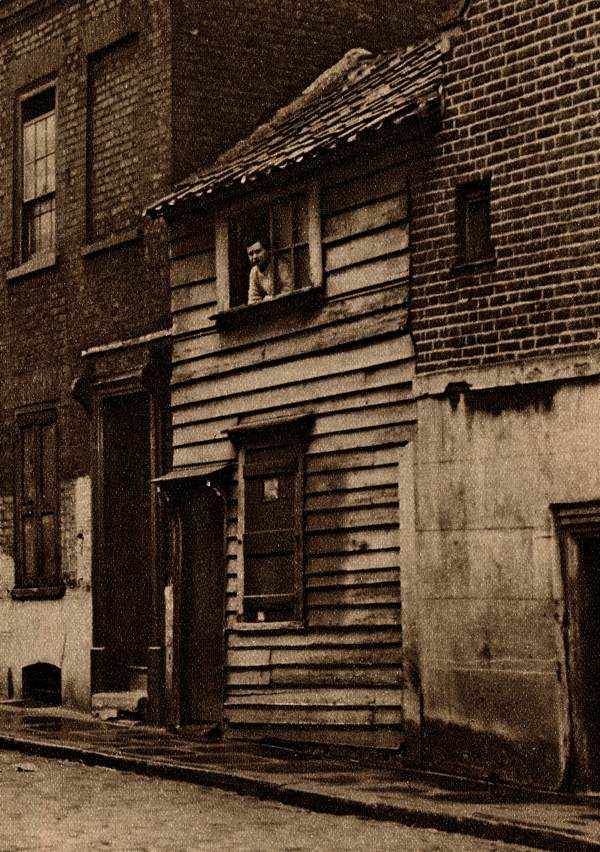
When this narrow little dwelling in St John’s Hill, Shadwell, was first built in 1753, its inhabitants could walk in a few minutes to the meadows round Stepney or, venture further afield, to hear the cuckoo in the orchards of Poplar.
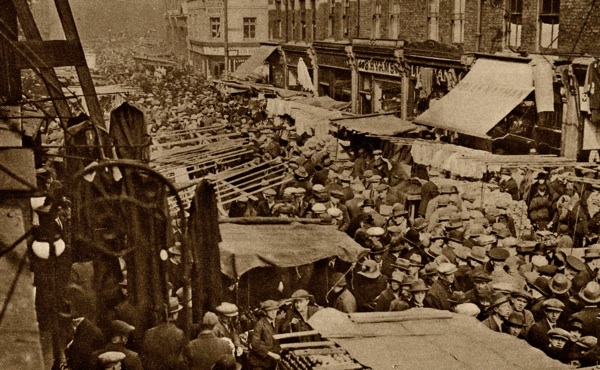
Middlesex St is still known by its old name of Petticoat Lane. Some of the goods on offer at amazingly low prices on a Sunday morning are not above suspicion of being stolen, and you may buy a watch at one end of the street and see it for sale again by the time you reach reach the other.
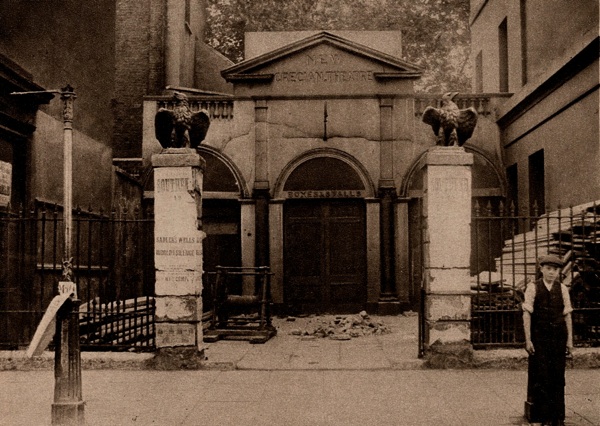
A vanished theatre on the borders of Hoxton, just before demolition, photographed by William Whiffin. In 1838, a tea garden by the name of ‘the Eagle Tavern’ was put up in Shepherdess Walk in the City Rd near the ‘Shepherd & Shepherdess,’ a similar establishment founded at the beginning of the same century. Melodramas such as ‘The Lights ‘O London’ and entertainments like ‘The Secrets of the Harem,’ were also given. In 1882, General Booth turned the place into a Meeting Hall for his Salvation Army. There is little suggestion of the pastoral about Shepherdess Walk now.
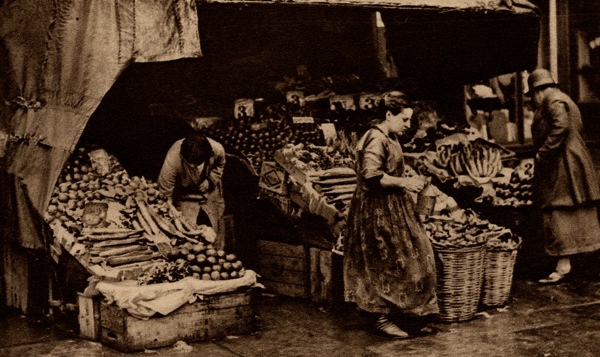
In the East End and all over the poorer parts of London, a strange kind of establishment, half booth, half shop, is common and particularly popular with greengrocers. Old packing cases are the foundation of a slope of fruit which begins unpleasantly near the level of the pavement and ends in the recess behind the dingy awning. At night, the buttresses of vegetables are withdrawn into shelter.
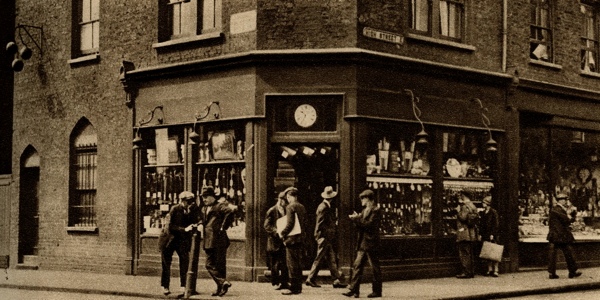
Old shop front in Bow photographed by William Whiffin. Pawnbroking, once as decorous as banking, has fallen from the high estate in the vicinity of Lombard St. Now, combined instead with the sale of secondhand jewellery, furniture and hundred other commodities, it is apt to seek the corners of the meaner streets.
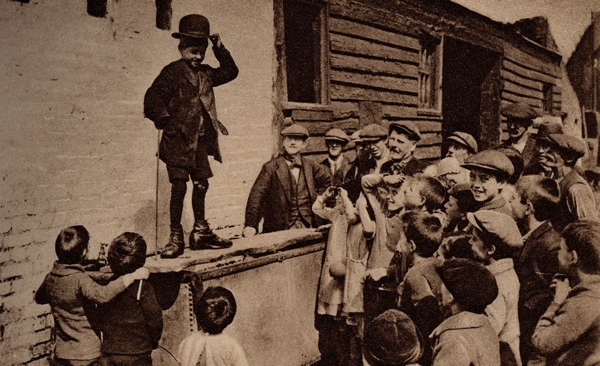
A water tank covered by a plank in a backyard among the slums is an unlikely place for a stage, but an undaunted admirer of that great Cockney humorist, Charlie Chaplin, is holding his audience with an imitation of the well-known gestures with which the famous comic actor indicates the care-free-though-down-and-out view of life which he has immortalised.
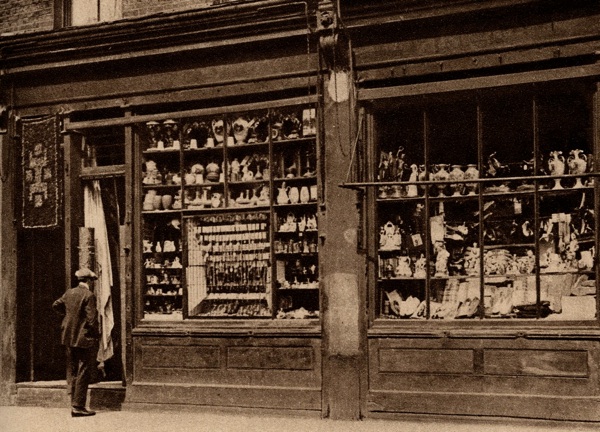
Old shop front in Poplar photographed by William Whiffin
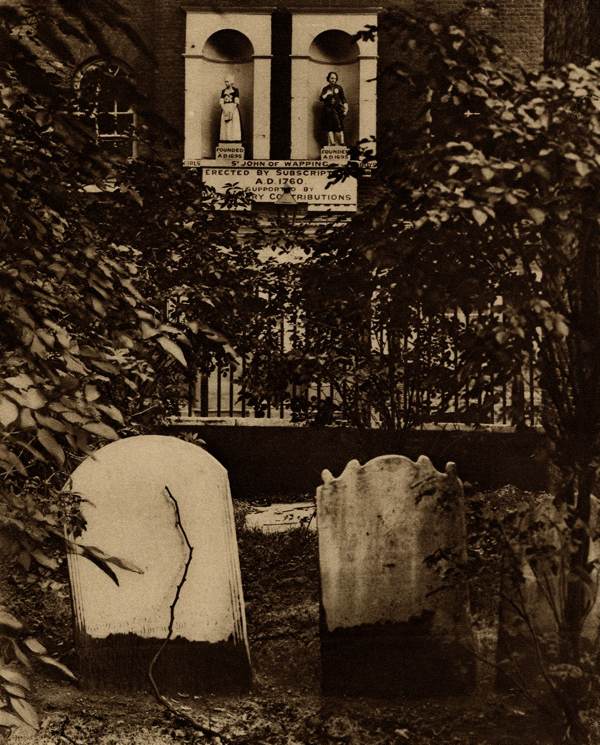
An old charity school for girl and boy down at Wapping founded in 1704. The present building dates from 1760 and the school is supported by voluntary subscriptions. The school provided for the ‘putting out of apprentices’ and for clothing the pupils.

The hunt for bargains in Shoreditch. A glamour surrounds the rickety coster’s barrow which supports a few dozens of books. But, to tell the truth, the organisation of the big shops is now so efficient that the chances of finding anything good at these open air book markets may have long odds laid against it.

The landsman’s conception of a sailing vessel, with all its complex of standing and running rigging that serves mast and sail with ordered efficiency, is apt for a shock when he sees a Thames barge by a dockside. The endless coils and loops of rope of different thickness, the length of chain and the litter of brooms, buckets, fenders and pieces of canvas, seem to be in the most insuperable confusion.
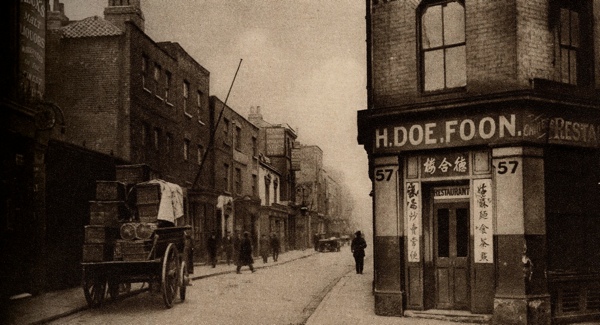
Gloom and grime in Chinatown. Pennyfields runs from West India Dock Rd to Poplar High St. A Chinese restaurant on the corner and a few Chinese and European clothes are all that is to be seen in the daytime.

The gem of Cornhill, Birches, where it stood for two hundred years. Towards the end of the eighteenth century, the brothers Adam erected its beautiful shop front. Within were old bills of fare printed on satin, a silver tureen fashioned to the likeness of a turtle and many other curious odd-flavoured things. Birches have catered for the inspired feasting of the City Companies and Guilds for two centuries but now this shop has moved to Old Broad St and, instead of Adam, we are to have Art Nouveau ferro-concrete.
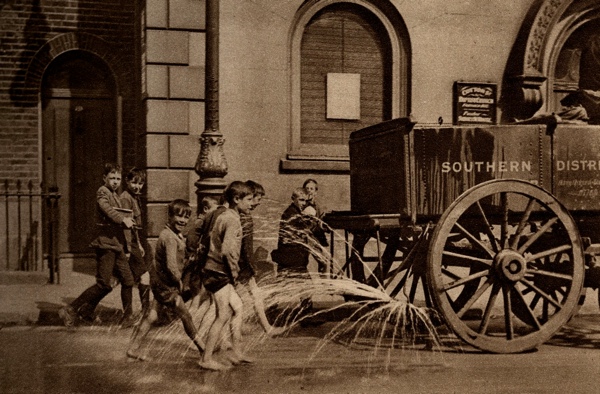
It is doubtful if the Borough Council of Poplar had any notion, when they supplied the district with water carts, that the supplementary use pictured in this photograph by William Whiffin would be made of them. Given a complacent driver, there is no reason why these children should not go on for miles.
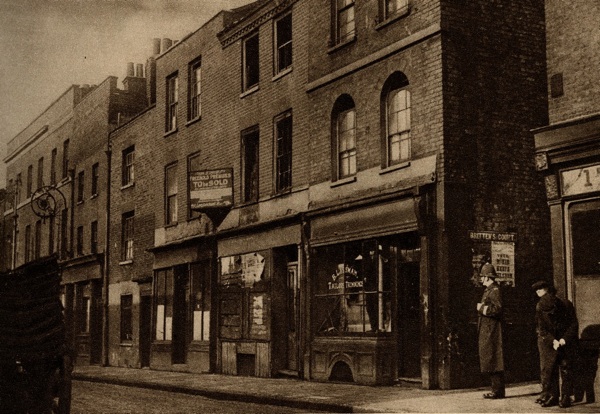
Grime and gloom in St George’s St photographed by William Whiffin. St George’s St used to be the famous Ratcliff Highway and runs from East Smithfield to Shadwell High St. It is a maritime street and contains various establishments, religious and otherwise, which cater for the sailor.
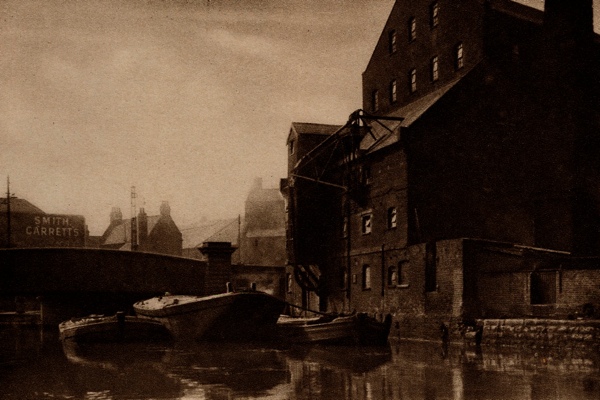
River Lea at Bow Bridge photographed by William Whiffin. On the right are Bow flour mills, while to the left, beyond the bridge, a large brewery is seen.

A view of Curtain Rd photographed by William Whiffin, famed for its cabinet makers. It runs from Worship St – a turning to the left when walking along Norton Folgate towards Shoreditch High St – to Old St. Curtain Rd got its name from a curtain wall, once part of the outworks of the city’s fortifications.
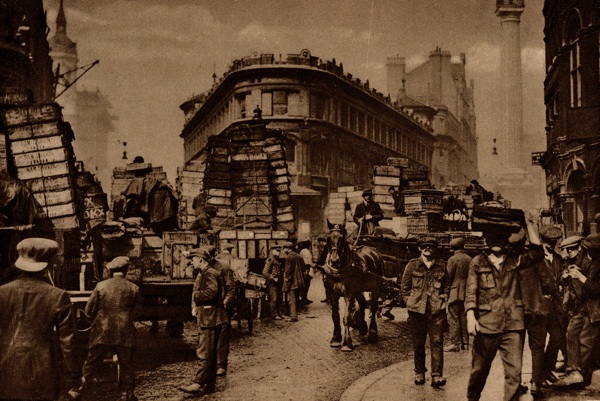
Fish porters of Billingsgate gathered around consignments lately arrived from the coast. At one time, smacks brought all the fish sold in the market and were unloaded at Billingsgate Wharf, said to be the oldest in London.
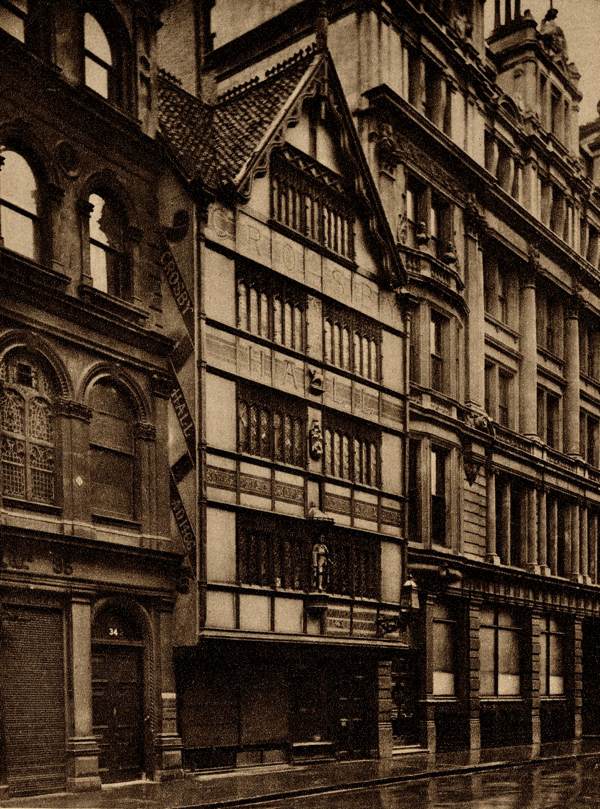
Crosby Hall as it stood in Bishopsgate. Alderman Sir John Crosby, a wealthy grocer, got the lease of some ground off Bishopsgate in 1466 from Alice Ashfield, Prioress of St Helen’s, at a rent of eleven pounds, six shillings and eightpence per annum, and built Crosby Hall there. It came into the possession of Sir Thomas More around 1518 and by 1638 it was in the hands of the East India Company, but in 1910 it was taken down and re-erected in Cheyne Walk.
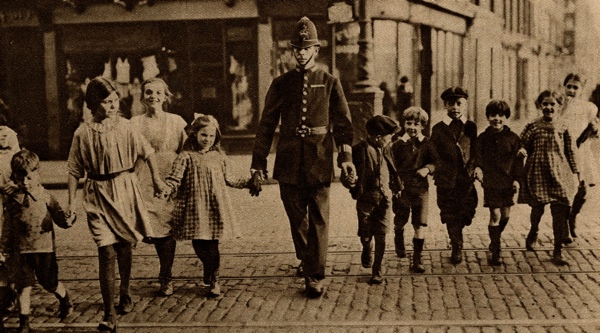
Whatever their relations with the Constable may come to be in later life, the children of the East End, in their early days, are quite willing to use his protection at wide street crossings.
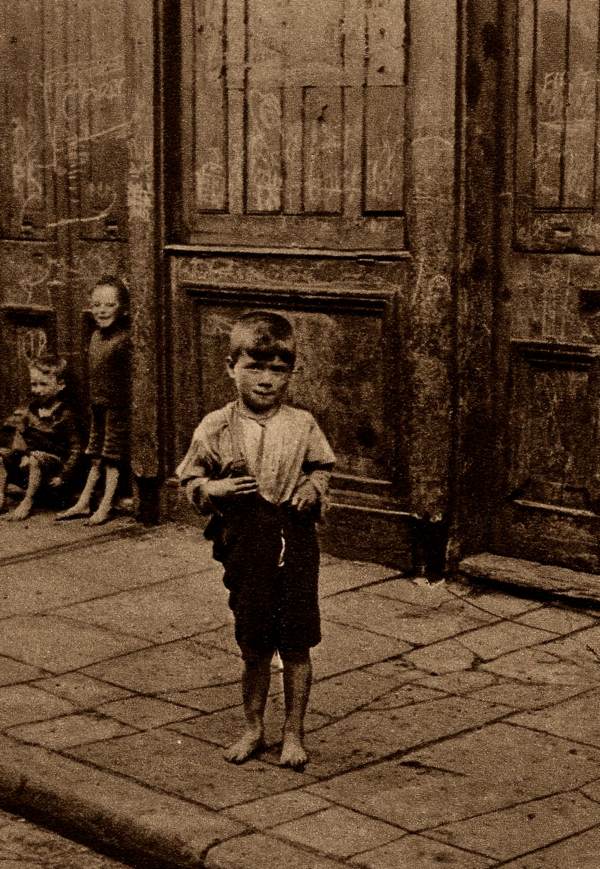
There is no more important work in the great cities than the amelioration of the slum child’s lot. Many East End children have never been beyond their own disease-ridden courts and dingy streets that form their playground.
Photographs courtesy Bishopsgate Institute
You may also like to take a look at
Aga Rais Mirza, Printer
This remarkable interview and set of pictures of Aga Rais Mirza, who spent his first years in Britain living in Spitalfields, were supplied to me courtesy of the oral history research project currently being undertaken under the umbrella of Everyday Muslim

Aga Rais Mirza was born in 1938 in the Indian city of Jaipur and came to London at the age of twenty-two, on 24th of January 1960. He came to seek a better life and always intending to go back home, yet he never did. Like many of his generation, the date of his arrival was etched in his mind. Mr Mirza’s first landlord was in the print business and guided him towards a career in printing and helped him enroll at the London College of Printing in Kennington while, to earn a living, he worked evenings in a canteen at Victoria Station called Express Deli. Mr Mirza spent his working life as a printer.
“I finished my education in Pakistan and I thought, ‘I should go over there to acquire more knowledge, more education, and then I will come back to Pakistan again.’ So I came here basically for the education. I took a plane from Karachi and landed over at Heathrow. At that time every English face looked alike to me, I was very scared and I had limited money, and they charged me five guineas from the airport to Victoria Terminal. But when we came to Victoria Terminal, I saw his face – my friend’s face – then I felt quite relaxed.
He brought me to Shoreditch, where he was living in a small box room on the first floor. There were three bedrooms in the house and all the rooms were occupied by the tenants. I started living there – I was sleeping on the mattress and he would sleep on to the bed. Slowly and gradually, he started looking for a job for me.
I got my first job in Leyton E10 in a wire cable company. So I started working over there and then I looked for a house over there with more room. I got an unfurnished flat at 5 Princelet St, Aldgate. I started living over there and it was quite big for me. I had a single bed. A friend of my friend contacted me who came from Punjab, he needed a place to live, so I invited to him to stay with me. He was in the tailoring business.
It was entirely different for me because before I was living with my parents and my family, here I was living on my own. I had to do everything that they used to do at home. Now I had to cook my food, I had to wash my clothes, and I had to do the shopping as well. So I did everything, while over there everything was shared by my sisters, by my brothers, by my parent. So it was very hard.
At that time, I used to write letters home. There was no telephone system and I did not have enough money to make telephone calls, so I used to write them letters – and letters used to take nearly two weeks. So, in a month’s time, I got a letter back.
When my wife came over, it was very difficult for her as well because the standard of living was very low and she was expecting something high in London. She was very pleased to tell her friends that she is going to London. When she came here, oh, it was a big big shock of her life! She was thinking I am living in Buckingham Palace but I was living in a very small house, in a very small flat, in Princelet St. It was a very low area then. There were not a lot of women living there and there were a lot of beggars, so whenever she used to walk on the street everyone was watching her, staring at her. So she got quite scared at the time.
I always kept the goal in my mind that in a few years of hard work we might be better off at home, in our own country.”
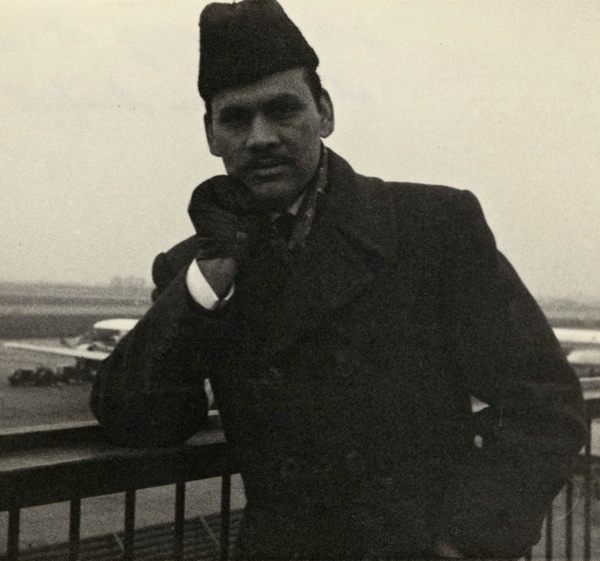
Aga Rais Mirza at the airport
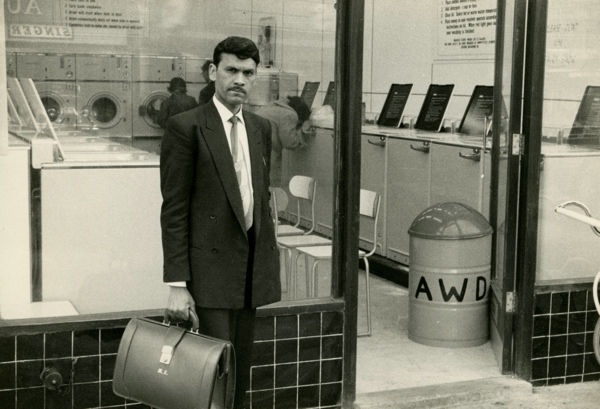
Aga Rais Mirza at the laundrette
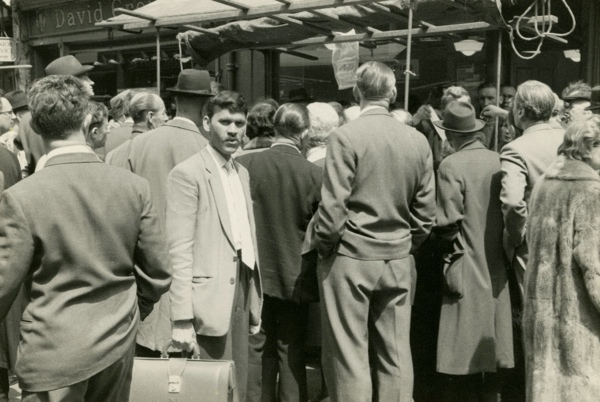
Aga Rais Mirza in Petticoat Lane in the sixties
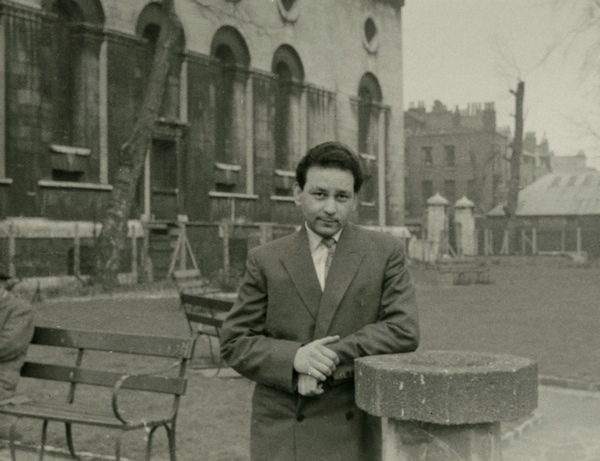
Aga Rais Mirza’s friend in the churchyard of Christ Church, Spitalfields
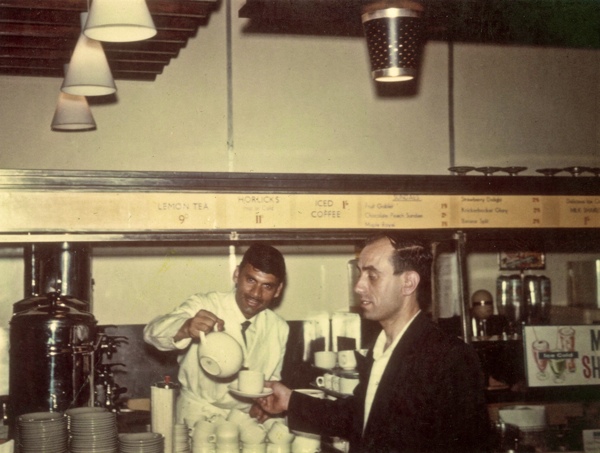
Aga Rais Mirza worked nights at Victoria Station while studying printing
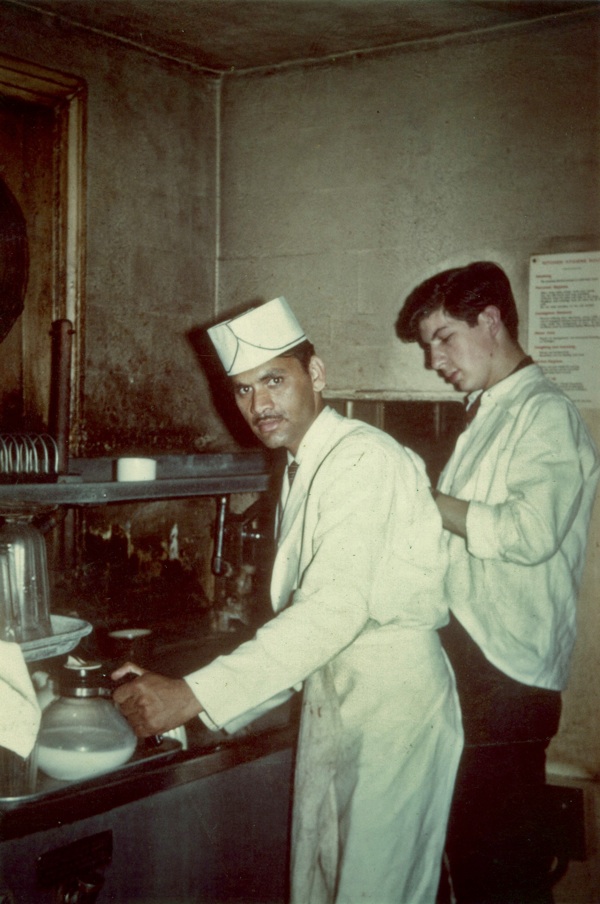
In the kitchen at Victoria Station
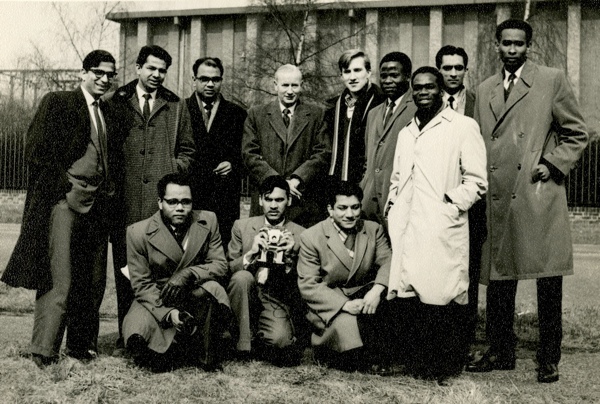
Aga Rais Mirza, squatting centre, with his class at London College of Printing in Kennington


Aga Rais Mirza at London College of Printing
You might also like to read about
King Of The Bottletops At The City Farm
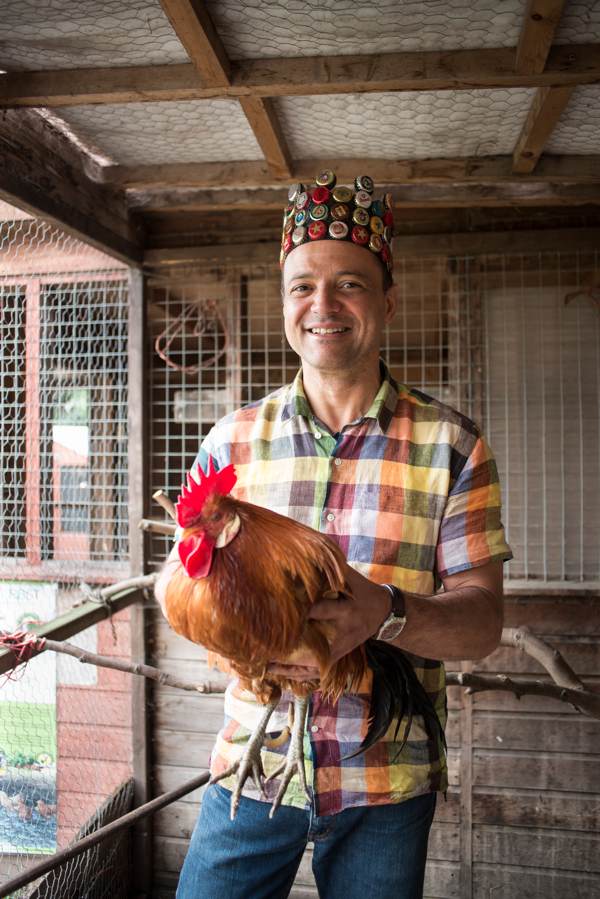
Robson & Kellogg the Cockerell
In recent weeks, Robson Cezar, King of the Bottletops has been enjoying a spell as artist-in-residence at Spitalfields City Farm, so while I was there picking hops with Master Brewer, Ben Ott, of Truman’s Beer last week, Contributing Photographer Sarah Ainslie & I dropped in to see how he was getting along.
The mellow atmosphere of harvest-time prevails at the farm now and I discovered Robson at work in his studio between the vegetable patch, where lines of tomato plants hang heavy with fruit, and the pig sty under the apple trees, where Holmes & Watson snaffle up windfalls.
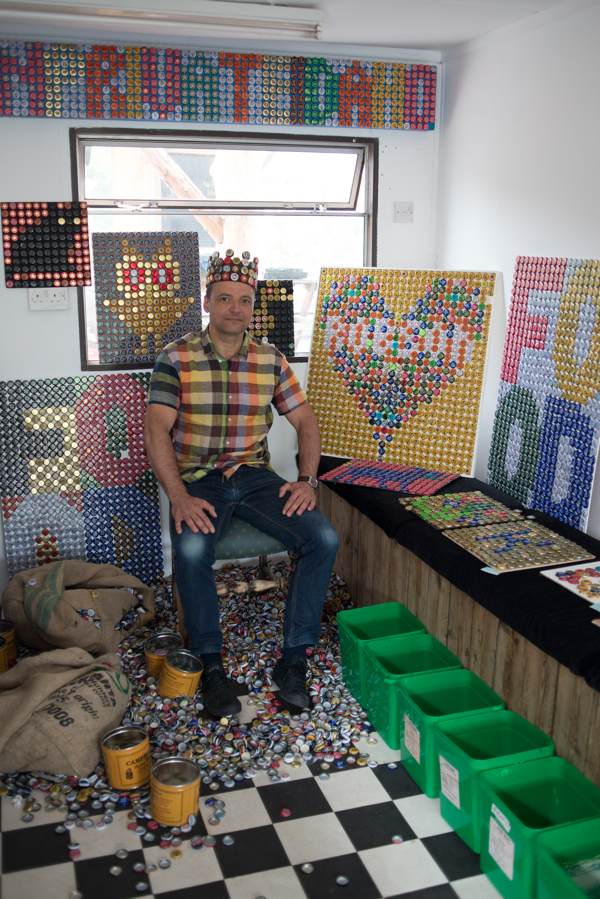
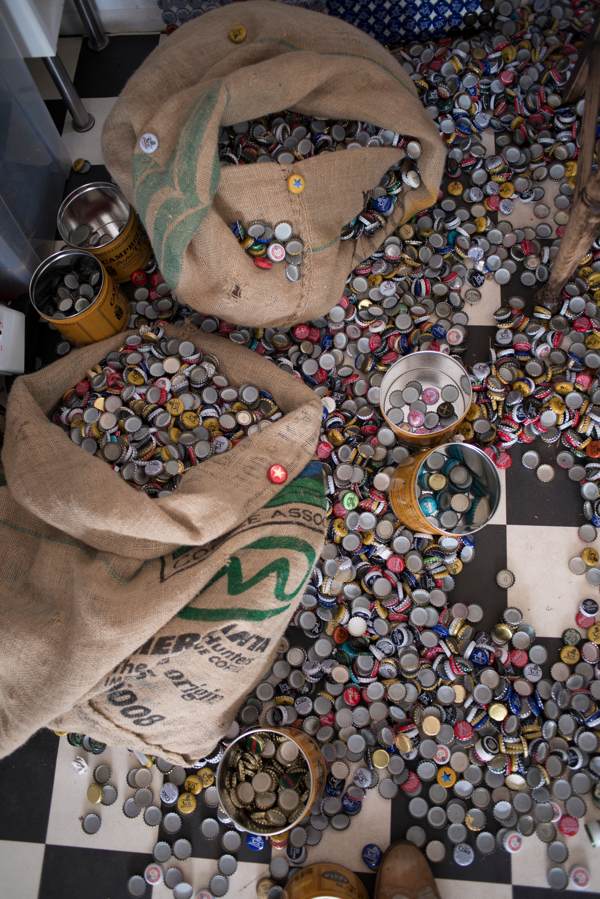
Inside the tiny converted portacabin, lined with weatherboarding and hung with Robson’s colourful pictures on the outside, you discover more bottlecaps than you ever saw, all piled up like loose coins in the king’s counting house. On a long shelf, lines of old tea tins serve as containers for each distinctive variety. All day, visitors to the farm – both young and old – come and go, dropping in to help sort bottletops into their respective colours or staying around longer to learn how to make their own pictures. And in the midst of all this, Robson sits placidly in his cardboard crown, glueing bottletops systematically onto a board – squeezing two drops of glue from a saucebottle onto each bottletop and pressing it carefully into place.
Diagrams on graph paper inside the cabin reveal his method, working out the structure of his design upon a grid. Then comes the arranging and shuffling, contemplating all the infinite permutations of colour and form to arrive at an ideal arrangement. Finally, he embarks upon the long process of attaching all the bottletops which can take several days and requires sustained concentration, like needlework or weaving. Happily, Robson can do this part while visitors come by asking questions or pursuing their own projects, but mostly just to wonder at his beautiful sparkling pictures conjured from such modest materials.
Drawing inspiration from the farm, Robson made a lively portrait of Kellogg the Cockerell, using two thousand bottletops, and then a glistening new sign for Lutfun Hussain’s Coriander Gardening Club for Bengali Women, in colours that match their ripening tomatoes. Taking an idea from the recent hop picking visit of Master Brewer, Ben Ott, he is currently at work creating a huge eagle of more than six thousand bottletops for the new Truman’s Brewery in Hackney Wick, to be completed for the Brewery’s First Anniversary Party next Sunday, 12th September. Next, he will set to work upon an enormous scarlet chilli in time for the London Chilli Festival at the Farm on Sunday 28th September.
In the meantime, if anyone fancies strolling over to admire the Farm in all its harvest glory and watching the master at work shuffling bottletops around a board, the King of the Bottletops is welcoming all to his court each day until the end of this month. And if anybody else decides they want a sign made of bottletops, please contact robsoncezar@hotmail.com
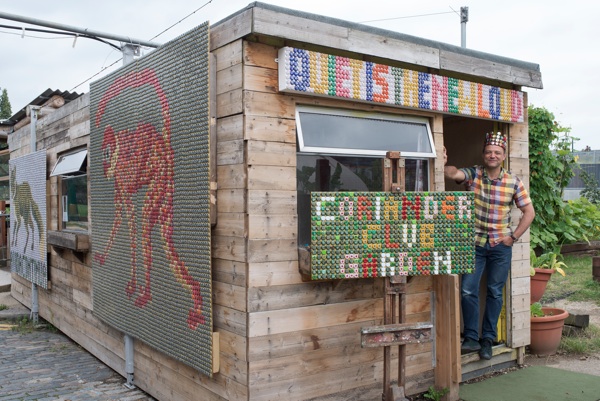
The studio
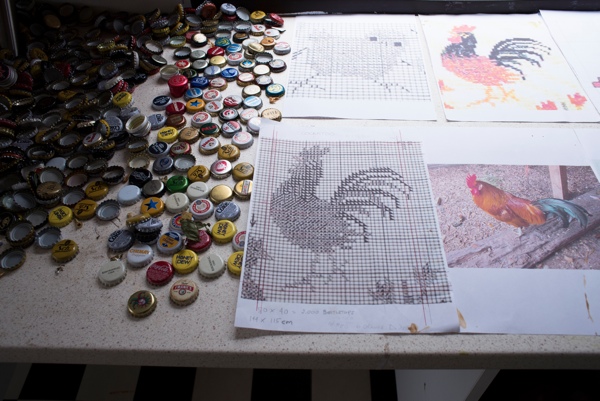
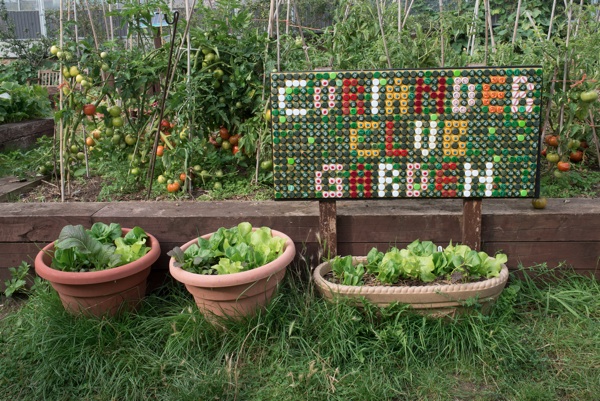
New sign for the Coriander Gardening Club
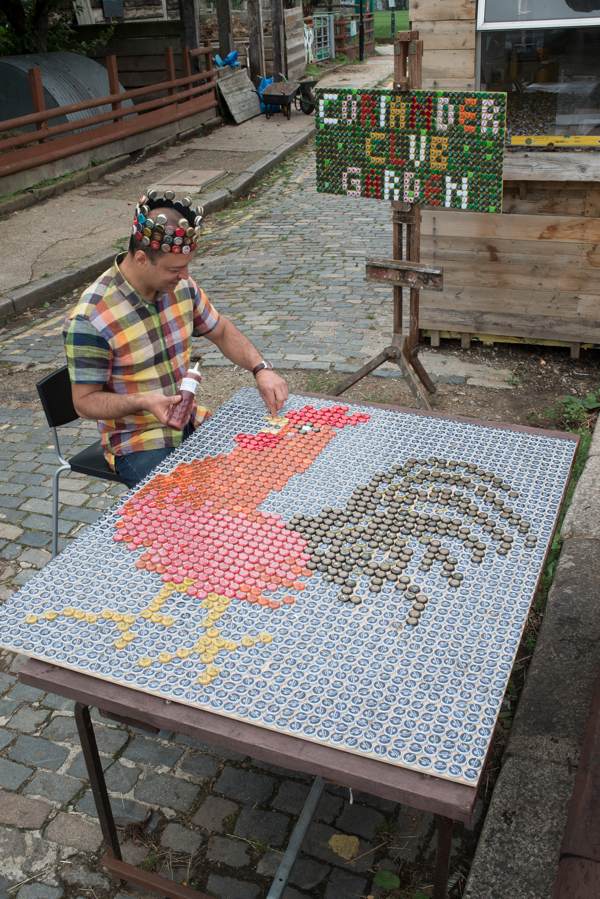
Robson at work on his portrait of Kellogg the Cockerell, using two thousand bottletops
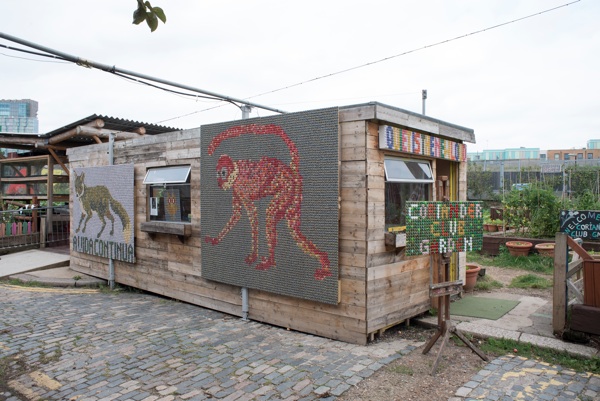
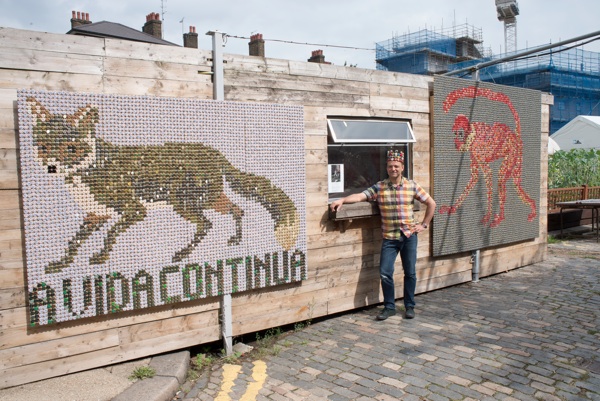
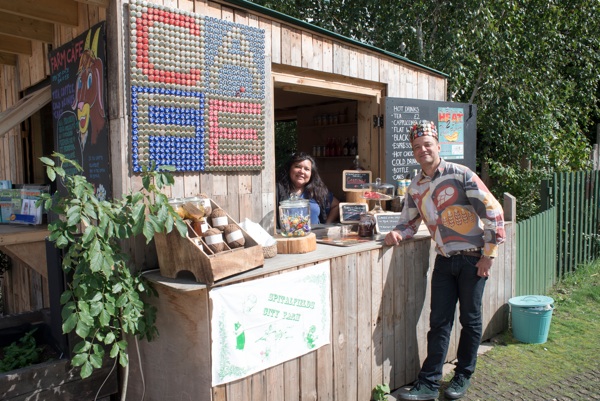
Robson with Rossana Leal and his new sign for the farm cafe
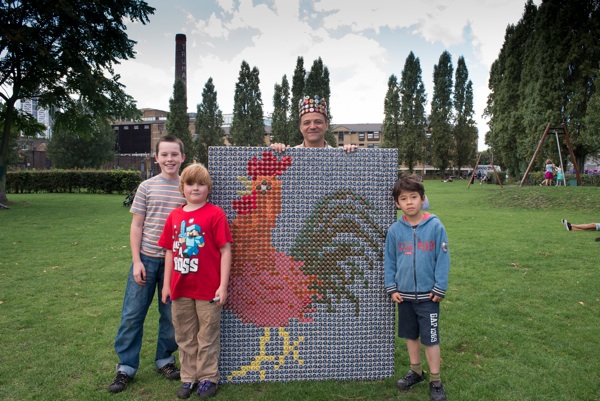
With friends in Allen Gardens
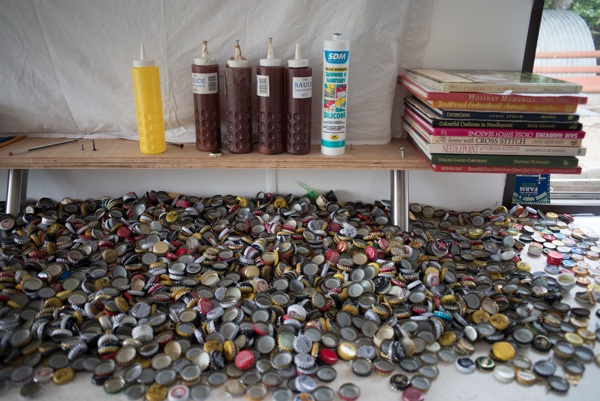
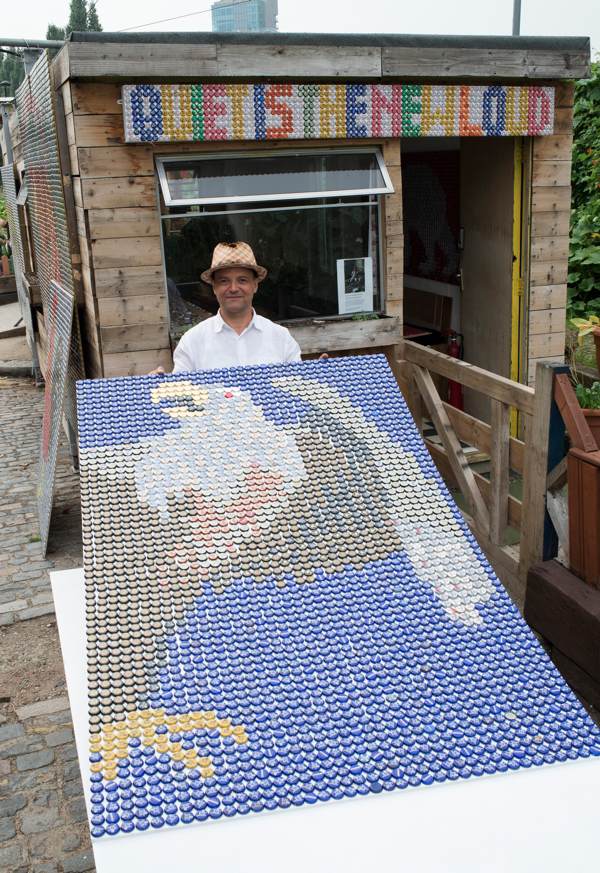
Work-in-progress on half of the eagle for the First Anniversary of the new Truman’s Brewery, using more than six thousand bottletops
Photographs copyright © Sarah Ainslie
Visit the King of the Bottletops at the farm any weekday (except Mondays) between 10am and 4pm until 28th September. Introductory workshops take place every day and can be booked by email to Rossana@spitalfieldscityfarm.org
The Festival of Heat – the second London Chilli Festival is at Spitalfields City Farm on Sunday 28th September 12-6pm
You may also like to read about












