
In Search of Horace Warner
Yesterday, I revealed the astonishing discovery of the unknown albums of more than a hundred of Horace Warner’s photographs of the Spitalfields Nippers dating from the turn of the nineteenth and twentieth centuries, and today I trace a little of what is known about the photographer.

Horace Warner (1871-1939)
This is a self-portrait by Horace Warner taken when he was around thirty years old at the time he was photographing the Spitalfields Nippers, the pictures by which he is remembered and that establish his posthumous reputation as a photographer. If you look closely you can just see the bulb in his left hand to control the shutter, permitting him to capture this image of himself.
With his pale moon-like face, straggly moustache and shiny locks, Horace looks younger than his years and yet there is an intensity in his concentration matched by the poised energy of his right arm. This is how he chose to present himself – wielding a brush, indicative of his profession as a wallpaper designer in the family business of Jeffrey & Co, run by his father Metford Warner (1843-1930), where he and his brother Marcus worked. The company was established in 1836 and Metford was a junior partner who became proprietor by 1869 and, under his leadership, they became a leading manufacturer. He was committed to representing artists’ designs more accurately than had been done before and commissioned William Burges and Walter Crane, among other leading designers of the time – most famously, collaborating with William Morris.
Last week, I set out to visit three places that were familiar to Horace Warner in an attempt to better understand the connections between the different aspects of his life that found their expression in these locations. First, I took the train to Highbury and walked up the hill beside the long eighteenth century terrace bounding the fields, turning off into the quiet crescent of Aberdeen Park, a private estate laid out in the eighteen-fifties.
The turret of the former Warner family house stood out among the other comfortably-appointed villas, as testimony to the success of Jeffrey & Co, supplying wallpaper to the artistic classes in the growing capital at the end of the nineteenth century. A woman pushing a pram along the pavement in front of me turned out to be the nanny employed by the current residents and, when I explained the reason for my visit, she volunteered that there were a series of old photographs still hanging in an upper room, which also retains its turn of the century embossed wallpaper.
Leaving the ghosts of Aberdeen Park, I turned south, following Horace’s route to work by walking for half an hour down through Canonbury, past the Tower and along the route of the New River, to meet the Essex Rd where the Jeffrey & Co wallpaper factory stands. An elegant turn-of-the century utilitarian building with three well-lit floors above for manufacturing and a showroom on the ground floor, it is currently occupied by a wholefood chain. William Morris’ wallpaper designs were all printed here until the thirties when they were taken over by Sandersons and the factory closed in 1940 but, if you go round to the side street, the loading doors remain as if another delivery might arrive at any time.
From here, the East End is a couple of miles south. Now in her nineties, Horace Warner’s surviving daughter, Ruth Finken, still remembers accompanying her father on this journey as a small child to deliver Christmas presents in Quaker St, where he was Sunday School teacher. She recalls how dark, dirty and frightening everything looked, and being told to hold her father’s hand and keep close. Ruth reports that her father was always one for getting the family to pose for his photos and that he spent ages getting everyone in exactly the right position. She also has a memory of one of his photographs of a pair of child’s boots upon the drawing room wall, along with a couple of his portraits of the Spitalfields Nippers, as reminders of those who were less fortunate.
Horace Warner’s participation as Superintendent at the Bedford Institute continued an involvement for his family in Spitalfields that stretched back to the seventeenth century when the Warner Bell Foundry was established. The Warner family were part of the Quaker movement too, almost since its inception, and the naming of Quaker St derives from the Friends Meeting House that opened there in 1656.
Yet the Quaker Mission at the Bedford Institute, that Horace Warner knew, owed its origin to a revival of Quakerism that happened a century later in Spitalfields – encouraged by Peter Bedford (1780-1864), a philanthropist silk merchant who devoted himself to alleviating poor social conditions. Rebuilt in 1893, the handsome red brick Bedford House that stands today would have been familiar to Warner.
In The Condition of The Working Class in England, Frederick Engels referred to the tragedy of a family living in the courtyards south of Quaker St as an example of the degradation of the poor in London and it was these people, living almost upon the doorstep of the Bedford Institute, that Horace Warner befriended and photographed. It was a small area, a narrow rectangle of shabby dwellings circumscribed by roads upon four sides, and no more than a hundred yards wide and five hundreds yards long. Today there is nothing left of it but Horace Warner’s photographs, yet since he annotated them with the names of his subjects we hope we can now discover more about the lives of these people through research into the records. Ultimately, what we can discover about Horace Warner exists in his response to others and their response to him, as manifest in his photographs.
“There isn’t a great deal of information we know about Horace,” his grandson Ian McGilvray admitted to me, “and, in any case, I imagine he would probably have been quite content to have it that way.”
Ruth Finken, Horace Warner’s daughter, is looking forward to seeing all of her father’s Spitalfields Nippers photographs in a book for the first time and – with your help – we mean to publish this on November 1st. As with our other titles, I need to gather a group of readers who are willing to invest £1000 each. Please email Spitalfieldslife@gmail.com if you would like to help bring this exciting project to fruition and I will send you further information.

The Warner family home in Aberdeen Park, Highbury


Jeffrey & Co, Wallpaper Factory & Showroom, 64 Essex Rd – the family business run by Metford Warner, where Horace worked with his brother Marcus

Bedford Institute, Quaker St, Spitafields, where Horace Warner was Sunday School Superintendent

Horace Warner’s photograph of one of the yards off Quaker St

Horace Warner’s photograph of Union Place off Quaker St

Horace Warner’s photograph of the children who lived in the yards beside Quaker St in 1900

Washing Day, Horace Warner’s photograph of children boiling up hot water for laundry

Little Adelaide’s Best & Only Boots – a photograph by Horace Warner that Ruth Finken, his daughter, remembers upon the drawing room wall as a child – the Bedford Institute distributed boots to children

Friederike Huber’s cover design for the book to be published on November 1st
Publication Rights in these Photographs Reserved
Click here to pre-order a copy of SPITALFIELDS NIPPERS by Horace Warner
You can see more of Horace Warner’s photographs here
An Astonishing Photographic Discovery

Today, it is my great delight to reveal these breathtaking photographs taken by Horace Warner in Spitalfields at the turn of the nineteenth and twentieth centuries. These pictures which have never been reproduced before, and have hardly been seen by anyone outside his immediate family, are published with the gracious permission of Horace Warner’s grandson, Ian McGilvray.
Previously, only a handful of Warner’s sympathetic portraits of the children who lived in the courtyards off Quaker St – known as the Spitalfields Nippers – were believed to exist, but through some assiduous detective work by researcher Vicky Stewart and a stroke of good luck upon my part, we were able to make contact with his grandson who keeps two albums comprising more than one hundred of his grandfather’s pictures of Spitalfields, from which the photographs published here are selected.
Many of the pictures in these albums are photographic masterpieces and I believe them to be the most significant set of photographs in existence of East Enders in this era. There is a rare clarity of vision in the tender photography of Horace Warner that brings us startling close to the Londoners of 1900 and permits us to look them in the eye for the first time. You can imagine my excitement when I met Ian McGilvray and opened Horace Warner’s albums to discover so many astonishing pictures. I experienced a sensation almost of vertigo, like looking down the dark well of time and being surprised by these faces in sharp focus, looking back at me.
It was no straightforward journey to get there. I first published a series of Horace Warner’s Spitalfields Nippers in these pages in 2011, reproduced from a booklet accompanying a 1975 exhibition of the handful of pictures once published in fund-raising leaflets by the Bedford Institute in 1912. Then last year, when I sought to reproduce these pictures in The Gentle Author’s London Album, Vicky Stewart established that the photographic prints were held in the Quaker archive at Friends House in the Euston Rd.
This discovery which permitted me to include those pictures in my Album was reward enough for our labours and I wrote an account of our quest entitled In Search of the Spitalfields Nippers last August. The story might easily have ended there, if we had not been shown a 1988 letter from Horace Warner’s daughter Gwen McGilvray that accompanied the prints. In this letter, Gwen mentions the ‘albums’ which was the first tantalising evidence of the existence of more of Horace Warner’s Spitalfields photographs.
Even as our hopes of finding these other pictures were raised, we were disappointed to realise that Gwen was unlikely to be still alive. Yet through the research facility now available online and thanks to his unusual surname, Vicky was able to find an address for one of Gwen’s four children, her son Ian, in Norfolk. It was a few years out of date but there was a chance he was still there, so we waited until the Album was published in October and sent off a copy to Ian McGilvray.
Within weeks, Ian wrote back to ask if I would like to visit him and see the ‘albums.’ It was my good fortune that the one of Horace Warner’s grandchildren we had been able to reach was also the guardian of the photographic legacy. And so it was that on a bright winter’s day I made a journey to Norfolk to meet Ian and see the complete set of Horace Warner’s Spitalfields Nippers for the first time. My fear was that I had seen the most important images among those already known, but my shock was to recognise that the best pictures have not yet been seen.
These wonderful photographs have the power to revolutionise how we think about East Enders at the end of the nineteenth century since, in spite of their poverty, these are undeniably proud people who claim a right to existence which transcends their economic status. Unlike the degraded photographic images created by charitable campaigners or the familiar middle-class studio portraits, Horace Warner’s relaxed intimate pictures draw us into a personal relationship with his subjects whom we meet as our equals. The Spitalfields Nippers are a unique set of photographs, that witness a particular time, a specific place, a discrete society, and an entire lost world.
As a designer managing the family wallpaper-printing business, Horace Warner had the income and resources to explore photography in his spare time and produce images of the highest standard technically. As superintendent of the charitable Bedford Institute, he was brought into close contact over many years with the families who lived nearby in the yards and courts south of Quaker St. As a Quaker, he believed in the equality of all and he was disturbed by the poverty he met in the East End. In the Spitalfields Nippers these things came together for Horace Warner, creating compassionate images that gave dignity to his subjects and producing great photography that is without parallel in his time.
Ian McGilvray has granted his blessing to the publication of all Horace Warner’s Spitalfields Nippers in a book for the first time so that everyone can see them and – with your help – we mean to do this on November 1st. As with our other titles, I need to gather a group of readers who are willing to invest £1000 each. Please email Spitalfieldslife@gmail.com if you would like to help bring this exciting project to fruition and I will send you further information.

 Excerpt of 1988 letter from Horace Warner’s daughter Gwen McGilvray referring to the ‘albums’ and giving the name of his grandson, Ian McGilvray. (Reproduced courtesy of Friends House)

Sisters Wakefield

Walter Seabrook


Celia Compton

Photo referred to by Gwen McGilvray with headlines at the end of the Boer War, dating it to 1902


At the Whitechapel Gallery to see the Burne Jones exhibition 1901

In Pearl St (now Calvin St)

See the man looking over the wall in Union Place (off Wheler St)

Friederike Huber’s cover design for the book to be published on November 1st
Publication Rights in these Photographs Reserved
Click here to order a copy of SPITALFIELDS NIPPERS by Horace Warner
Thomas Bewick’s Cat
Accompanying my volumes of Thomas Bewick’s History of British Birds, I also managed to discover a copy of his General History of Quadrupeds from 1824 in the Spitalfields Market and – of course – I turned first to his entry upon the domestic cat, from which I publish these excerpts below.

To describe an animal so well known might seem a superfluous task – we shall only, therefore, select some of its peculiarities as are least obvious and may have escaped the notice of inattentive observers.
It is generally remarked that Cats can see in the dark, but though this is not absolutely the case, yet it is certain that they can see with much less light than other animals, owing to the peculiar structure of their eyes – the pupils of which are capable of being contracted or dilated in proportion to the degree of light by which they are affected. The pupil of the Cat, during the day, is perpetually contracted and it is with difficulty that it can see in strong light, but in the twilight the pupil regains its natural roundness, the animal enjoys perfect vision and takes advantage of this superiority to discover and surprise its prey.

The cry of the Cat is loud, piercing and clamorous, and whether expressive of anger or of love is equally violent and hideous. Its call may be heard at a great distance and is so well known to the whole fraternity that, on some occasions, several hundred Cats have been brought together from different parts. Invited by the piercing cries of distress from a suffering fellow creature, they assemble in crowds and with loud squalls and yells express their horrid sympathies. They frequently tear the miserable object to pieces and, with the most blind and furious rage, fall upon each other, killing and wounding indiscriminately, till there is scarcely one left. These terrible conflicts happen only in the night.
The Cat is particularly averse to water, cold and bad smells. It is fond of certain perfumes but is more particularly attracted by the smell of valerian and cat mint – it rubs itself against them and if not prevented will infallibly destroy them.

Though extremely useful in destroying the vermin that infest our houses, the Cat seems little attached to the persons of those who afford it protection. It appears to be under no subjection and acts only for itself.
All its views are confined to the place where it has been brought up. If carried elsewhere, it seems lost and bewildered, and frequently takes the first opportunity of escaping to its former haunts. Frequent instances are recollected of Cats having returned to the place from whence they have been carried, though at many miles distance, and even across rivers, where they could not possibly have any knowledge of the road or the situation that would apparently lead them to it.
In the time of Hoel the Good, King of Wales, who died in the year 948, laws were made to fix the different prices of animals, among which the Cat was included as being at that period of great importance on account if its scarceness and utility. The price of a kitten was fixed at one penny, till proof could be given of its having caught a mouse twopence, after which it was rated as fourpence which was a great sum in those days.
If anyone should steal or kill the Cat that guarded the Prince’s granary, he was either to forfeit a milk ewe, or her fleece and lamb, or as much wheat as when poured on the Cat suspended by its tail would form a heap high enough to cover the tip of the former.

Hence we may conclude that Cats were not originally native of these islands, and from the great care taken to improve and preserve the breed of this prolific creature, we may suppose, were but little known in that period. Whatever credit we may allow to the circumstances of the well known story of Whittington and his Cat, it is another proof of the great value set upon this animal in former times.

You may also like to read about
Blackie, the Last Spitalfields Market Cat
At Quality Castings

Andrew Hudson, Master Caster
Quality Castings has occupied a string of old buildings alongside the Regent’s Canal in Haggerston for the last thirty years but, now the property has become more valuable for residential use, the company is transferring their business to Hackney Wick this summer. So Contributing Photographer Sarah Ainslie & I decided to pay a visit this week and record this celebrated endeavour in familiar surroundings before they move out to a new factory further east.
Our guide was Alan Factor, a soft-spoken Welshman with twinkly eyes that cast an air of alchemical mystery upon preceedings, even as he revealed to us the plain reality of the lost wax process. “We do precision casting in aluminium, brass, bronze, silver, gold, platinum and palladium,” he explained, clasping his hands proudly when we met him in the tiny white cubicle of a reception room without windows. “Jewellery’s gone to the Far East,” he revealed, “So we do more for engineering and industry now. We are a service industry, we replicate other people’s products.”
In wonder, Alan told us about a conceptual artist who melted down celluloid film stock to remove the silver and cast a chewed pencil with the metal extracted. He told us about the husband who brought a dried rose that had sentimental meaning for his wife and asked to have it cast in a precious metal. He told us they made the handles for the Queen’s Gold Cup at Ascot, that she presented to herself when her horse came first. “She won her own cup that year,” Alan confided with a chuckle, showing us a picture of the famous cup.
“We make a lot of different things,” he assured me, widening his eyes with promise as he led us through into the workshop, which reminded me a little of a school science laboratory. In the far corner Paul Prowse, Master Mould Cutter, was packing rubber around a small piece of jewellery in a frame the size of a tobacco tin. Then he placed it in a heated press that would melt the rubber and compact it into a mould. Taking out a mould that had already cooled, he set to work with a sharp knife like an expert fishmonger, inserting the blade and cutting through to fillet out the object at the centre and leave a clean mould for casting.
Next to Paul, Precision Waxer Geoff Luke was holding the completed rubber mould up to a hot wax injection machine, to create a replica of the original. Once the rubber mould was filled, he placed it upon a refrigerated surface to harden the wax before opening it up to remove delicate wax facsimiles of intricate jewellery and, using a paintbrush, dust them with talcum to prevent any sticking in the plaster mould. Across the room, Chris Walsh, another Precision Waxer was working with a heat gun, attaching the fragile wax forms onto a central core, arranged dextrously in a spiral to create a curious tree-like filigree effect.
Along the corridor, Alan led us through another door where we met Andrew Hudson, Master Caster, lurking in his own lair – a dignified industrial environment. Andrew places the frail wax ‘trees’ into cylinders which he fills up with plaster to create the mould that receives the molten metal. These cylinders are baked overnight in ovens to melt away the wax and leave a void into which the metal is poured. Thus, when these moulds are finally broken open, replicas of the original items are revealed – having travelled a strange journey through mutability, becoming negative, positive, negative and finally positive objects again.
Hundreds of orders stream through, mostly turned round in a week with repeats occasionally turned around in a day. It is an ancient process that has not lost its magic even when it is done with such apparent effortless efficiency and accomplishment, as at Quality Castings.

In the mould-making workshop

Placing the rubber in the heated press where it will form a mould as it melts

Paul Prowse, Master Mould Cutter of sixteen years experience


Removing the original from the mould

A selection of rubber moulds

Geoff Luke, Precision Waxer of seventeen years experience, fills the mould with wax


Geoff dusts the wax replica of a gold ring with talcum to prevent it sticking in the mould

Chris Walsh, Precision Waxer

Treeing up

Trees of wax replicas – on the left you can see parts of a watch

One hundred and fifty thousand moulds in the store room

Andrew Hudson, Master Caster

The trees are surrounded with plaster to create a mould for the casting


The moulds sit overnight in the ovens to remove the wax

Crucibles for hot metal


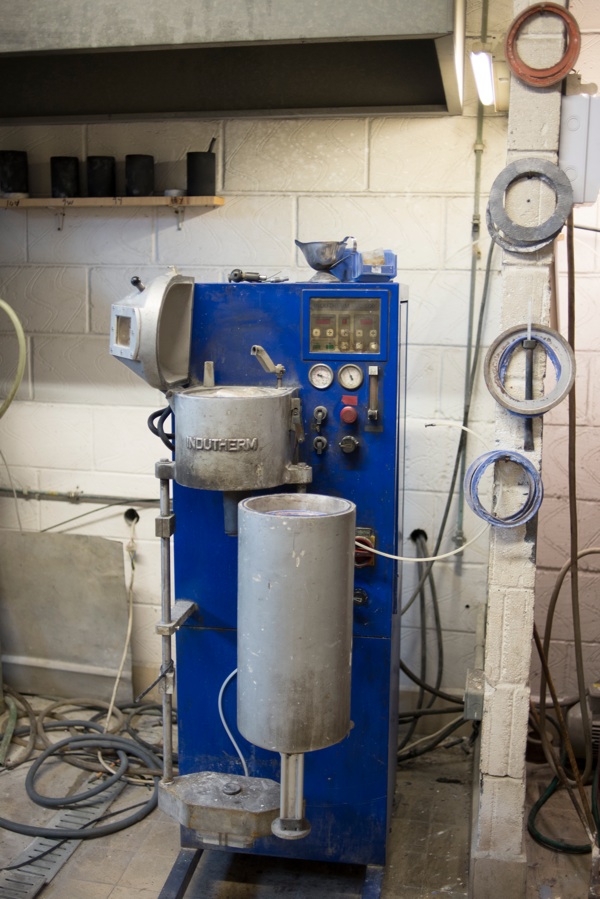
The crucible sits in the upper canister and the molten metal runs down into the mould

Finished castings ready for despatch

Alan Factor joined the company as General Manager twenty years ago
Photographs copyright © Sarah Ainslie
Quality Castings is currently at 2-4 Orsman Rd, N1 5QJ but will be moving this summer to Victoria Park Industrial Centre, Rothbury Rd, E9 5HD
You may also like to read about
Bob Mazzer On The Tube Again
Today it is my pleasure to publish some of Bob Mazzer’s tube photographs which did not make it into the book, accompanying an invitation to his forthcoming lecture at Rich Mix next Monday 30th at 7pm. In the meantime, Bob’s debut exhibition runs at Howard Griffin Gallery, 189 Shoreditch High St until July 13th and copies of UNDERGROUND can be ordered online here


Photographs copyright © Bob Mazzer
You may also like to read about
East End Lollipop People
Let us now praise the Lollipop People. Those benign spirits who arrive miraculously twice a day, like guardian angels or fairy godparents, glowing fluorescent, wielding their wands and shepherding their flocks safely across the road to and from school.
When the City of London & Cripplegate Photographic Society approached me offering their services to collaborate with Spitalfields Life, I knew at once that the Lollipop People would be the subject – to my eyes, they are unacknowledged, universally-loved, heroes and heroines who deserve to be celebrated and photographed.
Yet, getting to the right place at the right time and capturing these timid fleeting spirits, proved more challenging than we had anticipated. We discovered that, due to the Education Cuts, the Lollipop People are an endangered species and, such is the unassuming nature of these modest folk, some shunned the lens while others would not give their names.
Thankfully, through tenacity and charm, Cathryn Rees and Jean Jameson were able to produce this slim portfolio of elegant portraits that must serve as the historical record of these hardy, altruistic souls.

Frank Smith at Cubbitt Town School, Isle of Dogs (Photo by Cathryn Rees)

Sabah at Bigland Green School, Limehouse (Photo by Jean Jameson)

Abdul Rif at Caley Primary School, Bow (Photo by Jean Jameson)

At Cyril Jackson Primary School, Limehouse (Photo by Jean Jameson)

Jackie Clarke, St Peter’s School, Wapping (Photo by Cathryn Rees)

At Cyril Jackson Primary School, Limehouse (Photo by Jean Jameson)

Julie Hutchinson at Mayflower School, Poplar (Photo by Cathryn Rees)

Sabah at Bigland Green School, Shadwell (Photo by Jean Jameson)

At Redlands Primary School, Stepney (Photo by Cathryn Rees)
Photographs copyright © Cathryn Rees & Jean Jameson
Learn more about City of London & Cripplegate Photographic Society, London’s oldest photographic society, founded in 1899
Colin O’Brien’s London Life
There cannot be many photographers who have created the expanse of work that Colin O’Brien has done, documenting the changing life of London over seven decades – beginning as a child with a Box Brownie in Clerkenwell in 1948 and continuing today as a regular Spitalfields Life Contributing Photographer, taking the digital photos of the Druids for yesterday’s story.
A retrospective of Colin’s photography entitled London Life opens at Hackney Museum this week and today we preview a small selection of pictures from the show.

Car Breakers, Hackney Wick

Fish Shop, Chatsworth Rd in the eighties

Finsbury, 1951

Hackney, 1998

Old Dalston Station

East Enders Cafe, Hackney

Brick Lane in the eighties

Cafe, Battersea Park

Chatsworth Rd in the eighties

The Griffin, Shoreditch, on the last day of smoking in pubs

Tapping Harlem, Hackney Empire

Regents Canal, Hackney

Victoria Dwellings, Clerkenwell, in the fifties

Hackney, last day of the Routemaster on the 38 bus route

Old Kent Rd

Covent Garden, 2004

St Martin’s Lane

Battersea Power Station

Median Rd, Hackney

Rag & Bone Man, 1959

Colin O’Brien (left) at Sir John Cass School, Aldgate 1954

Raymond Scallionne & Razi Tuffano, Hatton Garden in 1948
Photographs copyright © Colin O’Brien
London Life runs at Hackney Museum until 30th August, Admission Free
Take a look at more pictures by Colin O’Brien
Colin O’Brien’s Clerkenwell Car Crashes
Travellers’ Children in London Fields
Colin O’Brien’s Brick Lane Market


