
The Relics Of The Liberty Of Norton Folgate
On the final day of British Land’s public exhibition for their controversial redevelopment of Norton Folgate, I publish the story of James Frankcom and his quest to find the relics of this ancient Liberty, which British Land are seeking to rebrand as ‘Blossom St.’ The exhibition is open today from 4pm until 8pm. This could be your last chance to visit these fine old buildings, and readers are encouraged to go and record their comments in writing – further details below.

James Frankcom holds the Beadle’s staff of Norton Folgate from 1672
For years, Spitalfields resident James Frankcom was on a quest to find the lost relics of the Liberty of Norton Folgate and – when he found them – with true magnanimous spirit, he invited me and Contributing Photographer Alex Pink to share in his glorious moment of discovery.
First recorded in the Domesday Book in 1086, the nine acres north of Spitalfields known today as Norton Folgate were once the manor of Nortune Foldweg – ‘Nortune’ meaning ‘northern estate’ and “Folweig’ meaning ‘highway,’ referring to Ermine St, the Roman road north from the City of London that passed through the territory. Irrigated by the spring in Holywell St, this fertile land was within the precincts of the Priory of St Mary Spital until 1547 when, after the Reformation, it achieved autonomy as the Liberty of Norton Folgate, ruled by a court of ten officers described as the “Ancient Inhabitants.”
These elected representatives – including women – took their authority from the people and they asserted their right to self-government without connection to any church, maintaining the poor, performing marriages and burials, and superintending their own watchmen and street lighting. The officers of the Liberty were the Head Borough, the Constable who supervised the Beadles, the Scavenger who dealt with night soil, and Overseers of the Poor. And thus were the essentials of social organisation and waste disposal effectively accomplished for centuries in Norton Folgate.
When James Frankcom discovered that he lived within the former Liberty, he began to explore the history and found an article in Home Counties Magazine of 1905 which illustrated the relics of Norton Folgate including a beadle’s staff, a sixteenth century muniment chest and an almsbox, held at that time in Stepney Central Library.
James contacted Malcolm Barr-Hamilton, the Archivist, at Tower Hamlets Local History Library in Bancroft Rd which houses artifacts transferred from the Whitechapel Library in 2010. There he found the minute books of Norton Folgate from 1729 until 1900, detailing the activities of the court and nightly reports by the watchmen. Curiously, in spite of the rowdy reputation that this particular neighbourhood of theatres and alehouses enjoyed through the centuries, including the famous arrest of Christopher Marlowe in 1589, the nightwatchmen recorded an unbroken sequence of “All’s well.”
In the penultimate entry of the minute book, dated October 1900, when the Liberty was abolished at the time of the foundation of the London County Council, James found mention of “certain relics of the Liberty of no use to the new Metropolitan Borough of Stepney” which the board of trustees gave to Whitechapel Museum for safe keeping. Searching among hundreds of index cards recording material transferred from Whitechapel to the archive, he found three beadle’s rods and an almsbox from Norton Folgate. Disappointingly, the muniment box had gone missing at some point in the last century, possibly when the collection was moved for safety to an unknown location during World War II.
When James put in a request to see the almsbox and the beadles’ rods, they could not be found at first but eventually they were located and, a year later, I met James outside the Bancroft Library, where the local history collection is held and we went inside together to see the relics. Upon a table in the vast library chamber was the battered seven-sided alms box cut from a single piece of oak in 1600 and secured by four separate locks. It was a relic from another world, the world of Shakespeare’s London, and three centuries of “alms for oblivion” had once been contained in this casket.
Yet equally remarkable was the staff of Norton Folgate with a tiny sculpture upon the top of a realistic four-bar gate complete with the pegs that held it together – an heraldic pun upon the name of Norton Folgate. Since the photograph of 1901, it had suffered some damage but the inscription “Norton Folgate 1672” was still visible. Bearing the distinction of being London’s oldest staff of office, it represents the authority of the people.
James Frankcom could not resist wielding this staff that was once of such significance in the place where he lives and and savouring the sense of power it imparted. It was as if James were embodying the spirit of one of the “Ancient Inhabitants” and not difficult to imagine that, if he had dwelt in Norton Folgate in an earlier century, he might have brandished it for real – apparelled in a suitably dignified coat and hat of office, of course.

Dating from 1672, this is the oldest Beadle’s staff in London and it represents the authority of the people in opposition to the power of the church. The gate is an heraldic pun upon the name of Norton Folgate.

The painted Beadles’ staffs date from the coronation of George IV in 1820.

Hewn from single piece of oak, the seven-sided almsbox of Norton Folgate made in 1600.

“This box was divised bi Frances Candell for THE pore 1600” is inscribed upon the top and upon the lid is this text – “My sonne defrayde not the pore of hys allmes and turne not awaie they eies from him that hath nede. Lete not they hande be strecched owte to relaue and shut when thou sholdest gewe.”


Title page of the earliest minute book of Norton Folgate 1729

In Norton Folgate, the watchmen recorded an unbroken sequence of “all’s well” night after night.


In the last minute book, on 24th October 1900, the Liberty of Norton Folgate was abolished with the establishment of the London County Council.


The relics of the Liberty of Norton Folgate as illustrated in Home Counties Magazine, 1905 – including the lost sixteenth century muniment chest and the former courthouse in Folgate St.
Photographs copyright © Alex Pink


Readers are encouraged to attend and record your comments in writing at the exhibition
You may also like to read about
Neville Turner In Elder St
On the second day of British Land’s public exhibition for their controversial redevelopment of Norton Folgate, I publish the story of Neville Turner whose family lived in Elder St before British Land partly demolished it in the seventies. The exhibition is open today from midday until 5pm, and readers are encouraged to go along and record their comments in writing – further details below.

This is Neville Turner sitting on the step of number seven Elder St, just as he used to when he was growing up in this house in the nineteen forties and fifties. Once upon a time, young Neville carved his name upon a brick on the left hand side of the door, but that has been replaced now that these are prized buildings of historic importance. Yet Neville counts himself lucky that the house he grew up in still stands, after it came close to demolition when half the street was swept away by British Land in the seventies.
At the time Neville lived here, the landlords did no maintenance and the buildings were dilapidated. But Neville’s Uncle Arthur wallpapered the living room with attractive wisteria wallpaper, which became the background to the happy family life they all enjoyed, in the midst of the close-knit community in Elder St during the war and afterwards. Subsequently, the same wisteria wallpaper appeared as a symbol of decay, hanging off the wall, in photographs taken to illustrate the dereliction of Elder St when members of the Spitalfields Trust squatted it to save the eighteenth century houses from demolition.
It was only when an artist appeared – one Sunday morning in Neville’s childhood – sketching the pair of weaver’s houses at number five and seven, that Neville first became aware that he was growing up in a dwelling of historic importance. Yet to this day, Neville protests he carries no sentiment about old houses. “This affection for the Dickensian past is no substitute for hot and cold running water,” he admitted to me frankly, explaining that the family had to go the bathhouse in Goulston St each week when he lived in Elder St.
However, in spite of his declaration, it soon became apparent that this building retains a deep personal significance for Neville on account of the emotional history it contains, as he revealed to me when he returned to Spitalfields this week.
“My parents moved from Lambeth into number seven Elder St in 1931 and lived there until they were rehoused in 1974. The roof leaked and the landlords let these houses fall into disrepair, I think they wanted the plots for redevelopment. But then, after my parents were rehoused in Bethnal Green, the Spitalfields Trust took them over in 1977.
I was born in 1939 just before the war began and my mother called me Neville after Neville Chamberlain, who she saw as the bringer of peace. I got a lot of stick for that at school. I had two elder brothers, Terry born in 1932 and Douglas born in 1936. My father was a firefighter and consequently we saw a lot of him. I felt quite well off, I never felt deprived. In the house, there was a total of six rooms plus a basement and an outside basement, and we lived in four rooms on the ground floor and on the first floor, and there was a docker and his wife who lived up on the top floor.
My earliest memory is of the basements of Elder St being reinforced as air raid shelters in case the buildings collapsed – and of going down there when the sirens sounded. Even people passing in the street took shelter there. Pedlars and knife-grinders, they would bang on the door and come on down to the basement. That was normal, we were all part and parcel of the same lot. I recall the searchlights, I found it interesting and I wondered what all the excitement was about. War seemed quite mad to me and, when it ended, I remember the street party with bonfires at each end of the street and everybody overjoyed, but I couldn’t understand why they were all so happy. None of the houses in Elder St were damaged.
We used to play out in the street, games like Hopscotch and Tin Can Copper. All the houses had a door where you could go up onto the roof and it was normal for people in the terrace to walk along the roof, visiting each other. You’d be sitting in your living room and there’d be a knock on the window from above, and it was your neighbours coming down the stairs. As children, we used to go wandering in the City of London, and I remember seeing typists typing and thinking that they did not actually make anything and wondering, ‘Who makes the cornflakes?’ Across Commercial St, it was all manufacturing, clothing, leather and some shoemaking – quite a contrast.
After the war, my father worked as a bookie’s runner in the Spitalfields Market, where the porters and traders were keen gamblers, and he operated from the Starting Price Office in Brushfield St. He never got up before ten but he worked late. They were not allowed to function legally and the police would often take them in for a charge – the betting slips had to be hidden if the police came round. At some parts of the year, we were well off but other parts were call the ‘Kipper Season’ which was when the horse-racing stopped and the show-jumping began, then we had very little. I knew this because my pocket money vanished.
I joined the Vallance Youth Club in Chicksand St run by Mickey Davis. He was only four foot tall but he was quite a strong character. He was attacked a few times in the street on account of being short and a few of us used to call up to his flat above the Fruit & Wool Exchange, so that he could walk with us to the club, but then he got ill and died. Tom Darby and Ashel Collis took over running the club, one was a silversmith and the other was a passer in the tailoring trade. We did boxing, table tennis and football, and they took us camping to Abridge in Essex. We got a bus all the way there and it only cost sixpence.
I moved on to the Brady Club in Hanbury St – it changed my outlook on life. They had a music society, a chess society, a drama society and we used to go to stay at Skeate House in Surrey at weekends. If you signed up to pay five shillings a week, you could go on a trip to Switzerland for £15. Yogi Mayer was the club captain. He called me in and said, ‘This is a private chat. We are asking every boy – If you can’t manage the £15, we will make up the shortfall. But this is between you and I, nobody else will know. I believe that everybody in the East End should be able to have an overseas holiday each year.’ It endeared him to me and made a big impression. When I woke in Switzerland, the sight of the lakes and the mountains was such a contrast to Elder St, and when we came back from our fortnight away I got very down – depressed, you would say now. I was the only non-Jewish person in the Brady Club, only I didn’t realise it. On one of the weekends at Skeate House, I did the washing up and dried it with the yellow towel on a Saturday. But Yogi Mayer said, ‘I won’t tell anyone.’
A friend of my brother’s worked in Savile Row and I thought it would be good for me too. I went to French & Stanley just behind Savile Row and they said they did need somebody but not just yet. So then I went to G.Ward & Co and asked if they wanted anybody, and there was this colonel type and he said, ‘Start tomorrow!’ I was fifteen and a bit, I had left school that Christmas-time. It lasted a couple of years and they were good to me. The cutter would give you the roll of work to be made up and say, ‘It’s for a friend of yours, Hugh Gaitskell.’ When I asked the manager what this meant, he said, ‘We’re Labour and they’re not.’
In 1964, I left Elder St for good, when I got married. I met my wife Margaret at work, she was the machinist and I was the cutter. She used to bring in Greek food and I liked it, and she said, ‘Would you like to come and have it where I live? You’ll have no excuse for forgetting the address because it’s Neville Rd!’
When I started in tailoring, the rateable value of the houses in Elder St was low because of the sitting tenants and low rents, and nobody ever moved. We thought it was good, it was a kind of security. The money people had they spent on decorating and, in my memory, it was always warm and brightly decorated. There was a good sense of well-being, that did seem generally to be the case. We were offered to buy both the houses, five and seven Elder St, for eighteen hundred quid but my father refused because we didn’t want them both.”

Neville with his grandmother.

Neville’s mother Ada Sims.

Neville’s father Charles Turner was in the fire service during the war (fourth from left in back row).

Neville as a schoolboy.

Neville’s ration book.

Coker’s Dairy in Fleur de Lis St used to take care of their regular customers – “If you were loyal to them, they’d give you an extra piece of cheese under the counter.”

Neville aged eleven in 1951, photographed by Griffiths of Bethnal Green.
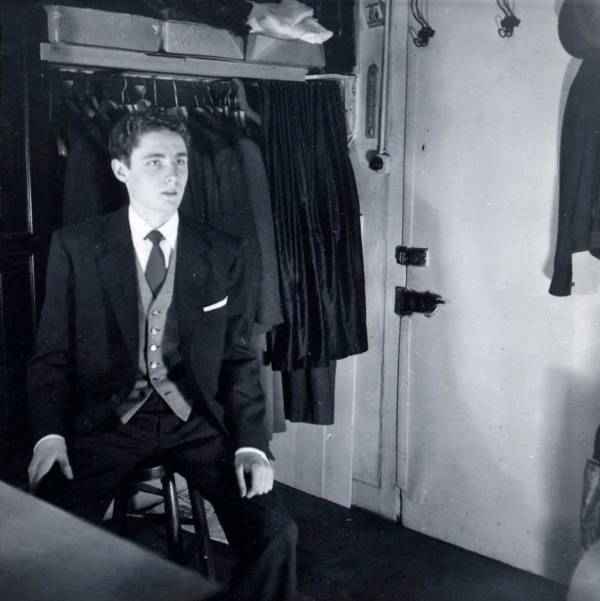
Neville at Saville Row when he began his career as a pattern cutter at sixteen.

Neville’s father Charles owned the only car in Elder St – “We had a car in Elder St when nobody had a car in Elder St, but it vanished when we had no money.”

Neville as a young man.

A family Christmas in Elder St, 1968 – Neville sits next to his father at the dinner table.

Neville’s father, Charles.

Neville and Margaret.

Margaret and Minas.

Neville, Margaret and their son Minas.


Neville’s Uncle Arthur who hung the wisteria wallpaper.

Minas and Terry.

The living room of number seven photographed by the Spitalfields Trust in 1977 with Uncle Arthur’s wisteria wallpaper hanging off the walls.

Neville Turner outside number seven Elder St where he grew up
Readers are encouraged to attend and record your comments in writing at the exhibition
You may also like to read about
Charles Skilton’s London Life 1950
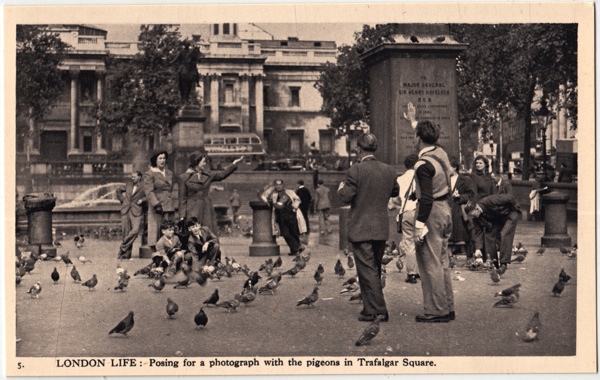
Now that the summer visitors are here and thronging in the capital’s streets and transport systems, I thought I would send you this fine set of postcards published by Charles Skilton, including my special favourites the escapologist and the pavement artist.
Looking at these monochrome images of the threadbare postwar years, you might easily imagine the photographs were earlier – but Margaret Rutherford in ‘Ring Round the Moon’ at The Globe in Shaftesbury Ave in number nine dates them to 1950. Celebrated in his day as publisher of the Billy Bunter stories, Charles Skilton won posthumous notoriety for his underground pornographic publishing empire, Luxor Press.




You may also like to take a look at
Today I tell the strange story of the Aquarium, Menagerie & Wax Works that once stood in Spitalfields upon the site that British Land have earmarked for controversial redevelopment

Click to enlarge
You might walk past the Savoy Cafe opposite Worship St in Bishopsgate and not give it a second thought. Yet this building is a salient example of how an extraordinary history may be present without any indication. For here, in 1875, opened the East London Aquarium, Menagerie & Wax Works Exhibition.
You can read the accounts of this popular attraction in the press cuttings below, and marvel at the Victorians and their love of wonders. “The Aquarium was a small, popular pleasure resort on Bishopsgate and contained, amongst other exhibits, a number of zoological specimens including bears, lions, jackals, birds and monkeys,” explained ‘The Police News,’ “The building extended from High St Shoreditch to Blossom St, having a frontage of eleven feet in the former and eighty-four feet in the latter street. The premises were once occupied by a silk merchant and were a few years ago transformed into an Aquarium for the lower classes, the price of admission being only one penny.”
Yet in spite of the celebrity wax figures, the water tanks with seals, the cave with illuminated views, the rifle gallery with bird shows and the arena offering performances by tamed lions three times daily, what was most remarkable about the East London Aquarium, Managerie & Wax Work Exhibition was the bizarre manner of its demise. Early on the morning of 8th June 1884, a fire broke out in the wax exhibition which quickly grew beyond control and entirely gutted the building, destroying the animals. “It does seem somewhat odd that in an Aquarium, of all places in the world, there should not be water enough to put out a fire,” queried one correspondent vainly.
The exoticism of the captive creatures added a level of grotesque surrealism to news reports of the conflagration. “The animals made their appearance at an iron-barred window looking out upon the thoroughfare running at the rear of the menagerie,” reported ‘The Standard’ referring to Blossom St, “Now and again watchers saw a black muzzle appear at the window and soon the form of a huge black bear came into view. The spectators were then horrified by seeing the animal extend its paws and convey to its mouth the large jagged fragments of glass that were scattered before it, but an adventurous bystander left the excited crowd, clambered up the wall and threw down the broken pieces from the window sill.”
Another account reports that, in the area where the seals performed, the fire was less severe – permitting the rescue of some animals. “The fish were destroyed but through the exertions of the firemen, the seals, the ducks, the elk, the jackal and the three bears were saved,” confirmed ‘The Police News.’
“Nature sometimes provides the spectacle of bird, beast and reptile all brought together to one level of helplessness by the tyranny of fire, but in the prairie or in the jungle they could at least run for life,” concluded the Standard’s correspondent in grim resignation, “For very obvious reasons, they could not be released onto the streets of East London.”
Walk down Blossom St today and you will find that warehouses built upon the site of the aquarium – two years later in 1886 – still stand, giving a clear indication of its location. You can imagine the horrified crowd watching the poor black bear clawing at broken glass and you wonder if the caves with illuminated views still exist in the vaults below your feet.
Over coming weeks, I shall be telling more of the stories of these streets at the edge of Spitalfields, unravelling the complex history of an area which has been densely inhabited for more than a thousand years and is currently subject to redevelopment proposals – as you can read below.

Police News, Saturday June 14th 1884

20 Norton Folgate is the former location of the entrance to the East London Aquarium, Menagerie & Wax Work Exhibition


City Press, 13th February 1875


City Press, 17th September 1879


City Press, 3rd December 1881


City Press, January 5th 1884


City Press, September 21st 1892

Sketch by Tim Whittaker of Spitalfields Historic Buildings Trust’s proposal to rebuild the corner of Folgate St & Shoreditch High St, linking the surviving nineteenth century terraces and restoring the streetscape while providing an entrance to the new development in the courtyard

These warehouses in Blossom St were built in 1886 upon the site of the London Aquarium and may include the vaults of the earlier building, but British Land proposes to reduce them to a facade as part of their redevelopment

Blossom St Photographs © Simon Mooney
Press cuttings courtesy Bishopsgate Insitute
Aquarium poster courtesy British Library
Animal engravings by Thomas Bewick
My grateful thanks to Matt Brown of the Londonist and Hannah Velten author of BEASTLY LONDON – A history of animals in the city for their contributions to this feature
Readers are encouraged to attend and record your comments in writing at the exhibition
You may also like to read about
Thomas Bewick’s Dogs
Inspired by the report on The Dogs of Shoreditch this week, I consulted my copy of Thomas Bewick’s General History of Quadrupeds 1824 that I found in the Spitalfields Market recently to see what breeds were familiar two hundred years ago – and perhaps the major difference I discovered is that many breeds which were working dogs then are domestic now.
 The Shepherd’s Dog

The Cur Dog

The Greenland Dog

The Bulldog

The Mastiff

The Ban Dog

The Dalmatian

The Irish Greyhound

The Greyhound

The Lurcher

The Terrier

The Beagle

The Harrier

The Fox Hound

The Old English Hound

The Spanish Pointer

The English Setter

The Newfoundland Dog

The Large Rough Water Dog

The Large Water Spaniel

The Small Water Spaniel

The Springer

The Comforter

The Turnspit

You may also like to take a look at
Calling All Huguenots!

Click to enlarge Adam Dant’s Map of Huguenots in Spitalfields
This week sees the inauguration of the Map of Huguenots in Spitalfields at Townhouse in Fournier St to which anyone with Huguenot ancestors in this neck of the works is invited to come along and add their forebears.
Cartographer extraordinaire Adam Dant has drawn a huge map as big as a wall and Stanley Rondeau, whose great-great-great-great-great-great-grandfather Jean Rondeau arrived as an immigrant in 1685, put a pin in it to mark his ancestor. Undoubtedly, this was the first of many to come as the Huguenots converge upon Spitalfields again next week for the Huguenot Threads festival which runs from 9th until 20th July.
The plan is to collect as many stories of Spitalfields Huguenot ancestry onto the map as possible to create an archive, and the next steps will be an online version and a possible publication. In the meantime, if you are unable to come to Spitalfields in person to make your mark, you can follow the evolution of the map at the facebook page for Townhouse and submit stories of your Huguenot ancestors to be included. Later, everyone with forebears on the map will be invited to a party to meet each other and celebrate their shared history.
Spitalfields was the most concentrated Huguenot settlement in Britain of the twenty-five thousand French Protestants who fled across the Channel, to save their lives after the Revocation of the Act of Nantes, in 1685 – and who thereby introduced the word refugee into the English language.

Stanley places his ancestor Jean Rondeau on the map

Stanley Rondeau, Spitalfields’ most celebrated Huguenot

Stanley Rondeau congratulates Adam Dant on his Huguenot Map of Spitalfields

Stanley recounts the tale of the Rondeaus of Spitalfields for Adam
Photograph of map © Patricia Niven
Photographs of Stanley Rondeau & Adam Dant © Sarah Ainslie
The Map of Huguenots is at Townhouse, 5 Fournier St, until the end of August
Click here to learn more about the HUGUENOT THREADS festival
You make also like to read
The Dogs Of Shoreditch
Contributing Writer Sarah Winman & Contributing Photographer Sarah Ainslie went along to the inaugural Shoreditch Dog Show to make this survey of the canine talent on display.
“The assembling rainclouds could not thwart canine ambition last Sunday as owners and their dogs gathered in the grounds of St Leonard’s Shoreditch for the Dog Show. There was plenty of four-legged jostling around the registration table, a cacophony of yelps and barks and woofs shouting “Me! Me! Me!”, as dogs of all shapes and sizes showed their eagerness to be accorded the grand title of Ditch & Bitch or Who’s Who Look-Alike, Waggiest Tail or Handsome Hound – categories that have yet eluded Crufts. A matter of time, one can only say.
The show was organised by Sheona Alexander of the Hanbury Project, part of the Spitalfields Crypt Trust, founded nearly fifty years ago at Christ Church, Spitalfields, to offer shelter to homeless men and help with alcohol addiction. Now located on Shoreditch High St, the Trust remains an inspirational charity, running a drop-in centre, providing food and advice and referrals for those who wish to get clean from alcohol and drugs, as well as managing a hostel situated on the High St.
The Hanbury Project is an abstinence-based scheme for men and women which aims to integrate recovering addicts back into society. It offers classes in art, woodwork, literacy, upholstery, and an ever-popular gardening class that meets twice a week in the grounds of the church. So remember dog owners and walkers, whether you have a champion or a pooch, it is still “poop & scoop” in the well-loved and well-tended grounds of St Leonard’s Church.
And as the day came to a close and the spotlight fell upon Best-in-Show, dogs gathered at the arena to assess their chances of glory. Others were happy to stand back and make new friends, but there were a couple of feral chancers, too – aren’t there always? – sniffing around the throng to take advantage of any unsuspecting haunch … not quite the grand entry the judges had in mind.” – Sarah Winman

Tink (bit of Bichon Frisé, bit of Jack Russell, bit of Something Else) & Sandra & Paul (the real-life ‘Rev’ of St Leonard’s, Shoreditch)
We’ve had her since November. She was adopted from a refuge and, if I could, I would enter her into the Smelliest Dog in Shoreditch category.

Flopsy (Neapolitan Bull Mastiff crossed with a German Shepherd) & Gary
His full name is Prince Flopsy Tender of the Night Brent. He’s four and a half years old and we’ve been together since he was five weeks. He was fished out of the canal in Bow and I was told to look after him, and we’ve been together ever since. He’s just won Handsome Hound.

Pippin (Long-Haired Chihuahua) & Joanne
Pippin’s ten months old and is entered into the Handsome Hound, although he’s a little too young to be handsome as he’s still on the cute side. He loves climbing logs so I might get him to try the assault course.

Pipee, Kenji & Buster (Japanese Shiba Inu) & Delia
This is the second oldest breed in the world and the closest DNA to the Wolf. They’re quite feral with a strong hunting instinct, so you don’t want to let them off the lead. They’re entered into Rescue Me, because Pipee and Buster are rescue dogs, and Handsome Hound categories.

Fozzy Bear (Labradoodle) & Nick
I named him Fozzy Bear because he’s a right old muppet. He’s a hundred per cent Australian Service Dog and loves hanging out with his cat buddies.

Randall (Lurcher) & James & Debra
We’ve had him a year. He is a rescue dog that we got from the Essex police. He’s entered into the Heinz Variety, Rescue Me and the Handsome Hound. He’s got a good chance in those categories, particularly in the Handsome Hound!
(Went on to win Heinz Variety Cutie and Best in Show)

Cosmas (Beagle) & Marina
He’s two and a half years old and is entered into the Waggiest Tail category.

Ruby & Bugsie (Victorian Bulldogs) & Julia & Tony
Bugsie’s four and Ruby’s two years old. They’re boyfriend and girlfriend, and all our friends are waiting for them to mate but I’m holding her back till she’s a bit older. They’re like children, they like to sulk. Pan-fried liver is the secret.

Iris (Whippet) & Penny
I’ve entered her into Ditch & Bitch. She has a fair to good chance of winning, but she’s got her game face on at the moment, not giving too much away.

Bobby (Pug crossed with Chihuahua) & Pema and Eddie
She’s two and a half years old. She was entered into Ditch & Bitch and Best Dressed Dog, but it’s not about winning or losing it’s about taking part. We like to count how many “ahhs!” she gets walking along the street.

Hunter (lLng-Haired Chihuahua) & Katie
He’s two and a bit. His real name is Knight of the Hunter, and he’s entered into the Handsome Hound and Who’s Who Look-Alike competition.
(Went on to win second place in Handsome Hound)

Badger (Dachshund) & Mr Slang
She’s nine months old and lives in Clerkenwell. She’s known as the Belle of the Well but unfortunately didn’t win Ditch & Bitch – money’s obviously changed hands – and she didn’t win Best Dressed either, because she wouldn’t wear her hat with aplomb.

Dotty (Parsons Jack Russell Terrier crossed with Shih Tzu) & Beverly
I entered us into the Who’s Who Look-Alike category because we’re both tall and skinny.

Napoleon (Boxer crossed with American Bulldog) & Christopher
He’s seven years old and is a rescue dog from Battersea. I was going to enter him into Handsome Hound to lead the charge against the super pedigrees but it was full up. So I’ve entered him into Rescue Me. I think he’ll nail it although there’s a cute Staffi over there with a flapping tongue.
(Napoleon went on to win Rescue Me for the best rescue dog)
Photographs copyright © Sarah Ainslie


