On A Thames Sailing Barge
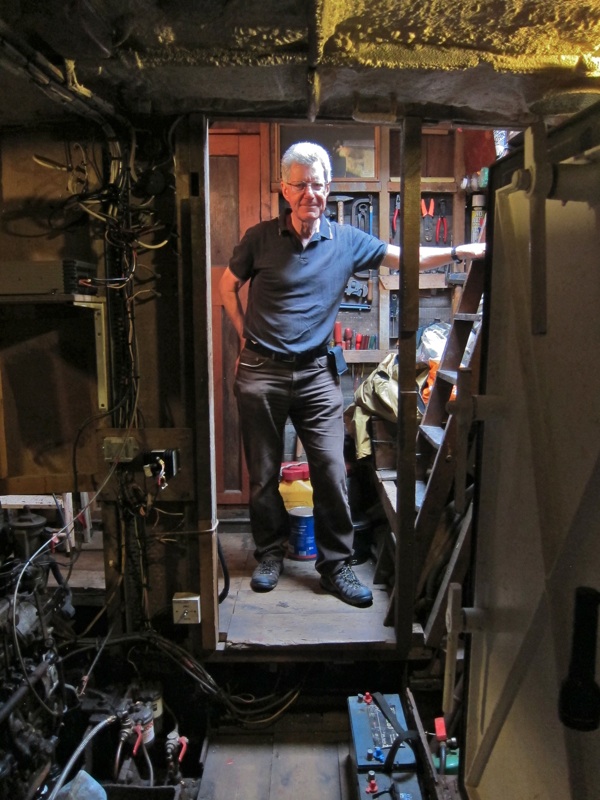
David Pollock, skipper of S B Repertor
“It’s all my wife’s fault,” admitted David Pollock of the Thames Sailing Barge Repertor with a grin of pure delight, when I asked how he came to be the owner of such a fine vessel. “She was an avid reader of the property pages and small ads, and one day she said, ‘There’s a Thames Barge for sale in The Times, let’s go and take a look.'” David continued, rolling his eyes, “I said, ‘You don’t know anything about Thames Barges,’ and she said, ‘I’ve been to a party on one!’ Well, one thing led to another and we bought it, and here we are twenty-seven years later.”
Our conversation took place in the engine room of Repertor, moored in St Katharine Docks for a few days in the midst of a busy summer of charter trips and races. Looking trim with its green, yellow and red paintwork, ropes coiled and russet sail neatly furled – the barge welcomes you with an appealing mixed aroma of engine oil and yacht varnish, as you step below deck. In the hold, where once the cargo was stored, there is now a large panelled galley with small cabins leading off a narrow passage. In its working days, Repertor was manned by a skipper and mate, with the skipper sleeping in the stern and the mate in the foc’sle next to the engine room.
“My twin brothers, Ben and Leo, and me, we’d shimmy up the rigging to the crosstrees to show off,” admitted Amy, David’s daughter, fondly recalling childhood summers on the barge, “People were horrified, but nothing terrible ever happened to us.” As a child, Amy spent every weekend and holiday on the boat, at first on the Isle of Dogs where it was repaired and then on extended coastal cruises. “My parents had three children in a tiny two bedroom flat in North London yet when they got a little money, rather than investing in it bricks and mortar, they invested it in steel and sail – and it was well worthwhile,” Amy confirmed to me, as she sat cradling her one-and-a-half-year-old daughter Rosa, who is herself now being introduced to the ways of maritime life.
The Repertor was one of the last Thames Sailing Barges, built in 1924 by the famous barge-masters Horlocks, based in Mistley on the River Stour in Essex. Such barges were the workhorses of coastal transport, making deliveries up and down the Thames and along the East Coast, their flat hulls enabling them to navigate the shallow creeks where larger vessels could not go.
“I’ve always sailed and my father was in the navy, he was a keen sailor,” David confided, revealing that he was not quite the dilettante he had first implied, “We did most of the work repairing the barge ourselves.” These days, David enters many of the nine barge races that happen at locations around the Thames estuary each summer from the River Medway at Chatham in May until the River Colne at Brightlingsea in September, and he has a reputation for winning a significant number, as the lines of trophies in the galley testify.
“It’s a way to refine the rigging as well as a test of skill – traditionally, barges had to race to get the ports to be the the first to get work delivering cargo, so it was a commercial imperative,” David explained, “The matches were begun in 1863 by Henry Dodds, a barge owner from Hackney who became known as The Golden Dustman by making a fortune transporting rubbish from London to Kent, where it was used in manufacture of bricks that were transported back again.”
Readers may be interested to learn that you can join David Pollock’s crew for one of these matches this summer. Involving as many as twenty-five traditional sailing barges over a day-long course, they can be dramatic races and the S B Repertor has won the annually-awarded title of ‘Champion Barge’ five times.

Amy Pollock

Repertor moored in St Katharine Docks


Amy brings her baby daughter on board.


Amy Pollock and her daughter Rosa
Click here if you would like to take a trip on Thames Sailing Barge ‘Repertor’
You may also like to read about
Stoke Newington’s Ghost Signs

This is the epicentre of ghost sign activity in Stoke Newington Church St. On the left is a triple-layer painted wall of the Westminster Gazette, Criterion Matches and Gillette Razors – all merged into one glorious palimpsest – and on the right is a double layer painted sign advertising “Fount Pens Repaired.”
Sam Roberts was walking past one day in 2006 when he had a moment of inspiration. “I thought that’s neat, nowadays we just have disposable pens,” he admitted to me, “The sign was from a different world to ours.” As Sam’s fascination grew, he began to compile a map London’s ghost signs and cycled around to photograph them all. Recognising that these curious signs comprise a powerful element in the collective psyche of urban life, he approached the History of Advertising Trust to develop an online archive containing more than six hundred specimens of which he is now the curator.
Recently, Sam has been studying the ghost signs of Stoke Newington, researching the stories behind their creation. The people and the businesses are mostly gone long ago and these fading signs are their last vestiges on this earth. Yet not everyone shares Sam’s recognition of their importance, as the painting-out of a huge intricate ghost sign upon the wall above above Stoke Newington Post Office demonstrated recently.“Many of these signs are over a hundred and twenty-five years old, “ Sam explained, “if they were a pieces of jewellery or furniture, people would immediately recognise their value.”
Thus, Sam is now leading walking tours to tell the poignant and compelling stories of the signs, revealing a local perspective upon the history of the streets and ensuring that these fragile traces of former generations are appreciated for their beauty and significance, as signposts to our shared past.

In Northwold Rd: R. Ellis. Ironmonger. Stoves, Range & Bath Boiler Works. Gas Fitter & Plumber. General House Repairs. Est. 60 Years. – Robert Ellis was born in 1835, died in 1898 and was buried across the road in Abney Park Cemetery. Note usage of bricks to define the height of the letters.

On Cazenove Rd: F. Cooper, Job Master for Wedding Carriages, Broughams, Landaus, Cabs

The faded illustration on the ceramic panel is captioned “The Duchess of Devonshire canvasses the Jolly Butchers to vote for Fox in 1784”

Eloma Preparations was here in Carnham St from 1947 until the eighties

Richardson & Sons, Shirtmakers, Hackney, Leyton & Walthamstow – painted in 1955 on an older panel

On Stoke Newington High St, painted over an earlier indecipherable sign: John Hawkins & Sons, Cotton Spinners & Manufacturers, Preston, Lancashire (Painted between 1926-1939 when the company was concentrating on increasing their home market when the struggle for Indian independence took away their overseas trade)

Walker Bros, Fount Pen Specialists, Phone Dalston 4522, Agents for Watermans Ideal Fountain Pen (A sponsored sign dated to the early twenties and repainted later on the left with “Any make” added.)

Hurstleigh’s Bakery – Daren – Brown Bread (Daren flour mills were in Dartford, Kent, on the banks of the river Darent)

Alf the Purse King – A Rubinsten & Sons – Purses, Pouches, Handbags, Wallets
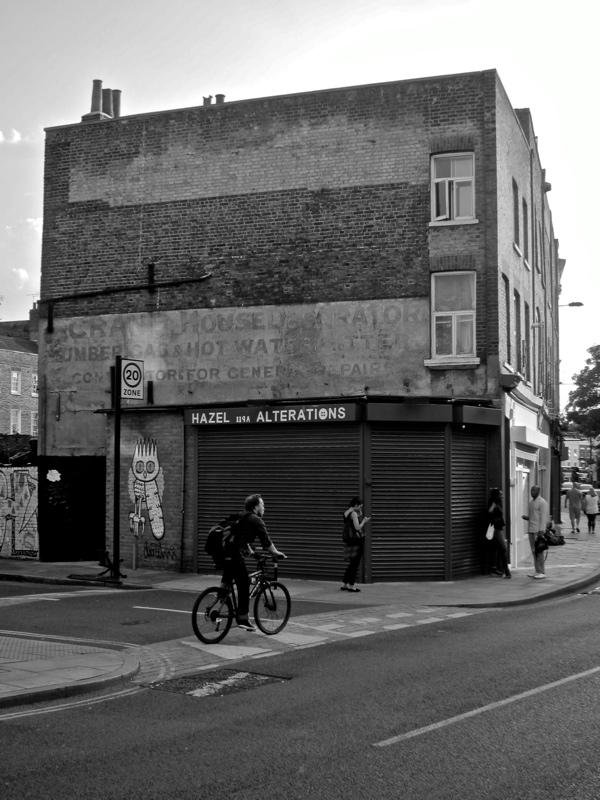
In Stoke Newington Church St : Crane, House Decorator, Plumber, Gas & Hot Water Fitter, Contractor for General Repairs (Dating from 1890, this believed to be Stoke Newington’s oldest ghost sign.)
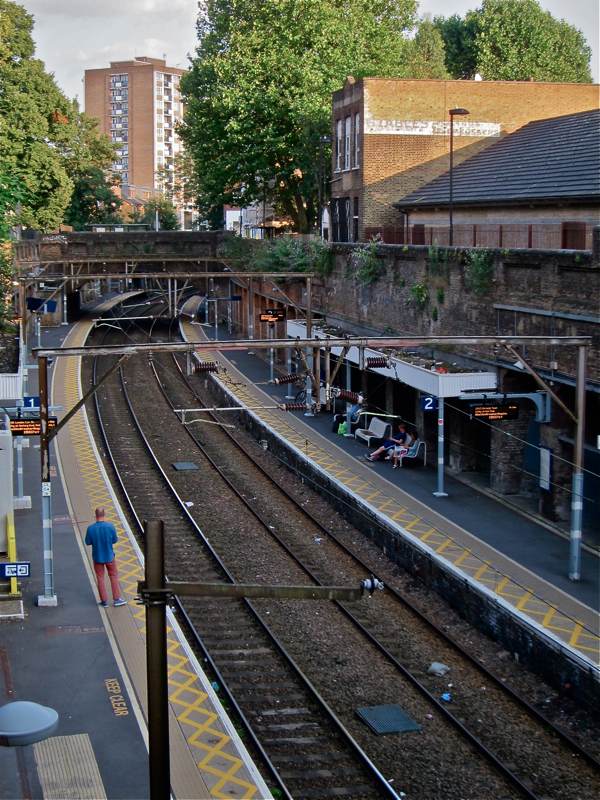
Visible from Stoke Newington Station, a narrow fragment of a double layer sign advertising “6 Tables”, “A Speciality” and “Debossing”
Find out more about Sam Roberts’ tours at his Ghost Signs website or visit the History of Advertising Ghost Signs Archive
You may also like to read about
Jeffrey Johnson’s Favourite Signs
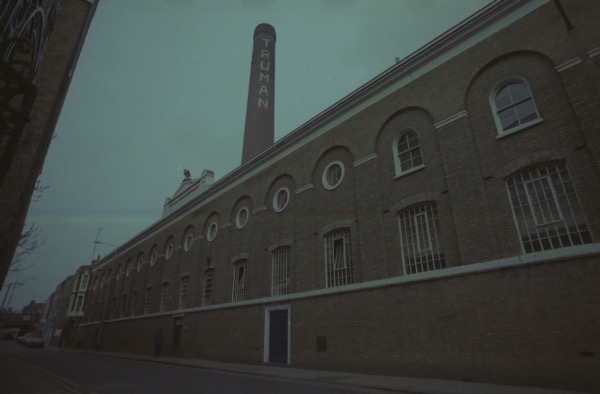
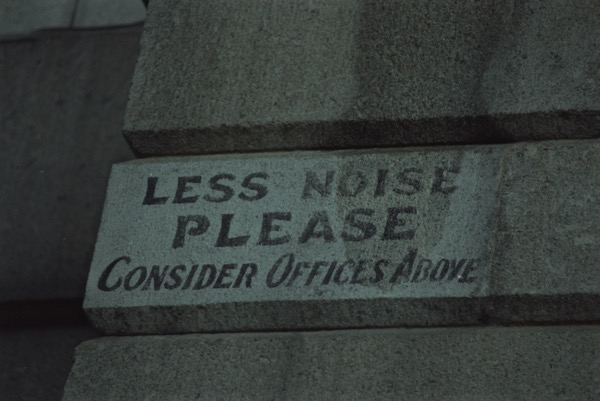
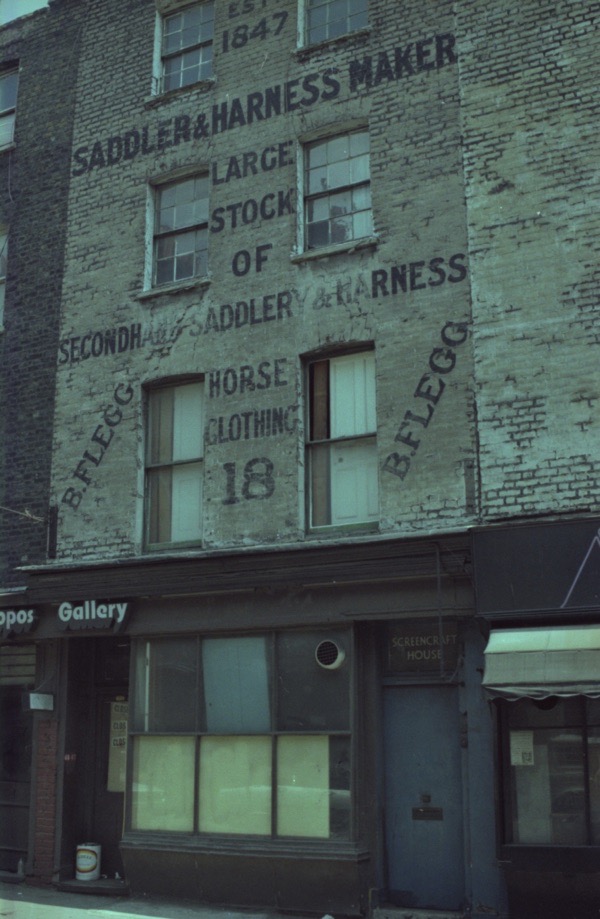
Mysterious Photographer Jeffrey Johnson deposited a stack of his pictures from the seventies and eighties with Archivist Stefan Dickers at the Bishopsgate Institute recently, including these photos of signs and ghost signs. Sharing Jeffrey’s relish at this magnificent array, I cannot resist the feeling that he is one after my own heart in savouring both the poetry and aesthetics of London’s old signage.
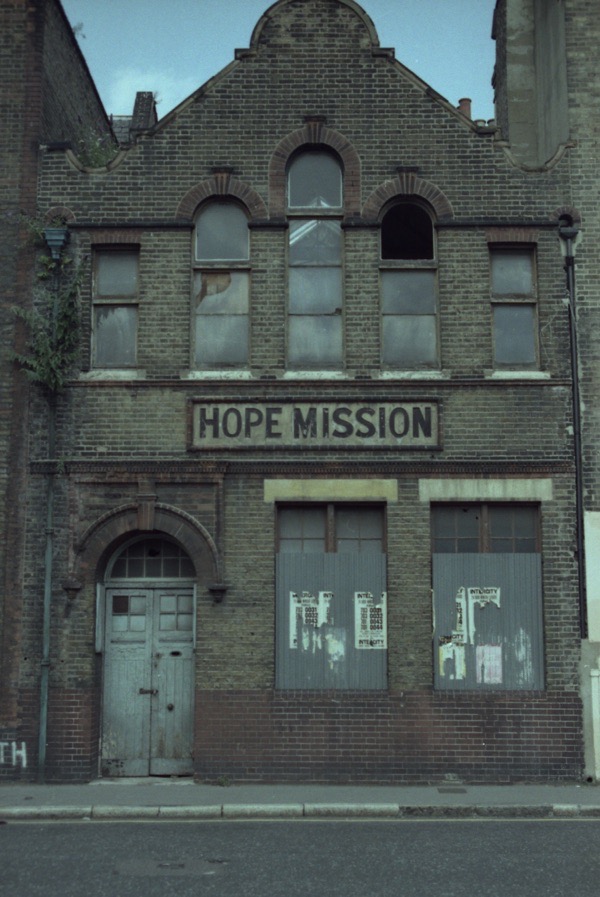
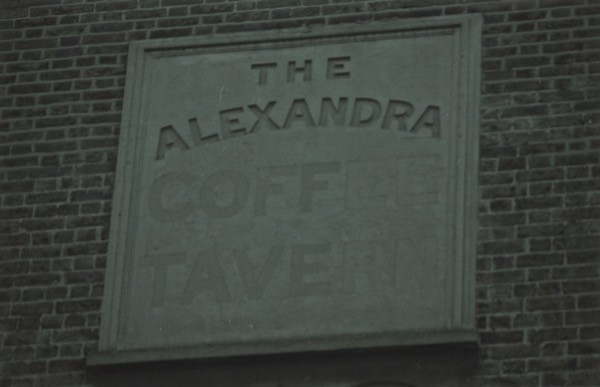
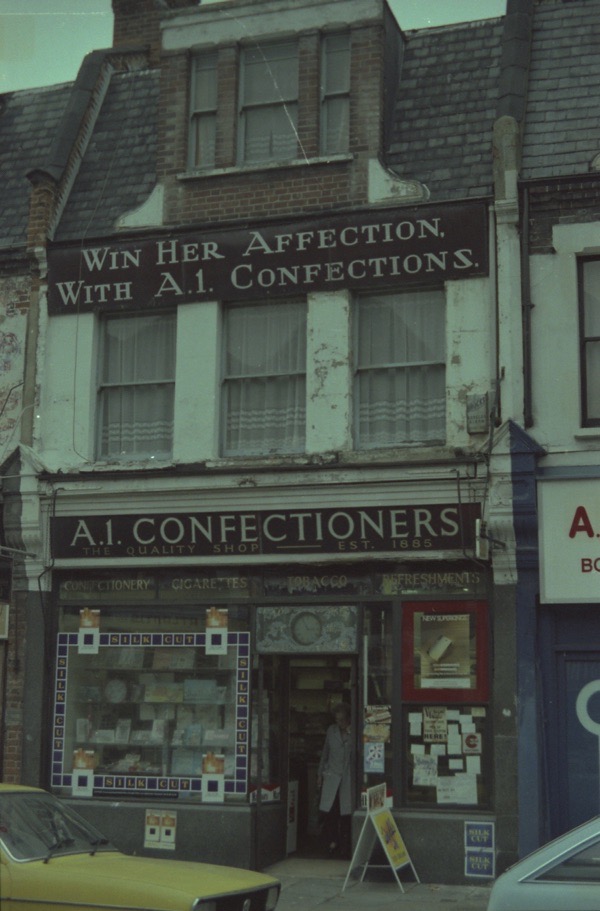
Win her affections with A1 Confections
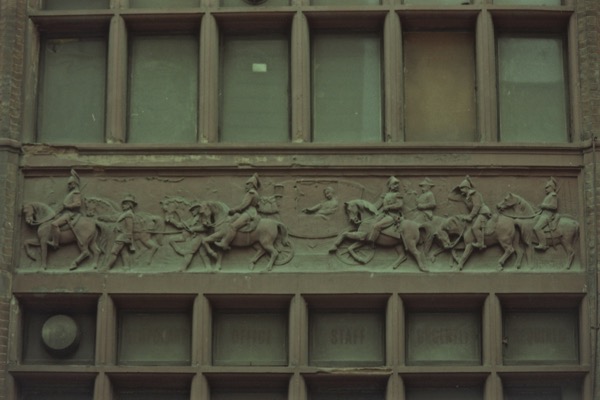
Temporary office staff urgently required
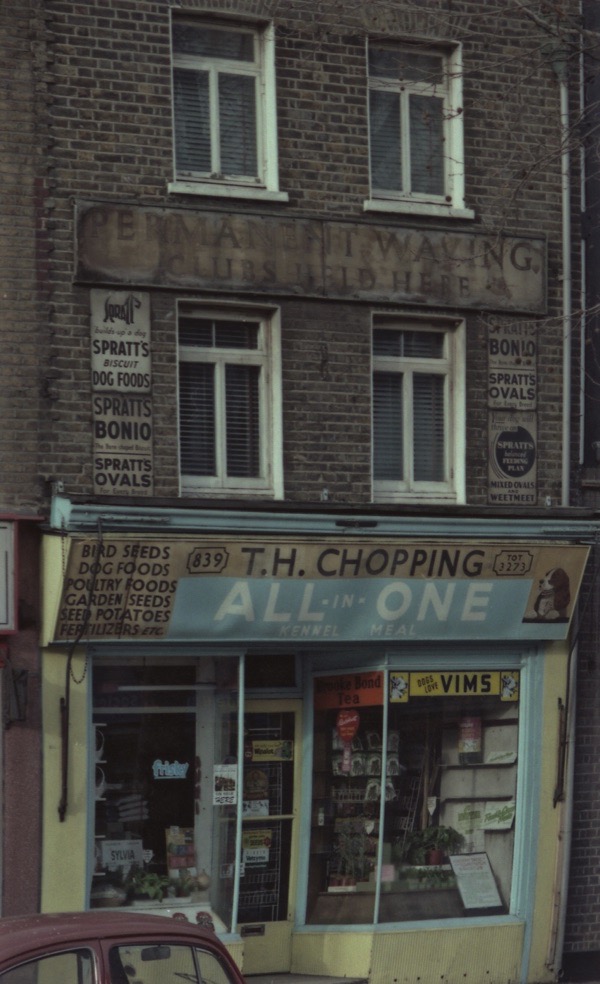
Permanent waving clubs held here
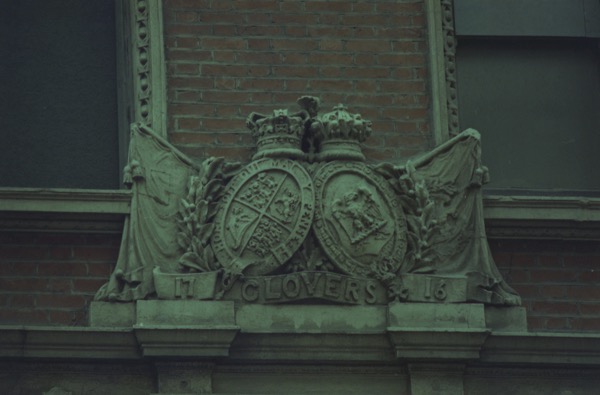
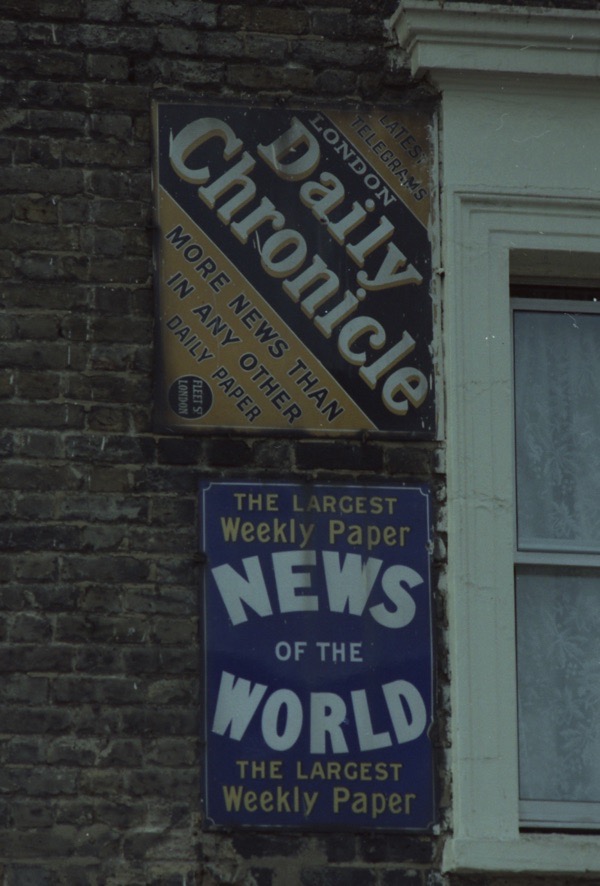
More news than in any other daily paper
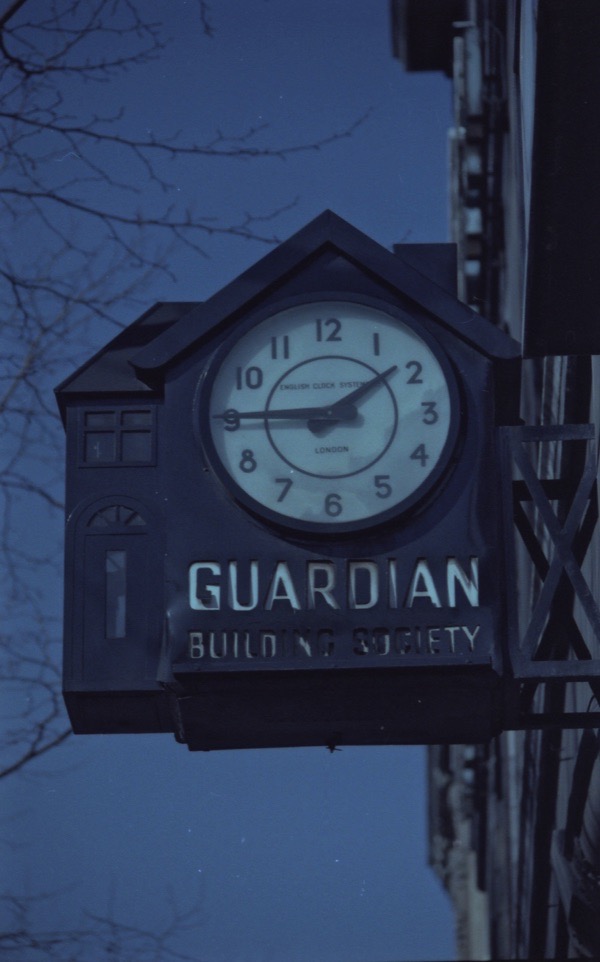
English clock system
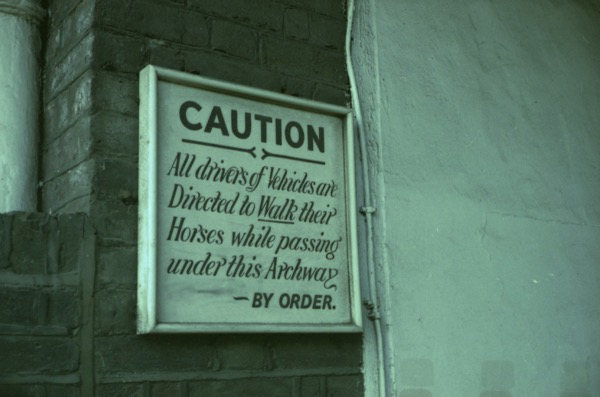
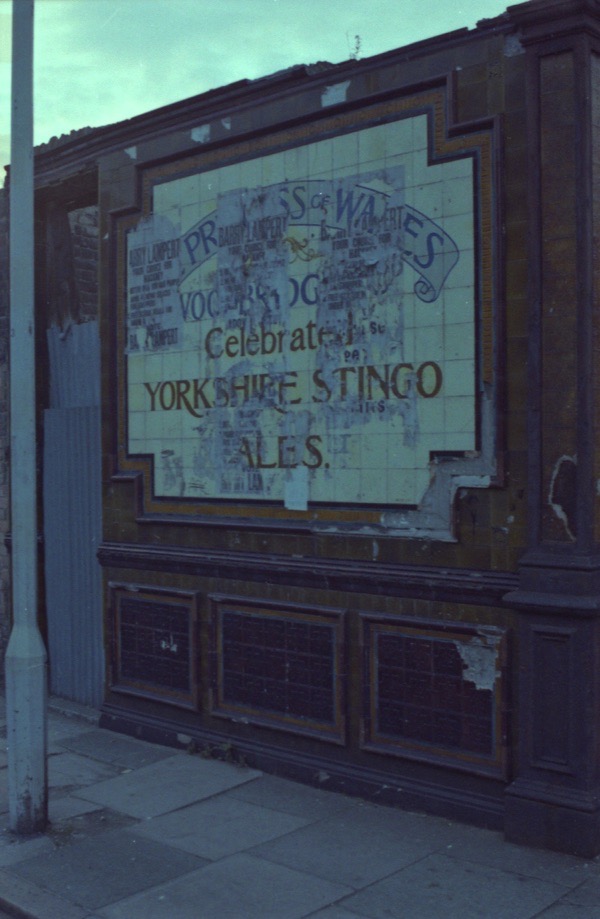
Barry Lampert – Your choice for Hackney
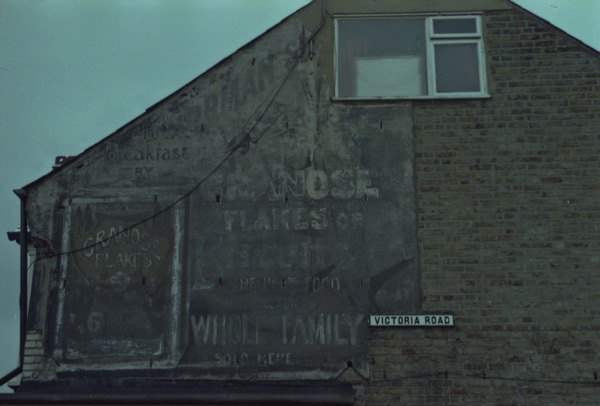
The best food for the whole family sold here
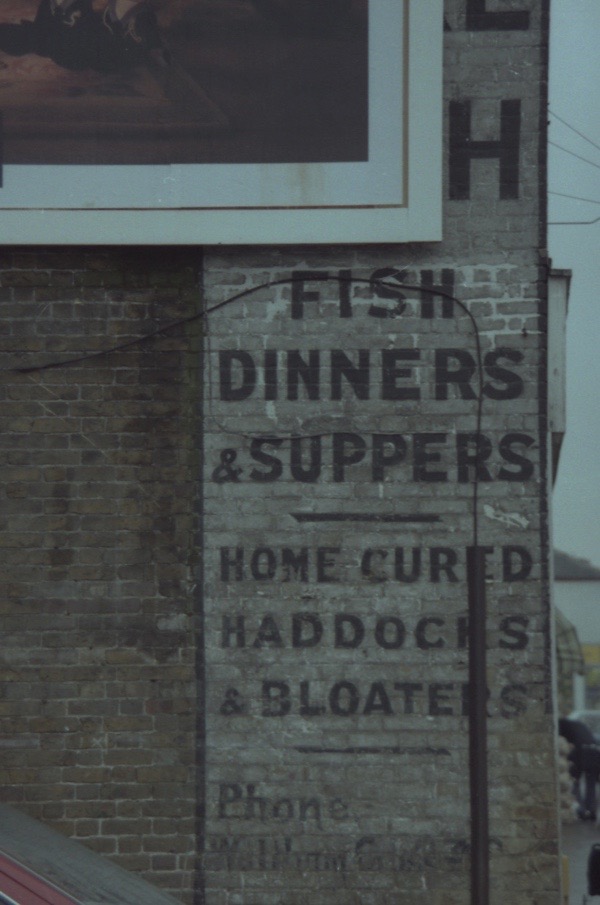
Home cured haddocks & bloaters
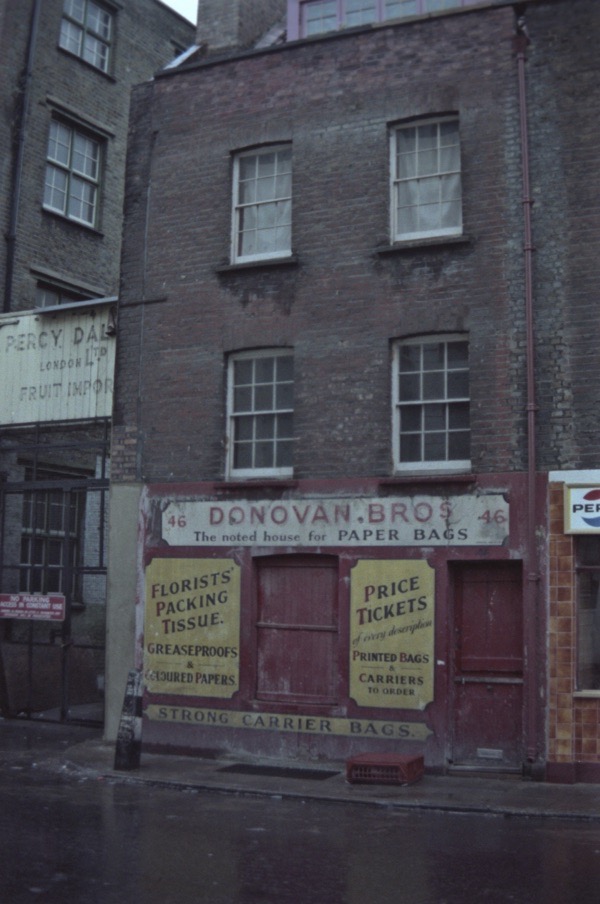
The noted house for paper bags
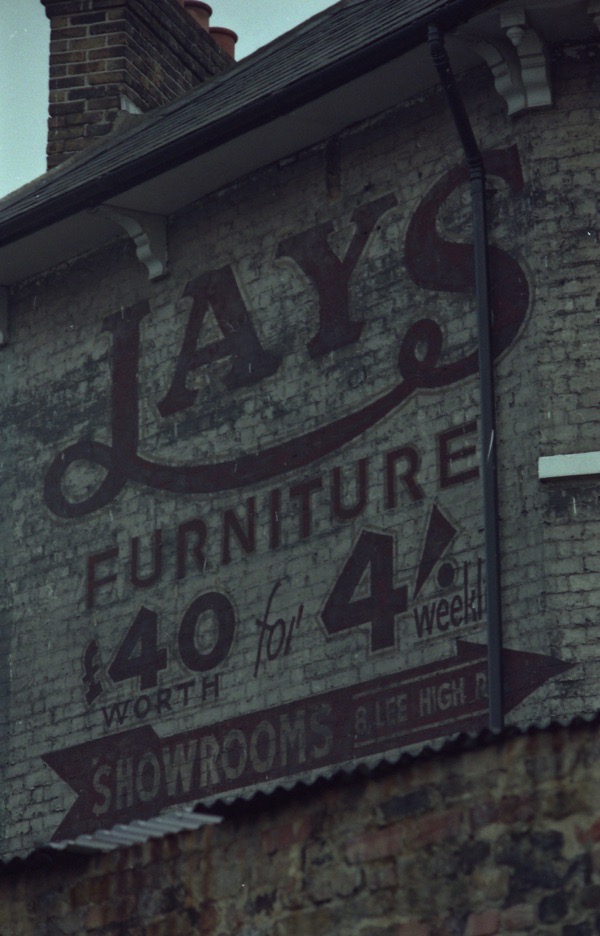
£40 worth for four shillings weekly
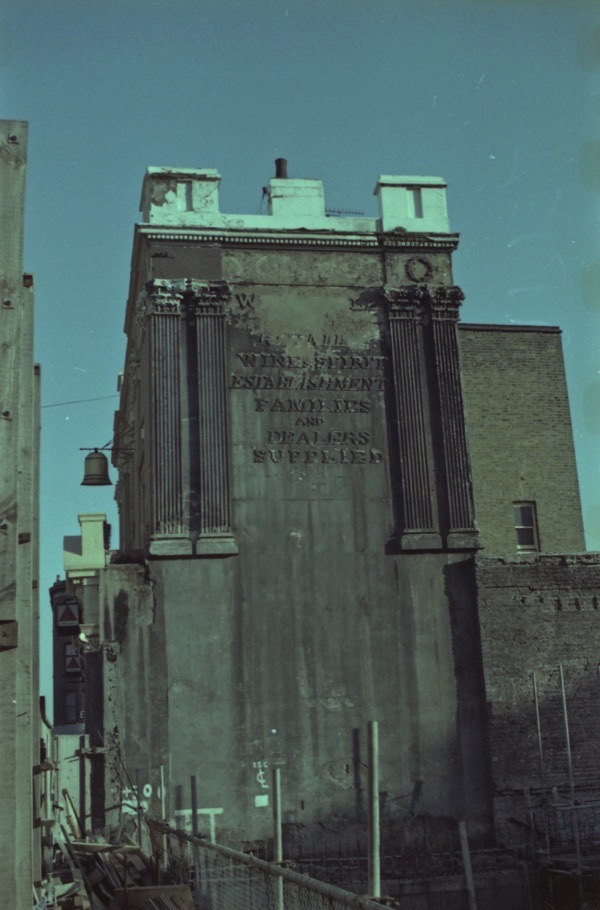
Families and dealers supplied
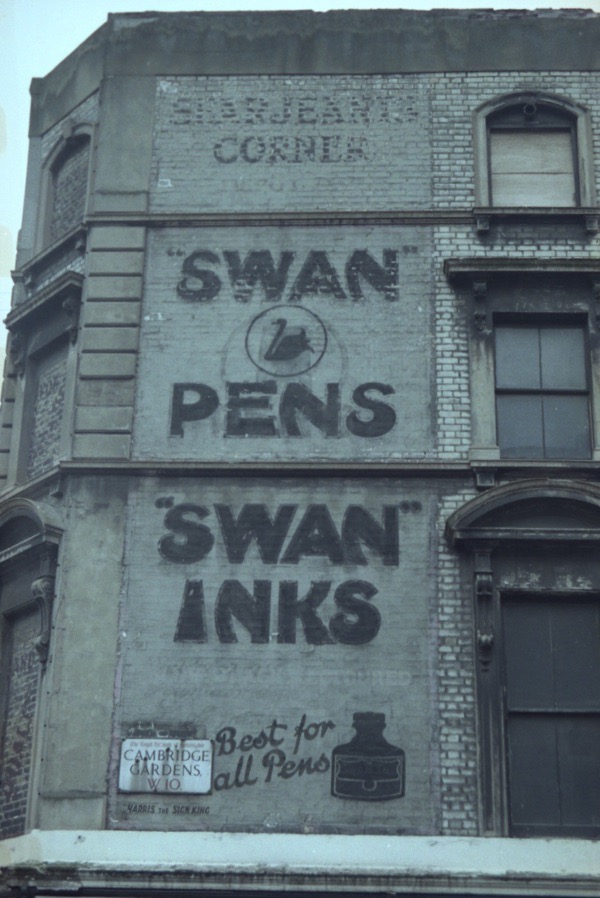
Harris the sign king
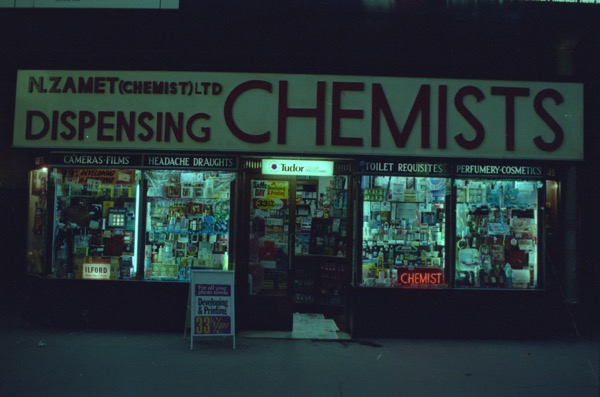
Headache draughts
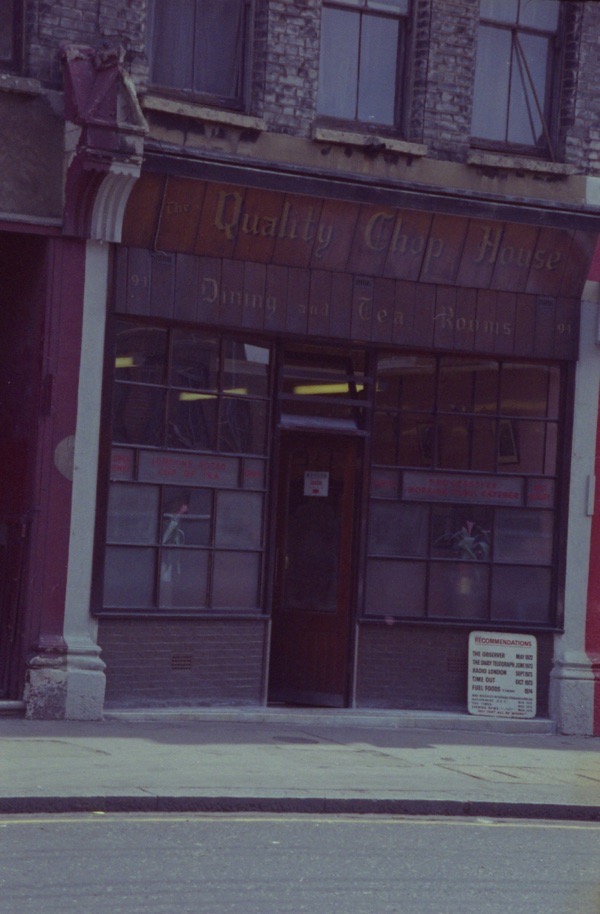
Progressive working class catering
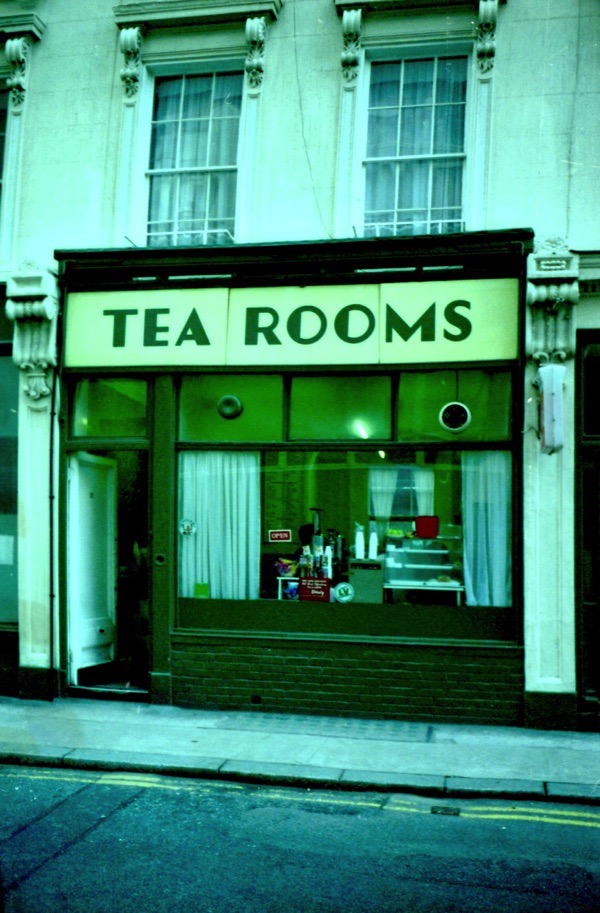

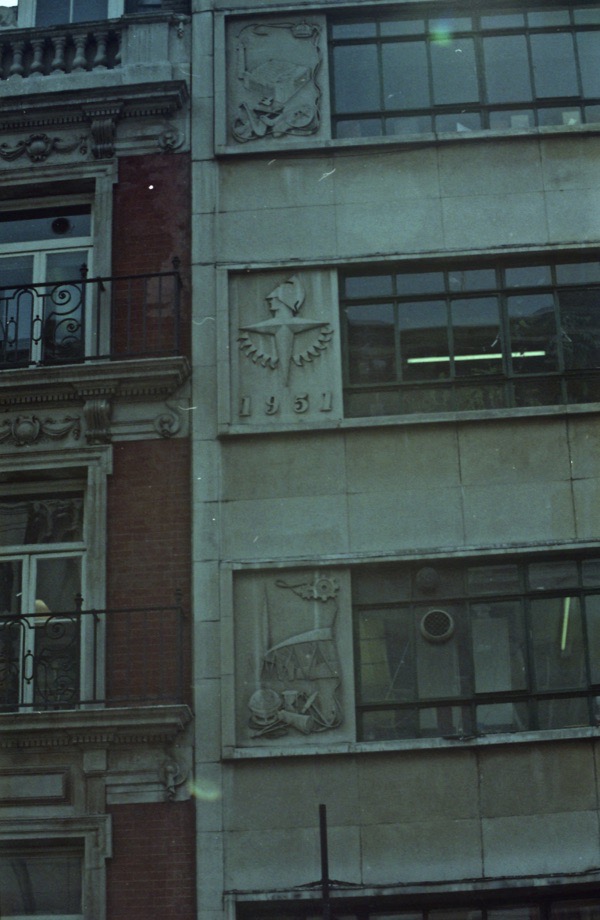

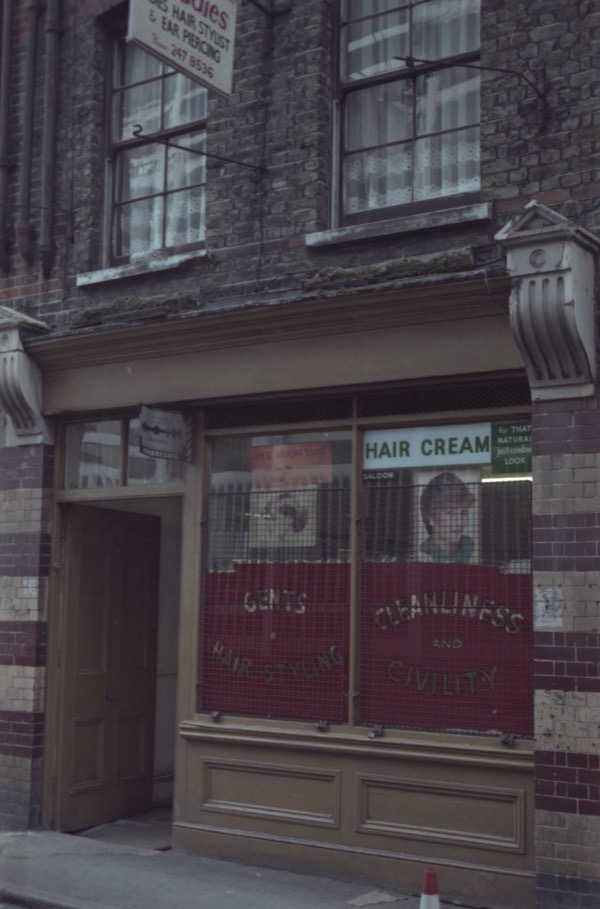
For that natural just combed look
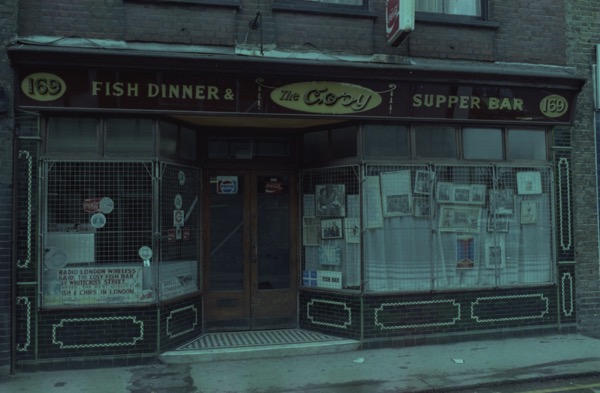
Radio London wireless said ‘The cosy fish bar in Whitecross St serves the best quality fish & chips in London.’
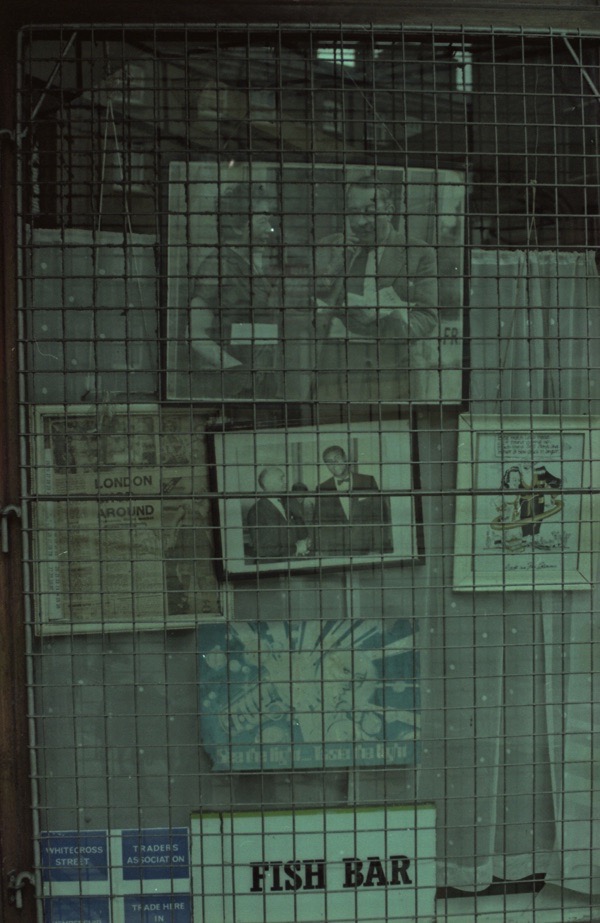
See the light…taste the light
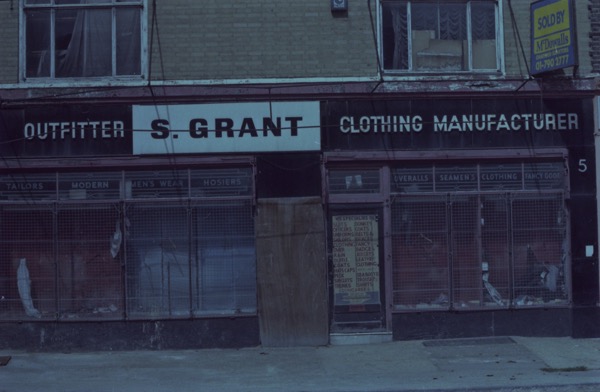
We specialies in suits, donkey coats, officers uniforms, belts & braces, sailors clothing…
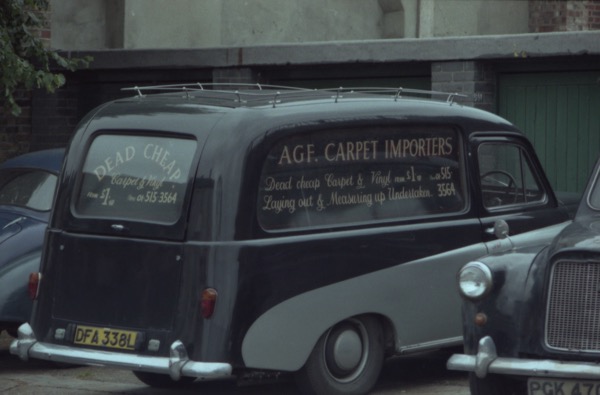
Laying out & measuring up undertaken
Photographs copyright © Jeffrey Johnson
You may also like to took at
The London Nobody Knows Now
Today I present THE LONDON NOBODY KNOWS NOW, a short film by Douglas Anderson, revisiting the locations of THE LONDON NOBODY KNOWS, Norman Cohen’s film of 1969 based upon Geoffrey Fletcher’s book of the same title.
The Genesis Cinema will be showing both the THE LONDON NOBODY KNOWS and THE LONDON NOBODY KNOWS NOW this Saturday 2nd July at 7:15pm with a panel discussion including filmmaker Douglas Anderson. Click here for tickets
You may also like to read about
A Brief History Of London’s Mulberries
Several readers who visited the exhibition of proposals for the site of the former London Chest Hospital by Crest Nicholson & Circle Homes contacted me in alarm when they discovered the developer planned to construct a new building which appears to be upon the site of the Oldest Mulberry in the East End, even though it is subject to a Tree Protection Order.
The London Chest Hospital developers’ website makes no mention of the historic Mulberry.
Outlining the cultural significance of this celebrated species, it is my pleasure to publish this metropolitan arboreal history by Peter Coles who is currently undertaking a Survey of Mulberries in the capital.
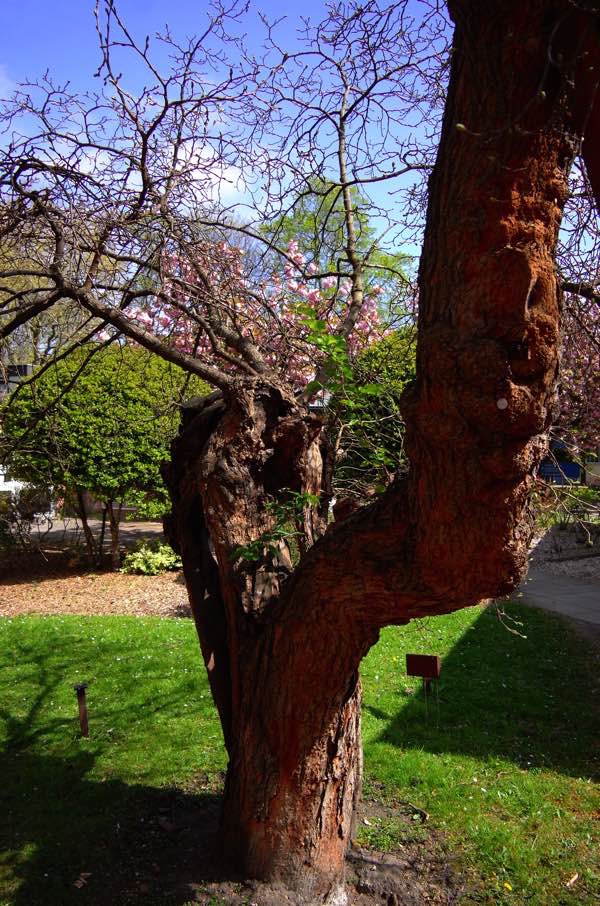
Jacobean Mulberry at the site of the former London Chest Hospital in Bethnal Green
At the last count, a survey being carried out by the Conservation Foundation’s new Morus Londinium project has identified over one hundred and thirty-five sites with Mulberry trees in London – and there are likely to be many more, with new trees coming to light every week.
As The Gentle Author discovered, it is fairly straightforward to trace the history of some veteran Mulberries, like those at Syon House and Charlton House, back to the sixteenth and seventeenth centuries. But others, like those hiding anonymously in East End gardens or beside the recycle bins on a street corner in Belsize Park, might be described in the words of Percy Bysshe Shelley, as “Lost angels of a ruined paradise.” Yet what was the nature of the horticultural paradise they have fallen from?
A common assumption is that these old Mulberry trees dotted around the city are left over from the failed attempt by James I to start a home-grown silk industry in the seventeenth century. His plan was to rival the lucrative monopolies of France and Italy in silk production and get rich, as they already had. Silkworms feed exclusively on Mulberry leaves – a secret the Chinese managed to keep for over two and a half thousand years – but these trees are not native to Britain.
In 1609, James wrote letters to all his Lord Lieutenants. Appealing to their patriotism, he offered them Mulberry saplings “at the rate of three farthings a plant, or at six shillings the hundred containing five score plants,” or more affordable packets of Mulberry seeds for the less well-off, so that they could establish plantations to feed thousands of silkworms. Around a hundred thousand saplings were imported for this project.
James created his own four-acre Mulberry Garden in the grounds of St James’ Palace – now the north-west corner of the garden behind Buckingham Palace – and an adjacent corner of Green Park. His consort, Queen Anne of Denmark, shared his enthusiasm and also established a Mulberry plantation, complete with silkworm nursery, at Greenwich Palace and another at the Royal Palace at Oatlands in Surrey. The Mulberry in the Queen’s Orchard in Greenwich Park is quite likely a Jacobean survivor, as is the tree at Charlton House.
The surviving Mulberries – and over ninety per cent of those in the Morus Londinium database – are black Mulberries (Morus nigra), a species that is native to what used to be the Persian Empire including present-day Iran, Turkey & Syria, where they are grown for their fruit not their leaves. Yet it was the white Mulberry (Morus alba) that underpinned China’s silk industry, a lesson the Italians and French also learned. Even though the black Mulberry was known to the Romans and grew around the Mediterranean, it was the white Mulberry that the Huguenot French king, Henry IV of France, had been planting in the Tuileries Gardens in Paris to encourage silk production.
Terraces of white Mulberries still survive in the Ardèche, Cevennes & Provence regions of France today, often next to disused or converted magnaneries (silkworm houses) where they supplied the silk industry around Lyons. And it was precisely from these regions that Huguenot weavers fled to England – notably Spitalfields – when the Edict of Nantes was revoked in 1685, unleashing persecution against Protestants.
So why did James I, apparently, import and plant thousands of black Mulberries? As silk historian John Feltwell, points out, mature white Mulberries in England can be counted on the fingers of one hand and none can be traced back to the silk industry. James’ advisers knew very well that silkworms thrive on the leaves of white Mulberries.
In 1607, Nicholas Gesse published his The Perfect Use of Silk-wormes, which was a translation of the definitive French textbook on silk & Mulberries, written by horticulturalist, D’Olivier de Serres. This and a book published in 1609 by William Stallenge (who became Keeper of the King’s Mulberry Gardens), entitled Instructions for the Increasing of Mulberrie Trees, clearly explain that, while both black and white Mulberries can be used to feed silkworms, the white should be chosen if possible. These texts also say that silkworms will eat the leaves of the black Mulberry but that the silk is coarser and the thread breaks more easily.
Despite efforts lasting into the reign of Charles II, England’s home-grown silk industry never took off. This is often blamed on the choice of the ‘wrong’ Mulberry but the truth is probably more complex. The English climate does not suit the white Mulberry, which is used to much warmer weather, so it may have been a deliberate choice to plant the black species. After all, this was the height of the ‘Little Ice Age’ in Britain, when the first Frost Fair was held on the Thames in 1607. Perhaps the climactic conditions made it harder to get the timing right to match the supply of Mulberry leaves – even those of the black Mulberry – with the hatching of silkworm larvae?
At the same time, James I was also trying to get a silk industry off the ground at Jamestown, in his North American colony of Virginia. Shiploads of white Mulberries were sent over, although the silkworm was found to be happy with the native red Mulberry (Morus rubra). Another theory is that this discovery may have led English silk producers to underestimate the silkworms’ dislike for leaves of the black Mulberry.
A few decades later, the English Civil War took minds away from what was proving to be a marginal industry. Mulberry plantations were eventually grubbed out, although the Mulberry Garden at St James’ Palace did enjoy success as a Pleasure Garden late into the seventeenth century. John Evelyn & Samuel Pepys both mention visiting it. Today, Buckingham Palace garden houses part of the National Mulberry Collection but Gardens Manager, Mark Lane who started the collection in the nineties, confirms that none are James I’s plantings. When he showed me around, Mark could point out thirty-five named varieties held in the collection, mostly white Mulberries and just a few decades old. The oldest specimen is a cutting from Shakespeare’s Mulberry, taken long after the Bard’s death.
There was a last-ditch attempt to revive London’s silk industry around 1718, when the Raw Silk Company established a plantation of two thousand Mulberry trees and a silkworm nursery in Chelsea Park, between Fulham Rd and King’s Rd – which may have been upon the initiative of Huguenot weavers in Spitalfields. But this only lasted for a few years and, by 1724, the trees and the silkworm house were sold off. Interestingly, Chelsea still has several old Mulberry trees and one is in Mulberry Walk on the site of the original plantation.
It is a mystery why there should be black Mulberries in and around the East End today. While this was the heart of silk weaving, it was never a place where Mulberries were grown on a scale required to produce silk commercially. Around 50,000 cocoons are needed to produce 1 kg of silk thread. That is a lot of silkworms and a lot of leaves, even though silk is very light and 1 kg would make many yards of silk ribbons. Perhaps people planted Mulberries out of nostalgia? It would be interesting to discover if there is any evidence for raising silkworms in the East End. Yet, with their understanding of silk production, why would they have planted black Mulberries?
Although attempts to produce raw silk in England petered out, the country developed a thriving silk industry in the eighteenth century, based upon raw silk imported from Italy, Persia, Bengal & China. This was the heyday of weavers in Shoreditch & Bethnal Green, until the industrial revolution saw the processes of throwing and weaving silk thread mechanised.
Yet there is another strand of the capital’s Mulberry heritage which goes back much further than James I and has nothing to do with silk. Excavations of water-logged Roman sites in London in the seventies found well-preserved Mulberry pips, revealing that Mulberry trees were introduced and cultivated in London as early as the first century AD. They would have been grown for their fruit, which the Romans appreciated in their feasting and its medicinal properties – Pliny the Elder, writing in the first century AD, writes of its value as a mouthwash.
These were also the reasons why black Mulberries were planted in medieval gardens of manor houses and monasteries – particularly the ‘physic gardens’ associated with infirmaries. John Gerard, in his Herball of 1597, writes – “The barke of the root is bitter, hot and drie, and hath a scouring faculty: the decoction hereof doth open the stoppings of the liver and spleen, it purgeth the belly and driveth forth worms.”
Like Spitalfields, much of Central London is built upon the ruins of medieval monasteries, razed after Henry VIII dissolved them. Part of Bartholomew Close, adjacent to the infirmary of the priory church of St Bartholomew-the-Great, was once a Mulberry garden. A very old Mulberry stump was found and grubbed out in the eighteen hundreds but there is a much more recent black Mulberry there today, next to the Lady Chapel of the church.
The Mulberry planted in 1548 at Syon House – formerly a Brigettine monastery founded in 1415 – pre-dates any interest in a silk industry. The Tudor Lambeth Palace has fine old black Mulberries and there is one next door, in what is now the home of the Garden Museum, near to the tomb of landscape gardener, John Tradescant. There is both a black and a white Mulberry in the grounds of the Tudor Fulham Palace, former home of the Bishops of London. And we must not forget the venerable – and threatened – black Mulberry on the site of the London Chest Hospital is on the site of Bishop Bonner’s manor house.
Finally, there was a fad for including black Mulberry trees when public parks were laid out at the end of the nineteenth century. Often these parks – like Brockwell Park – were created in the grounds of much earlier mansions. Vauxhall Park has a young Mulberry trunk sprouting from a much older bole, probably planted when it was laid out in the eighteen-eighties by Fanny Wilkinson, Britain’s first celebrated woman landscape gardener, who also designed Myatt’s Fields Park where there is an old black Mulberry tree to be discovered.
The Morus Londinium project sets out to record and research London’s mulberry trees to raise public awareness and protect them. If you know of a Mulberry or wish to find out more about London’s Mulberries, visit www.moruslondinium.org.

The Tower of London Mulberry
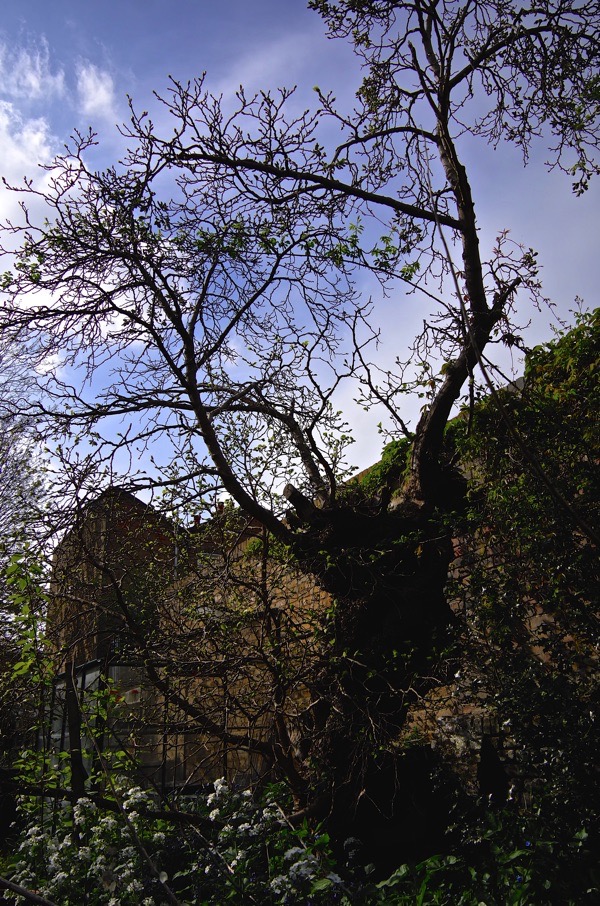
The Haggerston Mulberry
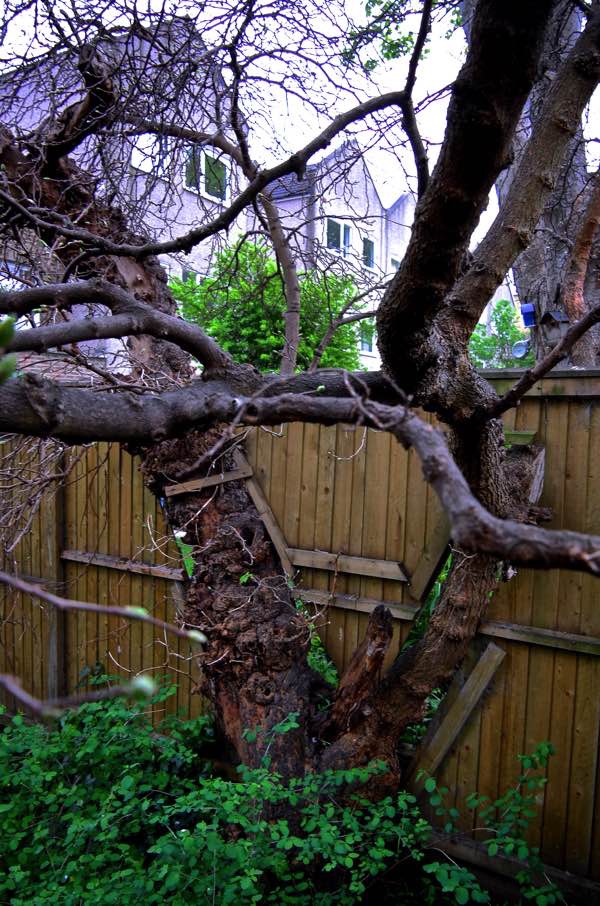
The Dalston Mulberry
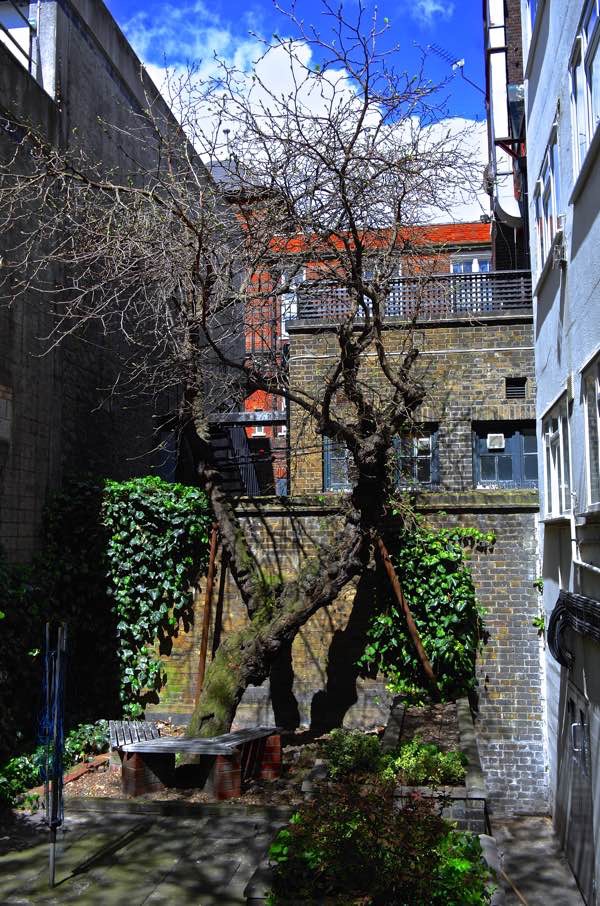
The Whitechapel Mulberry

The Stoke Newington Mulberry
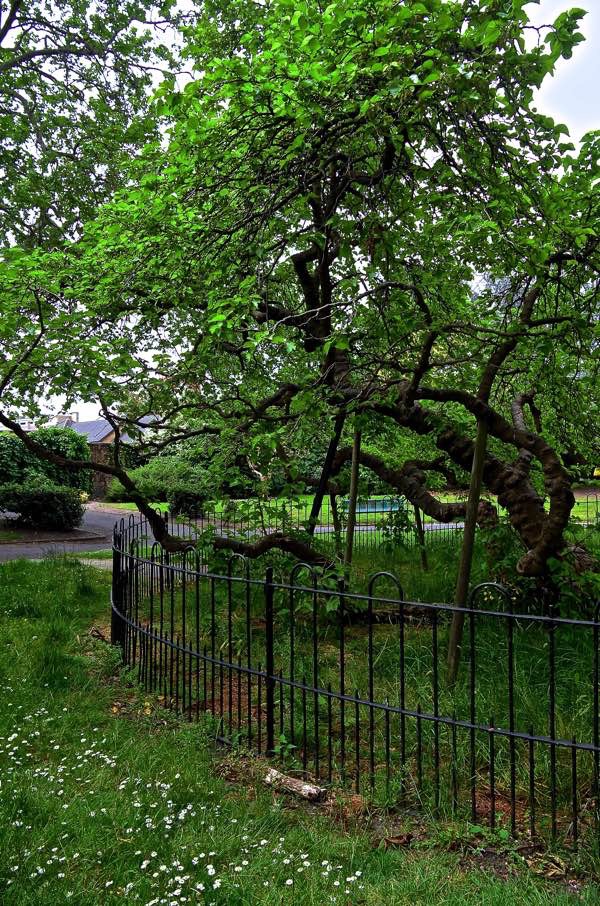
The Deptford Mulberry
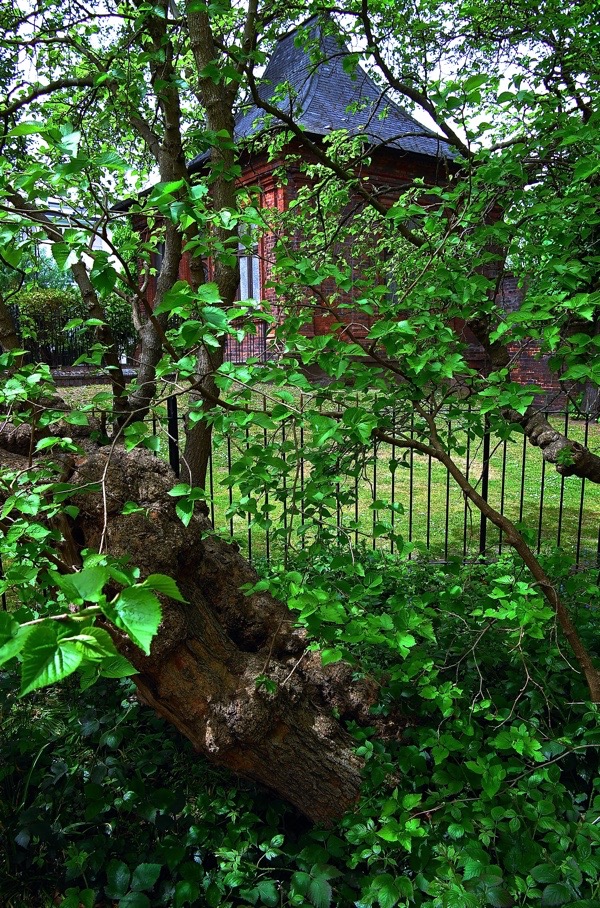
The Charlton Mulberry
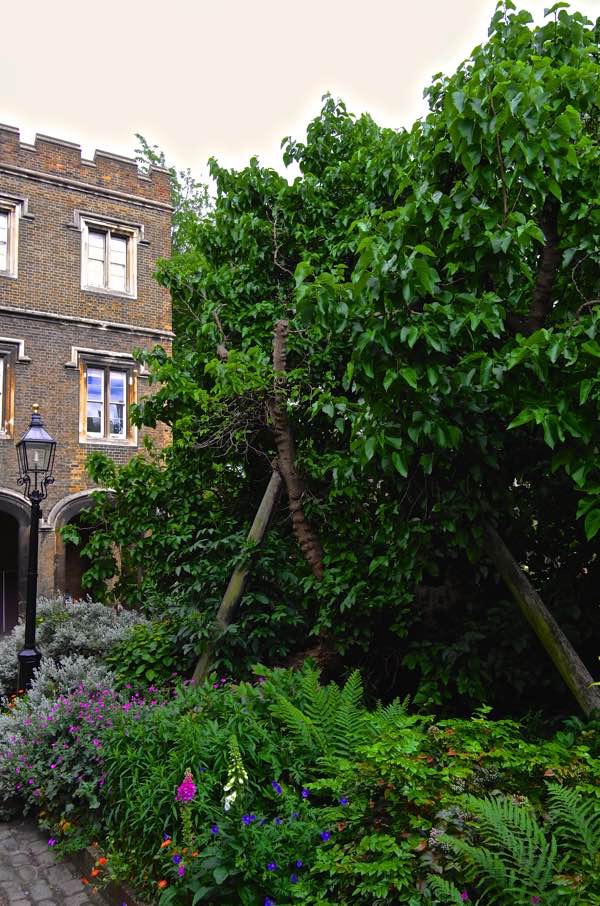
The Charterhouse Mulberry
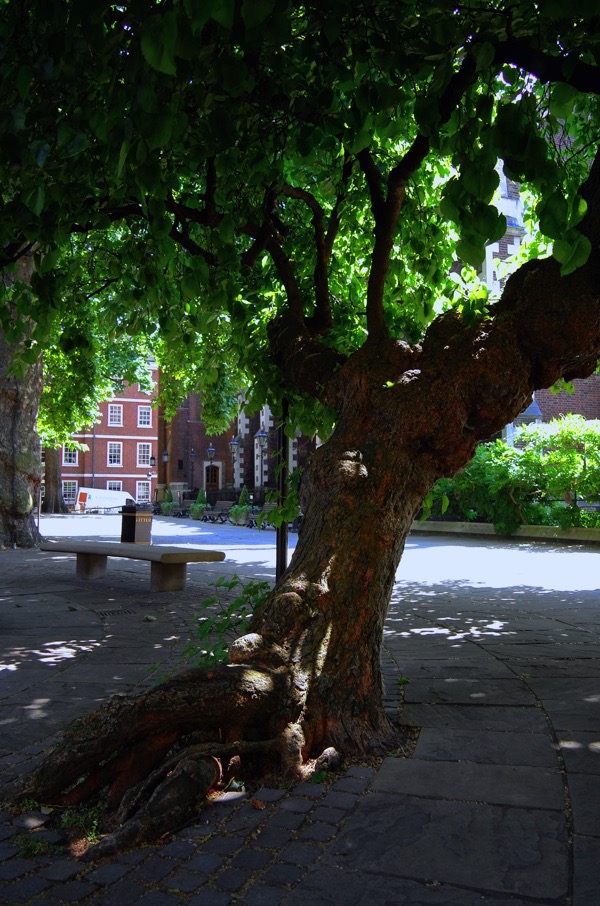
The Middle Temple Mulberry
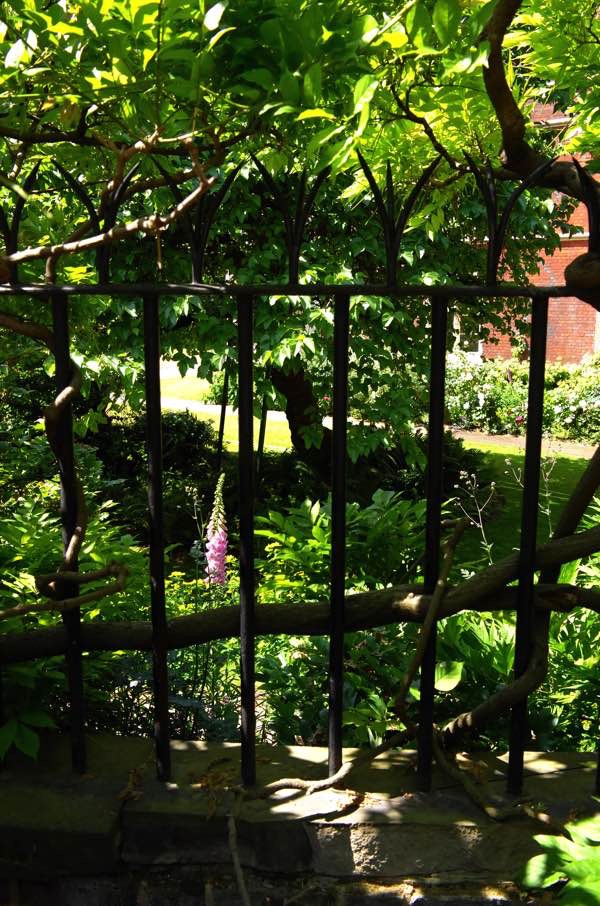
The King’s Bench Walk Mulberry
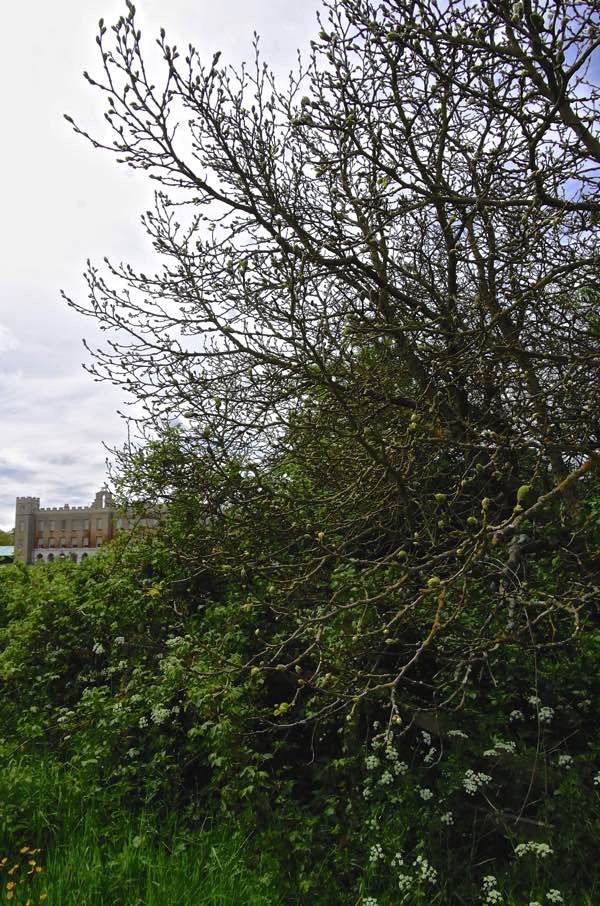
The Oldest Mulberry Tree in Britain at Syon Park
You might also like to read about
The Oldest Mulberry in the East End
Israel Zangwill’s Spitalfields
Literary historian Nadia Valman introduces the work of nineteenth century novelist Israel Zangwill, author of Children of the Ghetto and subject of a newly-launched app Zangwill’s Spitalfields, which delivers an immersive audio-visual journey through Spitalfields in the eighteen-nineties, using his forgotten novel as a walking guide. Click here to download the app for free

Israel Zangwill, 1890
Of the many Victorian bestsellers doomed to oblivion over the course of the twentieth century, one that little deserves its obscurity is Israel Zangwill’s 1892 Spitalfields novel Children of the Ghetto. It is a big, baggy monster of a book, brimming with vitality and jangling with questions and arguments about the destiny of Jewish immigrants in Britain. What is more, it has an acute sense of place. Zangwill’s intimacy with the institutions, streets and interiors of Jewish Spitalfields makes the novel a fascinating exploration of what this densely packed neighbourhood meant to the people who came at the turn of the twentieth century to build new lives here.
Israel Zangwill was born in 1864 in a small square near Petticoat Lane market, the son of a Russian-Jewish peddler. From these humble origins, he went on to become a star pupil at the Jews’ Free School in Bell Lane, later staying on to teach while he studied in the evenings for a degree at London University and began to publish satirical sketches. It was during his years as a schoolteacher in Spitalfields that Zangwill became witness to the dramatic changes sweeping the area during the eighteen-eighties and nineties: the huge influx of Jewish immigrants fleeing pogroms, persecution and economic hardships in the Russian empire and settling in their tens of thousands in east London. What a great subject for a young aspiring novelist! The ‘London ghetto’ was much talked about but very little understood. As a graduate with literary ambitions who had also lived and worked in Spitalfields for most of his life, Zangwill was able to write for a wide Victorian readership with unique credibility and authority.
Children of the Ghetto offers a panoramic account of Jewish lives in Spitalfields. In the background, Zangwill observes the changes that were reshaping east London’s landscape: dilapidated housing being demolished as part of new urban improvement schemes and austere new blocks of model dwellings springing up. In the foreground, the author’s eye surveys tailors and teachers, sweatshop masters and trades unionists, rabbis and Yiddish actors, immigrant parents and their English-born children. He reveals a community riven with divisions, struggling over its many possible futures.
Zangwill’s is an unconventional voice in Victorian literature. There is a good measure of untranslated Yiddish words in the novel, so that even if you happen to know some Yiddish you still feel as if you are eavesdropping on a subculture you will never fully grasp. And while many of his contemporaries were troubled by the noise, the mess and the muddle of the Jewish East End, Zangwill glories in it. He relishes the eclecticism of the Jewish liturgy, which he describes as ‘like an old cathedral in all styles of architecture, stored with shabby antiquities and side-shows and overgrown with moss and lichen,’ as much as the disorderly multilingual babble of the costers in Petticoat Lane. His prose has an idiosyncratic exuberance, evident here in his description of the morning rush hour outside the Jews’ Free School in Bell Lane.
“It was the bell of the great Ghetto school, summoning its pupils from the reeking courts and alleys, from the garrets and the cellars, calling them to come and be Anglicized. And they came in a great straggling procession recruited from every land and by-way, big children and little children, boys in blackening corduroy, and girls in washed-out cotton; tidy children and ragged children; children in great shapeless boots gaping at the toes; sickly children, and sturdy children, and diseased children; quaint sallow foreign-looking children, and fresh-coloured English-looking children; with great pumpkin heads, with oval heads, with pear-shaped heads; with old men’s faces, with cherub’s faces, with monkeys’ faces; cold and famished children, and warm and well-fed children; children conning their lessons and children romping carelessly; the demure and the anaemic; the boisterous and the blackguardly, the insolent, the idiotic, the vicious, the intelligent, the exemplary, the dull – spawn of all countries – all hastening at the inexorable clang of the big school-bell to be ground in the same great, blind, inexorable Governmental machine.”
Here, Zangwill’s love of crazily proliferating lists produces a vivid tableau, but it is also a sharp commentary on the process of transformation that is already shaping the future of Spitalfields’ Jews.
If you stand today at the site of the Jews’ Free School in Bell Lane, now an immense blue and grey skyscraper, it is hard to imagine the teeming life that once flowed through these narrow streets. The school was equally gargantuan for its day: by the late nineteenth century, when Zangwill was teaching there, it was the largest school in England and accommodated four thousand pupils. Founded in 1817 by the wealthy Rothschild family to try to help the children of local Jewish street peddlers into more respectable trades, by the time Zangwill was working there, and elementary education was compulsory, it was partially funded by the local education authority. The school stood on this site from 1822 until bombing destroyed it in 1939. Throughout the nineteenth century it cast its stern Gothic eye over the poor of Spitalfields and over the slaughterhouses and butcher’s shops with which it incongruously shared the street. This more miserable aspect to Bell Lane is also part of Zangwill’s portrait:
“…the crowd was swollen by anxious parents seeing tiny or truant offspring safe within the school-gates. The women were bare-headed or be-shawled, with infants at their breasts and little ones toddling at their sides, the men were greasy, and musty, and squalid. Here a bright earnest little girl held her vagrant big brother by the hand, not to let go till she had seen him in the bosom of his class-mates. There a sullen wild-eyed mite in petticoats was being dragged along, screaming, towards distasteful durance. It was a drab picture – bleak, leaden sky above, the sloppy, miry stones below, the frowsy mothers and fathers, the motley children.”
Even as he revels in the vitality of the children swarming through the alleys, Zangwill does not flinch from the humiliation and ugliness of their poverty. And that one sullen little girl squirming at the school gate hints at how Bell Lane was also in many ways a battleground. Founded as a philanthropic venture, the Jews’ Free School maintained and intensified its Anglicizing mission as the immigrant population expanded. In particular, the school dedicated itself to the eradication of Yiddish — the vernacular mix of German, Russian and Hebrew spoken by Jewish immigrants and considered an obstacle to their integration. Using Yiddish got Zangwill into trouble with the school authorities when he was working as a teacher and published a small section of Children of the Ghetto, peppered with Yiddish words, as a stand-alone essay. But that attitude towards Yiddish as the language of the past was widespread. Zangwill himself probably recognized that it was alienating for his wider readership, and with each edition of Children of the Ghetto he included fewer and fewer Yiddish words.
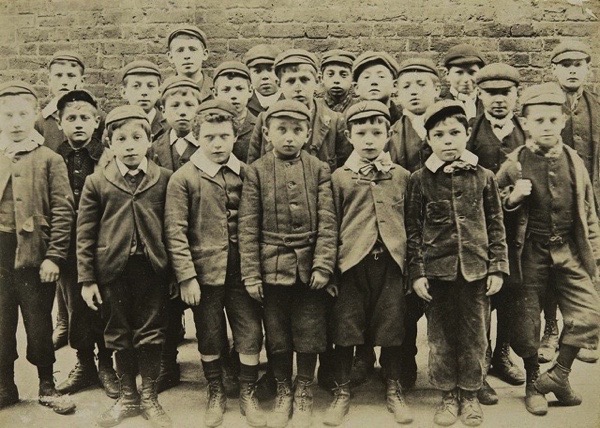
As Zangwill learned, the Jews’ Free School was a Victorian temple to aspiration through strict discipline. Unlike the cramped, dark homes that the pupils came from, its corridors were wide and open to light and air. With its huge courtyard for drill and its large arched windows it looked like a giant factory for reassembling children or a warehouse for storing them. That is how the school represented its pupils, as I discovered in a series of photographs in a late-Victorian album in the archives of the Jewish Museum, London. One image, of girls in the first class, is titled ‘As They Enter School’, and captioned underneath ‘Raw Material: Children arriving from Roumania, Russia, Germany etc, unable to speak English’. A second photograph, showing girls from the top class, is titled ‘As They Leave School’, and captioned ‘Finished Article: After several years training in Hebrew, Reading, Writing, Arithmetic, History, Geography, Literature, Science, Drill, Gymnastics, Needlework, Cookery, Laundry and Sports’. The images resemble Dr Barnardo’s ‘Before & After’ photographs of the destitute street children he rescued, and proudly present Jews’ Free School leavers, similarly, as fully trained and accomplished modern British citizens.
It is this production line that Zangwill writes of in his sketch of the motley mob of kids piling into school. He takes particular pleasure in the great diversity of the children, these are kids from all kinds of families, who have all kinds of destinies ahead of them. But Zangwill’s description of the chaotic variety of the ghetto school also has a particular poignancy as a reflection on the process that aims to reduce it to order and uniformity. The school bell in Bell Lane calls the children to come and be Anglicized, ‘to be,’ Zangwill says, ‘ground in the same great, blind, inexorable Governmental machine’. It summons them to their future but it also tolls for their old life. And as the novel unfolds, we see the everyday tragedies that result: parents no longer able to communicate in their mother tongue with their children and young people embarrassed by the foreignness of their elders. In Children of the Ghetto, Zangwill explored the tension between his conviction that Jewish immigrants needed to join the modern world, and his attachment to the unruly energy of their distinctive culture. It was a paradox that was to preoccupy him throughout his writing life.
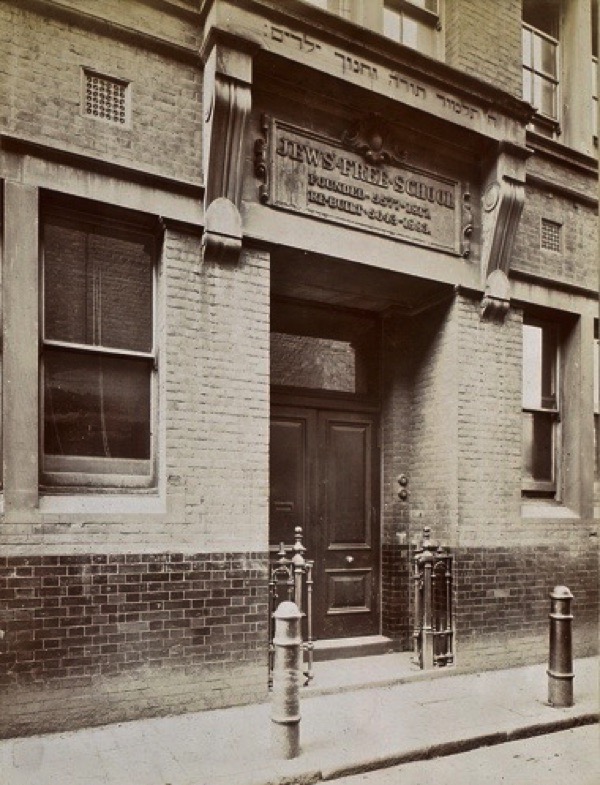
Jews’ Free School Entrance, Bell Lane


Chemistry Laboratory, 1908
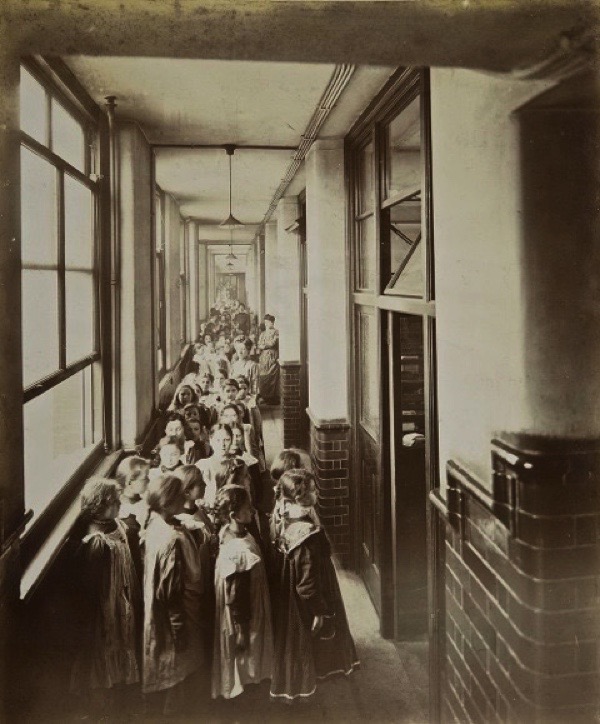
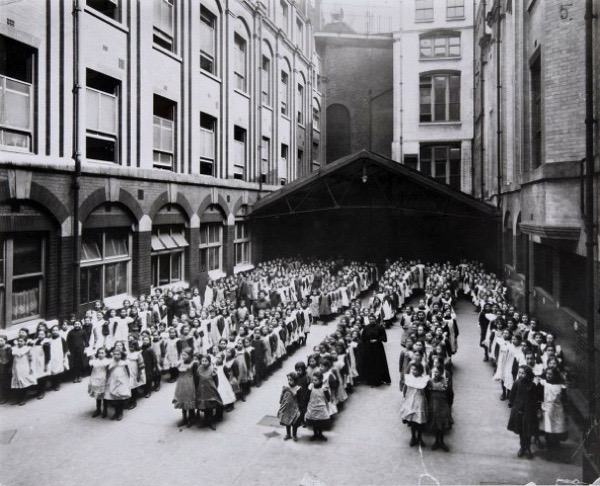
Playground Assembly, 1908
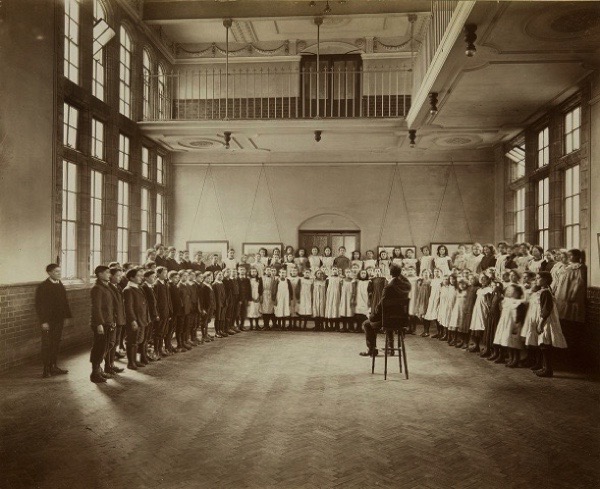
Choir, 1905

Hebrew Class, 1908
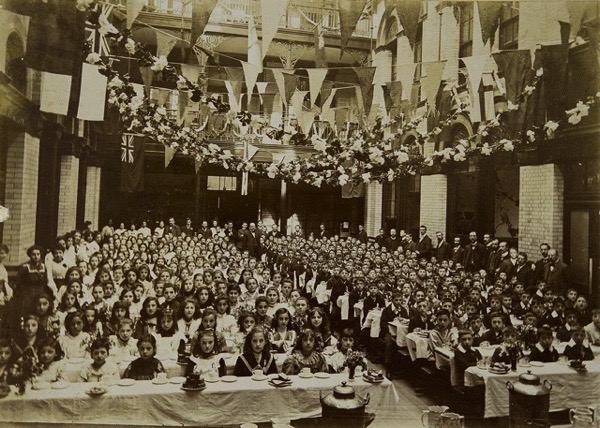
Celebration Tea in the Great Hall
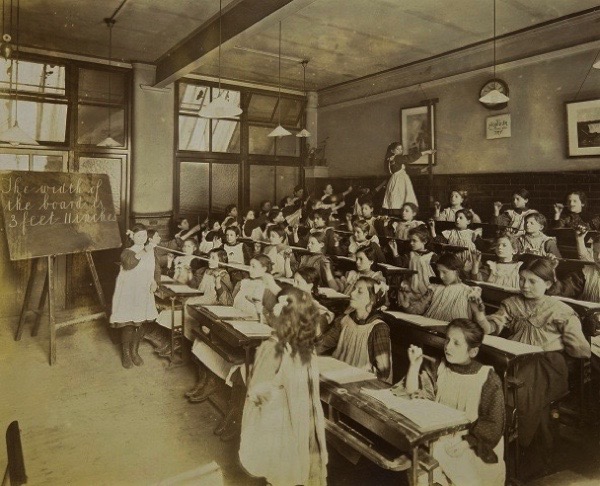
Lesson on Measurement
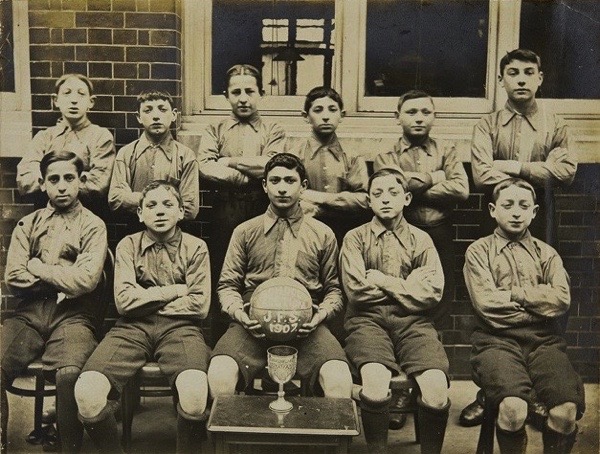
Football Team, 1907
Photographs copyright © Jewish Museum
You may also like to read about
Under The Arches At Three Colts Lane

Situated midway between Spitalfields and Bethnal Green lies Three Colts Lane. Although many years have passed since there were colts here, today there are many other attractions to make this a compelling destination, especially if you are having problems with your car – because Three Colts Lane is where all the motor repair garages are to be found, gathered together in dozens and snuggled up close together in ramshackle order. Who can say how many repair shops there are in Three Colts Lane? – since they inhabit the railway arches in the manner of interconnected troglodyte dwellings carved into a mountain, no-one can tell where one garage begins and another ends.
Three Colts Lane is where the lines from the East and the North converge as they approach Liverpool St Station, providing a deep warren of vaulted spaces, extended by shambolic tin shacks and bordered with scruffy yards fenced off with corrugated iron. Here in this forgotten niche, while more fences and signs are added, few have ever been removed, creating a dense visual patchwork to fascinate the eye. Yet even before I arrived in Three Colts Lane, the commingled scents of engine oil and spray paint were drawing me closer with their intoxicating fragrance, because, although I have no car, I love to come here to explore this distinct corner of the East End that is a world of its own.
Each body shop presents a cavernous entrance, from which the sounds of banging and clanging and shouting emanate, every one attended by the employees, distinguished by their boiler suits and oily hands, happily enjoying cigarettes in the sun. Yet standing in the daylight and peering into the gloom, it is impossible to discern the relative size and shape of these garages that all appear to recede infinitely into the darkness beneath the railway arches. An investigation was necessary, and so I invited Contributing Photographer Sarah Ainslie to join me in my quest to explore this mysterious parallel universe that goes by the name of Three Colts Lane. And many delights awaited us, because at each garage we were welcomed by the mechanics, eager to have their pictures taken and show us the manifold splendours of their manor.
There is a cheerful spirit of anarchy that presides in Three Colts Lane, incarnated by the senior mechanic with his upper body under a taxicab, who, when we asked gingerly if we might take pictures of the extravagantly vaulted narrow old repair shop deep beneath the arches, declared,“It’s not my garage. Do as you please! Make yourself at home!” To outsiders, these dark grimy spaces might appear alien, but to those who work here it is a zone where everyone knows everyone else, and where you can spend your working life in a society with its own codes, hierarchy and respect – only encountering the outside world through the motorists and cabbies that arrive needing repairs. My father was a mechanic, and I recognise the liberation of filth, how being dirty in your work sets you apart from others’ expectations. The layers of grime and dirt here – in an environment comprised almost exclusively of small businesses where no-one wears a white collar – speak eloquently of a place that is a law unto itself.
Starting at the Eastern end of Three Colts Lane, the first person we met was Lofty, proprietor of the A1 Car Centre, who proved to be a gracious ambassador for the territory. “Some garages, they just want to take the money,” Lofty declared in wonder, his chestnut-brown eyes glinting with righteous ire at the injustice – like a sheriff denouncing outlaws – before he pledged his own personal doctrine of decency, “But I believe it’s how you treat the customers that’s the most important thing, that’s why we are still here after twenty-five years.” And proof that Lofty is as good as his word was evident recently when seven hundred customers signed a petition saving the garage from developers who threatened to build student housing on the site.
We crossed the road to shake hands with Nicky at the Coborn Garage, admiring the fresh and gaudy patriotic colour scheme of red, white and blue, and his decorative signwriting that would not be out-of-place on a gipsy caravan. Under the railway bridge and down the road, we encountered Erdal and his nephew at Repairs R Us, where we marvelled at the monster engine from a Volvo truck that Erdal rebuilt and today keeps as a trophy by the entrance of his tiny arch. Further down, we met Ahmed, a native of Cyprus who grew up above the synagogue in Heneage St and has run his garage here for twenty-eight years. At the corner, across from Bethnal Green Station, we were greeted by Ian & Trevor, two softly spoken brothers who have been here twenty years repairing taxis in a former a scrap yard, still retaining its old weighbridge. We all squinted together at the drain pipe head dated 1870 with the initials of the Great Eastern Railway upon it, declaring the history of the site in gothic capitals, before Ian extracted a promise from me to come back once I had discovered the origin of the name Three Colts Lane.
Apart from calendar girls adorning the walls, the only women we glimpsed were those who restricted themselves to answering the telephone – barely visible in tiny cabins of domestic comfort, sheltering their femininity against the barbaric male chaos of the machine shops. But then, strolling down a back lane and passing one of the governors in a heated altercation with a quivering cabbie who had innocently scraped his Daimler, thereby providing the catalyst for an arresting display of bullish masculinity, we encountered Ilfet. With a triumphant mixture of self-assurance and sharp humour, Ilfet has won the respect of her male colleagues in the body shop, wielding a spanner as well as the next man. A bold pioneer in her field and stirling example to others, I was proud to shake the hand of Ilfet, the only – or rather – the first female mechanic in Three Colts Lane.
Growing bolder, we ventured deeper to discover the paint shops and frames where taxis were hoisted up for major surgery. We left daylight behind us to explore the furthest recesses of the dripping vaults, lined with corrugated iron, where a fluorescent glow pervaded the scene of lurid-coloured motors crouching in the gloom. We had arrived at the heart of Three Colts Lane, vibrating to the diabolic roar of the high speed trains passing overhead, whisking passengers in and out of London, oblivious to the hidden world beneath the tracks.


Photographs copyright © Sarah Ainslie
You may also like to read about