
Down The Roman Road
Contributing Photographer Sarah Ainslie & I took advantage of the summer weather to enjoy an excursion down the Roman Rd, the heartland of the East End’s culture of family businesses, and we met the people behind three of the most popular shops.
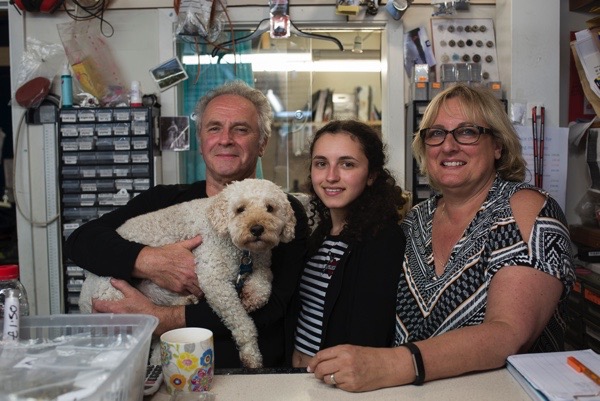
Robert, Phoebe & Jill Myers with Teddy at Sew Amazing
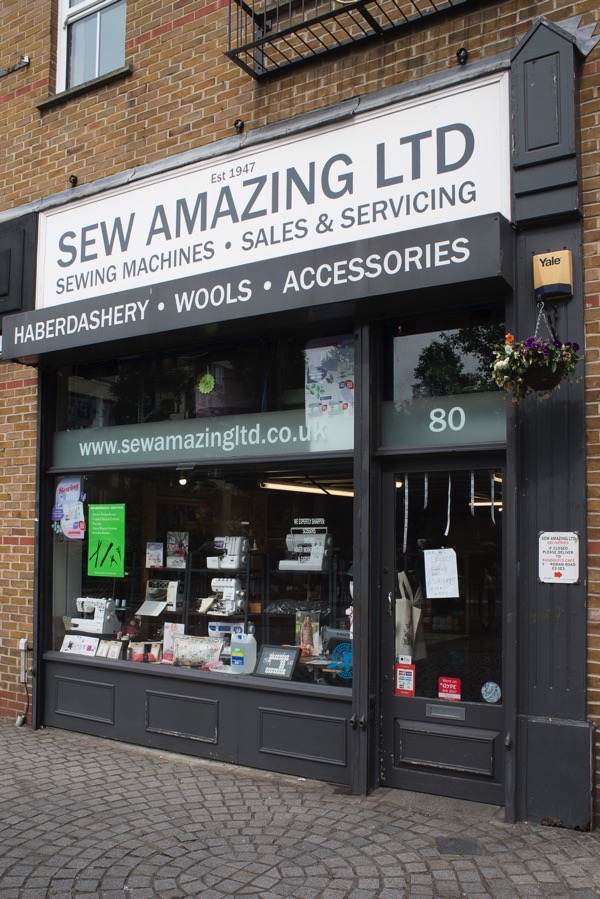
Robert Myers – “My dad, Alfie, started the business in 1947 in Stoke Newington Church St and he was there over fifty years before we moved here in 2000. His elder sister lent him eight pounds, which he paid off over a year, and he started the business on his own when he came out of the army. My father had a partner who ran up a lot of debt and vanished to Australia, so he had to work for another two years to pay that off. My dad was a pretty good sewing machine engineer. The shop was called A. Myers, Sewing Machines. He rented for the first twenty years before he wrote to the owners and told them he was fed up paying rent and was either going to move or buy the premises, so they sold it to him.
I joined the business in 1973, straight from school at seventeen years old. I wanted to do anything engineering and my first choice was the auto trade but it didn’t work out. So I worked with my dad. He said, ‘Give it a year and see if you like it.’ We went into the wholesale trade and I enjoyed driving to Europe. We got big at one time but there was no money in it, so we have gone back to how we started.
Today, we supply machines to local schools and industry as well our individual customers. My wife Jill handles the haberdashery side of the business and my cousin Mandi, she is a sewing machine engineer and she has been working with me for thirteen years. It is such a specialised trade and we have the knowledge. I have got a lot of knowledge but 80% of it is useless because there is no application for it. I can repair almost any sewing machine.
At the peak of the garment trade, there were perhaps fifteen or twenty sewing machines suppliers in Whitechapel area. Some specialised in textiles, some in hat makers and others in leather and footwear. Because we are more specialised we find there is an appreciation for our work. When people buy a sewing machine from us, we don’t just give it to them in a box, we sit them down and show them how to use it. We work a lot for disabled people and I adapt machines for them to use. I love people who have a disability and want to be creative, and it shocks me that other companies won’t be bothered with them. I enjoy the challenge.
I like working on old industrial machines. We have some here over a hundred years old and still in good working order. If you have the knowledge, you can repair them indefinitely. They are metal with nice big screws that can be tightened up. We stock thousands of spare components for machines going back eighty or a hundred years. It’s a little bit special.”
Sew Amazing, 80 St Stephen’s Rd, E3 5JL
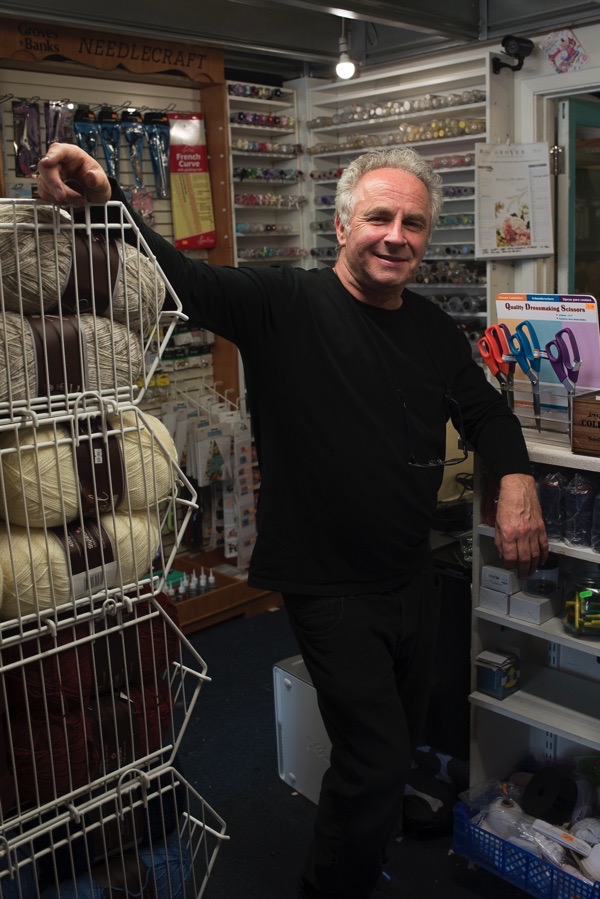
‘I have got a lot of knowledge but 80% of it is useless’
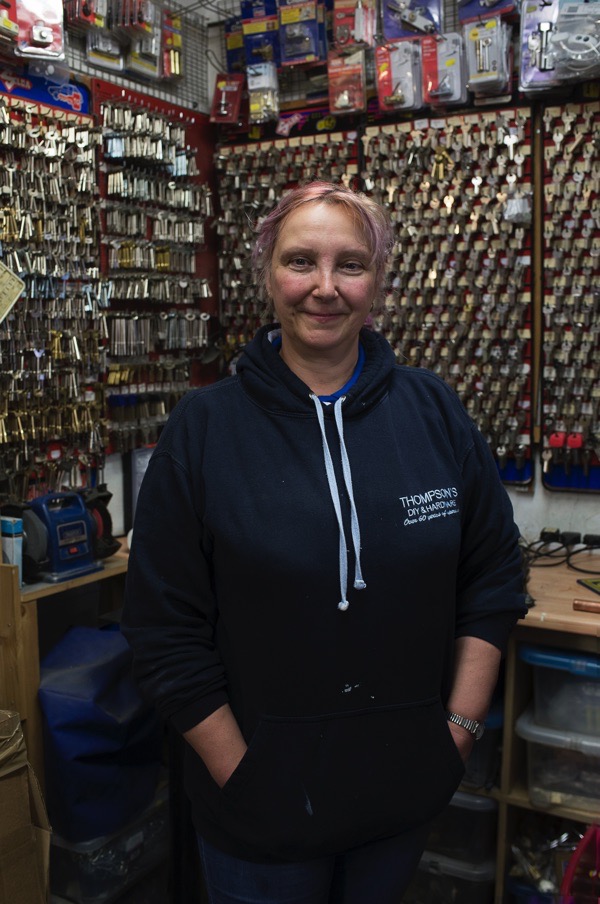
Annette Wakerley at Thompson’s DIY
Annette Wakerley – “Four generations of my family have been in this shop. My grandad, George Thompson, had four sons and my dad, Kenneth Thompson, took over the business and it went from him to me and my brother Mark Thompson. He’s round the back and I look after the shop, but Katie my daughter is taking over soon. She is doing all our webpages at the moment and bringing new life into it. I was born into this and I have been here fifty-three years, but the business has been here sixty-five years now. They had a place in Stroudly Walk in Bow before this place became available, it used to be a house and a shop but they converted the whole building into a shop.
All shops are going through hard times at the moment and I think we have to change in order to survive. We are developing our website but we believe personal attention to our customers is paramount. Fifty per cent of our customers have been with us forever and the others are new. There is a lot of letting round here so people only stay a couple of years and they come to us when need to repair the property before they so they can get their deposit back. People are busy with decorating during the summer when the weather is nice. Yet there is still a market for draught excluders even at this time of year. We hold a stock of around 12, 000 different items. I do know roughly how you use each item and, if I don’t, my brother does.
I am locksmith so I deal with all the keys and my daughter has just passed her test to be a locksmith as well, so she is out on a job now.”
Thompson’s DIY, 444 Roman Rd, E3 5LU
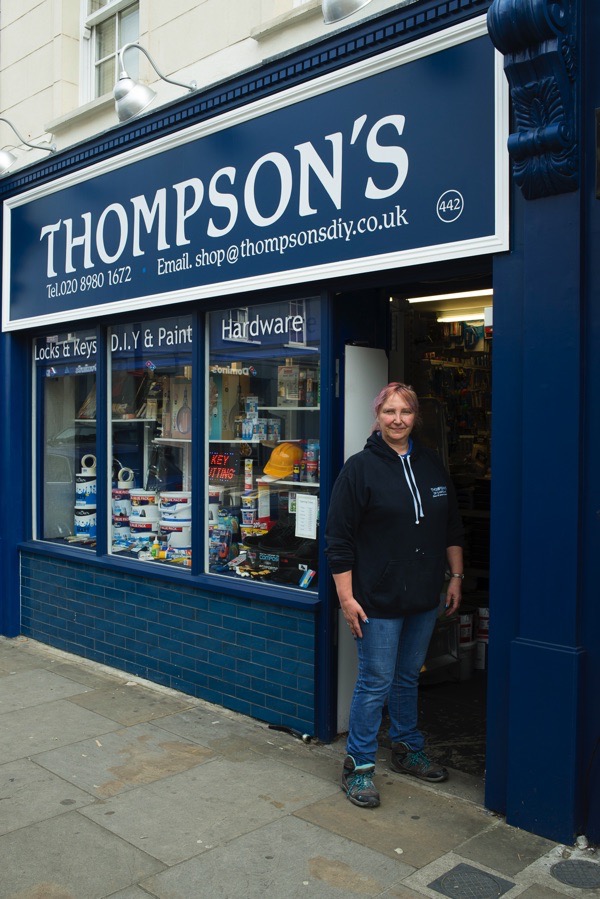
‘Four generations of my family have been in this shop’
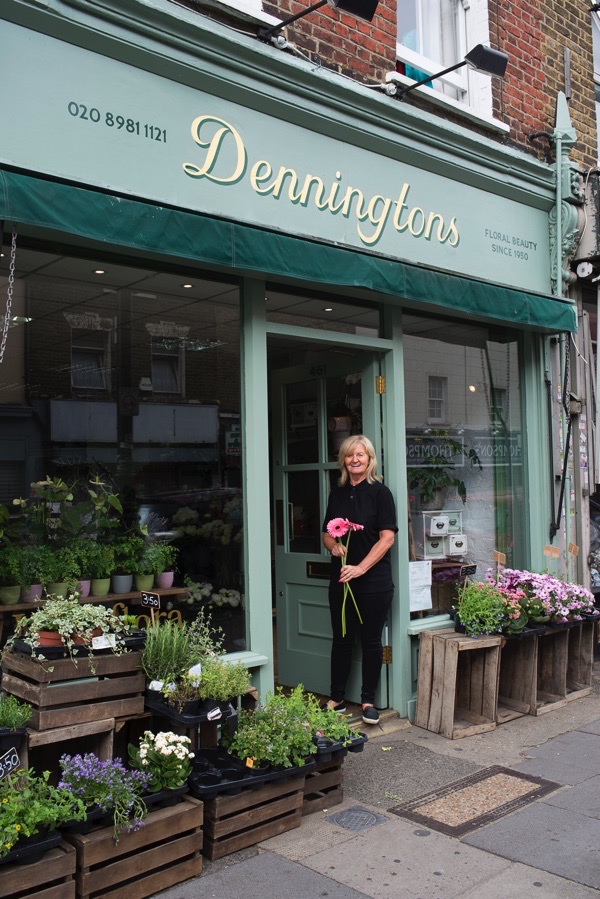
Sharon Adams at Dennington’s
Sharon Adams – “This shop has only been here twelve years but before that it was on the corner since the nineteen-fifties. The Denningtons all died a long time ago but my dad worked for them for years and became a director of the company and took the business over in the seventies. He was a porter at the Covent Garden flower market and Mr Dennington said, ‘Would you like to come and work for me?’ That was how they met. There were five shops at that time, Whitechapel, Bow, Forest Gate plus two shops and a flower stall in the Roman Rd. When my dad retired twelve years ago, my brother came into the business and we took it over together. Originally, I was a Saturday girl when I was fourteen years old and I used to spend my wages on dinky toys for my little brother that I bought From Gary Arber’s shop. I am sixty now and my son Lee runs the business today.
We just had eighty-five flower pieces go out to a funeral, our whole basement is for making wreaths. We are more of a funeral place than anything else, there are more funerals than weddings here.”
Denningtons, 464 Roman Rd, E3 5LX
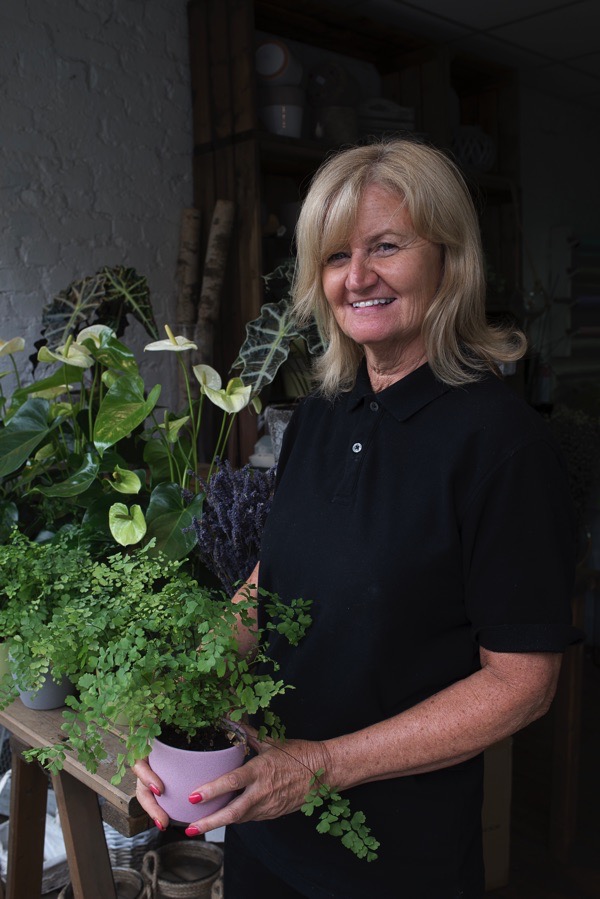
‘I was a Saturday girl when I was fourteen years old’
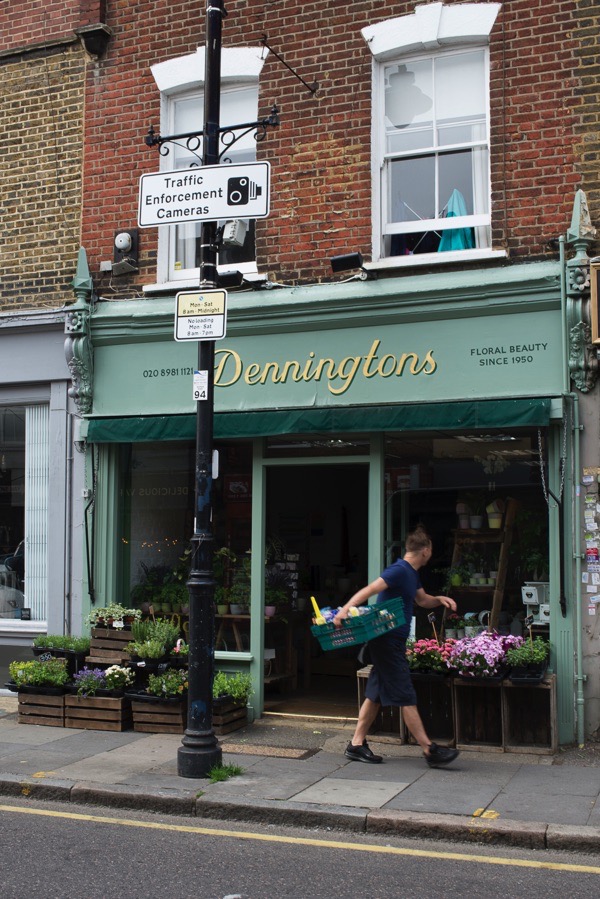
Photographs copyright © Sarah Ainslie
You may also like to read about
Visit The Secret Gardens Of Spitalfields
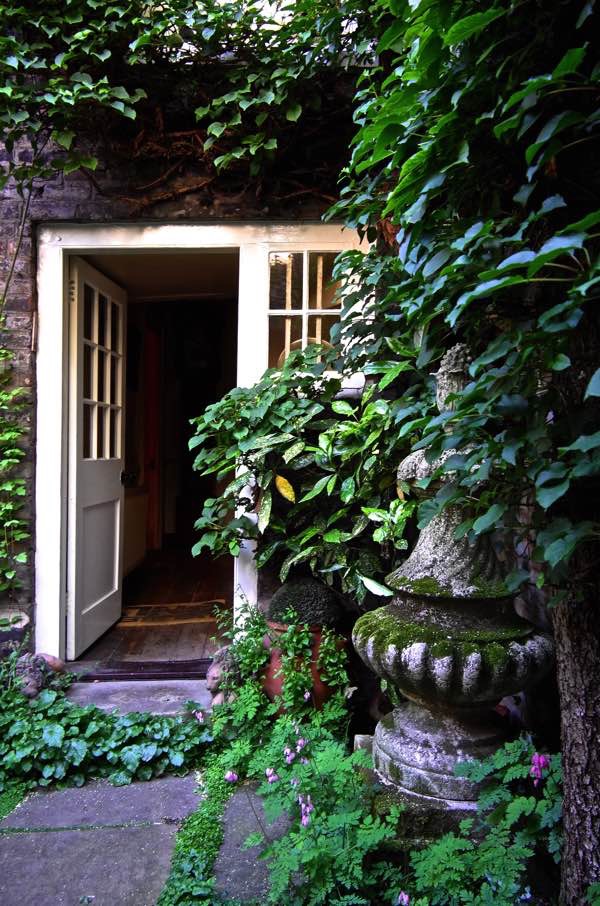
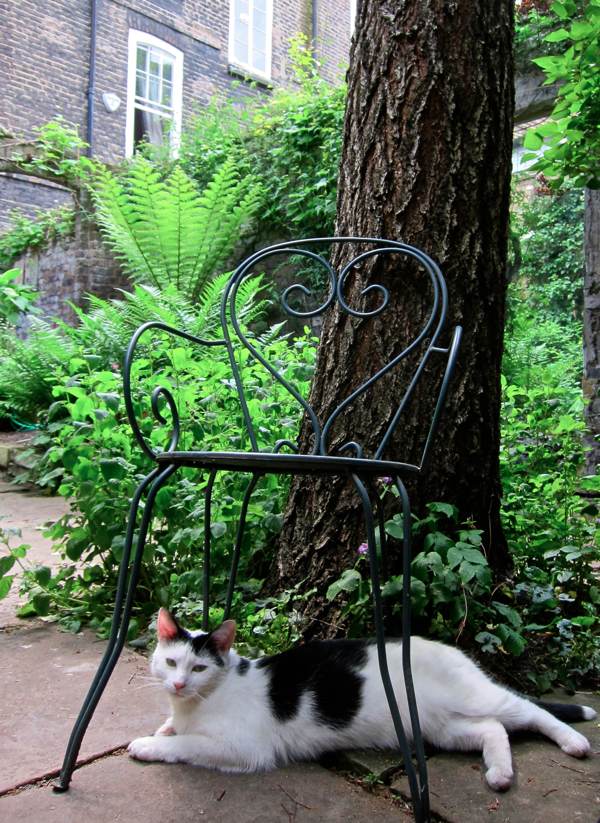
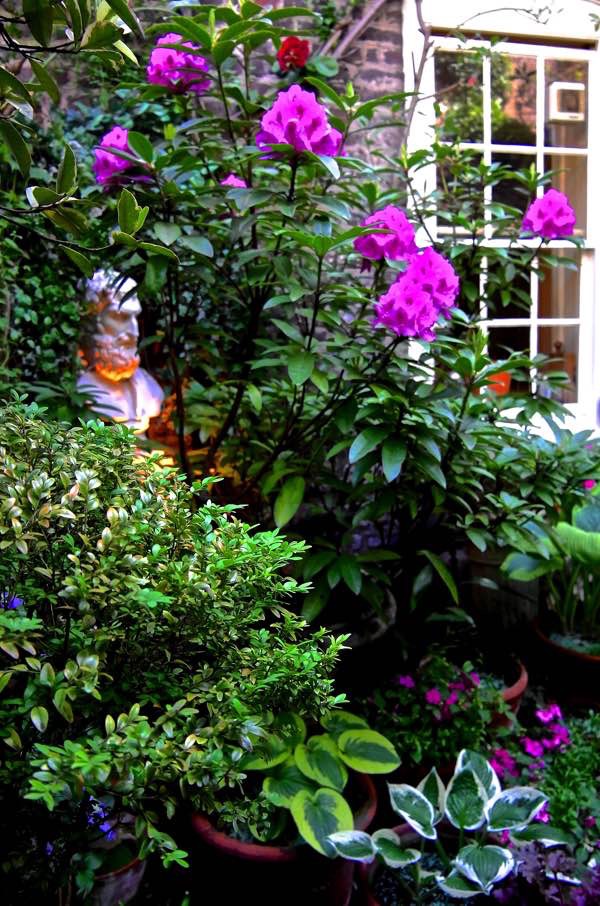
Eight gardens in Spitalfields are open for visitors on Saturday 16th June from 11am – 4pm. Tickets cost £14 to visit them all and you can find details at the website of the National Gardens Scheme.


You may also like to read about
At Snappy Snaps In Bishopsgate
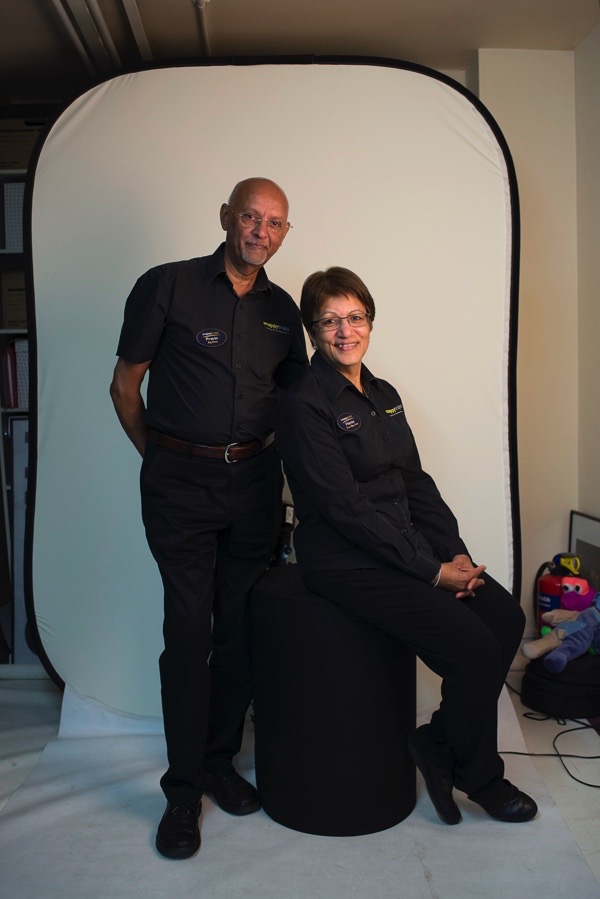
Pravin & Hansa Raval
You might think that all the family businesses had gone from Bishopsgate long ago, yet – despite its nationwide ubiquity – Snappy Snaps is an independently-owned franchise, and Pravin & Hansa Raval have run their own shop opposite Liverpool St Station for nearly thirty years.
Contributing Photographer Sarah Ainslie & I paid them a visit recently and were delighted to learn about the quiet revolution in photography that is happening at this moment. More people are making prints of their photographs than ever before thanks to new technology that permits images to be printed instantly and cheaply direct from mobile phones.
Hansa revealed to me that the most films ever delivered for processing was the morning after the millennium when three hundred and twenty seven were brought in to her shop, five hundred and thirty-seven that day in total, and she is proud to report that they never lost one.
Snappy Snaps require their franchise holders to wear captioned name badges, so Pravin sports one saying ‘Big Boss’ while Hansa’s declares she is ‘The Wise One.’ Thus Sarah & I were delighted to sit down with the Big Boss and The Wise One in the basement studio at 220 Bishopsgate to hear the story of their business from Pravin and learn about the changing trends in photography over the past quarter century.
“We got the lease in March 1992 and had the shop fitted and opened here that November and started trading on Bishopsgate. Previously it had been a BMW garage but when we took it over it was an empty building and we were the first retail business on this site. The street was completely barren then with just banks, building societies and offices but the area now is unrecognisable and we have seen it come up. When we first came out of Liverpool St Station, I said to Hansa, ‘Do we really want to take that?’ but we risked it and here we are all these years later. Apart from the newsagent, we are the only family business in Bishopsgate as far as we know.
The Snappy Snaps company is owned by Timpsons Shoe Repair who are the largest retail landlords in this country with over a thousand outlets. John Timpson who owns the company has a different way of doing business, he believes in ‘upside-down management’ which recognises that the people running the shops know his business better than he does. He comes in here quite often, making surprise visits and coming to have a chat with us to ask if we have any issues. He has a philosophy of visiting every business once a year.
My wife Hansa has a Masters Degree in Chemistry and I have a Master Degree in Pharmacology. We have completely different backgrounds to what we do now. Hansa was an analytical chemist but she left my job and started up the business. The pharmaceutical business in this country in the late eighties was going through a difficult time and it got the stage where we felt we needed to have our own business, something we could do ourselves and control our lives. It could have been a senior citizens’ home or a hotel, it could have been anything really.
We ended up at Snappy Snaps because one of my friends in the Territorial Army told me of someone who had just started a business with Snappy Snaps and he sent me the information and here we are. We had three Snappy Snaps in this area at one point, one in Farringdon and Aldgate as well but we are winding down now so we sold those. We used to run three enterprises from here and Hansa was the mastermind behind the technical side of things.
I left my job and joined Hansa in 1999. This is very much a personal business and we are here all the time and we also communicate with our customers online, sending and getting images by email. Our main business now is passport photography which means we have to understand the specific requirements for our customers.
When we started it was people bringing films to us for developing and printing but then it slowly went to digital. When we started our customers were mainly insurance companies who used film to record damage but that started dying in the late nineties when digital cameras came out, yet they still came to us because prints were important. We can offer prints from any image captured digitally. I think people always wanted to have prints but the quality is not there from home printers and we can offer cheaper prints at higher quality. The device that people use primarily now is the smartphone. Some of the most amazing pictures we see now are taken on mobile phones. For the first time in history, everyone is walking around with a camera all the time and the quality of some these pictures is astonishing.
We can download pictures wirelessly from phones and print them instantly. Taking a picture from a mobile phone is easy but getting a good print is more difficult. A lot of things can be done but some coaching of the customers is required and that is what we enjoy. Young people are coming in with film for developing now, it has become very popular again but I find myself teaching an eighteen year old how to load a camera. They trust us and I teach them about speed of film and exposure then I see their photography improve with each film they bring in for developing. We are rejuvenated by it.”
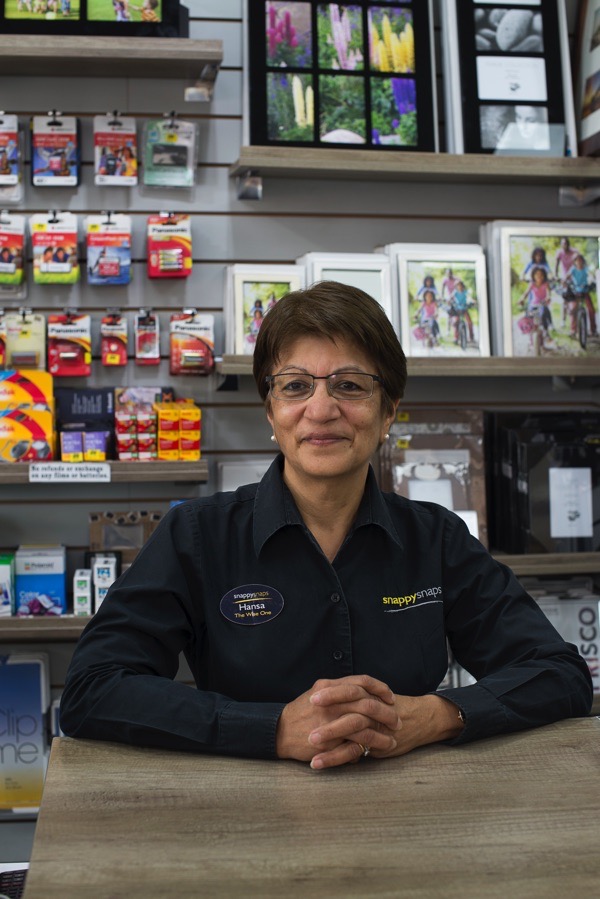
Hansa, The Wise One
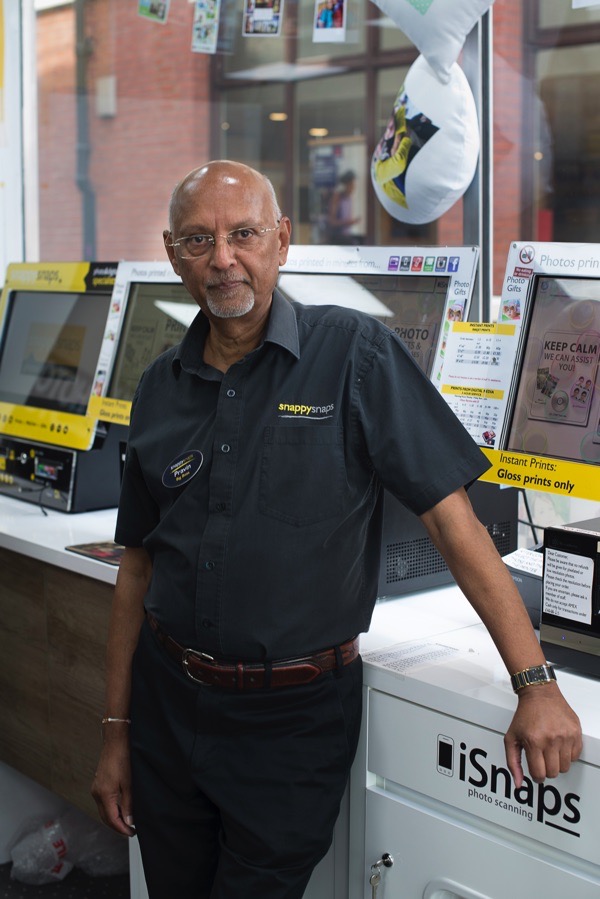
Pravin, Big Boss
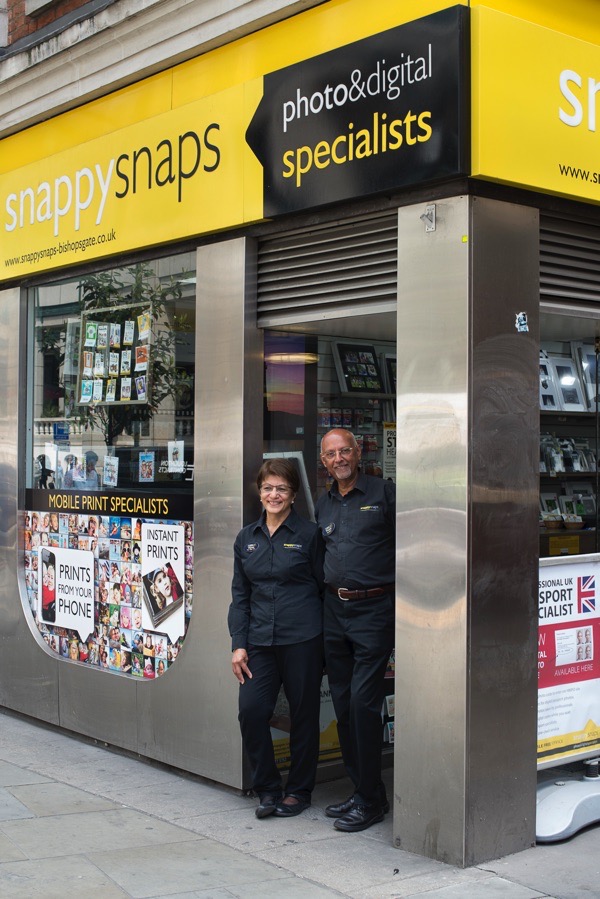
Snappy Snaps, 220 Bishopsgate, EC2M 4QD
Photographs copyright © Sarah Ainslie
You might also like to take a look at these other Bishopsgate Stories
The Romance of Old Bishopsgate
The Walking Footballers Of West Ham
Contributing Writer & Criminologist Professor Dick Hobbs reports on the craze for walking football
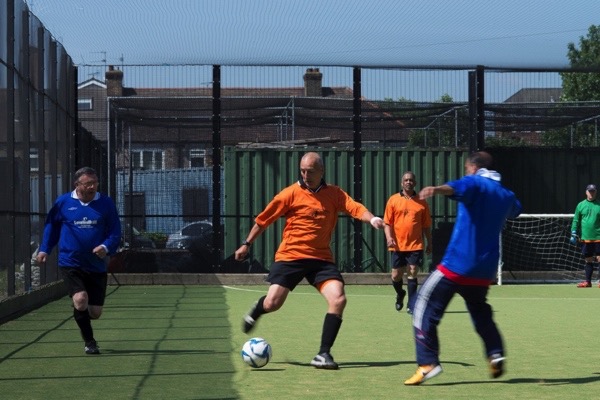
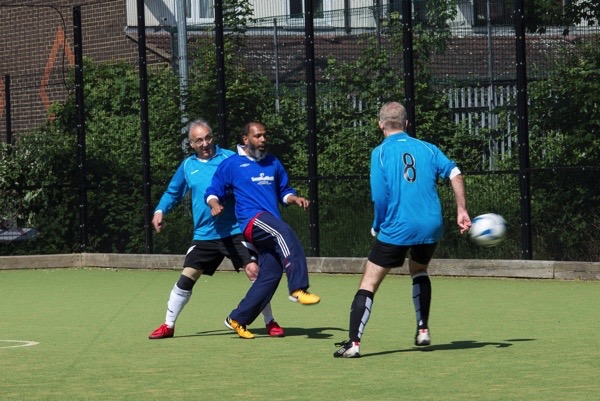
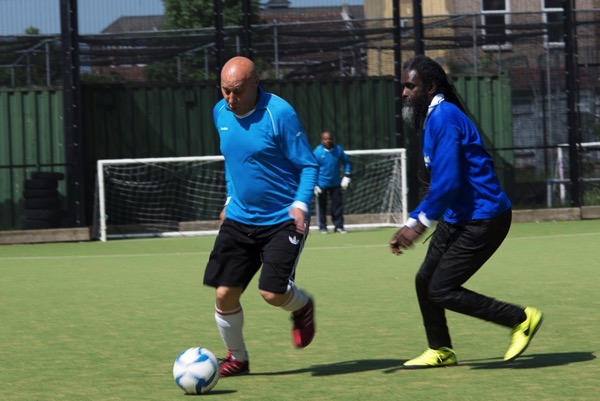
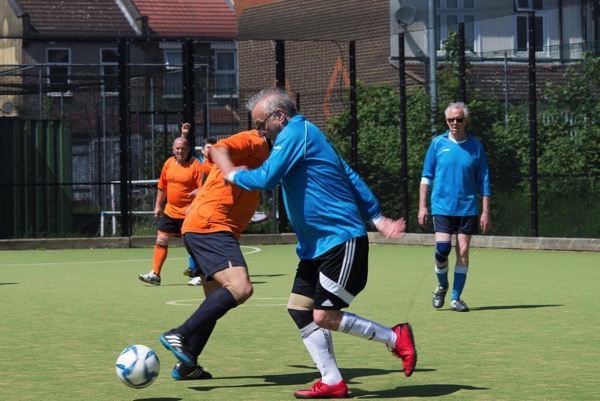
Walking football may sound like a creation of Monty Python, but with over eleven hundred clubs it is currently the fastest growing sport in the country. Created in 2011, walking football is played on a five-a-side pitch, running is not allowed, the ball cannot go above head height and physical contact is kept to a minimum. The sport is geared primarily for the over-fifties, but many clubs also encourage the involvement of younger people, the unemployed, sufferers of mental illness, and those recovering from illness or injury.
Although people live longer these days, those over fifty are becoming less active. Consequently, walking football players are evangelical about the sport’s many health benefits including weight loss, improved cardiovascular fitness, as well as a reduction in the loneliness and depression that feature in the lives of too many older men. However, none of this would be remotely possible if it was not enormous fun. Walking football is a real sport with wide appeal and it is common to find people who have never played football before on the pitch alongside those who have not kicked a ball since their twenties or thirties, and even a number who have played at semi-professional level.
In order to explore this extraordinary new sport Contributing Photographer Sarah Ainslie & I travelled to a forgotten corner of the East End to meet the members of the West Ham United Walking Football Team. Flanders Field in East Ham was once known as the ‘Wembley’ of school sports, but changes to local government funding in the nineties resulted in neglect. The grass grew over four feet high and the changing pavilion fell victim to an arson attack. Flanders Field became strewn with needles and bottles, and the neighbourhood was plagued by burglaries.
Led by local pastor Dave Mann, the community pushed back and in 2002 they took responsibility for the nine acre site. Dave acquired a small grant of five thousand pounds to hire equipment and – when strimmers proved ineffective – he clinched a two-for-the-price-of-one deal on a couple of sit-on grass mowers. In total, the Bonny Downs Community Association secured over £1.3million funding and they have transformed this once-derelict site into an outstanding sporting facility with cricket nets, a multi-use games area, a club room, and football pitches.
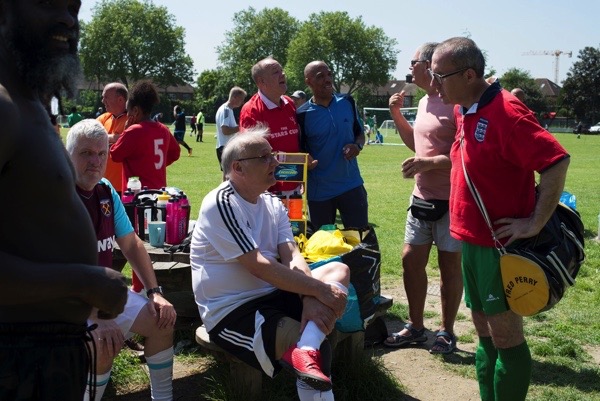
The centrepiece is the Bobby Moore Sports Pavilion, named after the local hero who was scouted at Flanders Field. When the walking football club started three and a half years ago, it had just three or four players, but its twice weekly sessions now attract between twenty to thirty enthusiasts and, in order to accommodate to demand, an additional session has just started in West Ham. Supported by the West Ham United Foundation and by coach and walking-football-guru Mark Blythe, the club has now partnered with health, lifestyle and homeless organisations. Several players had been advised to attend walking football sessions by their doctors and everyone we spoke with confirmed its physical and mental benefits.
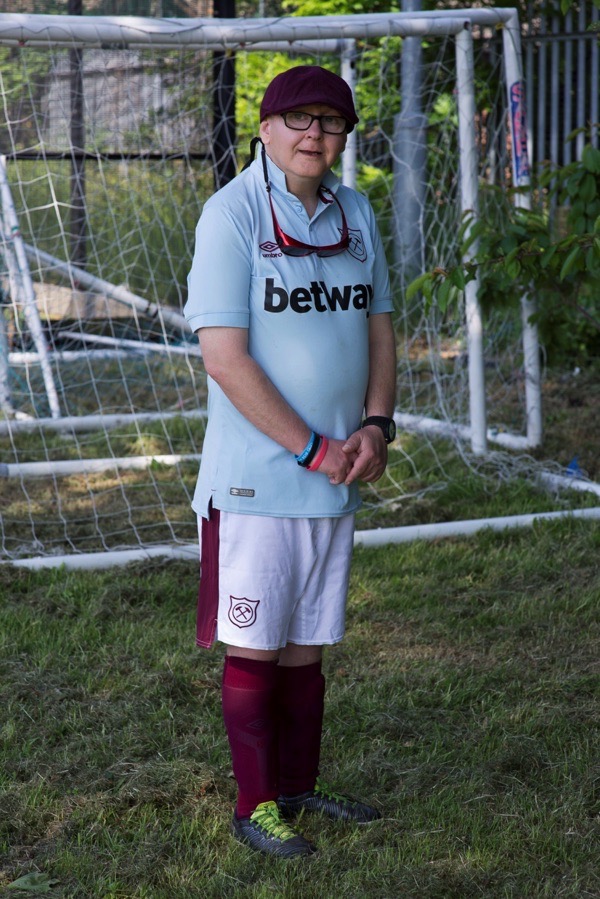
Brian
The most popular member of the club, voluntary worker Brian is forty-eight. ‘I go twice a week and I have made new friends he,’ he admitted. There was no hint of hesitation when I asked Brian what he liked best about walking football, ‘scoring’ he declared.
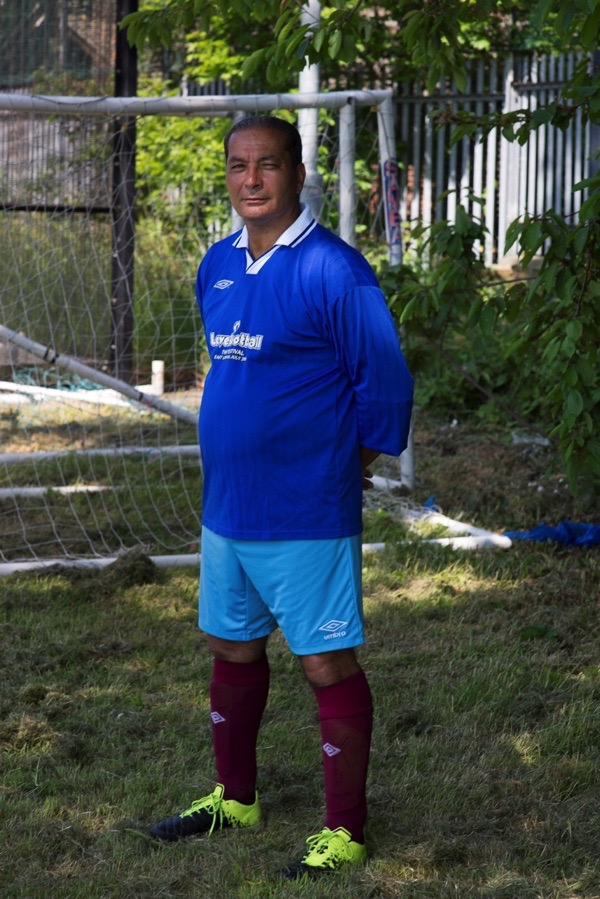
Doug
Doug is sixty-three years old and works as a caretaker. ‘I played a lot of football when I was younger, but gave it up and became overweight until a friend introduced me to walking football and I thought, “hang on I am not bad at this.” Then last year, I was down here playing and I snapped my achilles tendon. At first they put me in a cast, but I couldn’t stand it, so I went back to the hospital and I was put in a walking boot. It was better though it still got me down and I became depressed. I was in a bad way, yet the boys were behind me – I got support from them. We have all have problems, but we leave them off the pitch’. The previous weekend Doug had been appointed captain for a tournament in Margate. ‘It made me feel good,’ he revealed to me proudly.
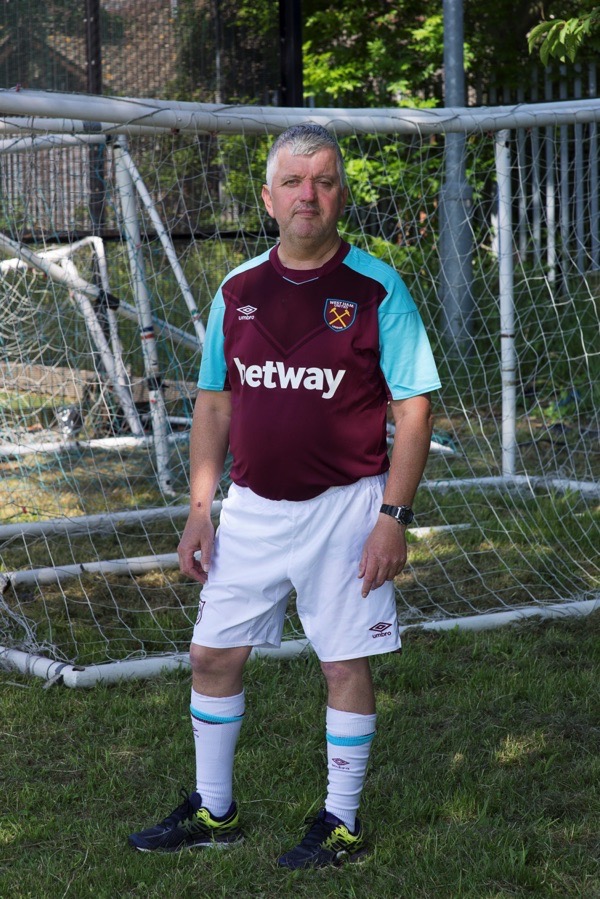
Ken
Ken was a former marathon runner who has turned to walking at football fifty-four years old after suffering a stroke.

Michael
Watching youthful sixty-one-year-old Michael play, it is clear that he – in common with many walking footballers – was once a highly accomplished player of the original game. ‘I have been coming here two years now and have never looked back,’ he confessed to me, ‘I used to play years ago, but this is a different game. There is no heading and you can’t run. I had a bad accident and done my knee – it is held together with wire. I don’t smoke or drink – I keep active, focused and work hard’.
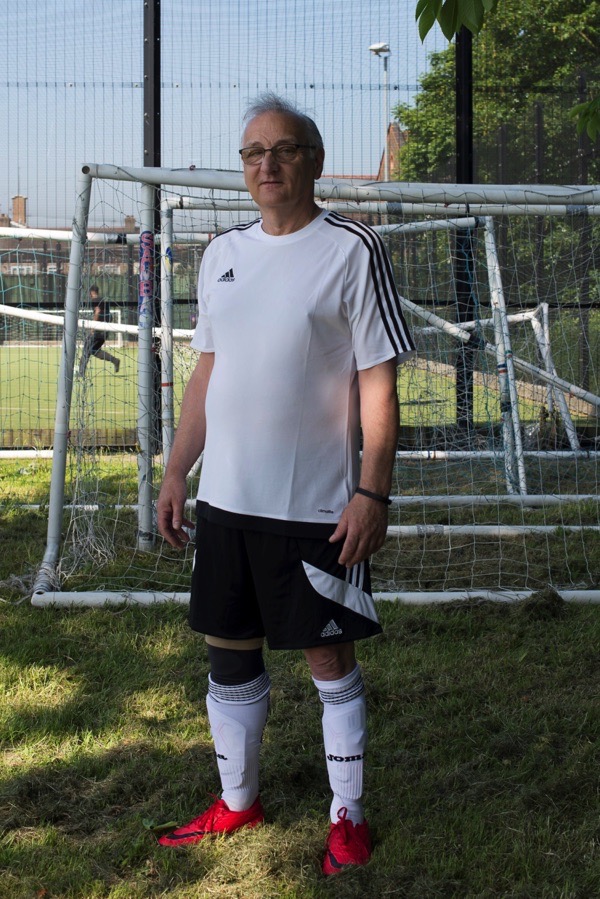
Derek
GPO worker Derek proudly wore the brightest pair of football boots. ‘I read about walking football in the Newham magazine and I have been coming for about eighteen months. I was sixty-four and hadn’t played football since my mid-twenties, but from the first time I played walking football it was like a drug, I love it. When you tell people you are playing walking football they laugh, but they should try it – playing competitively you need skills. It’s a fantastic game and it has really improved my social life too. In this respect, it is no different to when I was younger, it’s the same banter and I have made new friends.’
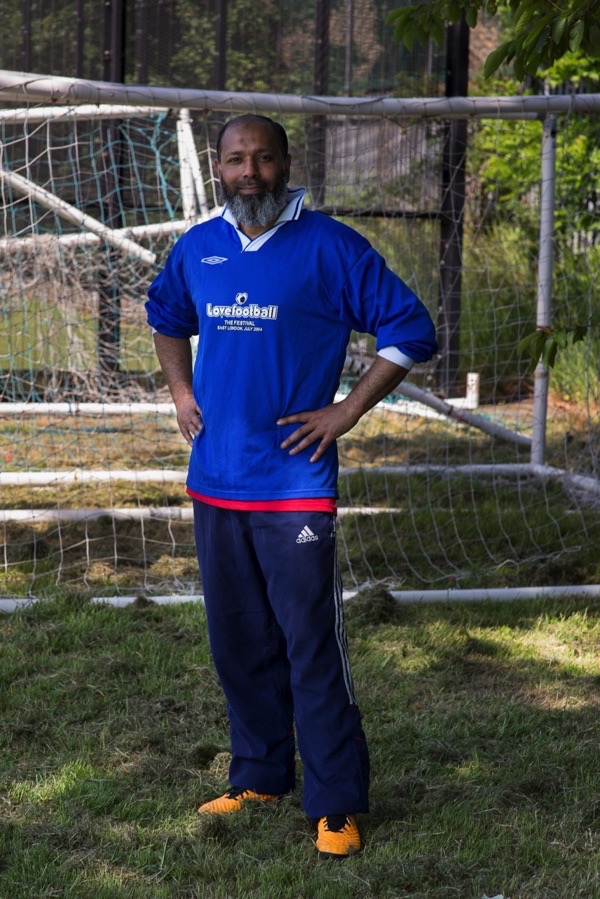
Abs
Civil Servant Abs is only forty-six and has been coming to walking football for several months. ‘My doctor suggested it as my family are prone to diabetes. I like it here, they are great people and I enjoy the social side and the tournaments. It is very hot today and I am fasting as it is Ramadan, but I am here because I want to be inspirational and show that you don’t have to stay indoors doing nothing, you can get out and exercise.’
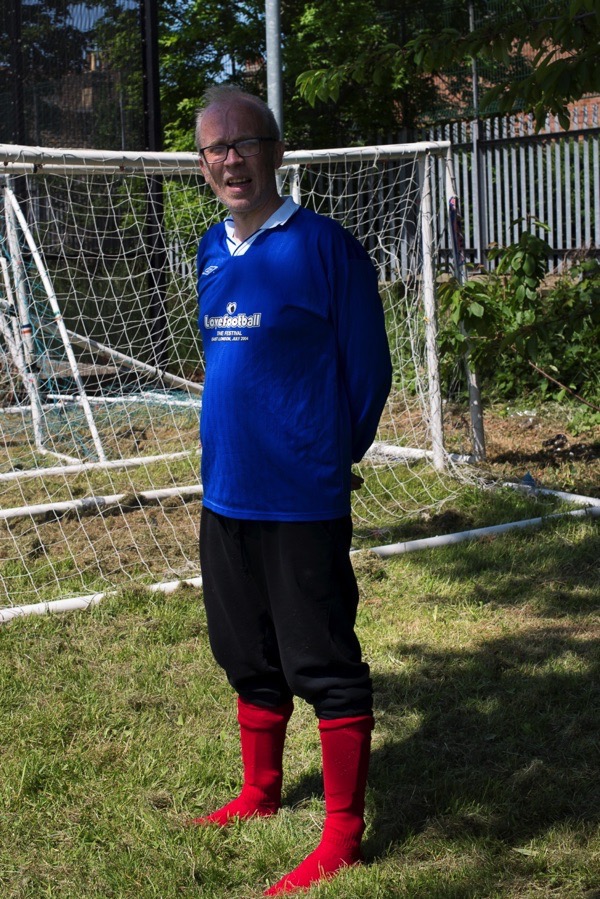
Paul
At forty-nine, van driver Paul is one of the younger members of the West Ham walking football fraternity. He plays with a rare intensity and concentration, making tackles and passing the ball quickly and efficiently. ‘I have been coming here for three years and walking football is a critical part of my life. I suffer from severe depression which expresses itself as anger and walking football is a big help. We were in Margate for a tournament last week and played really well. It was a great experience. These are nice guys, and if wasn’t for them and walking football I would be in a lot of trouble’.
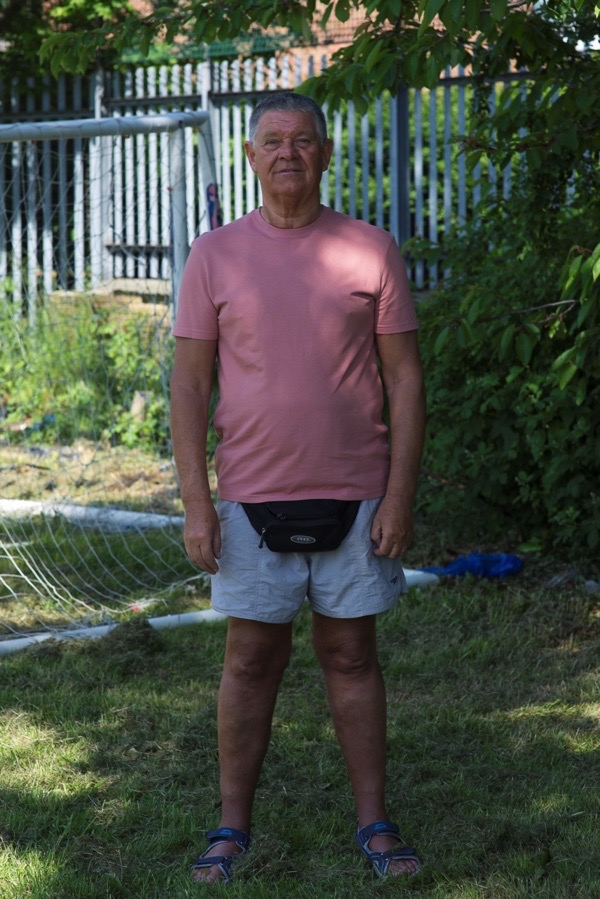
Pat
Although currently injured, Pat turned up on his bike to support his mates. Sixty-three-year-old can driver Pat used to keep fit by alternating between driving his taxi in the winter and in the summer when business was poor, working as a lifeguard. ‘I have been coming to walking football for about eighteen months. I absolutely love it and now I am injured I really miss it. After my annual medical, the doctor got me onto it by way of the West Ham Foundation. All the blokes are a great laugh and the social side is really good. We were in a documentary for Brazilian television and they had us walking in and out of the tunnel for hours. We are in our sixties and, at the end of all this hanging about and filming the same thing over and over again, they wanted us to play a game. We were knackered!’
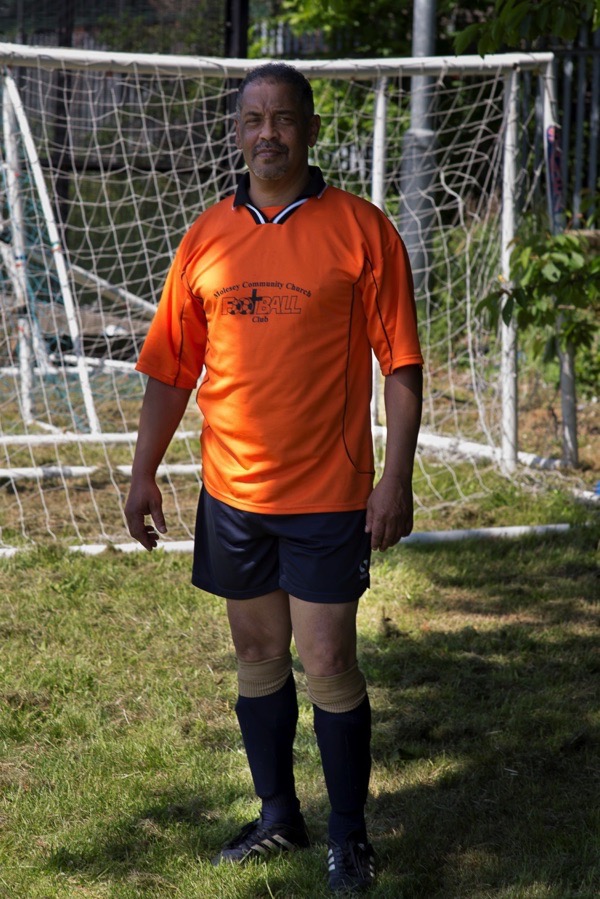
Edwin
Sixty-year-old Edwin is a project worker who also does out voluntary work. ‘I have been coming to walking football for three years and it is great fun. I hadn’t played football for about fifteen years. Walking football is a nice game, it’s good exercise and I am definitely feeling younger. When I score a good goal, I go home and I think about it all day’.
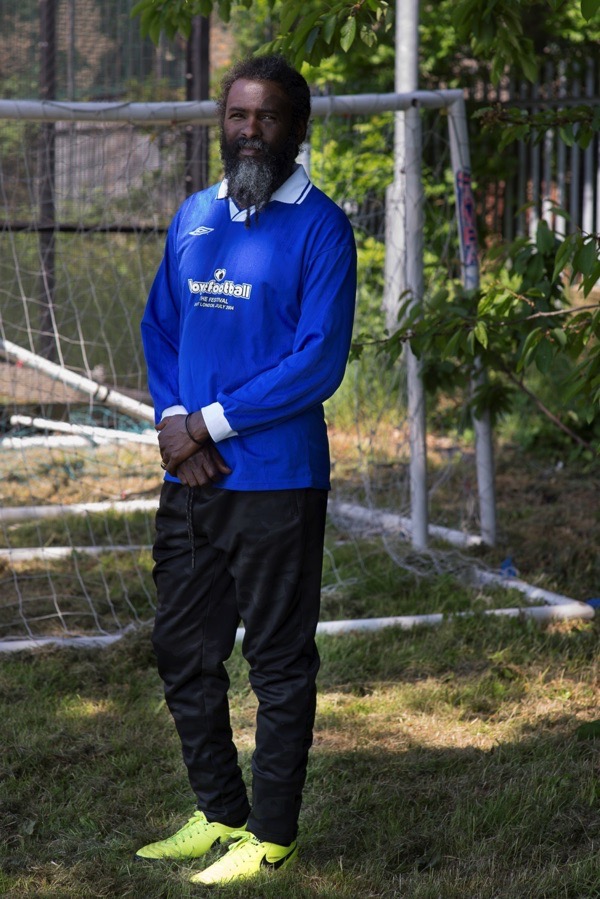
Clement
Fifty-one-year-old painter and decorator Clement has been playing walking football for two years. He plays on the left side, scoring goals and covering defence. ‘I used to play ordinary football years ago over Wanstead Flats. But this is a nice game, it’s less physical and you get less injuries. You meet different people from all backgrounds. On Tuesdays, after the session we all have a chat about life in general. Last weekend, we went to Margate and finished second and then we went to St Georges and got to the semi-final. It’s a great thing’.

Dave Mann
Dave Mann is an uncompromising advocate for the walking football team but – perhaps more importantly – he says ‘I am passionate about diversity. In the walking football club, we have two Rastafarians, four Hindus, ten Muslims and the rest are jellied-eel-eating Cockneys.’
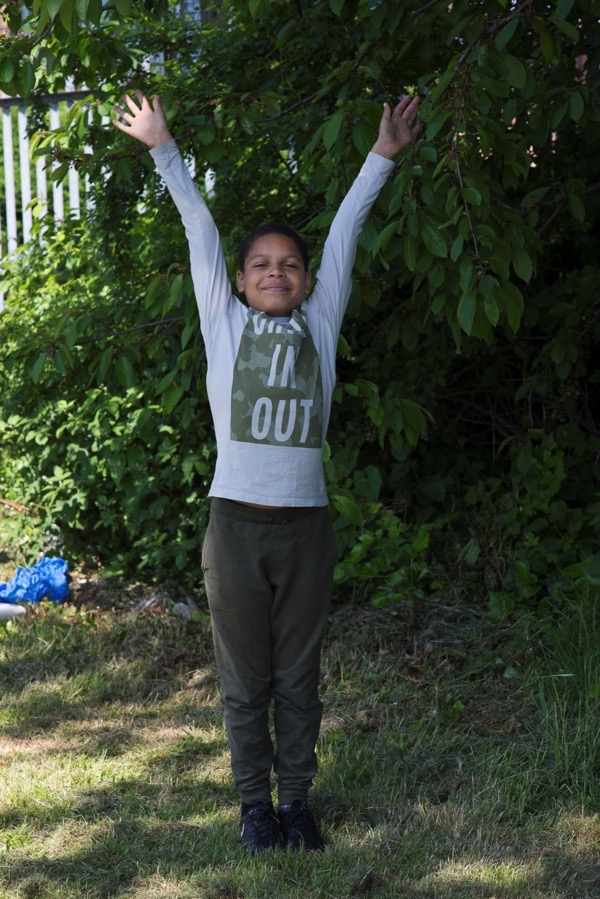
At Flanders Field we were accompanied by Doug’s grandson nine-year-old Marley Mann who was there to support his granddad and appointed himself as Sarah Ainslie’s assistant for the day.
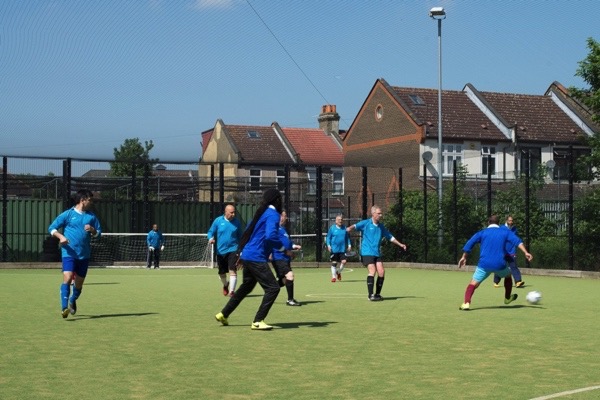
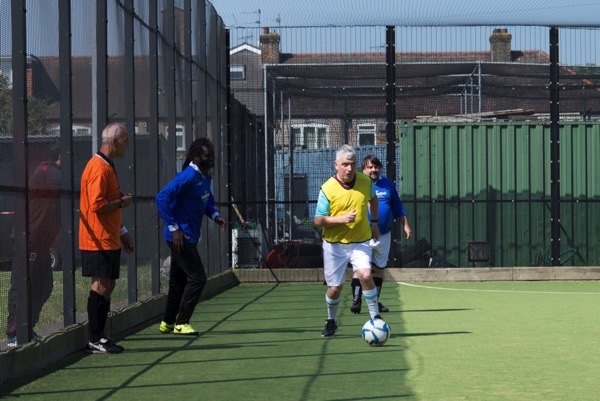
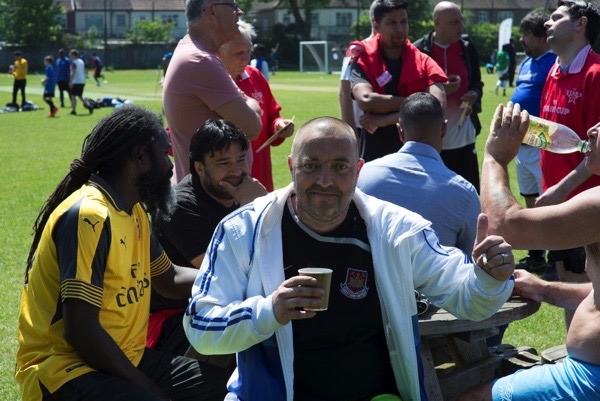
Steve, the West Ham walking football goalkeeper
Photographs copyright © Sarah Ainslie
You may like to read these other stories by Dick Hobbs
Bobby Cummines, Not A Gangster
Stories Of Hackney Old & New
Each Saturday, we are featuring one of Adam Dant’s MAPS OF LONDON & BEYOND from the forthcoming book of his extraordinary cartography to be published by Spitalfields Life Books & Batsford on Thursday June 7th.
Please support this ambitious venture by pre-ordering a copy, which will be signed by Adam Dant with an individual drawing on the flyleaf and sent to you on publication. CLICK TO ORDER A SIGNED COPY OF MAPS OF LONDON & BEYOND BY ADAM DANT
Tickets are already on sale for Adam Dant’s illustrated lecture showing his maps at the Wanstead Tap on Thursday June 21st. Click here to book tickets

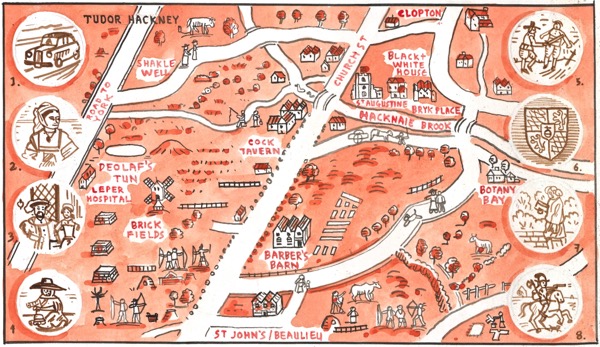
1. In the sixteenth century, Hackney is the first village near London accommodated with coaches for occasional passengers, hence the name of Hackney carriages.
2. 1521 – Thomas More’s third daughter Cecilia marries Giles Herond in ‘Shackelwell’ & resides at an ancient manor there.
3. 1536 – Henry VIII is reconciled with his daughter Mary at Brook House, Hackney. Mary had not spoken to her father in five years.
4. 1559 – London’s last case of leprosy is recorded at St Bart’s isolation house, ‘The Lock Hospital.’ Established in 1280, it was Hackney’s first hospital.
5. 1598 – Playwright Ben Jonson kills fellow actor Gabriel Spencer in a duel in the fields at Shoreditch and receives a felon’s brand on this thumb.
6. 1647 – The presence of Elizabeth of Bohemia & The Elector Palatine at an entertainment at ‘The Black & White house’ is commemorated in a window bearing their arms.
7. 1654 – Diarist John Evelyn visits Lady Brook’s celebrated garden at Brook’s House, Hackney.
8. 1682 – Prince Rupert discovers a new and excellent method of boring guns at his watermill in Homerton, but the secret of Prince Rupert’s metal dies with him.

9. 1701 – A bull baited by twelve dogs breaks loose at Temple Mills. Confusion and uproar ensue amongst the crowd of three thousand and a nine year old girl barely survives being tossed by the enraged animal.
10. 1750 – Legislature obliges people not to keep any other dogs but ‘such that are really useful’ after Charles Issacs at Hackney is bit by a dog and dies raving mad.
11. In the seventeenth century, the noted ‘Hackeny Buns’ of Goldsmith’s Row are as well regarded as those of ‘The Bun House’ at Chelsea.
12. 1665 – To be seen at Cooper’s Gardens for sixpence a person, the greatest curiosity that was ever seen, a white Dutch radish two feet and two inches round.
13. 1667 – In the church of St Augustine, Samuel Pepys eyes Abigail Vyner ‘a lady rich in Jewels but mostly in beauty, almost the finest woman that I ever saw.’
14. 1788 – In Cat & Mutton fields is seen the inhuman sport where any contestant catching ‘a soapy pig by the tail & holding it over his head’ wins a gold laced hat.
15. 1797 – The Hackney Militia gain a reputation for bumbling incompetence during the Napoleonic Wars.
16. 1811 – At The Mermaid Tavern pleasure gardens James Sadler & Captain Paget Royal Navy ascend in a balloon decorated in honour of The Prince Regent on his birthday.

17. 1787 – Plants from ‘Loddige’s Gardens’, originally owned by John Busch, gardener to Catherine the Great, are transferred to Crystal Palace.
18. 1805 – A stagecoach is broken to pieces and two ladies suffer severely when the vehicle overturns on the edge of a precipice at Hackney Wick.
19. 1816 – Brooke House, former home of Lady Brookes and Balmes House at Hoxton are opened as private lunatic asylums.
20. 1821 – Repairs are made at Hackney’s oldest brewery, Mrs Addison’s Woolpack Brewery on the Hackney Brook.
21. 1848 – Prince Albert opens The Hospital for Diseases of the Chest and in 1867 Princess Louise opens the North-Eastern Hospital for Sick Children in the Hackney Rd
22. 1850 – The construction of Victoria Park sweeps way hovels, formerly known as‘Botany Bay,’ and the inhabitants who are sent to another place bearing the same name.
23. 1866 – At the Parkesine Works in Wallis Rd and Berkshire Rd, Alexander Parkes manufactures the world’s first plastic.
24. 1880. – Hackney Wick firm Carless Capel & Leonard claim to have invented the term ‘petrol’ (St Peter’s Oil).

25. 1902 – Smallpox re-surfaces in Hackney with contagion found in a family of costermongers living in filthy conditions in Sanford Lane.
26. 1959 – Richard Burton films a scene for John Osborne’s ‘Look Back in Anger’ at Dalston Junction Railway Station.
27. 1952 – The great fog causes death and chaos in Hackney when a motor-cyclist collides with a bus, a man dies on a railway line and crime has a little hey-day.
28. 1964 – Teenagers at The Dalston Dance Hall adopt the ‘purple heart’ pill popping craze.
29. 1970 – M.O.D investigates the sighting of a U.F.O over Hackney by Mr Douglas Lockhart, gliding across a clear sky at 11.35pm on a Saturday night.
30. 2007 – Terry Castle and volunteers at Bethune Rd unearth a hoard of Nazi twenty dollar gold coins whilst digging a frog pond.
31. 2011 – Grandmother Pauline Pearce ‘Hero of Hackney’ bravely stands up to a gang of looting rioters at the Pembury Estate.
32. Thousands of ‘booze fuelled revellers’ leave a trail of destruction along the Regents Canal ‘Canalival’ floating party.

CLICK TO ORDER A SIGNED COPY OF MAPS OF LONDON & BEYOND BY ADAM DANT
Adam Dant’s MAPS OF LONDON & BEYOND is a mighty monograph collecting together all your favourite works by Spitalfields Life‘s cartographer extraordinaire in a beautiful big hardback book.
Including a map of London riots, the locations of early coffee houses and a colourful depiction of slang through the centuries, Adam Dant’s vision of city life and our prevailing obsessions with money, power and the pursuit of pleasure may genuinely be described as ‘Hogarthian.’
Unparalleled in his draughtsmanship and inventiveness, Adam Dant explores the byways of English cultural history in his ingenious drawings, annotated with erudite commentary and offering hours of fascination for the curious.
The book includes an extensive interview with Adam Dant by The Gentle Author.
Adam Dant’s limited edition prints are available to purchase through TAG Fine Arts
Ahmet Kamil, Shoe Repairer
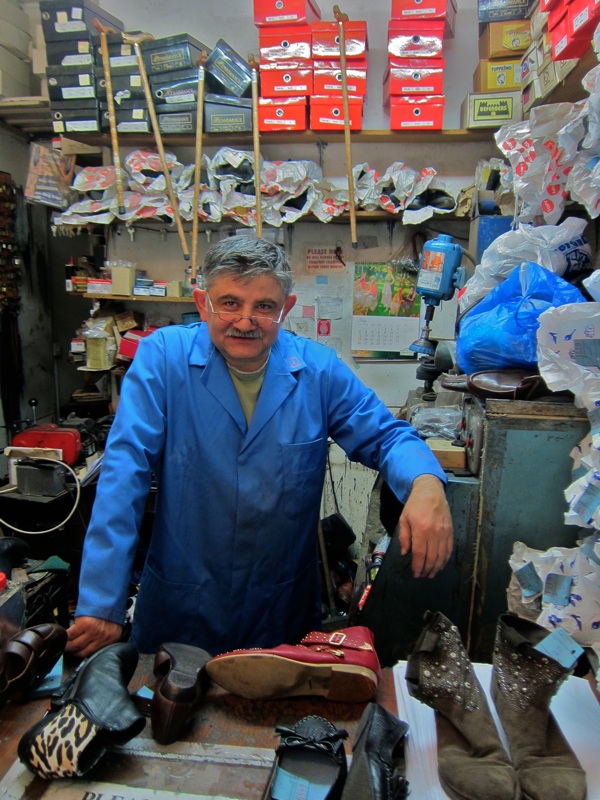
“I always trust my work”
One of the most popular characters around Newington Green in recent decades has been Ahmet Kamil. His modest repair shop is firmly established as a local hub where everyone is constantly popping in and out to get news, exchanging the time of day and having their shoes mended while they are about it too. At the end of a fine seventeenth century brick terrace, tucked in beneath a green awning, Ahmet’s premises have not changed for as long as anyone can remember.
Winter is the busy season for Ahmet and rainy days in summer can send people into his shop too, so I took advantage of yesterday’s sunshine to pop over to Newington Green and have a chat with him while the business was quiet. Possessing a soulful charisma and a generous spirit, Ahmet spoke his thoughts to me as he continued with his work and I enjoyed my morning in the peace of his beautiful workshop, offering a calm refuge from the clamour of the traffic outside heading up to Stoke Newington.
“This is a family business, we’ve been here about thirty years – maybe more. My father Sattretin Kamil started it up and passed it onto me, his son. Then I took over and now my son, Tevfik Kamil, will follow me. He hasn’t fully taken over yet but he will do so. He tried other things but he’s not been happy with them, so now he’s got interested in this and has decided to do it.
My father Sattretin made shoes by hand in Cyprus, he learnt it when he was only twelve years old and, after he came to this country at thirty-five, he couldn’t get a job so he decided to make shoes here. But he was advised that mending shoes might be easier and more profitable. He had four shops – in New Cross, Charlton, Hornchurch, and this one, all run by the family. After my father retired, we cut back to just this and the one in Charlton. When my son takes over, he’ll be here and I’ll be in Charlton.
I was twenty-five when I decided to give my father a hand and the business just stuck on me – he didn’t push me into it. Because everything’s done by hand, the more you do, the more you like it. Over the years there has been no real competition. If you trust the quality of your work there will never be any competition. I do everything by hand and my work is quality. There are chains with fifty or hundred branches where they do poor quality shoe repair and key cutting, and charge more money. My customers often complain to me about them. I always trust my work.
Shoes are getting more expensive and people’s habits are changing with time. They’re taking more care of their shoes, not throwing them away and getting a new pair – so there is a tendency to repair. Also, there’s a lot of secondhand shops popping up and people are buying old shoes, but the leather dries out and comes away from the sole, and stilleto heels get brittle and smash – and, as a consequence, they are bringing them to me. There’s a healthy future in it, yet there are easier jobs than this in which you can make better money. I’ve always thought of shoe repair alongside dry-cleaning, those shops make more money for less work. We are under pressure with the rent that is constantly going up and the price of materials, but we try to keep the service as cheap as we can.
Not many people will do shoe repair, you have to be fully committed and make good quality shoe repairs, and the work grows on you. But it’s the most difficult job you can do. It’s dirty and it’s hard work. While I was playing football until the age of thirty-five, I never had any aches and pains, but now standing still I get back ache. It’s midday and I’ve been working since nine o’clock – see how dirty my hands are. I work six days a week all year round. I’ve never had a Saturday off in thirty years. I’d like to go and watch the football, but instead I listen to it on the radio and watch the highlights.
You make a lot of friends. I’ve met a lot of people doing this work and many of my customers call me by my name. I’ve just recently been in hospital for an operation for ten days and my son was running the shop, and everybody was coming round, asking about me, ‘Where is he?’ So they are not just customers. Every year I take four weeks off in August and go back to Cyprus. When I come back again, everyone brings in their shoes. They say, ‘We wouldn’t take them anywhere else.’ They tell me, they wait until I come back because of the friendship. That’s the bond I have with my customers.”
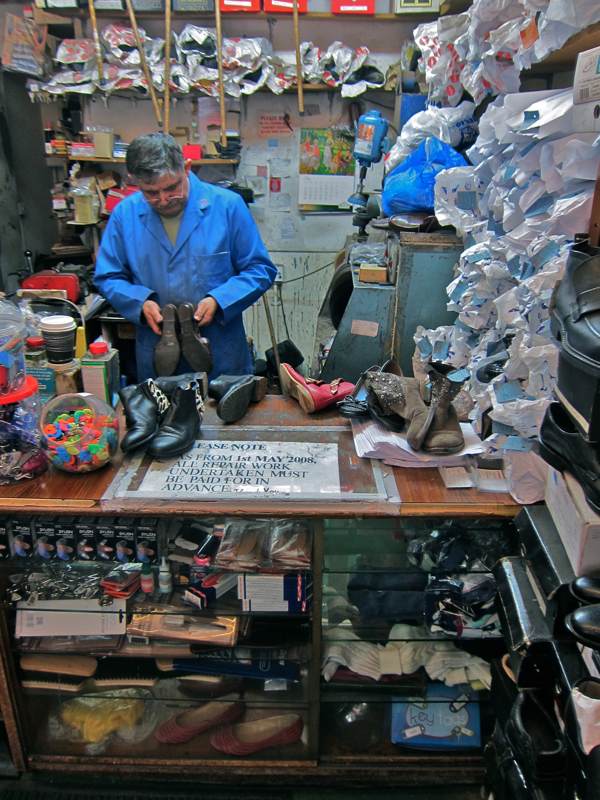
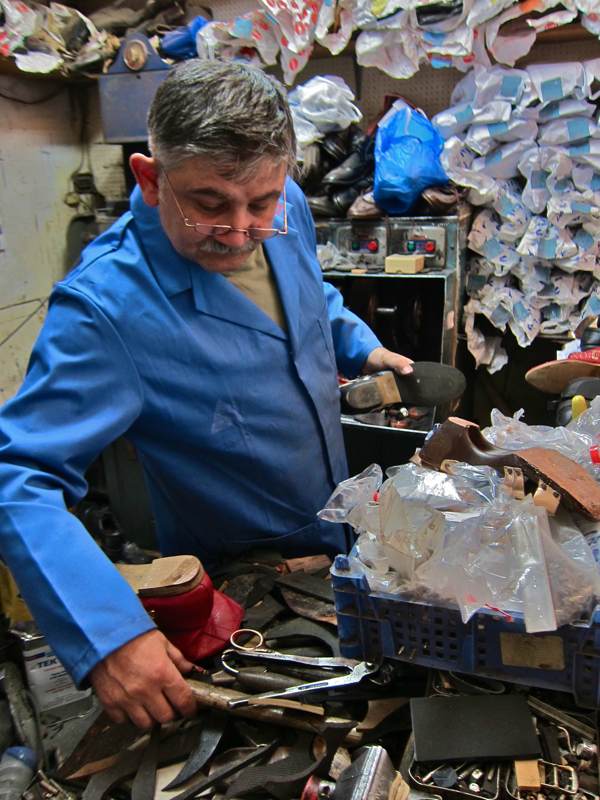
“Because everything’s done by hand, the more you do, the more you like it”
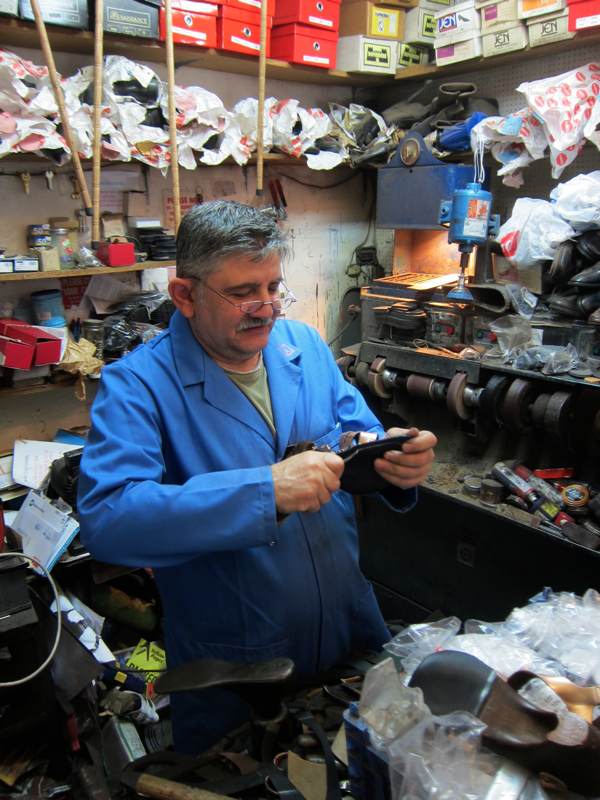
“I’ve never had a Saturday off in thirty years”
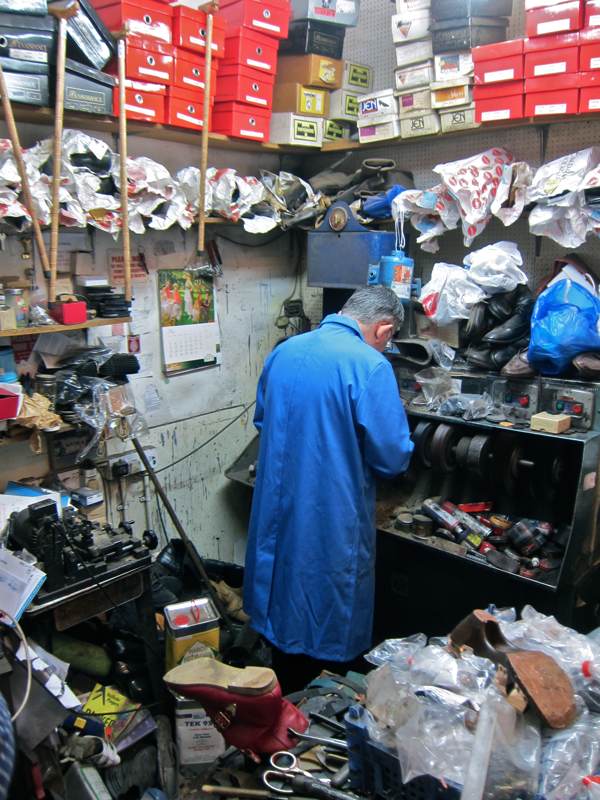

“It’s midday and I’ve been working since nine o’clock – see how dirty my hands are”
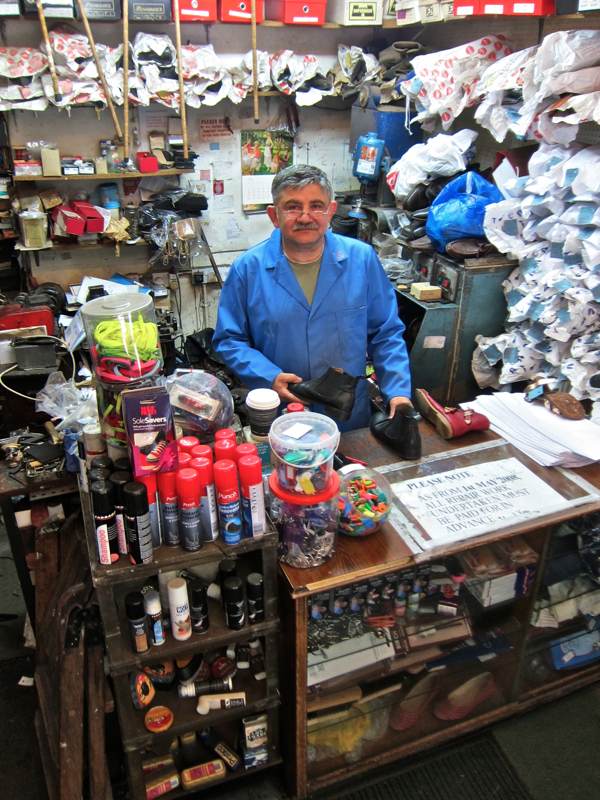
“You make a lot of friends”
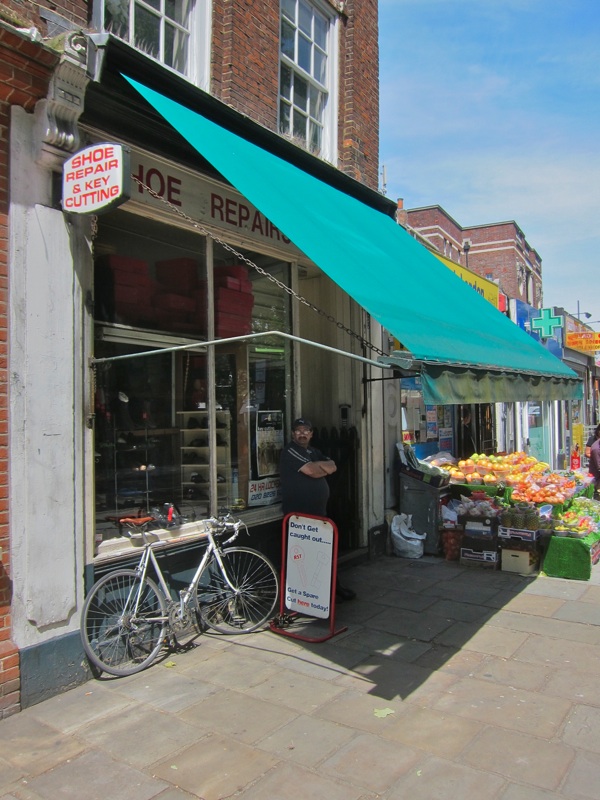
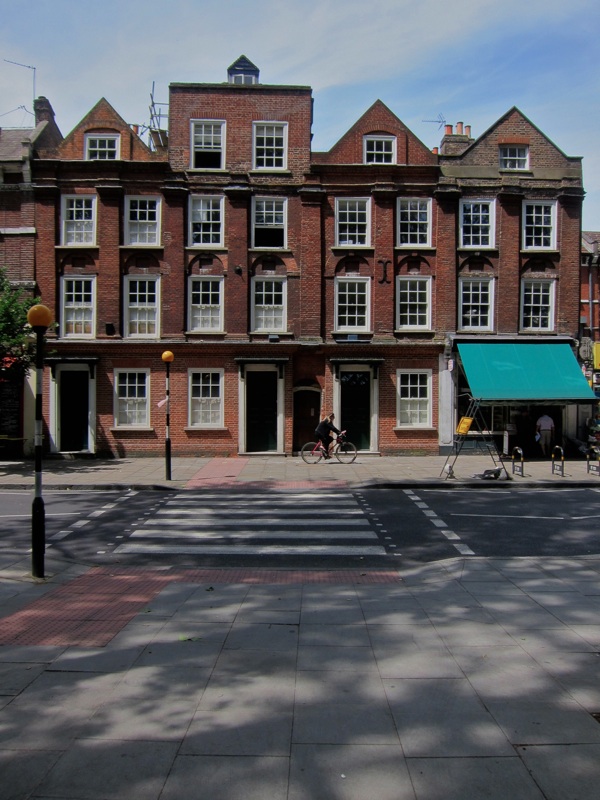
At the end of a fine seventeenth century brick terrace, tucked in beneath a green awning, Ahmet’s premises have not changed for as long as anyone can remember.
Shoe Repairs, 52 Newington Green, N16 9PX
You may also like to read about
Discovering the sixteenth century figures of Old King Lud & his sons that once stood upon Ludgate yet are now forgotten in an alley of Fleet St, made me think more closely of the gates that once surrounded the City of London.
So I was delighted to come upon this eighteenth century print in the Spitalfields Market for a couple of pounds with the plangent title “The City Gates As They Appeared Before They Were Torn Down.”
Printed in 1775, this plate recorded venerable edifices that had been demolished in recent decades and was reproduced in Harrison’s History of London, a publication notable for featuring Death and an Hourglass upon the title page as if to emphasise the mutable, ever-changing nature of the capital and the brief nature of our residence in it.
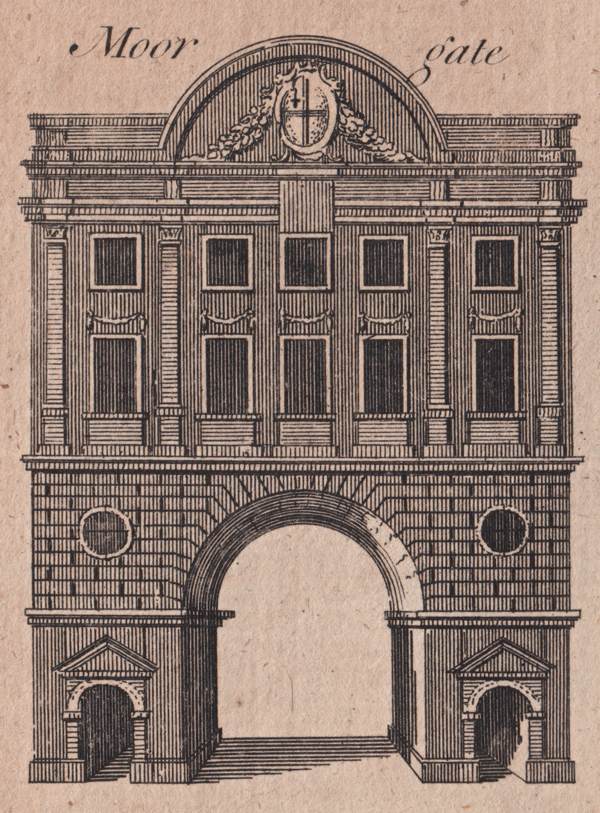
Moorgate (demolished 1761)
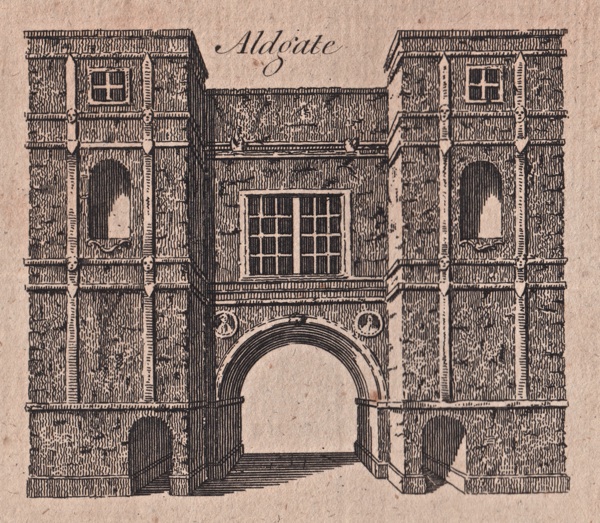
Aldgate (demolished 1761)

Bishopsgate (demolished 1760)
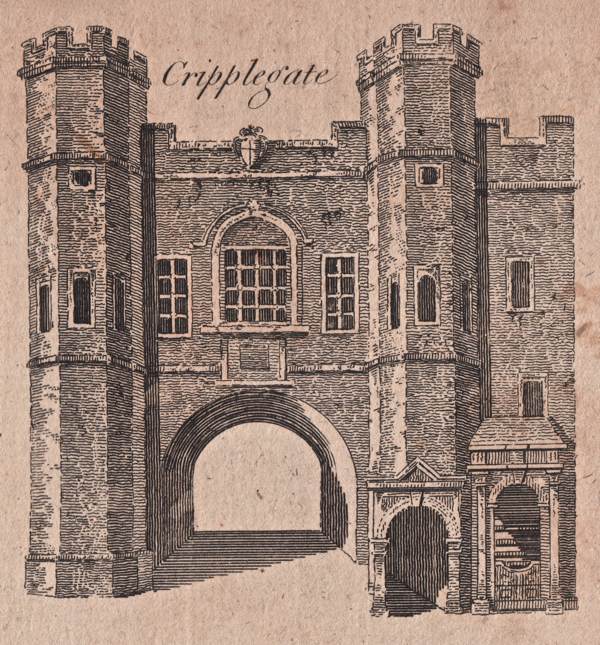
Cripplegate (demolished 1760)
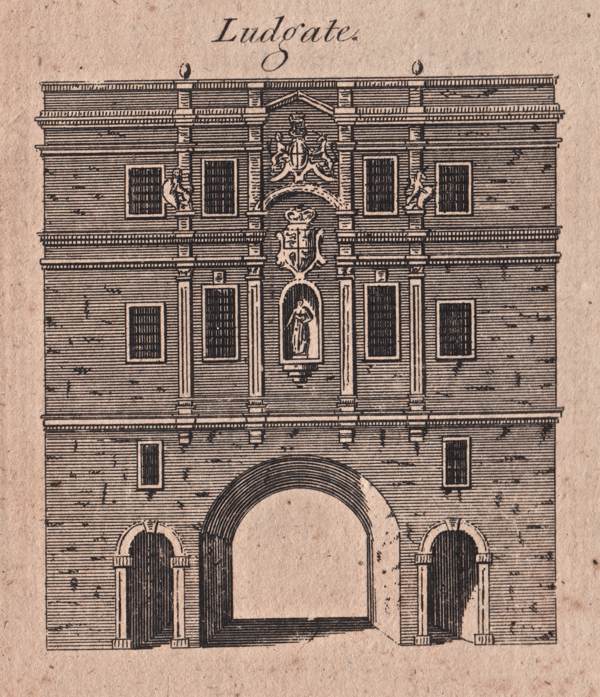
Ludgate (demolished 1760)
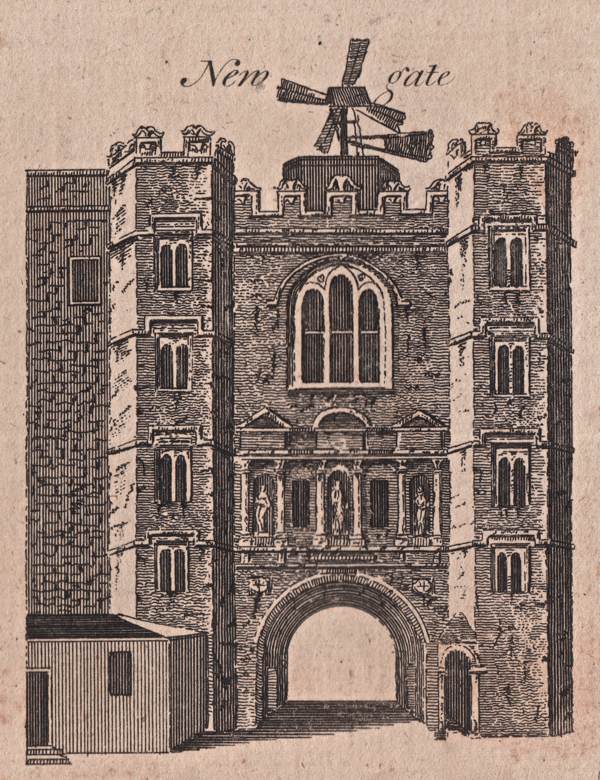
Newgate (demolished 1767)
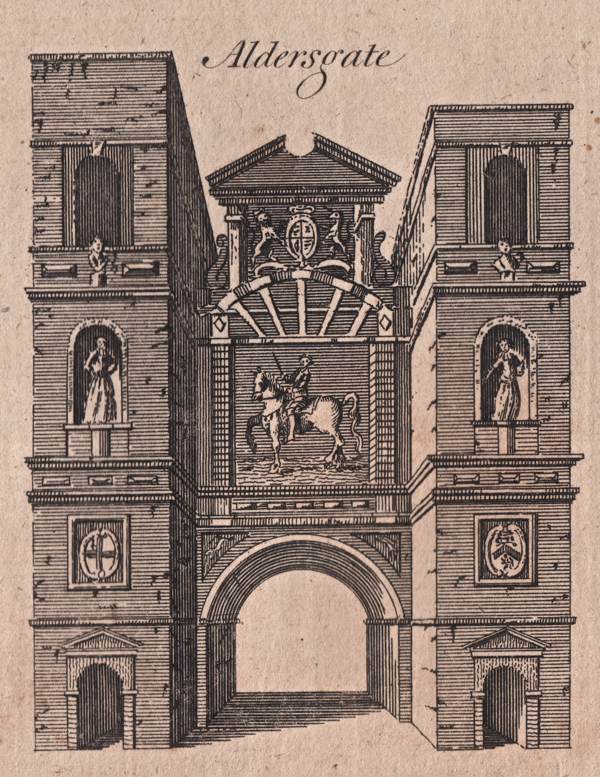
Aldersgate (demolished 1617)
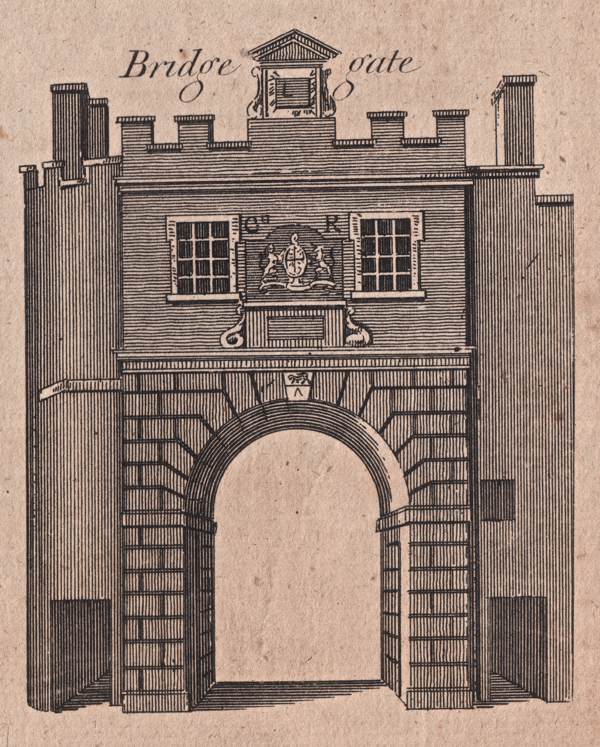
Bridgegate (demolished 1762)
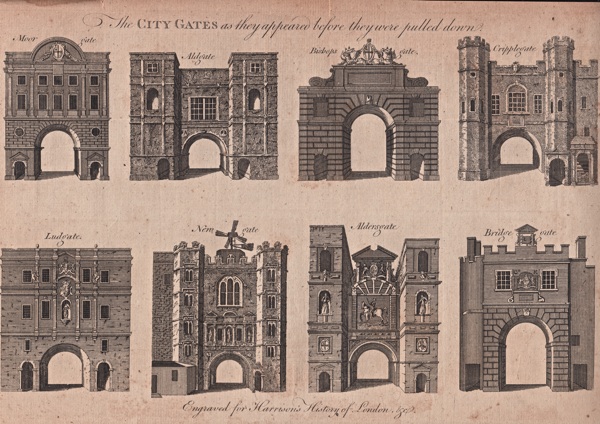
The City Gates As They Appeared Before They Were Torn Down, engraved for Harrison’s History of London 1775
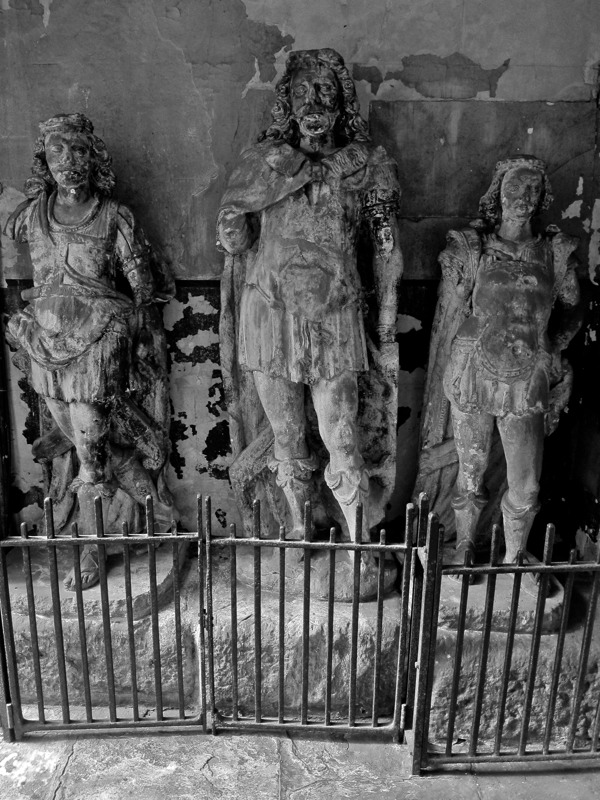
Sixteenth century figures of King Lud and his sons that formerly stood upon Ludgate, and stowed ever since in an alley at the side of St Dunstan in the West, Fleet St
You may also like to take a look at












