
So Long, Jil Cove
I have just learnt of the death of Spitalfields resident Jil Cove (1939 – 2025) back in July, aged eighty-six

Jil pensive

Jil humorous

Jil astute

Jil valiant

Jil triumphant
As Phil Maxwell’s exuberant portraits revealed, Jil Cove was one of the most quick-witted women you could hope to meet. She first came to Whitechapel in the nineteen fifties as a nurse at the Royal London Hospital, and then worked as a probation officer, putting East End villains on the straight and narrow for a quarter of a century, before becoming leader of the campaign to save the Spitalfields Market – when famously she had all the developers running around in circles for fifteen years. As a consequence of this and all her other work for the community over this time, Jil was universally respected in Spitalfields, even by those who would consider themselves her adversaries.
She lived in a small block of flats beside Petticoat Lane, where she was proud to count eight different nationalities amongst her neighbours in the building and where, as we sat in her cosy kitchen, she recalled a few impressions from the passing years.
“When I was eight years old, I said, “When I get married, I’m going to marry a black man and have a black baby.” My parents were generous to a fault but they had terrible views about black people. And I know my politics doesn’t come from them because they both voted for Margaret Thatcher. So I think it may be part of my rebellion. We lived across the road from a convent in Brighton and one day when I became a beatnik and wore no shoes, my dad said, “What will the nuns think? They’ll think we can’t afford shoes!” My mum thought I was going through a phase, but it was a sense of rebellion and a sense of justice too.
I trained as nurse in Brighton, and then applied to do midwifery at the Royal London Hospital. My mum came with me for the interview and there were drunks lying on the pavement all along Whitechapel, and she said, “You can’t come here!” but that was why I was attracted to it. I was working here in 1957, when the Windrush came over, and I worked alongside the first influx of black nurses, while my mum couldn’t believe black people were even allowed in the hospital.
After a couple of years, I was advised to give up nursing because I had a slipped disc, so I decided to try to become a probation officer and I got to know a psychiatric social worker at the Toynbee Hall in Commercial St where they had an outpost of Grendon Underwood prison – for inmates with personality disorders. At that time, the building where I live now was for ex-prisoners coming in and going off into the world, and she had a flat there but she needed a back-up to keep an eye on things, and I’ve been here ever since.
One of the things I do remember is walking down Brick Lane and, if you were on your own, Bengali guys would come up and ask “Do you want to come with me?” They were here without their families in those days. But I discovered if you carried a briefcase, it was, “Good Evening, Miss Cove! Nice to see you.”
In all the twenty-five years I worked in probation, I only took three people back to court for non-co-operation. You saw them for half an hour a week and you were supposed to influence them. My policy was radical non-intervention – I didn’t interfere with them and they didn’t interfere with me, but I was always there if they needed help. I think one of the things that me and my friends who worked together in the service for all those years valued was that we were left alone, but we had a small budget to do things – even as simple as getting a cat speyed.
One poor man, he was convinced the neighbours were sending sinister rays through the walls and ceiling, so we bought baking foil and helped him line the flat with it and it worked, it calmed him down. I remember one family in particular, the dad was a forger, the boys committed offences and the daughters would get pregnant, but somehow the mother held it all together – the kids were immaculately turned out and I always wondered how she did it. Another of the guys I worked with had done a lot of really nasty offences, a real tough nut. He was doing his A levels in prison and I visited him, and he said he’d just read the Diary of Anne Frank and it made him cry. It was November, and I said I wouldn’t retire until he got parole, and he got out next June. He’d never been to the theatre before so I took him to see Julius Caesar – you saw how you could change someone’s life and that’s what made it worthwhile. It was a nice job and I wouldn’t have left, but there was change towards a more punitive approach. In those days you could actually do social work. At my leaving party at The Water Poet, I got so drunk I was drinking pints of vodka and gin, and then they took me home and I drank half a bottle of rum.
On my sixtieth birthday, I had my first tattoo and I paid for it with my first pension money. He said, “You’re my first pensioner, and I’ve never done a daffodil before!” I went home and told my mum. I said, “I’ve had a tattoo,” and she said, “That’s disgusting!” So I thought, “If I can still disgust my mum at sixty, I must be OK.”
Jill told me she has not been to the Spitalfields Market for years, even though it was only quarter of a mile from her home. “The building we got was marginally better than the building they wanted to put there,” she confided, summing up the outcome of her campaign, “But when you’re up against the City and the local authority, you don’t stand much of a chance. At the end of the day, there was money.” Yet over time, Jil was been proved right in her case against the development, because in the rebuilding of the market, it was taken away from the residents and is no longer the community focus it once was. For many years, Jil’s influence has prevailed in Spitalfields and she will be remembered as a woman of great spirit and humour, a passionate unvanquished fighter.


Jil at an event in Victoria Park in the nineteen seventies.
Photographs copyright © Phil Maxwell
Walter Donohue, Director, Editor, Producer & Publisher
It is my pleasure to introduce you to Walter Donohue who is teaching our Screenwriting Course on 8th & 9th November at Townhouse, Spitalfields. We have a few places available. Email spitalfieldslife@gmail.com to book
CLICK HERE FOR MORE INFORMATION

Walter Donohue typing out edited script pages on set for ‘Orlando’ in St Petersburg, 1992
Introduction by filmmaker Joel Coen –
‘Not only is Walter a steady friend and a discerning intellect, he has also carved out a space in the movie business that no one else really occupies. In the theatre you would call it a ‘dramaturg’—a creative advisor to the director, both from a literary and a production point of view. This position doesn’t exist in the movie business. At least not officially. I can’t say that there aren’t legions of people who are eager to analyse and offer an opinion, but I will say that there are precious few that are so consistently right. You might call Walter a ‘movie whisperer’.’
Here is Walter Donohue’s own account of his extraordinary transatlantic journey to London where he has worked in theatre and film as a director, producer, editor and publisher for half a century –
‘In May 1967, I was on the verge of graduating from the theatre department of the Catholic University of America in Washington D.C. and start a job as an assistant director at Arena Stage when the Vietnam War suddenly escalated and all us guys were immediately eligible to be drafted. What the hell was I going to do? The only way out was to stay in school. I applied for a Fulbright scholarship to go to Bristol University and study theatre but I did not get the award and I was facing the prospect of being sent to Vietnam, so I contacted Bristol directly and ended up going anyway. Five of my fellow students were drafted and two died in Vietnam, so it really was a matter of life or death.
When I finished my degree, I hoped I would be able to jump into regular employment as a theatre director but that turned out to be difficult because directors had to be members of the union, which was reluctant to let in an American. I figured I had no alternative except to return to America but then, out of the blue, I heard that that Charles Marowitz needed an assistant at the Open Space Theatre in London. Some British people had tried the job and could not get on with him, so they thought that perhaps an American might stand a better chance.
For Charles, actors were just objects to push around on the stage. He did not seem to give much thought to the inner lives of the characters. In 1972, I was assistant director on a production of Sam Shepard’s The Tooth of Crime, and when Charles left town to do his version of Hamlet in Denmark, I took over and worked with the actors.
I asked Sam, who was living in London, to come in and watch a run-through, which he absolutely hated. He felt that the actors were moving around in a way that had nothing to do with the dramatic situation they were meant to be playing. ‘But that’s how Charles directed it,’ I said. ‘OK,’ said Sam, ‘I don’t want anything to do with this. I’m going home.’
Obviously, the production should somehow embody his intentions as a playwright, so I sat him down, asked what was wrong and we set about re-blocking the entire play. The actors clearly felt a sense of relief. We were all so pleased with ourselves, but when Charles got back into town and watched what we had done, he threw out all our work.
While Sam was still living in London, I set up a production of Cowboy Mouth, which Sam had co-written with Patti Smith. It was in a small, basement theatre, just Sam, me, and the two actors. No sense of hierarchy, no egos—just commitment to the vision of the writer.
I spent ten years as a theatre director focussing entirely on new writing. I had not realised at the time that the interactions I had with playwrights gave me the skills that came to fruition when I was asked to work at Channel 4. David Rose who had been head of drama at BBC Birmingham offered me a job as his assistant.
This was before Channel 4 began broadcasting. David and I imagined that as soon as we opened the door to our office, scripts would come pouring in, but that did not happen. People just did not know about it, so we scrambled to start commissioning scripts. I thought we should commission novelists. The first I approached was Neil Jordan, he had a script to hand—what became Angel. We also commissioned Angela Carter to write the screenplay of her version of Red Riding Hood, The Company of Wolves, which ended up becoming Neil’s next film after Angel.
Eventually people started sending their scripts to us. If I liked them, I would forward them to David, and if he liked them, they would come back to me because they always needed work. I became involved in the production of various films from their inception, which included going with David to the sets and watching these films being made, then looking at the various cuts with David when the films were in postproduction.
I encouraged David to support Paris, Texas, partly because Sam Shepard was the writer. Paris, Texas winning the Palme d’Or at Cannes really put Channel 4 on the map. I was sort of the script editor. Wim and Sam began with a stack of paper with the basic scene descriptions on them: Scene 1: Travis walking through the desert. Scene 2: Travis walks into a bar. That’s all they wrote, all the way to the end. Once they had done that, they went back and filled out each scene. Scene 1: Travis walking through the desert. Stops. Drinks from a carton. Throws it away. Walks off. Scene 2: Travis goes into a bar to find something to drink. He eats some ice and faints. That kind of thing. Wim and Sam felt that the best way to conceive the film on paper was to represent the story in terms of what was seen, not what was heard. Because Channel 4 was the main financier, I spent a week with Wim in Los Angeles because Sam, at that stage, was beginning to send the dialogue. Then I visited Berlin when Wim was in postproduction.
When we were looking for novelists to commission, I came across a thriller called In the Secret State by Robert McCrum. I thought he was the new Le Carré, so I went to meet him. It turned out he was working at Faber as its editorial director and he introduced me to the chief executive, Matthew Evans, who immediately said I should come work at Faber. I said I was not interested in publishing, I wanted to work in movies so he said, ‘Listen, British films only shoot at certain times of the year because of the weather. I will give you a desk and typewriter and a telephone, and can you start building Faber’s film list. When you are not here, when you’re working on a film, someone else from the company will look after things.’
In the beginning, most of the film books never made money. But then, in 1994, we published the screenplay of Quentin Tarantino’s Pulp Fiction, and it sold more than a hundred thousand copies. Tarantino had never gone to film school, so every eighteen-year-old thought they could be a filmmaker if they watched enough videos. But what gave Tarantino’s films their impact was their original structure and the music of the dialogue—which meant that neophyte filmmakers needed to read screenplays. They became teaching tools, of a kind, and in the wake of Pulp Fiction there was a huge spike in the sale of screenplays, as well as our interview books with filmmakers.
If I look back, the thing that is consistent, whether I was working in the theatre or at Channel 4 or at Faber, it is all more or less the same thing – dealing with writers, helping them get their work out there. I certainly enjoy the process. When a writer sends me their scripts, my response is based entirely on instinct, honed over the years. And I never made statements, I never imposed anything. I only ever asked the writers questions, to see if I could draw out from them anything that would clarify their intentions. Given the diversity of the filmmakers who approached Channel 4 for money, the best approach was just to respond to the originality of the writers.’

Invitation To The Launch Of Tessa Hunkin’s Hackney Mosaic Project Book

You are invited to join us at the private launch party for Tessa Hunkin’s Hackney Mosaic Project on Saturday 27th September from 2-5pm at the mosaic workshop in the Pavilion on Hackney Downs, Downs Park Rd, Lower Clapton, London, E5 8NP.
There will exhibitions of the sample pieces for each of the project’s mosaic works over the past thirteen years and of mosaics by members of the project. You will be able to visit the workshop, meet the makers and see how mosaics are made, and view the mosaics in the park, the Hounds of Hackney Downs and the magnificent Playground Shelter.
Tessa Hunkin will be signing copies.
Complimentary soft drinks will be supplied by our good friends at Company Drinks in Poplar.
Please register in advance if you wish to attend by emailing spitalfieldslife@gmail.com as numbers are strictly limited at the Pavilion.
CLICK HERE TO ORDER A SIGNED COPY OF TESSA HUNKIN’S HACKNEY MOSAIC PROJECT

We are including a complimentary copy of ‘A Hoxton Childhood’ with all pre-orders to United Kingdom addresses.


The Bookshops Of Old London

Help publication by preordering now and we will post you a copy signed by Tessa Hunkin at the end of September in advance of publication on October 2nd. Additionally, we are including a complimentary copy of A Hoxton Childhood (cover price £20) with all pre-orders in the United Kingdom. CLICK HERE TO ORDER YOUR COPY

At Marks & Co, 84 Charing Cross Rd
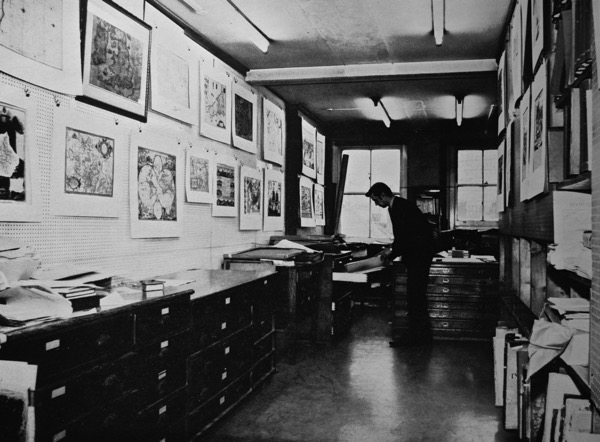
When Mike Henbrey reminisced for me about his time working at Sawyer Antiquarian Booksellers in Grafton St and showed me these evocative photographs of London’s secondhand bookshops taken in 1971 by Richard Brown, it made me realise how much I miss them all now that they have mostly vanished from the streets.
After I left college and came to London, I rented a small windowless room in a basement off the Portobello Rd and I spent a lot of time trudging the streets. I believed the city was mine and I used to plan my walks of exploration around the capital by visiting all the old bookshops. They were such havens of peace from the clamour of the streets that I wished I could retreat from the world and move into one, setting up a hidden bedroom to sleep between the shelves and read all day in secret.
Frustrated by my pitiful lack of income, it was not long before I began carrying boxes of my textbooks to bookshops in the Charing Cross Rd and swapping them for a few banknotes that would give me a night at the theatre or some other treat. I recall the wrench of guilt when I first sold books off my shelves but I found I was more than compensated by the joy of the experiences that were granted to me in exchange.
Inevitably, I soon began acquiring more books that I discovered in these shops and, on occasion, making deals that gave me a little cash and a single volume from the shelves in return for a box of my own books. In this way, I obtained some early Hogarth Press titles and a first edition of To The Lighthouse with a sticker in the back revealing that it had been bought new at Shakespeare & Co in Paris. How I would like to have been there in 1927 to make that purchase myself.
Once, I opened a two volume copy of Tristram Shandy and realised it was an eighteenth century edition rebound in nineteenth century bindings, which accounted for the low price of eighteen pounds. Yet even this sum was beyond my means at the time. So I took the pair of volumes and concealed them at the back of the shelf hidden behind the other books and vowed to return.
More than six months later, I earned an advance for a piece of writing and – to my delight when I came back – I discovered the books were still there where I had hidden them. No question about the price was raised at the desk and I have those eighteenth century volumes of Tristram Shandy with me today. Copies of a favourite book, rendered more precious by the way I obtained them and now a souvenir of those dusty old secondhand bookshops that were once my landmarks to navigate around the city.


Frank Hollings of Cloth Fair, established 1892

E. Joseph of Charing Cross Rd, established 1885


Mr Maggs of Maggs Brothers of Berkeley Sq, established 1855


Marks & Co of Charing Cross Rd, established 1904


Harold T. Storey of Cecil Court, established 1928


Henry Sotheran of Sackville St, established 1760


Andrew Block of Barter St, established 1911


Louis W. Bondy of Little Russell St, established 1946

H.M. Fletcher, Cecil Court


Harold Mortlake, Cecil Court

Francis Edwards of Marylebone High St, founded 1855


Stanley Smith of Marchmont St, established 1935


Suckling & Co of Cecil Court, established 1889


Images from The London Bookshop, published by the Private Libraries Association, 1971
You might also like to read about
The Dandy’s Perambulations

I am grateful to Sian Rees for kindly drawing my attention to The Dandy’s Perambulations by Robert Cruickshank, being an account of a trip to Kew Gardens in 1819


You may also like to take a look at
In The Orchards Of Kent


Years ago when I first visited the National Collection of Fruit Trees at Brogdale outside Faversham in Kent to enjoy the spring blossom, I vowed to go back in the autumn to admire the crop. This year, I fulfilled my ambition in the company of Contributing Photographer Rachel Ferriman and we were blessed with a golden afternoon in the North Kent Fruit Belt.
Nothing prepared me for the seemingly infinite variety of fruit that exists in nature. Walking into an orchard of two-thousand-two-hundred varieties of apple, all in fruit, is a vertiginous prospect that is only compounded by your guide who informs you this is merely a fraction of the over ten thousand varieties in existence.
What can you do? Your heart leaps and your mind boggles at the different colours and sizes of fruit. You recognise russets, laxtons and allingtons. Even if you had all day, you could not taste them all. Despite the cold spring, it has been a good year for apples. You stand wonderstruck at the bounty and resilience of nature. Then you start to get huffy at the pitiful few varieties of mostly-bitter green apples available to buy in shops, always sold unripe for longer shelf life. How is this progress?
Yet this thought evaporates as you are led through a windbreak into another orchard where five hundred varieties of pear are in fruit. By now your vocabulary of superlatives has failed you and you can only wander wide-eyed through this latter day Eden.
That afternoon there was no-one there but me, Rachel and the guide. We were delighted to have the orchards to ourselves. But this is when you realise the world has gone mad if no-one else is interested to witness this annual spectacle that verges on the miraculous. Walking on, as if in a medieval dream poem, you discover an orchard of medlars and another of quinces.
By now, your feet are barely touching the ground and you hatch a plan – as you munch an apple – to return at this same time of year, decide upon your favourite varieties and then plant your own orchard of soft fruit. When you stumble upon such an ambition, you realise that life is short yet we are all still permitted to dream.


Medlars

Quince

Plum

Mike Austen, our guide

Photographs copyright © Rachel Ferriman
The National Collection of Fruit Trees at Brogdale
You may like to read about my first visit
Sarah Ainslie’s Power Of Food Portraits
Help publication by preordering now and we will post you a copy signed by Tessa Hunkin at the end of September in advance of publication on October 2nd. Additionally, we are including a complimentary copy of A Hoxton Childhood (cover price £20) with all pre-orders in the United Kingdom. CLICK HERE TO ORDER YOUR COPY

Sajia Nessa harvesting tomatoes at Stepney City Farm
Historically, the East End was the centre of food production for London, abounding in market gardens and small holdings. Today, a new wave of food producers has arisen to challenge the dominance of fast-food and supermarkets. Contributing Photographer Sarah Ainslie has documented this movement in a series of portraits to be exhibited as part of the forthcoming Power of Food Festival. Running from 18th until 28th September, it celebrates the borough’s community and food culture, showcasing local projects building fairer, more sustainable food systems.
Sarah’s portraits will be shown at St Paul’s Way Community Centre, 12th September – 14th October, at Rich Mix in Bethnal Green Rd, 18th – 28th September and at Tower Hamlets Town Hall, 18th – 30th September.

Alani Shafiq, mushroom grower for MadLeap, cultivating oyster mushrooms in a converted car garage turned controlled environment studio at R-Urban eco-civic hub in Poplar. ‘I hope to leave a legacy of the fungi, diverse, resilient, adaptable, detoxifying, mutualistic, dramatic, beautiful, complex.’

Rokiah Yaman, co-founder of MadLeap, likes working with power tools on site when she is not fundraising, project managing or developing partnerships. ‘We want to share our enthusiasm for microbes and fungi. We hope to give people a better understanding of how they play a key role in supporting our digestion, health, and breaking down our biopresources – there is no such thing as waste in nature!’

Jim Ford & Genia Leontowitsch, custodians of a Swedenborg Square Orchard, a community orchard that is part of E1 Community Gardeners. Genia: ‘I’m really proud of it, this is the difference I’ve made.’

Liam Williams & Laura Buckley, co-ordinators at Cranbrook Community Food Garden, working to engage people on the Cranbrook Estate in Bethnal Green with food growing. Laura: ‘It’s attracted a lot more people to the garden, people feel more likely to come in, it’s really added to our estate.’

Fawzi Rahman, Aska Welford & Anna Corf Isehayek, stewards of House of Annetta, a spatial justice project in Princelet St, learning about localised and diverse approaches to surplus food. Anna: ‘Here it always starts with food, so it also makes it more accessible, and more relaxed, more welcoming.’

Rebecca Evans-Merritt , operations manager at Limborough Hub in Poplar, a garden and cooking space that offers the resources to cook, grow, learn about all things food and climate related, as well as social gatherings and celebrations. ‘We’re able to have that flow – growing food, cooking food, eating food.’

Shazna Hussain & Sajna Miah are the Food Lives team, a research group running a podcast looking into communities’ eating choices. Shazna: ‘It’s giving a voice to those women that have never been asked, or never really thought of, being able to share their knowledge and expertise around food.’

Melly, Shamima, Sabina, Marisa of Teviot Food Co-op, providing subsided organic produce with support from Alexandra Rose Charity and the Bridging the Gap initiative, making shopping for healthy and affordable food easier.

Katrina Wright, a local food grower who is part of the Right to Grow campaign in Tower Hamlets has lots of horticultural knowledge at her disposal, a gardening and growing expert. ‘It has a kind of ripple effect, so you are impacting people’s lives and creating a legacy’

Aleya Taher, cook and community organiser, heads Teviot People’s Kitchen, bringing together local residents for regular meals, run from the R-Urban community garden in Poplar.

Cameron Bray, Angharad Davies & Andy Belfield are part of the R-Urban/Public Works team, operating an eco-civic hub that explores sustainable ways of working with food waste from tower blocks, turning it into nutrient rich soil – as well as running workshops, gardening sessions, foraging walks and more. Cameron: ‘It’s a space for learning, sometimes in a traditional sense, but also learning from each other, listening to each other, learning the stuff people already know.’

Rita Attille, local grower interested in the connection between mental wellbeing and nature, works with health services to get local people gardening.
Photographs copyright © Sarah Ainslie
You may also like to take a look at


