
Philip Cunningham’s Shopfronts

Please drop an email to spitalfieldslife@gmail.com to attend the launch
It is my pleasure to publish these pictures from Photographer Philip Cunningham‘s astonishing archive of images from the seventies and eighties

Shop in Bow, c.1972
“In 1970 my partner, Sally, was a student on the Foundation Course at Hornsey College of Art. They taught her how to use a camera and process film and, in turn, she taught me. When we moved to the East East in 1971, the Council and GLC were still emptying and demolishing streets. People were being moved into tower blocks, which mostly had poor insulation and were physically alienating. By this time, the mythology of ‘streets in the sky’ was already discredited yet they continued anyway. There was still a lot of bomb damage but the remnants of previous communities could be seen, and I was determined to try and document what was left. I was also interested in the buildings themselves which had their own character. Taking at least a film a month, I built up a large archive. We were customers of some of these shops but others were already derelict. They represented a different life.” – Philip Cunningham

c.1972

Roman Rd, c.1976

Mile End Rd

Mile End Rd, c.1979

Mile End Rd, c.1979

Mile End Rd, c.1979

Mile End Rd, c.1979

Mile End Rd, c.1979

Mile End Rd, c.1978

Mile End Rd

Mile End Rd, c.1981

Mile End Rd, c.1985

Mile End Rd, c.1985

Malplaquet House, Mile End Rd, c.1976

Mile End Rd, c.1976

Mile End Rd, c.1979

Mile End Rd, c.1982

White Horse Lane, c.1979

East End India Dock Rd, c.1978

Roman Rd, c.1977

Stepney Way, c.1971

Antil Rd, c.1980

Hay Currie St, c.1978

Upper Clapton Rd, c.1983

Globe Rd, c.1976

Unknown location, c.1976

Brushfield St

Off Brick Lane, c.1976

Off Brick Lane, c.1976

Quaker St, c.1976

Off Cheshire St, c.1976

Cheshire St, c.1976
Photographs copyright © Philip Cunningham
You may also like to take a look at
A Public Inquiry Into The Truman Brewery Redevelopment

It was astonishing moment back in July when Tower Hamlets Council voted unanimously to reject the Truman Brewery’s planning application to build a corporate office plaza across the entire site. This was an impressive result for the Save Brick Lane campaign which is advocating for housing in this crucial location that could offer over 600 homes to local people. There are 26,000 on the housing list in the borough, but the rejected Truman Brewery proposal offers just 6 social housing units.
Yet it does not end here because the Truman Brewery has referred their application to the government’s Planning Inspectorate in the hope of getting the rejection overturned. The outcome is a twelve day Public Inquiry commencing on 14th October. In response, the Save Brick Lane campaign will speak for the community, putting the forward the case for homes not offices robustly, and has secured legal representation from Goodenough Ring – the solicitors who worked on the successful Save the Bethnal Green Mulberry case – including a solicitor, barrister, and a KC.
Save Brick Lane has until 14th October to raise £20,000 in legal fees to ensure the Truman Brewery’s plans for a corporate plaza are halted – they have already raised £10,695.
Click here to contribute to Save Brick Lane’s legal fighting fund

George Cossington, Steeplejack


This is George Cossington (1926-2014) in the top left of this picture, photographed in the pursuit of his trade as a steeplejack & steel erector, perched at the very top of a one hundred and fifty foot jib during the construction of Paternoster Square, next to St Paul’s Cathedral in 1958.
Seeing this vertiginous image, you will no doubt be relieved to know that George survived to tell the tales of his daring aerial adventures, still fit and full of swagger at eighty-one. ” In my day, you weren’t called a steel erector, you were called a spider man. I used to run up a sixty rung ladder in less than a minute and come down in less than twenty seconds – you just put your hands and feet on the sides and slid down! ” he bragged, with a modest smile that confirmed it was the truth.
George’s father was a steeplejack who once climbed Big Ben to fix the hands on the clock face and worked as chargehand on the construction on the Bank of England. So in 1947, when George left school at fourteen, there was no question about his future career, “All my friends were going into the Merchant Navy but when I came home with the form, my dad said, ‘No. You’re going into my trade so you get a pension.'” In fact, three out of the five boys in George’s family became steeplejacks, a significant measure of George’s father’s confidence in his own profession.
“My father, uncle and my brothers, we all loved it! There was none of this Health & Safety shit then, you learnt to be careful. What started coming in was the safety harness, a big belt with a hook on it attached to a rope – we hardly used them. There was no such thing as a crash helmet. Me and my brothers, we used to watch each other to check we put the bolts in correctly. It was all done properly, even without today’s safeguards.
I was apprenticed to Freddie Waite of Stratford. I started off as a tea boy. You learn as the months by, and then someone else becomes the tea boy and you learn how to adjust swivel bolts, rigging up steel beams, and how to sling a beam for the crane to lift. It takes well over a year before you start going off the ground. You had to learn rigging, slinging, welding, acetylene burning, and rope splicing. It takes five years to become a steeplejack. We used to walk the purlins that were four inches wide, you can’t do that today. Before scaffolding, we used wooden poles held together with wire bands, like they still do in the Far East. You had to know how to tie the wire bands securely, because it wasn’t an easy job going up to forty feet.
I enjoyed it, but I didn’t enjoy it when it was wet or cold. The crane used to take us in a bucket and put us on top of the steel work. In the Winter you could freeze. If it was a frosty night, we had a big fire in an oil drum and wrapped the chain around the fire to get the frost out of it, because if you didn’t it could snap like a carrot – a fifteen ton chain.
The day I fell, I was cutting some steelwork at Beckton Gas Works and it pissed down with rain, so they called us down. When I went back up again later, I cut one end of a beam without realising I had already cut the other end. I was seventeen years old. I was very lucky – my dad couldn’t believe it – a corrugated iron roof broke my fall. I had a few bruises, and a scar to this day. They called an ambulance but I was standing up by the time it came. I think I was only off work for a week, but I knew a couple of fellows that fell to their deaths.
My dad was still working up high until he was sixty-six. When he was the family foreman, he looked the business in a bowler hat. He taught me splicing and slinging, and he knew every sort of knot there was. He wouldn’t do anything you couldn’t do. He could throw a three-quarter inch bolt forty feet up for me to catch from a beam. Our last job together was on John Lewis in Oxford St. We were a hundred feet up in the air and he walked along beams as if they were on the ground.
I’ve never had a problem with heights. I’ve stood on the spider plate at the very top of a crane, three hundred and fifty feet up without a rope. I did it just for a laugh, but if my dad had seen me he’d have shot me…”
George retired at forty-five when he was required to wear a helmet on site, because he belonged to an earlier world that put more trust in human skill than safety procedures. When he spoke of pegging his own ladder to scale a factory chimney, I recognised a continuum with those that once climbed the spires of cathedrals, trusting their lives in the application of a skill which now exists only in the strictly controlled conditions of sport. Thankfully, with the advent of modern cranes and cherry pickers, men are no longer required to risk their lives in this way, but it only serves to increase my respect for the unacknowledged heroism of George Cossington, his brothers, his father, uncle and all of those in this city who fearlessly undertook these death-defying challenges as part of their daily routine. When you meet a steeplejack at the fine age of eighty-one, his very existence confirms his skill and proficiency in his former profession.
Because Freddie Waite bought a camera in 1958 to record the construction of Paternoster House, we have the privilege to see these rare images today, photographed by those working on the site. And while Paternoster House may already be history – demolished for a subsequent development – in the meantime there are enough monumental structures still standing that George worked on, like Shell House, the Chiswick Flyover, the Edmonton Incinerator towers and the chimney at the Bryant & May Factory, to remind us of his heroic thirty year career as a steeplejack & steel erector.

George (on the left) with the team, Kenny the master electrician, Ron the crane driver, then two slewmen and the foreman standing at the end, with Freddie (the master steeplejack that George was apprenticed to) standing at the back.

George is to be seen at top of the lower jib in the centre of the picture, between the steel structure and St Paul’s


George & Freddie at the end of the jib, as viewed from the boom.


George Cossington

The Cossington boys, George (back left) pictured with his brothers Brian, Sid and Bob (front row, left to right) and Joey (back right) outside the family home in Rochester Avenue, Upton Park, E13. George, Brian and Joey all became steeplejacks like their father, while Sid and Bob became master bricklayers.
Portrait copyright © Jeremy Freedman
At The Pearlies’ Harvest Festival
Please drop an email to spitalfieldslife@gmail.com to attend the launch
Today I preview the Pearly Kings & Queens Harvest Festival which takes place this Sunday 21st September, commencing with high jinks in the Guildhall yard in the City of London from 1:15pm followed by a procession to St Mary-le-Bow

On a Sunday afternoon in September, the Pearly Kings & Queens come together from every corner of London and gather in the square outside the Guildhall in the City of London for a lively celebration to mark the changing of the seasons.
When I visited there was Maypole dancing and Morris Dancing, there was a pipe band and a marching band, there were mayors and dignitaries in red robes and gold chains, there were people from Rochester in Dickensian costume, there were donkeys with carts and veteran cars, and there was even an old hobby horse leaping around – yet all these idiosyncratic elements successfully blended to create an event with its own strange poetry. In fact, the participants outnumbered the audience and a curiously small town atmosphere prevailed, allowing the proud Pearlies to mingle with their fans, and enjoy an afternoon of high-spirited chit-chat and getting their pictures snapped.
I delighted in the multiplicity of designs that the Pearlies had contrived for their outfits, each creating their own identity expressed through ingenious patterns of pearl buttons, and on this bright afternoon of early Autumn they made a fine spectacle, sparkling in the last rays of September sunshine. My host was the admirable Doreen Golding, Pearly Queen of the Old Kent Rd & Bow Bells, who spent the whole year organising the event. And I was especially impressed with her persuasive abilities in cajoled all the mayors into a spot of maypole dancing, because it was a heartening sight to see a team of these dignified senior gentlemen in their regalia prancing around like eleven year olds and enjoying it quite unselfconsciously too.
In the melee, I had the pleasure to grapple with George Major, the Pearly King of Peckham (crowned in 1958), and his grandson Daniel, the Pearly Prince, sporting an exceptionally pearly hat that is a century old. George is an irrepressibly flamboyant character who taught me the Cockney salute, and then took the opportunity of his celebrity to steal cheeky kisses from ladies in the crowd, causing more than a few shrieks and blushes. As the oldest surviving member of one of the only three surviving original pearly families, he enjoys the swaggering distinction of being the senior Pearly in London, taking it as licence to behave like a mischievous schoolboy. Nearby I met Matthew (Daniels’s father) – a Pearly by marriage not birth, he revealed apologetically – who confessed he sewed the six thousand buttons on George’s jacket while watching Match of the Day.
Fortunately, the Lambeth Walk had been enacted all round the Guildhall Yard and all the photo opportunites were exhausted before the gentle rain set in. And by then it was time to form a parade to process down the road to St Mary-le-Bow for the annual Harvest Festival. A distinguished man in a red tail coat with an umbrella led the procession through the drizzle, followed by a pipe band setting an auspicious tone for the impressive spectacle of the Pearlies en masse, some in veteran cars and others leading donkeys pulling carts with their offerings for the Harvest Festival. St Mary-le-Bow is a church of special significance for Pearlies because it is the home of the famous Bow Bells that called Dick Whittington back to London from Highgate Hill, and you need to be born within earshot of these to call yourself a true Cockney.
The black and white chequerboard marble floor of the church was the perfect complement to the pearly suits, now that they were massed together in delirious effect. Everyone was happy to huddle in the warmth and dry out, and there were so many people crammed together in the church in such an array of colourful and bizarre costumes of diverse styles, that as one of the few people not in some form of fancy dress, I felt I was the odd one out. But we were as one, singing “All Things Bring and Beautiful” together. Prayers were said, speeches were given and the priest reminded us of the Pearlies’ origins among he costermongers in the poverty of nineteenth century London. We stood in reverent silence for the sake of history and then a Pearly cap was passed around in aid of the Whitechapel Mission.
Coming out of the church, there was a chill in the air. The day that began with Summery sunshine was closing with Autumnal rain. Pearlies scattered down Cheapside and through the empty City streets for another year, back to their respective corners of London. Satisfied that they had celebrated Summer’s harvest, the Pearlies were going home to light fires, cook hot dinners and turn their minds towards the Wintry delights of the coming season, including sewing yet more pearl buttons on their suits during Match of the Day.


Watermen’s Stairs
Please drop an email to spitalfieldslife@gmail.com if you would like to come

Wapping Old Stairs
I need to keep reminding myself of the river. Rarely a week goes by without some purpose to go down there but, if no such reason occurs, I often take a walk simply to pay my respects to the Thames. Even as you descend from the Highway into Wapping, you sense a change of atmosphere when you enter the former marshlands that remain susceptible to fog and mist on winter mornings. Yet the river does not declare itself at first, on account of the long wall of old warehouses that line the shore, blocking the view of the water from Wapping High St.
The feeling here is like being offstage in a great theatre and walking in the shadowy wing space while the bright lights and main events take place nearby. Fortunately, there are alleys leading between the tall warehouses which deliver you to the waterfront staircases where you may gaze upon the vast spectacle of the Thames, like an interloper in the backstage peeping round the scenery at the action. There is a compelling magnetism drawing you down these dark passages, without ever knowing precisely what you will find, since the water level rises and falls by seven metres every day – you may equally discover waves lapping at the foot of the stairs or you may descend onto an expansive beach.
These were once Watermen’s Stairs, where passengers might get picked up or dropped off, seeking transport across or along the Thames. Just as taxi drivers of contemporary London learn the Knowledge, Watermen once knew the all the names and order of the hundreds of stairs that lined the banks of the Thames, of which only a handful survive today.
Arriving in Wapping by crossing the bridge in Old Gravel Lane, I come first to the Prospect of Whitby where a narrow passage to the right leads to Pelican Stairs. Centuries ago, the Prospect was known as the Pelican, giving its name to the stairs which have retained their name irrespective of the changing identity of the pub. These worn stone steps connect to a slippery wooden stair leading to wide beach at low tide where you may enjoy impressive views towards the Isle of Dogs.
West of here is New Crane Stairs and then, at the side of Wapping Station, another passage leads you to Wapping Dock Stairs. Further down the High St, opposite the entrance to Brewhouse Lane, is a passageway leading to a fiercely-guarded pier, known as King Henry’s Stairs – though John Roque’s map of 1746 labels this as the notorious Execution Dock Stairs. Continue west and round the side of the river police station, you discover Wapping Police Stairs in a strategic state of disrepair and beyond, in the park, is Wapping New Stairs.
It is a curious pilgrimage, but when you visit each of these stairs you are visiting another time – when these were the main entry and exit points into Wapping. The highlight is undoubtedly Wapping Old Stairs with its magnificently weathered stone staircase abutting the Town of Ramsgate and offering magnificent views to Tower Bridge from the beach. If you are walking further towards the Tower, Aldermans’ Stairs is worth venturing at low tide when a fragment of ancient stone causeway is revealed, permitting passengers to embark and disembark from vessels without wading through Thames mud.

Pelican Stairs

Pelican Stairs at night

View into the Prospect of Whitby from Pelican Stairs

New Crane Stairs

Wapping Dock Stairs

Execution Dock Stairs, now known as King Henry’s Stairs

Entrance to Wapping Police Stairs

Wapping Police Stairs

Metropolitan Police Service Warning: These stairs are unsafe!

Wapping New Stairs with Rotherithe Church in the distance

Light in Wapping High St

Wapping Pier Head

Entrance to Wapping Old Stairs

Wapping Old Stairs

Passageway to Wapping Old Stairs at night

Aldermans’ Stairs, St Katharine’s Way
You may also like to read about
Madge Darby, Historian of Wapping
Small Trades Scraps

Walter typing edited script pages in St Petersburg on the set of ‘Orlando’
When these die-cut Victorian scraps of small trades are enlarged to several times their actual size, the detail and characterisation of these figures is revealed splendidly. Printed by rich-hued colour lithography, glossy and embossed, these appealing images celebrate the essential tradesmen and shopkeepers that were once commonplace but now are scarce.
In the course of my interviews, I have spoken with hundreds of shopkeepers and stallholders – and it is apparent that most only make just enough money to live, yet are primarily motivated by the satisfaction they get from their chosen trade and the appreciation of regular customers.
Here in the East End, these are the family businesses and independent traders who have created the identity of the place and carry the life of our streets. Consequently, I delight in these portraits of their predecessors, the tradesmen of the nineteenth century – rendered as giants by these monumental enlargements.


You may also like to take a look at these other sets of the Cries of London
Geoffrey Fletcher’s Pavement Pounders
William Craig Marshall’s Itinerant Traders
H.W.Petherick’s London Characters
John Thomson’s Street Life in London
Aunt Busy Bee’s New London Cries
Marcellus Laroon’s Cries of London
More John Player’s Cries of London
William Nicholson’s London Types
Francis Wheatley’s Cries of London
John Thomas Smith’s Vagabondiana of 1817
John Thomas Smith’s Vagabondiana II
John Thomas Smith’s Vagabondiana III
Thomas Rowlandson’s Lower Orders
The Markets Of Old London

Help publication by preordering now and we will post you a copy signed by Tessa Hunkin at the end of September in advance of publication on October 2nd. Additionally, we are including a complimentary copy of A Hoxton Childhood (cover price £20) with all pre-orders in the United Kingdom. CLICK HERE TO ORDER YOUR COPY

Clare Market c.1900
I never knew there was a picture of the legendary and long-vanished Clare Market – where Joseph Grimaldi was born – until I came upon this old glass slide among many thousands in the collection of the London & Middlesex Archaeological Society, housed at the Bishopsgate Institute. Scrutinising this picture, the market does not feel remote at all, as if I could take a stroll over there to Holborn in person as easily as I can browse the details of the photograph. Yet the Clare Market slum, as it became known, was swept away in 1905 to create the grand civic gestures of Kingsway and Aldwych.
Searching through this curious collection of glass slides, left-overs from the days of educational magic lantern shows – comprising many multiple shots of famous landmarks and grim old church interiors – I was able to piece together this set of evocative photographs portraying the markets of old London. Of those included here only Smithfield, London’s oldest wholesale market, continues trading from the same building, though Leather Lane, Hoxton Market and East St Market still operate as street markets, but Clare Market, Whitechapel Hay Market and the Caledonian Rd Market have gone forever. Meanwhile, Billingsgate, Covent Garden and Spitalfields Fruit & Vegetable Market have moved to new premises, and Leadenhall retains just one butcher selling fowl, once the stock-in-trade of all the shops in this former cathedral of poultry.
Markets fascinate me as theatres of commercial and cultural endeavour in which a myriad strands of human activity meet. If you are seeking life, there is no better place to look than in a market. Wherever I travelled, I always visited the markets, the black-markets of Moscow in 1991, the junk markets of Beijing in 1999, the Chelsea Market in Manhattan, the central market in Havana, the street markets of Rio, the farmers’ markets of Transylvania and the flea market in Tblisi – where, memorably, I bought a sixteenth century silver Dutch sixpence and then absent-mindedly gave it away to a beggar by mistake ten minutes later. I often wonder if he cast the rare coin away in disgust or not.
Similarly in London, I cannot resist markets as places where society becomes public performance, each one with its own social code, language, and collective personality – depending upon the nature of the merchandise, the location, the time of day and the amount of money changing hands. Living in Spitalfields, the presence of the markets defines the quickening atmosphere through the week, from the Thursday antiques market to the Brick Lane traders, fly-pitchers and flower market in Bethnal Green every Sunday. I am always seduced by the sense of infinite possibility when I enter a market, which makes it a great delight to live surrounded by markets.
These old glass slides, many of a hundred years ago, capture the mass spectacle of purposeful activity that markets offer and the sense of self-respect of those – especially porters – for whom the market was their life, winning status within an elaborate hierarchy that had evolved over centuries. Nowadays, the term “marketplace” is sometimes reduced to mean mere economic transaction, but these photographs reveal that in London it has always meant so much more.

Billingsgate Market, c.1910
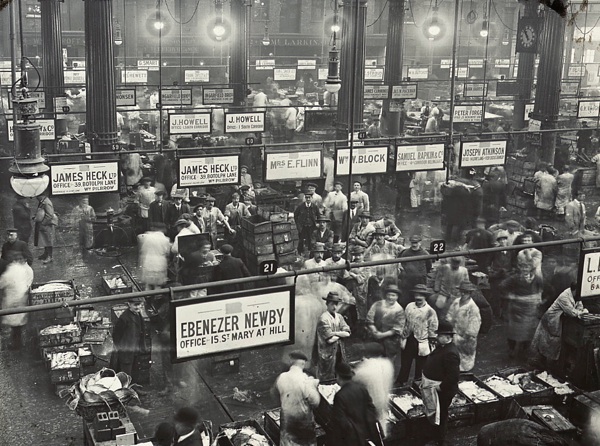
Billingsgate Market, c.1910

Whitechapel Hay Market c.1920 (looking towards Aldgate)

Whitechapel Hay Market, c.1920 (looking east towards Whitechapel)

Porters at Smithfield Market, c.1910

Caledonian Rd Market, c.1910

Book sale at Caledonian Rd Market, c.1910

Caledonian Rd Market, c.1910

Caledonian Rd Market, c.1910

Covent Garden Market, c.1920

Covent Garden Market, c.1910

Covent Garden, c.1910

Covent Garden Market, 1925

Covent Garden Market, Floral Hall, c.1910

Leadenhall Market, Christmas 1935

Leadenhall Market, c.1910

East St Market, c.1910

Leather Lane Market, 1936
 Hoxton Market, Shoreditch, 1910

Spitalfields Market, c.1930
Images courtesy Bishopsgate Institute
You may like to look at these old photographs of the Spitalfields Market by Mark Jackson & Huw Davies
Night at the Spitalfields Market
Other stories of Old London


