
Joanna Moore’s Spitalfields
Artist Joanna Moore undertook this series of drawings of Spitalfields’ less well known landmarks The Old St Patrick’s School in Buxton St, dating from the eighteen sixties, stands upon the grass of Allen Gardens beside the Georgian vicarage of the former All Saints church – the last survivors of the nineteenth century streets that once stood here, long before the park was laid out. Enfolded by its lofty garden wall, containing huge exotic shrubs and dripping with climbing plants, this finely proportioned cluster of buildings rises with tall attenuated chimneys, like some mysterious castle of romance. St Patrick’s School is a tantalising enigma to those who walk through here regularly and have heard tales of the secret tropical garden which is rumoured to exist behind these implacable walls.

The Watchhouse on the corner of St Matthew’s Churchyard in Wood St was built in 1754 and, with the growing trade in human corpses for dissection, in 1792 it was necessary to appoint a watchman who was paid ten shillings and sixpence a week to be on permanent guard against resurrectionists. A reward of two guineas was granted for the apprehension of any body-snatchers and the watchman was provided with a blunderbuss and permission to fire from an upper window, once a rattle had been sounded three times. The churchwarden who lives there today told me that, according to the terms of his lease, he still holds this right – and the blunderbuss and rattle are stored in the house to this day. The small structure at the rear originally housed the parish fire engine, in the days when it was just a narrow cart. In 1965, the Watchhouse gained notoriety of another kind when fascist leader Oswald Mosley stood upon the step to give his last open air public speech.

Gibraltar Walk off the Bethnal Green Rd is a handsome terrace of red brick nineteenth century artisans’ workshops that once served the furniture trade when it was the primary industry in this area. Of modest construction, yet designed with careful proportions, the terrace curls subtly along Gibraltar Walk, turning a corner and extending the length of Padbury Court, to create one long “L” shaped structure. These appealing back streets still retain their cobbles and there are even a couple of signs left from the days of furniture factories, but, most encouragingly, the majority of these premises are still in use today as workshops for small industries, keeping the place alive.

In Emanuel Litvinoff’s memoir, “Journey Through a Small Planet” describing his childhood in Cheshire St in the nineteen twenties, he recalls the feared Pedley St Arches where, “Couples grappled against the dripping walls and tramps lay around parcelled in old newspaper. The evil of the place was in its gloom, its putrid stench, in the industrial grime of half a century with which it was impregnated.” And today, with a gut-wrenching reek of urine, graced by a profusion of graffiti and scattered with piles of burnt rubbish, the place retains its authentic insalubrious atmosphere – a rare quality now, that is in demand by the numerous street fashion photo shoots, crime dramas and pop videos which regularly use this location. There is a scheme to turn the Great Eastern Railway Viaduct into a raised park – like the High Line in New York – but in the meantime wildlife flourishes peaceably upon these graceful decaying structures dating from the earliest days of the railway, constructed between 1836 and 1840 to bring the Eastern Counties Line from Romford to the terminus at Shoreditch High St.

Nestling at the base of Nicholas Hawksmoor’s monumental spire for Christ Church, Spitalfields, is the tiny private roof garden on the top of 3 Fournier St, where what was once planted as a camomile lawn has grown to become a wildflower meadow with pink campions, oxe-eye daisies and sorrel abounding. The pitched roofs on three sides entirely conceal this verdant arbor from the street and create a favoured climate where freesias, carnations, honeysuckle, wallflowers, foxgloves, wild strawberries and lettuces flourish, surrounded by espalier fruit trees and rambling roses, all unknown to those who tread the dusty pavements of Commercial St far below. Built in 1754 by Peter Le Keux, a silkweaver, this elegant old house follows the same Tuscan Order of architecture that was Hawksmoor’s guiding principle, and as you ascend the staircase endlessly winding up to the roof garden, you come upon subtle intricate details, like banisters with square capitals, that match those across the road at the church.

The Worrall House of 1720 is the quintessence of the Spitalfields nobody knows – built in a secret courtyard between Fournier St and Princelet St by Samuel Worrall, the builder responsible for many of the surrounding houses, it can only be approached through a narrow passage behind a heavily-encrusted door. When you step through this door, into the dark cobbled alley lined with ancient planks covered with paint and tar that has not been renewed in over a century, you feel – more than anywhere in Spitalfields – that you have stepped back in time. Here Samuel Worrall built a handsomely proportioned yet modest house for himself in his own builders’ yard. Just one room deep with a pedimented door and stone balls atop the gateposts, it resembles a perfect lifesize dolls’ house. Facing East and constructed of a single layer of bricks, it only receives sunlight in the morning and is not a warm building in Winter, yet there is an irresistible grace and mystery about this shadowy house of enchantment, presiding silently upon a quiet courtyard that is outside time.

Joanna Moore’s drawing of Victoria Cottages in Deal St was done upon the spot where Geoffrey Fletcher, author of “The London Nobody Knows,”sat and drew the same view in May 1977, when this terrace was threatened by bulldozers. Built in 1855 by the Metropolitan Association for Dwellings for Housing the Industrious Poor, after the design of Prince Albert’s Model Cottages for the Great Exhibition of 1851, these are one of the earliest examples of two storey cottage apartments. Scheduled for demolition in a slum clearance scheme, they were saved in 1978 through the intervention of Peter Shore who was both local MP and Environment Minister. If Geoffrey Fletcher came back today he would be delighted to step through the old iron gate and discover well-tended cottage gardens where the fragrance of flowers hangs in the air. Pairs of neat white front doors lead either to the ground or first floor dwellings, which, although designed as the minimum in the nineteenth century, appear generous and sympathetic by contemporary standards. To the rear is a peaceful flagged courtyard where residents hang their laundry and tend the shared garden.

Drawings copyright © Joanna Moore
You may also like to take a look at
List Of Local Shops Open For Business

A.L.Barry, Chandlers & Seed Merchants, Roman Rd
Every Wednesday, I shall be publishing the up to date list of stalwarts that remain open in Spitalfields. Readers are especially encouraged to support small independent businesses who offer an invaluable service to the community. This list confirms that it is possible to source all essential supplies locally without recourse to supermarkets.
Be advised many shops are operating revised opening hours at present, so I recommend you call in advance to avoid risking a wasted journey. Please send any additions or amendments for next week’s list to spitalfieldslife@gmail.com
This week’s illustrations are shopfront photographs from the beginning of the last century, reproduced courtesy of Philip Mernick.

J.Garwood, Greengrocer, Bow Rd
GROCERS & FOOD SHOPS
The Albion, 2/4 Boundary St
Ali’s Mini Superstore, 50d Greatorex St
AM2PM, 210 Brick Lane
As Nature Intended, 132 Commercial St
Banglatown Cash & Carry, 67 Hanbury St
Brick Lane Minimarket, 100 Brick Lane
The Butchery Ltd, 6a Lamb St (Open Thursdays only)
City Supermarket, 10 Quaker St
Costprice Minimarket, 41 Brick Lane
Faizah Minimarket, 2 Old Montague St
JB Foodstore, 97 Brick Lane
Haajang’s Corner, 78 Wentworth St
Leila’s Shop, 17 Calvert Avenue (Call 0207 729 9789 between 10am-noon on Tuesday-Saturdays to place your order and collect on the same day from 2pm-4pm)
The Melusine Fish Shop, St Katharine Docks
Nisa Local, 92 Whitechapel High St
Pavilion Bakery, 130 Columbia Rd
Rinkoff’s Bakery, 224 Jubilee Street & 79 Vallance Road
Spitalfields City Farm, Buxton St (Order through website)
Sylhet Sweet Shop, 109 Hanbury St
Taj Stores, 112 Brick Lane
Zaman Brothers, Fish & Meat Bazaar, 19 Brick Lane

Vanhear’s Coffee Rooms, Commercial Rd
TAKE AWAY FOOD SHOPS
Before you order from a delivery app, why not call the take away or restaurant direct?
Absurd Bird Fried Chicken, 54 Commercial St
Al Badam Fried Chicken, 37 Brick Lane
Band of Burgers, 22 Osborn St
Beef & Birds, Brick Lane
Beigel Bake, 159 Brick Lane
Beigel Shop, 155 Brick Lane
Bengal Village, 75 Brick Lane
Big Moe’s Diner, 95 Whitechapel High St
Burro E Salvia Pastificio, 52 Redchurch St
China Feng, 43 Commercial St
Eastern Eye Balti House, 63a Brick Lane
Enso Thai & Japanese, 94 Brick Lane
Holy Shot Coffee, 155 Bethnal Green Rd
Jonestown Coffee 215 Bethnal Green Rd
La Cucina, 96 Brick Lane
Leon, 3 Crispin Place, Spitalfields Market
Nude Expresso, The Roastery, 25 Hanbury St
E. Pellicci, 332 Bethnal Green Rd
Pepe’s Peri Peri, 82 Brick Lane
Peter’s Cafe, 73 Aldgate High St
Picky Wops Vegan Pizza, 53 Brick Lane
Quaker St Cafe, 10 Quaker St
Rosa’s Thai Cafe, 12 Hanbury St
Shawarma Lebanese, 84 Brick Lane
String Ray Globe Cafe, 109 Columbia Road
Sushi Show, 136 Bethnal Green Rd
Vegan Yes, Italian & Thai Fusion, 64 Brick Lane
Yuriko Sushi & Bento, 48 Brick Lane

S.Jones, Dairy, Bethnal Green Rd
OTHER SHOPS & SERVICES
Boots the Chemist, 200 Bishopsgate
Brick Lane Bookshop, 166 Brick Lane (Books ordered by phone or email are delivered free locally)
Brick Lane Bikes, 118 Bethnal Green Rd
Brick Lane Off Licence, 114/116 Brick Lane
Day Lewis Pharmacy, 14 Old Montague St
Eden Floral Designs, 10 Wentworth St (Order fresh flowers online for free delivery)
Harry Brand, 122 Columbia Road (Order gifts online for delivery)
GH Cityprint, 58-60 Middlesex St
Leyland Hardware, 2-4 Great Eastern St
Post Office, 160a Brick Lane

Huxtables Stores, Ironmonger, Broadway, Plaistow
ELSEWHERE
City Clean Dry Cleaners, 4a Cherry Tree Walk, Whitecross St
E5 Bakehouse, Arch 395, Mentmore Terrace (Customers are encouraged to order online and collect in person)
Gold Star Dry Cleaning & Laundry, 330 Burdett Rd
Hackney Essentials, 235 Victoria Park Rd
Quality Dry Cleaners, 16a White Church Lane
Newham Books, 747 Barking Rd (Books ordered by phone or email are posted out)
Region Choice Chemist, 68 Cambridge Heath Rd
Symposium Italian Restaurant, 363 Roman Road (Take away service available)
Thompsons DIY, 442-444 Roman Rd

Pearks Stores, Grocer, High St, East Ham
Bluebells At Bow Cemetery

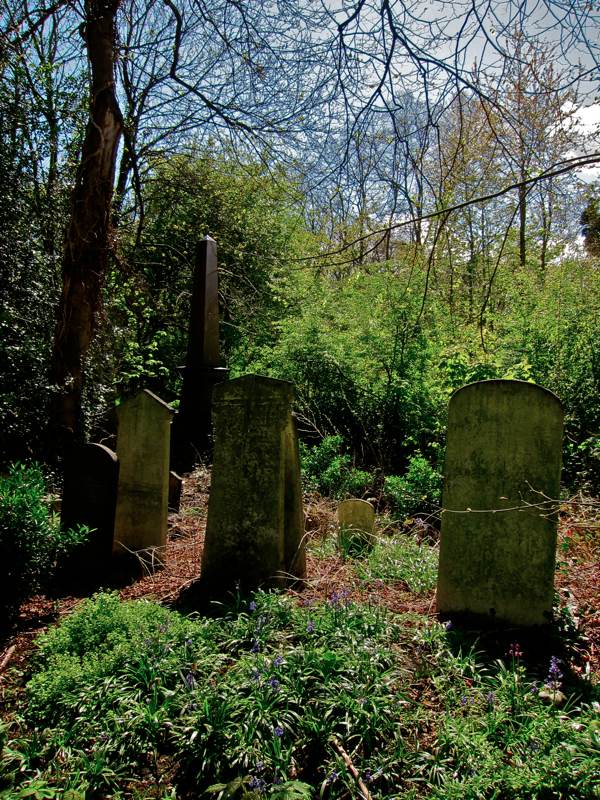
With a few bluebells in flower in my garden in Spitalfields, I was inspired make a visit to Bow Cemetery and view the display of bluebells sprouting under the tall forest canopy that has grown over the graves of the numberless East Enders buried there. In each season of the the year, this hallowed ground offers me an arcadian refuge from the city streets and my spirits always lift as I pass between the ancient brick walls that enclose it, setting out to lose myself among the winding paths, lined by tombstones and overarched with trees.
Equivocal weather rendered the timing of my trip as a gamble, and I was at the mercy of chance whether I should get there and back in sunshine. Yet I tried to hedge my bets by setting out after a shower and walking quickly down the Whitechapel Rd beneath a blue sky of small fast-moving clouds – though, even as I reached Mile End, a dark thunderhead came eastwards from the City casting gloom upon the land. It was too late to retrace my steps and instead I unfurled my umbrella in the cemetery as the first raindrops fell, taking shelter under a horse chestnut, newly in leaf, as the shower became a downpour.
Standing beneath the dripping tree in the half-light of the storm, I took a survey of the wildflowers around me, primroses spangling the green, the white star-like stitchwort adorning graves, a scattering of palest pink ladies smock highlighting the ground cover, yellow celandines sharp and bright against the dark green leaves, violets and wild strawberries nestling close to the earth and may blossom and cherry blossom up above – and, of course, the bluebells’ hazy azure mist shimmering between the lines of stones tilting at irregular angles. Alone beneath the umbrella under the tree in the heart of the vast graveyard, I waited. It was the place of death, but all around me there was new growth.
Once the rain relented sufficiently for me to leave my shelter, I turned towards the entrance in acceptance that my visit was curtailed. The pungent aroma of wild garlic filled the damp air. But then – demonstrating the quick-changing weather that is characteristic of April – the clouds were gone and dazzling sunshine descended in shafts through the forest canopy turning the wet leaves into a million tiny mirrors, reflecting light in a vision of phantasmagoric luminosity. Each fresh leaf and petal and branch glowed with intense colour after the rain. I stood still and cast my eyes around to absorb every detail in this sacred place. It was a moment of recognition that has recurred throughout my life, the awe-inspiring rush of growth of plant life in England in spring.




You may also like to read about
Find out more at www.towerhamletscemetery.org
Val Perrin’s Empty Brick Lane

At Shoreditch Station, looking through to Brick Lane
Something curious has happened in Spitalfields. As the streets have emptied of people and shops have closed, it is as if we have passed through a time warp and the place is returning to how it was when I first knew it in the seventies. In this selection from Val Perrin’s superb pictures of Spitalfields taken between 1970-72, I have focussed on his atmospheric photography of the deserted streets, evoking the sense of abandonment which prevailed at that time.


Cheshire St


Brick Lane


Sclater St

Hanbury St


Brushfield St
Photographs copyright © Val Perrin
You may also like to take a look at
Rosie Dastgir’s Letter From Tokyo
Contributing Writer Rosie Dastgir sent me this despatch with photographs from Tokyo

Yoyogi Park, Shibuya
There have been hints for days that the virus is coming to Tokyo – the thinned-out crowds along the Meguro River, banked with cherry blossom, the usual sakura celebrations eerily damped down. On the ten minute walk to Nakameguro, my subway station, I pass shuttered cocktail bars under the railway arches that stretch along a brightly lit street. Normally it thrums with people heading home from work for beer or piling into the many little ramen and sushi restaurants, and Spanish, Mexican and French bistros. A hasty shift from sit down service to takeaway is underway.
I arrived here in Japan in February to visit my husband who is working in Tokyo at present, not expecting to outstay the arrival of the blossom that heralds the arrival of spring. It is now past full bloom as I wait in abeyance, my flight home in March cancelled by the airline. We have been waiting for days for the government to announce a state of emergency and for lockdown in the world’s most populous city. But I do not know what is happening. I speak no Japanese and know barely anyone here. My Google Translate app is a slippery and unreliable friend when it comes to interpreting the written signs and warnings springing up on store fronts and lampposts.
At dusk, I walk outside to see what is still open. The young couple who run the miniature Italian bistro round the corner from our apartment wave through the lamplit windows where I ate a perfect pizza last week. I pause to peer through the blinds into the amber light. The folded-in air about the place has been been replaced by something else. There is a spirit of readying and preparation, with plastic boxes and dishes being lined up in cheery precision. On the blackboard outside, the only English word standing out is ‘takeaway’, giving me a pop of joy. Carbonara risotto and pizza margherita to go, which in Tokyo means beautifully cooked and then sculpted in Saran wrap.
The pink moon rises over the little graveyard beside the busy highway and I head to the 7–Eleven, the local convenience store that is my second home. It glows with possibility, the jingle soundtrack tinkling Cheer Up Sleepy Cheap as I drift round the shelves to see what is missing. The gaps speak of pragmatism rather than panic, I tell myself. The emptying began a month ago when semi lockdown was implemented in Tokyo, and schools and municipal spaces were closed. An extreme step for this orderly city which produced a quiet rush on hand sanitizer and face masks. Tylenol has fled the shelves. The anti-bacterial floor wipes are in peculiar demand. I try not to become restive.
Here are the boys gathered around the magazine section, lost in manga comics. There is the cute girl printing out documents at the photocopier. A mother wrangles her knee-high charge in school uniform and a floral face mask. Oh, they are back to school then. The masked cashier greets me jubilantly with “Irasshaimasé!” as she scans my carton of milk, a bag of sesame crisps and the pale pink mascara wand I have chosen from the make-up section. In February, I bought a can of Sakura-themed Asahi beer here, shiny pink with blossom and still emblazoned with the doomed Tokyo 2020 Olympics. That is all over and hanafukui time is here now, flower snow drifting onto the paths and the river.
In the Tokyu Store, a supermarket close to the station, I stare at a blank space where I believe toilet roll once was and I angle my Google Translate at the label. A woman notices and knowingly advises me that Japan will not run out. “We have plenty,” she says and I do not doubt her. This is not what I fear.
Needling messages arrive – shot through with panic – from a friend in New York. The fear has gripped him now, as if he had not noticed what was going on for months in Wuhan and South Korea. It has come to Europe and the United States and friends are understandably terrified. On WhatsApp, I still glimpse reassuring frames of life from our home in London – the freshly washed cat, a glossy tuft of grass, a bowl of hummus, one of my daughters revising for university exams and an oil painting by the other.
Distance stretches out between us. My family is bifurcated in two cities by the coronavirus. I am nearly 10,000 km away from London. I watch a video of flight patterns around the globe. From tomorrow, British Airways will cease flying from Tokyo to the United Kingdom. I flinch at a feeling I have resisted until now. I weigh up the odds. If I need to get back to London, I can fly via Qatar through the Gulf. It would take twenty-four hours. It is just possible – I tell myself – if there is an emergency. If? The emergency is already here.


You may like to read these other stories by Rosie Dastgir
At Tjaden’s Electrical Repair Shop
Gulam Taslim, Funeral Director
Cable St Gardeners
Now allotments have become even more valuable, both as havens of solace and sources of fresh greens, Photographer Chris Kelly celebrates the perennial Cable St Gardeners

Jane Sill – I hope to grow more vegetables in future. Other plants have taken over the space, especially poppies. They remind me of my grandfather who was wounded and left for dead of the first day of the Battle of the Somme, 1st July, 1916. He survived, was nursed in France and eventually brought back to this country. The Tibetan prayer flags were brought back from Lhasa by a friend.

Ray Newton – There are more younger people in the gardens now and more flowers. I’m still growing mainly vegetables. We’ve had a plague of snails this year because of the wet weather. I’m kept busy with my work as secretary of the History of Wapping Trust, I give talks and guided walks.

Anwara Begum – I’m growing more varieties of vegetables now. I have Bangladeshi pumpkins and different types of Bangladeshi cucumbers. I grow aubergines and chillies in my greenhouse – one of them is too hot even for me.

Manda Helal – Manda’s vines, pretty and delicious.

Marian Monas – I’ve been coming to the gardens for a few months. I live just around the corner. Eventually I hope to have a plot or to share one, but in the meantime I’m growing things in a raised planter. I’m happy with anything that grows really. I’ve got herbs, chard, rhubarb, lavender – and there are visits from a friendly rat.

Ron Osborne – I was one of the original gardeners here back in the seventies and I had a plot for about ten years. Then I started the Shadwell Basin Project for local youth and became involved with other things. I came back when Gina got this plot and we both spend time on it, but it’s basically hers.

Anne Herbert – Anne moved out of the area in 2005 but always comes back to the gardens on Open Day and keeps in touch with some of the other gardeners. Part of Anne’s former plot is now a well stocked pond.

Ann Ahern – I moved to Tower Hamlets from Notting Hill in 1999 and I’ve had my plot here since 2005. I live just eight minutes away. I’m growing mixed flowers, a few vegetables and I have a pond. My nephew has a seed bed on part of the plot. I’m not so good with seeds.

Monir Uddin – My latest project is to specialise in roses. I’m transplanting them, but they are quite tricky to grow and it takes at least a year for the roots to become established. I’m a photographer and I hope to photograph the roses for cards and calendars.

Helen Keep

Emir Hasham – Emir’s plot houses one of two beehives introduced to the gardens recently.

Hasan Chowdhury – I’m twelve and I’m the youngest gardener here. I first came with our neighbour Angel, who has a cat, and then Jane let me take over these raised planters. I’m growing spinach and potatoes, three different types of pumpkins, peas and coriander. I first learned about gardening from my mum and I like it because gardening is fun.

Suzanne & Mark Lancaster – We started gardening here fairly recently. It’s lovely to come to this beautiful oasis of flowers, birds and greenness in the heart of the East End. We live on busy Brick Lane, so it’s a joy to have somewhere so pretty and tranquil for a break. We hope to grow french beans, rhubarb and herbs in our raised planters.

Devika Jeetun – I’ve been coming to the gardens for a long time. I had to give up my plot when I was caring for my brother and I’m on the waiting list now. I’m growing herbs and vegetables in raised planters – potatoes, tomatoes, runner beans, spring onions and coriander. And I’m looking forward to having a plot again.

Balkis Karim

Annemarie Cooper – I’ve been gardening here for sixteen years and I don’t bother so much with vegetables now, my garden is basically a wildlife area. Those of us who encourage frogs have been using lion poo to keep the cats away from the ponds and it seems to work.

Sheila McQuaid – My gardening is more organised now. I come here at least twice a week. I’m growing different types of vegetables such as squashes and courgettes and I use the greenhouse for tomatoes. But the fruit has not been so good this year, so I’m growing more herbs, especially varieties of mint – I’m into mint tea in quite a big way.

Photographs copyright © Chris Kelly
To learn more about Cable Street Community Gardens or buy copies of the Cable St Gardeners book, contact Jane Sill janesill@aol.com or visit www.cablestreetcommunitygardens.co.uk
You may like to see the earlier series of Chris Kelly’s Cable St Gardeners
or take a look at these other pictures by Chris Kelly
A Pack Of Knaves
While people are staying indoors, I have no doubt that some will be getting on each other’s nerves. So for anyone who is growing frustrated, this Pack of Knaves engraved by Wenceslaus Hollar (1607-77) might permit you to forgive your household. Count yourself lucky that you are not cooped up with this lot.


Images courtesy University of Toronto
You may like to read these stories about Wenceslaus Hollar


