
Tom & Jerry’s Life In London

This frontispiece was intended to illustrate the varieties of “Life in London,” from the king on his throne at the top of the column to the lowest members of society at the base. At the centre are the protagonists of the tale, Tom, Jerry & Logic, three men about town. Authored by Pierce Egan, their adventures proved best sellers in serial form and were collected into a book in 1820, remaining in print for the rest of the century, spawning no less than five stage versions, and delineating a social landscape that was to prove the territory for both the fictions of Charles Dickens and the commentaries of Henry Mayhew.
Accounts of the urban poor and of life in the East of London are scarce before the nineteenth century, and what makes “Life in London” unique is that it portrays and contrasts the society of the rich and the poor in the metropolis at this time. And, although fictional in form, there is enough detail throughout to encourage the belief that this is an authentic social picture.
The characters of Tom, Jerry & Logic were loosely based upon the brothers who collaborated upon the illustrations, Isaac Richard & George Cruickshank, and the writer Pierce Egan, all relishing this opportunity to dramatise their own escapades for popular effect. Isaac Richard & George’s father had enjoyed a successful career as a political cartoonist in the seventeen-nineties and it was his sons’ work upon “Life in London” that brought the family name back into prominence in the nineteenth century, leading to George Cruikshank’s long term collaboration with Charles Dickens.
Jerry Hawthorn comes up from the country to enjoy a career of pleasure and fashion with Corinthian Tom, yet as well as savouring the conventional masquerades, exhibitions and society events, they visit boxing matches, cockpits, prisons and bars where the poor entertain themselves, with the intention to “see a ‘bit of life.” It is when they grow weary of fashionable society, that the idea arises to see a “bit of Life” at the East End of the Town.” And at “All Max,” an East End boozer, they discover a diverse crowd, or as Egan describes it, “every cove that put in an appearance was quite welcome, colour or country considered no obstacle… The group was motley indeed – Lascars, blacks, jack-tars, coal-heavers, dustmen, women of colour, old and young, and a sprinkling of the remnants of once fine girls, and all jigging together.” In the Cruikshanks’ picture, Logic has Black Sall on one knee and Flashy Nance upon the other while Jerry pours gin into the fiddler and Tom carouses with Mrs Mace, the hostess, all revealing an unexpectedly casual multiracial society in which those of different social classes can apparently mix with ease.
Situated somewhere between the romps of Fielding, Smollet and Sterne and prefiguring Dickens’ catalogue of comic grotesques in “Pickwick Papers,” the humour of “Life in London,” spoke vividly to its time, yet appears merely curious two centuries later. By the end of the nineteenth century, the comedy had gone out of date, as Thackeray admitted even as he confessed a lingering affection for the work. “As to the literary contents of the book, they have passed clean away…” he wrote, reserving his enthusiasm for the illustrations by the Cruikshank brothers – which you see below – declaring,“But the pictures! Oh! The pictures are noble still!”

Lowest life in London – Tom, Jerry & Logic amongst the unsophisticated sons & daughters of nature in the East.

The Royal Exchange – Tom pointing out to Jerry a few of the primest features of life in London.

A Whistling Shop – Tom & Jerry visiting Logic “on board the fleet.”

Tom, Jerry & Logic “tasting” wine in the wood at the London Dock.

White Horse Cellar, Picadilly – Tom & Logic bidding Jerry “Good bye.”

Jerry “beat to a standstill” Dr Please’ems’ prescription.

Tom & Jerry “masquerading it” among the cadgers in the back slums.

“A shilling well laid out” – Tom & Jerry at the exhibition of pictures at the Royal Academy.

Tom, Jerry & Logic backing Tommy, the ‘sweep at the Royal Cockpit.

Tom, Jerry & Logic in characters at the Grand Carnival.

Symptoms of the finish of “some sorts of life” – Tom, Jerry & Logic in the Press Yard at Newgate.

Life in London – Peep ‘o day boys, a street row. the author losing his “reader.” Tom & Jerry showing fight and Logic floored.

The “ne plus ultra” of Life in London – Kate, Sue, Tom, Jerry & Logic viewing the throne room at Carlton Palace.

Tom & Jerry catching Kate & Sue on the sly, having their fortunes told.

Jerry’s admiration of Tom in an “assault” with Mr O’Shannessy at the rooms in St James’ St.

Tom introducing Jerry & Logic to the champion of England.

The art of self-defence – Tom & Jerry receiving instruction from Mr Jackson.

Tom & Jerry larking at a masquerade supper at the Opera House.

Tom & Jerry in trouble after a spree.

Jerry in training for a “swell.”

Tom & Jerry taking blue ruin after the spell is broke up.

Life in the East. At the Half Moon Tap – Tom, Jerry & Logic called to the bar by the Benchers. The John Bull Fighter exhibiting his cups and ‘the uncommonly big Gentleman’ highly amused by the originality of the surrounding group.

The Mistakes of a Night. The Hotel in an Uproar. Tom, sword in hand backed by a Petticoat – “False Alarm!” but no Ghost.

Logic’s slippery state of Affairs. A Random Hit! and the Upper Works of Old Thatchpate not insured. And the fat Knight enjoying the Scene laughing, like Fun, at Logic’s disaster.

Hawthorn Hall. Jerry at Home: the Enjoyments of a comfortable fireside. Logic all Happiness. Corinthian Tom at his Ease. The Old Folks in their Glory, and the ‘uncommonly big Gentleman’ taking forty winks.

The Hounds at a Standstill. Jerry enticed by the pretty Gipsy Girl to have his fortune told.

Logic’s Upper Storey but no Premises. Jerry’s Return to the Metropolis.

Strong Symptoms of Water on the Brain in the Floating Capital.

The Duchess of Do-Good’s Screen, an attractive subject to Tom & Jerry

How to Finish a Night, to be Up and dressed in the Morning. Tom awake, Jerry caught napping and Logic on the go.

Splendid Jem, once a dashing Hero in the Metropolis, recognised by Tom amongst the Convicts in the Dockyard at Chatham.

Logic visiting his old Acquaintances on board the Fleet, accompanied by Tom & Jerry to play a Match at Rackets with Sir John Blubber.

Jerry up, but not dressed! A miserable Brothel, his Pal bolted with the Togs. One of those unfortunate Dilemmas connected with Life in London, arising from the Effects of Inebriety.

The Burning Shame! Tom & Jerry laughing at the Turn-up between the ‘uncommonly big Gentleman’ and the Hero of the Roundyken under suspicious Circumstances.

The Money Lender. The ‘High-Bred One’ trying it on, to get the best of the Old Screw, to raise the Needful towards Life in London, accompanied by Tom, Jerry & Logic.

Popular Gardens. Tom, Jerry & Logic laughing at the Bustle and Alarm occasioned amongst the Visitors by the Escape of a Kangaroo.

Life on the Water. Symptoms of a Drop too much for the ‘uncommonly big Gentleman.’

Melancholy End of Corinthian Kate! One of those lamentable Examples of a dissipated Life in London.

The Death of Corinthian Tom

Images courtesy Bishopsgate Insitute
You may like to look at these other sets of pictures by George Cruikshank
Jack Sheppard, Thief, Highwayman & Escapologist
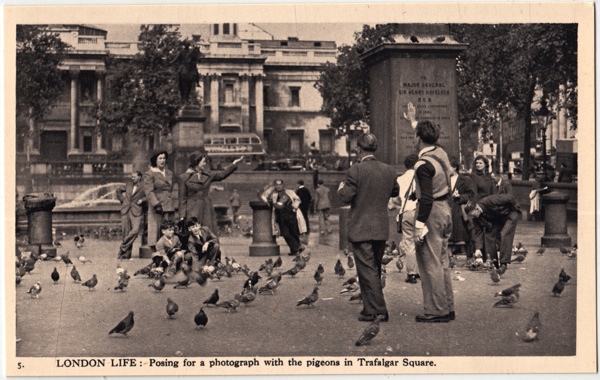
Charles Skilton’s London Life, 1950
Now that the summer is here, I thought I would send you this fine set of postcards published by Charles Skilton, including my special favourites the escapologist and the pavement artist.
Looking at these monochrome images of the threadbare postwar years, you might easily imagine the photographs were earlier – but Margaret Rutherford in ‘Ring Round the Moon’ at The Globe in Shaftesbury Ave in number nine dates them to 1950. Celebrated in his day as publisher of the Billy Bunter stories, Charles Skilton won posthumous notoriety for his underground pornographic publishing empire, Luxor Press.




You may also like to take a look at
The Secrets Of Christ Church

There is a such a pleasing geometry to the architecture of Nicholas Hawksmoor’s Christ Church, Spitalfields, completed in 1729, that when you glance upon the satisfying order of the facade you might assume that the internal structure is equally apparent. Yet it is a labyrinth inside. Like a theatre, the building presents a harmonious picture from the centre of the stalls, yet possesses innumerable unseen passages and rooms, backstage.
Beyond the bellringers’ loft, a narrow staircase spirals further into the thickness of the stone spire. As you ascend the worn stone steps within the thickness of the wall, the walls get blacker and the stairs get narrower and the ceiling gets lower. By the time you reach the top, you are stooping as you climb and the giddiness of walking in circles permits the illusion that, as much as you are ascending into the sky, you might equally be descending into the earth. There is a sense that you are beyond the compass of your experience, entering indeterminate space.
No-one has much cause to come up here and, when we reached the door at the top of the stairs, the verger was unsure of his keys. As I recovered my breath from the climb, while he tried each key in turn upon the ring until he was successful, I listened to the dignified tick coming from the other side of the door. When he opened the door, I discovered it was the sound of the lonely clock that has measured out time in Spitalfields since 1836 from the square room with an octagonal roof beneath the pinnacle of the spire. Lit only by diffuse daylight from the four clock faces, the renovations that have brightened up the rest of the church do not register here.
Once we were inside, the verger opened the glazed case containing the gleaming brass wheels of the mechanism, turning with inscrutable purpose within their green-painted steel cage, driving another mechanism in a box up above that rotates the axles, turning the hands upon each of the clock faces. Not a place for human occupation, it was a room dedicated to time and, as intervention is required only rarely here, we left the clock to run its course in splendid indifference.
By contrast, a walk along the ridge of the roof of Christ Church, Spitalfields, presented a chaotic and exhilarating symphony of sensations, buffered by gusts of wind beneath a fast-moving sky that delivered effects of light changing every moment. It was like walking in the sky. On the one hand, Fashion St and on the other Fournier St, where the roofs of the ighteenth century houses topped off with weavers’ lofts create an extravagant roofscape of old tiles and chimney pots at odd angles. Liberated by the experience, I waved across the chasm of the street to residents of Fournier St in their rooftop gardens opposite, just like waving to people from a train.
Returning to the body of the church, we explored a suite of hidden vestry rooms behind the altar, magnificently proportioned apartments to encourage lofty thoughts, with views into the well-kept rectory garden. From here, we descended into the crypt constructed of brick vaults to enter the cavernous spaces that until recent years were stacked with human remains. Today these are innocent, newly-renovated spaces without any tangible presence to recall the thousands who were laid to rest here until it was packed to capacity and closed for burial in 1812 by Rev William Stond MA, as confirmed by a finely lettered stone plaque.
Passing through the building, up staircases, through passages and in each of the different spaces from top to bottom, there were so many of these plaques of different designs in wood and stone, recording those were buried here, those who were priests, vergers, benefactors, builders and those who rang the bells. In parallel with these demonstrative memorials, I noticed marks in hidden corners, modest handwritten initials, dates and scrawls, many too worn or indistinct to decipher. Everywhere I walked, so many people had been there before me, and the crypt and vaults were where they ended up.
My visit started at the top and I descended through the structure until I came, at the end of the afternoon, to the small private vaults constructed in two storeys beneath the porch, where my journey ended, as it did in a larger sense for the original occupants. These delicate brick vaults, barely three feet high and arranged in a crisscross design, were the private vaults of those who sought consolation in keeping the family together even after death. All cleaned out now, with modern cables and pipes running through, I crawled into the maze of tunnels and ran my hand upon the vault just above my head. This was the grave where no daylight or sunshine entered, and it was not a place to linger on a bright afternoon in May.
Christ Church gave me a journey through many emotions, and it fascinates me that this architecture can produce so many diverse spaces within one building and that these spaces can each reflect such varied aspects of the human experience, all within a classical structure that delights the senses through the harmonious unity of its form.

The mechanism of this clock runs so efficiently that it only has to be wound a couple of times each year


Looking up inside the spire

A model of the rectory in Fournier St

On the reverse of the door of the organ cupboard

In the vestry

For nearly three centuries, the shadow of the spire has travelled the length of Fournier St each afternoon
You may also like to read about
The Gates Of Old London
Today I present these handsome Players Cigarette Cards from the Celebrated Gateways series published in 1907.


You may also like to take a look at these other sets of cigarette cards
At Clive Murphy’s Flat
As a follow-up to Saturday’s tribute to Clive Murphy who died last week at eighty-five, here is my account of his now legendary flat in Brick Lane.

Clive Murphy at his desk
Writer Clive Murphy lived in his two room flat above the Aladin Curry House on Brick Lane from 1974 and filled it with an ever-growing collection of books, papers and memorabilia. Once I heard he was going to tidy up, I realised I must record Clive’s glorious disarray lest his environment lose any of its charisma in the process of getting organised.
When Clive saw the card in the window and rented his flat, it was above a draper’s, but that went long ago as the Bengali shops and curry houses filled the street. Then, in more recent years, the nightlife arrived, with clubbers and party animals coming to throng Brick Lane at all hours. Yet, throughout this time, Clive lived quietly on the first floor, looking down upon the seething hordes of visitors and inhabiting a private world that was largely unchanged, save the accumulation of books and leaks in the ceiling.
Walking up the narrow staircase from the street, you came first to Clive’s kitchen looking back towards Hanbury St and Roa’s crane. At the front was a larger room looking onto Brick Lane which served as Clive’s bedroom and study, lined with fine furniture barely visible under the tide of paper and sitting beneath a water-stained ceiling that resembled a map of the world.
“I’ve had so may leaks and serious floods,” Clive recalled philosophically, “I have been sitting in the kitchen and water has come from the ceiling like from a tap. The landlord wanted to get me out because he could get seven times the rent, but when when the inspectors came round to assess the rent, I said, ‘Do you want to see my bathroom, it’s above the wardrobe?’ That brought my rent down.” And Clive raised his eyes to the tin bath on top of the wardrobe, chuckling in triumph.
Before he came to Spitalfields, Clive had already gained a reputation as a writer, with two novels and two volumes of oral history published. “When I first started writing, I’d write a short story and it’d be accepted, but then the pace slows down …” he confessed to me, casting his eyes over to the shelf dedicated to the volumes that comprise his life’s work and then gazing around at the piles of notebooks, files and packets of his books, mixed up with the contents of his library scattered higgedly-piggedly around the room.
“You see that suitcase,” he indicated, casually gesturing back to the tin bath which I now realised contained a battered case with a tag, “it has a novel in it.” I enquired about a stack of thirty old exercise books which caught my eye. “They are for the continuation of one of my novels, eventually I might read the whole lot and write a book” Clive assured me, turning to point out a selection of bibles on the shelf next to his bed. “My mother became a bit holy in old age, but that was because her friend seduced her into religion,” he informed me wearily, just in case I might assume they were his, “I think if people convert to Christianity in later life it’s a symptom they have lost their minds or need an emotional crutch to lean on.”
On the floor next to the bed was a wallpaper pattern book with newspaper cuttings pasted in it, the most recent of twenty-seven volumes that Clive had filled. “I collect all the things and people that interest me, either because they attract me or because I dislike them,” he explained, “I also keep all correspondence and note all phone calls.”
Visiting Clive’s flat was like entering his crowded mind, containing all the books he had read, all his own work and all the minutiae of life he had sought to preserve. It was the outcome of Clive’s infinite curiosity about life. “I used to walk all night and have lots of promiscuous encounters,” he confided to me, “I was an immigrant and I had to make friends. They say, ‘Don’t talk to strangers,’ but I think that’s very stupid advice because if I didn’t talk to strangers I’d have known nobody. I’m a very gregarious person, hence by talking to people at great length I got to know them.”
It was Friday afternoon and Clive was bracing himself for the approaching weekend and the ceaseless nocturnal crowds beneath his window. “It does keep you alert and alive and interested,” he admitted to me with characteristic good grace, “I don’t know anywhere else now and I have grown to love my little world. I like being in the hub of things.”
Clive never did tidy up, in the end he always had better things to do.

In Clive’s kitchen.


Note the wallpaper pattern books which Clive uses as scrap books for his press cuttings.


Clive at his desk overlooking Brick Lane.

“When the inspectors came round to assess the rent, I said, ‘Do you want to see my bathroom, it’s above the wardrobe?’ That brought my rent down.”


You may also like to read
At Sutton House

I love to visit dark old houses on bright summer days. There is something delicious about stepping from the heat of the day into the cool of the interior, almost as if the transition from one temperature to another was that of time travel, from the present into another era.
I wonder if this notion is a residue of my childhood, when my parents took me on summer trips to visit stately homes, so that now I associate these charismatically crumbling old piles of architecture with warm English afternoons.
Such were my feelings when visiting Sutton House, the oldest house in the East End, recently. It made me think of the country mansions of city burghers that once filled Spitalfields before the streets were laid out and the terraces built up.
Built between 1534-5 by Ralph Sadleir, an associate of Thomas Cromwell, Sutton House employed oak beams from the royal forest of Enfield given to Cromwell by Henry VIII. In 1550, Sadleir sold his house to John Machell who became Sheriff Of London, acquiring wealth as a City merchant. Overreaching himself in debt, the house was repossessed by Sir James Deane, a money-lender.
By 1627, it was in the ownership of Captain John Milward, a silk merchant and member of the East India Company, who furnished it with oriental carpets and commissioned elaborate strapwork murals upon the staircase that survive in fragments to this day.
Sarah Freeman leased the house in 1657 for a girls’ school which ran for nearly a century until it was divided into two dwellings in the mid-eighteenth century, Ivy House and Milford House. Only at the end of the nineteenth century were the two halves reunited when Canon Evelyn Gardner created St John’s Institute as a recreational club for ‘men of all classes.’ Within ten years the building was condemned as unsafe, but thanks to a public appeal which raised £3000 it was extensively renovated with additions in the Arts & Crafts style.
After the Institute left, a failed attempt was made to buy Sutton House for the nation before the National Trust stepped in to save it in 1938. For decades, rooms were let as offices to voluntary organisations until squatters occupied the house in the eighties. Then developers were prevented from converting it into luxury flats by a successful local campaign to Save Sutton House which eventually opened to the public in 1991.
Thus history passed through Sutton House like a whirlwind yet, despite all the changes, the atmosphere of past ages still lingers, especially in the shadowy panelled rooms that enfold the overwhelming mystery of numberless untold stories.


Tudor door and Georgian fanlight

Original transom window dating from the Tudor era

In the Linenfold Parlour

Looking downstairs from the Great Chamber

Looking from the Little Chamber into the Great Chamber

The Great Chamber

Cabinet in the Little Chamber

Tudor kitchen

Cellar stairs

Looking through the courtyard

Looking up from the courtyard


Known as the ‘Armada Window,’ this is the oldest window in the East End


Sutton House can be visited as part of a guided tour. Tickets go on sale every Friday for tours on the following Wednesday, Friday & Sunday.
You may also like to read about
Tea With David Bowie
I am delighted to publish this memoir by Cherry Gilchrist

Cherry in 1965
“It was 1965, and my schoolfriend Helen and I, aged sixteen, were spending a weekend in London. This was something we had to beg and plan for, getting our parents on side and making all sorts of promises as to what we would not do in regard to men, drink, and sleazy music clubs.
Our mothers only consented to this dangerous undertaking provided we stayed at the respectable YWCA girls’ hostel in Marylebone. Little did they know that even there we would have to fend off the amorous advances of African students who were keen to get to know English girls – they were staying the equivalent men’s hostel down the road. We made sure we kept our interaction to playing table tennis and talking urgently about the Queen when things threatened to get out of hand. Actually, we had our sights set on visiting Carnaby St and Soho anyway, and were not keen to get entangled on the wrong side of Oxford St.
Recently, Helen and I compared notes on our shared adventures during our teenage years. We revived our memories of that lively weekend. What did we actually get up to in Soho? I thought my diaries might help.
I still have all the schoolgirl diaries that I wrote which cover nearly every year from eleven to eighteen. I keep planning to destroy them because they are so cringe-making, but somehow it does not happen. I read out less-embarrassing-but-still-amusing parts if we have a schoolfriends’ reunion. And they are invaluable for reconstructing what I did and when. Even now they provide me with insights which change my perspective on past events. So I thumbed through 1965, looking for the right entry. And there it was – what two schoolgirls from Birmingham got up to in the heady streets of Soho, in Swinging London.
‘Went to Carnaby St but didn’t see anyone interesting. All the boys walking up and down were trying to look famous. The shops were displaying horrible floral ties and swimming trunks. Ugh. Walked to Denmark St (known as ‘Tin Pan Alley’ and the heart of the record industry) …where we met two boys from a supposedly up and coming group called Davy Jones and the Lower Third. One was called Teacup. Bought them cups of tea as they were impoverished. Went back to Carnaby St after lunch and looked in disgust at more floral ties.’
The next day we returned to Soho. It was not that we did not have anything else to do. In fact, we had enjoyed a rather too exciting night. We had neglected to tell our mothers that the YWCA could not have us for the middle night of our visit, and that we had fixed to stay in a flat near Dulwich normally occupied by Diz Disley, a well-known folk and jazz musician. I was deeply into folk music at the time. He had invited us to crash there while he was away. It was a large house with many comings and goings. More specifically, there were some unexpected arrivals in our bedroom during the night, which meant fending off more unwelcome advances. But these particular adventures take up two A4 pages of my diary and I will save them for another time.
Next day, we wandered into Trafalgar Sq where ‘We asked two American beats if they would like to climb up the lions to have their photo taken but they said they did not do that any more. One of them took the camera, pointed it at our stomachs and took a photograph. Then we went to Denmark St again. No sign of the elusive Davy Jones or any of the Lower Third. Had lunch in the café there, two boys called ‘The Ants’ sat at our table. They were quite sweet. One was good-looking and they were chuffed ‘cos they’d made a demo disc.’
So we had met a few young hopefuls, a couple of would-be pop groups. I typed out the account and emailed it off to Helen. She vaguely remembered another of the boys, but he was just one among so many now lost without trace. I agreed, it was doubtful that he had even made a passing wave in recording history. Nevertheless, I thought I would check the ‘elusive’ Davy Jones?
To my astonishment, I found that Davy Jones and the Lower Third had actually released a record shortly afterwards. So they had begun to climb the ladder.
The real surprise was when I read that Davy Jones changed his name to David Bowie. Was he already stepping into the role of the trickster? It is interesting that I had described him as ‘elusive’ in my diary. He was just eighteen and could not have foreseen the meteoric rise to stardom which awaited him.
So this is the story of how I once bought David Bowie a cup of tea in Soho, because he could not afford to pay for his own.”

You may also like to take a look at


