
So Long, Clive Murphy
My friend and inspiration Clive Murphy died on Wednesday aged eighty-five

Above a curry house in Brick Lane lived Clive Murphy like a wise owl snug in the nest he constructed of books, and lined with pictures, photographs, postcards and cuttings over the nearly fifty years that he occupied his tiny flat. Originally from Dublin, Clive had not a shred of an Irish accent. Instead he revelled in a well-educated vocabulary, a spectacular gift for rhetoric and a dry taste for savouring life’s ironies. He possessed a certain delicious arcane tone that you would recognise if you have heard his fellow-countryman Francis Bacon talking. In fact, Clive was a raconteur of the highest order and I was a willing audience, happy merely to sit at his feet and chuckle appreciatively at his colourful and sometimes raucous observations.
I was especially thrilled to meet Clive because he was a writer after my own heart who made it his business to seek out people and record their stories. At first in Pimlico and then here in Spitalfields through the sixties and seventies, Clive worked as a “modern Mayhew, publishing the lives of ordinary people who had lived through the extraordinary upheavals and social changes of the first three-quarters of the century before they left the stage.” He led me to a bookshelf in his front room and showed me a line of nine books of oral history that he edited, entitled Ordinary Lives, as well as his three novels and six volumes of ribald verse. I was astonished to be confronted with the achievements of this self-effacing man living there in two rooms in such beautiful extravagant chaos.
Naturally, I was immediately curious of Clive’s books of oral history. Each volume is an autobiography of one person recorded and edited by Clive, “ordinary” people whose lives are revealed in the telling to be compelling and extraordinary. They are A Funny Old Quist, memoirs of a gamekeeper, Oiky, memoirs of a pigman, The Good Deeds of a Good Woman, memoirs of an East End hostel dweller, A Stranger in Gloucester, memoirs of an Austrian refugee, Endsleigh, memoirs of a riverkeeper, At the Dog in Dulwich, memoirs of a struggling poet, Four Acres and a Donkey, memoirs of a lavatory attendant, Love, Dears! memoirs of a chorus girl and Born to Sing, memoirs of a Jewish East End mantle presser. The variety of subjects is intriguing and bizarre, and Clive explained his personal vision of creating a social panorama, “to begin with the humblest lavatory attendant and then work my way up in the world until I got to Princess Margaret.”
Much to Clive’s frustration, the project foundered when he got to the middle classes, and he coloured visibly as he explained, “I found the middle classes had an image of themselves they wanted to project and they asked to correct what they had said, afterwards, or they told downright lies, whereas the common people didn’t have an image of themselves and they had a natural gift of language.” I was curious to understand the origin of Clive’s curiosity, and learn how and why he came to edit all these books. And when he told me the story, I discovered the reasons were part of what brought Clive to England in the first place.
“I lived a sheltered life in Dublin in a suburb and qualified as a solicitor before I came to England in 1958. My mother wanted me to be solicitor to Trinity College where her father was Vice-Provost but I had been on two holidays to London and I’d fallen in love with the bright lights. I wanted to see a wider variety of people. So as soon as I qualified I left Dublin, where I had been offered a job as a solicitor at £4 and ten shillings a week, and came to London, where I got a job at once as a liftman at a Lyons Corner House for £8 a week and I have lived here ever since.
I was staying in Pimlico and there was a retired lavatory attendant and his wife who lived down below, and they invited me down for supper. He had such a natural gift for language and a quaint way of expressing himself, so I said ‘Let’s do a book!’ and that was Four Acres and a Donkey. Then I was living in another house and by complete chance there was another retired lavatory attendant, a woman who had once been a chorus girl, so I did another book with her, too, that was Love Dears!
At that time there was an organisation called Space which let out abandoned schools and warehouses to artists. In 1973, I answered their letter in The Times and they found me an empty building, it was the Old St Patrick’s School in Buxton St. I lived in the former headmaster’s study and that’s where I recorded my first East End book. I had nothing but a tea chest, a camp bed and a hurricane lamp. There was no electricity but there was running cold water. Meths drinkers used to sit on the doorstep night and day, and at night they would hammer on the door trying to get in. I was a bit frightened because I had never met meths drinkers before and I was all alone but gradually three artists came to live in the school with me.
Then I had to leave the school house because I was flooded out and, after a stint on Quaker St, I saw an ad in Harry’s Confectioners and moved here to Brick Lane in 1974. The building was owned by a Jewish lady who let the rooms to me and a professor from Rochester University who only came to use his place in vacations, so it was wonderfully quiet. There was a cloth warehouse on the ground floor then which is now the Aladin Restaurant. Every shopfront was a different trade, we had an ironmonger, an electrician and a wine merchant with a sign that said ‘purveyors to the diplomatic service.’ The wine merchant also had a concoction she sold exclusively to the meths drinkers but that wasn’t advertised.
I thought when I came here to Spitalfields I was going to be solely a writer, I had taught at a primary school in Islington but very soon I became a teacher of children with special needs here. Occasionally, I used to go in the middle of the night to buy food from a stall outside Christ Church, Spitalfields called ‘The Silver Gloves.’ I had no money hardly and I used to live off the fruit and veg thrown out by the market onto Brushfield St. But I found it exciting to be here because I found lots of people to interview. I had already written two novels and I was busy recording Alexander Hartog and Beatrice Ali, and I was happy to be learning about them, because I did lead a very restrictive life before I came to England.”
Clive was a poet at heart and there is an unsentimental appreciation of the human condition that runs through all his work. He chose his subjects because he saw the poetry in them when no-one else did and the books, recording the unexpected eloquence of these “ordinary” people telling their stories, bear witness to his compassionate insight.
As a writer writing my own pen portraits, I was curious to ask Clive what he had learnt from all his interviews with such a variety of people. “The gamekeeper said to me, ‘You mean you don’t know how to skin a mole?'” Clive recalled with relish, evoking the gamekeeper in question vividly, before returning to his own voice to explain himself, “I am amazed that we are all stuck in our little worlds – he really thought everyone would know that. It wasn’t just the knowledge that I learnt from people, it was their outlooks and personalities.”
Clive gave me copies of his two East End books and, as we sliced open a box I was delighted to discover “new” copies of books from 1975, beautifully printed in letterpress with fresh unfaded covers and some with a vinyl record inside to allow the reader to hear the voice of the protagonist. I could not wait to go home and read them, and listen.
I will never be able to walk down Brick Lane without thinking of Clive Murphy, who once lived above the Aladin Restaurant, as a beacon of inspiration to me while I am running around Spitalfields pursuing my interviews.

Clive Murphy in his kitchen
You may also like to read
On Missing Mr Pussy
In these dreamy days of high summer, I often think of my old cat Mr Pussy

While Londoners luxuriate in the warmth of summer, I miss Mr Pussy who endured the hindrance of a fur coat, spending his languorous days stretched out upon the floor in a heat-induced stupor.
As the sun reached its zenith, his activity declined and he sought the deep shadow, the cooling breeze and the bare wooden floor to stretch out and fall into a deep trance that could transport him far away to the loss of his physical being. Mr Pussy’s refined nature was such that even these testing conditions provided an opportunity for him to show grace, transcending dreamy resignation to explore an area of meditation of which he was the supreme proponent.
In the early morning and late afternoon, you would see him on the first floor window sill here in Spitalfields, taking advantage of the draught of air through the house. With his aristocratic attitude, Mr Pussy took amusement in watching the passersby from his high vantage point on the street frontage and enjoyed lapping water from his dish on the kitchen window sill at the back of the house, where in the evenings he also liked to look down upon the foxes gambolling in the yard.
Whereas in winter it was Mr Pussy’s custom to curl up in a ball to exclude drafts, in these balmy days he preferred to stretch out to maximize the air flow around his body. There was a familiar sequence to his actions, as particular as stages in yoga. Finding a sympathetic location with the advantage of cross currents and shade from direct light, at first Mr Pussy sat to consider the suitability of the circumstance before rolling onto his side and releasing the muscles in his limbs, revealing that he was irrevocably set upon the path of total relaxation.
Delighting in the sensuous moment, Mr Pussy stretched out to his maximum length of over three feet long, curling his spine and splaying his legs at angles, creating an impression of the frozen moment of a leap, just like those wooden horses on fairground rides. Extending every muscle and toe, his glinting claws unsheathed and his eyes widened gleaming gold, until the stretch reached it full extent and subsided in the manner of a wave upon the ocean, as Mr Pussy slackened his limbs to lie peacefully with heavy lids descending.
In this position that resembled a carcass on the floor, Mr Pussy could undertake his journey into dreams, apparent by his twitching eyelids and limbs as he ran through the dark forest of his feline unconscious where prey were to be found in abundance. Vulnerable as an infant, sometimes Mr Pussy cried to himself in his dream, an internal murmur of indeterminate emotion, evoking a mysterious fantasy that I could never be party to. It was somewhere beyond thought or language. I could only wonder if his arcadia was like that in Paolo Uccello’s “Hunt in the Forest” or whether Mr Pussy’s dreamscape resembled the watermeadows of the River Exe, the location of his youthful safaris.
There was another stage, beyond dreams, signalled when Mr Pussy rolled onto his back with his front paws distended like a child in the womb, almost in prayer. His back legs splayed to either side, his head tilted back, his jaw loosened and his mouth opened a little, just sufficient to release his shallow breath – and Mr Pussy was gone. Silent and inanimate, he looked like a baby and yet very old at the same time. The heat relaxed Mr Pussy’s connection to the world and he fell, he let himself go far away on a spiritual odyssey. It was somewhere deep and somewhere cool, he was out of his body, released from the fur coat at last.
Startled upon awakening from his trance, like a deep-sea diver ascending too quickly, Mr Pussy squinted at me as he recovered recognition, giving his brains a good shake, once the heat of the day had subsided. Lolloping down the stairs, still loose-limbed, he strolled out of the house into the garden and took a dust bath under a tree, spending the next hour washing it out and thereby cleansing the sticky perspiration from his fur.
Regrettably the climatic conditions that subdued Mr Pussy by day, also enlivened him by night. At first light, when the dawn chorus commenced, he stood on the floor at my bedside, scratched a little and called to me. I woke to discover two golden eyes filling my field of vision. I rolled over at my peril, because this provoked Mr Pussy to walk to the end of the bed and scratch my toes sticking out under the sheet, causing me to wake again with a cry of pain. I miss having no choice but to rise, accepting his forceful invitation to appreciate the manifold joys of early morning in summer in Spitalfields, because it was not an entirely unwelcome obligation.

You may also like to read
Mr Pussy Gives his First Interview

Click here to order a copy for £10

Nicholas Borden’s Lockdown Paintings Exhibition
I am delighted to announce that, following the tremendous response to Nicholas Borden’s recent paintings on Spitalfields Life, these will now be exhibited in a one man show entitled, WISHFUL THINKING, Nicholas Borden’s Lockdown Paintings at Townhouse Spitalfields, opening this Saturday 19th June and running until Sunday 4th July. (Paintings will also be for sale from the website from 19th June.)
Nicholas & I met up for a celebratory chat recently and he talked more about some of his paintings.
“I prefer to work outside but it is something I have only done in recent years, before that decision I think I was lost creatively. I like to observe things and be able to respond spontaneously. I tend to work quickly and not be premeditated.
For me, there is no substitute for working from life even if you have to deal with a lot of curious onlookers, that is why I try to work as early as I can in the day. On the street, you are painting in challenging circumstances and anything can happen but mostly people are encouraging. In future, I would like to simplify my compositions to create visions. Alfred Wallis was a great artist who was able to do that.
I felt cut off in Lockdown, so I listened to the radio a lot. I got by the best I could by being as busy as I could with my painting. I had a structure and a routine, and I worked on several paintings at a time. There were less people about, especially in Central London. I had never seen anything like it, almost apocalyptic. I hope we never live through anything like that again.
Painting helped me get through it and I am very lucky that I experienced no illness. Painting gave me strength and independence, and a new way of looking. During Lockdown, painting became the expression of my emotions. I think it made me a better painter.”
Nicholas Borden

Arnold Circus, Boundary Estate
I could not go home to visit my family in Devon over Christmas because of the Lockdown and it was a pretty lonely experience, so I painted this winter view of Arnold Circus in Shoreditch. It is not grim, it is a beautiful place and there is a lot of colour. I am aware of the campaign to Save Arnold Circus from tearing up the old paving and redesigning it, so I was inspired to paint this. It is a spectacular circular park with the original bandstand dating from 1900.

Wishful Thinking, gardens near Victoria Park
This is a view near where I live. It was hard to finish this painting because people were concerned that I was looking into their back gardens, but it is not against the law is it?

View from St Augustine’s Tower, Hackney
I have to thank St John in Hackney for giving me permission to use St Augustine’s Tower. They gave me the key and I had it for several weeks last summer, but it was exhausting climbing up a hundred steps every day to the roof. This was the first painting I did there, looking north-west towards Upper Clapton. In the foreground is the pedestrianised Narrow Walk and in the left hand corner is part of Marks & Spencer. I found I can compose work better when I am looking from high up.

Getting a bit of fresh air, Church St, Stoke Newington
This is next to Abney Park Cemetery where General Booth who founded the Salvation Army is buried. It is a spectacular cemetery. I painted it in winter and I was attracted to this gothic subject. It was raining but I saw a lot of new mothers walking up and down with their babies, getting a bit of fresh air.

Regent’s Canal at Victoria Park
I used a lot of ochre and Prussian blue in this painting. It was a winter’s day just after Christmas and I remember being very cold. From Victoria Park, I had this view across Regent’s Canal into the back gardens and I liked the composition. You can see into people’s lives. It is all revealed in the busy detail of sheds, washing hanging up and an abandoned greenhouse.

Feeding the pigeons near Mare St
This alleyway with a green area is quite close to where I live and feeding the pigeons became a bit of an issue during Lockdown. There is a rogue character who feeds them obsessively which has drawn controversy locally. I do not have any beef with it, but people who live nearby object and this painting typifies that tension.

St John of Jerusalem, Hackney
Someone chucked some water over me while I was doing this painting, just a sprinkle. I told my neighbour and he said, ‘Let’s go and sort them out,’ but I think it was intended as a joke. I have walked past this church thousands of times but I have never been inside. I have a Samuel Palmeresque feeling about it. He used strong yellows and liked romantic trees. Me and my brother used to be in the choir at our village church and we had to listen to sermons and the priest was completely mad. Maybe that was in the back of my mind when I painted this?

The Lake, Victoria Park
This is a winter scene at the lake. I come from the country originally and I like going for walks, so I think that is why I am constantly drawn back to the park, seeking peace and tranquility in the city.

Well St Common, Hackney
This painting has a domestic quality for me, Well Street Common is just round the corner from my flat in Hackney. I do not have a garden, so during Lockdown I found it relaxing to go there to read books and I always see people out playing ball games. I wanted the gardens to form a backdrop and this was painted in the evening because I wanted the long shadows. I thought it had a timeless quality.

Regent’s Canal at Old Ford Rd

Regent’s Canal at Victoria Park
This painting was produced over several days just before spring arrived. I try to go first thing on consecutive mornings at the same time, when it is still quiet. There is so much activity in Victoria Park and it is a long-established park that has not changed in all these years. That is part of its appeal for me. People always enjoy being outside and this was especially important during Lockdown.

St James’s Park, Westminster

Christ Church, Spitalfields
Ever since I first saw Christ Church, I recognised this was a striking piece of architecture. It has been painted by many artists before me, including Leon Kossoff and John Piper. It is an especially challenging subject, structurally and proportionally.
I remember painting this very early last summer, I tried to work quickly and directly because the light changes. You only have a span of around two hours before the light is so different you can no longer work, especially if you have long shadows. For me, the summer plumage of the tree brings joy to this image.

River Lea at Clapton
This was painted from the Lea Bridge. I like John Constable and I was thinking of him and of British landscape painting, although I am aware of the need to find your own vision.
Paintings copyright © Nicholas Borden
You may also like to take a look at
Nicholas Borden’s Latest Paintings
Catching Up With Nicholas Borden
Nicholas Borden’s East End View
Nicholas Borden’s Winter Paintings
Nicholas Borden’s Spring Paintings
Raphael Samuel’s Farewell To Spitalfields

In 1988, the Bishopsgate Institute staged an exhibition entitled A Farewell to Spitalfields curated by John Shaw and Raphael Samuel, the distinguished historian of the East End. The purpose was to assess the history of Spitalfields in the light of the changes that were forthcoming, as a result of the closure of the Truman Brewery and the Fruit & Vegetable Market.
Below you can read excerpts from Raphael Samuel’s introductory essay accompanied by David Bateman’s photographs of the Spitalfields Market, commissioned as part of this exhibition.
More than thirty years later, it is sobering to recognise the prescience of Raphael Samuel’s words. He was a historian with strong opinions who, on the basis of this article alone, demonstrated an ability to write about the future as clearly as he wrote the past. The Spitalfields portrayed in these pictures has gone and now – for better or worse – we live in the Spitalfields that Raphael Samuel, who died in 1996, wrote of yet did not live to see.
Spitalfields is the oldest industrial suburb in London. It was already densely peopled and “almost entirely built over,” in 1701 when Lambeth was still a marsh, Fulham a market garden and Tottenham Court Rd a green. It owes its origins to those refugee traditions which, in defiance of the Elizabethan building regulations, and to escape the restrictions of the City Guilds, settled in Bishopsgate Without and the Liberty of Norton Folgate.
Spitalfields is a junction between, on the one hand, a settled, indigenous population, and on the other, wave upon wave of newcomer. Even when it was known as ‘The Weavers’ Parish,’ it was still hospitable to many others – poor artisans, street sellers, labourers among them. In the late nineteenth century Spitalfields was one of the great receiving points for Jewish immigration and the northern end of the parish provided a smilar point of entry for country labourers. There was a whole colony of them at Great Eastern Buildings in the eighteen eighties, working as draymen at the brewery, and another at the Bishopsgate Goods Station. This ‘mixed’ character of the neighbourhood is very much in evidence today.
Spitalfields Market – threatened with imminent destruction by a coalition of property developers and City Fathers – is almost as old as Spitalfields. It was already in existence when the area was still an artillery range. In John Stow’s ‘Survey of London’ (1601) it appears a trading point “for fruit, fowl and root.” A market sign was incorporated in the coat of arms for the Liberty of Norton Folgate in Restoration times, and the market’s Royal Charter dates from 1682. The market, in short, preceded the arrival of the Hugeunots and has some claim to being Spitalfields’ original core. The market continued as a collection of ramshackle sheds and stalls until it was transformed, in the 1870s, by Robert Horner, who bought the lease of the land from the Goldsmid family in 1875. Horner was a crow scarer from Essex who, according to market myth, walked to London, became a porter in the market and eventually got a share in a firm. Ambitiously, he set about both securing monopoly rights for the existing traders, and replacing the impromptu buildings with a purpose built market hall – the “Horner” buildings which today is the oldest part of the market complex.
The older, eastern portion of the market is the direct product of Robert Horner’s vision of his own situation. It is built in the manner of the English Arts & Crafts movement. On its own terms, the old market is a pleasing piece and a worthy addition to the diversity of Spitalfields. Its rusticated archways on the Commercial St facade and the repeated peaks of the roof with their smallish sash windows lend a clearly Victorian flavour to Commercial St, which was largely a Victorian venture anyway. Inside the market it is a vintagely Victorian hall of glass and iron of unassuming beauty, even more so when at work, then its true worth as a genuinely functioning piece of Victorian space is revealed. Like St. Pancras in a different way, it has an element of the museum and an aesthetic that overlays the original construction upon utilitarian principles. Most of all the old market appears as a peculiarly English space. An effect that is heightened by the lavish use of ‘Wimbledon’ green. It is that deep traditional green that characterises English municipal space and that, in this case helps to marry the market to the discordant additions of the late 1920’s and to give distinction to the territorial boundaries of the market that have been historically more fluid.
The old market is a celebration of trade, a great piece of Victorian working space, not only of great historical value itself, but contributing to the visual manifestation of the historical development of the whole of Spitalfields. It is a worthy layer in an area that grew by a sort of architectural sedimentation. Hawksmoor’s Christ Church, the Huguenot fronts of Artillery Passage, the Georgian elegance of Elder St and the smaller houses of Wilkes St and Princelet St, the mid-Victorian utility of the Peabody Buildings, the rustic character of the old market, the twentieth century neo-classicism of the Fruit Exchange and several examples of a more unspeakable modernity are some among many accretions which contribute to make Spitalfields what it is. The most perfect example of a palimpsest in which diversity rather than Georgiana or Victoriana represent the true nature of the area.
The character of a district is determined not by its buildings, but by the ensemble of different uses to which they are put, and, above all, by the character of the users. It should be obvious to all but the self-deceived, that to stick an international banking centre in the heart of an old artisan and market quarter, a huge complex with some six thousand executives and subalterns, is, to put it gently, a rupture from tradition. The whole industrial economy of Spitalfields rests on cheap work rooms: rentals in the new office complex are some eight times greater than they are in the purlieus of Brick Lane, and with the dizzy rise in property values which will follow the new development, accommodation of all kinds, whether for working space or home, will be beyond local people. The market scheme will mean a social revolution, the inversion of what Spitalfields has stood for during four centuries of metropolitan development.
The fate of Spitalfields market illustrates in stark form some of the paradoxes of contemporary metropolitan development: on the one hand, the preservation of ‘historic’ houses; on the other, the wholesale destruction of London’s hereditary occupations and trades and the dispersal of its settled communities. The viewer is thus confronted with two versions of ‘enterprise’ culture: the one that of family business and small scale firms, the other that of international high finance with computer screens linking the City of London to the money markets of the world.
This set of photographs by David Bateman show something of the activity of the market today in what – if the Second Reading of the Market Bill continues its progress through Parliament – are likely to be its closing months.
Raphael Samuel 22nd July 1988
I am fascinated to read Raphael Samuel’s prescient words because – although the culture of small businesses and independent shops persists in Spitalfields against all the odds – it is evident that the proposed corporate redevelopment of the Truman Brewery would damage this culture still further.


Photographs copyright © David Bateman

Raphael Samuel
Portrait copyright © Lucinda Douglas-Menzies
The Save Brick Lane Protest

(Photo by Sarah Ainslie)
Contributing Photographers Sarah Ainslie and David Hoffman were there to document the triumphant protest yesterday organised by Nijjor Manush, East End Preservation Society, Bengali East End Heritage Society, East End Trades Guild and London Renters’ Union to challenge the Truman Brewery’s plan for a shopping mall with four floors of corporate offices on top as the overture to the redevelopment of the entire brewery site.
The local community gathered in Altab Ali Park, before marching up Brick Lane to the Brewery gates where speeches were given by residents, councillors, curry house owners and Dan Cruickshank on behalf of Spitalfields Trust. I publish a transcript of Tasnima Uddin’s rousing speech on behalf of Nijjor Manush.
“Today we show the Truman Brewery and Tower Hamlets Council that we will not stop until this development is rejected.
The choice before us could not be starker, 98.9% of the public consultation oppose the development plan that the council is seeking to push through.
Truman Brewery shame on you!
Today we stand for the 7000 and more people who condemn the Truman Brewery proposal.
We stand for the local residents struggling against chronic indifference from Tower Hamlets Council and creeping displacement by the City of London.
We stand for the people of Tower Hamlets who have made it a hot bed of activism, radical heritage and resistance for generations.
We stand in the proudest traditions of the East End and we stand against all those who seek to condemn those traditions to distant history.
The challenge before is a class issue and therefore necessarily a race issue as well. Tower Hamlets has one of the longest housing waiting lists in the country.
This proposal that the council is gearing up to approve will only push up rents, push out the local community and deepen the housing crisis.
Truman Brewery shame on you!
During the pandemic office blocks became empty, while council housing lists are overflowing.
Tower Hamlets Council where are you?
Tower Hamlets has already been identified as one of the most gentrified boroughs in London in the past decade. If this development goes through, Brick Lane’s Bangladeshi community will find themselves priced out and exiled from the place they call home.
We need a proper process of local decision making that is shaped by the needs of local communities, not the greed of large companies.
Truman Brewery shame on you!
This protest was planned for the eve of the council decision meeting, but they have delayed it. They will keep delaying it until public interest dies down, but we will be back again with another rally.
We will not let this development go through.
Truman Brewery shame on you!”
VISIT WWW.BATTLEFORBRICKLANE.COM

(Photo by Sarah Ainslie)

(Photo by Sarah Ainslie)

(Photo by Sarah Ainslie)

(Photo by Sarah Ainslie)

(Photo by Sarah Ainslie)

(Photo by Sarah Ainslie)

(Photo by David Hoffman)

(Photo by Sarah Ainslie)

(Photo by Sarah Ainslie)

(Photo by Sarah Ainslie)

(Photo by Sarah Ainslie)

(Photo by Sarah Ainslie)

(Photo by Sarah Ainslie)

(Photo by David Hoffman)

(Photo by David Hoffman)

(Photo by David Hoffman)

(Photo by David Hoffman)

(Photo by David Hoffman)

(Photo by Sarah Ainslie)

(Photo by David Hoffman)
Photographs copyright © Sarah Ainslie © David Hoffman
You may also like to read about
Dan Cruickshank’s Spitalfields Photographs
Dan Cruickshank took these photographs – many of which are published here for the first time – between 1969 when he first came to Spitalfields and 1977 when he led the campaign to stop British Land destroying Elder St. “I did it to document the buildings that were here then,” he explained to me in regret, “but sometimes you’d go back the next Saturday and there’d be virtually nothing left.”

Barrowmakers in Wheler St

Baker in Quaker St

Quaker St and Railway Dwellings

Junction of Bethnal Green Rd & Redchurch St

Weaver’s House at the corner of Bacon St & Brick Lane

Weavers’ houses in Sclater St, now demolished

Weavers’ houses in Sclater St, only those in foreground remain

Weavers’ houses in Sclater St, now demolished

Corner of Sclater St & Brick Lane

Houses in Hanbury St, now demolished

Houses in Hanbury St, now demolished

Old House in Calvin St, now demolished

Elaborate doorcase in Wilkes St, now gone

Brushfield St

Brushfield St, buildings on the right now demolished

Brushfield St, buildings on the right now demolished

Buildings in Brushfield St, now demolished

Brushfield St, buildings on the left now demolished

Looking from Brushfield St towards Norton Folgate

Selling Christmas trees in Spital Sq

Spital Sq with St Botolph’s Hall

Folgate St with Dennis Severs’ House in the foreground, houses in the background now demolished

House in Folgate St, now demolished

5 & 7 Elder St during squat to prevent complete demolition by British Land

Partial demolition of 5 & 7 Elder St

Rear of 5 & 7 Elder St during partial demolition

Inside 7 Elder St

Douglas Blain of Spitalfields Trust reads a paper in the loft of 7 Elder St after the roof was removed

Alleyway off Folgate St
Photographs copyright © Dan Cruickshank
You may also like to take a look at
The Pellicci Museum

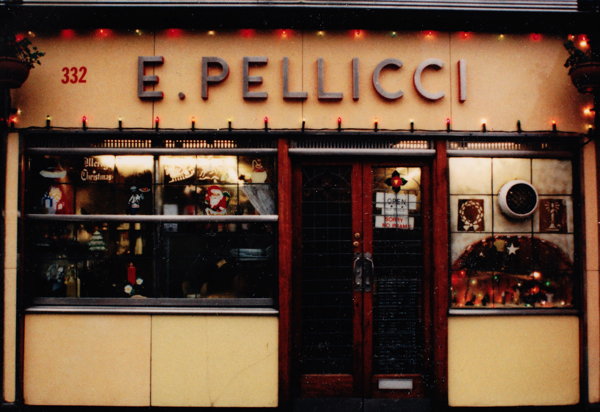
This is Lucinda Rogers‘ drawing of E.Pellicci in the Bethnal Green Rd, London’s most celebrated family-run cafe, into the third generation now and in business for over a century – and continuing to welcome East Enders who have been coming for generations to sit in the cosy marquetry-lined interior and enjoy the honest, keenly-priced meals prepared every day from fresh ingredients.
E.Pellicci is a marvel. It is so beautiful it is listed, the food is always exemplary and I every time I come here I leave heartened to have met someone new.
I found Lucinda Rogers’ drawing on the wall in one of the small upper rooms that now serves as an informal museum of the history of the cafe, curated by Maria Pellicci’s nephew – Toni, a bright-eyed Neapolitan, who has been working here since he left school in Lucca in Tuscany and came to London in 1970. He led me up the narrow staircase, opened the door of the low-ceilinged room and with a single shy gesture of his arm indicated the family museum. Toni has lined the walls with press cuttings, photographs and all kinds of memorabilia, which tell the story of the ascendancy of Pellicci’s, attended by a few statues of saints to give the pleasing aura of a shrine to this cherished collection.
Primo Pellici began working in the cafe in 1900 and it was here in these two rooms that his wife Elide brought up his seven children single-handedly, whilst running the cafe below to keep the family after her husband’s death in 1931. Elide is the E.Pellicci whose initial is still emblazoned in chrome upon the primrose-hued vitroglass fascia and her portrait remains, she and her husband counterbalance each other eternally on either side of the serving hatch in the cafe. In 1921, Nevio senior was born in the front room here. He ran the cafe until his death in 2008, superceded as head of the family business today by his wife Maria who possesses a natural authority and charisma that makes her a worthy successor to Elide.
As I sat alone in the quiet of the room, leafing through the albums, surrounded by the walls of press coverage, Maria came upstairs from the kitchen to join me. She pointed out the flat roof at the rear where her former husband Nevio played as a child. “He was very happy here,” she assured me with a tender smile, standing silently and casting her eyes between the two empty rooms – sensing the emotional presence of the crowded family life that once filled in this space that is now a modest store room and an office. Maria and Nevio brought up their children in a terraced house around the corner in Derbyshire St, and these days Toni goes round each morning early to pick her up from there, before they start work around six at the cafe she runs with her son Nevio and daughter Anna.
Pellicci’s collection tells a very particular history of the twentieth century and beyond – of immigration, of wars, of coronations and gangsters too. But, more than this, it is a history of wonderful meals, a history of very hard work, a history of great family pride, and a history of happiness and love.

Primo Pellicci still presides upon the cafe where he started work in 1900.

Primo’s children, Nevio and Mary Pellicci, 1930.

Pellicci’s wartime licence issued to Elide Pellicci in 1939 by the Ministry of Food.

Pellicci’s paper bag issued to celebrate the Coronation of Elizabeth II in 1953 – note the phone number, Bishopsgate 1542.

Mary and Maria Pellicci, Trafalgar Sq, 1963.


Nevio junior, aged seven, skylarking outside the house in Derbyshire St with pals Claudio and Alfie.

Nevio senior and Toni, 1980.

Pellicci’s customers in 1980.

Nevio senior, 1980.

Nevio and Toni.


Christmas card from Charlie Kray, 1980.

Nevio junior and Nevio senior.

George Flay’s portrait of Nevio Junior, 2006. See more at www.artofflay.com

George Flay’s montage of the world of Pellicci’s.

Nevio Senior, 2005

You may also enjoy reading


