
The Highdays & Holidays Of Old London
On Bank Holiday Monday, let us to consider the highdays & holidays of old London

Boys lining up at The Oval, c.1930
School is out. Work is out. All of London is on the lam. Everyone is on the streets. Everyone is in the parks. What is going on? Is it a jamboree? Is it a wingding? Is it a shindig? Is it a bevy? Is it a bash?
These are the high days and holidays of old London, as recorded on glass slides by the London & Middlesex Archaeological Society and once used for magic lantern shows at the Bishopsgate Institute.
No doubt these lectures had an educational purpose, elucidating the remote origins of London’s quaint old ceremonies. No doubt they had a patriotic purpose to encourage wonder and sentiment at the marvel of royal pageantry. Yet the simple truth is that Londoners – in common with the rest of humanity – are always eager for novelty, entertainment and spectacle, always seeking any excuse to have fun. And London is a city ripe with all kinds of opportunities for amusement, as illustrated by these magnificent photographs of its citizens at play.
Are you ready? Are you togged up? Did you brush your hair? Did you polish your shoes? There is no time to lose. We need the make the most of our high days and holidays. And we need to get there before the parade passes by.

At Hampstead Heath, c.1910.

Walls Ice Cream vendor, c.1920.

At Hampstead Heath, c.1910.

At Hampstead Heath, c.1910.

Balloon ascent at Crystal Palace, Sydenham, c.1930.

At the Round Pond in Kensington Gardens, 1896.

Christ’s Hospital Procession across bridge on St Matthews Day, 1936.

A cycle excursion to The Spotted Dog in West Ham, 1930.

Pancake Greaze at Westminster School on Shrove Tuesday, c.1910.

Variety at the Shepherds Bush Empire, c.1920.

Dignitaries visit the Chelsea Royal Hospital, c.1920.

Games at the Foundling Hospital, Bloomsbury, c.1920.

Riders in Rotten Row, Hyde Park, c.1910.

Physiotherapy at a Sanatorium, 1916.

Vintners’ Company, Master’s Installation procession, City of London, c.1920.

Boating on the lake in Battersea Park, c.1920.

The King’s Coach, c.1911.

Queen Victoria’s Diamond Jubilee procession, 1897.

Lord Mayor’s Procession passing St Paul’s, 1933.

Policemen gives directions to ladies at the coronation of Edward VII, 1902.

After the procession for the coronation of George V, c.1911.

Observance of the feast of Charles I at Church of St. Andrew-by-the-Wardrobe, 1932.

Chief Yeoman Warder oversees the Beating of the Bounds at the Tower of London, 1920.

Schoolchildren Beating the Bounds at the Tower of London, 1920.

A cycle excursion to Chingford Old Church, c.1910.

Litterbugs at Hampstead Heath, c.1930.

The Foundling Hospital Anti-Litter Band, c.1930.

Distribution of sixpences to widows at St Bartholomew the Great on Good Friday, c.1920.

Visiting the Cast Court to see Trajan’s Column at the Victoria & Albert Museum, c.1920.
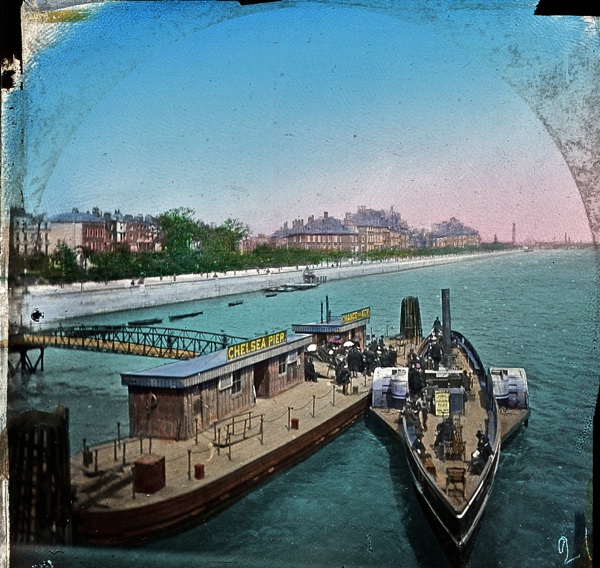
A trip from Chelsea Pier, c.1910.

Doggett’s Coat & Badge Race, c.1920.

Feeding pigeons outside St Paul’s, c.1910.

Building the Great Wheel, Earls Court, c.1910.
Glass slides copyright © Bishopsgate Institute
You may also like to take a look at
On May Day

Street Strolling Clowns by John Thomas Smith, 1816 (courtesy Bishopsgate Institute)

Sweeps on May Day in the City of London c. 1920 (courtesy Bishopsgate Institute)
On May Day, a traditional time of celebration in London when we look forward to the summer that lies ahead, I present this chapbook of The Seasons by W S Johnson from 1846 which was brought to my attention by Sian Rees.


Courtesy of McGill Library
You may also like to take a look at
Ron McCormick’s Spitalfields & Whitechapel
Today it is my pleasure to publish a selection of Ron McCormick’s fine photographs of Spitalfields and Whitechapel taken in the seventies when he lived in Princelet St

Carrying bicycles over Pedley St bridge

Street musician in Brick Lane market

Faces in the crowd, Commercial St

‘The boys’ pass time on the steps of the Great Synagogue, Fournier St

Costa cobblers, Hanbury St

Engineering works, Heneage St

Engineering works, Heneage St

Bottling girls in the Truman Brewery

Mother and toddler, Buxton St Holiday Club

Street scene, Whitechapel

Flower seller, Whitechapel

Shoe shop, Wentworth St

Mr & Mrs Ali with their children, Brick Lane

Bakery, Whitechapel

Leaving Spitalfields, Artillery Passage opens onto Middlesex St

Family playtime in streets off Whitechapel Rd

Cheshire St market

Girl and her grandmother, Great Eastern Buildings, Quaker St

Rooftop playground, Great Eastern Buildings, Quaker St

Roof of Great Eastern Buildings, Quaker St

Tenement buildings, Spitalfields

Street singer, Brick Lane market

Diamond merchants, Black Lion Yard

Woman with dogs in alley off Quaker St

Photographs copyright © Ron McCormick
You may also like to take a look at
At Eel Pie Island

Even though Twickenham is a suburb of London these days, it still retains the quality of a small riverside town. The kind of place where a crowd forms to watch a crow eating a bag of crisps – as I observed in the High St, before I crossed the bowed footbridge over to Eel Pie Island.
This tiny haven in the Thames proposes a further remove from the metropolis, a leafy dominion of artists’ cabins, rustic bungalows and old boatyards where, at the overgrown end of the only path, I came upon the entrance to Eel Pie Island Slipway. Here, where there are no roads, and enfolded on three sides by trees and tumbledown shacks, a hundred-year-old boatshed over-arches a hidden slipway attended by a crowded workshop filled with an accretion of old tools and maritime paraphernalia.
For the past thirty years, this magnificent old yard has been run by Ken Dwan, where twelve men work – shipwrights, platers, welders, marine engineers and marine electricians – on the slipway and in the workshop. “We have all the skills here, “ Ken informed me, “and the older ones are passing it onto the younger ones. Everybody learns on the job.” One of just four yards left on the Thames, Ken has his order book full for the next year, busy converting barges into houseboats, and maintaining and repairing those already in existence which, by law, have to be surveyed every five years.
Like his brother John Dwan – the Lighterman I spent a day with once – Ken has worked on the river his whole life, earning a living and becoming deeply engaged with the culture of the Thames. Ken makes no apology to describe himself as a riverman and, as I discovered, the currents of this great watercourse have taken him in some unexpected directions.
“I started as an apprentice Waterman & Lighterman at fifteen. When the Devlin Report came out in 1967, all Lightermen had to be fully employed by lighterage companies, and I joined F.T.Everard & Sons. You got your orders over the phone the night before, and they sent you to collect and deliver from any of the docks between Hammersmith and Gravesend. We used to drive and row barges of every conceivable cargo – lamp black, palm oil, molasses, wool, petrol, sugar – I even moved a church once!
The work moved East as the docks quietened down and companies closed. Because of the Devlin Report, we had a domino effect whereby, when one company shut, everybody would join the next but there wasn’t enough work and so they shut too. But, as freemen of the Thames, we Lightermen were able to work in civil engineering. I worked on the building of the Thames Flood Barrier, and a lot went into the construction of Canary Wharf and the redevelopment of the Pool of London.
After that, I worked on the passenger boats, and I decided to buy one with a partner and we formed Thames Cruises – doing trips from Westminster to Gravesend. We started by buying other people’s cast-offs and we needed to repair them, so then we bought this place and I came up here while my partner ran the passenger boats. They still run from Lambeth. I found that if you have the facility, a lot of people want repairs and now most of our work is for other people. We also do a small amount of boat building and we provide a service of scattering of ashes on the river for the Asian community.
I did a lot of rowing years ago, I went to two Olympics as a single sculler, in 1968 and 1972. I won my Doggett’s Coat & Barge and was made a Queen’s Waterman, becoming the Queen’s Bargemaster for three years. My job was to move the crown in the State Coach from Buckingham Palace to Westminster for the Opening of Parliament. It dates back to the time when the safest way to travel was by water. They do suggest that the London streets are safer now than years ago, but you may wish to question that. I was Master of the Watermen’s Company from 2007/8, and now both my sons have got their Doggett’s Coat & badge and work on the river too.
I loved working around the Pool of London years ago, and, sometimes after work, I used to walk through Billingsgate Market late at night. There’d be be fish and ice everywhere, the atmosphere in that place was incredible. When we were out of work, we could get a tanner there for pushing the barrows of fish up the hill. My favourite place in London then was Tower Hill in the early morning, the escapologist on the corner trying to get out of the bag, and the old coffee shops where you could get steak and kidney pudding. When the big old tomato boats moored on the West side of London Bridge, the bridge would be full of people watching what was being moved around – it didn’t matter what time of year, people lined the bridge because there was always something different being unloaded. All the cranes were still working then and the place was hive of industry. It was a privilege to be part of it. For a fifteen year old, the London Docks was an adventure playground.
It’s never been hard getting out of bed and going to work. I still love going on the river seven days a week. It was never a job. It was an absolute pleasure. It was a life.”
When Ken visited Eel Pie Island as a fifteen year old apprentice Lighterman, he did not know that one day he would come back as master of the boatyard here. Yet today, as custodian of the slipway, he is aware of the presence of his former self – indicating to me the hull of a lighter that he worked on when it carried cargo which now he is converting to a houseboat. His sequestered boatyard is one of the few unchanged places of industry on the Thames, where the business of repairing old vessels that no other boatyard will touch is pursued conscientiously, using the old trades – where all the knowledge, skills and expertise that Ken Dwan once learnt in the London Docks is kept alive.

Ken Dwan, Waterman & Lighterman


A nineteenth century Dutch barge and Thames lighter of a hundred years ago.


“This barge, I worked on it when it moved cargo and now we are converting it into a palace!”

Ken Dwan – the Queen’s Bargemaster – stands at the centre, surrounded by fellow Watermen.

Looking across to the mainland and Twickenham church.

You may also like to read about
Colin O’Brien’s Clerkenwell Car Crashes

Accident, daytime 1957
When Colin O’Brien (1940-2016) was growing up in Victoria Dwellings on the corner of Clerkenwell Rd and Faringdon Rd, there was a very unfortunate recurring problem which caused all the traffic lights at the junction to turn green at once. In the living room of the top floor flat where Colin lived with his parents, an ominous “crunch” would regularly be heard, occasioning the young photographer to lean out of the window with his box brownie camera and take the spectacular car crash photographs that you see here. Unaware of Weegee’s car crash photography in New York and predating Warhol’s fascination with the car crash as a photographic motif, Colin O’Brien’s car crash pictures are masterpieces in their own right.
Yet, even though they possess an extraordinary classically composed beauty, these photographs do not glamorise the tragedy of these violent random events – seen, as if from God’s eye view, they expose the hopeless pathos of the situation. And, half a century later, whilst we all agree that these accidents were profoundly unfortunate for those involved, I hope it is not in poor taste to say that, in terms of photography they represent a fortuitous collision of subject matter and nascent photographic talent. I say this because I believe that the first duty of any artist is to witness what is in front of you, and this remarkable collection of pictures which Colin took from his window – dating from the late forties when he got his first camera at the age of eight until the early sixties when the family moved out – is precisely that.
I accompanied Colin when he returned to the junction of the Clerkenwell Rd and Faringdon Rd in the hope of visiting the modern buildings upon the site of the former Victoria Dwellings. To our good fortune, once we explained the story, Tomasz, the superintendent of Herbal Hill Buildings, welcomed Colin as if he were one of current residents who had simply been away for the weekend. Magnanimously, he handed over the keys of the top flat on the corner – which, by a stroke of luck, was vacant – so that Colin might take pictures from the same vantage point as his original photographs.
We found a split-level, four bedroom penthouse apartment with breathtaking views towards the City, complete with statues, chandeliers and gold light switches. It was very different to the poor, three room flat Colin lived in with his parents where his mother hung a curtain over the gas meter. Yet here in this luxury dwelling, the melancholy of the empty rooms was inescapable, lined with tired beige carpet and haunted with ghost outlines of furniture that had been taken away. However, we had not come to view the property but to look out of the window and after Colin had opened three different ones, he settled upon the perspective that most closely correlated to his parents’ living room and leaned out.
“The Guinness ad is no longer there,” he commented – almost surprised – as if, somehow, he expected the reality of the nineteen fifties might somehow be restored. Apart from the blocks on the horizon, little had changed, though. The building on the opposite corner was the same then, the tube embankment and bridge were unaltered, the Booth’s Distillery building in Turnmills St still stood, as does the Clerkenwell Court House where Dickens once served as cub reporter. I left Colin to his photography as he became drawn into his lens, looking back into the midst of the last century and upon the urban landscape that contained the emotional history of his youth.
“It was the most exciting day of my life, when we left,” admitted Colin, with a fond grin of reminiscence, “Canvassers from the Labour Party used to come round asking for our votes and my father would ask them to build us better homes, and eventually they did. They built Michael Cliffe House, a tower block in Clerkenwell, and offered us the choice of any flat. My parents wanted one in the middle but I said, ‘No, let’s get the top flat!’ and I have it to this day. I took a photo of lightning over St Paul’s from there, and then I ran down to Fleet St and sold it to the Evening Standard.”
Colin O’Brien’s car crash photographs fascinate me with their intense, macabre beauty. As bystanders, unless we have specialist training, car crashes only serve to emphasise the pain of our helplessness at the destructive intervention of larger forces, and there is something especially plangent about these forgotten car crashes of yesteryear. In a single violent event, each one dramatises the sense of loss that time itself engenders, as over the years our tenderest beloved are taken from us. And they charge the photographic space, so that even those images without crashes acquire an additional emotionalism, the poignancy of transience and the imminence of potential disaster. I can think of no more touching image of loneliness that the anonymous figure in Colin O’Brien’s photograph, crossing the Clerkenwell Rd in the snow on New Year’s Eve, 1961.
After he had seen the interior of Herbal Hill Buildings, Colin confided to me he would rather live in Victoria Dwellings that stood there before, and yet, as he returned the keys to Tomasz, the superintendent, he could not resist asking if he might return and take more pictures in different conditions, at a different time of day or when it was raining. And Tomasz graciously assented as long as the apartment remained vacant.
I understood that Colin needed the opportunity to come back again, once that the door to the past had been re-opened, and, I have to confess to you that, in spite of myself, I could not resist thinking, “Maybe there’ll be a car crash next time?” Yet Colin never did go back and now he is gone from this world too.

Accident in the rain.

Accident in the rain, 2.

Accident at night, 1959.

Snow on New Year’s Eve, 1961.

Trolley buses, nineteen fifties.

Clerkenwell Italian parade, nineteen fifties.

Firemen at Victoria Dwellings, nineteen fifties.


Have a Guinness when you’re tired.


Colin’s photograph of the junction of the Clerkenwell Rd and Faringdon Rd, taken from Herbal Hill Buildings on the site of the former Victoria Dwellings.

When Colin O’Brien saw his childhood view for the first time in fifty years.
Photographs copyright © Estate of Colin O’Brien
John Thomas Smith’s Antiquities Of Old London
For good reason John Thomas Smith acquired the nickname ‘Antiquity Smith’ – while working as Keeper of Drawings at the British Museum, between 1790 & 1800, he produced a large series of etchings recording all the antiquities of London, from which I publish this selection of favourites today

Old houses in the Butcher Row near Clement’s Inn, taken down 30th March 1798 – the right hand corner house is suggested to have been the one in which the Gunpowder Plot was determined and sworn

A Curious Pump – in the yard of the Leathersellers’ Hall, Bishopsgate

Sir Paul Pindar’s Lodge, Half Moon Alley, Bishopsgate

A Curious Gate in Stepney – traditionally called King John’s Gate, it is the oldest house in Stepney

London Stone – supposed to be the Millinarium of the Romans from which they measured distances

The Queen’s Nursery, Golden Lane, Barbican

Pye Corner, Smithfield – this memorialises the Great Fire of 1666 which ended at Pye Corner

Old house in King St, Westminster – traditionally believed to have been a residence of Oliver Cromwell

Lollards’ Prison – a stone staircase leads to a room at the very top of a tower on the north side of Lambeth Palace, known as Lollard’s Tower

Old house on Little Tower Hill

Principal gate of the Priory of St Bartholomew, Smithfield

Savoy Prison – occupied by the army for their deserters and transports

Mr Salmon’s, Fleet St

Gate of St Saviour’s Abbey, Bermondsey

Rectorial House, Newington Butts

Bloody Tower – the bones of the two murdered princes were found within the right hand window

Traitors’ Gate

The Old Fountain in the Minories – taken down 1793

The White Hart, Bishopsgate

The Conduit, Bayswater

Staple’s Inn, Holborn

The Old Manor House, Hackney

Dissenting Meeting House at the entrance to Little St Helen’s, taken down 1799

Remains of Winchester House, Southwark

London Wall in the churchyard of St Giles Cripplegate

London Wall in the churchyard of St Giles’ Cripplegate

Figures of King Lud and his two sons, taken down from Ludgate and now deposited at St Dunstan’s, Fleet St, in the Bone House
Images courtesy Bishopsgate Institute
You may also like to take a look at
John Thomas Smith’s Ancient Topography
John Thomas Smith’s Vagabondiana
Bobby Prentice, Waterman & Lighterman

Bobby Prentice, Waterman & Lighterman, is a well respected personality along the river. Today he is the skipper of a pleasure boat ferrying tourists between Hungerford Bridge and Greenwich, but his relationship with the Thames is lifelong and profound. Bobby holds the record for the Doggett’s Coat & Badge Race, is one of the Vintner’s Company Swan Upping Team, and his legendary prowess as a rower even includes successive attempts to row the Atlantic Ocean. Amiable and possessing a striking natural gravity, there is no doubt that Bobby is a hardy soul.
Originally, Watermen were those who took passengers across the river, and today it is necessary to win your Doggett’s Coat and Badge – in the annual race held each June – to be able to call yourself a true Waterman. In a critical distinction, Lightermen were those who transported goods, lightening the load of cargo vessels with their barges which were called “Lighters.” Both professions are of ancient origin upon the Thames and, in his career, Bobby has been both a Waterman & a Lighterman.
On a sparkling afternoon, I joined Bobby and his son Robert in the cabin of the Sarpenden and – as we slid down river from Hungerford Bridge along King’s Reach and through the Pool of London, passing under Tower Bridge – he outlined his relationship with this powerful watercourse that defines our city.
“I was born and bred in Wapping, all my family come from Wapping. In 1969, at the age of sixteen, I was apprenticed to my father Robert. His father Robert was a Lighterman before him and his father Robert before that, which makes me the fourth as far as we know – there may well have been other Robert Prentices before – and my son Robert is also a Lighterman. We worked for the Mercantile Lighterage Co and in those days Fords at Dagenham did a lot of manufacturing, and we used to deliver knocked down kit ( that’s all the parts to assemble a car) to West India Dock, London Docks, Royal Albert Docks, Victoria Docks, Tilbury Docks and to Sheerness on the Medway for export.
I chose to do it, but my father didn’t want me to because the docks were already closing. When I wanted to leave school at fifteen, he encouraged me to stay on a year to get my exams. But I loved every minute of being on the river. I joined Poplar & Blackwall Rowing Club at ten and I spent all my youth on the river. I had the river in me. I used to go and work with my father as a little boy, just as children do today – I often have my grandchildren on the boat with me.
I did a five year apprenticeship, and a lot of Watermen & Lightermen still apprentice their children for five years, even though you can get a boat driver’s licence in two. My grandfather bought me my first sculling boat for £100 in 1968 and I won the Junior International Championship in 1970 and 1971, and represented Britain in the Youth World Championships. I won the Doggett’s Coat & Badge in 1973, then the double sculls at Henley with Martin Spencer, and subsequently Martin & I won three Home Internationals for England and two National Championships.
When I finished my apprenticeship, I spent my first two years in West India Dock. Once I got my licence, it enabled me to tow barges behind tugs and much more. I was one of the “jazz hands,” which is like being a journeyman. At twenty-two I got moved down to Grays in Essex and became a Tug Skipper, but in 1982 the Mercantile Lighterage Co folded as a consequence of the decline of the docks. The only lighterage left now is “rough goods’ – London’s waste, and my youngest son does that – towing the barges down to Mucky Flats and Pitsea Creek. This current business, Crown River Cruises, started in 1986, we began with one boat and we’ve got five now, and we do scheduled services. I still row.”
Yet no-one who works on the Thames can ultimately resist the tidal pull of that great expanse of water beyond and in Bobby Prentice’s case this attraction led him to try to cross the Atlantic in a rowing boat.
“Like most nutty things I’ve done it started in a pub. We’d been to a Doggett’s function and one of the lads suggesting rowing the Atlantic and I said , “No, I’ve finished serious rowing.” But then I went for a walk along Hadrian’s Wall and came back, and I decided to do it. We entered the Atlantic Race in 2005 from Gomera in the Canary Islands to Antigua and we set off a fortnight before Christmas in bad weather. It was hard mentally, but I made an agreement with my wife that I’d call her every Sunday at six on the satellite phone and I looked forward to it.
After seven weeks rowing, it became a lottery who was going to capsize next – “bombing” we call it. The boat was so small, you’re literally living in a coffin. Then, early one morning, we bombed out and spent forty-nine hours in a life raft. My wife handled it very well when they called to say I was “lost” – “He’s done that before,” she said, “He’ll be back.” When I was in the life raft I’d just had my weekly call and the satellite phone was at the bottom of the ocean. They didn’t know where we were and the beacon we had was faulty, we didn’t know if it worked. I was lying in the raft and my elbow blistered from trying to hold the beacon up the satellite. I was trying not to sleep because of the hypothermia and hoping someone had picked up my signal, which only gave a seven mile vicinity of my position. We were picked up by 160,000 ton tanker called “The Towman.” The ship was searching an area of 1500 square miles. It was an oil tanker with an Indian crew, they were lovely people. After ten days on the ship, we ended up in Gabon and were repatriated to Heathrow.
We decided to have another go in 2008, this time with four in the crew, but we had several breakdowns and aborted after ten days, ending up in the Verde Islands. So I thought, “That’s the end of it, I’m never going to do it again.” Then Simon Chalke approached me and said, “We’re building a twelve man boat. and we want to go for the Atlantic record.” I had turned fifty-six at the time and I said, “It’s not fair on those in the crew who are twenty,” because the rota was six hours rowing and six hours rest. But Ian Couch, the skipper, had already rowed the Atlantic and the Indian Ocean, and he wanted me on board, so I went for it. It was hard to tell my wife, but when I broke the news, she said, “Tell me something I didn’t know.”
I’d gone out in late November for training and come back again for Christmas. We were on standby waiting for the weather to clear, and then I got the call on Boxing Day and we set out a few days later in very early January. We didn’t break any records but we landed in Barbados after thirty-eight days, further South than we intended because of the weather conditions. I still haven’t been to Antigua.”
And then, even as I was still reeling from this account, Bobby shook hands and hopped off the boat at Tower Bridge leaving me in the company of his son Robert, the skipper of the ship, for the rest of the trip to the Thames Barrier. “So are you planning to row the Atlantic too?” I asked, wondering if this challenge might now become a rite of passage for successive Robert Prentices. “I wouldn’t discount the possibility,” he declared with relish as he stood with hands upon the wheel, his beady eyes twinkling excitedly at this enticing possibility.
I sat beside Robert on the bridge and he spoke animatedly as we travelled on through Limehouse Reach, Greenwich Reach, Blackwall Reach, Bugsby’s Reach and Woolwich Reach. He told me about the porpoises, dolphins and hundreds of seals he sees on the river, and how the whale in Westminster was not the first on the Thames because he saw one at Purfleet.
One Robert Prentice had disembarked, another Robert Prentice took his place at the wheel – the fourth and fifth Robert Prentices respectively – Watermen & Lightermen steering vessels through time as the mighty Thames flowed on.


Robert Prentice, fifth generation Waterman & Lighterman
You may like to read these other stories about Lightermen & the Thames


