
A Stranger’s Guide To London
Tickets are available for my tour from next Saturday
Click here to book your ticket for THE GENTLE AUTHOR’S TOUR OF SPITALFIELDS

Any readers from out of town who are preparing a visit to the capital this summer might like to read these excerpts from The Stranger’s Guide, exposing all the frauds of London, that I found in the archive at the Bishopsgate Institute.

The Countryman arrived in London.

Beaten by bullies & robbed.

Escaped & chased by watchmen.

Returned home gives a queer account of London.
BAWDS – Beware, young women, of those who, without any knowledge, pretend to be acquainted with you, your families and friends. This is an old bait to entice young women to their den to be devoured by the ravenous wolves to whom the bawd is a provider. Beware, ye unthinking young men, of receiving letters of assignation to meet at her house, for such letters are calculated to ensnare you and bring you to misery and destroy your health, fame and fortune. Avoid, ye countrymen and women, the pretended friendships of strangers that welcome you to town upon the arrival of the coach and that accost you at the inns, as they generally attend there for that purpose. If you once permit them to converse with you, they will by their artful speeches, so far ingratiate themselves into your good graces as the engage your belief, get the better of your resolutions and at length bring you, by listening to their stories, to ruin and destruction.
BULLIES – Are dependent upon bawds & whores, sometimes the bully pretends to be the husband of the whore, whose bread he eats, whose quarrel he fights, and at whose call he is ready to do as commanded. It is very common for these women to bring home a gentleman and on entering the house ask the maid in a whisper if her master is at home. The maid according to former instructions replies, “No, he is gone out of town and will not return until tomorrow.” Upon which the gentleman is invited in and entertained with a story of the bully’s jealousy and the whore’s constancy. When the gentleman expresses a desire to leave and the bill being called for, he finds fault with the change, then the maid enters and says her master is below and immediately the bully appears and demands to know the gentleman’s business there – if means to debauch his wife? He then blusters and talks about bringing an action but at length is pacified by the bill being discharged.
DUFFERS – These are a set of men that play upon the credulity of both sexes, by plying at the corner of streets, courts and alleys, their contraband wares, which generally consist of silk handkerchiefs made in Spitalfields, remnants of silk purchased at the piece brokers, which they tell you are true India, and stockings from Rag Fair or Field Lane, sometimes stolen, sometimes bought at very low prices, which they declare are just smuggled in from France, and therefore can afford to give you a bargain, if you will become the purchaser. On the other hand, should you not purchase, you will get abused and your pocket picked, at which they are very dexterous. Or, should you give them money to change, they tell you they will step to the public house to get it changed and come again in an instant. Then you see them enter the house and discover later, upon enquiry, they have escaped by the back door, to your great loss and mortification.
FORTUNE TELLERS & CONJURERS – Almost all countries abound with these vermin. In London, we have several very famous in the Astrological Science, who pretend to a knowledge of future events by observations of the celestial signs of the zodiac. The better to carry on their delusions, they can tell you whether your life will be happy or miserable, rich or poor, fruitful or barren, and thousand incidents to please your fancy and raise your curiosity, insinuating at the same time (if they think you have money about you) that much good awaits you, therefore they must have a greater price for their intelligence. Who would not give or guinea, nay two – say they for the completion of their wishes, be it wisdom or wealth, rather than a half a crown to learn that they might live in folly and poverty the rest of their lives?
FOOTPADS – Are so numerous and so often described in the public papers that little new light can be thrown upon them and their practices. Daring insolence and known-down arguments are generally their first salute, after which they rifle your pockets and, if you have but little of value about you, they often maim or violently bruise you for want of that you are not in possession of. These shocking acts of these rapacious sons of plunder call for the interference of the magistracy to put a stop to their daring and consummate impudence as they exhibit, in and about the metropolis, skulking in bye-lanes, desolate places, hedges and commons, in order to waylay the unsuspecting stranger or countryman.
GAMBLERS – There are so many methods of gambling as there are trades and they move in so many spheres, from the most noble dukes and duchesses to the most abandoned chimney-sweeper, pretenders to honour and honesty, versed in various tricks and arts, by which many among the nobility and the gentry have squandered away their fortunes for the occupation of a Complete Gambler or in the true sense of the word, an Expert Gambler. The better to put you on guard against this villainy, I will mention several of the most fashionable and alluring passtimes at which various methods of deluding and cheating are practiced with some success, viz. gaming houses and horse races, cock-fighting, bowling, billiards, tennis, pharo, rouge et noir, hazard &c. together with routs, assemblies, masquerades and concerts, of a particular or private nature. In the latter of these, you will find notorious gamblers of the female sex, who deal in art and deception, as well as some more notorious male cheats who barter one commodity for another without a reference of credit or making it a debt of honour.
HANGERS-ON – These are a set of men of an indolent life, who rather than labour to gain a livelihood, will submit to any meanness that they may eat the bread of idleness. There are many kinds, some pretending to understand the sciences, others the arts, some set up for authors, others wits and the like. Hangers-on will eat or drink with you wherever you stay but will never offer to pay a farthing, however in lieu thereof, they will tell you an indecent story or sing you the latest lewd song. These you will easily find out and may easily get rid of by not treating or encouraging them upon your arrival.
HIGHWAYMEN – Are desperate and resolute persons who having spent their patrimony or lavished their substance upon whores and gamesters, take to the road, in order to retrieve their broken fortunes and either recoup them by meeting with good booty or end their lives in Newgate. The best means to avoid highwaymen is not to travel by night and in be cautious in displaying money, banknotes or other valuables at the inns you put up at, and be careful what company you join for fear they learn of whither you are going and for what purpose – if to pay or receive money, they will almost certainly waylay and rob, if not murder you.
JILTS – Are ladies of easy virtue, who, through an hypocritical sanctity of manners, and pretensions to virtue and religion, draw the countryman and inexperienced cit into their clutches. Of all whores, the jilt is the most to be avoided – for knowing more than others, she is capable of doing more mischief.
KIDNAPPERS or CRIMPS – A set of men of abandoned principles, who having lavished away their fortunes enter into the pay of the East India Company, in order to recruit their army – and, in time of war, when a guinea or two is advertised to be given to any person that brings a proper man, of five feet eight or nine inches high, these kidnappers lie in wait in different places of rendezvous, in order to entrap men for money.
RING-DROPPERS – These are a set of cheats, who frequently cheat simple people, both from the country and in London, out of their money, but most commonly practice their villainous arts upon young women. Their method is to drop a ring just before such persons come up, when they accost them thus, “Young woman, I have found a ring and I believe it is gold for it has a stamp upon it.” Immediately, an accomplice joins in, who being asked the question replies, “It is gold.” “Well” says the formers, “As this young woman saw me pick it up, she has the right to half of it.” As it often happens that the young person has but a few shillings in her pocket, the dropper says, “If you have a mind for the ring, you shall have it for what you have got in your pocket and whatever else you can give me,” which sometimes turns out to be a good handkerchief, cloak or other article. The deluded creature then shows the ring to another person in the street who informs her she is cheated by sharpers and the ring is not worth tuppence, being only brass gilt with a false stamp put on the deceive the unwary.
PICK-POCKETS – There are more pick-pockets in and about London than in all Europe besides, that make a trade and what they call a good living by their employment. The opera, playhouses, capital auctions, public gardens &c swarm with them. And, of late years, they have introduced themselves into our very churches and more particularly Methodist meetings. Therefore it would be prudent, when in a crowd, to keep one hand on your money and the other on your watch, when you find anyone push against you. Pocket books are only secure in the inside pocket with the coat buttoned and watch chains should be run through a small loop contrived for the purpose of securing the watch in the fob.
QUACKS – These are a set of vile wretches who pretend to be versed in physic and surgery, without education, or even knowledge of a common recipe. If they think the patient is able to pay handsomely, they make them believe their case is desperate and generally turn them out worse than they find them.
SETTERS – These are a dangerous set of wretches who are capable of committing any villainy, as well by trapping a rich heir into matrimony with a cast-off mistress as by coupling a young heiress to a notorious sharper, down to the lowest scene of setting debtors for the bailiff and his followers. Smitten at the first glance of a lady, you resign your heart and hand at discretion, which she immediately accepts, on a presumption that delays are dangerous. The conjugal knot being tied, you find the promised and wished-for land, houses and furniture, the property of another and not of yourself.
SMUGGLERS – These are a numerous race of people that have no other way of living than following the illegal practice of smuggling. Two different gangs are concerted in carrying on this wicked business, the first to import the goods from abroad and the other to dispose of them when landed, but if the first were taken and punished as they deserve, the latter would fall of course.
WAGON HUNTERS – These are errant thieves, that ply in the dusk of the evening to rob the wagons upon their arrival. They are equally skillful in cutting away portmanteaus, trunks and boxes from behind chaises &c, if not thoroughly watched, which is the duty of every driver to take care of, by attending to the vehicle under his charge and giving a good look-out.
Images courtesy Bishopsgate Institute
You may also like to read about
At Stationers’ Hall
Tickets are available for my tour from Saturday 13th August
Click here to book your ticket for THE GENTLE AUTHOR’S TOUR OF SPITALFIELDS

‘The Word of the Lord Endures Forever’
Next time you walk up Ludgate Hill towards St Paul’s, turn left down the narrow passage just beyond the church of St Martin Within Ludgate and you will find yourself in a quiet courtyard where Stationers’ Hall has stood since the sixteen-seventies.
For centuries, this whole district was the heart of the printing and publishing, with publishers lining Ludgate Hill, St Paul’s Churchyard and Paternoster Row, while newspapers operated from Fleet St. Today, only Stationers’ Hall and St Bride Printing Library, down behind Ludgate Circus, remain as evidence of this lost endeavour that once flourished here.
Yet the Stationers’ Company was founded in 1403, predating printing. At first it was a guild of scriveners, illuminators, bookbinders, booksellers and suppliers of parchment, ink and paper. Even the term ‘stationer’ originates here with the stalls in St Paul’s Churchyard where they traded, which were immovable – in other words, ‘stationary’ stalls selling ‘stationery.’
No-one whose life is bound up with writing and words can fail to be touched by a visit to Stationers’ Hall. From 1557, when Mary Tudor granted the Stationers their Charter and for the next three hundred years, members had the monopoly upon publishing and once one member had published a text no-one else could publish it, thus the phrase ‘Entered at Stationers’ Hall’ became a guarantee of copyright.
Built in the decade following the Fire of London, the Great Hall was panelled by Stephen College ‘the protestant joiner’ at price of £300 in 1674. In spite of damage in the London Blitz and extensive alterations to other buildings, this central space retains its integrity as an historic interior. At one end, an ornate Victorian window shows William Caxton presenting his printing to Edward IV while an intricate and darkly detailed wooden Restoration screen faces it from the other. Wooden cases display ancient plate, colourful banners hang overhead, ranks of serried crests line the walls, stained glass panels of Shakespeare and Tyndale filter daylight while – all around – books are to be spied, carved into the architectural design.
A hidden enclave cloistered from the hubbub of the modern City, where illustrious portraits of former gentlemen publishers – including Samuel Richardson – peer down silently at you from the walls, Stationers’ Hall quietly overwhelms you with the history and origins of print in London through six centuries.


The Stock Room

The Stock Room c. 1910


The Stock Room door, c.1910

Panel of Stationers that became Lord Mayor includes JJ Baddeley, 1921

The Great Hall, where Purcell’s Hymn to St Cecilia was first performed in 1692

The Great Hall c. 1910


Stained glass window of 1888 showing Caxton presenting his printing to Edward IV

The vestibule to Great Hall

The Stationers’ Garden

The Court Room with a painting by Benjamin West

Looking out from the Court Room to the garden with the Master’s chair on the right

The Court Room

The Court Room, c 1910


Exterior of Stationer’s Hall, c. 1910


Archive photographs courtesy Bishopsgate Institute
You may also like to take a look at
A Fireplace Of Delft Tiles In Fournier St
Tickets are available for my walking tour next week
Click here to book your ticket for THE GENTLE AUTHOR’S TOUR OF SPITALFIELDS

The scourging
There is a fine house in Fournier St with an old fireplace lined with manganese Delft tiles of an attractive mulberry hue illustrating lurid Biblical scenes. Installed when the house was built in the seventeen fifties by Peter Lekeux – a wealthy silk weaver who supervised two hundred and fifty looms and commissioned designs from Anna Maria Garthwaite – these lively tiles have survived through the centuries to educate, delight and inspire the residents of Spitalfields.
Tiles were prized for their value and their decorative qualities, and in this instance as devotional illustrations too. Yet although Peter Lekeux was a protestant of Huguenot descent, a certain emotionalism is present in these fascinating tiles, venturing into regions of surrealism in the violent imaginative excess of their pictorial imagery.
The scourging of Jesus, Judith with the decapitated head of Holofernes, the Devil appearing with cloven feet and bovine features, and Jonah vomited forth by the whale are just four examples of the strangeness of the imaginative universe that is incarnated in this fireplace. Arranged in apparent random order, the tiles divide between scenes from the life of Jesus and Old Testament saints, many set in a recognisable Northern European landscape and commonly populated by people in contemporary dress.
It is possible that the tiles may date from the seventeenth century and originate from continental Europe. Their manufacture developed in Delft when, at the beginning of the sixteenth century, Chinese ceramics were imported from Portuguese ships captured by the Dutch, and because these were in demand local potters tried to copy them, starting a new industry in its own right. The earthenware tiles were covered with a tin glaze to create a white ground upon which the design was pricked out from a stencil, and then the artist simply had to join up the dots, producing the images quickly and to a relatively standard design.
“I’m not sure what this is supposed to illustrate!” exclaimed Sister Elizabeth at St Saviour’s Priory when I consulted her, colouring slightly when I showed the tile of the topless woman dragging a bemused man towards a bed, “Maybe the woman taken in adultery?” Yet she was able to identify all the other stories for me, graciously assenting to my request when I called round to the Priory in Bethnal Green seeking interpretation of the scenes in my photographs – after I had spent a morning in Fournier St crouching in the soot with my camera.
Upon closer examination, several hands are at work in these tiles – with the artist who drew Jesus confronting the Devil in the wilderness and Jonah thrown up by the whale, setting the dominant tone. This individual’s work is distinguished by the particular rubbery lips and fat round noses that recall the features of the Simpsons drawn by Matt Groenig, while the half-human figures are reminiscent of Brueghel’s drawings illustrating the nightmare world of apocalypse. More economic of line is the artist who drew Jesus clearing out the temple and Pilate washing his hands – these drawings have a spontaneous cartoon-like energy, although unfortunately he or she manages to make Jesus resemble an old lady with her hair in a bun.
There is an ambivalence which makes these tiles compelling. You wonder if they served as devout remembrances of the suffering of biblical figures, or whether a voyeuristic entertainment and perverse pleasure was derived from such bizarre illustrations. Or whether perhaps there are ambiguous shades of feeling in the human psyche that combine elements of each? A certain crossover between physical pain and spiritual ecstasy is a commonplace of religious art. It depends how you like your religion, and in these tiles it is magical and grotesque – yet here and now.
My head spins to imagine the phantasmagoria engendered in viewers’ imaginations over the centuries, as their eyes fell upon these startling scenes in the glimmering half-light, before dozing off beside this fireplace in a weary intoxicated haze, in the quiet first floor room at the back of the old house in Fournier St.


In the wilderness, the Devil challenges Jesus to turn stones into bread.

Joseph and Potiphar’s wife.

St Jerome with the lion in the wilderness.

Jesus drives the traders from the temple.

Jesus meets the Samaritan woman at the well.

Sampson and Delilah, cutting Sampson’s hair

Noah’s flood.

The woman who touched Jesus’ robes secretly and was instantly cured of her haemorrhage.

Judith with the head of Holofernes

Pilate washes his hands after Jesus is bound and led away.

Jesus and the fishermen

Jonah sits under the broom tree outside Nineveh.

The soldiers bring purple robes to Jesus to rebuke him when he claims to be an emperor.

Jonah is cast up by the whale upon the shore of Nineveh.

You may also like to read about
Harry T Harmer, Artist
Tickets are available for my walking tour next week
Click here to book your ticket for THE GENTLE AUTHOR’S TOUR OF SPITALFIELDS

St Botolph’s Without Aldgate, 1963
The facts of the life of Harry T. Harmer (1927-2013) are scarce yet his distinctive paintings speak eloquently of his personal vision. Born in Kennington, Harry was afflicted with epilepsy and married his wife Ruby when they were both in their adolescence. Ruby offered Harry emotional support in the face of a father who did not recognise his disorder and the couple enjoyed a marriage that lasted through eight decades.
Disqualified from military service, Harry worked in the parks department and, possessing a strong sense of justice, he fought for the rights of fellow workers through many years as a union representative. In the mid-fifties, Harry discovered an ability to draw and paint, travelling around Kennington and north of the river to the East End, making sketches of places that embodied the living city he knew intimately.
Harry had his first exhibition in 1963 and continued to paint and show his works for the rest of his life. Although sometimes described as a naive artist, it is obvious that the sensibility behind Harry’s painting is far from unsophisticated. His compelling pictures are concerned with more than straightforward representation of places, offering instead emotional landscapes of the lives of working people rendered in his own individual style.
Ruby keeps Harry’s treasured copy of the drawings of L. S. Lowry in two volumes as a token of his major artistic influence. Yet Harry forged a visual language of his own, placing his curious bird-like figures strategically within a delicately painted streetscape that appears on the point of dissolving.
For most of their married life, Harry and Ruby Harmer occupied a council flat in a dignified Victorian terrace in Kennington, where Ruby lives today tending to an appealingly unkempt garden and a posse of neighbourhood cats. In the back room overlooking the garden where Harry did his paintings, his small formica topped work table still stands by the window where now a box of his ashes sits beside a bunch of fresh flowers that Ruby changes each week. The popularity of Harry’s works means that Ruby is the devoted custodian of just a few of her husband’s paintings, and a suitcase of his pencil sketches, press cuttings and exhibition catalogues.

Wellclose Sq, 1962

St Katharine’s Way, 1962

Cable St, 1962

Harry T. Harmer, 2009
Paintings copyright © Ruby Harmer
Published courtesy of Tower Hamlets Local History Library & Archives
Take a look at some of the other artists featured in East End Vernacular

Click here to order a copy of EAST END END VERNACULAR for £25
Real Life For Children, 1819
Tickets are available for my walking tour next week
Click here to book your ticket for THE GENTLE AUTHOR’S TOUR OF SPITALFIELDS
Long before the internet and before photography, the first means of cheap mass-distribution of images was woodcuts. These appealing examples, enlarged from originals no larger than a thumbnail, are selected from a set of chapbooks, Pictures Of Real Life For Children, Printed & Sold by R.Harrild, Great Eastcheap, London. Believed to date from around 1819, the series included some Cries Of London and, in spite of the occasionally pious text, these are sympathetic and characterful portrayals of working people.
While some are intended as illustrations of professional types, such as Mr Prescription the physician, others are clearly portraits, such as the Rhubarb Seller who was also included in William Marshall Craig’s Itinerant Traders of 1804. Although we shall never know who they all were, the expressive nature of each of these lively cuts – achieved with such economy of means – leads me to suspect that many were based upon specific individuals who were recognisable to readers in London at that time.

Man with his Dancing Bear. This curious sight is frequently seen about the streets of this great city, and is far from being the most contemptible.

Mary Fairlop was always industrious, she rises with the lark to pursue her labour.

Mr Prescription, the physician, is taking the round among his patients. He is pleased to see Master Goodchild so well. By taking his physic as he ought, he is just recovered from a dangerous illness.

This is Mr Ridewell, the smart little groom, who is noted for keeping himself, his stable, and his master’s horse clean.

The Farmer.

The Milkmaid.

Hair Brooms.

Clothes Props. “Buy a Prop, a prop for your clothes.”

“Pickled Salmon, Newcastle Salmon.” Here comes Johnny Rollins, known for selling Newcastle salmon.

“Fine Yorkshire Cakes, Muffins and Crumpets.” In addition to his vocal abilities, this man has lately introduced a bell, by which means the streets are saluted every morning and afternoon with vocal and instrumental music.

“Rhubarb! Rhubarb!” This is a well-known character in our metropolis. He is a Turk as his habit bespeaks him. With his box before him, he offers his rhubarb to every passerby.

“Live Cod, dainty fresh Cod.” Much praise is due to the Fishman for his honest endeavours to obtain a livelihood. At break of day, he is seen at Billingsgate buying fish, and before noon he has been heard in most parts of the metropolis.

“Old Clothes, any shoes, hats or old Clothes.”

This is John Honeysuckle, the industrious gardener, with a myrtle in his hand, the produce of his garden. He is justly celebrated for his beautiful bowpots and nosegays all round the country.

The Nut Woman.

“Beer!” This is the publican with the nice white apron. I like this man’s beer, he keeps the Coach & Horses and his pots always look so clean.

This porter, for his industry and obliging disposition, is respected.

The Cooper is just now with adze in hand. hooping a large wine cask, which is part of a large order he has received from a merchant who trades to the East and West Indies.

The Pedlar.

The Organ Grinder.

The Watchman.
You may also like to take a look at these other sets of the Cries of London
Geoffrey Fletcher’s Pavement Pounders
William Craig Marshall’s Itinerant Traders
H.W.Petherick’s London Characters
John Thomson’s Street Life in London
Aunt Busy Bee’s New London Cries
Marcellus Laroon’s Cries of London
More John Player’s Cries of London
William Nicholson’s London Types
Francis Wheatley’s Cries of London
John Thomas Smith’s Vagabondiana of 1817
John Thomas Smith’s Vagabondiana II
John Thomas Smith’s Vagabondiana III
Thomas Rowlandson’s Lower Orders
More of Thomas Rowlandson’s Lower Orders
Chris Georgiou, Tailor
Tickets are available for my walking tour next week
Click here to book your ticket for THE GENTLE AUTHOR’S TOUR OF SPITALFIELDS

“I’ve worked seven days a week for forty-five years – each morning I come in about half eight and stay until seven o’clock,” tailor Chris Georgiou assured me, “If I didn’t like it, I wouldn’t do it.”
I was standing in his tiny tailoring shop situated in one of the last quiet stretches of the Kings Cross Rd. “You don’t want to retire,” Chris advised us, thinking out loud and wielding his enormous shears enthusiastically, “The bank manager round the corner retired and he’s had three heart attacks in three years and he now he takes thirty-five pills a day. He came to see me. ‘Chris, never retire!’ he said. A friend of mine, a tailor who worked from home, he retired but after a couple of years he came to see me, ‘Chris,’ he said, ‘Can I come and help you for a couple of days each week? I don’t want any money, I just need a reason to walk down the road.'”
Chris shook his head at the foolishness of the world as he resumed cutting the cloth and thus I was assured of the unlikelihood of Chris ever retiring. And why should when he has so many devoted long-term customers who appreciate his work? As I discovered, when a distinguished-looking gentleman came in clutching an armful of striped shirts that matched the one he was wearing and readily admitted I was a customer of fourteen years standing. Thus it was only a brief interview that Chris was able to grant me but, like all his work, it was perfectly tailored.
“I started out to be tailor at twelve years old, to learn this job you have to start early and you need a lot of patience to hold a needle. My mother was a very good dressmaker and she made shirts, that’s where I got it from. In Cyprus, when you finish school at twelve years old, you must choose a trade. I always liked to dress smart, so I said, ‘I’m going to be a tailor.’ I came from a poor family and I couldn’t have gone to college.
So learnt from a tailor in our village of Zodia. First, I learnt to make trousers and then I learnt to make a jacket, and then it was time to change. After that, I went to another place and said, ‘I know how to make jackets.’ I told lies and I got the job, and I started to learn the art of tailoring. Then I came here in 1968, under contract to a maker of leather wear in Farringdon Rd but, after a year, I told my boss I was going off to do tailoring. And I went to several tailors to see how they do it in England and I bought this shop from one of them in 1969, just a year after I arrived. At first, I used to get jobs from other tailors doing alterations and then I acquired my own customers. 95% of them are barristers and I have never advertised, all my customers have come through recommendations.
When I make a suit, it’s not for the customer, it’s for the people who see the suit. That’s my secret. They wear their suits in chambers and the others ask them where they get their suits. My customers come from the City. It pleases me when you do something good, satisfy your customer and they leave happy. You can’t get rich by tailoring but you can make a good living. I’ve made a lot of suits for famous people whom I’m not at liberty to mention but I can tell you I made a dinner suit for Roger Daltrey, when he got an award for charity work from George Bush, and I made a suit for Lord Mayhew. He brought two security guards who stood outside the shop. I made suits for both his sons and he asked them where they got their suits. He used to go to Savile Row but now he comes here.
I don’t go out for lunch, I eat food prepared by my wife that I bring with each day from East Finchley. She doesn’t see too much of me, that must be why my marriage has lasted forty years.”


“When I make a suit, it’s not for the customer, it’s for the people who see the suit”


“To learn this job you have to start early and you need a lot of patience to hold a needle”


“It pleases me when you do something good, satisfy your customer and they leave happy”

Photographs copyright © Estate of Colin O’Brien
Chris Georgiou, 120 Kings Cross Rd, Wc1X 9DS
You may also like to read about
The Alteration Tailors Of The East End
A Couple Of Pints With John Claridge
Tickets are available for my walking tour next week
Click here to book your ticket for THE GENTLE AUTHOR’S TOUR OF SPITALFIELDS

THE DRINK, E14 1964
John Claridge claims he is not a drinker, but I was not entirely convinced once I saw this magnificent set of beer-soaked pictures that he lined up on the bar, exploring aspects of the culture of drinking and pubs in the East End. “I used to go along with my mum and dad, and sit outside with a cream soda and an arrowroot biscuit,” John assured me, recalling his first childhood trips to the pub,“…but they might let you have a drop of brown ale.”
Within living memory, the East End was filled with breweries and there were pubs on almost every corner. These beloved palaces of intoxication were vibrant centres for community life, tiled on the outside and panelled on the inside, and offering plentiful opportunities for refreshment and socialising. Consequently, the brewing industry thrived here for centuries, inspiring extremes of joy and grief among its customers. While Thomas Buxton of Truman, Hanbury & Buxton in Spitalfields used the proceeds of brewing to become a prime mover in the abolition of slavery, conversely William Booth was motivated by the evils of alcohol to form the Salvation Army in Whitechapel to further the cause of temperance.
“When I was fifteen, we’d go around the back and the largest one in the group would go up to the bar and get the beers,” John remembered fondly, “We used to go out every weekend, Friday, Saturday and Sunday. We’d all have our suits on and go down to the Puddings or the Beggars, the Deuragon, the Punchbowl, the Aberdeen, the Iron Bridge Tavern or the Bridge House.” Looking at these pictures makes me wish I had been there too.
Yet the culture of drinking thrives in the East End today, with hordes of young people coming every weekend from far and wide to pack the bars of Brick Lane and Shoreditch, in one non-stop extended party that lasts from Friday evening until Sunday night, and stretches from the former Truman Brewery up as far as Dalston.
Thanks to John’s sobriety, we can enjoy a photographic pub crawl through the alcoholic haze of the East End in the last century – when the entertainment was homegrown, the customers were local, smoking and dogs were permitted, and all ages mixed together for a night out. Cheers, everybody!

A SMOKE, E1 1982. – “There was a relaxed atmosphere where you could walk in and talk to anybody.”

THE CONVERSATION, E1 1982. – “Who is he speaking to?”

DARTBOARD, E17 1982. -“I used to be a darts player, just average not particularly good.”

SINGING, E1 1962. -“She’d just come out of the pub…”

THE MEETING, E14, 1982. -“You don’t know what’s going on. There’s a big flash car parked there. Are they doing a piece of business?”

SLEEP, E1 1976. – “They used to club together and get a bottle of VP wine from the off-licence, and mix it with methylated spirits.”

BEERS, E1 1964. – “This is Dickensian. You wonder who’s going to step from that door. Is it the beginning of a story?”

ROUND THE BACK, E3 1963.

DOG, E1 1963. -“Just sitting there while his master went to get another pint of beer.”

EX-ALCHOHOLIC, E1 1982. – “He lived in Booth House and seemed very content that he had pulled himself out of it.”

LIVE MUSIC, E16 1982. -“It was a cold winter’s day and raining, but I had to get this picture. Live music and dancing in a vast expanse of nothing?”

THE BEEHIVE, E14 1964. – “She never stopped giggling and laughing.”
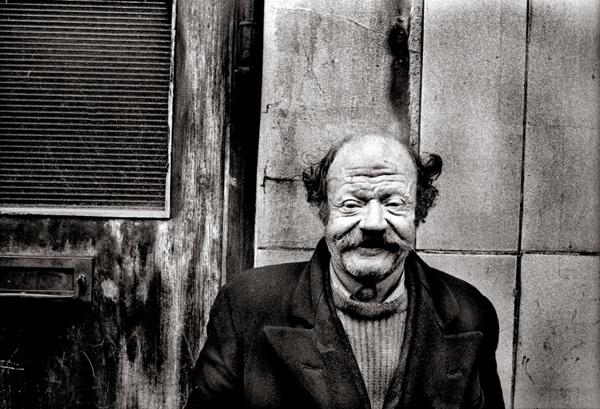
THE SMILE, E2 1962. -“He said, ‘Would you like me to smile?’ He was probably not long for this world, but he was very happy.”

IN THE BAR, E14 1964. -“I’d just got engaged to my first wife and she was one of my ex-mother-in-law’s friends. Full of life!”

THROUGH THE GLASS, E1 1982. -“I think the guy was standing at the cigarette machine.”

THE CALL, E16 1982. -“Terry Lawless’ boxing gym was above this pub. It looks as if everything is collapsing and cracking, and the shadows look like blood pouring from above.”

WHITE SWAN, E14 1982

LIGHT ALE, 1976 -“Four cans of light ale and he was completely out of it.”

CLOSED DOWN, Brick Lane 1982.
Photographs copyright © John Claridge
You may also like to take a look at


