
Hopping Photographs
Next tickets available for my walking tour are on Sunday 21st August
Click here to book for THE GENTLE AUTHOR’S TOUR OF SPITALFIELDS
This selection of hop picking photographs is from the archive of Tower Hamlets Community Housing. Traditionally, this was the time when East Enders headed down to the Hop Farms of Kent & Sussex, embracing the opportunity of a breath of country air and earning a few bob too.

Bill Brownlow, Margie Brownlow, Terry Brownlow & Kate Milchard, with Keith Brownlow & Kevin Locke in front, at Guinness’ Northland’s Farm at Bodiam, Sussex, in 1958. Guinness bought land at Bodiam in 1905 and eight hundred acres were devoted to hop growing at its peak.

Julie Mason, Ted Hart, Edward Hart & friends at Hoathleys Farm, Hook Green, near Lamberhurst, Kent

Lou Osbourn, Derek Protheroe & Kate Day at Goudhurst Farm

Margie Brownlow & Charlie Brownlow with Keith Brownlow, Kate Milchard & Terry Brownlow in front at Guinness’ Northland’s Farm at Bodiam, Sussex, in 1950

Mr & Mrs Gallagher with Kitty Adams & Jackie Gallagher from Westport St, Stepney, in the hop gardens at Pembles Farm, Five Oak Green, Kent in 1959

Jackie Harrop, Joan Day & George Rogers at Whitbread’s Farm, Beltring, Kent in 1949

Mag Day (on the left at the back) in the hop gardens with others at Highwood’s Farm, Collier St, in 1938

Pop Harrop at Whitbread’s Farm, Beltring, Kent in 1949

Sarah Watt, Mrs Hopkins, Steven Allen, Ann Allen, Tom, Albert Allen & Sally Watt in the hop gardens at Jack Thompsett’s Den Farm, Collier St, Kent in 1943

Harry Watt, Tom Shuffle, Mary Shuffle, Sally Watt, Julie Callagher, Ada Watt & Sarah Watt in the hop gardens at Jack Thompsett’s Den Farm, Collier St, Kent in the fifties

Harry Watt, Sally Watt, Sarah Watt holding Terry Ellames in the hop gardens at Jack Thompsett’s Den Farm, Collier St, Kent in 1957

Harry Ayres, a pole puller, in the hop gardens at Diamond Place Farm, Nettlestead, Kent

Emmie Rist, Theresa Webber, Kit Webber & Eileen Ayres in the hop gardens at Diamond Place Farm, Nettlestead, Kent

Kit Webber with her Aunt Mary, her Dad Sam Webber and her Mum, Emmie Ris,t in the hop gardens at Diamond Place Farm, Nettlestead, Kent

Harry Ayres with his wife Kit Webber in the hop gardens at Diamond Place Farm, Nettlestead, Kent.

Richard Pyburn, Mag Day, Patty Seach and Kitty Gray from Kirks Place, Limehouse, in the hop gardens at Highwoods Farm, Collier St, Kent

The Gorst and Webber families at Jack Thompsett’s Farm, Fowle Hall, Kent in the forties

Kitty Waters with sons Terry & John outside the huts at Pembles Farm, Five Oak Green, Kent in 1952

Mr & Mrs Gallagher from Westport St, Stepney, with their grandchildren in the hop gardens at Pembles Farm, Five Oak Green, Kent in 1958

Sybil Ogden, Doris Cossey, Danny Tyrrell & Sally Hawes near Yalding, Kent

John Doree, Alice Thomas, Celia Doree & Mavis Doree in the hop gardens near Cranbrook, Kent

Bill Thomas & his wife Annie, in the hop gardens near Cranbrook, Kent

The Castleman Family from Poplar hop picking in the twenties

Terry & Margie Brownlow at Guinness’ Northland’s Farm at Bodiam in Sussex in 1949

Alfie Raines, Johnny Raines, Charlie Cushway, Les Benjamin & Tommy Webber in the Hop Gardens at Jack Thompsett’s Farm at Fowl Hall near Paddock Wood in Kent

Lal Outram, Wag Outram & Mary Day on the common at Jack Thompsett’s Farm at Fowl Hall near Paddock Wood in Kent in 1955

Taken in September 1958 at Moat Farm, Five Oak Green, Kent. Sitting on the bin is Miss Whitby with Patrick Mahoney, young John Mahoney and Sheila Tarling (now Mahoney) – Sheila & Patrick were picking to save up for their engagement party in October

Maryann Lowry’s Nan, Maggie ,on the left with her Great-Grandmother, Maryann, in the check shirt in the hop gardens, c.1910

Having a rest in hop gardens at Whitbread’s Farm, Beltring, Kent in 1966. In the back row are Mary Brownlow, Sean Locke, Linda Locke, Kate Milchard, Chris Locke & Margie Brownlow with Kevin Locke and Terry Locke in front.

Margie Brownlow & her Mum Kate Milchard at Whitbreads Farm in Beltring, Kent in 1967. These huts were two stories high. The children playing outside are – Timmy Kaylor, Chrissy Locke, Terry Locke, Sean Locke, Linda Locke & Kevin Locke.

Chris Locke, Sally Brownlow, Linda Brownlow, Kate Milchard, Margie Brownlow, Terry Locke & Mary Brownlow at Whitbread’s Farm, Beltring, Kent in 1962

Johnno Mahoney, Superintendant of the Caretakers on the Bancroft Estate in Stepney, driving the “Mahoney Special” at Five Oak Green in 1947

The Clarkson family in the hop gardens in Staplehurst. Gladys Clarkson , Edith Clarkson, William Clarkson, Rose Clarkson & Henry Norris.

John Moore, Ross, Janet Ambler, Maureen Irish & Dennis Mortimer in 1950 at Luck’s Farm, East Peckham, Kent

Kate Fairclough, Mrs Callaghan, Mary Fairclough & Iris Fairclough at Moat Farm, Five Oak Green, Kent in 1972

A gang of Hoppers from Wapping outside the brick huts at Stilstead Farm, Tonbridge, Kent with Jim Tuck & John James in the back. In the middle row the first person on the left is unknown, but the others are Rose Tuck, holding Terry Tuck, Rose Tuck, Danny Tuck & Nell Jenkins. In the front are Alan Jenkins, Brian Tuck, Pat Tuck, Jean Tuck, Terry Taylor & Brian Taylor.

Nanny Barnes, Harriet Hefflin, “Minie” Mahoney & Patsy Mahoney at Ploggs Hall Farm

In the Hop Gardens at Jack Thompsett’s Farm at Fowl Hall, near Paddock Wood in Kent in the late forties. Alfie Raines, Edie Cooper, Margie Gorst & Lizzie Raines

The Day family from Kirks Place, Limehouse, at Highwoods Farm in Collier St, Kent in the fifties

Annie Smith, Bill Daniels, Pearl Brown & Nell Daniels waiting for the measurer in the Hop Garden at Hoathley’s Farm, Hook Green, Kent

On the common outside the huts at at Hoathley’s Farm, Hook Green, Kent – you can see the oasthouses in the distance. Rita Daniels, Colleen Brown, Maureen Brown, Marie Brown, Billy Daniels, Gerald Brown & Teddy Hart , with Sylvie Mason & Pearlie Brown standing.

The Outram family from Arbour Sq outside their huts at Hubbles Farm, Hunton, Kent. Unusually these were detached huts but, like all the others, they made of corrugated tin and all had one small window – simply basic rooms, roughly eleven feet square

Janis Randall being held by her mother Joyce Lee andalongside her is her father, Alfred Lee in a hop garden, near Faversham in September 1950

David & Vivian Lee sitting on a log on the common outside Nissen huts used to house hop pickers

Gerald Brown, Billy Daniels & Dennis Woodham in the hop gardens at Gatehouse Farm near Brenchley, Kent, in the fifties

Nelly Jones from St Paul’s Way with Eileen Mahoney, and in the background is Eileen’s mum, “Minie” Mahoney. Taken in the fifties in the Hop Gardens at Ploggs Hall Farm, between Paddock Wood and Five Oak Green.

At Jack Thompsett’s Farm at Fowl Hall, near Paddock Wood in Kent

Ploggs Hall Farm Ladies Football Team. Back Row – Fred Archer, Lil Callaghan, Harriet Jones, Unknown, Unknown, Nanny Barnes, Liz Weeks, Harriet Hefflin, Johnno Mahoney. Front Row – Doris Hurst Eileen Mahoney & Nellie Jones

John Moore, Ross, Janet Ambler, Maureen Irish & Dennis Mortimer in 1950 at Luck’s Farm, East Peckham, Kent

The Outram and Pyburn families outside a Kent pub in 1957, showing clockwise Kitty Tyrrell, Mary Pyburn, Charlie Protheroe, Rene Protheroe, Wag Outram, Derek Protheroe in the pram, Annie Lazel, Tom Pyburn, Bill Dignum & Nancy Wright.

Sally Watt’s Hop Picker’s account book from Jack Thompsett’s Den Farm, Collier St, Kent in the fifties

Tony Hall, Photographer
Next tickets available for my walking tour are on Sunday 21st August
Click here to book for THE GENTLE AUTHOR’S TOUR OF SPITALFIELDS

Bonner St, Bethnal Green
Tony Hall (1936-2008) would not have described himself as a photographer – his life’s work was that of a graphic designer, political cartoonist and illustrator. Yet, on the basis of the legacy of around a thousand photographs that he took, he was unquestionably a photographer, blessed with a natural empathy for his subjects and possessing a bold aesthetic sensibility too.
Tony’s wife Libby Hall, known as a collector of dog photography, revisited her husband’s photographs before giving them to the Bishopsgate Institute where they are held in the archive permanently. “It was an extraordinary experience because there were many that I had never seen before and I wanted to ask him about them.” Libby confessed to me, “I noticed Tony reflected in the glass of J.Barker, the butcher’s shop, and then to my surprise I saw myself standing next to him.”
“I was often with him but, from the mid-sixties to the early seventies, he worked shifts and wandered around taking photographs on weekday afternoons,” she reflected, “He loved roaming in the East End and photographing it.”
Born in Ealing, Tony Hall studied painting at the Royal College of Art under Ruskin Spear. But although he quickly acquired a reputation as a talented portrait painter, he chose to reject the medium, deciding that he did not want to create pictures which could only be afforded by the wealthy, turning his abilities instead towards graphic works that could be mass-produced for a wider audience.
Originally from New York, Libby met Tony when she went to work at a printers in Cowcross St, Clerkenwell, where he was employed as a graphic artist. “The boss was member of the Communist Party yet he resented it when we tried to start a union and he was always running out of money to pay our wages, giving us ‘subs’ bit by bit.” she recalled with fond indignation, “I was supposed to manage the office and type things, but the place was such a mess that the typewriter was on top of a filing cabinet and they expected me to type standing up. There were twelve of us working there and we did mail order catalogues. Tony and the others used to compete to see who could get the most appalling designs into the catalogues.”
“Then Tony went to work for the Evening News as a newspaper artist on Fleet St and I joined the Morning Star as a press photographer.” Libby continued,” I remember he refused to draw a graphic of a black man as a mugger and, when the High Wizard of the Klu Klux Klan came to London, Tony draw a little ice cream badge onto his uniform on the photograph and it was published!” After the Evening News, Tony worked at The Sun until the move to Wapping, using this opportunity of short shifts to develop his career as a graphic artist by drawing weekly cartoons for the Labour Herald.
This was the moment when Tony also had the time to pursue his photography, recording an affectionate chronicle of the daily life of the East End where he lived from 1960 until the end of his life – first in Barbauld Rd, Stoke Newington, then in Nevill Rd above a butchers shop, before making a home with Libby in 1967 at Ickburgh Rd, Clapton. “It is the England I first loved …” Libby confided, surveying Tony’s pictures that record his tender personal vision for perpetuity,”… the smell of tobacco, wet tweed and coal fires.”
“He’d say to me sometimes, ‘I must do something with those photographs,'” Libby told me, which makes it a special delight to publish Tony Hall’s pictures.

Children with their bonfire for Guy Fawkes


In the Hackney Rd

“I love the way these women are looking at Tony in this picture, they’re looking at him with such trust – it’s the way he’s made them feel. He would have been in his early thirties then.”


On the Regent’s Canal near Grove Rd


On Globe Rd

In Old Montague St

In Old Montague St

In Club Row Market

On the Roman Rd


In Ridley Rd Market

In Ridley Rd Market

In Artillery Lane, Spitalfields

 Tony & Libby Hall in Cheshire St
Photographs copyright © Libby Hall
Images Courtesy of the Tony Hall Archive at the Bishopsgate Institute
Libby Hall & I would be delighted if any readers can assist in identifying the locations and subjects of Tony Hall’s photographs.
You may also like to read
Whistler In The East End
Next tickets available for my walking tour are on Sunday 21st August
Click here to book for THE GENTLE AUTHOR’S TOUR OF SPITALFIELDS

William Jones, Limeburner, Wapping High St
American-born artist, James Abbott McNeill Whistler, was the first artist to appreciate the utilitarian environment of the East End on its own terms, seeing the beauty in it and recognising the intimate relationship of the working people to the urban landscape they had constructed.
He was only twenty-five when he arrived in London from Paris in the summer of 1859 and, rejecting the opportunity of staying with his half-sister in Sloane St, he took up lodgings in Wapping instead. Influenced by Charles Baudelaire to pursue subjects from modern life and seek beauty among the working people of the teeming city, Whistler lived among the longshoremen, dockers, watermen and lightermen who inhabited the riverside, frequenting the pubs where they ate and drank.
The revelatory etchings that he created at this time, capturing an entire lost world of ramshackle wooden wharfs, jetties, warehouses, docks and yards. Rowing back and forth, the young artist spent weeks in August and September of 1859 upon the Thames capturing the minutiae of the riverside scene within expansive compositions, often featuring distinctive portraits of the men who worked there in the foreground.
The print of the Limeburner’s yard above frames a deep perspective looking from Wapping High St to the Thames, through a sequence of sheds and lean-tos with a light-filled yard between. A man in a cap and waistcoat with lapels stands in the pool of sunshine beside a large sieve while another figure sits in shadow beyond, outlined by the light upon the river. Such an intriguing combination of characters within an authentically-rendered dramatic environment evokes the writing of Charles Dickens, Whistler’s contemporary who shared an equal fascination with this riverside world east of the Tower.
Whistler was to make London his home, living for many years beside the Thames in Chelsea, and the river proved to be an enduring source of inspiration throughout a long career of aesthetic experimentation in painting and print-making. Yet these copper-plate etchings executed during his first months in the city remain my favourites among all his works. Each time I have returned to them over the years, they startle me with their clarity of vision, breathtaking quality of line and keen attention to modest detail.

Limehouse and The Grapes – the curved river frontage can be recognised today

The Pool of London
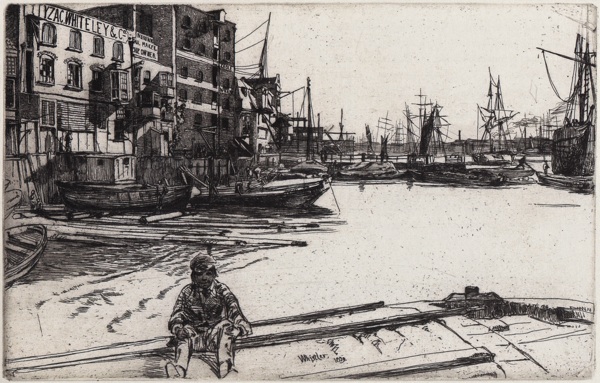
Eagle Wharf, Wapping

Billingsgate Market

Longshore Men

Thames Police, Wapping

Black Lion Wharf, Wapping

Looking towards Wapping from the Angel Inn, Bermondsey
You may also like to read about
Dickens in Shadwell & Limehouse
Madge Darby, Historian of Wapping
Ricardo Cinalli, Artist
Tickets are available for my walking tour now
Click here to book for THE GENTLE AUTHOR’S TOUR OF SPITALFIELDS

Portrait by Lucinda Douglas Menzies
When artist Ricardo Cinalli graduated from the University of Rosario in Argentina, a mentor offered to introduce him to Salvador Dali, if Ricardo was prepared to travel to London. In 1973, travelling by boat across the Atlantic to Barcelona in anticipation of encountering his hero, Ricardo was unfortunately delayed by two whole weeks and when he arrived in London, Dali was gone – but instead he discovered a whole new life.
At a party, Ricardo met Eric Elstob who was buying a house in Fournier St, opening the door to a surreal world of an entirely different nature. “We came to Spitalfields on a very depressing day. My God, it was a dump! I said to Eric, ‘Are you crazy?’ It was overwhelming – the market, the rats, the prostitutes and the meths drinkers outside the house. And the minute he opened the door I could see the place was in a horrible condition. But Eric explained to me to the history of the Huguenots, and the bells in the church rang and suddenly I understood the magic. He said to me, ‘You are invited to join my life’s project to restore this house.’ I had nothing to lose, so I said ‘Yes.’ He was a brave man to want to come and live here when no-one was interested. We had no money, we did all the work ourselves.”
Sitting comfortably in a green leather chair rescued from the Market Cafe, Ricardo spoke lyrically about his memorable introduction to Spitalfields, now these Herculean labours are safely in the past. It was an era when an imaginative few first recognised the beauty in the neglected houses and set about restoring them by their own labours, as Ricardo and Eric did at 14 Fournier St, taking seven years to bring it to conclusion.“It was a very exciting time, but for a person like myself it was very difficult, because I wasn’t used to this kind of dereliction, I was brought up in a house with ceilings and floors. We restored these houses with our own hands. Gilbert & George next door, they restored the panels one by one personally. To me it was unthinkable that I could do that, I was a painter, an artist. I came from a petit bourgeois background where you get someone else to do it. Yet I really had a fantastic time – it was horrible sometimes but there were moments of great joy too. And in the process I learnt something of the history of old London.”
After pausing to collect his thoughts silently,“I did that,” said Ricardo philosophically, gesturing towards Fournier St,” and then I did this,” he continued, referring to the house in Puma Court where he lives today. “And then I said, ‘Enough is enough!'”, he added, adopting the understated heroic tone of a Roman emperor reflecting on past victories, a role that suits his gracious nature and venerable Latin features perfectly.
Until this week, I only knew Ricardo Cinalli from his portrait on one of Simon Pettet’s tiles at Dennis Severs’ House, so I was exhilarated to walk into his five metre by five metre cube studio, dug into the ground beneath his narrow old house in Puma Court, complete with a glass pyramid ceiling looking up towards the lofty spire of Christ Church, Spitalfields. With supreme politesse, Ricardo opened the panel set into the floor of the studio to show me all the proud artefacts he found in the construction of his studio, which are preserved there.
As he dug down, Ricardo realised he was excavating a rubbish dump, with broken ceramics stretching from the sixteenth to the nineteeth century, innumerable oyster shells and clay pipes, rollers used by men in the eighteenth century to curl their wigs and even a pot of perfume with an address in Paris – once belonging to one of those Huguenot weavers that Eric Elstob first told Ricardo about, so many years before.
Working in his Spitalfields studio, Ricardo creates spirited and passionate paintings that are Baroque in their emotionalism and Surrealist in their imaginative extravagance. Over a career spanning more than forty years, he has become internationally renowned for his works on canvas, his huge pastel drawings, his theatre designs and his murals which include a vast fresco in a cathedral in Umbria and now his magnum opus – more than five years in the making – a giant fresco covering all the walls of a custom-built edifice in Punta del Este in Uruguay. An Argentinian of Italian descent, with his modest manners and ambitious paintings, Ricardo convincingly incarnates the spirit of his Renaissance predecessors in the art of fresco.
Ricardo led me from his minimalist studio into the tiny old house balanced on top of it. We ascended a narrow staircase with trompe l’oeil panelling into a living room lined with wooden panelling rescued from the former synagogue in Fournier St. Each floor comprises just one room and on the next storey is Ricardo’s bedroom and bathroom, all in one space, with every surface painted with classical designs. Finally, we reached the kitchen under the eaves with windows on both sides – like the foc’sle of a ship – allowing us exciting views in both directions over the roofscape of Spitalfields.
As we drank our tea quietly, gazing up from the kitchen window to the spire that overshadows the house, Ricardo told me the story of how his cat “Dolce” went missing when he was living in Fournier St, while the church was being renovated. One still moonlit night, Ricardo heard a distant “miaow” coming from on high. Cats will always climb upwards, and Dolce was found at last, stuck at the top of the spire.
“Spitalfields has some magic element, don’t you think?” Ricardo proposed delicately with a sympathetic smile, casting his deep brown eyes contemplatively upwards to Hawksmoor’s bizarre edifice looming over us. Seeing it through Ricardo’s eyes, from his sunlit painted kitchen, at the top of this narrow house, perched above his extraordinary cube studio with the pyramid on the roof, it was only natural to agree.
Ricardo Cinalli never met Salvador Dali but he found his own magic instead, here in Spitalfields.

In Ricardo Cinalli’s giant mural-in-progress in Uruguay, entitled “Humanistic Homage to the Millennium,” the figures are eight metres high. Click on this image to enlarge.
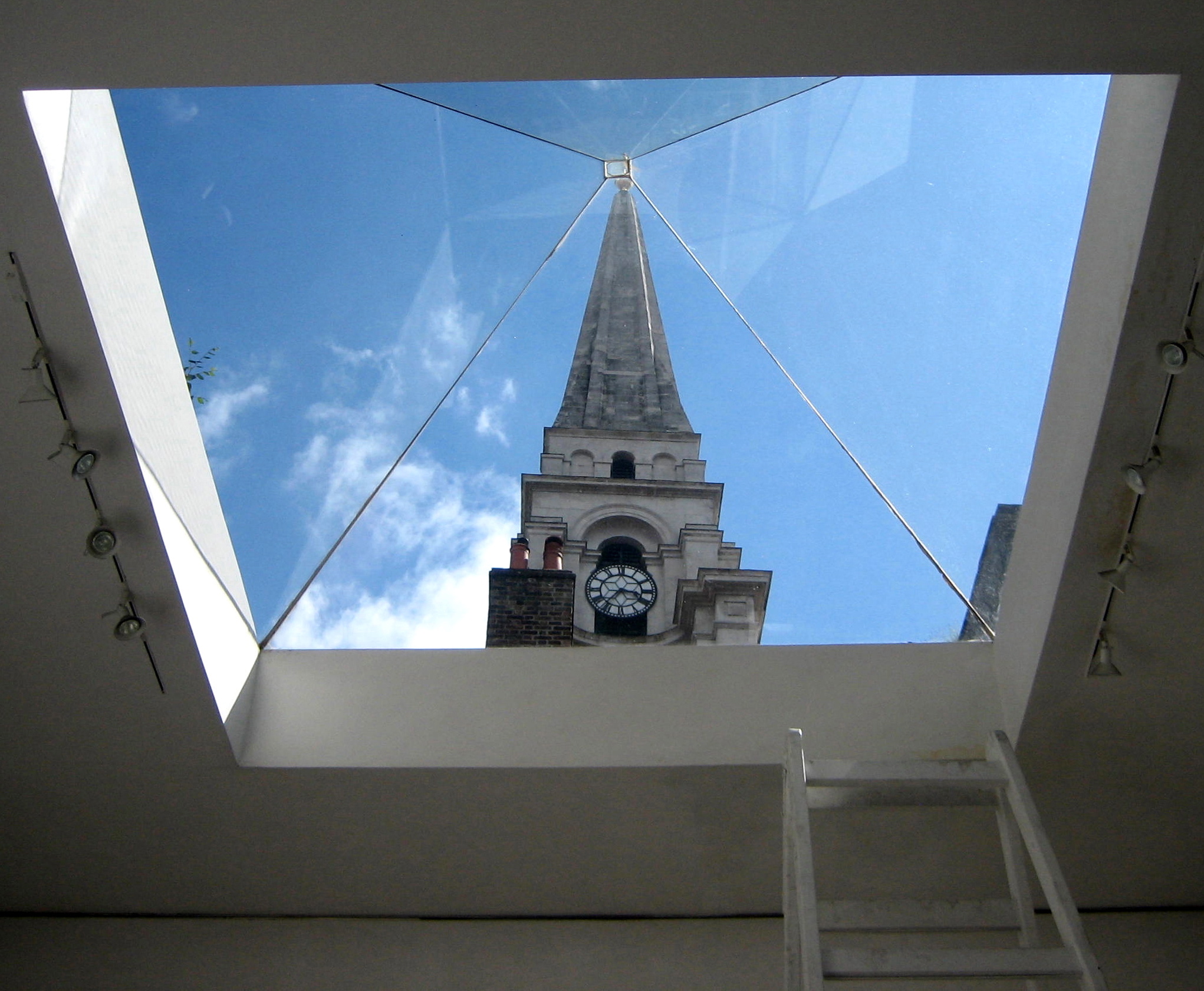
The glass pyramid on the roof of Ricardo Cinalli’s Spitalfields studio.

Banana boxes that are souvenirs of the seven years Ricardo spent restoring 14 Fournier St.

Finds discovered while digging the hole for the studio. Note the eighteenth century clay curlers for men’s wigs and the Huguenot perfume pot from Paris.

Looking towards Fournier St from the rear of Puma Court.
Watermen’s Stairs
Tickets are available for my tour from next Saturday
Click here to book for THE GENTLE AUTHOR’S TOUR OF SPITALFIELDS

Wapping Old Stairs
I need to keep reminding myself of the river. Rarely a week goes by without some purpose to go down there but, if no such reason occurs, I often take a walk simply to pay my respects to the Thames. Even as you descend from the Highway into Wapping, you sense a change of atmosphere when you enter the former marshlands that remain susceptible to fog and mist on winter mornings. Yet the river does not declare itself at first, on account of the long wall of old warehouses that line the shore, blocking the view of the water from Wapping High St.
The feeling here is like being offstage in a great theatre and walking in the shadowy wing space while the bright lights and main events take place nearby. Fortunately, there are alleys leading between the tall warehouses which deliver you to the waterfront staircases where you may gaze upon the vast spectacle of the Thames, like an interloper in the backstage peeping round the scenery at the action. There is a compelling magnetism drawing you down these dark passages, without ever knowing precisely what you will find, since the water level rises and falls by seven metres every day – you may equally discover waves lapping at the foot of the stairs or you may descend onto an expansive beach.
These were once Watermen’s Stairs, where passengers might get picked up or dropped off, seeking transport across or along the Thames. Just as taxi drivers of contemporary London learn the Knowledge, Watermen once knew the all the names and order of the hundreds of stairs that lined the banks of the Thames, of which only a handful survive today.
Arriving in Wapping by crossing the bridge in Old Gravel Lane, I come first to the Prospect of Whitby where a narrow passage to the right leads to Pelican Stairs. Centuries ago, the Prospect was known as the Pelican, giving its name to the stairs which have retained their name irrespective of the changing identity of the pub. These worn stone steps connect to a slippery wooden stair leading to wide beach at low tide where you may enjoy impressive views towards the Isle of Dogs.
West of here is New Crane Stairs and then, at the side of Wapping Station, another passage leads you to Wapping Dock Stairs. Further down the High St, opposite the entrance to Brewhouse Lane, is a passageway leading to a fiercely-guarded pier, known as King Henry’s Stairs – though John Roque’s map of 1746 labels this as the notorious Execution Dock Stairs. Continue west and round the side of the river police station, you discover Wapping Police Stairs in a strategic state of disrepair and beyond, in the park, is Wapping New Stairs.
It is a curious pilgrimage, but when you visit each of these stairs you are visiting another time – when these were the main entry and exit points into Wapping. The highlight is undoubtedly Wapping Old Stairs with its magnificently weathered stone staircase abutting the Town of Ramsgate and offering magnificent views to Tower Bridge from the beach. If you are walking further towards the Tower, Aldermans’ Stairs is worth venturing at low tide when a fragment of ancient stone causeway is revealed, permitting passengers to embark and disembark from vessels without wading through Thames mud.

Pelican Stairs

Pelican Stairs at night

View into the Prospect of Whitby from Pelican Stairs

New Crane Stairs

Wapping Dock Stairs

Execution Dock Stairs, now known as King Henry’s Stairs

Entrance to Wapping Police Stairs

Wapping Police Stairs

Metropolitan Police Service Warning: These stairs are unsafe!

Wapping New Stairs with Rotherithe Church in the distance

Light in Wapping High St

Wapping Pier Head

Entrance to Wapping Old Stairs

Wapping Old Stairs

Passageway to Wapping Old Stairs at night

Aldermans’ Stairs, St Katharine’s Way
You may also like to read about
Madge Darby, Historian of Wapping
Chris Miles’ East End
Tickets are available for my tour from next Saturday
Click here to book for THE GENTLE AUTHOR’S TOUR OF SPITALFIELDS

Chris Miles contacted me from Vancouver Island, where he describes himself as a Londoner in exile. ‘In the early seventies, I lived as a recently-graduated student in the East End, firstly on Grove Rd and then on Lauriston Rd above a supermarket,’ he explained and sent me his splendid photographs. Most were taken around Bethnal Green, Roman Rd and Mile End, and Chris & I welcome identification of precise locations from eagle-eyed readers.

George Davis is Innocent, Mile End Rd

Linda ‘n Laura

Getting a loaf, Stepney Green

S Kornbloom, Newsagent & Confectioner, Jubilee St

Corner Shop Groceries & Provisions, Stepney Way

Ronchetti’s Cafe, Piano’s & Kitchen Chairs Wanted

Snacks & Grills

The Bell Dining Rooms, Lot 63 Buildings at back

Leslies Restaurant, Fresh Up with your Meal

Harry’s Cafe, Teas & Snacks, Breakfasts & Dinners

Valente’s Cafe, Hackney Rd

Cafe Restaurant

Dinkie

Station Cafe

Fish Bar

J Kelly, No Prams or Trollie’s, Please

G Kelly

Charlie & Mick’s Cafe

Menu at Charlie & Mick’s Cafe

John Pelican

Joe’s Saloon – ‘We cater for long and short hair styles’

M Evans & Sons, Garn Dairy

Marion’s, Blouses, Trouser Suits, Smock Dresses, Ect.

Sunset Stores

N Berg, Watch & Clock Repairs


S Grant, High Class Tailor, Seamens Outfitter

Littlewood Brothers Ltd, Domestic Stores, Grocery & Hardware

J Galley & Sons, Established 1901

Henry Freund & Son, Established 1837

Rito for Better Roof Repairs

Common Market NO

Alan Enterprises Ltd, L & R Ostroff Ltd, Brick Lane

Photographs copyright © Chris Miles
You may also like to take a look at
At Walthamstow Pump House
Tickets are available for my tour from next Saturday
Click here to book your ticket for THE GENTLE AUTHOR’S TOUR OF SPITALFIELDS

Tiggy, the Pump House cat
What could be a more appealing excursion in these balmy summer days than a trip to a sewage pumping station in Walthamstow?
Although I would not claim to any special interest in mechanical things, I was astonished and delighted by the mind-boggling collection of pumps, engines, trains, buses, fire engines, steam rollers, cranes, historic domestic appliances and model railways to be discovered here.
Unfortunately when the suburban streets of Walthamstow grew up and spread across the fields, all the sewage ran downhill and accumulated in the Lee Valley. Undeterred, the Victorians installed massive engines driven by steam power to ensure that their magnificent drainage system kept the effluvium flowing smoothly. So efficient were these sewage pumps, manufactured by William Marshall Sons & Co, that they ran continuously from 1885 for over ninety years until steam power was replaced by electricity in the nineteen-seventies.
At this point, the historic machinery might have been lost forever if a group of local visionaries had not stepped in to cherish the pumps, engines and boilers. One of these far-sighted enthusiasts was Melvin Mantell who took me on a personal tour of some of the highlights of the pump house collection and explained how it all came about.
“For years, I knew Big Dave the heavyweight boxer who ran the greengrocer underneath the railway bridge in Leyton High Rd. One night his wife, an enormous woman, rang me up to ask ‘Are you coming down to the farm to have a look at the engines?’ I thought, ‘What the hell is she on about?’ but I knew she worked for the council at the depot where the rubbish was dumped. She said, ‘The old pump house has got steam engines in it.’ All the years I had been going there with my dad, dumping rubbish and seeing the building but ignoring it. She said, ‘We’re having an open day, would you like to visit?’
Me and a few others, we decided to come down on Thursday evenings and take care of the engines. We were known as the ‘Friends of the Pump House.’ At first, we were just cleaning off the rust with a Brillo pad and some oil, but my dad and old Reggie Watlings, the surface grinder who has been dead a long while, they restored the engines. We stripped them down and rebuilt them completely. Now we come down here every Tuesday, Thursday and Sunday during the day. We love everything about this place. We are open every Sunday for visitors free of charge and we get a lot of visitors coming in. It is quite staggering.”
What makes this museum so charismatic is that it has been accumulated by enthusiasts rather than organised for any didactic purpose and it was my pleasure to spend a morning with the small band of volunteers who tend to it each week. Cramming all these objects into a cabinet of wonders emphasises a joyous delight in human ingenuity as expressed through mechanical contrivances of all kinds. If you are seeking a celebration of the East End’s heritage of industry and technological innovation, this is the place.

Melvin Mantell – “I was born in Brewster Rd in Leyton in 1947 and I still live in that house today. I started work in 1969 in a builders’ merchants and then I went into the trade doing carpentry work, which I had learnt at school, staying on to get qualifications. Carpentry is my thing, including woodturning, and I have made furniture and cabinets.”


Sid Bell works in restoration of artefacts. ‘I was born in Forest Gate and my first job was at Nonpareil Engineering in Walthamstow. When I was fifteen then I went into making hydraulic motors of cast iron used in the construction of the Victoria Line. They could not have sparks down there because of the risk of explosion so engines were driven by oil pressure. I have built railway engines and made all the parts myself. Nowadays, I am retired and I help old people out in their gardens, and I am here three days a week. I made all these displays and organised the tools.’

In the Pump House

Entrance to the Pump House

Tube trains under repair

Abdul Seba is the IT manager and works on the restoration of trains

Melvin with a favourite bus from his collection

Steam roller

Historic domestic appliances

Walthamstow in miniature

A model of Walthamstow Station

A model of Liverpool St Station

Mozz Blunden, company secretary, location manager, painter, canteen manager and toilet cleaner


