
The Return Of The Gentle Author’s Writing Course
So many people have asked if I will be teaching another writing course that I have chosen to acquiesce to popular demand …

HOW TO WRITE A BLOG THAT PEOPLE WILL WANT TO READ: 12th-13th November 2022
Spend a weekend in an eighteenth century weaver’s house in Spitalfields and learn how to write a blog with The Gentle Author.
This course is suitable for writers of all levels of experience – from complete beginners to those who already have a blog and want to advance.
We will examine the essential questions which need to be addressed if you wish to write a blog that people will want to read.
“Like those writers in fourteenth century Florence who discovered the sonnet but did not quite know what to do with it, we are presented with the new literary medium of the blog – which has quickly become omnipresent, with many millions writing online. For my own part, I respect this nascent literary form by seeking to explore its own unique qualities and potential.” – The Gentle Author
COURSE STRUCTURE
1. How to find a voice – When you write, who are you writing to and what is your relationship with the reader?
2. How to find a subject – Why is it necessary to write and what do you have to tell?
3. How to find the form – What is the ideal manifestation of your material and how can a good structure give you momentum?
4. The relationship of pictures and words – Which comes first, the pictures or the words? Creating a dynamic relationship between your text and images.
5. How to write a pen portrait – Drawing on The Gentle Author’s experience, different strategies in transforming a conversation into an effective written evocation of a personality.
6. What a blog can do – A consideration of how telling stories on the internet can affect the temporal world.
SALIENT DETAILS
Courses will be held at 5 Fournier St, Spitalfields on 12th-13th November, running from 10am-5pm on Saturday and 11am-5pm on Sunday.
Lunch will be catered by Harry Thomas and tea, coffee & cakes by the Townhouse are included within the course fee of £300.
Email spitalfieldslife@gmail.com to book a place on a course.

Comments by students from courses tutored by The Gentle Author
“I highly recommend this creative, challenging and most inspiring course. The Gentle Author gave me the confidence to find my voice and just go for it!”
“Do join The Gentle Author on this Blogging Course in Spitalfields. It’s as much about learning/ appreciating Storytelling as Blogging. About developing how to write or talk to your readers in your own unique way. It’s also an opportunity to “test” your ideas in an encouraging and inspirational environment. Go and enjoy – I’d happily do it all again!”
“The Gentle Author’s writing course strikes the right balance between addressing the creative act of blogging and the practical tips needed to turn a concept into reality. During the course the participants are encouraged to share and develop their ideas in a safe yet stimulating environment. A great course for those who need that final (gentle) push!”
“I haven’t enjoyed a weekend so much for a long time. The disparate participants with different experiences and aspirations rapidly became a coherent group under The Gentle Author’s direction in a gorgeous house in Spitalfields. There was lots of encouragement, constructive criticism, laughter and very good lunches. With not a computer in sight, I found it really enjoyable to draft pieces of written work using pen and paper.Having gone with a very vague idea about what I might do I came away with a clear plan which I think will be achievable and worthwhile.”
“The Gentle Author is a master blogger and, happily for us, prepared to pass on skills. This “How to write a blog” course goes well beyond offering information about how to start blogging – it helps you to see the world in a different light, and inspires you to blog about it. You won’t find a better way to spend your time or money if you’re considering starting a blog.”
“I gladly traveled from the States to Spitalfields for the How to Write a Blog Course. The unique setting and quality of the Gentle Author’s own writing persuaded me and I was not disappointed. The weekend provided ample inspiration, like-minded fellowship, and practical steps to immediately launch a blog that one could be proud of. I’m so thankful to have attended.”
“I took part in The Gentle Author’s blogging course for a variety of reasons: I’ve followed Spitalfields Life for a long time now, and find it one of the most engaging blogs that I know; I also wanted to develop my own personal blog in a way that people will actually read, and that genuinely represents my own voice. The course was wonderful. Challenging, certainly, but I came away with new confidence that I can write in an engaging way, and to a self-imposed schedule. The setting in Fournier St was both lovely and sympathetic to the purpose of the course. A further unexpected pleasure was the variety of other bloggers who attended: each one had a very personal take on where they wanted their blogs to go, and brought with them an amazing range and depth of personal experience. “
“I found this bloggers course was a true revelation as it helped me find my own voice and gave me the courage to express my thoughts without restriction. As a result I launched my professional blog and improved my photography blog. I would highly recommend it.”
“An excellent and enjoyable weekend: informative, encouraging and challenging. The Gentle Author was generous throughout in sharing knowledge, ideas and experience and sensitively ensured we each felt equipped to start out. Thanks again for the weekend. I keep quoting you to myself.”
“My immediate impression was that I wasn’t going to feel intimidated – always a good sign on these occasions. The Gentle Author worked hard to help us to find our true voice, and the contributions from other students were useful too. Importantly, it didn’t feel like a ‘workshop’ and I left looking forward to writing my blog.”
“The Spitafields writing course was a wonderful experience all round. A truly creative teacher as informed and interesting as the blogs would suggest. An added bonus was the eclectic mix of eager students from all walks of life willing to share their passion and life stories. Bloomin’ marvellous grub too boot.”
“An entertaining and creative approach that reduces fears and expands thought”
“The weekend I spent taking your course in Spitalfields was a springboard one for me. I had identified writing a blog as something I could probably do – but actually doing it was something different! Your teaching methods were fascinating, and I learnt a lot about myself as well as gaining very constructive advice on how to write a blog. I lucked into a group of extremely interesting people in our workshop, and to be cocooned in the beautiful old Spitalfields house for a whole weekend, and plied with delicious food at lunchtime made for a weekend as enjoyable as it was satisfying. Your course made the difference between thinking about writing a blog, and actually writing it.”
“After blogging for three years, I attended The Gentle Author’s Blogging Course. What changed was my focus on specific topics, more pictures, more frequency, more fun. In the summer I wrote more than forty blogs, almost daily from my Tuscan villa on village life and I had brilliant feedback from my readers. And it was a fantastic weekend with a bunch of great people and yummy food.”
“An inspirational weekend, digging deep with lots of laughter and emotion, alongside practical insights and learning from across the group – and of course overall a delightfully gentle weekend.”
“The course was great fun and very informative, digging into the nuts and bolts of writing a blog. There was an encouraging and nurturing atmosphere that made me think that I too could learn to write a blog that people might want to read. – There’s a blurb, but of course what I really want to say is that my blog changed my life, without sounding like an idiot. The people that I met in the course were all interesting people, including yourself. So thanks for everything.”
“This is a very person-centred course. By the end of the weekend, everyone had developed their own ideas through a mix of exercises, conversation and one-to-one feedback. The beautiful Hugenot house and high-calibre food contributed to what was an inspiring and memorable weekend.”
“It was very intimate writing course that was based on the skills of writing. The Gentle Author was a superb teacher.”
“It was a surprising course that challenged and provoked the group in a beautiful supportive intimate way and I am so thankful for coming on it.”
“I did not enrol on the course because I had a blog in mind, but because I had bought TGA’s book, “Spitalfields Life”, very much admired the writing style and wanted to find out more and improve my own writing style. By the end of the course, I had a blog in mind, which was an unexpected bonus.”
“This course was what inspired me to dare to blog. Two years on, and blogging has changed the way I look at London.”
My Tenterground
“In the flesh, The Gentle Author is an even better storyteller, a magician of social history, who not only brings the past alive but reanimates the present.” Thank you to Patrick Barkham for his wonderful review of my tour in the August issue of The Oldie.
Tickets are available for my walking tour now
Click here to book your ticket for THE GENTLE AUTHOR’S TOUR OF SPITALFIELDS
We visit TENTERGROUND as part of the tour

Ikey Jacobs in 1959
Norman Jacobs sent me this unpublished memoir written by his father Isaac (known as ‘Ikey’) Jacobs, entitled Fleish or no Fleish? Below I publish extracts from his extraordinarily detailed manuscript, comprising a tender personal testimony of a Spitalfields childhood in the years following World War I.
My Tenterground consisted of six streets in the form of a ladder, the two uprights being Shepherd St and Tenter St, and going across like four rungs. Starting at the Commercial St end were Butler St, Freeman St, Palmer St and Tilley St – and this complex was encapsulated by White’s Row, Bell Lane, Wentworth St and finally Commercial St.
Our family lived in Palmer St which had about ten houses each side. They were terraced with three floors, ground, first and top. Each floor had two rooms, the front room overlooking the street and the back room overlooking the yard. By today’s standard the rooms were small. The WC and water tap were in the yard, and there was no inside toilet or running water.
The house we lived in contained three families. On the ground floor was a tailor who used his two rooms as a workshop. He was a foreigner, or – to us – a Pullock. All foreign Jews were called Pullocks by English Jews, no matter which part of Europe they came from. It was a corruption of Pollack. Should my mother be having a few words with a Pullock, she would tell them to go back to Russia – Geography not being her strong point. Incidentally, if we had words with an English family they would tell us to go back to Palestine. So it evened itself out. Our family, with roots of settled residence in England traceable back to the seventeen-nineties, spoke no Hebrew or Yiddish worth mentioning, and I’m ashamed to say paid but only lip service to Jewish holidays.
Jack Lipschitz was the tailor’s name. He threatened me with dire consequences for mispronouncing his name – his surname of course. He had a sewing machine in his front room where his wife and daughter, Hetty, worked and a sewing machine and long bench for ironing in the back. He did all the ironing whilst his brother, Lippy – also part of the menage – worked the back room machine. In the summer, Jack did all the pressing in the yard where there was a brick fire for the irons. How these four people lived and slept there too, I don’t know.
Up one flight of stairs to a small landing saw the door to Solly Norton’s rooms, which he shared with his wife, Polly, and son, Ascher, who was about my age. They had the first gramophone I ever saw, the type with the big horn. I would often go down and play with Ascher to hear it. The Nortons kept a fruit stall in the Lane.
Up another flight, along another very small landing, the door to our front room faced you. We moved to Palmer St from Litchfield Rd in Bow where we had lived in my Aunt Betsy’s house. She was one of my mother’s elder sisters, so I assume my parents must have rented a room or two off her.
I came into the world as the second child on December 21st 1915, my sister Julia having joined the human race on on April 30th 1914. The move to Palmer St must have taken place in late 1916 or early 1917. Once there, the family increased at a steady pace – Davy 1917, Woolfy 1919, Abie 1921, Joe 1923 and Manny 1924. We were named alternatively, one on Dad’s side of the family and one on Mum’s, Julia being the name of Dad’s mum and Isaac the name of Mum’s dad.

Rebecca & John Jacobs
My father was by trade a French polisher. When there wasn’t much in that line – which was often enough – he would turn his hand to other things. He was a very good lino-layer and, as he knew quite a few furniture shops along the Whitechapel and Mile End roads, he would get the occasional job doing that. From time to time, he would act as a waiter at the Netherlands Club in Bell Lane (note the connection with the Dutch Tenterground). He did this with a tall elderly man called Phillip, and I would often boast to my friends that my father was Head Waiter at the Bell Lane Club, which is what we called it.
My mother worked as a Cigar Maker, when she was single, in a firm she referred to as Toff Levy. Like many other cigar and cigarette firms of that time, it was situated in Aldgate. It was all handwork and girls were cheap labour. Working in the same firm was a certain Sarah Jacobs, and a friendship sprang up between her and Mum. This friendship sealed my destiny for – although as yet I was unborn – Fate had decreed that I was to be a Jacobs.
My mother was christened Rebecca (but known ever after as Becky), and she was the eighth child of Isaac and Clara Levy, born in the heart of the Lane at 214 Wentworth Dwellings on November 22nd 1888, just a few months after Jack the Ripper was supposed to have written the cryptic message “The Juwes are the men who will not be blamed for nothing” on one of its walls. My Nan, who had produced this heavenly babe, was herself a midwife. But alas for poor Isaac Levy, whose forename I proudly bear, he died at the turn of the century in company with Queen Victoria. My mother had told me that she left Castle St School at thirteen years of age, which seems to coincide with the death of her Dad, who had been a lifelong cripple and had to wear, as my mother put it, a high boot.
My dad, John, first saw the light of day on March 7th 1892 at 23 Bell Lane as the first child to bless the union of David and Julia Jacobs. His arrival was followed in quick succession by that of a brother Woolf and sister Sarah, the eventual link between John and Becky when she too worked for Toff Levy.
Upon our arrival in Palmer St, a stone’s throw as the crow flies from both Wentworth Dwellings and Bell Lane, we were a family of four, but we steadily increased to nine. Living on the top floor with this ever-expanding family had its problems – getting the pushchair up and down stairs, the occasional tumble down the stairs by one of the little ones, carrying up all the water and then the disposal of the dirty water again. Sharing one WC between three families didn’t help either.
On entering our front room, on the far right wall was a small coal-fired range, grate and oven. To its right, in a sort of recess, was a bed which was occupied by Mum and Dad, and generally the latest arrival. To the left of the fireplace, was a dresser which held the plates, cups and saucers and jam jars. Cups had a high mortality rate amongst us kids, so stone jam jars were pressed into service. Most of the cups were handleless. Some of the plates were of the willow pattern design and Mum would often tell us the story they depicted – “Two little boys going to Dover” etc.
We slept in the back room. We never had pyjamas, I don’t think we’d ever heard of them. So going to bed was quite a simple procedure – jersey, trousers, boots and socks off and into bed in our shirts. I can’t remember Julie’s night attire, she slept with the younger ones. We older boys slept like sardines, heads top and bottom, with all our legs meeting in the middle.

Ikey Jacob’s Map of Dutch Tenterground
On reflection, I suppose we were a very poor family. Dad did not seem to have regular work and the burden of feeding our ever increasing family fell heavily on the shoulders of mother. In the main, we lived on fillers like bread, potatoes and rice, but it wasn’t all doom and gloom. When Dad was working we did have good meals, but memory tells me there may have been more lean times than fat ones.
Bread and marge was the usual diet for breakfast and tea. Rice boiled with shredded cabbage or currants was served for dinner many a day. Potatoes, with a knob of marge, or as chips did service another day. Fried ox heart or sausages sometimes accompanied the potatoes. Fried herrings and sprats were issued when they were plentiful and cheap. There were times we would have a tomato herring and a couple of slices of bread, William Bruce was the name on the tin of these delicacies, still a favourite of mine today.
It was a common practice in our house to buy stale bread. One of us would be sent to Funnel’s with a pillow case and sixpence to make the purchase. Early morning was the best time to go as many other families did the same thing. We were not always lucky but when we were the lady would put four or five loaves in the pillow case, various shapes and sizes, for our tanner. When we got them home mum would sort out the fresher, or shall I say the least stale, for eating, and the remainder would then be soaked down for a bread pudding. Delicious.
We would also buy cakes that way too from Ostwind’s in the Lane. Six penn’orth of stale pastries was our order to the shop assistant and she would fill a paper bag up with them, probably glad to get rid of them. When in funds, large cakes were also bought on the stale system and I would often be sent to Silver’s, high class baker in Middlesex St, to purchase a sixpenny stale bola, a large posh-looking cake.
Itchy Park was the only park in the area. Not very large, it contained the usual gravestones, seats, trees and a few swings. As boys we were not always welcomed by our elders, who would probably be trying to have a kip. I used to like picking the caterpillars, little yellow ones, off the trees and putting them in matchboxes. Someone had told me they would eventually grow into butterflies but, after watching them carefully for a few days and finding nothing had happened, I would discard them – box and all.
The park was contained by a small wall from which sprouted high railings. Along this wall, sat the homeless and down and outs. It was said the park got its name from these people rubbing their backs against the railings because they were lousy. A drinking fountain, was set in between the railings with a big, heavy metal cup secured by a heavier chain. It was operated by pressing a large metal button, and the water emerging from a round hole below it.
In front of this stood a horse trough, much needed then as most of the traffic serving Spitalfields Market was horse drawn. The Fruit & Vegetable Market was very busy, especially in the morning when Commercial St would be choked with its moving and parked traffic. All the produce would be laid out on sacks, in baskets or in boxes, and one of the sights of the market was to see porters carrying numerous round baskets of produce on their heads. For me, this was the best time of day to go looking for specks – these were bad oranges or apples thrown into a box. Selecting those with half or more salvageable, I would take them home where the bad parts were cut away and the remainder eaten.

Ikey Jacobs in 1938
There were times when Dad would have to pay the Relieving Officer a visit. I don’t know how the system worked, but if you could prove you were in need he would allocate certain items of foodstuffs, and, I suppose, a few bob. After all, the rent had to be paid. His establishment was popularly called the bun house. When Dad returned we all gathered round to inspect the contents of the pillow case as he placed them on the table. The favourite was always the jar of Hartley’s strawberry jam. Being a stone jar, when emptied, and that didn’t take long, it served as another cup. The least popular item was the cheese, suffice to say we called it ‘sweaty feet.’
Our main provider in the winter months was the soup kitchen in Butler St. It opened two or three nights a week and issued bread, marge, saveloys, sardines and of course soup. The size of the applicant’s family decided how many portions they were entitled to – the portions ran from one to four. When you first applied they issued you with a kettle, we called it a can. It had a number stamped on the side depicting how many portions you were to get. Ours had four.
When it opened for business we would all line up outside along Butler St. Once inside, six crash barriers had to be negotiated in a single line till the door leading to the serving area was reached. There would be two men doing the serving, both dressed in white and wearing tall chef’s hats. The first one would give me four loaves, always brick loaves, two packets of Van den Burgh’s Toma margarine and two tins of sardines. If I preferred saveloys to soup, he would give me eight of those. I was always told to get the soup, because we had saveloys once and they were 80% bread.
Having dealt with the grocery department, I moved along to the soup-giver. He was a great favourite of mine, known by our family as ‘the fat cook,’ a stout, domineering man with a fine beard. As I gave him the can, he would look me in the eyes and ask, “Fleish or no Fleish?” If you did not want any meat you’d say “No Fleish.” Although, as a rule, the meat was 50% fat, I was always instructed to get some. So I would look up into his eyes and reply in a loud voice “Fleish.” He would glare at me and go off to a large boiler to get it.
There was a long table with form seating down each side, set out between the boilers and the servers, where anybody, Jew or Gentile, could go in and sit down to a bowl of soup and a thick slice of bread. They did three different varieties of soup – rice, pea and barley alternatively, one variety per night. People who did not want the soup at all, but just the groceries, were given a metal disc with the portion number stamped on it. Funny, not wanting soup in a soup kitchen.
Every Passover, before they closed for the summer, we would be given four portions of groceries for the holiday. Four packets of tea and of coffee, (I loved the smell of that coffee, its aroma came right through the red packet with Hawkins printed on it) Toma marge and many other foodstuffs. But not matzos – these were obtainable from the synagogue. Dad would come back from Duke’s Place Shul with about six packets of these crunchy squares. The ones we disliked most were Latimer’s because they were hard, but generally he would bring Abrahams & Abrahams, a trifle better. But beggars can’t be choosers and I suppose we were beggars, now I come to think of it.
Eventually the time came when we were told we were to leave the Tenterground. It was going to be pulled down. All I felt was despair. I knew no other place or way of life. Those dirty streets and slum houses were part of me. Long after we left, I would dream I was back there only to wake up to the reality that the Tenterground had gone for ever. Well, not quite for ever, there is still a little boy who haunts those long vanished streets – Ikey Jacobs.

A page of Ikey Jacobs’ manuscript
You may also like to read about
At Waterbeach
“In the flesh, The Gentle Author is an even better storyteller, a magician of social history, who not only brings the past alive but reanimates the present.” Thank you to Patrick Barkham for his wonderful review of my tour in the August issue of The Oldie.
Tickets are available for my walking tour now
Click here to book your ticket for THE GENTLE AUTHOR’S TOUR OF SPITALFIELDS

I set out to visit the intriguingly named Waterbeach and Landbeach in Cambridgeshire with the object of viewing Denny Abbey. Built in the twelfth century as an outpost of Ely Cathedral, it passed through the hands of the Benedictine Monks, the Knights Templar and a closed order of Franciscan nuns known as the ‘Poor Clares’ – all before being converted into a private home for the Countess of Pembroke in the fifteenth century. Viewed across the meadow filled with cattle, today the former abbey presents the appearance of an attractively ramshackle farmhouse.
A closer view reveals fragments of medieval stonework protruding from the walls, tell-tale signs of how this curious structure has been refashioned to suit the requirements of diverse owners through time. Yet the current mishmash delivers a charismatic architectural outcome, as a building rich in texture and idiosyncratic form. From every direction, it looks completely different and the sequence of internal spaces is as fascinating as the exterior.
In the second half of the twentieth century, the property came into the ownership of the Ministry of Works and archaeologists set to work deconstructing the structure to ascertain its history. Walking through Denny Abbey today is a vertiginous experience since the first floor spaces occupy the upper space of the nave with gothic arches thrusting towards the ceiling at unexpected angles. Most astonishing is to view successive phases of medieval remodelling, each cutting through the previous work without any of the reverence that we have for this architecture, centuries later.
An old walnut tree presides over the bleached lawn at the rear of the abbey, where lines of stone indicate the former extent of the building. A magnificent long refectory stands to the east, complete with its floor of ancient ceramic tiles. While the Farmland Museum occupies a sequence of handsome barns surrounding the abbey, boasting a fine collection of old agricultural machinery and a series of tableaux illustrating rural trades.
Nearby at Landbeach, I followed the path of a former Roman irrigation system that extends across this corner of the fen, arriving at the magnificent Tithe Barn. Stepping from the afternoon sunlight, the interior of the lofty barn appeared to recede into darkness. As my eyes adjusted, the substantial structure of purlins and rafters above became visible, arching over the worn brick threshing floor beneath. Standing in the cool shadow of a four hundred year old barn proved an ideal vantage point to view the meadow ablaze with sunlight in this exceptional summer.

Denny Abbey, Waterbeach


Mysterious stone head at Denny Abbey


The Farmland Museum, Waterbeach


Tithe Barn, Landbeach


You may also like to read my other story about Waterbeach
At The Caslon Letter Foundry
“In the flesh, The Gentle Author is an even better storyteller, a magician of social history, who not only brings the past alive but reanimates the present.” Thank you to Patrick Barkham for his wonderful review of my tour in the August issue of The Oldie.
Tickets are available for my walking tour now
Click here to book your ticket for THE GENTLE AUTHOR’S TOUR OF SPITALFIELDS

22/23 Chiswell St with Caslon’s delivery van outside the foundry
For centuries, Caslon was the default typeface in the English language. William Caslon set up his type foundry in Chiswell St in 1737, where it operated without any significant change in the methods of production until 1937. These historic photographs taken in 1902, upon the occasion of the opening of the new Caslon factory in Hackney Wick, record both the final decades of the unchanged work of traditional type-founding, as well as the mechanisation of the process that would eventually lead to the industry being swept away by the end of the century.

The Directors’ Room with portraits of William Caslon and Elizabeth Caslon.

Sydney Caslon Smith in his office

Clerks’ office, 15th November 1902. A woman sits at her typewriter in the centre of the office.

Type store with fonts being made up in packets by women and boys working by candlelight.

Another view of the type store with women making up packets of fonts.

Another view of the type store.

Another part of the type store.

In the type store.

A boy makes up a packet of fonts in the type store.

Room of printers’ supplies including type cases, forme trolleys and electro cabinets.

Another view of the printers’ supplies store.

Printing office on an upper floor with pages of type specimens being set and printed on Albion and Imperial handpresses.

Packing department with crates labelled GER, GWR, LNWR, CALCUTTA, BOMBAY, and SYDNEY.

New Caslon Letter Foundry at Rothbury Rd, Hackney Wick, 1902.

Harold Arthur Caslon Smith at his rolltop desk in Hackney Wick with type specimens from 1780 on the wall, Friday 7th November, 1902.

Machine shop with plane, lathes and overhead belting.

Gas engines and man with oil can.

Lathes in the Machine Shop.

Hand forging in the Machine Shop.

Another view of lathes in the Machine Shop.

Type store with fonts being made up into packets.

Type matrix and mould store.

Metal store with boy hauling pigs upon a trolley.

Casting Shop, with women breaking off excess metal and rubbing the type at the window.

Another view of the Casting Shop.

Another view of the Casting Shop.

Founting Shop, with women breaking up the type and a man dressing the type.

Casting metal furniture.

Boys at work in the Brass Rule Shop.

Boys making packets of fonts in the Despatch Shop, with delivery van waiting outside the door.

Machine shop on the top floor with a fly-press in the bottom left.

Woodwork Shop.
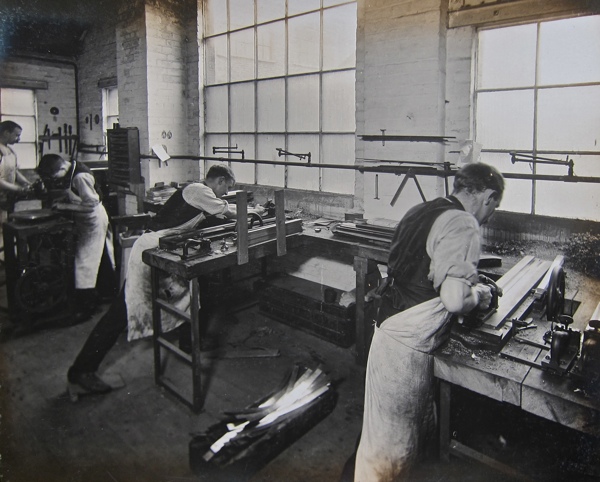
Brass Rule Shop, hand-planing the rules.

Caretaker’s cottage with caretaker’s wife and the factory cat.
Photographs courtesy St Bride Printing Library
You may also like to read about
William Caslon, Letter Founder
At Grenson’s Shoe Factory
“In the flesh, The Gentle Author is an even better storyteller, a magician of social history, who not only brings the past alive but reanimates the present.” Thank you to Patrick Barkham for his wonderful review of my tours in the August issue of The Oldie.
Tickets are available for my walking tour now
Click here to book your ticket for THE GENTLE AUTHOR’S TOUR OF SPITALFIELDS

Starting in 1866, a shoe factor by the name of William Green came regularly from Northamptonshire up to the City of London to get orders and then take them back to Rushden where, in 1874, he opened his first factory as William Green & Son, founding the company we know today as Grenson.
Since Grenson have a shop in Spitalfields nowadays, I set out to follow William Green’s footsteps back to where it all started. In his time – and until quite recently – Northamptonshire was renowned as the centre of the British shoe industry. Yet although those days are gone, the red brick Grenson factory, turreted at one end, still stands majestic among the little terraced streets at the heart of Rushden, just as it did when William Green opened it in 1895.
The appealingly named Roger Tuffnail, pattern cutter, was my guide –“My grandparents were blacksmiths,” he explained by way of introducing himself,“and I always understood the surname originated from that.” I could not help admiring Roger’s venerable brogues, cut from his own patterns. “Because I work in a shoe factory, I do not polish my shoes,” he confessed with a blush and a shy smile in response to my compliment. In fact, Roger is a key employee at the Grenson factory where he has worked since 1981.“I cut the patterns that make the uppers of the shoe, creating the style from a drawing,” he explained.
“I just naturally do it,” Roger added – just in case I should get an inkling how skillful he is – opening an old ledger full of drawings of shoes as he cast his mind back, “I was seventeen when I joined the shoe trade – in the clicking department.” Minutes later, we stood in the clicking department where foreman Robert Taylor – who knows a trick or two with a knife – revealed that this name derives from the sound the blade makes when you pull it out from thick leather, once you have finished cutting round the patterns.
Here at the centre of the old factory, intoxicated by the smell of new leather, I took a moment to appreciate this extraordinary industrial structure, designed to admit Northern light from rows of windows in the roof, creating an interior space almost ecclesiastical in its luminosity. Ancient photographs, ledgers, racks for time cards and most importantly old machines – well-maintained and working as well as ever – attest to more than century of shoemaking within these walls.
Nearby, a bevy of local ladies manned sewing machines and other cunning devices, joining pieces of the uppers together and punching those wonderful patterns that characterise the brogues which are a speciality here. This is known as the closing department. On the floor below, these uppers are moulded around the last and attached to the sole using the famous Goodyear Welting process. Sewing a strip of leather around the upper to join it to the sole makes it more waterproof and permits the option of removing the entire sole in years to come which means the shoe can be refurbished almost endlessly. This takes place in the lasting and making department. Once the heel is attached, the “making” of the shoe is complete and then after careful finishing, trimming, stamping, waxing and buffing, it arrives in the boot room where Sharon Morris fits the laces and Mavis Glen gives it a good polish. The whole process has taken three weeks to make as beautiful a pair of shoes as you could wish, in the traditional manner.
Yet this magnificent factory is not, as you might assume, some arcane endeavour quietly fading into obsolescence, like so many of the other Northamptonshire shoe factories that have gone forever. Instead, Grenson is enjoying a renaissance. Breaking his customary reserve, Roger turned positively declamatory to assure me “The future is very good for us.”
Today, he works very closely with new proprietor Tim Little to create shoes he describes as “traditional footwear with a little bit of a twist – a livelier look,” and the result has been that Grenson shoes have become popular with a whole new generation of younger customers, alongside those who have always bought their classic English styles.
“We were the first to bring out platform shoes for men in the seventies,” Roger reminded me, just in case I had assumed he was complete fogey. In fact, the current evolution of Grenson has been achieved through more subtle means, retaining the integrity of Roger’s classic shoe patterns while introducing different colours and soles to make them contemporary.
From his modest office on the top floor, Tim Little is evangelical to uphold the Grenson tradition and make it relevant in the twenty-first century. “There’d be no point, if I didn’t love English shoes and the way they have evolved,” he confided to me, committed to keep William Green’s business alive in Rushden, and to be selling shoes in London where his predecessor took orders a hundred and fifty years ago.


Rachel Brice has been here ten years and Jane Norman thirty-two years.

Lainie Alcock has been here fourteen years.

Robert Taylor, Clicking Room Foreman, has worked at Grenson since 1969.


Peter Neagle in the lasting room.


Dave Alcock ( Lainey’s husband) has worked here thirteen years.


Sharon Morris and Mavis Glen in the boot room.

Roger Tuffnail, pattern cutter


Roger shows an old Grenson pattern book.


Archive photographs copyright © Grenson
You may also like to read about
At Rayner & Sturges, Shirtmakers
At Drakes of London, Tiemakers
Schrodinger Wants To Recruit Me
Tickets are available for my walking tour now
Click here to book your ticket for THE GENTLE AUTHOR’S TOUR OF SPITALFIELDS

Schrodinger on the dresser, where he is not allowed
My cat Schrodinger wants to recruit me. After careful observation, he has decided that I am worthy of the highest feline honour. He believes I possess the necessary qualities and he is confident I could fulfil the role. He wants to me to become a cat.
I first received the summons a few weeks ago, though initially I did not understand the nature of the calling. During the balmy weather, Schrodinger has moved out of the house, forsaking his favourite spots indoors to doze all day in the deep shadow beneath the periwinkles in the corner of the garden. He has recently discovered his voice and now enters the house at dawn, crying aloud to herald the sun rising.
I assumed he sought to be fed, yet I would not grant such a request at an unsociable hour lest I encourage him to wake me regularly. So we confronted each other in the living room, me standing blocking his path with my back to the kitchen. To my surprise, he turned away towards the front door. He wanted me to follow him into the garden and I complied the first time, just to check there was no predator causing him alarm. There was none. So I returned to bed, leaving him standing disappointed in the garden.
He knows I like to sit quietly for hours while writing and am prone to frequent naps, both undeniably feline characteristics. Now the summer is here, Schrodinger wants me to share his outdoor life. He envisages us both dozing in the shade of the periwinkles by day and having adventures, running together through the dark undergrowth at night – just as Dick Turpin and Tom King did in Epping Forest.
I am flattered by Schrodinger’s invitation to feline vagabondage, even if I must decline. Yet he persists. When I ignore his calling at sunrise, he leaps onto the bed and rubs his spine against my shin as a gesture of affection and camaraderie.
Through these remaining weeks of warm weather, we shall discover which of us will prevail. In the eternal present tense of Schrodinger’s existence it will always be summer, yet I know that the autumn will surely come, the temperature will drop and the rain will fall.
Although Schrodinger is blissfully unaware, already I foresee that he will return to his indoor existence then. Come winter, if he wants to recruit me to sit quietly and join him in fireside naps, sharing his domestic life of feline leisure, I shall be happy to oblige.
You may also like to read about
Schrodinger’s First Year in Spitalfields
Swan Upping On The Thames
Tickets are available for my walking tour now
Click here to book your ticket for THE GENTLE AUTHOR’S TOUR OF SPITALFIELDS

Since before records began, Swan Upping has taken place on the River Thames in the third week of July – chosen as the ideal moment to make a census of the swans, while the cob (as the male swan is known) is moulting and flightless, and before the cygnets of Spring take flight at the end of Summer. This ancient custom stems from a world when the ownership and husbandry of swans was a matter of consequence, and they were prized as roasting birds for special occasions.
Rights to the swans were granted as privileges by the sovereign and the annual Swan Upping was the opportunity to mark the bills of cygnets with a pattern of lines that indicated their provenance. It is a rare practice from medieval times that has survived into the modern era and I have always been keen to see it for myself – as a vision of an earlier world when the inter-relationship of man and beast was central to society and the handling of our fellow creatures was a important skill.
So it was my good fortune to join the Swan Uppers of the Worshipful Company of Vintners’ for a day on the river from Cookham to Marlow, just one leg of their seventy-nine mile course from Sunbury to Abingdon over five days. The Vintners Company were granted their charter in 1363 and a document of 1509 records the payment of four shillings to James the under-swanherd “for upping the Master’s swans” at the time of the “great frost” – which means the Vintners have been Swan Upping for at least five hundred years.
Swan Upping would have once been a familiar sight in London itself, but the embankment of the Thames makes it an unsympathetic place for breeding swans these days and so the Swan Uppers have moved upriver. Apart from the Crown, today only the Dyers’ and Vintners’ Companies retain the ownership of swans on the Thames and each year they both send a team of Swan Uppers to join Her Majesty’s Swan Keeper for a week in pursuit of their quarry.
It was a heart-stopping moment when I saw the Swan Uppers for the first time, coming round the bend in the river, pulling swiftly upon their oars and with coloured flags flying, as their wooden skiffs slid across the surface of the water toward me. Attended by a flotilla of vessels and with a great backdrop of willow framing the dark water surrounding them, it was as if they had materialized from a dream. Yet as soon as I shook hands with the Swan Uppers at The Ferry in Cookham, I discovered they were men of this world, hardy, practical and experienced on the water. All but one made their living by working on the Thames as captains of pleasure boats and barges – and the one exception was a trader at the Billingsgate Fish Market.
There were seven in each of the teams, consisting of six rowers spread over two boats, and a Swan Marker. Some had begun on the water at seven or eight years old as coxswain, most had distinguished careers as competitive rowers as high as Olympic level, and all had won their Doggett’s coat and badge, earning the right to call themselves Watermen. But I would call them Rivermen, and they were the first of this proud breed that I had met, with weathered skin and eager brightly-coloured eyes, men who had spent their lives on the Thames and were experts in the culture and the nature of the river.
They were a tight knit crew – almost a family – with two pairs of brothers and a pair of cousins among them, but they welcomed me to their lunch table where, in between hungry mouthfuls, Bobby Prentice, the foreman of the uppers, told me tales of his attempts to row the Atlantic Ocean, which succeeded on the third try. “I felt I had to go back and do it,” he confessed to me, shaking his head in determination, “But, the third time, I couldn’t even tell my wife until I was on my way.” Bobby’s brother Paul told me he was apprenticed to his father, as a lighterman on the Thames at fifteen, and Roger Spencer revealed that after a night’s trading at Billingsgate, there was nothing he liked so much as to snatch an hour’s rowing on the river before going home for an hour’s nap. After such admissions, I realised that rowing up the river to count swans was a modest recreation for these noble gentlemen.
There is a certain strategy that is adopted when swans with cygnets are spotted by the uppers. The pattern of the “swan voyage” is well established, of rowing until the cry of “Aaall up!” is given by the first to spot a family of swans, instructing the crews to lift their oars and halt the boats. They move in to surround the swans and then, with expert swiftness, the birds are caught and their feet are tethered. Where once the bills were marked, now the cygnets are ringed. Then they are weighed and their health is checked, and any that need treatment are removed to a swan sanctuary. Today, the purpose of the operation is conservation, to ensure well being of the birds and keep close eye upon their numbers – which have been increasing on the Thames since the lead fishing weights that were lethal to swans were banned, rising from just seven pairs between London and Henley in 1985 to twenty-eight pairs upon this stretch today.
Swan Upping is a popular spectator sport as, all along the route, local people turn out to line the banks. In these river communities of the upper Thames, it has been witnessed for generations, marking the climax of Summer when children are allowed out of school in their last week before the holidays to watch the annual ritual.
Travelling up river from Cookham, between banks heavy with deep green foliage and fields of tall golden corn, it was a sublime way to pass a Summer’s afternoon. Yet before long, we passed through the lock to arrive in Marlow where the Mayor welcomed us by distributing tickets that we could redeem for pints of beer at the Two Brewers. It was timely gesture because – as you can imagine – after a day’s rowing up the Thames, the Swan Uppers had a mighty thirst.


Martin Spencer, Swan Marker


Foreman of the Uppers, Bobby Prentice


The Swan Uppers of the Worshipful Company of Vintners, 2011

The Swan Uppers of 1900


The Swan Uppers of the nineteen twenties.


In the nineteen thirties.


The Swan Uppers of the nineteen forties.


In the nineteen fifties.

Archive photographs copyright © Vintners’ Company
You may also like to read about


