
Robson Cezar’s New Whitechapel Market Houses

Through these last winter months, Spitalfields artist Robson Cezar has been collecting wooden fruit crates in Whitechapel Market on the way to his studio in Bow again, and making them into a new series of intricately crafted little wooden houses.
Each one is a day’s work for Robson and many are recognisable as inspired by buildings around the East End – including houses, signal boxes and a chapel. Photographer Sarah Ainslie visited him in his studio this week to document his creations. Every one is different and each comes with an LED light and battery.
The houses are £85 each plus £3.50 postage & packing. We are selling them on a first-come-first-served basis, so if you would like one please email spitalfieldslife@gmail.com giving your first, second and third choice, and we will supply payment details. We can only post these within the United Kingdom.
These houses are sculptures not toys and we do not recommend them for children under the age of twelve.


“During the first lockdown I walked the empty streets and reflected on the importance of having a safe and comfortable living space, especially during a time of crisis. I was inspired to create small wooden house sculptures using fruit and vegetable crates. My experience growing up in a tiny wooden house without any comfort in a favela in Brazil influences my work. To find scrap wood, I go to Whitechapel Market, which I pass every day on my way to my studio in Bow.”
Robson Cezar


C

E

F

G

H

I

K

M

N

Photographs copyright © Sarah Ainslie
You may also like to read about
Robson Cezar’s Wooden Houses from Whitechapel
The Way Of The Cross In Stepney

David Hoffman undertook a significant body of photography documenting the East End in the seventies and eighties that I plan to publish this year as a book entitled, A PLACE TO LIVE, Endurance & Joy in Whitechapel, accompanied by a major photographic exhibition at House of Annetta in Spitalfields.
I believe David’s work is such an important social document, distinguished by its generous humanity and aesthetic flair, that I must publish a collected volume. I have raised around a third of the money and have a growing list of supporters for this project now, so if you share my appreciation of David’s photography and would support this endeavour, please drop me a line at spitalfieldslife@gmail.com

A costume fitting
In the late seventies, Contributing Photographer David Hoffman documented the religious drama enacted upon the streets of Stepney around Easter time, recording astonishing images of magical realist intensity which feel closer to the medieval world than to our own day.
Gordon Kendall who played Jesus wrote this memory of his experience.
‘On a cold wet and depressing evening in April 1980, well over 100 actors, production crew and 2000 people lived through the experience of Our Lord’s Way Of The Cross enacted in the streets and estates of Stepney.
The excitement and challenge of playing Jesus really began on the Sunday before the event. Some of the actors were trying out their costumes and they looked very impressive.
Half way through the rehearsal, I needed to visit the toilet and so excused myself from the bodyguard of soldiers in costume. I knocked at the door of a flat. A lady came out and I requested the use of her toilet. She looked at me very oddly – she was a elderly lady – and she asked me who I was. I replied I was playing the part of Jesus and she flashed me a look which revealed she did not believe me, but she said ‘Come in.’
As I went through the flat I could see someone sleeping on the sofa in the lounge. When I closed the bathroom door, I could hear the woman waking up her friend and saying, ‘Nell, there’s a man in the toilet who says he’s Jesus.’ Then I heard some rapid movement and I could only wonder at the thoughts of this woman, struggling to her feet.
There was a knocking at the front door as I came out of the toilet and the two women opened it to be confronted by a fierce Roman Centurion in full regalia, asking if Jesus was in the flat. Fortunately, they relaxed into joyous smiles and it was kisses and handshakes all round as we departed.’

Roman soldiers


Jesus in flares

The arrest of the two thieves

Preparing for the crucifixion


A Roman legion marching


Pilate speaks


Roman soldiers at St Dunstan’s


Jesus consoles Mary

Bespectacled Jesus

Roman Centurion in regalia

Jesus gives himself up


The march to the crucifixion

The soldiers stripping Jesus of his raiments

Crucifixion courtesy of Whitbread

Behold, Jesus is risen in St Dunstan’s Church!
Photographs copyright © David Hoffman
You may also like to take a look at
Hot Cross Buns At St Bartholomew The Great
Click here to book for THE GENTLE AUTHOR’S TOUR OF THE CITY OF LONDON on Easter Monday
Tomorrow at 11:30am sees the Ceremony of the Widow’s Sixpence in Smithfield

Distribution of buns to widows in the churchyard of St Bartholomew the Great
St Bartholomew the Great is one of my favourite churches in the City, a rare survivor of the Great Fire, it boasts the best Norman interior in London. Composed of ancient rough-hewn stonework, riven with deep shadow where feint daylight barely illuminates the accumulated dust of ages, this is one of those rare atmospheric places where you can still get a sense of the medieval world glimmering. Founded by Rahere in 1123, the current structure is the last vestige of an Augustinian Priory upon the edge of Smithfield, where once martyrs were burnt at the stake as public entertainment and the notorious St Bartholomew Fair was celebrated each summer from 1133 until 1855.
In such a location, the Good Friday tradition of the distribution of charity in the churchyard to poor widows of the parish sits naturally. Once known as the ‘Widow’s Sixpence,’ this custom was institutionalised by Joshua Butterworth in 1887, who created a trust in his name with an investment of twenty-one pounds and ten shillings. The declaration of the trust states its purpose thus – “On Good Friday in each year to distribute in the churchyard of St. Bartholomew the Great the sum of 6d. to twenty-one poor widows, and to expend the remainder of such dividends in buns to be given to children attending such distribution, and he desired that the Charity intended to be thereby created should be called ‘the Butterworth Charity.'”
Those of us who gathered in the churchyard at St Bartholomew the Great on Good Friday were blessed with sunlight. Yet we could not resist a twinge of envy for the clerics in their heavy cassocks and warm velvet capes as they processed from the church in a formal column, with priests at the head attended by vergers bearing wicker baskets of freshly buttered Hot Cross Buns, and a full choir bringing up the rear.
In the nineteen twenties, the sum distributed to each recipient was increased to two shillings and sixpence, and later to four shillings. Resplendent in his scarlet robes, Rev Martin Dudley, Rector of St Bartholomew the Great climbed upon the table tomb at the centre of the churchyard traditionally used for that purpose and enacted the motions of this arcane ceremony – enquiring of the assembly if there were a poor widow of the parish in need of twenty shillings. To his surprise, a senior female raised her hand. “That’s never happened before!” he declared to the easy amusement of the crowd.
I detected a certain haste to get to the heart of the proceedings – the distribution of the Hot Cross Buns. Rev Dudley directed the vergers to start with choir who exercised admirable self-control in only taking one each. Then, as soon as the choir had been fed, the vergers set out around the boundaries of the yard where senior females with healthy appetites reached forward eagerly to take their allotted Hot Cross Buns in hand. The tense anticipation gave way to good humour as everyone delighted in the strangeness of the ritual which rendered ordinary buns exotic. Reaching the end of the line at the furthest extent of the churchyard, the priests wasted no time in satisfying their own appetites and, for a few minutes, silence prevailed as the entire assembly munched their buns.
Then Rev Martin returned to his central position upon the table tomb. “And now, because there is no such thing as free buns,” he announced, “we’re going to sing a hymn.” Yet we were more than happy to oblige, standing replete with buns on Good Friday and enjoying the April sunlight.

The Priory Church of St Bartholomew the Great, a century ago.


John Betjeman once lived in this house overlooking the churchyard.


The ceremony of the Widow’s Sixpence in the nineteen twenties.

“God’s blessing upon the frosts and cold!”

A crowd gathers for the ceremony a hundred years ago.

Hungry widows line up for buns.

The churchyard in the nineteenth century.


Rev Martin Dudley BD MSc MTh PhD FSA FRHistS AKC is the 25th Rector since the Reformation.

Testing the buns.


The clerics ensure no buns go to waste.

Hymns in the cold – “There is a green hill far away without a city wall…”


The Norman interior of St Bartholomew the Great at the beginning of the twentieth century.

The Gatehouse prior to bombing in World War I and reconstruction.

Archive images courtesy Bishopsgate Institute
You may also like to read about
East End Blossom Time
Click here to book for THE GENTLE AUTHOR’S TOUR OF THE CITY OF LONDON on Easter Monday

In Bethnal Green
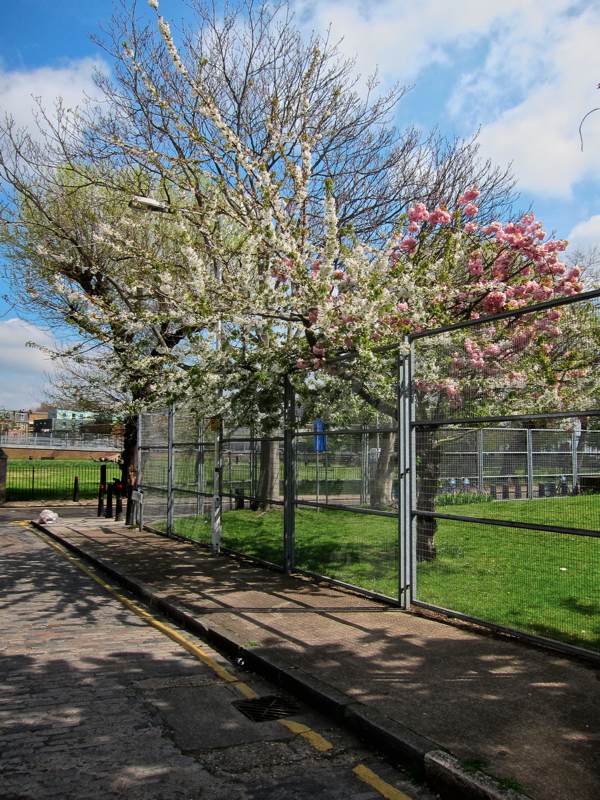
Let me admit, this is my favourite moment in the year – when the new leaves are opening fresh and green, and the streets are full of trees in flower. Several times, in recent days, I have been halted in my tracks by the shimmering intensity of the blossom. And so, I decided to enact my own version of the eighth-century Japanese custom of hanami or flower viewing, setting out on a pilgrimage through the East End with my camera to record the wonders of this fleeting season that marks the end of winter incontrovertibly.
In his last interview, Dennis Potter famously eulogised the glory of cherry blossom as an incarnation of the overwhelming vividness of human experience. “The nowness of everything is absolutely wondrous … The fact is, if you see the present tense, boy do you see it! And boy can you celebrate it.” he said and, standing in front of these trees, I succumbed to the same rapture at the excess of nature.
In the post-war period, cherry trees became a fashionable option for town planners and it seemed that the brightness of pink increased over the years as more colourful varieties were propagated. “Look at it, it’s so beautiful, just like at an advert,” I overheard someone say yesterday, in admiration of a tree in blossom, and I could not resist the thought that it would be an advertisement for sanitary products, since the colour of the tree in question was the exact familiar tone of pink toilet paper.
Yet I do not want my blossom muted, I want it bright and heavy and shining and full. I love to be awestruck by the incomprehensible detail of a million flower petals, each one a marvel of freshly-opened perfection and glowing in a technicolour hue.

In Whitechapel
In Spitalfields

In Weavers’ Fields

In Haggerston

In Weavers’ Fields

In Bethnal Green

In Pott St

Outside Bethnal Green Library

In Spitalfields

In Bethnal Green Gardens

In Museum Gardens

In Museum Gardens

In Paradise Gardens

In Old Bethnal Green Rd

In Pollard Row

In Nelson Gardens

In Canrobert St

In the Hackney Rd

In Haggerston Park

In Shipton St

In Bethnal Green Gardens

In Haggerston

At Spitalfields City Farm

In Columbia Rd

In London Fields

Once upon a time …. Syd’s Coffee Stall, Calvert Avenue
Moyra Peralta’s Worldly Goods
Click here to book for THE GENTLE AUTHOR’S TOUR OF THE CITY OF LONDON on Easter Monday
“These are all my worldly goods,” said Darren when he spread out these modest items to show Photographer Moyra Peralta in 1997. Moyra asked those she had befriended who lived upon the street to permit her to photograph the contents of their pockets and these pictures were the result.

Darren (Waterloo) – Dog, dog leads, keys on key-ring, penknife, cigarettes, lighter, matches, loose change, shoppers’ points card, religious medals on a string, prayer printed on a metal plate, photo of a dog, paperclip, safety pins, nine packets of sugar, paper serviette, personal papers, pain-killers, emery board and several plastic change bags.

Richard (Holborn) – Busking spoons (for `ham and egg-ing’, ie begging), diary, passport, one roll-up , matches, tobacco, cigarette papers, allowance book, medical prescription, Department of Social Security letter, penknife, photograph, paper tissues, and twenty-one pence.

Michael (Covent Garden) – Social Security book, moneybag, a pair of spectacles with case, a religious picture and prayer, a crucifix and chain, a five pound note, London Underground travel ticket, loose change, a US coin, two lighters, a pencil, comb, a chewing gum, a Medilink card and church postcards.

Chris, Malcolm & Jimmy (Trafalgar Sq) – Personal stereo, lighters, cigarettes, vitamin tablets, legal and medical papers, a photograph of Jack Nicholson, a cartoon drawing, copper coins, a match, a wristband and a lucky sprig of heather.

Sean (Covent Garden) – A Begging placard, a peeled orange, money tin, loose change, a paper hankie, cashew nuts, a pair of socks, an origami flower, a pocket dictionary, a postcard, a religious picture, a whistle, shoelaces, a plaster, a broken pencil and an Irish coin.

Rory – Virgin Atlantic docket, address book, a miniature elephant mascot, a personal stereo, two paperbacks, `british passport, an inhaler, a brush, two cigarette lighters, a matchbook, a pen, a hammer (for breaking into squats) and a torch (belonging to a friend).

Johnnie (Holborn) – A hairbrush, reading glasses, cigarette papers, tobacco, a lighter, a pair of scissors, a razor, a toothbrush, a toothpaste, vitamin capsules, a wallet, photographs, an envelope with more photographs, batteries, coins, a pen, a paperback and cream bath lotion.

Simon (Holborn) – A tobacco tin, some dog-ends, matches, a candle stub, loose change, paper towels, dog biscuits and bone, a collar and lead, a necklace, combs, a prescription, a notebook, a paperback, two photos, stamps, a copy of In & Around Covent Garden magazine, a cassette, a button, an envelope, a pencil, a bullet, a plastic knife and fork, and three tubes of glue.

Ray (Strand) – a wallet, a notebook, tissues, an address book, a news cutting, an Outreach contact card, phone cards, dice, a stamp, loose change, combs, a pair of spectacles, a watch, a pen, a playing card, a cigar stub, a pen cap, bottle of mouthwash, matches, buttons, shaving cream, soap, a piece of string, a needle, thread, a safety razor in a plastic case, throat sweets, scissors, antiseptic cream, wire and wire springs and a paperback.

Tommy (Holborn Station) – Copies of The Big Issue, a Vendor’s Identity Card, a spectacle case, cigarettes, peppermints, nail-clippers and a wristwatch.

Tony & Sandy – Rolling tobacco, a lighter, cigarette papers, painkillers, a plaster and a comb.

Richard displays his worldly goods in Holborn.
Photographs copyright © Moyra Peralta
You may also like to read about
Roy Reed At Billingsgate Market


Click here to book for THE GENTLE AUTHOR’S TOUR OF THE CITY OF LONDON on Easter Monday

Roy Reed took these pictures of Billingsgate Market when he was a twenty-three-year-old documentary photography student at the London College of Printing in 1975.
Roy’s enthusiasm for the subject was greater than the interest of the student journalist who asked him to take the pictures for a project on London’s dying markets. “When I suggested we get there early, she said, ‘See you there at eight,'” Roy recalled, rolling his eyes significantly. In the event, Roy got there at seven-thirty on a February morning and took his pictures just here as business was winding up at the nocturnal market. Nearly fifty years later, any disappointment Roy might harbour that the project was never written up and published is outweighed by his satisfaction in having taken these rare photographs of a lost world.
“It was nice chatting with the porters,” Roy remembered fondly, “No-one seemed to mind having their photograph taken – except maybe the guy in the tweed hat, you can see him looking at me suspiciously in the picture.” Taken at the time the market was already due to leave its ancient location next to London Bridge, Roy’s lively photographs comprise a fascinating record of a seemingly recent era in market life that grows increasingly remote.


Photographs copyright © Roy Reed
You may also like to read about
Suresh Singh’s Tank Top
Click here to book for THE GENTLE AUTHOR’S TOUR OF THE CITY OF LONDON on Easter Monday

Suresh Singh has been wearing this tank top since 1973
Suresh Singh, author of A MODEST LIVING: MEMOIRS OF A COCKNEY SIKH, is giving a lecture at the Hanbury Hall this Tuesday 4th April at 6:00pm as part of the Spitalfields Series.
Perhaps everyone has a favourite piece of clothing they have worn for years? I always admired Suresh Singh’s jazzy tank top and I was astonished when he told me he has been wearing it for half a century.
Suresh’s father Joginder Singh came to London from the Punjab in 1949 and the Singh family have lived at 38 Princelet St longer than any other family in Spitalfields.
In our age of disposable fashion, the story of Suresh’s treasured tank top is an inspiring example of how a well made garment can be cherished for a lifetime.
“My mum made this tank top for me in 1973 when I was eleven. She had friends who all knitted and they had bits of wool left over – what you would call ‘cabbage’ – so mum collected all these balls of different coloured wool. Otherwise, they would have been chucked away. She kept them in her carrier bag with her needles that she bought at Woolworths in Aldgate East. They were number ten needles.
Mum said to me, ‘Suresh, I’m going to knit you a tank top.’ I never asked her because dad had taught me that I should always be patient, but I think mum saw the twinkle in my eyes and she knew I wanted one. I had asthma, so it was to keep my chest warm. She knitted it over the winter, from November to January. Mum never had the spare time to spend all day long knitting, she had to do it in bits as she went along and keep putting it away.
Mum did not follow a pattern, she just looked at me and sometimes took measurements. It started getting really huge, so I said, ‘Mum, it’s going to be too big.’ She had a sense of scale, she did not draw round me and cut a pattern. Mum never did that. She replied, ‘You’ll grow into it.’ The idea was you would slowly grow into new clothes.
When my tank top was finished, it hung down to my knees and the armholes were at my waist, but Mum was adamant I would grow into it. I loved it because it was all the rainbow colours. There was red, then yellow, then black, then pink and that really beautiful green. It was so outrageous. No other Punjabi kid had one like it. They all wore Marks & Spencer or John Collier grey nylon jumpers, but I had this piece of art. To me, it was a masterpiece. It was so beautifully made, it was mum’s pride and joy. When I wore it, people would exclaim, ‘That tank top, mate, it’s classic!’ I would say, ‘Yeah, my mum made it.’ Sometimes, because it was too big, I could pull it up and tie it in a knot at the front.
Mum made it with such love that I have always kept it. Eventually, my children wore it, but I am claiming it these days. It is a one-off. What made the tank top special for mum was that she was making it for her son. People often say it is a work of art but mum never went to art school. She picked up the tradition of making something for your child. She put so much love into it and I wear it today and it is still really nice. It gives me comfort and it keeps my chest warm.
It has got swag, you know what I mean?
It fits me now.”

Suresh and his mum at 38 Princelet St

Suresh Singh aged four

Suresh Singh & Jagir Kaur at 38 Princelet St (Photograph by Patricia Niven)
You may also like to read about

Click here to order copy of A MODEST LIVING for £20


