
At 37 Spital Square
 .
.Click here to book for my tour through September and October

Click here to discover more about this autumn’s blog course

Drawing of 37 Spital Sq by Joanna Moore
What could be a better showcase for the Society for the Protection of Ancient Buildings than the fine eighteenth century house they restored in Spital Sq which serves as their headquarters? This magnificent tottering pile is the last surviving Georgian mansion of the entire square once lined with such dwellings, which traced the outline of the former Priory of St Mary Spital that was established in 1187. Indeed, pieces of Medieval stonework from the old Priory buildings are still visible, tucked into the foundations of 37 Spital Sq.
Originally constructed in the seventeen-forties as the home of Peter Ogier, a wealthy Huguenot silk merchant, the house has been through many incarnations both as dwelling and workplace until the Society took it on in a rundown state in 1981 and brought it back to life. As a Society that counted William Morris, John Ruskin, Thomas Hardy, Beatrix Potter, Sir Arthur Conan Doyle and John Betjeman among its members, the SPAB is irresistible to any writer with a passion for old buildings, and 37 Spital Sq certainly does not disappoint.
Neither museum or showhouse, the building has preserved its shabby charm as a working environment where people sit absorbed at their desks in elegantly proportioned rooms, surrounded by all the clutter of their activities and a few well-chosen paintings and pieces of old furniture. With staircases that seem to ascend forever, plenty of hidden corners and architectural idiosyncrasies, 37 Spital Sq is a house that invites you to ramble around – which is exactly what I did, matching up pictures in the Society’s archives of the building in 1981 with the same spaces as they are now.


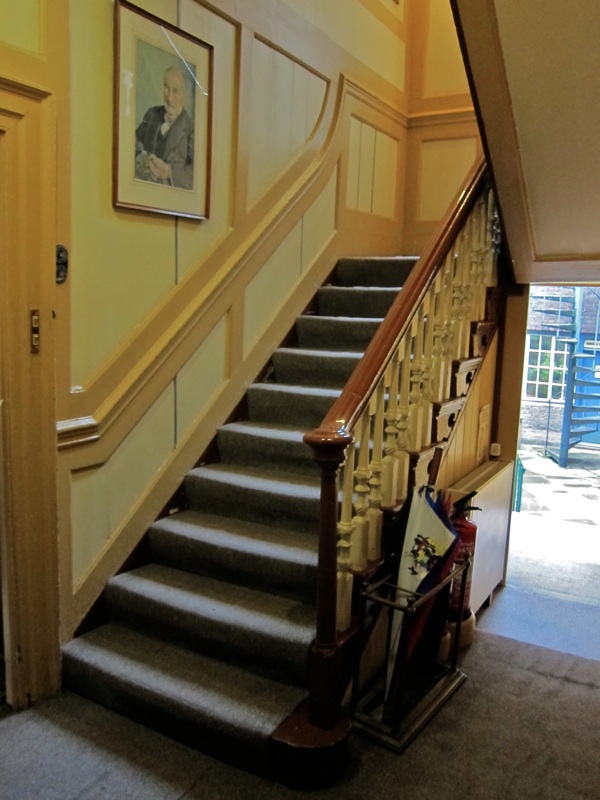


Huguenot silk weaver Peter Ogier is believed to have built 37 Spital Square in the seventeen-forties.
You may also like to read about
Philip Venning, former Director of the Society for the Protection of Ancient Buildings
Bill Crome, the Window Cleaner who sees Ghosts in Spital Sq
and these other renovations in Spitalfields
The Vocabulary Of Beer

Click here to book for my tour through September and October
Click here to discover more about this autumn’s blog course
I offer this choice selection of the language of drinking lest it may be of use to any of my readers who might be planning to take a draught over the weekend.

Life in the East – At the Half Moon Tap, 1830
Barrel – A cask built to hold thirty-six gallons.
Beer – There is no bad beer but some is better than others.
Binder – The last drink, which it seldom proves to be. Also used to describe the person who orders it.
Boiling Copper – Vessel in which wort is boiled with hops.
Boniface – Traditional name for an innkeeper, as used by George Farquhar in ‘The Beaux’ Stratagem.’
Bragget – A fancy drink made of fermented honey and ale.
Brewer – The artist who by his choice of barley and other ingredients, and by his sensitive control of the brewing process, produces beer the way you like it.
Butt – A cask built to hold one hundred and eight gallons.
Buttered Beer – A popular sixteenth century drink of spiced and sugared strong beer supplemented with the yolk of an egg and some butter.
Cardinal – A nineteenth century form of mulled ale.
Casual – An occasional visitor to the pub.
Cheese – A heavy wooden ball used in the game of skittles.
Chitting – The appearance of the first shoots while the barley is growing during the first stage of the malting process.
Coaching Glass – An eighteenth century drinking vessel with no feet that was brought out to coach travellers and consumed at one draught.
Collar – The frothing head on a glass of beer between the top of the beer and the rim of the glass.
Crinze – An earthenware drinking vessel, a cross between a tankard and a small bowl.
Crawler – One who visits all the pubs in one district, drinking a glass of beer in each.
Dipstick – An instrument used to measure the quantity of wort prior to fermentation.
Dive – A downstairs bar.
Dog’s Nose – Beer laced with gin.
Down The Hatch – A toast, usually for the first drink.
Finings – A preparation of isinglass which is added to the beer in the cask to clarify it.
Firkin – A cask built to hold nine gallons.
Flip – Beer and spirit mixed, sweetened and heated with a hot iron.
Fob – The word used in a brewery to describe beer froth.
Goods – The name used by the brewer to describe the crushed malted grains in the mash tuns.
Grist – Malt grains that have been cleaned and cracked in the brewery mill machines.
Gyle – A quantity of beer brewed at one time – one particular brewing.
Heel Tap – Term for beer left at the bottom of the glass.
Hogshead – A cask built to hold fifty-four gallons.
Hoop – A device displayed outside taverns in the middle ages to indicate that beer was sold. Later, it became the practice to display certain objects within the hoop in order to differentiate one tavern from another. eg The Hoop & Grapes
Kilderkin – Cask holding eighteen gallons.
Lambswool– A hot drink of spiced ale with roasted apples beaten up in it.
Liquor – The term used in the brewing industry for water.
Local – The pub round the corner.
Long Pull – Giving the customer more than they ordered, the opposite of a short pull.
Lounge – The best-appointed and most expensive bar of the public house.
Mash – The mixture of crushed malted grains and hot liquor which is run through the masher into the mash tun and from which is extracted liquid malt or wort.
Merry-Goe-Down – Old term describing good ale.
Metheglin – A spiced form of mead.
Mether Cup – A wooden drinking cup used by the Saxons, probably for Metherglin.
Mud-In-Your-Eye, Here’s – Traditional toast, with a meaning more pleasant than it sounds.
Nappy – Term describing good ale, foaming and strong.
Noggin – Small wooden mug, a quarter pint measure.
Noondrink – Ale consumed at noon when trade was slacker. Also, High Noon, drunk at three o’clock when street trading was finished.
One For The Road – Last drink before leaving the pub.
Pig’s Ear – Rhyming slang for beer.
Pocket – A large sack made to contain one and a half hundredweight of hops.
Porter – Popular in the late eighteenth and nineteenth centuries among London market porters, equivalent to a mixture of ale, beer and twopenny.
Public Bar – Where everything is cheapest and decoration and equipment is smiplest.
Puncheon – Cask built to hold seventy-two gallons.
Quaff – To drink in large draughts.
Regular – One of the mainstays of the public house.
Round – An order of drinks for more than one person.
Saloon Bar – Enjoying better amenities than a Public Bar and therefore more expensive to the customer.
Shandy – A drink of beer mixed with ginger beer, or sometimes beer and lemonade.
Short – A gin or whisky, usually taken before a meal.
Small Beer – A beer of lesser gravity, hence a trifling matter.
Smeller – A man employed in the brewery to examine casks after they have been washed and prior to their being filled with beer.
Snifter – Colloquial term for a drink.
Snug or Snuggery – Semi-private apartment in the pub, by custom reserved for use of the regulars.
Sparge – To spray hot liquor onto the grist in the mash tuns.
Spell, To Take A – To go round to the local for a beer, coined by Mr Peggotty in David Copperfield.
Stingo – A strong ale, similar to Barley Wine, popular during the winter months and usually sold in a bottle.
Stool – A useful piece of furniture for a customer who wants to stay at the bar, but is anxious to sit down.
Swig – To take a draught of beer, generally a large one.
Thirst – Suffering enjoyed by beer drinkers.
Tipple – To drink slowly and repeatedly.
Trouncer – The drayman’s mate who pushed and manhandled the wagon over potholes.
Tumbler – A flat bottomed drinking glass, derived from the Saxon vessel that could not stand upright and must be emptied in one draught.
Tun – Vessel in the brewery where the fermenting takes place.
Twopenny – A pale, small beer introduced to London from the country in the eighteenth century at fourpence a quart.
Wallop – Mild ale.
Wassail – Hot ale flavoured with sugar, nutmeg and roasted apples.
What’s Yours? – An invitation which sums up the companionable atmosphere of a public house.
Wort – The solution of mash extract in water, derived from the grist in the mash tuns.
Image from Tom & Jerry’s Life in London courtesy Bishopsgate Institute
Nature In London
Click here to book for my tour through September and October
Click here to discover more about this autumn’s blog course
Contributing Photographer Lucinda Douglas Menzies kindly gave me a copy of LONDON’S NATURAL HISTORY by R S R Fitter published in 1945, in which I discovered this splendid gallery of colour plates by Eric Hosking and other distinguished photographers of the day.

Feeding the pelicans at St James’s Park (Eric Hosking)

Backyard pig farming (Eric Hosking)

Coldharbour Farm, Mottingham – the last farm in London (Eric Hosking)

Feeding the pigeons in front of St Paul’s Cathedral (Wolfgang Suschitzky)

The New River & North-East Reservoir at Stoke Newington (Eric Hosking)

The nearest rookery to London, at Lee Green SE12 (Eric Hosking)

Allotments on Barking Levels (Eric Hosking)

Sand martin colony in a disused sand pit near Barnet bypass (Eric Hosking)

The Upper Pool at sunset with London Bridge in the background (Eric Hosking)

River wall at the confluence of the Ingrebourne with the Thames at Rainham (Eric Hosking)

Cabbage attacked by caterpillars (P L Emery)

A magnolia in the grounds of Kenwood House (Eric Hosking)

The Thames at Hammersmith with mute swans (Eric Hosking)

Sheep grazing at Kenwood House (Eric Hosking)

Teddington Lock (Eric Hosking)

A plum orchard near Chelsfield, Kent (Eric Hosking)

A black-headed gull feeding in St James’s Park (Eric Hosking)

A bold red deer at Richmond Park (C E Maney)

South-African grey-headed sheld duck, pair of mallard and a coot in St James’s Park (Eric Hosking)

Mute swans nesting on the River Lea, Hertingford, Herts (Eric Hosking)

Crocuses at Hyde Park Corner (Eric Hosking)

Roses in Queen Mary’s Garden, Regent’s Park (Wolfgang Suschitzky)

Anglers on the River Lea near Broxbourne, Herts (Eric Hosking)

Almond blossom in a suburban front garden, Ruislip, Middlesex (Eric Hosking)

Pear Tree in Blossom, Crouch End (Eric Hosking)

Rosebay willow herb and Canadian fleabane in a ruined City church (Eric Hosking)

Coltsfoot on a blitzed site (Eric Hosking)

Berkeley Sq plane trees (L Dudley Stamp)

Cress beds at Fetcham, Surrey (Eric Hosking)

Glasshouses in the Lea Valley (Eric Hosking)

Hainault Forest, Essex, from Dog Kennel Hill. The whole of this area was ploughed up a century ago (Eric Hosking)
You may also like to take a look at
At James Ince & Sons, Umbrella Makers
Click here to book for tour through September and October

Richard Ince, 11th generation umbrella maker
The factory of James Ince & Sons, the oldest established umbrella makers in the country, is one of the few places in London where you will not hear complaints about the rainy weather, because – while our moist climate is such a disappointment to the population in general – it has happily sustained generations of Inces for over two centuries now. If you walked down Whites Row in Spitalfields in 1824, you would have found William Ince making umbrellas and, six generations later, I was able to visit Richard Ince, still making umbrellas in the East End. Yet although the date of origin of the company is conservatively set at 1805, there was a William Inch, a tailor listed in Spitalfields in 1793, who may have been father to William Ince of Whites Row – which makes it credible to surmise that Inces have been making umbrellas since they first became popular at the end of the eighteenth century.
You might assume that the weight of so much history weighs heavily upon Richard Ince, but it is like water off a duck’s back to him, because he is simply too busy manufacturing umbrellas. Richard’s father and grandfather were managers with a large staff of employees, but Richard is one of only a handful of workers at James Ince & Sons today, and he works alongside his colleagues as one of the team, cutting and stitching, personally supervising all the orders. Watching them at work, it was a glimpse of what William Ince’s workshop might have been like in Spitalfields in 1824, because – although synthetics and steel have replaced silk and whalebone, and all stitching is done by machine now – the essential design and manufacturing process of umbrellas remains the same.
Between these two workshops of William Ince in 1824 and Richard Ince in 2011, exists a majestic history, which might be best described as one of gracious expansion and then sudden contraction, in the manner of an umbrella itself. It was the necessity of silk that made Spitalfields the natural home for James Ince & Sons. The company prospered there during the expansion of London through the nineteenth century and the increase in colonial trade, especially to India and Burma. In 1837, they moved into larger premises in Brushfield St and, by 1857, filled a building on Bishopsgate too. In the twentieth century, workers at Inces’ factory in Spitalfields took cover in the basement during air raids, and then emerged to resume making military umbrellas for soldiers in the trenches during the First World War and canvas covers for guns during the Second World War. Luckily, the factory itself narrowly survived a flying bomb, permitting the company to enjoy post-war success, diversifying into angling umbrellas, golfing umbrellas, sun umbrellas and promotional umbrellas, even a ceremonial umbrella for a Nigerian Chief. But in the nineteen eighties, a change in tax law, meaning that umbrella makers could no longer be classed as self-employed, challenged the viability of the company, causing James Ince & Sons to shed most of the staff and move to smaller premises in Hackney.
This is some of the history that Richard Ince does not think about very much, whilst deeply engaged through every working hour with the elegant contrivance of making umbrellas. In the twenty-first century, James Ince & Sons fashion the umbrellas for Rubeus Hagrid and for Mary Poppins, surely the most famous brollies on the planet. A fact which permits Richard a small, yet justly deserved, smile of satisfaction as the proper outcome of more than two hundred years of umbrella making by seven generations of his family. A smile that in its quiet intensity reveals his passion for his calling. “My father didn’t want to do it,” he admitted with a grin of regret, “but I left school at seventeen and I felt my way in. I used to spend my Saturdays in Spitalfields, kicking cabbages around as footballs, and when we had the big tax problem, it taught me that I had to get involved.” This was how Richard oversaw the transformation of his company to become the lean operation it is today. “We are the only people who are prepared to look at making weird umbrellas, when they want strange ones for film and theatre.” he confessed with yet another modest smile, as if this indication of his expertise were a mere admission of amiable gullibility.
On the ground floor of his factory in Vyner St, is a long block where Richard unfurls the rolls of fabric and cuts the umbrella panels using a wooden pattern and a sharp knife. Then he carries the armful of pieces upstairs where they are sewn together before Job Forster takes them and does the “tipping,” consisting of fixing the “points” (which attach the cover to the ends of the ribs), sewing the cover to the frame and adding the tie which is used to furl the umbrella when not in use.
Job was making huge umbrellas, as used by the doormen to shepherd guests through the rain, and I watched as he clamped the bare metal frame to the bench, revolving it as he stitched the cover to each rib in turn, to complete the umbrella. Then came the moment when Job opened it up to scrutinise his handiwork. With a satisfying “thunk,” the black cover expanded like a giant bat stretching its wings taut and I was spellbound by the drama of the moment – because now I understood what it takes to make one, I was seeing an umbrella for the first time, thanks to James Ince & Sons (Umbrella Makers) Ltd.

Richard Ince, seventh generation umbrella maker, prepares to cut covers for brollies.


Job Forster sews the cover to the ribs of the umbrella.


James Ince, born 1816

James John Ince, born 1830

Samuel George Ince, born 1853


Ernest Edward Sears, born 1870


Wilfred Sears Ince, born 1894


Geoffrey Ince, born 1932


Richard Ince, “Prepare for a rainy day!”
New photographs copyright © Chris Hill-Scott
Archive photographs copyright © Bishopsgate Institute
On Night Patrol With Constable Tassell
Next ticket availability Saturday 2nd September
We join Constable Lew Tassell on a night patrol in the City of London on Tuesday December 12th 1972

Police Constable Lew Tassell of the City of London Police
“One week in December 1972, I was on night duty. Normally, I would be on beat patrol from Bishopsgate Police Station between 11pm-7am. But that week I was on the utility van which operated between 10pm-6am, so there would be cover during the changeover times for the three City of London Police divisions – Bishopsgate, Wood St and Snow Hill. One constable from each division would be on the van with a sergeant and a driver from the garage.
That night, I was dropped off on the Embankment during a break to allow me to take some photographs and I walked back to Wood St Police Station to rejoin the van crew. You can follow the route in my photographs.
The City of London at night was a peaceful place to walk, apart from the parts that operated twenty-four hours a day – the newspaper printshops in Fleet Street, Smithfield Meat Market, Billingsgate Fish Market and Spitalfields Fruit & Vegetable Market.
Micks Cafe in Fleet St never had an apostrophe on the sign or acute accent on the ‘e.’ It was a cramped greasy spoon that opened twenty-four hours a day, seven days a week. During the night and early morning it served print-workers, drunks returning from the West End and the occasional vagrant.
Generally, we police did not use it. We might have been unwelcome because we would have stood out like a sore thumb. But I did observation in there in plain clothes sometimes. Micks Cafe was a place where virtually anything could be sourced, especially at night when nowhere else was open.”

Middle Temple Lane

Pump Court, Temple

King’s Bench Walk, Temple

Bouverie St, News of the World and The Sun

Fleet St looking East towards Ludgate Circus

Ludgate Hill looking towards Fleet St under Blackfriars Railway Bridge, demolished in 1990

Old Bailey from Newgate St looking south

Looking north from Newgate St along Giltspur St, St Bartholomew’s Hospital

Newgate St looking towards junction of Cheapside and New Change – buildings now demolished

Cheapside looking east from the corner of Wood St towards St Mary Le Bow and the Bank

HMS Chrysanthemum, Embankment

Constable Lew Tassell, 1972
Photographs copyright © Lew Tassell
You may also like to take a look at
A Walk Along The Ridgeway

Tickets available next Saturday 2nd September

They say it is the oldest road in Britain, maybe the oldest in Europe. Starting from the highest navigable point of the Thames in prehistoric times, the Ridgeway follows the hilltops to arrive at Salisbury Plain where once wild cattle and horses roamed. When the valleys were forested and impenetrable, the Ridgeway offered a natural route over the downland and into the heart of this island. Centuries of cattle driving wore a trackway that curved across the hillside, traversing the contours of the landscape and unravelling like a ribbon towards the horizon.
Over thousands of years, the Ridgeway became a trading route extending from coast to coast, as far as Lyme Regis in the west and the Wash in the east, with fortresses and monuments along the way. Yet once the valleys became accessible it was defunct, replaced by the Icknield Way – a lower level path that skirted the foot of the hills – and there are burial mounds which traverse the Ridgeway dated to 2000BC, indicating that the highway was no longer in use by then.
In fact, this obsolescence preserved the Ridgeway because it was never incorporated into the modern road network and remains a green path to this day where anyone can set out and walk in the footsteps of our earliest predecessors in this land. Leaving Spitalfields early and taking the hour’s rail journey to Goring & Streatley from Paddington, I was ascending the hill from the river by eleven and onto the upland by midday. In this section, the flinty path of the Ridgeway is bordered with deep hedges of hawthorn, blackthorn and hazel, giving way to the open downland rich with the pink and blue flowers of late summer, knapweed, scabious and harebells.
A quarter of a century has passed since I first passed this way and yet nothing has changed up there. It is the same huge sky and expansive grassy plain undulating into the distance with barely a building in sight. This landscape dwarfs the human figure, inducing a sense of exhilaration at the dramatic effects of light and cloud, sending patterns travelling fast across the vast grassy wind-blown hills. When I first began to write and London grew claustrophobic, I often undertook this walk through the different seasons of the year. I discovered that the sheer exertion of walking all day, buffeted upon the hilltops and sometimes marching doggedly through driving rain, never failed to clear my mind.
As a consequence, the shape of the journey is graven into memory even though, returning eighteen years since my last visit, the landscape was greater than I had fashioned it in recollection. And this is the quality that fascinates me about such epic terrain, which the mind cannot satisfactorily contain and thus each return offers a renewed acquaintance of wonder at the scale and majesty of the natural world.
In those days, I was in thrall to endurance walking and I would continue until I could go no further, either because of exhaustion or nightfall. This vast elevated downland landscape encouraged such excessive behaviour, leading me on and on along the empty path to discover what lay over the brow and engendering a giddy sense of falling forward, walking through the sky – as if you might take flight. I walked until I thought I could walk no more and then I carried on walking until walking became automatic, like breathing. In this state my body was propelled forward of its own volition and my mind was free.
One day’s walk brings you to Uffington and the famous White Horse, carved into the chalk of the downland. Placed perfectly upon the crest of a ridge within a vast fold of the hills, this sparsely drawn Neolithic figure looks out across the arable farmland of Oxfordshire beyond and can be seen for great distances. A mystery now, a representation that may once have been a symbol for a people lost in time, it retains a primeval charisma, and there is such an intensity of delight to reach this figure at the end of a day’s walking. Breathless and weary of limbs, I stumbled over the hill to sit there alone upon the back of the hundred foot White Horse at dusk, before descending to the village of Bishopstone for the night. There, at Prebendal Farm, Jo Selbourne offers a generous welcome and, as well as the usual bed and breakfast, will show you the exquisitely smoothed ceremonial Neolithic axe head found upon the farm.
The second day’s walk leads through the earthen ramparts of Liddington Hill and Barbary Castle, and on either side of the path the fields are punctuated by clumps of trees indicating the myriad ancient burial mounds scattered upon this bare Wiltshire scenery. It is a more expansive land than the fields of Berkshire where I began my journey, here the interventions made in ancient times still hold their own and the evidence of the modernity is sparser. As I made the final descent from the hill towards Avebury, a village within a massive earthwork and stone circle which was the culmination of my journey, I could not resist the feeling that it was all there for me and I had earned it by walking along the old path which for thousands of years had brought people to arrive at this enigmatic location of pilgrimage.
In two days upon the hilltops I had only passed a dozen lone walkers, and now the crowds, the coach parties, the shops and the traffic were a startling sight to behold. And so I knew my journey had fulfilled its purpose – to reacquaint me freshly with the familiar world and restore a sense of proportion. My feet were sore and my face was flushed by the sun. In Berkshire, the ripe fields of corn were standing, in Oxfordshire, they were being harvested and, in Wiltshire, I saw the stubble being ploughed in. It had been a walk to arrive at the end of the summer. It had been a walk through time along the oldest road.

Goring Mill

“Join it at Streatley, the point where it crosses the Thames, at once it strikes you out and away from the habitable world in a splendid purposeful manner, running along the highest ridge of the downs.” Kenneth Grahame, 1898

A ninety-two year old man told me this year is the worst harvest he could remember. “It doesn’t want to come in the barn,” he lamented.


At East Illsley

“A broad green track runs for many a long mile across the downs, now following the ridges, now winding past at the foot of a grassy slope, then stretching away through cornfield and fallow.” Richard Jefferies, 1879

“A rough way, now wide, now narrow, among the hazel, brier and nettle. Sometimes there was an ash in the hedge and once a line of spindly elms followed it round in a curve.” Edward Thomas, 1910

On White Horse Hill

“The White Horse is, I believe, the earliest hill drawing we have in England. It is a piece of design, in another category from the other chalk figures, for it has the lineaments of a work of art. The horse, which is more of a dragon than a horse, is cut on the top of the down’s crest, so that it can only be seen completely from the air, or at a long view, from the surrounding country – but it was precisely this aspect of the Horse design that I found so significant.” Paul Nash, 1938

The Neolithic axe head found at Prebendal Farm, photo by Rob Selbourne.

At Bishopstone


At Barbary Castle


“The origin of the track goes back into the dimmest antiquity: there is evidence that it was a military road when the fierce Dane carried fire and slaughter inland, leaving his nailed bark in the creeks of the rivers, and before that when the Saxons pushed up from the sea. The eagles of old Rome were, perhaps, borne along it and yet earlier the chariots of the Britons may have used it – traces of all have been found: so that for fifteen centuries this track of primitive peoples has maintained its existence through the strange changes of the times, til now in the season the cumbrous steam ploughing engines jolt and strain and pant over the uneven turf.” Richard Jefferies, 1879

Since the man suspected of making crop circles died, his protege has adopted a different style of design.

At Avebury

At Avebury
William Morris In The East End
Next ticket availability Saturday 2nd September

William Morris spoke at Speakers’ Corner in Victoria Park on 26th July & 11th October 1885, 8th August 1886, 27th March & 21st May 1888
If you spotted someone hauling an old wooden Spitalfields Market orange crate around the East End, that was me undertaking a pilgrimage to some of the places William Morris spoke in the hope he might return for one last oration.
The presence of William Morris in the East End is almost forgotten today. Yet he took the District Line from his home in Hammersmith regularly to speak here through the last years of his life, despite persistent ill-health. Ultimately disappointed that the production of his own designs had catered only to the rich, Morris dedicated himself increasingly to politics and in 1884 he became editor of The Commonweal, newspaper of the Socialist League, using the coach house at Kelsmcott House in Hammersmith as its headquarters.
As an activist, Morris spoke at the funeral of Alfred Linnell, who was killed by police during a free speech rally in Trafalgar Sq in 1887, on behalf of the Match Girls’ Strike in 1888 and in the Dock Strike of 1889. His final appearance in the East End was on Mile End Waste on 1st November 1890, on which occasion he spoke at a protest against the brutal treatment of Jewish people in Russia.
When William Morris died of tuberculosis in 1896, his doctor said, ‘he died a victim to his enthusiasm for spreading the principles of Socialism.’ Morris deserves to be remembered for his commitment to the people of the East End in those years of political turmoil as for the first time unions struggled to assert the right to seek justice for their workers.

8th April 1884, St Jude’s Church, Commercial St – Morris gave a speech at the opening of the annual art exhibition on behalf of Vicar Samuel Barnett who subsequently founded Toynbee Hall and the Whitechapel Gallery.

During 1885, volunteers distributed William Morris’ What Socialists Want outside the Salmon & Ball in Bethnal Green


1st September 1885, 103 Mile End Rd


20th September 1885, Dod St, Limehouse – When police launched a violent attack on speakers of the Socialist League who defended the right to free speech at this traditional spot for open air meetings, William Morris spoke on their behalf in court on 22nd September in Stepney.

10th November 1886 & 3rd July 1887, Broadway, London Fields

November 20th 1887, Bow Cemetery – Morris spoke at the burial of Alfred Linnell, a clerk who was killed by police during a free speech rally in Trafalgar Sq. ‘Our friend who lies here has had a hard life and met with a hard death, and if our society had been constituted differently his life might have been a delightful one. We are engaged in a most holy war, trying to prevent our rulers making this great town of London into nothing more than a prison.’

9th April 1889, Toynbee Hall, Commercial St – Morris gave a magic lantern show on the subject of ‘Gothic Architecture’


1st November 1890, Mile End Waste – Morris spoke in protest against the persecution of Jews in Russia
William Morris in the East End
3rd January & 27th April 1884, Tee-To-Tum Coffee House, 166 Bethnal Green Rd
8th April 1884, St Jude’s Church, Commercial St
29th October 1884, Dod St, Limehouse
9th November 1884, 13 Redman’s Row
11th January & 12th April 1885, Hoxton Academy Schools
29th March 24th May 1885, Stepney Socialist League, 110 White Horse St
26th July & 11th October 1885, Victoria Park
8th August 1885, Socialist League Stratford
16th August 1885, Exchange Coffee House, Pitfield St, Hoxton
1st September 1885, Swaby’s Coffee House, 103 Mile End Rd
22nd September 1885, Thames Police court, Stepney (Before Magistrate Sanders)
24th January 1886, Hackney Branch Rooms, 21 Audrey St, Hackney Rd
2nd February 1886, International Working Men’s Educational Club, 40 Berners St
5th June 1886, Socialist League Stratford
11th July 1886, Hoxton Branch of the Socialist League, 2 Crondel St
24th August 1886, Socialist League Mile End Branch, 108 Bridge St
13th October 1886, Congregational Schools, Swanscombe St, Barking Rd
10th November 1886, Broadway, London Fields
6th March 1887, Hoxton Branch of the Socialist League, 2 Crondel St
13th March & 12th June 1887, Hackney Branch Rooms, 21 Audrey St, Hackney Rd
27th March 1887, Borough of Hackney Club, Haggerston
27th March, 21st May, 23rd July, 21st August & 11th September, 1887 Victoria Park
24th April 1887, Morley Coffee Tavern Lecture Hall, Mare St
3rd July 1887, Broadway, London Fields
21st August 1887, Globe Coffee House, High St, Hoxton
25th September 1887, Hoxton Church
27th September 1887, Mile End Waste
18th December 1887, Bow Cemetery, Southern Grove
17th April 1888, Mile End Socialist Hall, 95 Boston St
17th April 1888, Working Men’s Radical Club, 108 Bridge St, Burdett Rd
16th June 1888, International Club, 23 Princes Sq, Cable St
17th June 1888, Victoria Park
30th June 1888, Epping Forest Picnic
22nd September 1888, International Working Men’s Education Club, 40 Berners St
9th April 1889, Toynbee Hall, Commercial St
27th June 1889, New Labour Club, 5 Victoria Park Sq, Bethnal Green
8th June 1889, International Working Men’s Education Club, 40 Berners St
1st November 1890, Mile End Waste
This feature draws upon the research of Rosemary Taylor as published in her article in The Journal of William Morris Studies. Click here to join the William Morris Society
You may also like to read about


