
My Cries Of London Lecture At St Bartholomew’s

Click here to book for my tour through September and October
As part of this year’s Bartholomew Fair in Smithfield, I shall be giving an illustrated lecture in St Bartholomew’s Church at 7pm on Friday 15th September about my love for the CRIES OF LONDON, showing my favourite images of four hundred years of street life in the capital.

Cries of London 1600, reproduced from Samuel Pepys’ Album © Magdalene College, Cambridge
The dispossessed and those with no other income were always able to cry their wares for sale in London. By turning their presence into performance with their Cries, they claimed the streets as their theatre – winning the lasting affections of generations of Londoners and embodying the soul of the city in the popular imagination. Thus, through time, the culture of the capital’s street Cries became integral to the distinctive identity of London.
Undertaking interviews with stallholders in Spitalfields, Brick Lane, Columbia Road and other East End markets in recent years led me to consider the cultural legacy of urban street trading. While this phenomenon might appear transitory and fleeting, I discovered a venerable tradition in the Cries of London. Yet even this genre of popular illustrated prints, which began in the seventeenth century, was itself preceded by verse such as London Lackpenny attributed to the fifteenth century poet John Lydgate that drew upon an earlier oral culture of hawkers’ Cries. From medieval times, the great number of Cries in London became recognised by travellers throughout Europe as indicative of the infinite variety of life in the British capital.
Given the former ubiquity of the Cries of London, the sophistication of many of the images, their significance as social history, and their existence as almost the only portraits of working people in London through four centuries, it astonishes me that there has been little attention paid to this subject and so I have set out to reclaim this devalued cultural tradition.
I take my cue from Samuel Pepys who pasted three sets of Cries into his albums of London & Westminster in a chronological sequence spanning a century, thereby permitting an assessment of the evolution of the style of the prints as well as social change in the capital in his era. In my book, I have supplemented these with another dozen series published over the following centuries which trace the development of the Cries right into our own time. My policy has been to collate a personal selection of those that delight me, those that speak most eloquently of the life of the street and those created by artists who demonstrated an affinity with the Criers.
Through the narrow urban thoroughfares and byways, hawkers announced their wares by calling out a repeated phrase that grew familiar to their customers, who learned to recognise the Cries of those from whom they bought regularly. By nature of repetition, these Cries acquired a musical quality as hawkers improvised upon the sounds of the words, evolving phrases into songs. Commonly, Cries also became unintelligible to those who did not already know what was being sold. Sometimes the outcome was melodic and lyrical, drawing the appreciation of bystanders, and at other times discordant and raucous as hawkers strained their voices to be heard across the longest distance.
Over time, certain Cries became widely adopted, and it is in written accounts and songbooks that we find the earliest records. Print collections of pictures of Criers also became known as ‘Cries’ and although the oldest set in London dates from around 1600, there are those from Paris which predate these by a century. Characteristically, the Cries represented peripatetic street traders or pedlars, yet other street characters were also included from the start. At first, the Cries were supplemented by the bellman and the town crier, but then preachers, beggars, musicians, performers were added as the notion of the Cries of London became expanded by artists and print sellers seeking greater novelty through elaborating upon the original premise.
Before the age of traffic, the streets of London offered a common public space for all manner of activity, trading, commerce, sport, entertainment and political rallies. Yet this arena of possibility, which is the primary source of the capital’s cultural vitality has also invited the consistent attention of those who seek policing and social control upon the premise of protecting citizens from each other, guarding against crime and preventing civil unrest. It suits the interest of those who would rule the city that, in London, street traders have always been perceived as equivocal characters with an identity barely distinguished from vagrants. Thus the suspicion that their itinerant nature facilitated thieving and illicit dealing, or that women might be selling their bodies as as well as their legitimate wares has never been dispelled.
Like the internet, the notion of the street as a space where people may communicate and do business freely can be profoundly threatening to some. It is a tension institutionalised in this country through the issuing of licences to traders, criminalising those denied such official endorsement, while on the continent of Europe the right to sell in the street is automatically granted to every citizen. Depending upon your point of view, the itinerants are those who bring life to the city through their occupation of its streets or they are outcasts who have no place in a developed modern urban environment.
When I interviewed Tony Purser on his last afternoon after fifty-two years selling flowers outside Fenchurch Street Station in the City of London, he admitted to me that as a boy he assisted his father Alfie, and, before licences were granted in 1962, they were both regularly arrested. Their stock was confiscated, they were charged three shillings and spent the night in the cells at Bishopsgate Police Station, before going back to trade again next day.
Street trading proposes an interpretation of the ancient myth of London as a city paved with gold that is not without truth. Many large British corporate retailers including Tesco, started by Jack Cohen in 1919, Marks & Spencer, started by Michael Marks in 1884, owe their origin to single stalls in markets – emphasising the value of street trading to wider economic development.
In the twentieth century, the Cries of London found their way onto cigarette cards, chocolate boxes, biscuit tins, tea towels, silk scarves, dinner services and, famously, tins of Yardley talcum powder from 1912 onwards, becoming divorced from the reality they once represented as time went by, copied and recopied by different artists.
Yet the sentimentally cheerful tones applied by hand to prints that were contrived to appeal to the casual purchaser, chime with the resilience required by traders selling in the street. And it is our respect for their spirit and resourcefulness which may account for the long lasting popularity of these poignant images of the self-respecting poor who turned their trades into performances. Even now, it is impossible to hear the cries of market traders and newspaper sellers without succumbing to their spell, as the last reverberations of a great cacophonous symphony echoing across time and through the streets of London.
Surely none can resist the romance of the Cries of London and the raffish appeal of the liberty of vagabondage, of those who had no indenture or task master, and who travelled wide throughout the city, witnessing the spectacle of its streets, speaking with a wide variety of customers, and seeing life. In the densely-populated neighbourhoods, it was the itinerants’ cries that marked the times of day and announced the changing seasons of the year. Before the motorcar, their calls were a constant of street life in London. Before advertising, their songs were the jingles that announced of the latest, freshest produce or appealing gimcrack. Before radio, television and internet, they were the harbingers of news, and gossip, and novelty ballads. These itinerants had nothing but they had possession of the city.
The Cries of London have taught me the essential truth of London street traders down through the centuries, and it is one that still holds today – they do not need your sympathy, they only want your respect, and your money.

Costermonger by Marcellus Laroon, 1687 (courtesy Bishopsgate Institute)

Pedlar by Marcellus Laroon, 1687 (courtesy Bishopsgate Institute)

‘Two Bunches a Penny, Primroses, Two Bunches a Penny!’ The Primrose Seller by Francis Wheatley, 1793 (courtesy Bishopsgate Institute)

‘Strawberries, Scarlet Strawberries’ by Francis Wheatley, 1793 (image courtesy Bishopsgate Institute)

Hair Brooms outside Shoreditch Church by William Marshall Craig, 1804 (courtesy Bishopsgate Institute)

Showman with a raree show at Hyde Park Corner by William Marshall Craig, 1804 (courtesy Bishopsgate Institute)

‘Rabbit, Rabbit – Nice fat Rabbit!’ by Luke Clennell 1812 (courtesy Bishopsgate Institute)

‘Lilies of the Valley, Sweet Lilies of the Valley’ by Luke Clennell 1812 (courtesy Bishopsgate Institute)

Pickled Cucumbers by John Thomas Smith, 1816 (courtesy Bishopsgate Institute)

The Flying Pie Man by John Thomas Smith, 1816 (courtesy Bishopsgate Institute)

London boardmen & women by George Scharf 1825-33 © British Museum

Long Song Seller, engraved from a photograph by Richard Beard, 1851 (courtesy Bishopsgate Institute)

Click here to buy a copy of my book of CRIES OF LONDON for £20
The Tree Huts Of Epping Forest
Click here to book for my tour through September and October

Click here to discover more about this autumn’s blog course

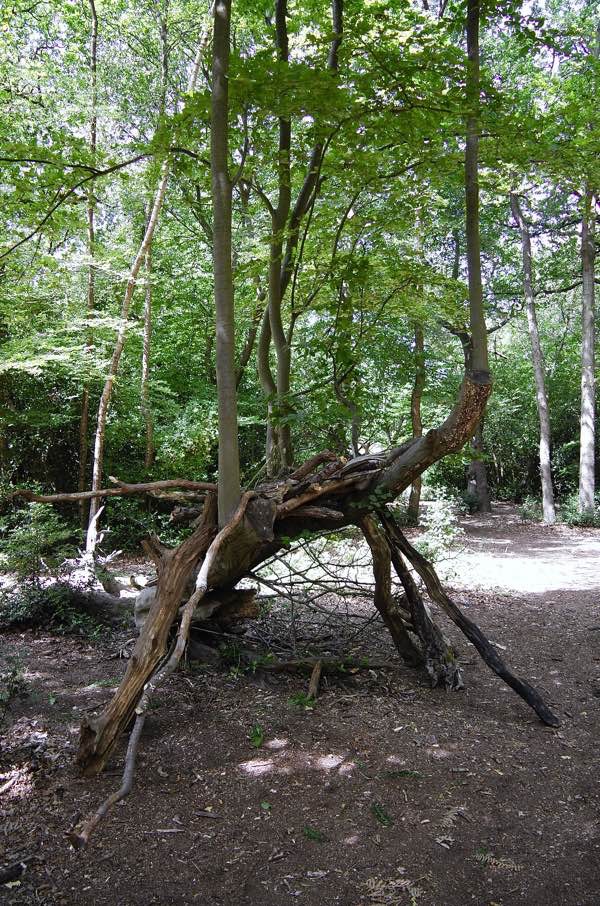
Who can resist the lure of the forest? Since Epping Forest is a mere cycle ride from Spitalfields, each year I visit to seek refuge among the leafy shades. And, in the depths of the forest, I come upon these makeshift tree huts which fascinate me with the variety and ingenuity of their design.
Who can be responsible? Is it children making dens or land artists exploring sculptural notions? Clearly never weatherproof, they are not human habitations. I wondered if the sprites and hobgoblins had been at work constructing arbors for the spirits of the forest. But then I remembered I had seen something similar once before, Eeyore’s hut at the edge of the Hundred Acre Wood.
Some are elaborate constructions that are worthy of architecture and others merely collections of twigs which tease the eye, questioning whether they are random or deliberate. They conjure an air of ritualistic mystery and, the more I encountered, the more intrigued I became. So much effort and skill expended suggest deliberate purpose or intent, yet they remain an enigma.



You may also like to take a look at
At Highgate Cemetery

Click here to book for my tour through September and October
Click here to discover more about this autumn’s blog course

If you seek to lose yourself in London and escape the scorching summer heat, Highgate Cemetery is the ideal destination. You step through the gothic-inspired gatehouse and take the winding path up the hill among the trees, with gracious architectural monuments, tombs and statues on either side. Foliage and shadow enclose the cemetery, shielding it from the city.
At the top of the hill you arrive at a grand entrance with exotically carved stone pillars and iron gates, hung with dense growth of ivy and creepers. You encounter deep shadows at the portal and, unavoidably, confront your own mortality. As you ascend the shady path alone towards the light, lined with doors, it is as if you are entering the ancient metropolis of a lost civilisation. But the residents have not fled, they are all still here under the permanent lockdown of death.
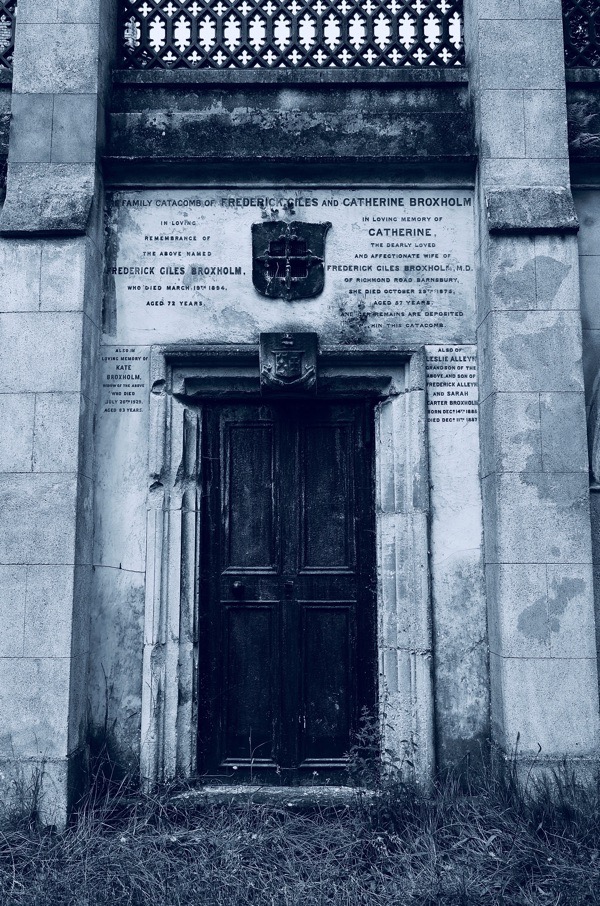
You wonder what you will find at the other end of this passageway. Yet you emerge again into the light to discover a narrow street of doorways leading to the left and the right, open to the sky and lined with flowers. As you pace around, you recognise that each one is subtly distinct from the others, with names to enable the holy postman. Within minutes, you discover this street is circular. You have arrived at the heart of the necropolis and you can walk for eternity around this street. You can change direction, but you can only travel in a circle.
Thank goodness there are stairs that permit you to escape and return to the world of the living, where you can stand and impassively observe this curious architectural feature at the heart of the cemetery. If you seek the soul of London, you will find it here in the rotunda at Highgate Cemetery.




Highgate Cemetery, Swain’s Lane, London N6 6PJ
You may also like to read about
J W Stutter Ltd, Cutlers
Click here to book for my tour through September and October
Click here to discover more about this autumn’s blog course

Bryan Stutter brandishes his Stutter scissors
Bryan Stutter and his wife Sue have amassed a handsome collection of old cutlery, all incised with the name of J.W.Stutter – the company founded by Brian’s great-great-great-grandfather Joel at the boundary of the City of London in the eighteen twenties. Cutlers were one of the myriad small trades that thrived here for centuries, selling their wares for domestic use and also providing tools to other manufacturers based in the vicinity, yet today the only evidence of their presence is in the name of Cutler St, a narrow thoroughfare leading off Houndsditch.
In an idle moment, years ago, Bryan was searching for the name of his forebear upon the internet when he found a J.W.Stutter cabbage knife for sale on an auction site. Bryan bought it on impulse and began searching for more items with the J.W.Stutter name, and thus his magnificent collection was born – reversing the trend of time, by bringing back together as many of the items manufactured and sold by J.W. Stutter as possible.
Bryan’s grandfather was the last in the family business and Bryan remembers coming up from Palmers Green as a child to Bishopsgate with his father to visit the shop in 1955 and seeing the famous 365 blade pen knife that was displayed in the window. “He offered sixpence to anyone that could open and shut every blade without cutting themselves,” Bryan recalled fondly. Originally, the company were manufacturing cutlers employing a sheet metal worker, a carpenter, an ivory carver and a silversmith, but by the sixties they could no longer compete with imported cutlery and the business was sold, moving to Hackney, only to close finally in 1982.
“As you get older, you start remembering things and you become interested in history, but by then the people you could have asked have died,” admitted Bryan, who had all but forgotten the former family business until he found some of the company papers with his father’s will. “I just thought, ‘this is my family history,'” he continued, gesturing to his proud assemblage of cutlery that includes the set of dessert knives he and Sue received as their wedding present, “If my daughter or nephew wants it, I can pass it in to them, and if nobody wants it, it can all go back on sale on the internet…”

J.W Stutter in Bishopsgate in the mid-twentieth century, with the 365 blade penknife on display.

365 blade penknife produced as an apprentice piece and shown at the Great Exhibition. Bryan remembers this in his grandfather’s shop.

J.W.Stutter at 133 Bishopsgate in 1911.

J.W.Stutter (third shop on the left) at 184 Shoreditch High St.

The nineteenth century cabbage knife that started Bryan’s collection.

Detail of the cabbage knife.

Hip flask by J.W.Stutter

Detail of the hip flask.

J.W.Stutter Corn knife c. 1840

Herb Chopper

Victorian pewter teapot

Detail of the pewter teapot

Sewing scissors, c. 1890

Nineteenth century razors in a presentation case.

Cobblers’ tool.

Detail of the cobblers’ tool

Victorian tackle retriever.

Set of dessert knives, mid-twentieth century.

Detail of the dessert knives.

Bryan & Sue Stutter with items from their Stutter collection.
Derrick Porter, Hoxton Poet
Click here to book for my tour through September and October
Click here to discover more about this autumn’s blog course

Derrick Porter
This is the gentle face of Derrick Porter, craggy and wise, framed by snowy hair and punctuated with a pair of sharp eyes that reveal a hint of his imaginative capacity. Standing against a rural backdrop upon the banks of the river Ching in Essex not far from High Beach where John Clare was confined, Derrick looks every inch an English poet and he is quick to admit his love of nature. Yet, although he acquired an affection for the countryside at an early age and Chingford is his place of residence, the focus of Derrick’s literary landscape and centre of his personal universe is his place of origin – Hoxton.
“It was a place we all wanted to get out of – it was a tough place to live,” Derrick confessed to me, recalling his childhood, “but the the culture of Hoxton and that era was my imaginative education.”
“My interest in literature stems from spending so many years in hospital up to the age of thirteen and they used to read to us – I looked forward to it so much, I learnt to love reading stories,” he confided, explaining that he suffered from tuberculosis as a child and was exiled from London for long stretches in hospitals. “They made us stay out in the fresh air which was the worst possible thing because it actually helped the germs to flourish, when the foggy atmosphere of London was much more beneficial to sufferers – but they didn’t understand that in those days.
My dad worked at the Daily Mail as a printer and my mum was a housewife, but I never saw him until I was six when he returned from the war. He had been captured by the Japanese and was held in a prisoner of war camp. At first, they sent him to America which was where they kept them to build them up again before they came home.
Before the age of ten years old, I lived in a prefab in Vince St next to the Old St roundabout and then we moved to Fairchild House in Fanshawe St. The prefabs were made of asbestos without any insulation and were very cold in winter. As children, we used to break off pieces of asbestos and throw them on to the bonfire to watch them explode. Maybe that affected my health? We had free rein then and we played in the old bombed buildings at the back of Moorgate – that was our playground.
At thirteen, I had an operation to have half of my lung removed and they told my mother that they didn’t know if I would recover. From then on, I took care of my own health and I became a fitness and health junkie. When I left school I thought I’d like to go back to the countryside and, when the teacher asked my ambition, I said, ‘I’m going to work on a farm,’ he told me, ‘You won’t find many in ‘Oxton, Porter.’ My father got me a job as in the general printing trade but it did my lungs in.
I always had this compulsion to get away from Hoxton and write. So I decided to emigrate to Australia on my own. I knew I had to get away. I was nineteen when I went for two years. I was engaged to be married but I broke the engagement and emigrated. I went to writing workshops in Australia and my earliest poems were written while I was there. I got a job as a printer on the Sydney Morning Herald. At first, they told me I couldn’t get a job without a union card, but then there was a bit of skullduggery. They took pity on me and, when I got a job, they gave me a card.
After that, I travelled in the USA with this small bag of my poems. Then, in Las Vegas, I stayed in this $1-a-night fleapit for three nights while I was waiting for the coach to take me to Los Angeles. Twenty minutes after I had boarded the bus, I realised I had left my bag behind with all the poems I had written in the previous two years. I cried, I felt so dismayed. It was a significant loss.
On my return, I moved into Langbourne Buildings off Leonard St in Shoreditch. I was surrounded by my friends and family and this was where I first joined a writing group. It was in Dalston and I started to write regularly. After seven years, I began to write some decent poems and then I read in the Hackney Gazette about Centreprise Literary Trust. So I went along there and met Ken Worpole, and gave him some of my poems. Then he got back in touch and said he’d like to publish them, and that was the first work I ever had in print.
By now I was twenty-nine and married with two young children, and we were offered the opportunity of swapping our flat for a house in Orpington. It was a fabulous house with a garden and we couldn’t refuse, but the rent was three times the price. We lived there for thirty-odd years and my poetry developed, I became a member of the Poetry Society and had my works published in magazines, although I rarely send my poems out because I always think I can do better.
I bought paintings from D & J Simons & Sons Ltd, picture frame and moulding makers, in the Hackney Rd and, when I moved to Orpington, I bought all their ‘second’ picture frames off them and sold them there. I started working for myself, buying reproduction furniture and selling it in Orpington Village Hall and I earned a living from that for twenty years. But all the time I was writing, writing and I had a lot of encouragement from people.
I rework my poems a lot because I’d rather have one good one than a lot of mediocre ones. I have written a lot of poems and discarded most of them because I’d rather just keep my best. I love letter writing and I believe it can be an art if it is done well. As long as I live, I’ll carry on writing.”

Derrick and his childhood friend Roy Wild on the steps of the eighteenth century house in Charles Sq where they played as children
Sitting Under a Tree in Charles Square
The clear urgency of the voice caused me
to look up, my finger marking the place
in the newspaper I was then reading…
How old do you think this tree is? it asked.
I said it was here when I was a boy.
Well, it won’t be for much longer, it said.
The owner of the voice began to circle
the tree before running his hands over
the gnarled trunk as if in search of a precise spot.
From under his coat appeared a long-handled axe.
It would be better if you moved, he said.
But not before the tree had endured
several blows…and a large, older woman, shouted
Are we to suffer this nonsense again?
Come home and do something useful for once.
Instantly the attack ceased and – without
another word passing between them – his steps
quickened to reach, if not overtake, the other.
My thumb then lifted from the newspaper
returning my eye to the Middle East
where, as yet, no allaying voice can be heard.

Derrick standing outside the flat at Fairchild House in Fanshawe St where he grew up
Derby Day in Fairchild House
Walking along our third floor balcony
I can see – before I enter the door – the piano
blocking the view into our living room.
You are watching the TV, circling horses
in The Sporting Life as John Rickman
calls home another of those certainties
you always said you should have backed.
From the kitchen the clang of pots
tells me it’s a Friday and mum’s busy
preparing a stew. A day perhaps
when sand had been kicked into my face
and I’d come home to pump iron.
If so, my bedroom door will be locked
and I’ll be lifting sand-filled-petrol-cans
hung along an old broom handle.
It’s also possible it’s the evening
of the Pitfield Institute’s Weight-Lifting final
when I won my only trophy. Or the day
cash went missing and I bought my first watch.
But as I turn the key and enter the door
I want it to be the day when even
the piano joined in…and Gordon Richards
rode Pinza to victory in the Derby.

The Apprentice
When Mr Hounslow asked the class what jobs
we had in mind, I answered,
Working on a farm, sir. “You won’t find many
in Hoxton” the reply. Come summer
I started work for a musical instrument
supplier in Paul Street, close to the old Victorian
Fire Station later re-sited in Old Street.
For one day a week I was promoted
to van boy and helped deliver to the likes
of Ronnie Scott’s Jazz Club in Soho,
a world far removed from that of Hoxton.
Here I saw the upbeat side of the business,
the posh shiny part that could open doors
if you had the right kind of connections.
After a year working with men who enjoyed
nothing better than to send the new boys out
to buy rubber nails and glass hammers,
if never themselves discovering who put
the mouse droppings into their biscuit tin,
I began to question where I was heading.
That summer – while on holiday in Ostend
with the Lion Club – my dad handed in
my notice…and when I returned, was told
I had to start work in the Printing Trade.
Its every aspect – machinery, ink, oil,
noise and dust, the very air – a sort of
road taken, as old Hounslow might have said,
for there being no farms in Hoxton.

Derrick Porter at Fairchild House, Hoxton
Poems copyright © Derrick Porter
You may also like to read about
King Sour, Poet & Rapper of Bethnal Green
At 195 Mare St
 .
.Click here to book for my tour through September and October
Click here to discover more about this autumn’s blog course

195 Mare St
I remember the moment I first caught a glimpse of 195 Mare St through the steamed-up window on the top deck of a bus going up to Hackney one rainy day years ago. In a split second it had passed, an astonishing vision of grand seventeenth century country mansion, marooned amidst the ramshackle urban accretions of subsequent centuries. Had I imagined it or was it real?
How frustrated I was to discover it was indeed real, a Dutch City merchant’s house of 1697, yet mired in long-standing disputes that rendered it unreachable in recent years. How delighted I am to report to you now that – unlike too many heritage battles of recent years – this story has a positive outcome, thanks to the astonishing tenacity and perseverance of a local couple who managed to prise the house away from developers, buying it as their family home to repair it sympathetically and open the lower floors as a community arts space.
After all these years, what a joy it was to visit at last and photograph this extraordinary house just at the moment when its new life begins. Twenty-first century Hackney dissolves as you step over the threshhold of 195 Mare St. Note the curiously-abstracted seventeenth century woodgraining in the hallway and experience the sense of elevation imparted by these lofty reception rooms where the intangible past still lingers, before you descend to the warren of kitchens below. In these low-ceilinged rooms, the presence of the past grows more vivid, evoked by the survival of so many original fixtures and fittings, and dense layers of patina evidencing centuries of hard work down here, below stairs.
At the head of the stairs, a warden’s booth remains with just enough room for a person to sleep, whilst keeping an eye on the nocturnal activities of the ex-prisoners in the dormitories that filled the top floor when this was the Elizabeth Fry Women’s Refuge. A rumour lingers that there were once shackles attached to a wall in one of the windowless basement rooms, where ‘miscreants’ were punished.
As I walked through the house and learnt of its mixed history, I recognised a longing to see the gardens replanted front and back, and growing up to maturity with trees and hedges to enfold it as a benign haven where life can flourish anew.
195 Mare Street was built in 1697 for Abraham Dolins, a wealthy merchant from Holland, as a grand country retreat from the City of London. Paintings by mayor European artists, including Rembrandt and van Dyck, were displayed in the house, and generations of Dolins lived here until 1800. Later it was owned by Thomas Wilson, Tory MP for the City of London, who was a supporter of the slave trade and argued for reparations for slave owners.
In 1860, the house was sold to the Elizabeth Fry Society and became the Elizabeth Fry Refuge for female ex-prisoners, with thousands of women and girls passing through after serving short prison sentences.
In the twentieth century, the house became the New Lansdowne Working Men’s Club and an important part of Hackney’s social life until it closed in 2004 and the house was abandoned before being squatted and then sold to a local developer for office space.
On the summer afternoon of my visit, there was just me and the new owner alone in the empty rooms. Yet the house was crowded with people – parties of avaricious City merchants, congregations of ‘fallen’ women struggling to regain their lives, hordes of working men of Hackney enjoying a night out, gangs of squatters shivering through the long winters, and crowds of other folk, indiscernible.

Looking out towards Mare St

Residual seventeenth century wood-graining in the hallway


Warden’s night booth at the head of the stairwell dating from the time of the refuge for ex-prisoners

The warden slept in here to monitor night-time activity of the residents

Top half of a seventeenth century dresser in the kitchen


Pantry door

Winder for the spit above the range

Seventeenth century dairy and food preparation area


195 Mare St
At 37 Spital Square
.Click here to book for my tour through September and October
Click here to discover more about this autumn’s blog course

Drawing of 37 Spital Sq by Joanna Moore
What could be a better showcase for the Society for the Protection of Ancient Buildings than the fine eighteenth century house they restored in Spital Sq which serves as their headquarters? This magnificent tottering pile is the last surviving Georgian mansion of the entire square once lined with such dwellings, which traced the outline of the former Priory of St Mary Spital that was established in 1187. Indeed, pieces of Medieval stonework from the old Priory buildings are still visible, tucked into the foundations of 37 Spital Sq.
Originally constructed in the seventeen-forties as the home of Peter Ogier, a wealthy Huguenot silk merchant, the house has been through many incarnations both as dwelling and workplace until the Society took it on in a rundown state in 1981 and brought it back to life. As a Society that counted William Morris, John Ruskin, Thomas Hardy, Beatrix Potter, Sir Arthur Conan Doyle and John Betjeman among its members, the SPAB is irresistible to any writer with a passion for old buildings, and 37 Spital Sq certainly does not disappoint.
Neither museum or showhouse, the building has preserved its shabby charm as a working environment where people sit absorbed at their desks in elegantly proportioned rooms, surrounded by all the clutter of their activities and a few well-chosen paintings and pieces of old furniture. With staircases that seem to ascend forever, plenty of hidden corners and architectural idiosyncrasies, 37 Spital Sq is a house that invites you to ramble around – which is exactly what I did, matching up pictures in the Society’s archives of the building in 1981 with the same spaces as they are now.


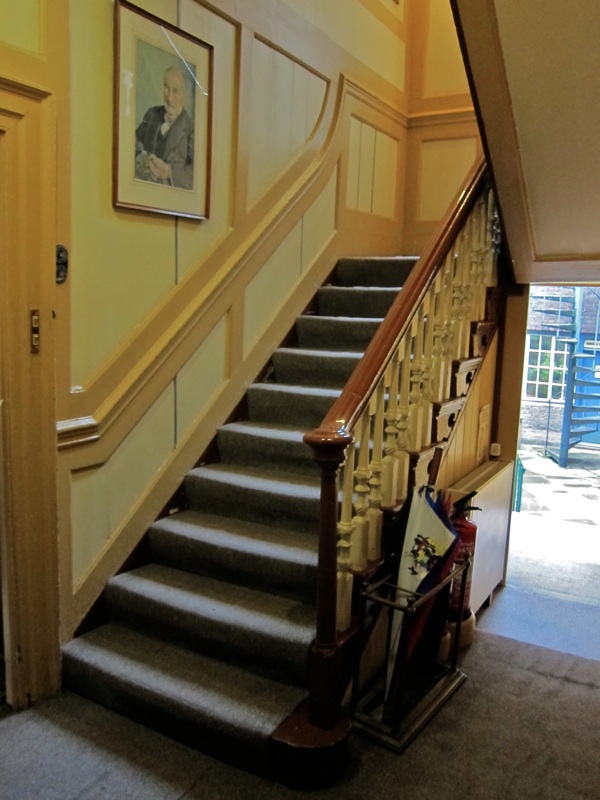


Huguenot silk weaver Peter Ogier is believed to have built 37 Spital Square in the seventeen-forties.
You may also like to read about
Philip Venning, former Director of the Society for the Protection of Ancient Buildings
Bill Crome, the Window Cleaner who sees Ghosts in Spital Sq
and these other renovations in Spitalfields


