
E. O. Hoppé’s Londoners
Click here to book THE GENTLE AUTHOR’S TOUR OF SPITALFIELDS
I came upon these intimate and dignified portraits by Emil Otto Hoppé (1878-1972), accompanying interviews by W. Pett Ridge in his LONDON TYPES, 1926.

RANK & FASHION
‘The costume known as pearlies went out so long ago that it can be regarded as a page of distant history. The presentment of a Cockney type is now achieved by other means. As a fact, Commercial Rd is determined to keep pace with the West End so far as male attire is concerned, but the time may come when Hackney Rd will lead.’

THE CHIPPER
‘An increased use of roadways has added to the range of the chipper. From the motor coach, as he goes along the countryside, he can fire comments at slow pedestrians and he can chaff the young women riding pillion on motor bicycles. As used at public meetings, chipping is sometimes known as heckling and no general election is complete without specimens of his art. A junior in any office or warehouse is wise to submit to the verbal attack made by the chipper of the establishment. In due course and with the passage of years, he too will become a chipper. In this way, traditions are maintained and old customs not allowed to die.’

THE MESSENGER GIRL
‘With all the short cuts she is well acquainted and it is not the messenger girl who is deceived by turnings out of Bishopsgate St…’

OF THE FOREIGN LEGION
‘Robinsky – first name Stanislaus – came here many years ago with his wife, neither being acquainted with the English language. Somehow they made their way from the docks to Tottenham Court Rd where they have lived ever since. Robinsky is growing old now and likely enough he does not feel his control over European matters is quite as complete as he once hoped it would be.’

COURT MARTIAL
‘All witnesses whether from Hoxton or elsewhere show a pained anxiety to be extremely decorous in language. Only under the encouragement of the magistrate’s clerk do they, in their quotations, consent to be verbally exact and report with coyness words to which, in ordinary life, they are fully accustomed.’

COMPARISONS
‘Cecil Whitstable swaggered along Latimer Rd, giving a wave of the hand to men acquaintances, with a forefinger to the peak of the cap when they were in the company of ladies. One of the men hurried after him and asked privately if he knew anything worth knowing about the three-thirty race that afternoon. Cecil replied that his mind was on weightier matters.’

HOME WORKERS
‘The home worker pays more dearly than for necessaries than anyone else in London and this is because she has to buy tea by the two ounces, butter by the quarter pound and sugar by the pennyworth…’

STREET MUSIC
‘There are changes in the musical repertory of London introduced so gradually that one requires an observant ear to detect the alteration of the programme. The rhythmical sound of horses hooves has become rare, even the piano organ has become less aggressive. In order that its voice may not reach a public outside its paying area, it frequently mutes its notes and rarely leaves Saffron Hill until the day is well advanced…’

THE COMPLETE LETTER WRITER
‘You will find the humble abode of one who has been visited by dire misfortune, deserted by all the acquaintances one knew in happier days and in brighter surroundings, many articles in the shape of furniture have had to go…’

THE CITY POLICEMAN
‘Protected by his outstretched arm from the traffic that near the Bank comes from every quarter, I have crossed safely without the trouble of diving into the station of the Central Railway. I have seen him dance with agreeable ladies in the great hall at the Cannon St Hotel. I have watched him at open air sports for an entire afternoon. I have looked on with awe at his boxing…’

PRIME OF LIFE
‘An occurrence on which he is an authority is the Clerkenwell Explosion – ‘Wheels a barrel of gunpowder close up against the wall of the prison, then lights a fuse and runs away,’ adding with relish, ‘A few dozen killed and over a hundred damaged. Precious little else talked about at the time I can assure you!”

NOTABLE FEATURES
“Living not far from Shoreditch Church, Mrs Marsden’s husband held a fixed objection to work and the task of earning a wage was left to her. Once he was absent for a fortnight and, when a neighbour brought news that a body had been taken out of the river, Mrs Marsden set out at once for the mortuary. ‘That’s Bill, right enough!’ she said. The insurance was drawn, an almost luxurious funeral provided and a good supply of refreshments laid in. But when the mourners returned, conducted by Mrs Marsden, they found Bill seated at the table. He had eaten the ham and consumed most of the beverages.’

CHAILEY’S RECORD
‘One of the bravest officers the division had ever included in its ranks, Mr Chailey was presented by the Chairman with a spontaneous collection amounting to over one hundred pounds.’

STEPS
‘In the quarters where doorsteps receive daily attention, the maid with her kneeling mat and other necessities of the job, comes up the area stairs early enough to permit of conversation with the acquaintances who pass by and she does not object to the interruptions created. The postman alludes to the temperature. ‘Don’t find I sleep well,’ he mentions autobiographically, ‘during the hot weather.’ ‘Small wonder,’ she remarks, good-humouredly. ‘Look at the life you have led.’ The postman goes on, greatly cheered by the implication.’

THE CHAR-LADY
It is rare for Mrs Miller to take a journey in a public conveyance without being recognised by a fellow passenger. Her bonnet assists her identification. Being no slave to fashion, she has always, in living memory, worn the same style and she retains the headgear when engaged in her daily tasks. I am unable to say whether of not she sleeps in it.’

FIRST DAY
‘George found himself a junior at a salary which juniors of an earlier period would have deemed impossible. A chief clerk to whom he was introduced gazed at him steadily through a pince-nez and said, not discouragingly, ‘I daresay we shall be able to knock some sense into you.’ To which George replied – having been warned to be polite to his superiors – ‘Much obliged, sir!”

HANDS
‘The beauty of the hand diminishes when it has to perform tasks at the Council Washhouses.’
Photographs copyright © Estate of E O Hoppé
You may also like to take a look at
The Bengali Photo Archive
Click here to book THE GENTLE AUTHOR’S TOUR for Saturday

These photographs are drawn from the Bengali Photo Archive, a new collection of personal and family images donated by local people alongside the work of photographers who have documented the lives of the Bengali community. An exhibition of pictures from the archive entitled, I Am Who I Am Now opens today at Four Corners in Bethnal Green and runs until 3rd August.

Dance at Spitalfields City Farm, Danièle Lamarche 1990s

Adult learners in Whitechapel, Bev Zalcock 1975

Shanaz with her mother in Bangladesh, Shanaz Siddiqa-Baeg 1981
 Brick Lane, David Hoffman 1990

Outside Ali Brothers’ grocery shop, Fashion St, Raju Vaidyanathan 1986

Shanaz at Biscott House and three passport photos collage, Shanaz Siddiqa-Baeg

Notes from the streets, Anthony Lam 1990s
 Mela, Brady St, David Hoffman 1987
 Portrait of a young girl, Anthony Lam 1980s

Montefiore Mural Painting, Tom Learmouth 1970s

Bangladesh Youth Movement winning the football tournament final, Lloyd Gee 1986

Shaira’s siblings and mother, Shaira Jahan 1982

Anti-racist protest in Tower Hamlets, Syd Shelton 1970s

Studio Portrait, Nita Roy Chowdhury 1983

TUC Unite Against Racism March, Mayar Akash 1990s

Brick Lane Mela, Raju Vaidyanathan 1996
Images courtesy Bengali Photo Archive
You may also like to take a look at
Summer At Bow Cemetery
Click here to book THE GENTLE AUTHOR’S TOUR for Saturday
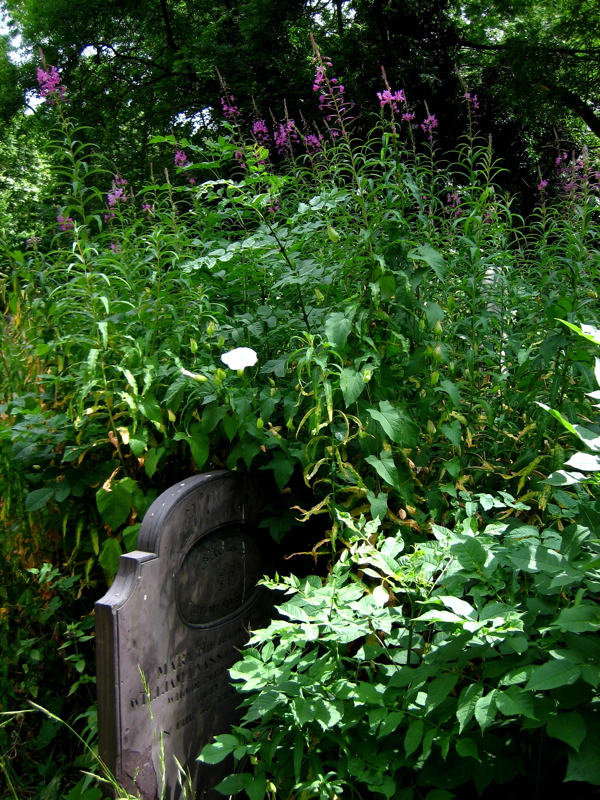
At least once each Summer, I direct my steps eastwards from Spitalfields along the Mile End Rd towards Bow Cemetery, one of the “Magnificent Seven” created by act of Parliament in 1832 as the growing population of London overcrowded the small parish churchyards. Extending to twenty-seven acres and planned on an industrial scale, “The City of London and Tower Hamlets Cemetery” as it was formally called, opened in 1841 and within the first half century alone around a quarter of a million were buried here.
Although it is the tombstones and monuments that present a striking display today, most of the occupants of this cemetery were residents of the East End whose families could not afford a funeral or a plot. They were buried in mass public graves containing as many as forty bodies of random souls interred together for eternity. By the end of the nineteenth century the site was already overgrown, though burials continued until it was closed in 1966.
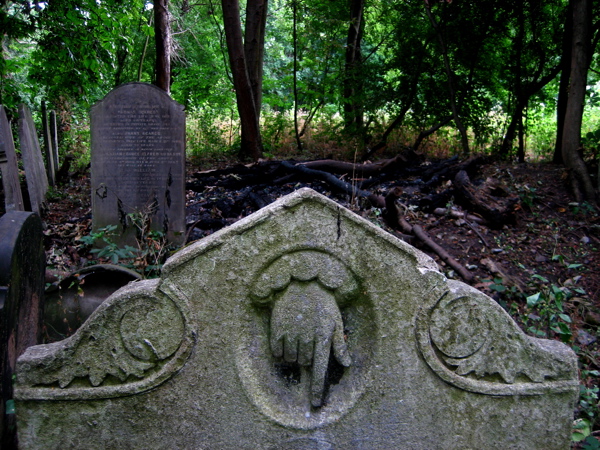
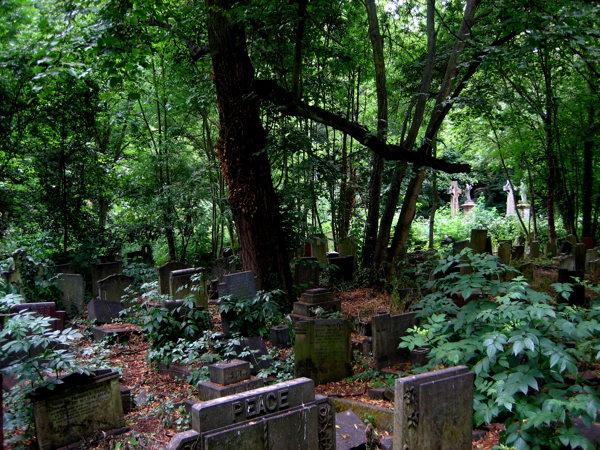
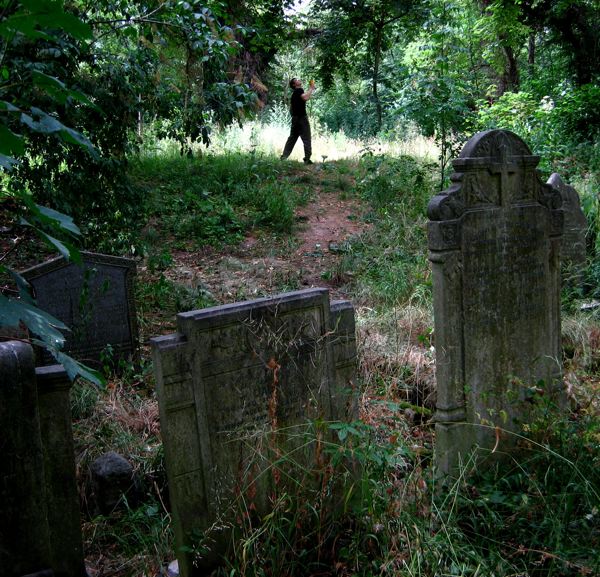
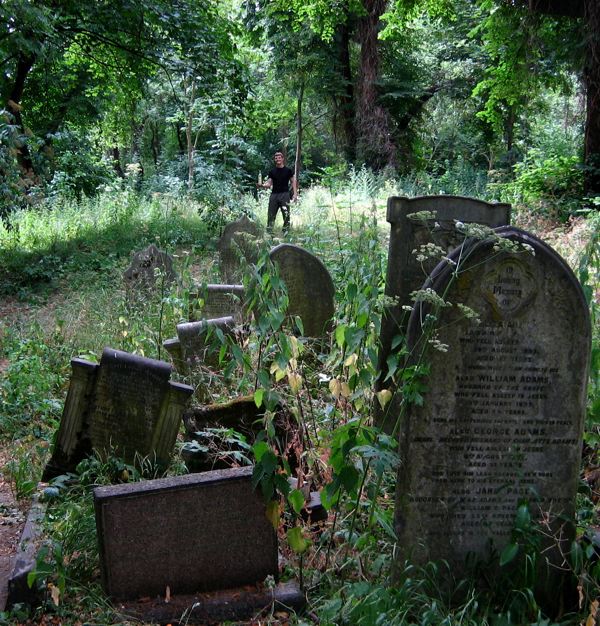
Where death once held dominion, nature has reclaimed the territory and a magnificent broadleaf forest has grown, bringing luxuriant growth that is alive with wildlife. Now the tombstones and monuments stand among leaf mould in deep woods, garlanded with ivy and surrounded by wildflowers. Tombstones and undergrowth make one of the most lyrical contrasts I can think of – there is a beautiful aesthetic manifest in the grim austerity of the stones ameliorated by vigorous plant life. But more than this, to see the symbols of death physically overwhelmed by extravagant new growth touches the human spirit. It is both humbling and uplifting at the same time. It is the triumph of life. Nature has returned and brought more than sixteen species of butterflies with her.
This is the emotive spectacle that leads me here, turning right at Mile End tube station and hurrying down Southern Grove, increasing my pace with rising expectation, until I walk through the cemetery gates and I am transported into the green world that awaits. At once, I turn right into Sanctuary Wood, stepping off the track to walk into a tall stand of ivy-clad sycamores, upon a carpet of leaves that is shaded by the forest canopy more than twenty metres overhead and illuminated by narrow shafts of sunlight descending. It is sublime. Come here to see the bluebells in Spring or the foxgloves in Summer. Come at any time of the year to find yourself in another landscape. Just like the forest in Richard Jefferies’ novel “After London,” the trees have regrown to remind us what this land was once like, long ago before our predecessors ever came here.
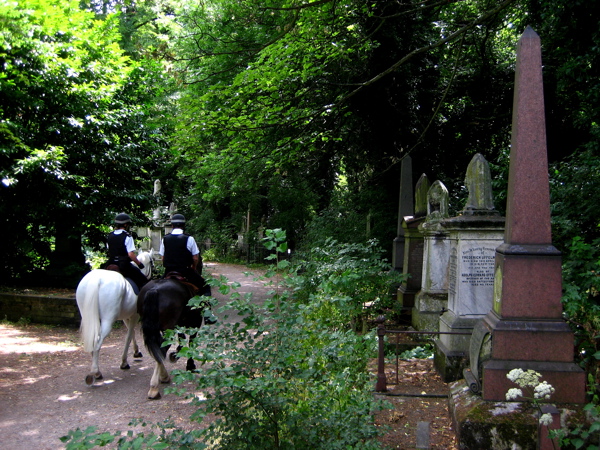
Over time, the tombstones have weathered and worn, and some have turned green, entirely harmonious with their overgrown environment, as if they sprouted and grew like toadstools. The natural stillness of the forest possesses greater resonance between cemetery walls and the deep green shadows of the woodland seem deeper too. There was almost no-one alive to be seen on the morning of my visit, apart from two police officers on horseback passing through, keeping the peace that is as deep as the grave.
Just as time mediates grief and grants us perspective, nature also encompasses the dead, enfolding them all, as it has done here in a green forest. These are the people who made East London, who laid the roads, built the houses and created the foundations of the city we inhabit. The countless thousands who were here before us, walking the streets we know, attending the same schools, even living in some of the same houses we live in today. The majority of those people are here now in Bow Cemetery. As you walk around, names catch your eye, Cornelius aged just two years, or Eliza or Louise or Emma, or Caleb who enjoyed a happy life, all over a hundred years ago. None ever dreamed a forest would grow over their head, where people would come to walk one day to discover their stones in a woodland glade. It is a vision of paradise above, fulfilled within the confines of the cemetery itself.
As I made my progress through the forest of tombstones, I heard a mysterious noise, a click-clack echoing through the trees. Then I came upon a clearing at the very heart of the cemetery and discovered the origin of the sound. It was a solitary juggler practicing his art among the graves, in a patch of sunlight. There is no purpose to juggling than that of delight, the attunement of human reflexes to create a joyful effect. It was a startling image to discover, and seeing it here in the deep woods – where so many fellow Londoners are buried – made my heart leap. Outside on the streets, a million people were going about their business while in the vast wooded cemetery there was just me, the numberless dead and the juggler.


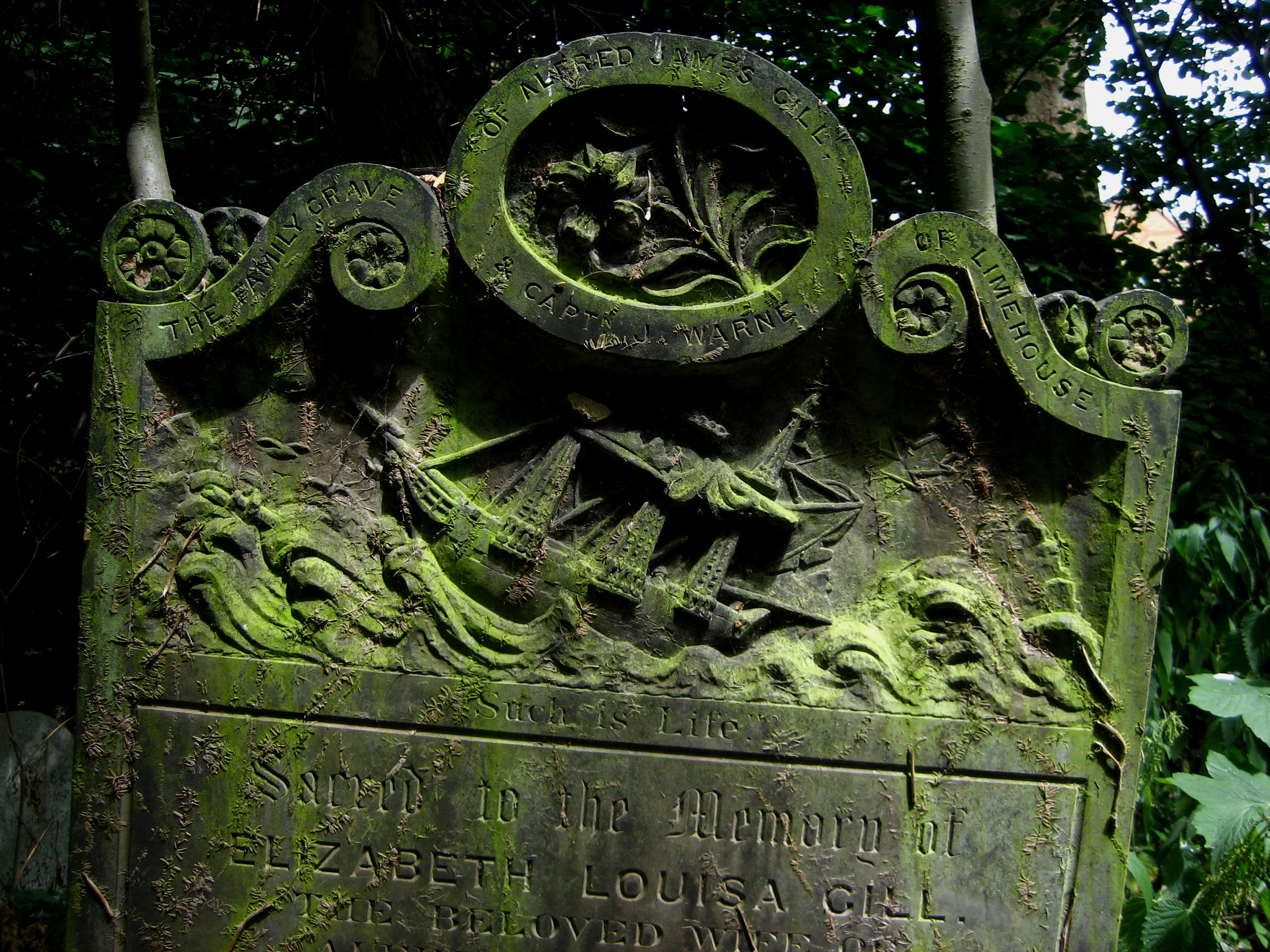
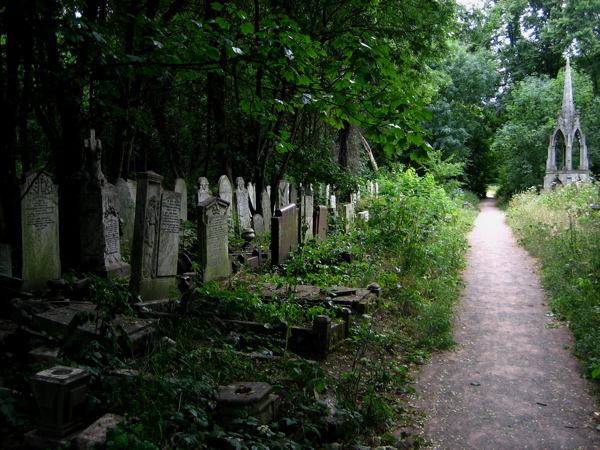
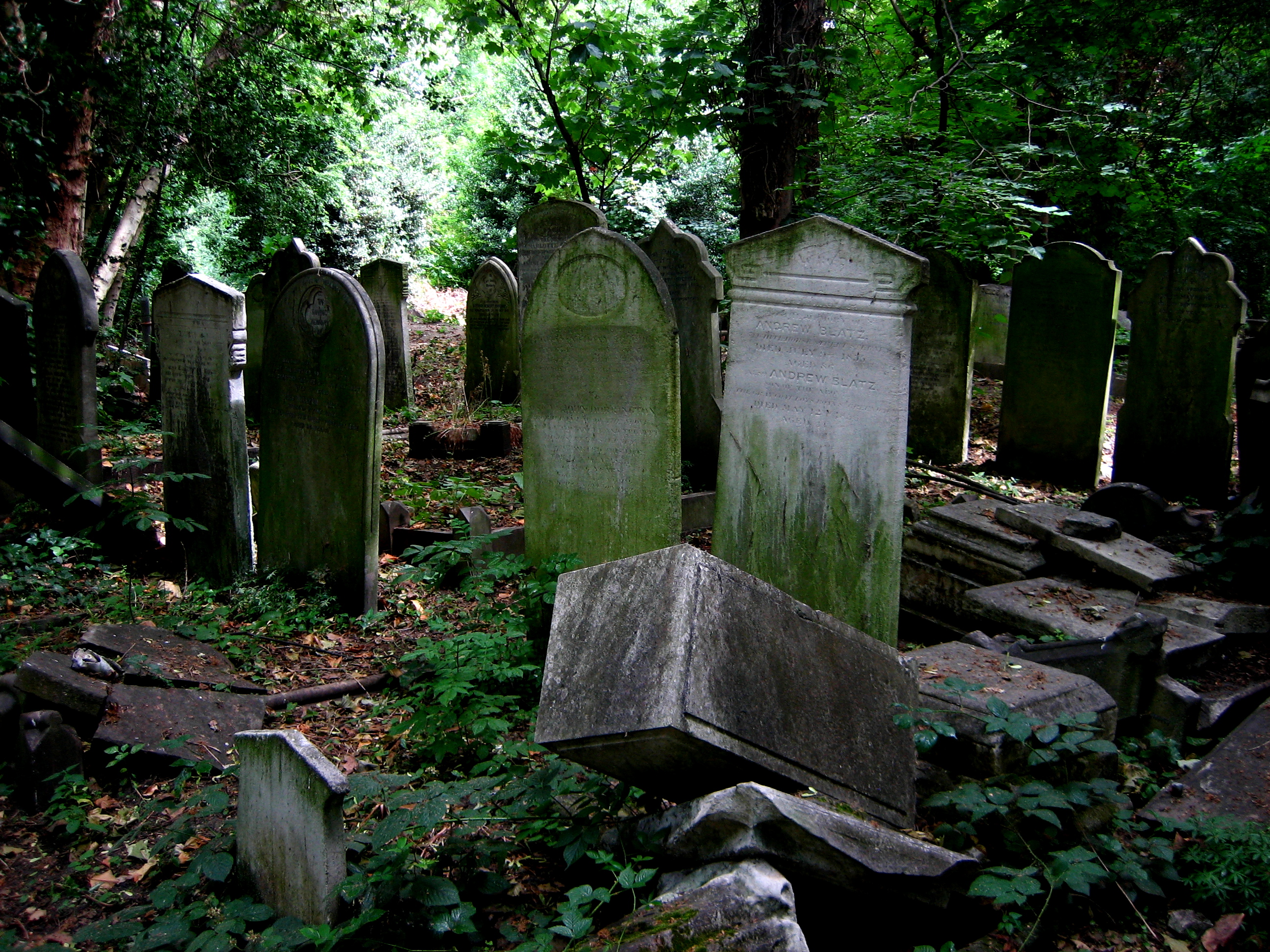
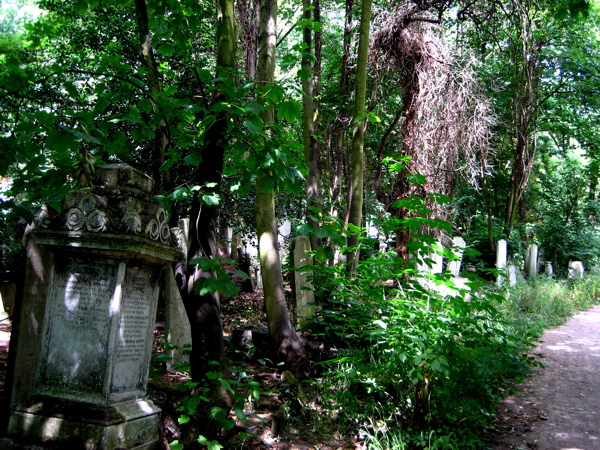
Find out more at www.towerhamletscemetery.org
The Tale Of John Crosby
Click here to book THE GENTLE AUTHOR’S TOUR for this Saturday
On the eve of the General Election, Historian Ruth Richardson uncovers a salutary tale from a century ago that eloquently illustrates the divergence between the two major parties in respect for the sanctity of the human body.

Dressing upon the grave of John Crosby, Barking Cemetery
This is the story of John Crosby, an east ender who died in the workhouse. His story offers one explanation of the appeal of the nascent Labour Party to many Londoners.
John Crosby was a decorated ex-serviceman, a veteran of the Crimean War, who died in 1921 in Romford Workhouse. He had outlived his family and, until he fell ill in the last year of his life, lived in lodgings on his army pension. The National Health Service was still a quarter-century in the future, so Mr Crosby was taken to the local workhouse and, when he died there, his body was sent for dissection.
I discovered Mr Crosby’s story when I was researching the records of the Anatomy Office. A news cutting had been heavily marked up for attention and it caught my eye. When I had read it, I understood the Anatomy Inspector’s official interest and possibly his alarm.
The Inspector of Anatomy’s job was to oversee the smooth working of the Anatomy Act, an unpleasant piece of class legislation passed in 1832 to create a new source of fresh corpses for medical schools. It went through quietly, mostly at night while Parliament was debating the Reform Bill during the day. The national uproar over the difficulty of extending voting rights occupied the newspapers for months, so reporting of the ‘midnight’ Anatomy Bill was effectively buried.
At the time, the teaching of anatomy was hampered by a shortage of corpses. Ever since Tudor times, dissection had been a exemplary punishment for murderers yet there were too few to supply medical students’ needs. Grave robbers were efficient but by the eighteen-twenties efforts to protect graveyards made their work more difficult and costs were rising. The discovery of the serial murderers Burke & Hare in Edinburgh in 1828 and then the London ‘Burkers’ of 1831, revealed that the high sums offered for fresh corpses had in fact served to commission murders. Between 1828 and 1832 (when the Anatomy Act was passed) the country was gripped by ‘burkophobia’ – the widespread terror of being murdered for dissection.
The Anatomy Act of 1832 was skilfully drafted. It transferred dissection from being a terrible judicial punishment, inflicted only upon the worst of murderers, to the very poor. Anyone receiving a pauper’s funeral could now be requisitioned for dissection without their consent.
Enormous resistance to the new law erupted across the country, including the phenomenal growth of the Victorian burial insurance industry, yet the Act remains the basis of corpse procurement even today. The same cruel inclination resulted two years later in the passage of the New Poor Law, establishing the harsh workhouse regime which terrorised the poor throughout Victoria’s long reign and well into the twentieth century.
In the nineteen-twenties, Dr Alexander MacPhail was the newly appointed Anatomy Inspector, travelling nationwide to persuade local authorities to send their unclaimed dead to medical schools. In April 1921, the Tory majority on Romford’s Board of Guardians obliged. Since Mr Crosby had no known living relatives and his friends were too poor to pay for his burial, he was classified as an ‘unclaimed’ pauper and sent for dissection.
But a minority group of the Guardians, who were elected from the nascent Labour Party, perceived the social injustice of the Anatomy Act and were implacably opposed to it. They tried to defend the Romford poor from its reach. Outnumbered, they had failed just as they had failed to prevent the Tory majority from forcing unemployed men from Barking, both fit and war-disabled, to walk six miles and back to the Romford labour yard to take the ‘work test’ – smashing stones etc – to qualify for unemployment relief.
Yet Mr Crosby’s case was another matter. Word got out that a decorated army veteran had been consigned to dissection. In 1921, the Great War was a recent memory and Romford War Memorial was being constructed while Mr Crosby was dying. It was unveiled in the town centre while Mr Crosby was lying on a dissecting table as his body was in the process of dissection.
The Guardians of the Romford Workhouse met fortnightly and, since the Tory majority also held the Chair, decisions already voted through were difficult to reverse. It took public outrage to force the decision to recall Mr Crosby’s corpse and weeks more passed before the Guardians’ resolution was effected by the Anatomy Inspector. Eventually, John Crosby’s body was returned to Romford.
The Tory group on the Guardians in Romford realised they were in the wrong and were so shamed by their own ugly decision that all but one of them avoided attending Mr Crosby’s funeral. 12th October 1921 was the day of a huge celebration in Romford and Barking. The streets were lined with silent spectators as a military escort from nearby Warley Barracks accompanied the coffin, draped in the Union Jack and borne on a gun-carriage. The procession marched from Romford Workhouse, via Mr Crosby’s old lodgings in James St, to Barking Cemetery. Wreaths had been sent by friends and neighbours, a Labour councillor, and from the ‘mother of a soldier’.
As the coffin passed through the cemetery gates, the military band in attendance struck up the Death March, three volleys were fired over the grave, and the plaintive sound of the Last Post echoed out across the cemetery. Speeches followed, and it was these – as reported in the local paper – which had been of such interest to the Anatomy Inspector. The graveside addresses included one from a highly respected local public figure, Mr Edwin Lambert, one of the minority Labour Party Guardians of the Poor.
‘As Labour members who recognised the rights of all, they held that if it was good for John Crosby to have his body put on the dissecting table it was good for anybody else. There should be no distinction. If it was necessary at all, let them be balloted for. But they did protest against this man’s body being taken to the dissection table without his sanction beforehand, while Lord Tom Noddy was allowed to go quite free because he could make a pomp and show of it.’
Between 1855, until his discharge from the Royal Artillery in 1883, John Crosby’s years of service included India (1857 onwards), Afghanistan (1878-80) and Egypt (1882). Like many recruits, Mr Crosby probably fibbed about his age in 1855 when he enrolled as a bugle boy in the Royal Artillery during the Crimean War. His age was recorded as thirteen but at his death in 1921 was recorded as seventy-seven years old, which does not add up. So it is possible that he was only eleven years of age when he joined the army.
Mr Crosby was certainly not the only army veteran sent for dissection by so-called ‘Guardians’ of the Poor in the years following World War One. He probably represents many workhouse inmates who ended up on the slab after serving this country in war. Thousands of working-class men injured or limbless from battle had been forced into workhouses on their return from the trenches and a good proportion of them had died there ‘unclaimed’, despite what they had been told by the ruling politicians about a ‘Land Fit for Heroes’.
It took two more years after Mr Crosby’s funeral for the Anatomy Office to issue a circular to corpse-suppliers – workhouses, infirmaries, mental hospitals etc – to the effect that any institutionalised veteran in receipt of an army pension was henceforth exempted from requisition for dissection.
The interwar period was brief, less than a generation. Veterans of World War Two knew that the ‘Land Fit for heroes’ had dishonoured its own rhetoric by sending injured servicemen to the workhouse. Their votes helped secure the 1945 Labour government which created our National Health Service.
With many thanks to Gemma Norburn, Staff at the Essex Records Office at Chelmsford, Staff at the British Library, Simon Donoghue at Havering Central Library, and Simon Hutchison.
You may like to read these other stories by Ruth Richardson
More Trade Cards Of Old London
Click here to book THE GENTLE AUTHOR’S TOUR for Saturday
Today it is my pleasure to show this selection of old London trade cards discovered by searching down the back of a hypothetical sofa and under a hypothetical bed. Especially noteworthy are the cards for Lacroix’s and Peter De la Fontaine which are the early work of William Hogarth.


Images courtesy Bishopsgate Institute
You may like to see my original selection
In The Lavender Fields Of Surrey
Click here to book THE GENTLE AUTHOR’S TOURS for July

I cannot imagine a more relaxing way to enjoy a sunny English summer afternoon than a walk through a field of lavender. Observe the subtle tones of blue, extending like a mist to the horizon and rippling like the surface of the sea as the wind passes over. Inhale the pungent fragrance carried on the breeze. Delight in the orange butterflies dancing over the plants. Spot the pheasants scuttling away and – if you are as lucky as I was – encounter a red fox stalking the game birds through the forest of lavender. What an astonishing colour contrast his glossy russet pelt made as he disappeared into the haze of blue and green plants.
Lavender has been grown on the Surrey Downs for centuries and sold in summer upon the streets of the capital by itinerant traders. The aromatic properties and medicinal applications of lavender have always been appreciated, with each year’s new crop signalling the arrival of summer in London.
The lavender growing tradition in Surrey is kept alive by Mayfield Lavender in Banstead where visitors may stroll through fields of different varieties and then enjoy lavender ice cream or a cream tea with a lavender scone afterwards, before returning home laden with lavender pillows, soap, honey and oil.
Let me confess, I had given up on lavender – it had become the smell most redolent of sanitary cleaning products. But now I have learnt to distinguish between the different varieties and found a preference for a delicately-fragranced English lavender by the name of Folgate, I have rediscovered it again. My entire house is scented with it and the soporific qualities are evident. At the end of that sunny afternoon, when I returned from my excursion to the lavender fields of Surrey, I sat down in my armchair and did not awake again until supper time.


‘Six bunches a penny, sweet lavender!’ is the cry that invites in the street the purchasers of this cheap and pleasant perfume. A considerable quantity of the shrub is sold to the middling-classes of the inhabitants, who are fond of placing lavender among their linen – the scent of which conquers that of the soap used in washing. – William Craig Marshall’s Itinerant Traders, 1804

‘Delight in the orange butterflies dancing over the plants…’

Thomas Rowlandson’s Characteristic Series of the Lower Orders, 1820


‘Six Bunches a-Penny, Sweet Lavender – Six Bunches a-Penny, Sweet Blooming Lavender’ from Luke Clennell’s London Melodies, 1812

‘Spot the pheasants scuttling away…’

From Aunt Busy Bee’s New London Cries


Card issued with Grenadier Cigarettes in 1902


WWI veteran selling lavender bags by Julius Mendes Price, 1919


Yardley issued Old English Lavender talcum powder tins from 1913 incorporating Francis Wheatley’s flower seller of 1792

Archive images courtesy Bishopsgate Institute
At Waterbeach
Tickets are available for my walking tour now
Click here to book your ticket for THE GENTLE AUTHOR’S TOUR OF SPITALFIELDS

I set out to visit the intriguingly named Waterbeach and Landbeach in Cambridgeshire with the object of viewing Denny Abbey. Built in the twelfth century as an outpost of Ely Cathedral, it passed through the hands of the Benedictine Monks, the Knights Templar and a closed order of Franciscan nuns known as the ‘Poor Clares’ – all before being converted into a private home for the Countess of Pembroke in the fifteenth century. Viewed across the meadow filled with cattle, today the former abbey presents the appearance of an attractively ramshackle farmhouse.
A closer view reveals fragments of medieval stonework protruding from the walls, tell-tale signs of how this curious structure has been refashioned to suit the requirements of diverse owners through time. Yet the current mishmash delivers a charismatic architectural outcome, as a building rich in texture and idiosyncratic form. From every direction, it looks completely different and the sequence of internal spaces is as fascinating as the exterior.
In the second half of the twentieth century, the property came into the ownership of the Ministry of Works and archaeologists set to work deconstructing the structure to ascertain its history. Walking through Denny Abbey today is a vertiginous experience since the first floor spaces occupy the upper space of the nave with gothic arches thrusting towards the ceiling at unexpected angles. Most astonishing is to view successive phases of medieval remodelling, each cutting through the previous work without any of the reverence that we have for this architecture, centuries later.
An old walnut tree presides over the bleached lawn at the rear of the abbey, where lines of stone indicate the former extent of the building. A magnificent long refectory stands to the east, complete with its floor of ancient ceramic tiles. While the Farmland Museum occupies a sequence of handsome barns surrounding the abbey, boasting a fine collection of old agricultural machinery and a series of tableaux illustrating rural trades.
Nearby at Landbeach, I followed the path of a former Roman irrigation system that extends across this corner of the fen, arriving at the magnificent Tithe Barn. Stepping from the afternoon sunlight, the interior of the lofty barn appeared to recede into darkness. As my eyes adjusted, the substantial structure of purlins and rafters above became visible, arching over the worn brick threshing floor beneath. Standing in the cool shadow of a four hundred year old barn proved an ideal vantage point to view the meadow ablaze with sunlight in this exceptional summer.

Denny Abbey, Waterbeach


Mysterious stone head at Denny Abbey


The Farmland Museum, Waterbeach


Tithe Barn, Landbeach


You may also like to read my other story about Waterbeach


