Leila’s Shop Report 4
There is a tiny triangular yard at the front of Virginia Rd School next to Leila’s Cafe that has been transformed into the school vegetable patch over the last year – where, each Tuesday afternoon, Leila McAlister supervises the after-school gardening club encouraging pupils to grow their own produce. Most of the eager gardeners are residents of the Boundary Estate and do not have gardens of their own, which makes this an especially valuable experience.
“We used to do occasional gardening days in the park at Arnold Circus, when it was really overgrown and a bit of a jungle, clearing patches and planting wildflower seeds and spring bulbs.” Leila recalled fondly, as we sat among the raised beds waited for the pupils to arrive yesterday, “The kids used to love it, but it was apparent that they had done no gardening before. They called earth “dirt” and were afraid of getting dirty – and they didn’t know the difference between worms and snakes.”
However, since most of these children were from Bengali families, Leila found they had a cultural attachment to vegetables. At home, the families ate together every day, enjoying a meal cooked from fresh ingredients and so the children were familiar with vegetables being prepared. “They had a very positive attitude to tasting things,” Leila explained, “Even Spinach and Chard, which children often wince at.”
And then last year, in a surprising development, the pupils of Virginia Rd School (who have their own school council) won a grant of a thousand pounds, which they applied for themselves, from Tower Hamlets’ Healthy Lives Team, to encourage vegetable growing in the borough. “I’m a governor of the school and it came up in the meeting that they had won this grant, and so I volunteered to take it further.” Leila admitted to me in delighted amazement, as the twelve members of the gardening club – aged between six and eleven – streamed excitedly through the blue gate, eager to begin.
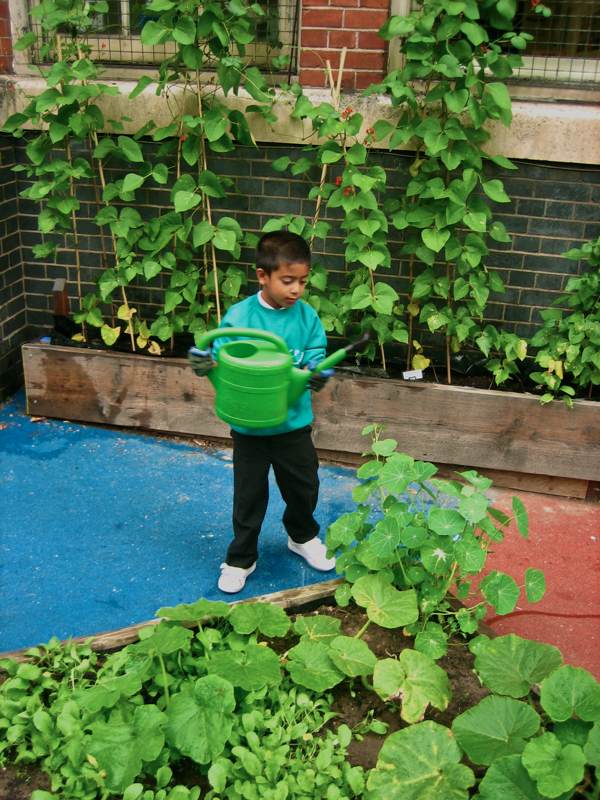
Once everyone helped themselves to cherries from the bowl, there was a short tour of the garden to assess the progress of the vegetables since last week, weaving our way among the raised beds and the pile of car tyres filled with soil that were now sprouting luxuriant growth. The giant pumpkins and sunflowers were ahead of themselves, and the lettuces and radishes grown from seed were making a healthy showing too, but once we got down on our knees it was apparent that some thinning out was necessary – an ideal job for nimble, small fingers.
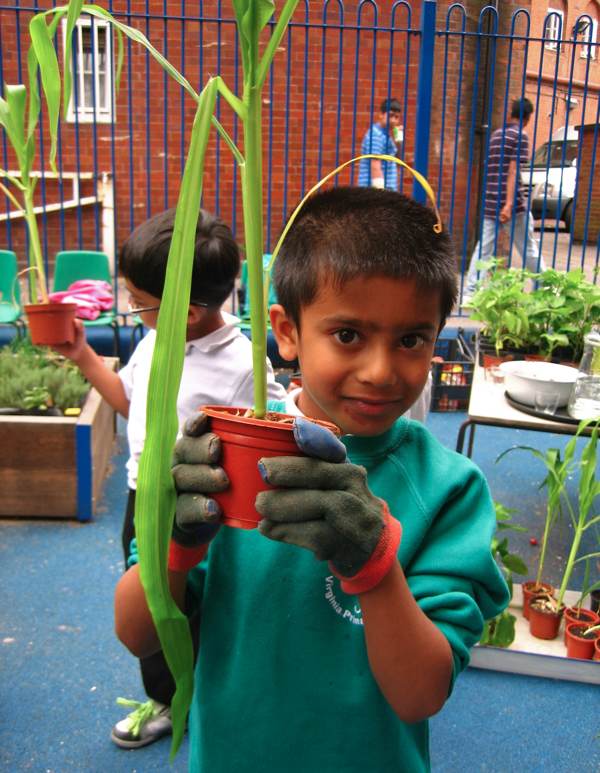
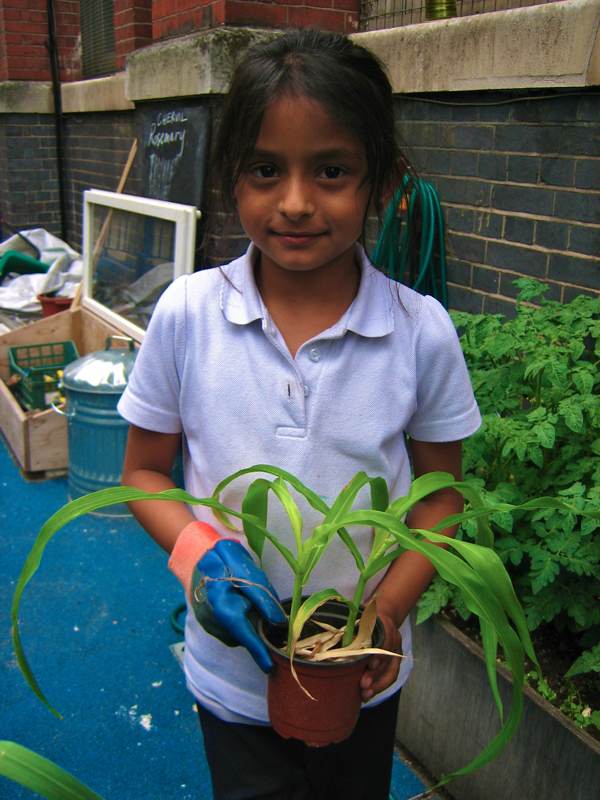
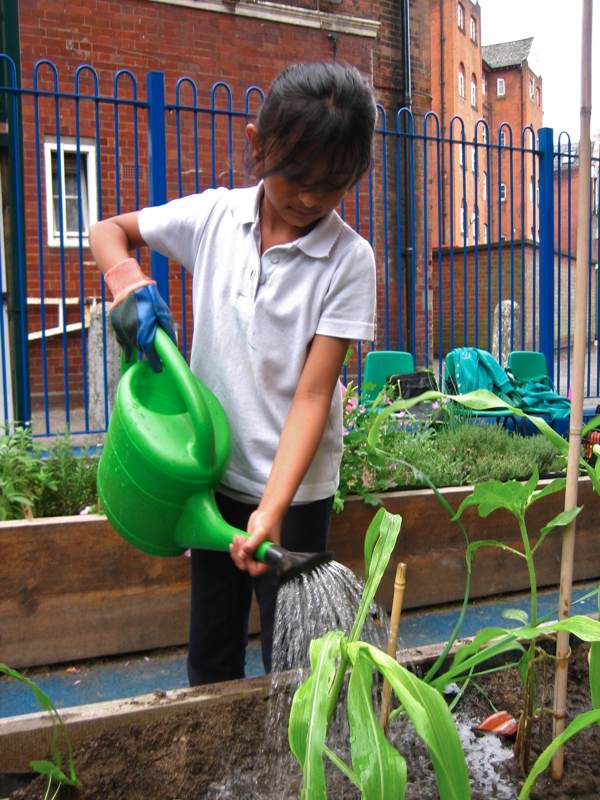
Then Leila produced a tray of corn seedlings for each of the young gardeners to take one and plant it. Gloves on and trowels at the ready, they were particular to tap the pots and tip the plants into their hands before planting, without damaging the roots. But, in their enthusiasm, some had not yet dug the hole – a situation which required the dexterous accommodation of holding a seedling in one hand whilst digging a hole with the other. You will be relieved to know that everyone achieved the desired result, planting an array of corn plants equally spaced between the line of sunflowers.
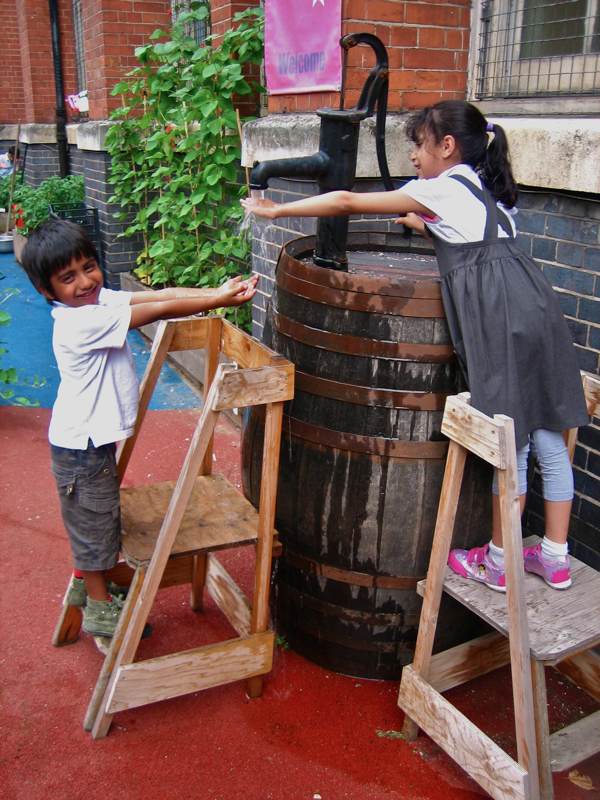
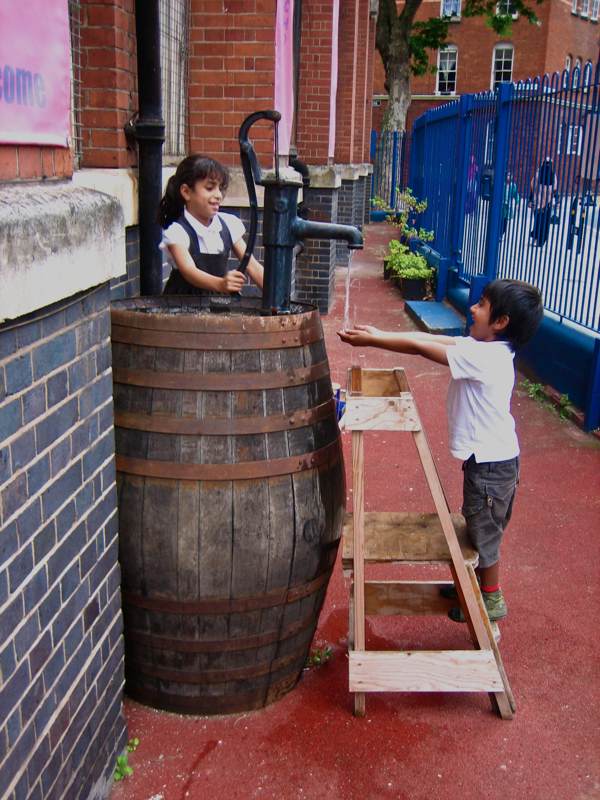
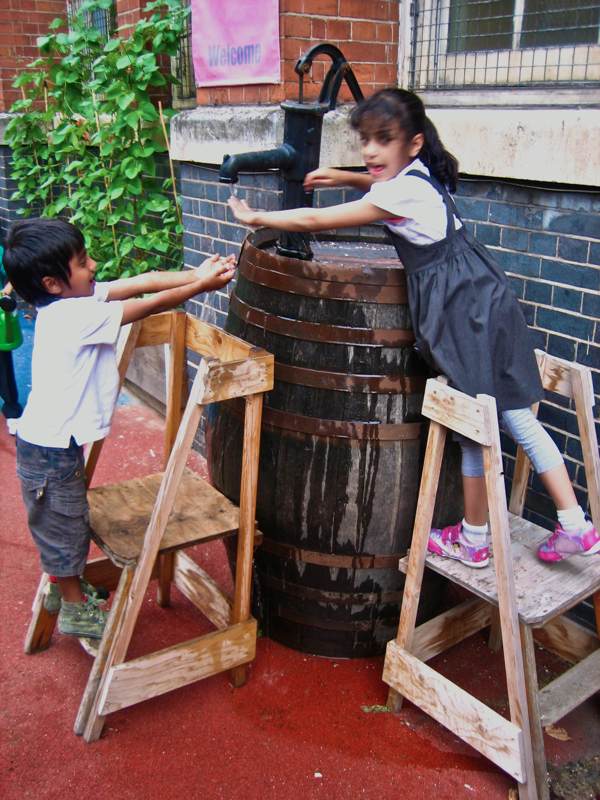
The time had arrived to bring out watering cans and fill them from the pump, always a highlight of an afternoon at the gardening club. One small person climbs up a ladder to reach the handle of the pump while another small person climbs up another ladder to hold the can under the spout where the water gushes out – the possibilities for high jinks are endless and never before has the filling of a watering can become such an adventure. The result is that members of the gardening club are eager to fill their cans as many times as possible and give their plants a good drenching.
Already, an hour had slipped away and, even as Leila produced some old olive oil tins and invited her young assistants to plant chilli pepper seedlings in them, parents were arriving and poking their heads through the railings, curious to observe the children’s horticultural achievements and smiling in approval. Then, from the lowering sky, where the clouds had been gathering upon this humid afternoon, came the first drip-drops of rain. And so, with a wave of thanks to Leila, the members of the gardening club helped themselves to the last of the cherries from the bowl and ran back to their homes scattered around Arnold Circus to shelter from the rain, leaving their newly planted vegetables to take care of themselves, in keen anticipation of new growth by next week.
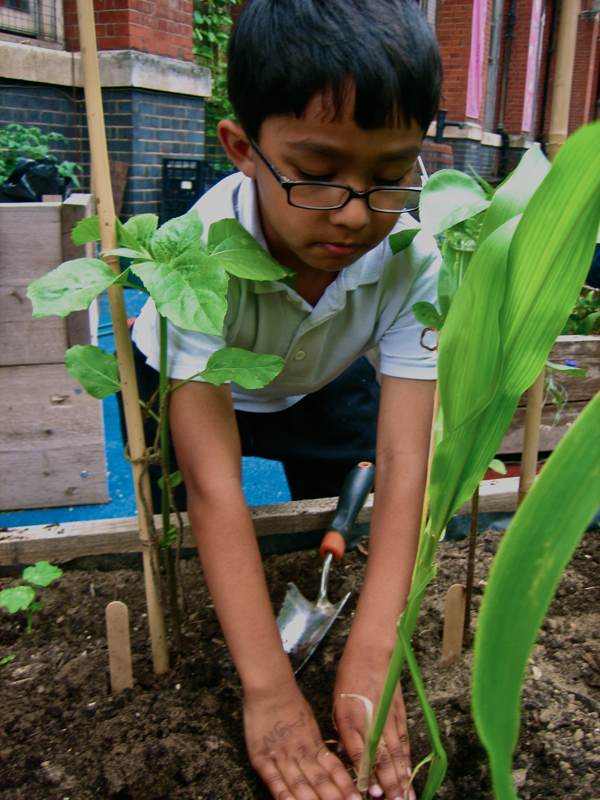
Planting the corn.
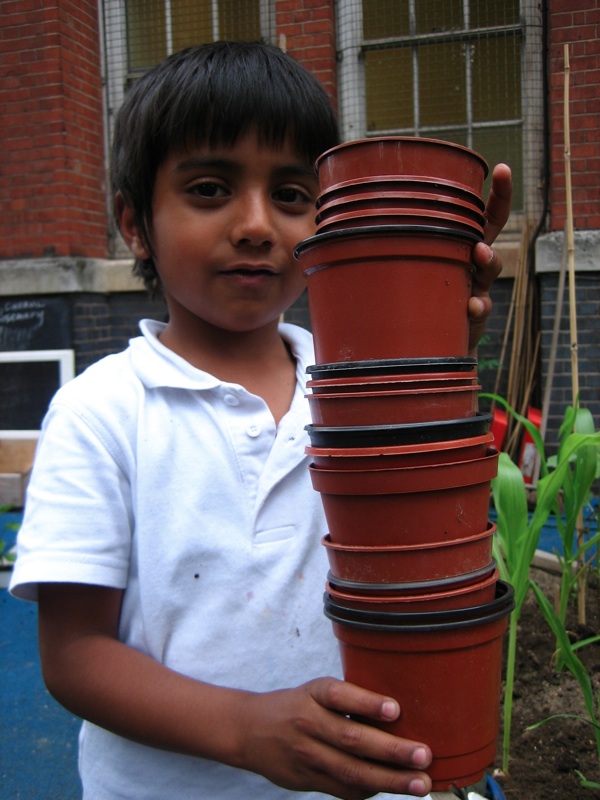
Collecting the pots.
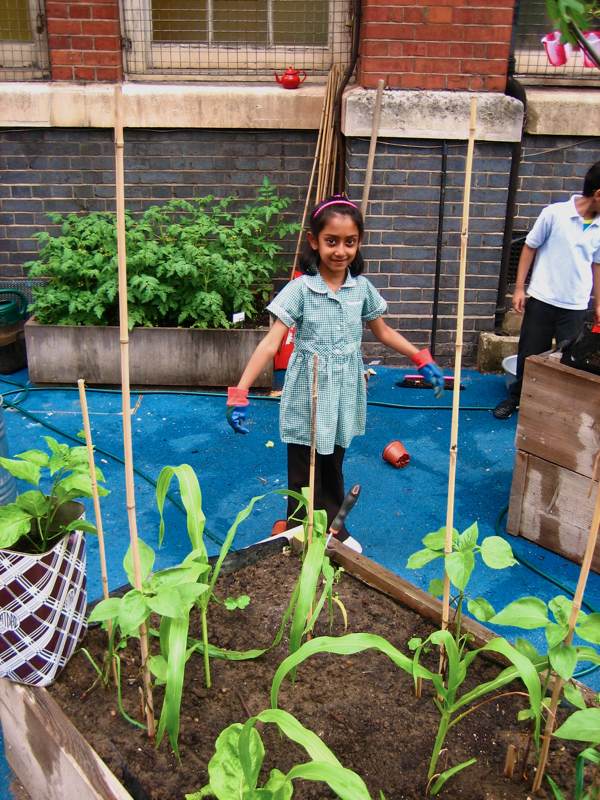
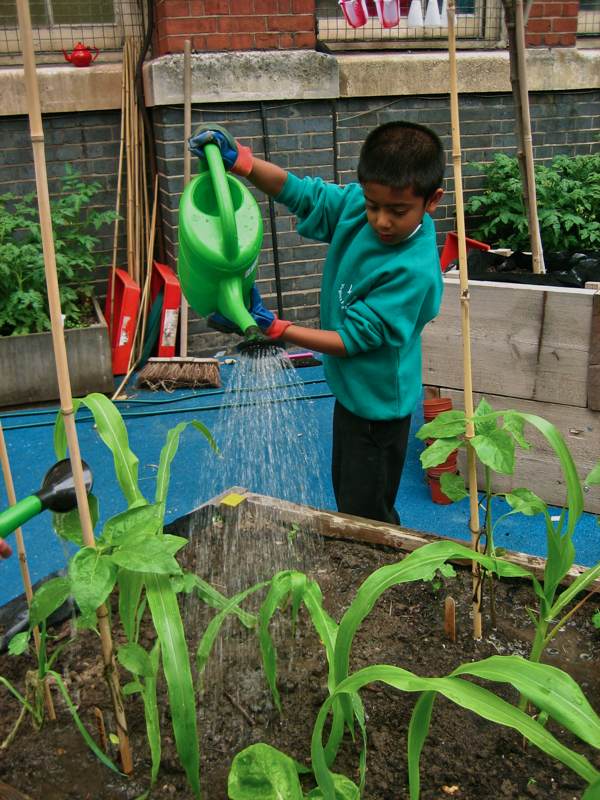

Filling the watering cans from the pump is a highlight at the gardening club.
You may also like to read
Leila’s weekly vegetable boxes are available for delivery throughout Shoreditch, Dalston, London Fields, Bethnal Green, Spitalfields and Whitechapel.
You can find the vegetable box blog by clicking here.
Belinda Hay, the Painted Lady

“I came to London because I heard the streets were paved with gold,” revealed Belinda Hay with a winsome smile and a twinkle in her eye, as we sat in her hair salon The Painted Lady in Redchurch St. In a sassy black catsuit and displaying a tantalising selection of elaborate tattoos partially visible, she presides here with an unselfconscious poise that is worthy of a movie goddess. Make no mistake, Belinda Hay is “The Painted Lady.”
“I grew up in a small town in New Zealand and one day, when I was eighteen, a mobile tattoo van came and parked up outside school, so I thought it would be a good idea to sneak out and get one.” she confided with sprightly self-evident logic, indicating the discreet little drawing of a fairy upon her right foot, and raising her eyebrows to add, “My mother didn’t speak to me for a month.”
At first, Belinda was frustrated, training as a hair stylist in an old-fashioned salon back home where the only customers were senior ladies. Little did she know that the skills she learnt there, working with curlers and creating perms, would be in great demand in London one day. “I loved my old ladies, but I had to get away,” she confessed to me, clasping her hands and appealing to my understanding.
“I make money from it now!” Belinda continued excitedly, appreciating the irony of the situation, and brightening up as she explained that those who love vintage are hungry for her authentic “old lady styles.” In fact, such has been her success that Belinda has written the book on it, entitled Style Me Vintage and two years ago, with bold enterprise, opened her own salon which is now the epicentre of the vintage hair style universe in London.
“They don’t mean anything,” Belinda insisted, when I queried the iconography of her tattoos,“the meaning is more about the time you have them done.” Yet, acknowledging that the little fairy with wings on her foot marked an assertion of youthful independence, Belinda explained that her current, and developing collection, dates back to six years ago when she found herself in Shoreditch with money in her pocket, thanks to the craze for her vintage-inspired hairdos. Thus, these new tattoos manifest Belinda’s personal transformation into The Painted Lady – a proud identity of her own creation.
To start with, Belinda had “Alice in Wonderland” on her right arm and next, to balance it, she had a peacock on her left arm and then it was pointed out that having tattoos on just her upper arms would make her arms look short, and so she had the designs extended to three-quarter-length on both arms. And that was just the beginning. “I like looking at myself this way,” she explained to me, caressing her multi-coloured arms with pleasure, “it’s strange, looking at old photos when I didn’t have tattoos.”
“It’s really very important to plan your tattoos,” Belinda advised me conscientiously,“I spent a few years unbalanced, with a half sleeve on the left and a three-quarter sleeve on the right,” rolling her eyes to indicate the social unease of such a circumstance. Given the density of design upon her shoulders, I was relieved to learn that this area of the body is relatively painless to get a tattoo. Unlike the inner arm which made Belinda wince even to speak of it. Although she did take this opportunity to tell me about the fox – that will her eventually fill her right thigh and which at present is a work-in-progress with just two and half hours done and another four hours to go – revealing that this also had its painful moments.
Tattooing is a slow, onerous and expensive process (one hundred to hundred and fifty pounds per hour) which means that the luxuriant detail of Belinda’s designs has cost her dearly on many levels. Yet “The more I get, the more I’d like to concentrate on birds and animals – with the peacock and the fox and the butterflies on my calf.” she declared enthusiastically, her eyes misting over and making a convincing show of becoming a goddess of nature, before revealing her plain humanity by whispering, “though I am always scared I’ll fall over and graze my elbows, it would lose the colour.”
She took a moment’s thought, when I asked her why she had tattoos. “I guess deep down it’s for attention, though I wouldn’t like to admit it – I am a realist.” she said, qualifying it at once with a second thought, “Yet I get annoyed when people stare at me, though when I meet others with tattoos I feel I have the right to stare at them.”
Unlike clothes that we can put on and take off, tattoos manifest your history in permanent designs upon the body. In Belinda’s case, I was fascinated by the tension between the ladylike styles she creates and the ambivalent counter-cultural quality of tattoos – a contradiction that she embraces. Commonly to be seen in the demure floral tea dresses of the nineteen fifties with immaculate make-up and coiffure, her tattoos entirely subvert the look – thus Belinda Hay enjoys the feminine glamour of an earlier age, whilst retaining the power and self-possession of a modern independent woman too.
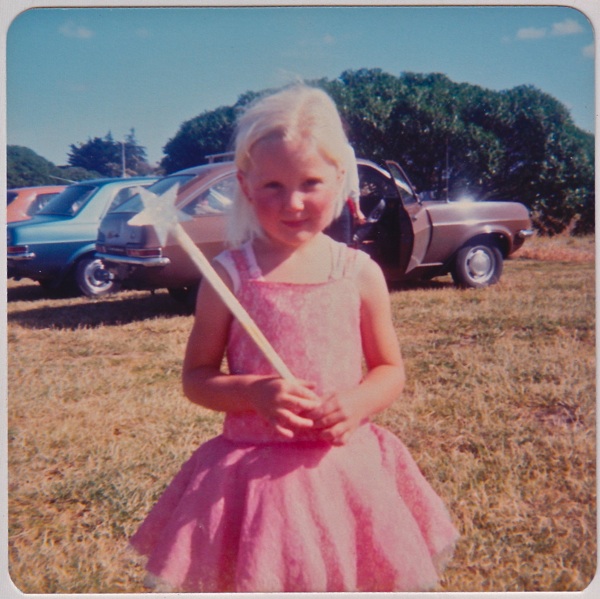
Belinda Hay dressed as a fairy, aged four in New Zealand.

“I like looking at myself this way – it’s strange, looking at old photos when I didn’t have tattoos.”

Belinda relaxes with her pet fox at her salon on Redchurch St.
You might also like to read about
Last Days of the White Vans of Whitechapel
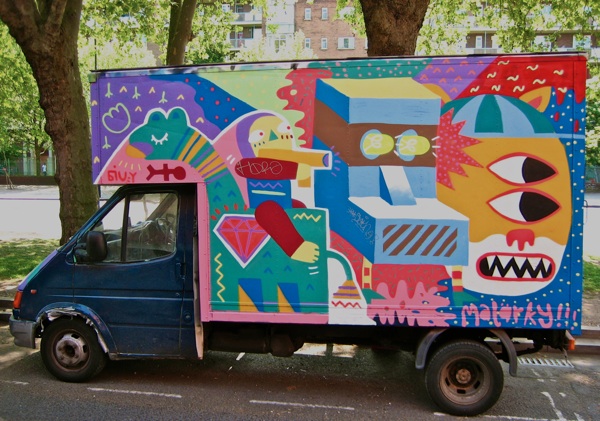
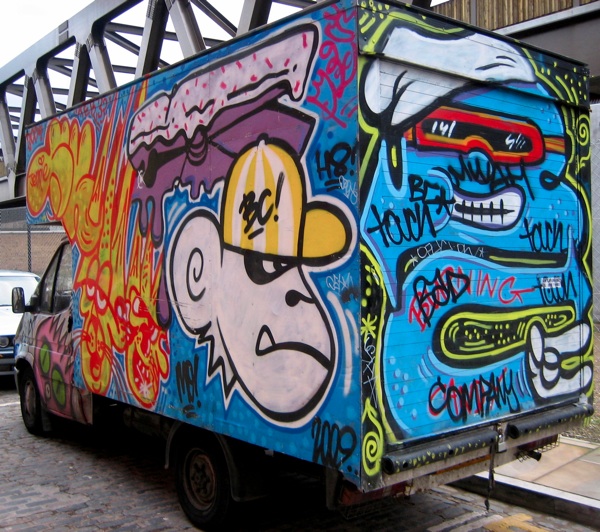
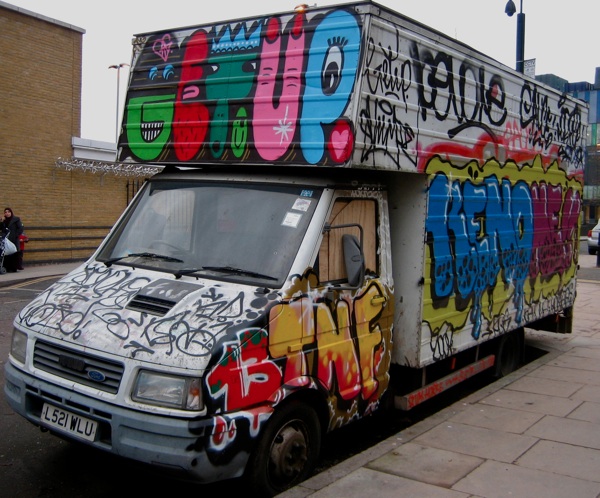
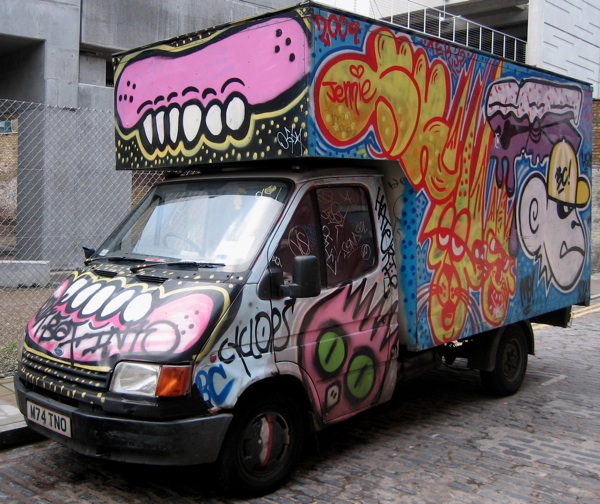
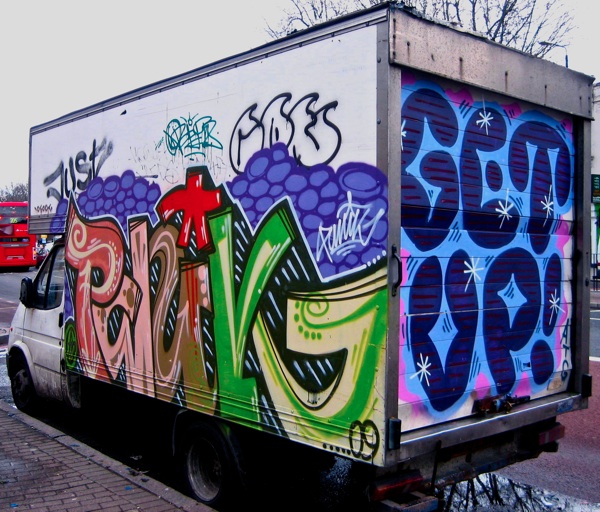
For a couple of years now, I have enjoyed photographing the colourfully-painted “white vans” of Whitechapel – those shabby old jalopies that the market traders use as overnight storage, which you see parked in all the back streets. But, just recently, I realised that the imposition of the Low Emission Zone in Central London in six months time will see the end of all these vehicles, causing the gallery of paintings to vanish along with them.
Even as I have photographed them, I have observed an evolution in the designs and so, as we approach the final flowering of the white vans of Whitechapel, I thought I would play the art historian and attempt to trace the development of these paintings through the early to this late period, just as if they were Renaissance murals in Tuscan churches.
Keith, who proudly parks his painted van in Sclater St Market where he stalls out each Sunday, explained to me how it all began back in 2005 when, like many other traders, he found that his beloved old truck was attracting taggers and this in turn was drawing the attentions of the police who began to stop him regularly. Keith’s brother Des runs a junk shop in Bacon St – a popular location for street artists – and there Keith learnt of the powerful culture of respect that exist between the painters. “They’re a tight crew,” he informed me, “If someone sprays over another’s painting, it’s war!” And so Keith devised a cunning plan to invite one artist to paint his entire van, which thereby became sacrosanct to the taggers, and then, instead of attention from the police, he found that wherever he went people wanted to photograph his van out of admiration.
The notion quickly spread, because others traders had the same problem, and today there are dozens of these painted vans which bring the romance of the circus and the fairground to the markets of the East End – and are especially concentrated around Whitechapel Market. This unlikely alliance between the traders and the street artists has led to an unprecedented flourishing of popular public art in which the market traders, acting simply out of the wish to keep their vans neat have become unwitting art patrons – I call them, “the accidental Medicis of Whitechapel.”
Once this phenomenon took flight and the artists saw each other’s work upon the vans, then an immediate development took place in which basic tags were replaced by more elaborate and complex versions of the artists’ monikers filling the vans – possible now, since once they were invited there was not longer any need to be covert. As time has gone by, these evolved tags have been supplemented and then replaced by images, until now artists are composing each side of the van as if it were a canvas and their tag is only present in a corner as discreet signature upon the artwork. These ambitious compositions – some of which are photographed here – that have begun to appear in the last year, comprise the mature and, possibly the final period of the white vans of Whitechapel.
When I spoke to Keith, he was eager to show me the new painting by street artist Eska upon his van, which is of the evolved mode, filled an entire side of the vehicle. Over this period, since it all began, Keith had his van repainted by several artists and has delighted in becoming something of a connoisseur, developing a discriminating sensibility of his own with regard to the painting of vans and always insisting now upon seeing examples of artists’ work before he will let them loose on his vehicle.
“It makes me feel calm,” he said, stroking his chin and tilting his head, to contemplate the newly painted green abstract with satisfaction, before adding in disdain,“What’s on the other side is too busy, all squirls and clowns – it’s like something out of the hippy sixties.” In fact, Keith had parked his van against the wall to conceal the aesthetic offence of the reverse of his van, which is due for repainting imminently. “But what are you going to do next year?” I ventured, “When all these vans have to go…” And Keith replied without taking his fond gaze from the new painting. “I’m hoping to take the box off this van,” he said, “and put it on a new one.”
There may, even yet, be a future for the white vans of Whitechapel.
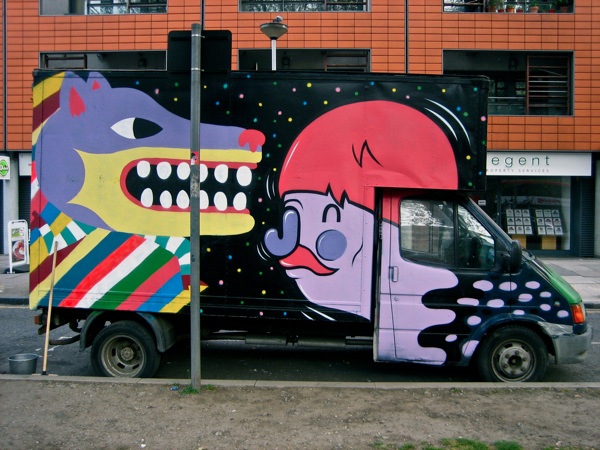



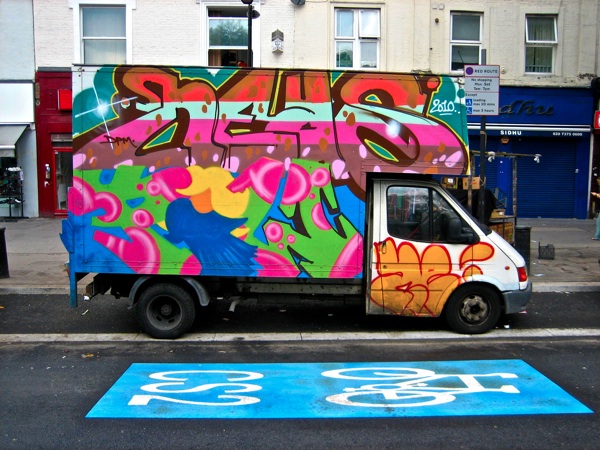
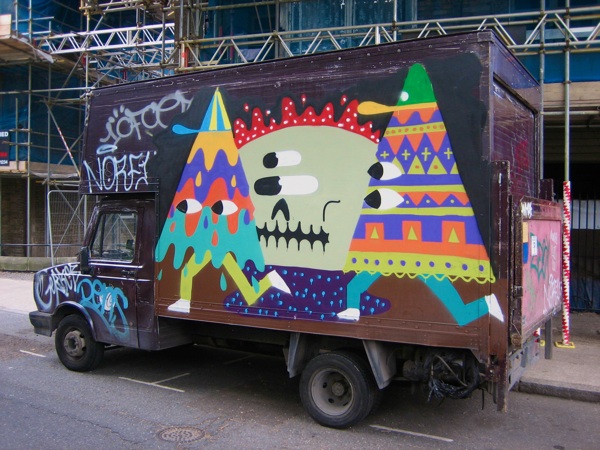

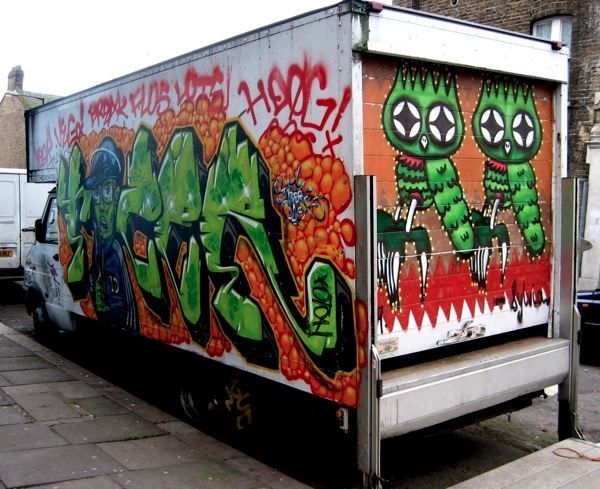
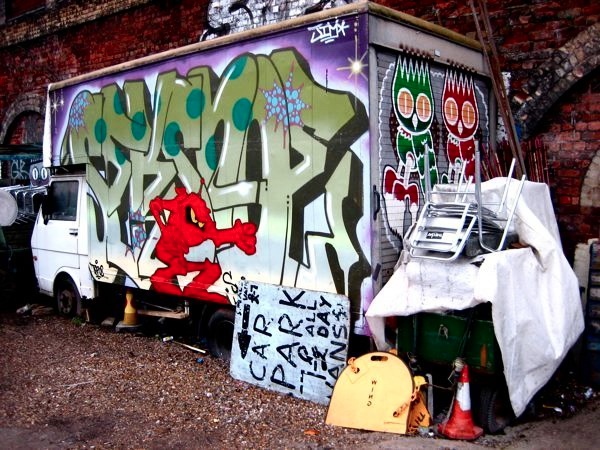

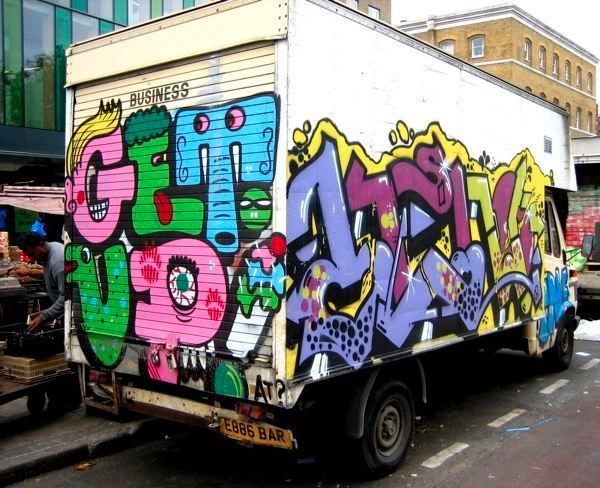
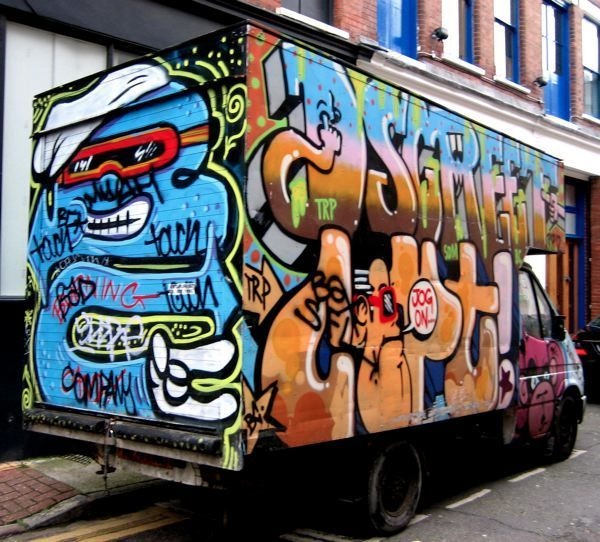


Keith’s van with the new painting by Eska
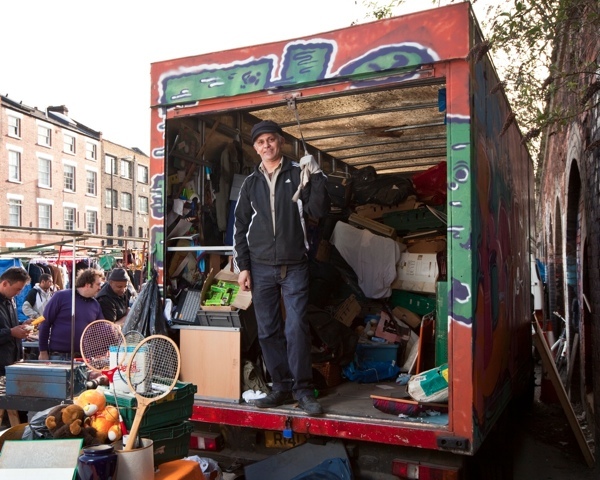
Keith of Sclater St Market
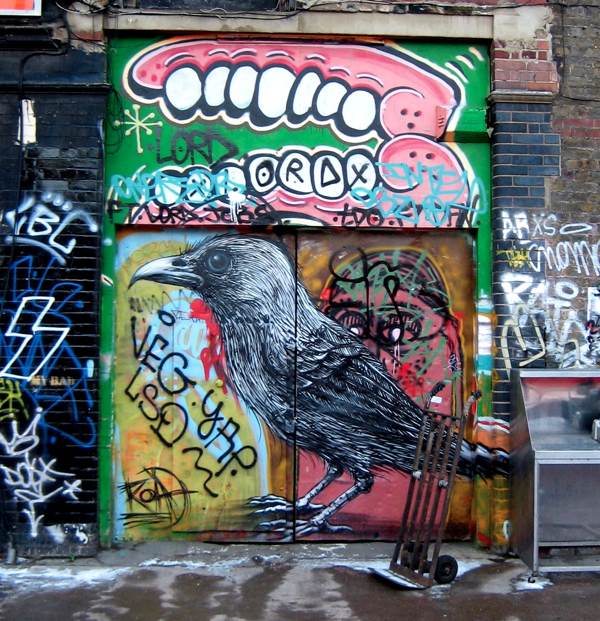
Crow by Belgian street artist Roa on the door of Keith’s brother Des’ junk shop in Bacon St
Portrait of Keith © copyright Jeremy Freedman
You may also like to read
Postcards from Petticoat Lane

Today I am sending you postcards from Petticoat Lane. Here are the eager crowds of a century ago, surging down Middlesex St and through Wentworth St, everyone hopeful for a bargain and hungry for wonders, dressed in their Sunday best and out to see the sights. Yet this parade of humanity is itself the spectacle, making its way from Spitalfields through Petticoat Lane Market and up to Aldgate, before disappearing into the hazy distance. There is an epic quality to these teeming processions which, a hundred years later, appear emblematic of the immigrants’ passage through this once densely populated neighbourhood, where so many came in search of a better life.
At a casual glance, these old postcards are so similar as to be indistinguishable – but it is the differences that are interesting. On closer examination, the landmarks and geography of the streets become apparent and then, as you scrutinise the details of these crowded compositions, individual faces and figures stand out from the multitude. Some are preoccupied with their Sunday morning, while others raise their gaze in vain curiosity – like those gentlemen above, comfortable at being snapped for perpetuity whilst all togged up in their finery.
When the rest of London was in church, these people congregated to assuage their Sunday yearning in a market instead, where all temporal requirements might be sought and a necessary sense of collective human presence appreciated within the excited throng. At the time these pictures were taken, there was almost nowhere else in London where Sunday trading was permitted and, since people got paid in cash on Friday, if you wanted to buy things cheap at the weekend, Petticoat Lane was the only place to go. It was a dramatic arena of infinite possibility where you could get anything you needed, and see life too.

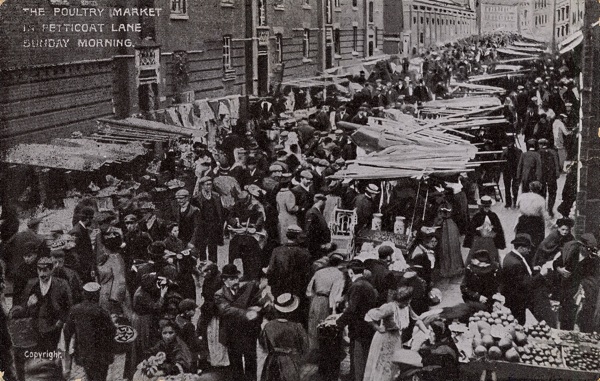


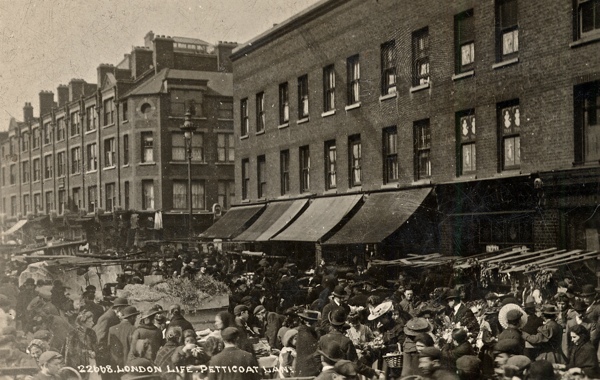


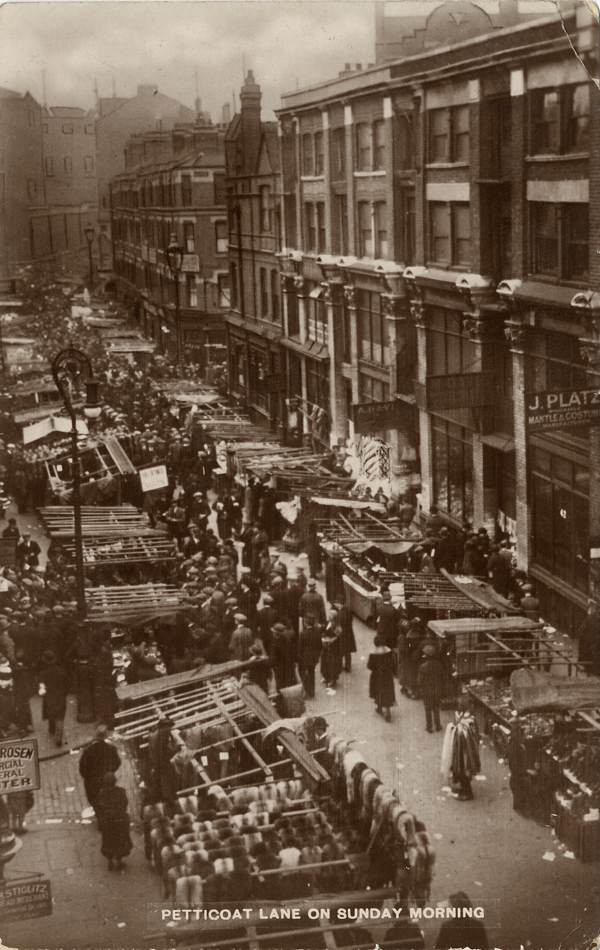


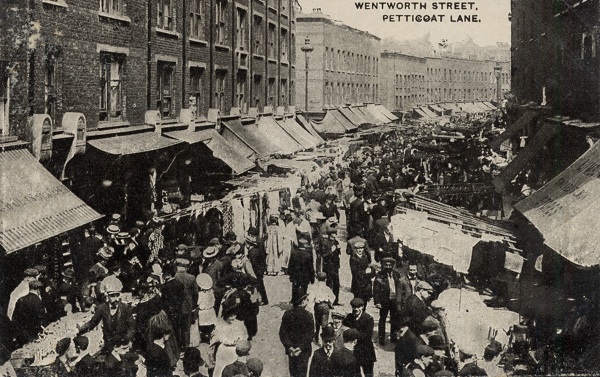
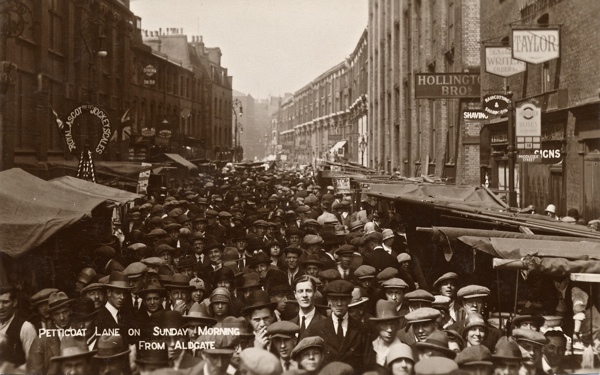

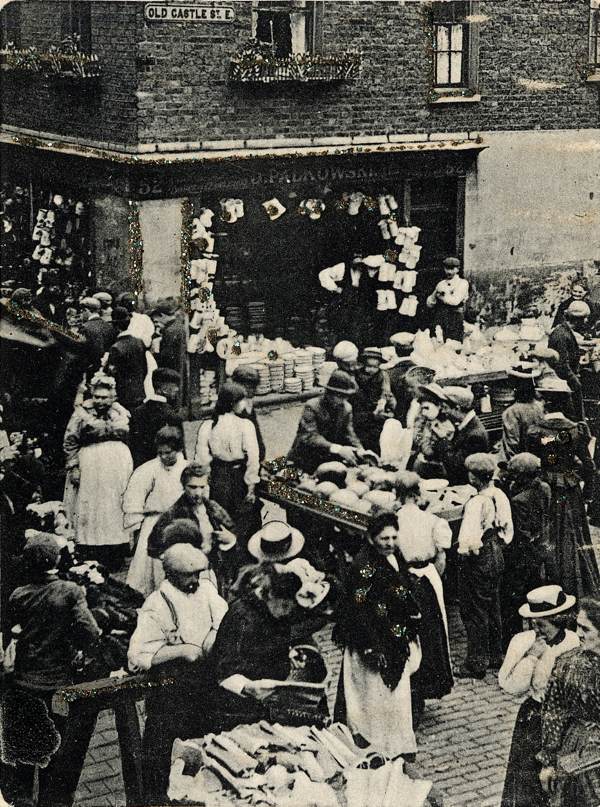
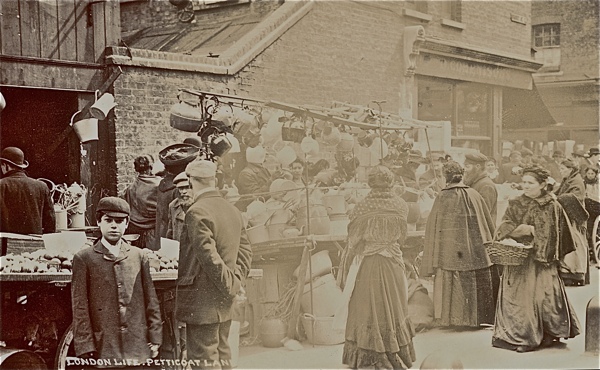


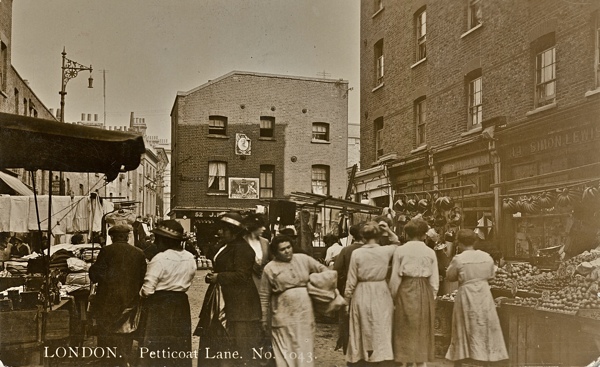

Images copyright © Bishopsgate Institute
You might also like to read about
Laurie Allen of Petticoat Lane
The Wax Sellers of Wentworth St
Larry Goldstein, Toyseller & Taxi Driver
Thomas Fairchild, Gardener of Hoxton

Next time you visit Columbia Rd Flower Market, once you have admired the infinite variety of plants on display, walk West until you come to the Hackney Rd. Directly ahead, you will discover a small neglected park and burial ground where, on the right hand side of the gate, is this stone which commemorates Thomas Fairchild (1667-1729) the Hoxton gardener.
Thomas Fairchild was the first to create a hybrid, making history in 1717 by the simple act of taking pollen from a Carnation and inserted it into a Sweet William in his Hoxton nursery, thereby producing a new variety that became known as “Fairchild’s Mule.” Everyone who loves Columbia Rd Market should lay flowers on this stone for Thomas Fairchild, because without his invention of the technique of hybridisation most of the plants on sale there would not exist. Yet when I went along with my Carnations in hand for Thomas Fairchild, I found the stone overgrown with moss that concealed most of the inscription.
Apprenticed at fifteen years old in 1682 to Jeremiah Seamer, a clothmaker in the City of London, Thomas Fairchild quickly decided that indoor work was not for him and decided to become a gardener. He had to wait until 1690 when he completed his apprenticeship to walk out of the City and up past Spitalfields to Shoreditch – where, in those days, the housing ended at St Leonards Church and beyond was only fields and market gardens. Thomas Fairchild found employment at a nursery in Hoxton, up beyond the market, but within a few years he took it over, expanding it and proceeding to garden there for the next thirty years.
In Hoxton, he kept a vineyard with more than fifty varieties of grapes, one of the last to be cultivated in England, and his nursery became a popular destination for people to wonder at all the exotic plants he grew, sent as specimens or seeds from overseas, including one of the first banana trees grown here. By 1704 he was made a freeman of the City of London as a member of the Worshipful Society of Gardeners and in 1722 he published, “The City Gardener. Containing the most experienced Method of Cultivating and Ordering such Ever-greens, Fruit-Trees, flowering Shrubs, Flowers, Exotic Plants, &c. as will be Ornamental and thrive best in the London Gardens.”
Drawing upon Thomas Fairchild’s thirty years of experience in Hoxton, it was the first book on town gardening, listing the plants that will grow in London, and how and where to plant them. He took into account the sequence of flowers through the seasons, and even included a section on window boxes and balconies. This slim volume, which has recently been reprinted, is a practical guide that could be used today, the only difference being that we do not have to contend with the smog caused by coal fires which Thomas Fairchild found challenging for many plants that he would like to grow.
When he died in 1729, it was his wish to be buried in the Poor’s Ground of St Leonard’s Church in the Hackney Rd and he bequeathed twenty-five pounds to the church for the endowment of an annual Whitsun sermon on either the wonderful works of God or the certainty of the creation. This annual event became known as the “Vegetable Sermon” and continued in Shoreditch until 1981 when, under the auspices of the Worshipful Society of Gardeners, it transferred to St Giles, Cripplegate.
Thomas Fairchild presented his hybrid to the Royal Society and, although its significance was recognised, the principle was not widely taken up by horticulturalists until a century later. In Thomas Fairchild’s day grafting and cuttings were the means of propagation and even “Fairchild’s Mule,” the extraordinary hybrid that flowered twice in a year, was bred through cuttings. Hybrids existed, accidentally, before Thomas Fairchild – Shakespeare makes reference to the debate as to their natural or unnatural qualities in “The Winters’ Tale” – yet Thomas Fairchild was the first to recognise the sexes of plants and cross-pollinate between species manually. Prefiguring the modern anxiety about genetic engineering, Thomas Fairchild’s bequest for the Vegetable Sermons was an expression of his own humility in the face of what he saw as the works of God’s creation.
I have no doubt Thomas Fairchild would be delighted by his position close to the flower market, but, as a passionate gardener and plantsman who made such an important and lasting contribution to horticulture, he would be disappointed at the sad, unkempt state of the patch of earth where he rests eternally. Given that his own work “The City Gardener” describes precisely how to lay out and plant such a space, it would be ideal if someone could take care of this place according to Thomas Fairchild’s instructions and let the old man rest in peace in a garden worthy of his achievements.

My Pinks bought from Columbia Rd Market last week.

From “The City Gardener,” 1722.

Plaque by the altar in Shoreditch Church commemorating Thomas Fairchild’s endowment for the “Vegetable Sermon.”


A pear tree in Spitalfields.

You may also like to read about
At the Strangers’ Rest Mission
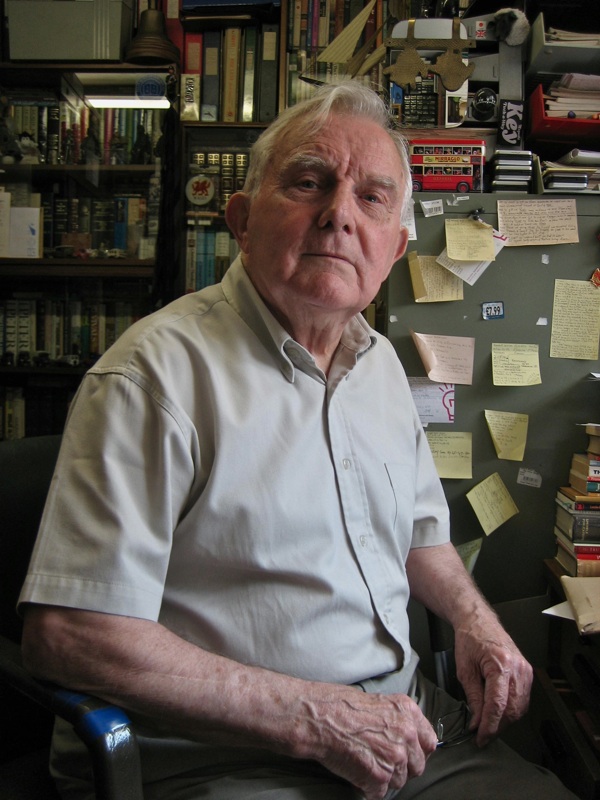
Pastor Gerald Daley
The Strangers’ Rest Mission is a plain brick building that drivers do not notice as they speed along the Highway through Wapping, in a neighbourhood where the deafening roar of the traffic never ceases and few people are to be seen upon the pavement. Yet the Mission has been here since 1877 when this was dockland, teeming with seafarers and others attracted “like flies to fresh meat” – as Gerald Daley puts it – who came to exploit the possibilities. In such circumstances, the Mission offered a refuge where a hearty welcome was extended to lonely sailors otherwise at the mercy of those who sought to separate them from their wages.
Pastor Gerald Daley came from Wales to the Strangers’ Rest in 1981 and has lived all these years with his wife Marion in the small flat attached to the chapel. Now at seventy-eight, he is due for retirement and awaiting a replacement, but in the meantime he spared me a couple of hours of reflection upon his time here and the history of the Mission itself. “I was born at the end of 1932, and my father was a union man who marched to London for jobs and he knew how much men suffered working in the docks, both at home in Swansea and in London,” explained Gerald, outlining all he knew of the East End before he came.
A self-declared evangelist and open-hearted preacher with natural rhetorical style and an eager nature, Gerald was converted when he was twenty-eight and working as an engineer. A fortuitous redundancy gave him the money to go to bible college and he was almost forty when he came to the Strangers’ Rest. With the docks had closed by then, the mission’s work had shifted towards those in need who lived in the vicinity.
“My concern was to serve the people,” Gerald said, “I used to go out and visit old people’s homes, and I used to go into schools and teach Religious Instruction and I would speak of the glorious benefits of the bible. Up until 1981, a lot of churches were being told about the poverty of the East End and sending clothes, which we distributed to people who wanted them, and we gave out food parcels at Christmas. We used to take people on trips to Felixstowe, it certainly made life more interesting.”
The Strangers’ Rest has more than six hundred supporters worldwide who send donations and all the correspondence keeps Gerald busy in his tiny crowded office until ten thirty each night, where he keeps some magnificent model boats and a stash of books of Giles cartoons to bring him light relief. “The goal is to have enough supporters to be self sufficient… “ Gerald admitted to me with a shrug, revealing that he struggles to balance the accounts, “but it’s what the good Lord has done and it gives us great purpose.”
Possessing a kind of holy innocence, Gerald is a target for conmen who come to the Strangers’ Rest with elaborate stories of distress designed to extricate money, which Gerald often gives. “It doesn’t harden you, but it wearies you,” he said to me with a wry smile, “you have to listen to a catalogue of catastrophes and woes. And we even had the offering stolen one Sunday morning.” Yet Gerald’s faith permits him to interpret these criminal interventions as divine agency. “God is not simply making us righteous,” Gerald told me with self-acknowledged pathos,“he is making us more holy by the challenges he sends to our self-righteousness.”
In his absolute belief, Gerald embodies the spirit that has sustained the Strangers’ Rest as the last mission of all those once associated with the docks. He carries the tale of Mrs Dagmar Andre, the Swedish millionairess who was not converted by chaplains upon the cruise ships she frequented, but by Gerald’s predecessor Bob Hutchinson – who ran the Mission for thirty-six years from 1935 until 1971, and rebuilt it after it was bombed with the largesse of Mrs Andre, in order that the good works might continue. And today Gerald has a small but committed congregation of older people who come for the weekly Sunday service followed by free lunch – “open to all,” he asked me to emphasise.
“When I preach I believe in total sincerity,” he asserted, his eyes shining with emotion – a statement he qualified later by declaring, ” Yet I may not be as excellent as I should be.” and mitigated unexpectedly, saying, “But you can always apologise if you are wrong.” And then he gave me selection of pamphlets and a bag of sweeties to take with me – before sending me off with a warm handshake, suggesting it was God’s providence that had sent me to him.
The Highway is one of the bleakest corners of the East End, and yet it is the location that has captivated Pastor Gerald Daley for nearly forty years. “I don’t go in for holidays a good deal, ” he said, as we sat in the empty prayer room with the traffic thundering outside, “I’m not against holidays, but I’m very happy where I am. It’s a work of delight.”
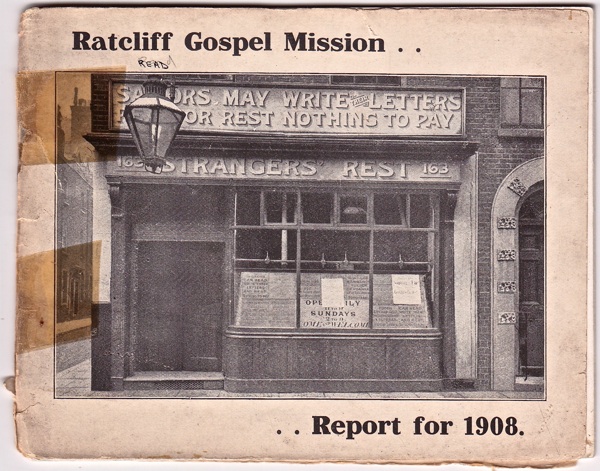
Sailors may write their letters – Read or rest, nothing to pay.
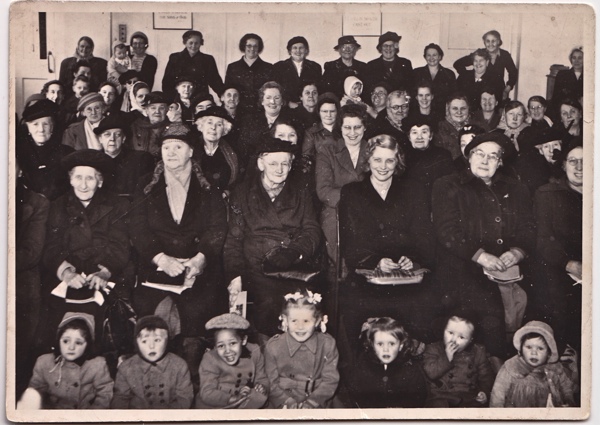
Ladies’ gathering, nineteen fifties.
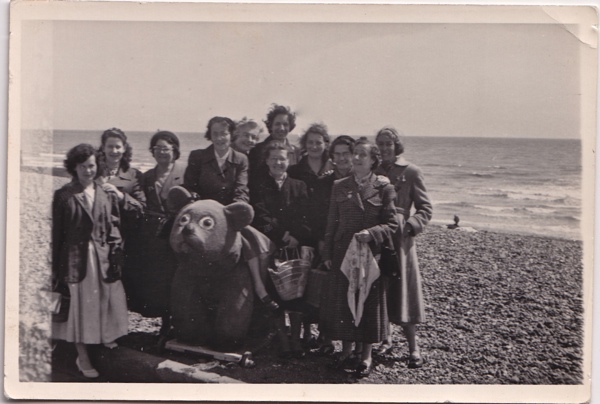
Ladies’ outing to the seaside, nineteen fifties.
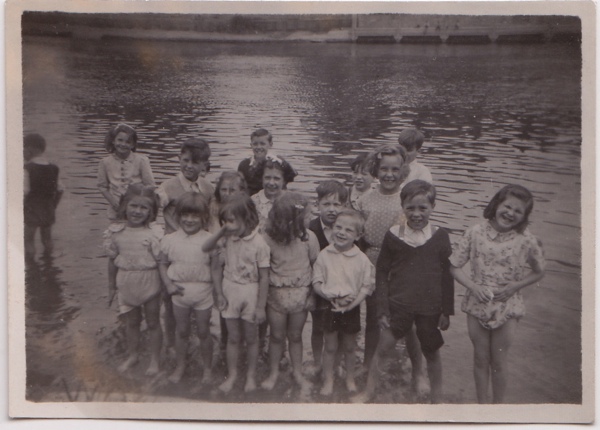
Childrens’ outing to Felixstowe.
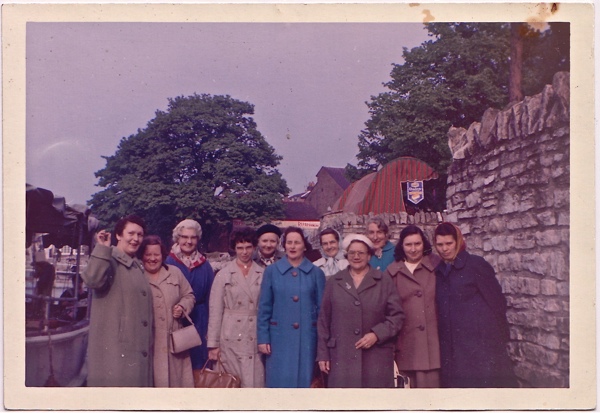
Ladies’ outing to Windsor, 1961.
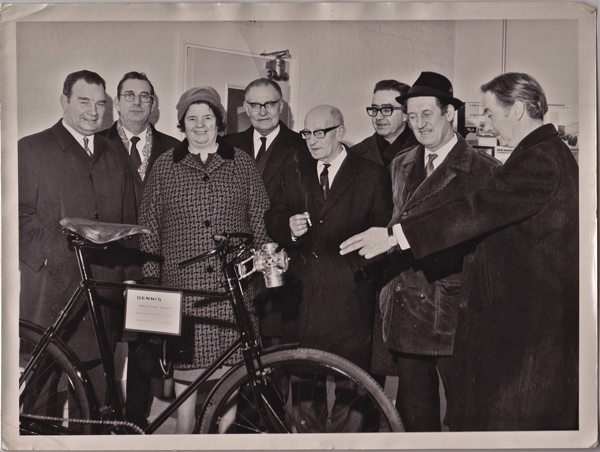
A visit by Mrs Armsby, the first woman to be mayor of Tower Hamlets.
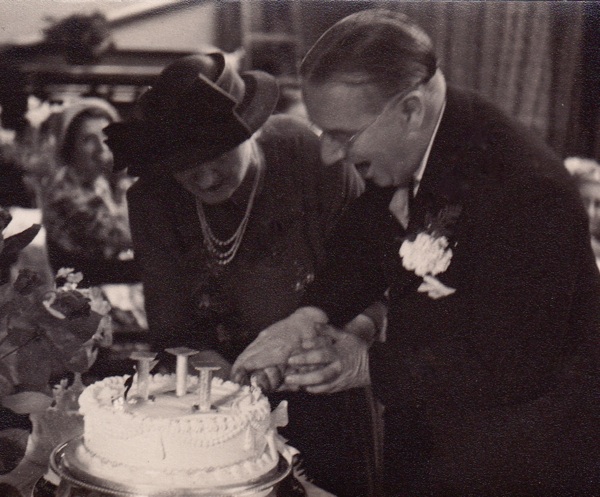
Millionairess patron Mrs Dagmar Andre & Mr Bob Hutchinson cut the cake.
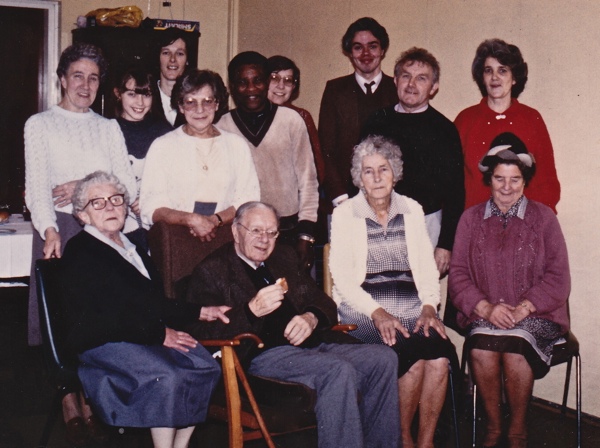
A visit to Bob Hutchinson, ex-superintendent of Strangers’ Rest Mission, at Pilgrims Care Home, 1987.
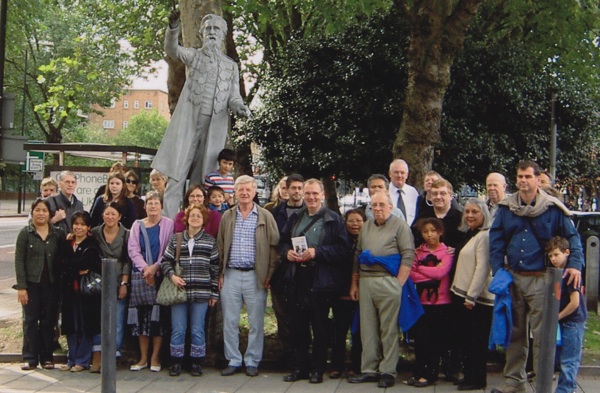
A walk from the Strangers’ Rest around sites of spiritual enlightenment in the East End – seen here at the statue of General Booth, Salvation Army Founder in the Mile End Rd.
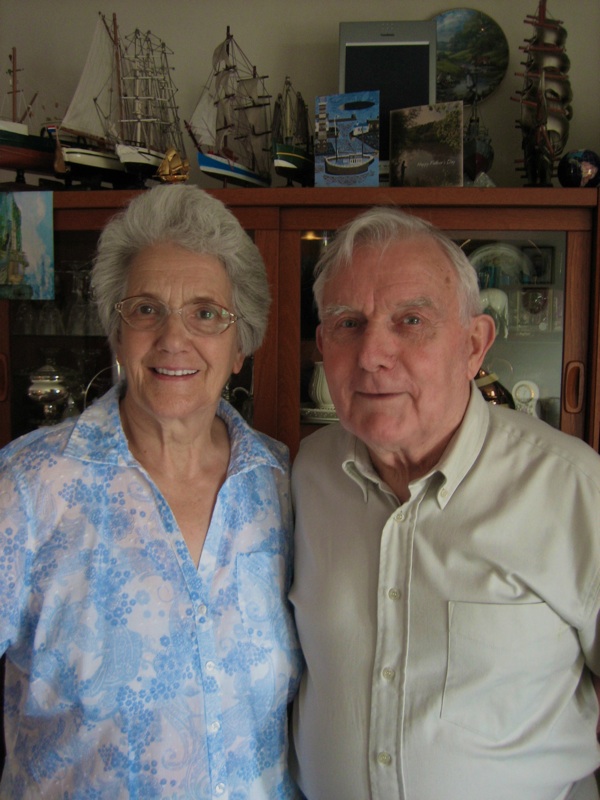
Pastor Gerald & Mrs Marion Daley
Spitalfields Antiques Market 24
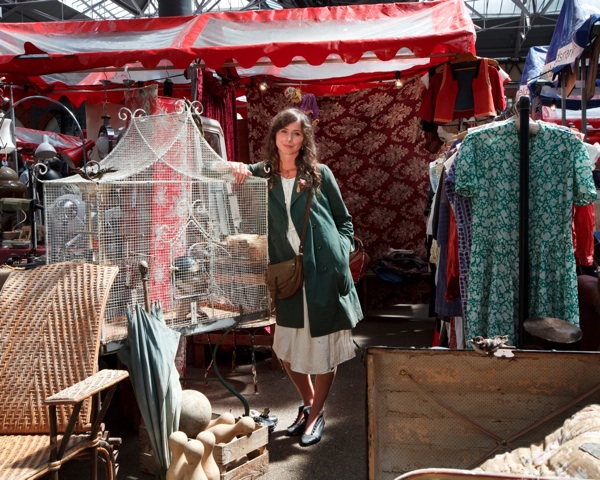
This is the alluring Marisa Lopez, who apologised to me for her appearance on account of having very little sleep – because she had just returned from France seeking new finds – but I think, in the light of this glamorous photograph, we can agree than no apology is necessary. “I only sell things I like, so if no-one wants to buy it at least I can wear it,” Marisa confided to me with a thin smile, lowering her eyes modestly, before casting a gaze over her collection of ravishingly beautiful old dresses, all chosen for their subtle colours and rich fabrics. Then, sitting upon a basketwork chair, in the sunlight filtering through the market roof, she clasped her hands in thought. “I feel very comfortable with this way of life.” she admitted, shading her face with her hand, “I work for myself – being on the road and sourcing things is fun. It’s creative and I can use my eye, and that, I think, is an art.”
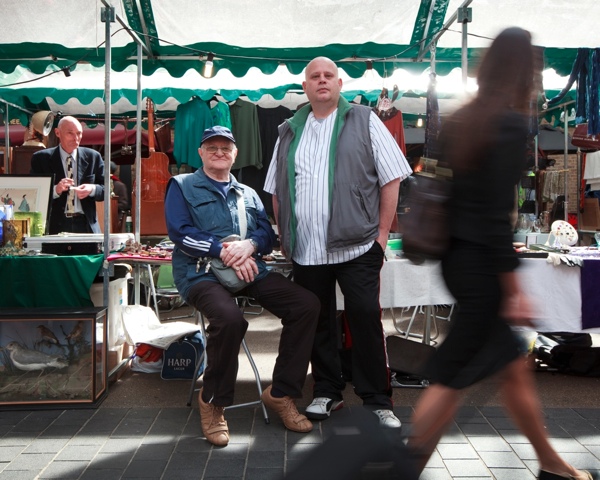
This is Steve & Paul, proud father & son, who have been stalling out together for three years. Born in the City Rd, Steve is a former East End tailor who started at fourteen, but since he retired in 1990 he has been dealing in unbreakables and other small items. “I’ve always been interested in coins, medallions and badges,” he assured me eagerly, “A lot I’ve had for years and I’m always looking out for anything unusual.” “I’m trying to learn off him,” added Paul, beaming at his father and managing to get a few words in. “I pick Paul up of a morning and he takes me round all the car boot sales.” continued Steve with a nod of gratitude. “At the moment, I don’t have to rely on it, this pays for holidays,” he whispered discreetly, “but if I had to rely upon this, it would be hard.” Then, for emphasis, Steve looked questioningly at his son and, on cue, Paul nodded in filial reassurance.
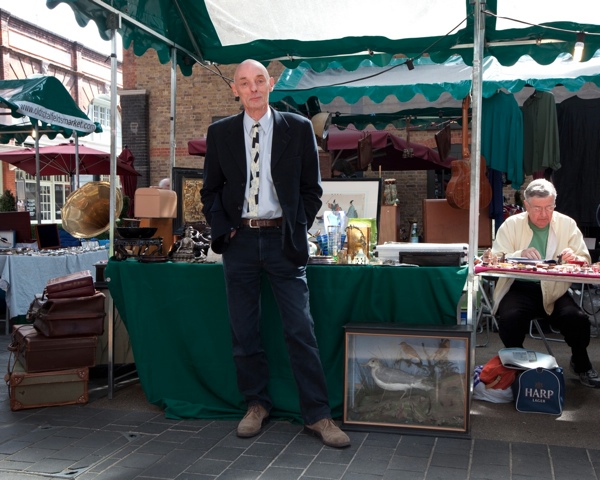
This fine tall gentleman is Alan Robinson, a paragon of discernment, sporting a narrow eighties’ silk tie of deceptive sophistication. “I’m a jacket sort of guy,” he declared recklessly, as if no further explanation was required for his natural formality of style in the face of the hegemony of casual dressing. Delighting in the independence of the antiques trade since 1979, Alan is currently supporting himself while completing his Phd in Visual Art at Goldsmith’s College, by selling leather suitcases, antique bronzes and other classy curios. Originally from Northern Ireland, Alan confessed he only recently discovered that his parents never told friends and family back home he was an antiques dealer, when they asked how his teaching job was going.
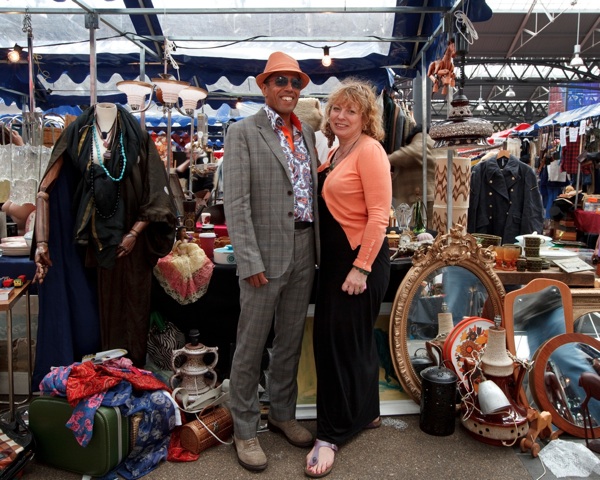
This is Jane Heslop & Paul Parker, a devoted couple on their first day trading in the market. “My husband is off in one of the pubs I expect, enjoying the local ambiance.” revealed Jane, when I found her sitting alone at her stall. Yet she seemed happy enough.“I’ve sold a few things, covered my costs and a bit on top of that – enough for dinner tonight!” she announced in visible satisfaction. Inspired by memories of visiting her grandfather’s upholstery workshop in Dalston Lane as a child, Jane – an independent woman who grew up in Hackney Wick – gave up her job as an indie cinema manager to train as an upholsterer and furniture restorer. “I’ve brought a bit of everything this week because I don’t know what sells here yet, “ Jane admitted to me with an optimistic grin, “but I hope to come back regularly if there’s space.”
Photographs copyright © Jeremy Freedman