
Spitalfields Market Portraits, 1991
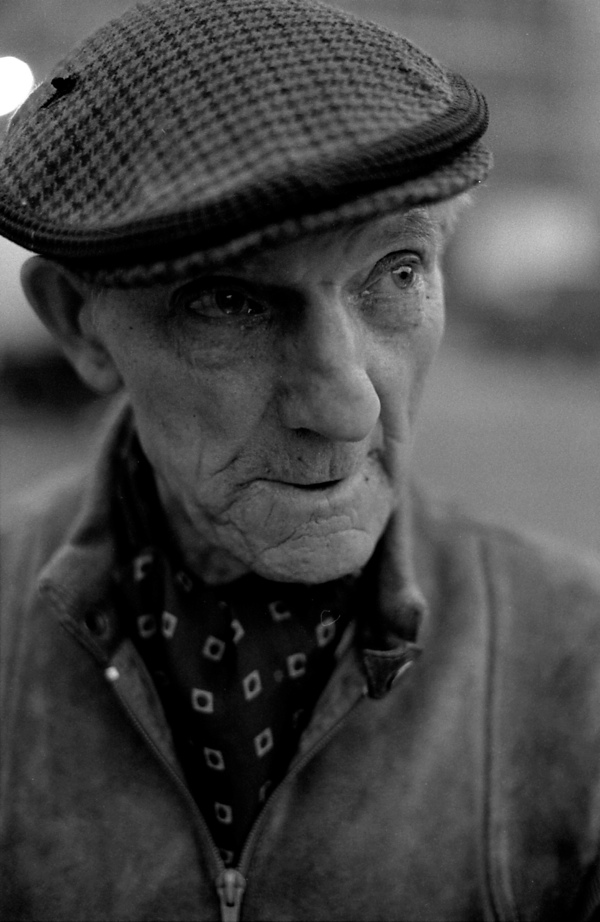
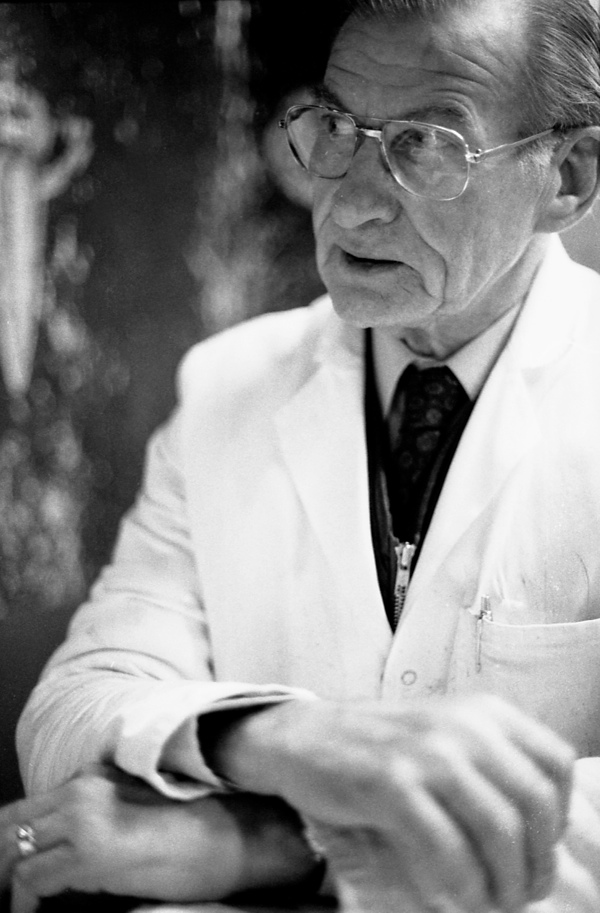
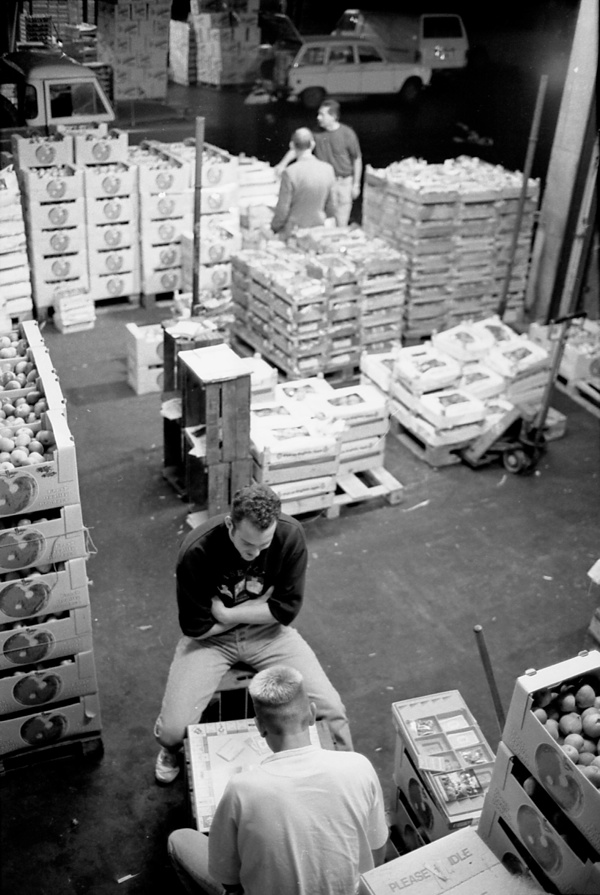
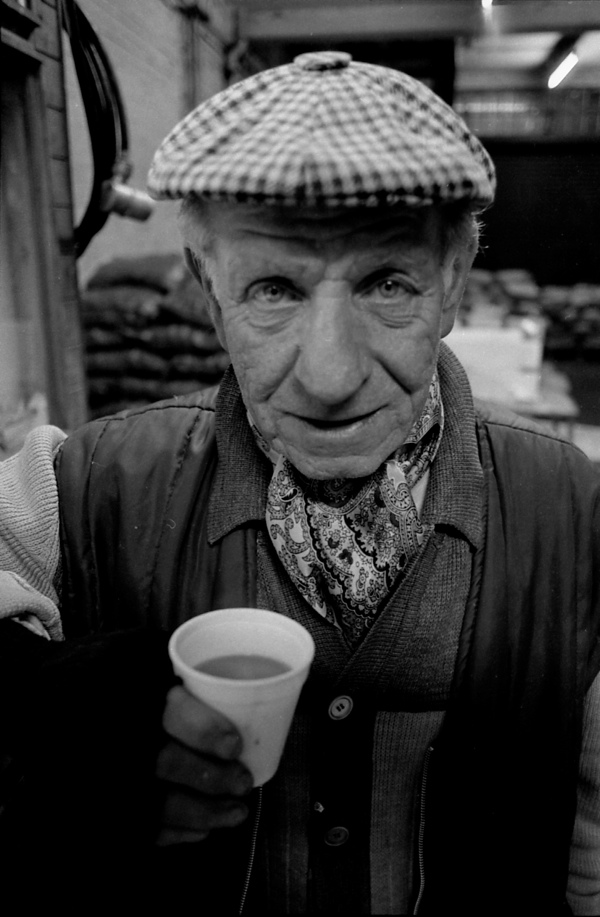
Following yesterday’s selection of nocturnal images chosen from more than three thousand photographs taken by Mark Jackson & Huw Davies in the last year of the Fruit & Vegetable Market in Spitalfields in 1991, it is my pleasure today to publish this gallery of portraits of market traders from the same source.
When Mark and Huw arrived at the market, they often separated to pursue different lines of inquiry, convened regularly through the night to compare results. Huw, the more more experienced photographer of the two, might set up the ambitious wide shots of the market and wait for figures to walk into the frame, while Mark, who did not even know how to load a camera at first, would chat with traders and snap portraits. And thus their different qualities complemented each other, so that today the body of pictures detailing the life of market exists as a totality in which the work of each photographer cannot be disentangled from the other.
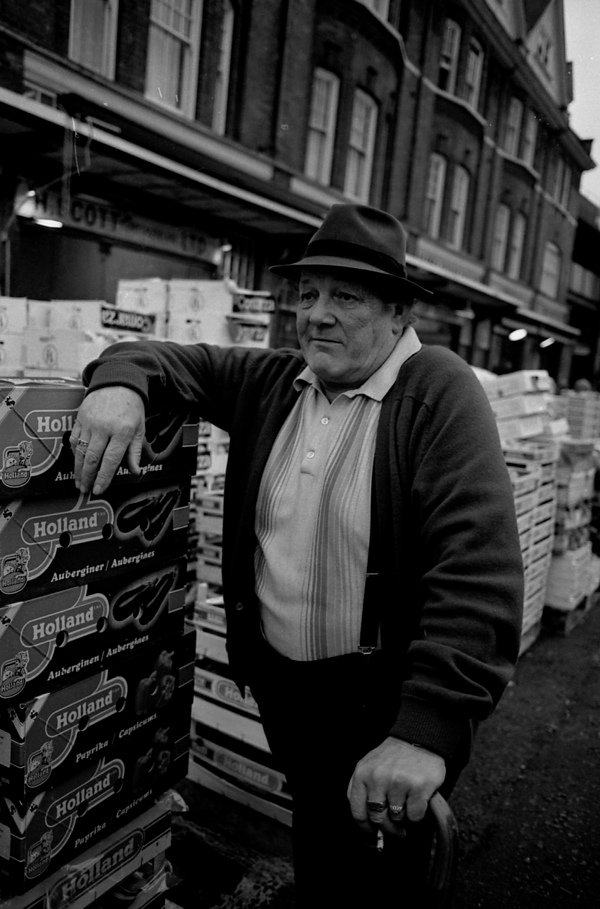
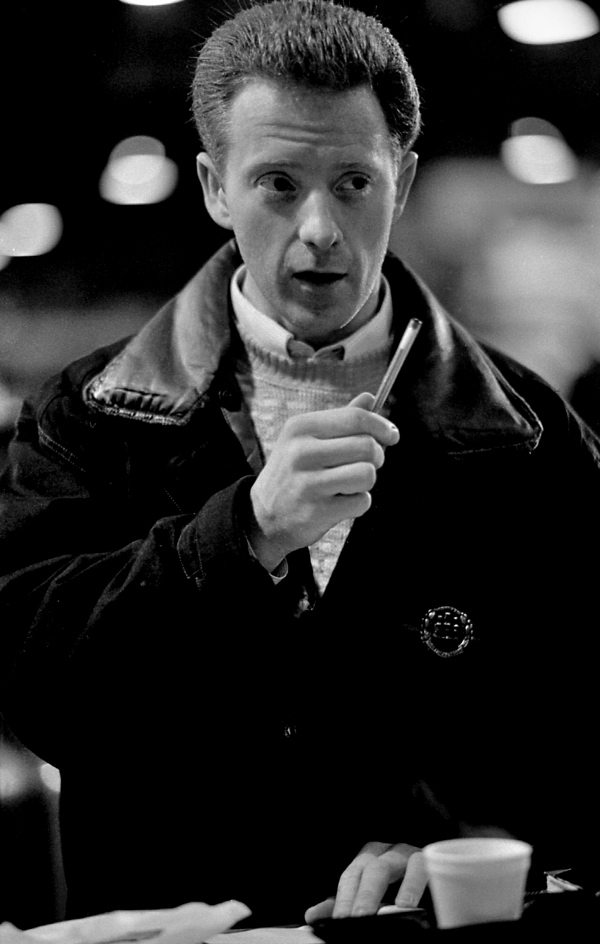
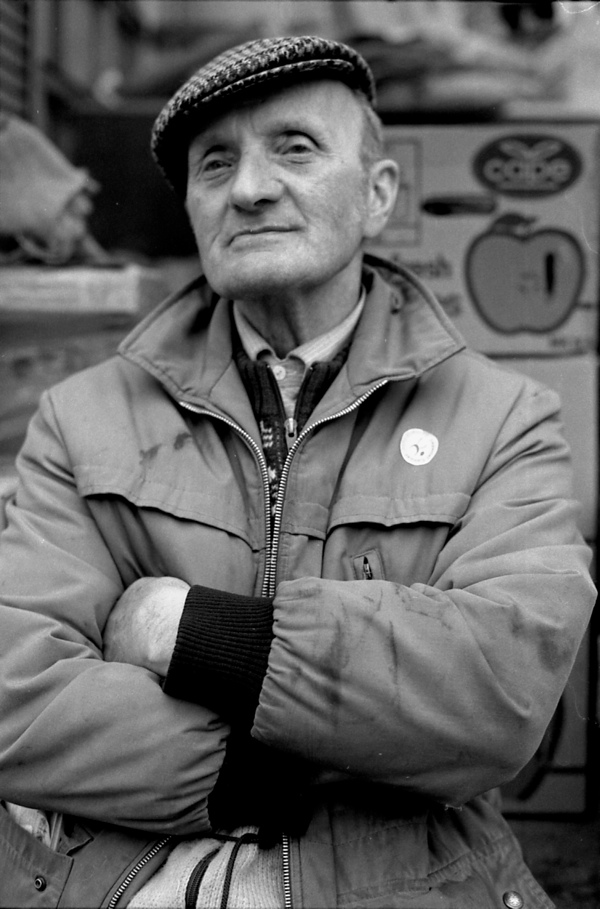
All these portraits were the result of conversations as the photographers came to know their subjects. Always, conversation came first and once both parties were comfortable, the pictures were taken. As the traders came to appreciate the project, more were keen to have their portraits done, waving the photographers over and demanding a picture. It was an event that grew more frequent as the closure approached, and those who had spent their working lives there were desirous of being photographed in their market. They wanted their existence recorded along with their fellows.
There was a rigor imposed upon the endeavour by the cost of the film and the limitation of the budget, giving value to every single frame. At first, Mark & Huw bought cheap second hand cameras that broke and then they saved for months to buy new Nikon cameras and lenses, including a precious 35mm lens for portraits which they shared between them. And, to save money they bought great rolls of film and wound it into their cameras, but it quite often got damaged by fingerprints in the process.
Then, each weekend when the market was closed, Mark & Huw filled the bath in their tiny flat with smelly chemicals mixed up from powder and developed the week’s films, hanging them with clothes pegs on strings to dry – and sometimes the mix of the developer was wrong and the pictures came out too dark. Yet in spite of all these limitations, and the resultant pitfalls and mishaps, Mark & Huw were able to produce the splendid, emotionally-charged portraits which you see here and, thanks to them, we are able to meet the Spitalfields Market traders of 1991 face to face.




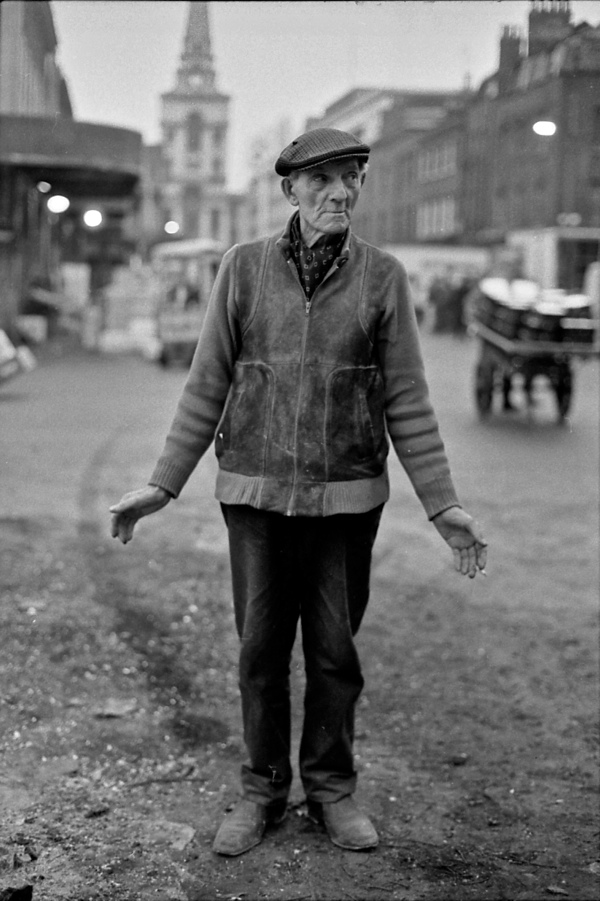


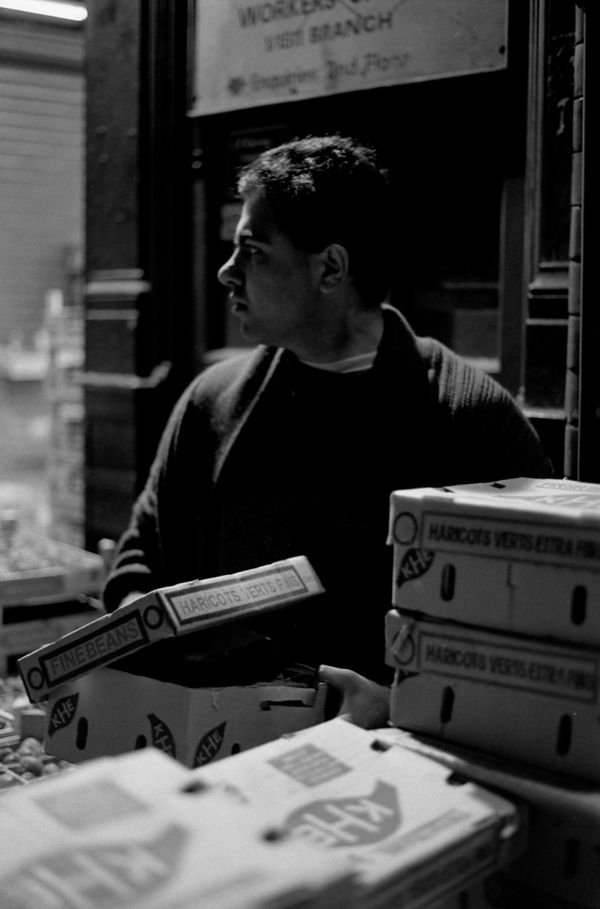



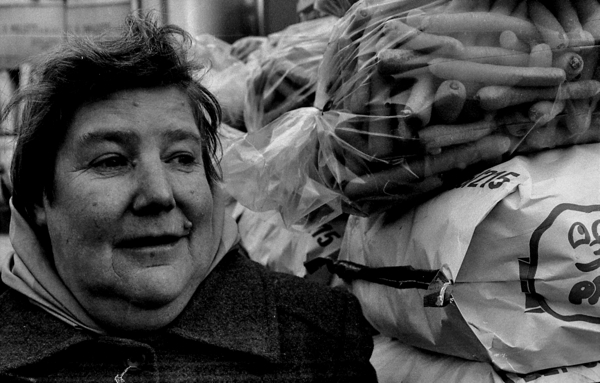
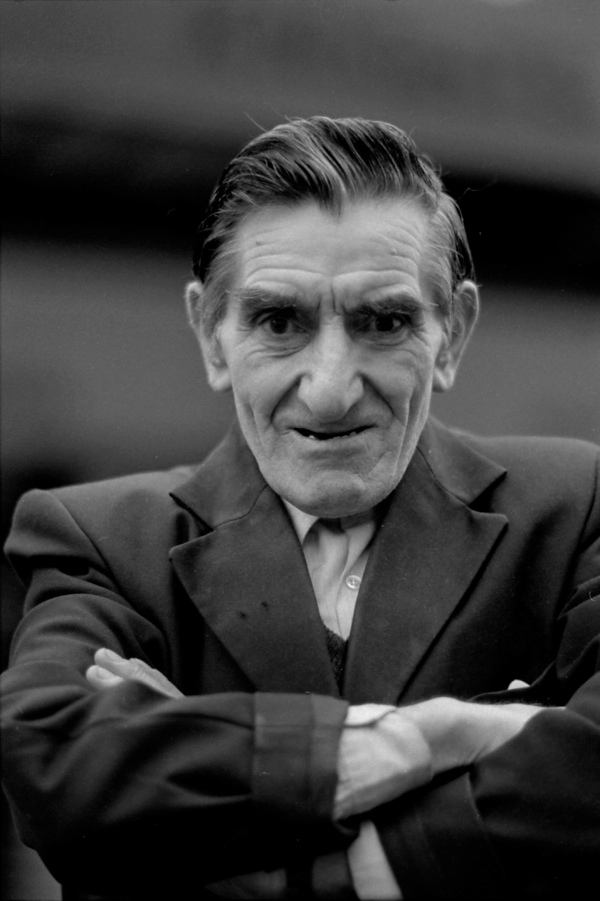





Photographs copyright © Mark Jackson & Huw Davies
You can see the original selection of
Mark Jackson & Huw Davies’ Photographs of the Spitalfields Market
and read about
Night at the Spitalfields Market, 1991

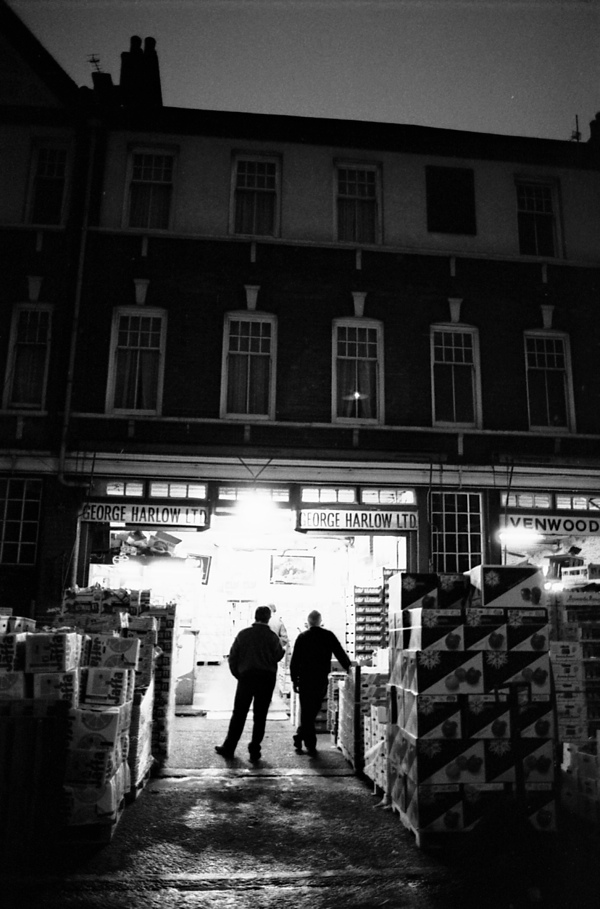
Last year, I published the first glimpse of the extraordinary unseen trove of over three thousand photographs taken by photographers Mark Jackson & Huw Davies during the last year of the Spitalfields Fruit & Vegetable Market before it moved out. Then I was only able to show you the few prints which existed, but now the Bishopsgate Institute has scanned all the negatives, it is my pleasure to publish more, chosen from the entire corpus of photographs recording the old market which traded in Spitalfields from 1638 until 1991.
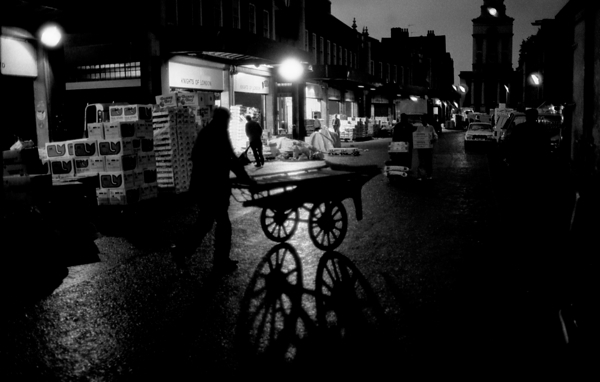
In this selection, I have chosen pictures that convey the nocturnal drama of the market and although they were taken only twenty years ago, they seem now to be images from the eternal night of history – with fleeting figures endlessly running, fetching and carrying, pushing barrows from the flaring lights out into the velvet blackness, where a bonfire burns beneath the great tower of Christ Church, Spitalfields, looming overhead.
Mark Jackson & Huw Davies were poets with cameras, aware that they were in an epic world with its own codes and customs, and they recognised the imperative to record it before it disappeared. No one asked them and no one paid them – as recent graduates, Mark & Huw shared a tiny flat and worked, as a courier and in a restaurant respectively, to buy film and subsidise their project. Each evening they took the last tube to Liverpool St Station and spent the night at the market, taking pictures and befriending the traders, before going straight back to work again in the morning, often without any sleep.
Like many of the most inspiring cultural projects, this remarkable body of photography was the result of individuals pursuing their own passion – Mark & Huw were committed to record what no one else was interested to look at. Neither became photographers, their greater project to record all the London markets was reluctantly abandoned when they went off to pursue other careers, but their Spitalfields Market photographs remain as an unrivalled achievement in the photography of markets.
Mark & Huw had only the resources to print a tiny fraction of their photographs, which means that this is the first time anyone has seen many of these pictures. Although there is a vivid realism in these photographs, there is an ethereal quality too, especially as many figures exist as mere shadows against the glimmering lights of the market. After the recent architectural interventions, there is an emptiness in the Spitalfields Market now it has been cleaned up, a tangible absence of everything that is here in these pictures. The chaotic beauty of market life has gone and these shadows haunt the market today.






Photographs copyright © Mark Jackson & Huw Davies
You can see the original selection of
Mark Jackson & Huw Davies’ Photographs of the Spitalfields Market
and read about
You may also like to read
Ivor Robins, Fruit & Vegetable Purveyor
Grave Humour from Harrow
 Last year, I paid a visit to St Paul’s in Shadwell, overlooking the basin – once known as the sea captain’s church – in the hope of photographing, or at least transcribing some of the tombstones in the graveyard commemorating those whose lives were spent upon the seven seas. But to my disappointment, I discovered that all the stones had been erased by the elements and I was confounded in my quest.
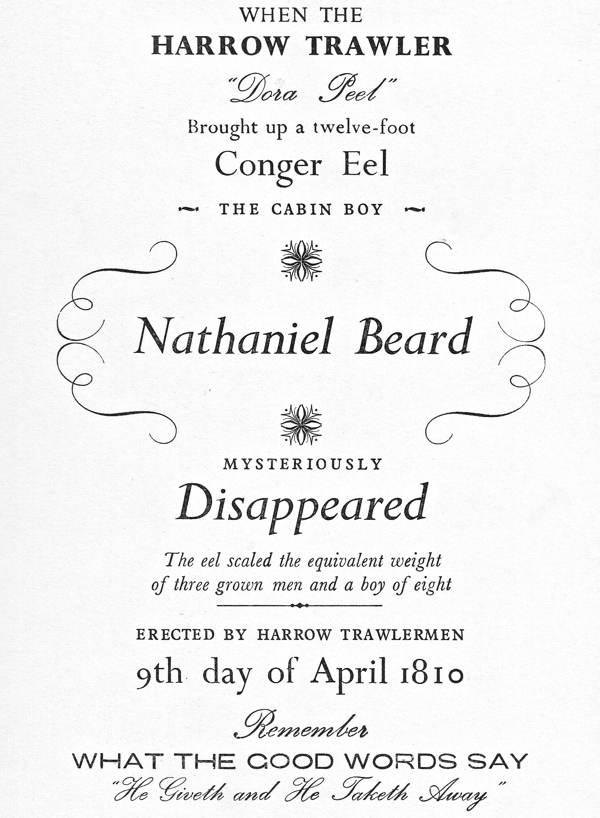
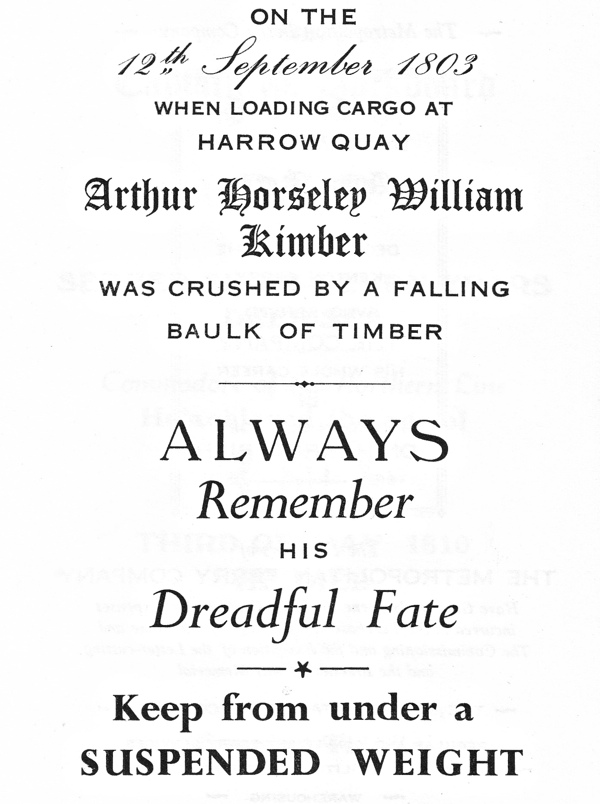
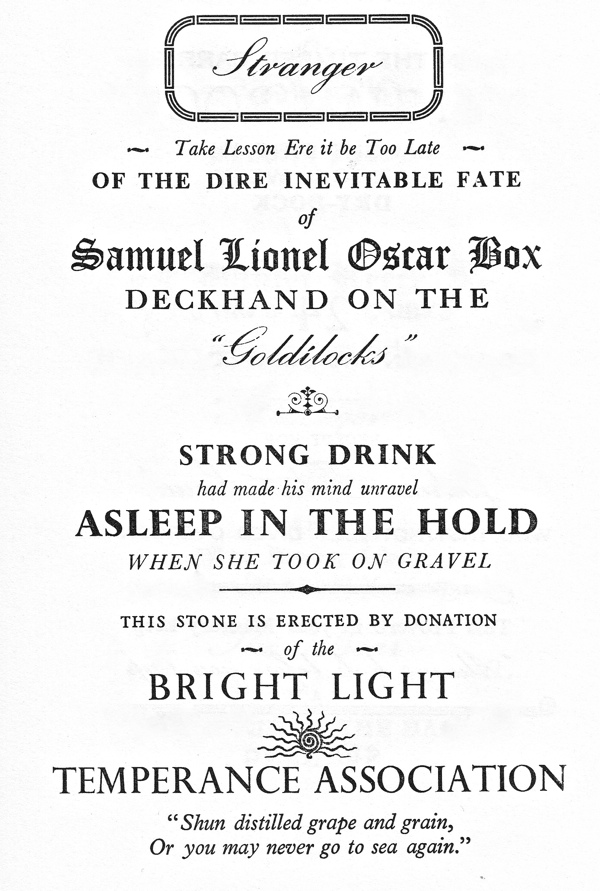
And so – as you can imagine – it rang a bell for me when a beautiful, hand-printed, slim volume of inscriptions from tombstones mysteriously arrived in the mail, collected by the distinguished poet Leonard McDermid in Harrow churchyard.
As a trawlerman, artist, poet, typesetter and bookbinder of over fifty years experience, Mr McDermid is obviously a whizz with the display fonts and these epitaphs afforded the ideal opportunity for him to pull out all the drawers in his comp room. With typography of exemplary elegance, bound in austere black covers and hand stitched by the author, this collection, entitled Northwest Passage, is an honourable tribute to those seamen who might otherwise be forgotten – as the Earl of Ruislip outlines in his brief introduction.
“THE AUTHOR of this collection has done an admirable service in deciphering and recording some of the inscriptions which I am told were to be found until quite recently in the churchyard at Harrow. Unfortunately there is little point in visiting the churchyard now if one is bent on reading the original inscriptions. The effects of the weather, acid rain and Health & Safety Legislation have ensured that no traces remain – The Rt. Hon. Rupert Glance-Chalmondley P.C., C.B.E., R.N.V.R., J.P., The Earl of Ruislip, Ruislip Manor.”
As both poet and seafarer, Mr McDermid has unlocked a certain mordant lyricism in these neglected epitaphs. It has been said of Leonard McDermid’s work that he “wraps his meaning within a shell and hides it in the sea, where it may happily be discovered.” and these nautical inscriptions evoke a rich and strange poetry of seaborne jeopardy, which offers the ideal light relief whenever melancholic tendencies strike.

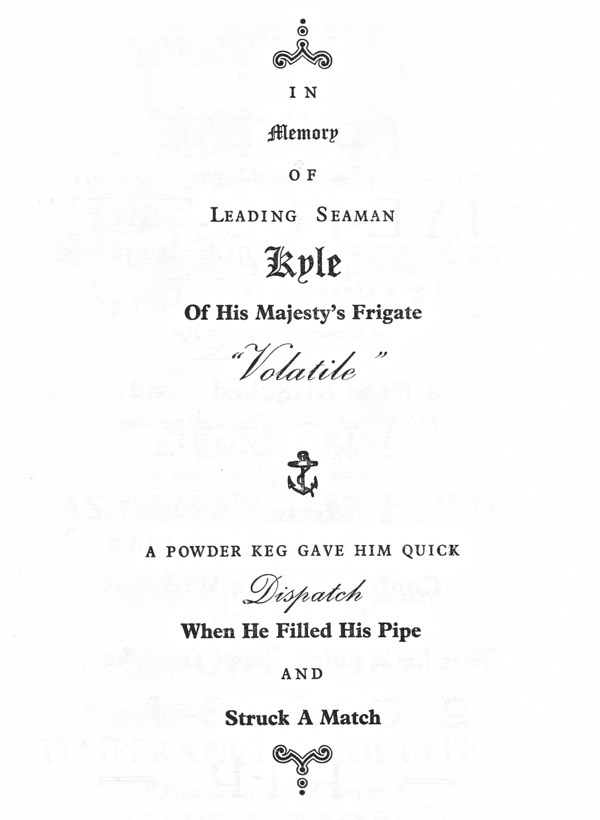
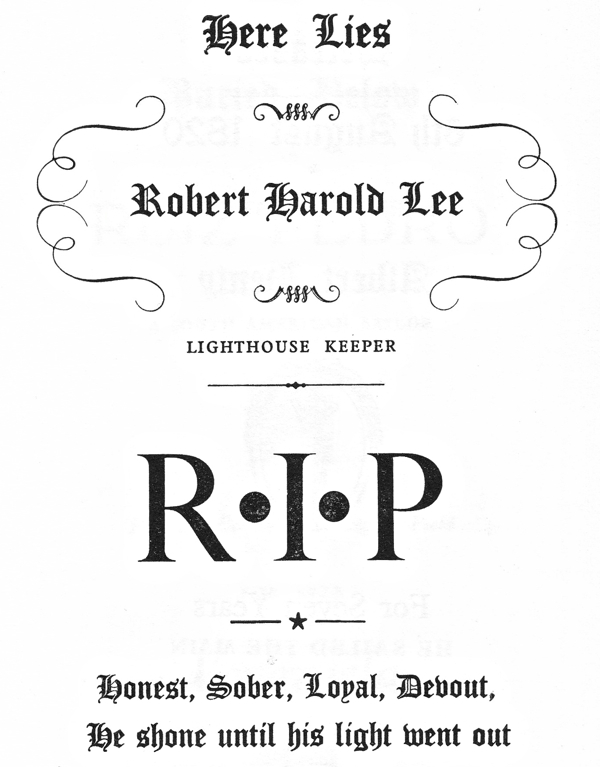 Texts copyright © Leonard McDermid
Copies of Northwest Passage, written, handprinted and bound by Leonard McDermid at The Stitchil Marigold Press can be obtained from www.theshopfloorproject.com
You may also like to read
Columbia Road Market 71

Each year at this time, I buy some Pinks from Columbia Rd to add to my small collection of Dianthus, for just a couple of pounds each. And to better appreciate the detail and scent of my new prized acquisitions, I keep them on the dresser for a few weeks in some of my old pots that I have found in the market, before I plant them out at the edge of a dry border in the hope to see them bloom again next Summer. In fact, the luscious Whatfield Ruby that I bought last year at Columbia Rd for three pounds has just finished flowering in my garden.
These distinctive flowers have been in cultivation since the medieval period (Shakespeare calls them “gilliflowers”). And the verb “to pink” dating from the fourteenth century, meaning to perforate – as in “pinking shears” – may be the origin of the common name, referring to their denticulated petals. In turn, the word “pink” as a colour may originate from these flowers that come in such elegant variety, and I love the subtle range of tones from sugared almond to coral, perfectly complemented by their silvery, grey green stems and narrow leaves.
Pinks evoke memories of my mother and grandmother’s gardens, where both had a cherished corners for Dianthus, and I always love to see them in the wild too, in their spindly natural incarnation – whether in the Hebridean machair, upon the cliffs in Dorset or high on the Pyrenees. Rich in association of many times and places, it lifts my spirits to encounter their subtle clove-like scent when I walk into the room each morning. These Pinks have brightened my house through the dullest cloudiest days this June.

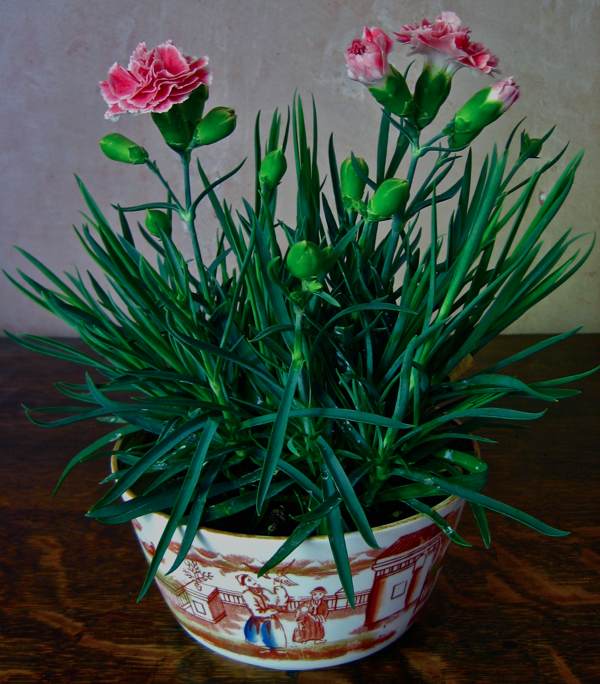

Whatfield Ruby
Emanuel Litvinoff, Writer

At ninety-six years old, Emanuel Litvinoff is taking it easy now, enjoying long afternoons of contemplation, gazing out from the tall windows of his tiny flat in a Georgian terrace in Mecklenburgh Square, Bloomsbury, to the tall plane trees where woodpeckers and crows are to be seen. Yet still he thinks back to the two tenements off Cheshire St where he grew up in the nineteen twenties.
In 1913, Emanuel’s mother and father fled Odessa to escape the pogroms in which thousands of Jews were killed – they travelled steerage and hoped to get to New York but they never made it beyond Spitalfields where Emanuel was born in 1915. When the First World War broke out, Emanuel’s father returned to Russia and never returned, which left Emanuel’s mother to bring up her family alone by taking in sewing. These were the circumstances in which Emanuel grew up, within the confines of his East End Jewish ghetto – “the small planet” as he termed it in his writing – and his beautiful account is full of feeling, remarkable for its emotional candour and lack of sentimentality, tracing the kindness and the cruelties of existence in a series of clear-eyed episodes from life of the young writer.
Although Emanuel won a scholarship to study the trade of his choice upon leaving school, he discovered that every one he selected was closed off to him as a Jew, and so he struggled, taking a series of menial jobs through the depression of the nineteen thirties and ended up working in the fur trade, nailing wet fur to boards. “It was tough,” admitted Emanuel. “I was often so hungry that I would hallucinate. We fought every day for our lives.” He remembers queueing for food in Whitechapel, applying to the Jewish Board of Guardians for a pair of boots and sleeping rough. Yet Emanuel was a born writer and in 1942 a slim volume of sombre poems was published, and when, on his first wife, Cherry Marshall’s, encouragement, he submitted a short story to an Evening Standard competition, he won a car. In the post-war literary world, Emanuel counted Dylan Thomas among the fans of his work as his writing took flight in the creation of articles, poems, novels and plays. And, with a strong moral sense enforced by his own experience Emanuel wrote a poem that challenged T.S. Eliot over the antisemitism expressed in his early work, and even Eliot had to admit, “It’s a good poem.”
All this I knew before I went to visit Emanuel Litvinoff, but when I walked into his room, lined with books and illuminated by floor-to-ceiling windows, where he lives with his second wife Mary McClory, I was touched by the modest presence of the man. Recently Camden Council have withdrawn the support for Emanuel which had been recommended by doctors at University College Hospital after Emanuel received treatment there, leaving Mary to take care of her husband without any assistance. Emanuel’s response is sanguine. “It seems the same as 1931 all over again,” he said, shaking his head in disappointment, “This is a depression caused by financiers and bankers, but it’s the poorest who are paying for it.”
Mary and Emanuel have been together for twenty-seven years and have a twenty-five year old son, Aaron. Now Mary has given up her job as a teacher to care for Emanuel full-time and while he sits perched in his chair wedged between bookshelves, she has created three elaborate balcony gardens for him to look out upon, growing rocket, beetroot, sweetpeas, nasturtiums and California poppies from seed and even potatoes in a pot. A sense of peace borne of mutual trust presides over this couple here in this quiet flat, looking down upon the old square. Mary brought out some original editions of Emanuel’s books which she had been looking at to compile a collection of his poetry and Emanuel was eager to examine these treasured copies, holding the pages right up to his nose and scanning the lines of verse as if for the first time, yet travelling a half-remembered journey in his mind.
Although frail, Emanuel certainly retains his charm and, when he stands, his physical presence, natural authority and stature become apparent too.“After a lapse of time, the past becomes a mythical country,” he wrote in 2008. A sentiment that has specific meaning for Emanuel Litivinoff as one who has travelled such an odyssey over almost a century and for whom the distant past of his childhood can be recalled only in fragments now – yet thanks to his extraordinary literary talent, it is a story and a world that exists forever in the pages of his masterpiece of autobiography, “Journey Through a Small Planet.”

Emanuel at his flat in Mecklenburgh Square, 2011.

Emanuel revisits Brick Lane, 1972.

Emanuel standing on the Pedley St bridge off Cheshire St in 1972

Emanuel with his brothers Abe and Pinny on 18th December, 1940.

Emanuel is the second from the right in the second row of this picture of class one at Wood Close School in the nineteen twenties.

The earliest photograph of Emanuel with his two brothers

Emanuel Litvinoff
New portraits copyright © Lucinda Douglas-Menzies
Find out more at www.emanuel-litvinoff.com
A Door in Cornhill

The Bronte sisters visit their publisher in Cornhill, 1848
An ancient thoroughfare with a mythic past, Cornhill takes its name from one of the three former hills of the City of London – an incline barely perceptible today after centuries of human activity upon this site, building and razing, rearranging the land. This is a place does not declare its multilayered history – even though the Roman forum was here and the earliest site of Christian worship in England was here too, dating from 179 AD, and also the first coffee house was opened here by Pasqua Rosee in 1652, the Turk who introduced coffee to London. Yet a pair of carved mahogany doors, designed by the sculptor Walter Gilbert in 1939 at 32 Cornhill – opposite the old pump – bring episodes from this rich past alive in eight graceful tableaux.
Walter Gilbert (1871-1946) was a designer and craftsman who developed his visual style in the Arts & Crafts movement at the end of the nineteenth century and then applied it to a wide range of architectural commissions in the twentieth century, including the gates of Buckingham Palace, sculpture for the facade of Selfridges and some distinctive war memorials. In this instance, he modelled the reliefs in clay which were then translated into wood carvings by B.P Arnold at H. H. Martyn & Co Ltd of Cheltenham.
Gilbert’s elegant reliefs appeal to me for the laconic humour that observes the cool autocracy of King Lucius and the sullen obedience of his architects, and for the sense of human detail that emphasises W. M. Thackeray’s curls at his collar in the meeting with Anne and Charlotte Bronte at the offices of their publisher Smith, Elder & Co. In each instance, history is given depth by an awareness of social politics and the selection of telling detail. These eight panels take us on a journey from the early medieval world of omnipotent monarchy and religious penance through the days of exploitative clergy exerting controls on the people, to the rise of the tradesman and merchants who created the City we know today.
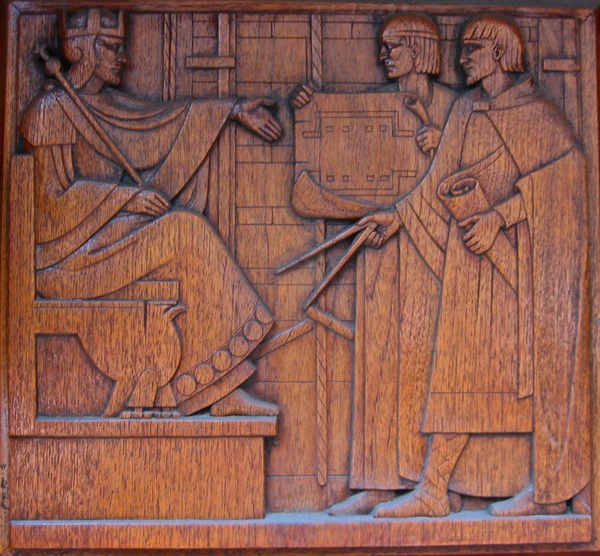
“St Peter’s Cornhill founded by King Lucius 179 AD to be an Archbishop’s see and chief church of his kingdom and so it endured for the space of four hundred years until the coming of Augustine the monk of Canterbury.”

“Eleanor, Duchess of Gloucester, did penance walking barefoot to St Michael’s Church from Queen Hithe, 1441.”

“Cornhill was an ancient soke of the Bishop of London who had the Seigneurial oven in which all tenants were obliged to bake their bread and pay furnage or baking dues.”
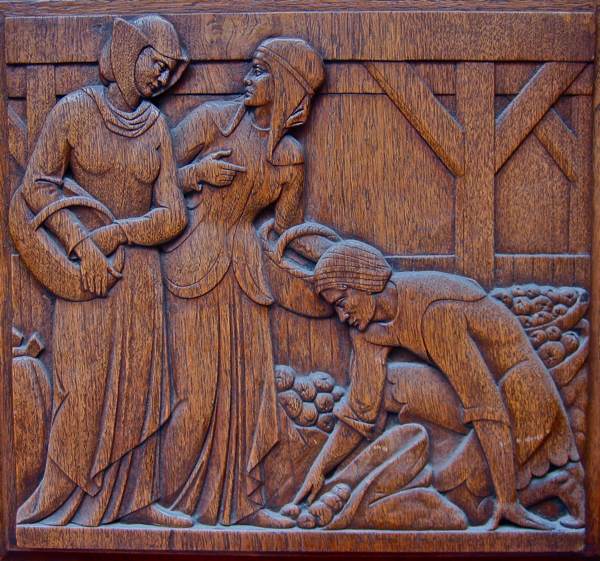
“Cornhill is the only market allowed to be held afternoon in the fourteenth century.”

“Birchin Lane, Cornhill, place of considerable trade for men’s apparel, 1604.”

“Garraway’s Coffee House, a place of great commercial transaction and frequented by people of quality.”

“Pope’s Head Tavern in existence in 1750 belonging to Merchant Taylor’s Company, the Vinters were prominent in the life of Cornhill Ward.”

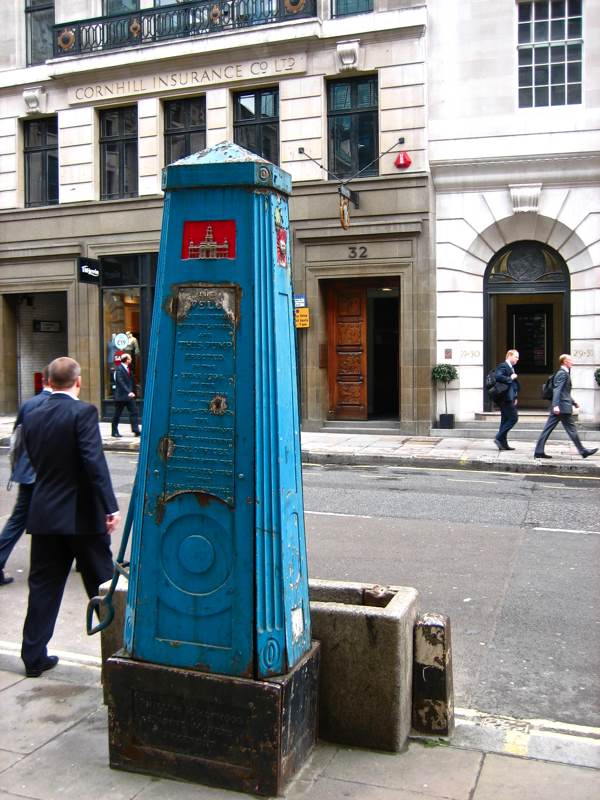
“This well was discovered, much enlarged, and this was pump was erected in the year 1799 by the contributions of the Bank of England, the East India Company, the neighbouring Fire Offices, together with the bankers and traders of the Ward of Cornhill.”

“On this spot a well was first made and a house of correction built thereon by Henry Wallis, Mayor of London in the year 1282.”
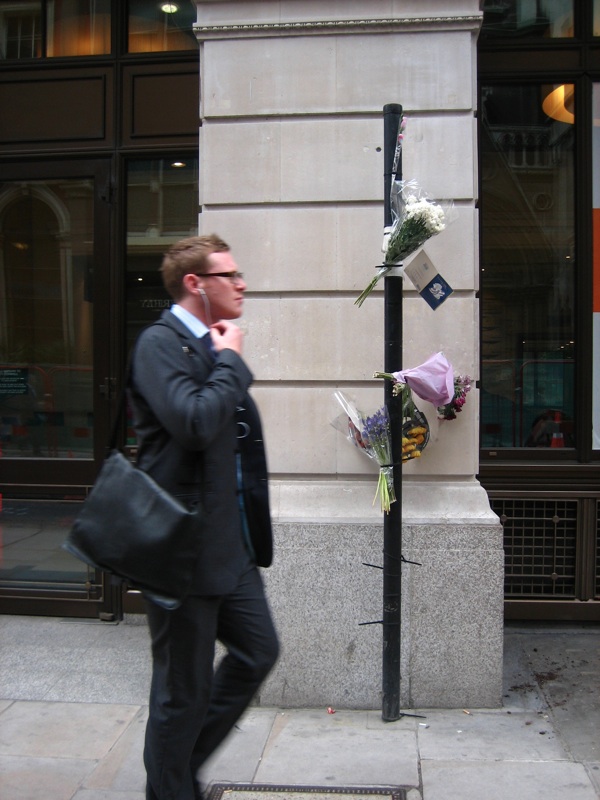
These flowers commemorate a recent episode in the history of Cornhill – the spot where Ian Tomlinson, newspaper seller, died in April 2009 after being hit with a baton by a policeman whilst trying to find his way home on the day of the G20 protests.
You might also like to read about
Spitalfields Antiques Market 23
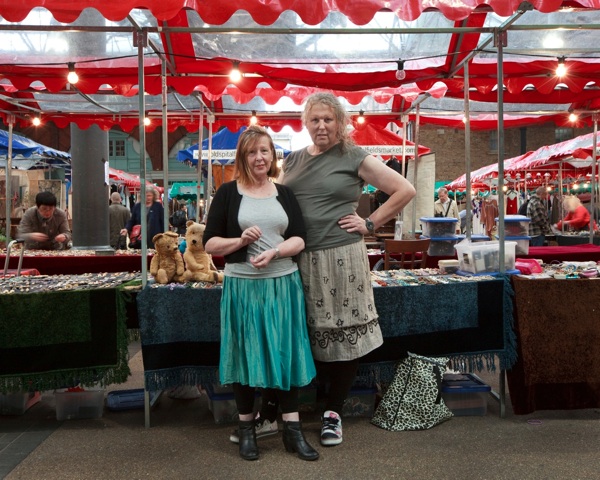
This is Nicola & Tiger, two sassy ladies who have been selling costume jewellery together for five years, and they obviously love what they do because they never stop. “We don’t wear much jewellery ourselves because we’re so busy working, it could get broken.” explained Nicola, with an ironic grin to illustrate the rough and tumble life of the market. Although,“If we were to go out in the evening, we would wear jewellery,” Tiger assured me – no stranger to social grace – before adding with a playful shrug, “but we are so busy working we never go out.” Both experienced restorers with an art school background, Nicola & Tiger met through the trade and have built up their business from one table to six, all lined with a vast selection of glittery and sparkling things.
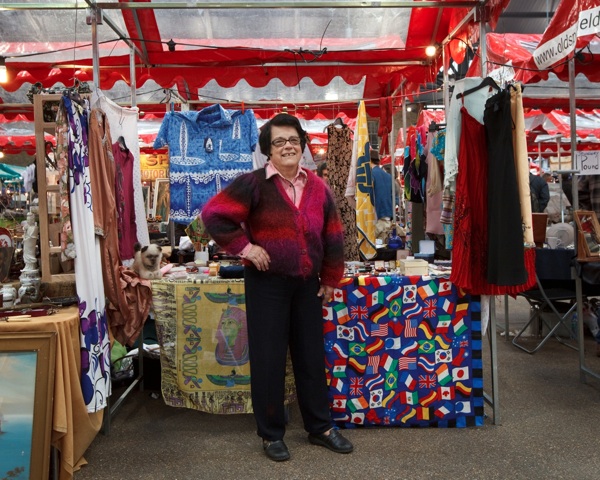
This is Fernanda, a spirited woman who came to London from Lisbon in 1959, and has great taste in knitwear among her many other accomplishments. “If it covers the expenses, then I am not disappointed because I want to get rid of my stuff, ” admitted Fernanda, widening her eyes for emphasis and speaking frankly, “If I stayed at home, I would give it away, so this way, at least I get to I come here. I have nothing else to do, and I made friends here.” Peering out shyly from behind her stall and blushing at her own weakness, Fernanda admitted to me she has a collection over over three hundred fans at home. With quiet determination, she comes each week on the train with three suitcases of her possessions to sell. “At the moment, I am trying to sell it all which is going to take the rest of my life!” she confessed happily, delighted at this perennial excuse to join her friends here in the market every Thursday.
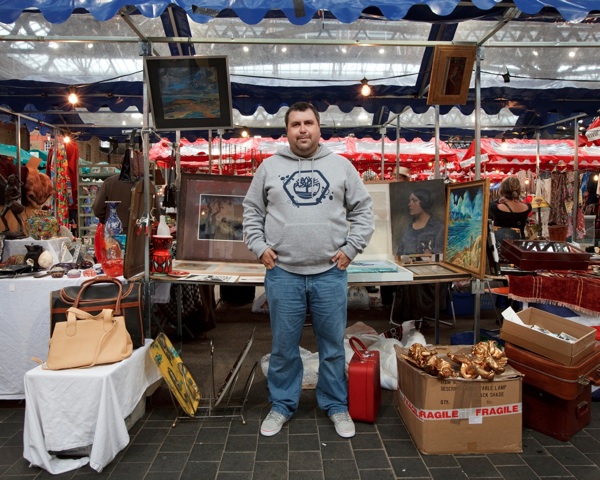
This is Daniel Dullaway who has been coming here for just three months selling early modern British Twentieth Century Art. “I am drawn to artists that are barely known,” he confided to me, revealing his own retiring nature,“those who did it for a living but never became famous.” And he produced a folder of wonderful old pen and ink sketches of detectives by Raymond Sheppard, founder of the Wapping Group. Always with a reliably intriguing selection of pictures to show and a range of works to suit every pocket, Daniel told me he is finding his way in the sale rooms. “Sometimes you buy loads of pictures and lose money,” he admitted with a tragic grin, his deep brown eyes shining soulfully,” but then you sell one for a lot of money and it builds up your confidence – it’s a bug.”
Photographs copyright © Jeremy Freedman
You may also like to take a look at












