
The Knickers of Spitalfields (Part One)

Madame Bordello shows off her knickers
Spitalfields Life contributing photographer Sarah Ainslie & I set out to explore the knickers of Spitalfields, but we soon discovered it was such a large and voluminous subject, comprising an infinite variety of design and reflecting the multitudinous quirks of the human libido, that we were overwhelmed with a slew of scanties and spoilt for choice of pants, and we knew we needed to seek professional help.
Still glowing from a couple of hours circuit training, luscious blonde, Michele Scarr, welcomed us to Bordello in Great Eastern St where she has a magnificent display of panties to delight the eye and gladden the heart of all lingerie lovers. You never know what you might discover rummaging around in Michele’s drawers and closets, she has all manner of frilly and lacy things, some that would not look out of place on a Christmas tree and other that are so diaphanous and revealing that they are barely there at all. Michele’s wardrobes stuffed with exotic underwear offer sophisticated amusement for those who have outgrown Narnia and such is the insatiable demand for fancy pants in Shoreditch that her stock changes every two weeks. These are fast moving undies.
“I worked in the City for twenty years as an investment banker, but I was never really happy and I always dreamed of opening a lingerie shop of my own,” confessed Michele, who took voluntary redundancy and opened up Bordello three and a half years ago. “It’s a boudoir,” she explained enthusiastically, spreading her arms wide with the extravagant brio and grace of a burlesque dancer, “for entertaining girlfriends and lovers, preening and dressing up – it’s a female space and it’s about the empowerment of women.”
Just fifty yards along Great Eastern St, we plunged down a deep dark staircase into the basement premises of Great Expectations. As we descended the metal staircase, it was as if we were entering the lower depths of a secret military installation but instead we found ourselves in the United Kingdom’s largest fetish store for men. Leaving the feminine world of satin and lace to enter the masculine arena of leather and rubber, we exchanged the frippery of the boudoir for the hardware of the dungeon.
Yet, in spite of their fierce looks, the muscle hunks who preside here were softly spoken and greeted us sweetly. “We have been part of this community for thirty years,” revealed Colin Dixon, the manager, who had just come from fitting a customer for rubber suit, “I adore this job, it’s not paid terribly well but I enjoy coming to work each day because it’s always different – and we get to know our customers intimately when we are taking their measurements.” Colin asked me to inform readers that a bespoke service is available for rubber and leather wear, and repairs can also be carried out should boisterous activity cause your gear to get split or torn.
We learnt that it is no accident the biggest fetish store is here at the edge of the City of London. “You’d be surprised how many corporate types go to work wearing a pair of rubber pants under their suits,” confided Colin with a twinkle in his eye, “A significant number of our customers are high-flying City people.”
Over in Hoxton Sq, we dropped in next on Sh! Women’s Erotic Emporium where unaccompanied men are not admitted except on Tuesdays between six and eight. Joanna Wierzbicka, the flirtatious manager, was fulsome in her advocacy of sexual diversity among her customers, “All kinds of women and their lovers are welcome here, transgender women as well.” she confirmed batting her eyelashes. Offering knickers for sale with the context of sexual exploration, Joanna is proud to offer a vital service to the local media and creative industries,“Quite a lot of them drop by after work to pick up a few things for the night,” she informed me with a knowing smile.
It was on leaving Sh! Sarah & I realised that, admirable as each of these three underwear outlets were in their distinctive ways, perhaps, in the fervour of our quest to investigate knickers we had favoured the exotic at the expense of the quotidian. This epiphany inspired us to return South and pay a visit to the good people at City Lingerie Ltd in the Whitechapel Rd where they sell thrifty underclothing in bulk.
Pants are available here from as little as one pound a pair and what they lack in style they make up in economy and volume. Yet the speciality is the bras that line the walls from floor to ceiling to such spectacular effect. Mr Ali, the genial proprietor who has been in ladies’ underwear for over twenty years, told me that an incredible three thousand bras pass through his hands each week, pointing out “The City Bra” which is his triumphant best seller, a pure cotton brassiere that retails at under ten pounds. “One day somebody left me some bras to sell,” he recalled, casting his eyes fondly upon the stack of crates of bras that filled the rear half of the shop, “And I thought,’The bra business is different.’ Now we are our own manufacturer and wholesaler.”
“It’s hard for ladies to find the right size,” he declared with a sympathetic shrug, “I enjoy satisfying my customers, they really appreciate it if they can get a bra that fits them at a bargain price.” Although modest and unassuming by nature, Mr Ali is a local hero to the women of Whitechapel.
It had been a long afternoon of underwear and Sarah & I had cast our eyes upon a lot of pants, but even as we reluctantly concluded the first day of our survey, we realised we had barely scratched the surface of the subject, and took comfort in the knowledge that there are still plenty of knickers yet to investigate in Spitalfields.
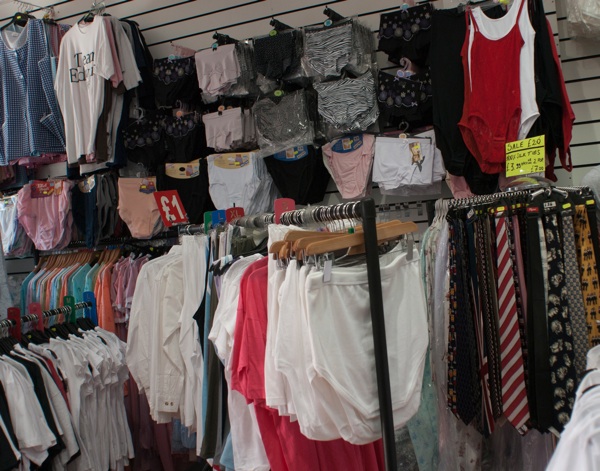
Practical styles at City Lingerie in Whitechapel with an emphasis on comfort and insulation.
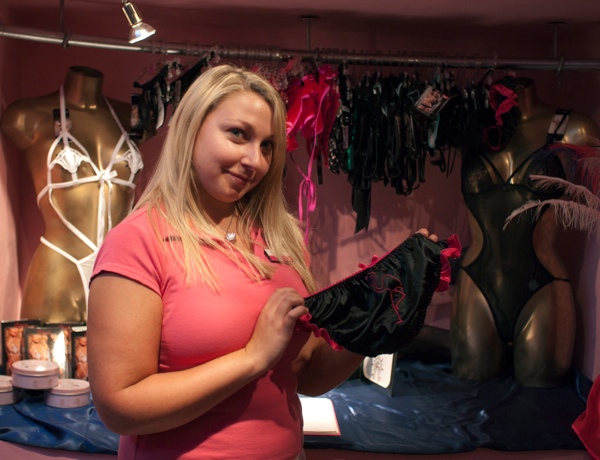
Joanna Wierzbicka at Ssh! shows off her flamingo knickers.
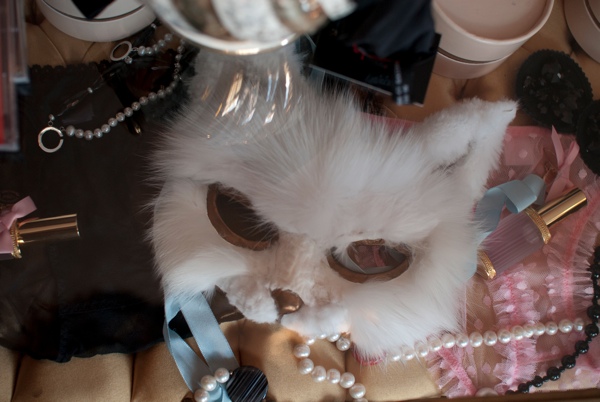
At Bordello.
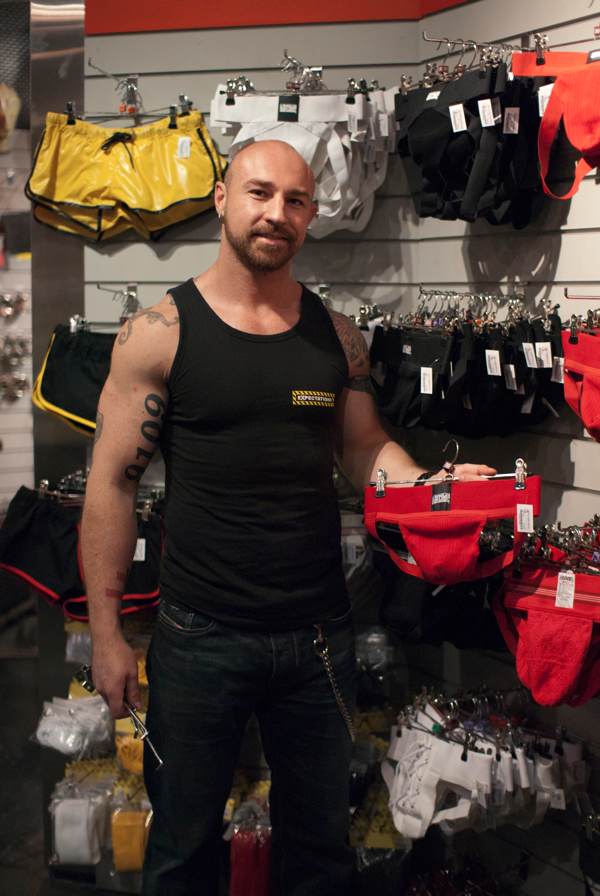
BJ at Great Expectations shows off his colourful jocks.
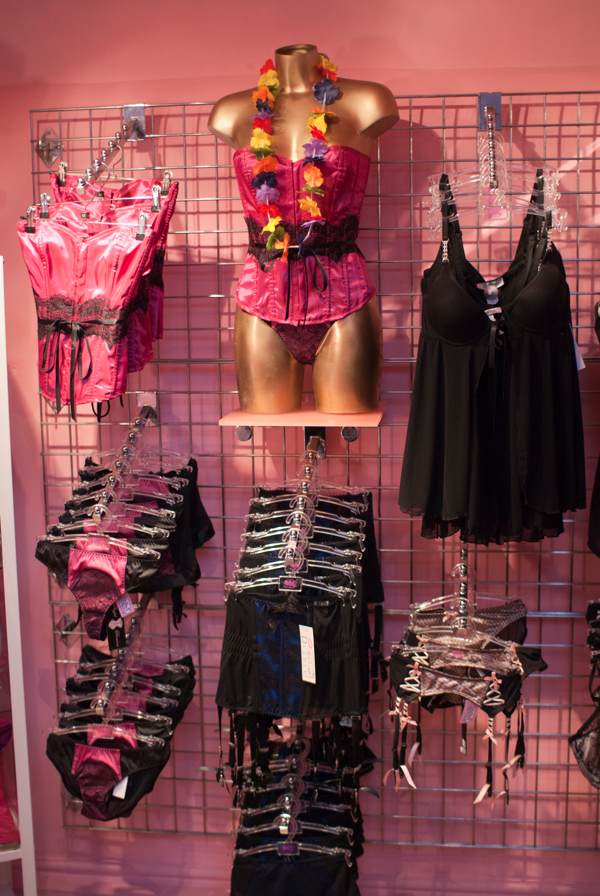
Racks of fancy scanties at Ssh!

Michele Scarr, also known as Madame Bordello, with her closet of satin bridal lingerie.

The economy range at City Lingerie.
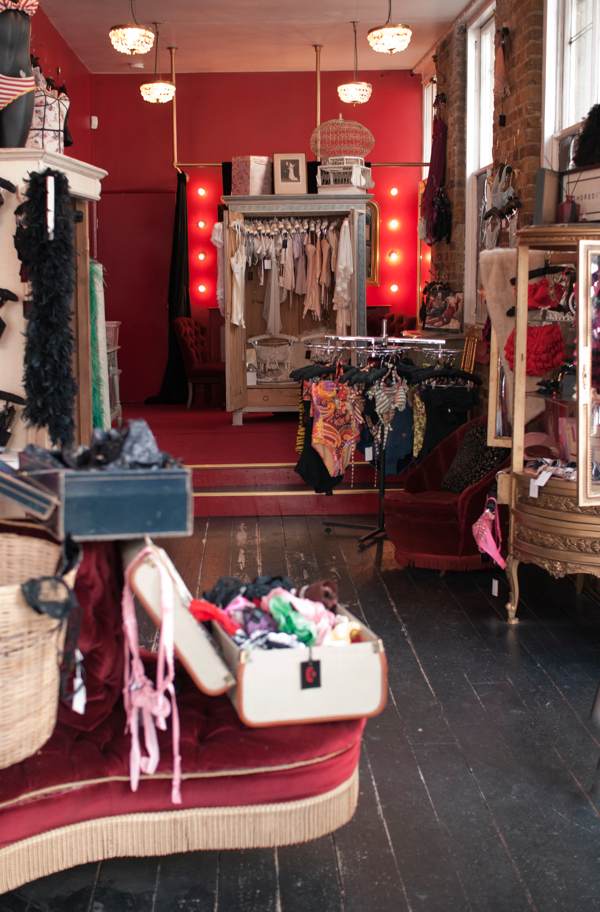
Wardrobes of classy knickers at Bordello.
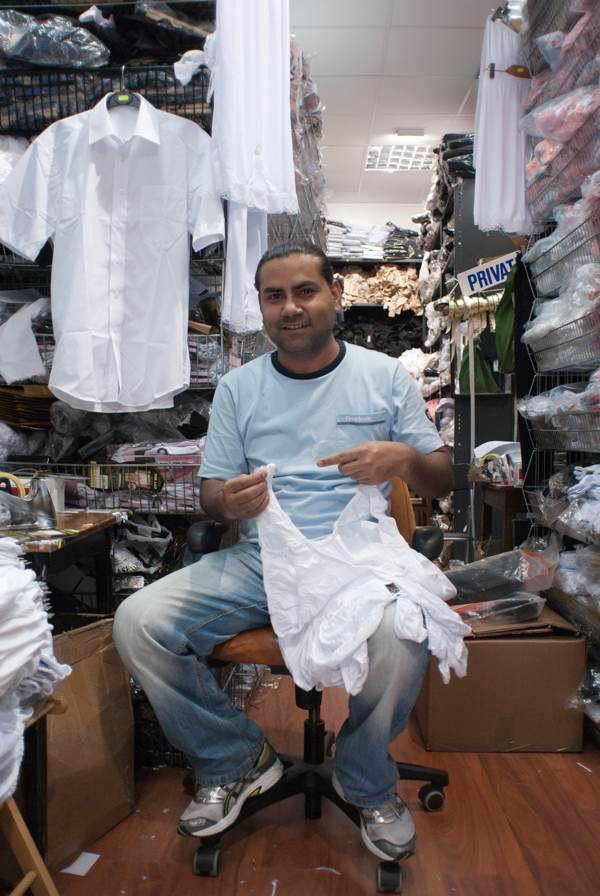
A hundred and fifty thousand bras pass through this man’s hands every year at City Lingerie.

Sassy frippery at Bordello.
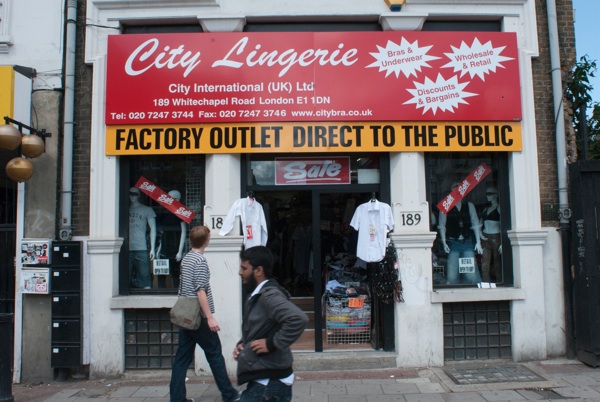
Bargain pants at City Lingerie in Whitechapel.
Photographs copyright © Sarah Ainslie
At the Eton Mission Rowing Club

Robert Hall, member since 1952
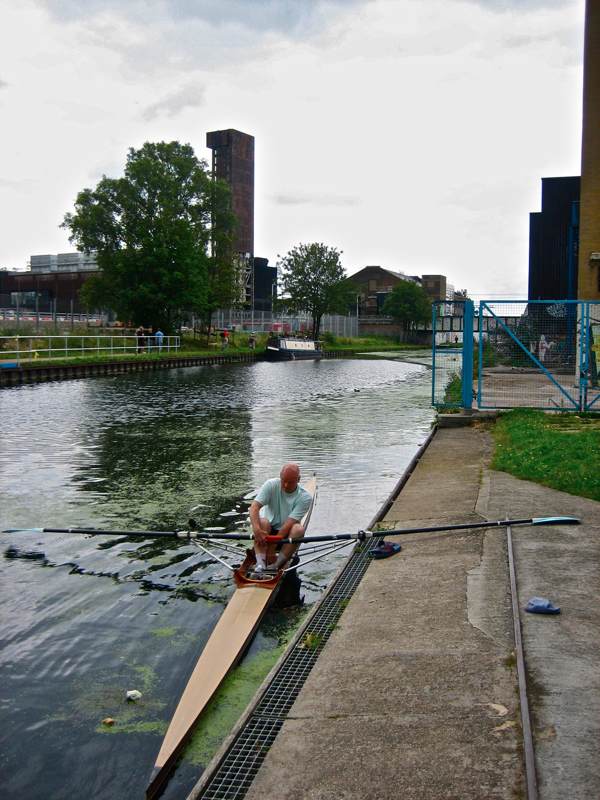
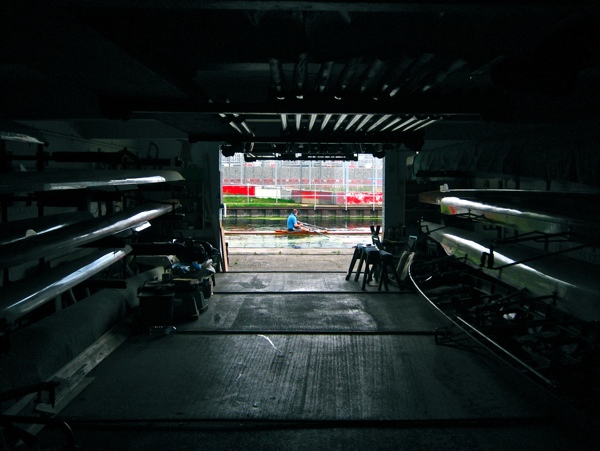
Nestled beside the cut of the River Lee in Hackney Wick is a beautiful rowing club with an atmospheric old club house and a magnificent history, which the 2012 Olympics is threatening to squeeze out of existence. Starting originally in the London Docks in 1885, and then given a home on the River Lee by Eton College, generations of East Enders have learnt to row here, winning a distinguished array of medals and prizes for the Eton Mission Rowing Club.
If you should require an advocate for the benefits of rowing, look no further than club member Henry Allingham who rowed here from 1909-14 and then returned from fighting in the trenches to row again from 1919-22. He came back in 2006, as the oldest man alive, to celebrate his one hundred and thirteenth birthday at the boathouse. And I can understand why, because the boathouse is filled with treasured old wooden boats and the slipway is flanked by buttercup lawns on either side, where blackberries grow over the fence and Moorhens nest at the river bank. The Eton Mission Rowing Club is a kind of paradise, but unfortunately it faces the site of the 2012 Olympics.
After it survived the loss of a generation of rowers depleted by the First World War and its club house was strafed by enemy fire in the Second World War, the club is now facing the autocratic caprices of the Olympic Authority. The bright-eyed Club Secretary Tim Hinchcliff welcomed me graciously when I visited last Sunday, yet an air of imminent apocalypse prevailed. “The way I see it, they’ve decided what’s good for us,” he told me, widening his eyes in disillusion,“We’ve never had any input into the plans.” Along with the other members, he is bracing himself for next Monday, 18th July, when the bulldozers move in to dig up the club’s lawn and demolish a storage shed, in preparation for the building of a bridge for the media to access the Olympic site on the other side of the river.
In spite of the rhetoric of consultation, the club was presented with a fait accompli by the Olympic Authority in the form of a Compulsory Purchase Order for a significant slice of their property. “The area’s too small now for all the things that we need to do,” confessed Tim in disappointment. The pitiful irony of such destructive action by a body set up to encourage sport is not lost upon the long-term members of the Eton Mission Rowing Club, who have endured an atmosphere of uncertainty since 2005 when the idea was first mooted – discouraging rowing crews who require an assurance of continuity for years ahead. And, while the precise nature of the Olympic plans – whether for a footbridge or a road bridge – have remained frustratingly uncertain, the nadir is set to arrive next year when the river is closed for security reasons and the rowing club will be forced to shut down for the Summer of 2012.
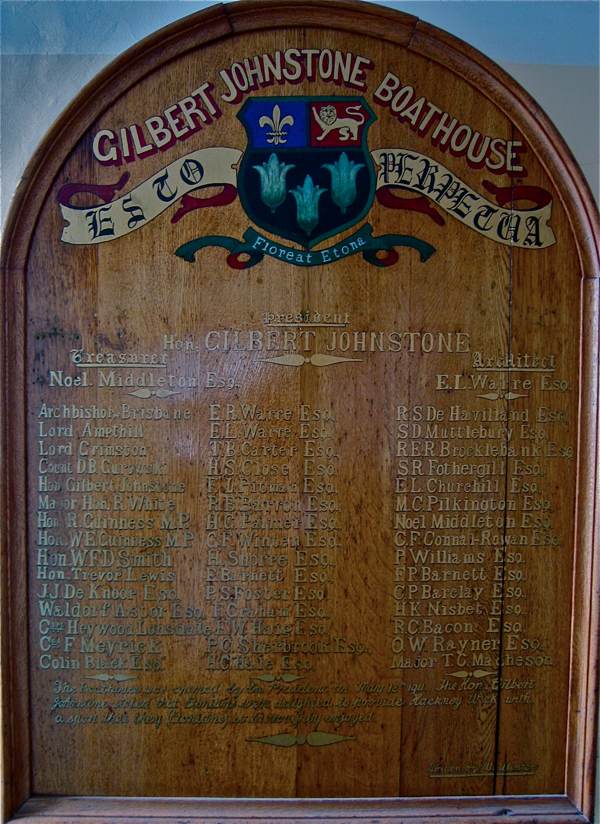
Yet in spite of the dark clouds looming overhead, the members were enjoying the opportunity of taking their boats out on the River Lee last Sunday, as they always have done, and were eager to talk to me about the manifold wonders of their beloved club. As we stood together under the lintel commemorating the building of the clubhouse, “Presented to the Eton Mission Rowing Club by their President Hon Gilbert Johnstone in Memory of his Etonian Wet-Bob Brothers, AD 1934.”, I asked Tim Hinchliff, the benign custodian, why he took up rowing in the first place and he discreetly indicated the caliper on his leg. “It was the only sport that was open to me.” he admitted, with a dignified modest grin.
Two Robert Halls, junior and senior, father and son, were sculling together. Robert senior joined the club in 1952, an upholsterer by trade, he served his apprenticeship round the corner in Hackney Wick at George Henshaw’s factory – “I just walked in and said I wanted to learn a trade.” He brought his son Robert down to be a coxon at the age of eight and they went on to row together, reeling off the lists of championships they had won, as they carried their sculls out the the water’s edge. “We know how to win,” confirmed Tim, speaking with professional pride, “We didn’t put out a team that didn’t win.” Hale and hearty with cropped white hair and a wiry physique, thanks to a lifetime’s rowing, “No-one could race us in this country,” asserted Robert senior, sharing a grin with his son. “It’s only if it’s frozen over that it will stop us,” he added as they pulled away from the shore, gliding way across the water with a swish of the oars.
Tim told me the club gets more enquiries for membership from women than men these days, and they would like to provide separate changing facilities by building a narrow extension onto the remaining piece of land between the clubhouse and the new bridge. Unfortunately the compensation is not sufficient to cover this and all requests for assistance have been ignored by the Olympic Authority, even if this is their opportunity to leave the venerable club better, not worse than they found it.
“They have shown no clemency, no kindness, no thought for anyone else’s existence,” said Robert Hall senior, a member of the club for sixty years, his eyes glittering with emotion. I cannot avoid saying that the members of the Eton Mission Rowing Club deserve better from the Olympic Authority than this shabby treatment. Renovating the club house and supporting the club would be a way to ensure the continuity of their beautiful endeavour. It is shameful that fellow sportsmen be exposed to corporate disdain by the Olympic Executives, simply because they happen to be in the way of a master plan conceived without their involvement, when their noble rowing club should be celebrated for providing sporting facilities on an egalitarian basis in East London for over a century.
“Everyone is welcome here,” Tim Hinchliff emphasised to me as we made our goodbyes, ever hopeful and diplomatic, “We get quite a lot of people who are interested in rowing. Once people are here, we can get them rowing in half an hour.”

The Gilbert Johnstone Club House.
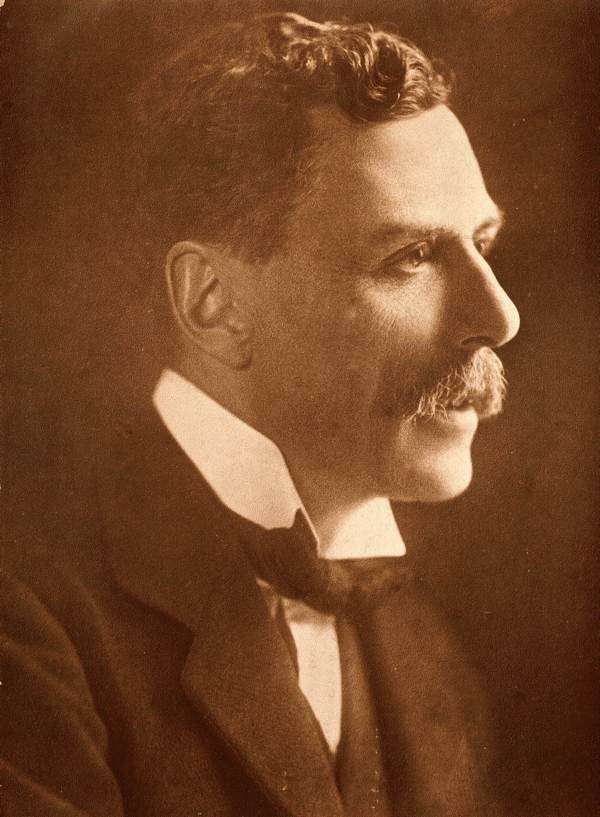
Gilbert Johnstone, founder of the club in 1892.
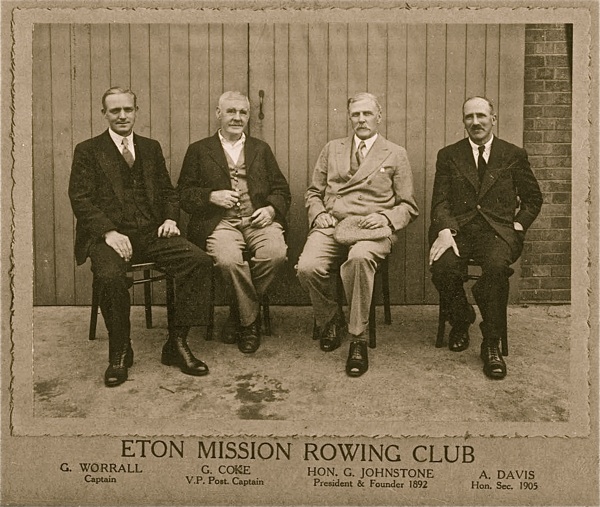
At the opening of the Gilbert Johnstone Boat House, 1934.

Robert Hall, senior & junior – “no-one could race us in this country.”
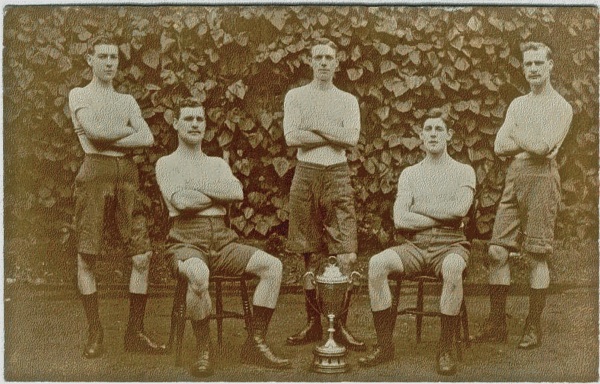
Bottomley Cup winners, 1914.
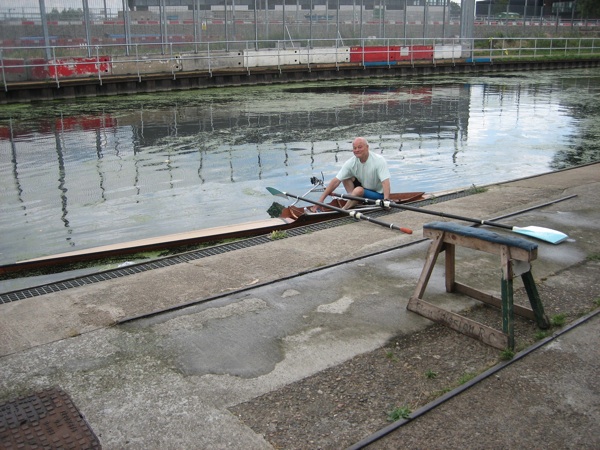
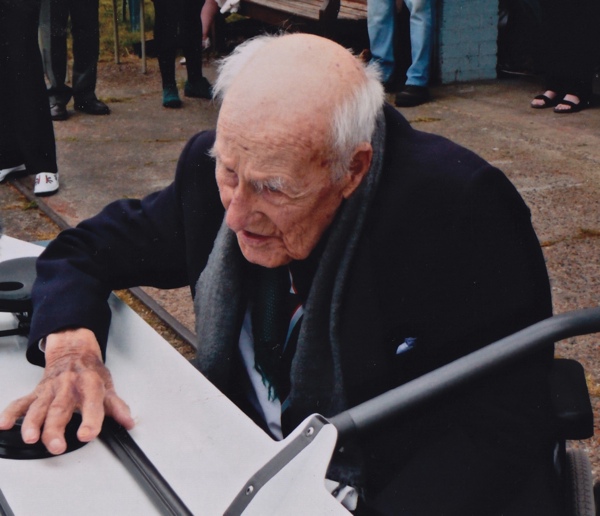
Henry Allingham, veteran of World War I and the oldest man alive, returned to his former rowing club in 2009 to celebrate his one hundred and thirteenth birthday.

Henry Allingham is recorded as winning second place in the gig handicap race in 1914.
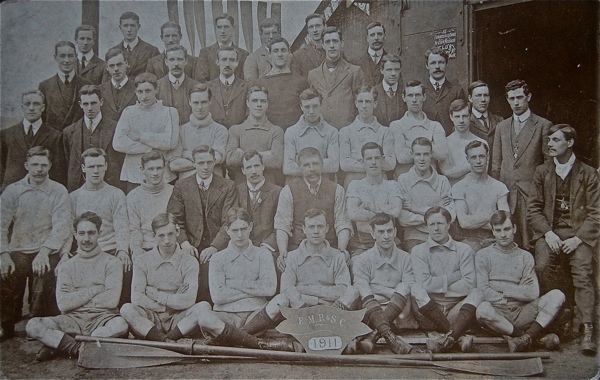
Henry Allingham is fourth from the left in the second row of this picture of the members in 1911.
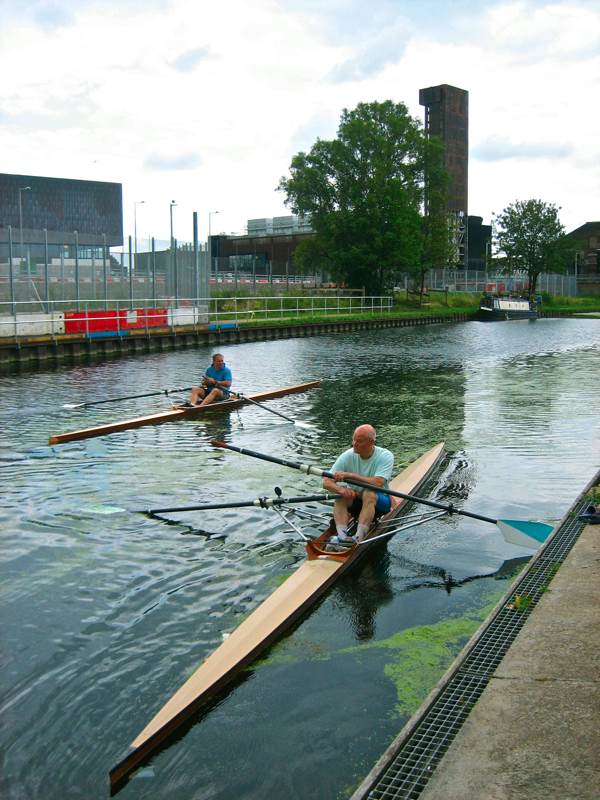
Robert Hall, junior & senior, set out to scull on the Lee.
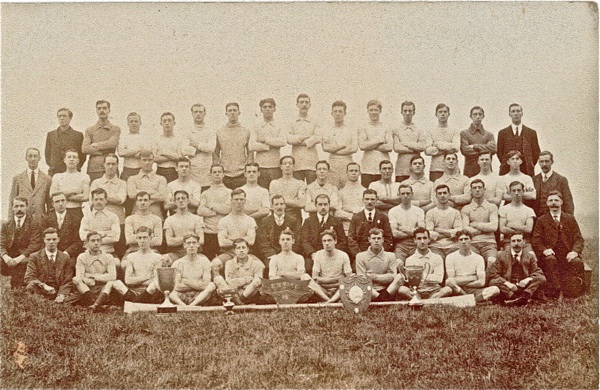
Members’ photograph, 1913.
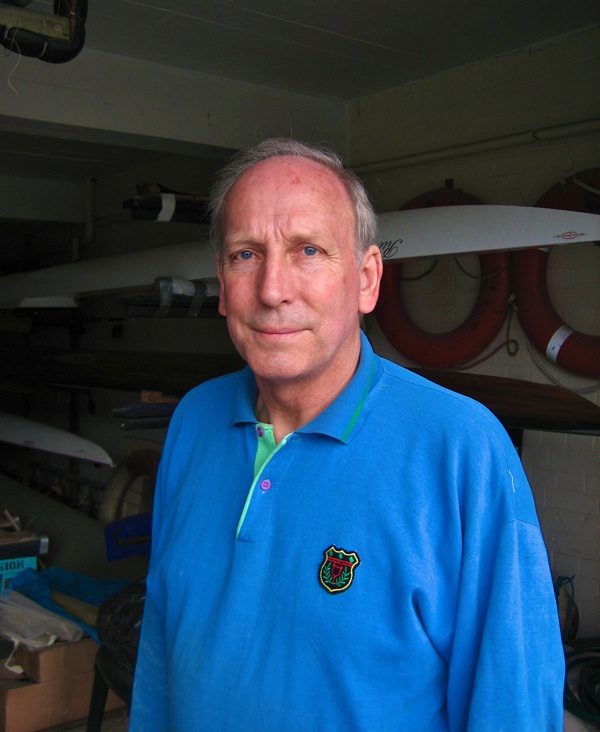
Tim Hinchcliff, Club Secretary.

Annual General Meeting, 1921


For years, the Hackney Otters took a dip in the Lee on Christmas Day to compete for a Turkey.

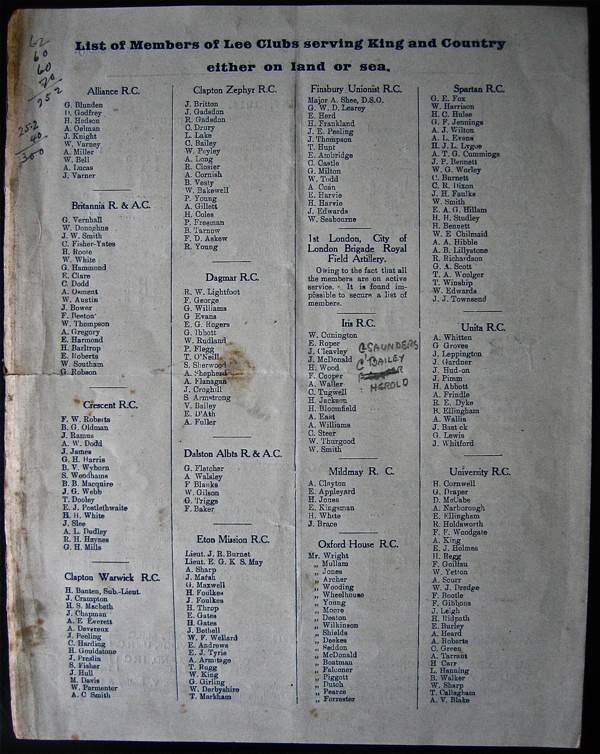
List of rowers who went to fight in World War I.

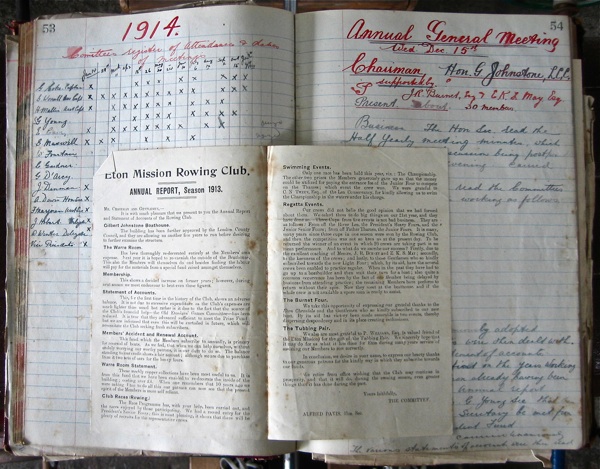
Annual General Meeting, 1914.
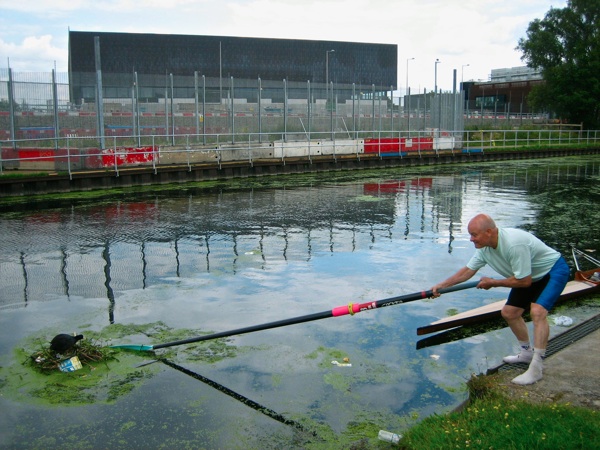
Robert Hall senior rescues a moorhen’s nest before it floats off down the Lee.
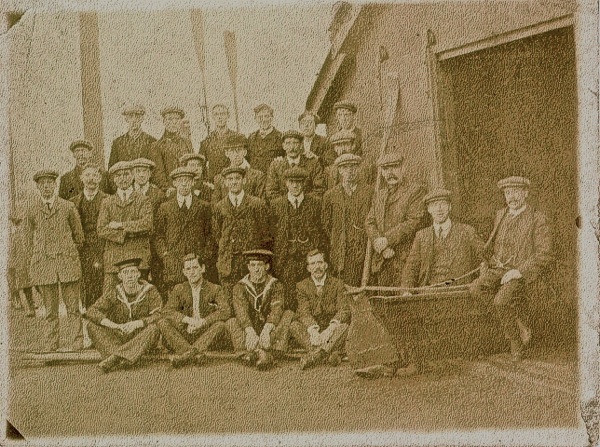
Eton Mission Rowing Club, 1911.
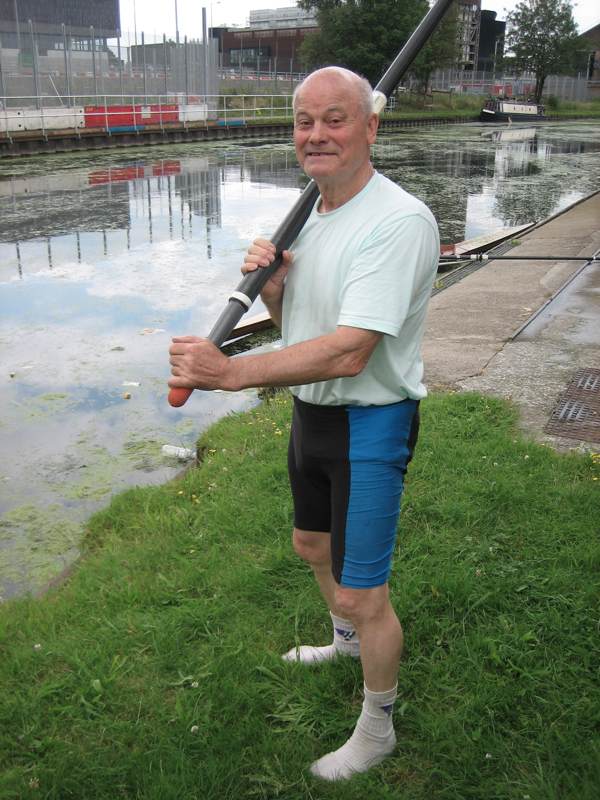
“I don’t like watching sport, I enjoy taking part!”
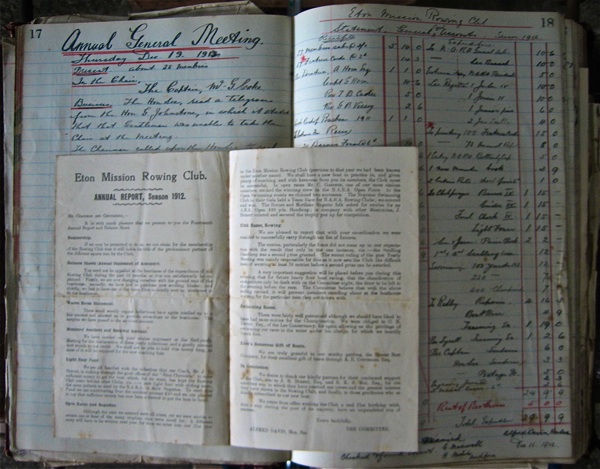

Robert Hall, senior.
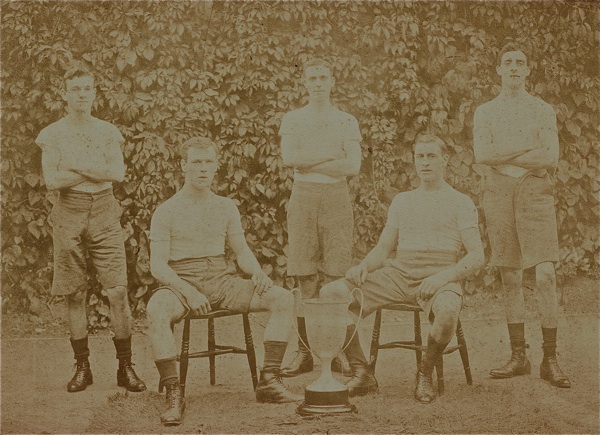
National Amateur Rowers’ Associtaion Cup Winners, 1911.


National Amateur Rowers’ Association & President’s Cup Winners, 1913.
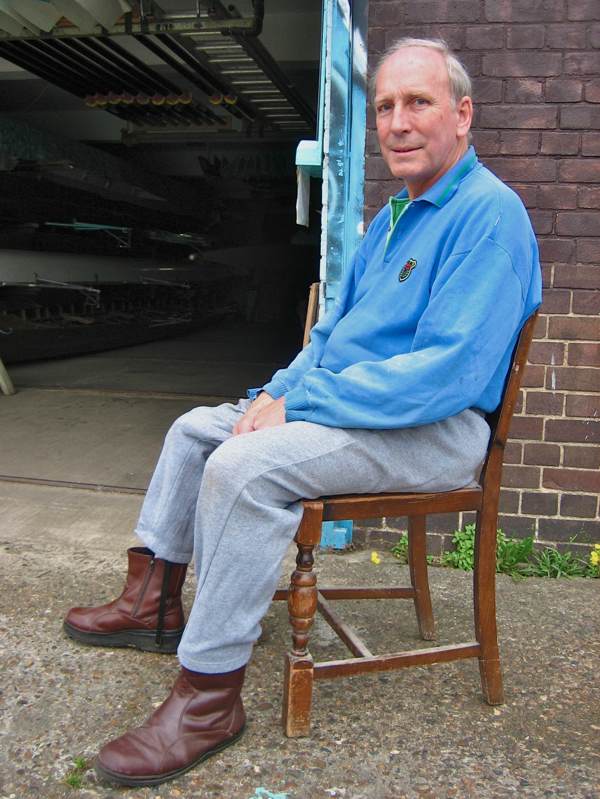
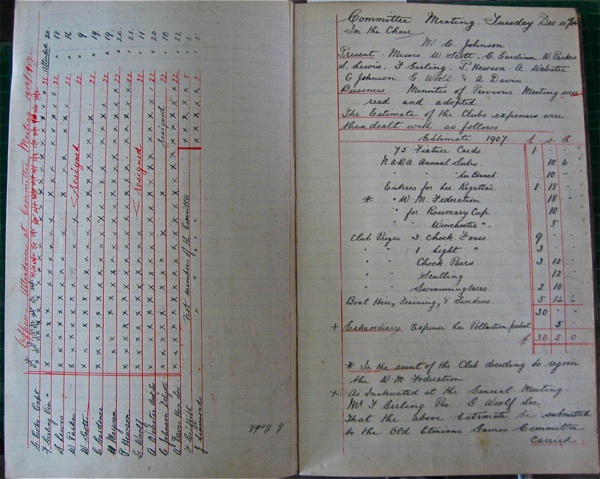
Annual General Meeting 1907

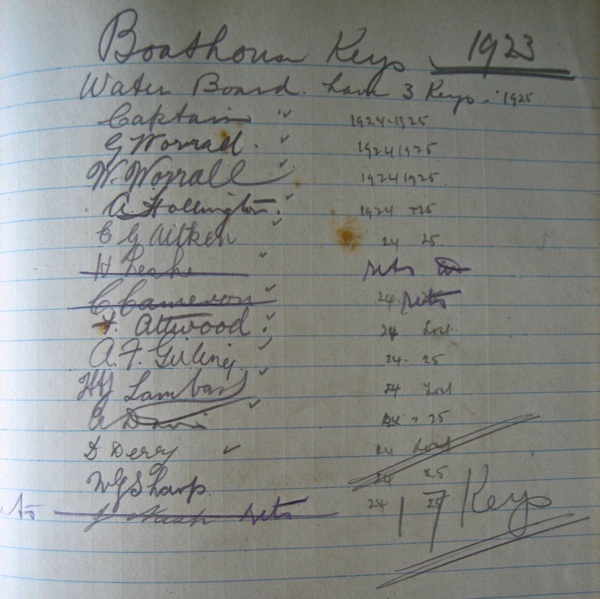
The assignment of boat house keys in 1923.

A cloud hangs over the Gilbert Johnstone Boat House in Hackney Wick.
You might like to attend the 6th Annual Coracle Race at the Eton Mission Rowing Club on Sunday 31st July from 3-6pm to show your support.
At Rayner & Sturges, Shirtmakers
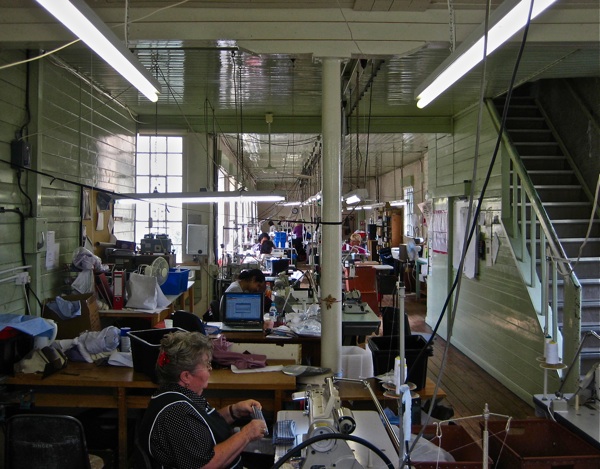
When Boyd Bowman of Alexander Boyd, the Spitalfields tailor, introduced himself to me as the last shirtmaker in England – I knew at once that I needed to visit his factory, next to the old dockyard at the mouth of the Medway near Chatham in Kent. Here at Rayner & Sturges, in a handsomely matchboarded nineteenth century building, tall and narrow like a ship and with light coming from windows on both sides, the finest bespoke shirts are made for Savile Row and Jermyn St. And if you walk into Alexander Boyd’s tailoring shop at 54 Artillery Lane, Spitalfields, and order a shirt to be made for you personally, this is where it will be cut and sewn.
On a rise up above the Medway stands the heroic shirt factory, established here in 1913 by Messrs Rayner & Sturges as part of a local clothing manufacturing industry in Kent that has all gone now, apart from this. Many of the staff trained and worked in other companies in the vicinity, but now the remaining skilled garment workers are all concentrated here, quietly making the very best shirts together.
You walk straight from the street into the factory floor where a rack of magnificent Italian and Swiss shirt cottons greet you on the left and paper patterns hang on the wall to your right. I set out to follow the path of a shirt, leading me to Anthony Rose, dignified cutter of fifty years experience. “You spent three years laying the cloth out and measuring the lengths before they let you cut it, “ he told me, “You’ve got to understand how the pieces go together in the finished article. We make the full-matched shirt for stripes and checks, which means the pattern matches at the shoulder, the sleeves, the pocket, across the front and the cuffs.” A master at work, he took out a length of bold blue-striped cotton, folded the cloth carefully in half and arranged the patterns strategically, cutting with a sharp pair of long, old scissors, to ensure an perfect symmetry of the finished shirt.
From the quiet of the cutting room, I climbed up to the sewing floor, echoing with the sound of machines and filled with dazzling morning sunlight. Here, Carol Williams, the cuffmaker, introduced herself, explaining that she began her career as dressmaker in Spitalfields at a factory on the corner of Toynbee and Commercial St in 1959, earning three pounds a week. The queen of cuffs today, she sandwiches the layers of shirting and liner together, sews them and turns them inside out to produce a perfect cuff every time.
Commanding the centre of the floor are a small posse of machinists, each specialising in different aspects of the shirt whether making collars or attaching sleeves. These lively ladies dressed in different colours welcomed me to their territory where they work with relaxed concentration and self-respecting perfectionism. The pieces of each shirt are gathered in a tray that gets passed along the line, as each member of the team works upon the garment until a beautiful new shirt emerges at the end. The skill and experience of these women working closely together, gossiping, amusing each other and taking pride in their exemplary work is a rare contrast to the sweatshops of mass-manufacturers.
Up on the top floor, in a room with a lofty aspect and a splendid wooden pent roof, I met Ryan an apprentice pattern maker, whose job is to translate the measurements and other specifications for a shirt into a paper pattern that can be sent down to Anthony on the ground floor to set the whole process rolling. Ryan’s father John, who is also his master, was eager to talk about all the famous names that wear the shirts made here, but I was more intrigued by this unusual and harmonious father and son team.
Not only was the building reminiscent of a ship, but the employees were a top-notch crew in which everyone contributed their different skills to a single end, permitting mutual appreciation and respect, sharing pride in the finished result. While there is no doubt that the age of mass production can sublimate and degrade the individual – that is what you read everywhere – here in Chatham at Rayner & Sturges, I found another story which by its existence proves that a different way can be viable. People work in decent conditions, without cutting corners, and create beautiful shirts for which enough customers are prepared to pay the price. It may be the last shirtmaker in England, but it is a new song of the shirt.
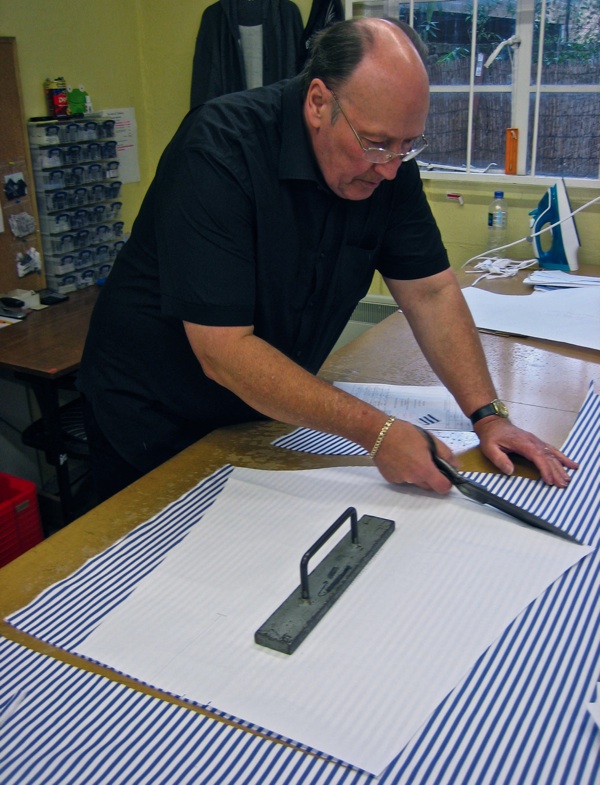
Anthony Rose, bespoke cutter of fifty years experience.


Carol Williams, cuffmaker – started as dressmaker in Spitalfields in 1959.
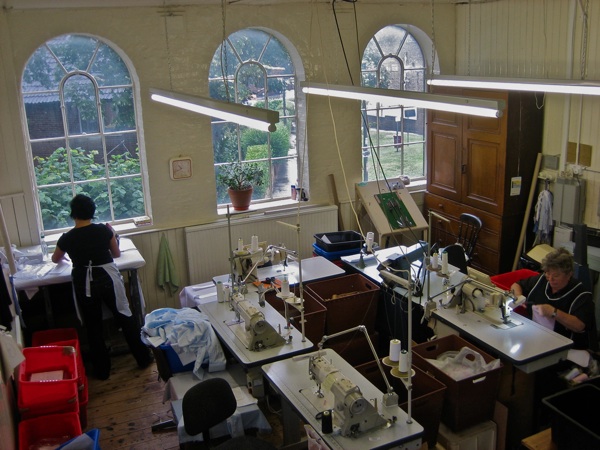
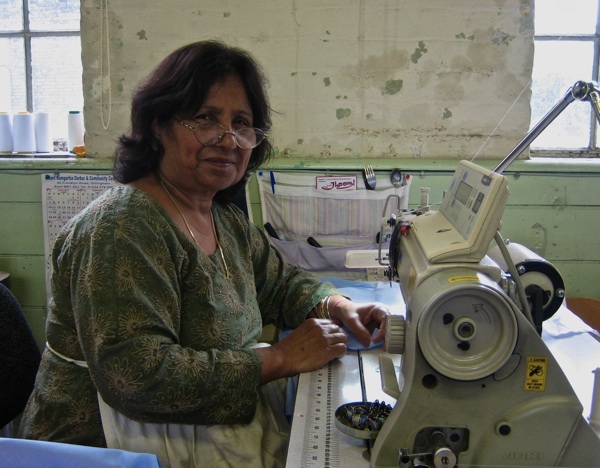
Nirmal Sopal, attaching the sleeves


Amlesa Ahluwa, making the backs, attaching labels and doing hems.


Maria Nazaresova, making the front.
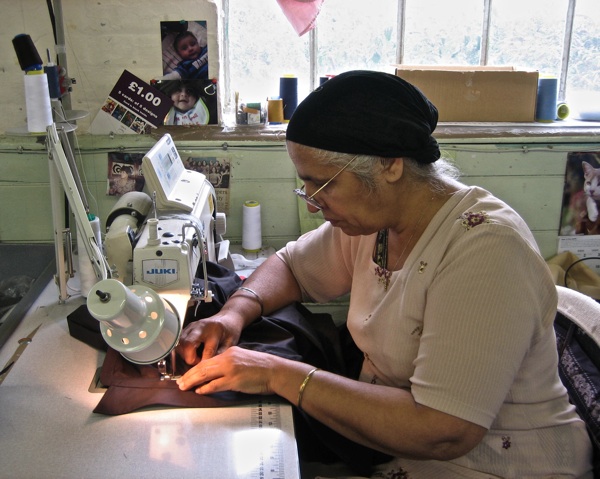
Gurmett Kaur, sewing on the collars.
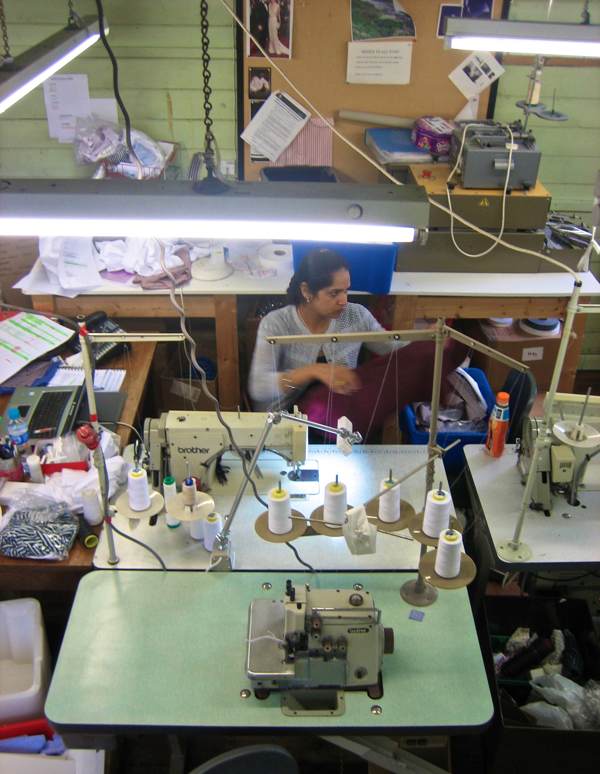

Lin Kendrick, quality control and buttonholing.

Ryan Carroll, pattern making

John Carroll, pattern maker and his son Ryan, apprentice pattern maker
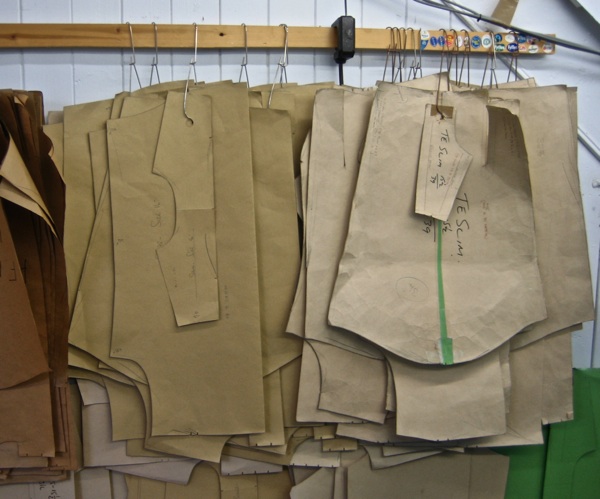
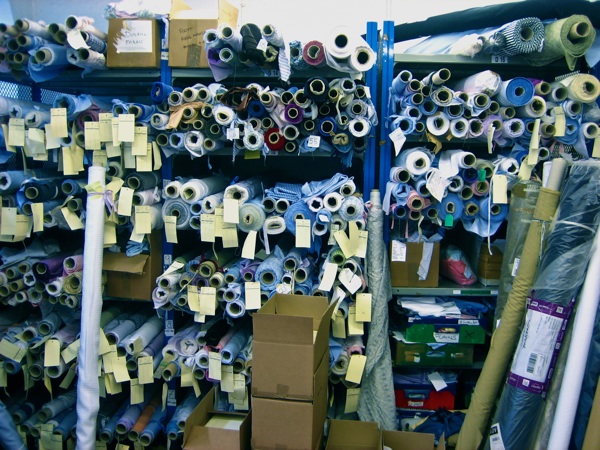
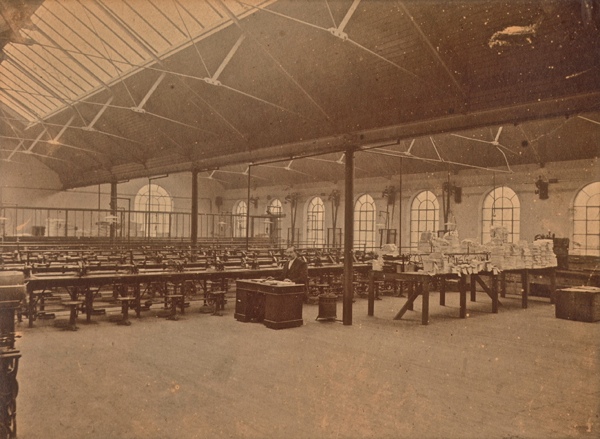
In 1913, Mr Rayner & Mr Sturges set up their factory in a former printing works.
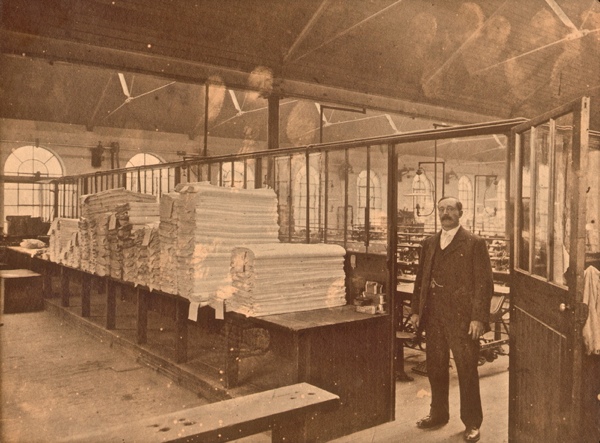

Fifty years ago, an outing from the Victoria Works, where the factory still operates today.
Brick Lane Market 13

This is Jacqueline & Michael Barnes, who sell stationery together under an awning on the yard in Sclater St. “We’ve been here on this pitch about twenty-five years,” ventured Jacqueline proudly, welcoming me her to her personal kingdom of immaculately organised envelopes and felt pens. “I’m originally from Paddington, and Mike, he’s the same as me, from Paddington.” she explained, shaking her head when I enquired if she was a local, before revealing that the couple have been seduced by the East End, “We moved over to Stratford because we wanted a quiet life, and now we’re living out in the sticks.” Michael ran around serving customers with an eager grin, stretching for items with his long limbs while Jacqueline held court, chatting to me and the near-constant stream of regulars who dropped in to convey their week’s news and pick up some cheap biros and post-it notes. “It’s not been good for months and we just do it to keep ourselves amused.” she whispered discreetly, when there was a lull, “We are pensioners now, and I look forward to coming down here – all the stallholders, we have a laugh and a joke together.”

These three keen lads from Essex are Sam, Jack & Perry, two brothers and a pal, who between them run a long stall, selling a spectacular selection of cheap tools and bicycle locks, which stretches the entire length of the yard in Sclater St. “It’s my dad’s business,” explained Sam, the eldest brother who is in charge, taking a respite from the intensity of the milling crowd and his ear-splitting banter –“I took over this bit about three years ago.” It makes for a compelling drama, as with eagle eyes, the three of them watch over the thousands of tools piled up, exchanging wary glances and sharp patter, while a ceaseless parade of customers passes along the stall. Sam’s skinny little brother Jack has been here each Sunday for several years, though he is still at school for another two years. “I was brought up around it and I’ll do this when I leave,” he informed me with a blush, his grey eyes glowing in anticipation, “and hopefully we’ll still be here in thirty years time.”

This is Kevin and his dad Tom who sell men’s casual wear at bargain prices in the Sclater St yard.“I started setting up and taking down the stalls for the traders when I was still at school, and then at fifteen I started trading on my own.” Kevin admitted with to me relish, “I left school early because I was earning more than the teachers.” Kevin, a magnanimous gentle giant who overshadows his father, has been trading for twenty years now and since Tom took early retirement, he comes to help Kevin out. “I work six days a week, sixteen hours a day nowadays,” Kevin told me as we sat in the afternoon shade at the back of his van while his father stood out on the empty yard awaiting customers -“It’s a measure of how hard we have to try these days to keep the money up.” Yet Kevin is undaunted by the challenge of market life in the recession.“I don’t like being beaten, so I’ll hang in,” he told me, catching his father’s attention with a grin and a nod. “Who could ask for anything more?” he asserted, turning to me and spreading his arms demonstratively,” I enjoy it, you’re busy out in the open air. And, when you’re making money, it’s happy days.”
Photographs copyright © Jeremy Freedman
Steve Lewis’ East End

Leslie Lucking combined the roles of Lollipop lady and mother to her daughter Tracey.
This is just one of hundreds of pictures Steve Lewis took of the East End in the nineteen sixties, when he was starting out as a young photographer at the age of seventeen. In 1972, Steve joined The Sun as a staff photographer and worked until 2006 covering a wide range of assignments for the paper, from celebrity to fashion. “It wasn’t until thirty-five years later, when I retired, that I found this box of negatives,” he revealed to me, uplifted by the rediscovery of his early work, “and I started going through them – it took the next two years to sort them all out and clean them up.”
There is a clarity of vision in these pictures, enlivened by Steve’s exploration of his new medium yet also informed by an understanding of the people, the places and the society he was depicting, because this was the world he grew up into and the world as he first knew it.
“I knew what I wanted to do at a very young age.” Steve confided, looking back to these forgotten photographs, “One day, I was at my school prize giving in Ilford Town Hall and the buildings opposite caught fire and the fire brigade came, and we all went out to watch the fire as the buildings burnt down. There was quite a crowd, and I saw all the photographers and I thought, ‘What a brilliant job!’
I was still very young and I went to the Ilford Recorder office and said, ‘I want to be a photographer’ and could I start as an apprentice when I left school. And they said, ‘After you have finished all your exams, you can come in as a darkroom assistant.’
They set me up with a camera to learn – an NPP plate camera and fourteen plates, and they sent me out to cover seven stories and said, ‘You can take two plates for each one.’ It was very difficult, especially if you were covering a large event, like a football match – but, looking back, it was a good way to learn.”
From there, Steve graduated to the Newham Recorder where editor Tom Duncan was keen to tackle social issues and the reality of working class people’s lives in the East End, that were barely touched by the “Swinging Sixties” phenomenon. It was this rolling commission that led Steve to take all of these photographs.“He was very go-ahead and he asked me to take a picture every week as a way to record what was going on and he called it ‘Lewis’ View'” recalled Steve, “I was not really aware what I was doing at the time, fitting in these pictures whilst I was putting together other stories for the paper.”
Yet today these photographs have brought Steve back to looking at the East End. And, collecting them into London’s East End, a 1960s album – a popular success with three reprints in the first year – and staging an accompanying exhibition, has delivered an unexpected result for Steve. “A lot of these people are still living in the East End!” he told me in astonishment,“One woman looked at my book and said,’It’s like having my own personal album.'” The outcome is that Steve is now photographing the East End again – for a second book in colour – returning to the same locations and even some of the same people, to reach across and span the divide of nearly half a century.
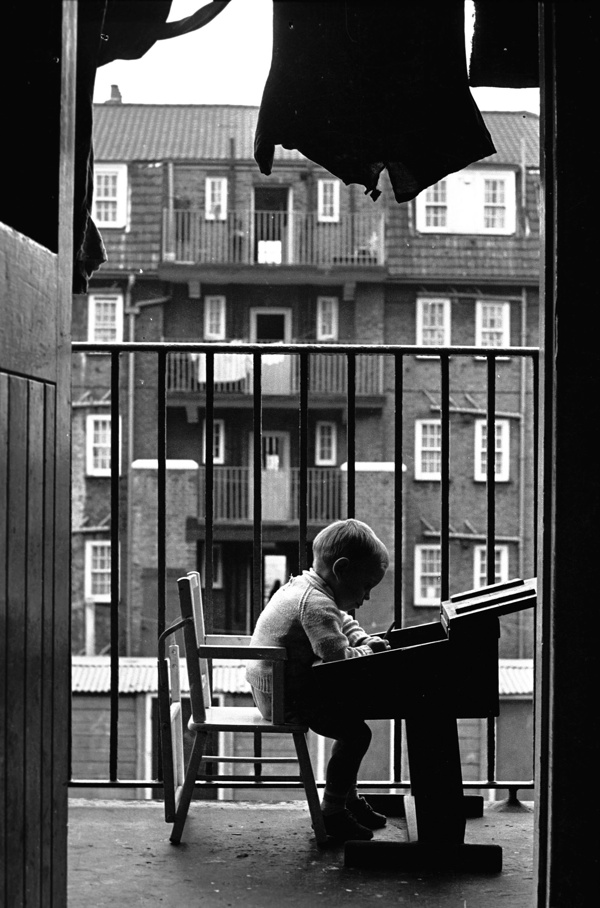
In a halfway home in Newham.
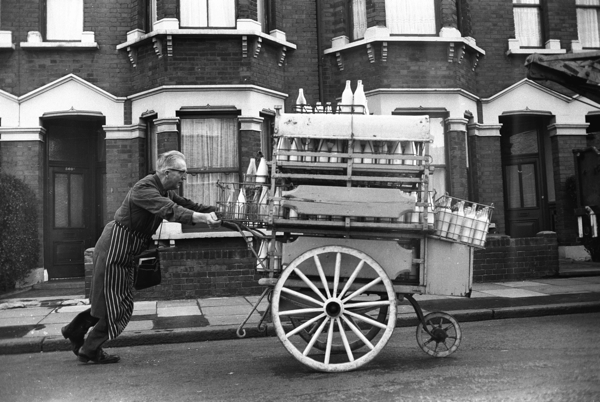
Alfred Davies had been delivering milk from this handcart to homes in Forest Gate for over thirty years.
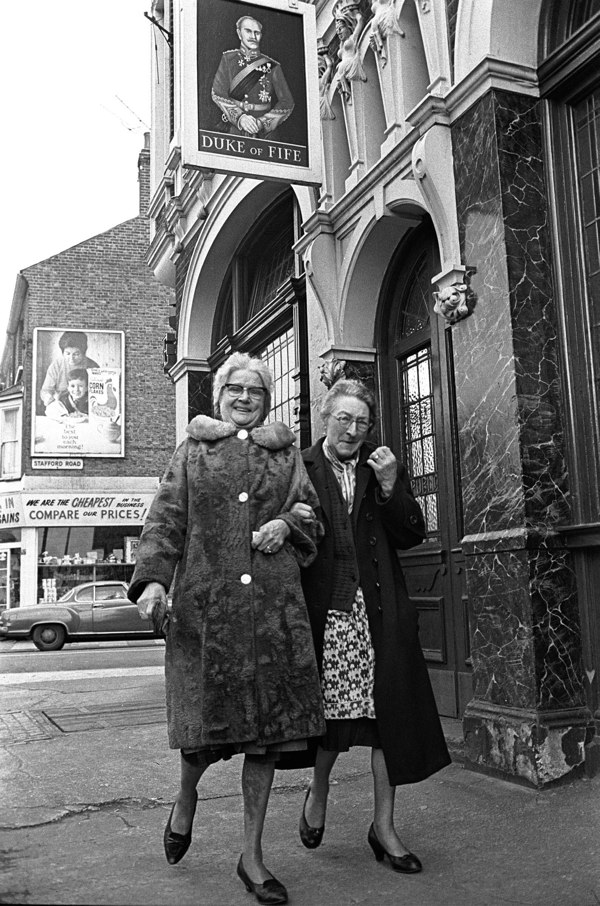
Sisters Rose Walsham & Susan Lawrence, lifelong customers at the Duke of Fife.
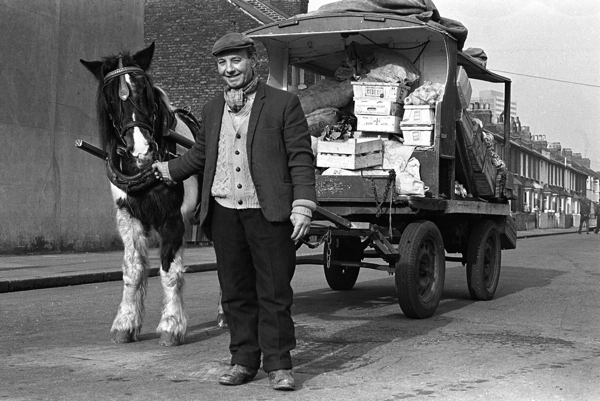
Street trader selling vegetables in Barking.
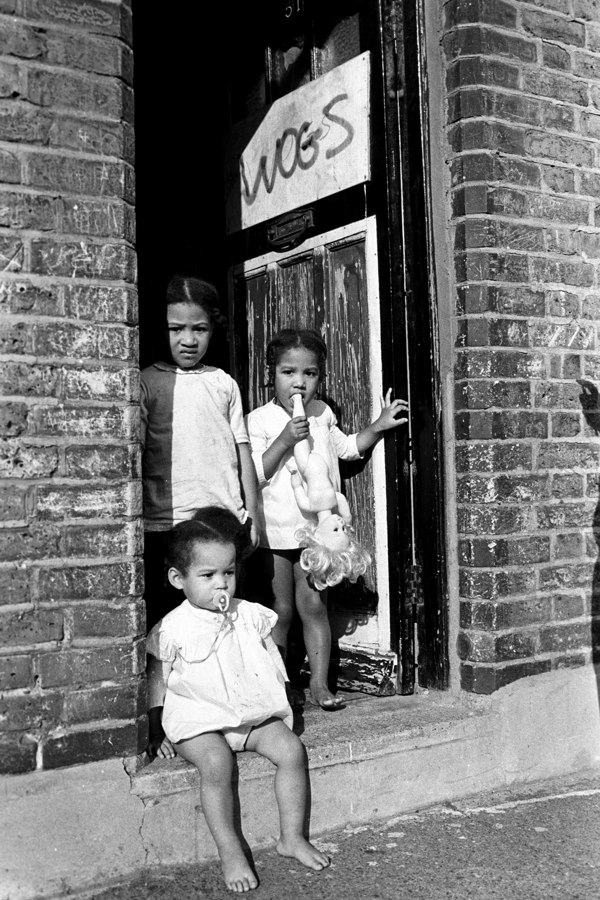
In Whitechapel, a group of National Front supporters came by night to nail their message of racial hatred to the door and fire bomb this family.

This urban beachcomber was a familiar sight upon the streets of Whitechapel and Stepney.
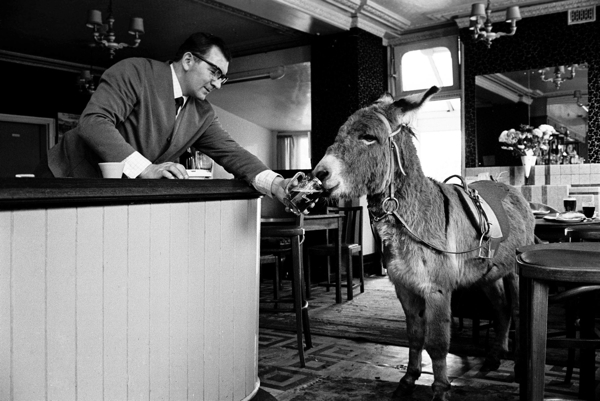
John Loftus of the Manby Arms in Stratford adopted “Bass” a retired donkey.

David Bailey and his American girlfriend Penelope Tree visit his mother in East Ham.
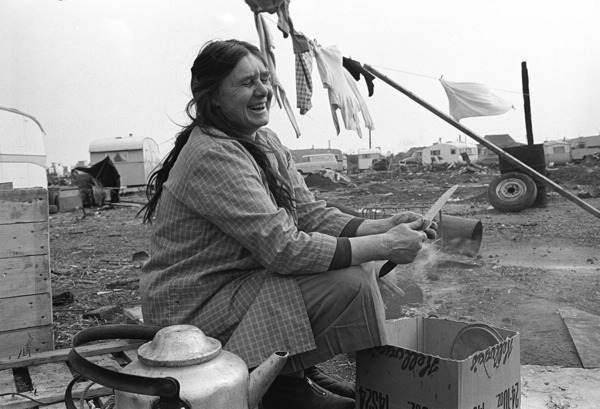
Mrs Mary Riley, caravan dweller, peeling potatoes in Barking.
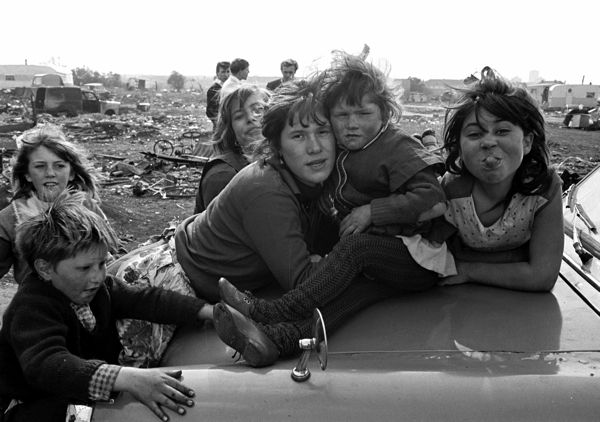
A Gipsy family on Beckton Marshes.
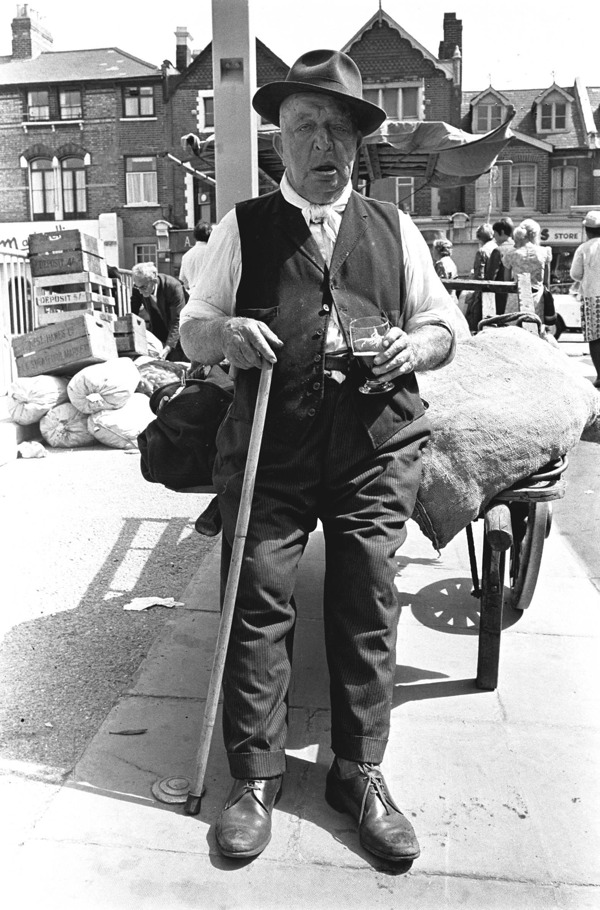
A street trader from the 1960s who – from his appearance – could equally belong to the 1860s.
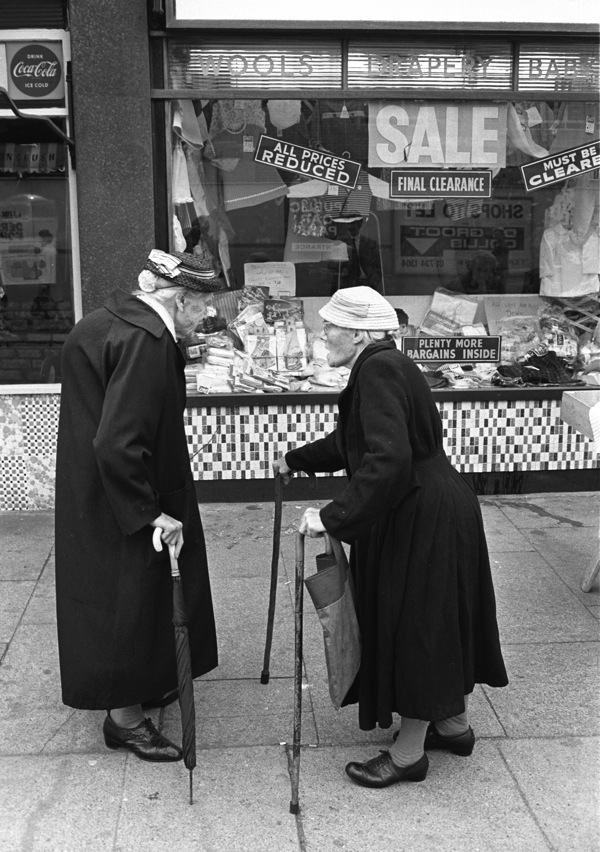
In the “Swinging Sixties.”
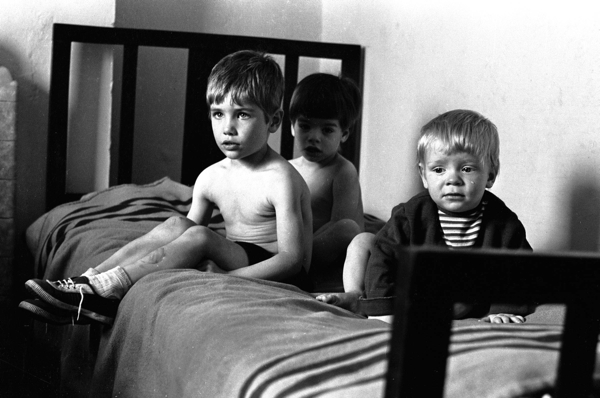
Homeless children in a halfway home.
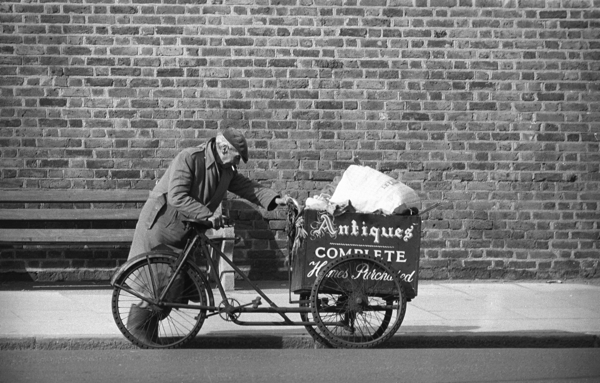
An ambitious rag and bone man advertises “COMPLETE Homes Purchased.”
Photographs copyright © Steve Lewis
London’s East End, a 1960s album by Steve Lewis is available from all good bookshops, www.amazon.co.uk or www.thehistorypress.co.uk or from 01235 465577 at Marston Book Services. All photographs can be purchased from Redcliffe Imaging Ltd
Leon Thompson, Ringing Master
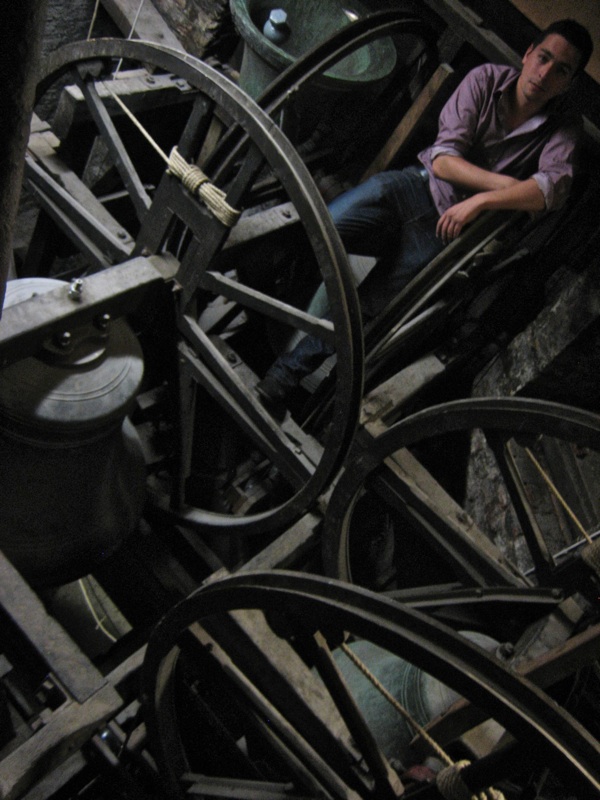
This is Leon Thompson, the young ringing master, lurking in the shadows of the belfry of St Matthew’s, Bethnal Green – a place where he has spent a lot of time recently, and where he feels happy and at home, keeping the old bells company. “I decided to start something,” he explained, “there’s been no ringing here since the war, so I decided to try and start a new team of ringers – in the past, the ringers here were described as ‘the best of the best’ and were invited to ring the first peal of bells when St Paul’s Cathedral was inaugurated.”
When Leon came along, he found that although the tower was neglected, the bells were still usable. And today, after raising twenty thousand pounds for some crucial restoration, much of which he did himself to save money, the bells have been rehung and the tower cleaned up, ready for a new beginning. Now, Leon is hanging up the old boards in the newly repainted ringers’ chamber, boards that record in graceful calligraphic signwriting the ringers of past centuries and commemorate famous peals such as the “Kent Treble Bob Major” of 27th April 1868 – the longest peal of bells in the world at that time – ringing continuously for nine hours and twelve minutes. It was an heroic achievement in the days when it required heft to ring bells, before modern bearings allowed them to swing smoothly with minimal friction.
Leon told me that most of the ringers whose names are recorded on the board worked in the London docks and would be used to physical labour, though J. Pettet was silk hat maker and H. Booth was a cigar maker, and neither are professions that require muscle. Yet the most significant name on the board for Leon personally is that of ringer Matthew Wood, a market porter whose family came from France as Huguenot refugees and Anglicised their name in the mid-nineteenth century. Three generations of men from this family were successive steeplekeepers and rang the bells in the tower, starting when it was built in 1746 and ending with the eighty-four-year-old Matthew Wood’s last peal in 1909, recorded upon a special board of its own. This particular Matthew Wood taught Arthur Hughes whose named is recorded on the same board as being there ringing beside him in 1909 – and Arthur Hughes taught Brooke Lunn – and when Brooke Lunn was an old man, he taught Leon Thompson.
This direct connection, that links him back to those who have rung before him, conjures an intense poetry for Leon. “When I stand here pulling this rope,” he explained, clutching the multi-coloured bell rope expertly in both hands and then sending it sliding through his fingers,” I am standing in the same spot that Matthew Wood stood in 1868, ringing the same bell, with the same clapper and hearing the same sound – the only thing that has changed is the piece of rope.”
And then the bell chimed from up above on cue, as if to applaud the notion.
St Matthew’s Church has seen better days – built by George Dance (who also designed St Leonard’s, Shoreditch) in 1746, it was burnt out in January 1859 when the fire brigade’s hoses froze and then was heavily rebuilt in 1861, only to take direct hit of an incendiary bomb on the very first night of the London blitz. All that remained was the shell and the tower but luckily the new set of bells, installed in 1861 after the first fire, survived the second conflagration.
Today the sixties rebuilding speaks more loudly that the work of Dance and you would be forgiven for not even realising it was an old church at all. But when Leon led me through a tiny door, barely three feet high, and we ascended a narrow spiral staircase within the thickness of the wall, I felt I was entering an older world. At first we came to the ringers’ chamber and then we ascended through a dark space that houses the working of the clock, up into the bell chamber. Here we sat upon the beams to chat in the silent presence of the bells made by the Whitechapel Bell Foundry in 1861, and Leon revealed that when he needed to order replacement clappers, he discovered the foundry still had the measurements on file from the original order.
“I learnt to ring at Oxford where I grew up. It’s very addictive – a hobby where you never stop learning.” he confided to me, eloquent in the half-light of the belfry and in the presence of these charismatic chimes, where he delighted in the intricate details of their configuration, adding enthusiastically, “The bell ringing community is very tight, so if you can ring fairly well, you can go anywhere in the world and you’ll always get a ring.”
“I’ve been in London for four years and I used to come up before that to ring at St Paul’s and Mary Le Bow,” Leon continued, “But I’ve always been drawn to the East End. My great-grandfather was from Bethnal Green and my parents grew up in Stepney.” And so I understood how it all came together for Leon Thompson here in the tower. These were the same bells that his great-grandfather would have heard.
Now Leon has discovered an engagement with the East End, through the magic of bells, he means to take it forward. “I want to start teaching people,” he declared, “My ambition is to get a band of local ringers who can be ‘the best of the best,’ like 1868.”
Leon Thompson needs volunteer bellringers, so if you would like to learn the art of bellringing at St Matthew’s, Bethnal Green, please email leon_thompson_541@hotmail.com Also, Leon will be hosting an open day on Saturday 16th July, from two until five, when visitors are welcome to explore the tower.

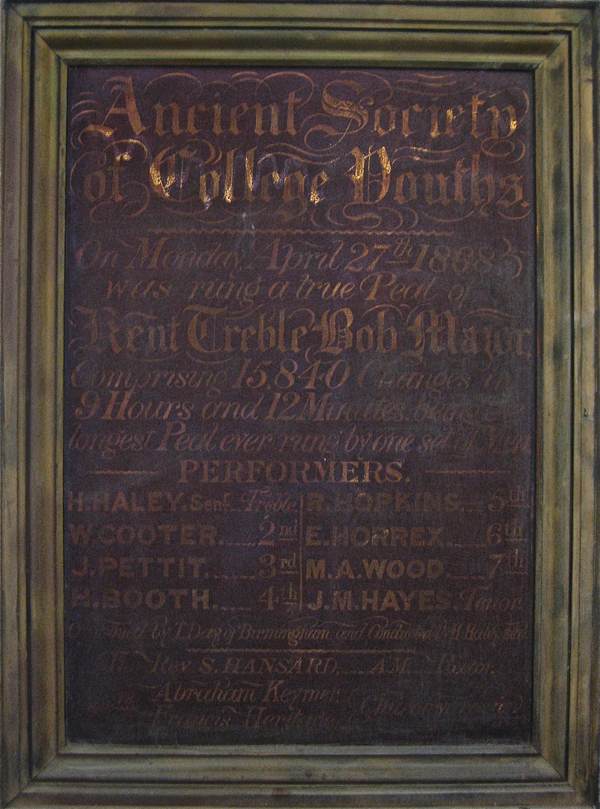
In 1868, the longest peal of bells ever rung was rung at St Matthew’s, Bethnal Green – nine hours and twelve minutes. Later, it provided the inspiration for Dorothy L. Sayers’ novel “The Nine Tailors.”
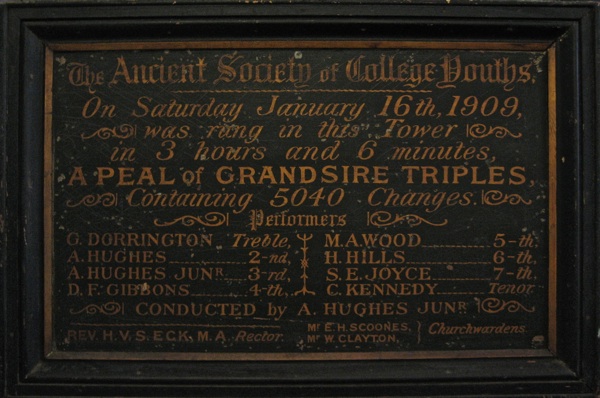
In 1909, the last recorded ringing by Matthew Wood, third generation steeplekeeper, whose grandfather rang the bells when the church was built in 1746.
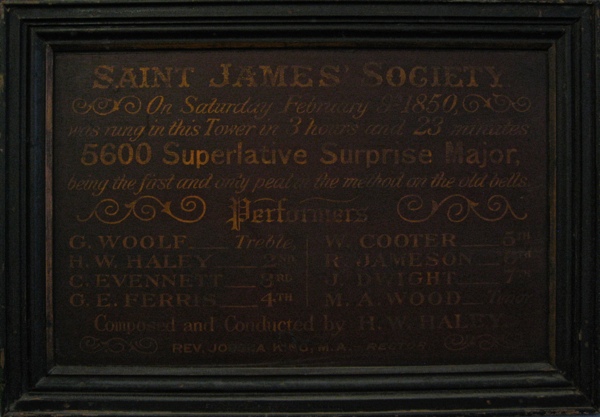
The only board surviving from before the fire of 1859.

Leon Thompson
You may also like to read these other stories about bells
Alan Hughes, Master Bellfounder
Max Levitas, Communist

Max Levitas became an East End hero when he was arrested in 1934, at the age of nineteen years old, for writing anti-Fascist slogans on Nelson’s Column in Trafalgar Square. “There were two of us, we did it at midnight and we wrote ‘All out on September 9th to fight Fascism,’ ‘Down with Fascism’ and ‘Fight Fascism,’ on Nelson’s Column in whitewash,” he told me, his eyes shining with pleasure, still fired up with ebullience at ninety-seven years of age, “And afterwards we went to Lyons Corner House to have something to eat and wash our hands, but when we had finished our tea we decided to go back to see how good it looked, and we got arrested – the police saw the paint on our shoes.”
On September 9th, Oswald Mosley, the leader of the British Union of Fascists, was due to speak at a rally in Hyde Park but – as Max is happy to remind you today – he was drowned out by the people of London who converged to express their contempt. It was both fortuitous and timely that the Times reprinted Max’s slogans on September 7th, two days before the rally, in the account of his appearance at Bow St Magistrates Court, thereby spreading the message.
Yet this event was merely the precursor to the confrontation with the Fascists that took place in the East End, two years later in October 1936, that became known as the Battle of Cable St, and in which Max is proud to have played a part – a story he tells today as an inspirational example of social solidarity in the face of prejudice and hatred. And, as we sat in a quiet corner of the Whitechapel Library last week, watching the rain fall upon the street market outside, it was a story that I was eager to hear in Max’s first hand account, especially now that he is one of last left of those who were there.
Politics have always been personal for Max Levitas, based upon family experience of some of the ugliest events of the twentieth century. His father Harry fled from Lithuania and his mother Leah from Latvia in 1913, both escaping the anti-semitic pogroms of Tsarist Russia. They met in Dublin and married but, on the other side of Europe, Harry’s sister Sara was burnt to death along with fellow-villagers in the synagogue of Akmeyan, and Leah’s sister Rachel was killed with her family by the Nazis in Riga.
“My father was a tailor and a trade unionist,” Max explained in the lively Dublin brogue that still colours his speech today, even after eighty years in the East End. “He formed an Irish/Jewish trade union and then employers blacklisted him, making sure he could never get a job,” Max continued with a philosophical grin, “The only option was to leave Dublin and we lived in Glasgow from 1927 until 1930, but my father had two sisters in London, so we came here to Durward St in Whitechapel in 1931 and stayed ever since.”
With this background, you can appreciate the passionate concern of Max – when he was nineteen and secretary of the Mile End Young Communist League – at a time when the British Government was supporting the Fascist General Franco in the Spanish Civil War. “Even after Hitler was appointed Chancellor in 1931, the British Government was developing arms with Germany,” Max informed me, widening his eyes in condemnation and bringing events into vivid reality that I had viewed only as history until he filled them with personal emotion.
“I was working as a tailor’s presser in a small workshop in Commercial St at the time. Mosley wanted to march through Whitechapel because it was where a large number of Jewish people lived and worked, and I knew the only way to stop him was to have unity of the people. I approached a number of unions, Jewish organisations and the Communist League to band together against the Fascists but although they agreed what I was doing was right, they wouldn’t support me.
But I give credit to the huge number of members of the Jewish and Irish communities and others who turned out that day, October the fourth, 1936. There were thousands that came together in Aldgate, and when we heard that Mosley’s intention was to march along Cable St from Tower Hill into Whitechapel, large numbers of people went to Cable St and barricades were set up. The police attempted to clear Cable St with horses, so that the march could go ahead, but the people of Cable St fought back and the police had to give in.
At three o’clock, we heard that police had decided that the march would not take place, because if it did a number of people would be killed. The Fascists were defeated by the ordinary people of Stepney, people who emptied buckets of water and chamber pots out of their houses, and marbles into the street. This was how they stopped Mosley marching through the East End of London. If he had been able to do so, more people would have joined him and he would have become stronger.”
Max Levitas spoke of being at the centre of a definitive moment in the history of the East End, seventy-five years ago, when three hundred thousand people came together to form a human chain – in the face of three thousand fascists with an escort of ten thousand police – to assert the nature of the territory as a place where Fascism and racism are unacceptable. It was a watershed in resistance to Fascism in Europe and the slogan that echoed around Stepney and Whitechapel that day was, “No paseran” – from the Spanish Civil War, “They shall not pass.”
After the war, Max became a highly respected Communist councillor in Stepney for fifteen years and, a natural orator, he remains eloquent about the nature of his politics.“It was never an issue to forge a Communist state like in the Soviet Union,” he informed me, just in case I got the wrong idea,“We wanted to ensure that the ordinary working people of England could lead decent lives – not to be unemployed, that people weren’t thrown out of their homes when they couldn’t pay their rent, that people weren’t homeless, as so many are today, living with their parents and crowded together in rooms.”
Max’s lifelong political drive is the manifestation of a tenacious spirit. When Max arrived in Whitechapel Library, I did not recognise him at first because he could pass for a man thirty years younger. And later, when I returned his photos to his flat nearby, I discovered Max lived up five flights of stairs and it became obvious that he walks everywhere in the neighbourhood, living independently even at his astounding age. “I used to smoke,” Max admitted to me shyly, when I complimented him on his energy.” I stopped at eighty-four, when my wife died – until then I used to smoke about twenty cigarettes a day, plus a pipe and cigars.” Max confessed, permitting himself a reckless grin of nostalgia.
“My mother and father both died at sixty-five,” Max revealed, turning contemplative,“I put that down to the way they suffered and poverty. My father worked around the clock to keep the family going. He died two years after my mother. At that time there was no National Health Service, and I phoned the doctor when she was sick, asking him to come, and he said, ‘You owe me some money. Unless you pay me, I won’t come.’ I said, ‘You come and see my mother.’ He said, ‘You will have to pay me extra for coming plus what you owe.’ But she died before he came and I had to get an ambulance.”
It was a story that revealed something more of the personal motivation for Max’s determination to fight for better conditions for the people of the East End – yet remarkably, in spite of the struggle of those around him and that he himself has known, Max is a happy man. “I’m always happy, because I can say that my life was worth living, ” he declared to me without qualification.
Max Levitas wants to live as long as possible to remind us of all the things he has seen. “I believe if racists marched through the East End today, people would stop them in the same way,” he assured me with the unique confidence granted only to those who have known ninety-seven years of life.


Max in 1945

Max campaigning in Stepney in the nineteen sixties.


Max with his wife on a trip to Israel in the nineteen seventies.
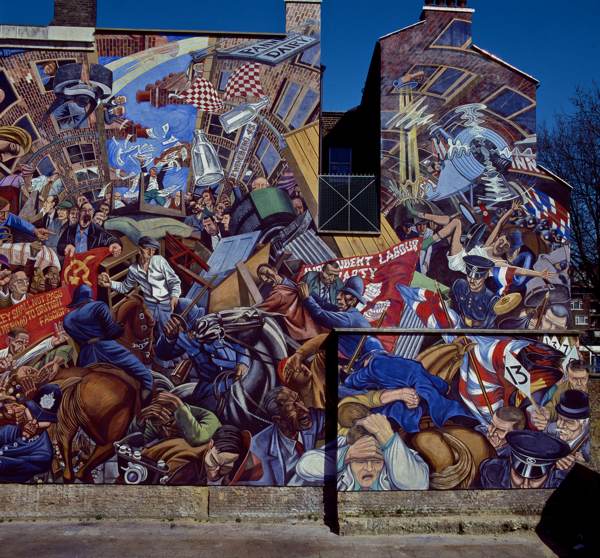
The Cable St mural
Portrait of Max Levitas copyright © Phil Maxwell
You can hear Max Levitas talking about the Battle of Cable St by clicking here
Watch original footage here
And learn more about Phil Maxwell & Hazuan Hashim’s film From Cable Street to Brick Lane featuring Max Levitas.












