
So long, Dino’s Restaurant & Grill
Dino’s Restaurant & Grill in Commercial St mysteriously closed “for refurbishment” this Summer never to reopen. This was the last of the traditional cafes that once served the Spitalfields Fruit & Vegetable Market and it was the scene of innumerable Spitalfields Life interviews. I am republishing this feature from March last year as tribute to a beloved Spitalfields institution – Dino’s boasted the distinction of possessing the widest range of clientele, where builders sat at one table with bankers at the next table, all gathered there as equals to enjoy an honest breakfast.

This swaggering Italian with the Fred Flintstone stubble and the Antonio Banderas hair is Matthew Ribeiro of Dino’s Grill & Restaurant in Commercial St. Often to be seen delivering a bacon sandwich to Jimmy Cuba, the music dealer in the market, and always up for the rough and tumble that is Jimmy’s chosen expression of affection.
If you are weary, and the howling gale is blowing down Commercial St and you need a bolt hole, Dino’s is the cafe to escape to for a quiet cup of tea.The unremarkable frontage and the wholesale clothing stores on either side ensure it is a place where nobody goes to be seen and thank goodness for that. Once you get inside and take your place in one of the snug Formica booths, no-one can see you from the street and you can let the world recede. There is a pleasant geometry and sense of order which is calming, the honey-coloured interior induces repose and posters around the walls introduce sufficient gentle diversion, should you require it.
Quite simply, in Dino’s Grill you can relax because you are not on show, it is an unreconstructed place where everyone is a regular and tourists never stray. The clientele comprises office workers, tradesmen, and builders. Dare I say it? It possesses an exotic quality that only true connoisseurs can fully appreciate, it is not fashionable – in fact, this cafe is almost unique in Spitalfields because it is completely unpretentious.
Opening in 1958 as Nando’s Cafe, it was run by Peggy Bragoli and her husband Nando Bragoli who was the chef. The couple lived upstairs above the cafe where they brought up their son Dino who was also born in 1958. Such was their pride in their boy that in 1972 when he began to work there at the age of fourteen, they renamed it Dino’s in his honour.
Innumerable stories confirm that Peggy was the leading light, even if she never got her name on the front of the cafe. You can see the only picture of her below, taken in 1996 with Matthew, who is the current proprietor. He remembers Peggy fondly, evoking her spirit by raising his eyebrows, waving his hands and deepening his voice for dramatic effect,“She was like the devil, she would do everything, run here, come back – a small woman but a very hard-working person! To begin with, they used to open at four in the morning and shut at seven in the evening. In 1993 once she retired, she would come and work for free. She wouldn’t accept anything from me because it was her life to be here, she’d say ‘No, no please!’ when I tried to pay her. And in 2003 when she returned to Piacenta in Italy, she cried because she didn’t want to go, it was her husband who wanted to leave.”
“I started working here in 1992 and I worked very hard, and they loved me like I was family, I was the only employee and I used to go to them for Christmas.” continued Matthew in an open-hearted spirit, in explanation of how he came to take on the running of the cafe.“Business is steady now,” he confirmed, adopting a professional tone before admitting,” I had a very bad year in 2009. Many of my lunch customers are from RBS and about fifty got the sack last year, now they have other jobs they come back to me. I am lucky because Dino is my landlord and he understands. The rent increases around here are crazy, every year my office customers change because companies move in and out as the rents rise. If you have the freehold you can survive in Spitalfields but otherwise forget it.”
For years, Gilbert & George dined at The Market Cafe in Fournier St. Then, when it closed, they transferred their patronage to Rossi’s Cafe in Hanbury St and now that is also gone they come to Dino’s Grill twice a week. There was a brief limbo after Rossi’s shut when I spotted them dining at The Luxe but it just did not seem right. Now they can now be reassured that no further accommodations on the catering front will be necessary because the Bragoli family bought the freehold of 76 Commercial St in 1964 for £4,000 which means that the future for Dino’s Grill is secure.
I followed Matthew as he sprinted up the stairs to the first floor kitchen with a familiar ease that I could not quite match. There I met Enzo, the head chef, who works here with his assistant preparing full English breakfasts, liver and bacon, steak pies and pasta sauces made fresh every day, all ready to be winched down in the dumb-waiter and served piping hot to hungry customers. “Spaghetti Al Dino” is the popular house speciality, spaghetti with Bolognese and a Bechamel sauce with cheeses, topped with ham, eggs and mushrooms, and baked to perfection in a metal dish.
I was touched when Matthew handed over the photograph of him and Peggy behind the counter in 1996. Even here, working three years after her retirement, Peggy doesn’t spare a moment to look up to the camera to show us her full face because the coffee machine is a more crucial object of attention. There is something all-consuming about running these small cafes, providing a loyal service to regular customers, and now Matthew is gripped too, as he confessed to me, “I couldn’t stay at home, even if I chose. I don’t think of myself as coming to work – I love it!”
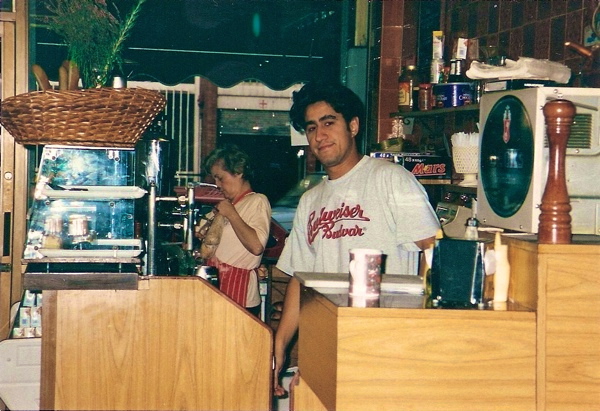
Matthew Ribeiro in 1996 with Peggy Bragoli.
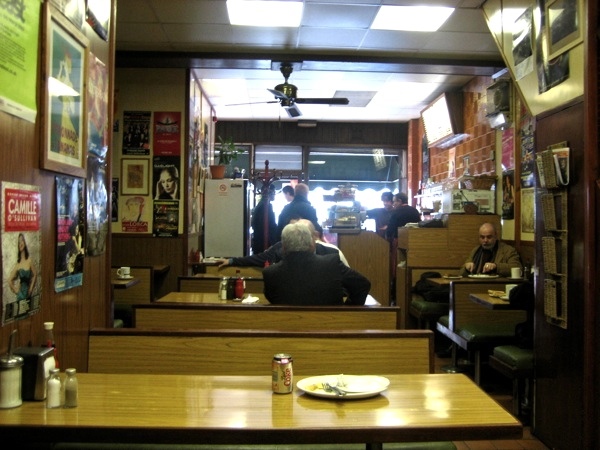
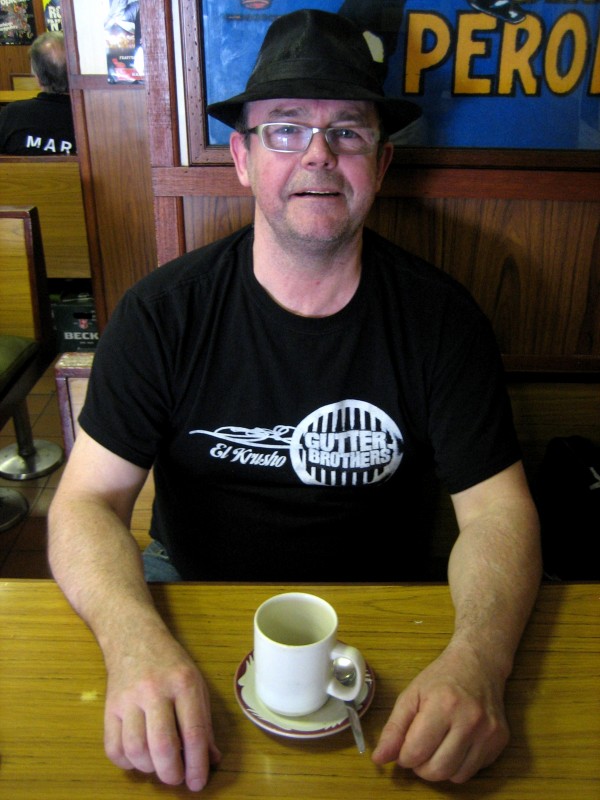
Jimmy Cuba, Music Dealer, at Dino’s
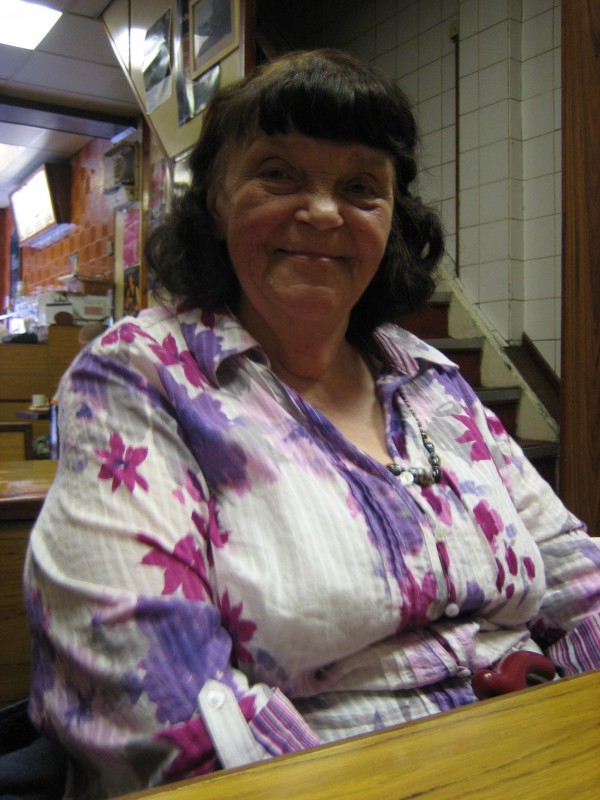
Molly the Swagman at Dino’s
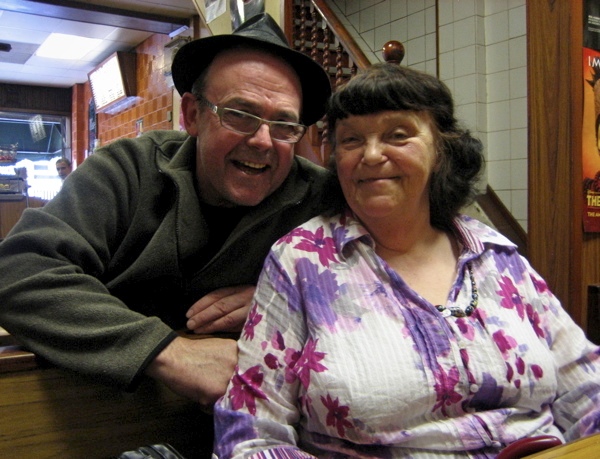
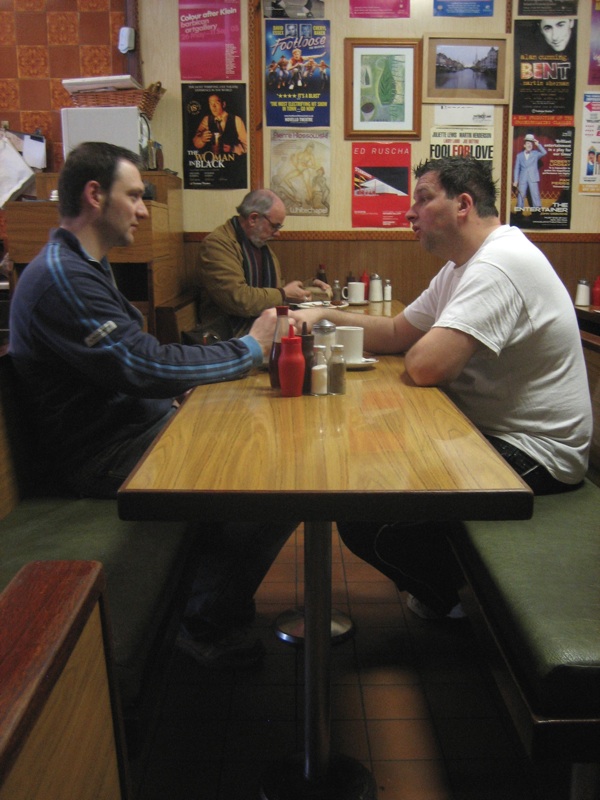
“Where builders sat at one table with bankers at the next table, all gathered there as equals to enjoy an honest breakfast…”
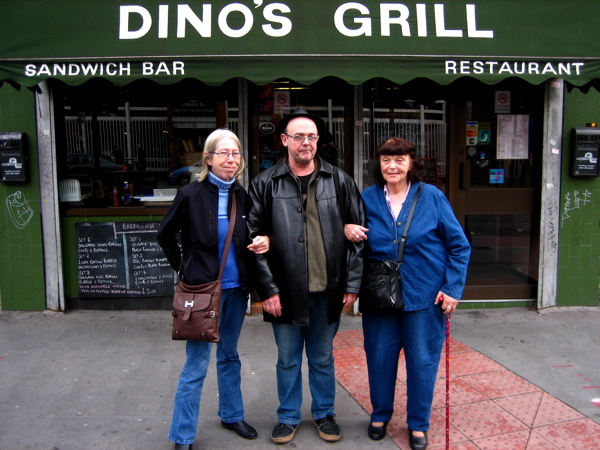
Jimmy Cuba and Molly the Swagman with her friend Ellen outside Dino’s
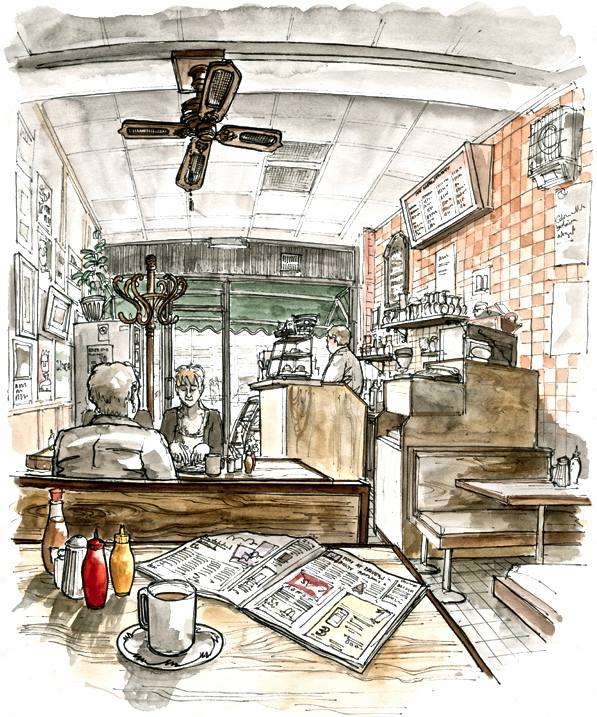
Joanna Moore’s portrait of Dino’s in 2010
You may like to read about these two celebrated long-term customers of Dino’s
At Itchy Park with Jack London

The churchyard of Christ Church, Spitalfields, was once known as “Itchy Park,” a nickname that may derive from the long-term presence of the homeless sleeping there and the lice that afflicted them. In 1902, at the age of twenty-six, the American novelist Jack London came to Itchy Park as part of seven weeks he spent wandering around the East End that Summer, talking to people and learning as much as he could of their lives. The result was a masterpiece, “The People of the Abyss,” in which London used his talent as a novelist to draw his readers into sympathy with those he described, creating a humane portrayal of a world that had previously been the preserve of social campaigners.
The shadow of Christ Church falls across Spitalfields Garden, and in the shadow of Christ’s Church, at three o’clock in the afternoon, I saw a sight which I never wish to see again. There are no flowers in this garden, which is smaller than my own rose garden at home. Grass only grows here, and it is surrounded by sharp-spiked iron iron fencing, as are all the parks of London town, so that homeless men and women may not come in at night and sleep upon it.
As we entered the garden, an old woman between fifty and sixty, passed us, striding with sturdy intention if somewhat rickety action, with two bulky bundles, covered with sacking, slung fore and aft upon her. She was a woman tramp, a houseless soul, too independent to drag her falling carcass through the workhouse door. Like the snail, she carries her home with her. In two sacking-covered bundles were her household goods, her wardrobe, linen, and dear feminine possessions.
We went up the narrow gravelled walk. On the benches on either side arrayed a mass of miserable and distorted humanity, the sight of which would have impelled Doré to more diabolical flights of fancy than he ever succeeded in achieving. It was a welter of rags and filth, of all manner of loathsome skin diseases, open sores, bruises, grossness, indecency, leering monstrosities and bestial faces. A chill, raw wind was blowing, and these creatures huddled there in their rags, sleeping for the most part of trying to sleep.
Here were a dozen women, ranging in age from twenty to seventy. Next a babe, possibly of nine months, lying asleep, flat on the hard bench, with neither pillow nor covering, nor with anyone looking after it. Next half-a-dozen men, sleeping bolt upright or leaning against one another in their sleep.In one place a family group, a child asleep in its mother’s arms, and the husband (or male mate) clumsily mending a dilapidated shoe. On another bench, a woman trimming the frayed strips of her rags with a knife, and another woman, with a thread and needle, sewing up rents. Adjoining, a man holding a sleeping woman in his arms. Further on, a man, his clothes caked with gutter mud, asleep, with his head in the lap of a woman, not more than twenty-five years old, and also asleep.
It was this sleep that puzzled me. Why were nine out of ten of them asleep or trying to sleep? But it was not till afterwards that I learned. It is a law of the powers that be that the homeless shall not sleep by night. On the pavement, by the portico of Christ’s Church, where the stone pillars rise towards the sky in a stately row, were whole rows of men asleep or drowsing, and all too deep sunk in a torpor to rouse or be made curious by our intrusion.
On August 25th 1902, Jack London wrote, “I was out all night with the homeless ones, walking the streets in the bitter rain, and, drenched to the skin, wondering when dawn would come. I returned to my rooms on Sunday night after seventy-two hours continuous work and only a short night’s sleep… and my nerves are blunted with what I have seen.” In later years, after the success of his great novels “Call of the Wild” and “White Fang,” he recalled of “People of the Abyss,” “No other book of mine took so much of my young heart and tears as that study of the economic degradation of the poor.”
More than a century later, London would be disappointed to return and discover people still sleeping in “Itchy Park” – nowadays they are almost exclusively male and are a mixture of homeless people, addicts and alcoholics, economic migrants and those sleeping it off after a heavy night in a club.
Yet change is imminent, as there is controversy in Spitalfields over the future of “Itchy Park.” Only the section next to Commercial St is open today, to the East are the former Christ Church youth club building and the playground of Christ Church School in Brick Lane. While the school, which is short of space, wishes to build a nursery upon the site of the youth club, there is another body of opinion that would like to see the park enlarged to include the youth club site as a public green space for all.
Meanwhile the sleepers of “Itchy Park” continue their slumber, office workers come to eat their lunch in the shade and tourists sit under the trees to rest their feet, and somehow everybody co-exists amicably enough.

Sleeping in the churchyard of Christ Church, Spitalfields, 1902

Sleeping in the churchyard of Christ Church, Spitalfields, 2011


Jack London
You may also like to take a look at John Thomson’s Street Life in London
At the Coracle Race

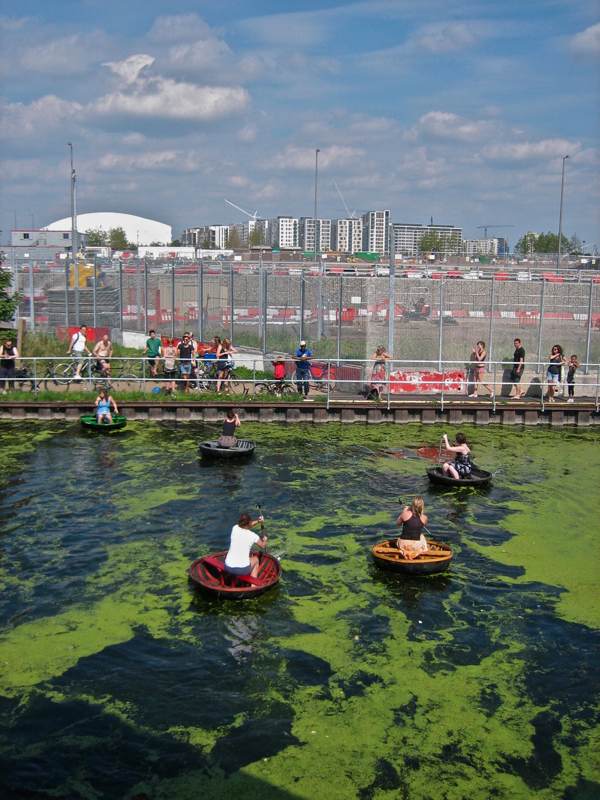
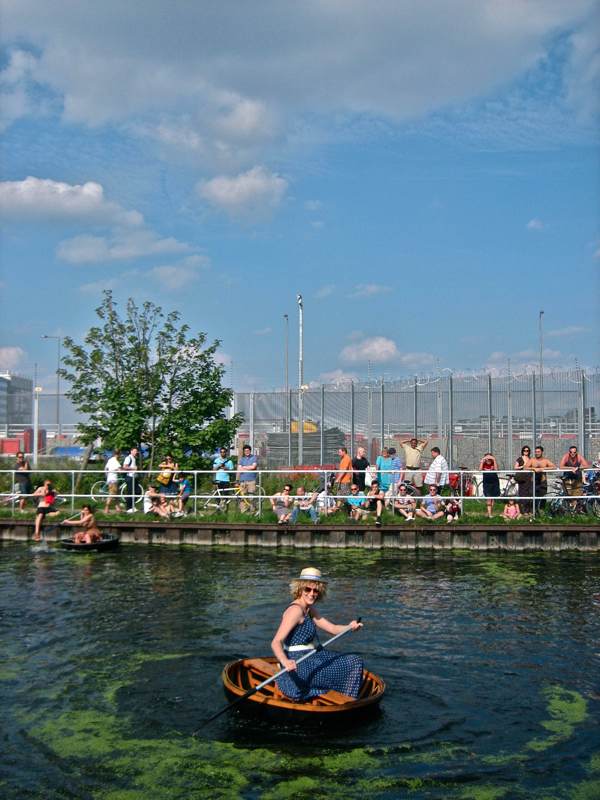
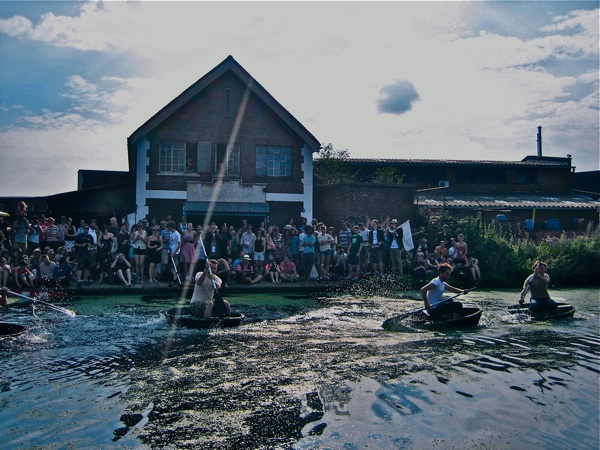
For the past six years, the last Sunday in July has seen the annual coracle race hosted by the Eton Mission Rowing Club on the cut of the River Lee in Hackney Wick, and at this year’s event there were more spectators and contestants than ever before. The youthful residents of Hackney Wick have embraced this annual contest with passion, queueing up expectantly to try their luck at manoeuvring these flimsy vessels from one side of the River Lee and back. It makes an extraordinary scene, with the venerable rowing club on one side of the river and the futuristic site of the 2012 Olympics bordered with razor wire on the other.
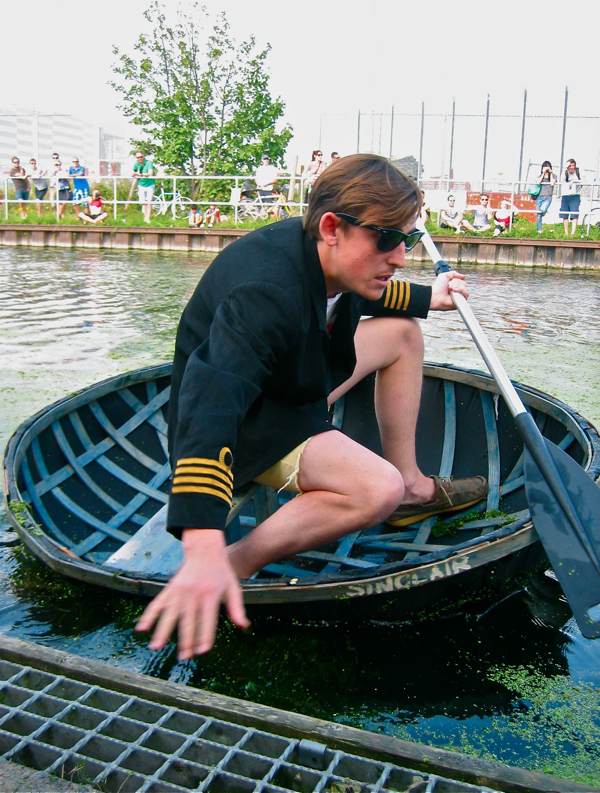
The beauty of this race is that anyone can walk in and sign up and take part. You do not have to have any experience, you do not have to have any skill, you only have to have an eager nature and not be afraid of getting wet. And on this baking July afternoon, there was no shortage of plucky contestants, some in pretty flowery dresses, others in smart naval uniform, all valiantly stepping forward without a second thought, quite undaunted by the looming possibility of public humiliation.
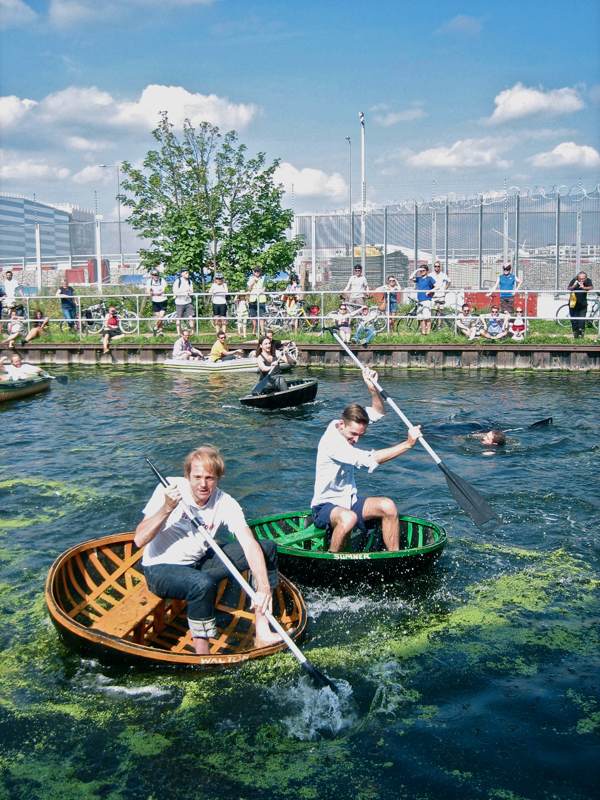
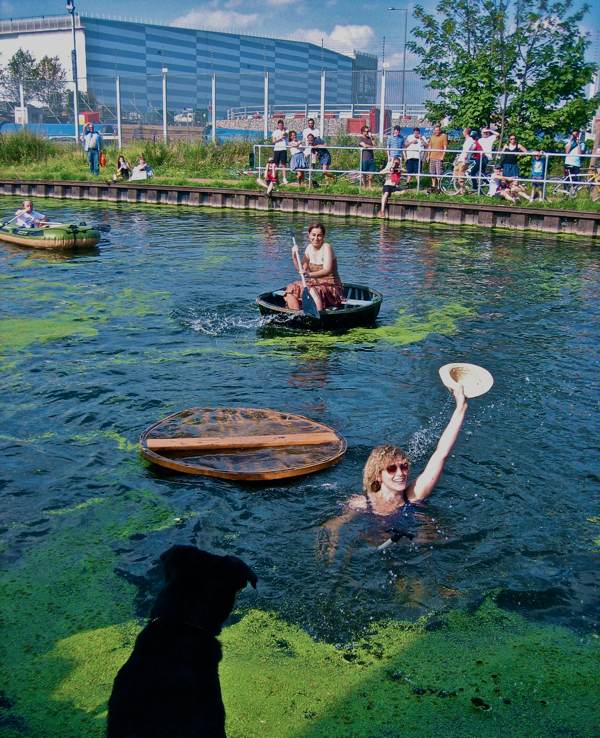
You might think that if St Brendan was able to paddle to America in his coracle, then a crossing of the River Lee might prove an inconsequential challenge, but you would be wrong. Once you have worked out which is the front and the back of these archaic craft – contrived from willow and canvas primed with tar – and climbed aboard, then you discover how tippy they are. Some got into their coracles and capsized instantly, while others waited until they were in the middle of the river surrounded by duckweed to take the plunge.
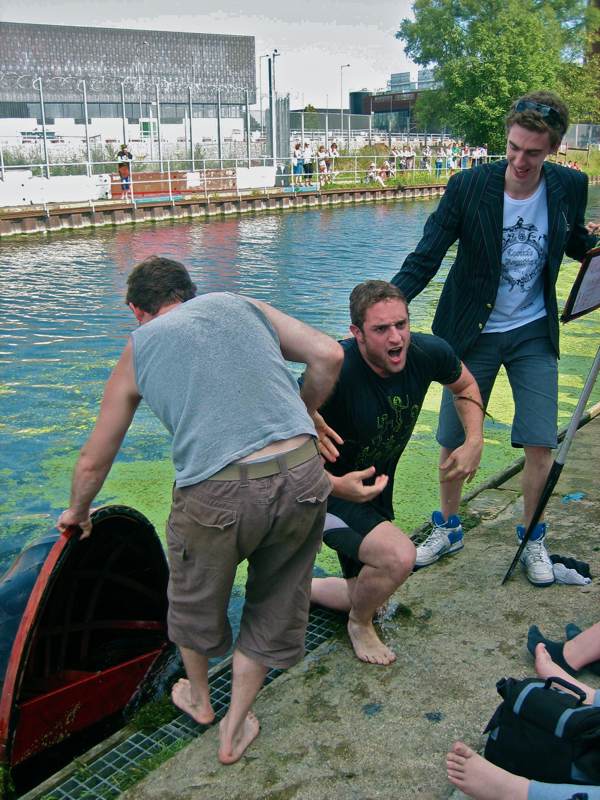
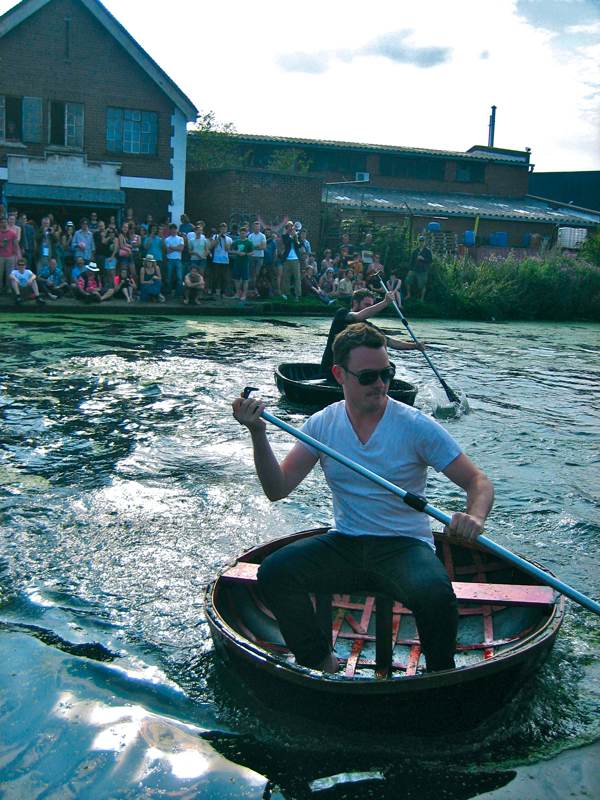
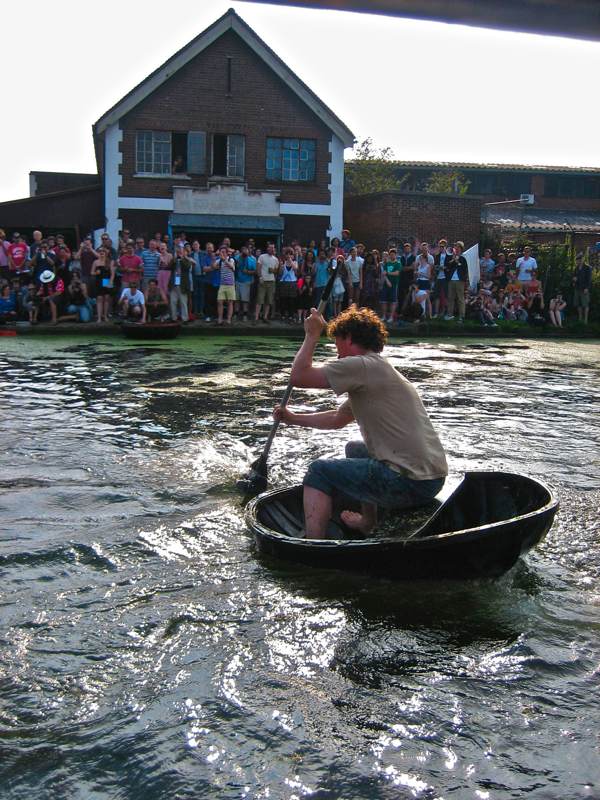
As you can imagine, it makes great spectator sport and spirits were riding high amongst the assembled throng crammed together on the riverbank in the July sunshine to witness a long afternoon of heats, culminating in men’s and women’s finals. To commence the race, each coracle has to be touching the shore and when the commentator waves his flag the contestants push themselves off, paddling alternate strokes on either side of their coracles. With entrants of wildly varying abilities, there are those who can paddle the traditional figure of eight stroke and there are those who simply drift off down the river in the breeze. Yet the races are not without drama, since the boats often collide in the heat of the contest, and, when one person capsizes, sometimes they take a rival down with them too. Emerging from the drink into the crowd like river gods, trailing duckweed and with water pouring from their pockets, these dripping heroes bring further misrule into the excited gathering.
At the centre of the event, pacing the riverbank and helping contestants in and out of their coracles was Harry Meadows, an artist with a studio nearby. Harry grew up in Wales where the coracle is part of the national identity and he is the one who had the inspiration to start this glorious event, when the possibility of the Olympics was first mooted in East London. “Like many people in Hackney Wick, I went to the public consultations for the Olympics where we spoke and they didn’t listen – it was a ritual. So I realised we needed a different ritual of our own to serve as “beating the bounds” for the community that exists here.” he explained to me, his pale features flushed by the sun and the success of the afternoon, as we sat in the cool of the club house afterwards when the hordes had departed.
The coracle race is a spontaneous expression of the vibrant community in Hackney Wick today, and I was delighted to see so many young people celebrating at the Eton Mission Rowing Club. Where, in happy contrast to the apprehension I encountered on my previous visit, I found the senior members in good spirits. Yet it was not simply the coracle race that gave them such pleasure, it was the news that a hiccup on behalf of the Olympic authority has revealed they are in a stronger position than it appeared when I was last here a month ago.
You will recall that the Olympic authority were preparing to take part of the Eton Mission Rowing Club’s site to build a bridge, which would make it very difficult for the club to function. Throughout this process, the authority was acting as if it had ownership of the land, but recent scrutiny of the legal documentation has revealed that they only have a licence to use of the land, whilst the rowing club retains the lease – so the Olympic authority will not only have to compensate the rowing club but give the land back afterwards too.
Looking to the future, Club Secretary, Tim Hinchcliff, now intends to submit a planning application to build an extension to their clubhouse on the controversial piece of land – containing a changing room for women, which the club lacks at present. “We’ve won a small victory but not the battle yet,” he admitted, his sharp blue eyes glowing with determination, anticipating the tough negotiations that will be required to ensure the rowing club can get its land back after the games.
After such a joyous afternoon of high jinks on the river – an unexpected manifestation of how new and old East End have been brought together in Hackney Wick in the face of an external threat – I was delighted to learn that the future of the Eton Mission Rowing Club looks brighter than before, and I hope it means the annual coracle race on the River Lee may also now continue for many years to come.




You might also like to read At the Eton Mission Rowing Club
Columbia Road Market 72

Clockwise from top – Spanish Mint, Basil Mint, Pineapple Mint and Tashkent Mint
My friends Mick & Sylvia Grover, the herbsellers in Columbia Rd, sell so many different kinds of Mint (Mentha) that it has inspired me to start a Mint garden to permit comparison of the diverse flavours and explore the myriad uses of each distinctive variety. While others are connoisseurs of fine wines, expensive whisky, unusual cheeses, fancy olive oil or rare wild fungi, it suits me to become the connoisseur of Mint, a delicious and useful herb that is less appreciated than more exotic flavourings only because it is so popular. I hope you will indulge this newly-minted trait, because whilst I try to resist the seductions of mere novelty, I am always eager to learn new things.
I think of my mother running down the garden in Devon with an umbrella in early Spring to grab a few sprigs of Mint to make a sauce to accompany the lamb for our Easter Sunday lunch, and I think of drinking Mint tea to accompany couscous at a troglodyte village at the furthest extremity of the Sahara desert in North Africa. These days, I like to chop up fresh Mint in my green salad and add it to bowls of homemade soup to create another dimension of piquancy, and surely no Summer is complete without Mojitos or a glass of Pimms with a Mint leaf floating in it.
For just a few pounds, I was able to buy nine different Mint plants from the Grovers in Columbia Rd, and ever since I have been pinching the leaves and training myself to the recognise their characteristic flavours. Though I do not think I am ready for any blind tasting just yet, it offers a relaxing way to idle a spare half hour on a Summer Sunday.
Garden Mint is the one I know from childhood and Spanish Mint is a more vigorous strain that has a flavour inclined to spearmint – which I think of as the flavour of chewing gum. Tashkent Mint is another hardy variety with coarser leaves and a more aromatic scented flavour than Garden or Spanish Mint. Moroccan Mint is the one you need to create the authentic mint tea, and, of the larger plants, this is my favourite for its rich green colour and regular well-defined leaves that are deeply perfumed.
Lemon Mint and Pineapple Mint may sound like novelties but they do carry a hint of the fruits they are named after, and Pineapple Mint has attractive variegated leaves and trailing growth. Either would make an ideal addition to fruit salad. Basil Mint is a fleshy plant that resembles Basil as much as Mint, yet while it does share the flavours of Mint and Basil, to me it also has a strong aroma of Lavender. This could be wonderful on a dish of Vanilla ice cream.
Then come the Peppermints – Black Peppermint which has a very strong spearmint flavour and leaves that darken to purple through the season, and Chocolate Peppermint which does not smell of chocolate but possesses a scent which, if you close your eyes, is close to the scent of “After Eight” Mints.
So there you have my nascent mint collection. I realise this is a huge subject which offers the opportunity of discourse upon the origins, culture and medicinal properties of each one of the different varieties of this favoured plant – but I choose to leave you with it there, lest I risk becoming a Mint bore.

Clockwise from top – Garden Mint, Chocolate Peppermint, Hilary’s Sweet Lemon Mint, Black Peppermint and Moroccan Mint.
You might like to read about Mick & Sylvia Grover, Herbsellers of Columbia Rd
Tony Burns, Boxing Coach

Pass under the sign that says “No guts, no glory,” then walk through the humid air laced with sweat, and the clamor of the boxing gym, where youths are sparring and slugging at punchbags, until you reach the tiny office in the corner – barely more than a cupboard – where Tony Burns has his lair. Once upon a time in the old East End, Tony came here to this former bathhouse for a wash, but today he is the head coach at the Repton Boxing Club, Britain’s most famous amateur club, which occupies the building now.
Tony took my hand with a boxer’s grip and cast his intense blue eyes upon me with a gentle yet incisive gaze from beneath such straggly brows, it was as if he was looking out at me from inside a cave. “You’re not a boxing person, are you?” he queried with a derisive smile, getting the sum of me in an instant. Yet in spite of my shortcoming, Tony indulged me magnificently, bringing out two pages of handwritten lists of boxing triumphs at Olympic and Commonwealth games which may be attributed to the noble Club, before tantalising me with enigmatic old black and white photographs of unidentified men in suits, some of which turned out to be illustrations of stories that I shall never be party to.
“It was a public school, Repton, what started this in 1884,” Tony explained, turning historian suddenly and gesturing around the atmospheric tiled spaces, lined with faded bills for the boxing bouts of yesteryear. “I often speak to the people at Repton School and they say ‘Couldn’t you bring a dozen boys up to Derbyshire for an education?’ But I don’t think you could take a kid from the East End and put him in a public school in Derbyshire, where all the pupils are the children of high ranking generals and such, he would bash everybody up”.
“When I was a kid you either kicked a ball or you hit someone. So, when I was twelve, I became a boxer,” continued Tony with faultless logic, “My mum died when I was a kid and if you lived in a place like this years ago, you was very fortunate to have a loving family. We all lived in Bacon St and Charlie Burns was the eldest, and they was a pain in the arse that family, but when I boxed all the family and friends would come, so I used to have quite a following.”
Then Tony looked at me critically. “I knew the Krays,” he confessed with an implacable gaze, returning to the pile of photos and searching my face for a reaction while showing me a picture,“We grew up together. I used to go round to their house in Valance Rd all the time, but I chose one path in life and they chose another.” The photograph was Tony with Reggie Kray, on the occasion of Reggie Kray’s wedding in 1997 at which Tony was best man. “He looks more dead than alive.” quipped Tony with a grimace, resigning the thought as he put the picture away again, closing the subject.
“The Repton was a club where East End boys could do all kinds of sports and they had around a thousand members when I joined,” Tony recalled, “but then it got closed down and Albert Jacob, the Mayor of Tower Hamlets, gave us this building on a thousand year lease. He saw the future of the East End – by putting this club here where it is – getting the kids off the streets and getting them off everything. The asset of the Repton is the area, it’s packed with talent out there.”
Tony was eager to tell me about his coaching, without filling in the details of his own distinguished boxing career which included winning the Amateur World Championship. “For some unexplained reason I had three gold medallists in the Olympics the first year I was here as coach in 1968.” he said, and at first I thought this statement was another expression of reserve on Tony’s part but then I realised it was something more intangible. “People do come along,” he puzzled, shaking his head in wonderment, as we walked through the gym to examine the photographs that lined the wall of fame extending around the corner, “We’ve had three hundred and fifty champions here – that’s national titles not championships – which is really quite unbelievable in forty years, roughly about ten a year.” he said.
“I can fall in love with a lad the minute he walks through the door, and make a fuss of him and build him up and make him think he’s a big talent.” admitted Tony, speaking tenderly, “The beauty of it is that I am at a club like this where maybe sixty or eighty youths come every weekend and you see them developing.”And he turned and cast his eyes around at the enthusiastic crew of young boxers of different races that filled the gym, all dripping with perspiration, full of fight and eager for glory.

Freddie Mills presents a clock to fifteen year old Tony Burns of Bethnal Green, who won his contest against R.Brice of Kingston, whilst Sammy McCarthy congratulates the young boxer during the recent amateur tournament at the Kingston Baths, October 31st 1955.

Tony Burns as a young boxer of twenty years old.

Tony Burns, Amateur World Champion Boxer, with Howard Winston, Professional World Champion.
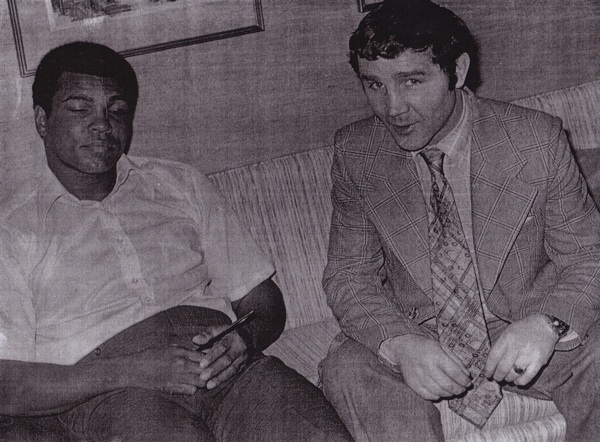
Tony Burns with Mohammed Ali.

Tony Burns with Reggie Kray in 1997.
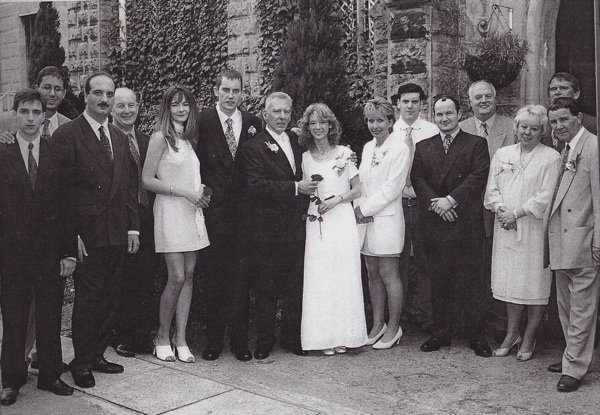
Tony is best man at Reggie Kray’s wedding in 1997.

Tony Burns with Frank Bruno.
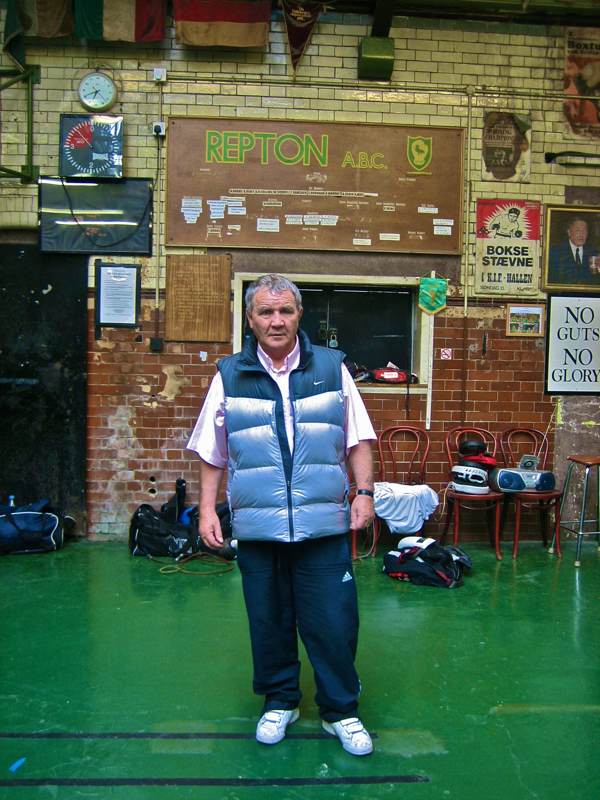
Tony Burns, Head Coach at the Repton Boxing Club.
You may also like to read about
Adam Dant’s Map of Hoxton Square 2011
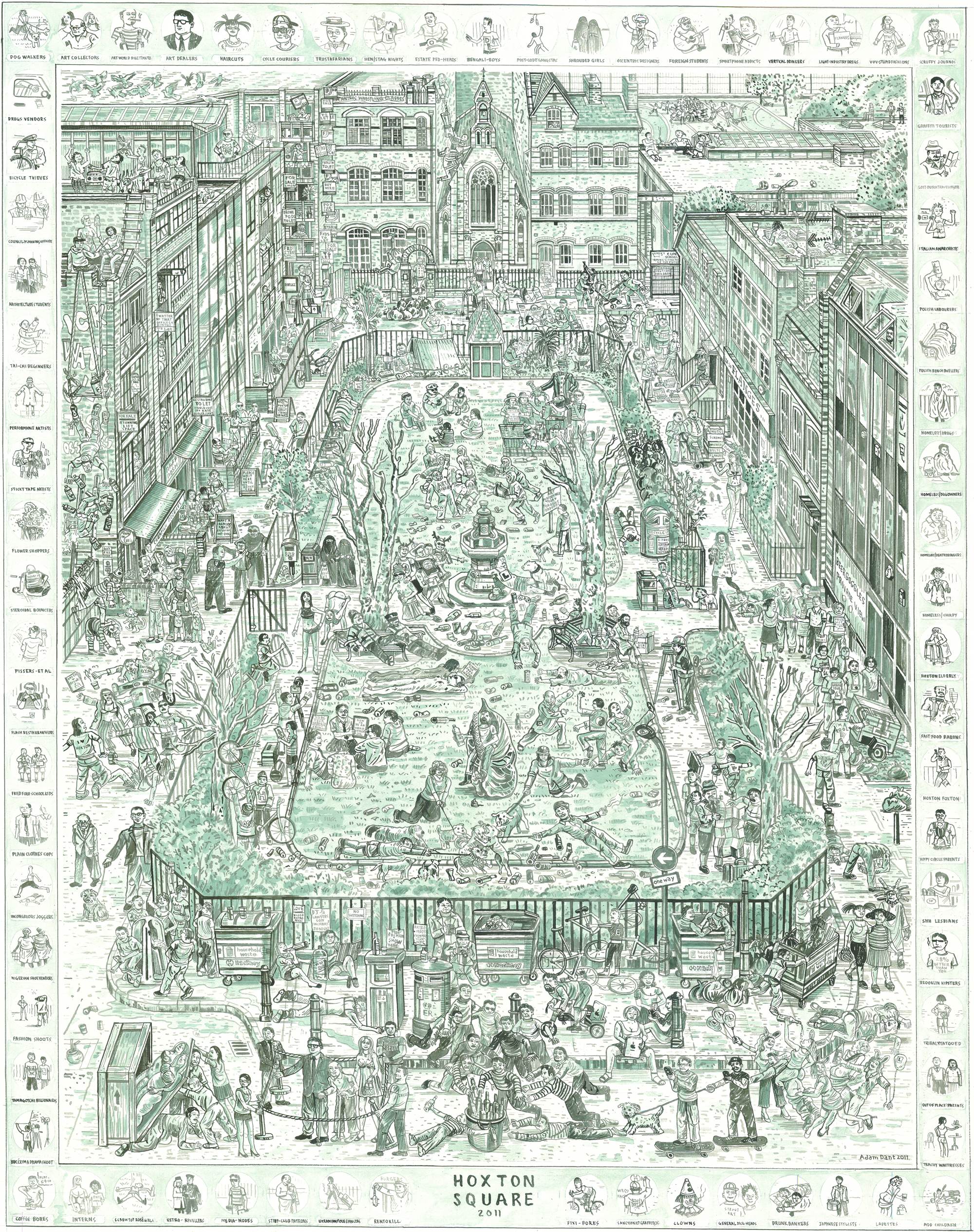
Click to see what goes on in Hoxton Square
Spitalfields Life contributing photographer Martin Usborne is leaving Hoxton Square, and he commissioned this map from Adam Dant as a momento. Once it was the life of the square that drew the photographer to live here but now it is the excess of life that is driving him away. The drama and the craziness have reached such a pitch that Martin has no choice but to take his leave, if he is ever to have another night’s uninterrupted sleep in his life.
Recently, Martin and Adam have identified more than seventy different “Hoxton Types” that may be spotted in the Square and which are illustrated here on the map. I imagine Martin looking down from his window in wonder, in the way that Mark Lester does in the film of “Oliver” when he awakens at Mr Brownlow’s house after being rescued from Fagin’s gang. Only, instead of the “Cries of London,” Martin looks out onto the rampage you see above, as portrayed in such loving graphic detail by Adam.
Whether you celebrate this as an exuberant libertarian paradise or whether you condemn it as the nadir of unpleasantness is a matter of mere opinion, but there is no doubt that in recent years Hoxton Square has become a phenomenon – a crowded playground where those who so desire are may lose their inhibitions and their wallets with ease. “It must have some charm or why would people come all the way from Essex to go there?” asked Adam, with a twinkle in his eye and his tongue firmly in his cheek.
Hoxton Square is the East End’s Garden of Earthly Delights, peopled with Dog Walkers, Art Collectors, Art World Dilettantes, Art Dealers, Haircuts,Cycle Couriers, Trustafarians, Hen/Stag Nights, Estate Ped-Heads, Bengali Boys, Postcode Gangstas, Shrouded Girls, Eccentric Designers, Foreign Students, Smartphone Addicts, Vertical Drinkers, Light Industry Dregs, VVV Stupid Fashions, Scruffy Journos, Graffiti Tourists, Lost Dutch Travellodgers, Italian Anarchists, Polish Labourers, Polish Benchdwellers, Homeless/Drugs, Homeless/Dogowners, Homeless/Chirpy, Hoxton Elderly,Fast Food Barons, Hippy Circus Parents, Shh! Lesbians, Brooklyn Hipsters, Tribally Tattooed Folk, Out of Place Parents, Trashy Waitresses, A.D.D. Children, Ladettes, Japanese Stylists, Drunk Bankers, General Dickheads, Clowns, Sanctioned Graffitists, Fixi Bores, Rentokill Workers, Ukranian Pole Dancers, Strip Club Patrons, Media Nodes, Screwtop Rosé Girls, Interns, Coffee Bores, BBC Drama Shoot Participants, Tamagotchi Billionaires, Fashion Shoots, Nigerian Shoe Vendors, Incongruous Joggers, Plain Clothes Cops, Fried Food Schoolkids, Flash Restaurateurs,Pissers, Sterodial Bouncers, Flower Shoppers, Sticky Tape Artists, Performance Artists, Tai Chi Beginners, Architecture Students, Council Planning Officers, Bicycle Thieves, Drugs Vendors – and Joseph Markovitch,and Martin Usborne and his dog Moose.

In the top left of this detail of the map you can see Martin Usborne (walking his dog Moose) and Joseph Markovitch, a native of Hoxton.
Images copyright © Adam Dant
You might like to look at Martin Usborne’s photographs of
and A Fox in Hoxton.
You may also like to see
Adam Dant’s Hackney Treasure Map
or his Redchurch St Rake’s Progress
or his Map of the History of Shoreditch,
or his Map of Shoreditch in the Year 3000,
or his Map of Shoreditch as New York,
or his Map of Shoreditch as the Globe,
or his Map of Shoreditch in Dreams,
or his Map of the History of Clerkenwell
Les Wilkes, Warehouse Manager

Since he retired from being a warehouse manager in 1995, Les Wilkes has helped out every day at the Mister City Sandwich Bar in Artillery Lane and become a popular figure there, well known among the City types who frequent this busy establishment. Although Les maintains a discreet presence, with his perfect manners, neatly pressed shirts and resolutely cheerful manner, he has become the presiding spirit of this celebrated shop, someone who has retained his sense of enthusiasm throughout a long life.
Roberto & Mirella Fiori, the proprietors of Mister City, introduced me to Leslie Arnold Wilkes with the respect due to a senior member of their family and when I discovered that he had been employed nearby for more than half a century, I was eager to hear his story. Fortunately, Les was passionate to speak of his experiences, talking with great pleasure of his working life around Bishopsgate.
After the number of years I’ve worked in the City and travelled all over London, I know all the little shortcuts, and the byways and alleys. Back in 1958, when I left school at sixteen, I went to work for a company of bookbinders, Richards & Keens, at the corner of Leadenhall St and Gracechurch St. My first employer was Jack Keens, he was the third generation in the business and I knew him simply as “the old man.”
I used to collate pages together by hand before they were numbered with a handheld numbering machine. When I was collating, I had to do it backwards so my colleague would be able to take the pages off the pile forwards. The binding was done with glue and staples. I used to heat up the glue on a gas ring. First I had to break it, like great big lumps of chocolate, and then put it in a pot of boiling water, using a paint brush to stir it up. Perforations were done by a special machine that could only take a few sheets at a time. So, to make fifty books took us a whole week! They were jolly days they were.
I did other jobs – if the boss went out of the office I used to answer the phone and take messages and orders for pens, pencils and envelopes. It was my job to pick up orders from the suppliers and deliver them to the customers, and that was the part I enjoyed the most, calling round to see the customers and having a little chat. I was an old-fashioned courier, I used to travel on foot around the City and sometimes I caught a bus. I used to get around so quick, they used to called me “speedy.” Back in the nineteen sixties I was in my twenties and I could bus around like a loony. I was actually employed as a warehouse manager but I used to do all these other jobs.
By the end, I worked there forty-nine years, from the age of sixteen in 1958 to sixty-five in 2007. I was the longest serving employee and the family who had run it for four generations since 1910, they kept it going until I retired. As the saying goes, “first in, last out.” A lot of people can’t believe that I would spend my life in one job. Oh yes, people are changing their jobs now, probably three or four times in their lifetime. I stayed because I enjoyed my job.
My last boss, Ian Keens, was two years older than me but he stayed on after retirement age for my benefit, to see me out. We shut it down together. The lease on the premises ran out and the business was put in the hands of the accountant. What we had to do was to send letters to all our customers, thanking them for their custom over the years but “regret that we are closing the business.” He’s living in Northern Ireland now and we only communicate by birthday and Christmas card. I have his phone number if I need to call him, and as far as I know he’s ok. Most of the other staff I don’t see them any more.
We moved premises twice, from Leadenhall St to Boar’s Head Passage and finally to Scrutton St in Shoreditch. I was the only one that went out for lunch, everyone else used to eat their sandwiches they had brought from home. Once I had made them coffee, I would go out for an hour. There were plenty of places to eat in Shoreditch but for some reason I chose to go down to the City Way Restaurant. It was proper Italian place where you could sit and have lunch. The chef at the City Way Restaurant was Pino Cimelli, Mirella’s father and I gradually became friends with him and he would come and sit at the table with me. It was all very nice and I got to know the whole family. This lasted from 1995 until 2007 when his son Luigi sold the shop. He works here at Mister City now on Fridays, so we are still in touch and have a good laugh.
I’ve come here every day to the Mister City Sandwich Bar for my lunch since I retired from work and I help out in the shop with a few jobs. I live in South East London, Grove Park, so it is quite a long journey. One of the jobs I do is I roll up the plastic knives and forks in the serviettes. I count the cups and see to the stock for the shop, and when they are short I phone up the supplier.
My family’s scattered around the globe. I’m not married and I’ve never been married, so I don’t have any children. I live alone and come here everyday for company, if I stayed at home it would drive me mad. The Fiori family are my adopted family. After I have checked everything and locked up, Mirella Fiori always walks over to Moorgate with me and we go to Marks and Spencer to buy food, and she helps me choose clothes if I need any.
At weekends, I do shopping and gardening. In the Summertime, depending on the weather, I do plenty of walking. I try to get out from London. From where I live, I am only two miles away from Chislehurst in Kent, so I am able to leave South East London behind by walking to Petts Wood and Orpington. And, sometimes, I walk to Bromley – it takes me about an hour at most.
I have always been partially blind, I am shortsighted in my right eye and I have no sight at all in my left eye, but it’s normal for me because I was born that way. I feel sorry for people who lose their sight.
Les’ story was fascinating to me, because it revealed him as a rare individual for whom work is never toil and who, through his openness of spirit, has personalised all his working relationships. As a consequence, Les has always drawn the respect and affection of his workmates and employers, reciprocating his lively humanity. I can think of no other example where a company owner kept the business running for an extra two years just till an employee reached retirement age. Les’ story reminds us of a different perception of business – in which the purpose of a company is as much to provide a living for its staff as it is to turn over a profit.
Although the City can seem impersonal to many, this has not discouraged Les from striking up unexpected friendships. It was his lunchtime conversations with Pino Cimelli that led to becoming a family friend of the Fioris of the Mister City Sandwich Bar. With radical initiative, Les chose not to sit at home after retirement but to continue his passionate involvement with the City by coming to the Fiori’s cafe in Spitalfields everyday. So next time you walk down Artillery Lane, be sure to drop in to the Mister City Sandwich Bar and shake hands with Les Wilkes – because he knows how to live.
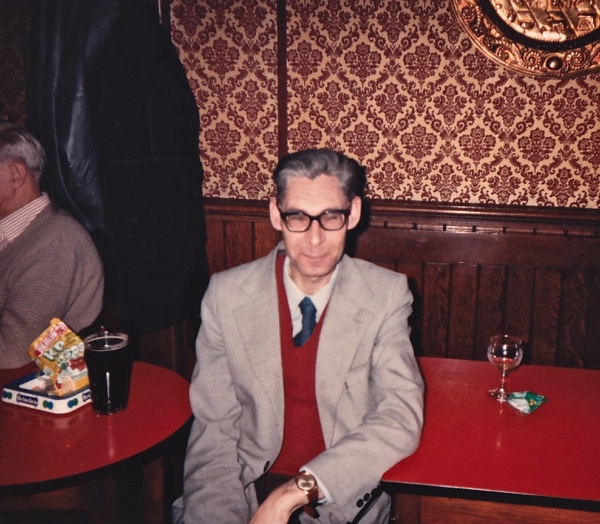
Les enjoys a pint of Guinness
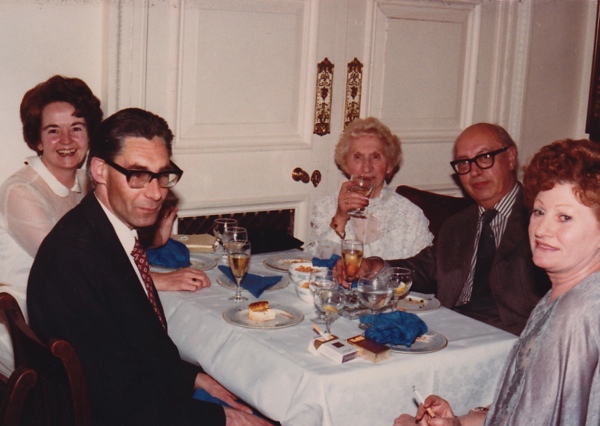
Les at dinner with “the old man” – Jack Keens in the nineteen eighties.
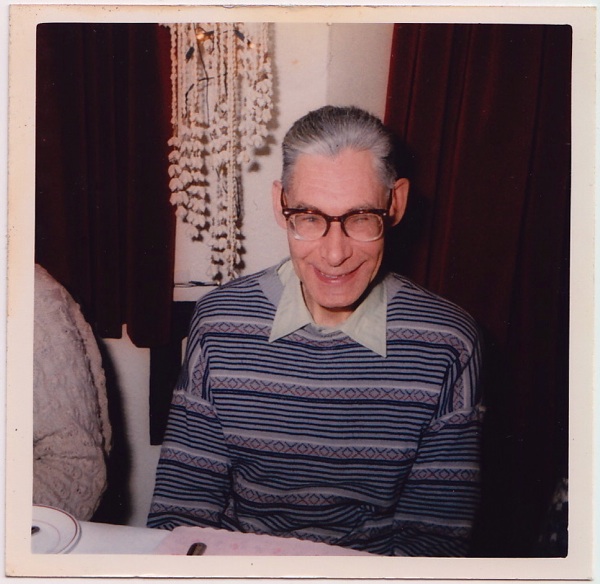
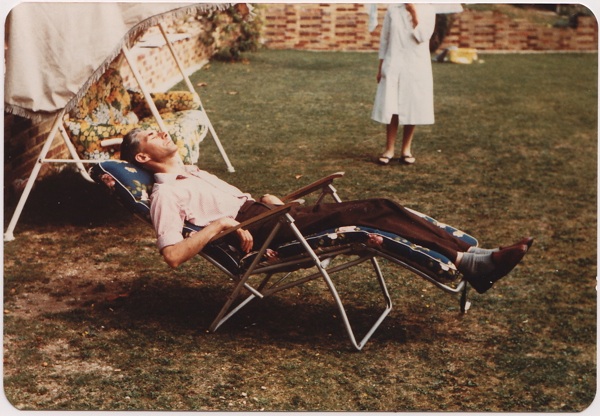
Jack Keens took this photo while Les was staying the weekend at his house.

Les Wilkes’ last boss, Ian Keens – “He was very keen on John Wayne, so between the staff we went out and bought that figure for him for his birthday on Christmas Eve.”
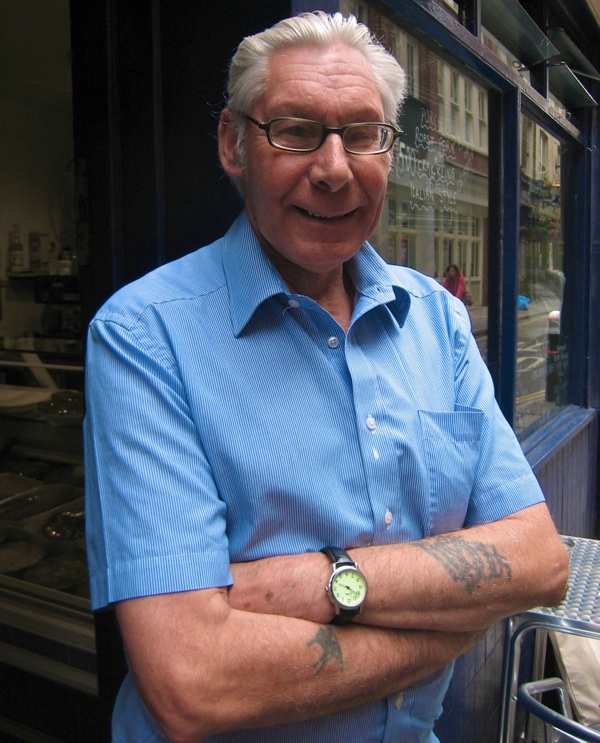
Les Wilkes
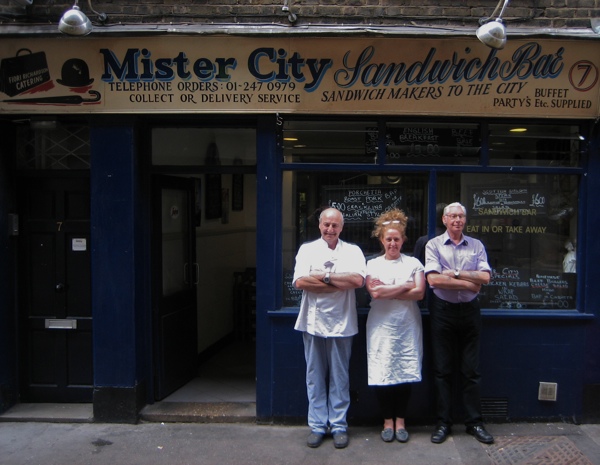
Les Wilkes with Roberto & Mirella Fiori
You may also like to read about At Mister City Sandwich Bar












