
Bruno Besagni, Reproduction Artist

This is Bruno Besagni, pictured in the nineteen fifties, with one of the finely painted casts that he made in his factory, Bruno’s, utilising the expertise that he first acquired in Clerkenwell at the age of fourteen. Bruno still has a similar lamp in his living room today and when I admired it, he gestured aloft with whimsical delight, directing my gaze overhead and there, overarching everything, was a flamboyant ceiling rose of acanthus leaves that he also made, using one frond he retrieved from broken plasterwork in an old hotel.
Moulding and painting statues became Bruno’s life, pursuing a traditional Italian technique which has its origins in religious art. In fact, alongside his career making lamps and figurines for sale, Bruno has made and repaired devotional statues for churches, including the painted effigy of St Mary of Mount Carmel that is carried in the Italian Parade in Clerkenwell each year. There is a certain kind of magic, conjuring such animated figures out of base materials, painted in lifelike colours and highlighted with gold, and it is a magic that has sustained Bruno throughout a long career.
Being Italian, my mother said, “You’ve got to go and work in a cafe or a restaurant, at least you’ll eat.” I tried it for a while, but I never got on with it. I got a job as artistic sprayer at the factory in Great Sutton St belonging to Giovanni Pagliai who came from Lucca in Florence where they make all the traditional statues. I took to it at once, I was fairly artistic and all my life I’ve been involved in art. I worked there for a couple of years from fourteen to sixteen, that’s where I met my wife Olive.
When the war began they were all imprisoned. Most of the staff were Italian, and one day a squad car pulled up and arrested everybody. They were “undesirables,” they came under section 28(b) – you were imprisoned but you could have food sent in. As my father was born here, I was a British citizen, so everybody but me got interned. After that, I did all sorts of jobs, chasing money because we were so poor. I should have listened to my mother and gone into the restaurant business.
I was born in 1926 at 48 Kings Cross Rd next to the Police Station, and we moved to Victoria Dwellings on the corner of Clerkenwell Rd in the Italian Quarter, when I was very small. Down “the hill,” everybody ducked and dived, and I had that education, but all I ever wanted to do was to play football and run. We were babies really, sent out to work at fourteen when we left school, earning twelve shillings and sixpence a week, and giving ten bob to your mum. It was a poor wage yet I enjoyed it, there were nine of us in the family then and we were all happy.
I wish I’d gone into the army. I was called up at eighteen, but I couldn’t fight because I had an uncle in the Italian army. It was a very difficult situation for me and – even today – I’m not proud of this. I would have loved to have gone into the army, because I’m a man’s man and I knew I’d have loved it. I worked on a farm instead, at Chepstow with other Conscientious Objectors who were English, and I was disgusted with them, because if they were in Germany, Hitler would have executed them all. They weren’t my cup of tea, they were writers and poets and university types. Being an athlete and a footballer, I joined the Chepstow Football Club and I became their star player. The Chepstow people didn’t want anything to do with us at first, but once I joined the team we got on like a house on fire. I always say, “Have boots, will travel!”
I ran away from there after a couple of years, because I was worried about my mother and the bombs were still dropping on London. They caught up with me and said, “You’ve got to do something.” so I worked in a munitions factory in Ruislip. I was still trying to chase money.
I was signed by Fulham, but footballers got no wages in those days and I couldn’t stand around acting the star when I had no money. The war was coming to an end and somebody said, “I’m going into the statue business,” so we started a little company in Camden Town. We used to open the window for ventilation when we did spray painting, and once the neighbour came round covered in gold paint! For a few years it went fine, but we was becoming villains, we were getting raided for our stock by the police. The purchase tax on items was 125%, so we didn’t have chance – until we learnt that some articles had no tax, like fruit bowls. They weren’t being made yet they were on the invoice! It was our little ploy.
Everything was plaster, we made elephants, dogs and cats. After the war, people had money to spend but nothing to buy so they queued to buy these figurines – all this stuff was rubbish! Then I moved into making statues, I wanted to be more classy and artistic. I called myself a reproduction artist in the end, because I not only cast the statues, I painted them too. I set up on my own, at first on the Caledonian Rd and then in a factory in Stratford, and I made proper statues. I had staff, there were about four of us, and we made Beethoven and Shakespeare. I’ve still got the mould for Shakespeare in my wardrobe, I don’t know why. Cupid, Hermes and Michelangelo’s David were also popular.
I was the second eldest of a family of eleven children, which can be a problem because my mum and dad were still young, and they had only to look at one another and they conceived. When I was eighteen and old enough to know what went on, I said to my dad, “You’ve got to stop. You’ll kill her.” and the doctor told him too, “You’ve got to get condoms and use them.” When he died, I found four thousand condoms in his private cupboard. But I have a lovely family, although we’ve got bad eyesight and heart trouble – I’ve lost three out of eleven. I’m a lucky boy, I’ve still got all my faculties at eighty-six.
Remarkably for one in such advanced years, Bruno still exudes the irrepressible vitality that characterises him in photographs spanning eighty years. It is this brave magnanimous spirit, combined with a passion for football and running, that has carried Bruno Besagni through the ups and down of life with such enviable panache.

Bruno’s mother’s identity card, giving the date of 1919 when she emigrated to Britain from Italy.

Bruno’s father, Guiseppe Besagni, an asphalt layer.

The boys of Back Hill, the centre of the Italian community in Clerkenwell.

Bruno with his sister Lydia who was afflicted with rickets, induced by deficiency in vitamin D.

Bruno in his school football team aged ten – he is second from right in the second row.

Bruno was a keen cyclist in his teens – he is on the right.

Bruno at an Italian Navy Summer Camp in 1937- he is on the left.

Becoming a young man, Bruno stands outside Victoria Dwellings in Clerkenwell with two friends.

Bruno, aged nineteen.

Bruno stands at the centre of the group of Conscientious Objectors at Chepstow.

The Evening Standard reports Bruno signing for Fulham.

Bruno with one of the lamps he made at his factory in the fifties.

A newspaper feature from the seventies, showing Bruno with some of his top-selling casts.

Bruno with an eagle lamp base.

Bruno’s cast factory at Stratford.

Bruno with a herd of casts of horses.

Bruno with one of his statues in his living room.

Bruno Besagni

Bruno & Olive Besagni
New Portraits copyright © Colin O’Brien
You my also like to read about Bruno’s wife
Olive Besagni, Assistant Film Editor
and
An Eastender Speaks Out Against the Riots
[youtube 9OM85NQ_5PY nolink]
[youtube DFzGgYQ6hJI nolink]
Monday a deputation from the parish of Bethnal Green waited upon Mr Peel to request that some measures might be devised to suppress the dreadful riots and outrages that take place every night in the parish, by a lawless gang of thieves, consisting of five or six hundred. The gang rendezvous in a brick-field at the top of Spicer St, Spitalfields, and out-posts are stationed to give an alarm, should any of the civil power approach, and their cry is “Warhawk,” as a signal for retreat.
On the brick kilns in this field they cook whatever meat and potatoes they plunder from the various shops in the neighbourhood, in the open day and in the face of the shopkeeper. Their outrages have been of the daring kind, there are now no less than five individuals lying in the London Infirmary, without hopes of recovery, that have fallen into the hands of the gang. Within the last fortnight upwards of fifty persons have been robbed, and cruelly beaten, and one of the gang was seen one day last week to produce amongst some of his associates, nearly half-a-hat-full of watches.
Mr Peel gave immediate orders for a detachment of Horse Patrol to be stationed day and night in the neighbourhood, and on Friday morning a party of forty men, to be under the jurisdiction of the Magistrates of Worship St Police Office, were mounted, they are a party of able-bodied men who have held situations in the army, accoutred with cutlasses, pistols, and blunderbusses. They will be in constant communication with forty of the dismounted patrol. The dismounted are divided into parties, and are stationed at the following posts, viz – Cambridge Heath Gate, Mile End Gate, Whitechapel Church, London Apprentice Gate, and near the Regent’s Canal in the Mile End Rd. Both parties are to remain on duty till five o’clock in the morning.
On Friday, being market day at Smithfield, the gang were on the look out for beasts, and we hear that, as early as six in the morning, two bullocks were taken from a drove. On Wednesday, a bullock was rescued from them in the Kingsland Rd, and after being secured in Clement’s barn till the gang had been dispersed, it was conveyed home to its owner, Mr Alexander, in Whitechapel market.
It was reported, that Mr Sykes, the proprietor of the ham and beef shop in Winchester St, Hare St fields, had died on Friday in the London Hospital, of the dreadful injuries he received from the gang, but we are happy to say he is still alive. It seems that Mr Sykes had only set up in business a few days, when about eight o’clock in the evening, about twenty fellows came round his shop, armed with sticks, he suspected they intended an attack, and for security got behind the counter, when the whole gang came in, and seizing a buttock of beef and a ham, ran out of the shop. He endeavoured to prevent them by putting out his arm, when one of them, with a hatchet or hammer, stuck him a tremendous blow which broke it in a dreadful manner, it has been since amputated, and he now lies in a very bad state. The gang then went into a baker’s shop and helped themselves to bread, and afterwards adjourned to the brick-field, and ate the provisions in a very short time.
It would be too tedious to state the numerous outrages that have been committed, but there is reason now to hope, that the establishment of the horse patrol, and the conviction on Thursday of three of them, at the Old Bailey, for attacking and robbing Mr Fuller, will be the means of routing them altogether.
September 24th 1826
Phil Maxwell & Sandra Esqulant, Photographer & Muse
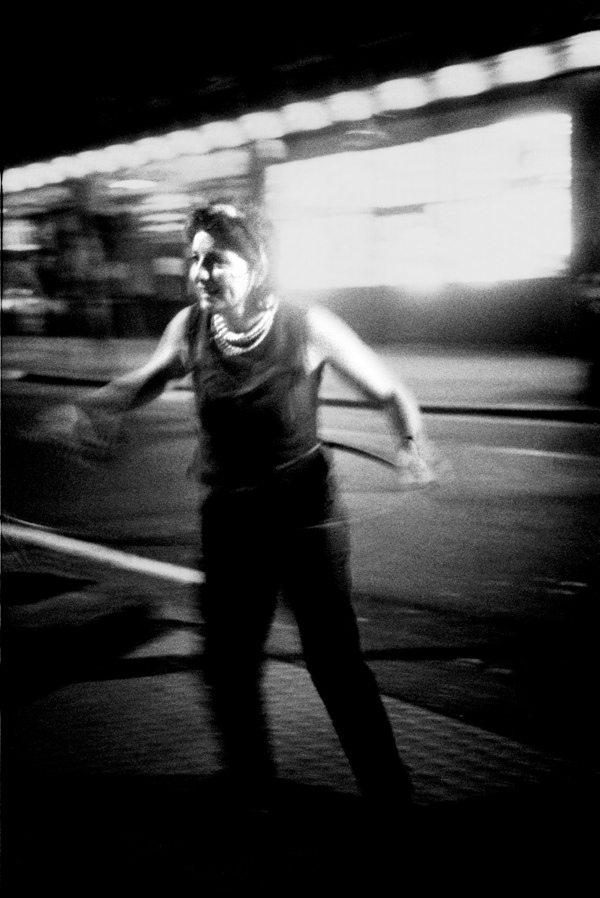
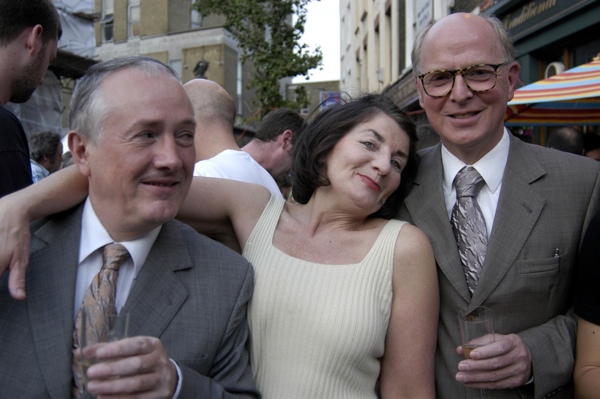
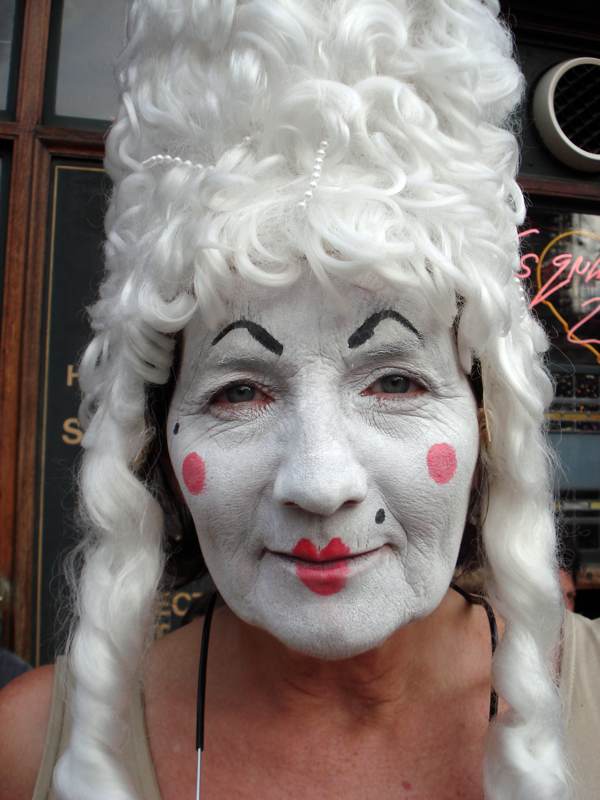
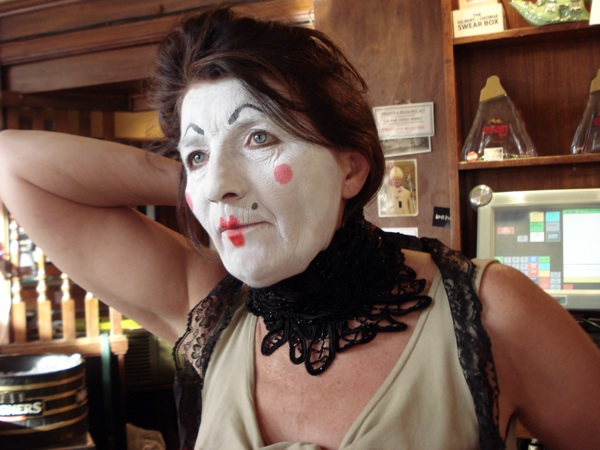
“One day, about fifteen years ago, Sandra took a Hula Hoop and started Hula Hooping on the traffic island in the middle of Commercial St, and, without even thinking about it, I took a picture of her,” recalled Phil Maxwell in amusement, outlining the spontaneous origin of his photographic relationship with Sandra Esqulant, landlady of the Golden Heart since 1979. No-one has taken more photographs in Spitalfields than Phil, becoming the pre-eminent street photographer of the East End, and so it was inevitable that he would turn his camera upon Sandra, whose buoyant, playful nature is a gift to photography.
Once the pub for the Truman Brewery which closed more than twenty years ago, the Golden Heart was kept by Sandra and her husband Dennis together, until he died in 2009 leaving her to continue alone. Sandra has risen to the challenge heroically and, today in Spitalfields, she is among the few who connect us to that earlier time, when the life of the Brewery and the Fruit & Vegetable Market dominated, and the Golden Heart opened at dawn to serve the market porters. As a consequence, she is one who commands such affection among residents of the surrounding streets, that the question “How’s Sandra?” is exchanged as a kind of greeting, and the answer is taken as indicative of the state of things in general in this particular corner of London.
“At first, I knew her only to go in and have a pint, which I didn’t do that often. It was only in later years that I started drinking in the Golden Heart. I’d be completely broke and she’d always lend me twenty quid.” admitted Phil with an uncharacteristic blush,“After the Hula Hoop, she let me take pictures of her anytime. I was photographing her once when she was dancing in the bar and one of the customers told me to stop, and Sandra said, ‘Phil can take pictures of me whenever he pleases, he’s my photographer.'”
We were sitting in Phil’s studio in Greatorex St, in anticipation of the arrival of the great lady for a photo session, and just as Phil began glancing discreetly at his watch, Sandra made her entrance – worthy of a heroine in a musical comedy – bearing cakes and coffees and an abundance of goodwill, and exclaiming “Oh Phil, I love you!”
As we consumed our Danish pastries, Phil took the opportunity to focus his lens upon Sandra, while reminding her of the Hula Hoop incident, a cue for further hilarity. “As you know, I like making people happy and seeing everybody happy and laughing, even though I’ve been a bit down myself recently,” she confided to me, placing a hand upon my wrist. “I used to wind people up by saying I could do it for two days non-stop. My biggest thrill was doing it at two or three in the morning,” she continued, filling with glee at the mere thought of nocturnal Hula Hooping on a traffic island, “the police would come round and they’d say, ‘Don’t worry, that’s just Sandra.'”
“So when shall we do your portrait?” queried Phil, interposing the question as if it were something far off, but catching Sandra’s attention and causing her to sit up quickly, in the manner of a school girl when a teacher enters. Phil sat behind his camera on the tripod and Sandra sat facing him, expectant and eager. “I’ve put my lipstick on, do I look alright?” she asked, seeking approval. “You look good.” granted Phil gently, a little preoccupied now, peering through his lens at her.
I sat to one side, observing both photographer and subject, fascinated by Sandra’s impassive mode of readiness, with chin lifted just as she raises her countenance at the bar to greet a customer. Over all this time it has become the gaze that she raises to meet life.
Phil shifted his attention between the view through the lens and looking over the camera to meet Sandra’s eyes. In the silence of the intimate moment, emotions coursed through Sandra’s features like currents in water and as she looked towards the lens, it was if she were looking through it, deeper and deeper.
“She’s not a person who tries to hide anything when the camera is in front of her.” commented Phil afterwards, once Sandra had departed leaving a space in the room, a vacuum where her presence had been.“There’s never a moment when she isn’t the centre of attention, but she doesn’t demand your attention, you just can’t help looking at her.” he said.
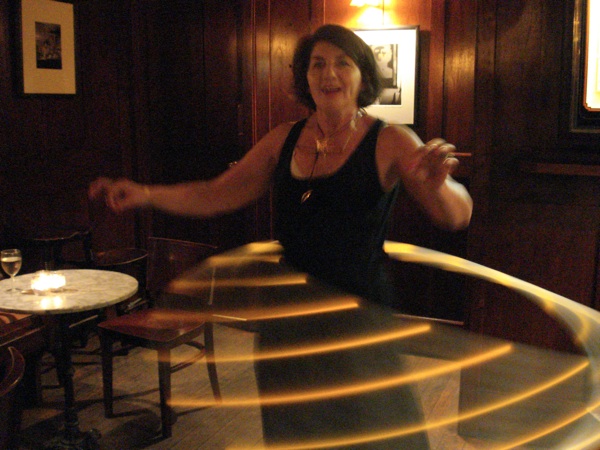
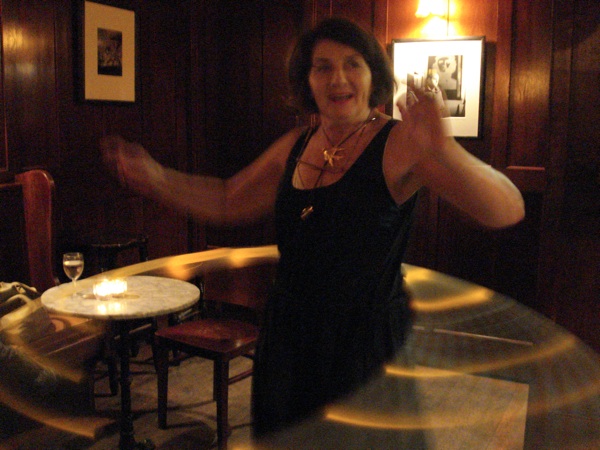
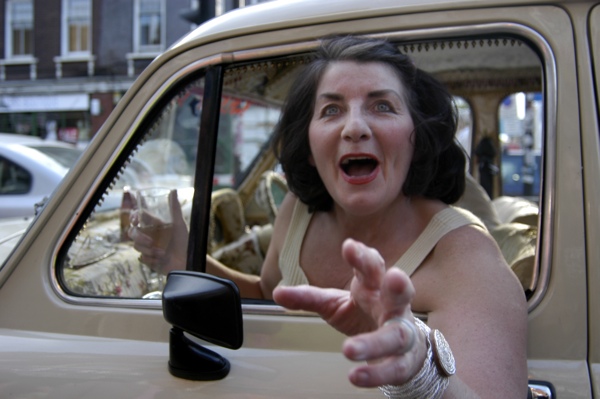





Photographs copyright © Phil Maxwell
You can watch Sandra a film portrait of Sandra Esqulant by Hazuan Hashim & Phil Maxwell by clicking here.
Phil Maxwell’s latest exhibition A Sense of Place: Living in the East End runs at the Rich Mix in the Bethnal Green Rd until Saturday 6th August, and I recommend Phil’s daily photoblog Playground of an East End Photographer.
More pictures by Phil Maxwell
Columbia Road Market 73
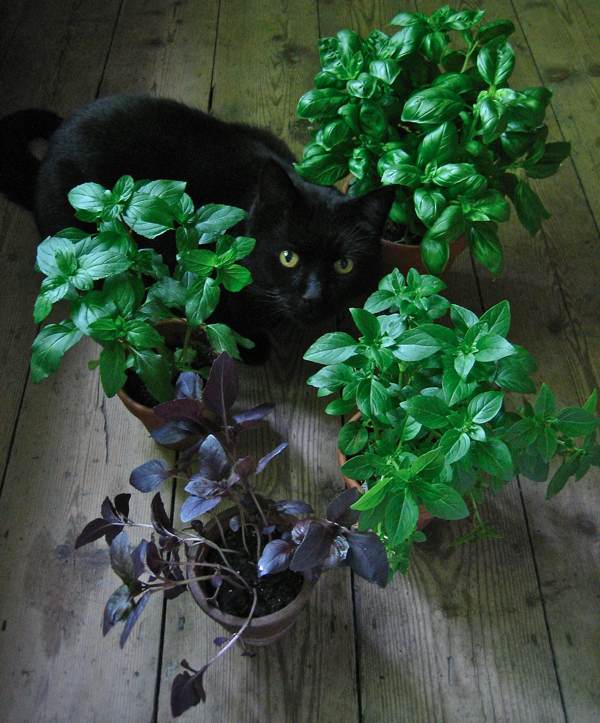
Clockwise from top – Basil, Thai Basil, Purple Basil and Basil Mint
These are the salad days of Summer, when each evening I sit in my tiny garden in Spitalfields beneath the leafy shelter of the big tree and eat sausages with salad, or chicken with salad, or a lamb chop with salad or a trout with salad, and so it goes on.
Which means that when I returned to visit Mick Grover, the herbseller, at Columbia Rd and stepped under his canopy in the crowded market to speak with him in the shade, and he offered me these different varieties of Basil plants, I did not think twice. A couple of times each week at this season, I walk down to Whitechapel Market at around six, when they are packing up and, for the outlay of a few pounds, I come back with box of ripe mangos. So, you will appreciate, with green salad and fruit salad every day, I have plenty of use for leaves of Basil.
There is a pungent allure to the fragrance of Basil, evoking the Mediterranean and conjuring thoughts of the infamous pot of Basil in the Decameron, when Lisabetta of Messina put the decapitated head of her lover Lorenzo in a pot of Basil and watered it with tears. The tale reflects an age-old ambivalence – the Romans believed Basil would only grow if it was cursed and in medieval art the figure of poverty is sometimes portrayed carrying a pot of Basil.
It is an equivocation perpetuated in “The English Physician or Herball” of 1653 by Nicholas Culpeper, who once grew herbs in Spitalfields, on a site where the Bishop’s Square development is today, and offered remedies to the poor folk there without charge. Culpeper wrote of Basil, “And away to Dr. Reason went I, who told me it was an herb of Mars, and under the Scorpion, and therefore called Basilicon, and it is no marvel if it carry a kind of virulent quality with it.” Though Culpeper also recorded that if Basil was applied to the site of a wasp sting or bite of a “venomous beast,” it “speedily draws the poison to it.”
A quarter of a mile away from where Culpeper had his garden, walking through the passage from Allen Gardens to Brick Lane can be a grim experience – the worst alley in Spitalfields – yet here one of the chefs from the Thai restaurant has taken the initiative to create a modest herb garden of Basil upon an indeterminate scrap of earth outside the kitchen door. There is pathos in this tiny patch of cultivation, surrounded by an ineffectual border of twigs in the midst of urban chaos. One set of footsteps would destroy it, and yet, miraculously, sweet Basil thrives in this most unpromising of circumstances.
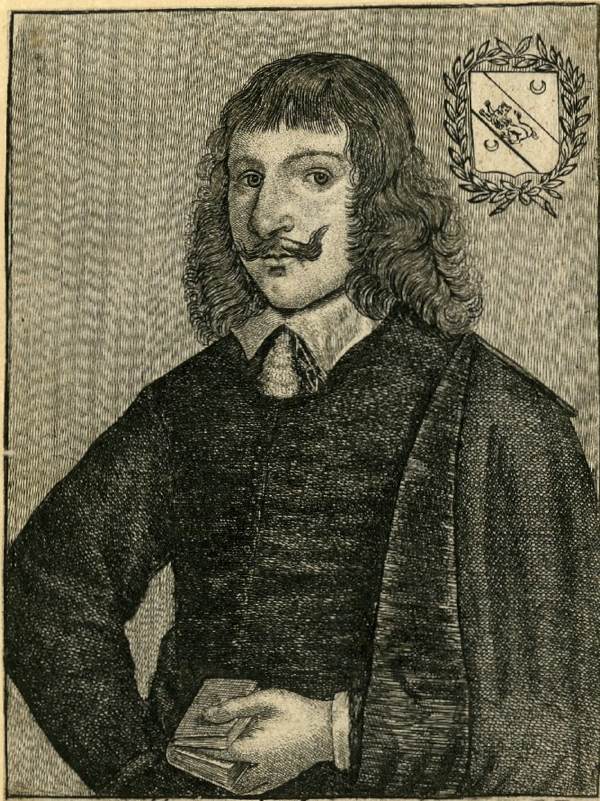
Nicholas Culpeper (1616-1654), Herbalist of Spitalfields
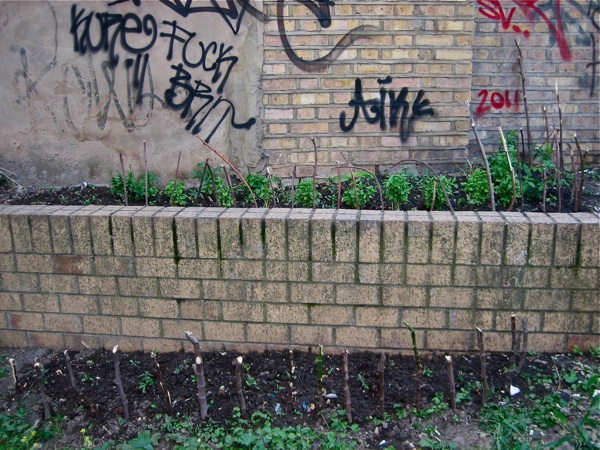
The chef’s herb garden behind the Thai restaurant in Brick Lane.
You might also like to read about
Mick & Sylvia Grover, Herbsellers
and their Varieties of Mint
At Simpsons Chop House
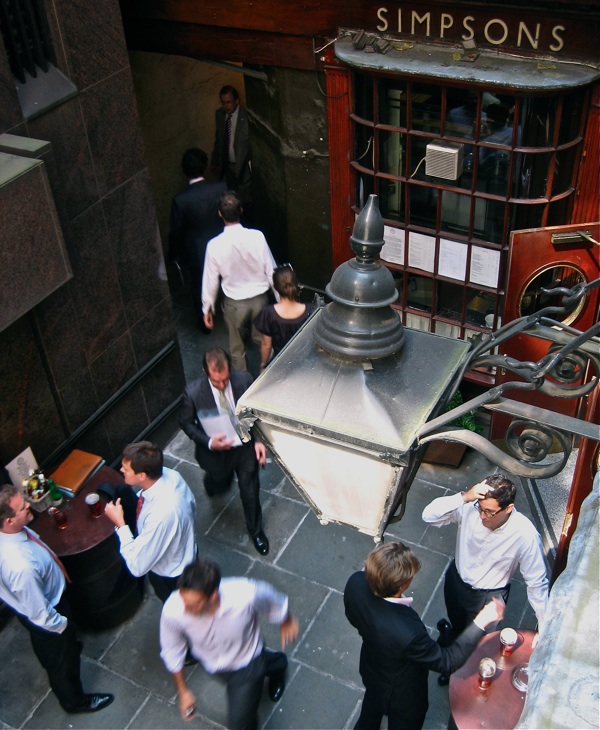
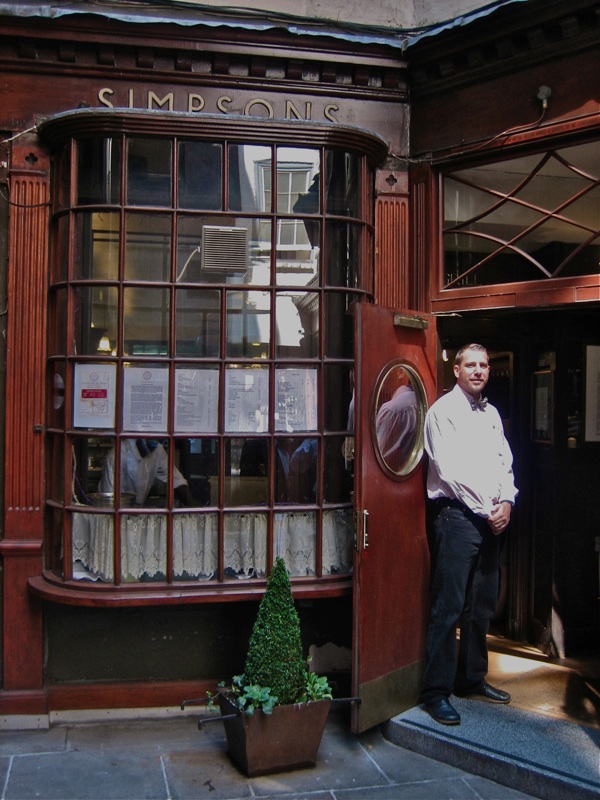
Occasionally I make forays into the City of London to visit some of my favourite old dining places there, and Simpsons Chop House – in a narrow courtyard off Cornhill since 1757 – is one of the few establishments remaining today where the atmosphere of previous centuries still lingers. Thomas Simpson opened his “Fish Ordinary Restaurant” in 1723 in Bell Alley, Billingsgate, serving meals to fish porters, before moving to the current site in Ball Court, serving the City gents who have been the customers ever since.
Once you pass through the shadowy passage tapering from Cornhill and emerge into the sunlight descending upon Ball Court, you feel transported into a different era, as if you might catch a glimpse of Charles Dickens and William Thackeray arriving for one of their customary lunches from the office of the Cornhill Magazine next door. Ahead of you are the two seventeenth century dwellings combined by Thomas Simpson, where a menu unchanged in two hundred and fifty years is still served upon each of the three floors, in rooms that are domestic in scale, linked by the narrow staircases of a private house.
The lunchtime rush comes late, around one, which makes midday the ideal time to arrive – permitting the opportunity to climb the stairs and explore before the City gents arrive to claim their territory with high spirits worthy of schoolboys, and, most importantly, it affords a chance to introduce yourself to the noble ladies of Simpsons, who gather in the grill room on the ground floor from around eleven thirty for a light snack and a lively chat to brace themselves before meeting their admirers.
These fine waitresses preside with such regal authority and character, they welcome customers as if they were old friends come to pay court at their personal salon or boudoir. And it is only appropriate that it should be so, since Simpsons was the first establishment to employ waitresses at the beginning of the twentieth century, even though women were not admitted as diners until 1916 – which licences the current females, making up for more than two centuries of lost time.
The redoubtable leading ladies among the coterie of Simpsons’ chop house goddesses are Jean Churcher and Maureen Thompson, who have both been here over thirty years, know all the regular customers, and carry between them the stories and the spirit of this eminent landmark, which has an atmosphere closer to that of a private lunch club than a restaurant. “I do feel like I’ve been here since the eighteenth century,” admitted Maureen, chuckling with self-effacing humour, “I’ve served three Prime Minister’s grandsons, Macmillan, Lloyd George and Churchill.”
“Midday was the bankers, one o’clock was the insurance people from Lloyds and two o’clock was the metal exchange brokers, and then they’d all mix up,” recalled Jean, waving her hands in a gesture of crazed hilarity to communicate the innumerable long afternoons of merrymaking she has seen here, in the days when banks allowed their staff to drink at lunchtime. Let them tell you tales of the old days when the chops were grilled on an ancient contraption which set the chimney on fire with such regularity that patrons would simply take up their lunch plates and copies of the Financial Times, and step out into the courtyard until the fire brigade appeared.
Before too long, the first diners arrived to interrupt our tête à tête, and I was despatched to the nether regions of the basement to meet the object of all the ladies’ affections, Scotsman Jimmy Morgan, still lithe and limber at seventy-eight, and cycling twenty miles every day thanks to a pacemaker and an artificial hip. I found Jimmy in his tiny burrow of an office deep beneath the chop house, sorting out paperwork. “I worked as a waiter at the George & Vulture next door for three years and E.J.Rose & Co, the company who were reopening Simpsons in 1978, after a two year closure, offered me the job as manager.” he explained to me politely in his lilting Glaswegian cadence, “It was a success right away, people were waiting for it to reopen. We did a free day on the first day to get in touch with all our old customers who worked around the corner.”
“I think my name’s still above the door and it’s gone all brown, it needs a wash. I was going to retire fifteen years ago but they asked me to stay on and , as my assistant manager was a friend, a waiter from the George & Vulture days, I asked if we could swap wages because I wanted him to get more money. I come in two days now. I live in New Eltham. I bicycle, I used to come by train but I’ve been coming by bike for nigh on twenty years. It takes me an hour, I tie it up on the railings and that’s it. It’s not too bad in this heat, I take my jacket off and put it in the saddle bag.”
Down in the cellar bar, the customers had not begun to arrive yet and, since we were alone, Jean took this discreet opportunity to bring out her calendar from under the counter, featuring all the staff in their birthday suits. My eyes popped at the impressive pairs of stiltons and jugs of ale placed strategically in these images, while Jean confided that she had been diagnosed with breast cancer in 2007 at the age of fifty-seven and that Clive Ward the current manager had lost his wife to cancer. Consequently, the staff got together and decided, as an act of solidarity, to bare all for this calendar which sold out within six weeks to their customers, raising more than ten thousand pounds for charity. It was indicative of the unique sense of community that exists at Simpsons chop house, where diners return, even long after they have retired, to maintain friendships with those they have known all their working lives.
Climbing the stairs again up to the sunlight in Ball Court, I found it full of City gents chattering like a flock of birds. There I met Alex who has been coming since 1972. “The menu hasn’t changed since then,” he reassured me, ‘The stewed cheese is still a favourite.”

Awaiting the lunchtime rush at Simpsons, the oldest tavern in the City of London.
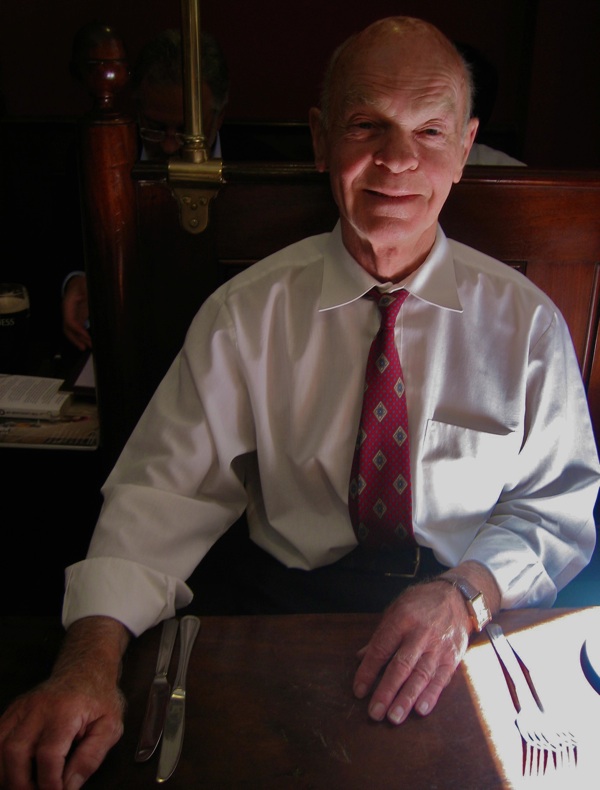
Jimmy Morgan, manager since 1978, cycles ten miles from Eltham to Cornhill and back.
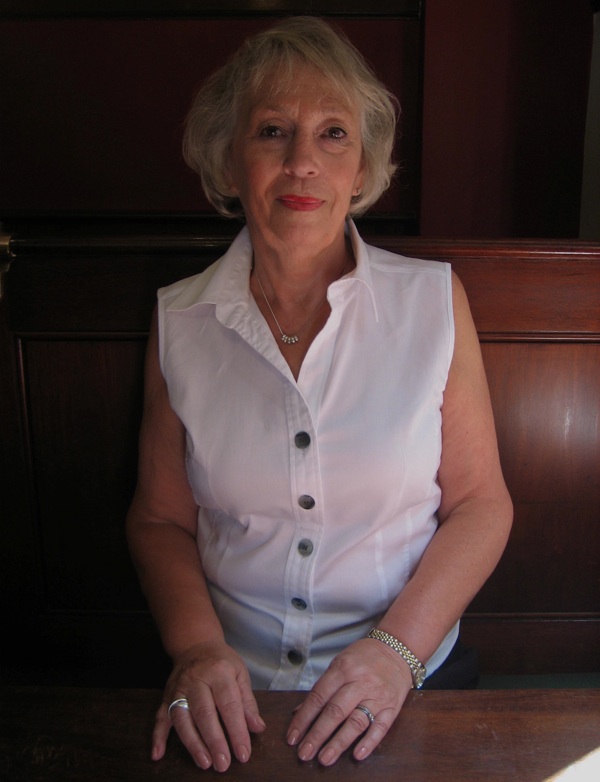
Jean Churcher, Queen of the basement bar.
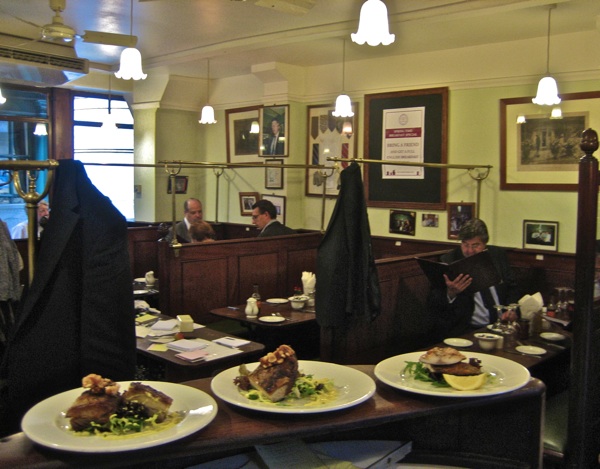
In the Grill Room.

Maureen Thompson, Queen of the Grill Room.
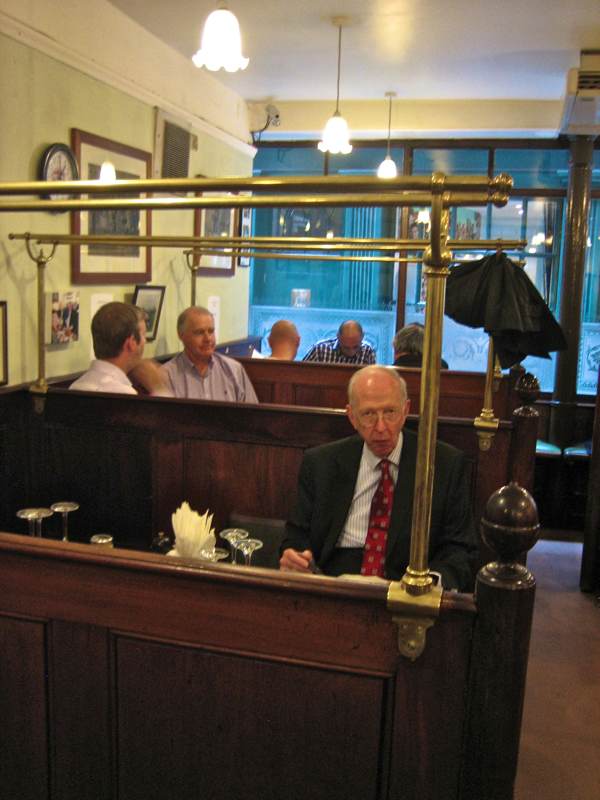
The brass rails were installed for the top hats of the gentlemen of the stock exchange and the bowler hats worn by the brokers.
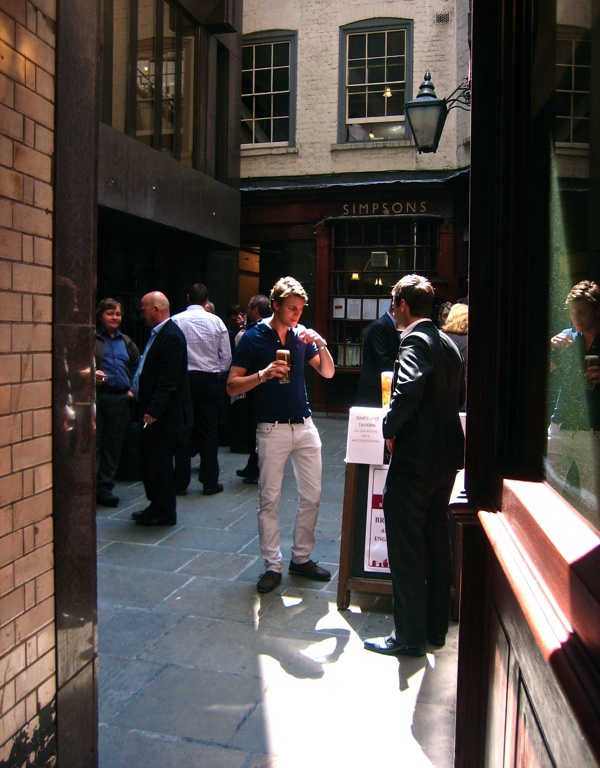
In Ball Court.
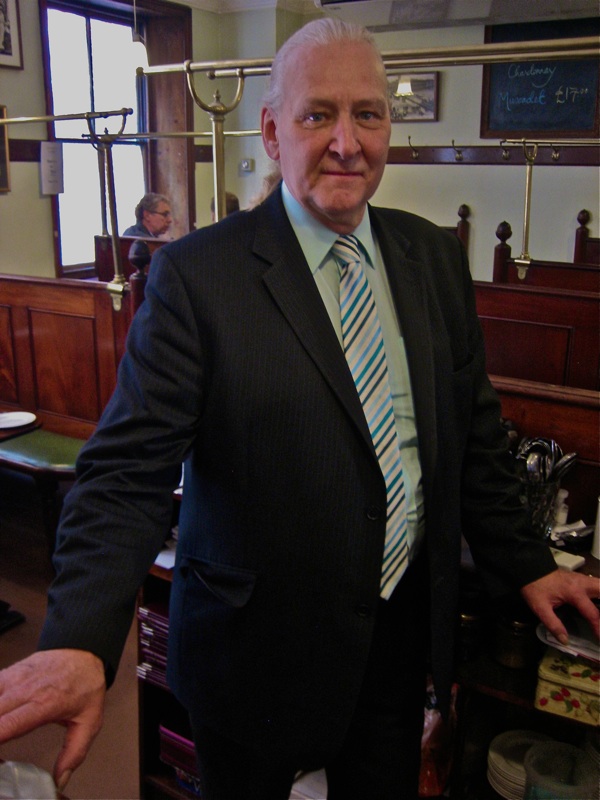
Clive Ward, current manager.
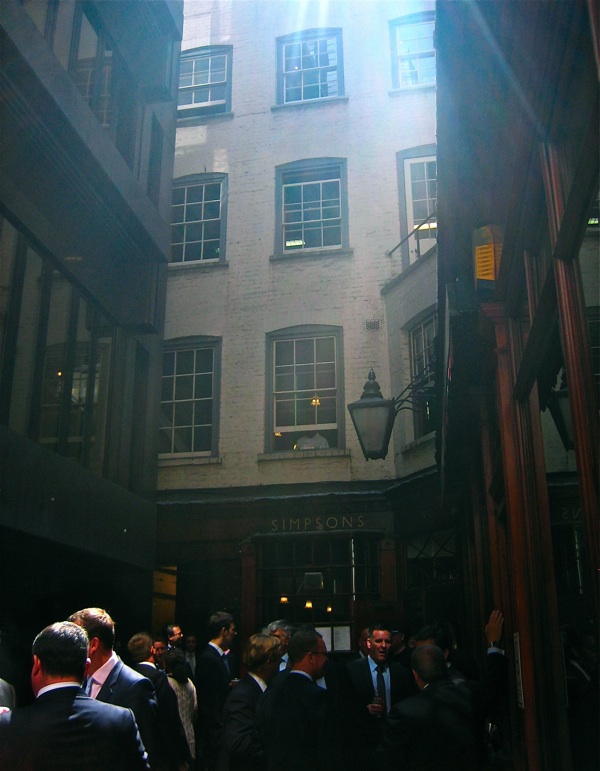
Emerge into the sunlight descending upon Ball Court and you feel transported into a different era.
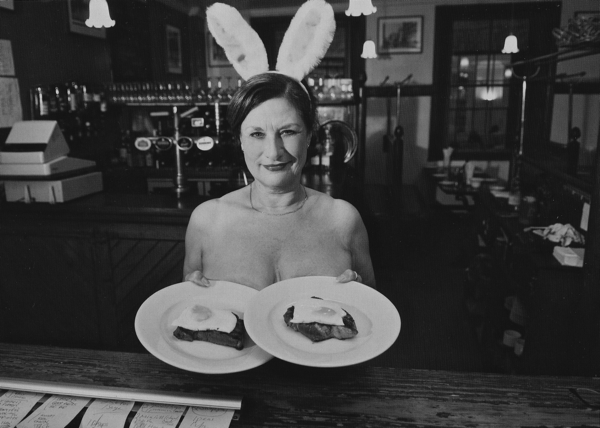
Maureen with a lovely couple of plates of eggs and ham for April
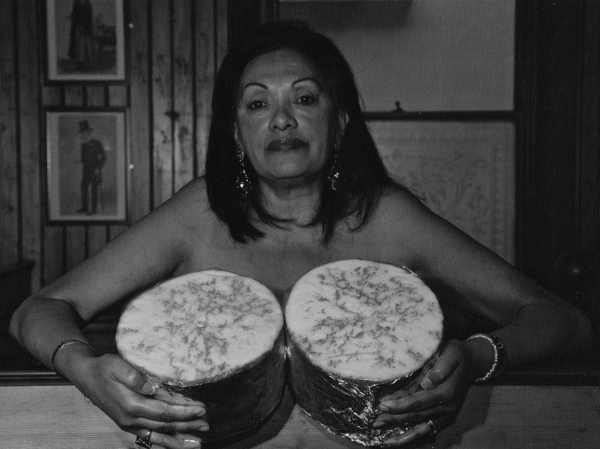
Kiri shows off her stiltons in February.
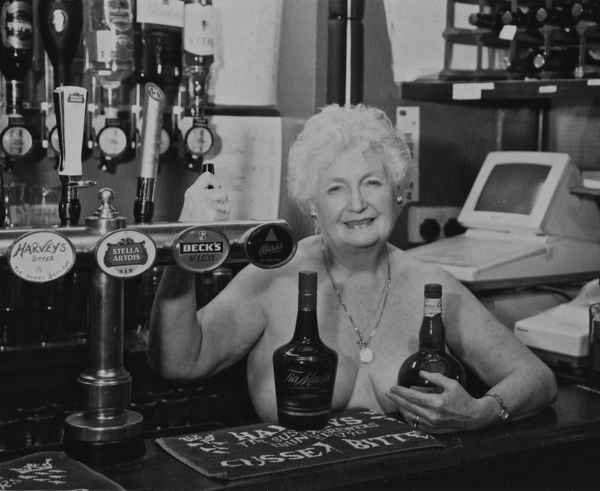
Maureen brings out her finest brandies in June
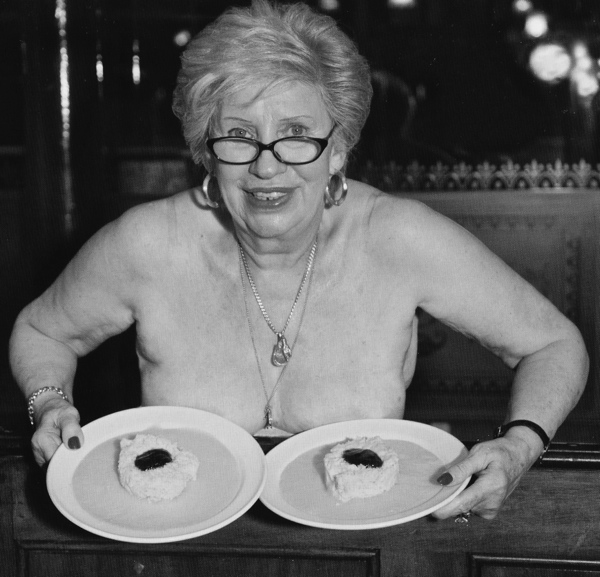
Sheila’s got a delicious pair of starters for October.
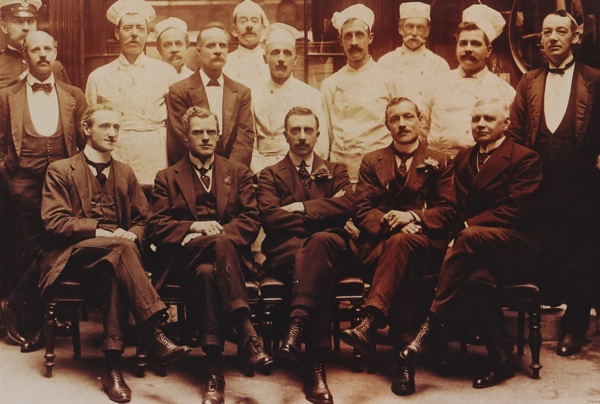
The staff of Simpsons in 1922.
Calendar photographs copyright © Jan Lilly
You might also like to read
or
Vera Hullyer, Parishioner of St Dunstan’s

This is Vera Hullyer sitting in front of the cupboard in the parish room where she keeps the vases and other paraphernalia she uses for creating the spectacular floral displays at St Dunstan’s – just one of myriad ways she has been involved with this ancient East End church since she first came here in 1945. Vera’s life has been interwoven with that of St Dunstan’s and its community over all these years, and she has become its devoted custodian, captivated by its mythic history and speaking of the distant past as vividly as she describes events of recent years.
Older in origin even than the Tower of London, St Dunstan’s once served the entire area now defined by the Borough of Tower Hamlets, which means that until Christ Church was built in the eighteenth century it was the parish church for Spitalfields. A wooden church dedicated to All Saints was built in Stepney after St Augustine’s conversion of the English in the sixth century and St Dunstan himself built the first stone church here in 952. A rough hewn stone relief from his time survives today, set into the wall behind the altar.
Along Fieldgate St from Whitechapel, I followed the route of the former path across the fields to visit this low-set medieval ragstone church that for centuries stood among orchards and farms until the modern East End grew up around it, spawning no less that sixty-seven “daughter” parishes out of the former rural parish of St Dunstan’s. Stepping in from the August rain and placing my umbrella in the stand, I was greeted by that distinctive silence which is unique to old stone buildings, and standing there in the gloom to survey the scene beneath the vast wooden roof, like a great upturned ship, I realised could have been in a country church almost anywhere in England.
A door opened at the far end of the chancel, spilling illumination into the half-light, and Vera came out of the shadows with nimble steps to greet me, shepherding me kindly to the octagonal parish room, where she made me a cup of tea and I was able to dry out my raincoat while she told her story.
I had an aunt that lived nearby in Stepney, she stayed here all through the war and had her roof blown off seven times. And my mother promised me that when the war ended we could come up from Fordingbridge, where we lived, to visit her for a holiday. So we came in August 1945 for VJ night, and I remember the church bells and the hooters on the river. Next day, we went up to Buckingham Palace and joined the crowd up against the railings.
I came to stay with my aunt every year after that for holidays, until 1953 when I came to London to work at the Air Ministry and I lived with her for the first two years. I was young and impecunious and seventeen and three quarters – people didn’t really go away from home then as they do now.
I’m half a Londoner, on my father’s side – he was born in Lambeth – and that bit came through. I’m a very different person now than if I had stayed down in Fordingbridge. Because I had been up to London for holidays, I knew my way around and I enjoyed it. I worked for several officers who had been in the war and Spitfire pilots who had been promoted – for a young girl it was very exciting. I was responsible for ordering and making sure that all the radio parts were in stock. From the Air Ministry, I went to be PA to a senior officer in Whitehall and I was there all through the Suez crisis and when Cyprus was partitioned.
I moved into a hostel in Queensgate, Kensington, in Spring 1955. It was a nice area, but there were four of us to a room. You got bed, breakfast and an evening meal, and the food was terrible. This was before fridges, and I acquired an ability to drink black Nescafe and toast made on the gas fire. At twenty-two, I moved out to Chiswick because we could afford a shared flat. But I still kept on coming to St Dunstans, and when I got married I came to live here and never moved again.
From when I first came to London, I joined the church badminton club to get to meet people. I met my husband, Charlie Hullyer, through the club, we were members of a big group of people there and I knew him for quite a while before we got married. He worked at the Whitechapel Bell Foundry as a carpenter. He made the frames for the bells and his last job, before he died in 1981, was to make a frame for the bells at Canterbury Cathedral. We got married at St Dunstan’s in 1965 and my son was baptised here. Charlie had a flat because he was the last child to leave home and he took it over after his parents died. So when we got married, we had somewhere to live – we didn’t have to move out like most people did. It was very difficult for the children of families to find homes locally and stay here, that’s why many East End families are split.
When I first came to the Ocean Estate, it was a bomb site and we used to walk my aunt’s dog there and there was this smell I will never forget. Then the flats went up. Most people were living in two-up two-downs, with no bathroom and a toilet in the backyard. Some were still living in bomb damaged homes. People were worn out, they had been evacuated and come back, and many had lost family in the bombing. So they were delighted with the new flats, it was real step up and it was luxurious.
The population then was old East Enders and Jewish people, but it’s changed a lot since 1953 and now it’s changing again. The Jewish people have all gone, and West Indians and Bangladeshis came in. It was all social housing then and people were poor. But the new housing is a mixture of some to buy and some to rent, so we have young professionals today who work in the City or at Canary Wharf. Whereas before it was just secretaries and machinists in the garment trade, while the men all worked in the docks.
Yet all the changes that Vera has seen are set in perspective by her relationship with St Dunstan’s. “We fly the red duster,” she announced to me with raffish glee, referring to red merchant navy flag fluttering from the tower, “That’s because before the registrar at Trinity House was established, all births and marriages at sea wherever they took place in the world were registered here in St Dunstan’s parish register and those people were parishioners of St Dunstan’s.”
Over more than sixty years now, Vera has pursued a constant involvement with St Dunstan’s, as member of the parish church council, as a church warden, as a sidesperson and as member of the congregation too. She has read the lesson. She has raised money to replace the magnificent wooden roof and to renovate the elaborate churchyard railings. She has headed the 17th Stepney Cub Scouts and she has done the church flowers for the last twenty years. When her husband Charlie brought his carpentry skills to the construction of crosses for elaborate performances of the Stations of the Cross performed upon the streets of Stepney in the seventies, Vera was stitching costumes.
It all adds up to a rich existence for Vera Hullyer at the centre of her chosen community in this remarkable building – a charismatic meeting place with a long history of devotion, offering an endless source of tales of those who have gone before to inspire the imagination.

Vera at the Tower of London when she first moved to London to work at the Air Ministry in the Winter of 1953, aged seventeen and three quarters, in the bottle green coat that she bought with her first earnings.

This tenth century stone relief carving is a relic of the church built by St Dunstan in 952.

St Dunstans on a map of 1615.

Honest Abraham Zouch, Ropemaker of Wapping, died 16th July 1648.

The Carthage stone, a souvenir of a sailor’s visit to Tunis.

Spandrel over the West door – legend has it that the devil came to tempt St Dunstan when he was working at his anvil, and the saint tweaked the devil’s nose with his red-hot pincers.

Vera Hullyer first came to St Dunstan’s on VJ day in the Summer of 1945.


At H. Forman & Son, Salmon Smokers
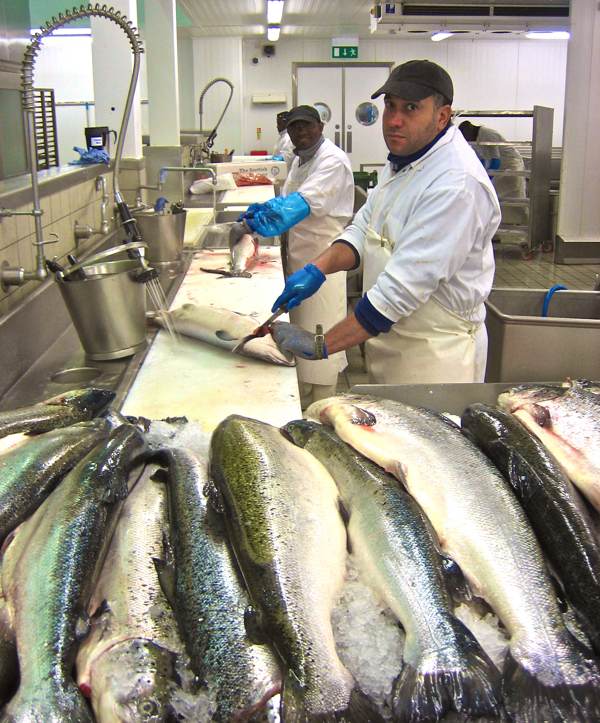
Smoked salmon is serious business at H. Forman & Son, the East End’s last smoke house, founded by Harry Forman in Stepney in 1905 and run today by his great-grandson Lance Forman at Fish Island in Hackney Wick.
This gleaming enterprise in a snazzy new building on the River Lee – designed in the shape of a salmon and overlooking the 2012 Olympic park – might seem a million miles away from the East End of a century ago, yet Lance, now the fourth generation in the business, is resolute to uphold his family name as synonymous with the finest smoked salmon you could ever taste. Consequently, it is a matter of personal honour for him to ensure that the culture and artisan methods of fish smoking are preserved without compromise. And thus, keeping it alive here in the East End has become Lance’s personal mission, sustaining him with moral courage through an extraordinary sequence of challenges to the family business posed by fire, flood and the shameful caprices of the Olympic authorities.
Harry Forman came originally from Odessa at the very beginning of the twentieth century, one of several who brought the technique and expertise of fish smoking from Eastern Europe to the East End of London and set up factories to provide smoked salmon for the Jewish population. In the early days, salmon was imported from the Baltic and arrived pickled in barrels of salt which gave it a pungent flavour and limited appeal, but then supplies of native Scottish Salmon were discovered through the Billingsgate market and smoked salmon took off, becoming one of the most popular gourmet foods of the twentieth century. Crucial to this success was the development of a mild cure that enhanced the natural flavour of the fish, known as the London Cure.
Over the course of the century, Harry’s son Louis took over and then Louis’ son Marcel, Lance’s father, superceded Louis who died just before Lance was born. When Marcel took charge in 1960, the business had moved to Dalston where Lance recalls visiting as a child. “I remember the Ridley Rd days from when I was six.” he mused, sitting in his modern glass office atop the new smoke house and gazing out over the rooftops of Hackney Wick, “My dad brought home a side of smoked salmon every week, and from the age of fourteen I would be working at the smoke house in my school holidays – I lived it and breathed it. We had to buy all the wild salmon when they were in season then, during the Summer months, and put them in cold storage for the rest of the year, and I remember the excitement of breaking open the crates of fish.”
For twelve years, Lance, a born entrepreneur, pursued other careers with tenacity and ambition, as an accountant, as a political adviser, and negotiating real estate deals in Eastern Europe. Yet he could not have known then that these occupations were developing exactly the skills he would later require to face the three tests that fate had in store for him when he joined the family business in 1996. “I thought I’d get a clearer view by listening to the manager who ran the company for my father, and he said to me, ‘There’s no longer any future in this, but I’ll manage the decline for the family.'” Lance confided with a sardonic grin, “I realised I had to come in – I knew there was a future because we had this wonderful product. Everybody loves smoked salmon!”
It all started well enough. Lance went out on the road as salesman and increased business by twenty five per cent each year, but then in 1998 when he took charge, the factory burnt down. The premises were in Queens Yard, Hackney Wick, where his father had moved Formans in 1981. After struggling for six months in the remains of the building, Lance had the entire structure refurbished. Then in 2000, the River Lee overflowed and put the factory under three feet of water, contaminating it. But, undiscouraged by fire and flood, Lance chose this moment to build a fine new factory across the river on the Hackney Marshes, completed in 2002, barely a year before the possibility of the Olympics was announced, placing Formans squarely at the centre of the proposed athletic stadium.
For the sake of three weeks of sport, two hundred and seventy businesses were displaced from East London, only seventy of which have yet re-established themselves. “You gave up the will to live,” exclaimed Lance, thinking back to that moment and placing a hand on his brow for effect, “Fire, flood and then a compulsory purchase order in five years!” Yet there was so much to play for. Smoked salmon in Britain began in the East End, before the Scots also began producing it, and Formans was the last company left here and Lance had Harry, Louis and Marcel standing behind him who had all worked their entire lives to carry the tradition forward. “You do feel the weight of history,” Lance admitted to me in a rare moment of vulnerability.
“There was a real mix of dishonesty and incompetence from the London Development Agency, they said they would help people move but they did nothing because they expected Paris to win the bid.” revealed Lance, his eyes shining as he became visibly emotional.“A lot of people don’t have the will to fight, but I am fired by a challenge. I became their worst nightmare, I had six years experience in accountancy, two years as a political adviser and three years in real estate. I realised I couldn’t win through the courts, so I appointed a high flying media lawyer. And then, on the day before I was to cross examine Sebastian Coe at a public enquiry, I got the message, ‘If you abandon your cross examination, we’ll do a deal with you.’ I sent a message back to Seb Coe, ‘You can run but you can’t hide.'”
The outcome was that the authority paid for Formans new smoke house, with a restaurant, an art gallery and a party venue overlooking the Olympic site. And, in what Lance Forman now happily describes a “one hundred and eighty degree turn,” the Olympic authority have adopted Formans as a venue of choice for corporate entertainment, even going so far as to claim the entire endeavour as a prime example of the legacy they hope to bequeath to London.
Lance Forman is one of the happiest people you could wish to meet these days, with more schemes underway than the British government and, above all, proud to show off his shining new smoke house kitchen that his great-grandfather Harry Forman would be proud to see. Family honour has been restored, and Lance exports his salmon around the world and supplies London’s top chefs and restaurants.
“People don’t realise what smoked salmon is any more,” he informed me in a whisper of dismay, returning to the core of his passion, clasping his hands evangelically in his eagerness to expose the smelly, slimy varieties done on the cheap, sprayed with smoky flavouring and injected with water, which create the widespread perception of this subtle delicacy. In Lance’s kitchen at Formans, I was able to witness the making of smoked salmon done entirely by hand, in time honoured method, by a highly skilled and self-respecting team of artisans. On the first day, the salmon is gutted, boned and filleted before being left overnight with salt to cure. Next day it is washed to remove almost all the salt and then hung in the smokebox to acquire its flavouring from the smoke of oak chips. The staff are in at four each morning to slice up the smoked salmon so that it can despatched to restaurants and eaten fresh that day because, contrary to popular belief, it is at its very best when fresh.
It was an extraordinary story, illustrating the tenacity and ingenuity that can be required to keep a family business alive. Lance Forman fascinates me as a lone business man who took on a war for the sake of culture and tradition, and thanks to his courage and cunning, the noble art of salmon smoking flourishes here in the East End.
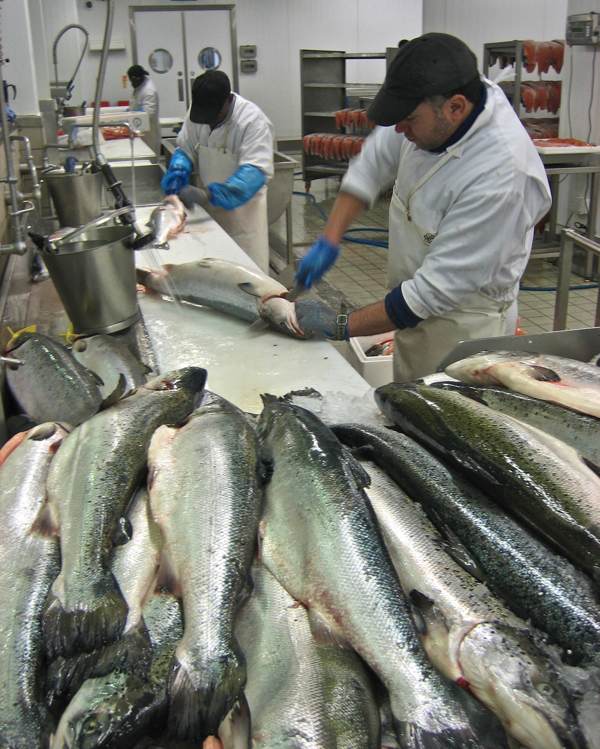
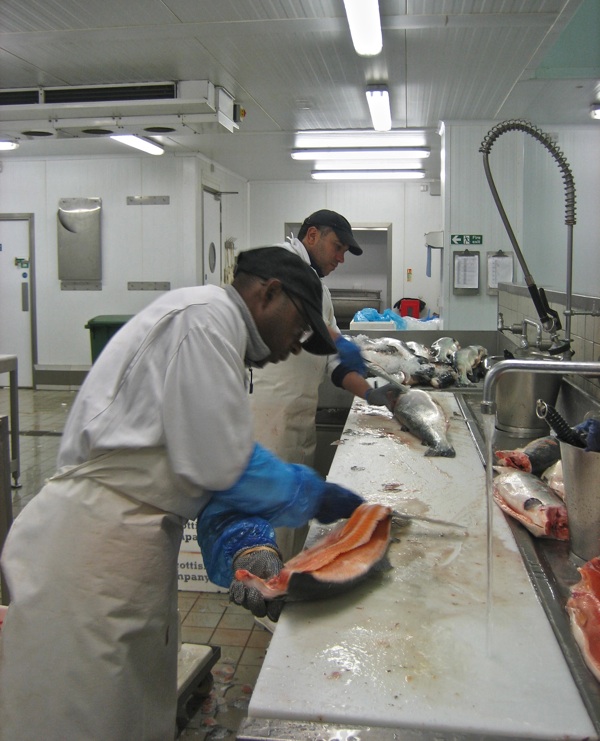
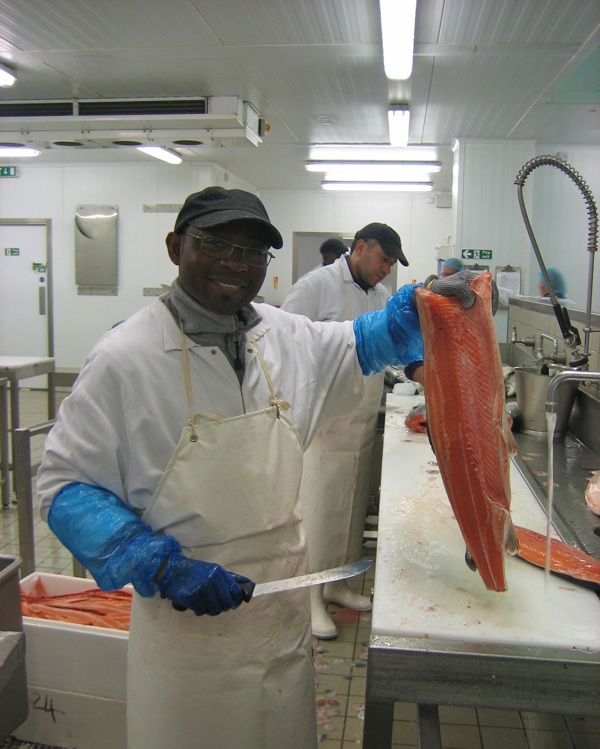

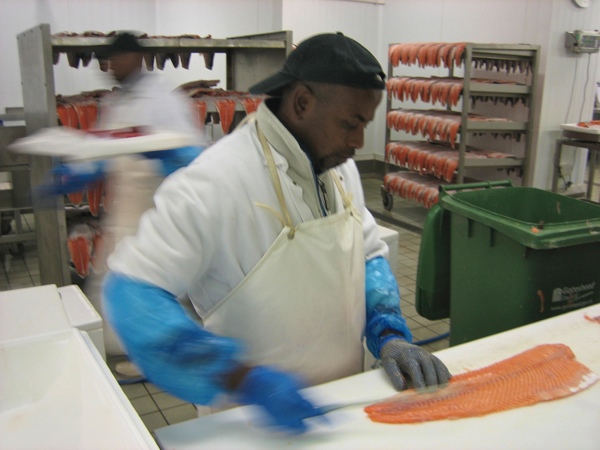
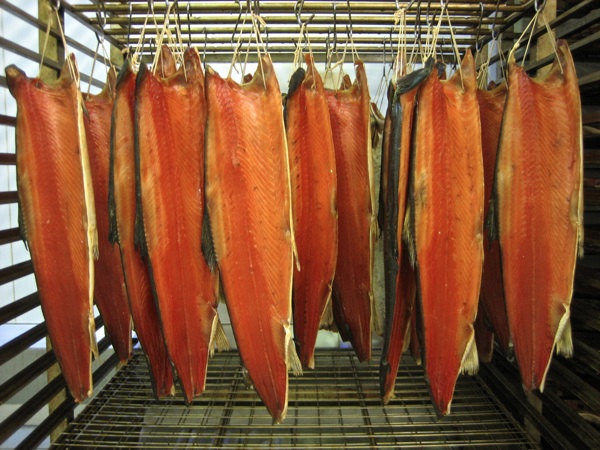
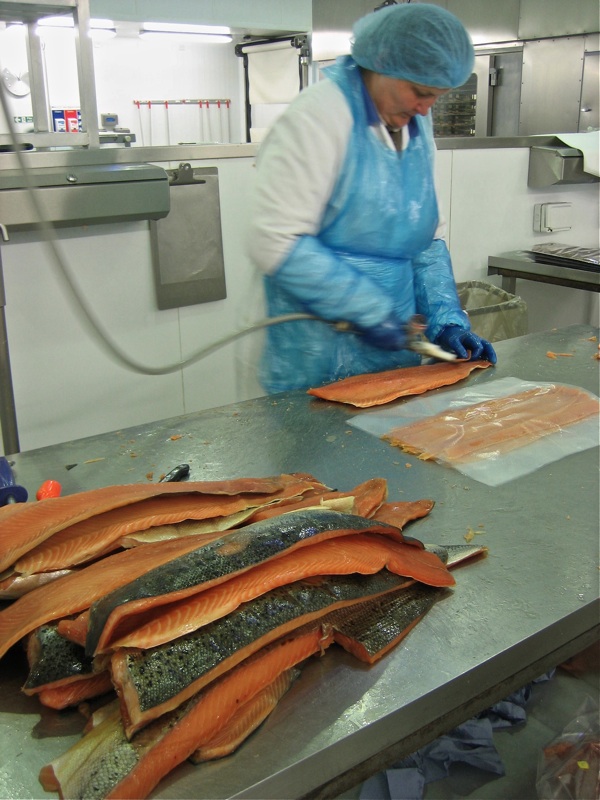
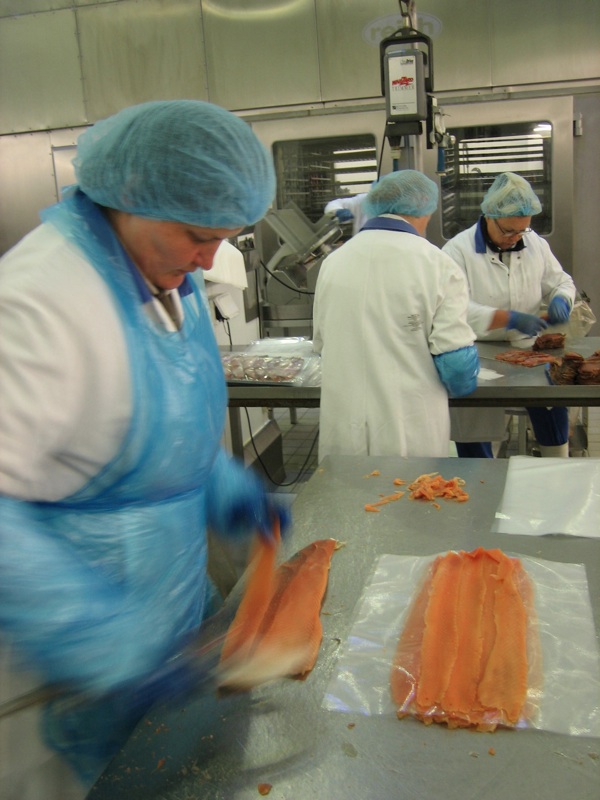
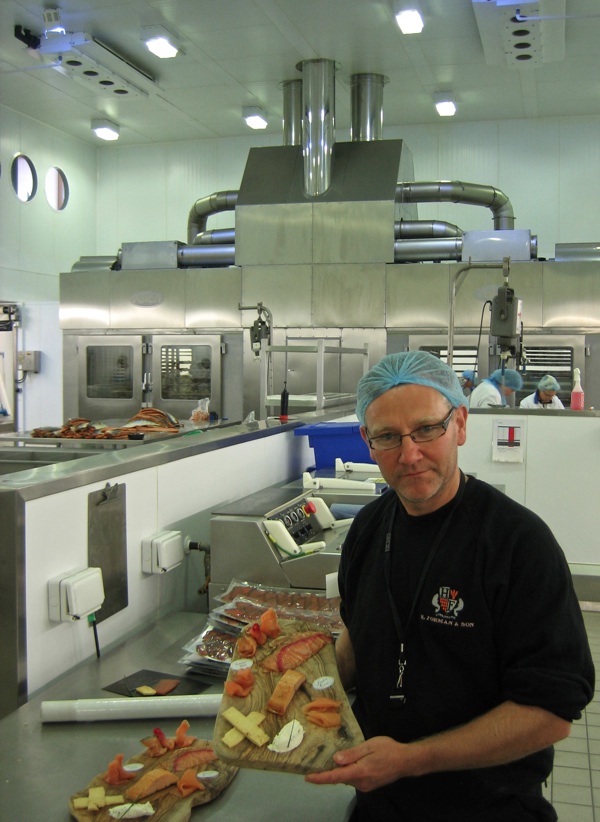
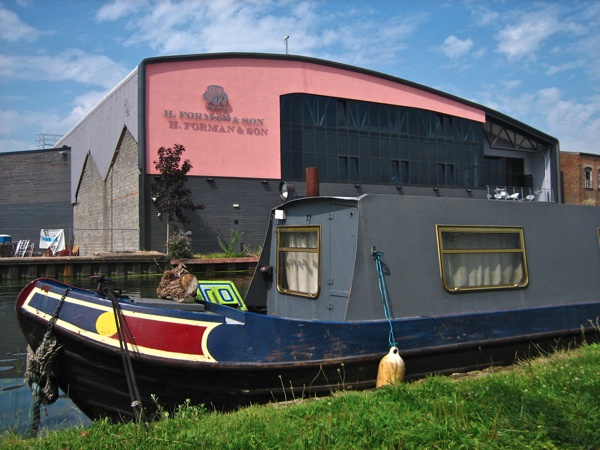
H. Forman & Son’s smokehouse and restaurant, facing the site of the 2012 Olympics.
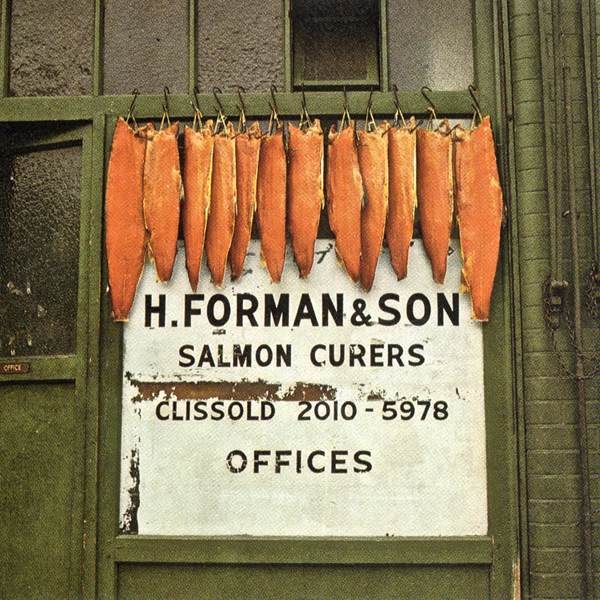
At the former H. Forman & Son smokehouse in Ridley Rd, Dalston.
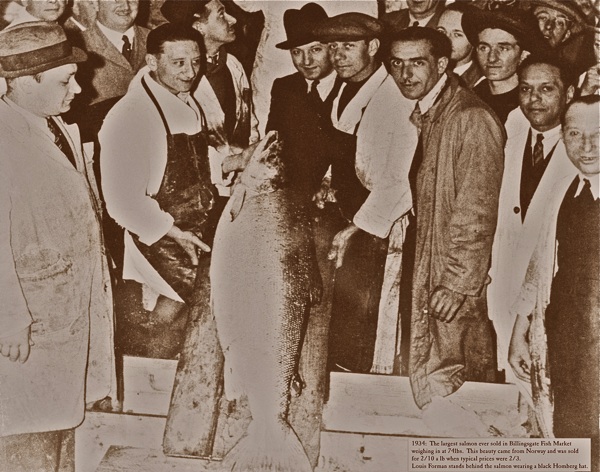
The largest salmon ever sold at Billingsgate Market was bought by Louis Forman in 1934, pictured here in a Homburg hat showing off his 74lb Norwegian trophy fish.












