
So Long, David Power
I am sorry to report the death of David Power on 15th December at the age of ninety

David Power 1934-2024
David Power lived in a comfortable Peabody flat round the back of the London Coliseum and, with his raffish charm, flowing snowy locks and stylish lambswool sweater, he was completely at home among the performers of theatre land. Yet, although David might have travelled only a short distance to the West End from his upbringing in the East End, it had been an eventful and circuitous journey to reach this point of arrival.
Blessed with a superlative talent, both as a pianist and as a composer, David interrupted our conversation with swathes of melody at the keyboard – original compositions of assurance and complexity – and these musical interludes offered a sublime counterpoint to the sardonic catalogue of his life’s vicissitudes. Settled happily with his third wife, David organised charity concerts which permitted him to exercise his musical skills and enjoy a lively social life too. At last, winning the appreciation he always sought, David discovered the fulfilment of his talent.
“I’ve done a lot of things in my time. All my family were boxers. In those days you had thirty or forty fights a week before you could make a living. It was a different world. Them days we had some good fights but they were hungry then. They punched the fuck out of each other but they were all friends too.
Me, I love boxing but I was a prodigy at the piano at the age of five. My mother, Lily Power, she couldn’t afford no piano lessons for me because we were poor. People have no idea how hard it was in the thirties and forties. I was born in Hounslow and my mother moved us back to Spitalfields where she was from.
My mum paid five shillings a week rent at 98 Commercial St but she wouldn’t let me answer the door when the rent collector came round. Today you couldn’t buy it for two million. Wilkes St was called the knocking shop because the brass went round there for the top class girls. They said, “Can we help you out, any way you like?” Itchy Park, next to the church, we called that Fuck Park – you could get it in there for sixpence. It was a wonderful, wonderful world.
Then I was evacuated to Worcester but I ran away about nine times. Each time, the police picked me up when I got to Paddington Station and put me on the train back again, I was nine years old. It was very funny.
They gave my mother an old pub in Worcester and she took in twenty armaments workers. There was no water, it was outside in the scullery. She charged one pound fifty a week for bed and breakfast and I used to get up at five-thirty to do the fires each morning in 1940. The most wonderful thing was when they brought gas into the house and we had a gas stove, and I didn’t have to worry about making up the fire each morning and heating the water for everyone for bath night on Friday. I got in a lot of trouble at school because I was Jewish and they used to say, “Show us your horns!” and that’s how I got into fighting.
I started work in Spitalfields Market when I was fourteen, I worked with a Mr Berenski selling nuts – peanuts and walnuts. The place was piled high with nuts! I had to stack them up with a ladder. I remember once the sack split and the nuts went everywhere and he chased me around the market. But Harry Pace, my cousin, he was a middleweight, he protected me.
I got a job in The Golden Heart playing the piano at weekends, earning one pound for two sessions. An old guy asked me to play, “When I leave the world behind,” and I thought, “He ain’t got long to go.” I earned three pounds, seventeen shillings and tuppence but, when my father discovered, he hit me round the ear and said, “You’ve been thieving!” Then my mother explained what I had been doing, and he took the money and gave me two bob.
After the war, my mother moved to Westcliff on Sea and that’s when she could afford two and sixpence for piano lessons for me, but by then I was much more interested in sport. As a child, I could play any music that I heard on the radio but, when I had my first lesson at ten years old, I thought crochets and quavers were sweets. There was a big Jewish community in Westcliff and I went to Southend Youth Club and started boxing there until I was called up for the army. I played football for Southend, we won the cup and I scored two goals. In the army, I sent my mum one pound a week home, but I was supposed to have been a concert pianist at eighteen. Fortunately, my Colonel liked music and I was in the NAAFI playing the piano and he asked me to play for the officers. They shipped me out to Hong Kong and Singapore and I played twice a month in the Raffles Hotel on Sundays and for the Prime Minister of Hong Kong.
When I came out the army, I was supported by Harriet Cohen, a concert pianist. I told her I was a ragged man but she wrote to the principal of the Guildhall School of Music. The professor told me to play flat, so I lay on the floor. I said, “You asked me to play flat, you fucking nitwit.” Then I went for an audition at the Windmill Theatre but they only offered me eight pounds a week for playing fourteen shows, so I jacked it in and did the Knowledge and became a cab driver, and got married in 1960. Then I decided to go into the markets and I worked in Covent Garden for twelve months as a porter, until my wife’s dad and I went into hotels – The Balmoral in Torquay and Hotel 21 in Brighton, but in the recession of the nineties I went bankrupt. We couldn’t compete with the deals offered by the big chains where businessmen used to bring their dolly birds at weekends.
Then I went on the road selling and I was earning three or four hundred pounds a week, especially in Wales. They didn’t know what a carpet was there. I once bought ten thousand dog basket covers for five pounds and sold them all at four for a pound as cushion covers in Pitsea Market. And that’s when I went into Crimplene, and then china, and then ties. Those were great days. Eventually, I went back in the taxi, worked like a slave, had a heart attack and died. Half of my heart is dead. I’ve been in and out of hospital with the old ticker ever since, so I decided to give something back by holding concerts for University College London Hospital. I do it all. I know talent when I see it and we have shows every month.
I never played the piano for twenty years, until ten years ago I went back to it – I wrote a piece of music when my wife died. I always wanted to be a pianist because music is something I get wrapped up in. A lot of people never believed I played the piano because I was so ragged, I had a ragged upbringing. If you come from the background that I came from, you’ve got keep putting money on the table. To be dedicated to music, you to have to be rich or a fool. I’m a born showman, that’s what they tell me, “David, you’re a showman.””

David (on the left) enjoys a picnic with his mother Lily and brothers and sisters in Itchy Park, Spitalfields in the nineteen thirties

David as a young boxer in the nineteen fifties

Concert Pianist Harriet Cohen encouraged David to become a professional pianist.

David Power, Showman
Panto Time!

Longer ago than I care to admit, fortune led me to an old theatre in the Highlands of Scotland. Only now am I able to reveal some of my experiences there and you will appreciate that discretion prevents me publishing any names lest those who are still alive may read my account.
It was a magnificent nineteenth century theatre, adorned with gilt and decorative plasterwork. Since this luxurious auditorium with boxes, red drapes and velvet seating was quite at odds with the austere stone buildings of the town, it held a cherished place in the affections of local theatregoers who crowded the foyers nightly, seeking drama and delight.
Although it is inexplicable to me now, at that time in my life I was stage struck and entirely in thrall to the romance of theatre. Perhaps it was because of my grandfather the conjurer who died before I was born? Or my love of puppets and toy theatres as a child? When I left college at the beginning of my twenties, I refused to return home again and I did not know how to make my way in London. So I was overjoyed when I landed a job at a theatre in the north of Scotland. I packed my possessions in cardboard boxes, took the overnight train and arrived in the frosty dawn to commence my adult life.
As soon as it was discovered I had a literary education, I was assigned the task of organising the script and writing the ‘poetry’ for the annual pantomime, which that year was Dick Whittington. In the theatre safe I found a stash of tattered typescripts dating back over a century, rewritten each time they were performed. These documents were fascinating yet barely intelligible, and filled with gaps where comedians would supply their own patter. I discovered that the immortals, in this case Fairy Bow Bells and Old King Rat, spoke in rhyming couplets. Yet to my heightened critical faculties, weaned on Shakespeare and Chaucer, these examples were lame. So I resolved to write better ones and set to work at once.
Fairy Bow Bells:
In the deepest, bleakest Wintertime,
I welcome you to Pantomime.
Here is Colour! Here is Magic!
Here is Love and naught that’s Tragic.
‘You are here to learn the art of compromise, and how to pour a decent gin and tonic, darling,’ the director informed me at commencement with a significant nod of amusement when I submitted my work. I tried to raise an amenable smile as I served the drinks, but it was a line delivered primarily for the benefit of the principals gathered in the tiny office for a production meeting. These were veterans of musical comedy and summer variety who played pantomime every year, forceful personalities who each brought demands and expectations in proportion to their place in the professional hierarchy, with the ageing comedian playing Dame Fitzwarren as the star. Next came the cabaret singer and dancer playing Dick Whittington and then the television personality playing Tommy the Cat.
It was my responsibility to manage auditions for the chorus of boy and girl dancers, sifting through thousands of curriculum vitae and head-shots to select the most promising candidates. Those granted the opportunity were given ten minutes to impress the musical director and the choreographer with a show tune and a short dance sequence. Shepherding them in and out of the room and handling their raw emotions proved a challenge when they lost their voices, broke into tears or forgot their routines – or all of these.
The cast convened for a read-through in the low-ceilinged rehearsal room in a portacabin in the theatre car park. Once everyone had shaken hands and a cloud of tobacco filled the room, the director wished everyone good luck and, turning to me before leaving the room, declared loudly ‘Don’t worry, darling, they know what to do!’, employing the same significant nod I had seen in the production meeting and catching the eye of each of the principals again.
We all sat down, I handed round the scripts and the cast turned to the first page. The principals gasped in horror, exchanging glances of disbelief and reaching for their cigarettes in alarm. Dame Fitzwarren blushed, tore out a handful of pages and spread them out on the table, muttering, ‘No, no, no,’ to himself in condemnation. I sat in humiliated silence as, in the ensuing half hour, my sequence of pages was entirely rearranged with some volatile horse trading and angry words. Was this the art of compromise the director had referred to? I had organised the scenes in order of the story – no-one had explained to me that in pantomime the sequence of opening scenes are a device to introduce the principals in order of status from the newcomers to the seasoned stars. Yet even if I had understood this, it would have made little difference since the cast were all unknown to me.
On the second day, the floor of the portacabin was marked with coloured tapes which indicated the placing of the scenery and it was my job to take the cast through their moves. Dame Fitzwarren was keen to teach his comedy kitchen sequence to the two young actors playing the broker’s men. Once he had walked them through, I suggested we should give it a go. ‘No,’ he said, ‘That was it, we did it.’ I understood that, in pantomime, comedians only rehearse their sequences once as a matter of honour.
The little theatre owed its existence to the wealth of the whisky distilleries which comprised the main industry in the town and many of the directors of these distilleries were members of the theatre board. In particular, I remember a diminutive fellow who made up for his lack of height with an abrasive nature. He confronted me on the opening night, asking ‘Is this going to be good, laddie?’ My timid reply was, ‘It’s not for me say, is it?’ ‘It had better be good because your career depends upon it,’ was his harsh response, poking me in the gut with his finger.
In fact, Dick Whittington – in common with all the pantomimes at that theatre – was a tremendous success, playing to packed houses from mid-December until the end of January. The frantic energy of the cast was winning and the production suited the mechanics of the building beautifully, with brightly coloured flying scenery, drop-cloths and gauzes. The audience gasped in wonder when Fairy Bow Bells waved her wand to conjure the transformation scene and booed in delight when Old King Rat popped up through a trap door in a puff of smoke. They loved the familiar faces of the comedians and laughed at their routines, even if they were not actually funny.
Given the punishing routine of three shows a day, the collective boredom of the run and the fact that they were away from home, the pantomime cast occupied themselves with a rollercoaster of affairs and liaisons which only drew to an end at the final curtain. Once Dick Whittington unexpectedly stuck her tongue down my throat in the backstage corridor on New Year’s Eve and Dame Fitzwarren locked the door of the star dressing room from the inside, subjecting me to his wandering hands when I came to discuss potential cuts in the light of the stage manager’s timings. I found myself entering and leaving the building through the warren of staircases and exit doors in order to avoid unwanted attention of this nature. The gender reversals and skimpy costumes contributed to an uncomfortably sexualised environment which found its expression on stage in the relentless innuendo and lewd references, all within an entertainment supposedly directed at children. ‘Thirty miles to London and no sign of Dick yet!’
I shall never forget the musical director rehearsing the little girls in tutus from a local stage school who supplied us with choruses of sylphs on a rota to accompany Fairy Bow Bells. ‘Come along, girls,’ he instructed the children, thrusting his chest forward and baring his dentures in a frozen smile of enthusiasm,’ Tits and teeth, tits and teeth,’ using the same exhortation he gave to the adult dancers.
Our version of Dick Whittington contained an underwater sequence, when Dick’s ship was wrecked, permitting the characters to ‘swim’ through a deep sea world which was given greater reality by the use of ultra-violet light and projecting an aquarium film onto a gauze. This was also the moment in the show when we undertook a chase through the audience, weaving along the rows. Drawing on the familiar tradition of pantomime cows and horses – and perhaps inspired by the predatory nature of the environment – I devised the notion of a pantomime shark in a foam rubber costume that could chase the characters through the front stalls and around the circle to the accompaniment of the theme from Jaws. I had no idea of the pandemonium that this would unleash but, each night, I made a point of popping in to stand at the back to enjoy the mass-hysteria engendered by my shark.
The actor playing Old King Rat had previously been cast as Adolphus Cousins in Major Barbara, so I decided to exploit his classical technique by writing a death speech for him. It was something that had never been done before and this is the speech I wrote.
Old King Rat:
This is the death of Old King Rat,
Foiled at last by Tommy the Cat.
No more nibbles, no more creeping,
No more fun now all is sleeping.
This is the instant at which I die,
Off to that rathole in the sky…
Naturally this was accompanied by extended death-throes, with King Rat expiring and getting up again several times. Later, I learnt my speech had been pirated by other productions of Dick Whittington, which is the greatest accolade in pantomime. Maybe it is even now being performed somewhere this season?
In subsequent years, I was involved in productions of Cinderella and Aladdin, but strangely I recall little of these. I did not realise I was participating in the final years of a continuous theatrical tradition which had survived over a century in that theatrical backwater. I did not keep copies of the scripts and the fragments above are all I can remember now. I do not know if I learnt the art of compromise but I certainly learnt how to pour a stiff gin and tonic. And I learnt that in any theatre there is always more drama offstage than onstage.

In The Winter Garden

A few years ago when the city was shut down and empty, I used to take long lone cycle rides in parts of London that were unknown to me, seeking an escape. One day in January, after cycling around Regent’s Park in the frost to admire John Nash’s terraces, I came to the winter garden.
It was late afternoon, the sun had set and dusk was gathering but, when I came upon the narrow gate leading through a rose arch to the garden, I could not resist exploring. Beyond the entrance lay a large formal garden once attached to a grand Regent’s Park mansion. It was divided by hedges into a series of hidden spaces like a labyrinth. I found the place empty and deserted, save a few lonely blackbirds. In the last light of day, I took these photographs.
I intended to publish my pictures and write about my visit then. Yet when I studied the photographs, I grew so enchanted that the experience barely seemed credible anymore. Instead, I kept the evidence of my melancholy pilgrimage to myself. Each year at this time, I revisited the photographs without finding any words to accompany them. On one occasion, I even set out to visit the garden again to verify my experience only to discover it was closed that day.
Contemplating these pictures now, they feel far away and I find it difficult even to remember the lockdown. It no longer seems real to me. Many are still struggling with the after-effects of that time yet when I look at these photographs I realise it is over. My pictures of this cold garden at twilight, with only a few plants showing, are how I shall recall it. The winter garden was where I found solace at the heart of the empty city.

Hylas

In the Rose Garden

The Sunken Lawn at St John’s Lodge

The Shepherdess Border


Snowdrops


The first primroses

‘To all protectors of the defenceless’


The Giant Urn


The Arbour Walk

St John’s Lodge Garden, Inner Circle, Regent’s Park, NW1 4NR
You may also like to take a look at
A Final Walk Home

I am proud to publish this edited extract from Awful Rigours & Wretched Pay by a graduate of my writing course. Christine Swan set out to write her family history and other stories.
Follow Awful Rigours and Wretched Pay
I am taking bookings for the next writing course, HOW TO WRITE A BLOG THAT PEOPLE WILL WANT TO READ on February 1st & 2nd.
Come to Spitalfields and spend a winter weekend with me in an eighteenth century weaver’s house in Fournier St, enjoy delicious lunches and eat cakes baked to historic recipes, and learn how to write your own blog.

I thought long and hard about what to do with my parents’ ashes. My dad died four years ago and my mum last year. In 2015, my parents moved into a little bungalow opposite my house leaving behind their home in St Margaret’s at Cliffe, Kent.
Mum was happy to make the move as she could not manage my dad’s falls and recognised that she needed help. My dad hated the idea initially and then swung between understanding and not fully understanding what was happening.
My dad was a seafarer. He joined the Royal Navy in 1941, aged just fifteen. On D-Day, he was deployed to an Assault Landing Craft. After the invasion, he was transferred from the Navy to the Army, firstly into the South Wales Borderers and then the Royal Welch Fusiliers as part of the 53rd division. Troops were deployed where they were needed rather than by the geography of their birth. He was an East Ender through and through.
In the years before he died, I saw him every day and he told me innumerable stories of the war but, as his memory faded still further, even these became less frequent. He would ask me questions instead. Sometimes the same question five or six times over. “Who is that nice lady from over the road?” he would ask Mum, “I don’t know why she comes here every day,” completely oblivious to me being his daughter.
My dad died in May 2019 and, in 2020, my mum had two massive and devastating strokes. From then on, her life and mine changed dramatically. My role as carer restricted my movements. After an active life, Mum had lost all will to move. Her sole joy was watching others going about their daily lives from the window. When she died, my life changed again, I could travel further from home. I never wanted to resent my loss of freedom but to regain it was bittersweet.
I thought long and hard about what to do with my parents’ ashes. This summer, I felt ready for closure and knew that there was only one possible resting place. I must go back to Kent. I did not bother to look at the weather prior to leaving, I was going to do this no matter what. As it turned out, I do not think I could have picked a better day.
I left London and arrived at Dover a little before midday. I had some bottles of water and a few sweets but I guessed that would be insufficient to power me during the afternoon, so I purchased two bottles of fizzy drink and two chocolate bars and off I went. As I had not booked a hotel in Dover, I was also loaded with my rucksack containing things for a few days, including my trip to the theatre the previous evening, as well as the ashes sealed in large, thick boxes.
The initial part of my journey was flat, through the town and then alongside the thundering A20 heading towards the Port of Dover. The path took me along the East Cliff which includes the back end of some magnificent houses that face Marine Parade. Then the ascent begins. The sun was beating down and the wind surprisingly warm. My shoes turned from black to grey as the chalk dust coated them. This was a physical toil but felt more like a pilgrimage.
The edges of the paths were bordered by wildflowers and flitting butterflies, mostly stunning blue. The sea appeared turquoise against the brilliant white of the chalk cliff, azure sky and fresh green grass. Everything seemed to add to the spiritual element of my quest, nature’s stained glass window.
The white shape of the South Foreland Lighthouse came into view. First, it appeared to be peeping over the top of a summit but gradually its entire structure was visible to me. Nearly there.
Past the lighthouse and along the footpath I remember walking with my children so many times to St Margaret’s at Cliffe. It became quieter the further inland I walked. I was now protected from the wind and there were fewer walkers. The lighthouse entrance acted as another filter, until I was completely alone.
A buzzard soared overhead, goldfinches twittered among the trees, the tall grasses wafted wildflowers and yet more butterflies. This was the place. I sat with my parents for some time. Everything was quiet, just me, mum and dad. I told them I loved them and I thanked them for everything. The sun moved in the sky and it was time for me to leave.
The walk back was easier. The declines outnumber the inclines and the physical weight I was carrying was less. I panicked a little when I lost track of time and realised that I did not have as much time as I thought to catch my train to Canterbury. I relaxed when I realised that my phone was displaying French time, as it sometimes does walking along the White Cliffs. Upon turning a bend, the time retreated by a whole hour.
I walked alongside the thundering traffic heading to the port. I was dusty, sweaty and tired. I arrived at the station in good time and, as I relaxed into my train seat, I reflected on the day. I had not slept well before and was dreading carrying out my task, but we all have to let go of people we love. When the time is right, we find the strength and it can be an experience that brings you closer not only to them but to yourself.

On Twelfth Night
I am proud to publish this entry from THE SILVER LOCKET by a graduate of my writing course. The author sets out to share stories of literary life: books old and new which inspire and comfort, and the people met along the way.
I am taking bookings for the next writing course, HOW TO WRITE A BLOG THAT PEOPLE WILL WANT TO READ on February 1st & 2nd.
Come to Spitalfields and spend a winter weekend with me in an eighteenth century weaver’s house in Fournier St, enjoy delicious lunches and eat cakes baked to historic recipes, and learn how to write your own blog.

Galette des Rois baked by George Fuest of Populations Bakery, Spitalfields
My sister introduced me to the Galette des Rois. I love frangipane, so the notion of a pastry tart with almond paste immediately appealed, but what really captured my imagination was the notion of figurines baked into the pie. Whoever gets the ‘feve’ or charm in their slice is named king or queen for the day. Many countries have their own version of the Galette, which marks the feast of Epiphany, when the three wise men visited the stable in Bethlehem. I asked a friend of mine who has lived in France for many years about the Galette and she told me:
‘One of the children goes under the table when the galette is being cut and calls out each person’s name randomly – you are served your portion when your name is called and the one with the feve gets to wear the crown.’
Twelfth Night marks the end of Christmas on 6th January, when we take down our decorations. This has been a tradition since at least the Middle Ages. In ‘Christmas Past Christmas Present’ Simon Carter explains ‘It combined elements of the Christian Feast of Epiphany and the end of the twelve days of the pagan feast, loosely based on the Roman Saturnalia and centred around the Winter Solstice. In medieval tradition, Twelfth Night revels always incorporated disguises, elaborate display and role-reversal, and were often led by an elected master of ceremonies who had the power to impose ‘punishments’ on those who refused to obey his will. This character could either be the Lord of Misrule but more often it was the ‘bean king’.
During the Commonwealth from 1644 to 1660, Christmas was banned by Act of Parliament. In 1660, with the restoration of the monarchy Christmas celebrations returned and it was marked with parties and family gatherings in which the Twelfth Night cake featured. In ‘The English Year’ Chris Roud explains that the roles of King and Queen ‘were chosen at random by items placed in the cake, in earlier times a bean and a pea were used: whoever found the bean became the King and whoever found the pea, the Queen… a clove was also used and whoever found it in their slice was designated them Knave’. Other items that were sometimes used were coins, thimbles and rings, and those present could be given other characters to play’.
On 6th January 1669, Samuel Pepys mentioned his Twelfth cake in his diary:
‘I did bring out my cake, and a noble cake, and there cut into pieces with wine and good drink, and, after a new fashion, to prevent spoiling the cake, did put so many titles into a hat and so draw cuts, and I was the Queen and The Turner, King, Creed was Sir Martin Marrall, and Betty was Mrs Millicent. And so we were merry till it was night’.
Marrall and Millicent were characters in John Dryden’s ‘Sir Martin Marrall’, a popular comedy of the period.
The tradition of baking cakes was so strong that people would gather round shop windows to admire the confectioners’ art. Picture if you will a scene in which boys in the crowd nail bystanders’ clothes to the shop window frames. Francis Place, in his autobiography written in the 1820s, describes this practice:
‘One great fete day with boys was Twelfthday. On this day they used to divert themselves and others with a most mischievous practice, now discontinued, of nailing people’s cloaths to Pastry Cooks Shops … Scarcely any one could stop to see what was in the shop without being nailed, the tails of men’s coats and the gowns and petticoats of women were generally so firmly nailed that to get loose without tearing their clothes was impossible … Sometimes a womans gown and the tail of a mans coat were nailed with the same nail. It frequently happened when a person was nailed that he or she turned round either to extricate himself or herself or to attack the boys and were instantly nailed on the other side also.’
Fanny Austen Knight, niece to Jane Austen, described their Twelfth Night ceremonies in 1809 at Godmersham Park, the country seat of Jane’s brother, Edward:
‘after Dessert Aunt Louisa, who was the only person to know the characters… took one by one out of the room, and having equipped them, put them into separate rooms, and lastly dressed herself. We were all conducted into the library and performed our different parts … Aunt Louisa and LDeedes were dominos (a Venetian disguise of a grotesque white mask and black tricorn hat and cloak); F Cage, Frederick Flint (which she did excellently), M Deedes, Orange Woman; Mama, Shepherdess; self, fortuneteller, Edward, … beau; G, Irish postboy; Henry, watchman; William, harlequin, we had such frightful masks, that it was enough to kill one with laughing at putting them on and altogether it went off very well and quite answered our expectations’.
Towards the end of the nineteenth century, the importance of Twelfth Night declined. Some traditions were transferred to our modern Christmas Day – finding a sixpence in the Christmas pudding for example.
As I take down my decorations this year, I will be thinking about times past and the excuse for misrule that Twelfth Night allowed and raising a glass to the Galette des Rois.

Two porcelain feves or charms made to bake in a Galette des Rois. They belong to my sister, who picked them out of a basket containing dozens in a flea market in Provence. She has photographed them with a penny to show how tiny they are.

Isaac Cruikshank’s depiction of a Twelfth Night party, 1794. (courtesy British Museum)

Bystanders’ clothes pinned together outside the bakery by mischievous boys from William Hone’s ‘Every Day Book’ of 1827

An innovative design for an individual Gallete des Rois by George Fuest
You also may like to read about
Cherry Gilchrist On Cheshire St
I am proud to publish this edited extract from CHERRY’S CACHE by Cherry Gilchrist, a graduate of my writing course. The author ran Tigerlily, a vintage clothes shop in Cambridge for seven years in the seventies, and has vivid memories of her weekly trips to Cheshire St in search of new stock. I have published Cherry’s text alongside photographs by Colin O’Brien.
I am taking bookings for the next writing course, HOW TO WRITE A BLOG THAT PEOPLE WILL WANT TO READ on February 1st & 2nd. Come to Spitalfields and spend a winter weekend with me in an eighteenth century weaver’s house in Fournier St, enjoy delicious lunches and eat cakes baked to historic recipes, and learn how to write your own blog.
If you are graduate of my course and you would like me to feature your blog, please drop me a line.

‘The East End was where my serious buying began, in terms of sourcing ‘period clothing’ as we called it then. I drove down almost every Sunday morning, leaving Cambridge in the dark, and often getting there before daybreak. Often my business partner Helen would accompany me or meet me there. It was she who had introduced me to this extraordinary collection of stalls and sellers, with their treasures and junk, rubbish and bric-a-brac.
The sprawling ragamuffin of a market was held around Sclater St and Cheshire St. They were lined with stalls, which also edged into the dilapidated old warehouses plus improvised sales pitches anywhere there was space. Piles of old clothes, shoes, bicycle parts and knick-knacks would be spread out along the walls and the pavements. Some were only fit for the dustbin and may even have come from there. Others could be treasures, retrieved from attics and forgotten places of storage. I had to be quick off the mark to decided which was which.
The first buyers would arrive before the day had dawned, flashing their torches onto the jumble of goods They were dealers, expertly picking out what was desirable for their own particular sales niche. It could be antiques, second-hand modern clothes, vintage radios, old machinery, watches and clocks, collectable books, or anything else potentially specialist and desirable. And we were not the only ones looking for textiles and clothes. Some of the upmarket and expensive London vintage stores had buyers on the prowl, it was a relatively new type of business but sellers in Portobello Rd and the Kensington Antiques Market were already cashing in.
I made these trips to London for a year or two before we opened our shop Tigerlily and we carried on after we began trading. It was not all straightforward – I remember when my car broke down at about 4:00am on a solo trip to London. I had to try and hitch a lift home in the dark. I was picked up by a car full of male partygoers on their way home. Luckily, they were all shattered by then, the driver was sober, and they were courteously silent for the half an hour or so that it took to drop me off in Cambridge.
I did a lot of these trips while pregnant – my daughter was born just before the shop began trading – and the nausea I felt in early pregnancy was intensified by the ripe smells of Brick Lane, the rotting fruit left over from weekday trading and the smell of mould and decay from some of the ancient bundles of fabric piled up at the back of the derelict warehouses. It was not always a pleasant task, sorting through what was on offer.
After Jessica was born, I sometimes brought her with me on these trips, perfectly content in her carrycot-on-wheels. Sometimes I met with East End disapproval – the custom there was for enormous, shiny prams. So our progress was greeted with shrieks of horror from Cockney mothers and grandmothers.
We did find marvellous things in Cheshire St. One day, I had finished my buying and was sitting waiting in the car for Helen to re-appear so that we could start the drive back to Cambridge, when she finally arrived, puffing under a load of blue velvet tailcoats. ‘I was on my way back, when I saw these. Some guy had just put them out.’ Apparently, they had been worn by the Parliamentary Whips, in the style of the eighteenth century and were now being scrapped for something more modern.
Once, I picked up a full-length hand-embroidered dress, draped over some railings with a few pitiful items, on sale for next to nothing. It was made of heavy hand-woven cream cotton. That I did keep, and wear, for a while. Like Helen’s tailcoats, it appeared just at the last moment in the morning. Although most of the good things went very early, you never knew what you might spot later on. It was difficult, sometimes, to drag ourselves away.
We would turn for home about 11:00am – Cambridge was not a long drive away. I emptied my flask of coffee while on the prowl and, on return, I made myself a large fried brunch and went back to bed for a few hours. The baby could share my nap, and I hoped that my husband would look after both children and make our tea! The sorting, washing, and pricing could wait until the Monday.
Those finds were never quite enough though, especially when it came to stocking a shop, so eventually my forays led to the bigger rag mills, where I made links with the sorters and sellers. Planned, longer trips, took over from the frenzied excitement of Brick Lane in the early dawn of a Sunday morning. But Cheshire St and Sclater St remain as my essential memory of hunting for treasures in the debris of the past.’


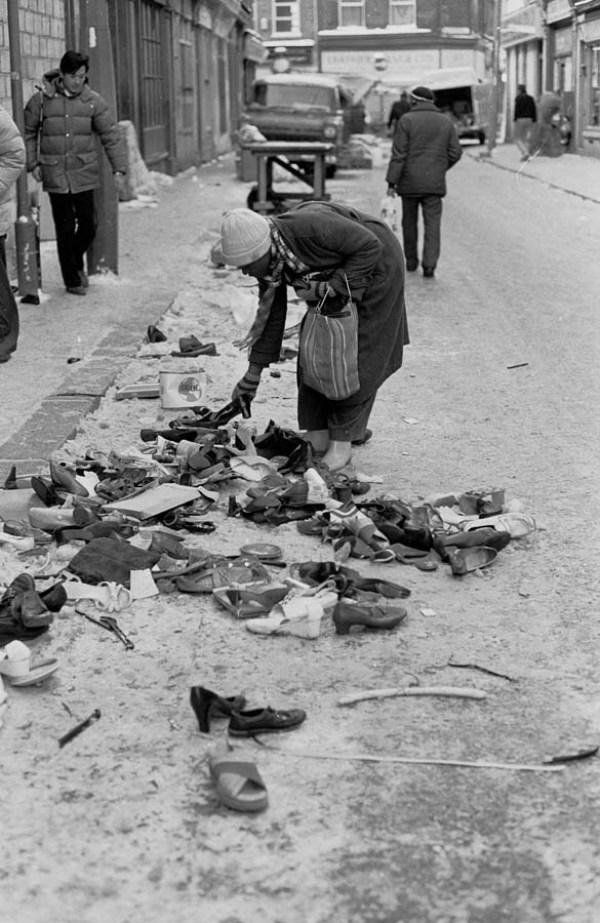


Coming and goings at the corner of Brick Lane.


At the time of the miners’ strike.


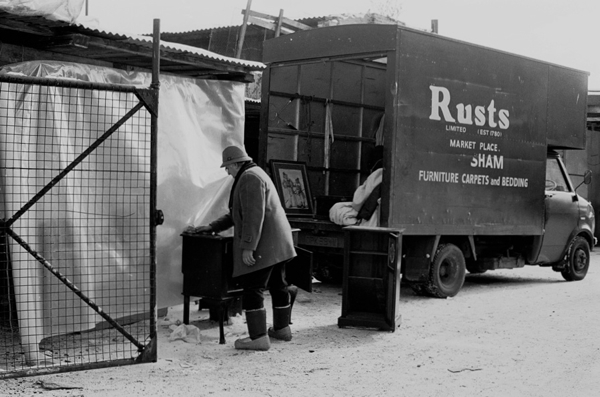


Photographs copyright © Estate of Colin O’Brien
You may also like Cherry Gilchrist’s account of meeting David Bowie
The Story Of Oxford Marmalade
I am proud to publish this story from THE OXFORD SAUSAGE by a graduate of my writing course. The author set out to write a spicy mix of Oxford stories from a house once belonging to a city sausage maker.
I am taking bookings for the next writing course, HOW TO WRITE A BLOG THAT PEOPLE WILL WANT TO READ on February 1st & 2nd. Come to Spitalfields and spend a winter weekend with me in an eighteenth century weaver’s house in Fournier St, enjoy delicious lunches and eat cakes baked to historic recipes, and learn how to write your own blog.
If you are graduate of my course and you would like me to feature your blog, please drop me a line.

Sarah Jane Cooper and her jars of sunshine
One of the activities that perks me up as I claw my way through January is marmalade making. A couple of weeks into the New Year, crates of the required bitter Seville oranges (smaller and more pitted than their sweeter counterparts) appear at Bonners in the covered market here in Oxford.
They are only available for a short period, a couple of weeks if you are lucky. So, as this is a city of marmalade eaters, you must be quick to secure your basketful of Spanish sunshine. My mother used to produce vast quantities, boiling the fruit whole to make the peel soft and easier to shred. She made it principally for my father who loved the thickly cut and chunky variety, spread liberally on buttered toast for breakfast and in suet puddings for Sunday lunch. I use the same recipe though I cut the rind thinner, but the heady smell of boiling fruit and sugar is still sweetly nostalgic for me.
I feel the weight of history as I boil and slice. Because Oxford is as well known for its marmalade as it is for its sausages. Indeed, 151 years ago, at this time of year in 1874, that Sarah Jane Cooper – as the story goes – made her first 75 lbs batch of marmalade just before the birth of her first child, using leftover Seville oranges from her husband Frank’s grocer’s shop in the High St. It was one of several ‘Italian Warehouses’ in the city that sold olive oil, parmesan, tea and hard-to-source oranges amongst other offerings.
Sarah certainly did not invent the bitter spread. More commonly made from quinces – the name is derived from marmelo the Portuguese word for quince, it was used medicinally to settle the stomach and was already popular in Scotland by the nineteenth century. Yet this was Sarah’s own special ‘Oxford’ recipe and it happened to arrive at the right time in the right place. By the eighteen-seventies, lunch was beginning to find favour over the substantial breakfasts of sole, haddock, bacon, eggs, porridge, steak, veal cutlets, kidneys and curried meats still served privately in Oxford college rooms. But toast and marmalade fitted the bill for a cheaper, healthier breakfast that could be eaten communally in the Dining Hall. The jars flew off the shelves and so, after having her baby, Sarah Jane made some more, a lot more. And, as was often the way in those days, her husband took the credit – ‘Frank Cooper’s’ Oxford Marmalade was born.
Sarah came from a well-known local family – the Gills had been ironmongers since the seventeenth century, until quite recently trading from a shop down the narrow alleyway that is Wheatsheaf Yard. To visit was like going back in time, every nook and cranny stacked high with pots, pans and boxes of screws of various sizes which you could buy singly, packed carefully in a brown paper bag. Now ironically the place is a nail bar, but not of the iron sort.
It seems unjust that the concoction Sarah cooked up should be branded with her husband’s name. There is blue plaque in her memory on the eighteenth century house at 83 High St where the family once lived, next to what was the old shop, now the Grand Café. But it is high up and hard to spot, so I hope I am doing my bit to put the record straight.
Cooper’s marmalade was at first produced in copper vats at the back of the shop on the High St by Sarah and a small team. The sweet smell must have been intoxicating as it wafted down the maze of the narrow back alleyways and up through the windows as students were assessed in the Examinations Schools next door. By the turn of the century, its growing popularity demanded an industrial scale of production. In 1903, a purpose-built factory was opened on Park End St – opposite the railway station – each storey catering for a different part of the manufacturing process. And despite the devastation afforded so much of this part of Oxford, it is still there.
Designed by Herbert Quinton and built by Thomas Kingerlee (now in its fifth generation as a family construction business), it is one of the few buildings that deserve attention as you alight from the train hoping for views of dreaming spires. Ornate wrought iron gates still stand where once horse-drawn carriages carried pots of marmalade for direct delivery to the station and shops in town. Huge, light filled curved windows reflect the shape of the roofline and beautifully ornate stone carvings of flowers and oranges adorn the frontage. The factory moved down the Botley Road in 1947, then the family sold up in 1964 and marmalade production moved fo Wantage and then out of the county altogether.
Frank Cooper’s Oxford Marmalade was in its heyday on Park End St. Employing a hundred staff, it was marketed as a cottage industry producing a natural product with no added ingredients, the peel shredded by hand, and packaged in beautiful Malings porcelain jars.
It received the Royal Warrant in 1913 – it was apparently a favourite with King George V – and there is even a tiny sample pot, complete with miniature signature label in Queen Mary’s doll’s house at Windsor. It accompanied Scott on his expedition to the South Pole. One of the only survivors is a rusty tin of the stuff, now on show at the Museum of Oxford, along with other Cooper memorabilia including a huge paddle used to stir the orange jam as it spluttered and spat.
It was to be found on the most aristocratic of breakfast tables. “Cooper’s Oxford, please Linda,” says Nancy Mitford’s Uncle Mathew in ‘The Pursuit of Love’. James Bond eats it in Ian Fleming’s ‘From Russia with Love.’ And you can be sure it was the principal ingredient of the marmalade sandwich the Queen took from her handbag when she met Paddington Bear.
And so it is in Sarah’s memory that I set about concocting what I hope will be a vintage marmalade year. First boiling until the fruit is pillow soft. Cooling, then scooping out the pith and pips, to be boiled again before sieving the amber juices onto the finely shredded peel. Add the warmed sugar, then watching while it boils because if you are not careful it will burn.
Marmalade makers can be a difficult bunch. We all do it slightly differently. Some use brown sugar which makes it darker and richer, others add cardamon or whisky. There is also the question of consistency. I prefer mine not so stiff that it stands to attention but not so runny that it dribbles down your sleeve. I know I have made a good marmalade when I hold the jars up to the light and the thin strands of orange seem to have stopped in the middle of a lively dance, suspended in pure sunshine. Sunshine on toast. I will settle for that. Thank you Sarah Jane Cooper.

On the left is 83 High St where Sarah Jane Cooper made her marmalade

The former jam factory in Park St, Oxford
 Women in aprons and removable sleeves to protect clothes, shredding oranges at the jam factory. (courtesy Historic England)

The tin of Oxford marmalade that accompanied Scott to the South Pole

My Seville oranges. I boil them whole and then let them cool so the peel is soft enough to shred easily.

Scoop out the pulp and pips, and add to the liquid. This is what gives it a good set. Cool then strain.

Add the shredded peel and sugar. Then, once dissolved, boil for about twenty minutes.

My Oxford marmalade
Photographs copyright © John Milnes


