
Alan Dein’s East End Shopfronts Revisited
As part of the exhibition After You’ve Gone: East End Shopfronts 1988 by Alan Dein at the Tower Hamlets Local History Library & Archives, Ais Clafferty went out to photograph the same locations today. A quarter of a century later, each has been transformed – some for the better, others for the worse and, in one example, time appears to have gone centuries backwards.
(Captions by exhibition curator Emma Hunt.)

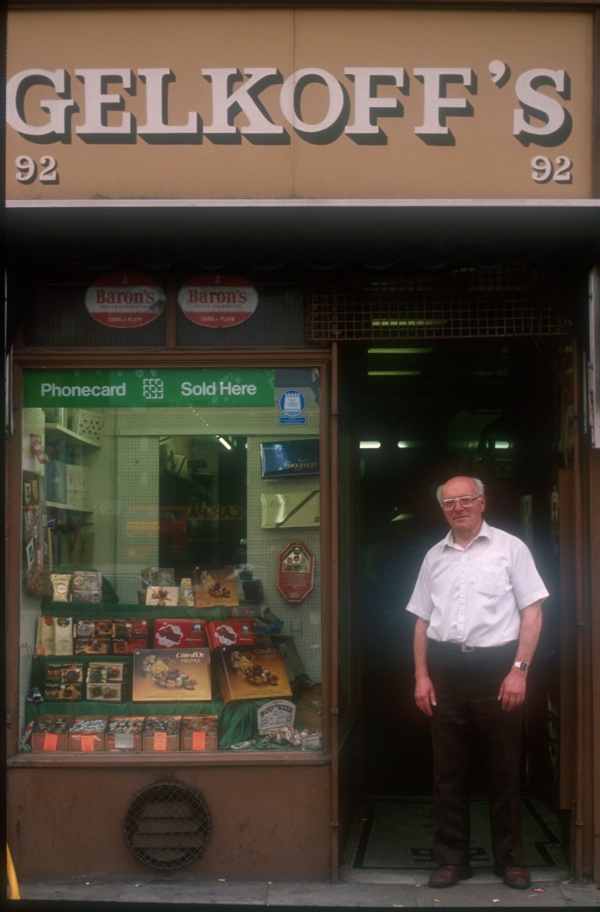
92 Whitechapel High St, 1988.

92 Whitechapel High St, 2012.
Mr Gelkoff stands in the doorway of his shop, imported chocolate meticulously arranged in the window case. His son Barry remembers the smell of chocolates, and the pride his family took in stocking the best and newest lines from all over Europe. Barry closed the shop in 1998, so his parents could retire.

65 Redchurch St, 1988.

65 Redchurch St, 2012.
J.Kay had been gone for at least fifteen years when Alan took this photo. Previously registered as various different furniture dealers, it even enjoyed a brief stint in the thirties as Vittora Ferrari’s Dining Rooms.

47 Quaker St, 1988.

47 Quaker St, 2012.
Leon Kuczynski is remembered fondly by his customers as a Polish or Russian Jew, sitting always on a stool at the counter, head in a newspaper, patiently waiting while local kids chose their sweets and ice creams. He had three of his own, a neighbour recalls, who all went into professions, left the neighbourhood and made their father proud.

30 Toynbee Sr, 1988.

30 Toynbee St, 2012.
Louis Simpson’s shop dates back to 1957 and continued trading until 1986. There had been a kosher butcher at this address since the building was erected at the beginning of the thirties. Frank Plaskowski and Harris Marks were both listed as proprietors at different times.

28a Goulston St, 1988.

Site of 28a Goulston St, 2012.
Schloss’ Woollens started trading in 1930 in Goulston St close to Petticoat Lane Market. By the time Alan took his picture in 1988, it was one of only two businesses still listed on the street. In 2004, the block was redeveloped to become part of the London Metropolitan University.

32 Hessel St, 1988.

32 Hessel St, 2012.
The East Enders Social Club has left no record.

205 Mile End Rd, 1988.

205 Mile End Rd, 2012.
Schwartz’s Shoes maintained a presence in the East End for most of the twentieth century. Samuel Schwartz, boot dealer, is listed at 127 White Horse Lane from the twenties to the mid-forties, before moving to 258-260, 250 and finally 205 Mile End Rd in 1972. The shop closed the year the picture was taken.

7 Toynbee St, 1988.

7 Toynbee St, 2012.
Conway stood at 7 Toynbee St from the early fifties until the late seventies. Originally listed as Frank Conway, warehouseman, the business later became Conway Automatics Ltd, and finally Conway Trading Ltd. By 1980, the shop had moved to 19 Toynbee St and an uncovered sign further down the street reveals another location at number 15.

111 Mile End Rd, 1988.

111 Mile End Rd, 2012.
Empty since 1973, Walter’s was one of four shops at 107-111 Mile End Rd, hiding the Georgian terrace houses behind for over a century. Nearly lost forever, the Grade II listed buildings were eventually bought by the Spitalfields Historic Buildings Trust and restored to their former glory.

34 Alderney Rd, 1988.

34 Alderney Rd, 2012.
Daniel Bliss was a secondhand furniture shop from the mid-forties until 1984. The name was originally Blitz, changed to Bliss after the bombing of World War II in which a member of the family was killed.

34 Alderney Rd 1979, painting by Geoffrey Fletcher.
1988 photographs copyright © Alan Dein
2012 photographs copyright © Ais Clafferty
After You’ve Gone: East End Shopfronts 1988 by Alan Dein runs from Thursday 17th May until Thursday 12th July at the Tower Hamlets Local History Library & Archives, 277 Bancroft Road, E1. Opening times for the exhibition are here. Alan Dein will give a talk on Saturday 9th June at 2.00pm.
Geoffrey Fletcher’s painting can be seen on the alongside other pictures in the Tower Hamlets Collection as part the National Archive of Paintings online here.
You may also like to see the original post
Happy Birthday Mavis Bullwinkle!

Mavis Bullwinkle
Today we are celebrating the birthday of one of Spitalfields’ best-loved residents, Mavis Bullwinkle. We count ourselves favoured that, apart from her six years enforced exile as an evacuee in Aylesbury during World War Two, Mavis has shown the good sense to spend her entire eighty years here. In this picture, you can see her standing at the door of the church house in Buxton St where her grandfather Richard Pugh lived when he came from North Wales as a lay preacher in 1898 to minister to the people of the East End, and it was here that Mavis’ mother Gwen was born in 1899. I regret that we cannot turn back the wheels of time, so that Richard could step through this door to wish his granddaughter a happy birthday, but the unfortunate reality is that he died of pneumonia in 1905 and left Mavis’ grandmother to bring up seven children alone – an event which created repercussions that resonate to this day for Mavis.
Yet Mavis displayed her characteristic good humour, amplified by her bright red ankle-length raincoat, when I met her outside Christ Church after morning prayers on an especially grey and cloudy morning this week. And it was my privilege to take a stroll around the neighbourhood with Mavis, as she pointed out some of the landmarks on her personal landscape, because after her eighty years, there are few who know Spitalfields as well as Mavis.
Although Mavis remembers Christ Church (or “Spitalfields Church” as she knew it) when her Uncle Albert Pugh was caretaker at during the nineteen thirties, she did not come here regularly until 1951 when her local church All Saints in Buxton St was shut. “I found it very gaunt with all that dark masonry,” she recalled, rolling her eyes dramatically and casting her gaze up to the tall spire looming over us. Then, in 1958, death watch beetle was discovered at Christ Church and this was shut too. “They found it on the Thursday and it was closed by the weekend,” Mavis revealed in a disappointed tone, “My sister Margaret was due to be married on the Saturday and she had to make do with the horrible hall in Hanbury St.”
Already the rain was setting in, so we set off briskly towards the Hanbury Hall and Mavis ameliorated her opinion of the place by the time we got there. “My uncle and his family lived here on the ground floor,” she explained, “the bedroom was on the right of the entrance and the living room and kitchen to left.” Mavis told me there was so much unemployment in the nineteen twenties that young men were encouraged to go to Australia and, eager to relieve the burden on his mother, Albert emigrated at nineteen, only to have an accident in the Outback that left him with a curvature of the spine. On his return, he found it even harder to get work until the rector of Christ Church appointed him caretaker. And when he died young in 1943, leaving a wife and two girls, the Rector arranged for them to have a flat in the market building at the corner of Brushfield St. Mavis taught at the Sunday School here at the Hanbury Hall from 1951 until 1981, while the congregation was in exile, and she stood in the rain looking up at the building in disbelief that so much time could have passed.
Then we set off towards the the north-easterly quarter of Spitalfields, once known as Mile End New Town, to the small web of streets which Mavis counts as home and that remains the focus of her existence. Taking a minor detour down Brick Lane to visit the former Mayfair Cinema – once an Odeon and now Cafe Naz – where Mavis came in her teens with her mother during the nineteen forties, “We didn’t come down here much otherwise,” she admitted with a shrug, “We did our shopping in Whitechapel or Bethnal Green.”
The nature of our odyssey caused Mavis to peer in wonder at her familiar streets. “When you live in a place so long you take it for granted, until it’s not there anymore and then you can’t even remember what was there before.” she confessed as we turned from Brick Lane into Buxton St, approaching Allen Gardens. Before the green field that we know today, Mavis recalls a warren of little streets here surrounding All Saints Church, the centre of her emotional and social universe growing up in Albert Family Dwellings in Deal St. This was the block her grandmother moved into in 1905 and Mavis moved out of in 1979 when it was demolished.
“The Reverend Holdstock used to give wonderful Christmas parties, and I had some of the happiest times of my life in here,” she confided to me as we stood outside the square rectory, one of the few old buildings remaining in the street today. “Around 1913, when my aunt Esther was young, she remembered meeting the cows coming up Buxton St to be milked, each morning as she was on her way to work at a factory in Shoreditch.” Mavis informed me, gesturing back towards the Lane and conjuring an image of the herd. When Mavis’ grandfather died, her Aunt Esther had to give up her training to be a teacher, working first as a nanny in the vicarage and then at a clothing factory. “She never got over it that she never got to be a teacher,” recalled Mavis tenderly, “and when she used to go on about it, I’d remind her that if she’d never gone to work in the factory she’d never have met her husband, Uncle John.”
Then we reached the patch of green where the church of All Saints once stood. “It was a very pretty church, late Victorian,” she told me, “built at the same time as the terraces round here. In those days people wouldn’t live somewhere unless there was a church. It was damaged by the bombing and once, when the rain came in the roof, the vicar made a hole in the floor with his umbrella so that it could drain away.”
From here, we walked down Deal St where Albert Family Dwellings formerly stood on the south corner of Underwood Rd. Only the the iron bollards labelled M. E. N. T. remain today to indicate that this was once Mile End New Town. Yet in Mavis’ mind it all still exists – the Prince of Wales pub on the corner of Buxton St, Davis’ Welsh Dairy on the north corner of Underwood Rd and Mrs Finkelstein’s sweetshop opposite, where for penny you could put your hand in a bran tub and get a little thing to put in your dolls’ house. Standing outside the former entrance of Albert Family Dwellings, Mavis recalled the evening of 2nd September 1939 when she and her sister Margaret were summoned to the school to be evacuated without being told where, and Mavis’ mother went home alone clutching a card with her daughters’ address in Aylesbury. Today, Mavis is probably the only witness to the former life of these streets that still resides in this location and the empty pavements are crowded with memories for her.
Mavis gave up a career in the City in preference to a lower paid job as a secretary at the Royal London Hospital because she wanted to be of service to people, and she worked there for forty years. Her grandfather Richard Pugh, the lay preacher from Wales, would have been proud of Mavis, following his example. The last of the Bullwinkles in Tower Hamlets, she fills with delight to speak of Spitalfields, and more than a century of striving and thriving in her family in this corner of the East End. Out of almost everyone I know, Mavis could most be said to be of this place. With a self-effacing nature, she has shown moral courage and selflessness in her work at the hospital, and in caring for her mother and two aunts until they died at ripe old ages. After eighty years, Mavis Bullwinkle knows what it means to live, and we salute her example and applaud her spirit.

Gwen Bullwinkle holds up Mavis in Hanbury St in 1933. “Every time my mother saw this picture, she would say, ‘Fancy taking us outside a pub!'”

Mavis by the War Memorial at Christ Church which her father Alf tended. “He used to grow flowers around it and keep it tidy.”

All Saints Sunday School in 1939 – seven year old Mavis is in the second row on the extreme right and her five year old sister Margaret is on her right.

Mavis outside the former rectory of All Saints Church. “I had some of the happiest times of my life here.”


Mavis & Margaret’s evacuation card, 1939.

Mavis stands on the spot where All Saints Church used to be in Buxton St until 1951.


Spitalfields’ celebrations for the coronation of King George VI, 1937.

Mavis in Vallance Rd outside the house of Quaker philanthropist Mary Hughes, daughter of Thomas Hughes. “Mary Hughes came up to my mother pushing me in a pram in the Whitechapel Rd in 1932 and exclaimed ‘Oh you wonderful mother!’ She was a little old lady dressed in black silk, from the nineteenth century, and my mother pulled away in fear. Only later did she learn who it was.”
You may also like to read my original profile
and
When Mavis Bullwinkle met Norah Pam
and
Mavis, Henrietta & Joan Chit Chat
PLEASE LEAVE YOUR BIRTHDAY MESSAGES BELOW FOR MAVIS
Alan Dein’s East End Shopfronts of 1988
First published by Spitalfields Life two years ago, Alan Dein’s photographs are now the subject of an exhibition at Tower Hamlets Local History Library & Archives in Mile End, giving history and context to these shopfronts. I am republishing the pictures today to celebrate this show which opens tonight and runs until 12th July.

P.Lipman, Kosher Poultry Dealers, Hessel St
“In my twenties, I’d been doing a number of oral history recordings, working for the Museum of the Jewish East End which was very active recording stories of the life of Jewish people who had settled here.” explained Alan Dein, broadcaster and oral historian, outlining the background to his unique collection of more than a hundred photographs of East End shopfronts.
“My photographs of the derelict shopfronts record the last moments of the Jewish community in the area. The bustling world of the inter-war years had been moved into the suburbs, and the community that stayed behind was less identifiable. In the nineteen eighties they were just hanging on, some premises had been empty for more than five years. They were like a mouthful of broken teeth, a boxer’s mouth that had been thumped, with holes where teeth once were.”
Feeding his twin passions for photography and collecting, Alan took these pictures in 1988 while walking around the streets of the East End at a time when dereliction prevailed. Although his family came from the Jewish East End and his Uncle Lou was a waiter at Blooms, Alan was born elsewhere and first came to study . “As a student at the City of London Polytechnic in Old Castle St, I spent a lot of time hanging out here – though the heart of the area for me at that time was the student common room and bar.” he told me.
“Afterwards, in 1988, I moved back to live in a co-operative housing scheme in Whitehorse Rd in Stepney and then I had more time to walk around in this landscape that evoked the fragmentary tales I knew of my grandparents’ lives in the East End. The story I heard from their generation of the ‘monkey parade’, when once people walked up and down the Mile End Road to admire the gleaming shopfronts and goods on display. My family thought I was mad to move back because when they left the East End they put it behind them, and it didn’t reflect their aspirations for me.
The eighties were a terrible time for removing everything, comparable to what the Victorians had done a century earlier. But I have always loved peeling paint, paint that has been weathered and worn seafront textures, and this was just at the last moment before these buildings were going to be redeveloped, so I photographed the shopfronts because this landscape was not going to last.”
In many of these pictures, there is an uneasy contradiction between the proud facades and the tale of disappointment which time and humanity has written upon them. This is the source of the emotionalism in these photographs, seeing faded optimism still manifest in the confident choice of colours and the sprightly signwriting, becoming a palimpsest overwritten by the elements, human neglect and graffiti. In spite of the flatness of these impermeable surfaces, in each case we know a story has been enclosed that is now shut off from us for ever. Beyond their obvious importance as an architectural and a social record, Alan’s library of shopfronts are also a map of his exploration of his own cultural history – their cumulative heartbreak exposing an unlocated grief that is easily overlooked in the wider social narrative of the movement of people from the East End to better housing in the suburbs.
Yet Alan sees hope in these tantalising pictures too, in particular the photo at the top, of Lipman’s Kosher Poultry Dealers, in which the unknown painter ran out of paint while erasing the name of the business, leaving the word “Lip” visible. “A little bit of lip!” as Alan Dein terms it brightly, emblematic of an undying resilience in the face of turbulent social change.

Goulston St

In Whitechapel

Commercial Rd

Redchurch St

Stepney Green

Cheshire St

Alie St

Hessel St

Hackney Rd

Quaker St

Mile End Rd

Toynbee St

Alie St

In E2

Brick Lane

Great Eastern St

Commercial St

Hessel St

Mile End Rd

Relocated to Edgeware

Bow Common Lane

Brick Lane

Ben Jonson Rd

Wilkes St

Bow Rd

Ridley Rd

New Goulston St.
Whitechapel High St

Alderney Rd, Stepney
Photographs copyright © Alan Dein
After You’ve Gone: East End Shopfronts 1988 by Alan Dein runs from Thursday 17th May until Thursday 12th July at the Tower Hamlets Local History Library & Archives, 277 Bancroft Road, E1. You must email localhistory@towerhamlets.gov.uk if you want to attend tonight’s launch. Opening times for the exhibition are here. Alan Dein will give a talk on Saturday 9th June at 2.00pm.
Even More Delft Tiles by Paul Bommer
For those who missed Paul Bommer‘s exhibition in Wilkes St last month, it my pleasure to publish the fourth and last batch of his faux delft tiles from that show, many inspired by stories here in the pages of Spitafields Life. Subsequently, Paul has been inundated with commissions to design new delft tile fireplaces for old houses in Spitalfields – I will keep you posted of developments.


The Auriculas of Spitalfields.


The Pear Tree where John Williams, suspect in the Ratcliffe Highway Murders was arrested.

Rhyming slang.

From The Signs of Old London.

A Night in the Bakery at St John.

According to legend, Brutus came from Troy to found London.

Catherine Wheel Alley, Spitalfields.

From The Signs of Old London.

Old Father Thames.

William Shakespeare in Spitalfields.

Grasshopper, symbol of Thomas Gresham, from The Signs of Old London.

“Three for a girl and four for a …”

Garnet St, Wapping.

Rhyming slang.

The Gun, Brushfield St.

Half Moon, Holywell St, from The Signs of Old London.


Quaker St, Spitalfields.

The Fox, Lombard St, from The Signs of Old London.

Images copyright © Paul Bommer
You may like to see the earlier selections of
More of Paul Bommer’s Delft Tiles
Yet More of Paul Bommer’s Delft Tiles
and also read about
In a Lonely Place

Pedley St Arch, Spitalfields, 1987
Photographer John Claridge told me that he enjoys his own company, which casts an equivocation upon the title he gave this set of pictures – published here for the first time – that he took in the East End between 1960 and 1987. As a kid photographer from Plaistow, succumbing to the thrall of Film Noir and Italian Neo-Realism, John set out with his camera to look at his own territory in the light of these inspirations. And the result is a collection of intriguingly moody images that reveal unexpected beauty, humanity, and even humour, in locations devoid of figures, yet tense with dramatic potential.
Two themes are emergent in these depopulated pictures of the East End in eternal half-light. One theme is the unlikely placing of familiar objects in locations that propose hidden narratives and the other theme is spaces that contain the anticipation of a human presence. Both are strategies inviting the viewer to ask questions, investigate the nature of the photograph and draw their own conclusion.
When John photographs a pair of shoes in the street, or a pram, or a pair of sofas, or an armchair, or even a clapped-out old car, there is always a sense that these things have been put there deliberately as part of a mysterious scenario, not abandoned but awaiting their owners’ return. Similarly, mannequins in a window or a picture of a girl used to repair a pane of glass, also appear meaningful in an unexplained way, asking us to do our own detective work. And the old sign announcing “News of the World” above a door unopened in years makes its own statement of existential significance. Scrutinise John’s picture of Upton Park station disappearing into the dawn mist, or the receding columns of E16, or the pictures of the Pedley St arch, each ripe with suspense. Would you be surprised to see a hoodlum in a fedora with a gun step from the shadows, or an amorous femme fatale in a trench coat come strolling to a rendezvous?
While many left the East End after the war to seek new lives in the suburbs, there were others who stayed and were comfortable living among the bombsites and empty houses, and in his youth John counted himself in the latter category. “I didn’t find it depressing,” he assured me, “because there was still a kind of community. I loved it. There was destruction everywhere yet you couldn’t destroy people’s spirits. But when they took their gardens away and put people in towers where they didn’t know their neighbours, that was destruction of another kind.”
John is keenly aware that outsiders may project their own tragic interpretations upon these pictures of dereliction but, as one who is not ashamed to call himself a Romantic, he asks – “Is it really a lonely place, or is it all in the mind?”

Mannequins, E1, 1968.

Pylon in Early Morning, E3, 1968.

News of the World, E1, 1968.

Shoes, E2, 1963.

Armchair, E1, 1965.

Lamp, E16, 1982.

Pram, E14, 1968.

Upton Park at Dawn, E13, 1966.

Circus Poster, E7, 1975.

Columns, E15, 1982.

Sewer Bank, E13, 1963.

Girl in the Window, E2, 1966.

End of the Street, E1, 1982

Ford, E13, 1961.

Beckton Gas Works, E6, 1987.

Volkswagon, E14, 1970.

Half a Building, E13, 1962.

Gravestones, E7, 1960.

Pedley St Arch, Spitalfields, 1987.
Photographs copyright © John Claridge
You may also like to take a look at
Tif Hunter’s Maltby St Portraits (Part Two)

Steve Benbow, London Honey Company
Once upon a time, Steve Benbow, the urban beekeeper, sold honey from the back of an old Morris Traveller in Brushfield St at the entrance to the Spitalfields Market. You may recall when Steve was first introduced in these pages, seeking homes for bees, and then – through the intervention of one of our readers – he was granted the roof of the Tate Gallery to keep his hives. These days, Steve has a railway arch in Maltby St, Bermondsey, and it was here that Tif Hunter took this portrait as part of his series recording the community of those who have created this flourishing endeavour, selling honestly produced food and drawing customers from across the London every Saturday morning.
Yet even as Tif completed his set of portraits, other railway arches opened up just a little further down the line at Spa Terminus, and some of the traders from Maltby St transferred to these larger spaces while new companies moved into those which had been vacated – confirming the contingent nature of all markets, endlessly shifting and evolving as street commerce ebbs and flows in the city.
Taken with a 5×4 nineteenth-century-style camera using just a single exposure for each portrait, Tif’s pictures are remarkable for their spontaneity, emphasising the ephemeral quality of the image. But when he set out to take these luminous photographs, he did not realise that Maltby St itself would change so quickly, granting them an extra level of transient poetry. Fortuitously, Tif Hunter’s set of portraits exists now as the record of a critical moment at Maltby St – the time before this current metamorphosis began.

Philip – Jacob’s Ladder Farms

Lucie – The Ham & Cheese Company

Archie – Coleman Coffee Roasters

Kitty – La Grotta Ices

Roy – Neal’s Yard Dairy

Paul – Tayshaw Limited

Flori – Monmouth Coffee Company

Archie – The Ham & Cheese Company

Claire – Violet Bakery

Roberto – Monmouth Coffee Company

Alaena – Kase Swiss

Harry – 40 Maltby St

Barbara – Kernel Brewery

Harry – Fern Verrow

Georgia – St John Bakery

Tristan – Fern Verrow

Lucy – St John Bakery

Nathan – The Butchery Ltd

Tania – Kernel Brewery
Photographs copyright © Tif Hunter
You may also like to see
Tif Hunter’s Maltby St Portraits (Part One)
and read about
The Auriculas of Spitalfields

An auricula theatre
In horticultural lore, auriculas have always been associated with Spitalfields and writer Patricia Cleveland-Peck has a mission to bring them back again. She believes that the Huguenots brought them here more than three centuries ago, perhaps snatching a twist of seeds as they fled their homeland and then cultivating them in the enclosed gardens of the merchants’ grand houses, and in the weavers’ yards and allotments, thus initiating a passionate culture of domestic horticulture among the working people of the East End which endures to this day.
You only have to cast your eyes upon the wonder of an auricula theatre filled with specimens in bloom – as I did in Patricia’s Sussex garden last week – to understand why these most artificial of flowers can hold you in thrall with the infinite variety of their colour and form. “They are much more like pets than plants,” Patricia admitted to me as we stood in her greenhouse surrounded by seedlings,“because you have to look after them daily, feed them twice a week in the growing season, remove offshoots and repot them once a year. Yet they’re not hard to grow and it’s very relaxing, the perfect antidote to writing, because when you are stuck for an idea you can always tend your auriculas.” Patricia taught herself old French and Latin to research the history of the auricula, but the summit of her investigation was when she reached the top of the Kitzbüheler Horn, high in the Austrian Alps where the ancestor plants of the cultivated varieties are to be found.
Auriculas were first recorded in England in the Elizabethan period as a passtime of the elite but it was in the eighteenth and nineteenth centuries that they became a widespread passion amongst horticulturalists of all classes. In 1795, John Thelwall, son of a Spitalfields silk mercer wrote, “I remember the time myself when a man who was a tolerable workman in the fields had generally beside the apartment in which he carried on his vocation, a small summer house and a narrow slip of a garden at the outskirts of the town where he spent his Monday either in flying his pigeons or raising his tulips.” Auriculas were included alongside tulips among those prized species known as the “Floristry Flowers,” plants renowned for their status, which were grown for competition by flower fanciers at “Florists’ Feasts,” the precursors of the modern flower show. These events were recorded as taking place in Spitalfields with prizes such as a copper kettle or a ladle and, after the day’s judging, the plants were all placed upon a long table where the contests sat to enjoy a meal together known as “a shilling ordinary.”
In the nineteenth century, Henry Mayhew wrote of the weavers of Spitalfields that “their love of flowers to this day is a strongly marked characteristic of the class.” and, in 1840, Edward Church who lived in Spital Sq recorded that “the weavers were almost the only botanists of their day in the metropolis.” It was this enthusiasm that maintained a regular flower market in Bethnal Green which eventually segued into the Columbia Rd Flower Market of our day.
Known variously in the past as ricklers, painted ladies and bears’ ears, auriculas come in different classes, show auriculas, alpines, doubles, stripes and borders – each class containing a vast diversity of variants. Beyond their aesthetic appeal, Patricia is interested in the political, religious, cultural and economic history of the auricula, but the best starting point to commence your relationship with this fascinating plant is to feast your eyes upon the dizzying collective spectacle of star performers gathered in an auricula theatre. As Sacheverell Sitwell once wrote, “The perfection of a stage auricula is that of the most exquisite Meissen porcelain or of the most lovely silk stuffs of Isfahan and yet it is a living growing thing.”

Mrs Cairns Old Blue – a border auricula

Glenelg – a show-fancy green-edged auricula

Piers Telford – a gold-centred alpine auricula

Taffetta – a show-self auricula

Seen a Ghost – a show-striped auricula

Sirius – gold-centred alpine auricula

Coventry St – a show-self auricula

M. L. King – show-self auricula

Mrs Herne – gold-centred alpine auricula

Dales Red – border auricula

Pink Gem – double auricula

Summer Wine – gold-centred alpine auricula

McWatt’s Blue – border auricula

Rajah – show-fancy auricula

Cornmeal – show-green-edged auricula

Fanny Meerbeek – show-fancy auricula

Piglet – double auricula

Basuto – gold-centred alpine auricula

Blue Velvet – border auricula

Patricia Cleveland-Peck in her greenhouse.


Next year, I hope to arrange to bring Patricia Cleveland-Peck’s auricula theatre to display in Spitalfields and invite you all to see it, but in the meantime I recommend her magnificent and authoritative work Auriculas Through the Ages, available here
You may also like to take a look at


