
Faulkner’s Street Cries
These cards produced by W. & F. Faulkner Ltd and issued with Grenadier Cigarettes in 1902 are the latest discovery in my ongoing exploration of the myriad versions of the Cries of London created down through the ages. Even the most sentimental images can reveal something of the reality of the working lives of hawkers, and I especially like this precisely observed set of surly, cantankerous portraits which convey the relentless nature of street trading with a rare mixture of wit and affection.

Flypaper seller.

Cats’ meat man.

Ice cream seller.

Chimney sweep.

Knife grinder.

Coalman.

Baked potato seller.

Dairyman.

Lavender seller.

Newspaper seller.

Novelties seller.

The muffin man.
You may like to take a look at these other sets of the Cries of London
William Craig Marshall’s Itinerant Traders
H.W.Petherick’s London Characters
John Thomson’s Street Life in London
Aunt Busy Bee’s New London Cries
Marcellus Laroon’s Cries of London
More John Player’s Cries of London
William Nicholson’s London Types
Francis Wheatley’s Cries of London
John Thomas Smith’s Vagabondiana of 1817
John Thomas Smith’s Vagabondiana II
John Thomas Smith’s Vagabondiana III
Thomas Rowlandson’s Lower Orders
The Printer, the Sculptor & the Huguenot
Please join me for a CHIT CHAT at LXV Books, 65 Roman Rd, Bethnal Green next Thursday 17th May at 7pm with my good friends Gary Arber, the printer, Roy Emmins, the sculptor, and Stanley Rondeau, the eighth generation Huguenot.
Tickets are £3, available from LVX Books 020 8983 2087 or email admin@lxvbooks.com. Wine will be served and books signed afterwards.


Crudgie, Motorbicycle Courier

Behold the noble Crudgie!
I have been hoping for the opportunity to catch up with Crudgie ever since we were first introduced at the Fish Harvest Festival last year, so this week I was delighted to accept his invitation to meet at that legendary bikers’ rendezvous, the Ace Cafe on the North Circular.
Over six foot six in height, clad head to toe in black leather, with extravagant facial hair trained into straggling locks and carrying the unmistakable whiff of engine oil wherever he goes, Crudgie makes an unforgettable impression. Crudgie’s monumental stature, beady roving eyes and bold craggy features adorned with personal topiary, give him the presence of one from medieval mythology, like Merlin on a motorbike. Yet in spite of his awesome appearance and gruff voice, I found Crudgie a warm and friendly personality, even if he does not suffer fools gladly, issuing fearsome warnings to pedestrians not to get in his way.
“I’m only called by my surname, Crudgington. “Ington” means family living in an enclosed dwelling, and “crud” is a variation of curd, so they were probably cheesemakers. There’s a place in Shropshire named Crudgington, but there’s nobody buried in the church with that name, nobody living there with that name either and nobody that lives there has ever heard of anybody called Crudgington. The shortened version of my name came about when I went to play rugby and cricket where everyone gets a nickname ending in “ie.” I’ve swum for the county, and competed as an athlete in the four hundred metres and javelin, as well.
I grew up in Billericay, famous for being the first place to count the votes in the General Election. My father was builder called Henry but everyone knew him as Nobby. I went into banking for ten years in Essex but I couldn’t get on with it, even though I was the youngest person ever to pass the banking exam. So then I went to work in insurance in the City, I worked for Barclays for ten years and played for their rugby team until they couldn’t afford to fund it anymore. In the nineteen nineties, I felt I was getting nowhere in insurance so I started motorbicycle couriering. I got a motorbike from my parents for fifteenth birthday, so I’ve always been a biker and I do thousands of miles on it every year, going to sporting events, meet-ups and scrambles.
It’s the camaraderie of it that appeals to me, meeting up with your mates, but unfortunately you are perceived as an outlaw. I have been stopped eighty-nine times in twenty-one years by the police. Apparently, couriers are the second most-disliked Londoners after Estate Agents. It’s because people get scared out of their wits when they are not thinking where they are going and a courier brushes by and gives them the shock of their life. People should look where they are going. If you are going to hit a pedestrian, it’s best to hit them them straight on, that way they get thrown over the handlebars. A few cuts and bruises, but nobody gets killed by a motorbicycle. Whereas if you veer to either side to avoid them, the danger is you clip them with your handlebars and it sends you into a tailspin, and you fall off.
I’m a member of the most important biker club – The 59 Club, set up by Father Bill Shergold in 1959. He was a vicar who was a biker, and he wanted to bring the mods and rockers together, so he opened up in a church hall in West London in 1961 and on the first day he had Cliff Richard & The Shadows performing there. Then in 1985, it moved to Yorkton St, Bethnal Green. It was open three days a week, and you could go in and have a cup of tea after work. They had a bike repair workshop for maintenance, two snooker tables and a stage where lots of bands performed. And once a year, you could go to a church service. They moved to Plaistow now, but everybody that was in it is still in it – it’s the largest bike club in the world.
There’s only a few British couriers left, most are Brazilians now. It used to be Polish until they earned enough money and all went back home. Once upon a time, there was a lot of money in it though it’s gone down thanks to technology, but the beauty is you can work when you like and you get to go interesting places that you’d never go otherwise. I’ve picked up the Queen’s hair products from SW3 and driven into Buckingham Palace to deliver them. I do a lot of deliveries for film companies and quite often I stay around on set to watch, especially if it’s in some interesting stately home that you wouldn’t normally get to visit. If I have to go somewhere on a journey out of London, I always take time to visit the museum or castle or whatever there is to see.
I’ve worked from nine until seven for years, but I’ve decided I’m only going to do nine thirty to six because I’m getting old. If I had independent funds, I wouldn’t be riding anymore. I haven’t missed a day in quite a few years and I’ve only ever had one week off in twenty years…”
When I arrived at the Ace Cafe, I saw Crudgie’s bike outside and I spotted him through the window, head and shoulders above his fellows. Inside, a long counter ran along one wall, facing a line of windows looking out on the North Circular, and the space in between was filled by tables, scattered with helmets to indicate those which were reserved by customers. Once Crudgie had greeted me with a firm bikers’ handshake, we settled by the window where he squeezed every drop from his teabag to achieve a beverage that was so strong it was almost black. A characteristic Crudgie brew.
Like the questing knight or the solitary cowboy, Crudgie has no choice but to follow his ordained path through the world, yet he is a law unto himself and the grime he acquires speeding through the traffic is his proud badge of independence. A loner riding the city streets with his magnificent nose faced into the wind, Crudgie is his own master.


Crudgie at the Ace Cafe on the North Circular. “- Like Merlin on a motorbike.”
You may also like to read
The Last Fish Porters of Billingsgate Market

John Schofield, porter for thirty years
The fish porters of Billingsgate Market have been abolished. On 28th April this year, a centuries-old way of life came to an end as the porters who have been in existence since Billingsgate started trading in 1699 had their licences withdrawn by the City of London Corporation. Long-established rights and working practises – and a vibrant culture possessing its own language and code of behaviour handed down for generations – were all swept away overnight to be replaced by cheaper casual labour.
Thus, a cut in economic cost was achieved through an increase in human cost by degrading the workforce at the market. The City recognised the potential value of the land occupied by the Billingsgate fish market at the foot of the Canary Wharf towers, and the abolition of the porters was their first step towards moving it out and redeveloping the site.
While the news media all but passed this story by, photographer Claudia Leisinger took the brave initiative herself to be down at the market continuously throughout the last winter, documenting the last days of this historic endeavour, and taking these tender portraits of the porters in the dawn, which record the plain human dignity they have shown as their livelihood and identity were taken from them .
“My interest in the Billingsgate porters’ story stems from a fascination with the disappearance of manual labour, work generally considered menial by our society, yet carried out with a great deal of pride and passion by those small communities involved.” Claudia told me, and it is to her credit that in a moment of such vulnerability these men trusted her to be their witness for posterity.

Bradley Holmes, porter for twenty years.

Nick Wilson, porter for twelve years.

Micky Durrell, porter for forty-five years.

Jeff Willis, porter for twenty-five years.

Gary Simmons, porter for thirty-three years.

Dave Bates, porter for twenty-two years.

Conor Olroyd, apprentice porter.

Three generations – Edwin Singers, porter for fifty-three years, with his son, Leigh Singers, porter, and grandson, Brett Singers, porter.

Steven Black, porter for twenty years.

Tony Mitchell & Steve Martin, both porters for over thirty-two years.

Martin Bicker, porter for twenty-four years.

Andy Clarke, porter for two years.

Laurie Bellamy, porter for thirty-one years.

Alfie Sands, shopboy.

Gary Durden, porter for thirty-one years.

Jack Preston, porter for two years.

Dicky Barrott, porter for twenty years.

Alan Downing, porter for forty-five years, with his grandson Sam who comes down on Saturdays.

Dave Auldis, porter for six years.

Colin Walker, porter for forty-six years.

Brett Singers, shopboy for three years.

Bobby Jones, porter for thirty years.

Basil Wraite, porter for thirty-one years.

Steve Sheet, porter for fifteen years.

Steve Jones, porter for thirty years.

Greg Jacobs, porter for thirty-two years.

Chris Gill, porter for thirty-two years.

Photographs copyright © Claudia Leisinger
See more of Claudia Leisinger’s Billingsgate pictures and hear the voices of the porters by clicking here
You may like to read these other Billingsgate stories
A Walk With Rodney Archer

Rodney with the birch tree he planted in Fournier St in 1985.
Rodney Archer is one of Spitalfields’ most popular long-term residents, and over the years he has seen many come and go as part of the transformation that has overcome the place since he came to live here in 1980. Among the the few occupants that is not a millionaire in Fournier St today, Rodney delights in the patina of ages’ past that dignifies his ramshackle old house, enhanced by all the glorious paraphernalia he has accumulated over the last thirty years, including – most famously – Oscar Wilde’s fireplace which is installed in his living room.
Yesterday, taking advantage of a brief respite of sunshine on a cloudy April afternoon, I asked Rodney to take me on a tour of his personal landmarks in Spitalfields yet, to my surprise, his modest realm did not extend beyond Fournier St. We commenced in Rodney’s shady back garden beneath the majestic silver birch which has become a well-known feature as the largest tree in this hidden space enclosed between the houses of Fournier St, Brick Lane, Princelet St and Wilkes St. “My mother and I planted this in 1985. We got it from the council for £15 when they were encouraging people to plant trees.” he said, slipping an arm round the trunk affectionately,“I was born in London, but it reminds me of the woods where I used to go camping in Ontario where I grew up.”
Across the street from his front door, Rodney showed me the former home of his friends Eric & Ricardo. “I came to Club Row in 1970 to buy kittens, but the first time I was invited over was in the mid-seventies when I came here for lunch. I asked Eric & Ricardo to let me know if a house came up in the street and the first one they called me about was the one I live in now. ” he recalled, “It changed my life. It was the beginning of being happy, and it was Spitalfields that did it. I had never felt comfortable where I lived before.” Rodney came to Spitalfields after his mother broke her hip and the doctor told her she had to live with her son, and so they shared the house in Fournier St. “All the basements were workshops for leather goods then, and there was Mr Lustig the tailor, and Solly at Gale Furs who’d been there since the thirties,” Rodney said, casting his eyes up and down street as he thought back over the years.
A few doors down, we came to another magnificent house where, remarkably, Rodney once mixed the plaster for the walls. “I worked as an unskilled labourer here for fifty hours a week for £67 in 1980, I was a plasterer’s mate and my boss was twenty years old. It was my venture into the working class,” he admitted, raising his eyebrows significantly with a shy smile, “Michael & Donald the couple who lived here were very polite and they never acknowledged me as a neighbour while I was working on site. The Times later described them as ‘a celibate couple’ in Donald’s obituary.” Yet there was another resident in this house who made the biggest impression on Rodney.“Nelly Foreman was a Jewish woman from the nineteen thirties, a sitting tenant who had survived into the nineteen eighties. She’d look out the top window at everybody and always called my mother ‘Violet’ rather than Phyllis. She was moved to the ground floor but she didn’t like looking out the window as much from there and she was very particular about disturbance during the building work, so she and I had a feisty relationship.” he confided to me fondly, “She was the last Jewish woman on Fournier St and she saw everything change.”
Across the street, we stood outside another grand eighteenth century house. “My friend Julian lived here,” Rodney explained gesturing towards the unyielding door with a smile, “He used to give elaborate dinner parties in the eighteenth century style with footmen. There were no lights and the place was painted in the original colours, so it was very dark and atmospheric. At one point, Dennis Severs, Julian and I spent a day scumbling the front room together – we were pretty close.” Today, Julian lives in a castle in Ireland, Rodney informed me.
Passing Wilkes St, as we walked westward, Rodney sat on the steps that previously led to the famous Market Cafe which operated here from 1947 until 1997, run by the brother and sister team of Phylis & Clyde (widely known as Clive). “They arrived around five in the morning, and began serving amazing puddings and roast beef meals from seven o’clock,” Rodney said, rolling his eyes hungrily, “Phylis was a colourful character, always fully made up at five in the morning. If she didn’t like someone, she threw them out. Clyde worked down in the kitchen and, if you were one of the favoured few, you were able to walk past her and order directly from him.”
At the end of Fournier St, we reached The Ten Bells or “Jack the Ripper,” as Rodney knew it in the eighties when it was a strip pub. “I once spent a New Year’s Eve here with the strippers, prostitutes and taxi drivers, when I was feeling sorry for myself. There was part of me, in my loneliness, that identified with them.,” he confessed as we sat in the large tiled bar room, “There was always a certain bleakness here in Spitalfields and it hasn’t shaken it off entirely, even today.”
“In the eighties, property developers realised that, when gay people moved in here, it would go up in value and then straight people would come afterwards. ” he continued, “Yet I don’t understand why people who are drawn to a place for what it is then feel compelled to change it. They complained about the vegetables from the market in the street and they were looking forward to the gentrification, but there were those of us who came here because of the roughness and authenticity of the people and the place. “
As we returned up Fournier St, I was concerned that our walk had been a tour of things which had gone, so I asked Rodney what he had found here and his answer was immediate.“I found myself in Spitalfields,” he assured me, stopping in his tracks, “Until I came here I wasn’t happy in myself, but this place has become part of my being.”

Rodney outside the former home of his friends Eric & Ricardo.

Rodney outside the house where he mixed all the plaster for the walls.

Rodney outside the former home of his friend Julian.

Rodney outside the former Market Cafe, run by brother and sister Phylis & Clyde between 1947 and 1997.

Rodney at The Ten Bells where he once spent New Year’s Eve.
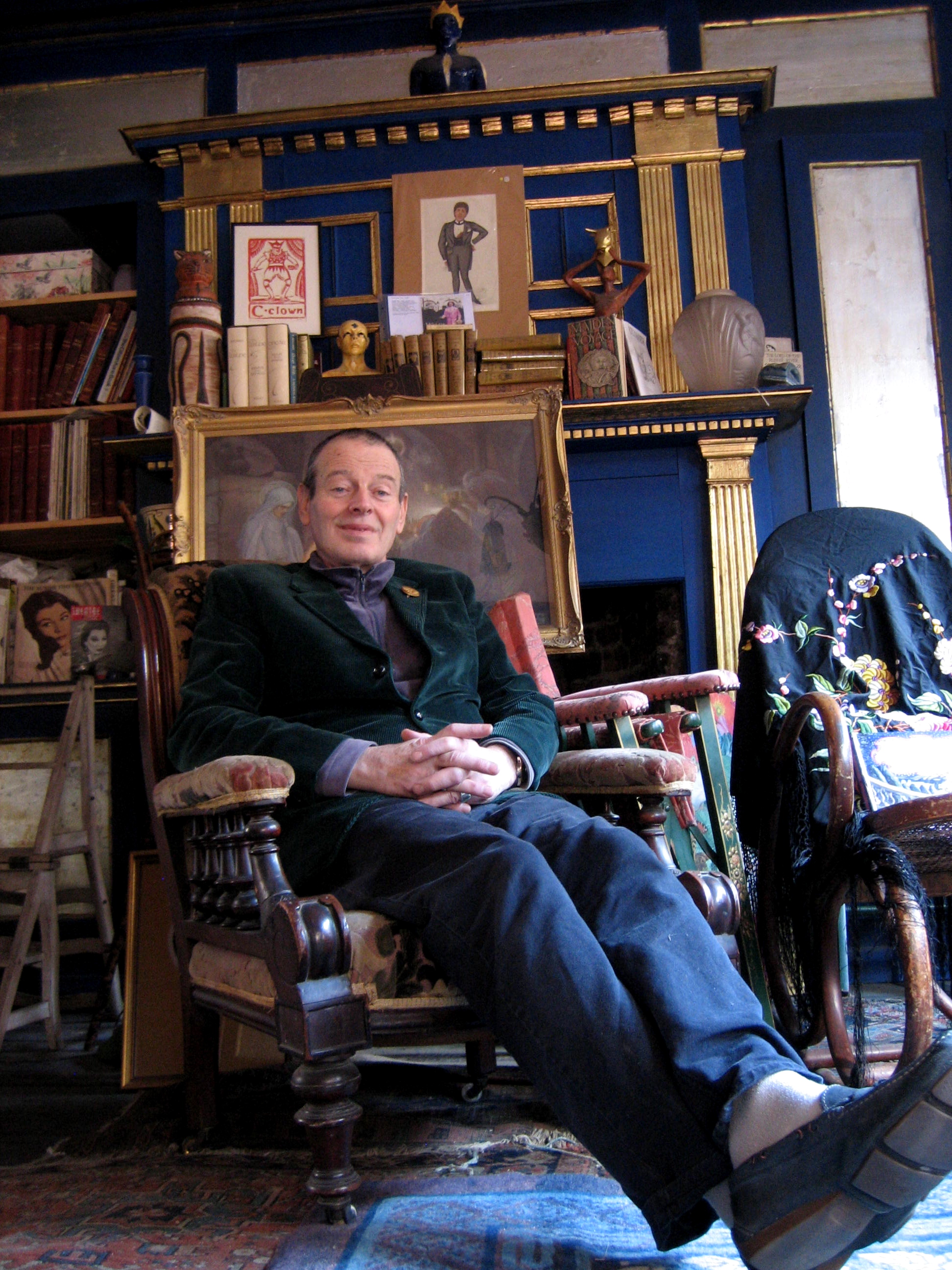
Rodney in his living room with Oscar Wilde’s fireplace.
You may also like to read my original profile
Yet More of Paul Bommer’s Delft Tiles
For those who missed Paul Bommer‘s exhibition in Wilkes St last month, it my pleasure to publish yet more of his faux delft tiles, many inspired by stories here in the pages of Spitafields Life.


Rhyming Slang.

Oranges & Lemons Say the Bells of St Clements.


The Laurel Tree, former pub in Brick Lane.

One for sorrow, two for joy…

Rose Alley, off Bishopsgate.

Turk’s Head, former pub in Wapping.

The Crown & Leek, former pub in Deal St.


Jane Amelia Parker makes jewellery out of clay pipes from the Thames.

Swanfield St, Bethnal Green was once a roosting ground for swans.


Fleur de Lys St, off Commercial St.


Truman, Hanbury & Buxton, brewers of Brick Lane.

Rhyming Slang.

The London Stone in Cannon St is believed by some to date from the origins of the City.

The Romance of Old Bishopsgate.

The symbol of Childs Bank from The Signs of Old London.

Will Somers, Shakespearian clown buried at St Leonards Shoreditch.

Maria Pellicci, The Meatball Queen of Bethnal Green.

At St Dunstans’ Church, Stepney.

“Bran” is the giant from mythology buried under the Tower of London and also the Welsh word for raven.

Stasia Makarewicz of Topolski in Maltby St.

At Alexander Boyd’s Tailoring Workshop.
Images copyright © Paul Bommer
You may like to see the earlier selections of
More of Paul Bommer’s Delft Tiles
and also read about
John Claridge at the Salvation Army

At Booth House, Whitechapel, 1967
William Booth, an ex-pawnbroker, founded the Salvation Army by preaching in a tent upon Whitechapel Waste in July 1865 and, although his mission has spread around the world since then, the East End remains the heartland of this endeavour which began simply as The East London Christian Mission.
Published today for the first time, John Claridge‘s bold, clear-eyed and compassionate photographs were taken while visiting the Salvation Army at Booth House in the Whitechapel Rd between 1959 and 1982, as the result of his long-term interest in their work among the dispossessed. “As a kid, I remember sitting outside the pub with a cream soda and seeing them coming round selling copies of the War Cry,” John told me, “I think the Salvation Army is an essential part of the East End.”
“The early pictures were taken when I used to go wandering around and talking to the guys on the street, and they told me they were going to the Salvation Army, so I followed them.” he recalled, “The later ones were done by invitation as charity work to raise money, and I wanted to document what they were doing because I think they do a fantastic job. Over twenty years, the facilities were updated but the people didn’t seem to change. I met people from all across the social spectrum who were in need of help, most were East Enders without families who couldn’t take care of themselves.
The Salvation Army offer a welcome to lost souls sleeping rough on the street, and they give people some faith in themselves when everything’s going down the drain. Anyone could end up like that, some who I met were well educated, people like you and me. And, as a photographer, I found that if you showed a little respect, they showed you their pain.”
Yet there is a generous humanity in John’s Salvation Army pictures, recording resilience as much as pain, and emphasising strength of character, self-possession and dignity in faces of East Enders riven by the trials of life.

Waiting for the hostel to open in the morning, 1965.

Entering Victoria Home, 1959.

Waiting for the hostel to open, 1960.

On the way to the hostel, Whitechapel Rd, 1959.

At Victoria Home, 1982.

At Booth House, 1982.

In the canteen at Victoria Home, 1982.

At the childcare centre for working mothers in Hoxton, 1982.

At Victoria Home, 1982.

Recipient of home delivery meals, Whitechapel, 1982. “I went with one of the ladies, taking him lunch, and that’s how I got this picture.”

At Victoria Home, 1982.

At a prayer meeting, Booth House, 1982.

Blind pianist at the Hoxton day centre, 1982

At a prayer meeting, Booth House, 1982.

Resident of Hopetown women’s hostel, 1982

At Hopetown, Old Montague St, 1982

Caretaker at Victoria Home, 1982.
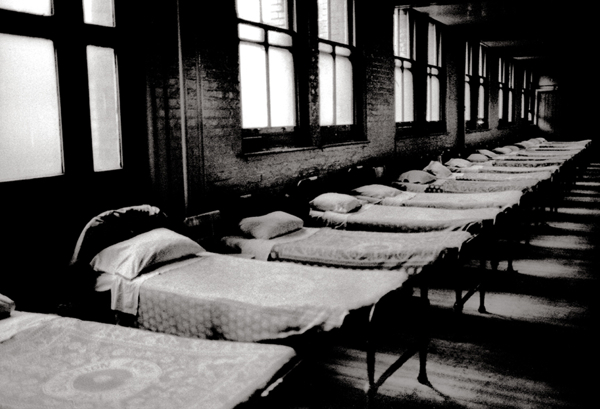
Dormitory at Victoria Home, 1982.

Showers at Victoria Home, 1982
Photographs copyright © John Claridge
You may also like to take a look at
Along the Thames with John Claridge
and read these other stories of the dispossessed
The Dosshouses of Spitalfields


