
Marketa Luskacova’s Brick Lane

Two women with a cigarette, Cheshire St 1977.
When photographer Markéta Luskačová came from Prague in the mid-seventies, it became her great delight to visit the markets in London since they were forbidden under Communist rule in her own country. It was Brick Lane market in particular that took Markéta’s fancy, both as a subject for photography and a source of cheap produce. In fact, such was the enduring nature of her fascination and need, Markéta continued coming to Spitalfields to take photographs and get her weekly supply of fruit and vegetables for over thirty years.
As a young photographer in Czechoslovakia, Markéta went out to visit remote villages which were so poor that the collectivisation imposed elsewhere by the Communists was not viable, and she recorded a way of life barely changed for centuries in breathtakingly beautiful pictures, first exhibited in Prague in 1971 and later shown at the Victoria & Albert Museum in 1983. By chance, Markéta’s photographs were seen in Prague by Colin Osman, editor of Creative Camera, who was on a visit from London to attend the opera and he published them in his magazine, drawing international recognition for the quality of her vision.
In London, Markéta showed her work to Norman Hall, the renowned picture editor of The Times but when she told him she wanted to photograph markets, he dismissed it as “a subject for beginners” yet she set out undiscouraged.
“I went to Brick Lane and I never left. I fell in love with it.” she admitted to me, “Most of all, I photograph things I like and I was lucky enough that somebody saw my work and supported my photography for a little while.”
A year later, Markéta took her photographs of Brick Lane to Norman Hall and, looking at them, he declared, “This may be a subject for a beginner, but it is not a beginner that took these photographs.”
“I was poor,” recalled Markéta, “so I needed to do my shopping there as it was the cheapest place to buy things. I could identify with the people in Brick Lane because they were immigrants and they were in need of cheap goods. Once I had done my shopping, I would leave my bag with a stallholder while I took my photographs.”
In 1991, Markéta had a one woman show at the Whitechapel Gallery of her photographs of Spitalfields, establishing her reputation as a major photographic talent in this country. Those pictures – of which a selection are published here today – were the result of a two-year residency in which she selected from and printed her pictures taken between 1975 and 1990. Yet it is less widely known that these represent only a portion of those Markéta has taken in Brick Lane as result of her long-term relationship with the market which now extends over thirty years.
In particular, Markéta recorded the last days of the ancient market in birds and animals that existed in Sclater St and Club Row until it was closed down in 1990 as a result of protests by animal rights activists. Markéta shared a natural sympathy with the dealers, observing their affection for their charges, unlike the hard-line protestors, one of whom pushed her in front of a car.
Famously, Markéta photographed the sale of a lion cub in Brick Lane. She remembers that it was first offered at £150 and then the price diminished to £100 and finally £75, over successive weeks, as the cub grew and became less cuddly and more threatening. Eventually, the seller came back one Sunday without the lion but clasping a tray of watches that he had swapped the creature for. In Brick Lane, Markéta found her primary subject as a photographer, offering an entire society in realistic detail and a mythological universe of infinite variety.
“I don’t go to Brick Lane regularly anymore, sometimes six months passes between one visit and another” Markéta confided to me,“I photographed what I saw there and what I thought it was good to record, be it a face or a smile, an animal or a shoe. I believe in the evidential quality of photography, and I know that unless things are done in a visually interesting way they are not remembered.”
A woman with a gentle manner and a piercing gaze, Markéta Luskačová’s magnificent photographs reflect her own personality. They are simultaneously generous in their humanity yet unsentimental in revealing the nature of people. More than twenty years after her last show in the East End it is my delight to show a selection of her Brick Lane pictures here today.

Lion cub and dog, Club Row Market 1977.

Street musician, Cheshire St 1977.

Man selling trousers, Petticoat Lane 1974.

Woman in front of a poster, Bethnal Green Rd 1990.

Woman in the Bird in the Cage pub, Bethnal Green Rd 1976.

Man with a clock, off Cheshire St 1989.

Street musician, Cheshire St 1979.

Man with kitten, 1977.

Girls from Canon Barnett Primary School in the train on their way back from the seaside, 1988.

Woman and child, Sclater St 1976.

Old man and children with donkey, Sclater St 1980.
Photographs copyright © Markéta Luskačová
More Trade Cards of Old London
After recently publishing a selection of trade cards that might have been found by rummaging in a drawer in the eighteenth century, it is my pleasure to show this further selection discovered by searching down the back of a hypothetical sofa and under a hypothetical bed. Especially noteworthy are the cards for Lacroix’s and Peter De la Fontaine which are the early work of William Hogarth.


Images courtesy Bishopsgate Institute
You may like to see my original selection
Mick Taylor Models for Labour and Wait

Mick checks his costermongers’ knot
As one of those unfortunates that sniffles through eight months of the year, I regularly used to humiliate myself by pulling out ragged scraps of toilet paper from my pocket to wipe away the dewdrop at the end of my nose. Then I discovered the large brightly coloured handerfchiefs sold at old-school tobacconists, one in the Charing Cross Rd and the other in High Holborn, and the problem was taken care of – until both shut recently. Fortunately, Labour and Wait in Redchurch St have stepped in to fill the gap with a magnificent range in twelve different colours and subtle variants of spots and stripes – known variously as handerchiefs, neckerchiefs and bandanas according to their usage.
Rich in cultural associations, red spotted handkerchiefs have traditionally been worn by cowboys, gypsies and farmhands, also by Cary Grant in ‘To Catch a Thief,’ Peter Rabbit and Pigling Bland, customers in San Francisco leather bars, and even wrapped up as Dick Whittington’s bundle. In the East End, Mick Taylor, the man known as the Sartorialist of Brick Lane, who has been sitting outside the Beigel Bakery for the last half century – off and on – is the most visible proponent, and whatever his outfit he is always to be seen with a jaunty coloured neckerchief.
So I was delighted when Simon Watkins of Labour and Wait told me he had invited Mick Taylor to model their complete range of neckerchiefs, because Mick knows how to wear them better than anyone. Mick remembers his grandfather putting one on each morning before going to work and each of his uncles, Frank, Jim and Alf wore them everyday while collecting dustbins in the East End.
Tying a neckerchief is second nature for Mick. Folding the neckerchief in half diagonally at first, he then folded it a further three times with a triangular ‘tail’ left over, before wrapped it round his neck with the ‘tail’ at the rear of his collar. Once the points are crossed over, he explained, it is a question of tying the stook loosely in what is known as the costermongers’ knot. Mick revealed that the secret to getting a good knot is to start with uneven ends, giving you a satisfyingly symmetrical knot once it is tied.
“This brings back memories for me, ” Mick revealed as he straightened his neckerchief, ” – of London Fields on a Saturday night, going out in a mohair suit from Myers in the Hackney Rd.” Because, although he chose to model the neckerchiefs with a look that approximates to a costermongers’ outfit, Mick was keen to emphasise that they can equally be worn to add swagger to a suit. Mick selected red, blue and yellow as his favourites. “Flash colours,” he terms them, “they all look good with a white shirt.”
So look out for Mick and his new neckerchiefs, bringing a splash of brightness to Brick Lane and celebrating the arrival of the sunshine. With twelve colours to choose from, there is a neckerchief to suit every taste at Labour and Wait, and – now that Mick has shown the way – this could turn out to be the fashion trend of the summer in the East End.

Classic red

Black

Brown

Green

Bright red

Blue

Light Blue

Yellow

Dark Blue

First, fold your neckerchief in half diagonally.

Second, fold it three times, leaving a tail that will sit under your collar at the back.

Thirdly, cross the points with one end longer than the other before you tie the costermonger’s knot.


Neckerchiefs in twelve different colours available from Labour and Wait.
You may also like to read about
A Few Diversions by John Claridge

The Daily Message in E3, 1972
Taken between 1959 and 1982, and published here for the first time, each one of these East End pictures by John Claridge contains a diversion of some kind – either illustrating an activity that is incidental to the flow of life or presenting an observation that is itself a distraction. “These are small incidents, humdrum diversions like going to the hairdresser or the baths, not shattering moments but part of the life of the community all the same,” he assured me. Yet although these sly visual anecdotes may refer to marginal or quotidian experiences, they can sometimes reveal as much or more about the texture and tenor of their times than any news photo of the day.
John collected his observations of life out of a fascination to explore the strange poetry of existence, revealing his interest in reflections upon images seen through glass, his passion for lettering and design, and especially his delight in people. He takes pleasure in observing how they inhabit a place, and how they show their creativity when they strive to make themselves at home, even in the most unlikely or inopportune of circumstances.

Bridalwear shop, Spitalfields 1966. “Wherever you went at that time, there was always a bridal shop.”

Twenty past one? Spitalfields 1967. “You couldn’t design it better!”

American wrestler and trainer, Walthamstow Town Hall 1982. “They asked me to take the picture.”

Barbers, Spitalfields 1964. (note spelling of ‘closing’)

Accordion player, Spitalfields, 1970. “He was playing under an arch and the sound drifted around, it was wonderful.”

Corsetiere, Whitechapel 1961. “A man came up to me while I was doing this and asked, ‘What are you doing?’ ‘I’m taking a picture,’ I said. ‘There’s something wrong with you, lad,’ he replied.”

East Ham baths, E6 1961. “After Saturday morning football, we always went to East Ham baths to have a bath.”

Football in the street, Spitalfields 1959.

Sweet kiosk, Spitalfields 1967. “See my reflection in this picture. She was so proud. Afterwards, she and her friends came out to be photographed.”

Snack bar – cold drinks, Spitalfields 1982.

Boy on a rocking horse, E2 1982. “Look at the conditions he’s living in. The bars look like a prison and he’s got nowhere to go.”

At the 59 bikers’ club, E9 1973. Founded by Father William Shergold, biker priest, in 1959 to bring mods and rockers together.

Lady on the balcony, Spitalfields 1962. “Her diversion for the day was standing there and watching the world go by.”

Windmill seller, E2 1961.

Washing day, E14 1961. “I just came out of my girlfriend’s house and she said, ‘Look, it’s washday across the road.'”

Man with jobs poster, Spitalfields 1963. “I asked him, ‘Are you alright for a couple of bob?’ and he sat in the sun for me for a moment.”

Ear piercing, Spitalfields 1964. Is this ear piercing done to people over five years of age, or has the jeweller been piercing ears since five years of age?

Hotdog van, Spitalfields 1961.

Cup of tea, Spitalfields 1964. “Settled onto this old sofa in the market, enjoying his cup of tea, he looks like he should be wearing an eighteenth century wig and coat.”
Photographs copyright © John Claridge
You may also like to take a look at
Along the Thames with John Claridge
Please join me tonight (Tuesday 22nd May) at 7pm for a RAG TRADE CHIT CHAT with Philip Pittack, Cloth Merchant, Clive Phythian, Master Cutter and Cosmo Wise, Rag Dealer at PAGES OF HACKNEY, 70 Lower Clapton Road, London E5 0RN.
Tickets £3 Call 020 8525 1452 or book online here
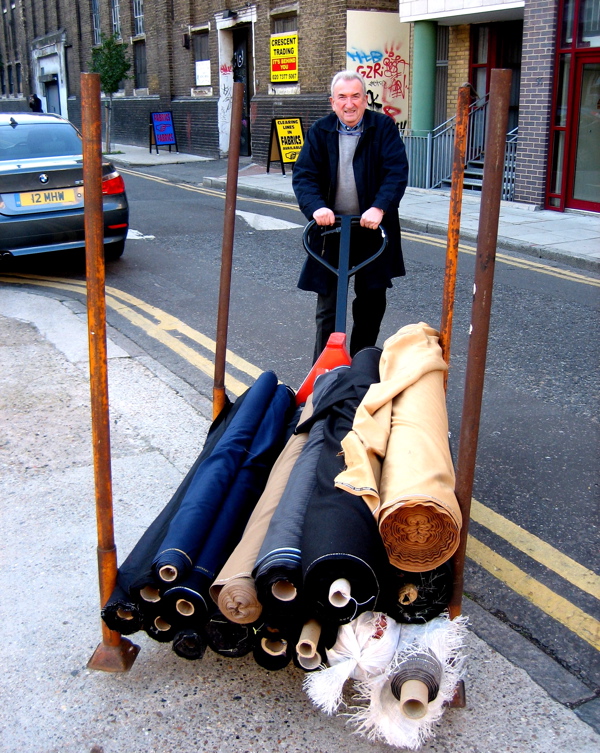
Philip Pittack, Clearance Cloth Merchant at Crescent Trading.

Clive Phythian, Master Cutter at Alexander Boyd.

Cosmo Wise, Rag Dealer.
Photograph of Clive Phythian copyright © Jeremy Freedman
You may like to read about
Philip Pittack & Martin White, Cloth Merchants
The Cockney Alphabet
It is my delight to publish this guest post by Jonathon Green, the notorious lexicographer of slang, introducing Paul Bommer’s beautiful new print.

Illustrated with characteristic brio by Paul Bommer, this is The Cockney Alphabet, sometimes known as the Surrealist Alphabet. It is first recorded in the late 1920s, and was seen as a parody of the mnemonic-didactic lists of letters and words that have been taught to children from at least the mid-nineteenth century. It seems to require English as its base language, and while it has been offered in a variety of forms, it pays a consistent tribute to that much-loved linguistic freak: the pun.
It must, because in language as in life we demand our creation myths, have an origin. My predecessor in slang lexicography, Eric Partridge, who in 1961 published a monograph on the subject, sought links to the children’s alphabets of the nineteenth century when A was most commonly either an ‘Apple’ or an ‘Archer’, and the practical ones of World War I signallers when clarity was all and the letter was enunciated as ack (able and alpha would follow later, products of a new cataclysm). Pushing further back, he made reference to Old English. But this was surely wishful thinking and the origins, or to be more precise the first recorded appearance, remains less than a century old.
It all starts around 1930. There are roots of course and attributions, not least to a throwaway line from Jonathan Swift’s Polite Conversation – his skewering of supposedly smart society’s verbal clichés – of 1734, and Swift was also responsible for a humorous alphabet in which each phrase was created by prefixing a letter of the Greek alphabet to the word guinea, e.g. alpha guinea (half a…), beta guinea (bet a…), gamma (i.e. game which also means bet) guinea etc., but for the genuine beginnings we must return to the palmy, not to mention stilted days when Lord Reith still sat on high and all was right with the BBC:
There have been alternatives – A, for instance, can stand for ‘ism’, E for ‘brick’, N for ‘mation’, T for ‘painful’ and Z for ‘effect’ and each letter can muster half a dozen or so – but this is the canonical list. Paul Bommer’s version follows very much on these lines. It has an added dimension, denied other examples of this popular, if skewed A-Z, of referring whenever possible to Spitalfields landmarks, for instance the action of K for Restaurant ‘takes place’ in E. Pellicci. R for Cock Linnet offers a sign for the one-time animal market of Club Row, P for relief is set on Middlesex Street (with ads for ‘Schmutter,’ ‘Whistles’ and ‘Titfers’) and so on.
Charlie Clapham and Bill Dwyer, the cross-talk double act who were the first of their kind to be broadcast on the BBC, and the first to air this version of the A-Z, called it the ‘Surrealist Alphabet’; more often it is known as the Cockney one. The question must be asked; is it in fact either? As for the former, the French poet Apollinaire, who coined the term in 1918, would not have recognised it as especially avant garde. If it is surrealist then it is not ‘super-realism, the literal meaning, but a weaker, popularised use: quirky or eccentric. As for Cockney… listening to the scratchy recording of Clapham and Dwyer from 1933, it is apparent that the former, who had been a clerk in legal chambers, was no East Ender. Photos have him in a stereotyped ‘silly ass’ monocle, sometimes even a topper, and his accent is to match. Dwyer, who had been a commercial traveller, is a candidate for Cockneydom, but if his syllables suggest a Londoner, they are nothing like the self-consciously tortured tones of such music hall ‘costermongers’ as Gus Elen.
[youtube mCbOx1q06-Y nolink]
It was not the first word-game that used the alphabet as its source. For instance there was the nursery sequence, again based on that ubiquitous apple, in this case en-pastried: ‘A was an Apple-pie, B bit it, C cut it, D dealt it, all the way to ‘X,Y,Z and Ampersand’ who ‘All wish’d for a piece in hand’. Nor is it the last. In December 2000 Jeff Aronson, a clinical pharmacologist, published his ‘medical alphabet’ in The Lancet:
The list ended with ‘Z for de doctor (I’be got a code iddy doze)’, although that combination had already been used in less specialist phonetic compilations.
It is, however, the most important, or at least the source from which all others have stemmed. The reality seems to be, and again I nod to Partridge, that the alphabet was generated sometime in the Twenties, as a form of game conjured up by the touring casts of Variety shows, playing with words to help while away the tedium of provincial boarding houses. Its basis is indeed the old children’s alphabets, which it parodies. Somewhere along that line Clapham and Dwyer must have picked it up (although they had had no Variety career themselves); the radio gave it a popularity among the uninitiated. It was not especially Cockney – Spitalfields references aside, it is only the dropping of the aitches in the first line (and in L, i.e. ’ell, and R, i.e. ’arf) that suggests the connection (and Cockneys are hardly unique in that omission) – but after the pre-war radio duo, it was heard most commonly on the lips of comedians, again BBC stars, such as Flanagan and Allen (they of the Crazy Gang), Arthur Askey (and R, in one version is ‘for Askey’ and in time ‘for Daley’) and Ted Ray, all of whom played the metropolitan card.
So if not surrealist and if – strictly speaking – Cockney has to be declared a misnomer, then what is the alphabet? The answer must be what Partridge if few others have termed it: a comic phonetic alphabet. Ultimately it is about pronunciation and beyond that, puns. Sometimes ‘for’ may need to be pronounced ‘fer’ but at others it requires the sound of standard English. As in rhyming slang certain popular figures, e.g. ‘I for Novello,’ have been sustained within its playfulness, but again, they are not especially Cockney. Others have vanished, e.g. ‘K for ancis’: Kay Francis, a twenties star, having left little trace. ‘K for Restaurant’ has succeeded, and is timeless. That it depends on the pronunciation ‘kayf’ rather than the Frenchified café does nod Eastwards, but the word is far more usually sounded ‘caff’.
Clapham and Dwyer were big enough to be included in early TV’s programming for the 1937 Coronation but they seem to have faded with the Thirties. Their alphabetical creation – or at least popularization – is in robust health. The ludic potential remains. Y for ‘unts, anyone? Z for Elli?


Copies of Jonathon Green’s epic three volume masterpiece ‘Green’s Dictionary of Slang’ are available here.
Copies of Paul Bommer’s print ‘The Cockney Alphabet’ are available from the Spitalfields Life online shop.
You may like to read my original profile

Hanbury St, May 2010.

Hanbury St, May 2012.
I shall never forget how my heart leapt with delight when I saw Roa, the Belgian street artist, painting his forty-foot crane in Hanbury St two years ago. Originally intended as a heron, Roa changed his design while it was still a work-in-progress after Bengali people asked if it was a crane, a bird that is sacred to them and to many other cultures around the world. Since then, Roa’s crane has presided benignly over Brick Lane, becoming a landmark, an embodiment of the soul of the place and an object of pilgrimage, as thousands have come to photograph it.
Yet my moment of delight was countered this week by a moment of dismay to see a man installing a huge banner of ugly corporate-style design announcing “Banglatown, Brick Lane, Curry Capital 2012,” obliterating the heron save for the tip of its beak and its tail. The banner is spectacularly pointless, since once you can see it you are already in the midst of the curry restaurants, and it reflects shamefully upon the currymongers that they should demonstrate such hubris as to sacrifice the celebrated work of an internationally famous artist in this way.
As he always does, Roa was conscientious in seeking the consent of the owner of the building before he undertook his painting, which has proved itself to be an exemplary piece of street art by enlivening its immediate environment and bringing poetry to this neglected corner of Spitalfields. By contrast, those who installed the obnoxious banner did not obtain approval from the owner of the building. But – worse than this – in their haste, they put it up without waiting until planning permission had been given or any public consultation undertaken, showing no respect for due process or the wishes of the inhabitants of Spitalfields who are paying for the offending banner through their council tax.
Meanwhile, an online petition to remove the banner and uncover the crane has reached over a thousand signatures in just two days, as some measure of the widespread affection in which this painting is held. And, given that the planning decision on this banner is not due until after May 29th, there are likely to be more than a few objections before then. With painful irony, a covering letter attached to the planning application for the miserable banner proposes that it will “encourage footfall” and informs us that it was “designed by the council’s in-house team with a knowledge and understanding of the local community.” It took two thousand signatures on a petition to persuade Hackney Council to grant a reprieve for Roa’s Rabbit in the Hackney Rd and I suspect we shall see a similar scenario played out in Spitalfields over coming weeks.
This spring, Roa returned to undertake two new paintings in the neighbourhood, a flayed pig on Buxton St and a mighty hedgehog on Chance St. The hedgehog takes the place of the squirrel one hundred yards away in Club Row, the first of his finely-drawn creatures Roa painted in the East End in the autumn of 2009. Such is the popularity of this work that locals now refer to photographers as “squirrel snappers” And, even though the squirrel has been damaged by a series of tags painted across it, the new hedgehog more than makes up for this loss in terms of scale and presence. At the end of Chance St where it meets the Bethnal Green Rd, the hedgehog waits eternally poised to cross the road.
The genius of Roa’s work is to evoke creatures possessing such febrile life that they confront us with our relationship to the natural world, which we can easily forget in the city. His huge animals become the familiar spirits of the places they inhabit and we love them for the ambivalent natures, simultaneously appealing and threatening, yet always drawing our respect.

The flayed pig on Buxton St.

The mighty hedgehog on Chance St.

A little dog crosses the road to see the hedgehog.

Two thousand people signed the petition to prevent Hackney Council painting over Roa’s rabbit in the Hackney Rd in 2010.

Roa’s squirrel on Club Row in autumn 2009, sadly covered by tags today.
You can sign the petition to remove the banner covering Roa’s crane here.
The planning application for the banner is on the Tower Hamlets Council website here.
You can register formal objections to the planning application for the banner by leaving your comments here.
You may also like to read about
An Afternoon with Roa, Street Artist


