At The E5 Bakehouse
Today, it is my pleasure to introduce you to our friends at the E5 Bakehouse (next to London Fields Station) where we shall be staging our book launch and exhibition tomorrow night between 6 and 9pm. They will be firing up the brick oven in the bakehouse yard to cook us some tasty fare, with refreshment kindly provided by Truman’s Beer and fiddler Dan Mayfield supplying the tunes.
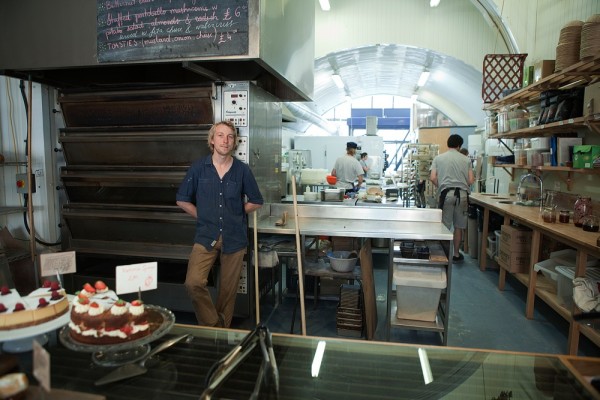
Ben Mackinnon
Not so long ago, Ben Mackinnon started baking at home for his friends and making deliveries on his bicycle each Saturday. A few years later, you would have found him selling his bread from a table on the pavement outside Leila’s Shop. Quite recently, he was running his own wood-fired brick oven and baking organic bread in the yard at the Happy Kitchen.
But for the last two years, Ben has been running the E5 Bakehouse in two arches under London Fields Station, producing an endless supply of sourdough bread and a whole range of loaves, cakes and savouries to delight the residents of Hackney. And the outcome has been the spontaneous creation of a new social centre for the neighbourhood, where you can pick up your daily loaf, linger over coffee and cake or, if you wish, learn bread-making yourself at weekly classes. It is a working place, a meeting place and a creative place, uniting the local community.
When you walk into the Bakehouse everyone is busy, yet no-one seems to be in charge. It is a model of relaxed concentrated activity and the outcome is superlative baking. Many of these people were originally volunteers who came along to use Ben’s first brick oven under the railway arches and opening the Bakehouse allowed him to offer them a salary. Similarly, just as the famous wild Hackney yeast is kept alive from one batch of sourdough to the next, so profits are slowly reinvested in equipment and resources that permit the Bakehouse to grow.
“I was searching for something to get my teeth into,” Ben admitted to me, referring back to a significant spell of unemployment in his twenties,“and you can’t match the satisfaction of bread when it’s done really well.” Lanky and blonde, with an infectious youthful energy, Ben has conjured the Bakehouse into existence through his own hard work and persistence.
“In May 2011, we moved into this arch and we still deliver everything by bicycle – we are reinventing the wheel!” he declared, gesturing excitedly around at the flurry of life surrounding him, “Everything’s organic, the energy is from renewable sources and we are careful to buy from suppliers who farm in better ways. We really focus on quality and we have a great team of people.”
Curiously, most of the staff at the Bakehouse did not originally train as bakers. Many have impressive university qualifications in high-brow subjects, yet they all share a devotion to the elemental process of traditional bread-making in a slow labour-intensive way. This ardor, held in common, unites and inspires these zealous bakers. They are strongly engaged with their working practice and idealistic to discover a better quality of life for themselves and their customers – no less than pursuing a better world through kneading dough.
“We are passionate about sourdough and the lost traditions of our baking ancestors.” Ben assured me, quoting the phrase that is the heartfelt maxim of the E5 Bakehouse.
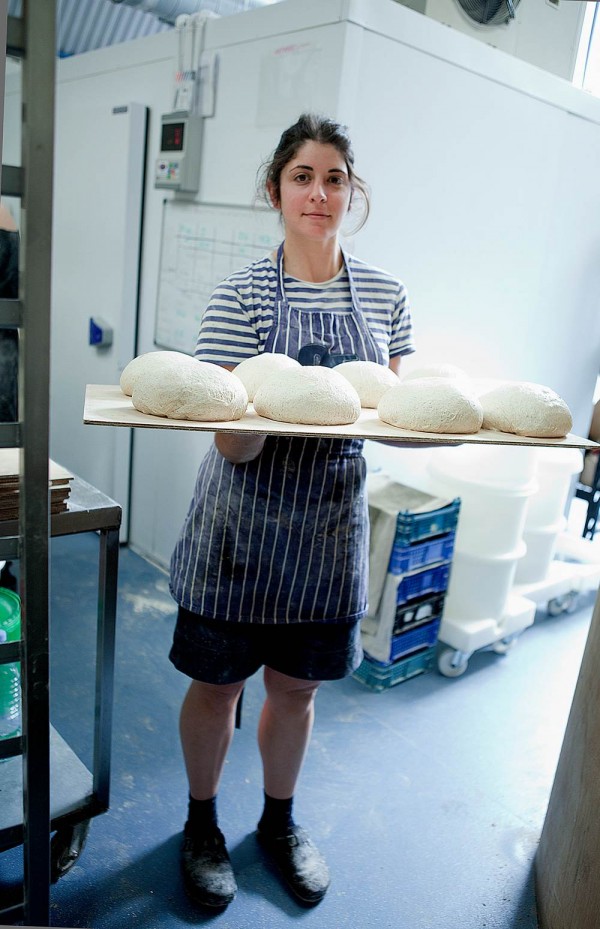
Lauren Gerstel, Baker
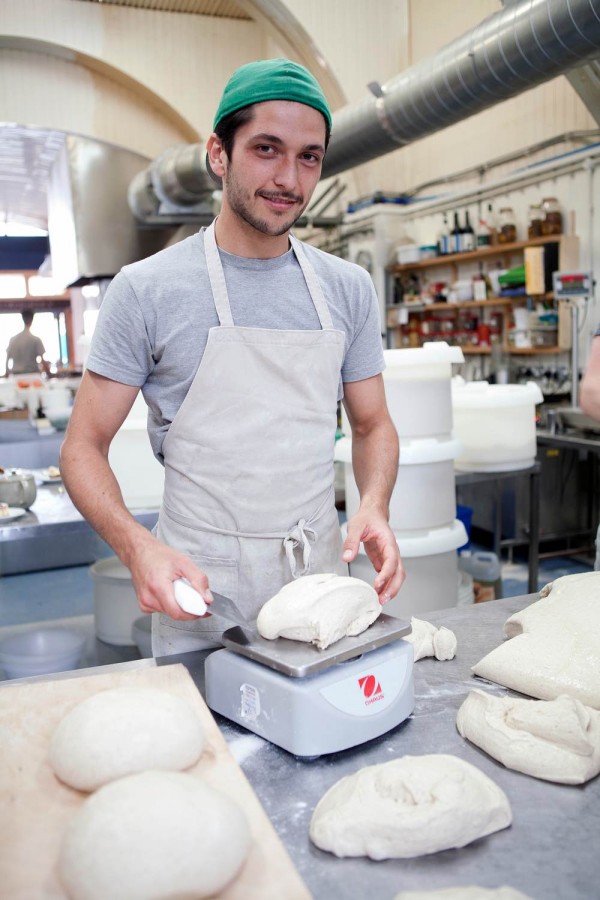
Gregoire Diqueliou, Baker
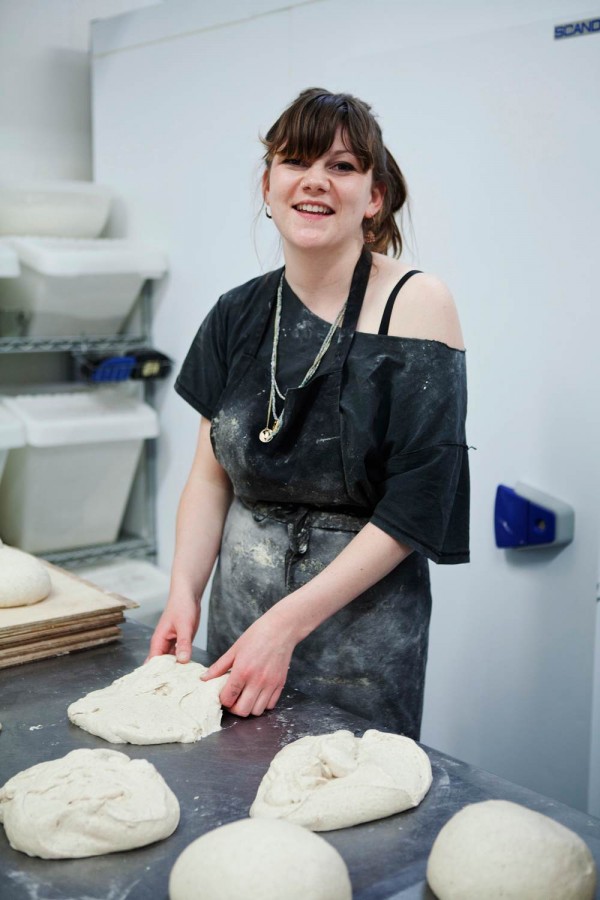
Hannah Gledhill, Cafe Manager
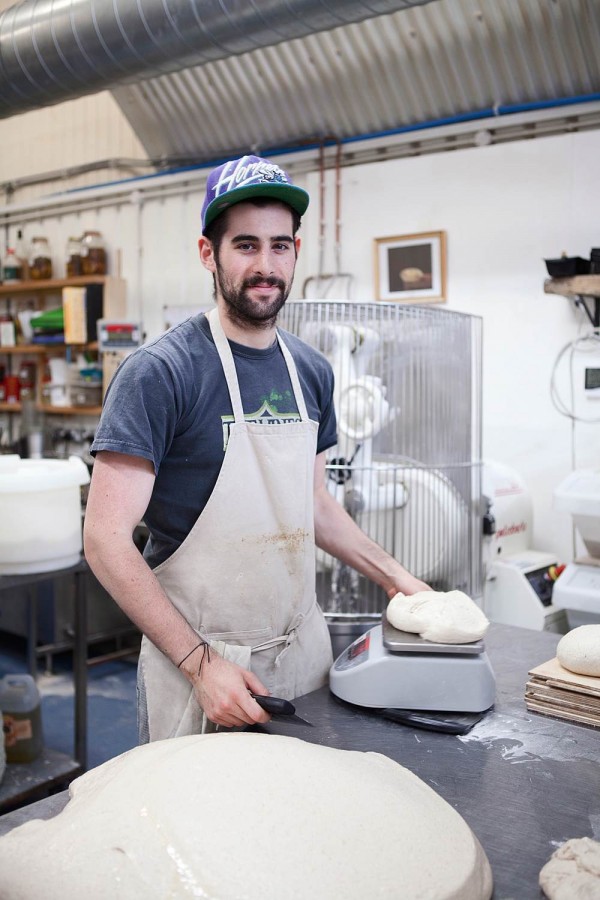
Ben Glazer, Baker
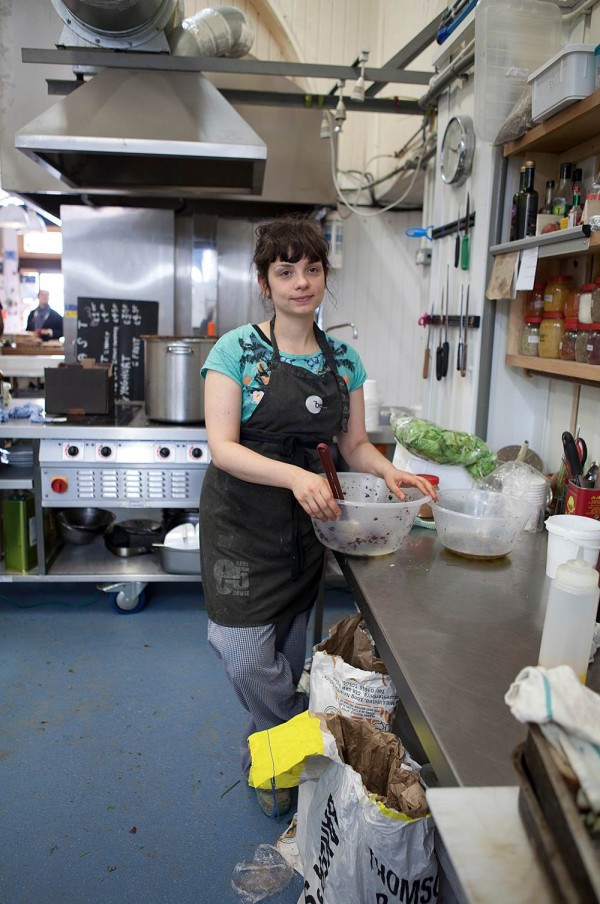
Despina Siahuli, Head Chef
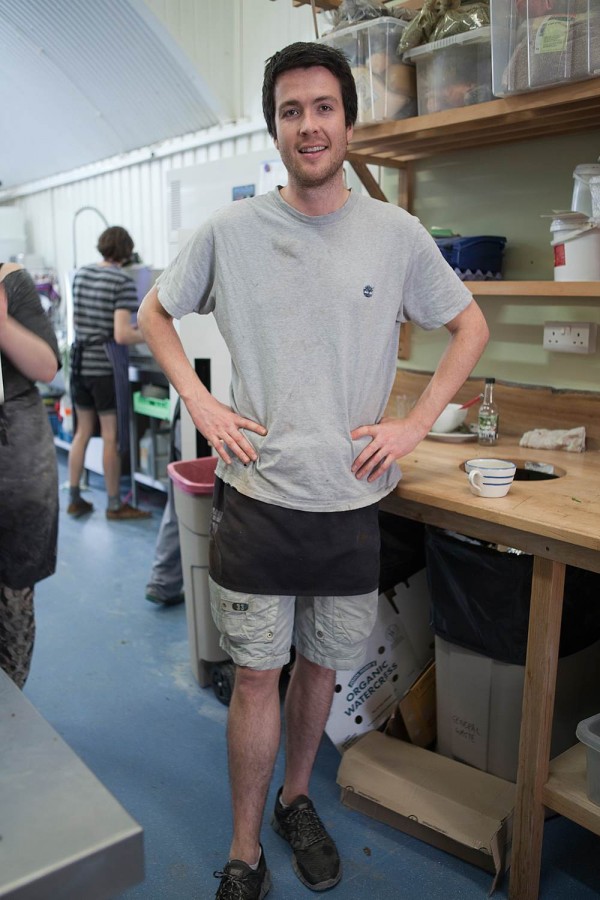
Dan Cartwright, Barista
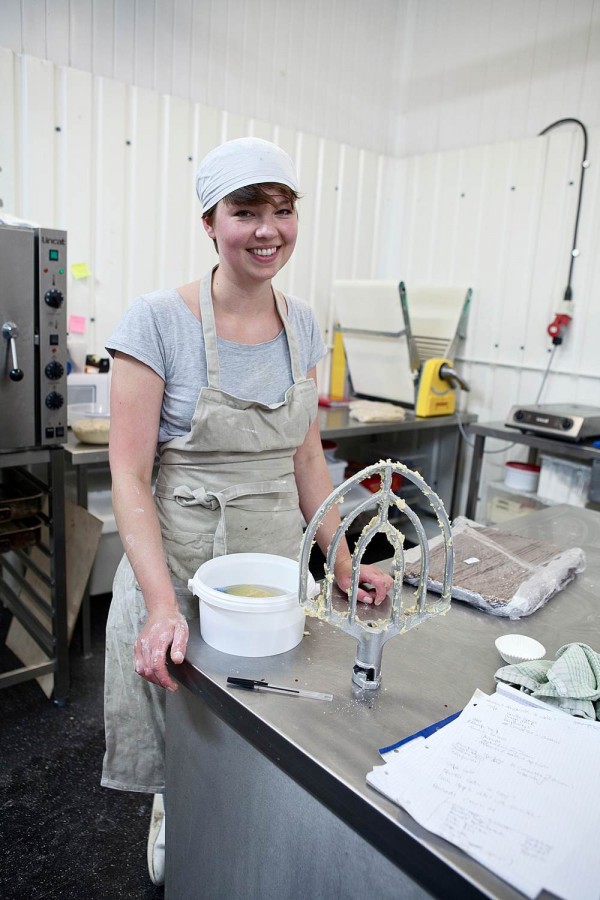
Franzi Thomczik, Pastry Chef
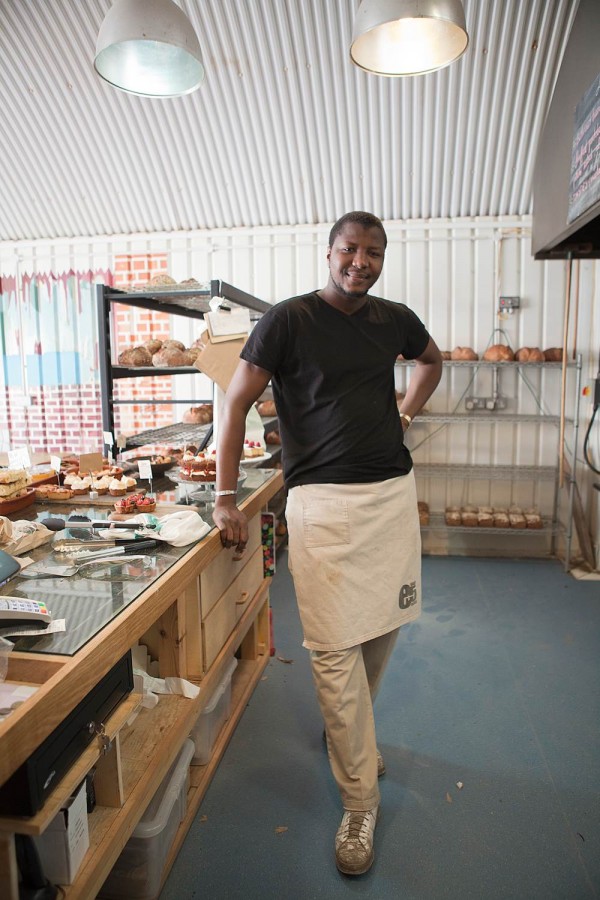
Souleymane Diarra, Barista
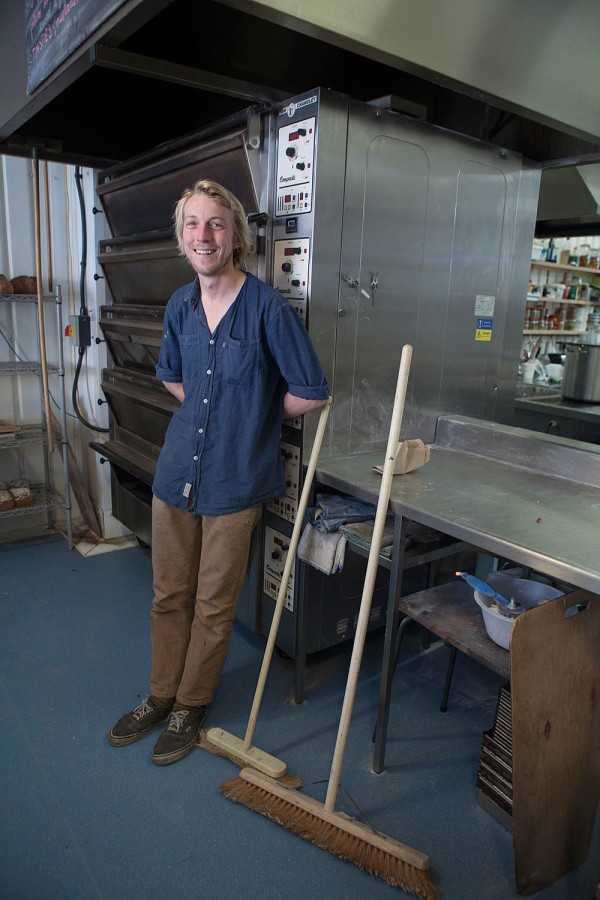
Ben Mackinnon, Entrepreneurial Baker
Photographs copyright © Colin O’Brien
E5 Bakehouse, 395 Railway Arches, Mentmore Terrace, London E8 3PH
You may also like to read about
Bakery Sculptures in Widegate St
At The Aldgate Press
We are proud that the first title published by Spitalfields Life Books was printed here in Brick Lane by The Aldgate Press and, on the day we collect the copies in advance of publication on Wednesday, we want to introduce you to our friends who were responsible for producing it so magnificently.
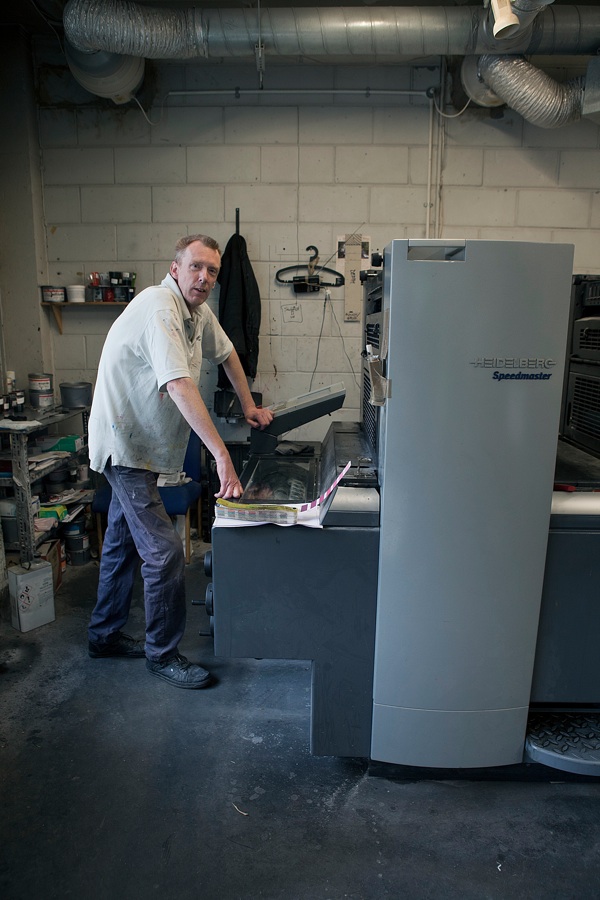
Andrew Holmes – “I left to go to Australia but I came back because I like it here!”
Well hidden in a shambolic old shed among the warren of dingy narrow lanes between Whitechapel and Spitalfields, The Aldgate Press is a worker’s co-operative created thirty years ago as an offshoot of the The Freedom Press, founded by Charlotte Wilson and Peter Kroptkin in 1886. No wonder front man Steve Sorba introduces himself as “one of a long line of Italian Anarchists in the East End.”
“Vernon Richards’ father, who was implicated in an assassination attempt upon Mussolini, sued the Daily Telegraph and Vernon used the money to set up The Aldgate Press, ” Steve explained with alacrity, as if it were an obvious path to seek funding for a new business.“We were editing Freedom, the Anarchist newspaper, which was being printed in Margate because there was no longer a printing press here, so we decided to set up a printing company to print the newspaper and all the anarchist classics.”
“He raised £20,000, and helped us acquire the equipment and get training in how to to use it,” Steve continued, “We always took on jobs from outside and we printed for lots of like-minded organisations including Friends of the Earth, Shelter, Human Rights Watch, as well as the Whitechapel Gallery, the V&A, Serpentine Gallery and the ICA.”
“We wanted to work as a co-operative to prove that it was possible, and do work that we cared about for people who cared about what they were doing. Everybody gets paid the same here and we decide among ourselves what we should do.”
Thirty years later, The Aldgate Press is the cultural focus of publishing in the East End. Everyone that wants to get publications printed eventually climbs the rickety old metal stairs on the side of the building to talk with Steve Sorba. Characteristically to be seen sporting cycling gear and demonstrating admirable self-control, Steve retains a saintly calm while holding everything together at the print works – whatever unlikely deadlines or ambitious expectations are presented to him.
In the case of “Travellers’ Children in London Fields,’ Colin O’Brien wanted the pictures in his book to resemble his own photographic prints. So it was to the credit of The Aldgate Press that Colin was able to be there in the print shop with Ken the printer, adjusting the first runs of his pictures to his satisfaction and then checking every single page as it came off the press. The flexibility of the printing staff allowed us to create a photography book that is both true to Colin’s vision and an entirely distinctive publication.
When Colin and I returned to do portraits of the staff last week, we were surprised to discover that most people had been working there for twenty years or more and I asked Steve why this was. “People don’t leave because they’re having so much fun,” he admitted with a sly grin, “or maybe it’s because they realise that anywhere else would be worse?”
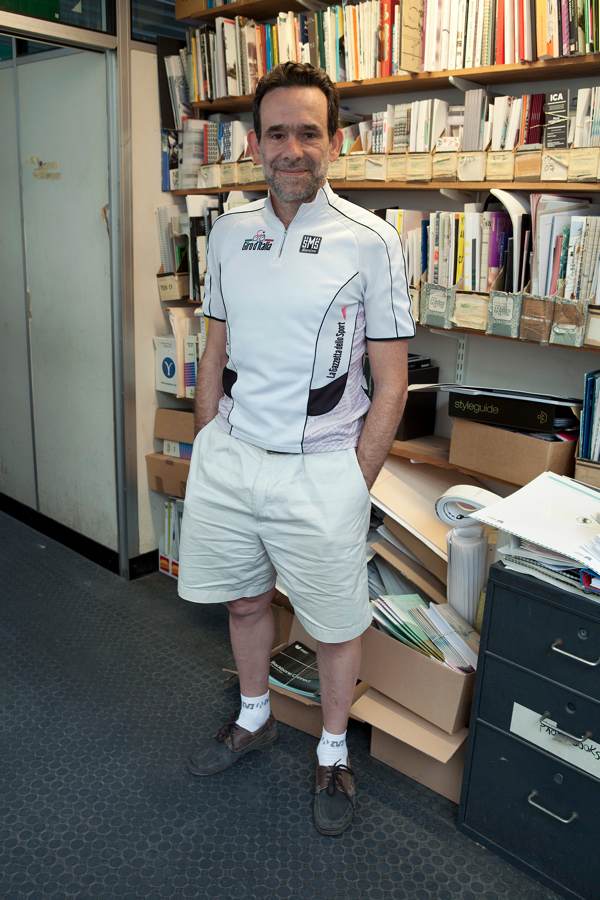
Steve Sorba, Frontman -“So many printers have left London but a lot of people like to deal with someone local.”
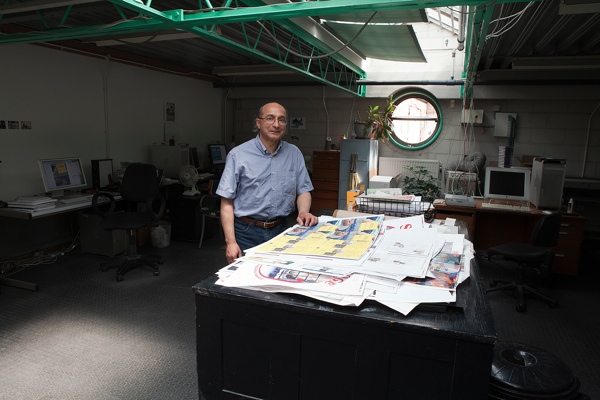
Kevin Fernandes, Pre-Press – “I am responsible for everything that goes on before the job goes to print, including artwork checking. It’s an interesting job and because it’s a co-operative we get a wide range of customers.”
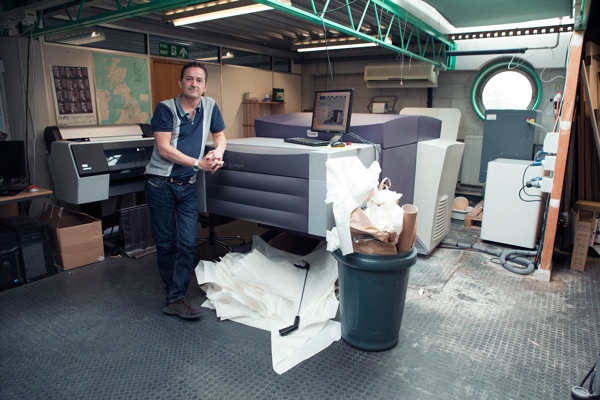
Jem Kathrens, Platemaker – “It’s a computer-based job these days, I get pdfs and impose them on the plates. I’ve stayed here since 1990 because it’s a nice working environment, with no bosses!”
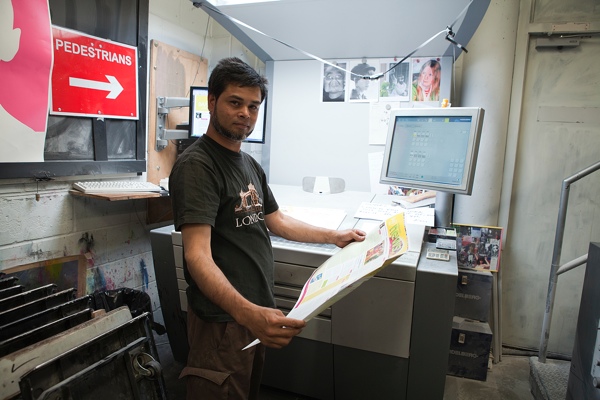
Suhel Uhmed, Printer, who printed the jacket for “Travellers’ Children in London Fields.”
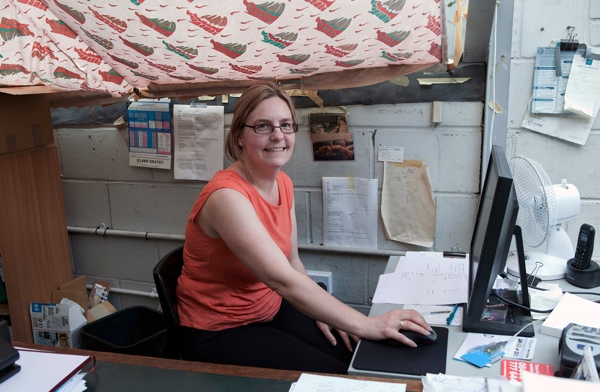
Jill Rolfe, Printing and Accounts – “I do accounts and I do printing but I’ve been here longer as a printer. Twenty-three years is way too long – this is what happens, you get here and you never leave…”
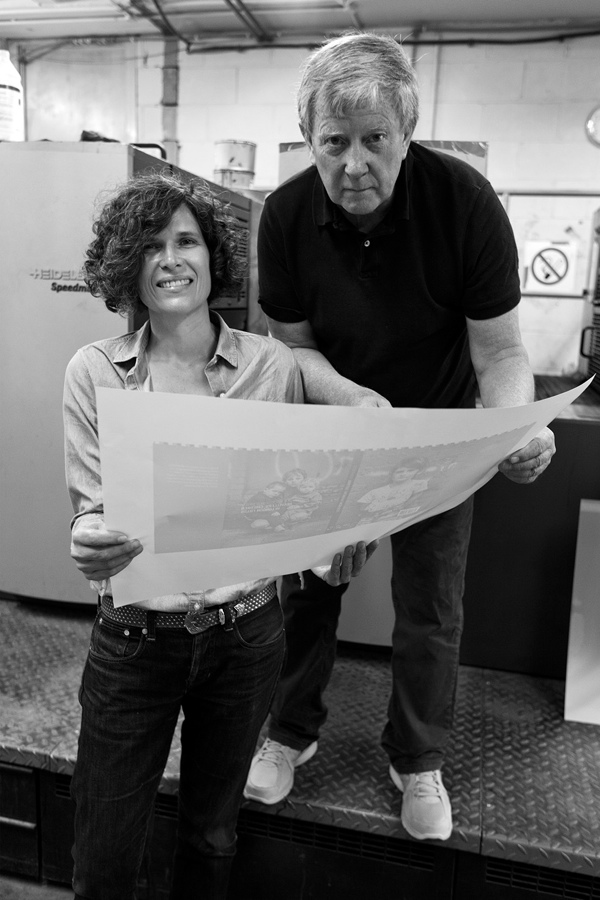
Book designer Friederike Huber & Photographer Colin O’Brien with the jacket of Colin’s book.
Aldgate press photographs copyright © Colin O’Brien
Friederike Huber & Colin O’Brien photograph © Alex Pink
You may also like to read about
The Gentle Author Turns Publisher
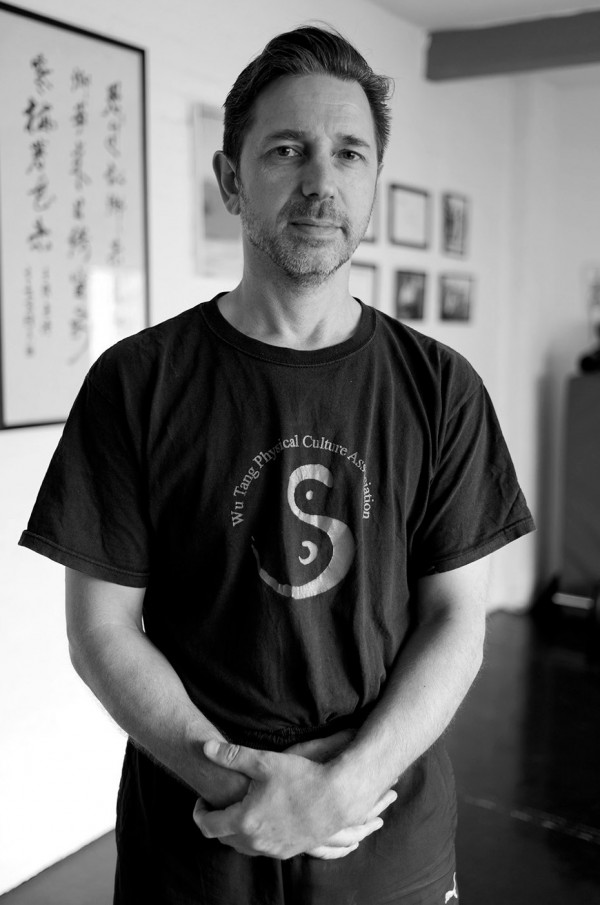
Chris Chappell, Master of Taoism
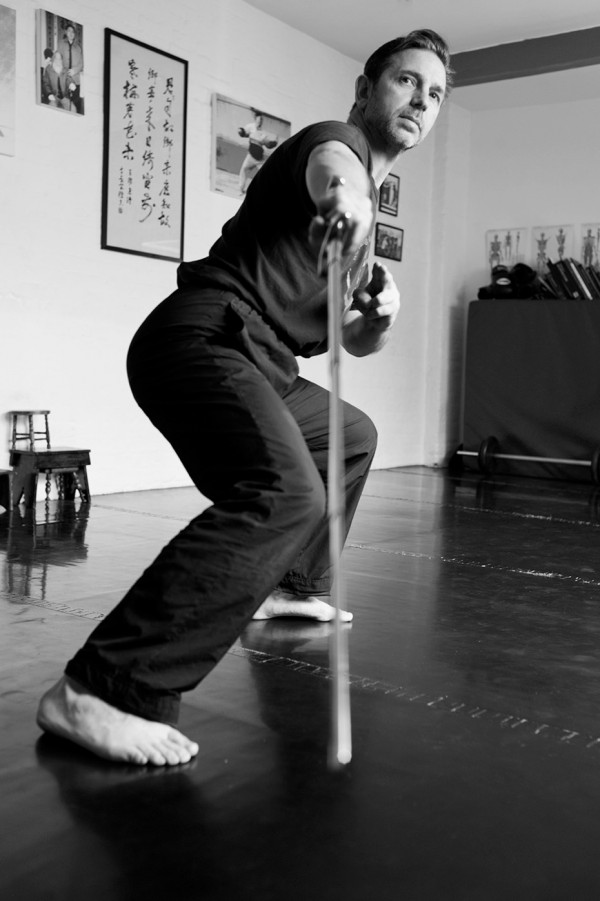
Turn right off Brick Lane into a narrow courtyard and there, in a long gallery above an old stable, you will find Chris Chappell, the Spitalfields Master of Taoism. Blessed with a sinuous grace in his movement, Chris appears possessed with a spirit of another world – as his bright eyes glisten and his limbs take on a directed life of their own – advancing step by step across the floor with superlative control like a warrior expecting ambush in a dark forest. He is a harbinger from ancient China, carrying age-old techniques of movement and physical control into the modern world, and teaching them to Londoners today as a means to overcome injury and ameliorate stress, and tackle the demons of contemporary life.
Slight of statue and with a gentle yet purposeful manner, Chris is a creature who exists in his stealthy movement. He teaches Tai Chi – not that slow moves-in-the-park variety but something swifter and more directed to a purpose. Travelling back and forth to China where he learns from his master Ma Bao Guo, Chris has conjured the atmosphere of the ‘hutong’ in his Spitalfields yard and, once you enter the sanctum of the long gallery, you find yourself in a charged space. Here, where the clamor of Brick Lane recedes, Chris told me his story.
“I’m from Durham originally but I came to London to the Ballet Rambert School in 1981 and I acquired a flat in Dalston – and I’ve been in the East End ever since. My first experience of Tai Chi was when I came out of ballet school. A lot of dancers force their bodies to perform in certain ways and they fall apart, but I got so much benefit from Tai Chi – it helped me in my professional work , it fulfilled something that I didn’t get from ballet and it led me in a different direction.
I came to Spitalfields in 1995 when I opened my first studio. It was a Tai Chi and Chigung studio in an underground part of the old market that’s been demolished now – a hundred yards from where they found the Roman cemetery, so there was me and two thousand dead bodies. Formerly, I was a professional dancer and kickboxer, and I decided to take the plunge and I got this space close to the City. I didn’t realise that the area was famous for it, that Daniel Mendoza had his boxing gym in Aldgate East in the nineteenth century and that mine was in the same spirit, of a private gym for one-to-one tuition.
It was my first shot at being self-employed and I used to chain my signboard to a lamppost in Bishopsgate close to where RBS is now, in the hope of drawing custom – I did it in the belief that if I built it they would come. Until then, I had only been teaching kickboxing in a room in my flat. It was slow at first, but it caught on yet it wasn’t how I envisaged, my clients included City people, artists and housewives – and they came from all over, as far away as Stirling in Scotland.
I like the challenge of working with people who want to realise and refine what they do, using a method that engages body and mind at the same time. I do a lot of work rehabilitating people after illness or injury. My work uses medieval Chinese folk practices which have passed down through generations. ‘Chigung’ was a term coined in 1956 as a catch-all to include all kinds of therapeutic exercise, body control and martial arts. I am a disciple of Master Ma Bao Guo of Zhengzhou in Henan Province, China. He is a classical Master of Chen style Tai Chi Chuan and Hsing-I-Chuan. I met him in 2005 when his son was studying at Newcastle University. He was like a throwback to the early twentieth century. He’s of the high performance ilk and I have a strong connection with him because of the nature of his style of movement. He has a strong internal power.
I am also the first disciple of Master Frank Allen of the infamous Wu tang Physical Culture Association of New York City in the Lineage of Cheng Ba Gua Zhang of Grandmaster Lui Jing Ru of Beijing. Ba Gua Zhang’s foundation is a circle-walking practice.
These last ten years, my work has been mostly private lessons. I have studied anatomy and human dissection, so that I can talk to people about their bones and ligaments in a practical way – and how these things effect the dynamic of their movement, as opposed to just talking about ‘Chi’! The masters they only talk about ‘Chi,’ they may say no more than ‘Gungfu is good.’
My reputation is for pragmatic internal training that you can actually use immediately to improve your health or improve your sport. I get to make a living by doing something I enjoy. I get the satisfaction of helping those who have been written off by giving them back a life. I get the opportunity to pursue my mind training and physical practice. I’m my own boss and I don’t have to ask when I want to go away to China. There is also the challenge of being on Brick Lane, moving amongst the frantic energy – but this is the best place to practice, because the real thrill is to be able to be present here in the midst of the chaos.”
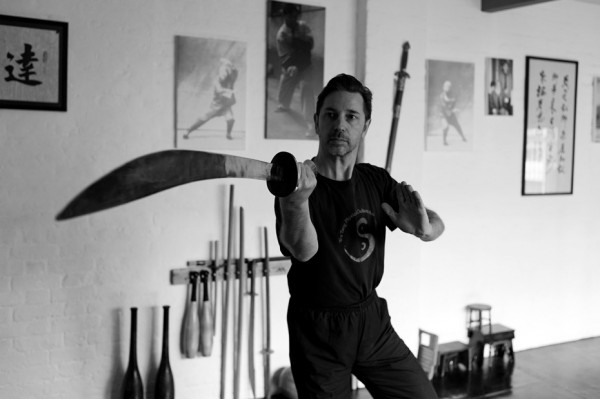
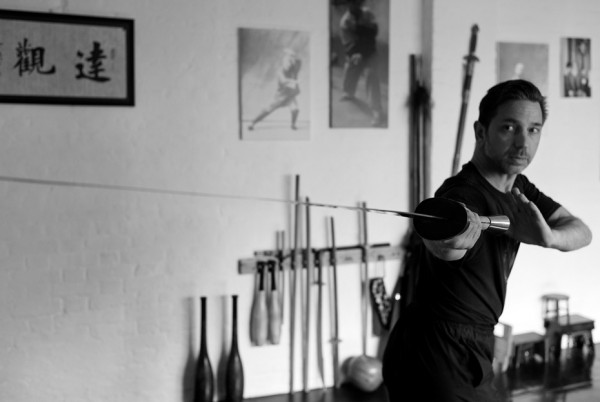
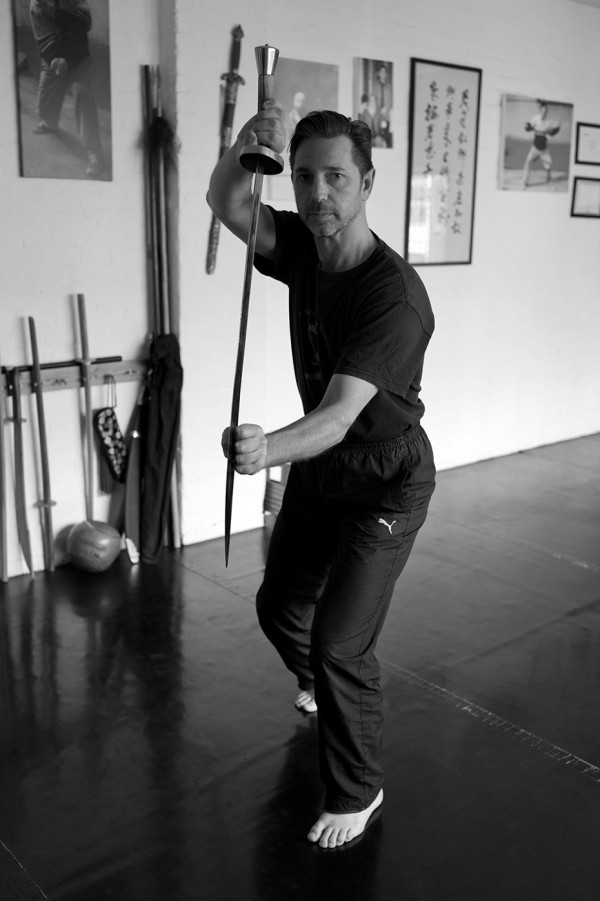
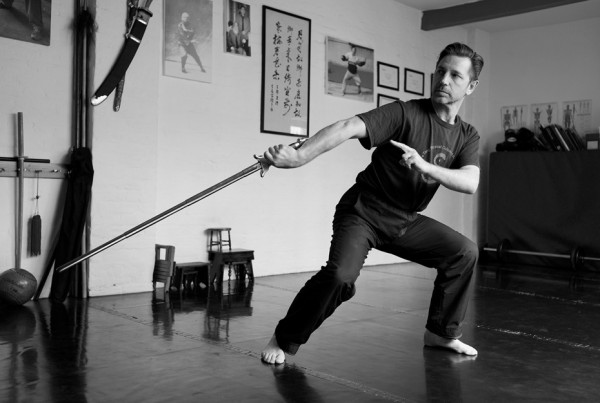
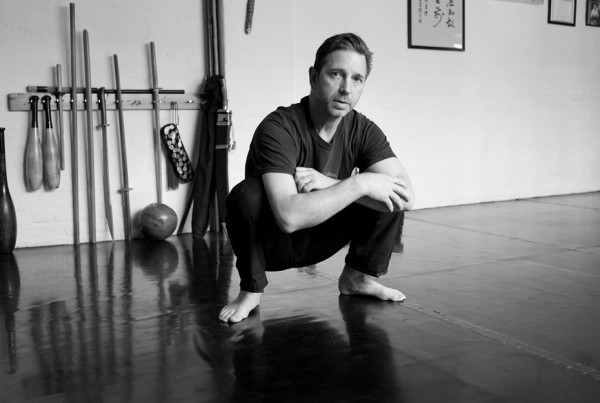
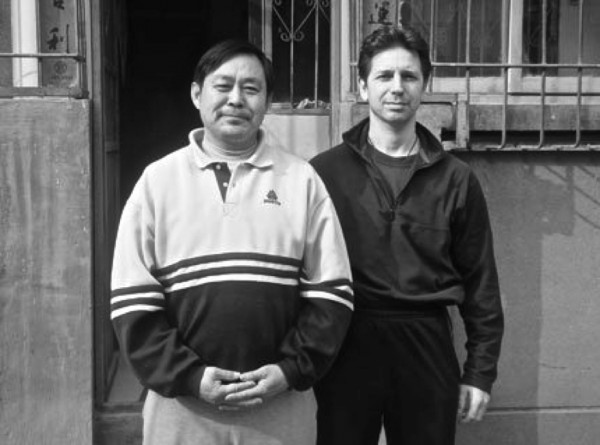
Chris Chappell with his teacher, Master Ma Bao Guo
[youtube 2xvEUkrzgFY nolink]
Watch Chris in action.
Photographs copyright © Alex Pink
Real Taoism, 170 Brick Lane, E1 6RU
The Return of Parmiter’s School
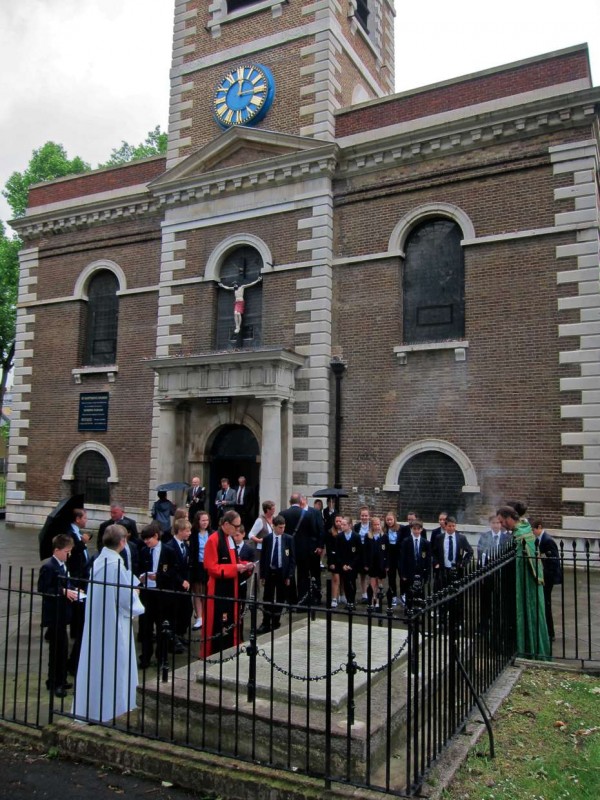
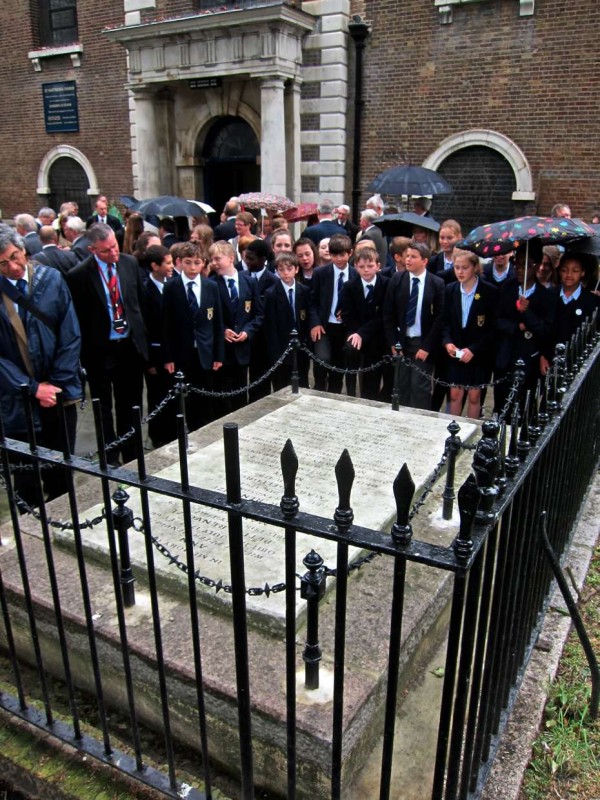
Pupils of Parmiter’ School, which moved to Watford from Bethnal Green over thirty years ago, returned to the East End yesterday to honour Peter Renvoize, one of their benefactors who is buried in the churchyard of St Matthew’s. They were joined by members of the Old Parmiter’s Society of Bethnal Green for a service of rededication of the Renvoize family tomb which has recently been renovated. And I joined the excited throng as guest of Parmiter’s old boy Ron Pummell.
In his will of 1682, silk merchant Thomas Parmiter left two farms in Suffolk to supply income for “six almshouses in some convenient place upon the waste of Bethnal Green, and further, for the building there one free schoolhouse or room, wherein ten poor children of the hamlet of Bethnal Green may be taught to read, write…” Yet it was not until 1720 that his legacy had accrued sufficient funds, and the buildings in Grimsby St, off Brick Lane, were only completed in 1722.
In the nineteenth century, the school’s most generous benefactor was Peter Renvoize (1757-1842) who left £500 to Parmiter’s, plus £10 to the master and five shillings to each schoolboy, along with the wish that his family vault be kept “In good repair and condition.” By chance, Peter Renvoize’s tomb and that of his contemporary Joseph Merceron (1764–1839), were the only two graves out of eighty thousand buried here that survived the bombing of the church in 1940.
And thus you might think yesterday’s service of rededication of the tomb was a simple celebration of the enlightened altruism of the venerable Peter Renvoize, yet the truth is more equivocal. Peter Renvoize and his henchman Joseph Merceron were two of the most notorious characters in the history of Bethnal Green,whose activities included swindling the poor funds at St Matthew’s of £925 in 1819.
The ambivalence of the occasion did not go unacknowledged by Rev Kevin Scully, Vicar of St Matthew’s. In his welcoming address, he laid it out fair and square, outlining the notoriety of Joseph Merceron who was both church warden and owner of a number of disorderly pubs and brothels in Bethnal Green – before serving time in prison only to return to the role of church warden again.
“We’re quite famous for gangster funerals here,” admitted Rev Scully, referring to the Krays’ funerals that took place in his church and running his gaze provocatively along the rows of children,“we serve all members of the community and maybe some of you will be part of the criminal fraternity one day?” Then, lest he cast a shadow upon the day for the young ones, Rev Scully salvaged an uplifting moral from this dubious history, citing Peter Renvoize’s legacy to their school as a redeeming example of how “good comes out of bad.”
Once headmaster, Nick Daymond, had read from the book of Corinthians reminding us all that charity “Rejoiceth not in inquity, but rejoiceth in the truth,” and after we had all sung the school song we filed out into the church yard in the rain to peer at the tomb where Peter Renvoize lay buried beneath.
Afterwards, it was my pleasure to be introduced by Ron Pummell to some of his fellow members of Old Parmiter’s Society who had attended the school before it moved from Bethnal Green. Running through a distinguished list of former pupils, Ron mentioned Nick Leeson, the trader that bankrupted Barings Bank, who attended Parmiter’s after the school moved to Watford. “We always say, ”If he’d been a Bethnal Green boy, he would have got away with it,'” he joked.
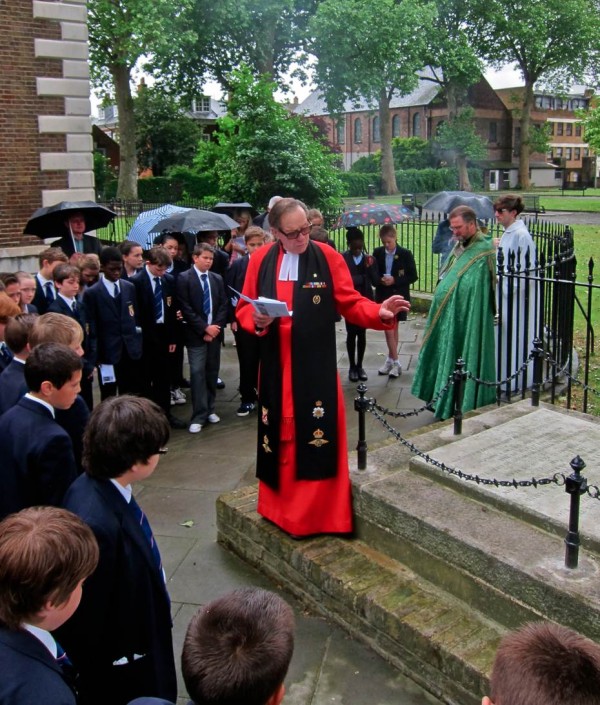
Rev Gp Capt Donald Wallace rededicates the tomb of Peter Renvoize.
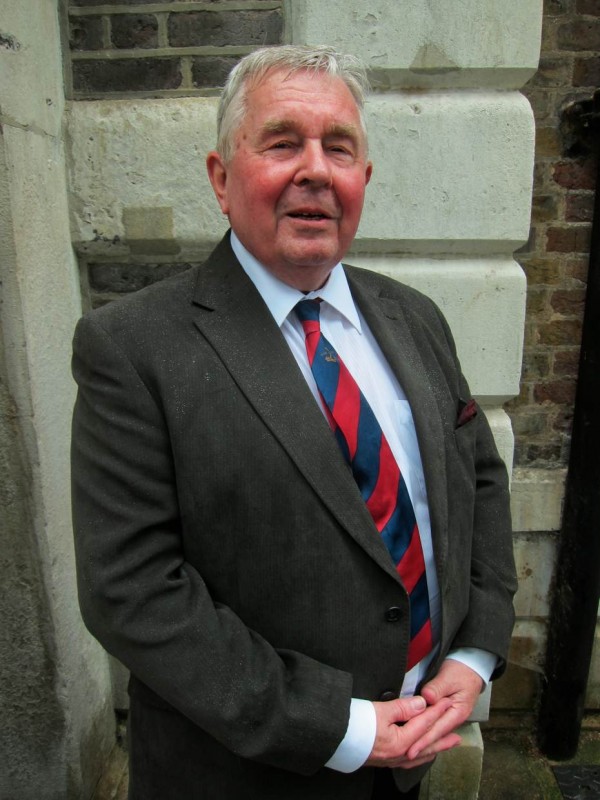
Ron Pummell, member of the Old Parmiter’s Society of Bethnal Green
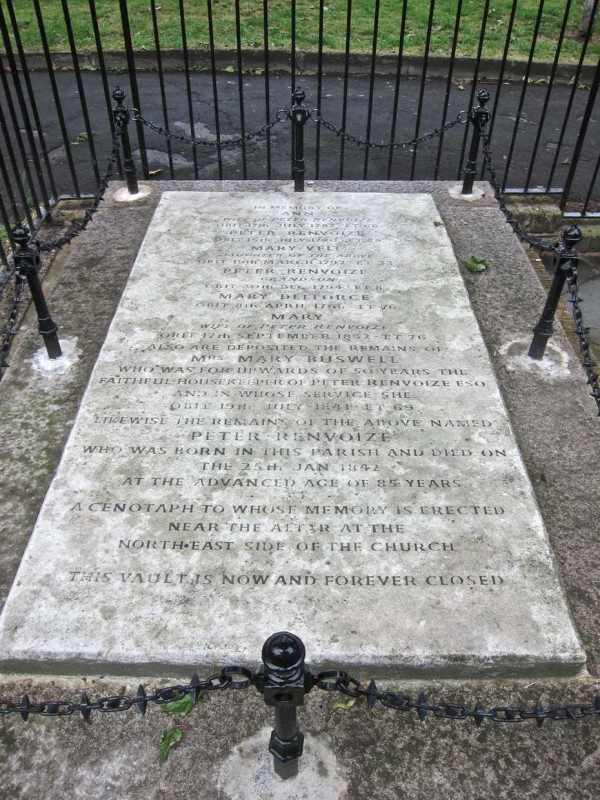
The vault of Peter Renvoize
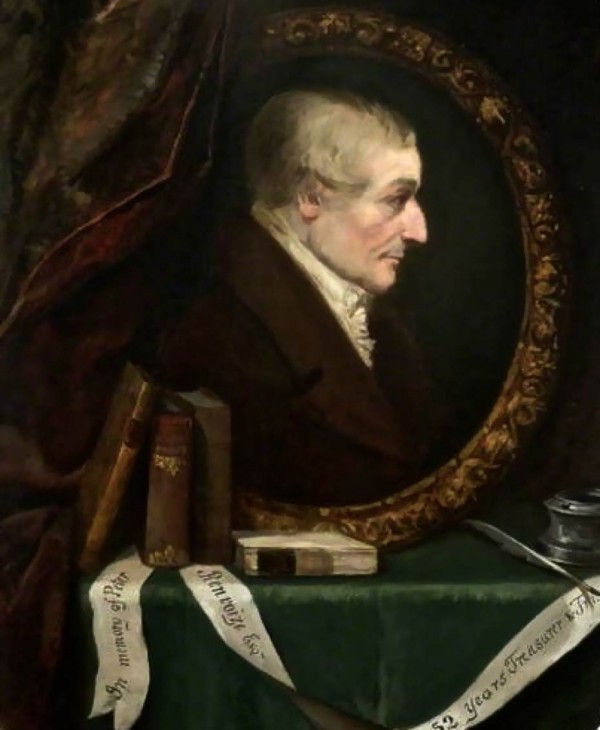
Peter Renvoize, school treasurer, who conspired to swindle £925 from the poor of Bethnal Green in 1819.
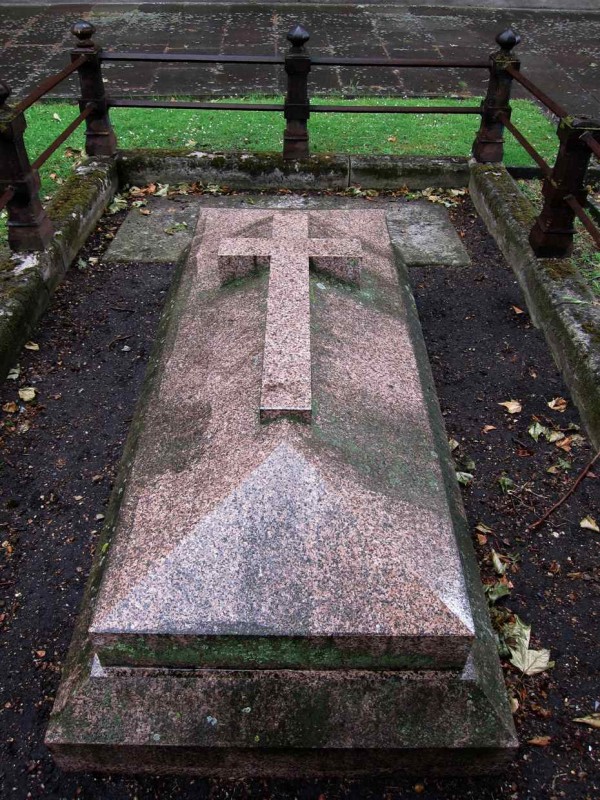
The tomb of the Merceron family – Joseph Merceron was church warden, magistrate and a notorious criminal of Bethnal Green.
You may also like to read about
The Beating of the Bounds in the City of London
More Travellers’ Children in London Fields
As I await delivery of copies of Colin O’Brien’s Travellers Children in London Fields that I am publishing next week, I am looking back upon those pictures which did not find their way into the book. Rather than let these stray images from this extraordinary series be forgotten, I am publishing some here as a taster of what you can expect from the book.
Click to buy a signed copy of Colin O’Brien’s book for £10!


“I came across the travellers whilst I was photographing a deserted warehouse in London Fields. They had parked their caravans in and around Martello St near the railway arches by the station. This part of Hackney was very run down in the eighties. The streets were littered with rubbish and many of the decaying Victorian terraces were being demolished. The area was neglected and dangerous, with graffiti everywhere.
The travellers were Irish, mostly families with three or four children, living in modern caravans which looked extremely cramped but comfortable. On the first week, I started to take one or two Polaroid shots of the children which I gave to them to show their parents. Some of the parents then dressed the children up and sent them out for me to take more portraits.
I continued to take pictures over a period of three weeks and got to know some of the travellers well. They took me into their confidence and trusted me with their children.
When I returned to the site on the fourth week the families had gone. I was surprised, though I should not have been because this is what travellers do – they move on. I had no way of contacting them, yet I was left with this set of pictures, and it was only when I started to print the negatives that I realised what an amazing set of photographs they were.”
– Colin O’Brien


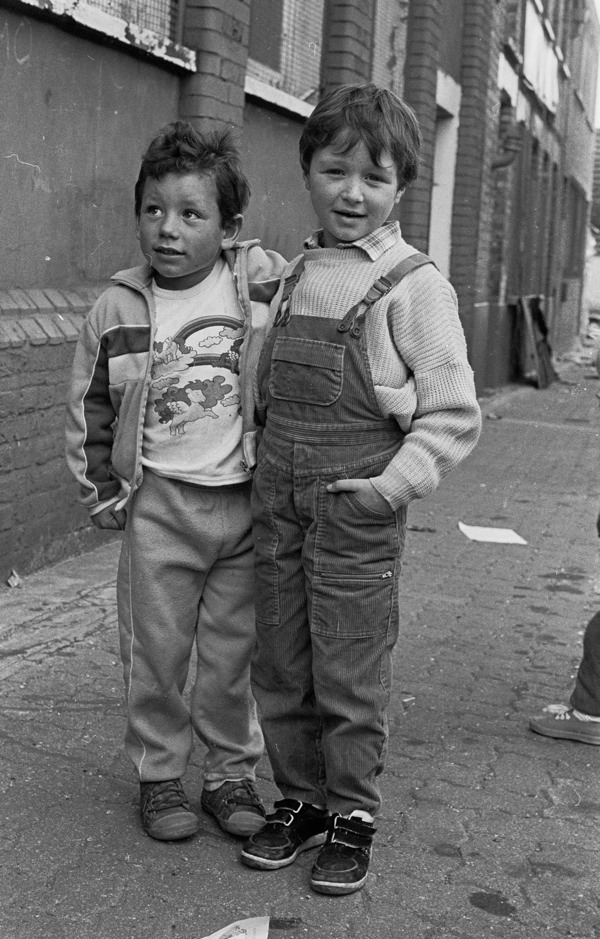


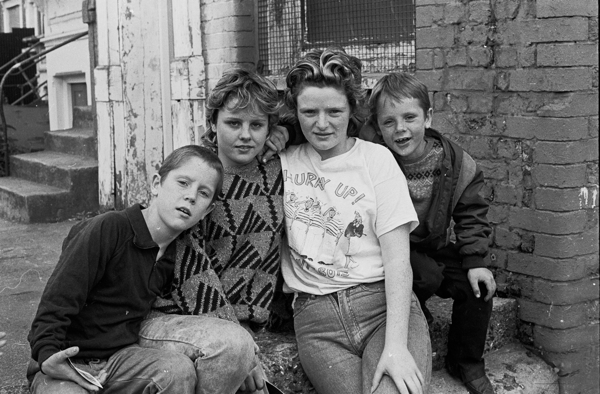


Hardback copies will be on sale at £10 from 3rd July at the Bishopsgate Institute, Brick Lane Bookshop, Broadway Bookshop, Labour & Wait, Leila’s Shop, Newham Bookshop, Pages of Hackney, Rough Trade and Townhouse, Fournier St. Faber Factory Plus part of Faber & Faber are distributing Travellers’ Children in London Fields nationwide, so if you are a retailer and would like to sell copies in your shop please contact bridgetlj@faber.co.uk who deals with trade orders.
Photographs copyright © Colin O’Brien
You may also like to read about
Alex Pink’s Fournier St, Then & Now
No street in the East End has seen a greater transformation than Fournier St, where once were shabby clothing factories, sweatshops and furriers, are now immaculately appointed mansions. In this final part of the collaboration with Tower Hamlets Local History Library & Archive, Spitalfields Life Contributing Photographer Alex Pink selected photographs from the collection and then took a stroll from Christ Church to Brick Lane to review the changes that conservation has brought.
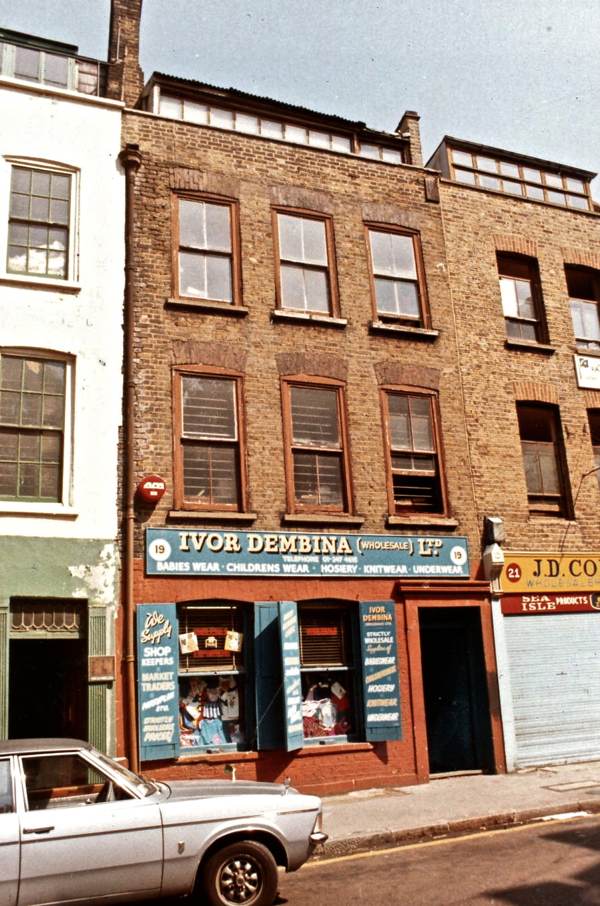
19 Fournier St, 1975
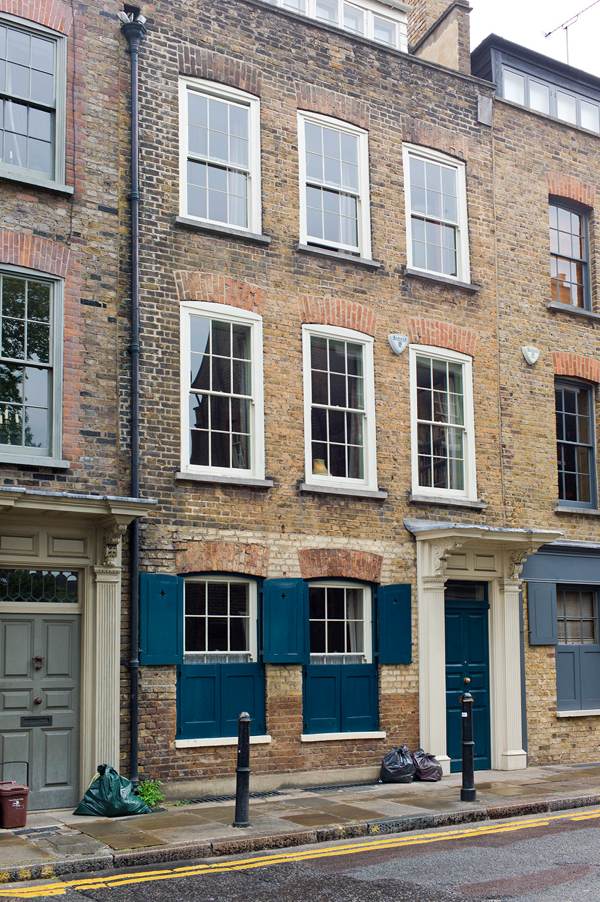
19 Fournier St, 2013
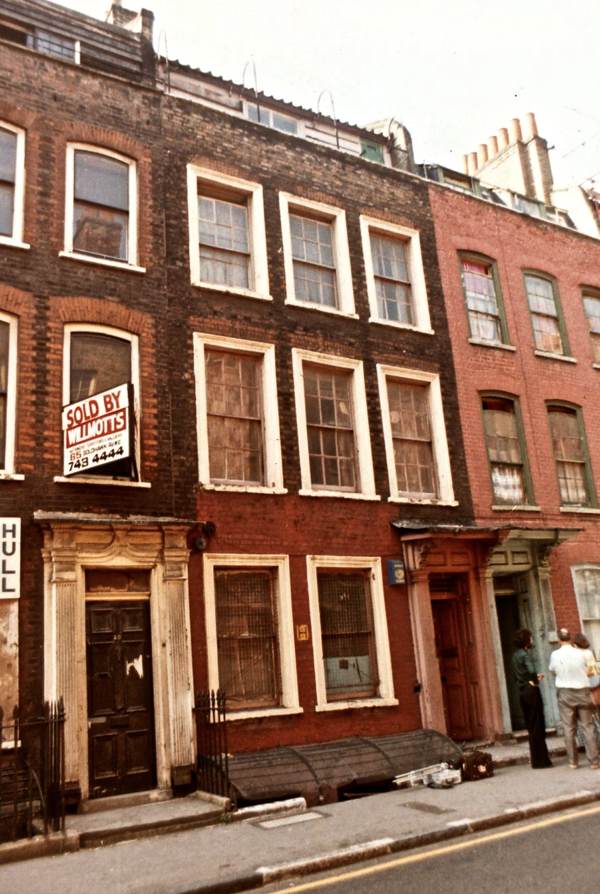
20 Fournier St, 1975
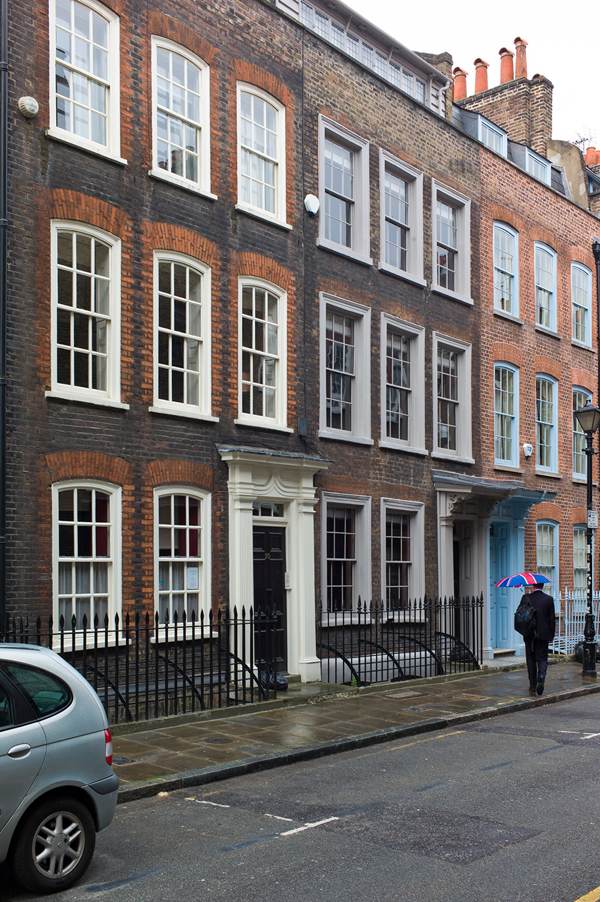
20 Fournier St, 2013
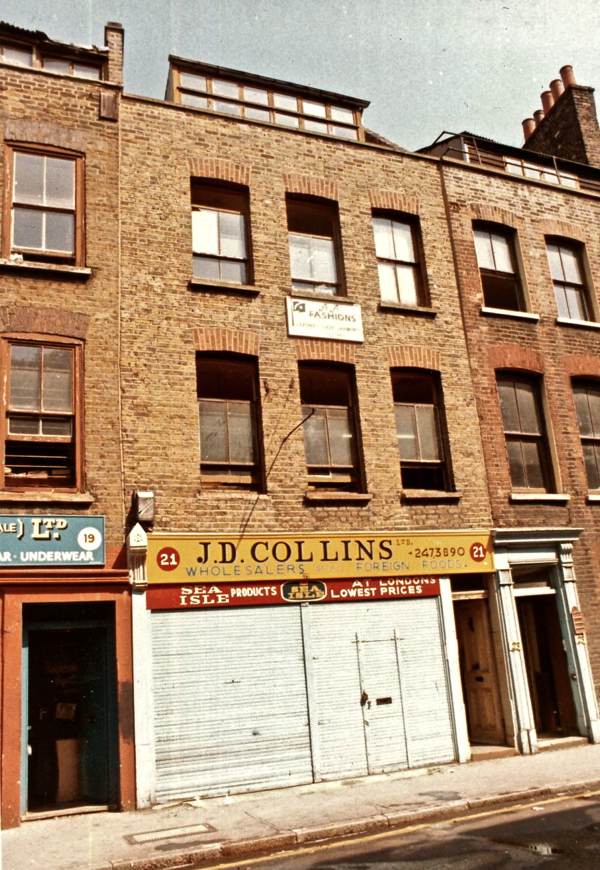
21 Fournier St, 1975
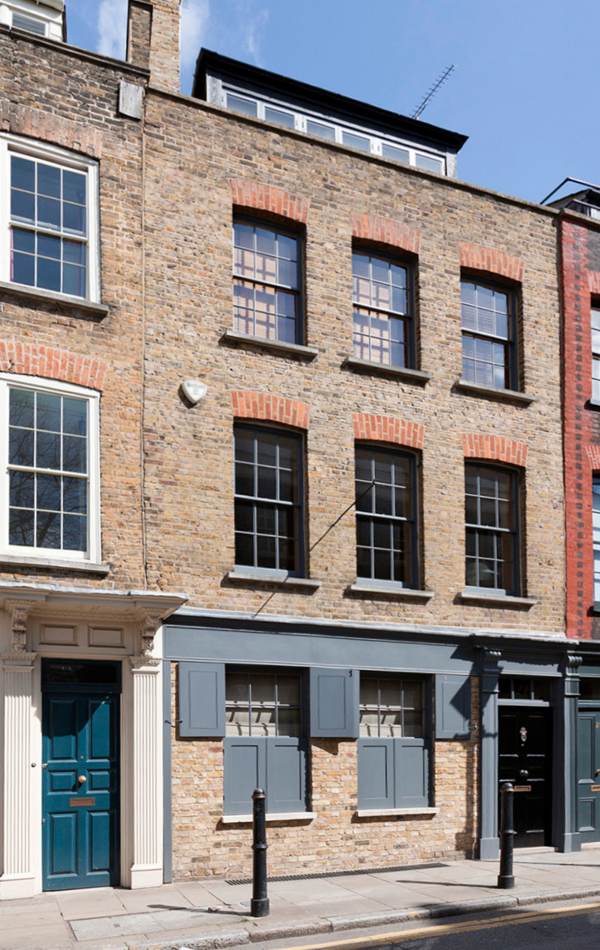
21 Fournier St, 2013
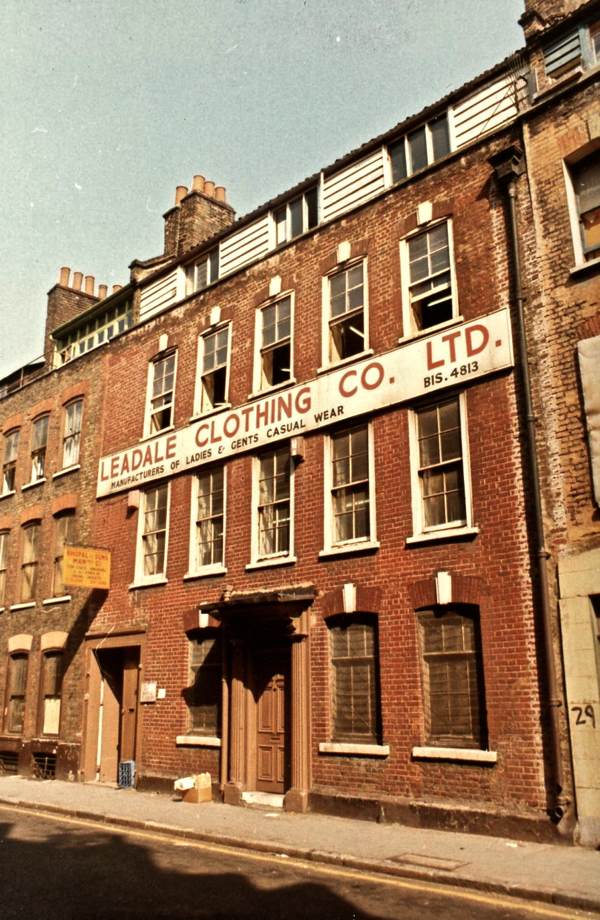
27 Fournier St, 1975
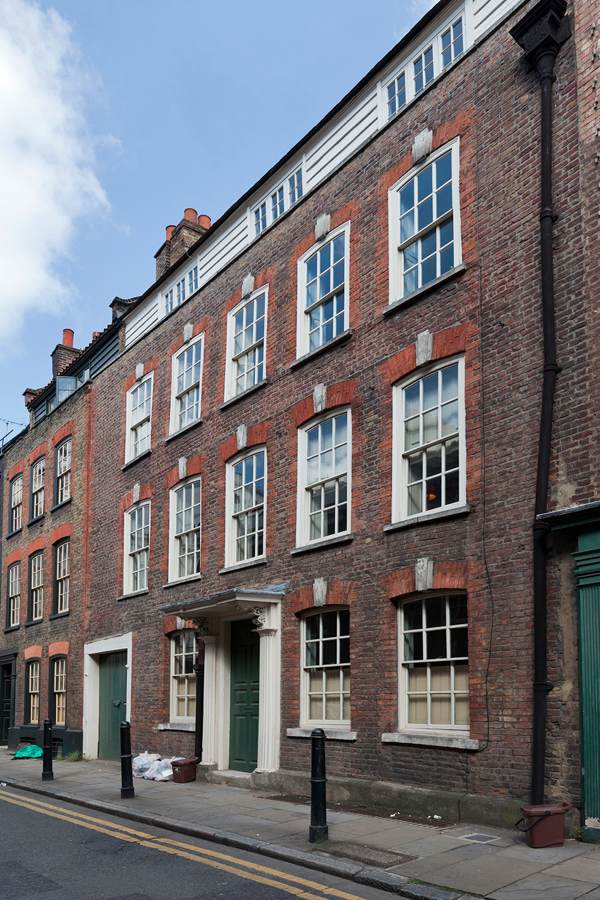
27 Fournier St, 2013

29 Fournier St, 1975
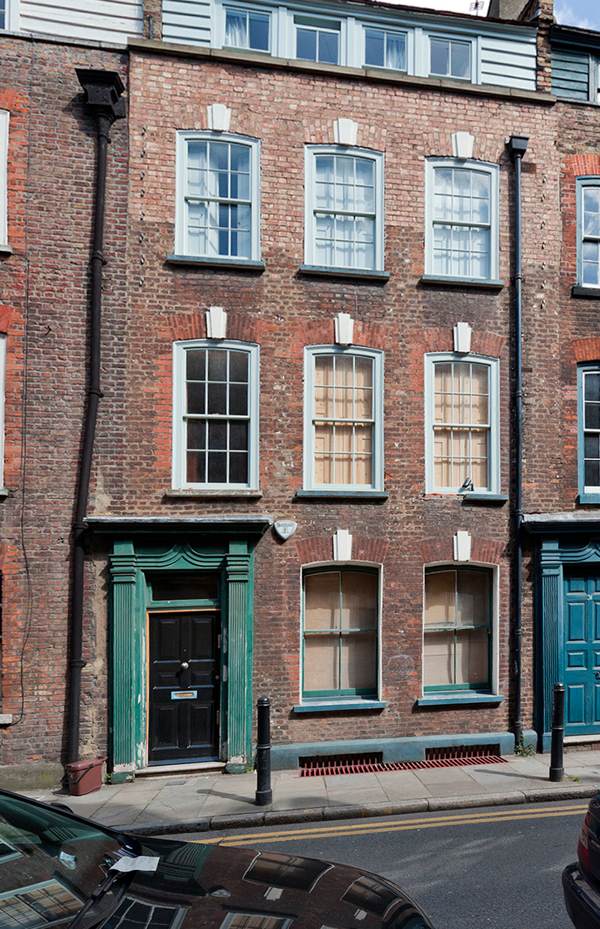
29 Fournier St, 2013
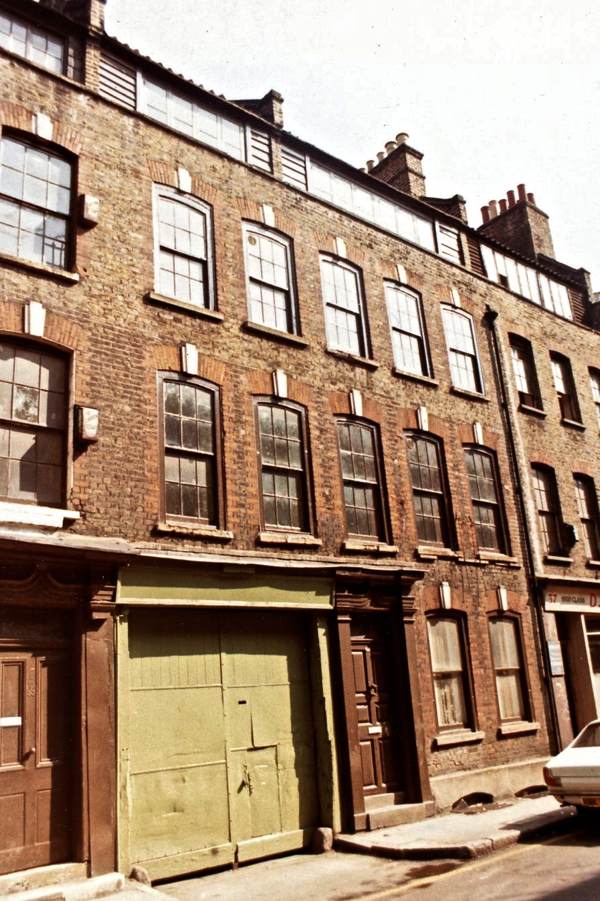
33 Fournier St, 1975
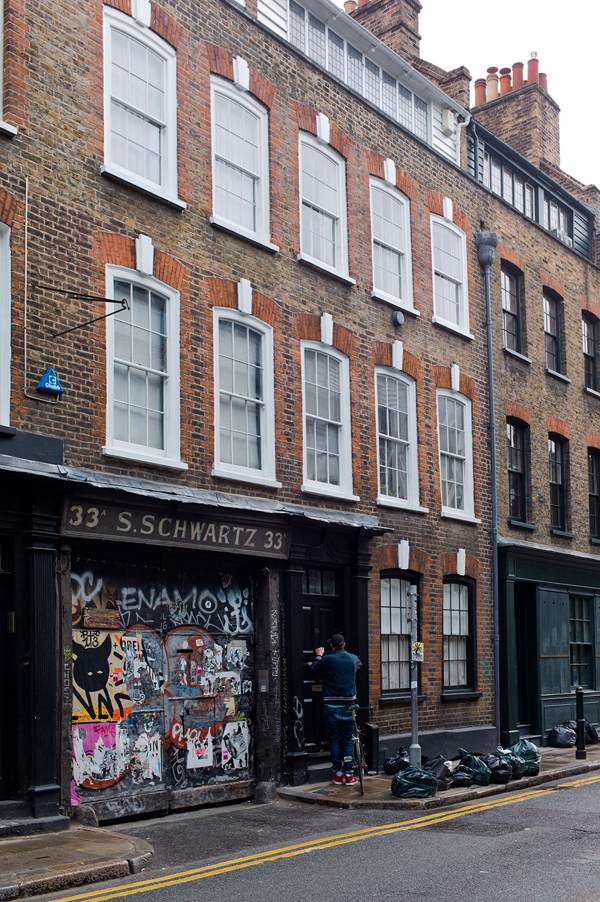
33 Fournier St, 2013

37 Fournier St, 1975
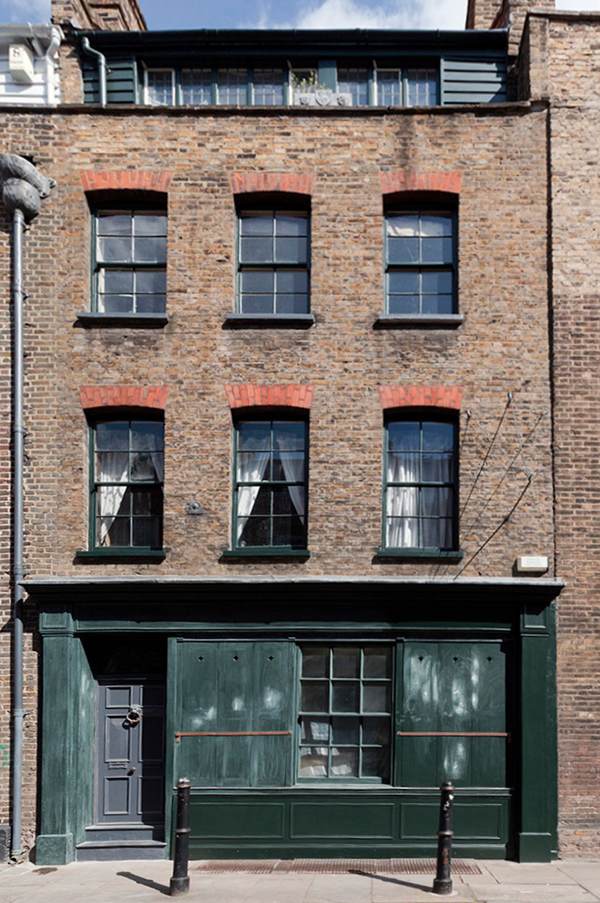
37 Fournier St, 2013
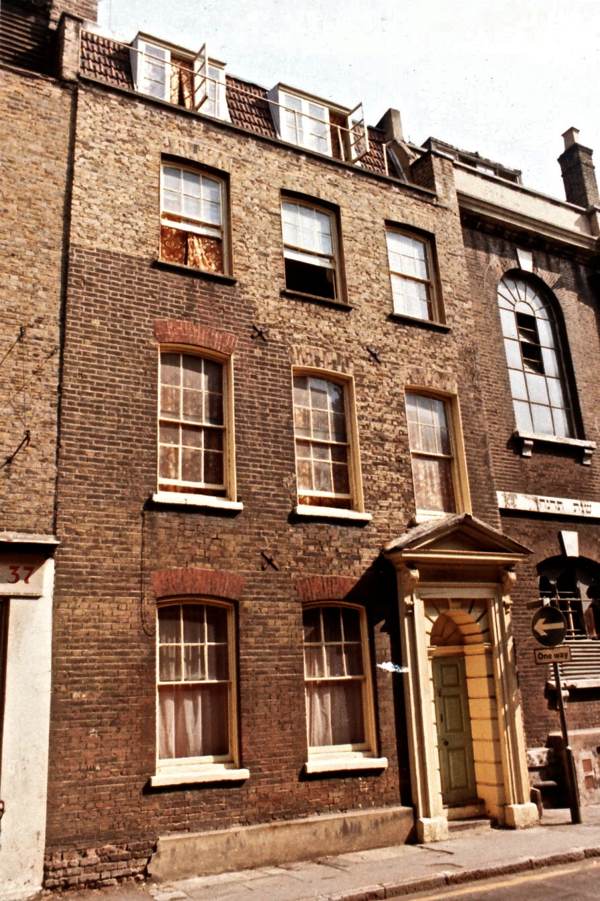
39 Fournier St, 1975
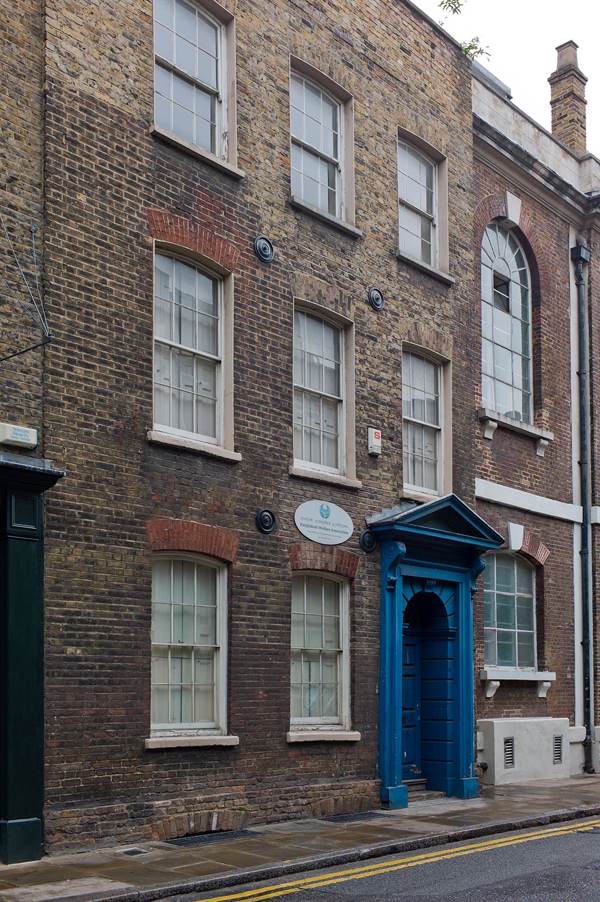
39 Fournier St, 2013
Archive images courtesy Tower Hamlets Local History Library & Archives
New photographs copyright © Alex Pink
Visit Tower Hamlets Local History Library & Archives for opening times, collections & events.
You may also like to read these other Fournier St stories
Jonathan Miller in Fournier St
All Change at 15 & 17 Fournier St
A Tourist in Whitechapel
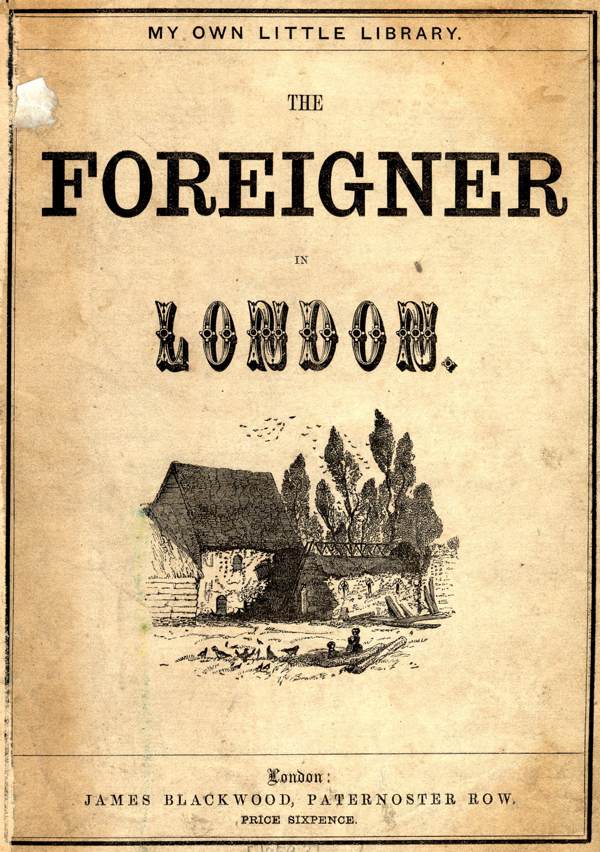
Now that the visitor season is upon us again, I discovered this comic pamphlet of 1859 in the Bishopsgate Institute which gives a fictional account of the experiences of a French tourist in Whitechapel yet permits us a rare glimpse of East End street life in that era too.
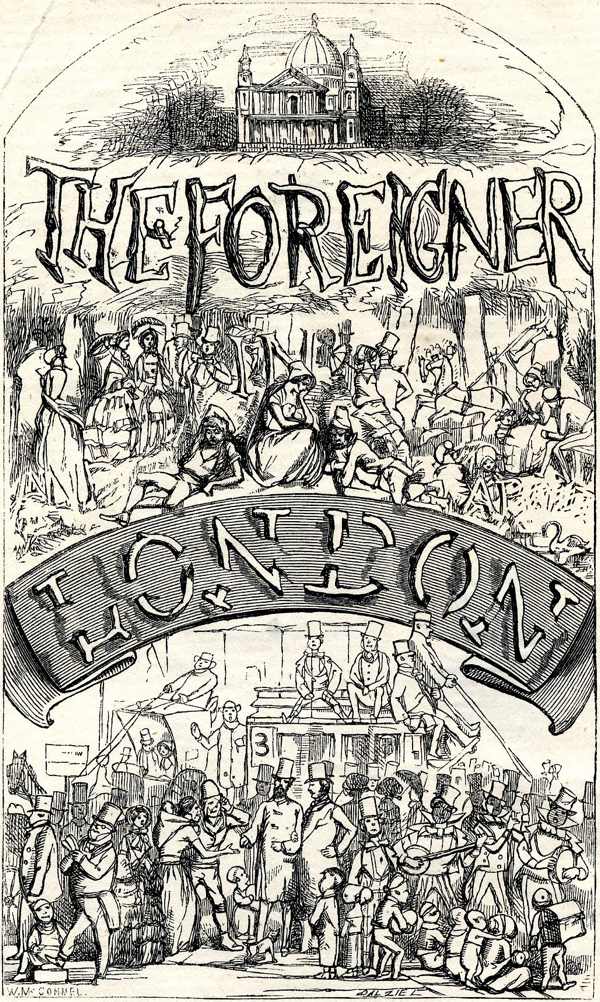
Monsieur Theophile Jean Baptiste Schmidt was a great observer of human nature. He was a great traveller too, for he had been across the Atlantic. But he had never been to London, so to London he determined to come.
When he arrived at London Bridge, to which he came in his Boulogne steamboat, he was met by his friend and countryman, Monsieur Hippolyte Lilly, who had resided some years in the city and knew all about its ways. Now Monsieur Lilly was a bit of a wag, so he determined to play Monsieur Schmidt a practical joke. Instead of taking his friend to the West End of London, when he landed, he led him to Whitechapel, and lodged him in a small public house called the Pig & Whistle.
“Baptiste, my friend,” said Hippolyte, “The English are a very strange people and you must not offend them – if they ask you for anything, you must give it at once.”
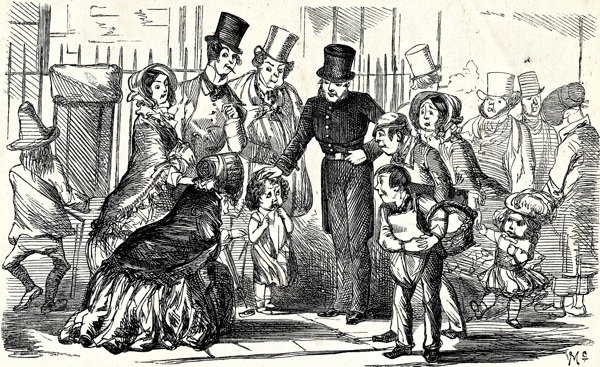
The Lost Child
No sooner therefore were the friends in Whitechapel, than they sallied out to see London. The stranger was very much astonished at the throng of people and vehicles, and they had not gone far before they saw a little crowd assembled on the pathway, so they at once stopped to see what was going on. Looking over the shoulders of a couple of young ladies they discovered a little child being questioned by a policeman.
“What is the matter?” asked Hippolyte. “Child lost,” replied the policeman. “Better give the man a shilling,” said Hippolyte to his friend. Baptiste therefore put his hand in his pocket and drew out a long silk purse, and taking from it a franc presented it to the policeman, who received it with a nod and a knowing wink.
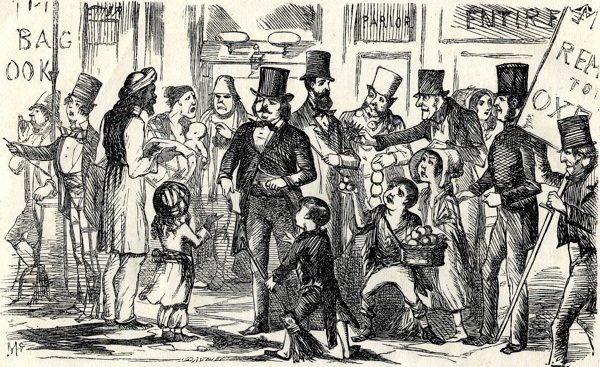
The Benefits of a Long Purse
The action of the foreigner was not lost upon the crowd, and in a few minutes the friends found themselves surrounded by eager applicants. A little boy with a broom tumbled head over heels for their diversion, a Jew offered them a knife with twenty blades. an Indian begged them to buy a tract, a cabman wished to have the honour of drinking their healths, a boy offered them apples at three a penny, a woman with a child in her arms asked them to treat her to glass of gin, a man with a board requested them to fit themselves with a suit of clothes and a little girl wished to sell them a string of onions. To all of these people Monsieur Baptiste gave some piece of money, so that he was soon a very popular character. The policeman, however, cleared the way and they walked on.
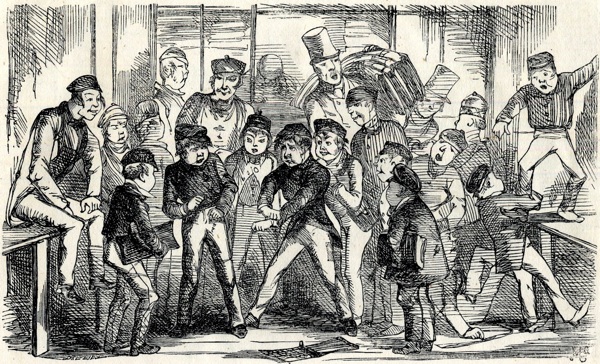
The Conductors of the London Press
Presently they came to the outside of a newspaper dealers, where they saw a crowd of boys and men, laughing, talking, and playing. “These are the conductors of the London Press,” said Hippolyte.
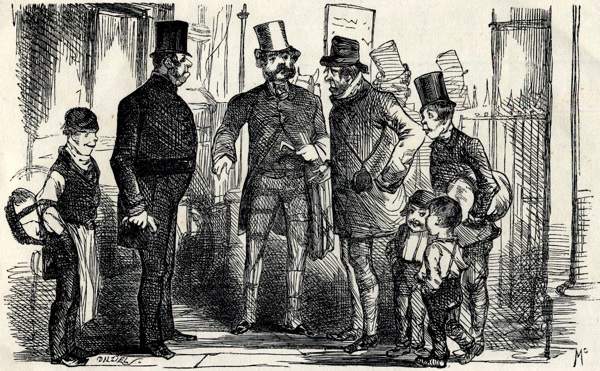
The Disputed Fare
Soon afterwards they witnessed, and took part in, a dispute between a gentleman with a great moustache, a policeman, and a cab driver assisted by a variety of little boys. Baptiste soon settled the dispute by giving the cabman a shilling.

The Great Market
“I will now take you to the Great Market,” said Hippolyte, leading him through the dense crowd assembled round the butchers’ shambles in Whitechapel.
Monsieur Baptiste wondered very much at all he saw, thought the flaming gaslight, streaming over the heads of the people, “a very fine sight,” allowed himself to be pushed and hustled to and fro in the throng with perfect good humour, and was not in the least offended when one stall keeper offered him five bundles of firewood for a penny, or when another recommended him to invest sixpence in the purchase of a dog collar, or when a third – stroking his upper lip – politely asked him whether she should show him the way to the half-penny shaving shop.
Nor did he doubt for a moment what his friend told him was true when he was informed that this was the principal market for the supply of London with fresh meat. At last however, he expressed a desire to get out of the hot, unwholesome throng of poor people, which became every moment more dense, more noisy, and more bewildering.
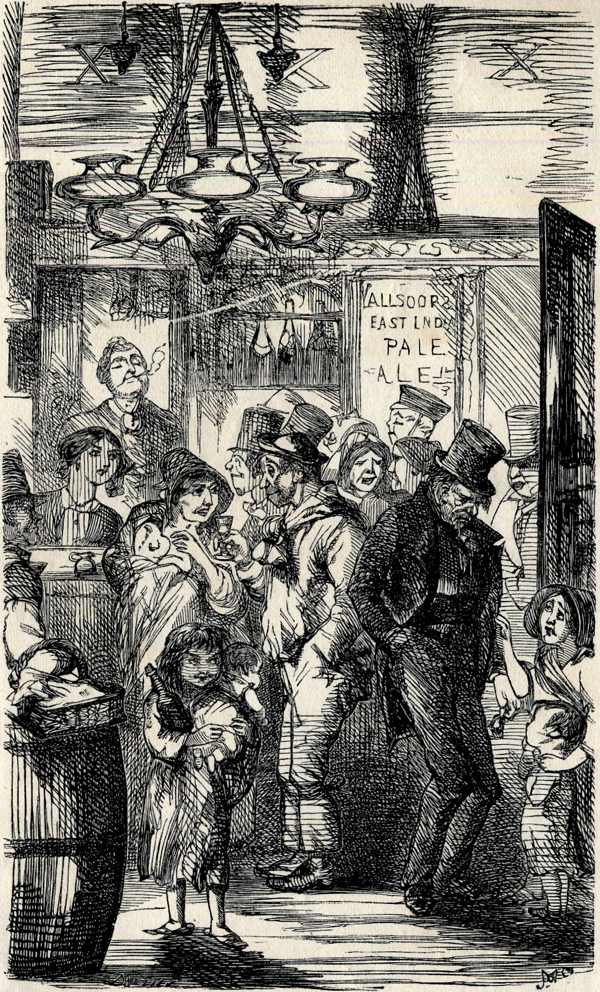
The English Aristocracy
“Let us have one little glass of wine,” said Hippolyte, and forthwith they found themselves in the centre of a throng in a low gin shop.
The space in front of the counter was crowded with people of the poorest sort – an Irish labourer, in a smock frock and trousers tied below the knee with a hay band, was treating a miserable-looking woman to a glass of gin – a poor, half-starved girl was trying to persuade her tipsy father to go home, while another child was staggering under the weight of a baby on one arm and a gin bottle under the other – a miserable hag of a woman was crying ballads in a cracked voice – while a dirty-faced man was selling shrimps and pickled eels from a basket on his arm – and a Whitechapel dandy was joking with the smart barmaid – whose master stood at the door of his private parlour and smoked his cigar with the air of a lord.
A very hot, disagreeable odour filled the place, so that Monsieur Baptiste was obliged he must go home to his hotel. But just before he reached the door of the gin shop, he turned to his friend and asked, “What sort of people are these?”
“These are the aristocracy of England,” said Hippolyte. “These?” exclaimed Baptiste, beginning to see his friend’s joke, “then take me to see the poor.”
How many other places the friends visited that evening, how many jokes Hippolyte played upon Baptiste, and how many other shillings the foreigner spent on his first day in London, I cannot tell you. But I know that he laughed a good deal at the idea of seeing the wrong end of London first.
“Nevertheless, ” Baptiste exclaimed the next morning, “London is a very fine, great, big wonderful city.”
Images courtesy Bishopsgate Institute
You may also like to read about