
Cruikshank’s London Almanack, 1838
This set of engravings is the fourth in a series of calendars illustrating the seasons and festivals of the London year, drawn annually by George Cruikshank for The Comic Almanack published by Henry Tilt of Fleet St. 1838 was the year of Victoria’s coronation and I had no idea that frost fairs persisted until this era, equally the ‘Flying Showers’ of July provide evidence – should we ever need it – of the constant volatility of English summer weather. (Click on any of these images to enlarge)

JANUARY – New Year’s Eve, 1837 departs and 1838 arrives
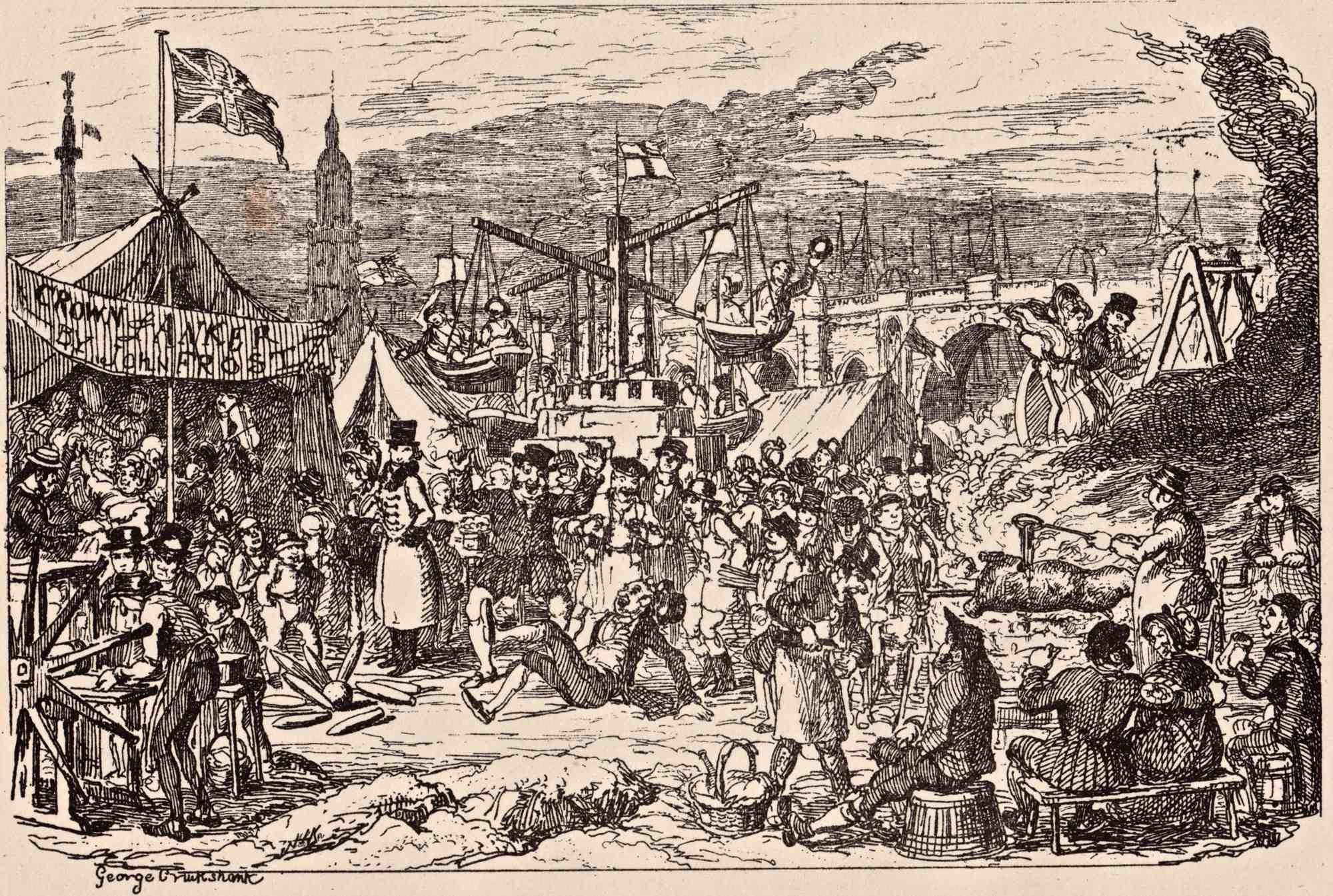
FEBRUARY – Frost Fair on the Thames
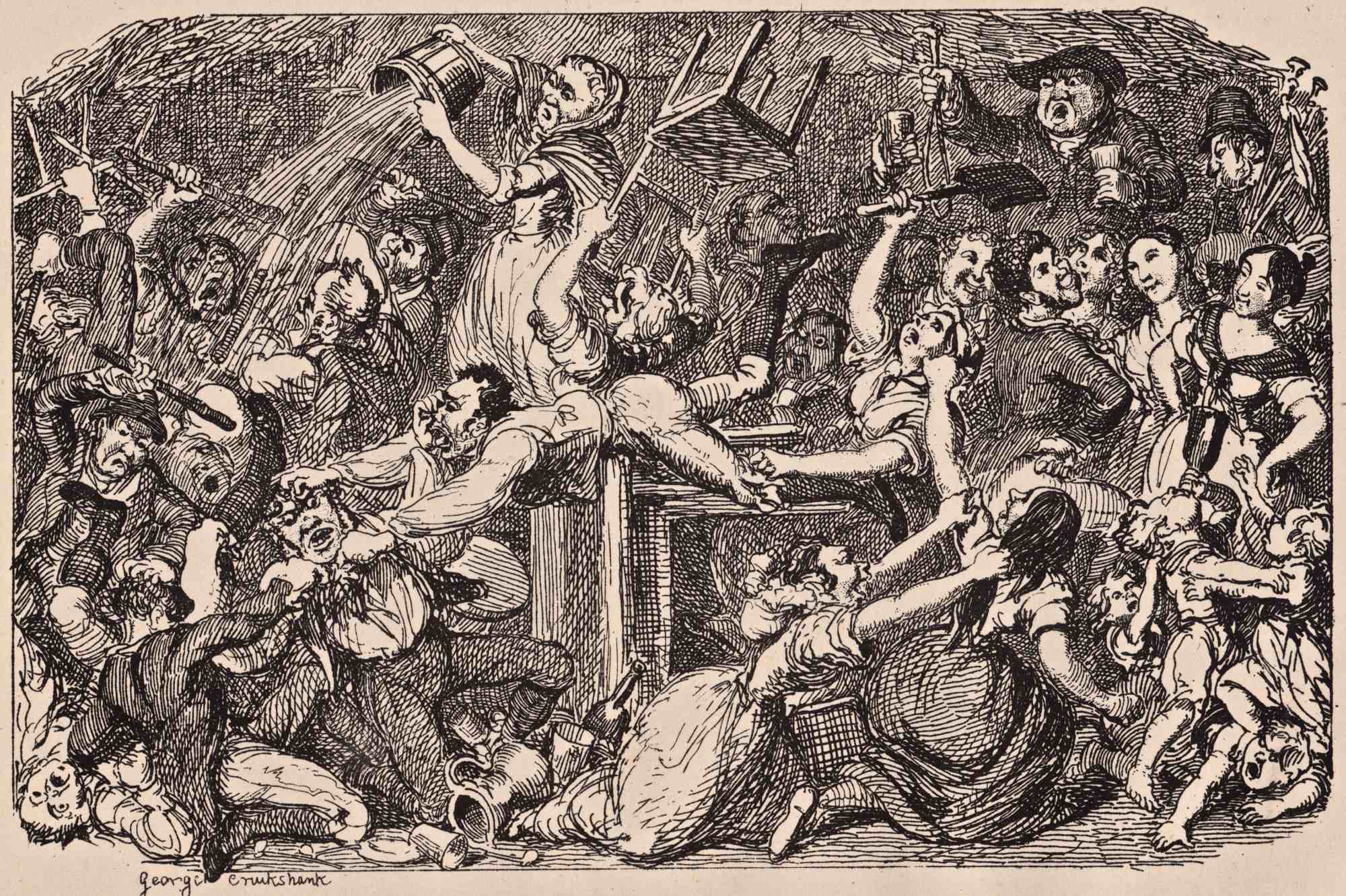
MARCH – St Patrick’s Day at Seven Dials
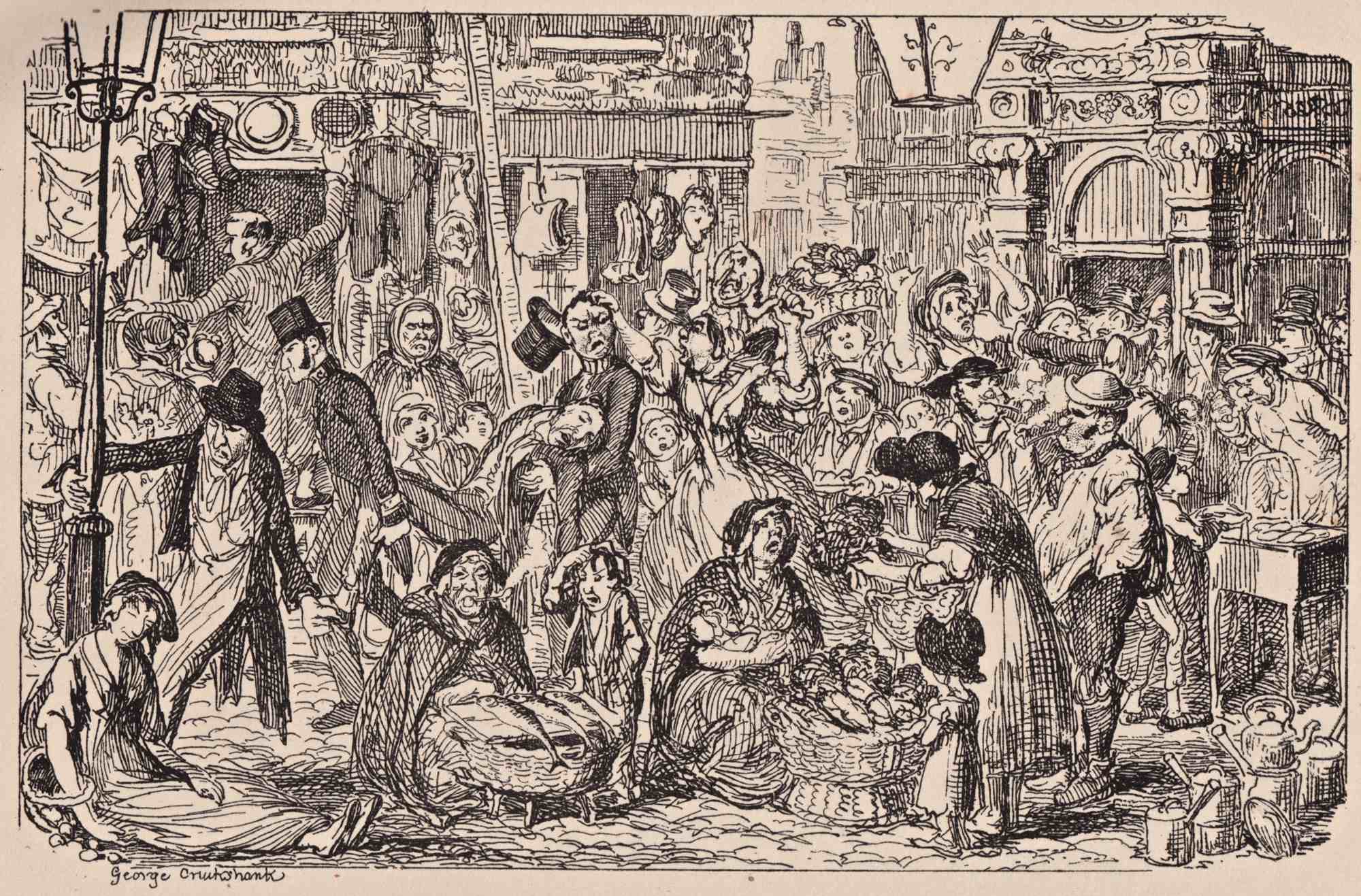
APRIL – Street market on Low Sunday
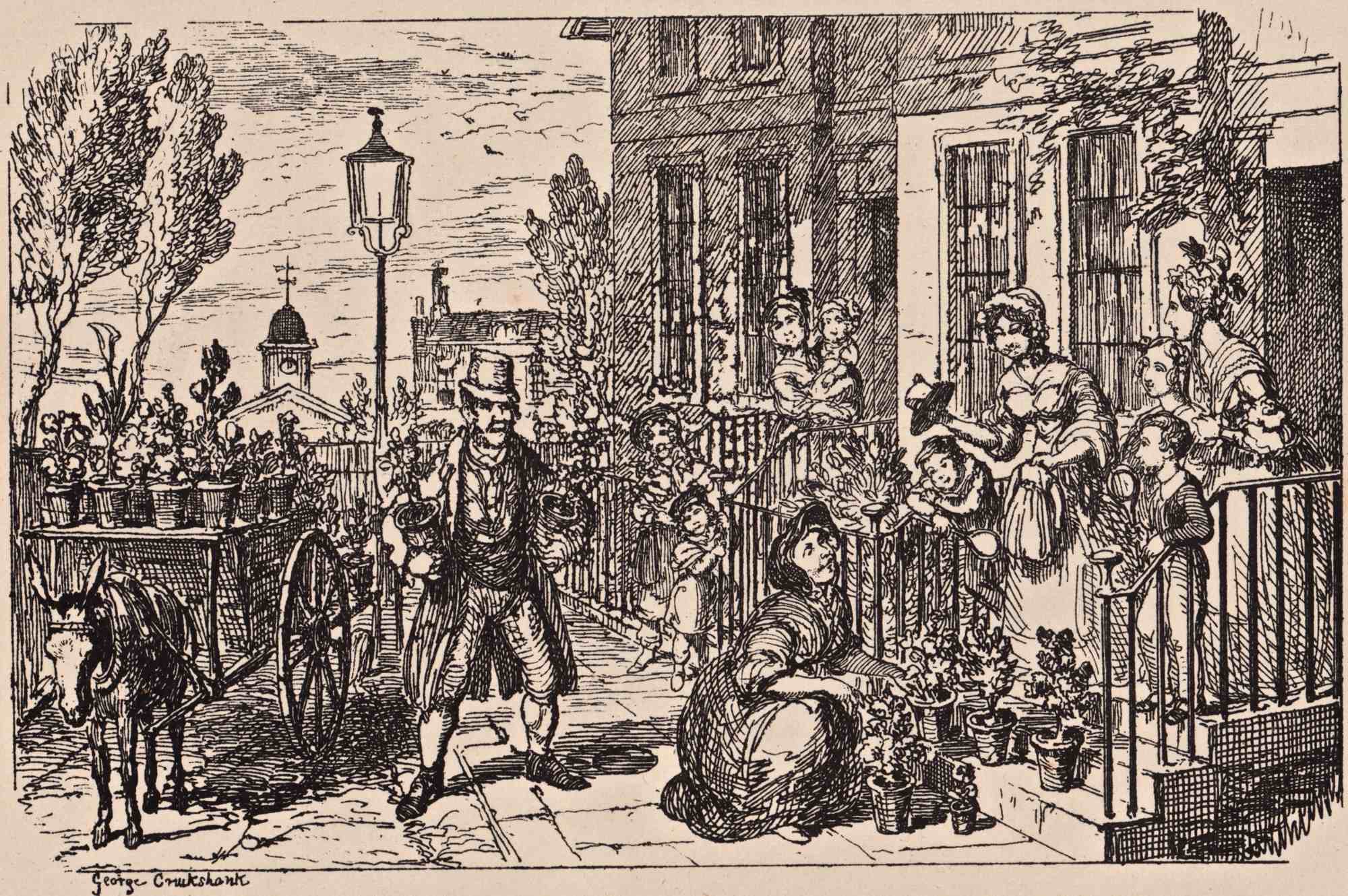
MAY – Street plant sellers ‘All a growing!’
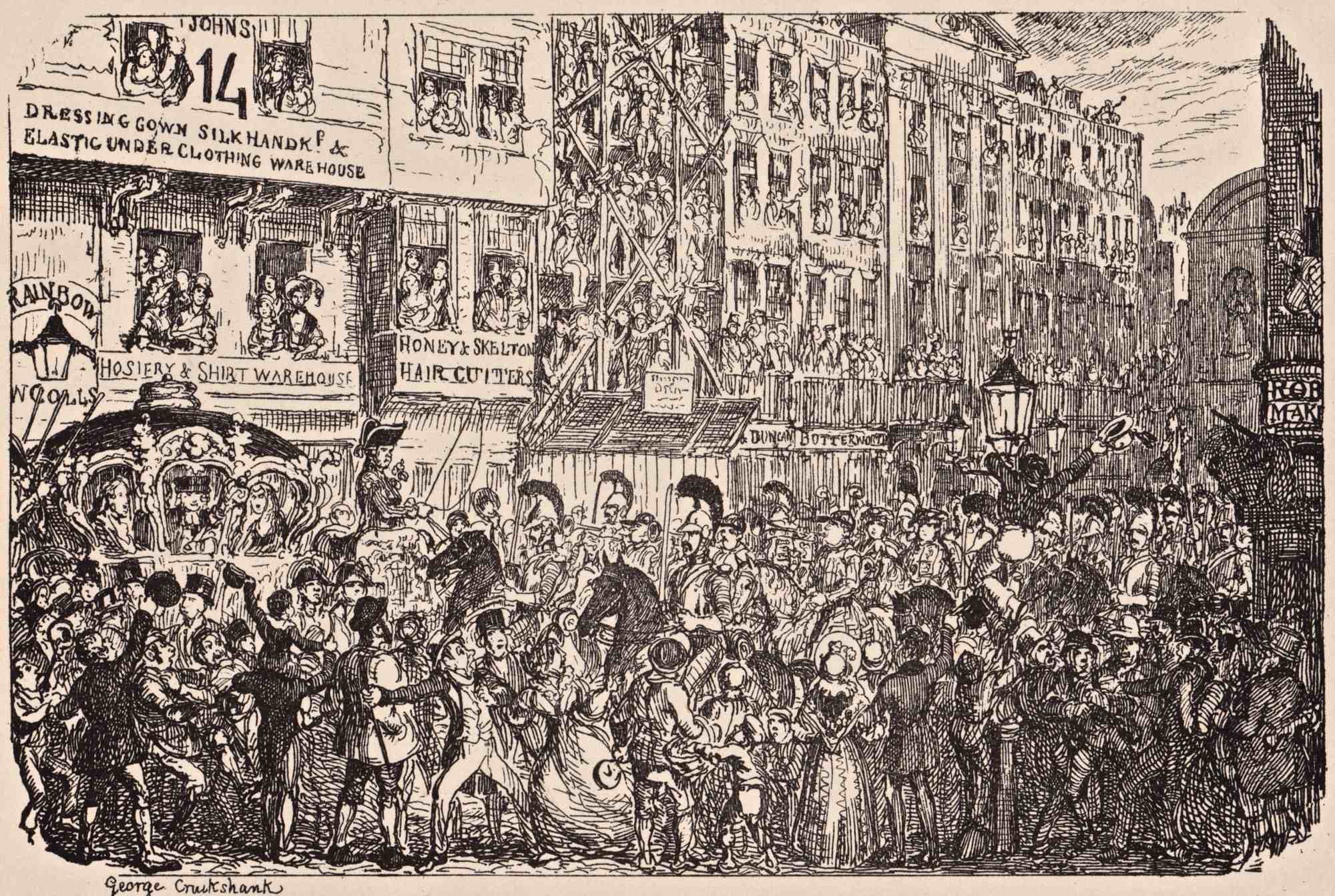
JUNE – The Coronation of Queen Victoria
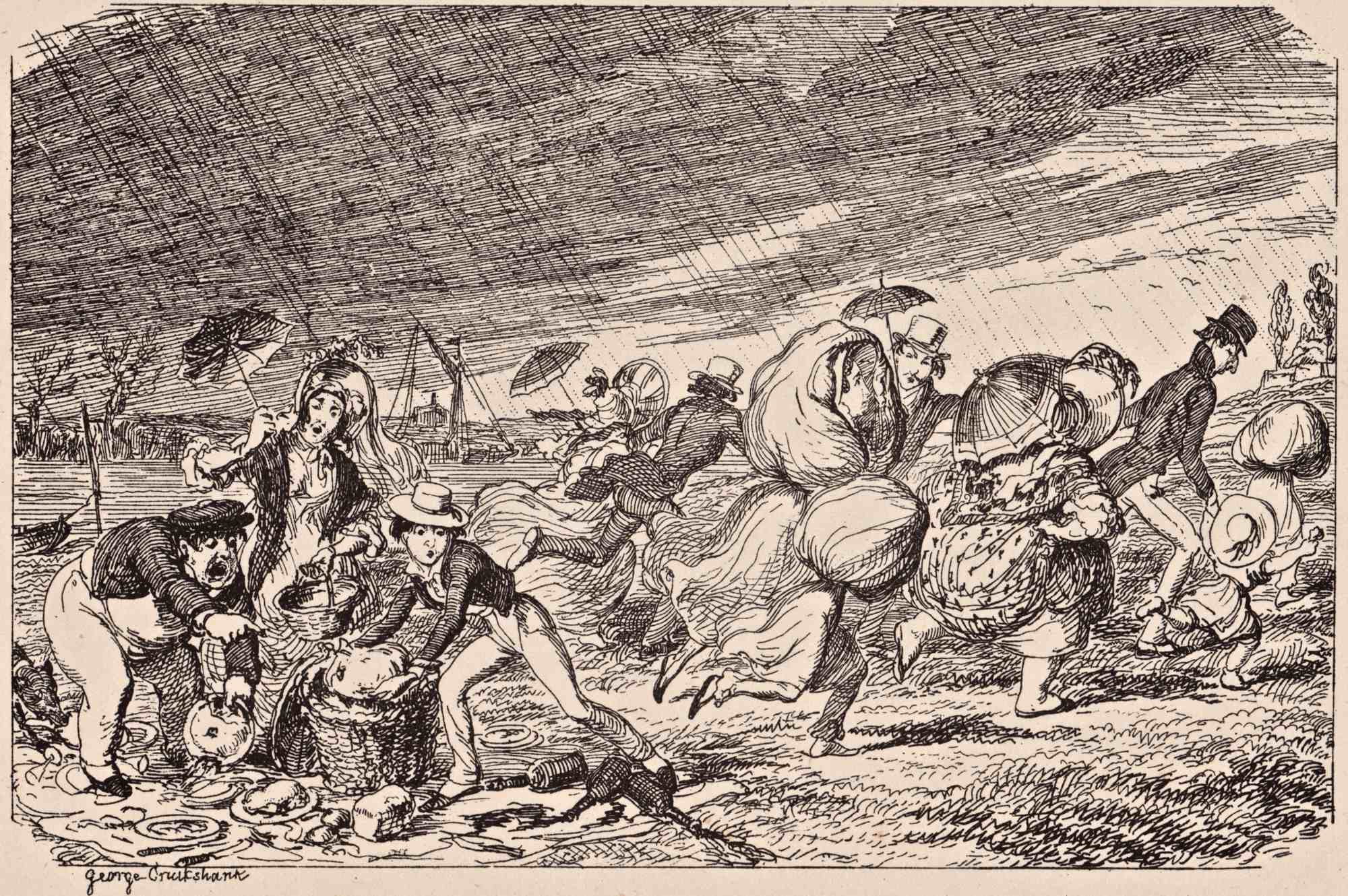
JULY – Flying Showers in Battersea Fields
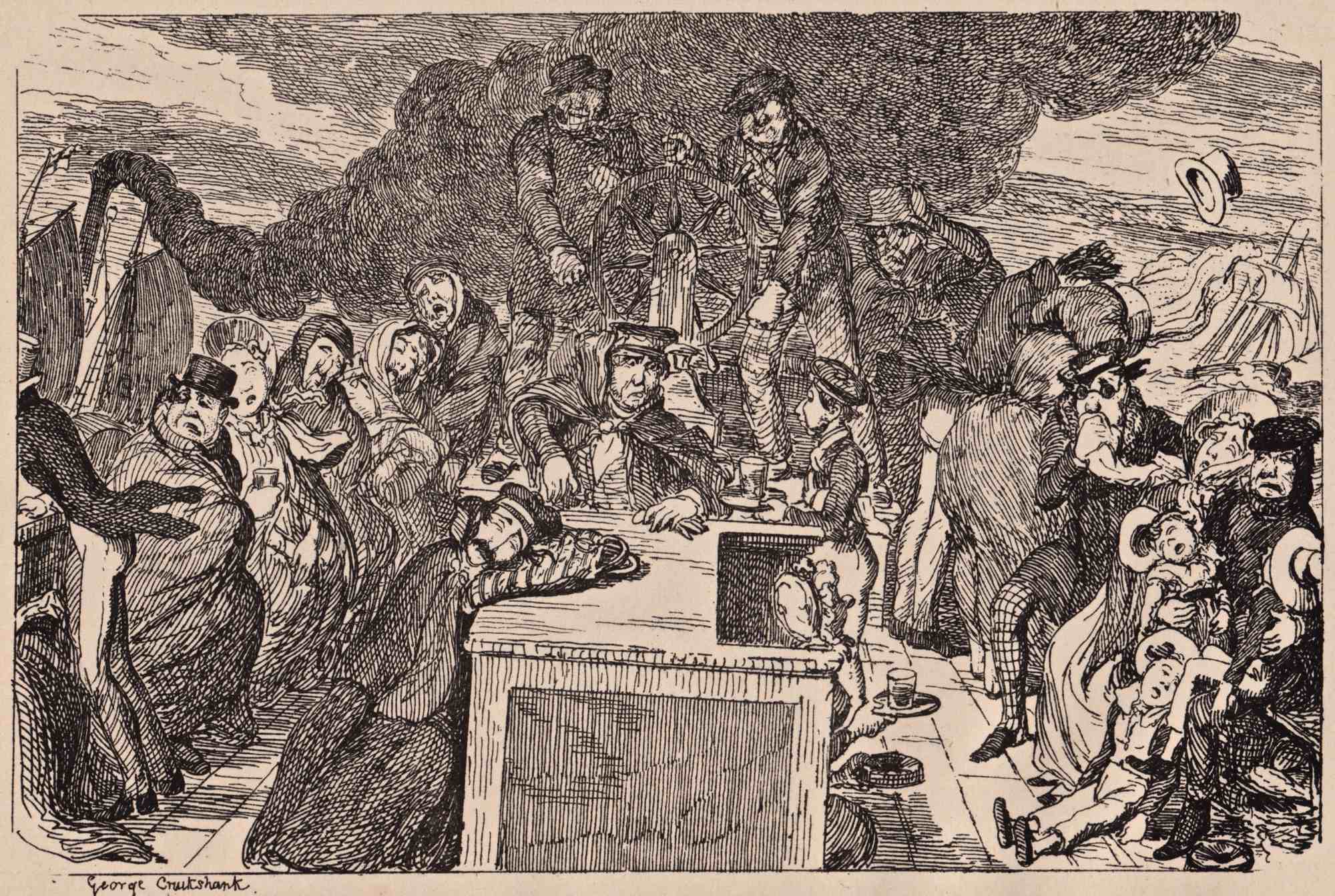
AUGUST – ‘Sic Omnes,’ on board the steamer from London Bridge to Boulogne
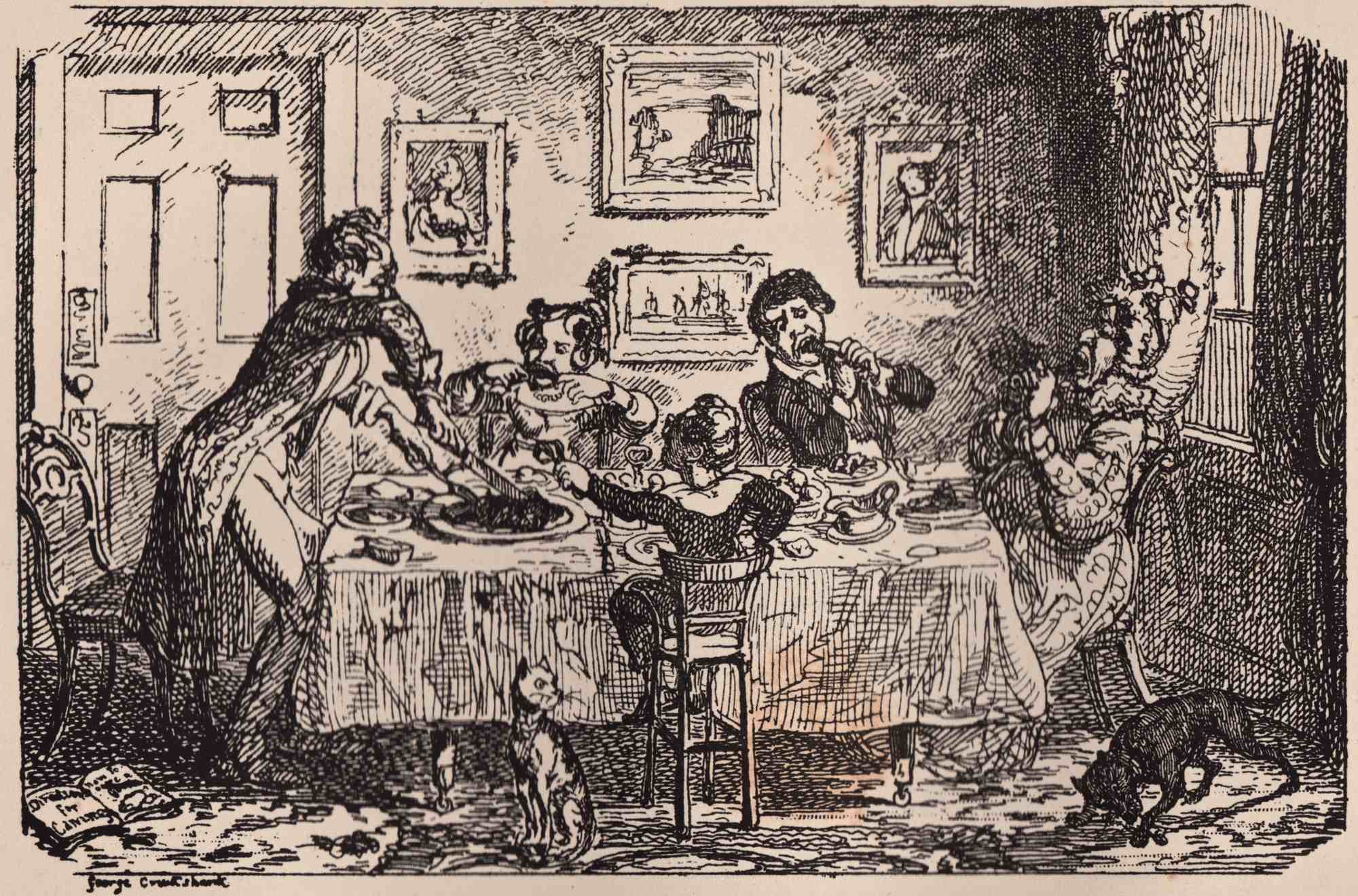
SEPTEMBER – The Michaelmas Gander, ‘De goostibus non est disputandum.’
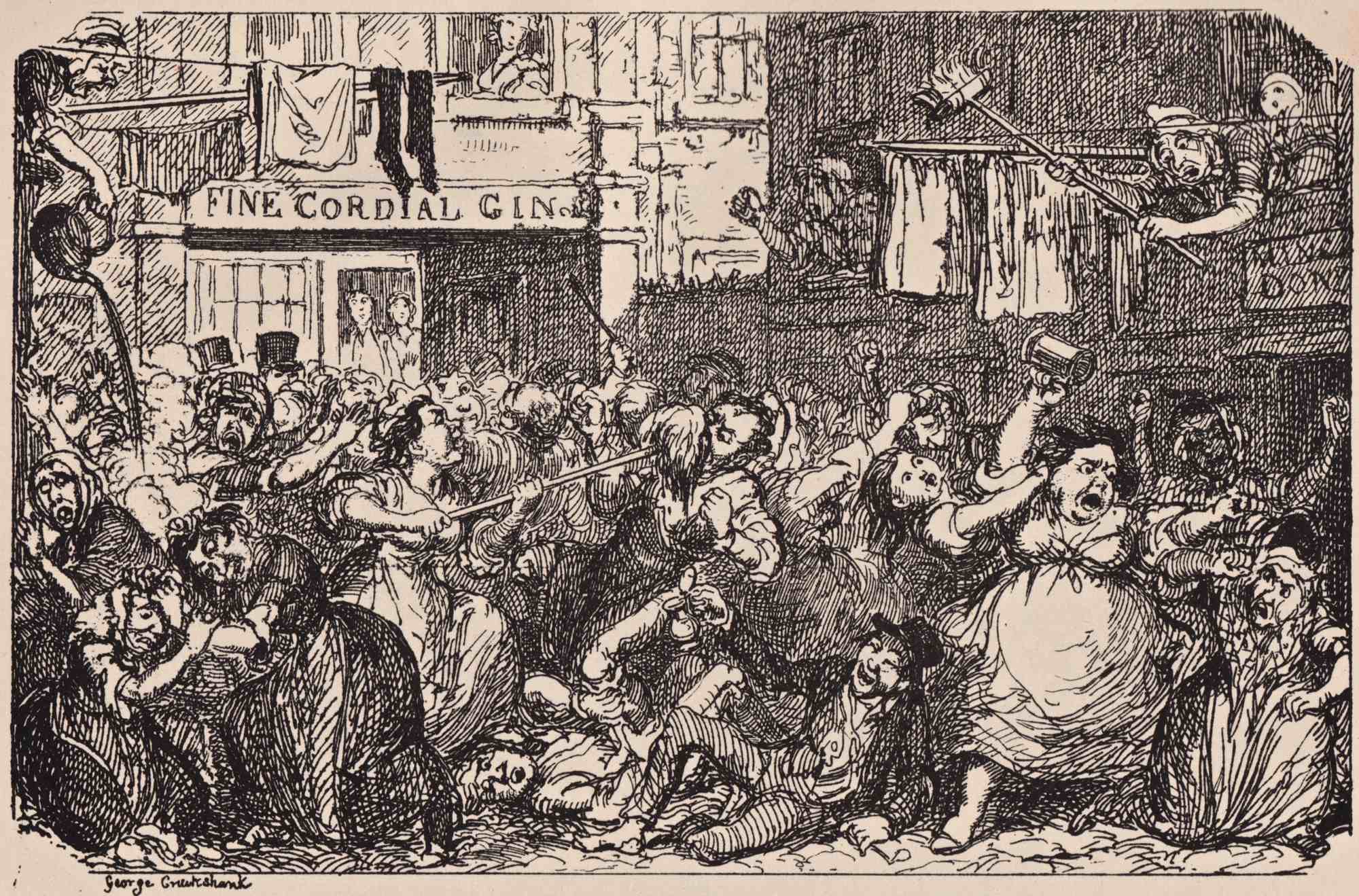
OCTOBER – Battle of A-gin-court in Petty France

NOVEMBER – The Gunpowder Plot or Guys in Council
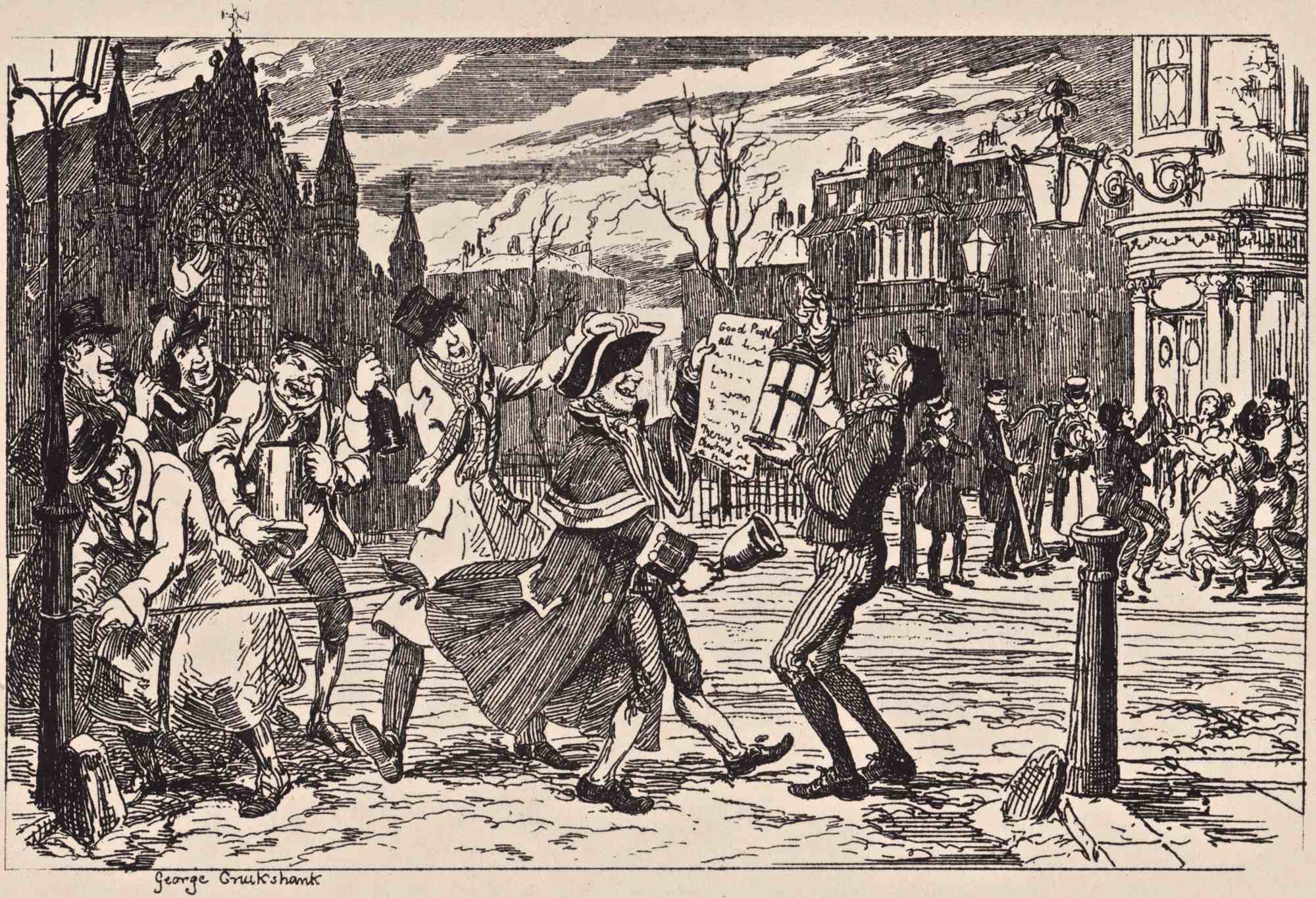
DECEMBER – Christmas Eve
You may also like to take a look at
Cruikshank’s London Almanack, 1835
Cruikshank’s London Almanack, 1836
Cruikshank’s London Almanack, 1837
Save The Rochelle Infants’ School
Back in February, Tower Hamlets Council Planning Committee voted to refuse alterations to the Rochelle Infants’ School that would erase the social history of this important building at the core of Arnold Circus, Britain’s first Council Estate.
Yet this week, James Moores, the current owner, appeals to the Planning Inspectorate to overturn this decision and permit him to alter the structure so that he can turn the building over to commercial use as corporate offices, taking it away from use by the people of the Boundary Estate as a community resource forever.
It was thanks in no small measure to objections sent by readers of Spitalfields Life that the Council rejected the application to alter the school, and so today I publish a revised version of my original article, outlining the significance of the building and including new material uncovered about this historic structure.

This is Contributing Artist Lucinda Rogers‘ sketch of the facade of the former Nichol St Infants’ School that opened in 1879, known as Rochelle Infants’ School since 1900. Yet even those who are familiar with this corner of Shoreditch may not recognise it, because the Boundary Estate was constructed around the school as Britain’s first social housing in 1895.
Blending so harmoniously with the Estate buildings on either side, few realise that this school carries the history of those who once lived here in the notorious slum known as The Nichol, for whom it was built. Apart from the bandstand created from the pile of the rubble of their demolished homes, the school is now the only visible evidence of their existence. But, unlike the inscrutable mound, through the nature and detail of its design this fascinating building speaks eloquently of life in The Nichol.
Walk down Montclare St and enter the yard beside the old Wash House to see this view of the elegant facade, conceived upon an eighteenth century model with two symmetrical wings framing an imposing central entrance beneath a gable in the Queen Anne style, which today looks out upon an area divided by low walls into gardens and courtyards. The central tower contains two separate staircases – gently sloping for child safety – a shallower one for juniors and a steeper one for senior infants, leading to the covered playground on the roof. Walk around the block to Club Row and you will see the other elevation, with its row of eight neo-classical arched windows interspersed by brick pilasters, by which the building is most commonly recognised.
Nichol St Infants’ School was designed by the progressive school architect Edward Robert Robson, who had worked with George Gilbert Scott and knew Dante Gabriel Rossetti personally. In the East End, he was also responsible for the People’s Palace in Mile End and the Jews’ Free School in Spitalfields. Nichol St Infants’ School was constructed as a gesture of idealism to raise the aspirations of the residents of The Nichol. In his pioneering and definitive work of 1874, “School Architecture,” Robson wrote, “If popular education be worth its great price, its homes deserve something better than a passing thought. Schoolhouses are henceforth to take rank as public buildings, and should be planned and built in a manner befitting their new dignity.”
Accommodating over three hundred and sixty pupils within the restricted site of Nichol St Infants School required a playground upon the roof, which Robson designed with a metal cover taking into account that pupils might not possess adequate clothing for rain or poor weather. Recent research by engineering historian and industrial archaeologist, Malcolm Tucker, has confirmed that the metal roof of 1879 is a unique survivor, complete with its nineteenth century wrought iron structure and original iron trusses intact.
Robson’s arrangement of the classrooms exemplified his own ‘model plan’ that he devised as early as 1840. This consisted of one large schoolroom containing a ‘double classroom’ at each end with a partial wall down the middle separating two classes, permitting one senior teacher to supervise junior teachers and their classes. Schools could not afford to employ enough experienced teachers and Robson’s design provided an architectural solution to this deficiency by permitted teaching assistants to be overseen. The schoolroom at Rochelle is possibly the only example of this configuration still in existence.
The high ceilings and large windows were designed to admit plenty of light and air, offering sufficient ventilation to ameliorate the smell of a large number of unwashed infants packed closely together. The architect’s sensitivity to the children’s needs is evident in these considerations and many others, yet his concern extended beyond the material in this modest building, which possesses spare lyrical flourishes that transcend the utilitarian. A prime example is the unexpectedly intricate decorative wooden casing of the iron girders in the ceilings of the classrooms, as if to reward those who lifted their gaze upwards.
Today, the former Nichol St Infants School stands as the only unaltered example of Robson’s principles of school design and thus it is of unique importance, socially, historically and architecturally. In February, Tower Hamlets Council voted to reject the proposed series of alterations to the building enabling commercial office use which would change it irreversibly – partly demolishing Robson’s facade to create an extension, raising the roof level, thus destroying the covered playground with its original metal roof structure, and dividing up the double classrooms with their high ceilings by inserting mezzanine floors which will require removing the decorative casings of the beams in the process.
This week, James Moores, the owner, is appealing to the Planning Inspectorate to overturn that decision, thus permitting him to enact these changes and more which are proposed, that will eradicate much of the meaning of the building – both as a witness of the lives of the people of The Nichol, and as a pertinent reminder of an era when improving the lot of the poor, and allowing them human dignity, became a priority.
Just fifteen years after the school was completed, the Boundary Estate was constructed around it, with the position of the bandstand and the orientation of the seven roads radiating out from it defined by the location of Robson’s building. Thus his school became the keystone of Britain’s first social housing Estate – in its layout and in adopting Robson’s lyrical use of red brick detailing that referenced vernacular architecture of an earlier age but, most importantly, in the social values embodied. Remodelling Robson’s building to facilitate a permanent incursion of commercial offices that serve corporate business interests and preventing any future use by the people of the Boundary Estate would be a betrayal of the founding principles of this historic endeavour.
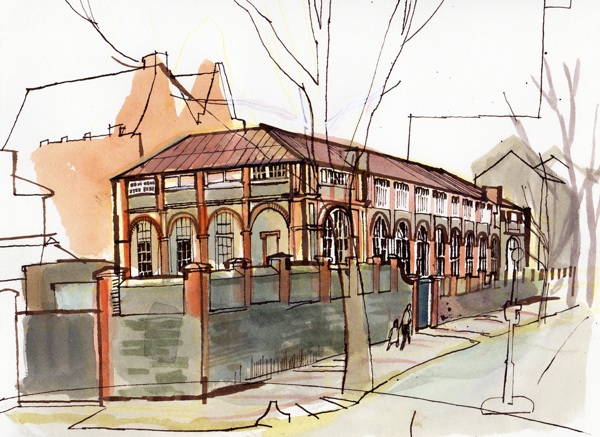
Lucinda Rogers’ sketch of the Club Row elevation of the former Nichol St School.

The stair tower leading to the covered playground was at the centre of the building, beneath these windows topped by E.R.Robson’s magnificenty flourished gable in the Queen Anne style.

In spite of an accretion of low walls, the facade of Nichol St Infants School is still intact.

The school seen from Club Row, formerly Nichols Row, showing the eight windows that give light to the schoolroom and the eight-barred openings that gave light and air to the covered playground.
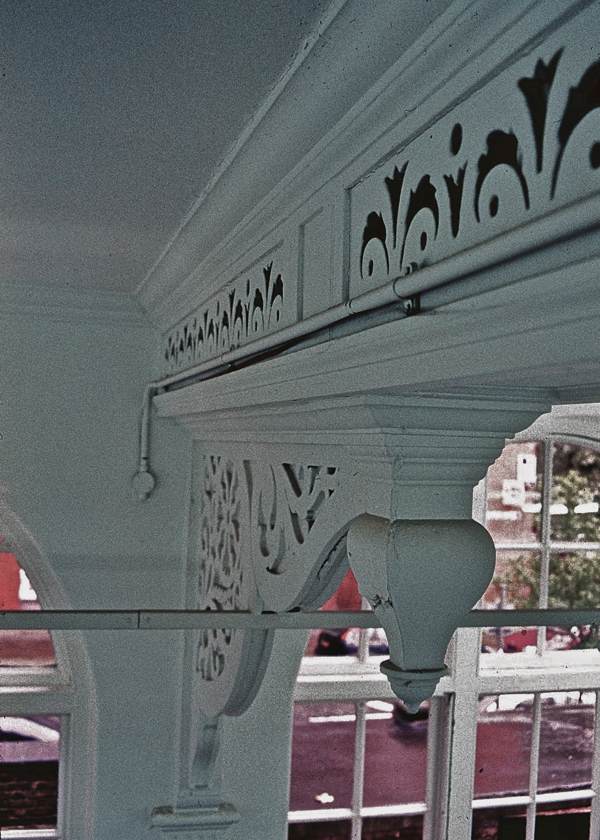
Decorative roof beams in the schoolroom.
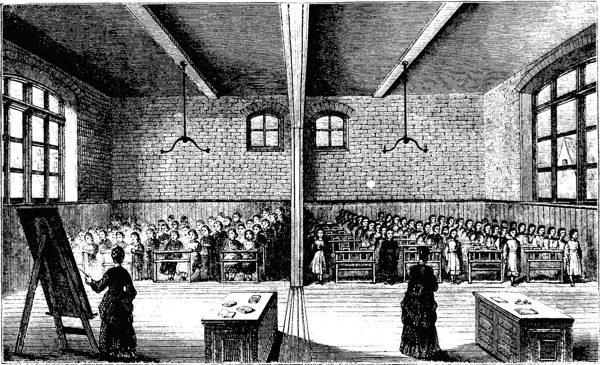
Double classrooms designed by Robson, as employed at Nichol St Infants’ School (From School Architecture 1874)

The site of Nichol St Infants School surrounded by the streets of The Nichol before they were replaced by the Boundary Estate. (Edina Historical Maps)

1895, the construction of the Boundary Esate around the Rochelle School and Nichol St School, seen at the centre of this photograph. The pile of rubble to the left became the bandstand at the centre of Arnold Circus. (City of London, London Metropolitan Archives)

This 1938 London County Council map shows the Boundary Estate as it remains today with the Rochelle Infants’ School Building half way up Club Row on the right.
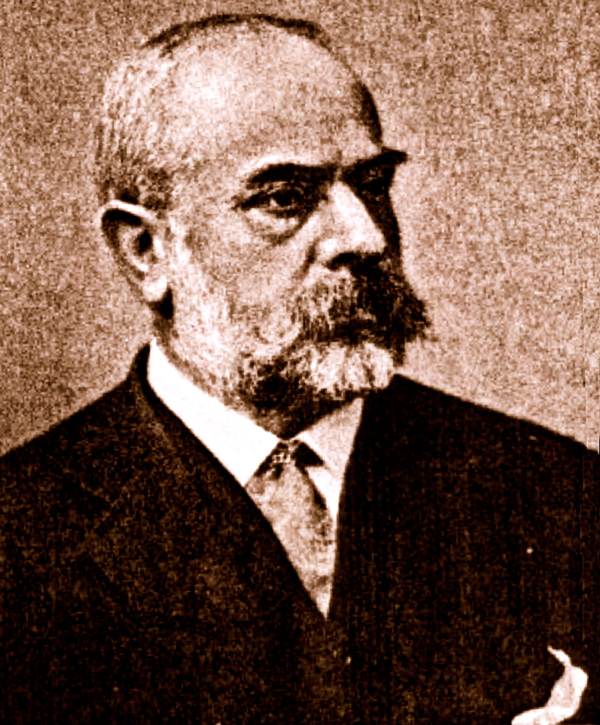
Edward Robert Robson (1835-1917), Consulting Architect to Her Majesty’s Education Department.
Drawings copyright © Lucinda Rogers
You have until 5pm on Tuesday 13th August to write to the Planning Inspectorate, opposing the appeal and asking them to uphold Tower Hamlets Council’s decision to refuse the alterations to the Rochelle Infants’ School.
Send your email to Michael Joyce teamp16@pins.gsi.gov.uk quoting Appeal Case No. 2199055 Club Row Building and include your address.
If you would like to join THE FRIENDS OF ROCHELLE, a group dedicated to retaining the Rochelle School as a community asset for the people of the Boundary Estate please email thefriendsofrochelle@gmail.com
Click to sign the petition to protect the Rochelle Infants School Building
My grateful thanks to Tom Ridge who supplied his research as the basis of this feature.
You may like to read about some local people who were educated at Rochelle School
Mattie Faint, Clown & Giggle Doctor
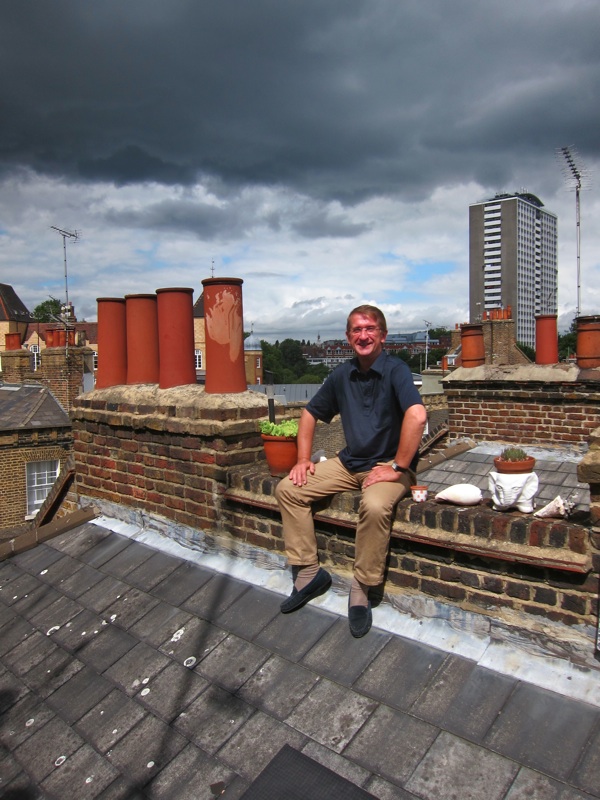
With his sunny disposition and indefatigable good humour, Mattie Faint, the clown, maintains the resilient smile that is his customary expression, irrespective of any dark clouds that gather.
This picture was taken on the roof of Mattie’s house in Clerkenwell, the area of London associated with the most famous clown of all – a connection which Mattie cherishes. “Joseph Grimaldi always lived in Islington, he was the Clerkenwell clown and now I am the Clerkenwell clown – I tend his grave.” he admitted to me proudly. Mattie is the archivist of Clowns International, preserving the history of his chosen profession, and this afternoon he is hosting a festival honouring the celebrated performer at Joseph Grimaldi Park in Pentonville Rd.
Yet the life of a twenty-first century clown is very different from that of his predecessors. The Annual Grimaldi Service held each year in February once marked the gathering of clowns in London to seek employment before the Circuses set out on tour, but the decline of touring circuits meant clowns had to find alternative employment doing advertising, promotions and entertaining at corporate events. After the crash and recession, this work no longer exists but, with characteristic ingenuity, clowns have discovered a new arena for their singular talents as ‘giggle doctors.’
“I’ve been in Clerkenwell about thirty years, but I’m from Plymouth originally. I came up on a scholarship with the National Youth Theatre at seventeen. I worked with props and scenery and stage management, and did twenty shows in eight weeks and decided I didn’t want to go back to Plymouth. Instead I found a job as a junior electrician at the Saville Theatre and worked my way up to sound operator. I did Cameron Mackintosh’s first show and it only lasted two weeks. Then I worked on ‘Hair’ as sound operator for three and a half years, and became stage manager at twenty-one and, after the nine-hundredth-and-ninety-ninetieth performance, three-and-a-half tons of plaster fell from the ceiling into the auditorium and closed the show down. It happened at five thirty in the morning, but there had been a full house the night before and it could have been a national disaster killing two hundred people.
Then I took ‘Hair’ to Africa as company manager and we didn’t get an audience in Lesoto, but I was invited to stay on at the hotel as PR manager and clown.What I liked about being a clown was that I could have a second personality. It allows you to be naughty and do things that you wouldn’t do in normal life and get away with it. I had a double existence – whenever they wanted entertainment, I’d go to my office and change into a clown. People didn’t know if I was a PR officer dressed as a clown or whether I was a clown dressed as a PR officer. I remember a little boy said to his mother, ‘Who’s he?’ and she said, ‘That’s Mattie the clown dressed up as a man.’ And I thought I’d like to put that on my tombstone.
It’s one of the most difficult kinds of acting because you are working without a stage and surrounded by your audience. Quite often it can be hard from the security point of view. Teenagers and sometimes adults can ridicule you and try to destroy what you are. I’ve found myself in dangerous situations more than once where I’ve had to run. But forty-three years I’ve worked as a clown and it’s a great thing to be.
After Africa, I came back and did ‘Cinderella’ with Jim Davidson in Bristol, and I realised I didn’t want to do that any more. So, in 1980, I channelled all my energies into being a clown full-time and made a good living out of children’s parties and doing promotional work in shopping centres. But the world has changed because of the recession and the work dried up. I used to work alongside Santa at Canary Wharf for three weeks each year but now they just make do with Santa and a few elves.
Eighteen years ago, I started working an entertainer for the Theodore Children’s Trust, a charity that sends clowns into hospitals as ‘giggle doctors.’ At first, there were just two of us but now there are thirty-two working in twenty-one hospitals, all professionally trained entertainers who go into wards and visit children at their bedsides to bring laughter when they are suffering traumatic things. I’ve worked this week at Great Ormond St Hospital, visiting two to three hundred children and covering the entire hospital in two days.
So the business has changed a lot for clowns but I am lucky to work a couple of days each week as a giggle doctor, and I like the work because you really get a chance to make a difference. It’s so nice when people laugh. Laughter is a difficult thing for many people to find in their lives. As Chaplin said, ‘A day without laughter is a day wasted.'”
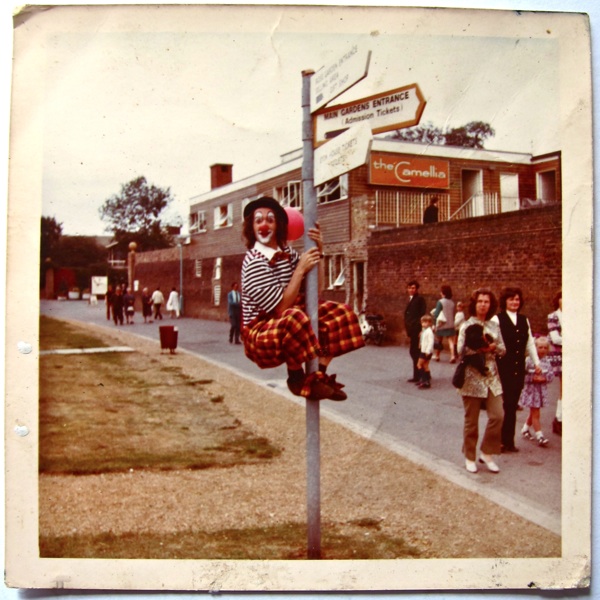
Mattie’s first day as a clown, June 1971
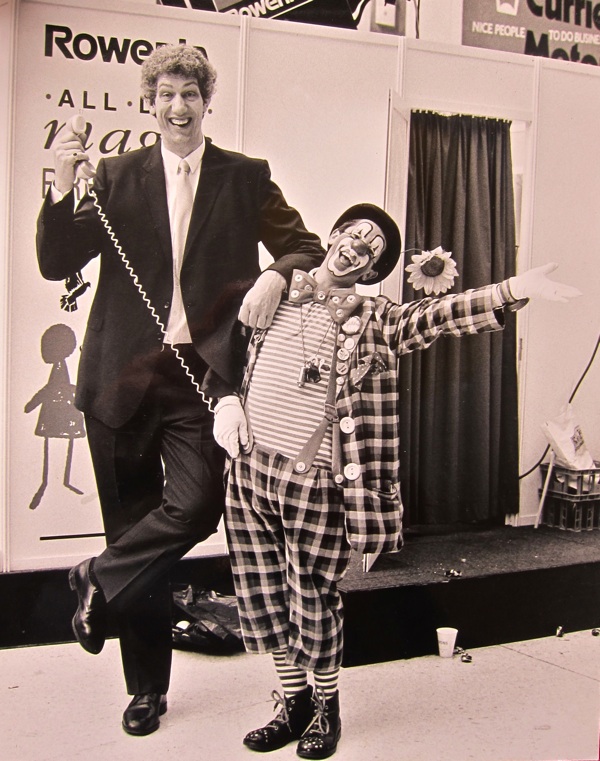
Mattie with Britain’s tallest man, Chris Greener

Mattie as the Kia-ora Kid.
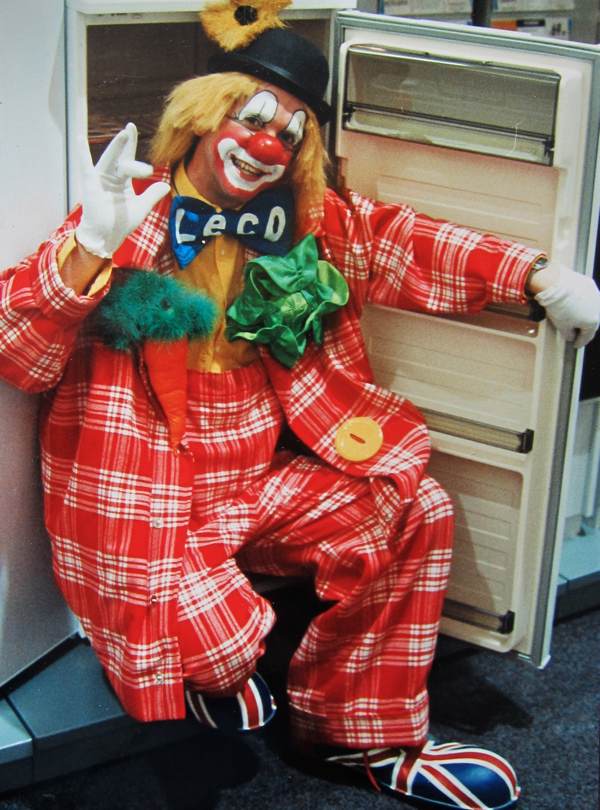
Mattie as Leco, the refridgerator clown.
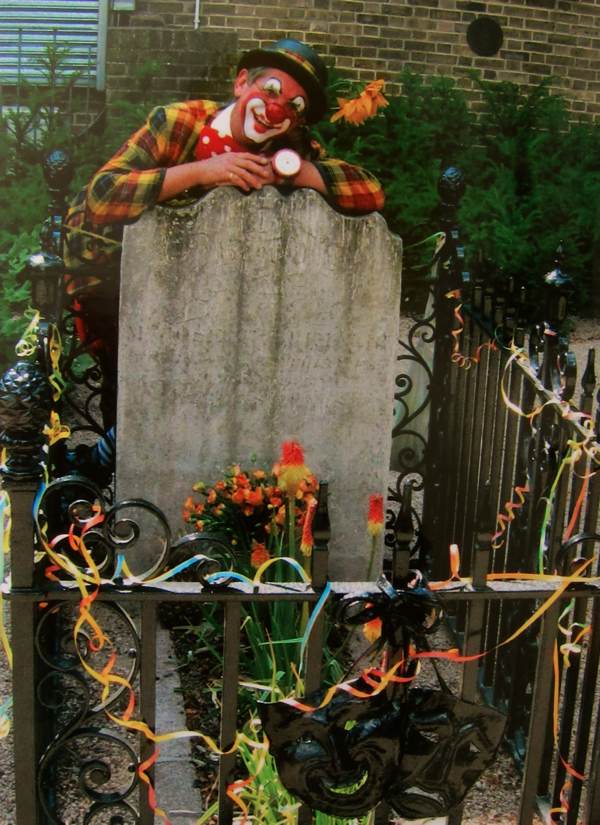
Mattie pays homage at the grave of Joseph Grimaldi
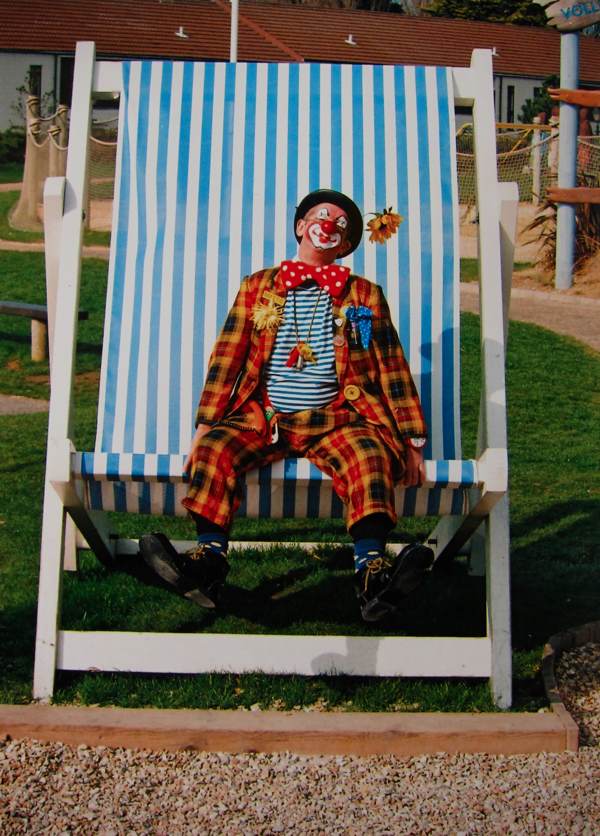
Mattie puts his feet up.
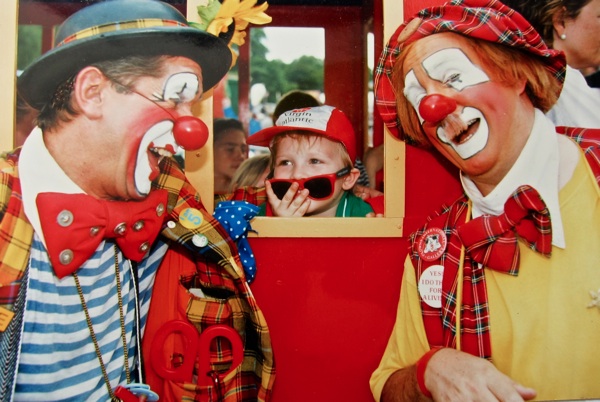
Mattie with his pal Ginger Nuts
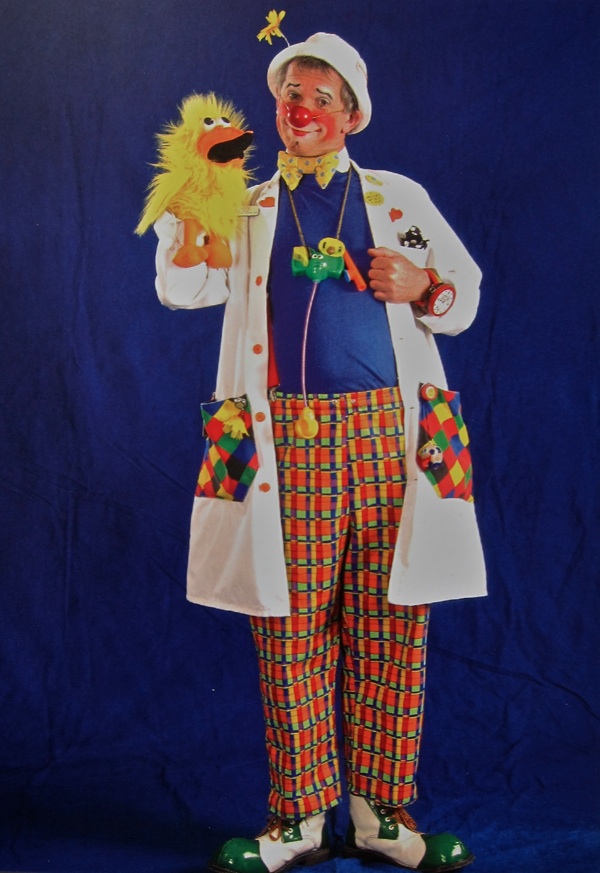
Mattie as a Giggle Doctor

A record of Mattie’s distinctive make-up.
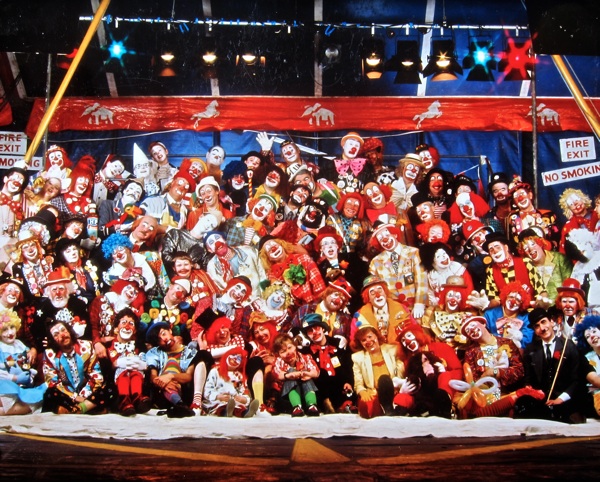
At the clowns’ convention.

Mattie
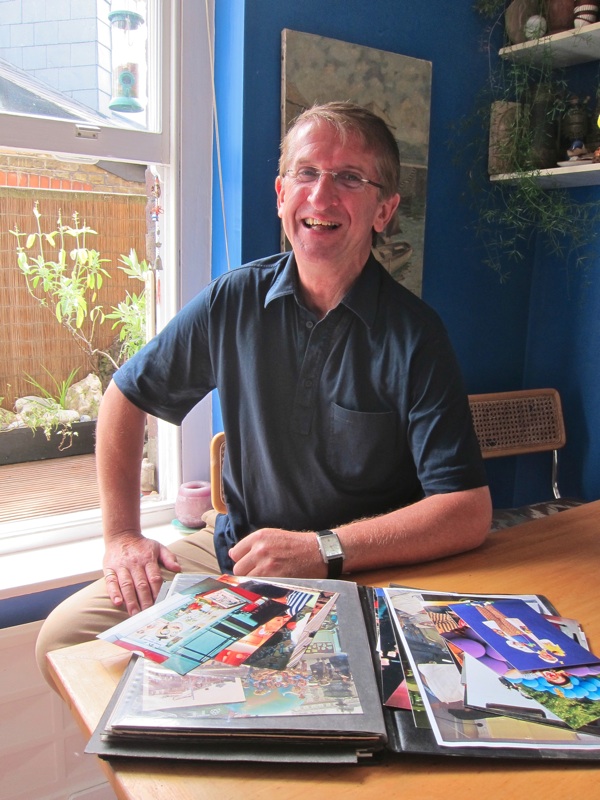
Matty Faint, Clown & Giggle Doctor
Joseph Grimaldi Park Community Festival runs from 2pm-5pm this afternoon at Joseph Grimaldi Park, Collier St, N1 9QZ, with clowns, cheerleaders, latin dancers, stalls, face-painting and more. Admission is free.
You may also like to read about
Two Men From Ilfracombe

Two young men from Ilfracombe
A small cache of glass slides of a century ago arrived at the Bishopsgate Institute recently as a donation from Ilfracombe Museum, yet the fact that nothing is known of these two men from Ilfracombe featured in the photographs has not prevented speculation.
“Don’t we look like born Londoners, taking a stroll down the Victoria Embankment in our best suits on a Saturday morning? It makes the quay at Ilfracombe look pitiful I must say. We sought out the statue of old Raikes on his pedestal in the park and took a picture for Norah and her Sunday School nippers, like we promised. I never thought there were so many people in the world as we saw in Fleet St, it makes you wonder who cooks them all dinner? Everyone seems to know where they are going, so we did our best to blend in, keeping our noses directed towards St Paul’s up ahead in the fog. Himself tugged upon my cuff at every watering hole and it was all I could do to resist. Yet I still felt intoxicated by the train journey, changing at Exeter St David’s and whisking us at lightning speed to Paddington yesterday. We kept our wallets in our inside pockets, like you told us, and made sure that we did not both fall asleep at once, lest we should get robbed. Himself snored all the way up and missed the changing wonders of the landscape, of course. The sheets in the guesthouse were not of the cleanest but rather than raise a fuss I slept on top of the blanket. You do fear you might get lost in all the streets and never find your way out again. Magnificent vessels moored in the Pool and it reminded us of home to see the little tugs and pilot boats bobbing. It makes my head spin to see the big cargo ships lined up and think of the dark continents so far away. I swear I never walked so much as we did through the West End and back across the Park, and I felt we deserved a decent refreshment but the prices were iniquitous and I shall regret that cold roast beef sandwich as long as I live. Yet Himself was philosophical and asked what is existence without adventures like this? The boots are bearing up well, thankfully. At least, if we never go outside dear old Ilfracombe again, we can say that we have seen life now. Greetings to Ernie and Nan, and little Ralph and the twins.”

“Behold Sir Robert Raikes who founded the Sunday Schools movement”

“Best foot forward up Ludgate Hill”

“Outside St Paul’s”
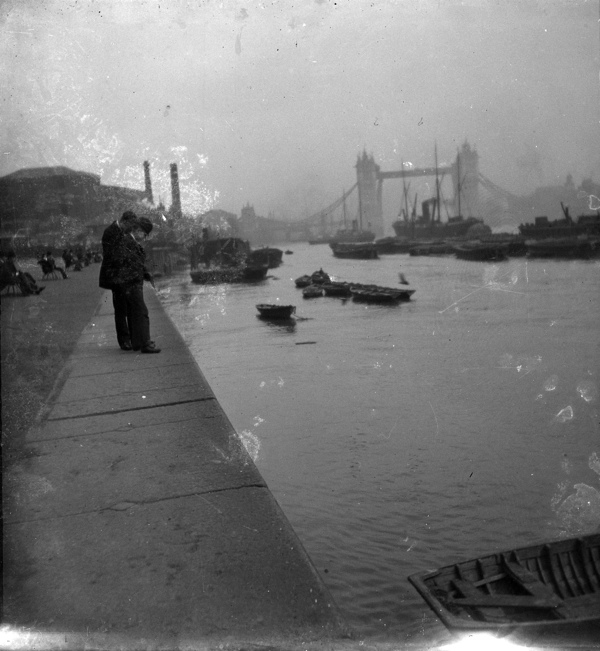
“At the Pool of London”

“Passing ourselves off as Londoners”

“This is me and Albert”
Photographs courtesy Bishopsgate Institute
Fred Iles, Meter Fixer

Fred & Marie Iles with Smudge
Fred Iles was born half a mile from his allotment in Stepney and his wife Marie grew up in Garden St that once stood where the allotment is today. They were married in St Dunstan’s, just across the road, and today live fifty yards away in Rectory Sq. As for Smudge, she is a local too and gave birth to two litters in the allotment shed.
Fred grows potatoes, cabbages, strawberries, gooseberries, runner beans and nasturtiums to draw the bees in his allotment, which is a small enclosure at the heart of Stepney City Farm. Surrounded by on all sides by other plots, this is a secluded corner sheltered from the wind where Fred can pass his time gardening peacefully in the company of his cat.
As gardeners will know, the growing season has been very late this year, but Fred had a good crop of strawberries and, as he was telling me his story yesterday, while boney old Smudge patrolled the territory, Marie searched among the runner beans and discovered the first pickable specimens of the season.
“We never had a garden of our own. My grandfather Edmund lived with us when I was a child, he had come up to London from Bristol originally with two children and he ended up with four sons and three daughters. He was a great pigeon fancier and our backyard was all pigeon lofts where he kept three hundred pigeons – that’s a lot of pigeons. He was very successful at it and when he was dying he called me into his bedroom and showed me his box of medals and asked me to take one. I picked the silver one because it had a picture of a pigeon on it. There were gold ones I could have picked but I was too young to understand. He told me that Iles is a French name and that my ancestor fought in Napoleon’s army and was brought over to Bristol as prisoner of war and then stayed.
I was born in 1926 just half a mile from here in Hartford St, in a little cobbled yard called Wades Place. My father William was a seaman in his younger days and he went all over the world. I don’t know how he learnt about classical music but he was very knowledgeable and he used to play the Gounod’s Faust and Viennese waltzes on his harmonica for me.
I was here for part of the Blitz. It started on a Saturday afternoon at 3pm. I was in the yard and I heard the roar of the aeroplanes. I was thirteen and I thought it was our planes coming back, but it wasn’t. My father took me inside and we sat under the stairs which we thought was the safest place. I couldn’t see anything but I could hear the sound of the anti-aircraft guns and the engines of the planes and, at my age, I found it very exciting.
By the time they came back to bomb the docks, we had an Anderson shelter in the garden and we sat there listening to the sound of bombs dropping. My father decided it was too much and sent me and my mother and my sister to his brother in Oxford. He worked in the Morris factory which, at that time, was building aeroplanes and he got me job at fifteen making cowling panels for the side engines of Hawker Hurricanes. It was exciting work but it was miserable waiting in the cold for the bus to go to work at seven in the morning.
I got called up to the army on D-Day, June 6th 1944 and I was eighteen years old on my birthday, 30th June. They summoned me for 20th July, the day they tried to assassinate Hitler, so I had three weeks freedom before they put me in the army. By the time I’d learnt to shoot a gun, for some unknown reason they put me in the Royal Electrical Mechanical Engineers. I was posted to the anti-aircraft guns around London and then they sent me to an experimental laboratory in Shoeburyness where they were working on radar. I found I had an easy time for three and a half years until I was discharged in 1947.
I went to the Labour Exchange and the man said, ‘There’s not much going but I like the look of you so why not come and work on this side of the counter? And when a good job comes in you can get it.’ I worked there for six months, and my father was unemployed and he came in and signed on the dole. After six months, the London Electricity Board came along and I worked there for twenty-six years, at first in the office and then as a meter fixer.
When I started here at the allotment, it was quite hard. It was still a bomb site and I had to clear the bomb damage before I could plant anything. There were just six of us pensioners then and I needed something to do in my spare time. They retired me at sixty in 1986, but I started my allotment here four years before that. Smudge turned up on the allotment one day, fifteen years ago. And I thought ‘poor old cat’ and decided to feed it, so she made the allotment her home and now I have to come and feed her every day.”
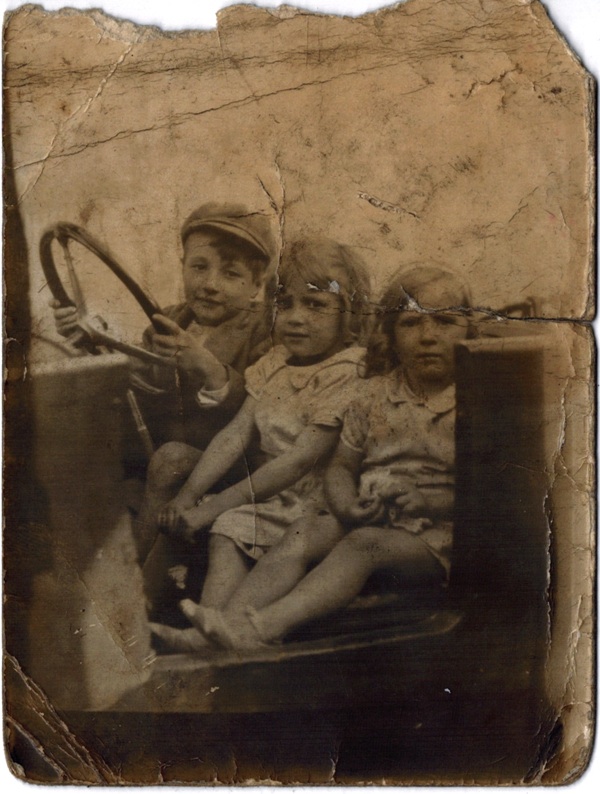
Fred aged five with his sister Phyllis and cousin Rosamund in 1931, taken by Griffiths in the Roman Rd

Fred in uniform at eighteen years old, 1944

Fred and his pal Gimlet in Shoeburyness

Fred stands at the base of the aerial in Shoeburyness.

Fred (left) enjoys a pint with Bernard & Jack at Shoeburyness in 1946

Fred (top left) with pals on the beach at Shoeburyness
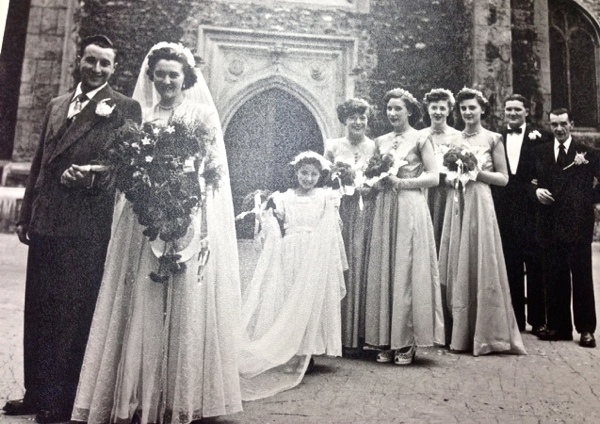
Fred & Marie get married at St Dunstan’s Stepney, 1st August 1953

Fred & Marie on their wedding day.

Fred in the seventies.
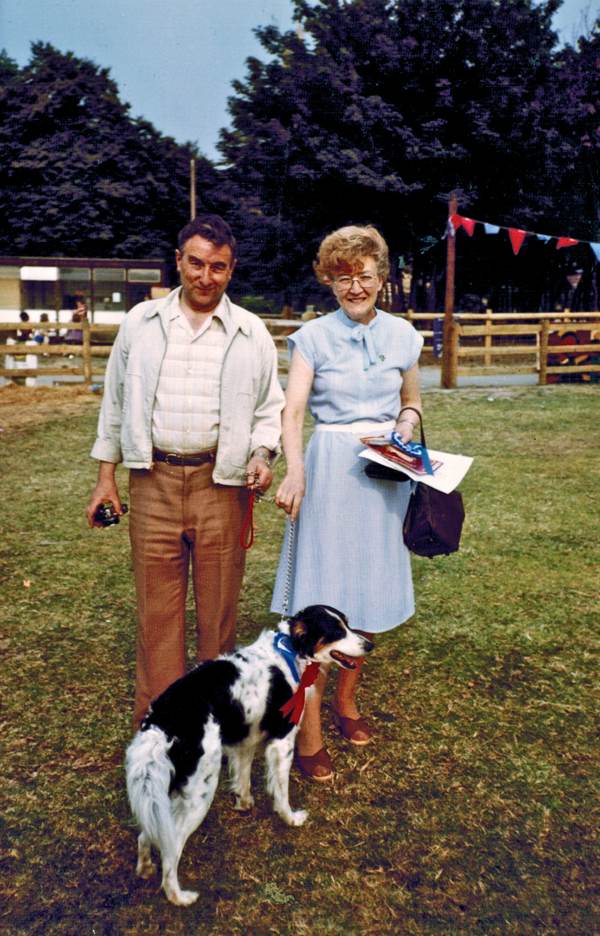
Fred & Marie with their prizewinning dog Rufus, in July 1984 at Stepney City Farm – when Rufus won the dog with the waggliest tail and best mongrel.
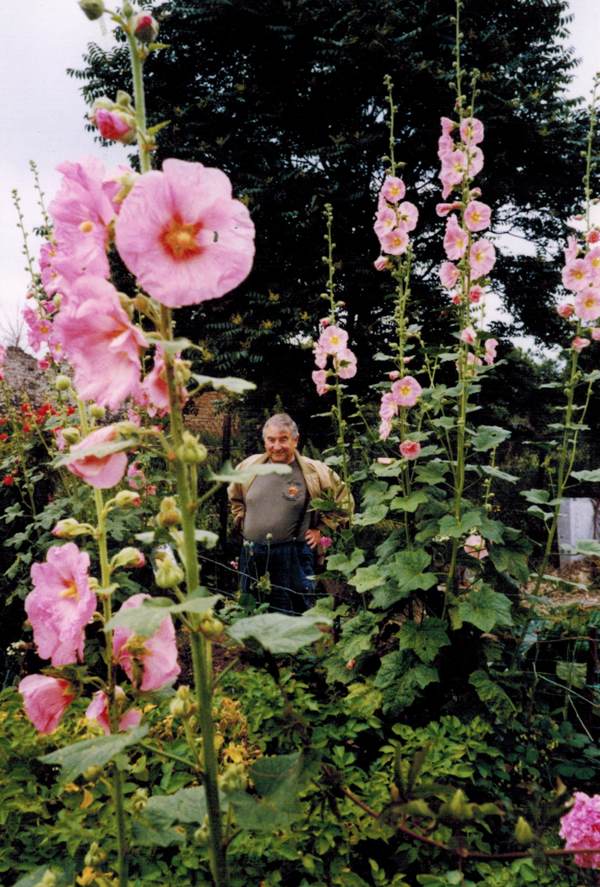
Fred grew some magnificent hollyhocks on the allotment in the nineties
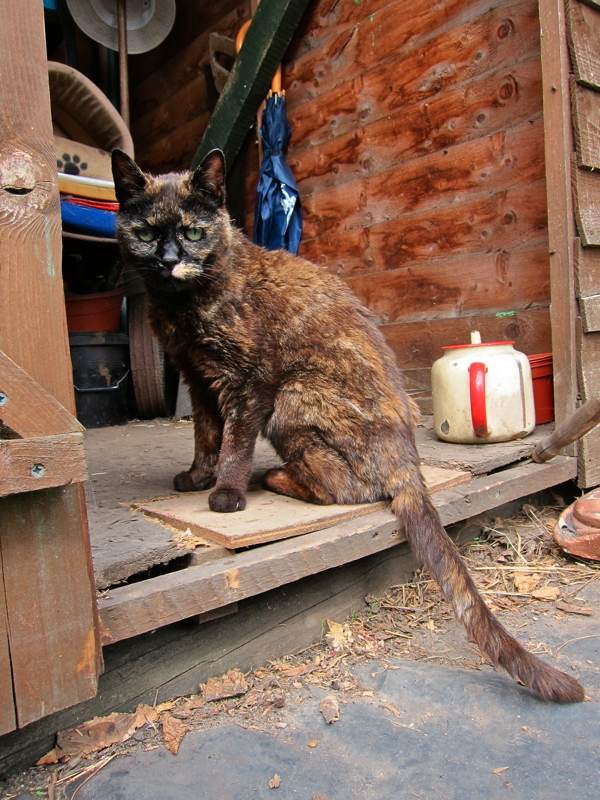
“Smudge turned up on the allotment fifteen years ago. And I thought ‘poor old cat’ and I decided to feed it, so she made the allotment her home and now I come every day to feed her.”

Fred and Smudge
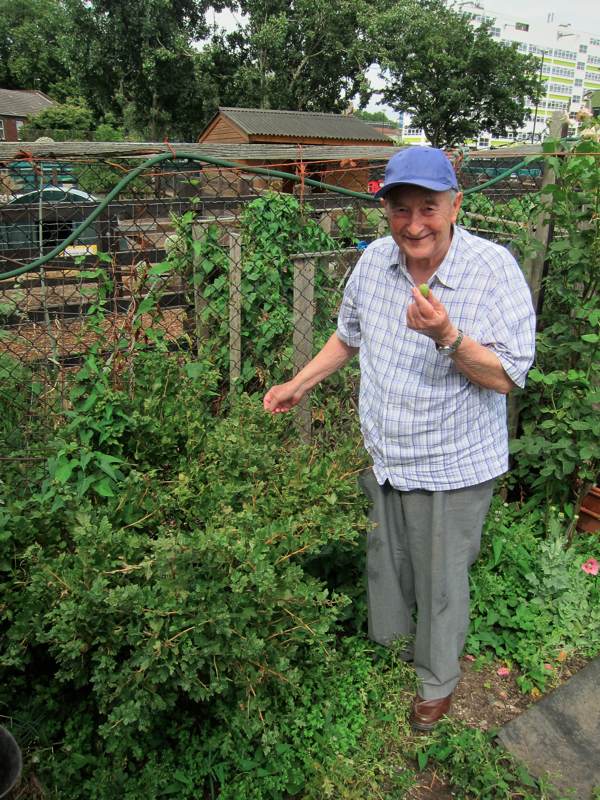
Gooseberry time in Stepney

Fred & Marie Iles celebrated their sixtieth wedding anniversary on 1st August
Stepney City Farm runs a Farmers’ Market every Saturday from 10am – 3pm, selling food from local producers at affordable prices. If you would like to join their Urban Farmer scheme and learn about growing vegetables and caring for livestock contact karen@stepneycityfarm.org
You may also like to read about
Bob Mazzer’s Street Photography
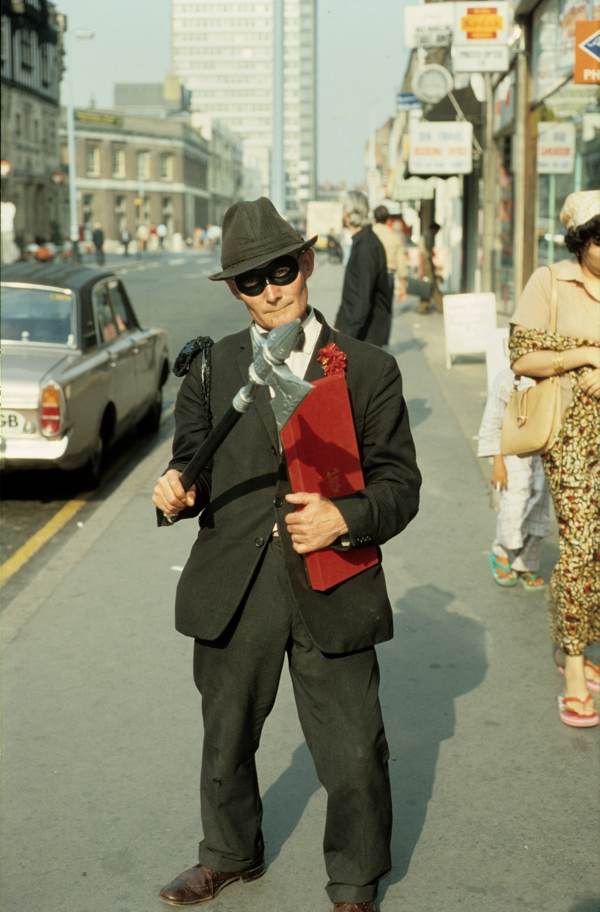
Axeman in Praed St
One day, on his way to work at “The Office” – the porn cinema in Paddington where he was a projectionist – Bob Mazzer met this mad axeman in the street who fortunately was more than happy to have his photo taken.
This picture may come as a surprise to those who only know the tube photography for which Bob has become celebrated, yet his distinctive vision of existence is equally evident in these compelling images of London street life. “I’ve never not done photography above ground,” Bob confessed to me,“If you are a photographer, then you can’t walk down the street without a camera … and the tube is an extension of the street.”
These pictures published here for the first time are from the years when Bob worked in two porn cinemas, at Paddington and latterly at King’s Cross, offering him ample opportunity to wander with his Leica M4, photographing on the streets by day and on the tube going home at night.
“I was obviously out and about a lot in the eighties,” he declared in delighted surprise, contemplating this diverse collection of images.
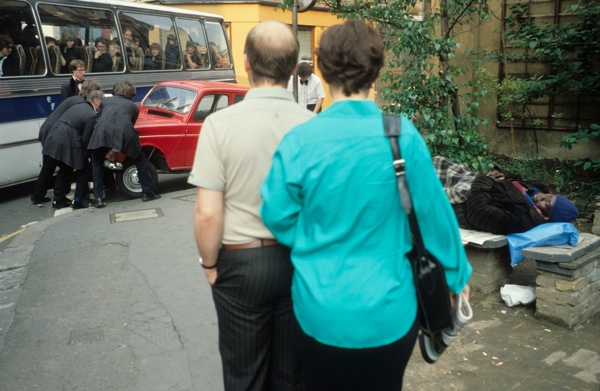
“I came round the corner into Cambridge Circus and this was happening – these men had climbed out of the coach and were moving the car out of the way – but I couldn’t hit the shutter before these people walked in the way and at first I was pissed off, but later I realised they make the photograph – they stand in for you, the viewer. Meanwhile, the man on the bench slept through it. The whole thing was bonkers really.”
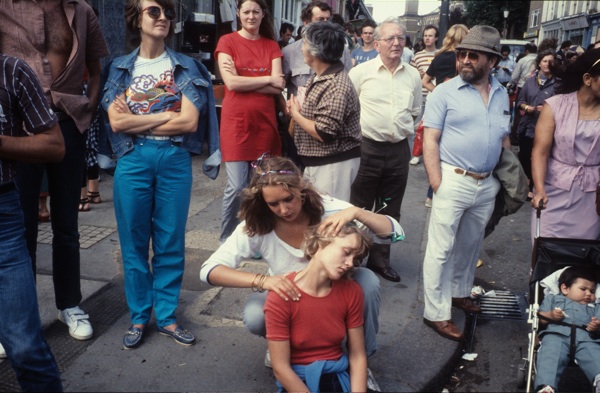
“This was at the Notting Hill Carnival. In a quiet moment, here was this cameo of a little therapy session on the pavement edge.”
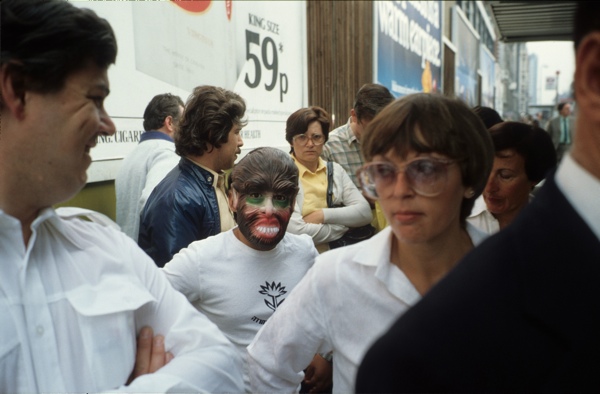
“I was waiting for a bus. Sometimes you have to pretend you are waiting for a bus to get the shot.”
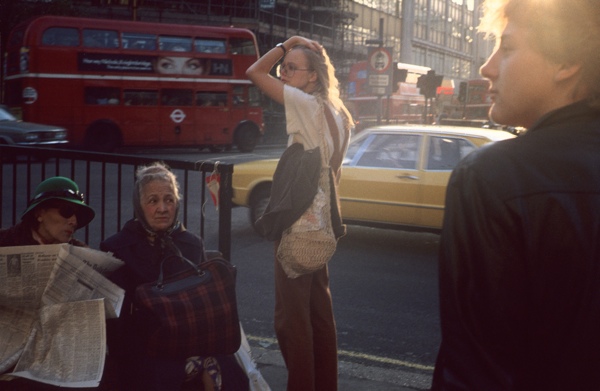
“It all seems to be about eyes, people looking in different directions.”
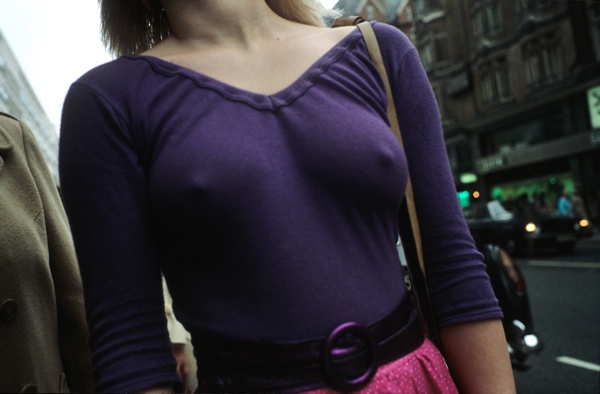
“I was at the bus stop and she was standing on the other side of the concrete post, so I angled my camera at waist level and ‘guestimated’ the shot. I love the colour range and her outfit – it was so ‘Hey everybody look at these.'”
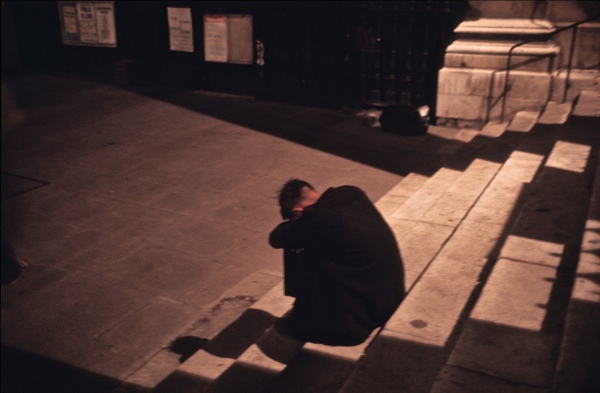
“At St Martin in the Fields, a destitute bloke with nowhere to go and I felt for him.”
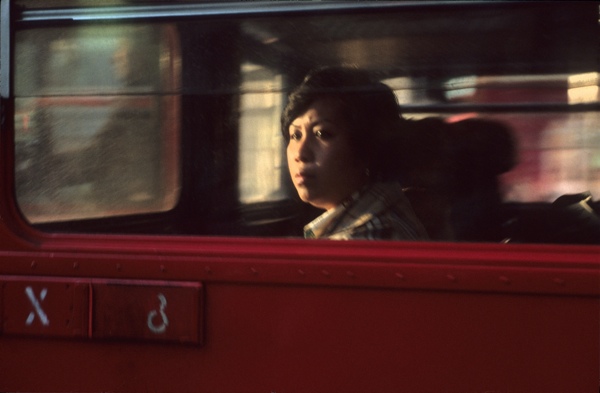
“I was walking down Oxford St and the bus passed by. It was a split second and I didn’t have time to think about it.”

“I was on my way to work at the porn cinema in King’s Cross and I saw this artificial leg sticking out and I was preparing to photograph it when this scuffle suddenly happened.”
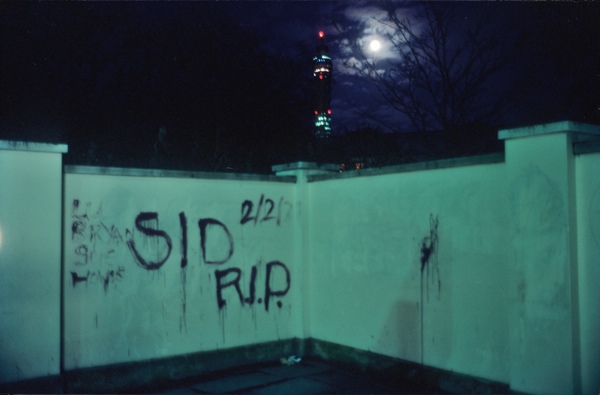
“This is outside Regent’s Park tube. Sid Vicious had only just died.”

“This was in Soho Sq. They look like they could be conjoined. I always think this is one of the strangest pictures I’ve ever taken. I crouched down and said, ‘I love how you look, please let me take your picture,’ and it was all over in a second.”
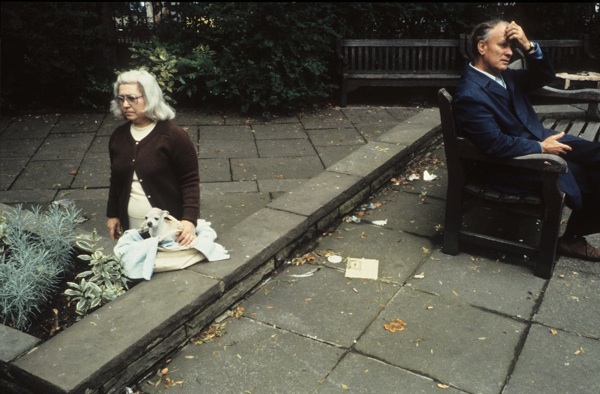
“In Soho Sq again. I thought it was a mad thing to do, to stand with a dog in a bag.”
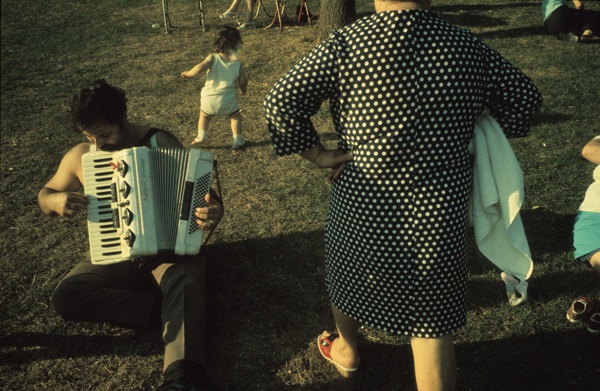
“I used to go to Regent’s Park a lot.”
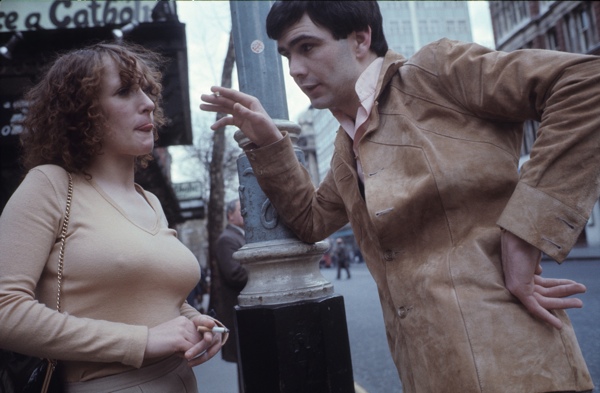
This was outside Wyndhams Theatre in Charing Cross Rd when ‘Once a Catholic’ was playing. It was shot from the hip, I wasn’t looking through the viewfinder. You have to be not there or they’d say, ‘What are you doing?’ I’m probably standing at right angles.”
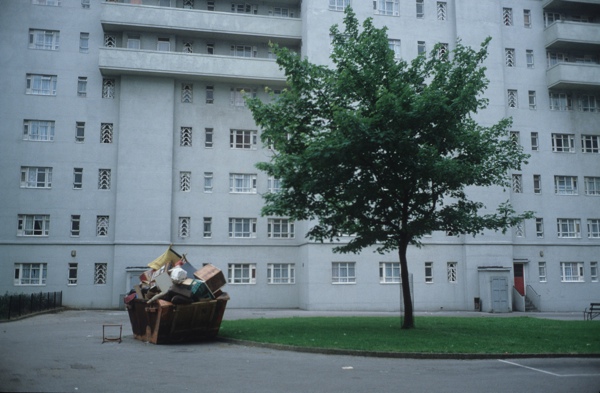
“I’m speechless when I look at this. You couldn’t want to live there, but my dad did for a while in a block of flats very near.”
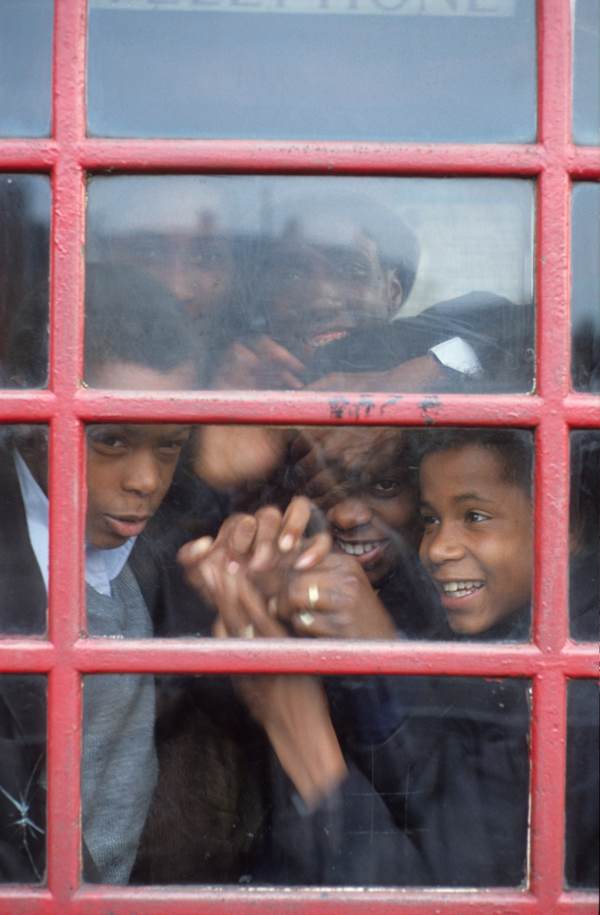
“I love black kids, and I love the way the hands and eyes are so friendly in this picture. If you’ve got the right vibe, I find people tend to be friendly.”
Photographs copyright © Bob Mazzer
You may like to take a look at
Cruikshank’s London Almanack, 1837
This set of engravings is the third in a series of calendars illustrating the seasons and festivals of the London year, drawn annually by George Cruikshank for The Comic Almanack published by Henry Tilt of Fleet St. With each series, Cruikshank was required to avoid repeating himself and thus he became more ingenious as the years went by. (Click on any of these images to enlarge)
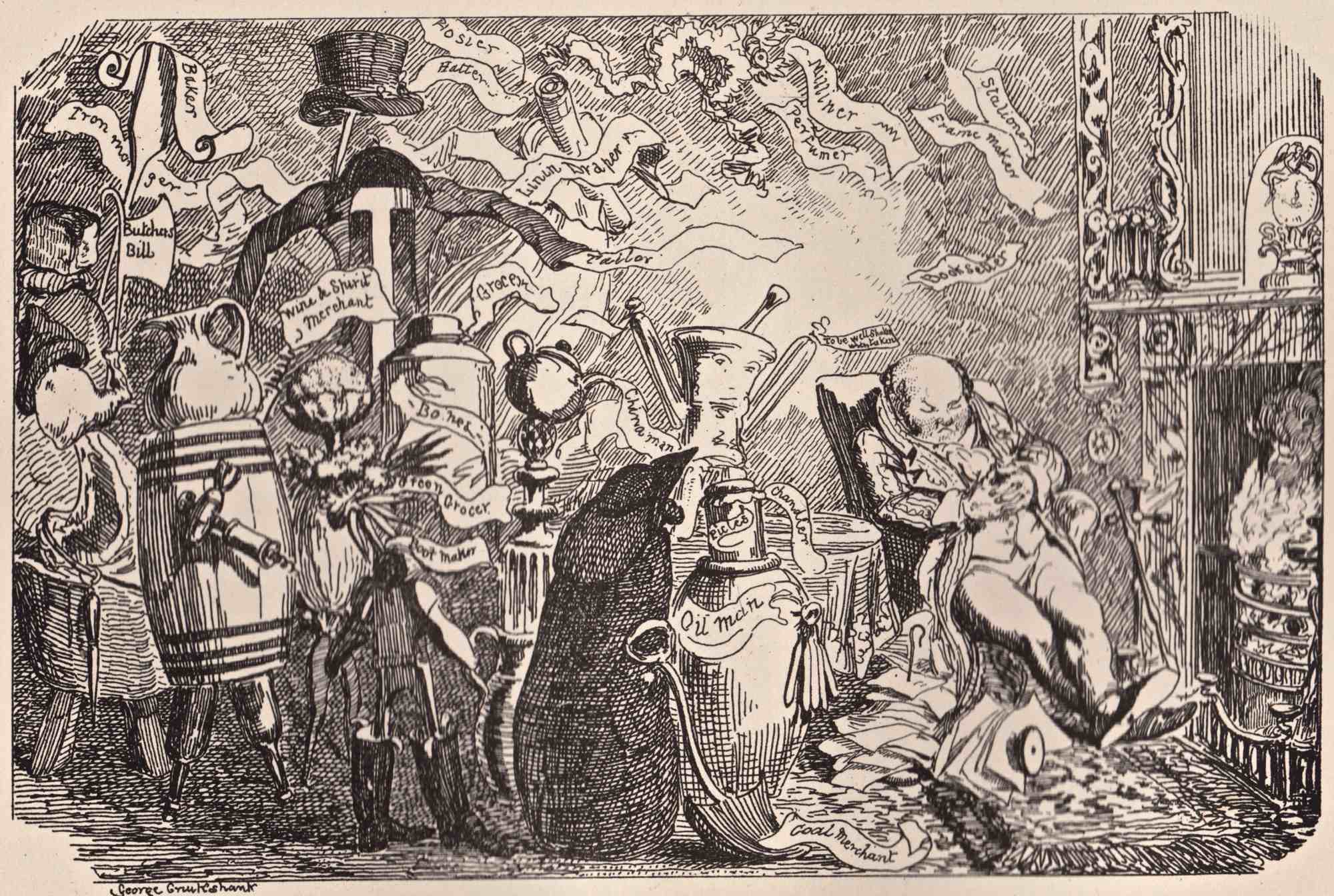
JANUARY – Last Year’s Bills
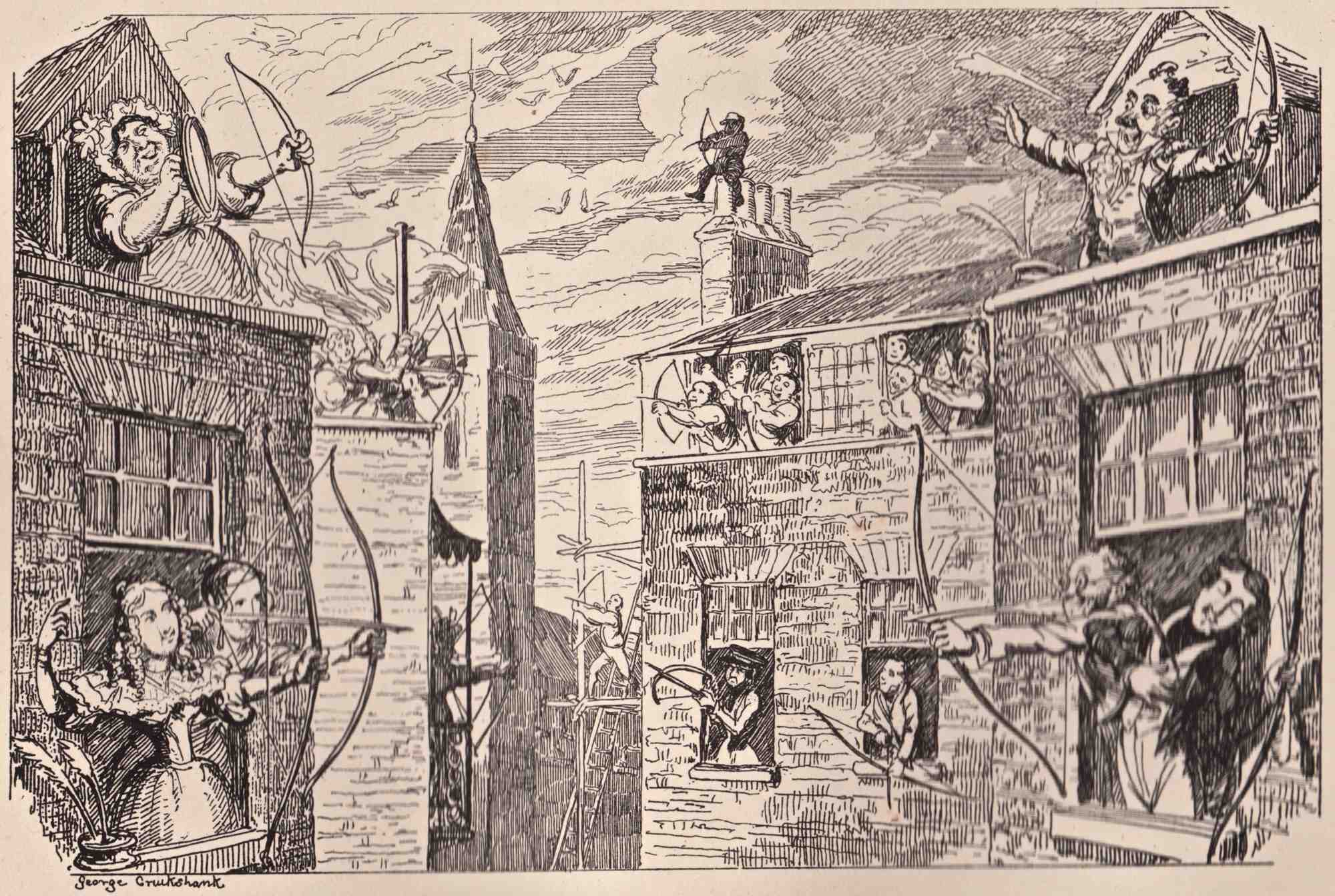
FEBRUARY – Valentine’s Day
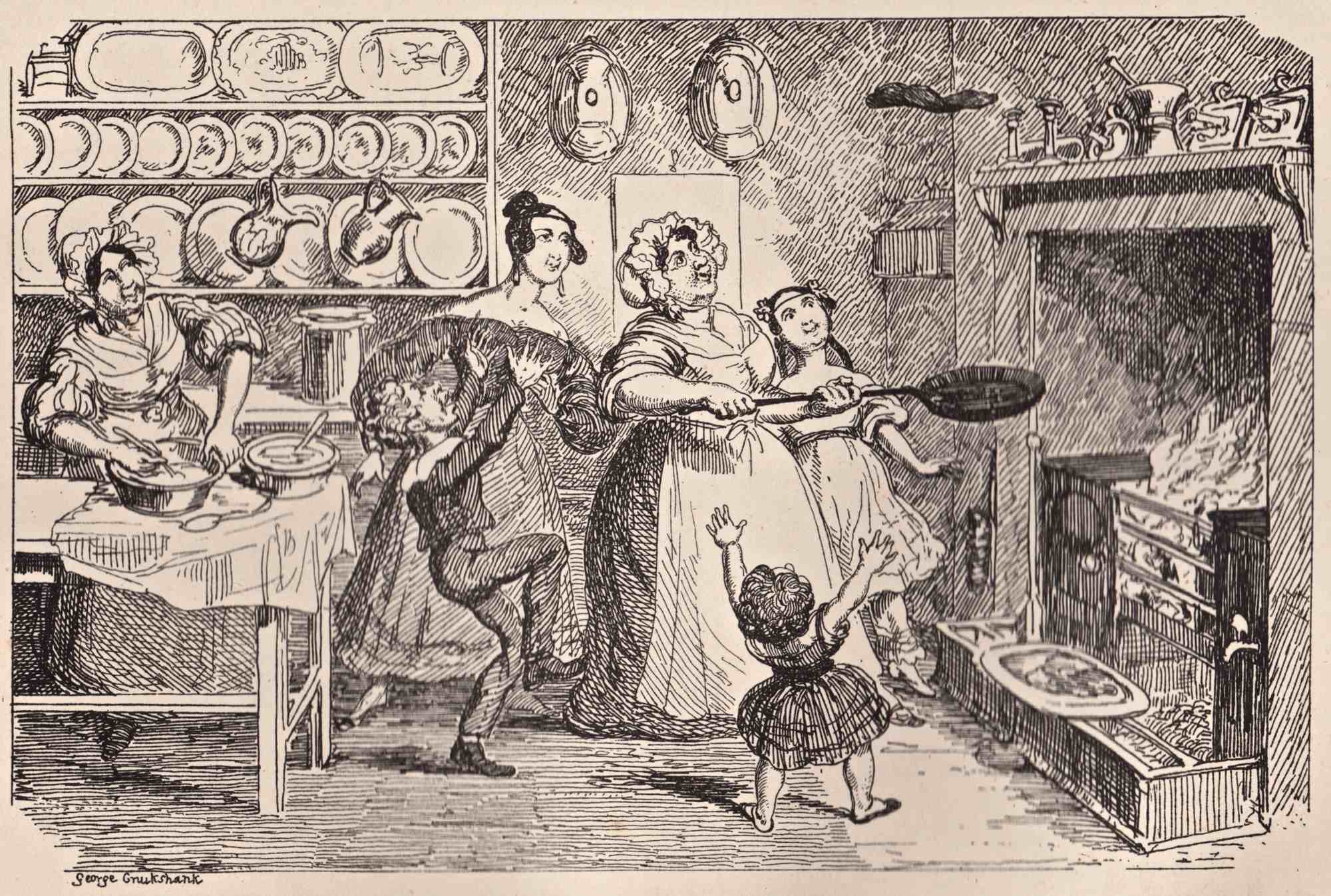
MARCH – Tossing the Pancake

APRIL – Return from the Races
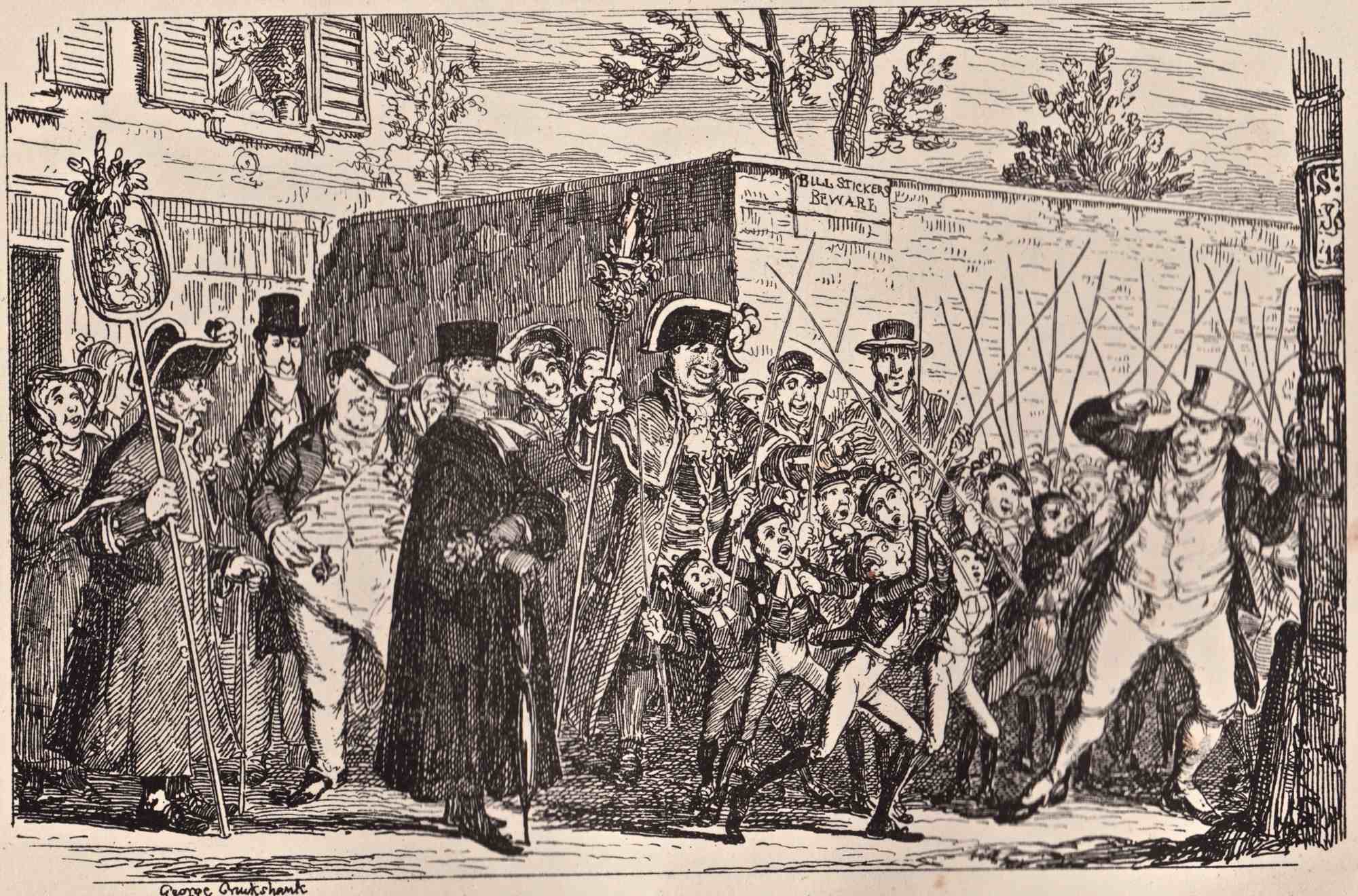
MAY – Beating the Bounds
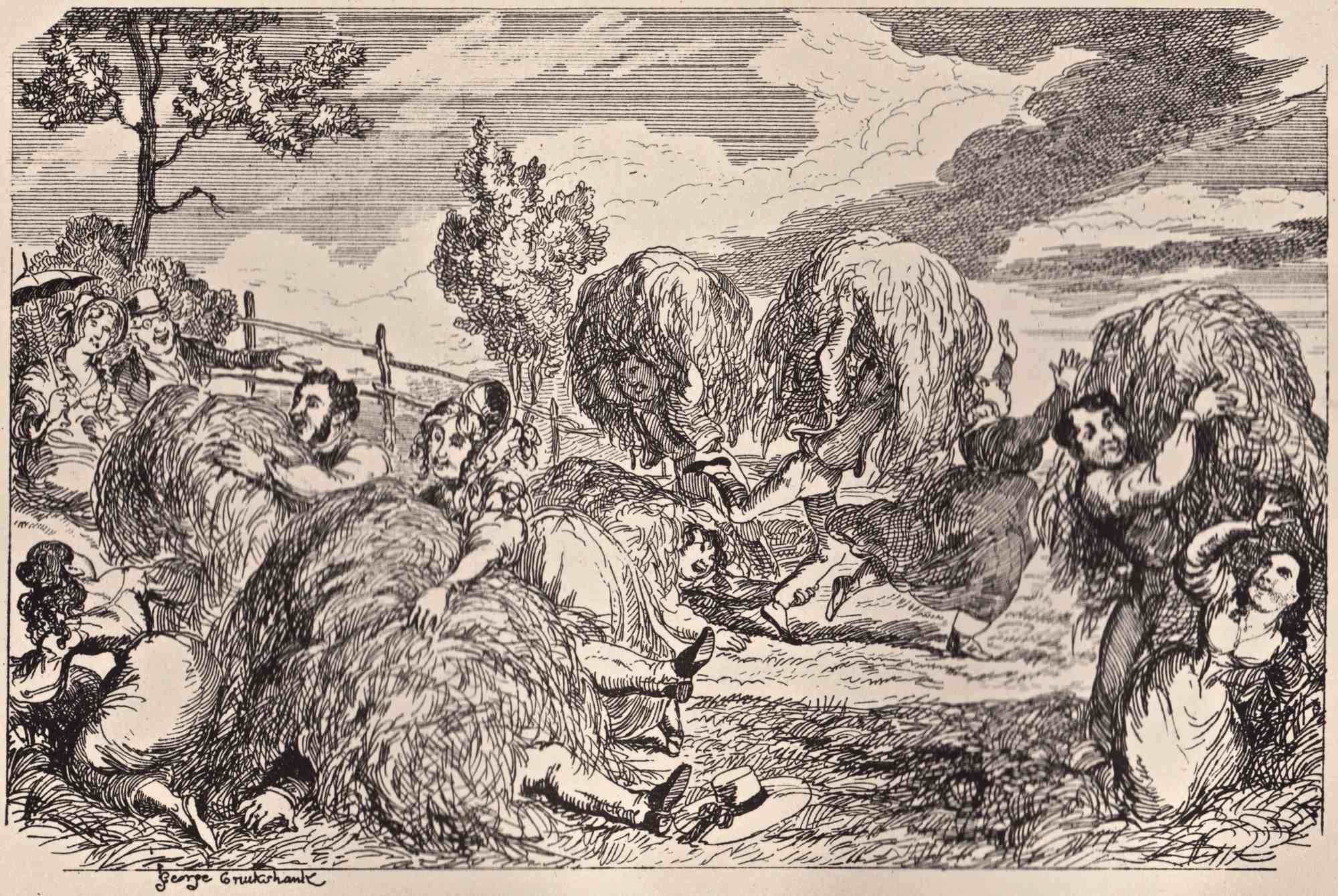
JUNE – Haymaking
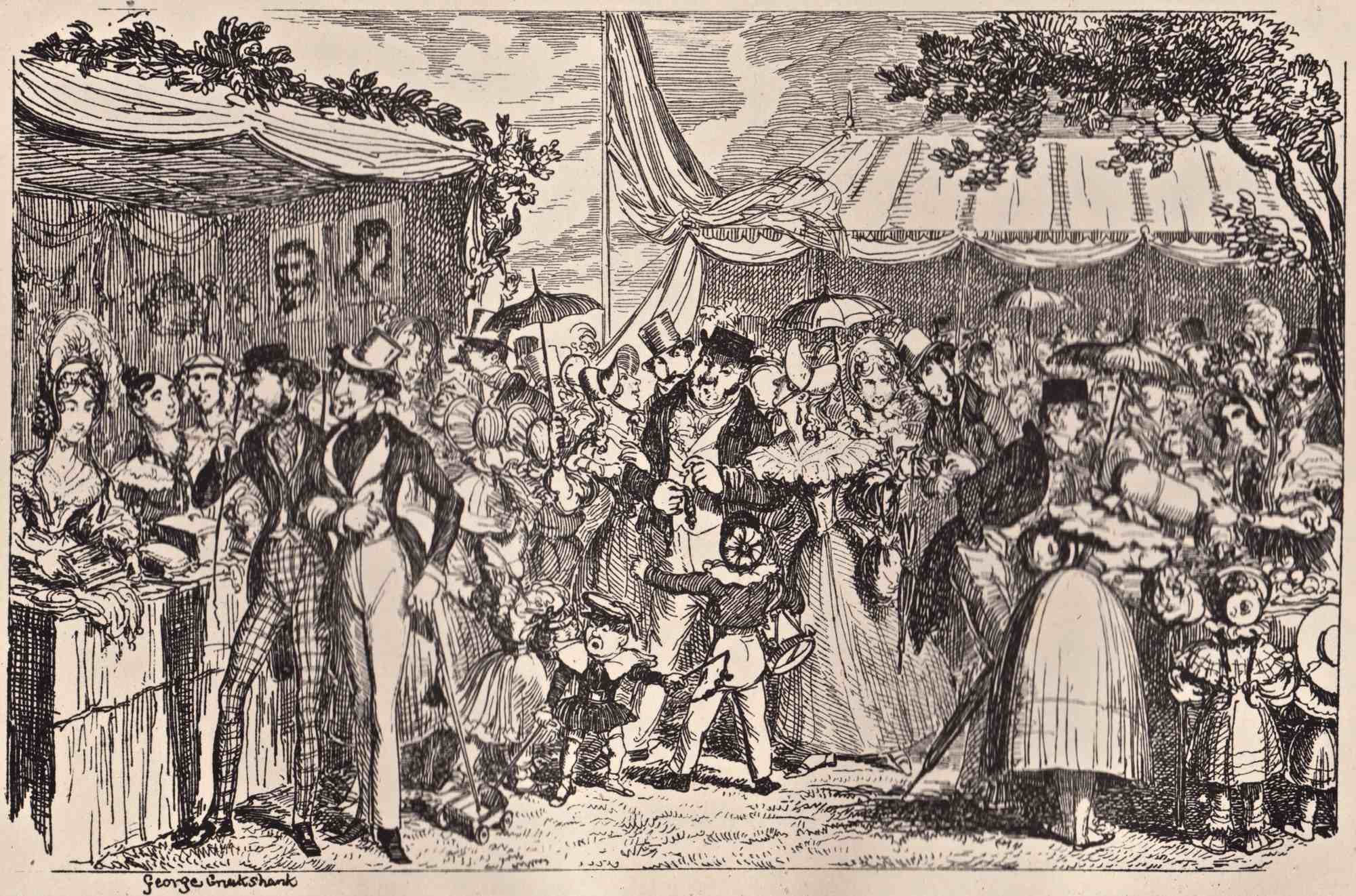
JULY – Fancy Fair
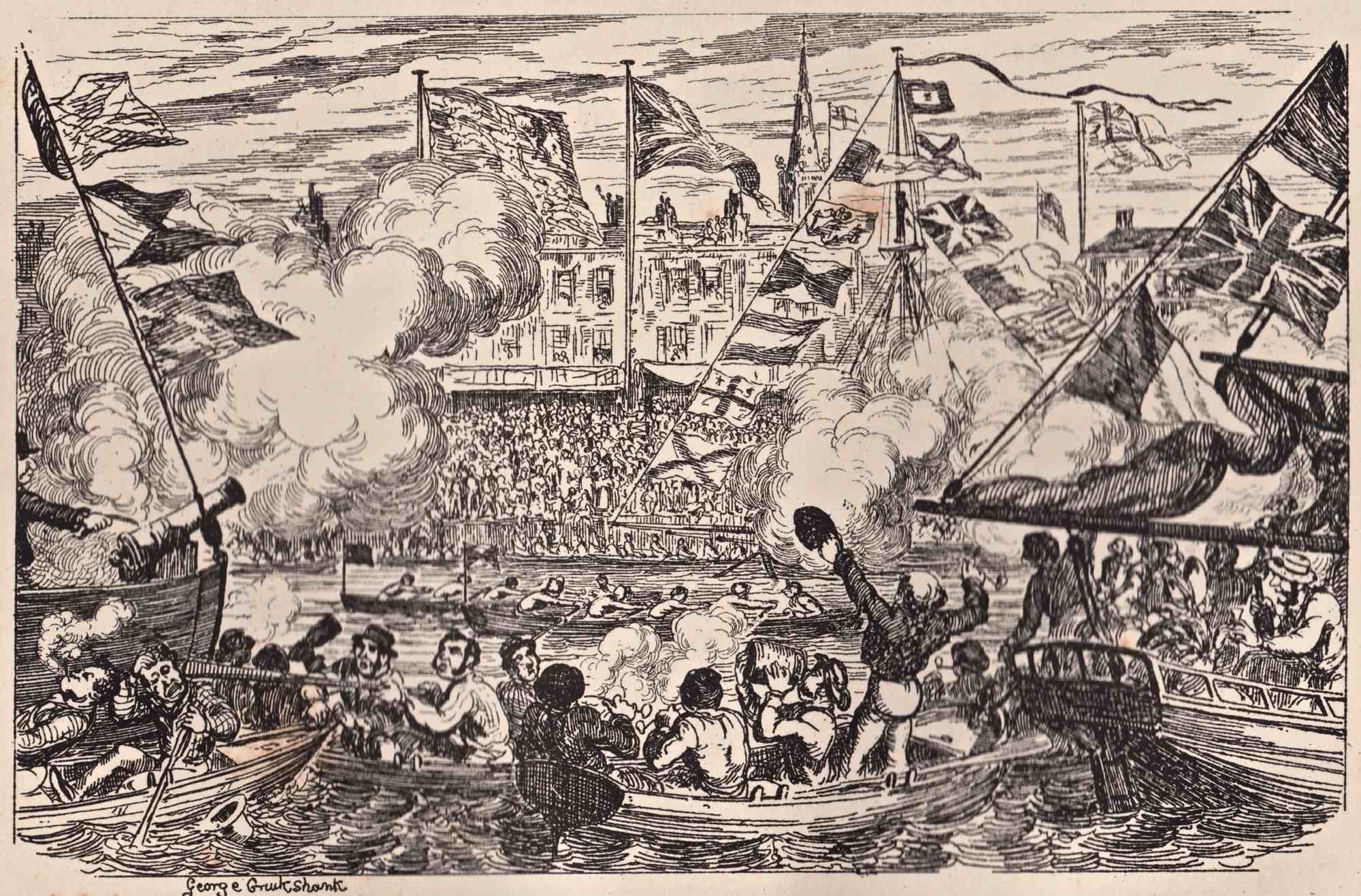
AUGUST – Regatta
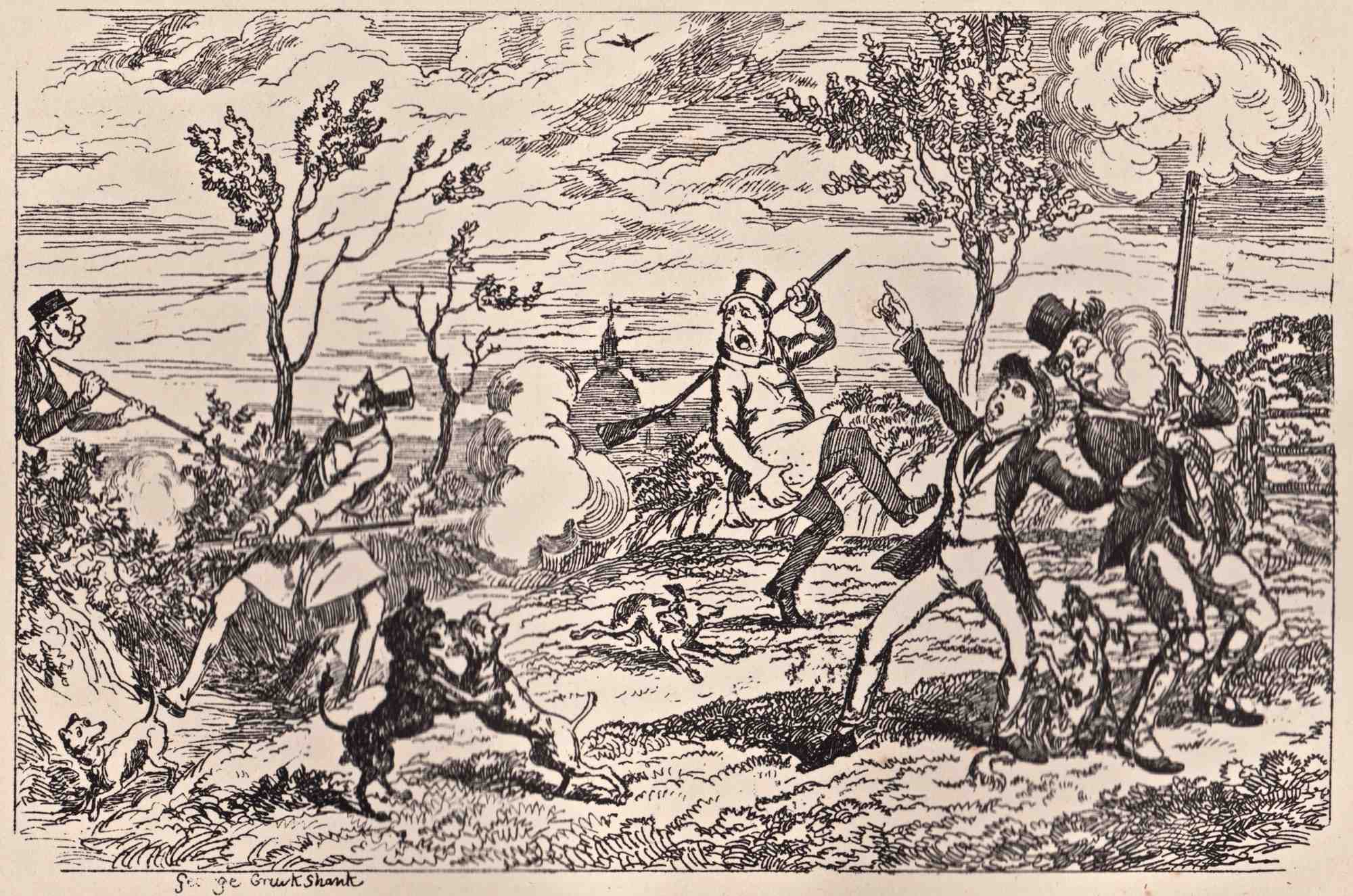
SEPTEMBER – Cockney Sportsmen
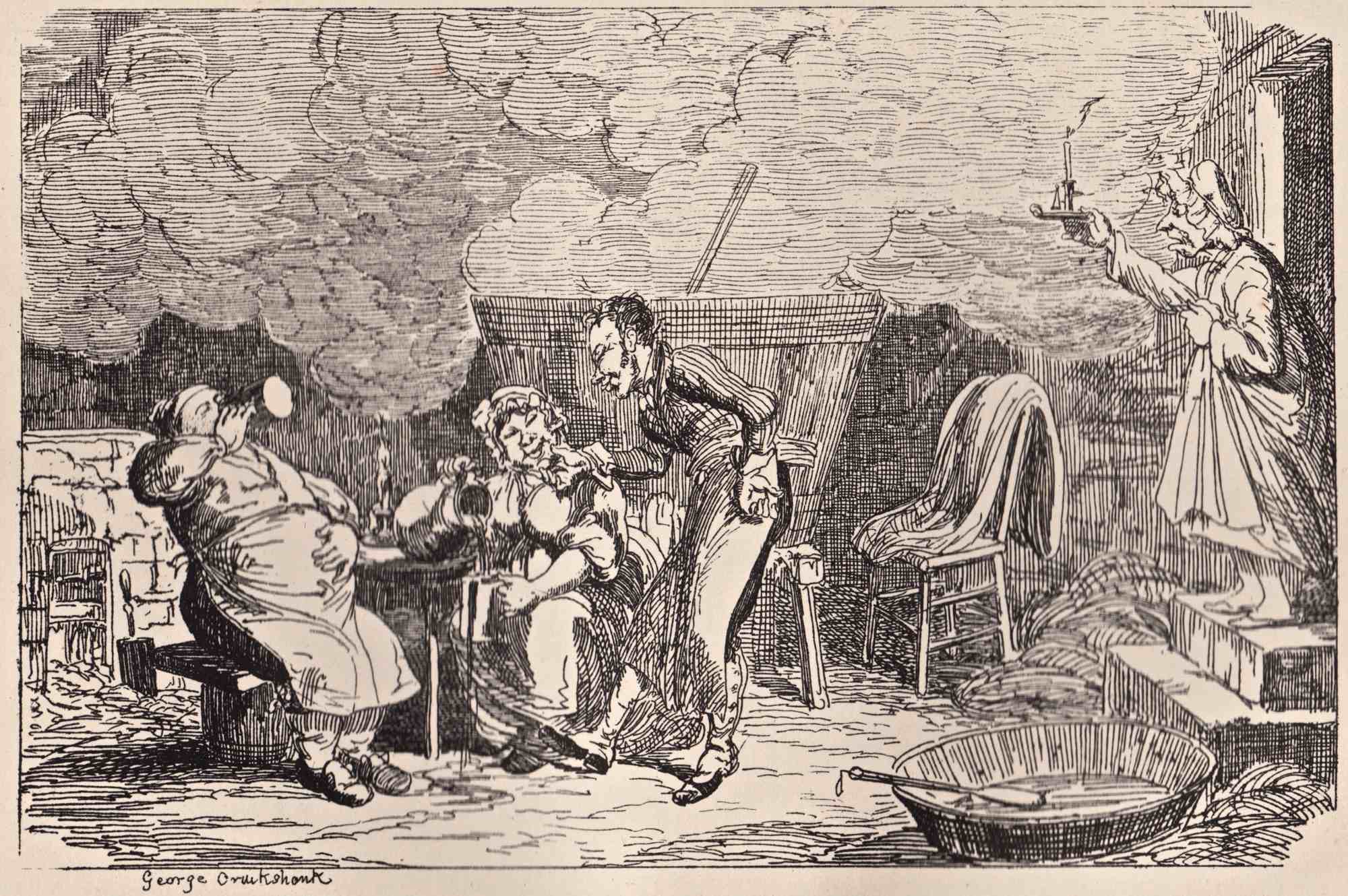
OCTOBER – Brewing
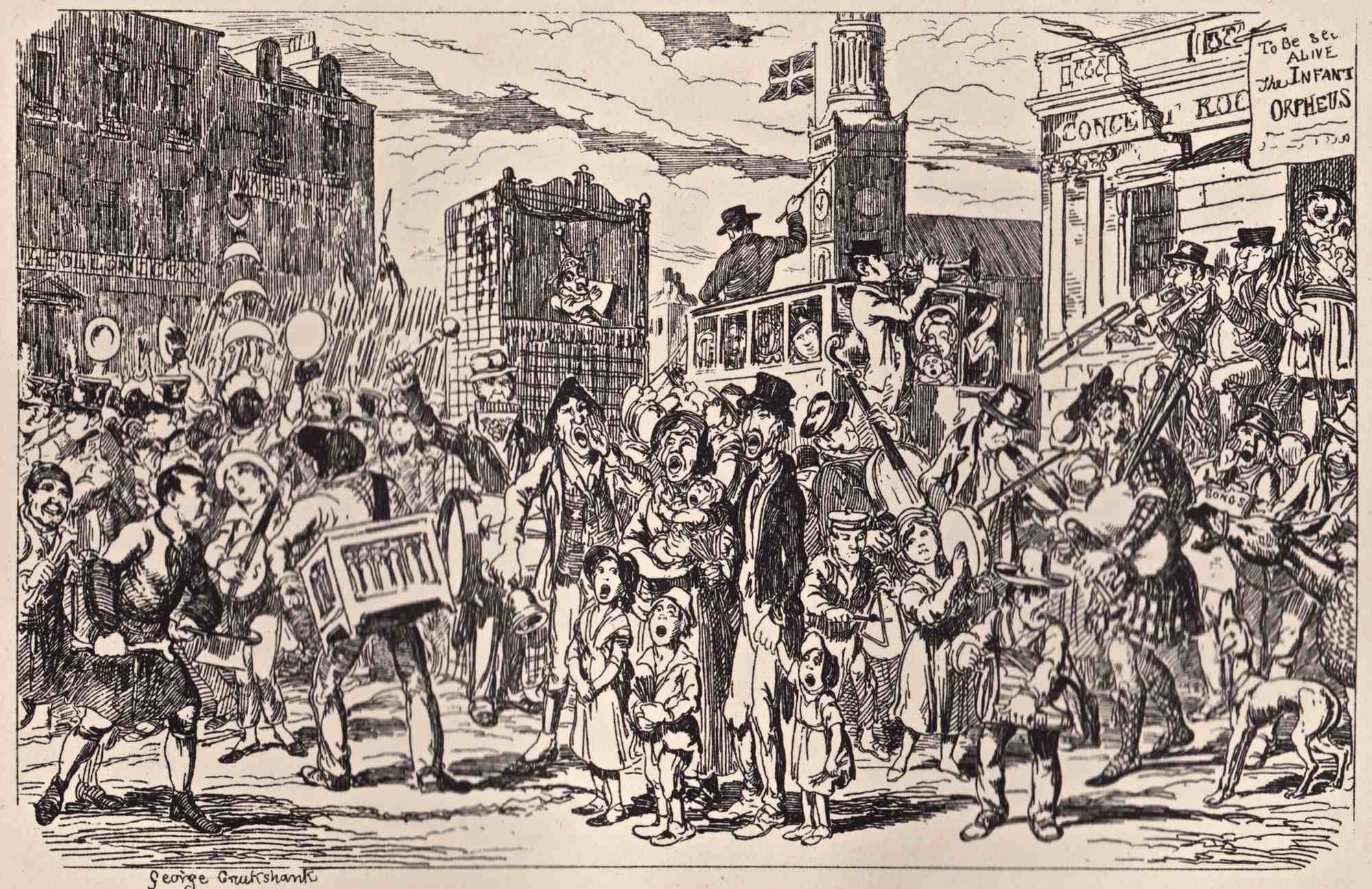
NOVEMBER – St Cecilia’s Day (the patron saint of music)
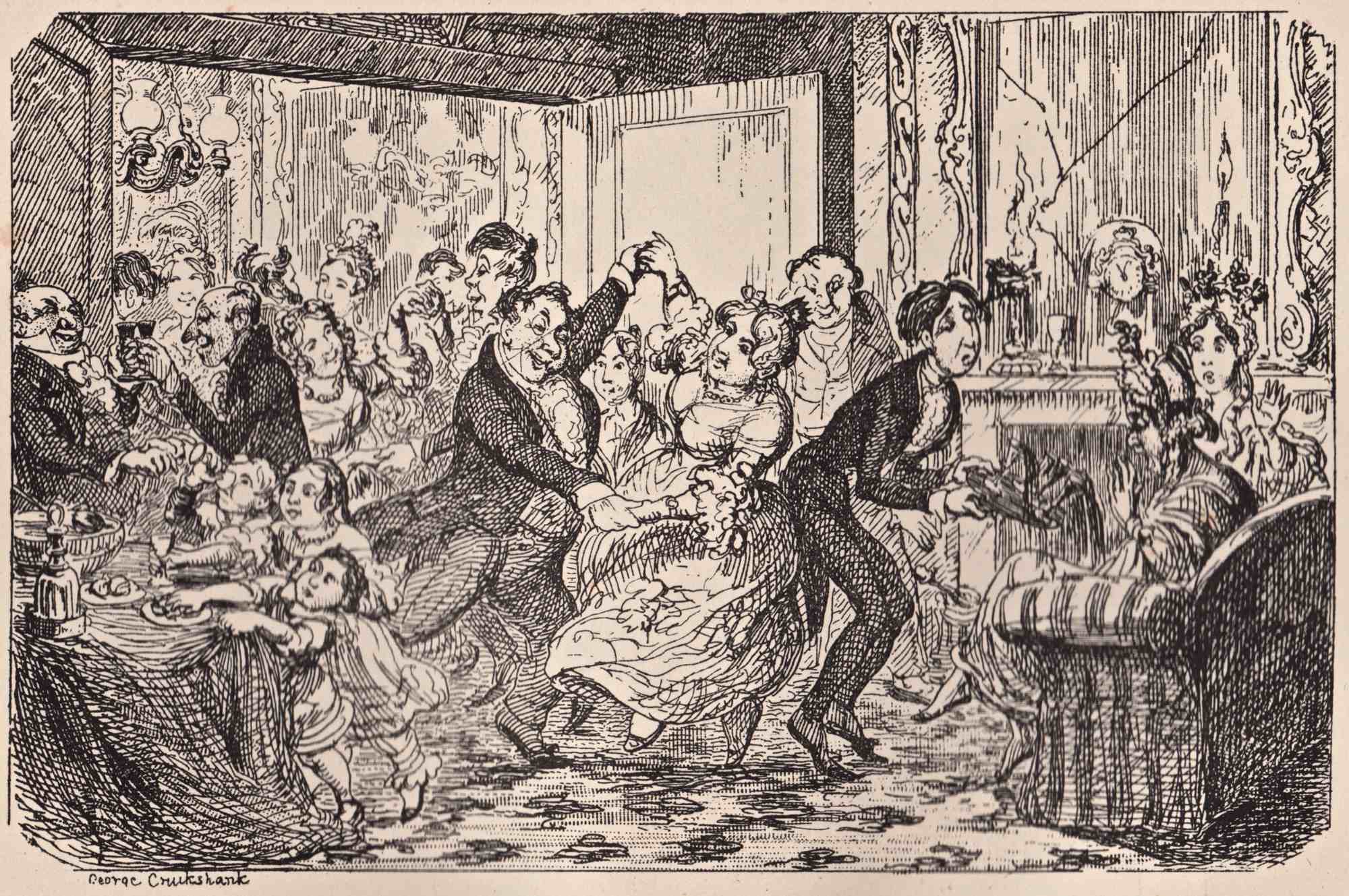
DECEMBER – Christmas Eve Ball
You may also like to take a look at
Cruikshank’s London Almanack, 1835
Cruikshank’s London Almanack, 1836












