
Postcards From Petticoat Lane

Click here to book for my tours through March, April and May

Today I am sending you postcards from Petticoat Lane. Here are the eager crowds of a century ago, surging down Middlesex St and through Wentworth St, everyone hopeful for a bargain and hungry for wonders, dressed in their Sunday best and out to see the sights. Yet this parade of humanity is itself the spectacle, making its way from Spitalfields through Petticoat Lane Market and up to Aldgate, before disappearing into the hazy distance. There is an epic quality to these teeming processions which, a hundred years later, appear emblematic of the immigrants’ passage through this once densely populated neighbourhood, where so many came in search of a better life.
At a casual glance, these old postcards are so similar as to be indistinguishable – but it is the differences that are interesting. On closer examination, the landmarks and geography of the streets become apparent and then, as you scrutinise the details of these crowded compositions, individual faces and figures stand out from the multitude. Some are preoccupied with their Sunday morning, while others raise their gaze in vain curiosity – like those gentlemen above, comfortable at being snapped for perpetuity whilst all togged up in their finery.
When the rest of London was in church, these people congregated to assuage their Sunday yearning in a market instead, where all temporal requirements might be sought and a necessary sense of collective human presence appreciated within the excited throng. At the time these pictures were taken, there was nowhere else in London where Sunday trading was permitted and, since people got paid in cash on Friday, if you wanted to buy things cheap at the weekend, Petticoat Lane was the only place to go. It was a dramatic arena of infinite possibility where you could get anything you needed, and see life too.


Images copyright © Bishopsgate Institute
You might also like to read about
Laurie Allen of Petticoat Lane
The Wax Sellers of Wentworth St
Inside The Model Of St Paul’s
Click here to book for my tours through March, April and May

Simon Carter, Keeper of Collections at St Paul’s
In a hidden chamber within the roof of St Paul’s sits Christopher Wren’s 1:25 model of the cathedral, looking for all the world like the largest jelly mould you ever saw. When Charles II examined it in the Chapter House of old St Paul’s, he was so captivated by Wren’s imagination as manifest in this visionary prototype that he awarded him the job of constructing the new cathedral.
More than three hundred years later, Wren’s model still works its magic upon the spectator, as I discovered when I was granted the rare privilege of climbing inside to glimpse the view that held the King spellbound. While there is an austere splendour to the exterior of the model, I discovered the interior contains a heart-stopping visual device which was surely the coup that persuaded Charles II of Wren’s genius.
Yet when I entered the chamber in the triforium at St Paul’s to view the vast wooden model, I had no idea of the surprise that awaited me inside. Almost all the paint has gone from the exterior now, giving the dark wooden model the look of an absurdly-outsized piece of furniture but, originally, it was stone-coloured with a grey roof to represent the lead.
At once, you are aware of significant differences between this prototype and the cathedral that Wren built. To put it bluntly, the model looks like a dog’s dinner of pieces of Roman architecture, with a vast portico stuck on the front of the dome of St Peter’s in the manner of those neo-Georgian porches on Barratt Houses. Imagine a fervent hobbyist chopping up models of relics of classical antiquity and rearranging them, and this is the result. It is unlikely that this design would even have stood up if it had been built, so fanciful is the conception. Yet the long process of designing a viable structure, once he had been given instruction by Charles II, permitted Wren to reconcile all the architectural elements into the satisfying whole that we know today.
I had been tempted to visit the cathedral by an invitation to go inside the model but – studying it – I could not imagine how that could be possible. I could not see a way in. ‘Perhaps one end has hinges and Charles II crawled in on his hands and knees like a child entering a Wendy House?’ I was thinking, when Simon Carter, Keeper of Collections opened a door in the plinth and disappeared inside, gesturing me to follow. In blind faith, I dipped my head and walked inside.
When I stood up, I was beneath the dome with the floor of the cathedral at my chest height. There was just room for two people to stand together and I imagined the unexpected moment of intimacy between the Monarch and his architect, yet I believe Wren was quietly confident because he had a trick up his sleeve. From the inside, the drama of the architecture is palpable, with intersecting spaces leading off in different directions, and – as your eyes accustom to the gloom – you grow aware of the myriad refractions of light within this intricately-imagined interior.
Just as Wren directed Charles II, Simon Carter told me to walk to the far end of the model and sit on the bench placed there to bring my eye level down to the point of view of someone entering through the great west door. Then Simon left me there inside, just as I believe Wren left Charles II within the model, to appreciate the full effect.
I have no doubt the King was thrilled by this immersive experience, which quickly takes on a convincing reality of its own once you are alone. Charles II discovered himself confronted by a glorious vision of the future in which he was responsible for the first and greatest classically-designed church in this country, with the largest dome ever built. Such is the nature of the consciousness-filling reverie induced by sitting inside the model that the outside world recedes entirely.
How astonishing, once you have accustomed to the scale of the model, when a giant face appears filling the east window. I could not resist a gasp of wonder when I saw it and neither – I suggest – could Charles II when Christopher Wren’s smiling face appeared, grinning at him from the opposite end of the nave, apparently enlarged to twenty-five times its human scale.
In these unforgettable circumstances, the King could not avoid the realisation that Wren was a colossus among architects and – unquestionably – the man for the job of building the new St Paul’s Cathedral. The model worked its spell.

Behold, the largest jelly mould in the world!


The belfry that was never built


The single portico that was replaced by a two storey version


Just a few fragments of paintwork remain upon the exterior

Original paintwork can be seen inside the model

Charles II’s point of view from inside the model

You may like to read my other stories of St Paul’s
In The Roof Of St Paul’s Cathedral


On the right of this photograph, taken in the roof of St Paul’s Cathedral, is the concave wall of the outer dome and curving away to the left is the convex wall of the painted inner dome that sits inside it, just like an enormous boiled egg beneath a cosy. It is a strange configuration which means the lower dome does not have the bear the weight of the dome roof, and which creates extraordinary incidental spaces that never cease to fascinate me whenever I return to scale this majestic cathedral.
Once I am through the main door, passing all the visitors standing and gazing at the vaulted cathedral ceiling far overhead, I go straight to the entrance to the roof. This was where I came the very first time I was ever permitted to visit London on my own as a child, and I have returned consistently through all the intervening years without disappointment.
Leaving the nave and ascending the stairs, you enter a different St Paul’s – no longer the monumental space dedicated to public worship but a warren of staircases and narrow passages that enable people to run like rats within the walls and emerge again to peer down at their world askance. If you are lucky, your initial burst of enthusiasm will carry you clattering up the wide spiral stairs to the height of the nave roof. At the head of these, formal elegance ceases as you turn left into a crooked passage and right, up a steep, tapering staircase which is only as wide as your shoulders, and where you must lean forward when the ceiling lowers to child height, before – without warning and quite unexpectedly – you step out into the cavernous void of the Whispering Gallery.
This was where I was transfixed by vertigo on my first visit. Sitting perched upon the tenuous balcony that circumscribes the dome with my back to the wall, the emptiness was overwhelming and the expectation of imminent collapse tangible. To this day it remains the most intense spatial experience that I know. I see the space contained by the great dome overhead and the aisles stretching below in four directions and it sets my head reeling, and I cannot avoid envisaging the dome spinning out of kilter and collapsing in an apocalypse. I can feel the magnetism to leap into the nothingness as if it were a great pool. Even the paintings upon the dome fill me with dread that the figures will fall from their precarious height. And each time I come there I must sit, while whispers fly around me, and make peace with these feelings before I can leave.
Sobered by the initial climb and awed by the Whispering Gallery, visitors usually take a moment to relax and scrutinise the views from the Stone Gallery that runs around the base of the exterior dome. Here I sat with my father while he recovered himself, when he came to visit me once when I first moved to London. As we discussed the idle spectacle of the view, I became aware for the first time that he was failing and growing old, and was quietly ashamed of my thoughtlessness in bringing him, when I knew it would be a point of honour for him not to admit to any struggle.
From here you climb into the interior of the domed roof – laced with iron staircases, spiralling and twisting around the central brick cone, like a giant pie funnel, that supports the lantern at the very top. Every wall tilts or curves or arches in a different direction and there is no longer any sense of height, you could equally be underground. Let me confide, on this recent visit, to my surprise and for the first time, this was where I experienced disorientation. I found myself in a space without a horizontal floor and barely any vertical services, hundreds of feet in the air, sandwiched between the roof dome with the sky above and the interior dome beneath – promoting morbid thoughts of smashing through this inner dome to fall like one of the figures from the paintings on the other side of the wall.
Yet as before, none of these grim fantasies were realised and I came safely to the Golden Gallery at the very top of the cathedral, two hundred and eighty feet above the ground. There is a spyhole in the floor there – God’s eye view – that allowed me to look right down through both domes to the floor below where the crowds crept like ants. And then, with the great dome beneath me, I could gaze out upon the city from a point of security, and free of vertigo.
When I climbed back down to ground level, I looked up to the dome from underneath and saw the speck of light from the spyhole and knew that to whoever was gazing at that moment I was now one of the ants. In medieval cathedrals, the focus of the architecture was upon the altar but at St Paul’s it is directly under the dome, where anyone can stand and be at the centre of things. The scale and ingenuity of St Paul’s are both an awe-inducing human achievement and one that makes people feel small too – a suitable irony in a great cathedral designed by a man named after the smallest bird, Wren.
I shall continue to return and climb up to the dome as long as I am able, because my trips to the roof at St Paul’s offer contradictory experiences that unlock me from the day to day. It is a reliable adventure which always delights, surpassing my recollections and revealing new wonders, because the vast scale and intricate configuration of this astounding edifice defy the capacity of the human mind to hold it in memory.

At the foot of the stair.


Iron staircases spiral in the hidden space between the inner and the outer domes of the cathedral

Looking through from the top of the lantern down to the floor two hundred and seventy feet below


Looking from the floor to the dome and the lantern above
Spires Of City Churches

Spire of St Margaret Pattens designed by Christopher Wren in the medieval style
I took my camera and crossed over Middlesex St from Spitalfields to the City of London. I had been waiting for a suitable day to photograph spires of City churches and my patience was rewarded by the dramatic contrast of strong, low-angled light and deep shadow, with the bonus of showers casting glistening reflections upon the pavements.
Christopher Wren’s churches are the glory of the City and, even though their spires no longer dominate the skyline as they once did, these charismatic edifices are blessed with an enduring presence which sets them apart from the impermanence of the cheap-jack buildings surrounding them. Yet they are invisible, for the most part, to the teeming City workers who come and go in anxious preoccupation, barely raising their eyes to the wonders of Wren’s spires piercing the sky.
My heart leaps when the tightly woven maze of the City streets gives way unexpectedly to reveal one of these architectural marvels. It is an effect magnified when walking in the unrelieved shade of a narrow thoroughfare bounded on either side by high buildings and you lift your gaze to discover a tall spire ascending into the light, and tipped by a gilt weathervane gleaming in sunshine.
While these ancient structures might appear redundant to some, in fact they serve a purpose that was never more vital in this location, as abiding reminders of the existence of human aspiration beyond the material.

In the porch of St James Garlickhythe where I sheltered from the rain

St Margaret Pattens viewed from St Mary at Hill

The Monument with St Magnus the Martyr
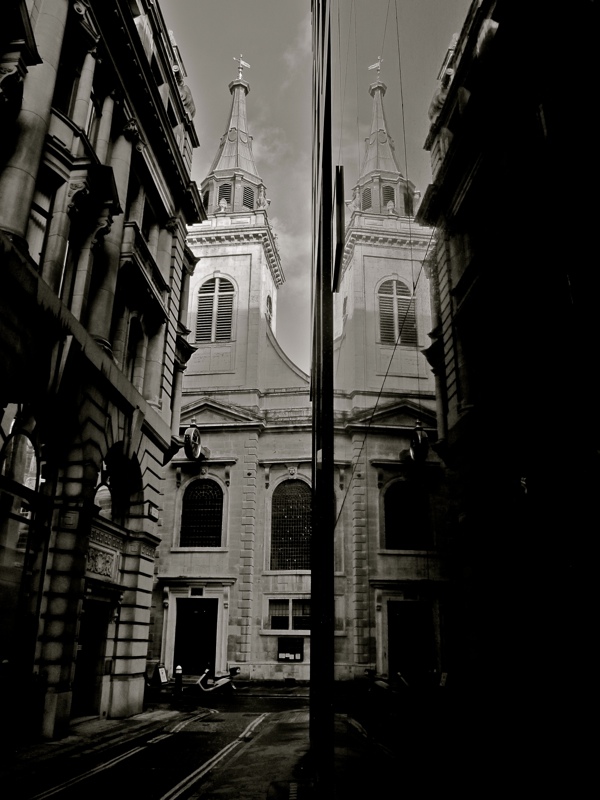
St Edmund, King & Martyr, Lombard St

St Michael Paternoster Royal, College Hill

Wren’s gothic spire for St Mary Aldermary

St Augustine, Watling Street

St Brides, Fleet St

In St Brides churchyard

St Martin, Ludgate

St Sepulchre’s, Snow Hill

St Michael, Cornhill

St Mary Le Bow, Cheapside

St Alban, Wood St

St Mary at Hill, Lovat Lane

St Peter Upon Cornhill

At St James Garlickhythe
You may also like to take a look at
The Kiosks Of Whitechapel

Mr Roni in Vallance Rd
As the east wind whistles down the Whitechapel Rd spare a thought for the men in their kiosks, perhaps not quite as numb as the stallholders shivering out in the street but cold enough thank you very much. Yet in spite of the sub-zero temperatures, Contributing Photographer Sarah Ainslie & I discovered a warm welcome this week when we spent an afternoon making the acquaintance of these brave souls, open for business in all weathers.
I have always marvelled at these pocket-sized emporia, intricate retail palaces in miniature which are seen to best effect at dusk, crammed with confections and novelties, all gleaming with colour and delight as the darkness enfolds them. It takes a certain strength of character as well as a hardiness in the face of the elements to present yourself in this way, your personality as your shopfront. In the manner of anchorites, bricked up in the wall yet with a window on the street and also taking a cue from fairground callers, eager to catch the attention of passersby, the kiosk men embrace the restrictions of their habitation by projecting their presence as a means to draw customers like moths to the light.
In Whitechapel, the kiosks are of two types, those offering snack food and others selling mobile phone accessories, although we did find one in Court St which sold both sweets and small electrical goods. For £1.50, Jokman Hussain will sell you a delicious hot samosa chaat and for £1 you can follow this with jelabi, produced in elaborate calligraphic curls before your eyes by Jahangir Kabir at the next kiosk. Then, if you have space left over, Mannan Molla is frying pakora in the window and selling it in paper bags through the hatch, fifty yards down the Whitechapel Rd.
Meanwhile if you have lost your charger, need batteries or a memory stick in a hurry, Mohammed Aslem and Raj Ahmed can help you out, while Mr Huld can sell you an international calling card and a strip of sachets of chutney, both essential commodities for those on-the-go.
Perhaps the most fascinating kiosks are those selling betel or paan, where customers gather in clusters enjoying the air of conspiracy and watching in fascination as the proprietor composes an elaborate mix of spices and other exotic ingredients upon a betel leaf, before folding it in precise custom and then wrapping the confection into a neat little parcel of newspaper for consumption later.
Once we had visited all the kiosks, I had consumed one samosa chaat, a jalebi, a packet of gummy worms and a bag of fresh pakora while Sarah had acquired a useful selection of batteries, a strip of chutney sachets and a new memory stick. We chewed betel, our mouths turning red as we set off from Whitechapel through the gathering dusk, delighted with our thrifty purchases and the encounters of the afternoon.

Jokman Hussain sells Samosa Chaat

Mohammed Aslem sells phone accessories and small electrical goods

Jahangir Kabir sells Jalebi

Raj Ahmed

Mannan Molla sell Pakora

Mr Duld sells sweets and phone accessories in Court St

Mr Peash

Photographs copyright © Sarah Ainslie
You may also like to read about
Israel Bidermanas’ London
 .
.Click here to book your tour tickets for Saturday 8th March and beyond

Lithuanian-born Israel Bidermanas (1911-1980) first achieved recognition under the identity of Izis for his portraits of members of the French resistance that he took while in hiding near Limoges at the time of the German invasion. Encouraged by Brassai, he pursued a career as a professional photographer in peacetime, fulfilling commissions for Paris Match and befriending Jacques Prévert and Marc Chagall. He and Prévert were inveterate urban wanderers and in 1952 they published ‘Charmes de Londres,’ delivering this vivid and poetic vision of the shabby old capital in the threadbare post-war years.

In the cemetery of St John, Wapping

Milk cart in Gordon Sq, Bloomsbury

At Club Row animal market, Spitalfields

The Nag’s Head, Kinnerton St, SW1

In Pennyfields, Limehouse

Palace St, Westminster

Ties on sale in Ming St, Limehouse

Greengrocer, Kings Rd, Chelsea

Diver in the London Docks

Organ Grinder, Shaftesbury Ave, Piccadilly

Sphinx, Chiswick Park

Hampden Crescent, W2

Underhill Passage, Camden Town

Braithwaite Arches, Wheler St, Spitalfields

East India Dock Rd, Limehouse

Musical instrument seller, Petticoat Lane

Grosvenor Crescent Mews, Hyde Park Corner

Unloading in the London Docks

London Electricity Board Apprentices

On the waterfront at Greenwich

Tower Bridge
Photographs courtesy Bishopsgate Institute
You may also like to take a look at
Peta Bridle’s Shops
In her latest series of drawings done on location, Peta Bridle has cast her attention upon shops.
Her exhibition DRAWN TO LONDON opens this Wednesday 26th February and runs until Tuesday 25th March at the Back To Ours Cafe, Good Shepherd Building, 15A Davies Lane, Leytonstone, E11 3RR. 7:30am – 4pm daily.

Leadenhall Market, City of London
The ironwork of Horace Jones’ fine 1881 market building is painted red and cream with dragons on the top, and lit by large glass lamps. Built as a poultry market, the last butcher closed just ten years ago.
Leadenhall has been a centre of trade for centuries with a lead-roofed market building standing here since 1321. Beneath the market are the remains of the Roman forum where commercial and legal business were conducted. Ruins of the forum may be visited in the basement of one of the shops today.

Gardners’ Bags, Leyton
Paul Gardner’s family ran their market sundries shop in Commercial St, Spitalfields from 1870 until just before the pandemic when they relocated to Leyton. Plastic bags hang like bunting overhead and rolls of fluorescent stickers are stacked on the original wooden counter. Paul stands with a large set of green scales in front of him and his old greengrocers’ fruit and vegetable signs displayed behind. It is always a pleasure to visit the charismatic Paul Gardner, the paper bag baron of the East End.

Citywear Independent Gent’s Outfitters, Wentworth St
Citywear Independent Gent’s Outfitters is on a corner in Petticoat Lane Market. Broken lettering clings to the faded black-painted brickwork and rails of clothing are wheeled in and out every day. In recent years, a fashionable speakeasy known as ‘Discount Suit Company’ has opened in the basement serving cocktails.

Arber & Co Ltd, Printers & Stationers, Roman Rd
I met Gary Arber some years ago at his shop. In the basement, down a flight of stairs, was the family print works which had operated since 1897. The glass cabinets in the shop, from when they once sold toys, were stuffed full of paper and notepads, pens and books, and there was string hanging down from the ceiling and boxes of paper stacked in every available space. Note the old Scalextric poster stuck to the front of the wooden counter. Gary retired in 2014, his shop is no more and last time I passed it had become a nail bar.

A1 Car Care Centre, Bethnal Green
Located off Three Colts Lane in Bethnal Green is the A1 Car Care Centre. Hand painted signage in bold blue type on yellow brickwork advertises their services – Tyres! Punctures! Tracking! Servicing!

W G Ford, Poyser St, Bethnal Green
Just an old metal sign left on the wall reveals that this was once the workshop of W.G. Ford Sheet Metal & Steelworkers. I love all the beautiful textures, the graffiti covered brickwork of the railway arch, the cobbled and uneven setts in the road, and the corrugated iron walls.

Bonners Fish Bar, Walthamstow
I made this drawing from across the road. Whilst I was there, people were coming along to admire the new painting by Banksy of two hungry pelicans helping themselves to fish that he did as part of his animal series in 2024.

Tile Mart, Hackney
This beautiful old premises was once a buildings materials supplier. I love the faded paintwork with its fragmentary signage.

MA Soda Ltd, Brixton Market
This busy greengrocer is located in the indoor market. Painted bright green and yellow, a giraffe adorns one side of the doorway and tree branches reach over the other. While I was drawing, the display was constantly changing as fruit and vegetables disappeared into baskets, and new boxes were opened and produce restocked.

Manze’s Pie & Mash, Deptford
Drawn during the last week of trading after more than a century, there was a continual flow of customers and well-wishers. A man told me he remembered sitting on his mother’s knee in Manze’s when he was three. ‘It’s in the blood,’ he told me, ‘It’s important we don’t forget places like this. I am eighty now and I’ve come today with my son.’ The shopfront is green with a black glass sign and gold lettering while white letters on the window declare ‘Meal in a Moment – Manze’s Meat Pies – All Made Daily.’

Manze’s Pie & Mash, Deptford
Manze’s was founded between 1890 and 1914 by Michele Manze who came from Italy in 1878. Until January of this year it was ran by his grandson George Manze until he retired. I sat at the back to sketch the comings and goings while George served his customers at the front. The building is Grade II listed, with an interior lined with marble-topped tables and wooden high-back benches and tiled walls. It was always a popular place to eat before Millwall matches.

Medici Gallery, South Kensington
The Medici Gallery is a greetings card gallery which has traded from this shop since the thirties and every month the window has a beautiful new display. After almost century, this celebrated landmark is now being evicted as part of the redevelopment of South Kensington Station and the handsome Victorian terrace will be facaded. When I visited last summer the window celebrated Van Gogh and his sunflowers.

Medici Gallery, South Kensington
The basement kitchen is full of recycled and salvaged treasures with a window looking onto a tiny garden painted in bright colours, full of pots, parrots, lights and ornaments, which customers can peek down into from above through a skylight.

Word On The Water, London Book Barge, Regent’s Canal, Kings Cross
This is a floating bookshop housed inside a twenties Dutch barge near Granary Sq. New and used books are displayed on shelves, both on deck and below. Inside the boat there are comfortable sofas where you can sit and browse while viewing ducks swimming past at eye level. I sat on the towpath to draw while a trumpeter played jazz up on deck.

Lisle Street, Chinatown
The curve of Lisle Street is filled with Chinese restaurants, cafes and a supermarket. Red lanterns strung across the street bob in the breeze sending their gold tails fluttering. It was busy with tourists and tradespeople but somehow I managed to find a space for my little stool while I did this drawing.

Chinese cakes
A selection of cakes from bakeries in Chinatown. The top two moon cakes represent family reunions and happiness when families gather to celebrate the Mid-Autumn Festival. Taiyaki, the fish-shaped cake, is made of made of pancake batter and filled with azuki paste (sweetened red beans). After I had done my drawing, I got to eat my still life with a cup of tea.
Drawings copyright © Peta Bridle
Follow Peta Bridle on Instagram
You may also like to take a look at
Peta Bridle’s London Viewpoints
Peta Bridle’s East End Sketchbook
Peta Bridle’s Riverside Sketchbook
Peta Bridle’s Gravesend Sketchbook
Peta Bridle’s City of London Sketchbook
Peta Bridle’s Latest Drypoint Etchings

Peta’s exhibition is open from from Wednesday 26th February until Tuesday 25th March, the Back To Ours Cafe, Good Shepherd Building, 15A Davies Lane, Leytonstone, E11 3RR.


