
At Dalston Lane

Can you believe that this partly-demolished late Georgian terrace is the outcome of a “conservation-led’ scheme? So it is in Hackney, where the bulldozers moved in last month only to be hastily withdrawn when it was pointed out to the council that their action was illegal, forcing Murphy (their developer partners) to seek permission at a planning meeting which takes place next week, on March 3rd.
However, this pitiful sequence of events does permit members of the public to submit objections in the hope that the rest of the terrace may be spared the wreckers’ ball. And, in the meantime, Spitalfields Life Contributing Photographer Simon Mooney went inside to take the pictures you see below, permitting us a glimpse of the historic interiors.
In 1800, Dalston Lane was – as its name suggests – merely a country track through agricultural land, but the pace of development up the Kingsland Rd, served by the brickyards that opened to produce building material from the London clay, delivered three symmetrical pairs of dignified Italianate villas constructed by Richard Sheldrick in 1807.
By 1830, terraces on either side filled up the remaining plots to create a handsome row of dwellings with front gardens facing onto the lane. In this era, Dalston was still rural and it was not until the end of the century that the front gardens were replaced by the run of shopfronts divided by Corinthian capitals which we see today.
This modest yet good quality terrace represents the essential fabric of the East End and its evolution manifests two centuries of social history in Dalston. Consequently, the terrace is enfolded by a Conservation Area that embraces other contemporary buildings which define the distinctive quality of this corner of Hackney and thus, when the council sought to regenerate the area in 2012, it was with a “conservation-led” scheme.
Yet when the council’s surveyors questioned the structural integrity of the terrace, if it were to stand up to being woven into the facade of a new development, nobody suggested reworking the development to suit the terrace – or simply repairing the buildings. Instead the council decided, without any consultation, to demolish the terrace and replace it with a replica that would permit higher density housing within the development.
In January, this destruction was halted when the council’s survey was called into question by the Society for Protection of Ancient Buildings and others, who called for an independent appraisal by a surveyor with experience of historic structures. So now we have until next week to object to this “conservation-led” scheme that entails the demolition of all the buildings. As one wag so eloquently put it, “Is that like a picnic without the sandwiches?”
Click here before March 3rd to object to the demolition of the terrace in Dalston Lane
In your objection, please point out the substantial harm this demolition will do to the Dalston Lane (West) Conservation Area and emphasise that it does not comply with national, regional or local heritage planning policies and guidance.

The shameful hole in the terrace

Paired villas of of 1807 to the left and terrace of 1830 to the right

Rear of 1830 terrace

Paired villas built by Richard Sheldrick in 1807

The villas built in symmetrical pairs, note detail of long stairwell window


The rendering is a late nineteenth century addition

Late Georgian shutters re-used as a partition


Original reeded arch in plaster

Reeded panelling


Late Georgian newel with stick banisters


Original panelling


One house is still inhabited

The presiding spirit of the terrace

Late nineteenth century shop interior panelled with tongue and groove, with original shelves and fittings


A century of use illustrates changing styles of fascia lettering


One of the paired villas of 1807 has been destroyed and another half-demolished

The terrace of 1830 on the right has an unusual single window detail on the first floor

The terrace with the graphic of its replica with which the developers hope to facade their structure

Run of nineteenth century shopfronts punctuated by Corinthian capitals

Dalston Lane 1900

Dalston Lane 1940

Kingsland Rd, c. 1800. Brickworks manufacture building materials for the rapid development that is spreading across the agricultural land. The buildings to the right still stand in the Kingsland Rd, just around the corner from Dalston Lane.
Photographs copyright © Simon Mooney
You may also like to read about
At The Spring Flower Show

There may yet be another month before spring begins, but inside the Royal Horticutural Hall in Victoria it arrived with a vengeance last week. The occasion was the RHS Plant & Design Show held each year at this time, which gives specialist nurseries the opportunity to display a prime selection of their spring-flowering varieties and introduce new hybrids to the gardening world.
I joined the excited throng at opening time on the first day, entering the great hall where shafts of dazzling sunshine descended to illuminate the woodland displays placed strategically upon the north side to catch the light. Each one a miracle of horticultural perfection, it was as if sections of a garden had been transported from heaven to earth. Immaculate plant specimens jostled side by side in landscapes unsullied by weed, every one in full bloom and arranged in an aesthetic approximation of nature, complete with a picturesque twisted old gate, a slate path and dead beech leaves arranged for pleasing effect.
Awestruck by rare snowdrops and exotic coloured primroses, passionate gardeners stood in wonder at the bounty and perfection of this temporary arcadia, and I was one of them. Let me confess I am more of a winter gardener than of any other season because it touches my heart to witness those flowers that bloom in spite of the icy blast. I treasure these harbingers of the spring that dare to show their faces in the depths of winter and so I found myself among kindred spirits at the Royal Horticultural Hall.
Yet these flowers were not merely for display, each of the growers also had a stall where plants could be bought. Clearly an overwhelming emotional occasion for some, “It’s like being let loose in a sweet shop,” I overhead one horticulturalist exclaim as they struggled to retain self-control, “but I’m not gong to buy anything until I have seen everything.” Before long, there were crowds at at each stall, inducing first-day-of-the-sales-like excitement as aficionados pored over the new varieties, deliberating which to choose and how many to carry off. It would be too easy to get seduced by the singular merits of that striped blue primula without addressing the question of how it might harmonise with the yellow primroses at home.
For the nurserymen and women who nurtured these prized specimens in glasshouses and poly-tunnels through the long dark winter months, this was their moment of consummation. Double-gold-medal-winner Catherine Sanderson of ‘Cath’s Garden Plants’ was ecstatic – “The mild winter has meant this is the first year we have had all the colours of primulas on sale,” she assured me as I took her portrait with her proud rainbow display of perfect specimens.
As a child, I was fascinated by the Christmas Roses that flowered in my grandmother’s garden in this season and, as a consequence, Hellebores have remained a life-long favourite of mine. So I was thrilled to carry off two exotic additions to a growing collection which thrive in the shady conditions of my Spitalfields garden – Harvington Double White Speckled and Harvington Double White.
Unlike the English seasons, this annual event is a reliable fixture in the calendar and you can guarantee I shall be back at the Royal Horticultural Hall next year, secure in my expectation of a glorious excess of uplifting spring flowers irrespective of the weather.


Double-gold-medal-winner Catherine Sanderson of ‘Cath’s Garden Plants’


You may also like to read about
Time To Write Your Novel?

The Bronte sisters arrive in Cornhill to meet their publisher Thackeray, 1848
In response to popular demand, we are running our HOW TO WRITE YOUR FIRST NOVEL course again in Spitalfields on the weekend of Saturday 22nd & Sunday 23rd March. The course is hosted by two writers who achieved notable success with their first novels – Rosie Dastgir author of A Small Fortune published by Quercus & Kate Griffin author of Kitty Peck and The Music Hall Murders published by Faber.
As guests, Walter Donohue, Senior Editor at Faber, will be talking about what he looks for in a first novel and Spitalfields resident Clive Murphy will be amusing us with his experiences as a novelist in London in the seventies.
The course will be held at 5 Fournier St, an eighteenth century weavers’ house, on Saturday and Sunday from 10am – 5pm. Lunch catered by Leila’s Cafe and tea, coffee and cakes by the Townhouse are included within the course fee of £250.
There are just fourteen places available, email spitalfieldslife@gmail.com to book your place on the course. Accommodation at 5 Fournier St can be provided upon enquiry.

Walter Donohue, Senior Editor at Faber
“I am looking for a distinctive narrative voice and an arresting first line, one that makes the reader ask, ‘What happens next?’ Of course, any novel must have structure – a beginning, middle and an end, though each part doesn’t have to be of equal length. I hope for characters that are grounded and authentic, with whom the reader can empathise, and prose that flows across the page, drawing the reader into a believable world. Originality and imagination are essential, expressed in a strong story. But above all, I look for a certain confidence that derives from a writer responding to what their instinct tells them to write about.”

Rosie Dastgir
“I never made a conscious decision to be a writer. Writing was always something I did from a very early age. But I did make a conscious decision to write a novel when I moved to New York in 2005, it was the moment to try something new. I’d been writing screenplays and had worked in documentaries at the BBC for many years. One day, a project that I’d worked on for a while stalled and I was so demoralized that I decided I’d write something that didn’t require a committee of approval. So I wrote a short story, inspired by a trip I’d made to Pakistan when I was a teenager, and that became the seed of this novel. It evolved over several years and went through many iterations, as I rewrote it. I finished it in New York where it was published in 2012.”

Kate Griffin
“Writing is an oddly lonely thing to do. It’s just you, staring at a notebook or a laptop, perhaps the sound of a clock ticking somewhere in the background, the occasional gurgle of central heating pipes, maybe a radio playing softly in an another room, a child laughing in the street?
That’s my experience anyway. I’m sure every writer will tell you something different. We all work in different ways. Despite the impression I might have given above of an isolated hermit-like existence, the main reason I write is that I love being surrounded by people. More specifically, I love it when my own sense of self is crowded out by the characters in my head clamouring to have their say. On a good day, they tell their own story – I don’t even have to do the work! On a bad day, I give up and attempt to find inspiration in the fridge. (It’s never there.)
Writing appeals to the thwarted theatrical in me. Not only do I get to set the scene, build and decorate the sets and write the script, I get to play all the parts too. Sometimes I run characters’ lines through my head as I type (I’m a lap top writer, not a long-hander) and at other times I read them aloud in suitable voices to make sure they sound right. There’s a chasm of difference between words on a screen and words spoken aloud. Often the only way to bridge that gap – and find out if they fly – is to try them out.
Having the opportunity to become a new person and explore an alien world through their eyes is something that motivates me to write. It’s like setting off on an adventure – even if you think you’ve got a map and a plan you’ll often surprise yourself. That’s part of the fun and part of the challenge.
My first novels ‘Kitty Peck and the Music Hall Murders’ and ‘The Jade Boy,’ for children, were published in the summer of 2013. I think it’s no coincidence that on Midsummer’s Day last year I also turned fifty. It was a watershed moment.
I’ve always written, in some way, for a living. I started out as a journalist on a local newspaper and then I hopped over the fence to work as a press officer. I love playing with words, but increasingly I found myself frustrated that I was telling other people’s stories not my own. I don’t think I ever admitted this, even to myself, but at some level, a small but horribly insistent voice kept insinuating itself into my mind, whispering that there was something else, something more creative and personal, that I could be doing with my ‘skills’.
Eventually I listened. Outside of work, I started writing about things that interested and entertained me. I was quite surprised at some of the macabre, strange, fanciful, gothic and, frankly, camp scenes that leapt from my head to the page. Once I started, I couldn’t stop. I was like Cecil B. DeMille directing a private and slightly mad epic. I’ve realised I don’t really do ‘small’. I’d love to pretend that I write with the precision and miraculous delicacy of Jane Austen, but, in truth, my characters and stories have a larger than life quality that owes a great deal to fairy tale, pantomime and the stage – the great obsessions of my childhood.
Actually, those passions have never gone away. They’ve clearly been marinating on a low flame for nearly half a century, but now they’re ready to serve and I’m grateful that despite the terrible things I put them through, my characters – the repertory company that lives in my head – still want to talk to me and tell me what happens next.
When they don’t, I’ll start to worry. ”

Clive Murphy, Poet, Oral Historian & Author of three novels – Summer Overtures, Freedom For Mr Mildew & Nigel Someone. Brigid Brophy wrote of Summer Overtures, “It makes angelic use of words (and sentences and paragraphs). It is lucid, cool, sly and inventive … may well be required reading, having become a classic.”
HOW TO WRITE YOUR FIRST NOVEL, 22nd & 23rd March, 5 Fournier St, Spitalfields
You may also like to read about
At The Smithfield Market Public Enquiry
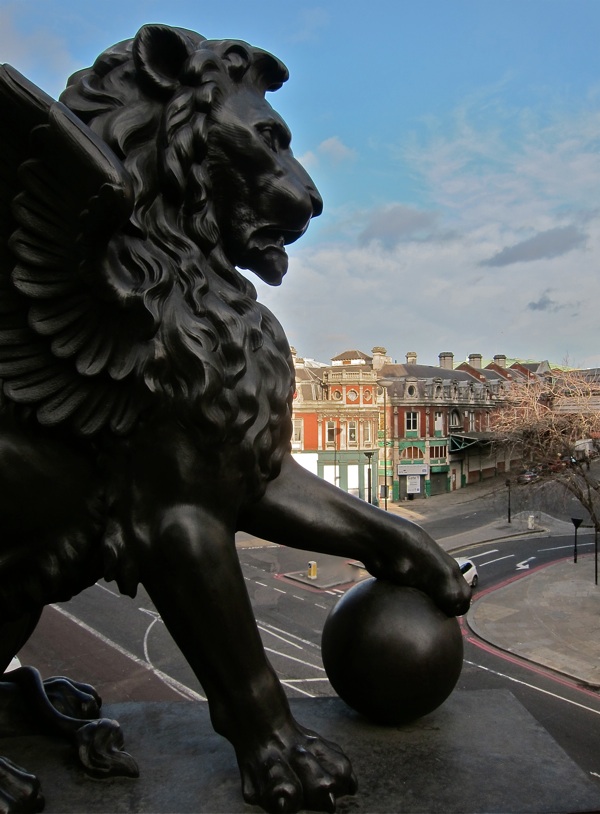
Behold the winged lion on the Holborn Viaduct looking down protectively upon the Smithfield General Market, as – over at the Guildhall – the Public Enquiry that will decide the fate of this magnificent building designed by Horace Jones, the architect of Tower Bridge, reaches the end of its second week.
I went over yesterday as SAVE Britain’s Heritage began to outline their proposal which seeks the renovation of the building and its reopening as a retail market, in opposition to the plan by Henderson Global Investments which entails demolishing the structure and retaining only the facade as an apologia for three disproportionately-large office blocks that would sit behind it.
When I arrived, Chris Costelloe the Director of the Victorian Society, was championing the significance of the General Market as an integral part of the grandest procession of market buildings in Europe and its use as a market hall as intrinsic to the distinctive character of Smithfield, an area of cultural significance both within London and nationally. He gave no quarter to the developers’ advocates who maintained that retention of the old facades upon their new blocks was itself a form of conservation and were eager to refute the suggestion that the neglect of the building in recent years was in any sense deliberate upon their part.
“The public hasn’t been given enough information to envisage the potential of the market,” Clementine Cecil, the Director of SAVE Britain’s Heritage, explained to me afterwards, “It’s a classic situation – a building is boarded up and thus its architectural and historical significance is concealed.”
Yet Clementine was able to supply me with the photographs below that reveal the beautiful forgotten interior of the last market structure designed by Horace Jones after he had designed Central Smithfield, Leadenhall and Billingsgate. He rose to the engineering challenges posed by this problematic site, suspended over a railway line and upon a slope, with ingenuity and flair, devising hollow “Phoenix columns” that were strong enough to support the vast open roof while minimising the weight of the edifice.
If you care about the future of Smithfield, I urge you to join the audience at the Enquiry and demonstrate by your presence the importance of preserving London’s oldest market. The Smithfield Market Public Enquiry is open to the public at the Basinghall Suite, accessed via the Art Gallery, at the Guildhall in the City of London from 10am daily. There are four days remaining for the enquiry, today Friday 21st February and next week, Tuesday 25th, Wednesday 26th and Friday 28th February – the latter being the culmination of the enquiry with final submissions.

The vast dome at the heart of the Smithfield General Market

The magnificent roof span of an avenue in Horace Jones’ General Market

Horace Jones’ ingenious lightweight hollow “Phoenix columns” that support the roof span

A trading avenue within the General Market

About 40% of the Fish Market will be demolished as part of Henderson Global Investment’s plan

This part of the Fish Market could get demolished and reconstructed with an office block on top
You may also like to read about
Joan Brown, Secretary at Smithfield Market
Mortlake Jugs
Once, every household in London possessed an ale jug, in the days before it was safe to drink water or tea became widely affordable. These cheaply-produced salt-glazed stoneware items, that could be bought for a shilling or less, were prized for their sprigged decoration and often painstakingly repaired to extend their lives, and even prized for their visual appeal when broken and no longer of use.
All these jugs from the collection of Philip Mernick were produced in Mortlake, when potteries were being set up around London to supply the growing market for these household wares throughout the eighteenth century. The first of the Mortlake potteries was begun by John Sanders and taken over by his son William Sanders in 1745, while the second was opened by Benjamin Kishere who had worked for Sanders, and this was taken over by his son William Kishere in 1834.
These jugs appeal to me with their rich brown colouration that evokes the tones of crusty bread and their lively intricate decoration, mixing images of English country life with Classical motifs reminiscent of Wedgwood. Eighteenth-century Mortlake jugs are distinguished by the attenuated baluster shape that follows the form of ceramics in the medieval world yet is replaced in the early-nineteenth century by the more bulbous form of a jug which is still common today.
There is an attractive organic quality to these highly-wrought yet utilitarian artefacts, encrusted with decorative sprigs like barnacles upon a ship’s hull. They were once universally-familiar objects in homes and ale houses, and in daily use by Londoners of all classes.

1790s ale jug repaired with brass handle and engraved steel rim

A panel of “The Midnight Conversation” after a print by Hogarth

Classical motifs mixed with rural images

A panel of “Cupid’s Procession”

A woman on horseback portrayed on this jug


Agricultural implements and women riders

Toby Fillpot


Panel of Racehorses


Cupid’s procession with George III & Queen Charlotte and Prince of Wales & Caroline of Brunswick


Panel of “Cockerell on the Dungheap”


Panel of “The Two Boors”

Square- based jug of 1800/1810


Toby Fillpot

William Kishere, Pottery Mortlake, Surrey
You may also like to look at
Imaginary Libraries In The City Of London
The ever-ingenious Adam Dant has devised these illustrations, selected from his new book BIBLIOPOLIS, Imaginary Libraries in the City of London, proposing an alternative history for the Square Mile based upon Culture rather than Commerce. With each example, Adam has helpfully given us a photograph of the location today so that we may observe the remaining ‘evidence’ and share his vision of this strangely credible yet entirely fictitious version of the past.

The Subterranean Bovine Archive
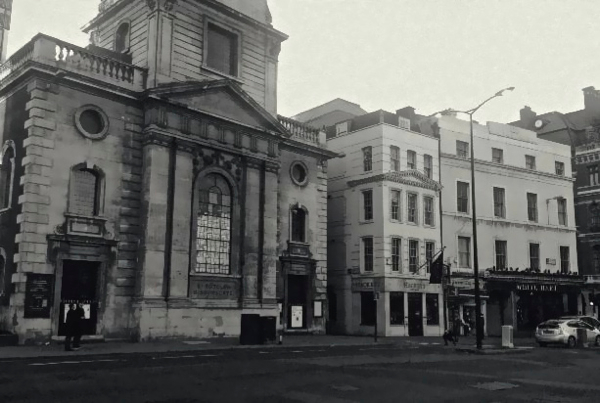

The Bathhouse Library


The Walbrook Fluvial Shelves


The Guildhall Peripatecknicon Library


The Gresham Secretary


The Walbrook Stepped Library


The Candlewyke Lineamental Census


Gallic Oculus & Vitiarama


Stowe’s Raised Survey Diorama


Cheape Moralitorium


The Wall Reading Rooms


The Library By The Tree


The Debtors’ Library


The Library Of Compleat Replenishment


Jamaica Topoteque


Library On A Pole


Bibliothecque Incinis


An ape studies Adam Dant’s handsome new book
Copyright © Adam Dant
Signed copies from the hardback limited edition of three hundred copies of BIBLIOPOLIS, IMAGINARY LIBRARIES IN THE CITY OF LONDON are available direct from Adam Dant at £45 + £5 (postage & packing) adamdant@gmail.com
You may also like to take a look at
Last Days At WF Arber & Co Ltd

Gary Arber
Four years have passed since I first walked eastward through the freshly fallen snow across Weavers’ Fields on my way to visit Gary Arber, third generation incumbent of W.F. Arber & Co Ltd, the printing works in the Roman Rd opened by Gary’s grandfather Walter Francis Arber in 1897. Captivated by this apparent time capsule of a shop where little had changed in over a century, I was tempted to believe that it would always be there, yet I also knew it could not continue for ever.
“In October, I couldn’t find enough money from my takings to pay my business rates,” Gary admitted to me yesterday, “and that’s when I decided it was time to call it a day.” As the last in the family business, in recent years Gary had been pleasing himself. After three generations, the metal type is all worn out and so Gary let the machines run down, taking on less and less printing. Now he has put the building up for sale with Oliver Franklin and set May 28th, when his insurance runs out, as his date to vacate the premises.
Bearing the responsibility of custodian of the contents, a major question for Gary has been where to find a home for his collection of six printing presses which are of historic significance. I am pleased to report that he has given them to the Cat’s Eye Press in Happisburgh, Norfolk, who have agreed to restore them all to working order and put them to use again. Since he made his decision in October, Gary has been at work clearing up the sea of boxes and detritus that had accumulated to conceal the machines and yesterday I took advantage of this brief moment to see the presses in their glory before the process of taking them apart and transferring them to Norfolk commences later this week.
“It’s good to see them again after thirty years,” declared Gary, as he led me down the narrow staircase to the small basement print workshop where the six gleaming beasts are newly revealed from beneath the litter. In the far corner is the Wharfdale of 1900 that has not moved since it was installed brand new and, at the foot of the stairs, sits the Golding, also installed in 1900. The Wharfdale is a heavy rectangular machine that famously was used to print the Suffragettes’ posters while the more nimble Golding was employed to print their handbills. At WF Arber & Co Ltd it has not been forgotten that Gary’s grandmother Emily would not permit his grandfather to charge Mrs Pankhurst for this work.
The Heidelberg of 1939 is the last press still in full working order and Gary informed me that since World War II broke out after it was delivered, his father (also Walter Francis) had to pay the British Government for the cost of it, although he never discovered if the money was passed on to the Germans afterwards. Next to it, stands the eccentrically-shaped Lagonda of 1946 which we are informed by its future owner is believed to be the last working example in existence.
In between these two pairs, sit the big boys – two large post-war presses, a Mercedes Glockner of 1952 and Supermatic of 1950. Gazing around at these monstrous machines, sprouting pipes and spindles and knobs, Gary can recall them all working. In his mind, he can hear the fierce din and see those long-gone printers – Fred Carter, Alfie Watts, Stan Barton & Harry Harris among others – who worked here and wrote their names in pencil underneath the staircase. Sometime in the mid-fifties, alongside their names and dates, Gary wrote his name too, but instead of the date he wrote “all the time” – a statement amply confirmed by his continuing presence more than half a century later.
Yet Gary never set out to be a printer. He set out to fly Lincoln Bombers, only sacrificing his life as a pilot after his father’s premature death, in order to take over the family print works. “I bought myself out in 1954, but I would be dead by now if I had stayed on, retired and grown fat like all the rest,” he confided to me, rationalising his loss,“I’m the only one surviving of my crew and I can still lift a hundredweight.”
“I remember when I first came here to visit the toy shop upstairs as a child but I didn’t get a toy except for my birthday and at Christmas,” Gary informed me, “My grandfather always had his bowler hat on. He had two, his work bowler and his best bowler. He was a very strict and moral man, he raised money for hospitals and he was a governor of hospitals.”
We shall all miss WF Arber & Co Ltd, but it is far better that Gary chose to dispose of the business as it suits him, and wraps it up to his satisfaction, than be forced into it by external circumstances. After all these years, Gary Arber can rest in the knowledge that he has fulfilled his obligation in a way that pays due respect to both the Walter Francis Arbers that precede him.

The Wharfdale & The Glockner

The 1900 Golding that printed the Suffragettes’ handbills

The 1900 Wharfdale that printed the Suffragettes’ posters

The 1952 Mercedes Glockner

Gary was printing with this 1939 Heidelberg last week

The last known working Lagonda in the world, 1946

The 1950 Supermatic

Gary found his Uncle Albert’s helmet under one of the machines while clearing up. Albert was killed while in the fire service during World War II.

The printers wrote their names and dates in the fifties but Gary wrote “[here] all the time”
Read my other stories about Gary Arber


