
East End Soldiers Of World War I
Approaching the centenary of the outbreak of World War I, we remember some of those from the East End who served in the conflict. These photographs are selected from those being collected by Tower Hamlets Community Homes for an exhibition and booklet to be produced in August. You can contribute a picture and a story by emailing andy.coleborn@thch.org.uk
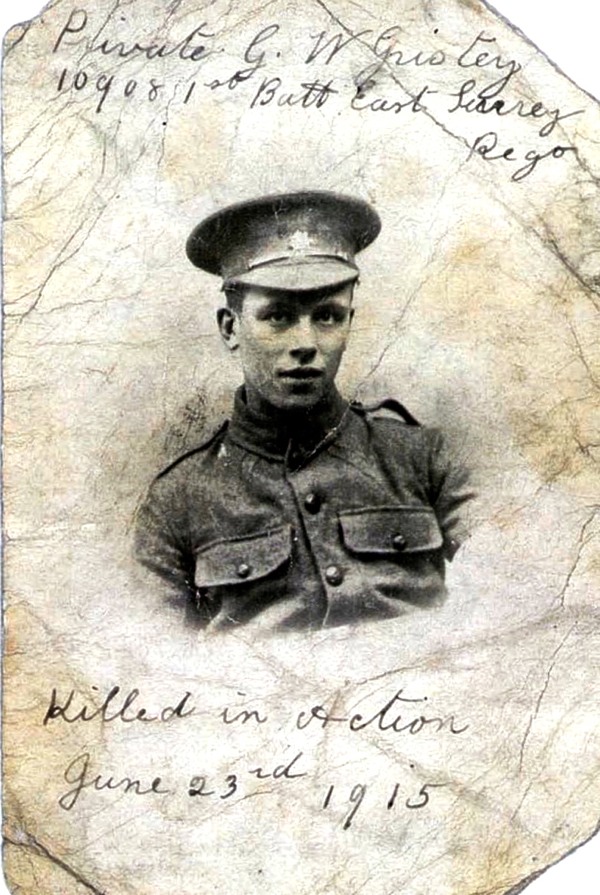
George Gristey was born in Hackney on 13th March 1890. At the time of his death his mother, Laura, lived in Cranbrook Rd, Green St, Bethnal Green. George served as a Private in the East Surrey Regiment and was was killed in action in Belgium on 23rd June 1915 and buried at Woods Cemetery, south-east of Ypres in West Flanders.

Arthur Outram was born on 20th September 1890 in London St, Ratcliff and died in Belgium on 10th October 1917 while serving as a Sergeant with the Second Battalion, Duke of Wellington’s Regiment. Like many of his comrades, he has no known grave, but is commemorated on panel eighty-two of the Tyne Cot Memorial in the Tyne Cot Cemetery (the largest British war cemetery) south-west of Passchendaele, and his name is also upon the memorial at St Anne’s, Limehouse. He married Ellen Callaghan at St Matthew’s, Limehouse, on 26th November 1916 and they had one son, also called Arthur, who was less than a month old when his father was killed.

Issy Smith VC (pictured on the left) was born as Ishroulch Shmeilowitz in Alexandria, Egypt, on September 1890, the son of French citizens Moses and Eva Shmeilowitz, who were of Russian origin. Issy arrived in the East End aged eleven, as a stowaway, and attended Berner St School, Commercial Rd, before working as a delivery man locally. He joined the British Army in 1904 and was present at the Delhi Durbar of King George V and Queen Mary in 1911.
The citation for Issy Smith’s Victoria Cross reads “No. 168 Acting Corporal Issy Smith, 1st Battalion, The Manchester Regiment. For most conspicuous bravery on 26th April, 1915, near Ypres, when he left his Company on his own initiative and went well forward towards the enemy’s position to assist a severely-wounded man, whom he carried a distance of two hundred and fifty yards into safety, whilst exposed the whole time to heavy machine-gun and rifle fire. Subsequently Corporal Smith displayed great gallantry, when the casualties were very heavy, in voluntarily assisting to bring in many more wounded men throughout the day, and attending to them with the greatest devotion to duty regardless of personal risk.”
In recognition of his Victoria Cross, he was also awarded the French Croix de Guerre and Russian Cross of St. George. He died on 11th September 1940.

Henry Sumner was born on 27th April 1875 in Dingle Lane, Poplar. Henry was a professional soldier – a Corporal in the Tenth County of London Regiment who served in the Boer War and the First World War, when he became a guard at the German Prisoner-of-War camp at Alexandra Palace. He married Margaret Fenn (1882-1958) at St Saviour’s, Poplar, on 7th October 1904 and they had eight children. He died at the Queen’s Hospital for Military Personnel in Chislehurst, Kent, in 1924.

Joseph Klein (1888-1974) lived in Gold St, Mile End Old Town, and he never spoke of the conflict in which he was awarded the 1914-15 Star, British War Medal and the Victory Medal in World War I – It is believed he threw them all in the Thames.

Richard Williams was born as William Waghorn on 4th April 1875 in Old Brewery, Hayes, Kent. He worked in Kent as a labourer and moved to the East End to work on the construction of the Blackwall Tunnel. He married Margaret Constable (1888-1966) on 28th June 1913 in the Registry Office in Mile End Old Town and they had twelve children and lived all their married life in Stepney. Richard enlisted for World War I but his lungs were damaged in the conflict, causing him to suffer from poor health until he died in Stepney in 1947.

Poet and artist, Isaac Rosenberg, who died in action at the Somme in 1918 at the age of twenty-seven, lived at 47 Cable St between 1897 and 1900 where he attended St Paul’s School, St George’s-in-the-East. In 1900, the family moved over to Stepney so Isaac could attend Baker St School and receive a Jewish education.
Isaac loathed war and hated the idea of killing but, while unemployed, he learned that his mother would be able to claim a separation allowance, so he enlisted. He was assigned to the Twelfth Suffolk Regiment, a Bantam Battalion formed of men less than five foot and three inches in height, but in the spring of 1916 he was transferred to the Eleventh Battalion of the King’s Own Royal Lancaster Regiment and in June of that year he was sent to France.
He was killed early on the morning of 1st April 1918 during the German spring offensive. His body was not immediately found but, in 1926, the remains of eleven soldiers of the KORL were discovered and buried together in Northumberland Cemetery, Fampoux. Although his body could not be identified, he was known to be among them. His remains were later reinterred at Bailleul Road East Cemetery, St. Laurent-Blangy, near Arras where his headstone reads ‘Buried near this spot.’ Beneath his name, dates and regiment, are engraved the Star of David and the words “Artist and Poet.”
His ‘Poems from the Trenches” are recognised as some of the most outstanding verse written during the War.

Samuel Adelson who resided with his aunt at 8 Gosset Street, Brick Lane was in the Thirty-Eighth Battalion, Royal Fusilliers, and fought in Palestine in 1918. He was born in Nemajunai, Trakai, Lithuania in 1896 to David Adelson and Zlota Gordon Adelson. After the war, in 1920 Samuel emigrated to America where he died in Springfield, Massachusetts, in 1925.

Charles Hunt was born in 1888 in Mile End and served as a Private in the Twelfth (Prince of Wales’ Royal) Lancers. The Lancers arrived in France on 18th August 1914 and only ten days later, fought a battle against a regiment of German Dragoons at Moy. Charles was awarded the 1914 Star and Victory medals but, just eleven days after arriving in France and at only twenty-six years of age, he died of his wounds – Charles’ grave is in Bavay, a small cemetery that was behind German lines for most of the war.

George Outram was born on 17th March 1870 in Dunstan Rd, Mile End, the son of Arthur Outram (1826-1904) and Martha Jane Harden (1841-1877). He married Margaret (Mag) Charlotte Constable (1871-1932) on Christmas Day 1889 at St Paul’s Church, Bow Common, which stood on the site of the modern St Paul’s with St Luke’s Church, at the junction of Burdett Rd and St Paul’s Way. After service in the Merchant Navy, George became a lighterman, and he and Mag had ten children. The picture shows George in an army uniform, taken during the World War I, when he took barges across to France. Although not enlisted in the army, he wore a uniform so that if captured by the Germans he would not be shot as a spy. He died in Mile End Hospital in April 1938, aged sixty-eight.

Henry Maffia and Elizabeth Maffia with their son John, taken in 1915. Henry was wounded twice in Flanders and gassed on the last day of the War, dying on 16th March 1920 from the effects of the gas. Liberal MP for Bethnal Green, Sir Percy Holman, fought until 1928 to obtain a War Widows’ Pension for Elizabeth Maffia.

Robert Tolliday (front row first left) lived in Peabody Buildings, Shadwell. He served in the Twelfth Lancers until 12th May 1917 when the Lancers became the Fifth SMG and he stayed with them until the end of the War. He was one of the last who charged into the German lines on horseback with no weapon beyond a wooden lance and when a bomb exploded beneath his horse, Old Tom, it kept on running with its entrails streaming until it collapsed.
You might also like to read about
C A Mathew At Brightlingsea
In September 2010, I wrote speculatively about the obscure photographer C A Mathew who took an extraordinary set of pictures in Spitalfields in April 1912 – now preserved at the Bishopsgate Institute – and how he succeeded in capturing the life of the streets with a spontaneity unlike any other photographer of his era. Subsequently, his work has grown in popularity as his photographs have gained wider exposure and a new exhibition opens next week at Eleven Spitalfields in Princelet St.
My account of C A Mathew At Brightlingsea follows his journey when he left Spitalfields on the day he took the photographs and is the first in a series of features which draw upon new research by Vicky Stewart, revealing more about the photographer and proposing a better understanding of his intentions in taking the pictures that are our most vivid visual record of street life in Spitalfields a century ago.

Wreck Warehouse, Brightlingsea
He sat on the train with the camera on his knee and realised he was no longer young. The hawthorn glowed in the April dusk as the train sped through Essex leaving the grimy terraces of Stepney behind. It had been a long day, taking twenty-one plates and measuring the width of each dusty street to the nearest inch.
Ellen, his wife of sixteen years, sat dozing peacefully against the window, cradling the box of glass plates. The train journey from Liverpool St to Brightlingsea was barely more than an hour but it traversed two worlds, he thought – as they passed through Romford where he recognised the streets of his childhood, where his father had once been a letter carrier.
He could no longer have done the job alone, he realised. All those years he worked as a surveyor’s clerk, following his father’s final profession, he always needed someone to hold the other end of the tape measure. He had done it sometimes for his father as a youth but, in this instance, someone had to keep the children back at least fifteen feet from the camera too.
They were like hungry seagulls the way they descended upon him in Artillery Passage and Frying Pan Alley, and he was relieved when the pictures in the narrow lanes were done. He had chosen Saturday because an empty thoroughfare suited his purpose better, yet he had not reckoned on the hordes at play who delighted in the novelty of his camera.
As he watched her sleep, he was grateful for Ellen’s strength of character, marshalling the crowd, leaving him to fuss with the plates and calculate the exposures. The morning had been occluded but the sun broke through bringing bold shadow to the streets later in the day and he was relieved that the heavy showers threatened in yesterday’s Gazette had not materialised.
Ellen woke when the ticket inspector appeared, as the train pulled out of Colchester and the fields outside merged into the spring night. She had encouraged him to take on Charles Humphreys’ photographic studio at 33 Tower St when it became vacant just fifty yards from their house at 158, a year earlier. He was forty-seven years old and she told him it as an opportunity not to miss.
Photography had always been his hobby and his aspiration and, with her support, he believed he could make enough to keep the two of them in their modest terrace home, by taking portraits. Already, there had been a steady flow of custom through the studio and he had done schools and cricket clubs and football teams, but this commission taking him up to London was his largest undertaking.
On Monday, he would go into the studio and develop the plates. Ellen had obtained a stack of strawboard cards that she would mount the prints upon and he would annotate them with the street widths in his precise and legible, yet undemonstrative, handwriting which he had refined over years of making out surveyors’ reports.
As they descended from the train at Brightlingsea, Ellen suggested a detour to the fishmonger on the way home and, in spite of his weariness, he insisted upon accompanying her. They trudged up Station Rd into Victoria Place in the dark, as the drizzle moved in from across the estuary, past the King’s Head – a curious long medieval structure with a pair of prim Victorian bay windows interpolated at the far end. Turning right into the High St, they passed The Brewer’s Arms with its picturesque sagging roof, and arrived at the fishmongers just in time to carry off a piece of smoked haddock before the shop closed for the weekend.
Coming out of the shop, he stopped in his tracks in exhaustion and looked across the street in wonder at the magnificent structure of Jacob’s House, reputed to be England’s oldest timber frame building. From all those years as a child walking around Romford accompanying his father delivering letters through to his own work as a surveyor’s clerk, he had grown fascinated by buildings and places and the stories they told.
He and Ellen walked slowly down Tower St towards the harbour, past the whimsical pairs of Victorian villas – Dahlia, Rose and Primrose Villas – past the Sailmaker’s Loft and the Salvation Army Hall. Arriving at his studio next to the Masonic Hall, he hastily unlocked the door and they were glad to leave the camera and box of plates there upon the table.
They walked arm in arm down to 158, she opened the gate and he unlocked the door. He took a last breath of sea air before he closed the door. He found it a tonic after the filthy atmosphere of London and the smoke of Liverpool St Station.
Their house at the easterly end of Tower St was beside the harbour in Brightlingsea Creek where the oyster smacks and crab boats unloaded their catch daily. In the next street was the wreck warehouse attesting to the history of this ancient cinque port. As its name suggests, Brightlingsea was a remarkable place for a photographer to live. The light reflected off the sea into the sky and created a luminosity in the air which intensified colour and definition of form. Sometimes he dreamed he was living in a photograph.
He and Ellen commonly walked together along the sea wall and he was entranced by the sparkling effects of sunlight upon the water, though they both agreed it was a subject better suited to painting than photography. Sunday morning dawned bright and clear, and they took their customary stroll along the Western Promenade past the ramshackle beach huts as far as Bateman’s Tower.
He had overcome his weariness of the previous day and was happy that – against the odds – the commission had been fulfilled. He did not know that Ellen would die at the age of fifty-five, just four years later. He did not know that he would continue with the studio in Tower St for only another six years and then move to Wood Green to live with his sister Winifred, before establishing another studio in Wallingford in Oxfordshire and working there until his death in 1923.
He had been asked to take some photos for ‘A History of the Town of Brightlingsea’ to be published in 1913 and – in April 1912 – he was looking forward to the prospect of his nascent career as a photographer, but he already knew that the commission in Spitalfields was the last and only one of its kind that he would chose to undertake. He was curious to see how those photographs would turn out.

The Brewer’s Arms, High St

Winkies Fish & Chips, New St

Jacob’s House, High St – reputedly England’s oldest timber frame house

Turret staircase at Jacob’s House

Georgian cottage, High St

Victorian villa in Tower St

Sailmaker, Tower St

Gambo Cottages, Tower St

C A Mathew’s former studio, 33 Tower St

Salvation Army Hall, Tower St

C A Mathew’s house, 158 Tower St

C A Mathew’s front door

Wreck Warehouse, Sydney St

Hotel at Brightlingsea Harbour

Boat shed at Brightlingsea Harbour

West Promenade, Brightlingsea

Beach huts dishevelled by the storms

View towards Bateman’s Tower from West Promenade


Bateman’s Tower looking towards Brightlingsea Creek

One of the twenty-one photograph taken by C A Mathew in Spitalfields on Saturday April 20th 1912
C A Mathew photograph © Bishopsgate Institute
Take a look at C A Mathew’s photographs and read my earlier stories
Sights Of Wonderful London
It is my pleasure to publish these splendid pictures selected from the three volumes of Wonderful London edited by St John Adcock and produced by The Fleetway House in the nineteen-twenties. Not all the photographers were credited – though many were distinguished talents of the day, including East End photographer William Whiffin (1879-1957).

Roman galley discovered during the construction of County Hall in 1910

Liverpool St Station at nine o’clock six mornings a week

Bridge House in George Row, Bermondsey – constructed over a creek at Jacob’s Island

The Grapes at Limehouse

Wharves at London Bridge

Old houses in the Strand

The garden at the Bank of England that was lost in the reconstruction

In Huggin Lane between Victoria St and Lower Thames St by Andrew Paterson

Inigo Jones’ gate at Chiswick House at the time it was in use as a private mental hospital

Hoop & Grapes in Aldgate by Donald McLeish

Book stalls in the Farringdon Rd by Walter Benington
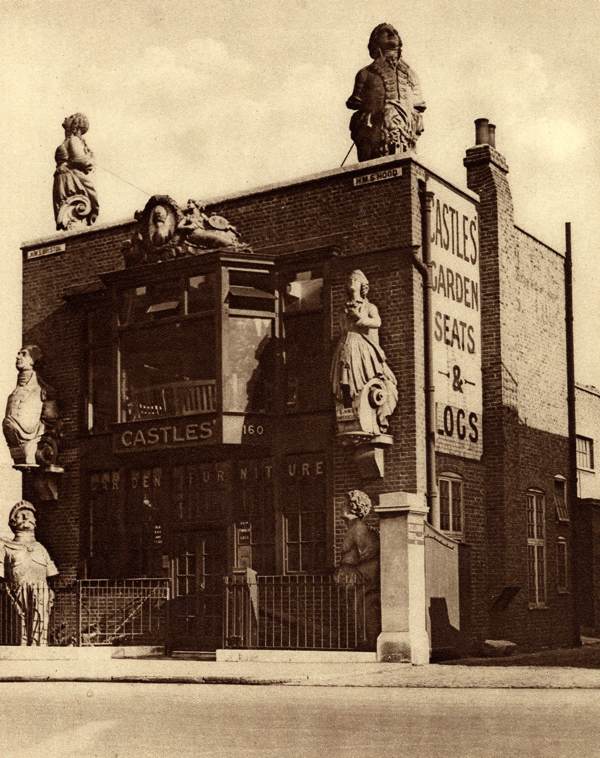
Figureheads of fighting ships in the Grosvenor Rd by William Whiffin

The London Stone by Donald McLeish

Dirty Dick’s in Bishopsgate

Poplar Almshouses by William Whiffin

Old signs in Lombard St by William Whiffin

Penny for the Guy!

Puddledock Blackfriars

Punch & Judy show at Putney

Eighteenth century houses at Borough Market by William Whiffin

A plane tree in Cheapside

Wapping Old Stairs by William Whiffin

Houndsditch Old Clothes Market by William Whiffin

Bunhill Fields

The Langbourne Club for women who work in the City of London

On the deck of a Thames Sailing Barge by Walter Benington

Piccadilly Circus in the eighteen-eighties

Leadenhall Poultry Market by Donald McLeish

London by Alfred Buckham, pioneer of aerial photography. Despite nine crashes he said, “If one’s right leg is tied to the seat with a scarf or a piece of rope, it is possible to work in perfect security.”
Photographs courtesy Bishopsgate Institute
You may also like to take a look at
Joan Brown, The First Woman In Smithfield
On the final day of the Smithfield Market Public Enquiry, I publish my interview with Joan Brown, the first woman to be permitted to work inside the Smithfield Central Market in 1945

“When the cat can’t decide whether to go out, I say ‘Make up your Smithfield mind!'”
At ninety-three years old, Joan Brown is not given to protest. In fifty-seven years working as a Secretary at Smithfield Market, she mastered the art of operating through diplomacy and accommodation. Yet last year, Joan was driven to write a letter of objection to the City of London Corporation when she learned of the proposed demolition of the General Market. “The bustle and excitement of Smithfield became part of my life until I finally retired at the age of seventy-four,” she wrote, “You will appreciate my feelings at the thought of even part of those lovely buildings being destroyed.”
The General Market of 1868, where Joan first began her career in West Smithfield, contains one of Europe’s grandest market parades beneath a vast glass dome, designed by Sir Horace Jones who was also responsible for Tower Bridge. Although proposals from SAVE Britain’s Heritage exist to refurbish the historic building and reopen it as a retail market, revitalising this part of London, the City Corporation has granted planning permission to Henderson Global Investments to replace it with three tower blocks, retaining only the facade of the original edifice.
Today, Friday 28th February, is the final day of the Smithfield Public Enquiry with closing submissions and although, regrettably, Joan will not be attending due to her advanced years, she hopes some readers might like to go along on her behalf.
I visited Joan in her tiny bucolic cottage situated among overgrown gardens in a quiet cul-de-sac in Peckham. Of sprightly demeanour and impeccable manners, Joan has good claim to be the first woman to work in Smithfield Market. Yet, even though she was conscientious not to absorb the colourful vocabulary for which which the Market is famous,“When the cat can’t decide whether to go out, I say ‘Make up your Smithfield mind!'” she confessed to me.
“I went to work at Smithfield Market in 1937 when I was seventeen years old. I was studying at a school for commercial typists and, at that time, there was a recession so it was hard to find work, but my shorthand teacher was asked by a neighbour who worked at Smithfield if he knew of anyone reliable – so I was offered the job.
My mum was horrified – all those men and that bad language! But my dad said, ‘We’ll sort this out,’ and he went to take a look and discovered the office was in West Smithfield, not in the Market itself. So I took the job. It was a family business and I worked for John Jenkins, the son, as his Private Secretary. We were agents for Argentine Frigorifico and we had a stall in the market selling Argentine Chilled Beef, it was not ‘refrigerated’ but ‘chilled.’
It was very well organised, a number of Argentine famers formed a group and a ship of their meat arrived in the London Docks once a week. It opened up on a Monday and so much beef – only beef – was brought over to the market in time for the five o’clock opening. That went on each day until the ship was emptied at the end of the week. Then another one arrived and it happened all over again.
I worked there until the war came, when everything changed and I was employed by the Ministry of Food. We were evacuated to North Wales and the Ministry organised these Buffer Depots in every village in the country and my job was to keep a record of it all. I had to co-ordinate the corned beef supplies. It was incredibly complicated and there were no computers, I had a large sheet of paper – we called them ‘B*gger Depots.’
After the war, I came back to my old employer but I discovered we didn’t have an office anymore, it had been bombed. So I said, ‘John, why don’t we use one of the spaces over the shop in the Central Market?’ He said, ‘But we can’t expect customers to walk through the Market to get to our office.’ Then I reminded him that there was a door onto Charterhouse St, so they didn’t have to walk through the Market. We moved into an octagonal office in one of the rotundas above the Market and that was when I became part of Smithfield proper.
Before the War, women couldn’t go into the Market but afterwards we were allowed in. I always remember walking through the Market for the first time, the Bummarees were perfectly respectful. I walked down Grand Avenue and they all moved out of the way, calling ‘Mind the Lady!’ The Bummarees delivered the meat, they wore long overalls and they used absolutely appalling language and were famous for that. But it wasn’t real, they didn’t mean anything by it.
I worked for John for more than fifty years and sometimes we had visitors from the Argentine. After John died, the business was sold and I was taken on by the new owners, Anglo-Dutch Meats. I became Private Secretary to their Director, Mohammed El Maggot. He was Egyptian though he had been to school in England. He was known as ‘Hamdi’ in the Market and I worked for him for several years. He was a very polite young man and his father was determined that he was going to work, that’s why he bought the company to occupy his son. Mohammed came to work every day at five o’clock in the morning and he settled in to work.
One day, he walked into the office and announced, ‘I want you to come to my wedding – in Cairo!’ When we came back, he and his wife took a flat in the Barbican and he said, ‘I want you to come over and teach Imam how to make a proper cup of tea.’
As far as I was concerned, that was the end of my life in Smithfield – I was seventy-four and it was time to retire. Mohammed was terribly upset but I said, ‘It’s no good Hamdi, I have to go!’ I thought, ‘That’s where I cut my connections, otherwise it will be, ‘Can you go to Harrods to buy the baby a bottle?” So I cut myself off completely from Smithfield Market in 1994. I never married, I was always working in the Market. When I was sent to North Wales, I left all my boyfriends behind in London and I was surrounded by a lot of middle-aged men.
I was always happy to be in the Market, I was part of the Market. To look down from my office window upon the Grand Avenue and see everything going on. That was my life.”

Smithfield Market as Joan Brown first knew it in the nineteen-thirties


Entrance to the General Market on Charterhouse St, completed 1881

Entrance to the underground store at the General Market

South-east corner of the General Market

North- east corner of the General Market


War Memorial in Grand Avenue in Central Market

The Central Meat Market


Joan Brown worked in an office in one of the rotundas at Smithfield’s Central Market

The Central Meat Market at Smithfield
Archive images courtesy Bishopsgate Institute
The Smithfield Market Public Enquiry concludes today, Friday 28th February, with final submissions from 10am at the Basinghall Suite (accessed through the Art Gallery) at the Guildhall in the City of London.
You may also like to take a look at
Sarah Ainslie at Smithfield Market
David Hoffman At Smithfield Market

Photographer David Hoffman visited Smithfield Market in November 1989 under commission by New Statesman & Society. In the event, only David’s black and white pictures were published in the magazine but he shot thirteen rolls of colour film, and today I publish a selection of these photographs of Smithfield for the first time.
“It took me two weeks to get permission from Mr Noakes, Market Clerk & Superintendent,” David explained, “I visited three or four nights until eight in the morning and then I went for a huge fry-up at the Cock Tavern.”
“The men who worked in the market were a really friendly, happy bunch – rough and ready,” he recalled fondly, “a few lumps of fat came flying and hit me on the neck, but nothing evil.”
“It was a privilege to go to Smithfield and take these photographs – I love the way the culture of the market has evolved organically from the needs of the buyers and the sellers over centuries, rather being organised from the top down.”


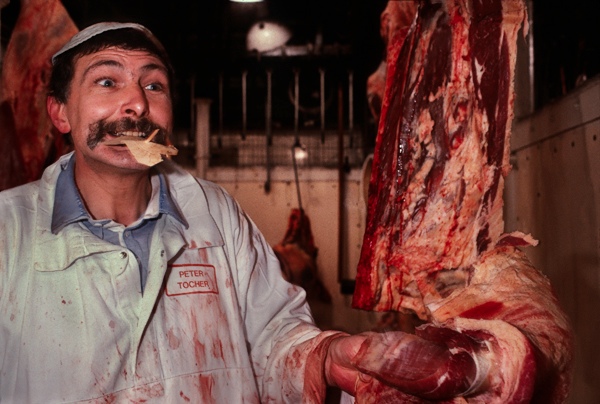


Photographs copyright © David Hoffman
The Smithfield Market Public Enquiry concludes tomorrow, Friday 28th February, with final submissions from 10am at the Basinghall Suite (accessed through the Art Gallery) at the Guildhall in the City of London.
You may also like to take a look at
Wonderful London
It is my pleasure to publish these dignified and characterful portraits of Londoners, believed to be by photographer Donald McLeish (1879-1950), selected from the three volumes of Wonderful London edited by St John Adcock and produced by The Fleetway House in the nineteen-twenties.

Telescope Man on Westminster Bridge

Old woman who inhabited the alleys off Fleet St

Breton Onion Seller

Costermonger and child

Cats’ Meat Man

Knife Grinder

Charwoman

Islington Window Cleaner

Flower Seller

Concertina Player

Hurdy-Gurdy Man

Gramophone Man

Escapologist

Wandering Harpist

Street Sweeper

Scavenger

District Messenger

Telephone Messenger

Railway Fireman

Railway Engine Driver

Carman

Railway Porter

Gold Beaters

Gas Fitters

Chimney Sweep

Telephone Cable Man
Photographs courtesy Bishopsgate Institute
You might also like to take a look at
John Thomson’s Street Life in London
William Nicholson’s London Types
Sarah Ainslie At Smithfield Market

For six months during the winter and into the spring of 1994, Spitalfields Life Contributing Photographer Sarah Ainslie visited Smithfield Market one night each week from two or three until six or seven in the morning, and these are a selection of her pictures. This was the Horace Jones’ Central Market prior to restoration, in the days when all the meat was still out in the open, before the building was altered and the meat put behind glass in refrigerators. “It was like going into a subterranean world and I loved it,” Sarah admitted to me, “You could walk right through the market and see everything.”


“I feel a huge respect for what they do at Smithfield and I find it beautiful to see the animals hanging up”


“There’s a strong camaraderie amongst the guys and a lot of banter”

“I grew fascinated by it, this thing that operated at night and closed when everyone else woke up”


“Smithfield Market is different from everything else in London because it’s so functional, and people aren’t used to seeing that, especially in the midst of the city. Now it’s become a taboo, something that people are more comfortable to have hidden away.”


“I was drawn to the visceral quality of the environment with its smell of meat and people running around carrying big pieces of meat, there’s such drama to see these people in the midst of it all.”


“We tend to forget where meat comes from, when you go to a supermarket you don’t see the origin”


“I never found it disgusting but people used to ask me, ‘Don’t you find it horrible?’ Yet, coming from a farming background, I had seen cows and pigs brought up and sent off to feed people.”


“Sometimes, I used to go into the cafe and take photos and, one morning, these guys who were sitting there covered in blood, who had been cutting up meat all night, they started having a philosophical discussion about God…”

Photographs copyright © Sarah Ainslie
The Smithfield Market Public Enquiry runs today (25th February) from 10am – 5pm at the Basinghall Suite (accessed through the Art Gallery) at the Guildhall in the City of London. and on Wednesday 26th and Friday 28th February – the latter being the culmination of the enquiry with final submissions.
You might also like to take a look at


