
Arful Nessa’s Sewing Machine
The first of seven stories by Writer & Anthropologist Delwar Hussain, author of Boundaries Undermined, who grew up in Spitalfields

Arful Nessa with her sewing machine table
Rather than the sound of Bow bells, I was born to the whirring of sewing machines in my ear. Throughout most of my childhood, my mother did piecework while my father worked in a sweatshop opposite the beigel shop on Brick Lane, stitching together leather jackets for Mark & Spencer. The factory closed down long ago.
Initially my mother’s industrial-grade Brother sewing machine was in the kitchen, in between the sink and the pine wood table. But it took up too much space there and was also considered dangerous, once ambulatory children started populating the house. It was decided that it would be moved to one of the attic rooms on the top floor of our home, following the custom of the Huguenot silk weavers of the past. There the machine lived and there my mother would be found hunched over it, during all hours of the day and often late into the night. She says it was most hard on her back and shoulders, which would ache from the work.
“The men used to work in the factories. I preferred to do it at home because it was less work compared to what they did. They had to work harder,” she explains, “I began before the children were born. I wasn’t doing much at home, so I thought I should try it and earn a little money. Other women were working as machinists then and an old neighbour who had lived on Parfett St taught me how to operate the machine. I couldn’t do pockets, but I did pleats, belts and hems on skirts for women who worked in offices. I took in work for a factory on Cannon St Rd that made suits and another on New Rd that made blouses.”
For a while my mother sewed the lining into jackets and winter coats, working for a short Sikh man who had a clothes shop on Fournier St. He had quick steps and a bunch of heavy keys dangling from the belt on his trousers. The man still owes her money, she recalls. He would give her wages in arrears, promising to pay, but it never materialised. Following him, she worked for another man, who also did not pay. “Where would you go looking for them today?” my mother asks, “Everyone we used to know around here has left. So much has changed.”
I remember the almost-sweet smell of the machine oil, the thick needles, bundles of colourful nylon yarn, piles and piles of skirts in all shades and sizes, the metal bobbin cases and the sound of the sewing machine. When the foot peddle was down, the vibration could be felt throughout the house. Strangely, this provided a sense of comfort – the knowledge that my mother was upstairs and everything in the world was as it should be.
When I was around twenty, my brothers and sisters and I colluded with each other to get rid of the sewing machine. It had lain dormant in the attic room ever since my mother gave up taking in piecework some years previously. The work had slowly become more irregular and less financially rewarding. “When I first started, I was able to earn around seventy-five pence per skirt, then towards the end, when there were many more women working, it dropped to around ten pence per coat.” These were also the days when much of the manufacturing in East London was being shipped out to parts of the world where there was cheaper labour, including Bangladesh and Turkey.
With my mother’s working paraphernalia left as it was, the space resembled Rodinsky’s room – he was the mythical recluse who once lived a few doors down from us in the attic of 19 Princelet St and who had disappeared one day, leaving everything intact. I had an idea to turn our attic into a study, installing my PC which my mother had bought for me from the money she had saved from sewing. With a separate monitor, keyboard and large hard drive, it was almost as big as her Brother sewing machine.
She had always been a hoarder, so we knew that getting rid of it was going to be a delicate and difficult matter. We had given her prior warnings, but these had fallen on deaf ears. Then one night, when she had gone to bed, my siblings and I crept upstairs and, with a lot of effort, detached the head of the sewing machine from the table. Huffing and puffing, we carried it down three flights of stairs and delicately dumped it at the end of our street. We did the same with the table base.
Of course, she discovered the machine was missing the next day and was incredibly upset. She had “spent one hundred and forty pounds on it,” she said. “It still worked,” she said, “why had we not told her, she could have given it to someone at least, instead of it being thrown away” and “what had she done to deserve children who were so wasteful.” After that, I forgot all about the Brother sewing machine that once lived in our attic.
Recently, I returned from a research trip to Dhaka. I am currently writing a book about the people of that city and had interviewed garment workers about their lives and fears. I came home and was speaking to my mother about it when the subject of her earlier life as a machinist came up. And then she announced her revelation.
My mother and our Somali neighbour had managed to rescue the sewing machine from where my brothers, sisters and I had thought we had discarded the thing. The two women had somehow managed to shuffle the table base along, scraping hard along the pavement. But instead of bringing it back to the house, they took it to the neighbour’s, where it was to stay in the garden until they decided what to do with it. The machine head on the other hand was far too heavy for them to carry and they abandoned it.
This disclosure had to be investigated. My mother and I immediately knocked on our neighbour’s door, and asked if it was still there. The neighbour led us to the garden where, hidden behind wooden boarding and tendrils of ivy, we found the sewing machine my mother had spent so many years working on.
Considering it had endured years outdoors, it looked like it was still in relatively good health. Bits of it, such as the bobbin winder and the spool base were slightly rusty, but the address of the showroom on Cambridge Heath Rd where my mother bought it was clearly labelled and the motor looked in working condition.
She is still upset with my brothers and sisters and me for throwing it away. This confused me. “Why would you want to hold onto something that is a source of oppression?” I asked, high-mindedly. “The machine helped to feed and educate my family,” she answered quietly.
My mother then reminded me that my aunt, her sister, also had a Brother sewing machine and made skirts for many years from her kitchen in Bethnal Green. We went to speak to her. She no longer works as a seamstress and has resorted to keeping her dismembered machine on the veranda of her ground floor flat. The table now stores pots and pans, baskets containing seeds and drying leaves. The head was in the bottom drawer of a metal cabinet next to it, wrapped up in a Sainsbury’s shopping bag. My aunt still has some of the cloth which she would make into skirts and she showed me the pleats on a piece of salmon-coloured material.
“Most of the women in this block worked for different factories and one of them taught me how to do it. I worked for a Turkish man on Mare St for around seven years. I would get started around 7am after the morning prayer at 6am. I can’t remember where the skirts were being sold, but they were for well known shops in the West End. In one day, I could work on fifty or sixty pieces. Some days I made around a hundred. I received around forty or fifty pence per piece and could earn around three hundred pounds per week. But it was all irregular, nothing was fixed. My children would help by cutting the loops off when they got home after school. There is no work anymore, but I kept the machine in case I needed to fix things. It still works.”
While I took notes, sitting on the chair she would sit on whilst working, I could hear dregs of conversation between the two sisters, comparing the quality of oranges in Bethnal Green market to Asda and Iceland, as well as recalling what happened to other women whom they both knew that had worked as seamstresses. This industry, now gone, is a piece of the thread that joins the past with the present in the East End and, in turn, unites the people who have come to make this part of London their home.

My aunt with her sewing machine in Bethnal Green


Arful Nessa
Photographs copyright © Sarah Ainslie
You may like to read Delwar Hussain’s other story about his mother
New Hope For The Terrace In Dalston Lane
 Tim Whittaker’s sketch of his proposal for the terrace restored
This spring, when Hackney Council granted itself permission to demolish this late Georgian terrace in Dalston Lane as part of a ‘Conservation-led’ scheme, it seemed all hope was lost of saving these much-loved buildings which tell the story of the last two centuries in this corner of East London. But now a Judicial Review of the Council’s action is being sought by the campaigners seeking to prevent destruction and Murphy, the Council’s Development Partner, may be having second thoughts about their participation in this small but highly-controversial project.
Meanwhile, the Spitalfields Historic Buildings Trust which was responsible for saving many of the important old buildings in Spitalfields, has put forward a proposal to take on the terrace and restore it. “The Trust has approached Hackney Council and Murphy to ask if they’d like to relinquish the project,” confirmed Tim Whittaker, Director of the Spitalfields Trust, when I met him in Dalston Lane recently to take a look at the current sad picture of decay.
Working with Circle 33 Housing Association, the Trust is offering to buy the entire property from Hackney Council, renovate the historic fabric of the terrace, rebuilding where necessary to restore the streetscape and constructing new housing in a sympathetic style upon the adjoining land. The restored Georgian houses would be sold for private ownership, but more than half of the development would be low-cost housing and the shops would be leased to independent businesses.
Already the Spitalfields Trust scheme has won support from members of the Council and it would offer a satisfactory resolution for all parties concerned, burying this recent sorry episode, and ensuring a future for the terrace that serves the needs of the community and retains an important landmark. Readers can assist in encouraging this outcome by writing letters of support to Jules Pipe, Mayor of Hackney jules.pipe@hackney.gov.uk and Guy Nicholson, Hackney Cabinet Member for Regeneration guy.nicholson@hackney.gov.uk

Spitalfields Life Contributing Photographer Simon Mooney went inside the terrace in Dalston Lane to take these pictures, permitting us a glimpse of the historic interiors that could easily be lost forever.
In 1800, Dalston Lane was – as its name suggests – merely a country track through agricultural land, but the pace of development up the Kingsland Rd, served by the brickyards that opened to produce building material from the London clay, delivered three symmetrical pairs of dignified Italianate villas constructed by Richard Sheldrick in 1807.
By 1830, terraces on either side filled up the remaining plots to create a handsome row of dwellings with front gardens facing onto the lane. In this era, Dalston was still rural and it was not until the end of the century that the front gardens were replaced by the run of shopfronts divided by Corinthian capitals which we see today.
This modest yet good quality terrace represents the essential fabric of the East End and its evolution manifests two centuries of social history in Dalston. Consequently, the terrace is enfolded by a Conservation Area that embraces other contemporary buildings which define the distinctive quality of this corner of Hackney and thus, when the council sought to regenerate the area in 2012, it was with a ‘Conservation-led’ scheme.
Yet when the Council’s surveyors questioned the structural integrity of the terrace, if it were to stand up to being woven into the facade of a new development, nobody suggested reworking the development to suit the terrace – or simply repairing the buildings. Instead the Council decided, without any consultation, to demolish the terrace and replace it with a replica that would permit higher density housing within the development.
In January, this destruction was halted when the Council’s survey was called into question by the Society for Protection of Ancient Buildings and others, who called for an independent appraisal by a surveyor with experience of historic structures. But then, by a single vote, Hackney Council granted itself permission to proceed with this ‘Conservation-led ‘scheme that entails the demolition of all the buildings. As one wag so eloquently put it, “Is that like a picnic without the sandwiches?”

The shameful hole in the terrace

Paired villas of of 1807 to the left and terrace of 1830 to the right

Rear of 1830 terrace

Paired villas built by Richard Sheldrick in 1807

The villas built in symmetrical pairs, note detail of long stairwell window


The rendering is a late nineteenth century addition

Late Georgian shutters re-used as a partition


Original reeded arch in plaster

Reeded panelling


Late Georgian newel with stick banisters


Original panelling


One house is still inhabited

The presiding spirit of the terrace

Late nineteenth century shop interior panelled with tongue and groove, with original shelves and fittings


A century of use illustrates changing styles of fascia lettering


One of the paired villas of 1807 has been destroyed and another half-demolished

The terrace of 1830 on the right has an unusual single window detail on the first floor

The terrace with the graphic of its replica with which the developers hope to facade their structure

Run of nineteenth century shopfronts punctuated by Corinthian capitals

Dalston Lane 1900

Dalston Lane 1940

Kingsland Rd, c. 1800. Brickworks manufacture building materials for the rapid development that is spreading across the agricultural land. The buildings to the right still stand in the Kingsland Rd, just around the corner from Dalston Lane.
Photographs copyright © Simon Mooney
You may also like to read about
George The Dog
Coinciding with the publication of the memoir by East End artist John Dolan, JOHN & GEORGE, telling his life story and exploring the benign influence of his dog George, Howard Griffin Gallery is opening an exhibition of his portraits of George next Thursday, 17th July. As a preview, we publish this selection of drawings illustrating the multi-facetted personality of this celebrated hound.


Drawings copyright © John Dolan

John Dolan & George the Dog in Shoreditch High St
Portrait copyright © Colin O’Brien
John Dolan – John & George is at Howard Griffin Gallery, 189 Shoreditch High St, from 17th July – 17th August
You may also like to read about
Bob Mazzer On The Buses
After more than forty years photographing on the tube, Bob Mazzer revealed to me that recently he has been photographing from the bus. Over recent weeks while his debut exhibition UNDERGROUND has been running at the Howard Griffin Gallery, Bob has regularly been catching the 48 back and forth from London Bridge to Shoreditch High St – and taking pictures of what he sees from the window.
Given that the number of pictures in Bob’s current exhibition corresponds approximately to the number of years he has been photographing on the tube, I think we may wait awhile before a show of his bus pictures materialises that meets his own rigorous selection criteria. Yet each of the photos below is characterised by the unique view of humanity that we recognise in all his work.


Photographs copyright © Bob Mazzer
You have just three days left to catch Bob Mazzer’s debut show UNDERGROUND at Howard Griffin Gallery, 189 Shoreditch High St, until Sunday 13th July
You may also like to take a look at
Dee Tocqueville, Lollipop Lady

Cordelia Tocqueville
Contributing Photographer Sarah Ainslie & I made the trip over to Leytonstone recently to pay homage to Cordelia – known as ‘Dee’ – Tocqueville, the undisputed queen of East End Lollipop Ladies, who has been out on the street pursuing her selfless task every day, come rain or shine, for as long as anyone can remember. “I took the job at first when my daughter was small, because she was at the school and I could be at home with her in the holidays,” Dee admitted to me, as she scanned the road conscientiously for approaching cars,“Though after the first winter in the rain and cold, I thought, ‘I’m not sticking this!’ but here I am more than forty years later.”
Even at five hundred yards’ distance, we spotted Dee Tocqueville glowing fluorescent at the tricky bend in Francis Rd where it meets Newport Rd outside the school. A lethal configuration that could prove a recipe for carnage and disaster, you might think – if it were not for the benign presence of Dee, wielding her lollipop with imperial authority and ensuring that road safety always prevails. “After all these years, I’m part and parcel of the street furniture,” she confessed to me coyly, before stepping forward purposefully onto the crossing, fixing her eyes upon the windscreen of an approaching car and extending her left hand in a significant gesture honed over decades. Sure enough, at the sight of her imperial sceptre and dazzling fluorescent robes the driver acquiesced to Dee’s command.
We had arrived at three, just before school came out and, over the next half hour, we witnessed a surge of traffic that coincided with the raggle-taggle procession of pupils and their mothers straggling over the crossing, all guaranteed safe passage by Dee. In the midst of this, greetings were exchanged between everyone that crossed and Dee. And once each posse had made it safely to the opposite kerb, Dee retreated with a regal wave to the drivers who had been waiting. Just occasionally, Dee altered the tone of her voice, instructing over-excited children at the opposite kerb to “Wait there please!” while she made sure the way was clear. Once, a car pulled away over the crossing when the children had passed but before they had reached the other side of the road, incurring Dee’s ire. “They’re impatient, aren’t they?” she commented to me, gently shaking her head in sage disappointment at human failing.
Complementing her innate moral authority, Dee is the most self-effacing person you could hope to meet.“It gives you a reason to get up in the morning, and you meet lots of people and make lots of friends,” she informed me simply, when I asked her what she got out of being a Lollipop Lady. Dee was born and grew up fifty yards away in Francis Rd and attended Newport Rd School as a pupil herself, crossing the road every day, until she crossed it for good when she married a man who lived a hundred yards down Newport Rd. Thus it has been a life passed in the vicinity and, when Dee stands upon the crossing, she presides at the centre of her personal universe.“After all these years I’ve been seeing children across the road, I have seen generations pass before me – children and their children and grandchildren. The grandparents remember me and they come back and say, ‘You still here?'” she confided to me fondly.
At three-thirty precisely, the tumult ceased and the road emptied of cars and pedestrians once everyone had gone home for tea. Completing her day’s work Dee stowed the lollipop in its secret home overnight and we accompanied her down Newport Rd to an immaculately-appointed villa where hollyhocks bloomed in the front garden. “I have rheumatism in my right hand where the rain runs down the pole and it’s unfortunate where I have to stand because the sun is in my eyes,” she revealed with stoic indifference, taking off her dark glasses once we had reached the comfort of her private den and she had put her feet up, before adding, “A lot of Boroughs are doing away with Lollipop Ladies, it’s a bad thing.” In the peace of her own home, Dee sighed to herself.
The shelves were lined with books, evidence of Dee’s passion for reading and a table was covered with paraphernalia for making greetings cards, Dee’s hobby. “People don’t recognise me without my uniform,” she declared with a twinkle in her eye, introducing a disclosure,“every Thursday, I go up to Leyton to a cafe with armchairs, and I sit there and read my book for an hour with a cup of coffee – that’s my treat.” Such is the modest secret life of the Lollipop Lady.
“When my husband died, I thought of giving it up,” Dee informed me candidly, “but instead I decided to give up my evening cleaning job for the Council, when I reached seventy, and keep this going. I enjoy doing it because I love to see the children. One year, there was an advert on the television in which a child gave a Lollipop Lady a box of Cadbury’s Roses and I got fifteen boxes that Christmas!”


“After all these years, I’m part and parcel of the street furniture”

Dee puts her feet up in the den at home in Newport Rd

Dee with her brother David in 1959 outside the house in Francis Rd where they grew up
Photographs copyright © Sarah Ainslie
You may also like to take a look at
Smithfield Market Is Saved!
It is my great pleasure to announce that – in a landmark victory for Conservation – Smithfield Market is saved thanks to the public campaign led by SAVE Britain’s Heritage. Yesterday Eric Pickles, Secretary of State, rejected the City of London’s plan to gut the market building for offices in favour of restoration and reuse. In celebration, I publish my interview with Joan Brown, the first woman to be permitted to work inside the Smithfield Central Market in 1945.
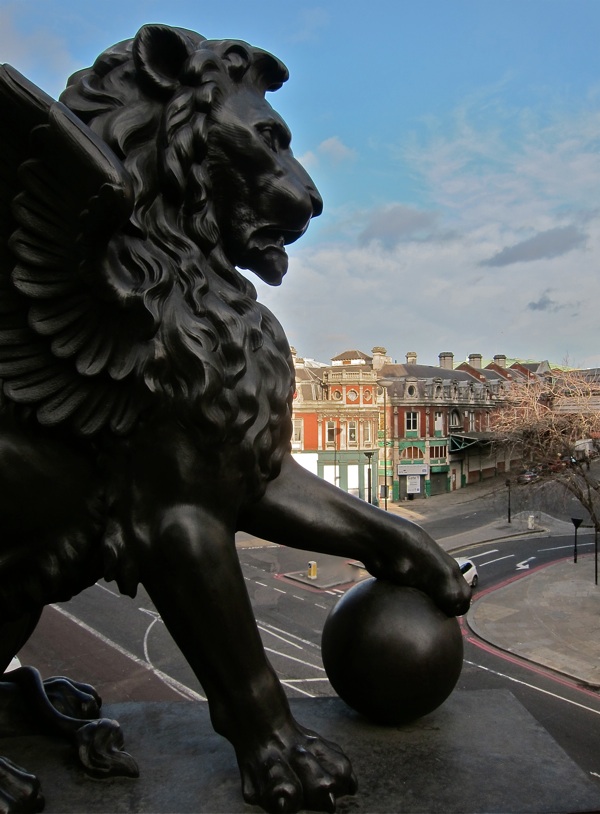
The Lion on the Holborn Viaduct looks down protectively upon the Smithfield Market
Joan Brown, the first woman to work in Smithfield Market, is delighted by the decision to save the Market buildings that she knew so well. At ninety-three years old, Joan is not given to protest – in fifty-seven years working as a Secretary at the Market, she mastered the art of operating through diplomacy and accommodation. Yet last year, Joan was driven to write a letter of objection to the City of London Corporation when she learned of the proposed demolition of the General Market. “The bustle and excitement of Smithfield became part of my life until I finally retired at the age of seventy-four,” she wrote, “You will appreciate my feelings at the thought of even part of those lovely buildings being destroyed.”
The General Market of 1868, where Joan first began her career in West Smithfield, contains one of Europe’s grandest market parades beneath a vast glass dome, designed by Sir Horace Jones who was also responsible for Tower Bridge. Although the City Corporation granted planning permission to Henderson Global Investments to replace it with three tower blocks, retaining only the facade of the original edifice, yesterday Eric Pickles, Secretary of State, announced the outcome of the Public Enquiry held this spring, ruling “the proposal to demolish important parts of significant market buildings, to the great detriment to the surrounding area, to be wholly unacceptable.”
Additionally, he criticised the City of London for “the history of deliberate neglect and that, in assessing the planning balance, less weight should therefore be given to the current condition of the buildings than to the consequent benefit of their repair.” He concluded that “it is important that they are repaired and put into a beneficial use.” The way is now open for these buildings to be restored and reopened, returning access to these magnificent structures to Londoners after a generation of neglect.
I visited Joan Brown in her tiny bucolic cottage situated among overgrown gardens in a quiet cul-de-sac in Peckham. Of sprightly demeanour and impeccable manners, Joan has good claim to be the first woman to work in Smithfield Market. Yet, even though she was conscientious not to absorb the colourful vocabulary for which which the Market is famous,“When the cat can’t decide whether to go out, I say ‘Make up your Smithfield mind!'” she confessed to me.
“I went to work at Smithfield Market in 1937 when I was seventeen years old. I was studying at a school for commercial typists and, at that time, there was a recession so it was hard to find work, but my shorthand teacher was asked by a neighbour who worked at Smithfield if he knew of anyone reliable – so I was offered the job.
My mum was horrified – all those men and that bad language! But my dad said, ‘We’ll sort this out,’ and he went to take a look and discovered the office was in West Smithfield, not in the Market itself. So I took the job. It was a family business and I worked for John Jenkins, the son, as his Private Secretary. We were agents for Argentine Frigorifico and we had a stall in the market selling Argentine Chilled Beef, it was not ‘refrigerated’ but ‘chilled.’
It was very well organised, a number of Argentine famers formed a group and a ship of their meat arrived in the London Docks once a week. It opened up on a Monday and so much beef – only beef – was brought over to the market in time for the five o’clock opening. That went on each day until the ship was emptied at the end of the week. Then another one arrived and it happened all over again.
I worked there until the war came, when everything changed and I was employed by the Ministry of Food. We were evacuated to North Wales and the Ministry organised these Buffer Depots in every village in the country and my job was to keep a record of it all. I had to co-ordinate the corned beef supplies. It was incredibly complicated and there were no computers, I had a large sheet of paper – we called them ‘B*gger Depots.’
After the war, I came back to my old employer but I discovered we didn’t have an office anymore, it had been bombed. So I said, ‘John, why don’t we use one of the spaces over the shop in the Central Market?’ He said, ‘But we can’t expect customers to walk through the Market to get to our office.’ Then I reminded him that there was a door onto Charterhouse St, so they didn’t have to walk through the Market. We moved into an octagonal office in one of the rotundas above the Market and that was when I became part of Smithfield proper.
Before the War, women couldn’t go into the Market but afterwards we were allowed in. I always remember walking through the Market for the first time, the Bummarees were perfectly respectful. I walked down Grand Avenue and they all moved out of the way, calling ‘Mind the Lady!’ The Bummarees delivered the meat, they wore long overalls and they used absolutely appalling language and were famous for that. But it wasn’t real, they didn’t mean anything by it.
I worked for John for more than fifty years and sometimes we had visitors from the Argentine. After John died, the business was sold and I was taken on by the new owners, Anglo-Dutch Meats. I became Private Secretary to their Director, Mohammed El Maggot. He was Egyptian though he had been to school in England. He was known as ‘Hamdi’ in the Market and I worked for him for several years. He was a very polite young man and his father was determined that he was going to work, that’s why he bought the company to occupy his son. Mohammed came to work every day at five o’clock in the morning and he settled in to work.
One day, he walked into the office and announced, ‘I want you to come to my wedding – in Cairo!’ When we came back, he and his wife took a flat in the Barbican and he said, ‘I want you to come over and teach Imam how to make a proper cup of tea.’
As far as I was concerned, that was the end of my life in Smithfield – I was seventy-four and it was time to retire. Mohammed was terribly upset but I said, ‘It’s no good Hamdi, I have to go!’ I thought, ‘That’s where I cut my connections, otherwise it will be, ‘Can you go to Harrods to buy the baby a bottle?” So I cut myself off completely from Smithfield Market in 1994. I never married, I was always working in the Market. When I was sent to North Wales, I left all my boyfriends behind in London and I was surrounded by a lot of middle-aged men.
I was always happy to be in the Market, I was part of the Market. To look down from my office window upon the Grand Avenue and see everything going on. That was my life.”

Joan Brown “When the cat can’t decide whether to go out, I say ‘Make up your Smithfield mind!’”

Smithfield Market as Joan Brown first knew it in the nineteen-thirties


Entrance to the General Market on Charterhouse St, completed 1881

Entrance to the underground store at the General Market

South-east corner of the General Market

North- east corner of the General Market

The vast dome at the heart of the Smithfield General Market

The magnificent roof span of an avenue in Horace Jones’ General Market

Horace Jones’ ingenious lightweight hollow “Phoenix columns” that support the roof span

A trading avenue within the General Market

Inside Horace Jones’ adjoining Fish Market

An avenue in the Fish Market
Archive images courtesy Bishopsgate Institute
You may also like to take a look at
Sarah Ainslie at Smithfield Market
The Relics Of The Liberty Of Norton Folgate
On the final day of British Land’s public exhibition for their controversial redevelopment of Norton Folgate, I publish the story of James Frankcom and his quest to find the relics of this ancient Liberty, which British Land are seeking to rebrand as ‘Blossom St.’ The exhibition is open today from 4pm until 8pm. This could be your last chance to visit these fine old buildings, and readers are encouraged to go and record their comments in writing – further details below.

James Frankcom holds the Beadle’s staff of Norton Folgate from 1672
For years, Spitalfields resident James Frankcom was on a quest to find the lost relics of the Liberty of Norton Folgate and – when he found them – with true magnanimous spirit, he invited me and Contributing Photographer Alex Pink to share in his glorious moment of discovery.
First recorded in the Domesday Book in 1086, the nine acres north of Spitalfields known today as Norton Folgate were once the manor of Nortune Foldweg – ‘Nortune’ meaning ‘northern estate’ and “Folweig’ meaning ‘highway,’ referring to Ermine St, the Roman road north from the City of London that passed through the territory. Irrigated by the spring in Holywell St, this fertile land was within the precincts of the Priory of St Mary Spital until 1547 when, after the Reformation, it achieved autonomy as the Liberty of Norton Folgate, ruled by a court of ten officers described as the “Ancient Inhabitants.”
These elected representatives – including women – took their authority from the people and they asserted their right to self-government without connection to any church, maintaining the poor, performing marriages and burials, and superintending their own watchmen and street lighting. The officers of the Liberty were the Head Borough, the Constable who supervised the Beadles, the Scavenger who dealt with night soil, and Overseers of the Poor. And thus were the essentials of social organisation and waste disposal effectively accomplished for centuries in Norton Folgate.
When James Frankcom discovered that he lived within the former Liberty, he began to explore the history and found an article in Home Counties Magazine of 1905 which illustrated the relics of Norton Folgate including a beadle’s staff, a sixteenth century muniment chest and an almsbox, held at that time in Stepney Central Library.
James contacted Malcolm Barr-Hamilton, the Archivist, at Tower Hamlets Local History Library in Bancroft Rd which houses artifacts transferred from the Whitechapel Library in 2010. There he found the minute books of Norton Folgate from 1729 until 1900, detailing the activities of the court and nightly reports by the watchmen. Curiously, in spite of the rowdy reputation that this particular neighbourhood of theatres and alehouses enjoyed through the centuries, including the famous arrest of Christopher Marlowe in 1589, the nightwatchmen recorded an unbroken sequence of “All’s well.”
In the penultimate entry of the minute book, dated October 1900, when the Liberty was abolished at the time of the foundation of the London County Council, James found mention of “certain relics of the Liberty of no use to the new Metropolitan Borough of Stepney” which the board of trustees gave to Whitechapel Museum for safe keeping. Searching among hundreds of index cards recording material transferred from Whitechapel to the archive, he found three beadle’s rods and an almsbox from Norton Folgate. Disappointingly, the muniment box had gone missing at some point in the last century, possibly when the collection was moved for safety to an unknown location during World War II.
When James put in a request to see the almsbox and the beadles’ rods, they could not be found at first but eventually they were located and, a year later, I met James outside the Bancroft Library, where the local history collection is held and we went inside together to see the relics. Upon a table in the vast library chamber was the battered seven-sided alms box cut from a single piece of oak in 1600 and secured by four separate locks. It was a relic from another world, the world of Shakespeare’s London, and three centuries of “alms for oblivion” had once been contained in this casket.
Yet equally remarkable was the staff of Norton Folgate with a tiny sculpture upon the top of a realistic four-bar gate complete with the pegs that held it together – an heraldic pun upon the name of Norton Folgate. Since the photograph of 1901, it had suffered some damage but the inscription “Norton Folgate 1672” was still visible. Bearing the distinction of being London’s oldest staff of office, it represents the authority of the people.
James Frankcom could not resist wielding this staff that was once of such significance in the place where he lives and and savouring the sense of power it imparted. It was as if James were embodying the spirit of one of the “Ancient Inhabitants” and not difficult to imagine that, if he had dwelt in Norton Folgate in an earlier century, he might have brandished it for real – apparelled in a suitably dignified coat and hat of office, of course.

Dating from 1672, this is the oldest Beadle’s staff in London and it represents the authority of the people in opposition to the power of the church. The gate is an heraldic pun upon the name of Norton Folgate.

The painted Beadles’ staffs date from the coronation of George IV in 1820.

Hewn from single piece of oak, the seven-sided almsbox of Norton Folgate made in 1600.

“This box was divised bi Frances Candell for THE pore 1600” is inscribed upon the top and upon the lid is this text – “My sonne defrayde not the pore of hys allmes and turne not awaie they eies from him that hath nede. Lete not they hande be strecched owte to relaue and shut when thou sholdest gewe.”


Title page of the earliest minute book of Norton Folgate 1729

In Norton Folgate, the watchmen recorded an unbroken sequence of “all’s well” night after night.


In the last minute book, on 24th October 1900, the Liberty of Norton Folgate was abolished with the establishment of the London County Council.


The relics of the Liberty of Norton Folgate as illustrated in Home Counties Magazine, 1905 – including the lost sixteenth century muniment chest and the former courthouse in Folgate St.
Photographs copyright © Alex Pink


Readers are encouraged to attend and record your comments in writing at the exhibition
You may also like to read about


