
At John Keats’ House

“Much more comfortable than a dull room upstairs, where one gets tired of the pattern of the bed curtains” – Keats was moved to this room on 8th February 1820 at the onset of tuberculosis
I set out yesterday with the intention to photograph the morning sunshine in John Keats’ study at his house in Hampstead. Upon my arrival, the sky turned occluded yet I realised this overcast day was perhaps better suited to the literary history that passed between these walls two centuries ago. The property was never Keats’ House in any real sense but, rather, where he had a couple of rooms for eighteen months as a sub-let in a shared dwelling.
Born in a tavern in Moorgate in 1795, where the Globe stands today, and baptised at St Botolph’s Bishopsgate, John Keats was ridiculed by John Gibson Lockhart in Blackwood’s magazine in 1817 for being of the ‘Cockney School,’ implying his rhymes suggested working class speech. Qualifying at first as an Apothecary and then studying to be a Surgeon, in 1816 John Keats sacrificed both these professions in favour of poetry. “It is a better and a wiser thing to be a starved Apothecary than a starved Poet, so back to the shop Mr John, back to plasters, pills, and ointment boxes,” wrote Lockhart condescendingly, but Keats was not dissuaded from his chosen path.
Early on the morning of 1st December 1818, after passing the night nursing his brother Tom through the terminal stage of tuberculosis at 1 Well Walk, Hampstead, John Keats walked down the hill to the semi-detached villas known as Wentworth Place to visit his friend Charles Armitage Brown. He invited Keats to move in with him, sharing his half of the house and contributing to the household expenses.
John Keats’ arrival at Wentworth Place was also the entry to a time when he found love with Fanny Brawne, who moved in with her mother to the other half of the villa, as well as his arrival at the period of his greatest creativity as a poet. It was a brief interlude that was brought to an end in early 1820 when Keats discovered he had tuberculosis like his brother, from whom he had almost certainly contracted the infection.
Within three weeks of moving in, Keats suffered from a severe sore throat and worried for his own health as he struggled to complete his epic ‘Hyperion,’ yet his spirits were raised by an invitation for Christmas from Mrs Brawne at Elm Cottage and the growing attachment to her daughter Fanny, whom he had previously described as “animated, lively and even witty.”
In April, the tenants vacated the other part of Wentworth Place and Mrs Brawne moved in with her daughters, which meant that John Keats met the eighteen-year-old Fanny Brawne continuously in the gardens that surround the house. At any moment, he might glance her from the window and thus their affection grew, leading to the understanding of an engagement for marriage between them. This romance coincided with a flowering of creativity on Keats’ part, including the composition of of his celebrated ‘Ode to a Nightingale,’ inspired by hearing the nightingale sing while on a walk across Hampstead Heath
Yet Keats spent the summer away from Hampstead, visiting the Isle of Wight, Winchester and Bath, while engaging in an emotionally-conflicted correspondence with Fanny and pursuing the flow of poetic composition that had begun in the spring. Although Keats wrote to Brown of his attraction to return to Fanny, admitting “I like and cannot help it,” perversely he took rooms in Great College St rather than moving back to Wentworth Place. But on Keats’ return to Hampstead to collect his possessions on 10th October, Fanny Brawne opened the door to him and he was smitten by her generosity and confidence, and his hesitation dissolved. He moved back to Wentworth Place almost at once and presented Fanny with a garnet ring, even though he could not afford to marry.
Living in such close proximity to the object of his affection led Keats to adopt a vegetarian diet in the hope of lessening his physical desire. During the long harsh winter that followed, Keats was often isolated at Wentworth Place by heavy snow and freezing fog, making only occasional trips down to London to visit literary friends. Catching a late coach back to Hampstead, Keats had left his new warm coat behind at Wentworth Place and sat on the top of the coach to save money. Descending in Pond St, Keats felt feverish but, by the time he reached Wentworth Place, he was coughing blood and realised he had suffered a lung haermorrhage. Yet he wrote that all he could think of was, “the love that has been my pleasure and torment.” He was twenty-four years old.
At first Mrs Brawne tried to keep Fanny and John Keats apart in the tiny house and he wrote her twenty-two letters in six weeks, but it proved impossible to sustain the separation and she permitted her daughter to visit him every day while he was recuperating. Keats could not see her without recognising that death would separate them and he wrote a poem entitled ‘To Fanny’ in recrimination against himself.
The tragedy of the situation was compounded when Brown, Keats’ landlord, decided to lease his part of Wentworth Place, forcing Keats to leave in the spring. At the beginning of May, he moved to cheaper lodgings in Kentish Town, still within a mile of Fanny Brawne. In July, ‘Hyperion’ was published but by then he realised was living in the shadow of death and told a friend he was suffering from a broken heart.
In August, Keats went to Wentworth Place in distress and laid himself upon the mercy of Mrs Brawne, who took him in and permitted him to live under the same roof as her daughter for a few weeks before he travelled to Italy for his health. On Wednesday 13th September 1820, John Keats walked with Fanny Brawne from Wentworth Place to the coach stop in Pond Place and they said their last farewells. Fanny went home and wrote “Mr Keats left Hampstead” in her copy of the Literary Pocket Book that he gave her for Christmas 1818. They did not meet again and Keats never returned to Wentworth Place, dying in Rome on 23rd February 1821.
Within decades, the railway came to Hampstead and then the tube train, and the village became a suburb. An actress bought Wentworth Place, redeveloping it by combining the two houses into one and adding a large dining room on the side. In 1920, the house was threatened with demolition to make way for a block of flats. However, funds were raised to restore the house as a memorial to Keats. Thus you may visit it today and enter the place John Keats and Fanny Brawne fell in love, and where he wrote some of the greatest poems in our language.

John Keats in 1819 when he lived at Wentworth Place

Wentworth Place, completed 1816 as one of the first houses to be built in Lower Hampstead Heath

John Keats lived here

In John Keats’ study

The right hand room on the ground floor was John Keats’ study and the room above was his bedroom

Keats’ room where he learnt he had tuberculosis which had killed his brother Tom a year earlier

“Dearest Fanny … They say I must remain confined to this room for some time. The consciousness that you love me will make a pleasant prison of the house next to yours.” 4th February, 1820

In Fanny Brawne’s room


The boiler for hot water. The house had no running water which had to be brought from the pump.

The Mulberry tree is believed to have been planted in the seventeenth century and predates the house.

The death mask in John Keats’ bedroom at Wentworth Place

The font at St Botolph’s, Bishopsgate, where John Keats was baptised in 1795
Visit Keats House, Keats Grove, Hampstead, NW3 2RR
You may also like to read about
Viscountess Boudica Goes Cornish

Boudica bakes a hot pasty in her Baby Belling
I am half-Cornish on my mother’s side, so – when Viscountess Boudica invited me over to Bethnal Green for a freshly-baked pasty yesterday – it was a summons I was unable to resist. Since the Cornish have been officially recognised as a national minority by the European Court of Human Rights recently and, given that they have no special feast day, Viscountess Boudica took it upon herself as a champion of minorities to celebrate their culture this week.
Never one to do anything by half, Viscountess Boudica answered the door dressed in the Cornish colours of black and white and then ushered me excitedly into her living room – where I have seen so many seasonal decorations through the past year – now festooned in Cornish flags and where even the television is black and white. In one corner, was Boudica’s home made tableau of Cornish pirates and, in another corner, her cheeky Cornish pixie.
“More than four hundred years ago, when my family got hoiked out of Ireland due to Queen Elizabeth and her troops, they fled to France and then lived in Cornwall before going to Kemble in Gloucestershire,” she revealed to me, “so this is a thankyou.” A proud advocate of all things Celtic, Boudica displayed her enamel lapel badge of crossed flags, illustrating the solidarity of Ireland and Cornwall.
“It’s a magical place and they still have druids there,” she assured me, speaking fondly as she served up the piping hot pasties, “the people are very friendly and they stand up for themselves – they are a proud race.” The sunshine streamed in the window as we enjoyed our steaming pasties and then Viscountess Boudica pulled out her Cornish dictionary, so I tactfully made my farewell and left her to her linguistic studies.

Boudica enjoys her Cornish pasty

“Yeghes da!”

Boudica with her badge of allegiance between the Irish and the Cornish

Boudica with her pirate tableau – “the pirates are synonymous with Cornwall”

Boudica is one of thirteen thousand viewers who still have a black and white television licence – “A colour licence is £150 but black and white is only £50, so I save £100 a year!”

Boudica with her Cornish pixie – ” I got him from a car-boot sale for 50p, he called out to me and I just had to have him.”


“Nyns yw unn tavas nevra lowr!”
Be sure to follow Viscountess Boudica’s blog There’s More To Life Than Heaven & Earth
Take a look at
Viscountess Boudica’s Domestic Appliances
Viscountess Boudica’s Halloween
Viscountess Boudica’s Christmas
Viscountess Boudica’s Valentine’s Day
Viscountess Boudica’s St Patrick’s Day
Read my original profile of Mark Petty, Trendsetter
and take a look at Mark Petty’s Multicoloured Coats
Lost In Long Forgotten London
If you got lost in the six volumes of Walter Thornbury’s London Old & New you might never find your way out again. Published in the eighteen-seventies, they recall a London which had already vanished in atmospheric engravings that entice the viewer to visit the dirty, shabby, narrow labyrinthine streets leading to Thieving Lane, by way of Butcher’s Row and Bleeding Heart Yard.

Butcher’s Row, Fleet St, 1800

The Old Fish Shop by Temple Bar, 1846

Exeter Change Menagerie in the Strand, 1826

Hungerford Bridge with Hungerford Market, 1850

At the Panopticon in Leicester Sq, 1854

Holbein Gateway in Whitehall, 1739

Thieving Lane in Westminster, 1808

Old London Bridge, 1796

Black Bull Inn, Gray’s Inn Lane

Cold Harbour, Upper Thames St, City of London
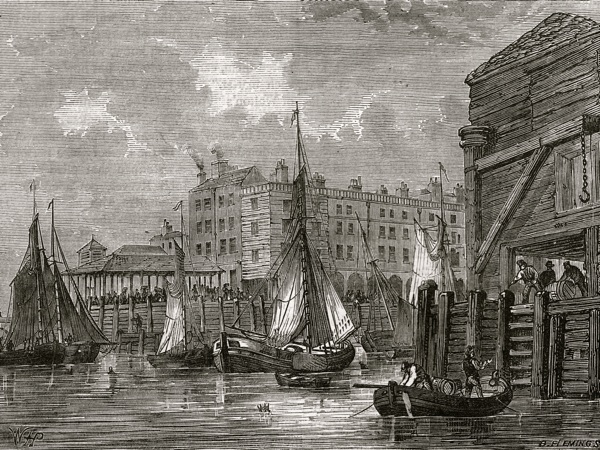
Billingsgate, 1820

Bedford Head Tavern, Covent Garden

Coal Exchange, City of London, 1876

The Cock & Magpie, Drury Lane

Roman remains discovered at Bilingsgate

Hick’s Hall in Clerkenwell, 1730

Former church of St James Clerkenwell

Door of Newgate Prison

Fleet Market

Bleeding Heart Yard in Hatton Garden

Prince Henry’s House in the Barbican

Fortune Theatre, Whitecross St, 1811

Coldbath House in Clerkenwell, 1811

Milford Lane, off the Strand, 1820

St Martin’s-Le-Grand, 1760

Old Bethlehem Hospital (Bedlam), Moorfields, in 1750
Images courtesy Bishopsgate Institute
You may also like to take a look at
The Many Spoons Of Barn The Spoon

Eighteen months after he opened his shop, I paid a call upon my good friend Barnaby Carder, widely known as Barn the Spoon, in the Hackney Rd last week to see how he was getting along – and I was delighted to discover him in high spirits and learn that the spoon business is booming. “I feel there’s no turning back,” he admitted to me, speaking as he whittled furiously while surrounded by wood chips, “I’m more in love with making spoons than ever.”
“Things are going brilliantly,” he continued, “Spoonfest, my international festival of spoon-carving in Edale is sold out, I’m teaching spoon carving at Tate Britain in July and I’m giving a lecture on making a living from craft at the Pitt Rivers Museum. It’s all going on!” Such is the rise of the one with the uncontested claim to be Britain’s top spoon carver.
Around us were scattered diverse spoons of all shapes and sizes, comprising the evidence of Barn’s ceaseless labour and exuberant creativity in spoon-carving – every one a masterpiece of its kind. Taking an example of each in hand, I asked him to explain to me their form and function – and below you can see prized specimens of the many spoons of Barn the Spoon.


“It’s not a fork, it’s a straining spoon for wet stuff like salad”

“Based on a medieval eating spoon from the Museum of London in Sycamore with a mineral stain”

“A Sycamore cooking spoon with a mineral stain, shaped so you can scrape the dish”

“Long-handled soup spoon in Birch”

“A Hawthorn eating spoon with a thumb grip that makes it very functional”

“This tea caddy spoon in Cherry wood is the perfect measure for two cups of tea”

“Assymetric cooking spoon in Sycamore, shaped so you can cook and serve with it.”

“Assymetric cooking spoon in Beech, carved from a bent branch so the grain follows the direction of the shovel so it’s stronger and won’t split”

“Another cooking spoon in a medieval design with a tapering handle in Sycamore”

“A little sugar spoon in Cherry wood”

“A child’s eating spoon in Sycamore”

“This Sycamore spoon oiled with linseed oil was inspired by the Swedish style, as taught to me by Jared Stonedahl”

“This is a similar spoon in the Swedish style in Birch. You can see the rings in the bowl, that’s because it’s made from a split branch, cut in the opposite direction to the grain, so you can carve the bowl down into the pith.”

“Another Swedish style spoon, this time in spalted Alder – the fleck in the wood is created by a fungus”

“A left-handed pouring ladle based on a Roman example in the Museum of London”

Barn the Spoon, 260 Hackney Rd, E2 7SJ. (10am-5pm, Friday-Sunday)
You might also like to read
Barn the Spoon at Bow Cemetery
Adverts From Shoreditch Borough Guide
The London of Borough of Shoreditch existed from 1899 until 1965. Yet although it ceased to be a political entity long ago, thanks to the official guides preserved in the Bishopsgate Institute, we may do our Saturday shopping there – especially if we are in line for some quality cabinet-making, upholstery or bedding.


Images courtesy Bishopsgate Institute
You might also like to take a look at
Women’s Day At The Whitechapel Mission

Friday is Women’s Day at the Whitechapel Mission and, after our first visit to the Mission on Easter Tuesday, Photographer Colin O’Brien and I were honoured to be invited back to join the happy gathering last week.
A long line was already assembling in the street even before the door opened at midday, when the crowd poured in to the canteen eager for pie and mash and custard trifle, and the weekly companionship of females that is on offer here. Josephine from Poplar is always first in the line and she had been waiting on the pavement since ten o’clock in excited anticipation of this event which forms the climax of her week. As Sue Miller, the Day Centre Manager explained to me, “This is where you can be who you are and no-one will judge you.”
Settling down to lunch, the women sought out their friends and companions, and an atmosphere of quiet expectation filled the room once the plates were cleared away. Each week, there is a different activity, ranging from pampering- including facials, pedicure and massage – to cooking and styling. This week, Sue distributed tiny canvasses the size of postcards along with brushes and paints, outlining the brief to create a picture upon the theme of ‘new beginnings.’
You might think such an occupation would be dismissed as trivial by this group of street-smart worldly-wise women, yet a quiet descended upon the room as some serious contemplation took place with bitings of lips and scratchings of heads. So many decisions were required. Beyond the frosted glass panels, Whitechapel receded for an hour and joyful creative endeavour prevailed.
Once the pictures had been conjured into existence, Colin took portraits of the proud creators and their works, and a sense of collective euphoria erupted at the group photo. But then it was time for the ritual distribution of modest gifts that is the culmination of the afternoon and, clutching boxes of popcorn, the women filed reluctantly out into the street to face to challenges of life again.
Cheerful farewells counteracted the sadness of departure, qualified by brave calls of “See you next week!”

“We’re sisters from Whitechapel, we’ve been coming here for thirty-five years”

Sue, Day Centre Manager, explains the art project


Time to leave


“See you next week!”
Photographs copyright © Colin O’Brien
Click here to learn more about The Whitechapel Mission
You may also like to read about
Janet Brooke’s City Churches

Christ Church Spitalfields
Knowing how much I love the City Churches, Janet Brooke sent me this breathtaking series of linocuts portraying some favourite examples. “Each design is carved into a piece of lino and printed on my Imperial Press which was built in 1832 in Curtain Rd, Shoreditch,” Janet explained, “I cut separate blocks for each colour which have to be carefully registered to fit together.”
I was thrilled by such an ambitious use of a modest technique which – in Janet’s hands – is ideally suited to the dramatic architectural geometry of these magnificent structures. “I am fascinated by the way these buildings, which were once high points of the City, are now hidden amidst the landscape of contemporary London,” Janet admitted to me.

St Mary Abchurch

St Mary Somerset

St Edmund King & Martyr

St Stephen Walbrook

St Augustine Watling St

St Nicholas Cole Abbey

St Michael Paternoster Royal

St Benet Paul’s Wharf

St Lawrence Jewry

St Vedast alias Foster

St Alban Wood St

St Magnus the Martyr

St Margaret Lothbury

St Andrew by the Wardrobe

St James Garlickhythe

St Michael Cornhill

St Brides

St Margaret Pattens

St Clement Danes

Images copyright © Janet Brooke
You may also like to take a look at
The City Churches of Old London


