
At 38 Princelet St
TICKETS AVAILABLE THIS SATURDAY 30TH AUGUST. Join me for a ramble through 2000 years of culture and history at the heart of old London followed by tea and cakes served in a 300-year-old house overlooking Christ Church, Spitalfields. CLICK HERE TO BOOK
In this except from A MODEST LIVING, Memoirs of a Cockney Sikh, the first London Sikh biography, Suresh Singh tells the story of his family who lived in their house in Princelet St for seventy years, longer than any other family in Spitalfields.
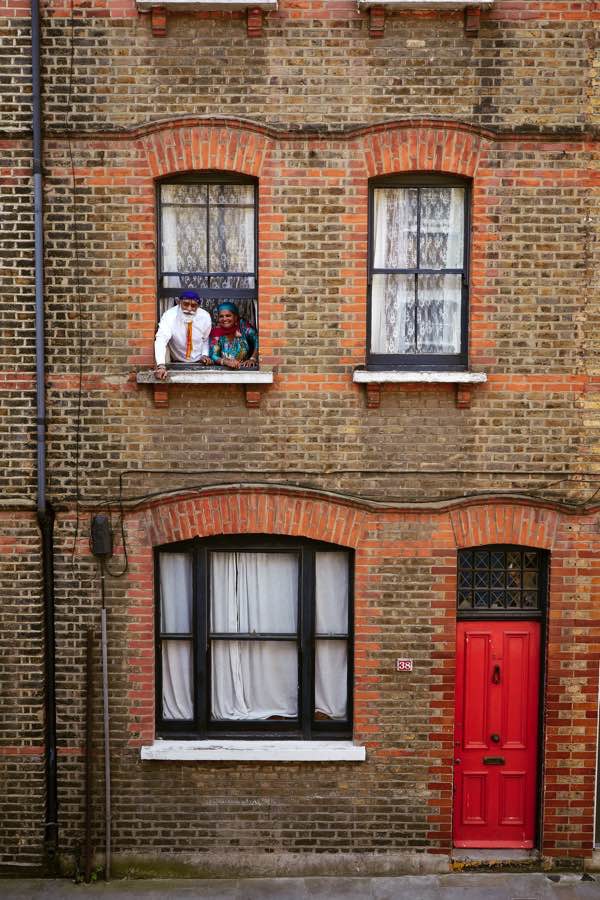
Suresh Singh and his wife Jagir at 38 Princelet St (Photograph by Patricia Niven)

Joginder Singh at 38 Princelet St
Dad came with very little. In 1949, he left his village in the north of India, carrying a small satchel with a tin of shoe polish and not much else. Because he was from the shoemaking caste he thought he could shine peoples’ shoes in London and that was what he did at first.
Somebody told Dad that you could sleep in doorways in Spitalfields and quickly find work there. The porters piled up their barrows and it fell on the floor in abundance, so you could easily collect enough fruit and vegetables for a week. He knew people would leave you alone and you could get by. I think something drew him to Spitalfields.
A man called Mama Nanak came to London before my father. He was a friend of the family and a wheeler-dealer, a dodgy guy. No-one ever said much about him but there is a photograph of him in his suit with a big moustache. He was an enterprising, entrepreneurial man. Eventually, he went to work at Heathrow Airport cleaning toilets and moved to Southall. He brought Sikhs over and said to them, ‘You can stay here.’ He was someone who worked his way around things. He and Dad got hold of a house from a Jewish furrier. In those days, you could just buy the keys.
Our house, it was a slum then. Official records state it was vacant at the time. Dad wanted a big house so that he could welcome his mates and soon there were as many as fifty people living in it. You ask any Punjabi from here to Glasgow who arrived in Spitalfields in the fifties and they will tell you they lived at 38 Princelet Street, even if it was for one night. Some people even walked from Heathrow Airport. They were hot-bedding, with one person getting up to go to work and another climbing into the same bed. It was pretty rough but it was a place where people got on. You could mingle in Spitalfields if you had a big overcoat and a hat, tucking yourself into the area with its smell of bonfires, the brewery, and the fruit and vegetable market.
It was a dark place at night but Dad had a sense of direction even though he could not read or write. He found his way by landmarks. Hawksmoor’s tall spire of Christ Church, with its illuminated clock, dominated the neighbourhood. Even when it was dirty, Christ Church was pretty swag, and Dad liked it. Although there were tramps outside and the bustling Spitaltfields market was across the road, he believed you could elevate yourself out of it.
Our house was in the next street and Liverpool Street station was beyond. On Sundays you could pick up stuff for nothing in the flea markets and Dad got most of our furniture there. In the surrounding streets were Maltese families, Irish families, Hassidic and other Jewish families. It was a mishmash of people and Dad was in his element. Spitalfields pulled him in. The Punjab and the East End of London were two different worlds. I think the docks and the river led him to this place, where you could get by even if you had very little.
Dad found it very difficult to get work because he had a beard and long hair wrapped up in a turban. Some Sikhs shaved their heads. He was told there was a guy in Glasgow who would do it with an accompanying ritual. Dad took the coach to Glasgow to the rough part of the tenement blocks. The guy said to my Dad, ‘This is how you get a job in England.’ He took Dad into the yard and removed his turban and shaved his hair and his beard off. They said that day, ‘Joginder Singh wailed at the top of his voice.’ Dad said, ‘Now my Sikhism is from within.’ He realised that he was in a foreign land but he could keep his faith inside. He made that sacrifice to get a job.
Dad worked in Liverpool Street station and Old Broad Street shining shoes on and off for fifteen years. He did not mind it, although others in the house often asked, ‘Why do you want to do that? You’ve come to England, why do you want to get down on your knees and shine shoes?’ Dad answered, ‘That is a lovely thing to do.’
When he came back from Glasgow, he got a job at once on a building site. People in the house thought, ‘Oh well he shaves, he gets a Wilkinson blade from the market and he keeps himself clean-cut.’ Yet Dad always wore the clothes of a Punjabi Sikh in the house, even if outside he wore proper tailored suits with a nice cut from a good Jewish tailor. These were bought down Brick Lane or in Cheshire Street and probably came off a stiff but they were bespoke. His friends always used to laugh, ‘Joginder Singh, the suits are very beautiful – don’t know how you got them?’ He always kept his shoes polished too, that was very important to him. Even today, I always keep my shoes polished.
I think it is funny but also sad that Dad would do that. Why did he put his pyjamas on and become like a proper Punjabi in the house, but dress in a suit before he went out? I think if he had put a coat over his pyjamas to go out he probably would have got away with it, but he never did. He always valued being in Britain and he worked really hard. I think Spitalfields welcomed him for that.
Dad was always bringing home down-and-outs he met in the street. Often, Dad would invite his vagabond friend Karama but Mum would say, ‘Keep him downstairs,’ because he was infested. So Dad sat him in the yard, shaved his hair off and set it alight, and as they burnt, the fleas would pop like sparklers. I remember Mum being at the end of her tether sometimes because Dad fed these down-and-outs. We still eat the same diet today and, if anybody comes, they eat what we eat. We do not say, ‘We’ve got friends coming, we’ve got to get special food.’ It is what it is, that was how it was and how it is today. It was the same when Mum was here and she passed it on to Jagir, my wife.
Dad became the owner of 38 Princelet Street in 1951, about two years after he arrived in London. I remember the house being full of people, with three gas meters and cookers upstairs and downstairs. My view was of kneecaps and shoes. Mr Ford, the environmental health officer was knocking on the door all the time saying, ‘We’re going to close you down.’ When I was a child we lived on the top floor, which was just an open space with the walls knocked through and the rafters uncovered with two skylights.
Our house was quite broken down and we did not have hot water or central heating. We used to bathe outside in the yard. I remember putting pans on the gas, heating up water. Once it boiled, we tipped it into a bucket and carried it down into the yard then topped it up with cold water. Dad washed in cold water and when he threw it on him, he yelled ‘Wah Hey Guru!’ The joke in the community was that Joginder Singh was a holy man because he kept shouting ‘Wah Hey Guru!’ but really it was the shock of cold water.
Some Sikhs did not want to stay with us, saying, ‘How can you live among Muslims and Jews?’ and he replied, ‘At least they don’t gossip, so you go and I’ll stay here.’ Our house was an open house and for many people it was a safe house – especially when Dad was there.

Joginder Singh in the kitchen at 38 Princelet St – “I think it is funny but also sad that Dad would do that. Why did he put his pyjamas on and become like a proper Punjabi in the house, but dress in a suit before he went out?”
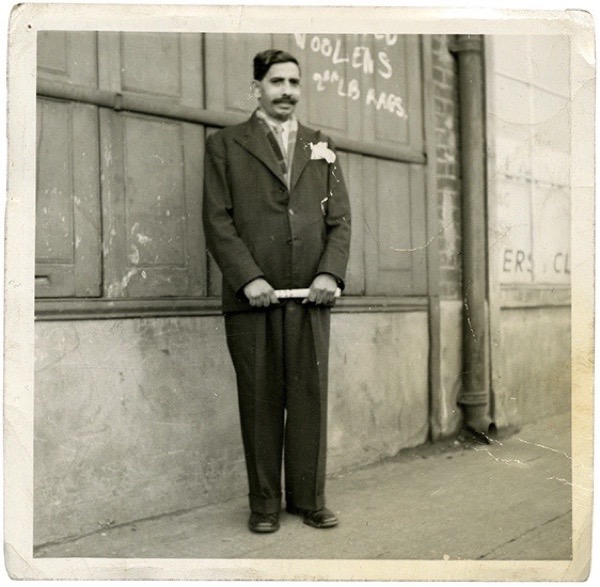
Mama Nanak – “He was an enterprising, entrepreneurial man. Eventually, he went to work at Heathrow Airport cleaning toilets and moved to Southall.”
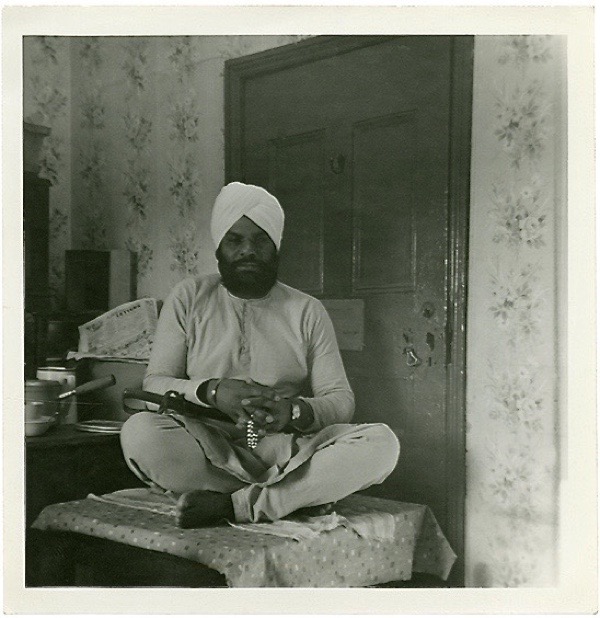
Joginder Singh
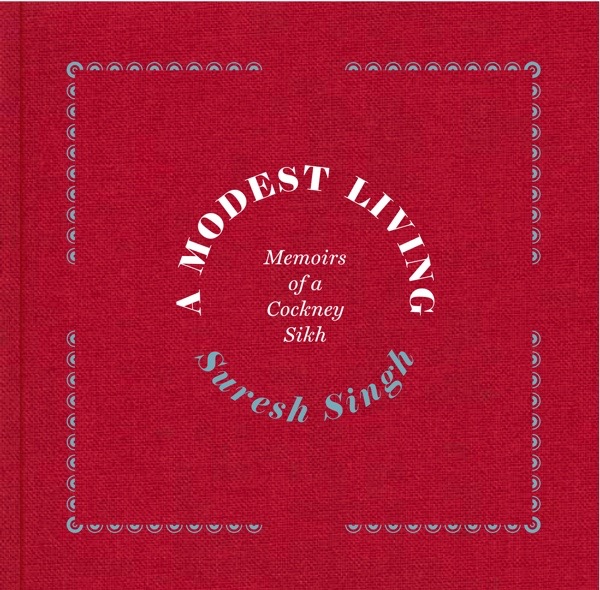
Click here to order a copy of A MODEST LIVING for £20

Bill Crome, Spitalfields Window Cleaner
TICKETS AVAILABLE SATURDAY 30TH AUGUST. Join me for a ramble through 2000 years of culture and history at the heart of old London followed by tea and cakes served in a 300-year-old house overlooking Christ Church, Spitalfields. CLICK HERE TO BOOK
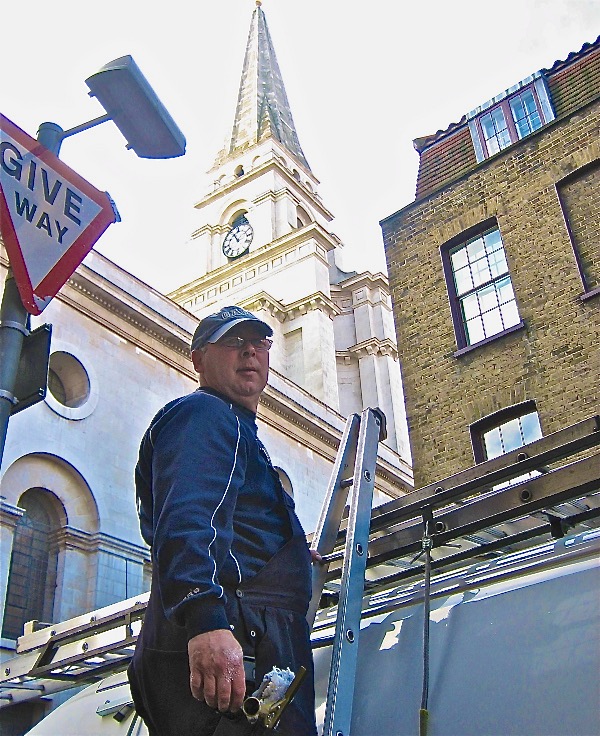
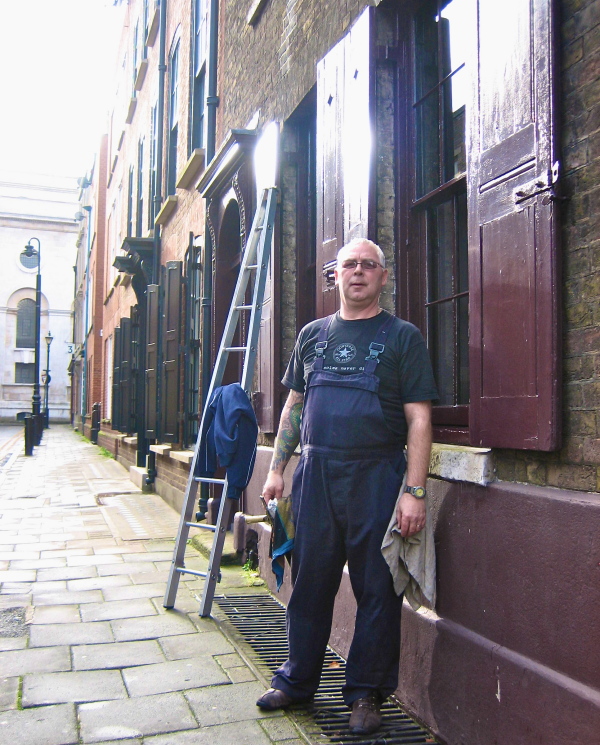
This is Bill Crome, a window cleaner of thirty years’ experience in the trade who makes a speciality of cleaning the windows of the old houses in the East End. You might assume cleaning windows is a relatively mundane occupation and that, apart from the risk of falling off a ladder, the job is otherwise without hazard – yet Bill’s experiences have proved quite the contrary, because he has supernatural encounters in the course of his work that would make your hair stand on end.
“It wasn’t a career choice,” admitted Bill with phlegmatic good humour, “When I left school, a man who had a window cleaning business lived across the road from me, so I asked his son for a job and I’ve been stuck in it ever since. I have at least sixty regulars, shops and houses, and quite a few are here in Spitalfields. I like the freedom, the meeting of people and the fact that I haven’t got a boss on my back.” In spite of growing competition from contractors who offer cleaning, security and window cleaning as a package to large offices, Bill has maintained his business manfully but now he faces a challenge of another nature entirely. Although, before I elaborate, let me emphasise that Bill Crome is one of the sanest, most down-to-earth men you could hope to meet.
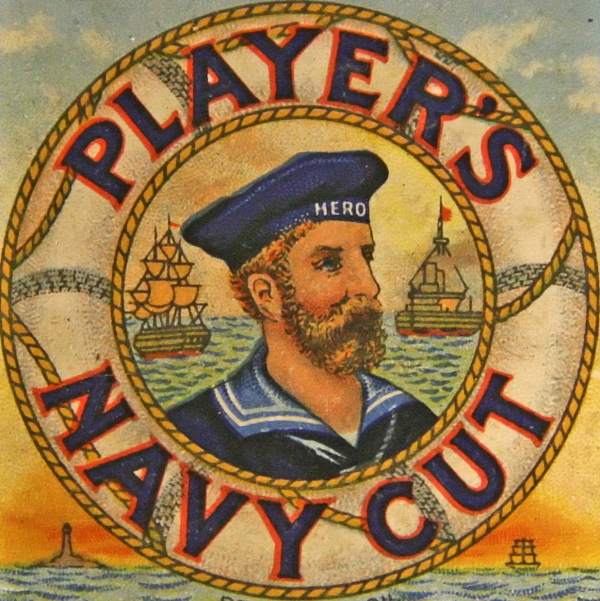
“I’ve heard there is a window cleaner in Spitalfields who sees ghosts,”I said, to broach the delicate subject as respectfully as I could. “That’s me,” he confessed without hesitation, colouring a little and lowering his voice, “I’ve seen quite a few. Five years ago, at the Society for the Protection of Ancient Buildings in Spital Sq, I saw a sailor on the second floor. I was outside cleaning the window and this sailor passed in front of me. He was pulling his coat on. He put his arms in the sleeves, moving as he did so, and then walked through the wall. He looked the sailor on the Players Navy Cut cigarette packet – from around 1900 I would guess – in his full uniform.
And then I saw a twelve year old girl on the stair, she was bent down, peering at me through the staircase. I was about to clean the window and I could feel someone watching me, then as I turned she was on the next floor looking down at me. She had on a grey dress with a white pinafore over the top. And she had a blank stare.
I did some research. I went to a Spiritualist Church in Wandsworth and one of the Spiritualists said to me, ‘You’ve got a friend who’s a sailor haven’t you?’ They told me how to deal with it. When we investigated we found it was to do with the old paintings at the Society for the Protection of Ancient Buildings. Amongst the collection were portraits of a sailor and of a girl. Once I was walking up to the top floor, and I looked at the picture of the girl, and she had a smiling face – but when I went back to collect my squeegee, I looked again and she had a frown. It sounds really stupid doesn’t it? I found a leaflet in the house explaining about the history of the paintings and how the family that gave them was dying off. The paintings are off the wall now yet they had a nice feeling about them, of sweetness and calm.”
Bill confirmed that since the paintings were taken down, he has seen no more ghosts while cleaning windows in Spital Sq and the episode is concluded, though the implications of these sinister events have been life-changing, as he explained when he told me of his next encounter with the otherwordly.
“I was cleaning the windows of a house in Sheerness, and I looked into the glass and I saw the reflection of an old man right behind me. I could see his full person, a six -oot-four-inch-very-tall man, standing behind me in a collarless shirt. But when I turned round there was no-one there.
I went down to the basement, cleaning the windows, and I felt like someone was climbing on my back. Then I started heaving, I was frozen to the spot. All I kept thinking was, ‘I’ve got to finish this window,’ but as soon as I came out of the basement I felt very scared. Speaking to a lady down the road, she told me that in this same house, in the same window, a builder got thrown off his ladder in the past year and there was no explanation for it.
I won’t go back and do that house again, I can tell you.”
As Bill confided his stories, he spoke deliberately, taking his time and maintaining eye contact as he chose his words carefully. I could see that the mere act of telling drew emotions, as Bill re-experienced the intensity of these uncanny events whilst struggling to maintain equanimity. My assumption was that although Bill’s experience at the Society for the Protection of Ancient Buildings might be attributed to a localised phenomenon, what happened in Sheerness suggests that Bill himself is the catalyst for these sightings.
“I feel that I have opened myself up to it because I’ve been to the Spiritualist Church a few times,” he revealed to me. “I do expect to see more ghosts because I work in a lot of old properties, especially round Spitalfields. I don’t dread it but I don’t look forward to it either. It has also made me feel like I do want to become a Spiritualist, and every time I go along, they say, ‘Are you a member of the church?’ But I don’t know, I don’t know what can of worms I’ve opened up.”
Bill’s testimony was touching in its frankness – neither bragging nor dramatising – instead he was thinking out loud, puzzling over these mysterious events in a search for understanding. As we walked together among the streets of ancient dwellings in the shadow of the old church in Spitalfields where many of the residents are his customers, I naturally asked Bill Crome if he has seen any ghosts in these houses. At once, he turned reticent, stopping in his tracks and insisting that he maintain discretion. “I don’t tell my customers if I see ghosts in their houses,” he informed me absolutely, looking me in the eye, “They don’t need to know and I don’t want to go scaremongering.”
Thomas Newington’s Recipes
TICKETS AVAILABLE SATURDAY 30TH AUGUST. Join me for a ramble through 2000 years of culture and history at the heart of old London followed by tea and cakes served in a 300-year-old house overlooking Christ Church, Spitalfields. CLICK HERE TO BOOK
At this harvest season, I thought you might take inspiration from these recipes – culinary and medicinal – from Thomas Newington‘s book that he wrote in 1715 while in domestic service in Brighton, illustrated with wood engravings by Reynolds Stone. Do let me know how you get on.
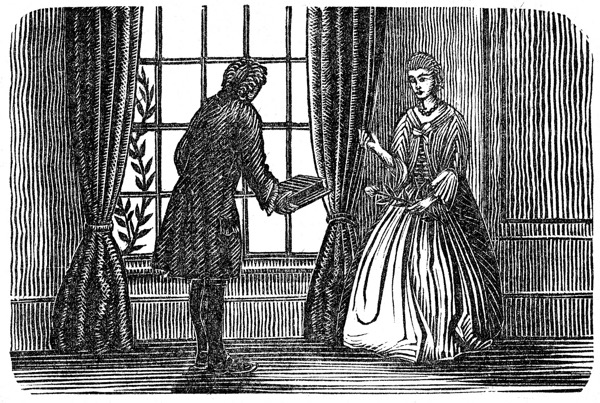
Madam, Perhaps you may wonder to see your Receipts thus increased in Bulk and Number, Especily when you consider that they come from me who cannot make pretentions to things of thy nature, but haveing in my hands some Excelent Manuscripts of Phisick, Cookery, Preserves &c which were the Palladium of Many Noble Familyes, I did imagine that by blending them together, which in themselves were so choice and valuable, they woud magnifie and Illustrate each other.
Madam, I might well fear lest these rude and unpolished lines should offend you but that I hope your goodness will rather smile at the faults commited than censure them.
However I desire your Ladyships pardon for presenting things so unworthy to your View and except the goodwill of him who in all Duty is bound to be.
Your Ladyships Most Humble & most Obeiant Sarvant,
Thomas Newington
Brighthelmstone, May the 20: 1719
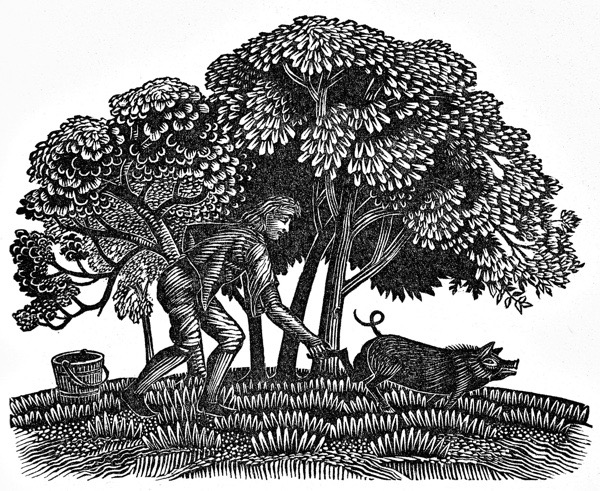
HOW TO KILL & ROAST A PIGG
Take your Pigg and hold the head down in a Payle of cold Watter untill strangeled, then hang him up buy the heals and fley him, then open him, then chine him down the back as you doe a porker first cuting of his head, then cut him in fower quarters, then lard two of the quarters with lemon peele and other two with tops of Time, then spit and roast them. The head requeares more roasting than the braines with a little Sage and grave for sauce.
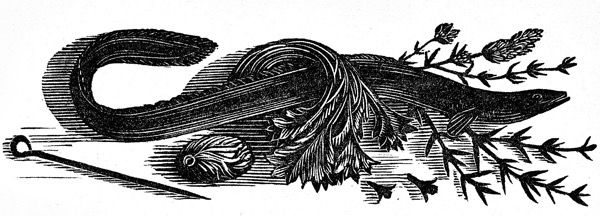
TO SPITCHCOCK EELS
Pull of the skins to the taile, then strow on them a little cloves, Mace, peper & salt, a little time and savory and parsly shred very fine. Then draw up the skinn and turn them up in the shape of S, and some round. Run a skure through them, then frye or boyle them and lay them round other fish.
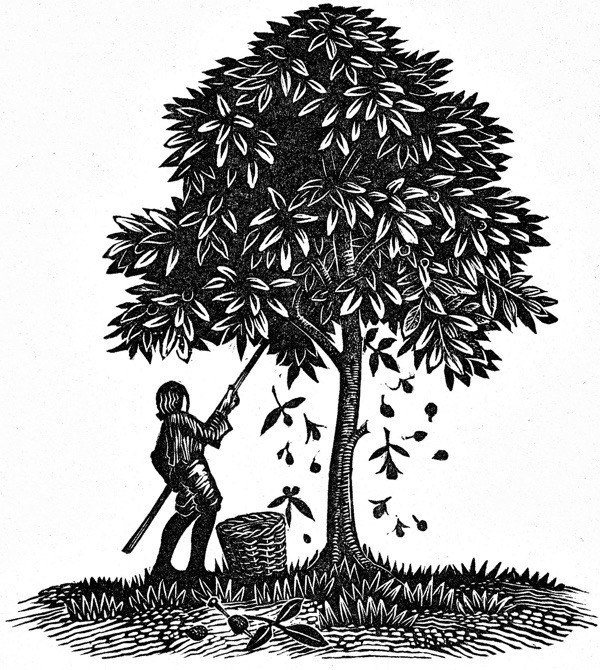
TO PRESERVE GREENE WALNUTS
Take your wallnuts when they be so young that a pin will go through them, then set them on fire and let them boyle in fair Watter till the bitterness go out, shifting it once or twice. Then take to every pound of Walnuts a pound of lofe sugar, half a pint of watter, boyleing till they be tender in this surrupe. Then let them stand to soak in this surrupe 3 or 4 dayes, then take them out and prick 3 or 4 holes in each sticking half a Clove and a little Cynament in each, but if you fear it will be to strong of the spice omit some of them. Then set on your surrupe and skim it, adding a pound more of sugar. Boyle them therein to thick syrrupe and let them stand for a fortnight or three Weekes, then boyle them up and add more sugar if you see Occasion. They are Cordial to take in a Morning, good for the stomach and Loosen the Body.
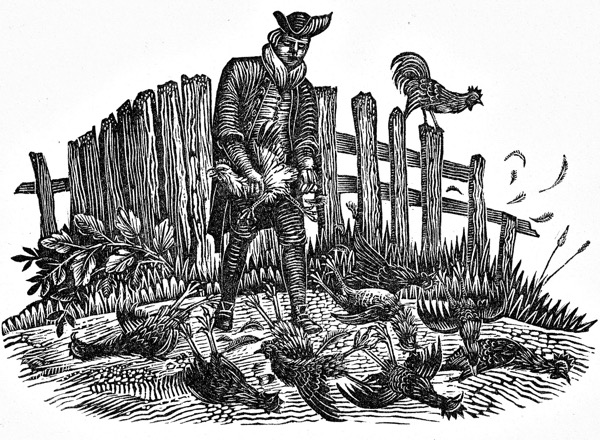
A REMEDY FOR THE PLAGUE
Among the excelent and aproved medecines for the Pestilence, there is none worthy and avaylable when the sore appeareth. Then take a Cock Pullet and pluck of the fethers of the taile or hinderpart till the rump be bare, then hold the bare of the said Pullet to the sore and the pullet will gape and labour for life and in the end he will dye. Then take another Pullet and doe the like and so another as the Pullets do dye, for when the Poyson is Drawn out the last Pullet that is offered therto will live. The sore Presently is assuaged and the party recovereth.
A SURRUP FOR THE PRESERVATION OF LONG LIFE RECOMMENDD TO THE RIGHT HONBLE MARY COUNTESS OF FEVERSHAM BY DR PETER DUMOULIN OF CANTERBURY JUNE YE 2, 1682
An Eminent Officer in the great Army with the Emperour Charles the 5th sent into Barbary had his quarters there Assigned him in an Old Gentlemans House with whom by mutall offices of Humanity he soone contracted a singular Freindship. Seeing him looke very Old yet very Fresh and Vigourous he asked him how old he was – he answerd he was 132 years old, that till Sixty Yeares of Age he had been a good Fellow takeing little care of his health but that then he had begun to take a spoonfull of surrup every morning fasting, which ever since has keept him in health. Being Desired to impart that receipt to his Guest he freely granted it and the Officer being returned to his Cuntry made use of that surrup and with it Preserved himself and many more, yet kept the Receipt secret till haveing attained by this surrupe ninety two years of Age, he made a scruple to keep it secret any longer and publisht for the Common good.
Take of the juices of mercurial eight pounds, of the juice of Burridg two pounds, of the juice of Buglosse two pounds. Mingle these with twelve pounds of clarrified Honey, the whitest you can gett, let them boyle together aboyling and paas them through a Hypocras Bag of new flannell. Infuse in three pints of White Wine, a quarter of a pound Gentian Root and half a pound of Irish root or blew Flower de Lis. Let them be infused twenty fower houers then straind without squeezing, put the liquor to that of the herbs and Hony, boyle them well together to constistence of a surrup. You must order the matter so that one thing stays not for the other but that all be ready together. A spoonfull of this surrup is to be taken every morning Fasting.
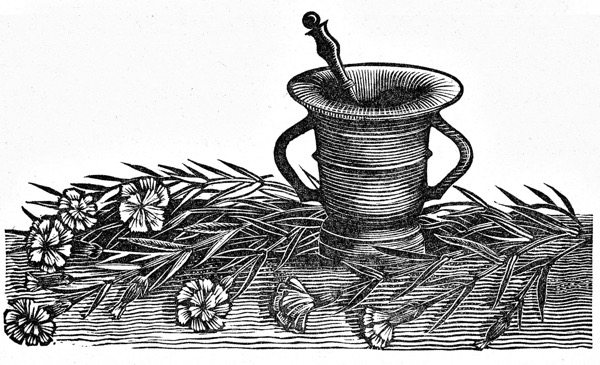
TO MAKE SURRUPE OF CLOVE GILY FLOWERS
Take a pound of the flowers when they are cleane cut from their white bottom and beat them into a stone Mortar till they be very fine all. Then haveing Fair watter very well boyled, take a quart of it boyling hott and pour it to them in the Mortar, then cover it close and let it stand all night, and the next dat streyne them out and to every pint of this Liquor take a pound and a half of Duble Refine Lofe Sugar beaten, then put your sugar and set it on the fire and boyle it and, when it is clean scimed, take it of and pour it into a silver or Earthen Bason and so let it stand uncovered till the next day, then glass it up and stop it close and set it not but where it may stand coole & it will keep the better.
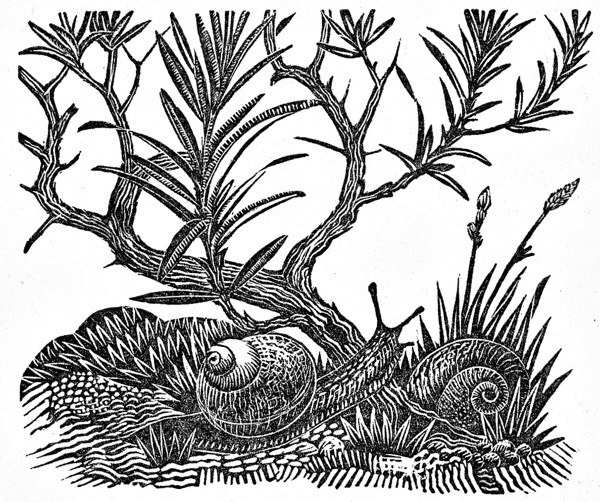
A SNAYLE WATTER IS GOOD IN A CONSUMPTION OR JAUNDICE TO CLEAR THE SKIN OR REVIVE YE SPIRRITS
Take a Peck of Garden Snayles in their Shells. Gather them as near as you can out of lavender or Rosemary and not in trees or grass. Wash them in a Tubb three times in Beere, then make your Chimney very clean and power out a bushall of charcole and, when they are well kindled, make a great hole with a fire shovell and put in your Snayles and Put in some of your cleane burnt coals among them and let roast till they leave makeing a noise. Then you must take them forth with a knife and clean them with a cleane Cloathpick and wipe away the coales and green froth that will be upon them. Then beat them in a mortar shells and all.
Take also a Quart of Earthworms, slitt and scower them with salt, then wash them in whitewine till you have taken away all the filth from them, and put them into a stone Mortar and beat them to peices. Then take a sweet, clean Iron pott which you will sett your limbeck on, then take 2 Ms. of Angellica and lay it in the bottome of your Pott and 2 Ms. of Sallendine, on the top of that putt in 2 quarts of Rosemary Flowers, Bearsfoot, Egrimony, the redest Dock roots you can get, the barbery bark, Wood Sorrell, bettony, of each three handfulls, 1 handfull of Rue, of Flengreek and Turmerick, of each one ounce well beaten.
Then lay your Snayles and wormes on top of your herbs and flowers and power upon them the strongest Ale you can gett fower gallons, and two gallons of the best sack and let it stand all night or longer, stirring Divers times. In the morning put in two ounces of Cloves, twelve ounces of hartshorne, six ounces of ivory, the waight of two shillings of Saffron. The Cloves must be bruised. You must not stir it after these last things are in.
Then set it on your limbeck and close it fast with Rye Past and receive your water in Pintes. The first is the strongest and so smaller, the smallest may be mended by puting in some of the strongest. When you use it, take three spoonfulls of beere or Ale to two spoonfulls of the strongest and to this three quarts of cowslips flowers, one quart of Buglose and buridg flowers and 3 Ms. of liverworth.
If you will, you should feed your Snayles with sallendine and barbery leaves and bough, and the wash them in new milk fower times and then in a Tubb of strong Ale so that they may be very cleane, and then burn them.
You may also like to read about
At Gravesend

You can help publication by preordering now and we will post you a copy signed by Tessa Hunkin at the end of September in advance of publication on October 2nd. Additionally, we are including a complimentary copy of A Hoxton Childhood (cover price £20) with all pre-orders in the United Kingdom. CLICK HERE TO ORDER YOUR COPY
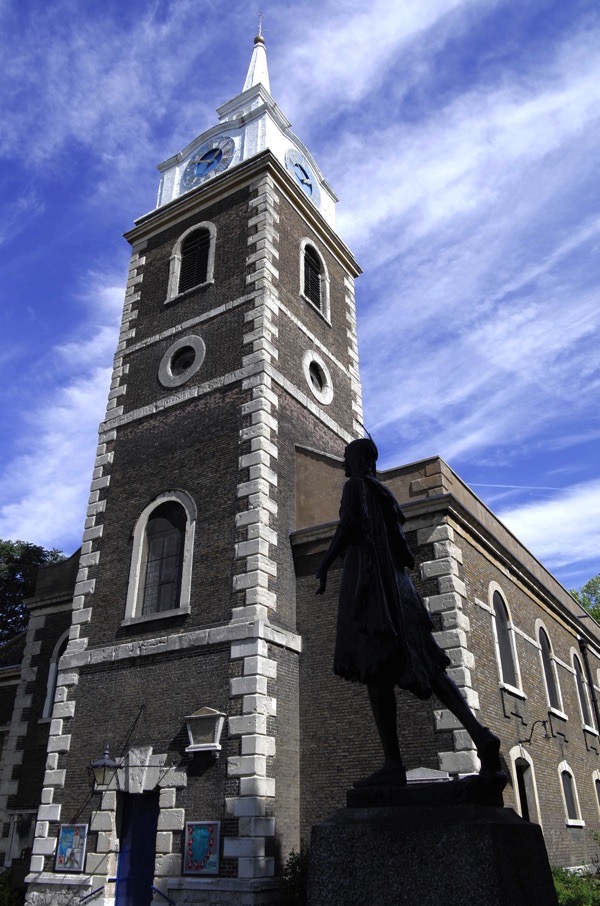
St George’s where Pocahontas is buried
It was at Gravesend that Pocahontas, one of the very first Americans to visit Europe, landed when illness forced her to abandon her return journey on March 21st 1617. The ship turned from its course before it left the Thames estuary and sought harbour at Gravesend where Pocahontas died just a few hours after coming ashore. Only twenty-one, she experienced much in her short life and left a young son, Thomas. He was taken back to London and completed her aborted journey home in adulthood, while his mother was buried at St George’s church, where today a handsome bronze figure embodies her presence to greet the pilgrims.
A brisk walk up the steep High St was sufficient to displace these plangent thoughts, replacing them with astonishment at the number of tattoo parlours and nail bars in such a small stretch of shops. Well-tended hanging baskets of flowers at every turn spoke eloquently of civic pride, while the many high quality buildings from earlier centuries evidenced the former wealth of Gravesend.
The appealing architectural vernacular of this shambolic medieval High St, interspersed by the Victorian grandeur of the Market Hall and the Carnegie Library, enticed me up the hill to the square where a group of senior Sikh gentlemen sat, happily passing the time of day and looking dapper in their turbans of multiple hues of blue.
Before long, hunger beckoned and I set off past Bawley Bay, where families once emigrated to the Antipodes, and St Andrew’s Mission church, built out over the water in 1871, and the Clarendon Royal Hotel, conceived as a palace for James II, and the Customs House of 1812, and the fourteenth century Milton Chantry, the oldest building in Gravesend, and the New Tavern Fort, constructed in expectation of an invasion by the French.
My destination was the Promenade Cafe, an elegant thirties pavilion set back from the sea behind a wide lawn, thronging with customers, young and old, and everyone quite at home. This eastern stretch of Gravesend is where local residents, especially families, come to enjoy their leisure, offering paddling, feeding the swans, dog-walking and the quiet spectacle of passing traffic in the estuary. Among other hungry customers, I sat patiently at my table until a waiter should call out the number of my dinner ticket and deliver my plate of fish and chips.
‘Number Six!’ called the waiter, wielding a tray laden with two steaming fish dinners and inspiring everyone to turn their heads to see who was to be the lucky recipient. ‘Number Six?’ the waiter bawled at the top of his voice. Mystified by lack of any response, ‘Number Six?’ he queried, before returning inside shaking his head in disappointment. Puzzled glances passed between the dinners until a senior gentleman in a corner perked up. ‘Did he say Number Six?’ he asked, speaking his thoughts out loud. Observing nods of assent from neighbouring tables, he leapt to his feet clutching his ticket and hurried inside declaiming, ‘He didn’t speak loud enough, did he?’ and ‘What’s wrong with you, can’t you speak up?’
East of the promenade and over the canal, an atmosphere of extravagant post-industrial decay prevails. I walked for a mile along an overgrown narrow path between huge abandoned factories to emerge in a light industrial estate where small businesses still thrive, mostly in maritime related trades. At the very end, where the Higham Marshes begin sits the Ship & Lobster, occupying a position as the first and last pub on the Thames. Of significant history and in a breathtaking location, it was refreshing to encounter this friendly unpretentious local pub that serves the community of workers from the industrial estate, and has successfully evaded tourism or tarting up.
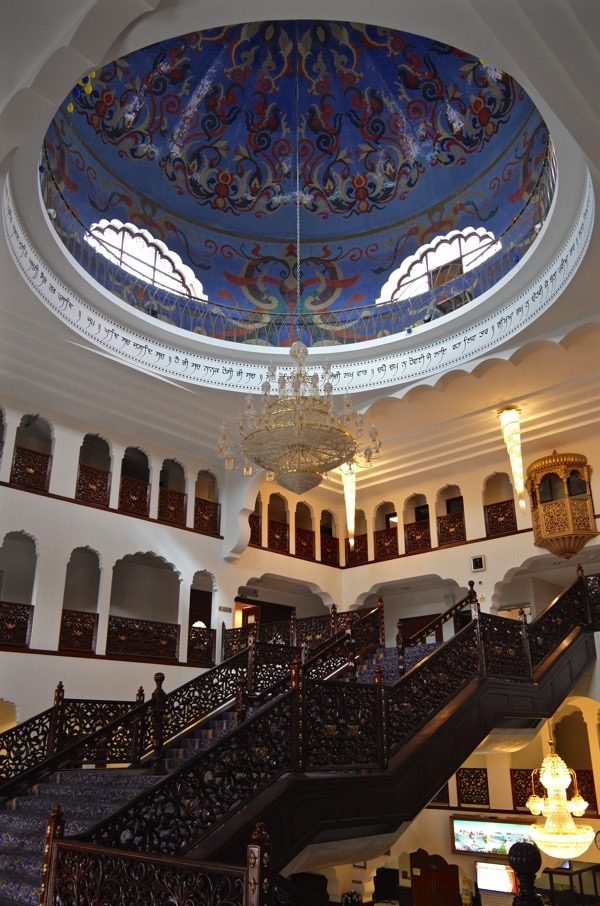
I had one more landmark to discover. Sitting on the hill above Gravesend, the Guru Nanak Darbar Gurdwara Sikh Temple looks for all the world as if had been magically transported there by a genie from the Arabian Nights. Built entirely of gleaming white marble, on an equal scale to a European cathedral, this a compelling piece of architecture rendered even more remarkable by its unexpected location. Approaching through the elaborate gatehouse pavilion, I could not resist crossing the car park and walking right up to it – I should not have been surprised if it had vanished like a mirage.
A woman in long coloured robes hurried towards me. Immediately, I felt that I had trespassed and prepared my apology, but instead she welcomed me openly and invited me inside, explaining where I could find a cloth to cover my head and where I could leave my shoes if I wanted to attend a service. The interior of the temple with its enormous blue dome, lined with mosaic, and ceremonial staircase was no less impressive than the exterior. Yet the atmosphere was relaxed and I found myself reciprocating polite nods with worshippers passing in the hallway. My foray into the world of the Sikhs.
The shadows were lengthening and my feet were sore but I was enchanted by my day trip to Gravesend. Gravesend has so much to recommend it, I thought.
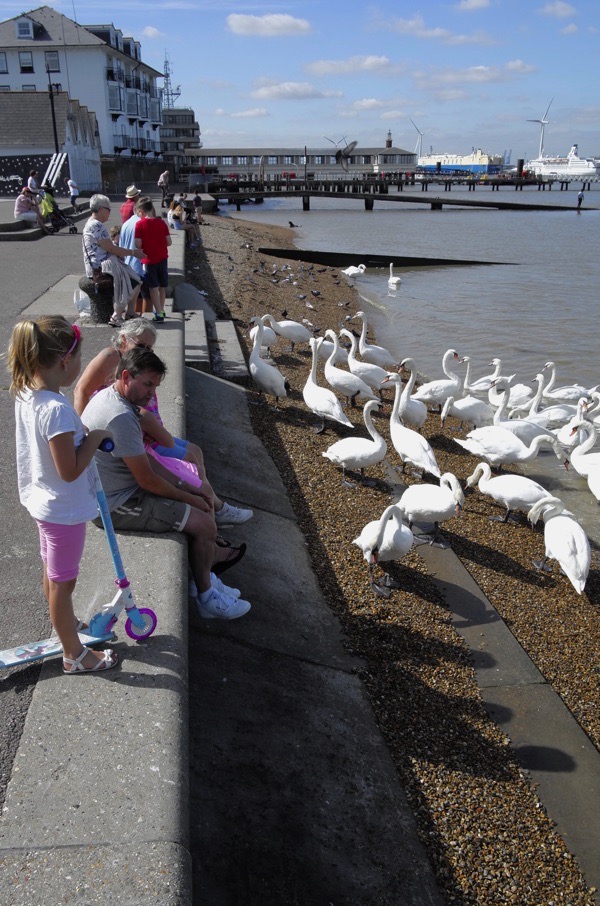
On the riverfront at Gravesend
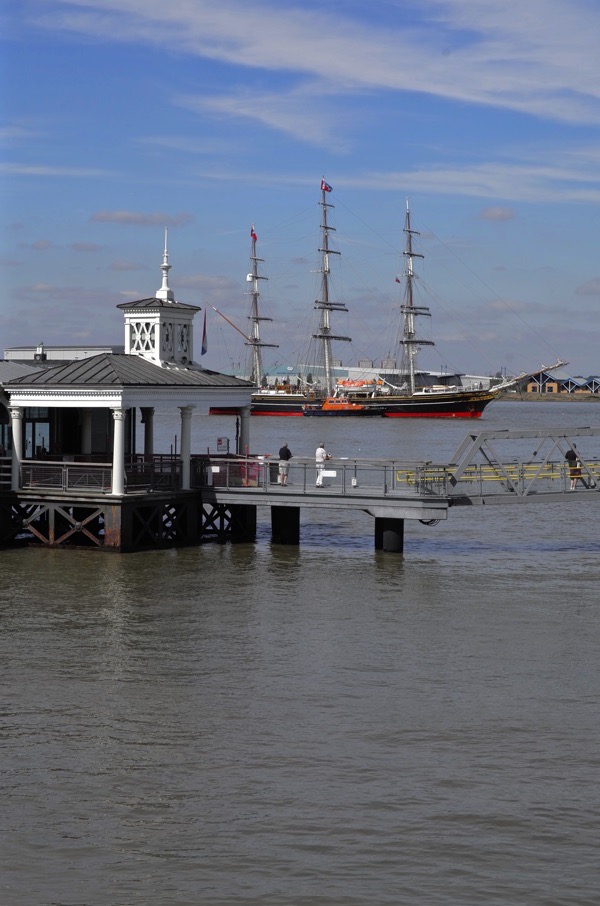
Gravesend has the oldest cast iron pier in Britain
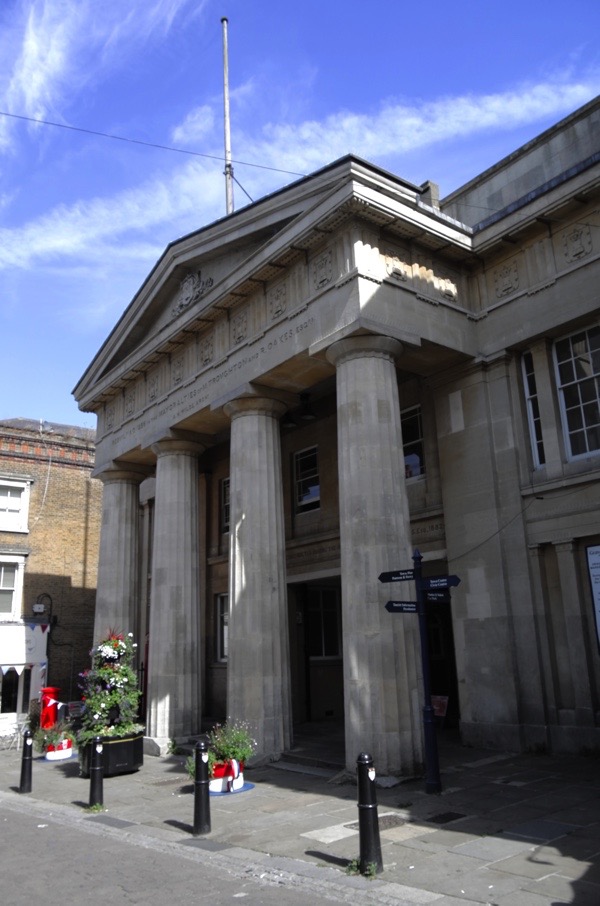
Gravesend Market
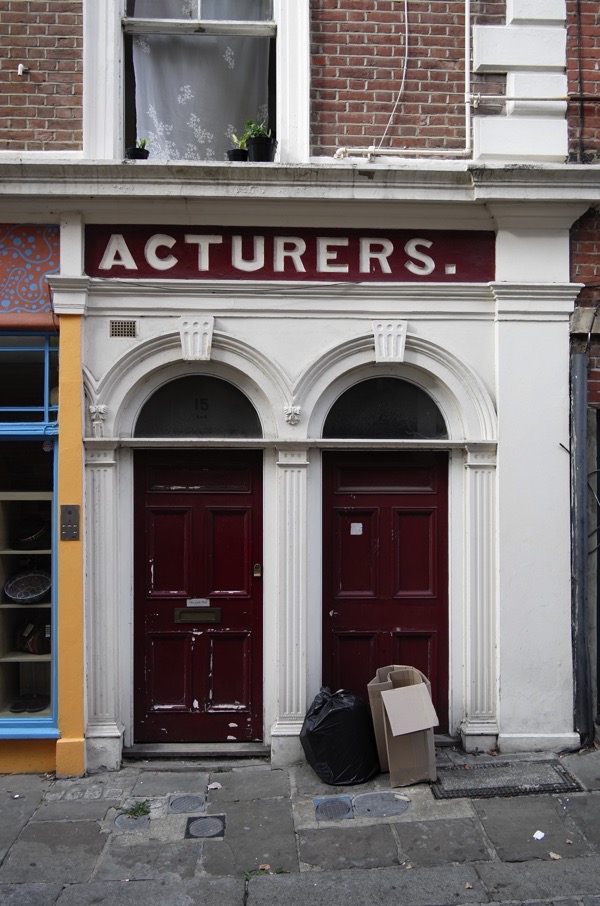
Former manufacturers
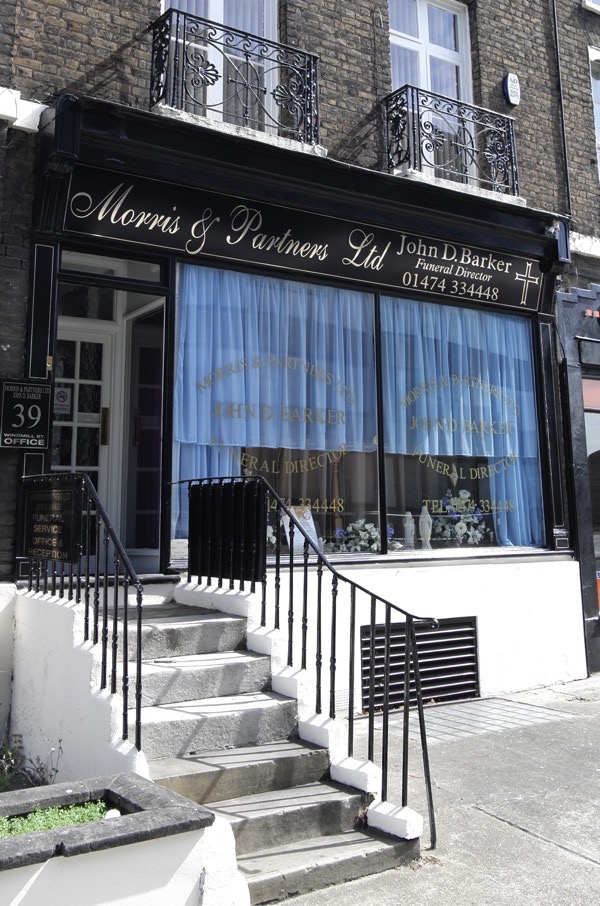
Traditional Undertaker at Gravesend
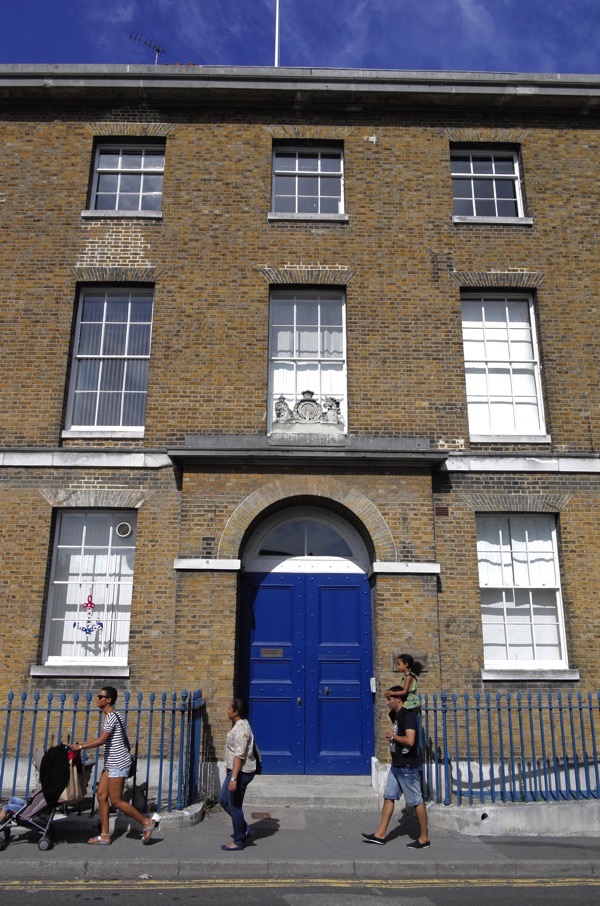
Customs House
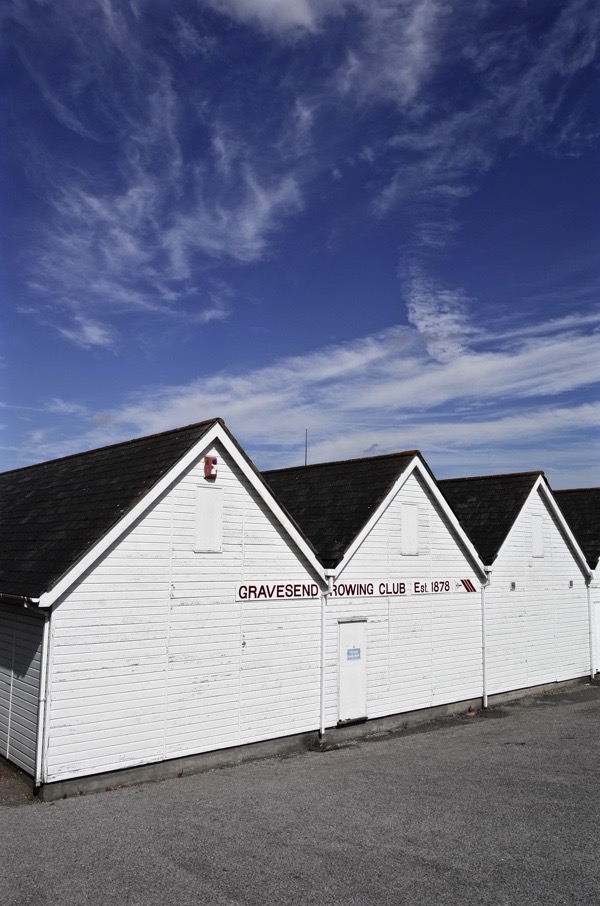
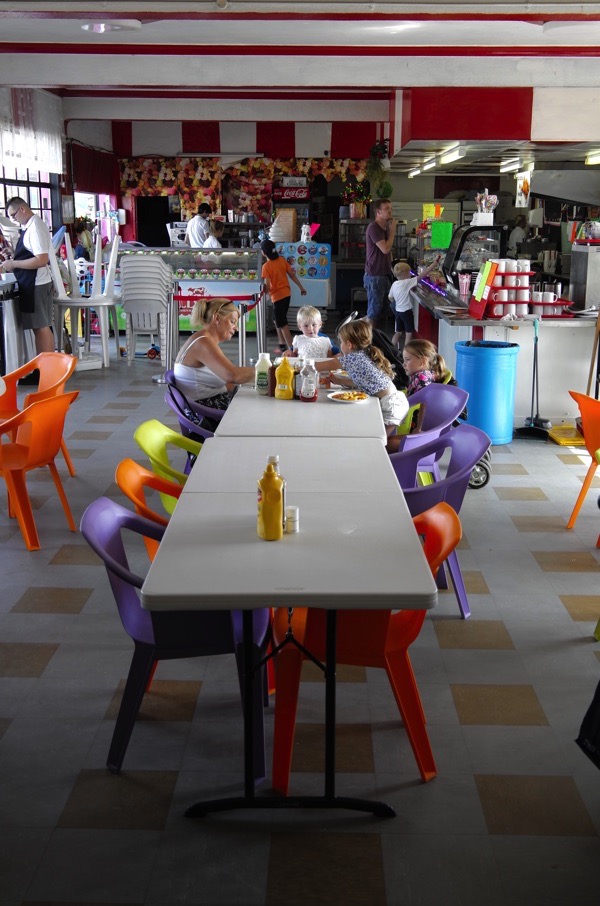
At the Promenade Cafe
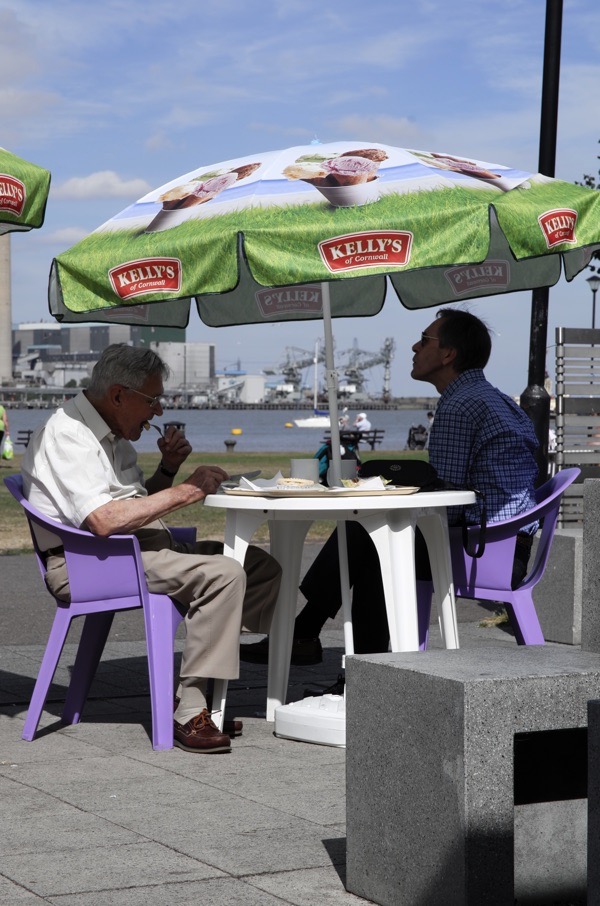
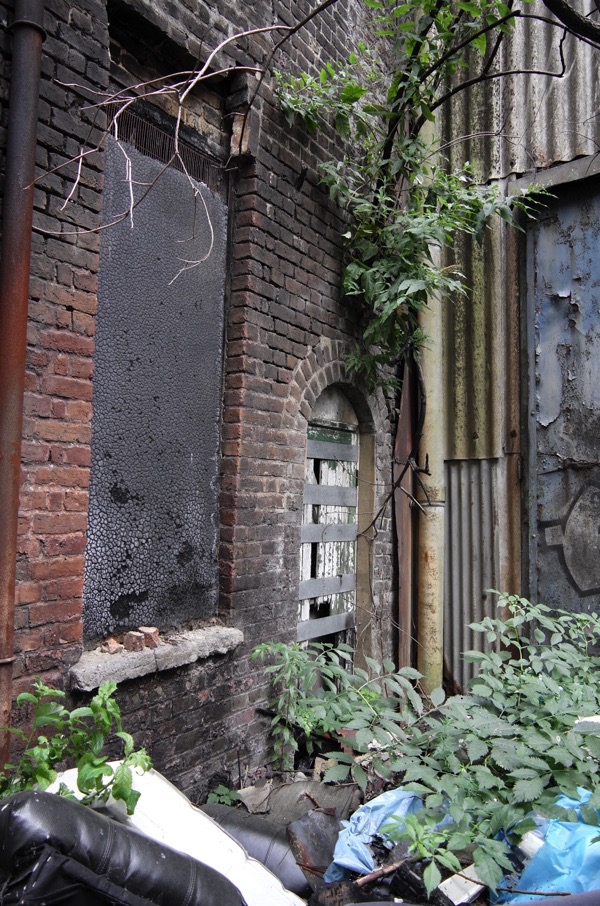
Along Wharf Rd
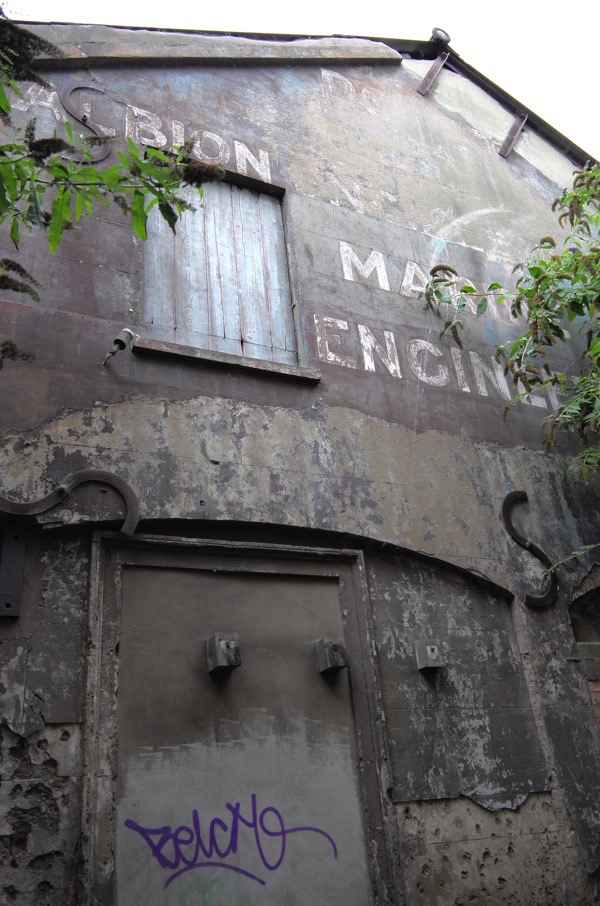

In Mark Lane
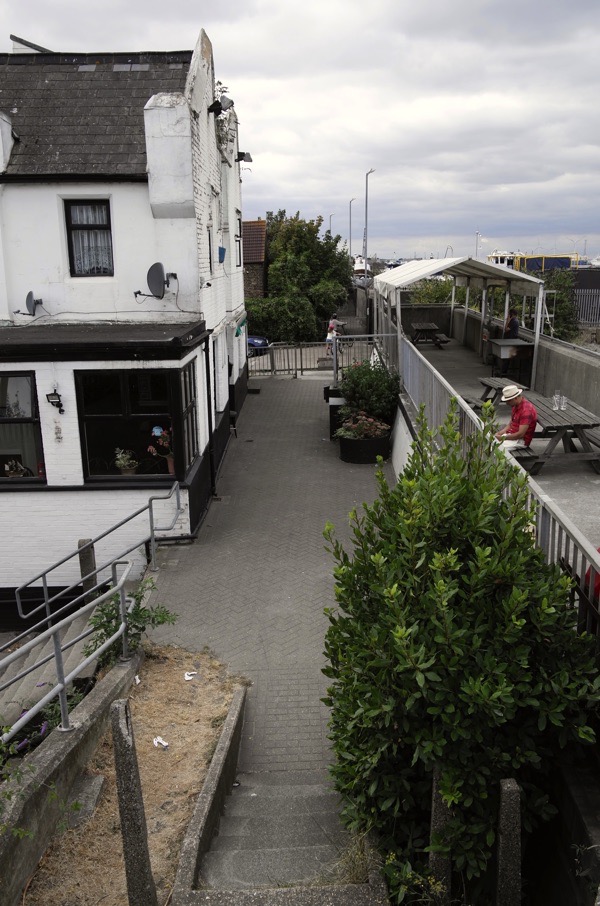
The Ship & Lobster, the first and last pub on the Thames. Featured in Great Expectations, this pub was supposedly founded when Charles II and his brother James raced barges here.

Guru Nanak Darbar Gurdwara, Sikh Temple
Plan your trip at www.visitgravesend.co.uk
Sixteenth Annual Report
Sixteen years ago this week, I began to publish a daily post in these pages.
In this year’s report, I am delighted to announce two pieces of good news. Firstly, the Truman Brewery’s office development has been rejected by Tower Hamlets Council. Secondly, the book of Tessa Hunkin’s Hackney Mosaic Project will be published by Spitalfields Life Books on 2nd October.
SAVE BRICK LANE
As a result of years of campaigning by Save Brick Lane, the community came together in Spitalfields to demand housing not offices on the former Truman Brewery site and the elected councillors responded by rejecting the plans for a corporate gated plaza unanimously in July.
There are over 23,000 people on the housing list in Tower Hamlets and the Truman Brewery site has the potential to offer 345 homes for local people but the proposed development only offers 6 units of social housing.
Yet the story does not end here because there will be a public inquiry in October which will make a recommendation to the Secretary of State who will make a final decision next year.
TESSA HUNKIN’S HACKNEY MOSAIC PROJECT
Thanks to the support of you – the readers of Spitalfields Life – who contributed to our crowdfund in the spring, our plan to publish a handsome hardback monograph of the work of Tessa Hunkin’s Hackney Mosaic Project has come to fruition.
Over the past months, we have been working behind the scenes to compile a beautiful art book, photographing the mosaics, editing the text and designing the pages. In July, Tessa travelled to Vicenza to oversee the printing and ensure that the mosaics are reproduced exactly as she wants them to be seen.
You can help publication by preordering now and we will post you a copy signed by Tessa Hunkin at the end of September. Additionally, we are including a complimentary copy of A Hoxton Childhood (cover price £20) with all pre-orders in the United Kingdom.
Both Save Brick Lane and Hackney Mosaic Project are inspirational examples of local people coming together to work collectively to improve their neighbourhoods and in such troubled times we need to celebrate these endeavours that give everybody hope.
With these thoughts in mind, thus ends another year in the pages of Spitalfields Life.
I am your loyal servant
The Gentle Author
Spitalfields,
22nd August 2025
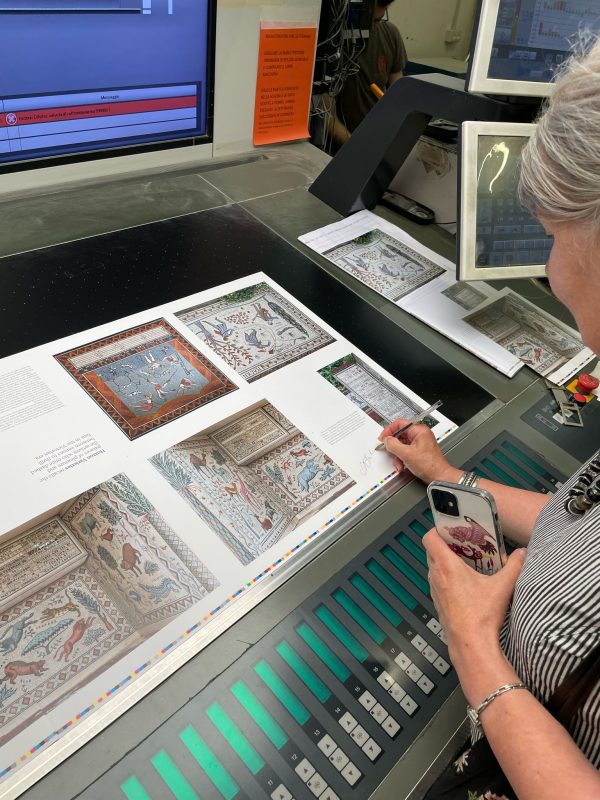
Tessa Hunkin signs off pages of her book at the printer

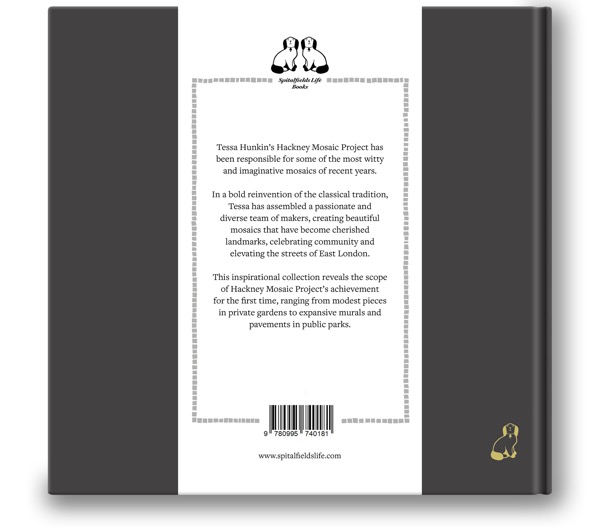
CLICK HERE TO ORDER YOUR SIGNED COPY AND GET A FREE COPY OF ‘A HOXTON CHILDHOOD’
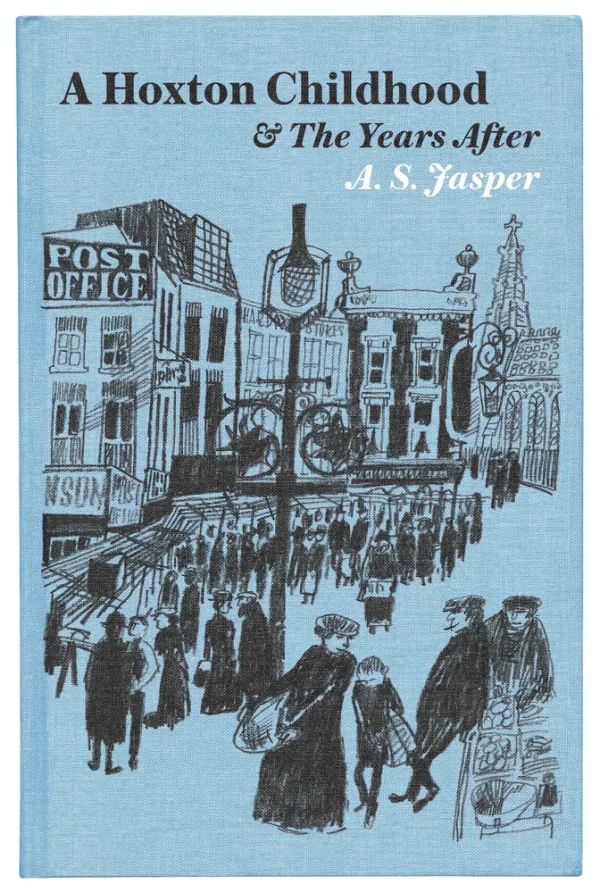
We are sending a complimentary copy of A Hoxton Childhood with all preorders in the United Kingdom

Schroedinger is currently on holiday
At Dirty Dick’s
Book now for my tours through August, September & October
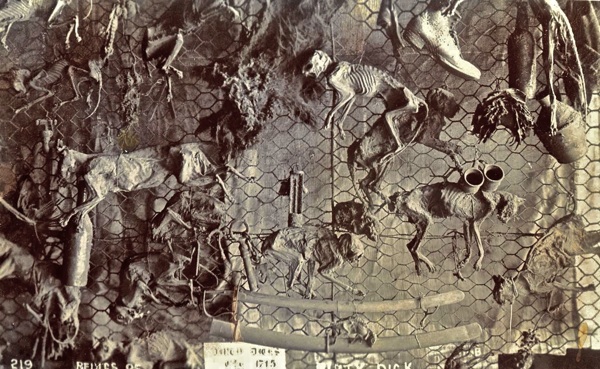
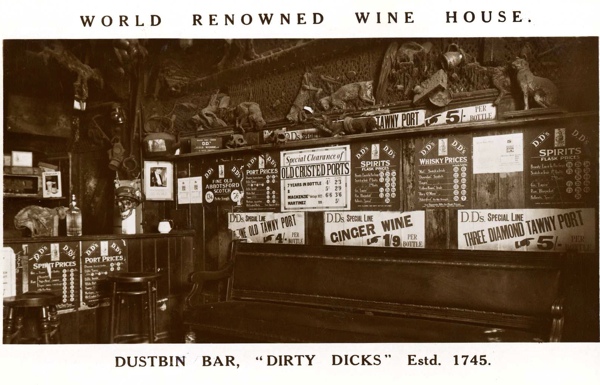
These are the dead cats that once hung behind the counter of the celebrated “Dustbin Bar” at Dirty Dick’s Old Port Wine & Spirit House in Bishopsgate. It is a location that holds a special place in my affections as the first pub I ever went into in London, one day after work at the Bishopsgate Institute.
Although this was longer ago than I care to admit and regrettably the cats in this picture had already gone by then, yet I still recall the sense of expectation, entering the narrow frontage and walking back, and back, and back through the warren of rooms with sawdust on the floor – descending ever deeper into the bowels of the city, it seemed. And I can only imagine how this strange drama might have been enhanced by the presence of umpteen dead cats suspended from the ceiling.
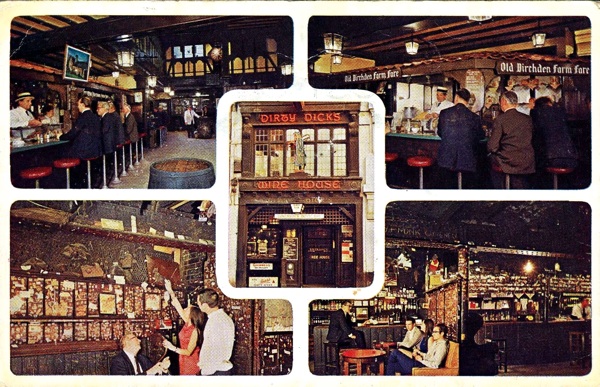
This was how it was described in 1866 – “A small public house or rather a tap of a wholesale wine and spirit business…a warehouse or barn without floorboards – a low ceiling, with cobweb festoons dangling from the black rafters – a pewter bar battered and dirty, floating with beer – numberless gas pipes tied anyhow along the struts and posts to conduct the spirits from the barrels to the taps – sample phials and labelled bottles of wine and spirits on shelves – everything covered with virgin dust and cobwebs.”
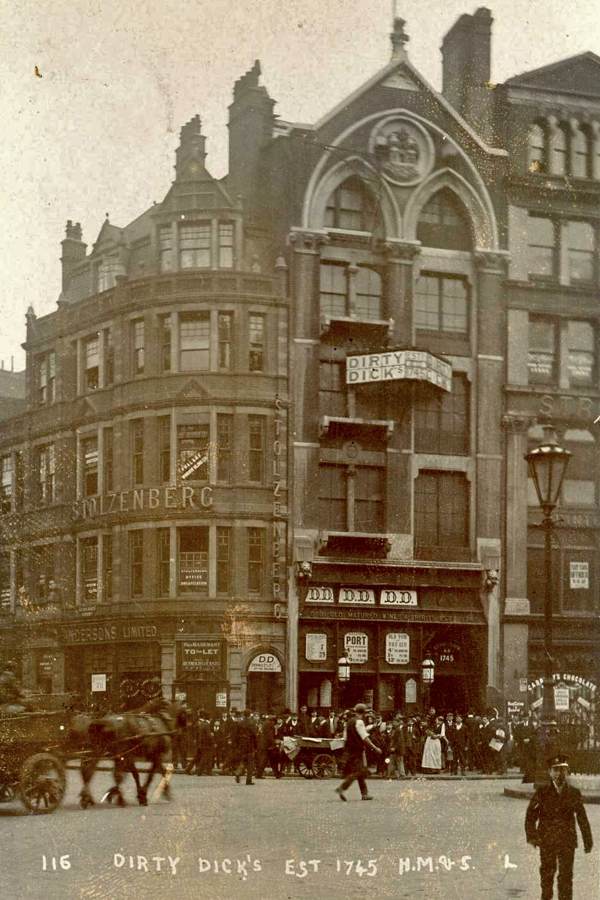
Yet all was not as it might seem, because the presence of these curious artefacts was not due to unselfconscious eccentricity, it was an early and highly successful example of what we should call a “theme pub.” Established in 1745 as The Old Jerusalem, the drinking house took the name of Dirty Dick’s in 1814 and adopted his story along with it. The original of Dirty Dick was Nathaniel Bentley, a successful merchant with a hardware shop and warehouse in Leadenhall St in the mid-eighteenth century. After his bride-to-be died on their wedding day – so the legend goes – he never cleaned up again, never washed or changed his clothes. “It’s of no use, if I wash my hands today, they will be dirty again tomorrow,” he declared. Bentley died in 1809, and the Bishopsgate Distillers appropriated this story of the notorious dirty hardware merchant, adorning their bar with dead cats and cobwebs to perpetuate the legend.
Charles Dickens knew Dirty Dick’s and was fascinated with this myth of one who sealed up the door on the wedding breakfast and left the cake and table decorations to acquire dust eternally. In a letter to the printer of his weekly publication “Household Words” dated 30th December 1852, he wrote “Don’t leave out the Dirty Old Man, he is capital.” And it has been suggested that Nathaniel Bentley was the inspiration for the character of Miss Havisham in “Great Expectations.”
Dirty Dick’s was rebuilt in the eighteen seventies, though the cellars are of an earlier date, and now the bizarre artefacts are banished to a glass case, yet it is still worth a visit. Explore the wonky half-timbered spaces and seek out the secluded panelled rooms at the rear, where you can enjoy a quiet drink away from the commotion of Bishopsgate to contemplate the ancient coaching inns that once lined this street, long before the age of the railway and the motor car.

Nathaniel Richard Bentley – the origin of the myth of Dirty Dick.

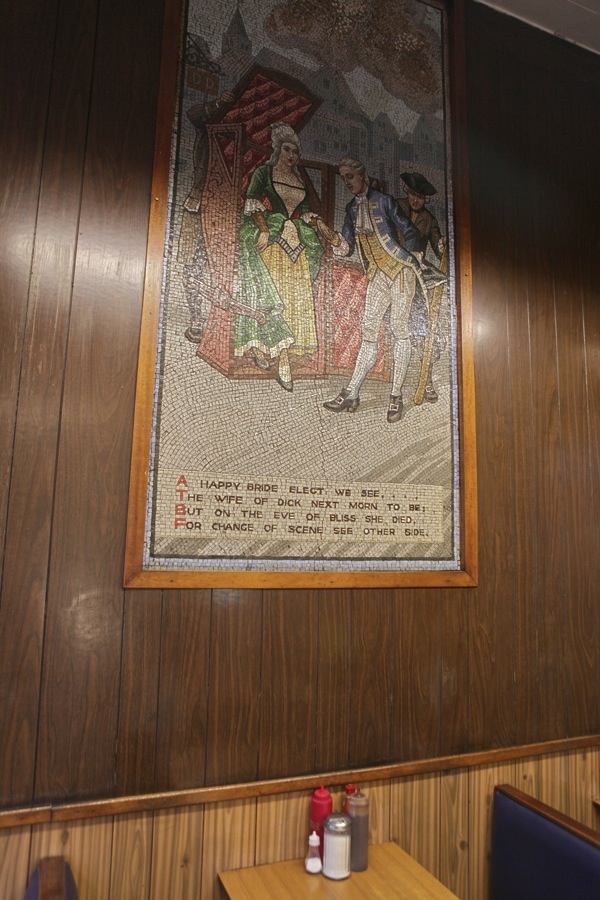
Part of the former City Corner Cafe – now a takeaway food joint -was once an alley leading into Dirty Dick’s adorned with a series of these mosaics which illustrated the tale.


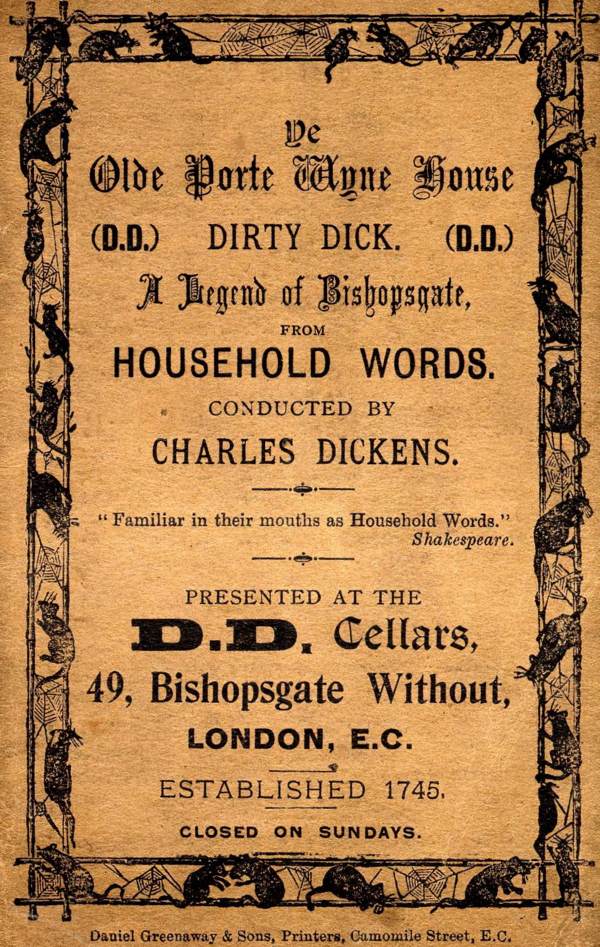
Dirty Dick by William Allingham
A Lay of Leadenhall
In a dirty old house lived a Dirty Old Man.
Soap, towels or brushes were not in his plan;
For forty long years as the neighbours declared,
His house never once had been cleaned or repaired.
‘Twas a scandal and a shame to the business-like street,
One terrible blot in a ledger so neat;
The old shop with its glasses,black bottles and vats,
And the rest of the mansion a run for the rats.
Outside, the old plaster, all splatter and stain,
Looked spotty in sunshine, and streaky in rain;
The window-sills sprouted with mildewy grass,
And the panes being broken, were known to be glass.
On a rickety signboard no learning could spell,
The merchant who sold, or the goods he’d to sell;
But for house and for man, a new title took growth,
Like a fungus the dirt gave a name to them both.
Within these there were carpets and cushions of dust,
The wood was half rot, and the metal half rust;
Old curtains—half cobwebs—hung grimly aloof;
‘Twas a spiders’ elysium from cellar to roof.
There, king of the spiders, the Dirty Old man,
Lives busy, and dirty, as ever he can;
With dirt on his fingers and dirt on his face,
The dirty old man thinks the dirt no disgrace.
From his wig to his shoes, from his coat to his shirt,
His clothes are a proverb—a marvel of dirt;
The dirt is prevading, unfading, exceeding,
Yet the Dirty Old Man has learning and breeding.
Fine folks from their carriages, noble and fair,
Have entered his shop, less to buy than to stare,
And afterwards said, though the dirt was so frightful,
The Dirty Man’s manners were truly delightful.
But they pried not upstairs thro’ the dirt and the gloom,
Nor peeped at the door of the wonderful room
That gossips made much of in accents subdued,
But whose inside no one might brag to have viewed.
That room, forty years since, folks settled and decked it,
The luncheon’s prepared, and the guests are expected,
The handsome young host he is gallant and gay,
For his love and her friends are expected today.
With solid and dainty the table is dressed—
The wine beams its brightest—flowers bloom their best;
Yet the host will not smile, and no guest will appear,
For his sweetheart is dead, as he shortly shall hear.
Full forty years since turned the key in that door,
‘Tis a room deaf and dumb ’mid the city’s uproar;
The guests for whose joyance that table was spread,
May now enter as ghosts, for they’re everyone dead.
Though a chink in the shutter dim lights come and go,
The seats are in order, the dishes a row;
But the luncheon was wealth to the rat and the mouse,
Whose descendants have long left the dirty old house.
Cup and platter are masked in thick layers of dust,
The flowers fallen to powder, the wine swath’d in crust,
A nosegay was laid before one special chair,
And the faded blue ribbon that bound it is there.
The old man has played out his part in the scene
Wherever he now is let’s hope he’s more clean;
Yet give we a thought, free of scoffing or ban,
To that Dirty Old House and that Dirty Old Man.
(First published by Charles Dickens in Household Words, 1853)

Nathaniel Bentley, Eccentric Character & Hardwareman of Leadenhall St – the well-known Dirty Dick
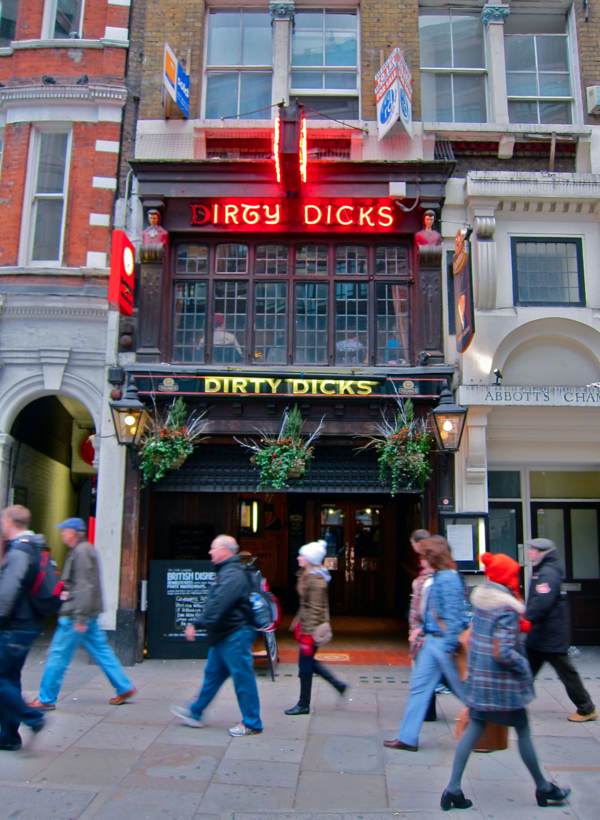
Photograph of City Corner Cafe copyright © Patricia Niven
Archive pictures courtesy of Bishopsgate Institute
You may also like to read about
Fred Iles, Meter Fixer
Book now for my tours through August, September & October

Fred & Marie Iles with Smudge
Fred Iles was born half a mile from his allotment in Stepney and his wife Marie grew up in Garden St that once stood where the allotment is today. They were married in St Dunstan’s, just across the road, and lived fifty yards away in Rectory Sq. As for Smudge, she is a local too and gave birth to two litters in the allotment shed.
Fred grows potatoes, cabbages, strawberries, gooseberries, runner beans and nasturtiums to draw the bees in his allotment, which is a small enclosure at the heart of Stepney City Farm. Surrounded by on all sides by other plots, this is a secluded corner sheltered from the wind where Fred can pass his time gardening peacefully in the company of his cat.
Fred had a good crop of strawberries this year and, while boney old Smudge patrolled the territory, Marie searched among the runner beans and discovered the first pickable specimens of the season.
“We never had a garden of our own. My grandfather Edmund lived with us when I was a child, he had come up to London from Bristol originally with two children and he ended up with four sons and three daughters. He was a great pigeon fancier and our backyard was all pigeon lofts where he kept three hundred pigeons – that’s a lot of pigeons. He was very successful at it and when he was dying he called me into his bedroom and showed me his box of medals and asked me to take one. I picked the silver one because it had a picture of a pigeon on it. There were gold ones I could have picked but I was too young to understand. He told me that Iles is a French name and that my ancestor fought in Napoleon’s army and was brought over to Bristol as prisoner of war and then stayed.
I was born in 1926 just half a mile from here in Hartford St, in a little cobbled yard called Wades Place. My father William was a seaman in his younger days and he went all over the world. I don’t know how he learnt about classical music but he was very knowledgeable and he used to play the Gounod’s Faust and Viennese waltzes on his harmonica for me.
I was here for part of the Blitz. It started on a Saturday afternoon at 3pm. I was in the yard and I heard the roar of the aeroplanes. I was thirteen and I thought it was our planes coming back, but it wasn’t. My father took me inside and we sat under the stairs which we thought was the safest place. I couldn’t see anything but I could hear the sound of the anti-aircraft guns and the engines of the planes and, at my age, I found it very exciting.
By the time they came back to bomb the docks, we had an Anderson shelter in the garden and we sat there listening to the sound of bombs dropping. My father decided it was too much and sent me and my mother and my sister to his brother in Oxford. He worked in the Morris factory which, at that time, was building aeroplanes and he got me job at fifteen making cowling panels for the side engines of Hawker Hurricanes. It was exciting work but it was miserable waiting in the cold for the bus to go to work at seven in the morning.
I got called up to the army on D-Day, June 6th 1944 and I was eighteen years old on my birthday, 30th June. They summoned me for 20th July, the day they tried to assassinate Hitler, so I had three weeks freedom before they put me in the army. By the time I’d learnt to shoot a gun, for some unknown reason they put me in the Royal Electrical Mechanical Engineers. I was posted to the anti-aircraft guns around London and then they sent me to an experimental laboratory in Shoeburyness where they were working on radar. I found I had an easy time for three and a half years until I was discharged in 1947.
I went to the Labour Exchange and the man said, ‘There’s not much going but I like the look of you so why not come and work on this side of the counter? And when a good job comes in you can get it.’ I worked there for six months, and my father was unemployed and he came in and signed on the dole. After six months, the London Electricity Board came along and I worked there for twenty-six years, at first in the office and then as a meter fixer.
When I started here at the allotment, it was quite hard. It was still a bomb site and I had to clear the bomb damage before I could plant anything. There were just six of us pensioners then and I needed something to do in my spare time. They retired me at sixty in 1986, but I started my allotment here four years before that. Smudge turned up on the allotment one day, fifteen years ago. And I thought ‘poor old cat’ and decided to feed it, so she made the allotment her home and now I have to come and feed her every day.”
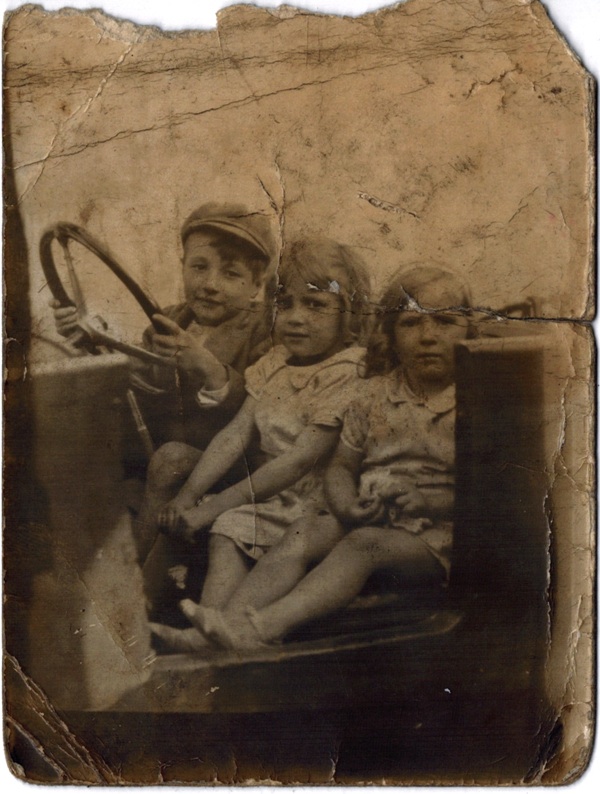
Fred aged five with his sister Phyllis and cousin Rosamund in 1931, taken by Griffiths in the Roman Rd

Fred in uniform at eighteen years old, 1944

Fred and his pal Gimlet in Shoeburyness

Fred stands at the base of the aerial in Shoeburyness.

Fred (left) enjoys a pint with Bernard & Jack at Shoeburyness in 1946

Fred (top left) with pals on the beach at Shoeburyness
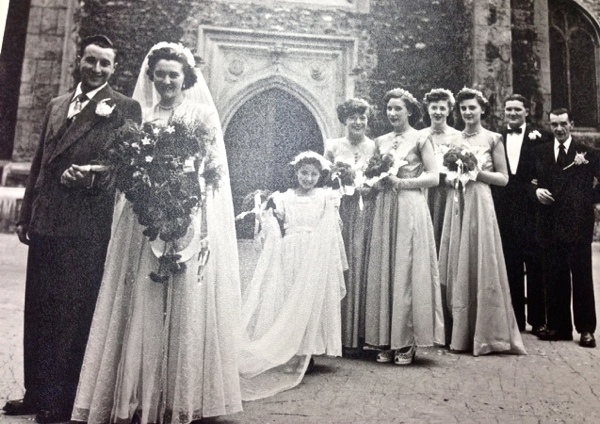
Fred & Marie get married at St Dunstan’s Stepney, 1st August 1953

Fred & Marie on their wedding day.

Fred in the seventies.
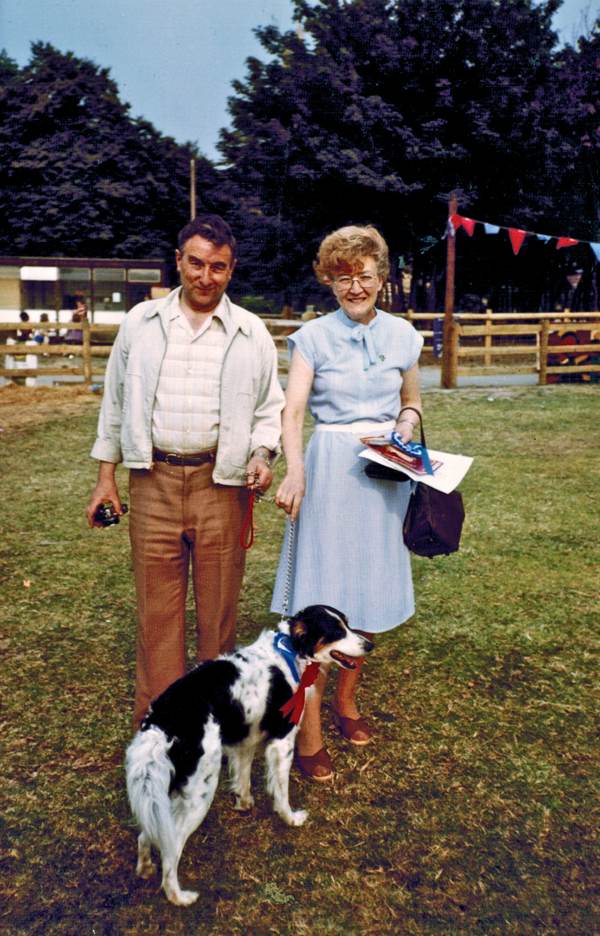
Fred & Marie with their prizewinning dog Rufus, in July 1984 at Stepney City Farm – when Rufus won the dog with the waggliest tail and best mongrel.
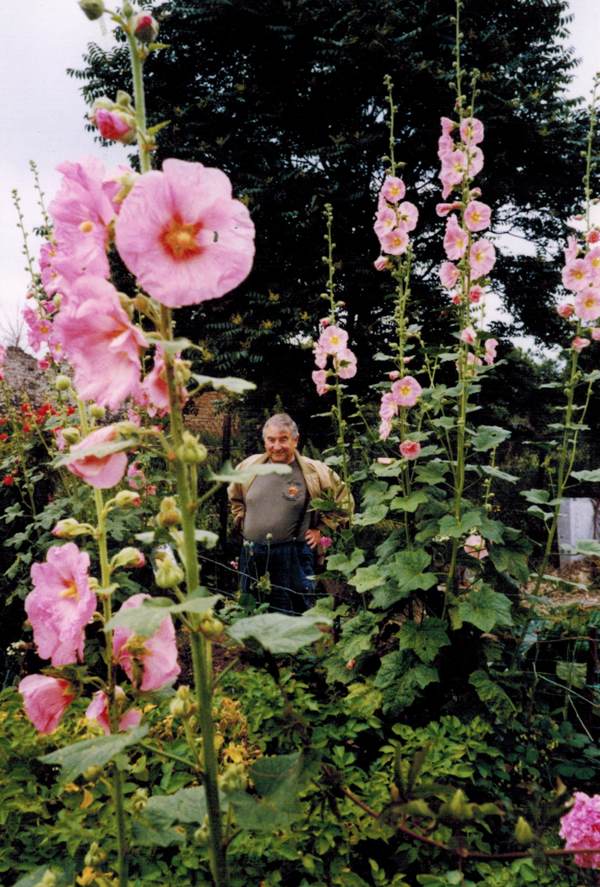
Fred grew some magnificent hollyhocks on the allotment in the nineties
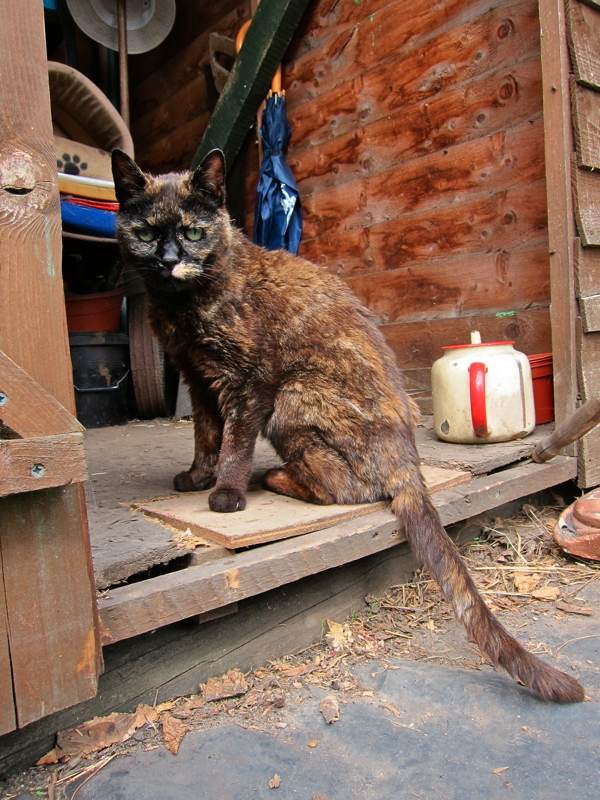
“Smudge turned up on the allotment fifteen years ago. And I thought ‘poor old cat’ and I decided to feed it, so she made the allotment her home and now I come every day to feed her.”

Fred and Smudge
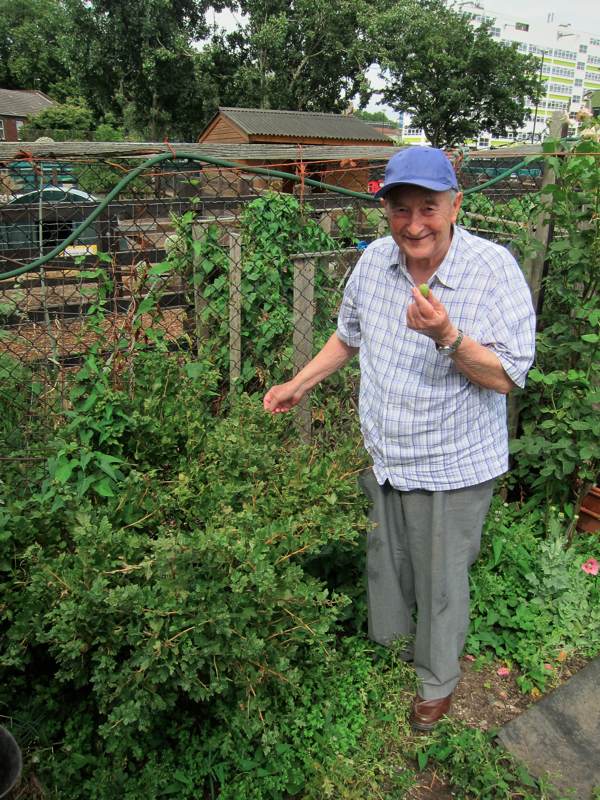
Gooseberry time in Stepney

Fred & Marie Iles celebrated their sixty-fifth wedding anniversary in 2018
Stepney City Farm runs a Farmers’ Market every Saturday from 10am – 3pm, selling food from local producers at affordable prices.
You may also like to read about












