
At Robin Hood Gardens
Today’s story is the fifth of seven features by Contributing Writer Delwar Hussain and the first in a series of three related stories exploring the fate of Robin Hood Gardens housing estate in Poplar
Like many superheroes, Robin Hood had a thing for coloured tights and strange headgear. In common with other fantasy figures, Robin also had a favourite colour – in his case green – and spent his time opposing the tyranny of the powerful elites. Yet unlike some of his fictional colleagues, he did not have special powers, no flying or ability to become invisible. Instead, he had a merry band who stole from the rich and gave to the poor. The theme of his ‘Adventures of Robin Hood’ series has these lyrics:
- “He came to Sherwood Forest with a feather in his cap
- A fighter never looking for a fight
- His bow was always ready, and he kept his arrows sharp
- He used them to fight for what was right.”
I would like to imagine that Alison & Peter Smithson might have hummed along to these lines if the show came on their grainy black and white television set in their architecture studio in the sixties. The pair had been charged with designing a public housing estate in a neighbourhood of Poplar that would become ‘Robin Hood Gardens’ and it was a highly appropriate name for their project.
The tale of Robin Hood proposes an allegory of the Welfare State and the redistribution of wealth of the few throughout the whole of society, based upon the belief that everyone, regardless of how much or how little they have, should have free access to the basics of healthcare, education and a home. More than an ambitious idea, it was a revolutionary endeavour.
Yet, less than fifty years after the first families moved into Robin Hood Gardens, it is to be torn down as part of the £500 million Blackwall Reach Regeneration Project, which might equally be described as a redevelopment, a land grab or an act of social cleansing – depending upon your point of view.
The undertaking is a joint venture between Tower Hamlets Council and Swan Housing Group that will see 1,575 new homes built over ten years. When Swan’s bid was accepted by the Council in 2011, it was on the basis that half the homes would be ‘affordable,’ yet Swan’s website now says the majority will be for the rich and just a third, only 560 homes, will be social housing.
Earlier this year, a group of architects failed in an attempt to get Robin Hood Gardens listed, protecting the buildings from demolition. Consecutive campaigns led by residents have been ignored by the Council and their calls for refurbishment of the buildings rejected.
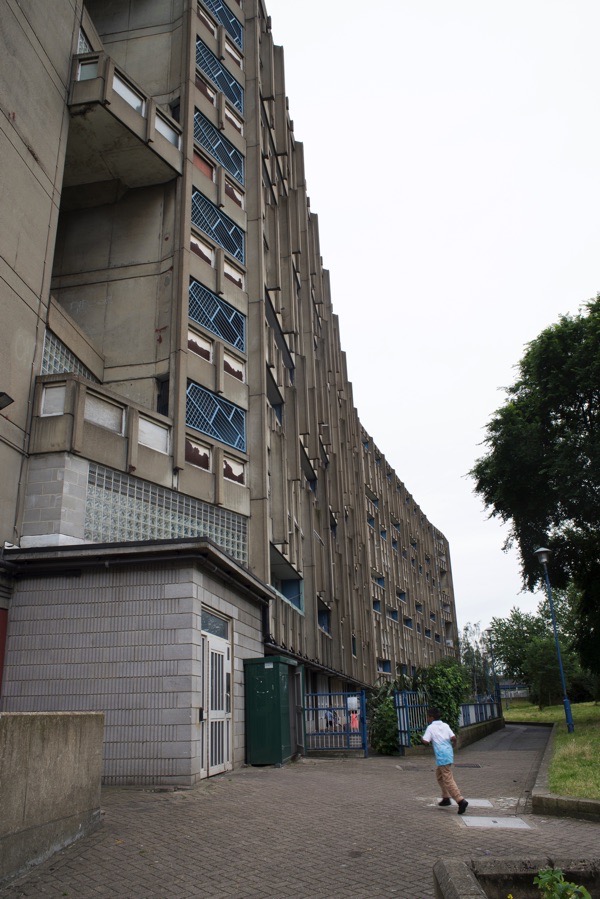
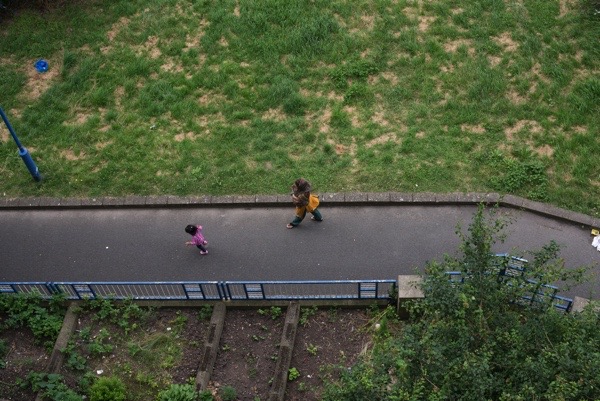
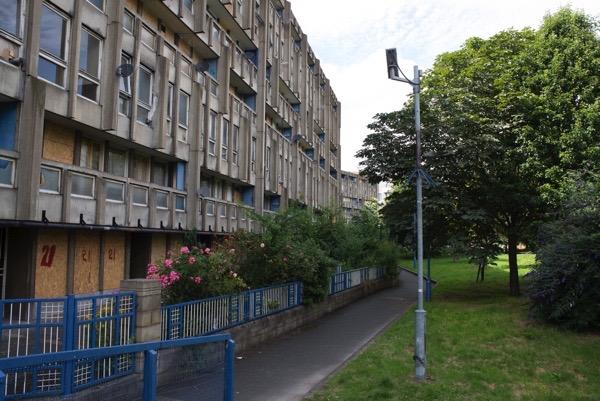
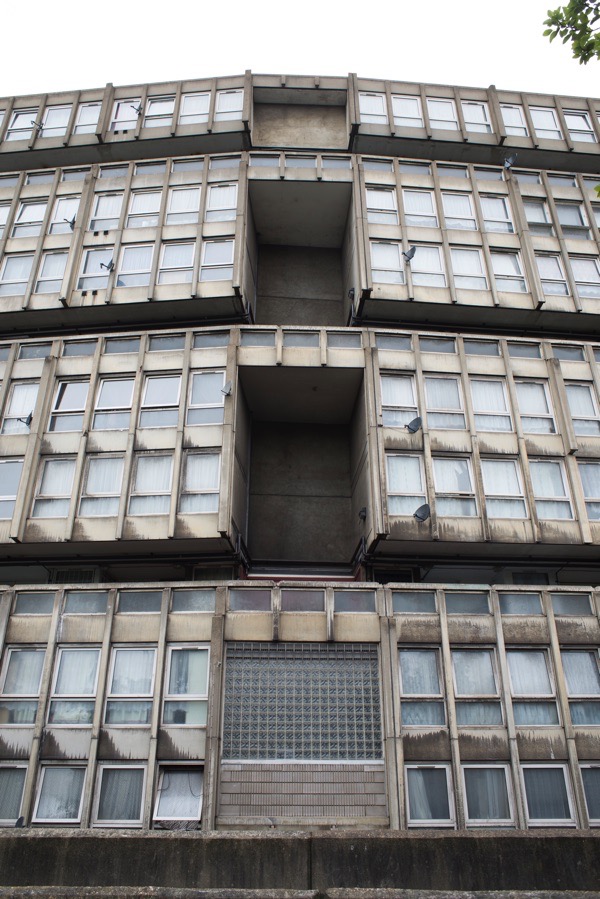
It was a listless day when Contributing Photographer Sarah Ainslie & I visited Robin Hood Gardens. The sky was so low you could almost touch it, yet the pair of long concrete buildings that the Smithsons created were truly a sight to behold. Conceived in the ‘Brutalist’ style, they face each another across a garden with a mound in the centre. They are beasts of buildings, grotesque, petrifying even – but alluring and sublime at the same time – as if you were gazing up at a sheer rock face or the protective walls of a medieval fortress built to keep out marauders.
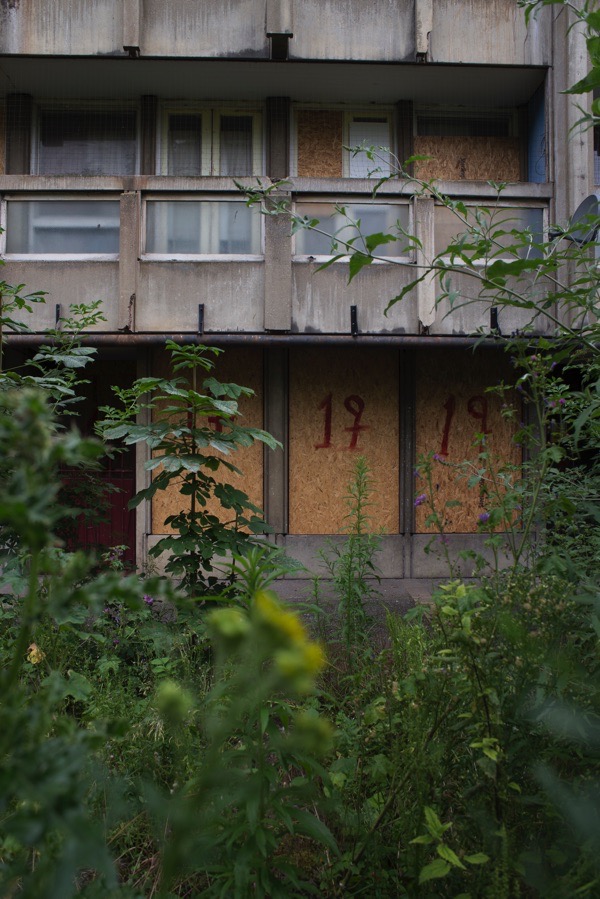
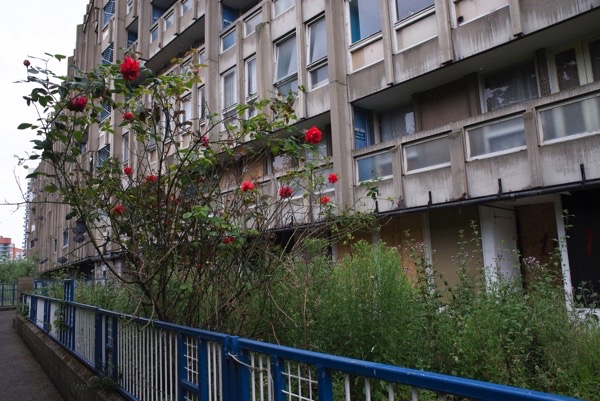
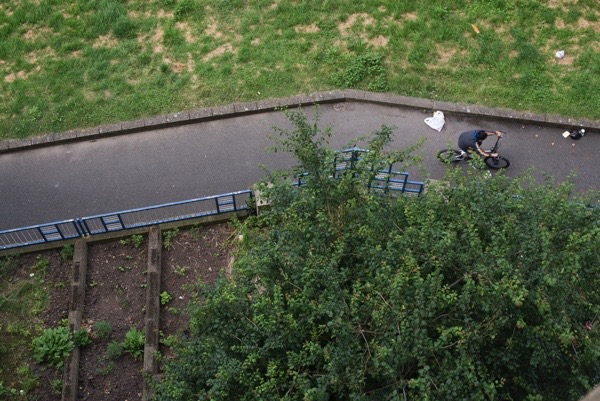
We walked around the periphery of the first of the edifices which houses flats 1 to 104. Deserted now, the residents have already been dispersed or – to use the official jargon – ‘decanted.’ The doors have been boarded up and numbered haphazardly with red paint like plague dwellings, while in the gardens roses, lavender and parsley continue to grow in spite of their abandonment.
Satellite dishes clung to the concrete walls like fungus. It made me wonder what the exodus looked like when the residents departed. Notices warning of ‘Potential Asbestos Hazard’ have been put up deter would-be intruders, even though the inhabitants lived alongside this implied threat for years
One motive for support of the ‘redevelopment’ among some residents was the Council’s lack of maintenance of Robin Hood Gardens. It was a comment I heard over and over again from residents and those who once lived there. I found old graffiti – Mick your mum – intermingled with more recent examples – ROTEN – with the second ‘T’ missing for lack of space and – TORN. Through the grimy windows, the accoutrements of everyday life were still visible where exposed light bulbs dangled like nooses, while the different styles, colours and textures of curtains and wallpapers echoed the former occupants, revealing their personal tastes and aspirations.
Pinned to a lamp post was a weathered notice dated 25th October 2015, stating that the Blackwall Reach Compulsory Purchase Order 2013 submitted by Tower Hamlets Council had been upheld by the Secretary of State for Communities & Local Government. The order gave the go-ahead for the Council’s compulsory purchase of flats. The purpose of the order, the notice said, is ‘for carrying out development, redevelopment and improvement of the area’ to ‘contribute to achieving the promotion or improvement of the economic, social or environmental well-being of the area.’ Yet this ominous notice failed to mention who the eventual beneficiaries of the improvement will be.
Standing in the shadow of the building, I noticed a strange silence, existing in spite of the constant traffic entering and leaving the nearby Blackwall Tunnel which gushes around the estate like a river. The Smithsons’ original design included concrete sound buffers but they could never have envisaged how the area would be transformed by the Canary Wharf development that surrounds Robin Hood Gardens today.
Outside the estate playground there was another notice, warning children to be wary of strangers. A boy in a baseball cap walked past. The boy and this stranger looked at one another. Taking no notice of the sign, he talked to me. His name was Adil. He appeared to be about thirteen years old. His grandmother lived in the now-deserted building before she was re-housed in autumn of 2015, he told me.
He pointed to the shiny, pre-fabricated flats just over the road where she now lived. This is part of what Swan call ‘Phase 1a’ of the project, where two andoyne new blocks housing some of the decanted residents from Robin Hood Gardens. Phase 1a also includes the construction of a new mosque, playground and a community centre.
‘Is your grandmother happy in the new place?’ I asked.
‘I don’t know,’ Adil replied, ‘She can see her old flat through her new windows and she keeps saying how the old building is full of her memories.’
‘What sort of memories?’ I queried.
‘You know. Of living here, raising my mum and my aunt, that sort of thing.’
‘Do you know when these buildings will to be knocked down?’ I enquired.
“I don’t. I don’t think anyone does, but my grandmother said that the football pitch and the park in the middle will stay.”
‘You must be happy about that?’ I suggested.
‘Maybe? Depends if we’re allowed to still use them,’ he replied.
I told Adil I would like to speak to his grandmother about her memories and wrote my phone number on a piece of paper for him. No sooner did he leave than the strange silence descended again yet I picked up another sound. It was faint but I was sure I heard it. I strained my ear to listen for it again. There it was – a beep – every minute or so, coming from the belly of the building and echoing around the empty carcass. It was a smoke detector in one of the flats, waiting to have its battery replaced. Like a pulse, a heartbeat, it was calling out to tell anyone passing that the building was alive. It was still living.
The second of the two buildings is taller than the first and houses flats 105 – 214. Most of this is still inhabited and the smell of warm spices pervades, but there is something about it that gives off the sense that it has been condemned. When Secretaries of State and Members of Parliament have written you off and global capital investment is circling, you do not have too many options left, other than a miracle or a superhero, perhaps.
From here too, the sounds of life continued to reverberate, refusing to be quietened. I heard the voices of London in Sylheti, Polish, Somali and English. ‘Kelly you’re getting on my nerves,’ someone shouted. Someone else was doing DIY, hammering into a concrete wall, unperturbed that the building was destined to be cleared and knocked down.
A man in a pair of sunglasses opened the main door and I asked whether he will allow us in.
‘You architects?’ he enquired in a thick cockney accent.
‘Do we look like architects?’ I smiled.
‘There have been loads coming and going recently.
‘No, we’re just curious about the community here and what they will do when these buildings are knocked down.’
‘I’m looking forward to it,’ he stated adamantly, ‘It’s about time. There are people here ‘chasing the dragon’ in broad daylight. I’ve been coming here for the last twenty years but have lived here for the past five and the problem has just got worse.’
‘Will knocking the building down solve the drug problem?’ I suggested.
‘Probably not, but I have neighbours who never use the staircase, they don’t know what they will find. Hopefully the new place won’t be like this…”
‘Aren’t you worried about being moved out of the area to somewhere you have no connection to?’
‘If we’re moved to Birmingham…?’ he queried.
‘Birmingham?’ I interrupted, ‘I was thinking of Stratford or someplace like that.’
‘I know some people who have been moved to Birmingham, that’s just the way it is.’ he assured me, ‘I have a full time job and need to live around here, but to them, it doesn’t really matter where they are – they don’t have jobs, they’re claiming benefits, they could do that from anywhere.’
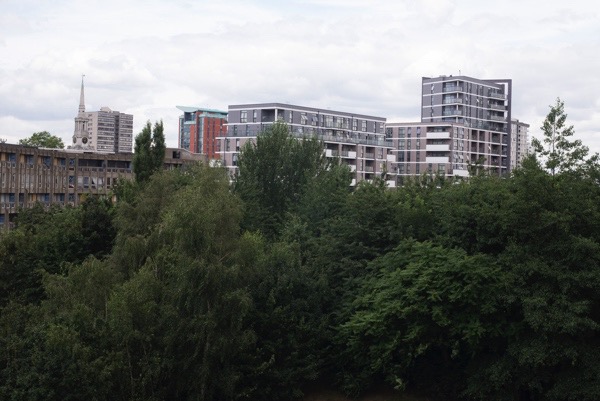
Sarah & I took the lift to the top floor. On one side, we saw Canary Wharf, the Millennium Dome, the Emirates Cable Car, the Olympic Park and Balfron Tower (another Brutalist building in Poplar built as social housing, yet now being sold privately as luxury flats). From the other side, past the garden and the abandoned building, the views are telling. Ahead, in the City, grows a forest of gleaming towers including the Shard, the Grater, the Gherkin and the Natwest building. They loom over Robin Hood Gardens as if to assert, ‘Give it up, your time is up.’
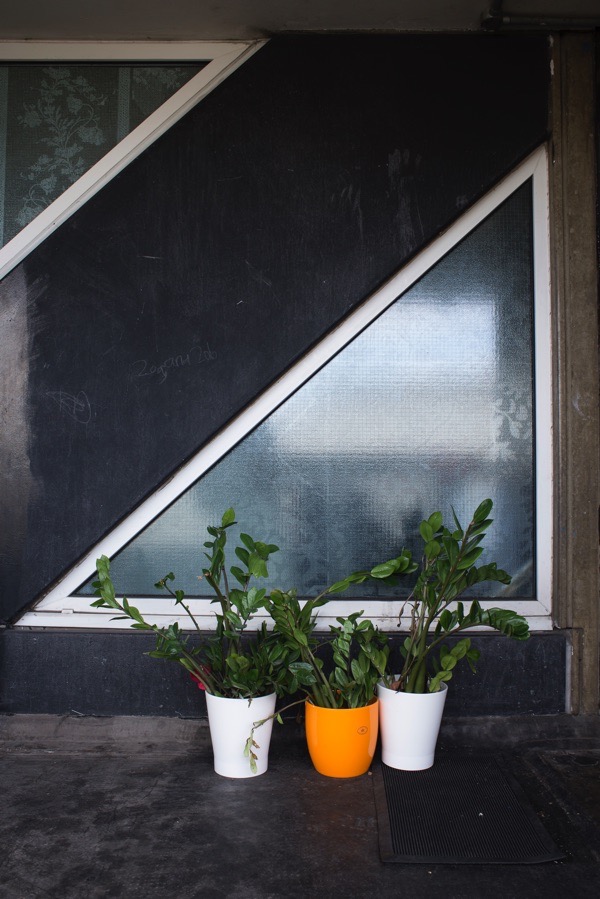
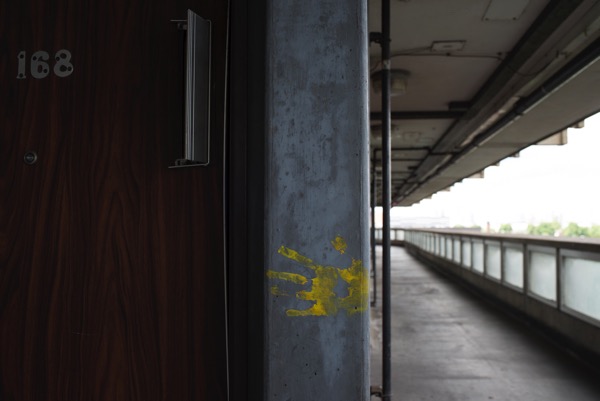
All along the large, wide landing, not one door was the same as another – they had all been personalised. Stickers on windows proclaimed ‘Back the Bid – Olympics 2012’ –‘Burglars Beware’ and ‘I’m helping to save lives:lifeboats.‘ There were coconut trees growing in plastic pots, a chilli plant here and a lemon tree there, all healthy and thriving.
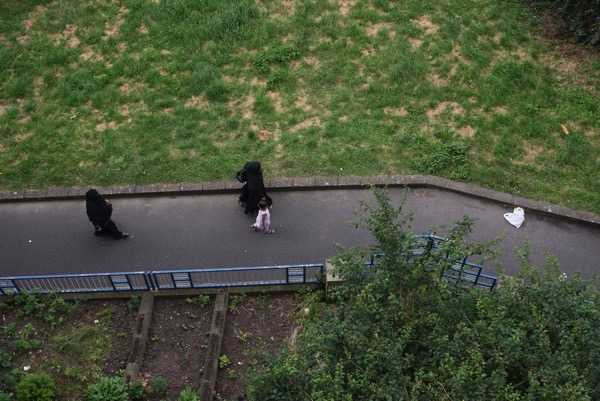
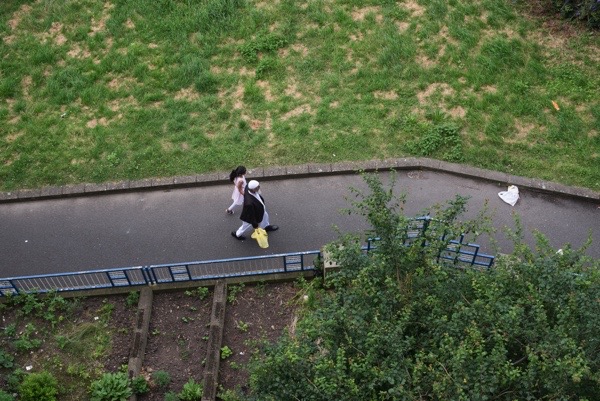
Back outside, we encountered an old lady in the gardens pulling clumps of a tall plant out of the ground. She wore a black hijab with strands of her grey hair concealed below a canary yellow scarf. She explained that she had grown the mustard and come back to pick it. She lived on the second floor of this building, raising six children there before she was decanted across the road into the same new building as Adil’s grandmother, the boy I had met earlier.
‘At Robin Hood Gardens, we had space,’ she said, without stopping what she was doing, ‘We had a breeze, we had light, but now we are living in boxes, that’s what the new place is like. I’m on the ninth floor, can you believe, an old lady like me?’
‘What do you think of Robin Hood Gardens?’
‘Some people thought it ugly but I found it beautiful. They didn’t fix anything so that’s why it’s in the state that it’s in. I always said that if they spent the money to fix it and not knock it down, then that would be better, but who am I to be heard, nobody? These buildings were solid, built to last until the end of time. The new ones aren’t like this – in ten years time they will say that they too have gone bad and knock them down.’
‘So why did you leave?’
‘We had to. Unless we took the flat they offered, there was no guarantee – they said – that we could continue living in this area. But once the new buildings are completed, we will be allowed to come back. They showed us the paperwork. We are just temporary over there in those buildings, not legal. We will be back.’
I did not understand what she meant when she said she would be back once the new buildings were built. Much later, I discovered that all kinds of promises were made to residents to bring them on side, including a promise that they would be allowed to move back into the new flats that are to be built.
‘What will you do with the mustard plants?’ I asked.
‘I’ll keep some and I’ll give some to the people who now live in my flat in Robin Hood Gardens,’ she admitted, ‘They are a nice family. I tell them that I lived there for twenty-one years and no-one knows more about the flat than I do. They don’t mind me visiting. They give me tea and ask me how to fix things there.’
(This feature continues tomorrow)

Click to enlarge this panorama of Robin Hood Gardens

Photographs copyright © Sarah Ainslie
You might also like to read
The Gentle Author At Libreria
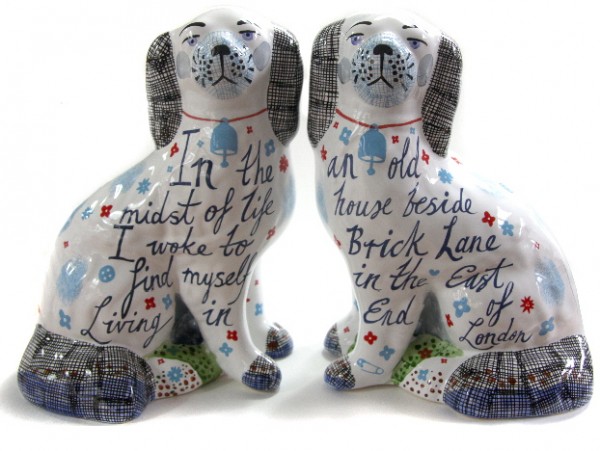
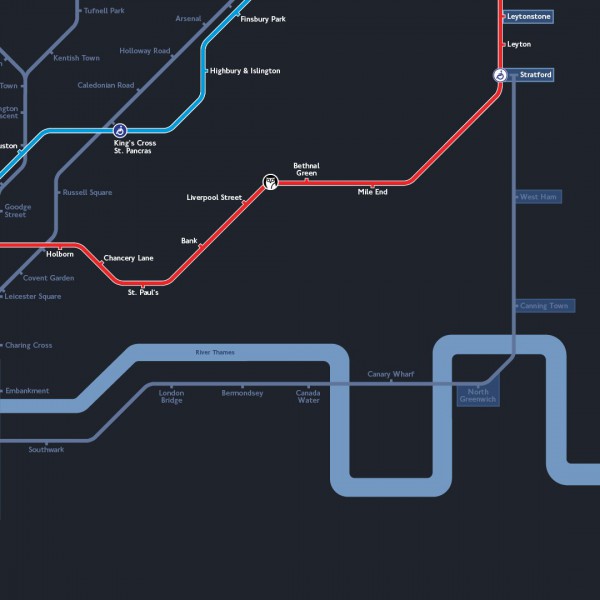
To celebrate the inauguration of the all-night tube this Friday 19th August, Libreria bookshop in Hanbury St will be opening twenty-four hours with authors doing readings until dawn. At 9pm, I shall be reading some of my stories of Spitalfields and night owls are welcome to come along. Admission is free and complimentary whisky will be served to encourage you to stay through the small hours.
Halima Blacker, Make-Up Artist
Today’s story is the fourth of seven features by Contributing Writer Delwar Hussain
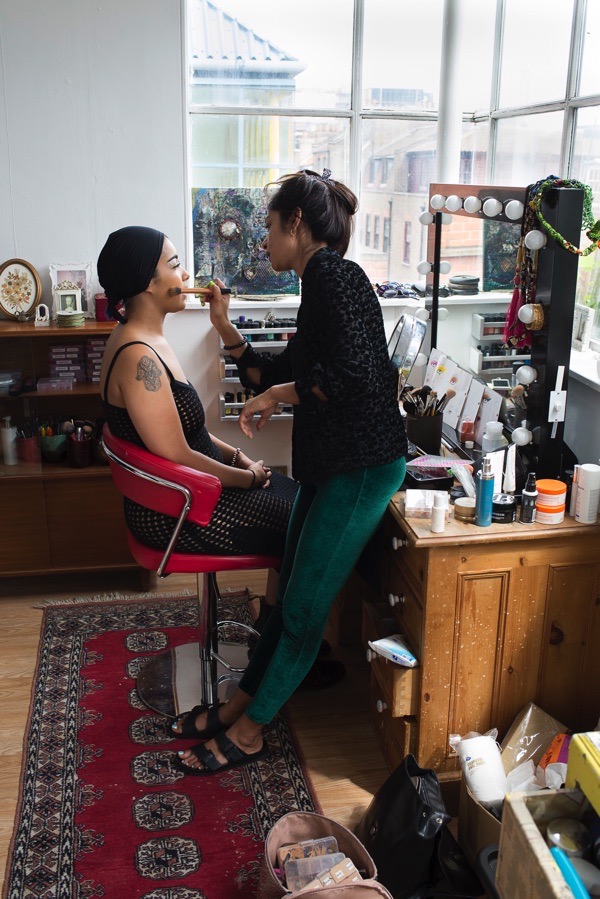
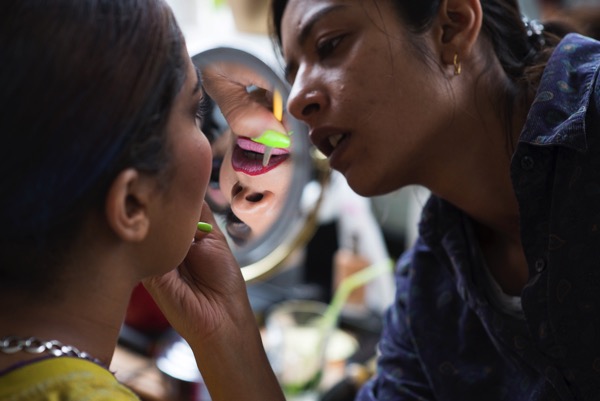
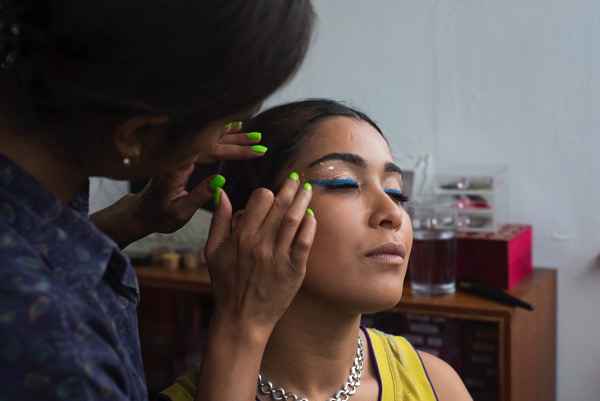
Halima Blacker is perched on the edge of the table, head tilted to one side, mouth ajar. Like a surgeon with a scalpel, she draws a line over an eyebrow with absolute precision. In her other hand, smeared in colours that resemble bruises, she holds a palette of paints.
Halima is a make-up artist and we are in her attic studio overlooking the rooftops of Brick Lane. Her friend Zahra Idrissi, whom she is working on, is a soul singer and lives a few streets away.
Around them, the table as well as the rest of the room is overflowing with containers crammed with brushes and sponges, pens and bottles, tubs, tubes, jars, vials and trays. There are racks of liquids and powders, things that squirt, others that spew, some that pump, or burst or spray. They have names like Liquid Suede, Intense Retinal Fluid, Liquid Metal, Le Style Ultra Slim & Aqua Cream. Colours range from cyan or peach tornado to jungle and soft ochre. There are brushes that look like spring flower buds, others that resemble the heads of little birds or the tails of furry creatures.
Halima mostly works in silence even though reggae music plays from a mobile phone. At one point, she stops and she and Zahra talk about Grace Jones, Kim Kardashian and the Hottentot Venus all in one breath. The process is intimate, tactile and visceral. Quick, delicate waves and sweeps across a cheekbone, a cotton bud below an eye to merge colours together and finger tips to pat colour in. All of this is occasionally broken up with instructions for Zahra.
“E” Halima says.
“EEEEEEEE,” Zahra repeats, stretching her mouth as far back as possible so that she can apply colour on the contours of her lips.
“Don’t blend yet, it needs to dry.”
Zahra keeps her mouth open but has stopped EEEEEEing.
“Ok, blend….” Halima instructs.
Zahra brings her lips together and gently squeezes them, smudging the various tones together to make a different shade from the ones applied.
“……that will make the colour pop,” Halima says, “like you’ve had a raspberry and it’s stained your lips.”
With another look, I watch as Halima takes a honeycomb stencil, places it onto Zahra’s forehead and dabs it with fluorescent pink powder.
“That’s done,” she announces. “It’s messy, but I like it.”
“Really, what about my lips,” Zahra asks, confused.
“I’m drawing them on your hands.”
“Oh really,” Zahra replies, “that’s ‘sick,’” and they both burst into laughter.
Zahra now looks part-reptilian, part-something-that-has-emerged-out-of-sixties-Pop-Art-or-nineties-Acid-House. But it is not finished until she puts her hand with the lips painted on it next to her mouth in the style of The Thinker by Rodin and suddenly it all changes. It reminds me of Picasso’s, Weeping Woman or Woman Wearing Yellow Hat (Jaqueline). Yet Halima’s work is not static, or one-dimensional on a canvas, or – in this case – even on a face. It moves, acts and reacts. Zahra pulls her phone out and makes a video of herself and uploads it onto Snapchat giving it new life and incarnations.
It may be too easy to say that what Halima does is an extension of the graffiti that lines Brick Lane where she has lived all her life, but it emerges out of the same place and time. She is not limited to just faces or hands either, her studio is packed full of jewellery that she also makes. It all blends different styles and forms – from Fine Art to Performance to Craft, as well as urban street culture, music and fashion.
Halima tells me that she has been making people up since she was six, when her older sister gave her lipstick samples from Avon. She remembers painting her cousin’s faces, doing different themes and, from that, she progressed to weddings.
“Brides usually want to look as different to their real self as possible,” Halima says. “They want a defined nose, sculpted cheekbones, chiselled this and highlighted that. They want to hide what they think are their imperfections. The funny thing is that they always say they want it natural, but this requires a huge amount of make-up.”
Today Halima works on music videos and fashion shoots, yet it is her own work that she feels most connected to. “I use make-up to create something, rather than just to make someone beautiful or blend in. I love colour and I love experimenting with texture. I like using make-up to communicate whatever I’m feeling. People may feel free, but looking at what they put on their faces you can see that they are trapped. I hear people say that they have never put green on their face – for example – or blue, which I find strange. I think what I do helps them to express a sense of freedom.”
Halima stamps Zahra’s mouth with an ink pad. I ask what it says on it.
“The world of reality has its limits but the world of imagination is boundless.”
“Don’t focus too much on what it says,” she tells me, “I’m using it more for how it looks” – yet I like these words, they are entirely appropriate.
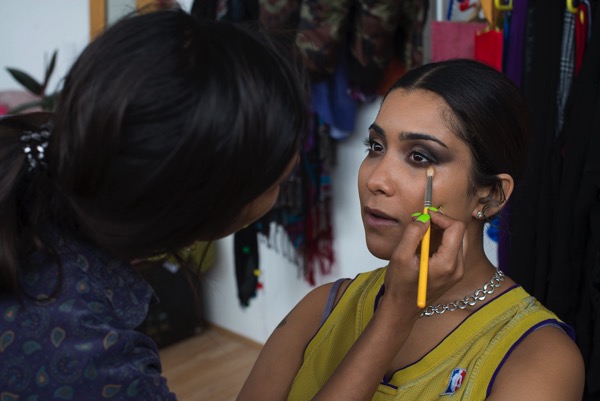



Halima Blacker
Photographs © Sarah Ainslie
Arrange your make-up session with Halima at www.makeupsurgery.net
You may also like to take a look at
David Fried, Artist
Today’s story is the third of seven features by Contributing Writer Delwar Hussain
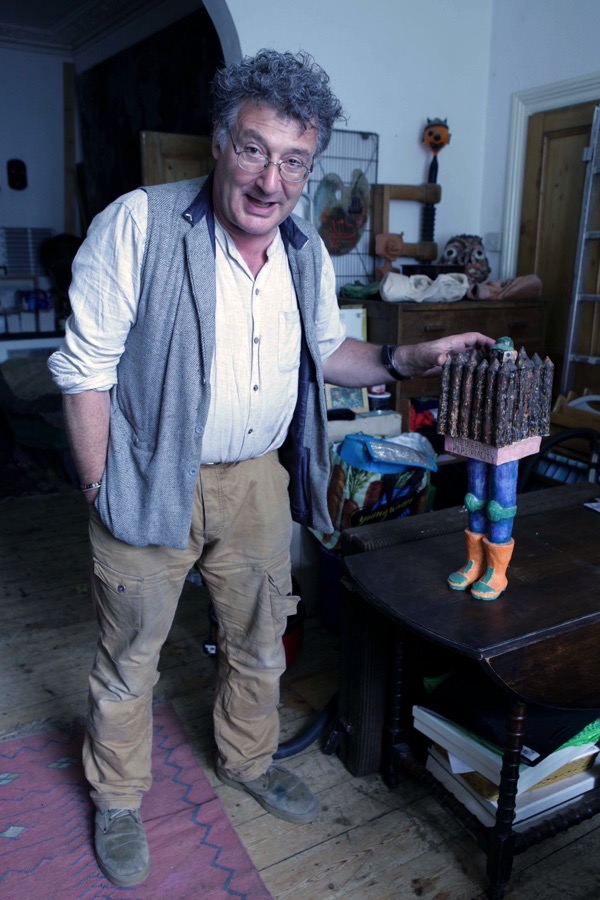
Dave with The Defended Personality
Dave Fried is an Artist that works part-time as an Art Therapist with people who have mental health issues. Contributing Photographer Colin O’Brien & I are drinking tea in the kitchen of Dave’s Victorian house in Stoke Newington where he has lived for the past twenty years. As Dave talks, I observe his hands. He pinches his thick thumb and forefinger to emphasise a point, opens his palms out to the ceiling when explaining something, taps the table with a middle finger, points into the air, rubs the left hand with the right, clasps them together and slides them in between his thighs.
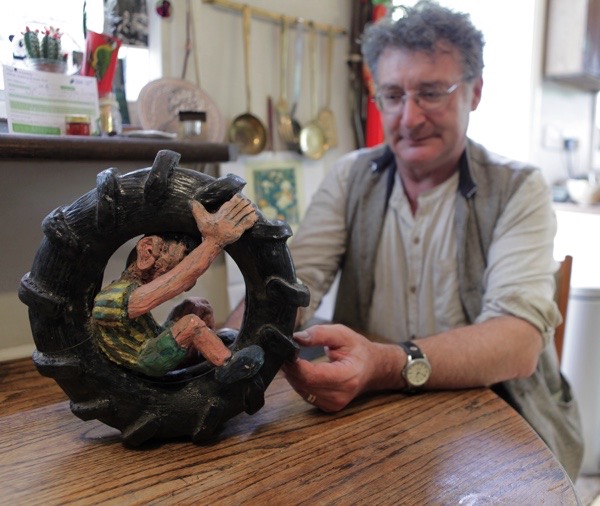
Next to the kitchen table is a ceramic sculpture of a boy inside a tractor tyre, a memory from his childhood when he used to roll down hills in them. Dave has made the boy in the tractor tyre repeatedly in many different forms, including drawings and paintings.
“I like making things properly,” he tells me. “A lot of artists have other people to do their stuff and they become ‘art managers.’ Sometimes I show my works, sometimes I sell them, but really for me, it’s about making them – that’s the pleasure of it.”
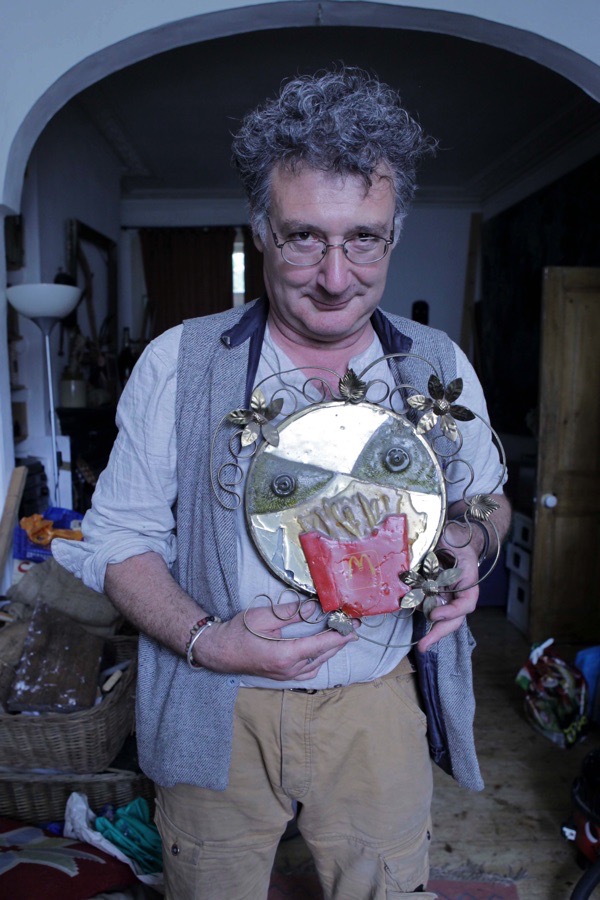
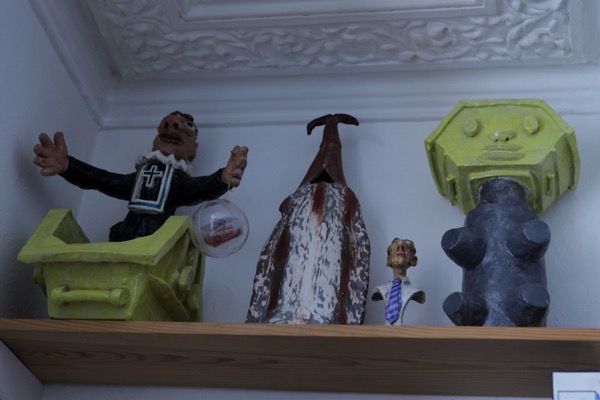
Dave’s artwork is placed all around the house – paintings, drawings, etchings, ceramics and sculptures. He takes me around, pointing to this drawing and that installation in the hallway, and the sculpture in the garden. They feel tactile, you want to pick them up, touch them, turn them over and discover what might be underneath. He is constantly experimenting with materials and styles, but the process is always the same he says, “I make a mess first then attempt to find and create order out of the confusion.”
In the sitting room, with its ornate plaster cornice and marble fireplaces are books, records, motorbike equipment and a washing machine. There is a small painting hanging on a wall besides the window. ‘The Milkman’ was painted in 1973 and was the first oil painting he ever did. It is of a man in a blue uniform and hat, who looks like he could either be a figure of authority or just a harmless milkman holding two pints of milk, or even a boy playing the role. Dave says the painting is yet to be finished, but so many years have passed since he began that he would not know where to start again.
“My art allows me to externalise things I am thinking and feeling,” he says. “I use it to communicate my ideas and thoughts. If I didn’t do it, I would go crazy. I think my work has a sense of humour, a little dark perhaps, and some people find it a little bleak or disturbed.”
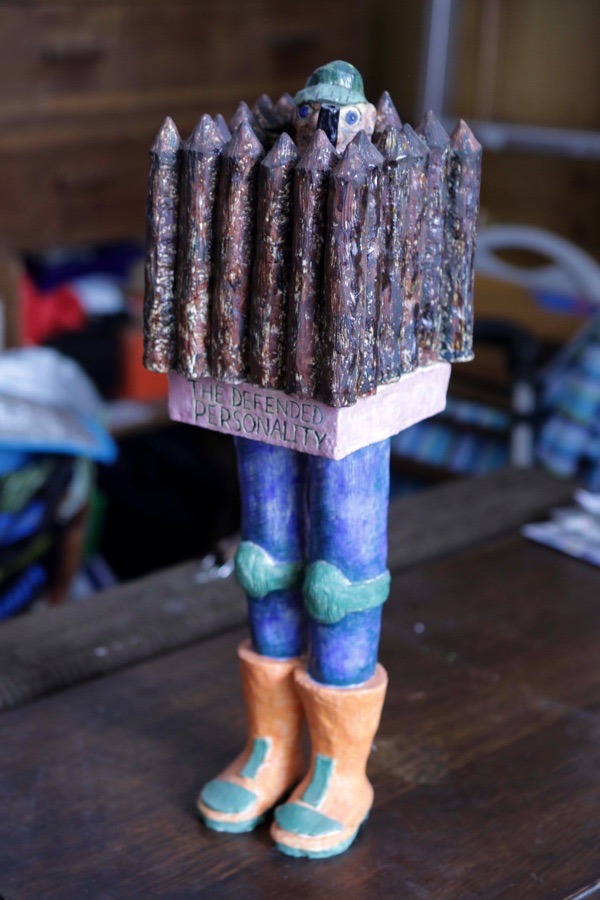
On a book shelf is a sculpture of what looks like a watchtower with the head of a figure carrying a rifle popping over the top. It has ‘The Defended Personality’ etched onto it. Dave reaches over and takes it off the shelf. The watchtower is held up by the legs of the figure, so that it is both a figure and a watchtower.
“We all have defences for a reason – to protect ourselves, we don’t want to be vulnerable” Dave explains. “But some people are so defensive of themselves and their personality that it’s like they are inside a fortress. If you are so defensive that no one can get in and you can’t get out, then it becomes a prison of sorts, a trap.”
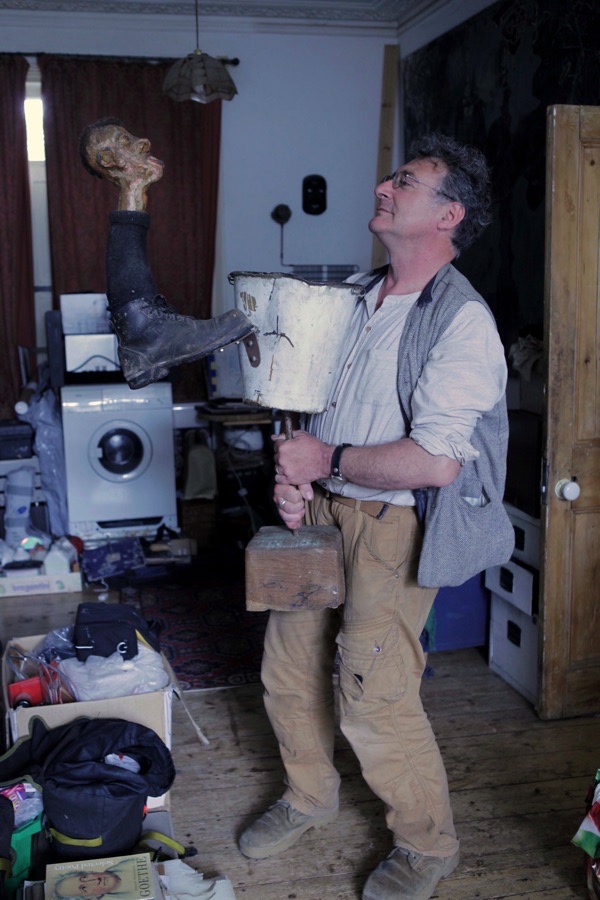
Dave bends down and picks up another sculpture. It is called ‘Kicking the Bucket’ and is an example of his dark humour. A white bucket has a black boot sticking out of it and, at the end of this is a human head baring its teeth. Dave made it soon after the death of his father who, along with his mother, Dave’s grandmother, had come to London in 1938 as a refugee escaping the Nazi Holocaust. Most of the family that did not get out were killed.
There is an oil painting of his father that Dave has just inherited leaning on top of a speaker in the sitting room. The likeness between the two is apparent, but then I realise something. Dave’s figures – whether they are painted, drawn or sculpted – nearly always have great, big bulging eyes, overly large hands and faces on a relatively small body. They are in-between or a combination of boy and man. They have similar expressions on their faces, either deceptive, suggesting that they are in the middle of a fit of laughter, or grimacing in abject pain.
Ambiguity exists in other forms too, apparent with the sculpture of the boy inside the tyre. This image has connotations of freedom and movement, a lack of restrictions, but there is also something slightly sinister about it. The tyre only gives an illusion of freedom because it will dictate how you will roll down the hill.
Back at the kitchen table, Dave talks more about his childhood. He speaks steadily, rhythmically, thoughtfully. His voice is deep and heavy. He was born in London but grew up in Copenhagen with his mother. He says it was a difficult time in his life. His parents got divorced and he had a fraught relationship with his mother’s new family. He experimented with drugs and was sent to a child psychologist. Eventually, at the age of fourteen, Dave returned to London to live with his father.
As well as being a poet, writer and translator, Dave’s father Erich Fried was a member of the German intelligentsia, a Marxist, a Bohemian and a Humanist. Dave remembers people coming to the house in Kilburn every day. They were characters he describes as being “profoundly lost,” disaffected young Germans and also older survivors of the war and its aftermath, wanting to start a revolution or seeking guidance.
“My father spent much of his life trying to understand how a civilised society could enact mass murder in the way that Germany did. Like so many of his generation, he was haunted by the Holocaust and the Second World War. He talked about it every day, how totalitarian regimes dehumanise people and then do anything they want to them, including mass extermination. They discussed endlessly how Hitler had been elected democratically and then did away with the democratic system altogether, and about the logistics of the Holocaust.”
Erich and his life experiences exerted a profound influence upon Dave. The things that he saw and heard, Dave says, were too much for a teenager to know and, in the process, they undermined his sense of security. I look at Dave’s hands, now resting on his lap. When Erich died in 1988, Dave says it left a void in his life and in the lives of others too – and maybe Art can only begin to fill it?
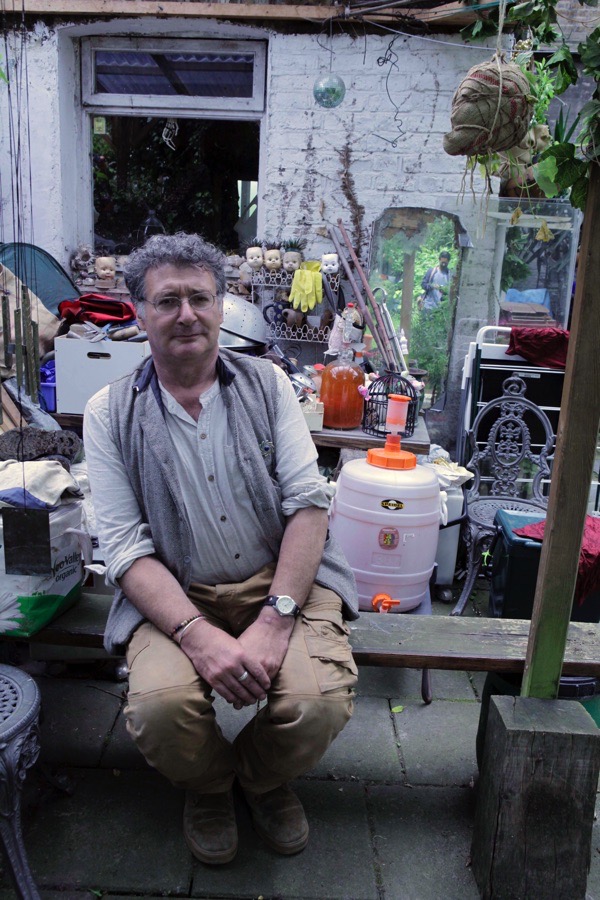
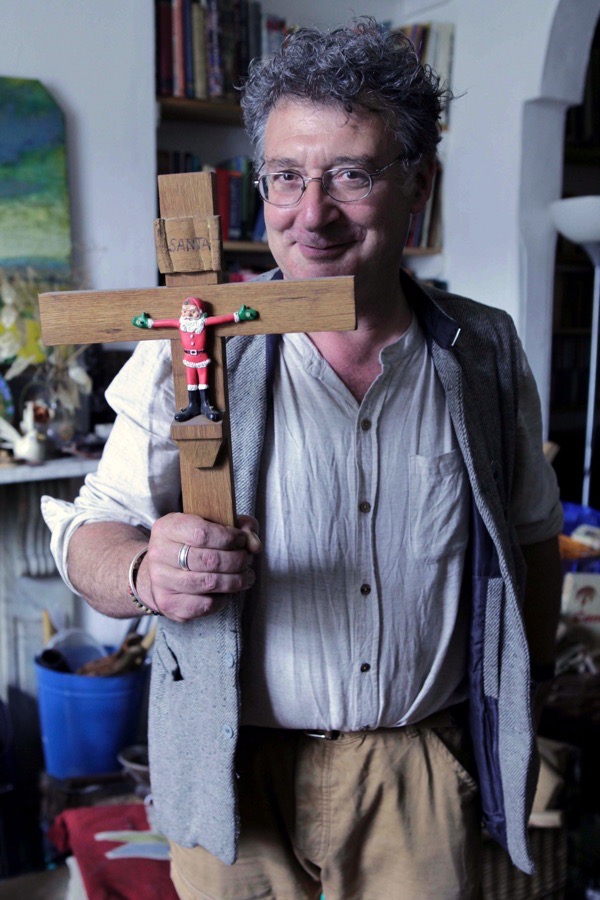
Dave Fried
Photographs copyright © Colin O’Brien
You may also like to read
Shanaz Begum, Custodian Of Stories
Today’s story is the second of seven features by Contributing Writer Delwar Hussain

Shanaz Begum admitted that she had been rifling through the family albums in anticipation of my arrival with Contributing Photographer Sarah Ainslie. She found plenty of old black and white studio portraits of her parents wearing flash seventies sunglasses, shots of uncles and aunts in platform shoes, and snaps of cousins in eighties and nineties attire. But, out of the entire collection, she could find only one picture of herself with Ayesha Khatun, her dadi (grandmother).
It was taken in 1987 during Shanaz’s birth ceremony, a few days after she was born, when the azaan is whispered into a baby’s ear and hair shaven off the head. The strands of hair are weighed using the measurement for gold and the equivalent in money is donated to charity. In the photograph, a freshly-shorn and oiled Shanaz is held by one of two grand aunts, while her dadi sits on a low stool on the right.
Shanaz remembers her dadi did not like having her picture taken and there are only a few of her. She always said, “Why waste the film on me when you can take pictures of other people?” if anyone pointed a camera in her direction.
Yet this photograph was not what Sarah & I had come to see. From out of the wardrobe in her bedroom, Shanaz took out an unassuming plastic bag with leopard spots printed on it. It was the contents of this bag – full of memories and silences – that we had come to discover.
Carefully, Shanaz pulled out what look like sarees from the bag. They had once belonged to her dadi. Pealing the delicate layers of silk away, she revealed a little white box and a black woollen shawl, folded neatly. It had been handwoven by Manupri women in Sylhet where her dadi was born in 1940. As far as Shanaz knows, her dadi kept it her whole life and wore it at all times of celebrations, including weddings and Eid. “Why does Shanaz keep it in this plastic bag?” I wondered.
“It’s the same bag that dadi kept them in,” Shanaz answered, “She was a simple woman and I store her things in it because it preserves her smell.”
“Here,” she offered and I leant forward and took in a lungful. The shawl smelled faintly of attar (incense). “What does it smell like to you?” I asked, and Shanaz picked the shawl up and buried her face in it.
“It evokes warmth to me,” she replied, coming up for air. “It reminds me of her home on the Boundary Estate where she lived for more than thirty-five years after she moved to London to be with my ‘dada’ (grandfather). It brings back memories of growing up in that flat, living with my uncles, aunts and cousins, and of cuddling up to my dadi, and of the bond my mother had with her. She was a small woman but she had a fiery soul, and I can still smell it in this shawl.”
The first and – so far – the only time Shanaz wore her dadi’s shawl in public was when she was nominated for an award. Shanaz works on women’s education projects at Mulberry School for Girls where she was once a pupil. It was 2012 and by then her dadi was already unwell, the cause of her illness had been kept a secret among a select few by her family.
“In need of reassurance and confused as to why I was on the list of nominees, I spoke to her about my feelings and she said something I will always remember – ‘there is no-one who is your superior and no-one who is your inferior.’”
Shanaz won the award and was invited to tea at Buckingham Palace. “It made sense to wear the shawl at the occasion,” she said, “I wanted to embody both the grit and grace of my dadi.”
I watched as Shanaz opened the little white box that also lives in the plastic bag. Inside is a gold necklace. As she laced it through her fingers, Shanaz smiled and said that she and her dadi had the same hands. “Others in the family have slender, long fingers but I was blessed with her short stubby ones.”
In order for her dada to come to London in 1965, Shanaz’s dadi sold her gold wedding necklace to pay for his plane ticket. She did not tell anyone what she had done, Shanaz says, since people would have found it shocking. Married women are expected to wear the gold necklace until their husband dies, when they take it off forever. Thirty years later, dadi’s second son bought this necklace as a replacement.
However, unlike the shawl, Shanaz has never worn the necklace. “Gold is important for an older generation of women but I don’t like it very much,” she explained, “I’ll wear the necklace on my wedding day so my dadi can be present and because my mother will insist but, for younger women, it doesn’t have the same significance as it once did. My dadi and my mother didn’t have the same freedoms as men and were only valued on the basis of how much gold they had but, for my generation, we don’t need gold for validation. We have degrees and we have jobs but, most importantly, we have a voice. We can speak up.”
The very last time Shanaz’s dadi wore the necklace was two weeks before she died. She had taken it off, as she had done each time she went to the hospital over the previous five ears. “She had blood cancer,” Shanaz revealed, “By the end, she just gave up. She didn’t want to fight anymore. You could sense it. But she was only seventy-years old. She was so young.”
Today, as the eldest of thirty grandchildren, Shanaz has been invested with the role of being the narrator as well as the caretaker of her dadi’s stories, passing them on so that they continue to live in the world. I ask Shanaz what she would like to pass on to her children.
“The shawl and the necklace have so much significance for me but really I just hope my daughters will recognise the lineage they are a part of, and see my mother as a strong and as loving a person as my dadi.”
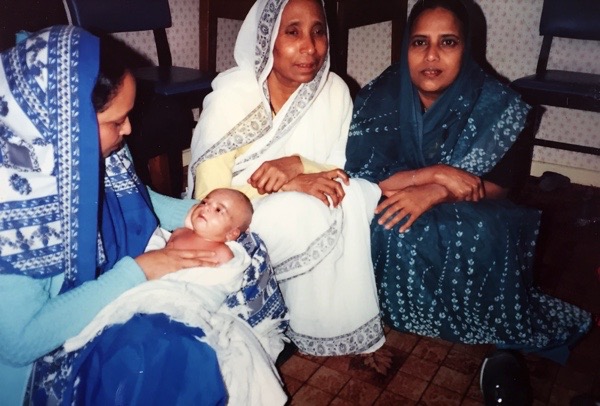
Shanaz’s birthing bath, 1987
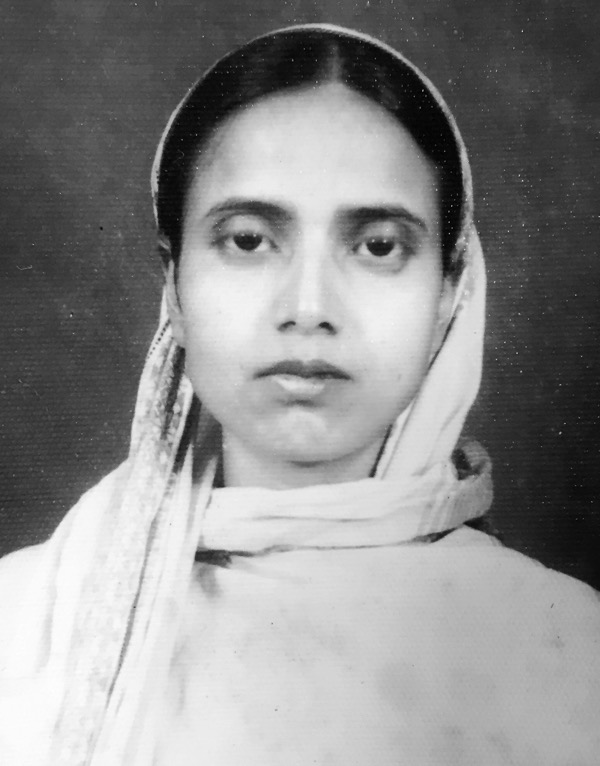
Ayesha Khatun, Shanaz’s grandmother, 1972
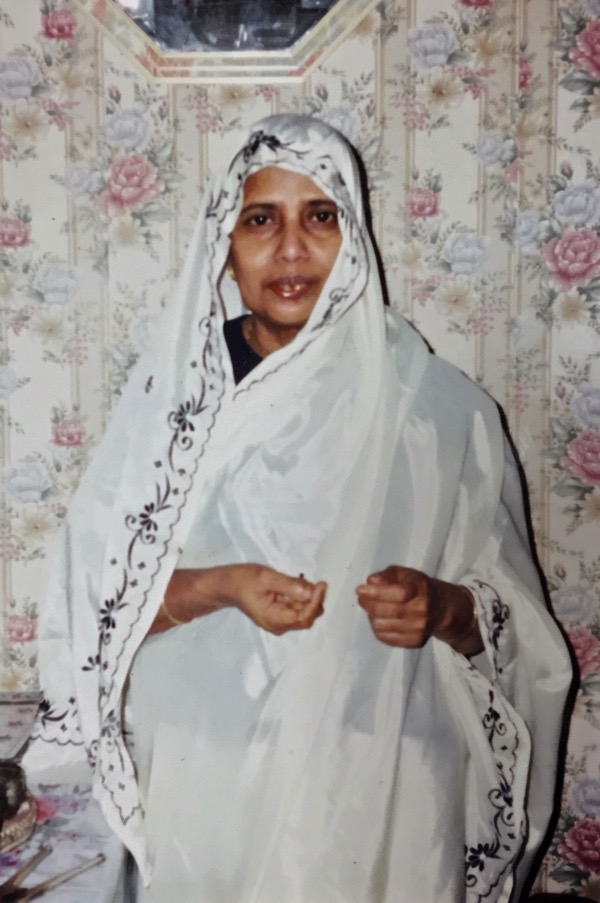
Ayesha Khatun, 1996
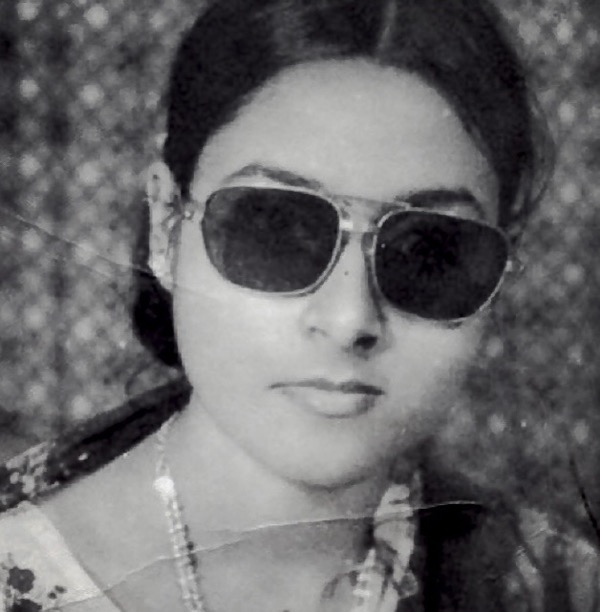
Shelly Choudhury, Shanaz’s mother, 1980

Shanaz and her mother today
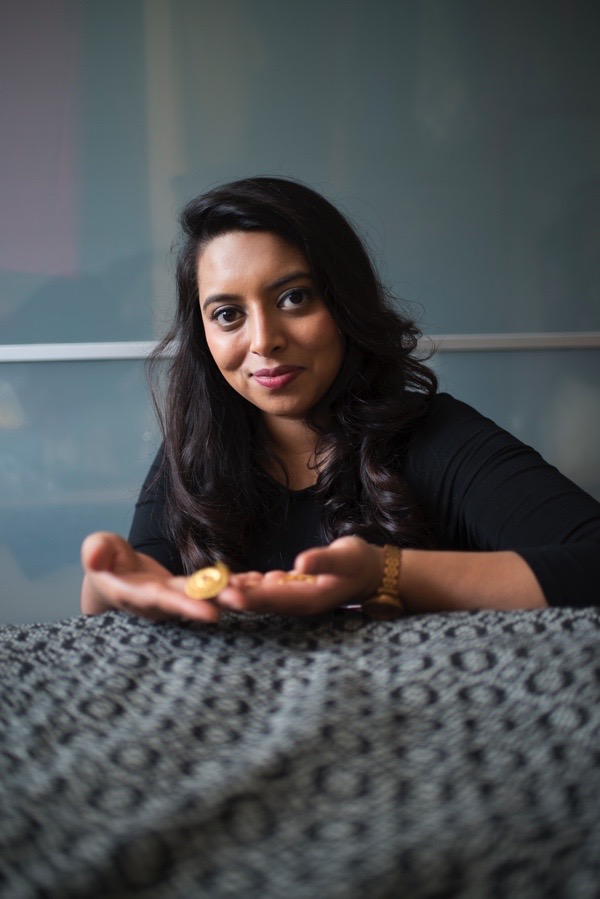
Shanaz Begum
New portraits © Sarah Ainslie
You may also like to take a look at
The Jungle On The Corner Of Princelet St
Today’s story is the first of seven features by Contributing Writer Delwar Hussain, commencing with this childhood memoir of growing up in Puma Court, Spitalfields, in the nineteen-nineties
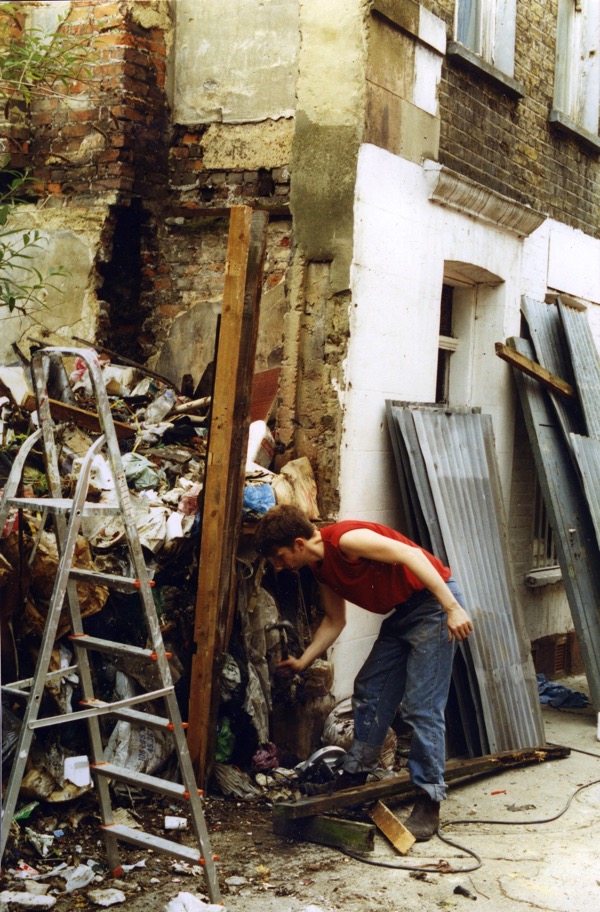
Simon Chambers at the entrance to the ‘jungle’
Next time you walk through Spitalfields, stop at the junction of Princelet St and Wilkes St. Stand with your back to Brick Lane and look closely at the house on the right hand corner. You may be surprised to learn that buried beneath 1 Princelet St is – or rather once was – a ‘jungle.’
Let me take you back to the early nineties when Spitalfields was a place of abandoned buildings, bustling warehouses and overcrowded factories. There was no house on the corner of Princelet St and Wilkes St. It was literally a bomb site and piled with rubbish at least ten feet high, forever threatening to topple over onto passersby. A neighbour, Charlie Brandt who lived at 13 Wilkes St, overlooking the corner, built a fence out of timber and corrugated sheets, yet still the rubbish accumulated.
A plan to clear the rubbish and make a garden upon this site emerged. Like many things, no single person suggested the idea yet organically it came together. The plan was discussed between neighbours and, slowly, things began to happen. History had become piled up in front of us, so we set ourselves the challenge of making a new start.
It took five skips over a period of several months to clear the rubbish from the site. At the very top were plastic shopping bags of domestic refuse, chair legs and glass. Amongst these were syringes, balls of aluminium foil and used condoms. Then followed waste from nearby garment factories, rusty sewing machines and bags of shredded leather and cloth. Underneath it all, rubble and concrete from the Georgian building that had once stood there.
In 1993, I was a shy, introverted thirteen year old. I spent much of my time with the family cat Sheba and thought swearing was one of the worst things a person could do. I dreamt about being a ballet dancer and I did secret and exclusive performances for my siblings in my bedroom. I rarely left the house except to go to the Whitechapel Library to borrow Nancy Drew novels.
Whilst helping clear the site, I met youth workers, teachers, unemployed people, restaurant waiters, a storyteller, single parents, factory workers, a prostitute and other kids. These were the people who lived and worked in the surounding streets, with personalities and histories of kinds I had never encountered before.
Recently, I spoke with Simon Chambers who squatted 3 Princelet St, about what he remembers from that time. I met Simon just before the ‘jungle’ begun and, over the proceeding years, he became my oldest friend. “We had to clean out the space because rats were coming into the house and we asked the council several times to do it, because it was their land, but they refused. So we decided to do something about it ourselves,” he told me.
When the last of the skips was full, I remember all of us standing in the empty space, confident about what we had done but quite unsure as to where we were headed. Yet before long the ‘jungle’ began to take shape. I do not know where the name came from. Maybe it was a reference to the amount of rubbish or, possibly, an over-estimation of what we were going to create?
Neighbours donated soil, plants, bits of wood and tools. We built a wall using cobble stones that we found and Simon made benches out of railway sleepers. “In those days, people would dump all sorts of things that we could pick up. I found a great big door in Liverpool St that had been chucked out when a building was being cleared. We used this for a fence and then painted the wood with engine oil because we thought it would stop it rotting,” he recalled.
After the initial euphoria, we held meetings to discuss what we wanted out of the ‘jungle.’ It was a cultivated place where everyone had a voice and everyone was listened to. Over time, participating in these conversations changed me from the person I had been.
We discussed what to do about the massive buddleia with its lilac flowers that had grown amongst the rubbish. With my newly-developed sense of confidence, I led the charge to cut it down. I wanted the jungle to represent something new, a break from what it had been, but Simon argued that the buddleia should stay, that it had grown while the site had been abandoned and had its story to tell – plus it attracted loads of butterflies. So the buddleia stayed and I did not spend too much time agonising over it, because there were plenty of other things going on.
We organised parties that spilled out onto the street. One autumn, we led a lantern procession from the jungle to the Spitalfields City Farm and performed our interpretation of the Guy Fawkes story. We even considered the possibility of doing an alternative version of the Ripper tours that were becoming popular then, with the idea of inviting tour groups into our jungle.
Sets of keys were necessary to get in through the fence. My younger brother Ali, who was also involved in creating the jungle, remembers the keys circulated in such a way that they were always available from one of the neighbours whenever they were needed. He used to go and chill with his friends in the jungle.
The jungle thrived, becoming the centre of the community. A tree was planted and a fishpond dug out. There were treasure hunts at Easter and fireworks at New Year. Ali and Simon remember the bonfires, when we cooked food together and sang.
Over time, there were differences of opinion about who the jungle was for, and when and how it could be used. Some neighbours were concerned that the jungle was being used by ‘unwholesome’ people and the keys were finding their way into the hands of those we did not know, and stolen car radios were turning up amongst the bushes. There was fear that the jungle might become similar to its adjacent plot, also a bomb-site, that was cleared and turned into a car park, where junkies took heroin and prostitutes brought tricks. Yet others said that they did not mind how the jungle was utilised as long as people were respectful of the place.
Such are my memories of the impressions which that time and place left in my mind. With hindsight, the jungle and the discussions it generated seem quaint compared to the monumental changes that were occurring around us. Towards the end of the jungle, in the late nineties, ruined and derelict houses became scarce in Spitalfields as they were bought up by the well-heeled, who fashioned them into the homes they imagined them to once have been.
In my mind, it was around this time that the presence of estate agents became pervasive, though they had stalked these streets for longer than I was conscious of. Our neighbours were changing. Tempted by wads of money, many were moving out. Sweatshop workers were kicked out. My friend Simon, who had lived in Princelet St for many years, was forced to leave too.
Many of the buildings were replaced and occupied by people whom we did not know and whom we rarely saw, who led an altogether different sort of life. A developer came knocking on the doors of the jungle too. No one I spoke with remembered precisely when this happened or the details of it, but the land was sold and the jungle was demolished along with everything it stood for.
I was not around to see this happen. By then, I had become a fully blown teenager, interested in other things. I made new friends with new excitements that took me away from the jungle. I turned my back on it, blotting it out of my memory in order to make room for the next phase of my life. My brother Ali cannot remember the changes either. “One day it was the jungle and next a house had been built on top of it,” he said to me.
Only years later when the streets around it had irrevocably changed, the ‘jungle’ and its existence came back to me, and I realised that the restless roots below 1 Princelet St grew from a different time, of different ideals, sensibilities and possibilities.
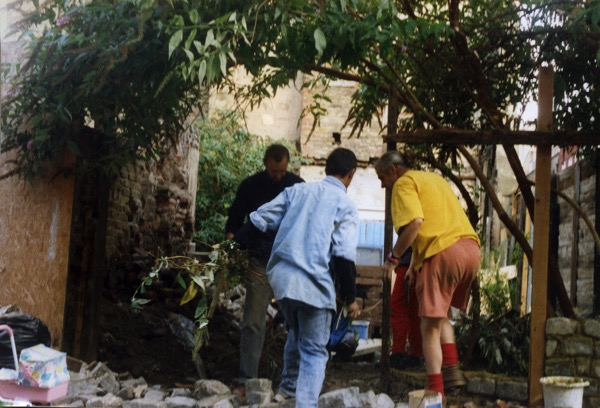
Delwar (in blue) assists neighbours in clearing the ‘jungle’
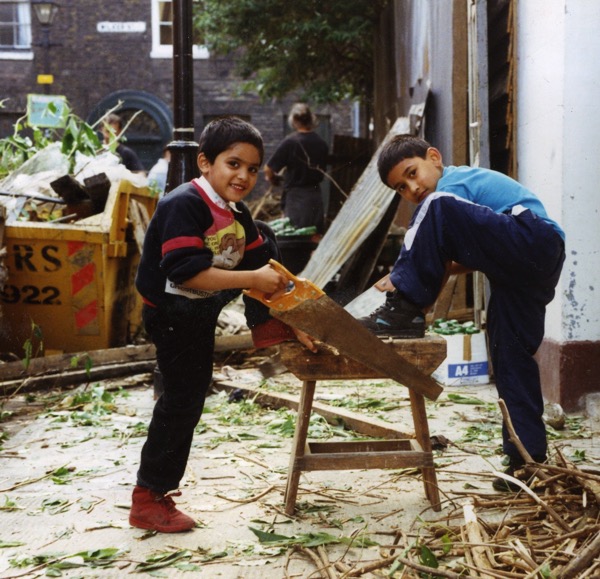
Iqbal Hussain and pal
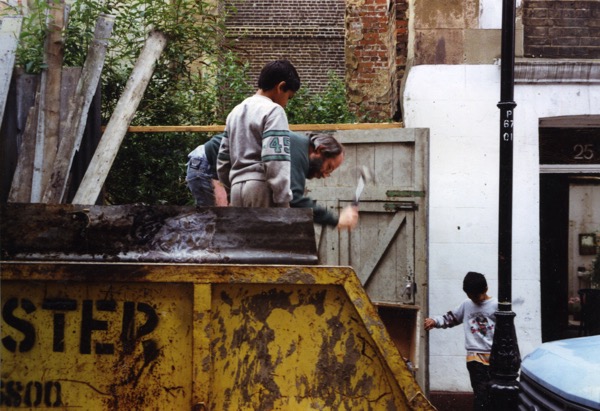
Charlie Brandt (resident of 7 Wilkes St with helpers)
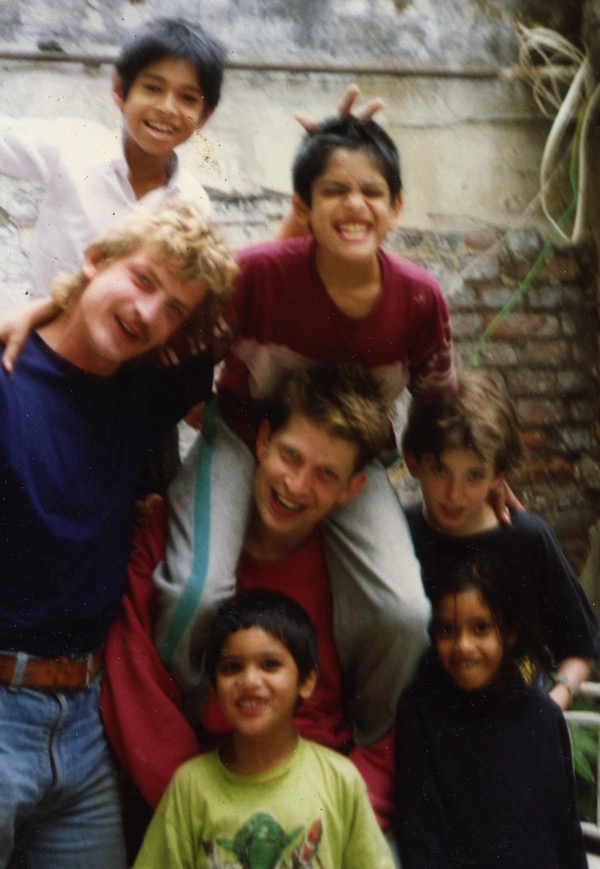
In the centre, Simon Chambers with Ali Hussain on his shoulders and Iqbal Hussain in front, Halima Hussain to the left, surrounded by neighbours in 1993
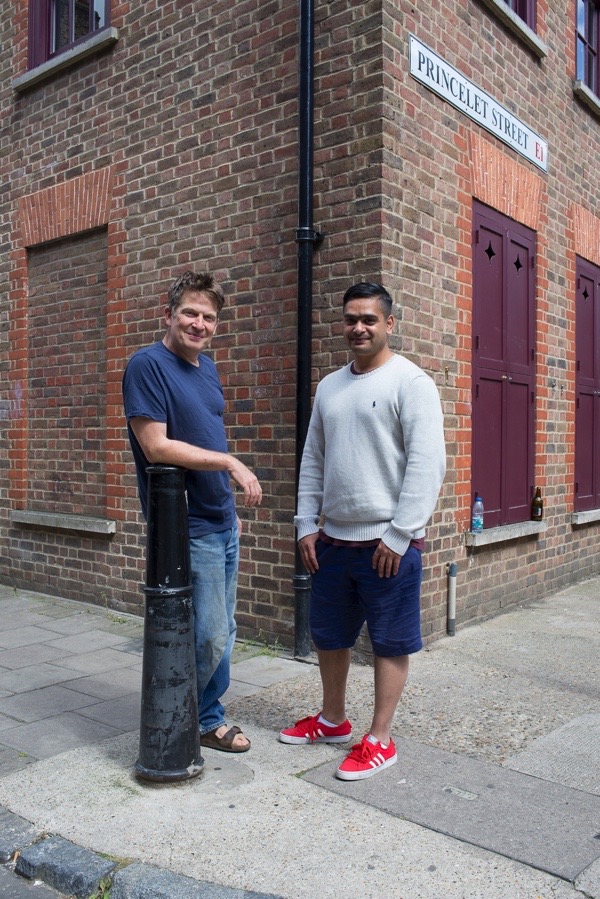
Simon Chambers & Ali Hussain stand on the corner of Princelet St today
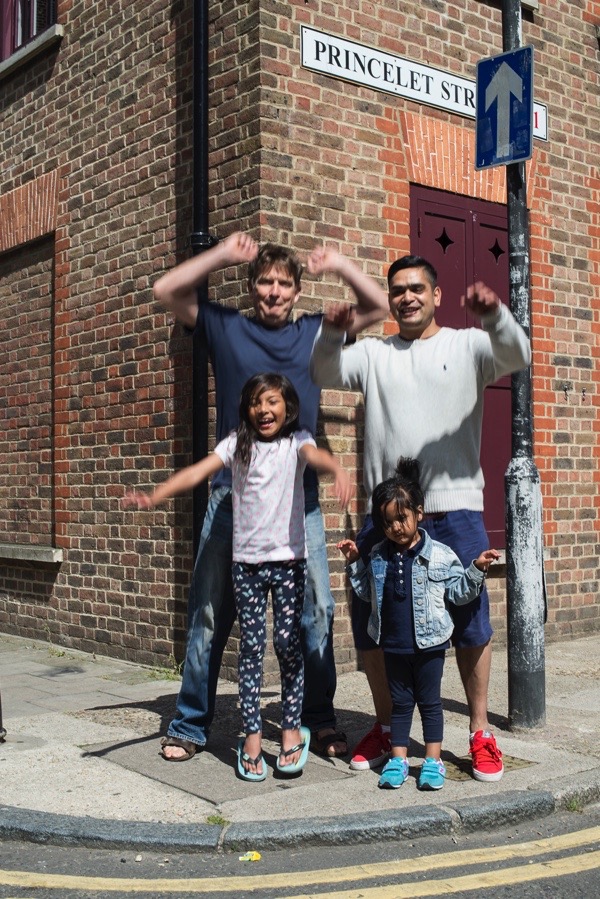
Simon & Ali with Ali’s daughter and niece
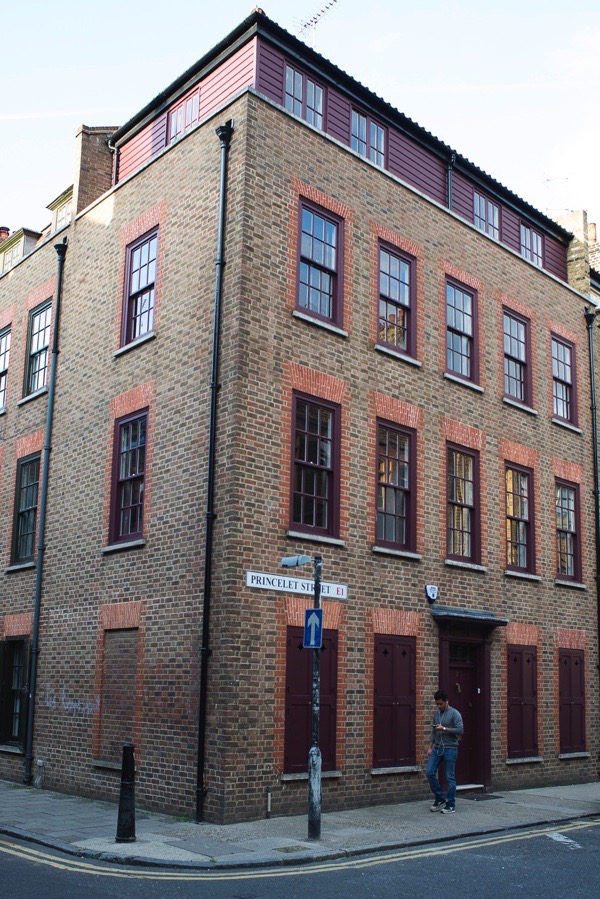
The corner of Princelet St & Wilkes St today where once there was a ‘jungle’
New portraits © Sarah Ainslie
Delwar Hussain is the author of ‘Boundaries Undermind: The Ruins of Progress on the Bangladesh/India Border’ published by Hurst
You may also like to read these other stories by Delwar Hussain
Inside The Model Of St Paul’s
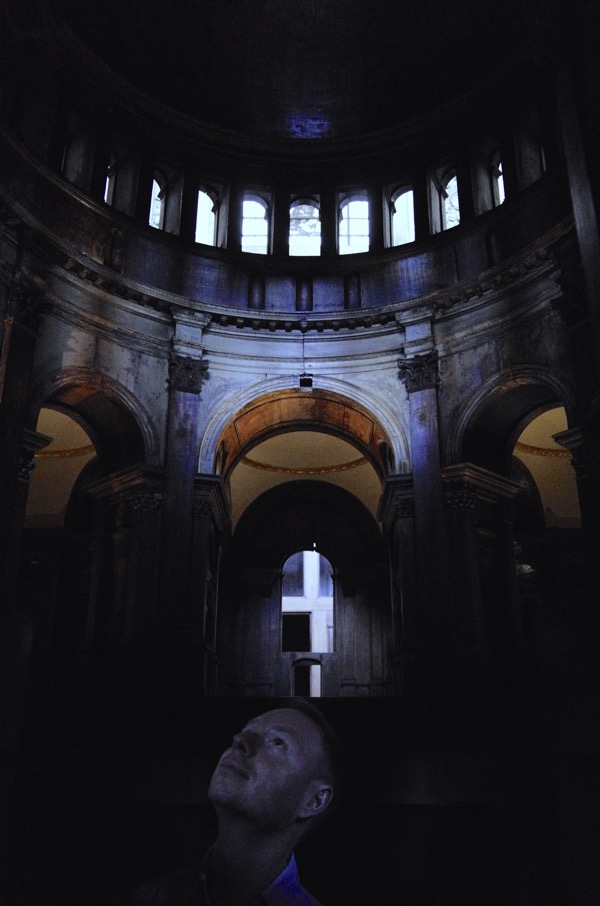
Simon Carter, Keeper of Collections at St Paul’s
In a hidden chamber within the roof of St Paul’s sits Christopher Wren’s 1:25 model of the cathedral, looking for all the world like the largest jelly mould you ever saw. When Charles II examined it in the Chapter House of old St Paul’s, he was so captivated by Wren’s imagination as manifest in this visionary prototype that he awarded him the job of constructing the new cathedral.
More than three hundred years later, Wren’s model still works its magic upon the spectator, as I discovered last week when I was granted the rare privilege of climbing inside to glimpse the view that held the King spellbound. While there is an austere splendour to the exterior of the model, I discovered the interior contains a heart-stopping visual device which was surely the coup that persuaded Charles II of Wren’s genius.
Yet when I entered the chamber in the triforium at St Paul’s to view the vast wooden model, I had no idea of the surprise that awaited me inside. Almost all the paint has gone from the exterior now, giving the dark wooden model the look of an absurdly-outsized piece of furniture but, originally, it was stone-coloured with a grey roof to represent the lead.
At once, you are aware of significant differences between this prototype and the cathedral that Wren built. To put it bluntly, the model looks like a dog’s dinner of pieces of Roman architecture, with a vast portico stuck on the front of the dome of St Peter’s in the manner of those neo-Georgian porches on Barratt Houses. Imagine a fervent hobbyist chopping up models of relics of classical antiquity and rearranging them, and this is the result. It is unlikely that this design would even have stood up if it had been built, so fanciful is the conception. Yet the long process of designing a viable structure, once he had been given instruction by Charles II, permitted Wren to reconcile all the architectural elements into the satisfying whole that we know today.
I had been tempted to visit the cathedral by an invitation to go inside the model but – studying it – I could not imagine how that could be possible. I could not see a way in. ‘Perhaps one end has hinges and Charles II crawled in on his hands and knees like a child entering a Wendy House?,‘ I was thinking, when Simon Carter, Keeper of Collections opened a door in the plinth and disappeared inside, gesturing me to follow. In blind faith, I dipped my head and walked inside.
When I stood up, I was beneath the dome with the floor of the cathedral at my chest height. There was just room for two people to stand together and I imagined the unexpected moment of intimacy between the Monarch and his architect, yet I believe Wren was quietly confident because he had a trick up his sleeve. From the inside, the drama of the architecture is palpable, with intersecting spaces leading off in different directions, and – as your eyes accustom to the gloom – you grow aware of the myriad refractions of light within this intricately-imagined interior.
Just as Wren directed Charles II, Simon Carter told me to walk to the far end of the model and sit on the bench placed there to bring my eye level down to the point of view of someone entering through the great west door. Then Simon left me there inside, just as I believe Wren left Charles II within the model, to appreciate the full effect.
I have no doubt the King was thrilled by this immersive experience, which quickly takes on a convincing reality of its own once you are alone. Charles II discovered himself confronted by a glorious vision of the future in which he was responsible for the first and greatest classically-designed church in this country, with the largest dome ever built. Such is the nature of the consciousness-filling reverie induced by sitting inside the model that the outside world recedes entirely.
How astonishing, once you have accustomed to the scale of the model, when a giant face appears filling the east window. I could not resist a gasp of wonder when I saw it and neither – I suggest – could Charles II when Christopher Wren’s smiling face appeared, grinning at him from the opposite end of the nave, apparently enlarged to twenty-five times its human scale.
In these unforgettable circumstances, the King could not avoid the realisation that Wren was a colossus among architects and – unquestionably – the man for the job of building the new St Paul’s Cathedral. The model had worked its spell.
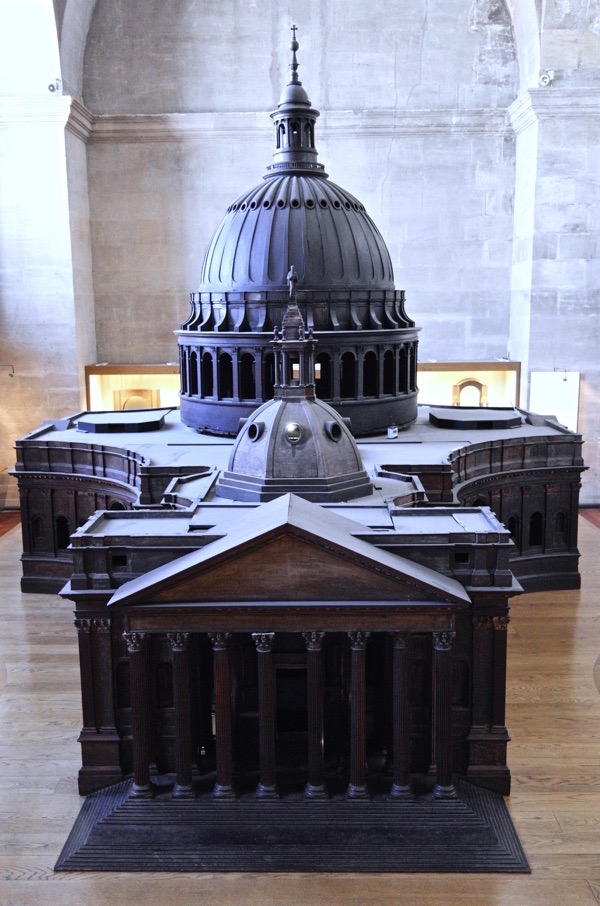
Behold, the largest jelly mould in the world!
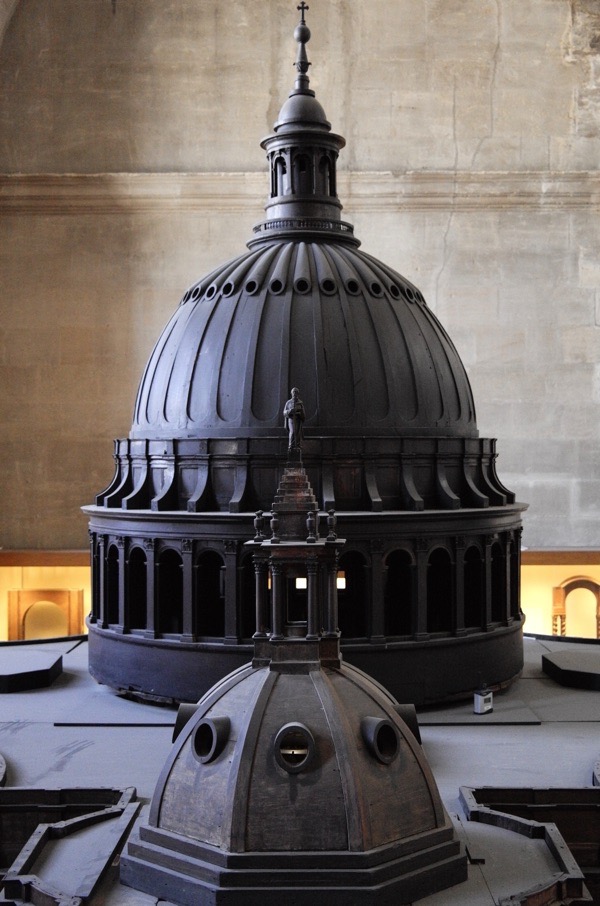
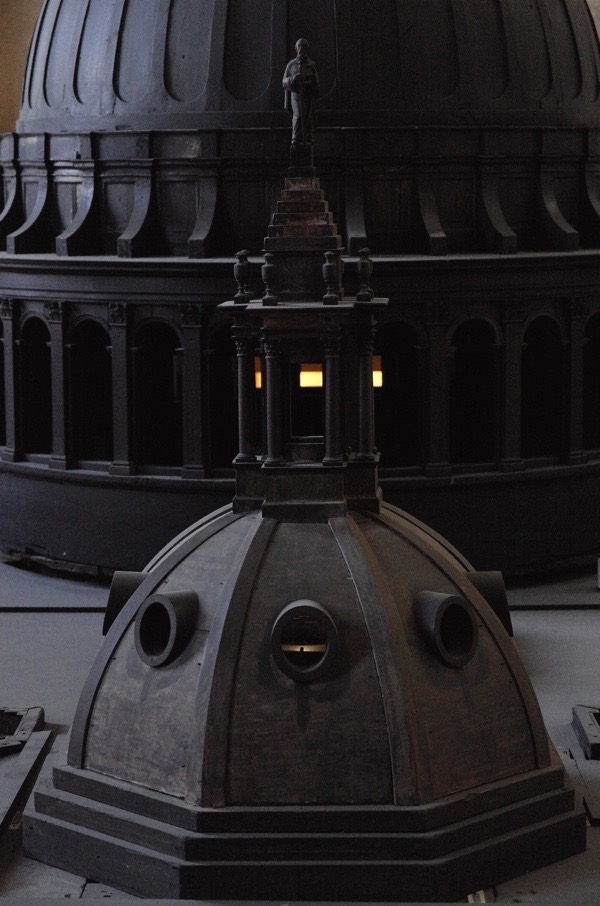
The belfry that was never built
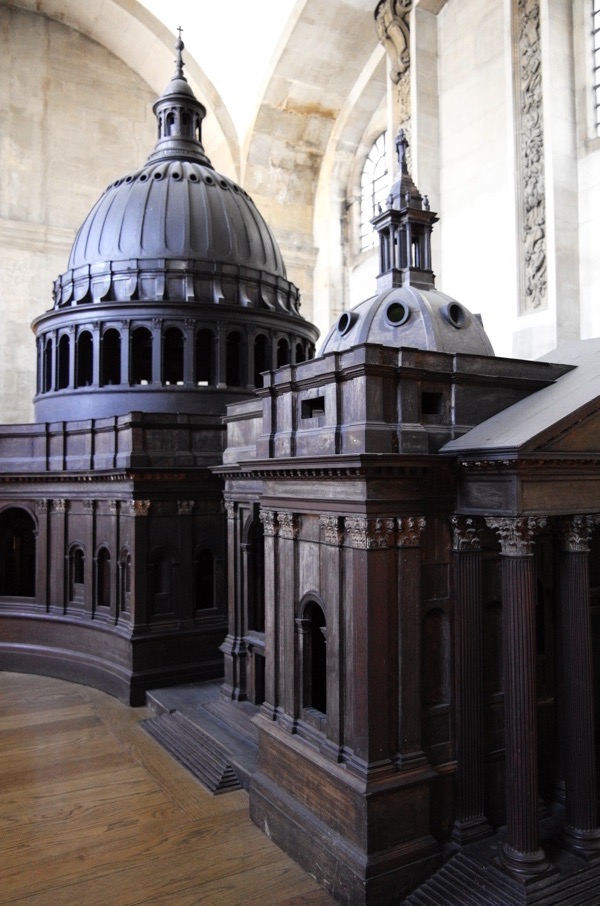
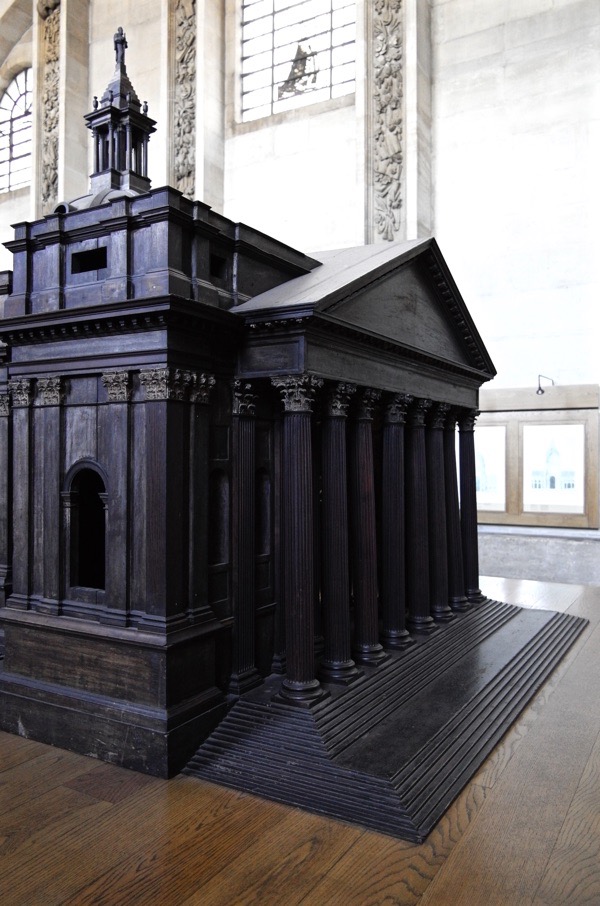
The single portico that was replaced by a two storey version
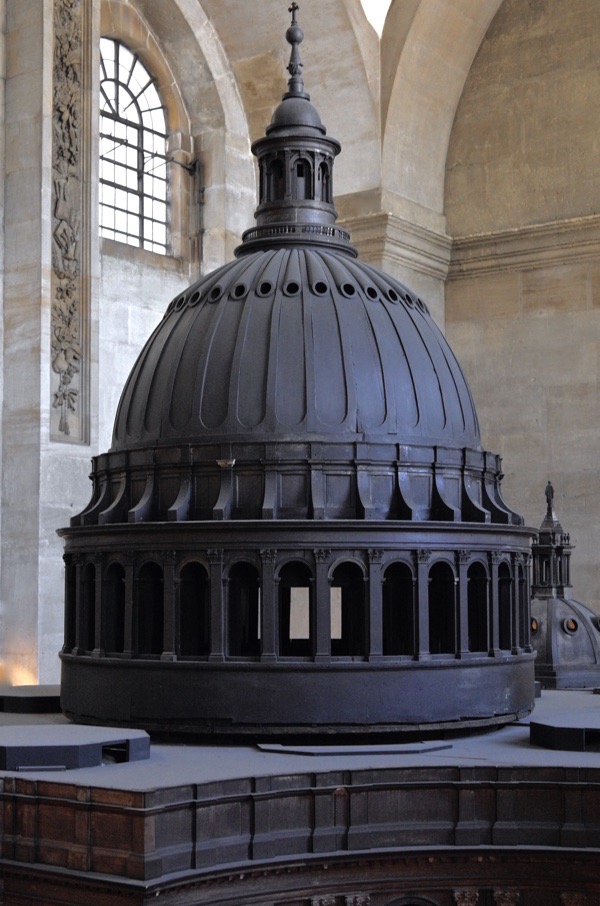
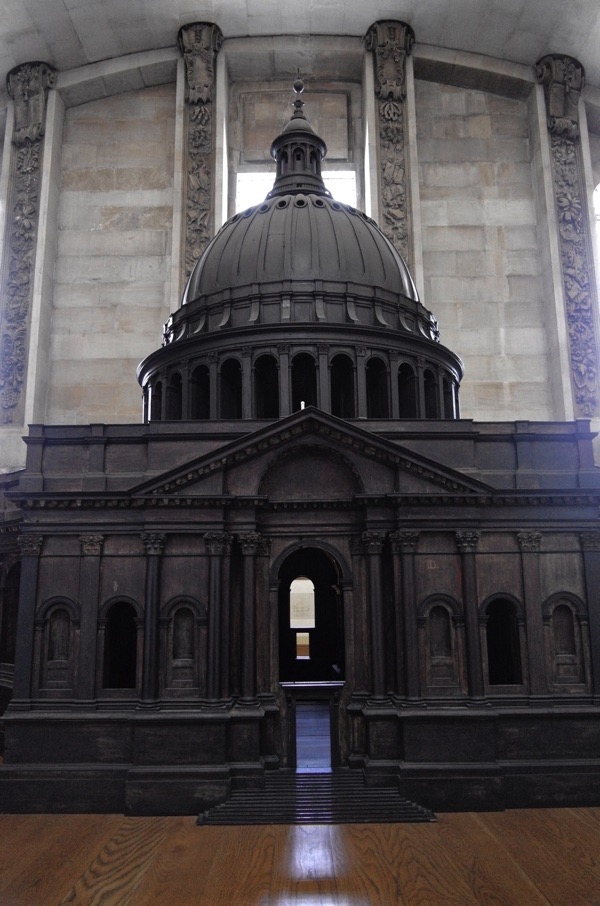
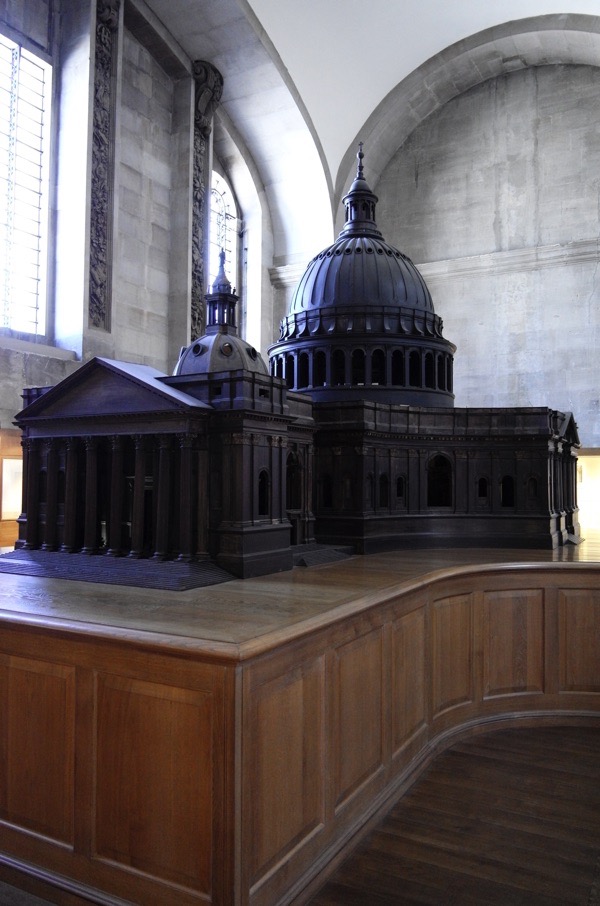
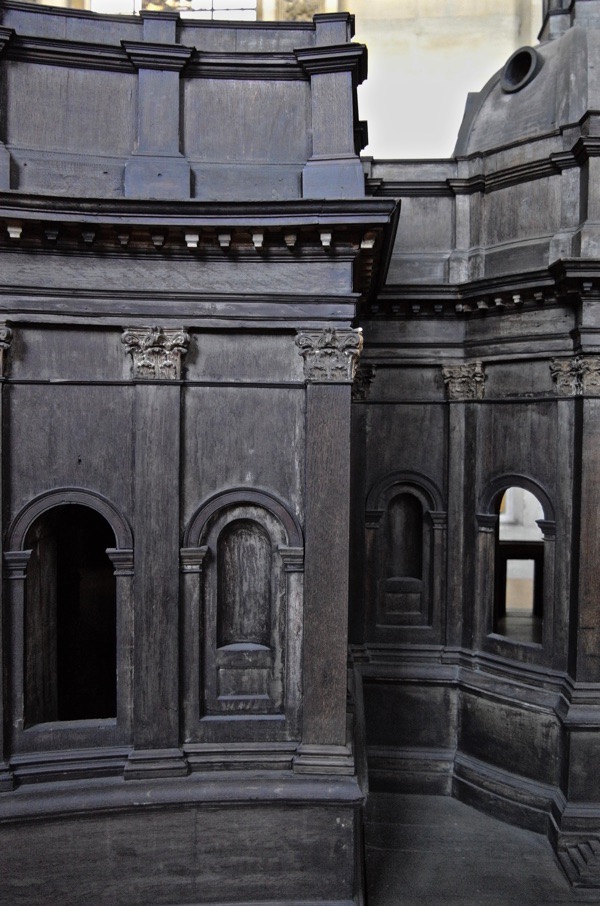
Just a few fragments of paintwork remain upon the exterior
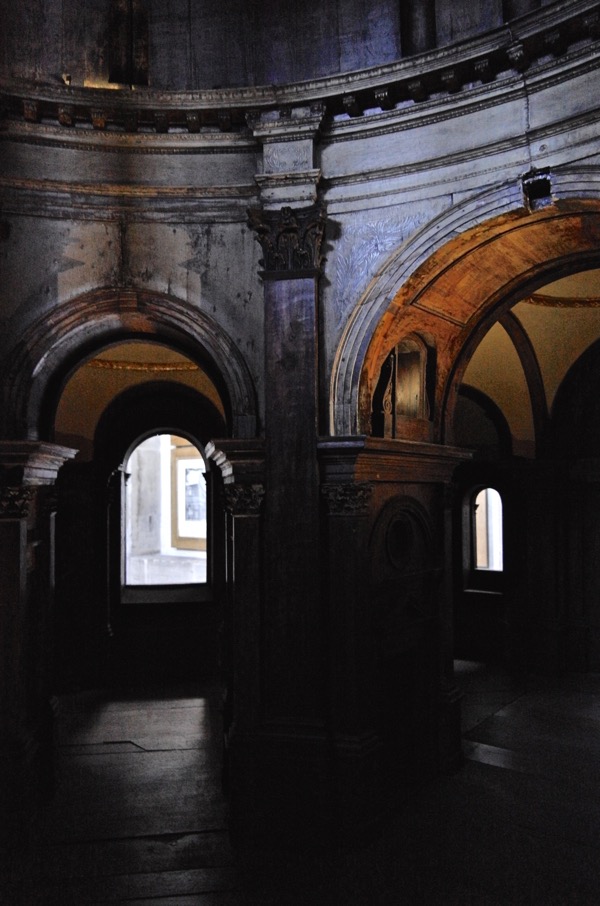
Original paintwork can be seen inside the model
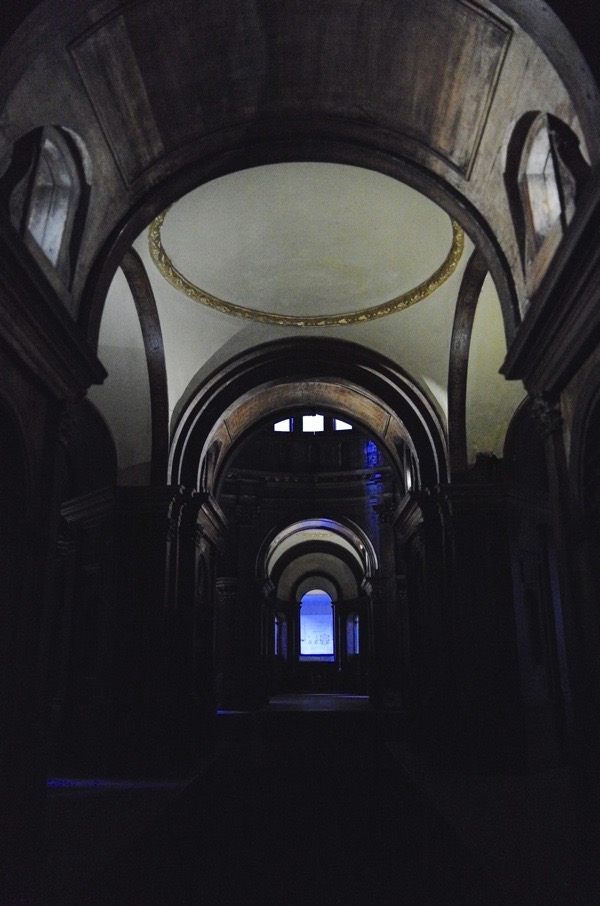
Charles II’s point of view from inside the model
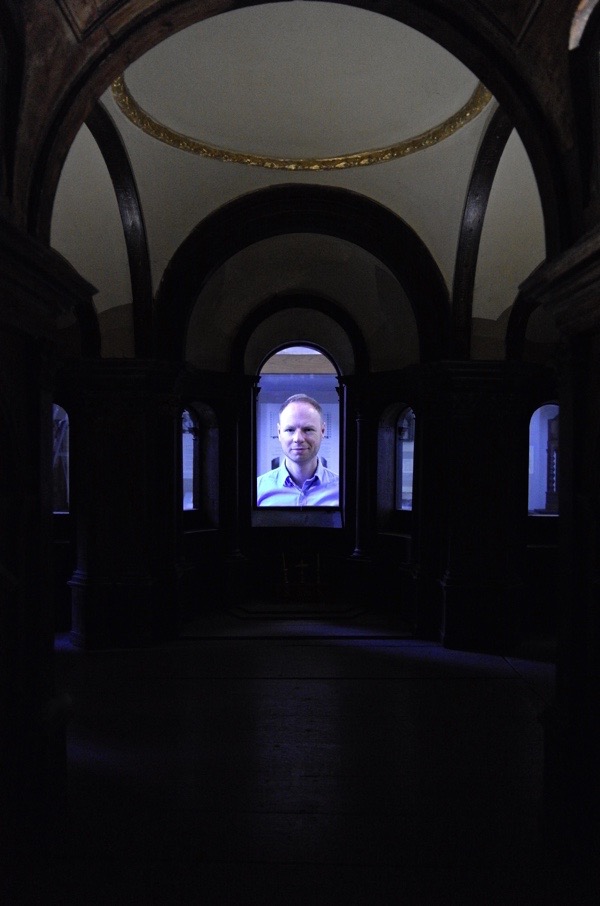
‘How astonishing, once you have accustomed to the scale of the model, when a giant face appears filling the east window.’
Click here to book for a tour of the Triforium at St Paul’s Cathedral
Click here for events commemorating the 350th Anniversary of the Great Fire
You may like to read my other stories of St Paul’s












