Terry Barns, Knot Tyer

‘There isn’t really a word for it in English,’ admitted Terry Barns, ‘in French, they call it ‘matelotage’ meaning ‘sailors’ knot-making.’
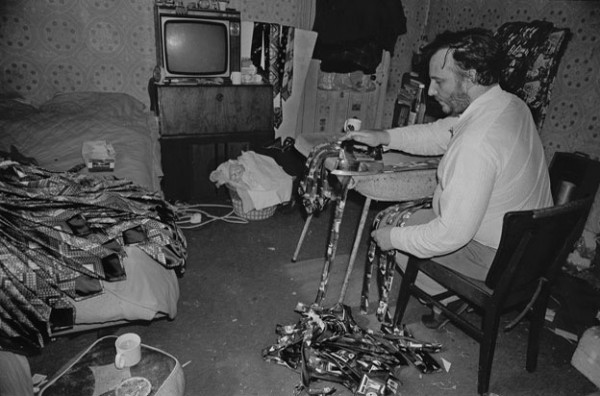
Terry did not become a serious knot tyer until his fifties, yet it was a tendency that revealed itself in childhood. Celebrating the Queen’s Coronation in 1952, when Terry was just nine years old, his mother made him a guardsman’s outfit from red and black crepe paper with a busby fashioned from the shoulders cut out of an old fur coat. Terry’s contribution was to make the chin strap. ‘We got some gold string and I tied reef knots over a core, making what I now know is known as a ‘Pilgrim’s Sennet’ or a ‘Soloman’s Bar,’ he explained to me in wonder at his former precocious self, ‘but I never thought anything about it at the time.’
This is how Terry tells the story of the intervening years –
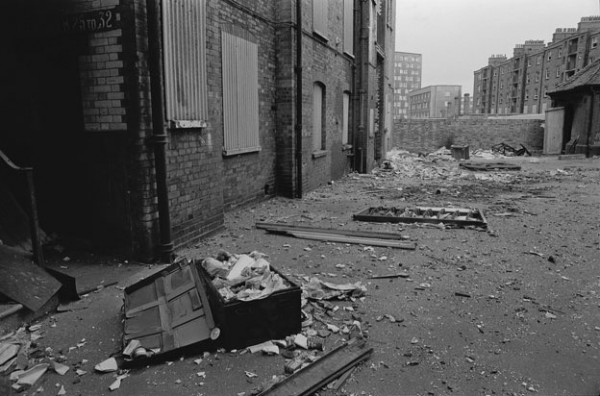
‘My early life was in the Queensbridge Rd but I was born in Hertfordshire because Hitler was trying to blow up the East End in 1944. My mum was a dress machinist and my dad was a wood machinist, he used to drill the holes in bagatelles and I still have one he made at home. In 1950, when I was six, we got a Council House in Clapton with a bathroom and an inside toilet – it was wonderful.
Somehow, I passed the 11-plus and ended up at Grocers’ Company School in Hackney Downs. When I left school at fourteen, being a prudent person, I joined the General Post Office as a telephone engineer, running around Mare St and Dalston. Nobody told me I could have stayed on at school and I soon realised that if I didn’t leave the GPO, I’d never know anything else. So I became a ‘Ten Pound Pom’ and went off to Australia in 1966.
I met my wife Carol in Pedro St in Hackney at that time and she followed me to Australia shortly after. I was a very quick learner and I had a very good job in Sydney working for a Japanese telephone company, Hitachi, but we had no intention of staying and came back in 1968. Then we got married in 1969, had three children and bought a house, so that occupied me for the next twenty years! I went back to the GPO which became BT and, when I was fifty, they asked if I would like to take some money and not go back again. So I have been living on my BT pension for the past twenty years and that has been the story of my life.’
Yet, all this time that Terry had been working with telephone cables, his tendency with string and rope had been merely in abeyance. ‘In the seventies, my wife bought me a copy of The Ashley Book of Knots,’ he revealed, bringing out a pristine hardback copy of the knotter’s bible containing nearly four thousand configurations. At a stall outside the Maritime Museum in Greenwich, Terry came across the International Guild of Knot Tyers which led to a four day course with legendary knot tyer, Des Pawson in 1994. ‘He’s got a museum of rope work in his back garden,’ Terry confided in awe.
‘I’m an engineer, but Des – he’s artistic,’ Terry informed me, ‘he educated me how to see things, he showed me when things look right.’ For over ten years, Terry has been on the Council of the Guild of Tyers, accompanying Des as his bag man, demonstrating knot work at festivals of matelotage in France – ‘My kind of holiday,’ he describes it enthusiastically.
When a sculptor cast a rope in bronze to symbolise the identity of the East End, it was Terry who wound the strands – and you can see the result at the junction of Sclater St and Bethnal Green Rd today. The largest pieces of rope you ever saw are placed as features in Terry’s front garden in Woodford. Inside the house, walls are hung with nautical paintings and shelves are lined with volumes of maritime history. They tell the story of one man’s lifetime entanglement with cable, rope and string, and remind of us of how the East End was built upon the docks, of which the ancient and ingenious culture of rope work was a major thread, still kept alive by enthusiasts like Terry Barns.


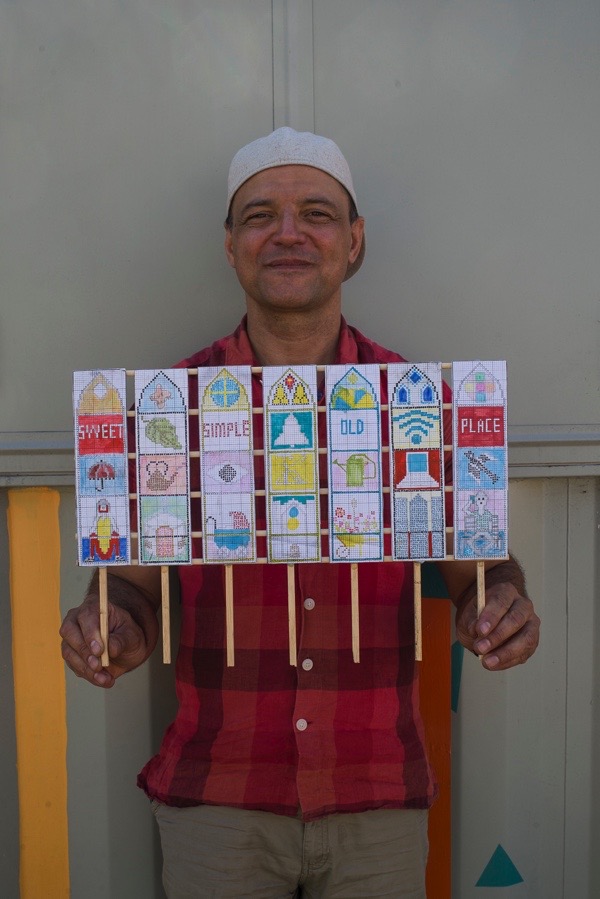
Terry with one he tied earlier
You might like to find out more at International Guild of Knot Tyers
You may also like to read about
Albert Stratton, Pigeon Racer
With the pigeon racing season commencing in April, I took the opportunity of an introduction to the sport kindly extended to me by Albert Stratton, Secretary & Clock setter of the Kingsland Racing Pigeon Club, which has been established for over a century. Ever since I read Dickens’ description of the pigeon lofts in Spitalfields in 1851, I have been curious to discover whether anyone keeps pigeons here today. So I was delighted to find Albert in the garden of his house beside Weavers Fields in Bethnal Green, where he has two sheds filled with pigeons, and learn that the venerable East End culture of keeping homing pigeons is alive, nurtured by a small group of fanciers.
Albert is a powerfully built man with a generous spirit, who becomes lyrical in his enthusiasm when talking about these familiar birds that are as mysterious as they are mundane. Commonly considered pests, pigeons are so ubiquitous as to be almost invisible, yet if they were rare maybe we would prize them for their fine plumage and astounding navigational abilities – just as Albert does.
“When I was fourteen, growing up in Shoreditch, I was walking through the flats one day and there was a pigeon on the floor, as skinny as you can get. He had a ring round his foot, so I took him home and my dad said, ‘It’s a racing pigeon, you’ve got to let it go because it belongs to someone.’ Then we found it couldn’t fly, so he said, ‘We’ll keep it on the balcony and build it up until it can fly.’ But when we did let it go, it flew up in the air and back into the box – and after that I became fascinated with pigeons and how they will stay with you.
We moved to the Delta Estate and had a flat on the top floor with a big balcony, and when I found four Tippler pigeons (which are fancy pigeons not racers) abandoned, I took them home and kept them on the balcony in crates with wire netting on the front. I used to let them go out and fly, and they’d come back. Then, when we bought the house in Bethnal Green, we decided to keep racing pigeons. We built two sheds and had six babies delivered by courier from the Maserella stud in Leicester.
In 1983, I joined the Kingsland Pigeon Racing Club and my first year’s racing with them was 1985 and I won fourth place in the club which gets you into the prize money. And you think to yourself, anyone can do this – but you find out later, it’s hard. You’ve got to keep your pigeons healthy and fit – spot on. Sick pigeons can’t race. You’ve got to train them to build up the muscle and the fitness. Pigeon racing is like horse racing – the money is in the breeding not the racing. You pay to breed from the winners, studs buy up the winning pigeons and then sell off their young ones.
We start the season on 10th April at Peterborough, from there to my house is seventy-one and half miles. After that first race, we carry on in stages of thirty miles between each race point, moving up the country. Newark at one hundred and twelve and a half miles is the second race point, and after fifteen weeks we end up in Thurso at five hundred and seven miles North of here.
Before the race, we all go round to the club headquarters in Mr Hamilton’s garden, where we mark each pigeon with a numbered rubber band. Then we synchronise our clocks. Once the pigeon arrives home, you take the number off the leg and put it in the clock which stops the timer. The timing runs from the moment when the pigeons are liberated.
Pigeons fly at fifty miles per hour with no wind. So, if they are liberating the pigeons at nine o ‘clock in Peterborough, you check the weather and, if the wind forecast is thirty-five miles per hour from the North, then you estimate it should take approximately two hours, which means the pigeons will arrive in Bethnal Green at eleven. Once you’ve worked out a time of arrival, you are waiting for them. I’ve stood at the back door looking to the North and everything that moves in the sky you go, “Come on, come on!” – if it’s yours or not. You look at your watch and then back at the sky.
There’s nothing better than seeing one of your birds come out of the sky, when it folds to make itself small to become as fast as possible, because it wants to get home. As soon as it arrives, you go in the garden with peanuts to get his attention, so you can get the rubber band off and put it in the clock.
Then you go round to the club, where the rubber bands are collected and all the clocks are struck off against the master timer to confirm they are all the same. We know the exact time they left and the exact time they arrived, so we divide the distance by the time to get velocity and the bird that has the greatest velocity wins. We record our first ten birds which means everyone gets their name published in The Racing Pigeon, which covers all the East End clubs.”
I followed Albert into the shed to take pictures while he cleaned out the shelves and tenderly checking on those birds hatching eggs or nursing chicks, even holding up a tiny blind newborn chick in his large hand to show me, replacing it gently under its mother’s breast before it got cold, and then chasing the other pigeons outside to get some exercise.
When Albert joined the Kingsland Club in 1983 there were thirty members but now there are eight, the others have died or moved East towards Clacton, Albert says, and Kingsland itself is the only proper club left in Hackney where there once four or five. Today, there is one in Stepney Green and another in Wood Green, that is distinguished by its multiracialism. “Polish people might be the only lifeblood to save pigeon racing in this country,” commented Albert absent-mindedly from within the shadows of the pigeon shed, “If people don’t mix there’ll be no peace in this world.”
It is truly remarkable how these modest birds can navigate over great distances, and I was touched to observe the passion they draw from Albert, whenever the miracle is repeated, each time they fly home to him. Through pigeons, Albert in his small garden in Bethnal Green is connected to the wide landscape that the pigeons traverse to fly home and through pigeons Albert also is connected to the intense social life of the Federation of Racing Clubs, as the average for every pigeon accumulates through the season to arrive at a prize bird that can deliver a substantial reward.
While we were talking in the living room, our conversation was interrupted when we saw a cat appear on the roof of the pigeon shed and Albert rolled his eyes, “Look at that creature! Where’s my rifle?” he growled.
The Last Spitalfields Market Cat

Here you see Blackie, the last Spitalfields market cat, taking a nap in the premises of Williams Watercress at 11 Gun St. Presiding over Blackie – as she sleeps peacefully among the watercress boxes before the electric fire with her dishes of food and water to hand – is Jim, the nightman who oversaw the premises from six each evening until two next morning, on behalf of Len Williams the proprietor.
This black and white photograph by Robert Davis, with a nineteenth century barrow wheel in the background and a nineteen fifties heater in the foreground, could have been taken almost any time in the second half of the twentieth century. Only the date on the “Car Girls’ Calendar” betrays it as 1990, the penultimate year of the Spitalfields Fruit & Vegetable Market, before it moved East to Stratford.
In spite of Jim the nightman’s fond expression, Blackie was no pet, she was a working animal who earned her keep killing rats. Underneath the market were vaults to store fresh produce, which had to be sold within three days – formalised as first, second and third day prices – with each day’s price struck at two in the morning. But the traders often forgot about the fruit and vegetables down in the basement and it hung around more than three days, and with the spillage on the road which local residents and the homeless came to scavenge, it caused the entire market to become a magnet for vermin, running through the streets and into the labyrinth beneath the buildings.
It must have been paradise for a cat that loved to hunt, like Blackie. With her jet black fur, so black she was like a dark hole in the world running round on legs, vanishing into the shadow and appearing from nowhere to pounce upon a rat and take its life with her needle-sharp claws, Blackie was a lethally efficient killer. Not a submissive creature that could be easily stroked and petted as domestic cats are, Blackie was a proud beast that walked on her own, learnt the secret of survival on the streets and won independent status, affection and respect through her achievements in vermin control.
“They were all very pleased with Blackie for her great skill in catching rats, she was the last great market cat.” confirmed Jim Howett, a furniture maker who first met Blackie when he moved into a workshop above the watercress seller in 1988. “The other traders would queue up for kittens from Blackie’s sister’s litters because they were so good at rat-catching. Blackie brought half-dead rats back to teach them how to do it. Such was Blackie’s expertise, it was said she could spot a poisoned rat at a hundred feet. The porters used to marvel that when they said, ‘Blackie, there’s a rat,’ Blackie would focus and if the rat showed any weakness, would wobble, or walk uncertainly, she would turn her back, and return to the fire – because the rat was ill, and most likely poisoned. And after all, Blackie was the last cat standing,” continued Jim, recounting tales of this noble creature that has become a legend in Spitalfields today. “The story was often told of the kitten trained by Blackie, taken by a restaurant and hotel in the country. One day it brought a half-dead rat into the middle of a Rotary Club Function, seeking approval as it had learnt in Spitalfields, and the guests ran screaming.”
The day the Fruit & Vegetable Market left in 1991, Blackie adjusted, no longer crossing the road to the empty market building instead she concentrated on maintaining the block of buildings on Brushfield St as her territory by patrolling the rooftops. By now she was an old cat and eventually could only control the three corner buildings, and one day Charles Gledhill a book binder who lived with his wife Marianna Kennedy at 42 Brushfield St, noticed a shadow fly past his window. It was Blackie that he saw, she had fallen from the gutter and broken a leg on the pavement below. “We all liked Blackie, and we took care of her after the market left,” explained Jim, with a regretful smile, “so we took her to the vet who was amazed, he said, ‘What are you doing with this old feral cat?’, because Blackie had a fierce temper, she was always hissing and growling.”
“But Blackie recovered, and on good days she would cross the road and sun herself on palettes, although on other days she did not move from the fire. She became very thin and we put her in the window of A.Gold to enjoy the sun. One day Blackie was stolen from there. We heard a woman had been seen carrying her towards Liverpool St in a box but we couldn’t find her, so we put up signs explaining that Blackie was so thin because she was a very old cat. Two weeks later, Blackie was returned in a fierce mood by the lady who taken her, she apologised and ran away. Blackie had a sojourn in Milton Keynes! We guessed the woman was horrified with this feral creature that growled and scratched and hissed and arched its back. After that, Blackie got stiffer and stiffer, and one day she stood in the centre of the floor and we knew she wasn’t going to move again. She died of a stroke that night. The market porters told me Blackie was twenty when she died, as old as any cat could be.”
Everyone knows the tale of Dick Whittington, the first Lord Mayor of London whose cat was instrumental to his success. This story reminds us that for centuries a feline presence was essential to all homes and premises in London. It was a serious business to keep the rats and mice at bay, killing vermin that ate supplies and brought plague. Over its three centuries of operation, there were innumerable generations of cats bred for their ratting abilities at the Spitalfields Market, but it all ended with Blackie. Like Tess of the D’Urbevilles or The Last of the Mohicans, the tale of Blackie, the Last Great Spitalfields Market Cat contains the story of all that came before. Cats were the first animals to be domesticated, long before dogs, and so our connection with felines is the oldest human relationship with an animal, based up the exchange of food and shelter in return for vermin control.
Even though Blackie – who came to incarnate the spirit of the ancient market itself – died in 1995, four years after the traders left, her progeny live on as domestic pets in the East End and there are plenty of similar black short-haired cats with golden eyes around Spitalfields today. I spotted one that lives in the aptly named Puma Court recently, and, of course, there is Madge who resides in Folgate St at Dennis Severs’ House and my old cat, Mr Pussy whose origins lie in Mile End but has shown extraordinary prowess as a hunter in Devon – catching rabbits and even moorhens – which surely makes him a worthy descendant of Blackie.

Blackie at 42 Brushfield St

Blackie in her final years, 1991/2

Mid-nineteenth century print of Dick Whittington & his cat
The Door In Cornhill
The Bronte sisters visit their publisher in Cornhill, 1848
An ancient thoroughfare with a mythic past, Cornhill takes its name from one of the three former hills of the City of London – an incline barely perceptible today after centuries of human activity upon this site, building and razing, rearranging the land. This is a place does not declare its multilayered history – even though the Roman forum was here and the earliest site of Christian worship in England was here too, dating from 179 AD, and also the first coffee house was opened here by Pasqua Rosee in 1652, the Turk who introduced coffee to London. Yet a pair of carved mahogany doors, designed by the sculptor Walter Gilbert in 1939 at 32 Cornhill – opposite the old pump – bring episodes from this rich past alive in eight graceful tableaux.
Walter Gilbert (1871-1946) was a designer and craftsman who developed his visual style in the Arts & Crafts movement at the end of the nineteenth century and then applied it to a wide range of architectural commissions in the twentieth century, including the gates of Buckingham Palace, sculpture for the facade of Selfridges and some distinctive war memorials. In this instance, he modelled the reliefs in clay which were then translated into wood carvings by B.P Arnold at H. H. Martyn & Co Ltd of Cheltenham.
Gilbert’s elegant reliefs appeal to me for the laconic humour that observes the cool autocracy of King Lucius and the sullen obedience of his architects, and for the sense of human detail that emphasises W. M. Thackeray’s curls at his collar in the meeting with Anne and Charlotte Bronte at the offices of their publisher Smith, Elder & Co. In each instance, history is given depth by an awareness of social politics and the selection of telling detail. These eight panels take us on a journey from the early medieval world of omnipotent monarchy and religious penance through the days of exploitative clergy exerting controls on the people, to the rise of the tradesman and merchants who created the City we know today.
“St Peter’s Cornhill founded by King Lucius 179 AD to be an Archbishop’s see and chief church of his kingdom and so it endured for the space of four hundred years until the coming of Augustine the monk of Canterbury.”
“Eleanor, Duchess of Gloucester, did penance walking barefoot to St Michael’s Church from Queen Hithe, 1441.”
“Cornhill was an ancient soke of the Bishop of London who had the Seigneurial oven in which all tenants were obliged to bake their bread and pay furnage or baking dues.”
“Cornhill is the only market allowed to be held afternoon in the fourteenth century.”
“Birchin Lane, Cornhill, place of considerable trade for men’s apparel, 1604.”
“Garraway’s Coffee House, a place of great commercial transaction and frequented by people of quality.”
“Pope’s Head Tavern in existence in 1750 belonging to Merchant Taylor’s Company, the Vinters were prominent in the life of Cornhill Ward.”
You might also like to read about
Portraits From The Surma Centre
Contributing Photographer Patricia Niven and Novelist Sarah Winman, author of “A Year of Marvellous Ways,” made this series of portraits and interviews at the Surma Centre at Toynbee Hall.
“After the Second World War, Britain required labour to assist in post-war reconstruction. Commonwealth countries were targeted and, in what was then East Pakistan (it became Bangladesh after the 1971 Liberation War), vouchers appeared on Post Office counters, urging people to come and work in the United Kingdom, no visa required. The majority of men who came in the fifties and sixties came from a rural background where education was scarce and illiteracy was common. But this generation were hard workers, used to working with their hands, men who could commit to long hours, who had an eagerness to work and a young man’s inquisitiveness to see the world: the perfect workforce to help rebuild this nation. And they did rebuild it, and were soon found working in factories and ship yards, building roads and houses, crossing seas in the merchant navy. These pioneers were the men we met at the Surma Centre.” – Sarah Winman
Shah Mohammed Ali, age 75 years.
I came to this country in November 1961 because my uncle was already living here and inspired me to come. In East Pakistan, I had been working in a shop. I felt life was good. My earliest memory of London was Buckingham Palace. I missed my friends and family but I really missed the weather back home. I became a factory worker, and worked all over the country: a cotton factory in Oldham, a foundry in Sheffield, an aluminium factory in London and Ford motor factory in Dagenham. Ford gave me a good, comfortable life. We had friends all over the country and they would tell us if there was more money being offered at a different factory and then we’d move. I thought I would stay in Britain for four years and then go back home. My heart is in Bangladesh. The roses smell sweeter.
Eyor Miah, age 69 years.
I came to this country in September 1965. I had been a student in East Pakistan. Life was hard, my father was a sailor. I read in a Bengali newspaper stories of people travelling and earning money, and I thought that I, too, would like to do that. I wrote to somebody I knew here to help me. It was a slow process, all done by mail, because of course, there was no internet. It took me two years to gain my papers. I didn’t mind because I was very determined to achieve.
When I first arrived, I became a machinist in the tailoring industry and I earned £1 and ten shillings a week. My weekly outlay was £1 and the rest I saved. Brick Lane was very rundown then. The Jewish population were very welcoming, probably because they were eager for workers! We would queue up outside the mosque and they would come and pick the ones they wanted. In 1969 I bought a house for £55. Of course, I missed my mother who stayed in Bangladesh, and before 1971 I actually thought I would return to live. After that date though, I felt Britain was my home and life was better here.
After tailoring, I worked in restaurants and then began my own business as a travel agent, set up my own restaurants and grocery shop. I have four children. Life has been good to me.
Rokib Ullah, age 81 years.
I came to this country in 1959, because workers were being recruited from the Commonwealth to rebuild after the Second World War. Life in East Pakistan then was good. I was very young and working as a farmer. My fellow countrymen told me about the work in the UK and I came here by air. When I arrived, the airport was so small, not like it is today. And the weather was awful, so bad, not like home, I found that difficult, together with missing my neighbours and friends. I worked in a tyre factory, and then in garment and leather factories. I planned to stay here and earn enough money, and then return to Bangladesh. I am a pensioner now and frequently go back to Bangladesh. It is in my heart. One day I plan to go there forever.
Syed Abdul Kadir, age 77 years.
I first came to this country in 1953. I was in the navy in Karachi and I was selected by the Pakistan Government to be in the Guard of Honour in London at the Queen’s Coronation. I remember this day very clearly. It was June and the weather was cold. When Queen Elizabeth was crowned the noise was tremendous. There were shouts of “God Save the Queen!” and gun salutes were fired. We marched to Buckingham Palace where more crowds were waiting. The Queen and her family came out on the balcony and the RAF flew past the Mall, and the skies above Victoria Embankment were lit up by fireworks. I feel very lucky to have been part of this, and I still have my Coronation ceremony medal.
Since my first visit, I developed a fondness for the British culture, its people and the Royal Family. I have always believed this country looks after its poor.
I owe the Pakistan Navy for much of my experiences in life and was lucky to travel and to see the world. I actively participated in the 1965 India-Pakistan war and the 1971 Pakistan war and have medals for both.
My family are settled here and my life revolves around grandchildren. I have been coming to Surma since 2004. When someone sees me, they call me “Captain!” We are like a family here.
Shunu Miah, age 79 years.
I came to this country in November 1961. Back home, I helped my father farm. It was a good life, still East Pakistan, the population was low, not much poverty, food for everyone: it was a land of plenty. It wasn’t a bad life, I was young and was just looking for more. My uncle had been in the UK since 1931, my father since 1946, both encouraged me to come.
Cinema here was my greatest memory. Back home, cinema was rare. Every Saturday and Sunday there was a cinema above Cafe Naz on Brick Lane, or I’d go to the cinema in Commercial Rd, or up to the West End. It was so exciting, the buildings, the underground, the lights! People were friendly and welcoming then. I saw Indian films, but also Samson and Delilah and the Ten Commandments with Charlton Heston.
I have worked at the Savoy Hotel as a kitchen porter and also in cotton factories in Bradford. What did I miss? Family and friends, of course, but also the weather. The smell of flowers, too, they are much stronger back home. I thought I would stay here and work for three or four years, go home and buy land, build a house and live happily ever after. I have helped to build homes for my family in Bangladesh. I have never been able to own a home here.
Abul Azad, Co-ordinator at the Surma Centre.
“These men are very loyal to a country that has given them a home,” said Abul Azad, the charismatic project co-ordinator at Surma Centre in Whitechapel. “When they first arrived, living conditions were bad, sometimes up to ten people lived in a room. Facilities were unhealthy, toilets outside, and nothing to protect them from an unfamiliar cold that many still talk about. Most intended to earn money to send back to families, and then return after a few years – a dream realised by few, especially after the settlement of families. Instead they were open to exploitation, often working over sixty hours a week, the consequence of which is clearly visible today in low state pensions, due to companies not paying the correct National Insurance contributions. And most Bangladeshi people don’t have private pensions. Culturally, pensions are not of this generation. Their families are their pension – always imagined they would be looked after. But times are changing for everyone.”
Surma runs a regular coffee morning, providing support for elderly Bangladeshi people. The language barrier is still the greatest hindrance to this older generation and Surma provides a specialist team ready to assist their needs – both financially and socially – and to provide free legal advice. It is also quite simply a haven for people to get out of the house and to be amongst their peers, to read newspapers, to have discussions, to talk about what is happening here and in Bangladesh.
There is something profound that holds this group together, a deep unspoken, clothed in dignity. Maybe it is the history of a shared journey, where the desire for a better life meant hours of physical hardship and unceasing toil and lonely years of not being able to communicate. Maybe it is quite simply the longing for home, remaining just that: an unrealised dream. Whatever it is – “This is a very beautiful group.” said Abul Azad.
Photographs copyright © Patricia Niven
You may also like to take look at these other portraits by Patricia Niven and Sarah Winman
St Patrick’s Day In Bethnal Green
Viscountess Boudica is already making her preparations in readiness for St Patrick’s Day on Thursday
Beannachtaí na Féile Pádraig oraibh
In the East End, we owe a debt of gratitude to Viscountess Boudica of Bethnal Green for her inspirational example in observing each of the festivals of the year with passion and gusto. This week finds her togged up like a cheeky Leprechaun and swigging Guinness as if she was born to it, and when I enquired further I discovered this was precisely the case.
“My people were landowners near Dublin but when Elizabeth I sent her army into Ireland, we were forced to flee to France and then we returned to live in Gloucestershire,” she admitted to me with the melancholy refined smile of one from an ancient aristocratic lineage.“Once when I was a child, we were on holiday in Wales and I stared out to sea – I always felt there was something out there for me,” she continued, getting lost in contemplation as she surveyed the magnificent green and orange decorations that adorned her pink living room.
It was only as an adult that the Viscountess Boudica discovered her true origins. “Even before I found out I was Irish, I knew I was different from everybody else in relating to English culture, ” she confessed to me as she stroked her ginger locks and sipped her Guinness thoughtfully, “Now I’m planning to go to Dublin in search of my roots…”
Éirinn go brách
Cá mbeidh tú ag fliuchadh na seamróige?
Sláinte!
Tabhair póg dom, táim Éireannach.
Viscountess Boudica’s jacket with Irish badges from the days she hung out with skinheads
Viscountess Boudica searches for St Patrick’s Day music
Viscountess Boudica recommends The Nolans and Sham 69 for your St Patrick’s Day listening
Viscountess Boudica pulls out one of her old Irish themed coats
Viscountess Boudica models the outfit she has designed for her trip to Dublin in search of her roots
Be sure to follow Viscountess Boudica’s blog There’s More To Life Than Heaven & Earth
Take a look at
Viscountess Boudica’s Domestic Appliances
Viscountess Boudica’s Halloween
Viscountess Boudica’s Christmas
Viscountess Boudica’s Valentine’s Day
Read my original profile of Mark Petty, Trendsetter
and take a look at Mark Petty’s Multicoloured Coats
Amy Cooper’s Needlework
One afternoon, I walked down the Mile End Rd to the Bancroft Library, where the Local History collection is housed, to view a small collection of Spitalfields silk and lace. The archivist produced a cardboard chocolate box from the nineteen sixties with a Raeburn portrait of a child on the top. He kindly placed a table beside the window in the dying afternoon light and covered it with a piece of grey paper. The he opened the box and unwrapped the precious packages inside wrapped in white tissue paper, arranging them on the table, so that in the last light of day I could photograph them for you.
The first item to catch my eye was this little silk purse with the phrase SPITALFIELDS SCHOOL OF DESIGN 1848 elegantly picked out in gold thread. Not only is the stitching neat and regular, the balance and spacing of the typography is perfect. This curious item has no wear, it cannot have had any function beyond displaying the accomplishment of its own creation. It fits neatly into the palm of the hand and is exquisite in every detail, the string of golden glass beads looped around the edges, the delicate string handle, the jet button and the oyster blue silk lining.
Next I examined the needlebook below, with embroidery of flowers on both covers, and – taking the utmost care – I unfastened the ribbons that held it closed. Opening it up, I found a scrap of paper folded in between the pages of needles which tells us the maker. This needlebook was made by Miss Amy Cooper: she was born in 1794 & died in 1891. The script itself had a delicacy and restraint, similar to the handwriting of “No more twist!” pinned on the Lord Mayor’s unfinished waistcoat in The Tailor of Gloucester.
I love the aesthetic, using pale silk and embroidering subtly coloured flowers in natural colours, as fresh as the day they were stitched. The use of different toned threads in the recognisable heather and rose flowers suggests Amy worked from nature. Every individual stitch is a decision made with the same care you might bring to the selection of vocabulary and arrangement of words in a poem. Fine details, like the sky blue lining, the grey glass beads sewn at intervals around the edge of covers and the use of bordered ribbon upon the spine, draw the eye to observe the nuances of this lovely artefact. When someone invests as much time and consideration as Amy did here, it deserves our closest examination and rewards us in turn by delighting the eye.
Amy Cooper lived to be ninety-seven, born five years after the French Revolution, she died in the year that automobiles began manufacture. The three sisters who donated the collection, which belonged to their mother Mrs Ann Maitland MacEwen, knew nothing of its origins – so we cannot say if Amy made them all or establish what is the connection to the Spitalfields School of Design, which was an early government project to promote design in industry, founded at 37 Crispin St in 1842. Amy would have been fifty-four in 1848, when the purse was made, and I would like to think she made it as an example to show her pupils at the school.
The other two items that complete this modest collection are two girls’ lace caps. The workmanship of these pieces is inconceivably intricate and the awe-inspiring skill on display bears testimony to long hours of patient labour.
With thanks to Tower Hamlets Local History Library & Archive
You may also like to read about