
Pierce Egan’s ‘Life In London’

This frontispiece was intended to illustrate the varieties of ‘Life in London,’ from the king on his throne at the top of the column to the lowest members of society at the base. At the centre are the protagonists of the tale, Tom, Jerry & Logic, three men about town. Authored by Pierce Egan, their adventures proved best sellers in serial form and were collected into a book in 1820, remaining in print for the rest of the century, spawning no less than five stage versions, and delineating a social landscape that was to prove the territory for both the fictions of Charles Dickens and the commentaries of Henry Mayhew.
Accounts of the urban poor and of life in the East of London are scarce before the nineteenth century, and what makes “Life in London” unique is that it portrays and contrasts the society of the rich and the poor in the metropolis at this time. And, although fictional in form, there is enough detail throughout to encourage the belief that this is an authentic social picture.
The characters of Tom, Jerry & Logic were loosely based upon the brothers who collaborated upon the illustrations, Isaac Richard & George Cruickshank, and the writer Pierce Egan, all relishing this opportunity to dramatise their own escapades for popular effect. Isaac Richard & George’s father had enjoyed a successful career as a political cartoonist in the seventeen-nineties and it was his sons’ work upon “Life in London” that brought the family name back into prominence in the nineteenth century, leading to George Cruikshank’s long term collaboration with Charles Dickens.
Jerry Hawthorn comes up from the country to enjoy a career of pleasure and fashion with Corinthian Tom, yet as well as savouring the conventional masquerades, exhibitions and society events, they visit boxing matches, cockpits, prisons and bars where the poor entertain themselves, with the intention to “see a ‘bit of life.” It is when they grow weary of fashionable society, that the idea arises to see a “bit of Life” at the East End of the Town.” And at “All Max,” an East End boozer, they discover a diverse crowd, or as Egan describes it, “every cove that put in an appearance was quite welcome, colour or country considered no obstacle… The group was motley indeed – Lascars, blacks, jack-tars, coal-heavers, dustmen, women of colour, old and young, and a sprinkling of the remnants of once fine girls, and all jigging together.” In the Cruikshanks’ picture, Logic has Black Sall on one knee and Flashy Nance upon the other while Jerry pours gin into the fiddler and Tom carouses with Mrs Mace, the hostess, all revealing an unexpectedly casual multiracial society in which those of different social classes can apparently mix with ease.
Situated somewhere between the romps of Fielding, Smollet and Sterne and prefiguring Dickens’ catalogue of comic grotesques in “Pickwick Papers,” the humour of “Life in London,” spoke vividly to its time, yet appears merely curious two centuries later. By the end of the nineteenth century, the comedy had gone out of date, as Thackeray admitted even as he confessed a lingering affection for the work. “As to the literary contents of the book, they have passed clean away…” he wrote, reserving his enthusiasm for the illustrations by the Cruikshank brothers – which you see below – declaring,“But the pictures! Oh! The pictures are noble still!”

Lowest life in London – Tom, Jerry & Logic amongst the unsophisticated sons & daughters of nature in the East.

The Royal Exchange – Tom pointing out to Jerry a few of the primest features of life in London.

A Whistling Shop – Tom & Jerry visiting Logic “on board the fleet.”

Tom, Jerry & Logic “tasting” wine in the wood at the London Dock.

White Horse Cellar, Picadilly – Tom & Logic bidding Jerry “Good bye.”

Jerry “beat to a standstill” Dr Please’ems’ prescription.

Tom & Jerry “masquerading it” among the cadgers in the back slums.

“A shilling well laid out” – Tom & Jerry at the exhibition of pictures at the Royal Academy.

Tom, Jerry & Logic backing Tommy, the ‘sweep at the Royal Cockpit.

Tom, Jerry & Logic in characters at the Grand Carnival.

Symptoms of the finish of “some sorts of life” – Tom, Jerry & Logic in the Press Yard at Newgate.

Life in London – Peep ‘o day boys, a street row. the author losing his “reader.” Tom & Jerry showing fight and Logic floored.

The “ne plus ultra” of Life in London – Kate, Sue, Tom, Jerry & Logic viewing the throne room at Carlton Palace.

Tom & Jerry catching Kate & Sue on the sly, having their fortunes told.

Jerry’s admiration of Tom in an “assault” with Mr O’Shannessy at the rooms in St James’ St.

Tom introducing Jerry & Logic to the champion of England.

The art of self-defence – Tom & Jerry receiving instruction from Mr Jackson.

Tom & Jerry larking at a masquerade supper at the Opera House.

Tom & Jerry in trouble after a spree.

Jerry in training for a “swell.”

Tom & Jerry taking blue ruin after the spell is broke up.
Images courtesy © Bishopsgate Insitute
You may like to look at these other sets of pictures by George Cruikshank
Jack Sheppard, Thief, Highwayman & Escapologist
A Bread, Cake & Biscuit Walk

This biscuit was sent home in the mail during World War I
As regular readers will already know, I have a passion for all the good things that come from the bakery. So I decided to take advantage of the fine afternoon yesterday to take a walk through the City of London in search of some historic bakery products to feed my obsession, and thereby extend my appreciation of the poetry and significance of this sometimes undervalued area of human endeavour.
Leaving Spitalfields, I turned left and walked straight down Bishopsgate to the river, passing Pudding Lane where the Fire of London started at the King’s Bakery, reminding me that a bakery was instrumental in the very creation of the City we know today.
My destination was the noble church of St Magnus the Martyr, which boasts London’s stalest loaves of bread. Stored upon high shelves beyond the reach of vermin, beside the West door, these loaves were once placed here each Saturday for the sustenance of the poor and distributed after the service on Sunday morning. Although in the forgiving gloom of the porch it is not immediately apparent, these particular specimens have been there so many years they are now mere emblems of this bygone charitable endeavour. Surpassing any conceivable shelf life, these crusty bloomers are consumed by mould and covered with a thick layer of dust – indigestible in reality, they are metaphors of God’s bounty that would cause any shortsighted, light-fingered passing hobo to gag.
Close by in this appealingly shadowy incense-filled Wren church which was once upon the approach to London Bridge, are the tall black boards tabulating the donors who gave their legacies for bread throughout the centuries, commencing in 1674 with Owen Waller. If you are a connoisseur of the melancholy and the forgotten, this a good place to come on a mid-week afternoon to linger and admire the shrine of St Magnus with his fearsome horned helmet and fully rigged model sailing ship – once you have inspected the bread, of course.
I walked West along the river until I came to St Bride’s Church off Fleet St, as the next destination on my bakery products tour. Another Wren church, this possesses a tiered spire that became the inspiration for the universally familiar wedding cake design in the eighteenth century, after Fleet St baker William Rich created a three-tiered cake based upon the great architect’s design, for his daughter’s marriage. Dedicated today to printers and those who work in the former print trades, this is a church of manifold wonders including the pavement of Roman London in the crypt, an iron anti-resurrectionist coffin of 1820 – and most touching of all, an altar dedicated to journalists killed recently whilst pursuing their work in dangerous places around the globe.
From here, I walked up to St John’s Gate where a biscuit is preserved that was sent home from the trenches in World War I by Henry Charles Barefield. Surrounded by the priceless treasures of the Knights of St John magnificently displayed in the new museum, this old dry biscuit has become an object of universal fascination both for its longevity and its ability to survive the rigours of the mail. Even the Queen wanted to know why the owner had sent his biscuit home in the post, when she came to open the museum. But no-one knows for sure, and this enigma is the source of the power of this surreal biscuit.
Pamela Willis, curator of the collection, speculates it was a comment on the quality of the rations – “Our biscuits are so hard we can send them home in the mail!” Yet while I credit Pamela’s notion, I find the biscuit both humorous and defiant, and I have my own theory of a different nuance. In the midst of the carnage of the Somme, Henry Barefield was lost for words – so he sent a biscuit home in the mail to prove he was still alive and had not lost his sense of humour either.
We do not know if he sent it to his mother or his wife, but I think we can be assured that it was an emotional moment for Mrs Barefield when the biscuit came through her letterbox – to my mind, this an heroic biscuit, a triumphant symbol of the human spirit, that manifests the comfort of modest necessity in the face of the horror of war.
I had a memorable afternoon filled with thoughts of bread, cake and biscuits, and their potential meanings and histories which span all areas of human experience. And unsurprisingly, as I came back through Spitalfields, I found that my walk had left me more than a little hungry. After several hours contemplating baked goods, it was only natural that I should seek out a cake for my tea, and in St John Bread & Wine, to my delight, there was one fresh Eccles Cake left on the plate waiting for me to carry it away.

Loaves of bread at St Magnus the Martyr

Is this London’s stalest loaf?

The spire of Wren’s church of St Bride’s which was the inspiration for the tiered design of the wedding cake first baked by Fleet St baker William Rich in the eighteenth century

The biscuit in the museum in Clerkenwell

The inscrutable Henry Charles Barefield of Tunbridge Wells who sent his biscuit home in the mail during World War I

The freshly baked Eccles Cake that I ate for my tea
You may like to read these other bakery related stories
Memoirs Of William Henry Knapp
Jeanette Crawley sent me her transcript of ten pages of a memoir written in 1935 by her great-grandfather William Henry Knapp (1872-1952), describing his early life working in the City of London for a Provisions Merchant at the end of the nineteenth century, of which it is my pleasure to publish these extracts for the first time today.
You might assume that the work of a City delivery boy was mundane, yet William delivered breakfasts to condemned prisoners at Newgate, tangled with Secret Service agents and attended executions. ‘Every day was of interest,’ he concluded retrospectively.

William Henry Knapp
I first saw the light on the 27th July 1872 at 73 Carter Lane, London EC2, formerly Shoemakers Row. My father was employed at the above address for forty-five years in the manufacture of tobacco etc and was resident for thirty-two years past, at the place where I grew and noted the ever-changing aspect of the City proper.
At that time, cabs plied for hire and buses made their regular call at such places as the Mansion House and other notable buildings. I also well remember the extra horse ridden by a boy to help pull the bus up Ludgate Hill – what a contrast to the present day.
I attended the local infant school and rose by gradual stages until it was time for lessons on a higher plane and I graduated to St Thomas Charterhouse, a school of sound teaching and hard and fast rules. I see today in my mind’s eye – fifty-four years after – the urbane and full-bearded headmaster, Mr Smith, who in turn was well supported by most efficient class masters Mr Wallace, Mr Cose etc. who were there to teach and no nonsense. I also well remember that a cane was provided but never shared. In my day, recreation consisted of just the bank holiday and two weeks in the summer – what a contrast. As regards the education then and now – well, I will not give it a voice but just think it.
Home life was very regimented and, as I see things today, distinctly correct and helpful to shaping of the lives, creating and fitting us as men and women for the life to be. Parents were eminent and ruled as parents should.
During my school days many great events happened. The Tay Bridge disaster, the Nile expedition, Boer War and later the African War, etc. etc. All very terrible in their way and I well remember seeing the return of some of the guards who fought in their regimentals in those days and were bespattered with blood and dust. In spite of leaving, still the war game goes on.
Now I get along to the age of fourteen years, the usual time for launching out to get one’s own living. I well remember, after a domestic episode in which my father and myself were the chief factors, he giving his dictum that I must find work inside two days or go back to school and, as I preferred the former, I got going and obtained a situation in a house which I served truly and well for over five years.
I can visualise the employer – my ideal of a real man – questioning me as to my own ability for work. Among the questions put was how much can you carry? So, sticking out my chest, I answered ‘Three quarters of a hundredweight, Sir,’ and from that day onward, during my junior capacity, I was well loaded each time I went delivering.
I would point out that we had no trollies, trucks or tricycles, but just a tray containing goods on which I carried the weight of which often totalled a hundredweight and had to be delivered in rotation to the numerous customers. The title of the firm was Sherwood & Vesper Provision Merchants, 45 Ludgate Hill, London EC2, that was controlled by George Beach Newman and to him I owe my knowledge of the Provision Trade.
My start in life was eight shillings per week for thirteen hours a day, and I recall my father’s question, ‘Where are your wages?’ I proudly placed same in front of him. He then decided that I would hand four shillings to my mother, place two shillings and sixpence in the bank and retain one shilling and sixpence for myself and buy my own clothes – what a proposition for a youth of today.
One of the duties, during my first years, was to take in the last breakfast of the condemned in Newgate Prison. That came about by the fact that we served the celebrated firm of Ring Brymer, the City Caterers, and through them it became my duty to deliver such necessaries.
During the five years with my first firm, many incidents occurred that have been imprinted on my mind, such men as Alderman Treelawn, Sir John Bennett and local characters like W. Straken, the Ludgate Hill Stationers, the sons of the latter were in everyday touch with me and his daughters had a smile for me. For, behold, I was by that time junior clerk and cashier and, as such, received the esteem of the above.
Leading up to those years was the memory of the Phoenix Park Murders and, after the trial, the chief culprit Brady and others were executed at Newgate. Carey the informer was acquitted, receiving a free pardon and I believe a solatium from the British government and free passage to Australia. A destination he failed to reach because he was followed on board the vessel and shot by a man named O’Donnell who was brought back to England and executed at Newgate. As a small boy at that time, I remember among the crowd outside was brother of O’Donnell who, when the black flag went up, excitedly shouted, ‘My brother died bravely’ and, but for the police protection, would have been roughly handled.
Ireland was a mass of trouble in those days and their next actions to voice their demand for Home Rule was the deputing of members of their secret Clan to blow up many important and Public buildings in and about London with dynamite. I well remember many members of the Clan were captured in a house in Nelson Sq, Blackfriars Rd, but, from that time and onwards, there was a reign of terrorism which put the authorities at their wits end.
And, while touching on this subject, I now come to the time when I, in the capacity of junior clerk at Ludgate Hill, was the unconscious messenger and bearer of news of great portent as between the celebrated Secret Service agent Major Le Caron and the British government. The Major was the chief of the Fenian organisation on the American side and his good work between the two countries helped in a large degree to stamp out the Fenian menace. But, from the time of his leaving America for England, he went in daily fear of his life and was guarded wherever he went, and what he could not openly do, I did through my employer Mr Newman.
The connection of the aforesaid was – as under my employ – my employer’s name was George Beach Newman, Le Caron’s real name was William Beach and they in turn were the cousins of the celebrated Jam Manufacturers T.W.Beach. So you see, by their aid, Le Baron was able to distribute his knowledge and not forced to be his own messenger.
His career as Secret Service man was very valuable and I had grown into manhood when next I saw him, by chance, seated in a carriage on his way to Hastings which also was my destination. I did hear, just a few years afterwards, of his death and, as his age was somewhere in his fifties, he died comparatively a young man.
My first working years were very interesting as well as being hard-working and, as a man today beyond the sixty mark, I can think of the romance attached to my first job necessitating my calling at some of the most important buildings, firms and institutions in the City. Some are demolished or out of date but just a few remain and I can recount from memory a few of the places and firms.
My old firm was on Ludgate Hill, next St Martin’s Court, which is bordered on one side by the well known City Stationers, W. Straker. While I have him in mind, I must tell you that his first start in life was sitting in a small window in the left hand corner of St Paul’s Church and printing visiting cards at so much per hundred while you wait. In his case, one can quote the old adage, ‘nothing succeeds like success.’ What a character he was, good features, curly grey hair, immaculately dressed. If he ever wore a hat, it was of the sombrero type worn at a rakish angle, with a silk coat, plush waistcoat and very pronounced black and white check trousers. In his spare time, on bright days, he would parade the pavement near or about his premises and people naturally asked, ‘Who’s that?’ He was a city character once seen could never be forgotten.
At the extreme end of St Martin’s Court stood what we boys called the old London Wall – a mass about forty feet by ten and possibly the position of the ancient Lud Gate, one of the many gates protecting the City. I well remember with the tools of those days it took considerable time to demolish it.
Harking back to my birthplace, the room above the factory in which I was born, stood on the old site of Blackfriars Priory and close handy was also the Church of St Anne’s Blackfriars, destroyed in the Great Fire of London but never rebuilt, where is a grand playhouse to this day and, upon that site, stood Shakespeare’s Blackfriars Theatre. All that remains today of that particular site is the Old Apothecaries Hall, where I have seen the giant spit support a whole Bullock.
My early work took me to the halls of all the great City companies and I was always impressed by their stately grandeur, and many a tasty morsel has come the way of yours truly – for my work took me right into the kitchens to see his highness the Chef, who reigned supreme in all matters pertaining to food.
When the factory buildings adjacent were demolished, the workers came across the old foundations of the priory and many interesting finds were made including some thousands of arm and leg bones and skulls. I think it was conjectured at the time that there were remains of old Friars or a collection of remains from the Great Fire.
We now retrace to Ludgate Circus where stands the King Lud public house, very famous in its day. On the opposite side, Q.Dells the Phrenologist who placated his windows with leaflets on his knowledge of the human brain and was also another of the City’s characters.
My firm found every public house of note to Temple Bar and – possibly the best house of all still remains – The Old Cheddar Cheese, in those days run by another notability, Beauford Moore. I had the honour of delivering the real Cheshire Cheese that stood on the public house bar for all and Sundry to taste.
In Cornhill stood the firm of Ring & Brymer, the most noted of all City Caterers, where Turtle Soup was made from real turtles. I have seen them myself delivered by the vanload and no other firm at that time knew better how to serve up and prepare a banquet than they. When I review those days bygone – what an account – one regular order alone was forty pounds of Harris’s bladders of lard and, during the year, an order for two hundred and fifty York Hams and always ten special hams for the Lord Mayor’s Banquet.
Their weekly order averaged about fifty pounds, payable every Friday morning. This would make the mouths water of tradesmen today. At that time, the Mansion House used to have its own kitchen and staff. The chef was supreme, his name sounded to us like ‘Shrubshole.’ The housekeeper on many occasions handed me some titbit with a kindly, ‘Would you like this, sonny?’ and sonny did, you bet!
There is one more episode of my early days on Ludgate Hill and that was the coming to my old firm – just before Christmas time – of fine grand elderly gentlemen who were the principals of Courage’s, the Brewers which at that time was termed ‘Tomkins, Courage Cracknel & Co.’ Those five gents used to select and taste from two hundred and fifty to three hundred Stilton Cheeses to give away as Christmas presents. Each and every one of them had to be packed there and then, under their watchful eye, and labelled to Mr or Mr so-and-so. There they sat around an improvised table, tasting cheese, drinking some celebrated Courage’s Stout and munching Bath Water Biscuits. A sight for the Gods, and I doubt if it will ever occur again in the Provision Trade. These reminiscences are as good as a tonic to me. In spite of hard work and long hours, every day was of interest.


Photographs of Ludgate Hill courtesy of Bishopsgate Institute
Modern London, The World’s Metropolis
“The attention of our readers is now directed to the history of the rise and progress of leading business houses of London. We have endeavoured to give a review of those firms whose honourable dealings and straightforward methods, irrespective of the magnitude and class of their of operations, make them worthy of the mention they have received” – from Modern London, The World’s Metropolis, 1888

J G Ingram & Son, The London India Rubber Works, Hackney Wick – The business dates back in its foundation over forty years and was established originally by Mr Ingram in Hoxton, before – owing to its rapid development and the necessity for increased accommodation – the present factory was built fifteen years ago.

D H Evans & Co, Silk Mercers, Drapers & Outfitters, Oxford St – Within a comparatively short period of time, this notable concern has developed, through the energy and perseverance of its proprietary, from one shop of average size to one of the largest drapery establishments in London.

John Ward, Patentee & Inventor of Invalid Chairs, Carriages etc, Tottenham Court Rd –This notable business was formed upwards of a century and a half ago. Mr Ward is engaged in this very scientific industry upon a very extensive scale and his productions for the relief of the invalid are esteemed all over the world.

Charles Taylor, The Depository, Southwark, Opposite The Elephant & Castle – There are very few business establishments whose names are more familiar to the general public of London than the name of The Depository, as a monument to Mr Taylor’s vigorous ability and progressive spirit.

George Wright & Co, Billiard Table Manufacturers, Westminster Bridge Rd – During the time it has been in existence, this notable firm has led the way in inventions and improvements, thereby extending and improving the popularity of the game of billiards as a universal pastime for gentlemen.

Whittard, Crisp & Co, Leather & Hide Factory, Market St, Bermondsey – This is a house that occupies a very prominent position in the factoring trade of Bermondsey, and its name and commercial principles are well known and highly esteemed by a widespread circle of valuable connections.

Thorley & Co, Cattle Food Manufacturers, Caledonian Rd, Kings Cross – Thorley’s Cattle Food is the first production of its kind to achieve a recognised position among agriculturalists and must be regarded as one of the great discoveries of a period that has been particularly prolific in great inventions.

P B Cow & Co, Patentees & Manufacturers of India Rubber & Waterproof Fabrics, Cheapside – It is now about forty years since Mr Peter Brusey Cow succeeded Mr Mackintosh, the inventor of the remarkable waterproof garment, in the control of this gigantic commercial concern.

W Walker & Sons, Cabinet Manufacturers, Bunhill Row – The history of the firm dates back to 1848 when the concern was founded by Mr W Walker and during the whole of the forty years that has elapsed since then the growth of the business has been continuous. A visit to their superb showrooms in Bunhill Row will reveal the very acme of artistic achievement in this branch of the industry.

W H Willcox & Co, Manufacturers & Merchants in Engineers’, Mill & Railway Furnishings & Supplies, Southwark St – Founded fifteen years ago by Walter Henry Willcox, the firm are in a position to supply everything in the way of engineers’ requisites – from a bolt to a steam engine.

Robert Adams, Patentee, Manufacturer & Specialist in Improved Builders’ Ironmongery & Building Appliances, Newington Causeway – The business in question was established in 1870 and has acquired the most eminent reputation in the special departments of mechanical industry and hardware supply to which its undertakings apertain.

W Wilfred Head & Mark, News & General Printers, Lithographers & Engravers, Fleet Lane, Old Bailey – This eminent firm was founded upward of a quarter of a century ago and carried on business in Johnson’s Court, Fleet St, taking the name ‘Dr Johnson Press’ which it still retains and under which it is widely known in the printing world.

Avern, Sons & Barris, Cork Merchants & Manufacturers, Minories – One of the principal house engaged in the great London Cork Trade, their corks obtained a medal in Paris in 1878 and find favour with bottlers all over the world.

Conrad W Schmidt, Varnish Manufacturer, Carpenters Rd, Stratford – There is probably no larger firm of varnish manufacturers in the United Kingdom or, for that matter, anywhere than that of Mr Conrad W Schmidt.

Grovers & Rockley, Musical Instrument Warehouse, The Grove, Stratford – This is the only establishment in the East End that embraces all departments in connection with the musical instrument trade. It was founded in the Kingsland Rd many years ago and was long since removed to its present location.

John Burgess & Son, Italian Warehousemen, Strand – Nowhere in London is the art of conservation, as practically applied to the preserving of certain classes of comestibles, more perfectly exemplified in some of its higher forms than at this famous old establishment at the corner of Savoy Steps.

Samuel Haskins & Brothers, Engineers, Manufacturers of Shop Fronts, Revolving Shutters Etc, Old St – This eminently reputed house originated in the year 1784 under the auspices of the grandfather of the present principals and has been conducted uninterrupted from that day to this by members of its founder’s family.

S E Norris & Co, Curriers, Leather Merchants, Belting Manufacturers, Shadwell High St & St Paul’s Works – This notable concern is one of the oldest in the trade and first came into especial prominence as far back as 1775, and, in the character and quality of their curried leather, this firm takes rank with the first in the kingdom.

Images courtesy Bishopsgate Institute
The Modest Wonders Of Hackney Wick

As you descend from the Greenway into Dace Rd, leaving Victoria Park behind you and with the Olympic Park looming up ahead, you are aware of entering another territory altogether. In this atmospheric corner of Hackney Wick, a few narrow streets lined with dignified Victorian and early-twentieth century brick structures survive to tell the story of East End industry, revealing a hidden heritage of rubber clothing, fancy chocolate, dry-cleaning, spectacles and more.
Although these buildings are protected within the Fish Island & White Post Lane Conservation Area, the Swan Wharf Stable Block is currently under threat from developers, challenging the nature of the entire Conservation Area. So I took this opportune moment to make a photographic survey of some of the modest wonders of Hackney Wick, and historian Tom Ridge kindly agreed to supply background architectural and industrial information.

Main entrance to the courtyard in eastern part of Bernard Birnbaum’s Wick Lane Rubber Works built 1886-89 on Smeed Rd with adjacent four-storey waterproof clothing factory which is the now Bridget Riley Studios. This building is London’s and possibly England’s only surviving nineteenth century rubber works.

Smeed Rd

Dace Rd

Bernie Birnbaum’s rubber works started off in Spitalfields and, at first, he was getting his rubber solution from other countries to spread onto the fabric. But here, in this huge factory in Hackney Wick, raw rubber could have come by canal to Old Ford Lock and then been hand-carted to the back of works where they processed it, turning balls of raw rubber into a solution to spread on fabric.

Former of Percy Dalton Peanuts, Dace Rd – another company that began in Spitalfields. The building beside the gate was 1898-99 gatehouse for Britannia Works which extends westwards in matching cottage style 1902, 1907 and 1910. Four storey building on right built 1882 as a waterproof clothing factory as part of Bernard Birnbaum’s Wick Lane Rubber Works.

Britannia Works, Dace Rd, seen from the west with surviving eastern part built 1898-99 for the Britannia Folding Box Company Limited (formerly of Leonard St, Finsbury). The company were also printers and lithographers, and moved to Hackney Wick when they needed space for steam-powered print works.

Algha Works at corner of Smeed Rd and Stour Rd, built 1908 as a printing works for Waterlow & Sons Ltd of Shoreditch, taken over in 1932 by Max Wiseman & Co as a spectacle factory, where gold-rimmed glasses were manufactured for the National Heath Service, including those worn by John Lennon and Mahatma Ghandi.

Swan Wharf multi-storey stable block, 60 Dace Rd, was built 1906-12 by and for cartage contractors trading as Henry Crane, while the loading doorways were probably inserted around 1929 for twine manufacturers.

Swan Wharf

Crown Wharf was formerly engineering workshops and a forge built in 1904 for Safety Tread Syndicate Ltd

Bream St

Bream St

Surviving western part of Broadwood’s Piano Works built 1902 with tapering square stock stock-brick chimney shaft with blue-brick ornamental cap. This end of the works included a saw mill for imported timber brought by barge to the company’s timber yard on the nearby Hackney Cut.

1899-1900 circular red-brick chimney shaft with blue-brick cornice on Roach Rd, built by J Chessum & Sons for their builder’s yard on west bank of the Hackney Cut. Subsequently occupied by the timber yard and cabinet works of Abraham Younger. The shaft bore the name Younger until 2000.

Clarnico’s 1913-14 six storey chocolate factory, now Mother Studios and The White Building from the east side of White Post Lane bridge. The steel plate girder bridge over the Hackney Cut was built 1899-1901 but the original stone capped piers were replaced in 2013. The two storey white building was built by Clarnico circa 1897 for the roasting and processing of imported cocoa beans, brought from the docks by barge.

Clarnico’s from the west with White Post Lane rising up to cross the bridge over the Hackney Cut. It has yellow stock brick walls with a blue brick base and curtailed blue-brick piers. The south-west corner was rebuilt following damage in World War II as was the roof of the cocoa factory but all the other Clarnico buildings in Queen’s Yard were damaged beyond repair.

Former Achille Serre Ltd dyeing & dry-cleaning works, 92 White Post Lane. This photograph shows the back part of the 1904-05 building on White Post Lane seen from the south. Both buildings here have transverse pitched roofs between parapetted gables, but the southern buildings’ roofs also have lanterns for extra daylight on the top floor ‘spotting room,’ where dry-cleaned and pressed clothes were inspected before being sent back to the shops for collection by customers.

Doorway at Achille Serre, White Post Lane

Everett House, 43 White Post Lane built in 1911 as offices for Achille Serre with transverse pitched roofs between parapetted gables. This western part of Queen’s Yard was the first of Achille Serre’s three works and was established in the mid-eighteen seventies as the first dry-cleaning works in England.
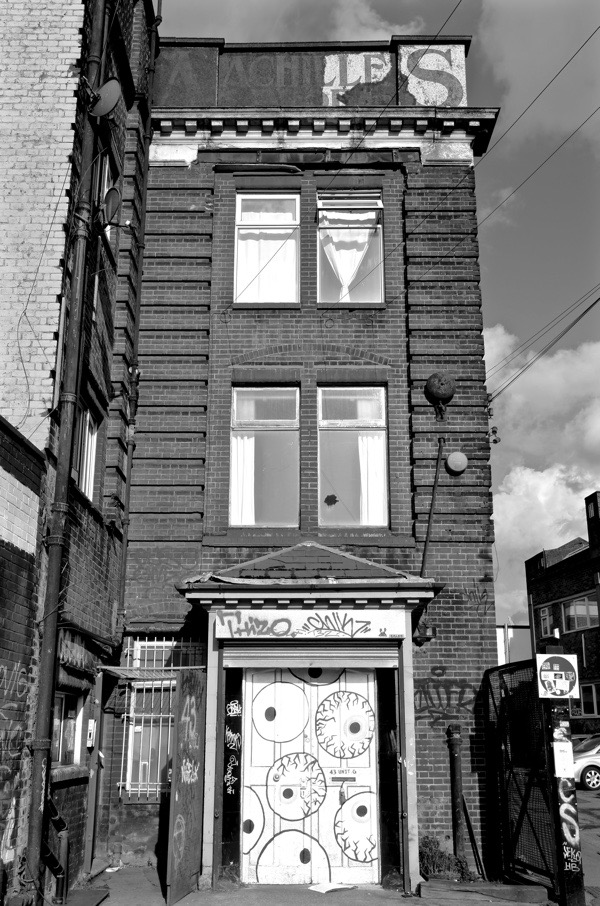
Achille Serre, Britain’s first dry-cleaning works

Central Books, 99 Wallace Rd. Clarnico’s printing works and cardboard box factory built around 1900. Chocolate boxes were probably made here for the Clarnico chocolates manufactured in Queen’s Yard.

The former Lord Napier public house built circa 1865 on the corner of White Post Lane and Hepscott Rd – is to be restored and reused under the London Legacy Development Corporation’s Hackney Wick Central Area Masterplan.

Portrait of Tom Ridge by Lucinda Douglas Menzies
TOM RIDGE WRITES
The Fish Island & White Post Lane Conservation Area was designated in 2014 by the London Legacy Development Corporation, who also identified thirty-two non-designated heritage assets in the Conservation Area – mostly late-nineteenth and early-twentieth century industrial buildings which according to its Local Plan are to be “restored and reused.”
These are now the only large group of historic industrial buildings surviving in the Lower Lea Valley, which is the capital’s largest waterside industrial area, dating from when London was the both largest industrial city in the world and the greatest port.
Between 1880 and 1920, the best multi-storey industrial building were being built there, with brick load-bearing walls and internal metal frames of cast iron columns and steel beams or steel stanchions and steel beams. There are thirteen industrial buildings with such ‘transitional structures’ in the Conservation Area, which is probably the largest group of these buildings in London.
Should the London Legacy Development Corporation allow Constable Homes to simply retain the Swan Wharf stable block’s three-storey walls facing on Dace Rd and build a five-storey building on the site behind, a planning precedent will be established. In time, this precedent would almost certainly result in the loss of all the other historic industrial buildings in the Conservation Area, replaced by new buildings with just a few retained facades.
Please help me fight to save this unique industrial Conservation Area and ensure that the London Legacy Development Corporation and developers observe the relevant local and national policies.
Click here to sign the petition to Save Swan Wharf in Fish Island, Hackney Wick
You may like to read my profile of Tom Ridge
Delft Tiles In Fournier St

The scourging
There is a fine house in Fournier St with an old fireplace lined with manganese Delft tiles of an attractive mulberry hue illustrating lurid Biblical scenes. Installed when the house was built in the seventeen fifties by Peter Lekeux – a wealthy silk weaver who supervised two hundred and fifty looms and commissioned designs from Anna Maria Garthwaite – these lively tiles have survived through the centuries to educate, delight and inspire the residents of Spitalfields.
Tiles were prized for their value and their decorative qualities, and in this instance as devotional illustrations too. Yet although Peter Lekeux was a protestant of Huguenot descent, a certain emotionalism is present in these fascinating tiles, venturing into regions of surrealism in the violent imaginative excess of their pictorial imagery.
The scourging of Jesus, Judith with the decapitated head of Holofernes, the Devil appearing with cloven feet and bovine features, and Jonah vomited forth by the whale are just four examples of the strangeness of the imaginative universe that is incarnated in this fireplace. Arranged in apparent random order, the tiles divide between scenes from the life of Jesus and Old Testament saints, many set in a recognisable Northern European landscape and commonly populated by people in contemporary dress.
It is possible that the tiles may date from the seventeenth century and originate from continental Europe. Their manufacture developed in Delft when, at the beginning of the sixteenth century, Chinese ceramics were imported from Portuguese ships captured by the Dutch, and because these were in demand local potters tried to copy them, starting a new industry in its own right. The earthenware tiles were covered with a tin glaze to create a white ground upon which the design was pricked out from a stencil, and then the artist simply had to join up the dots, producing the images quickly and to a relatively standard design.
“I’m not sure what this is supposed to illustrate!” exclaimed Sister Elizabeth at St Saviour’s Priory when I consulted her, colouring slightly when I showed the tile of the topless woman dragging a bemused man towards a bed, “Maybe the woman taken in adultery?” Yet she was able to identify all the other stories for me, graciously assenting to my request when I called round to the Priory in Bethnal Green seeking interpretation of the scenes in my photographs – after I had spent a morning in Fournier St crouching in the soot with my camera.
Upon closer examination, several hands are at work in these tiles – with the artist who drew Jesus confronting the Devil in the wilderness and Jonah thrown up by the whale, setting the dominant tone. This individual’s work is distinguished by the particular rubbery lips and fat round noses that recall the features of the Simpsons drawn by Matt Groenig, while the half-human figures are reminiscent of Brueghel’s drawings illustrating the nightmare world of apocalypse. More economic of line is the artist who drew Jesus clearing out the temple and Pilate washing his hands – these drawings have a spontaneous cartoon-like energy, although unfortunately he or she manages to make Jesus resemble an old lady with her hair in a bun.
There is an ambivalence which makes these tiles compelling. You wonder if they served as devout remembrances of the suffering of biblical figures, or whether a voyeuristic entertainment and perverse pleasure was derived from such bizarre illustrations. Or whether perhaps there are ambiguous shades of feeling in the human psyche that combine elements of each? A certain crossover between physical pain and spiritual ecstasy is a commonplace of religious art. It depends how you like your religion, and in these tiles it is magical and grotesque – yet here and now.
My head spins to imagine the phantasmagoria engendered in viewers’ imaginations over the centuries, as their eyes fell upon these startling scenes in the glimmering half-light, before dozing off beside this fireplace in a weary intoxicated haze, in the quiet first floor room at the back of the old house in Fournier St.


In the wilderness, the Devil challenges Jesus to turn stones into bread.

Joseph and Potiphar’s wife.

St Jerome with the lion in the wilderness.

Jesus drives the traders from the temple.

Jesus meets the Samaritan woman at the well.

Sampson and Delilah, cutting Sampson’s hair

Noah’s flood.

The woman who touched Jesus’ robes secretly and was instantly cured of her haemorrhage.

Judith with the head of Holofernes

Pilate washes his hands after Jesus is bound and led away.

Jesus and the fishermen

Jonah sits under the broom tree outside Nineveh.

The soldiers bring purple robes to Jesus to rebuke him when he claims to be an emperor.

Jonah is cast up by the whale upon the shore of Nineveh.

You may also like to read about
Joan Lauder, Cat Lady Of Spitalfields
Today I publish Rodney Archer’s memories, with Phil Maxwell’s black and white photos from the eighties and Clive Murphy’s colour pictures from the nineties, of Joan Lauder, Cat Lady of Spitalfields.
Recently, Clive Murphy revealed to me he is working on a book entitled ‘Angel of the Shadows’ about Joan, whom he interviewed for over twenty years until her death in 2011, so I am looking forward to learning more about the life of an extraordinary woman who has become an enduring enigma in the East End.
In my imagination, Joan Lauder is a mysterious feline spirit in human form that prowls the alleys and back streets – a self-appointed guardian of the stray cats and a lonely sentinel embodying the melancholy soul of the place.

One day, when I went round to enjoy a cup of tea and shot of rum with Rodney in his cosy basement kitchen in Fournier St, he told me about Joan, the Cat Lady, who made it her business to befriend all the felines in Spitalfields during the nineteen eighties.
Rodney: Joan went all around the neighbourhood feeding the cats regularly and she had names for them. You’d see her crouching, looking through the corrugated iron surrounding Truman’s Brewery, waiting for the cats to come and then they suddenly all appeared. I think once I saw her there and I asked her what she was doing, and she said ‘I’m waiting for the cats to appear.’
‘My darlings,’ she really did call them, ‘My darlings,’ and it was wonderful in a way that she had this love of cats and spent her life encouraging them and feeding them and keeping them alive. I could never quite work it out, but she had a bag, like one of those trolleys you carry, full of cat food. Now, either she’d taken the tops off the tins or something, since I noticed – because she had a kind of witchlike aspect – that although she put her hands right into the tin to feed them and then just threw it down, I never saw any cat food on her hands. It was like something out of Grimm’s Fairy Tales.
Over the years, I would chat to her but she was someone that you had to have some time for, because once she began she went on and on. The Cat Lady was strange – she spent all her money on the cats – she was like a character out of Dickens. She was almost a street person, except she had a place to live. And she did get benefits and she wasn’t an alcoholic or anything, she was very doughty, she had a bit of a moustache.
She was the kind of woman that, a hundred years ago, people would have been fearful of in a way. There was something awesome about her, because she had her own aura and she was there to feed the cats, and the cats were much more important to her than people. I’d talk about my cat to her and I think once she stopped by my door, and I opened it, and my cat sat looking at her.
The Gentle Author: I’ve heard she had this mantra, “Cats are better than rats.” Were there a lot of rats at that time?
Rodney: I think there were. When the market was still going and you had all the fruit and vegetables, the rats would come out to feed. I never saw that myself, but you might see a rat running along the curb. A lot of people said they were looking forward to the market closing because the area would be cleaner and neater, but I regretted that the market left and there weren’t cabbages everywhere.
The Gentle Author: Can you remember when you first saw the Cat Lady?
Rodney: I think I first saw her on the corner of Fournier St and Brick Lane. She had a huge physical endurance, but I think she must have been exhausted by her journey every day, because she would often stop for quite a long time, and she’d just be there looking around. I suppose she might have been looking for the cats. That’s why you could catch up with her and ask her how she was doing.
One day I just spoke to her, maybe I’d seen her around, and I said, ‘Are you feeding the cats?’ And she told me, and I said had a cat and so we talked about cats and the wisdom of cats and that kind of thing. And afterwards, I’d see her quite often. She didn’t talk much to me about her life – but she was the Great Mother of all the cats in Spitalfields.

Phil Maxwell photographed Joan, the Cat Lady, in the eighties


The cat lady on Brick Lane in the late nineteen eighties.
Phil: The woman in this photograph was always dressed in a head scarf and large coat. Usually she would pull a shopping bag on wheels behind her. She was the Cat Lady of Spitalfields. She knew where every cat and kitten lived in the wild and made it her task to feed them every day. Her bag was full of cat food which she would serve on newspaper at designated spots around Spitalfields.

Phil: The Cat Lady pauses for a second beside the Seven Stars pub on Brick Lane. She has just left some food in the ‘private road’ for some cats.

Phil: The Cat Lady floats past Christchurch School on Brick Lane – with her eyes closed, she contemplates the next cat awaiting a delivery.

Phil: The Cat Lady waits outside her favourite cafe in Cheshire St. Now a trendy boutique, in the nineteen-eighties you could buy a cup of tea and a sandwich for less than a pound at this establishment.

Phil: The Cat Lady ‘kept herself to herself’ and avoided the company of others

Phil: It must be about twenty years since I last saw the Cat Lady of Spitalfields. She devoted her life to feeding the stray cats of the area. I have no idea where she lived and I never saw her talking to another person. She seemed to live in her own separate cat world. Even though I was sitting opposite her when I took this photograph, I felt that she had created a barrier and would be reluctant to engage in conversation. It was impossible to make eye contact. I’m pleased I photographed her on the streets and in her Cheshire St cafe. She would not recognise Cheshire St and Brick Lane today.

Joan Lauder, The Cat Lady of Spitalfields (1924-2011) by Clive Murphy

At Angel Alley, Whitechapel, 5th March 1992

Feeding the cat from The White Hart in Angel Alley, 5th March 1992

In Gunthorpe St, 5th March 1992

Buying cat food at Taj Stores, Brick Lane, 3rd August 1992

In Wentworth St, 3rd August 1992

Calling a cat, Bacon St, 3rd August 1992

The cat arrives, Bacon St, 3rd August 1992

Alley off Hanbury St, 2nd August 1992

Hanbury St, 26th November 1995

At Aldgate East, 3rd August 1992

At Lloyds, Leadenhall St, 3rd August 1992

Walking from Angel Alley into Whitechapel High St, 3rd August 1992

Beware Of The Pussy, 132 Brick Lane, 26th November 1995

Clive visits Joan in her Nursing Home, 1995
Clive: The women I have loved you could count upon the digits of one hand – my mother, her mother, our loyal companion Maureen McDonnell, the poet Patricia Doubell and the demented, incontinent Joan Lauder, the Cat Lady of Spitalfields who, in 1991, when I first spoke to her was already my heroine, a day-and-night-in-all-weathers Trojan, doggedly devoting herself to cats because human beings had for too long failed her.
She looked at me with suspicion when I suggested we tape record a book. Only my bribe that half of any proceeds of publication would fall to her or her favoured charities and enable the purchase of extra tins of cat food persuaded her at least to humour me. I could swear I saw those azure eyes, set in that pretty face, dilate.
I had entrapped her with the best of intentions as she, I was to learn, often entrapped, also with the best of intentions, the denizens of the feral world to have them spayed or neutered in the interests of control. But to the end, her end, I don’t think she ever trusted or respected me. I once found her surreptitiously laying down Whiskas in my hallway for my own newly-adopted cat which I named Joan in her honour. And she once spat the expletive ‘t***’ at me in a tone of total dismissal. To be called a foolish and obnoxious person was hardly comforting, given that I believe my own adage ‘in dementia veritas’ holds all too often true.
Black & white photographs copyright © Phil Maxwell
Colour photographs copyright © Clive Murphy


