
Wolfgang Suschitzky, Photographer
As a complement to his recent feature on the work of photographer Edith Tudor-Hart, Contributing Writer Mark Richards explores the photography of her brother, Wolfgang Suschitzky

Bethnal Green, 1937
I had the privilege of meeting the late Wolfgang Suschitzky (1912-2016) three times – once at an exhibition opening, once at a book signing and, most recently, when he agreed to a portrait session and interview last year. His apartment was like a treasure-trove with walls covered in photographs, prints and works of art, providing an evocative glimpse into the mind of an artist who, over seven decades, produced some of the most memorable photographs of his generation.
Wolf was kind enough to share some insights into his photographic career and the context of many of his photographs – in particular his famous Charing Cross Series. Born in Austria in 1912, Wolf grew up in the same environment as his his older sister Edith Tudor-Hart. His father, Wilhelm Suschitzky, ran a Socialist bookshop in Vienna and was of Jewish origin, but had renounced his faith and become an atheist. It is clear from his work, and from speaking to him, that Wolf was a humanist who had remarkable empathy with his subjects, both human and animal. His humanity is the golden thread which links all of his photographs together.
I know of many attempts to categorise Wolf’s photography but the breadth of his work defies any simple description. For me, what is most striking about Wolf as a photographer was his versatility and his ability to apply himself to many different situations. Above all, Wolf was an opportunist with an outstanding eye for what works visually and how to execute it technically. He was in turn a documentary photographer, a portrait photographer, a photographer of animals and an accomplished cinematographer. Whichever mode he was in, his photographs reveal an humane clarity of vision born out of one common characteristic, which was his patience. When I asked him what he thought was the most important element of any photograph, his reply was simple – he said it was timing. Choosing when to press the button and capture a moment was the key to many of his most striking images.
Wolf had originally planned to be a Zoologist but his interest in photography was encouraged by his sister, Edith, who had studied at the Bauhaus in Dessau and eventually he enrolled there too. When I asked him about the Bauhaus and what influence it had on his photography he was quite dismissive, saying that all they taught him was how to make a good print. The course was technical and does not seem to have been a great deal of help when it came to the aesthetics of photography and what makes a great photograph. For that, he had to look to other influences such as Henry Cartier-Bresson, Willy Ronis and the emerging Bill Brandt.
Yet the technical rigour instilled into him at the Bauhaus laid the foundation on which much of his future success as a photographer was built. You can have the best eye in the world for composition, but it is of little use if you cannot take a good photograph and print it properly. He told me that he always made his own prints and much of his creative interpretation came in the darkroom. He had remarkable skills that are now all but lost in this age of digital photography.
Wolf left Austria in 1934 and stayed briefly in London before moving to Amsterdam with his new wife. After this short marriage, his wife left him and he returned to London in 1935. He later attributed his existencel to the failure of that marriage, but for their separation he might not have survived the war.
His modesty, patience and sensitivity come through in much of his work. They are evidenced by not trying to impose himself on the subjects but allowing them to flow through his lense to the printed image. His archive includes an astonishing range of work from projects he initiated as well as seventy years of commissioned photography.
One of Wolf’s most well-known set of photographs is his Charing Cross Series, taken early in his career. As a foreigner in London, he was able to see the city through fresh eyes and took many photographs of everyday life in the capital, which as – a new arrival – seemed far from normal to him. As photographers, we all recognise the sense of excitement in exploring a new city and photographing subjects which the locals perceive to be unremarkable.
Wolf’s excitement and interest in his new environment comes through in this series. While many of the photographs possess technical excellence, much of the significance of the series has been acquired in the decades that have passed since the photographs were first taken. He was a struggling photographer at the time, so much of what he took in his early years was opportunistic, aimed at making some money – often with limited success. Originally, Wolf wanted to produce a book of his Charing Cross photographs but the cost was prohibitive and he could not find anyone to publish it.
As London was overtaken by war, Wolf’s adopted city was changed forever. During those dark times, he captured some remarkable images of London at the height of the Blitz. Yet, even when photographing these subjects, Wolf managed to preserve his distinctive style and stand out from those that merely sought to capture scenes for the record.
Throughout his life, Wolf maintained his interest in Zoology and took many remarkable photographs at London Zoo, where he enjoyed interacting with animals enormously. Wolf considered these photographs to be portraits in the proper sense of the word and they took a huge amount of patience to execute.
Wolf had a particular talent for taking portraits. His modesty, good nature and empathy enabled him to put his subjects at ease. When I asked him why he moved into portraiture, his answer was simple – he did it to bolster his income. Yet his relationship with portraiture was clearly much more than that because it included street portraits for which he earned no fee. Wolf treated both the famous and those who were not famous on an equal footing, always striving to preserve the dignity of his subjects.
Much like his sister, Wolf was committed to social justice and some of his photographs revealed the poverty of Londoners, especially children. His photograph of two children playing with a matchbox has many similarities to the famous Bakery Window by Edith Tudor-Hart. However, Wolf’s photograph was not staged but taken as a candid snapshot of deprivation in the East End.
In addition to his ability to portray people and animals, Wolf also possessed an impressive ability to capture the atmosphere of the urban environment, as you can see in the pictures below. Yet I cannot show the entire range of Wolfgang Suschitzky’s work here, I have not even touched on his work as a cinematographer. Out of a number of books available, the most recent is Seven Decades of Photography published by Synema, which I highly recommended.
The fact that these photographs were all taken using film, with no preview facility and only a limited number of available frames, makes Wolf’s achievement all the more remarkable.

The Matchbox, Stepney, 1936

Charing Cross Road, 1937

Man outside Foyles, 1936
This celebrated photograph of Foyles’ bookshop appears staged but, in fact, is a classic street photograph. Wolf waited patiently across the road for his subject to appear. He told me that he took the photograph speculatively, on the basis that Foyles might be interested in buying it for advertising, but when he presented it to them it was rejected as being of insufficient interest – a decision which seems remarkable in retrospect.

Charing Cross Rd, 1937

Shoe Shine, Charing Cross Rd, 1937
Wolf told me that this was a Soho gangster who was not pleased at having his photograph taken, but the woman in the photograph seemed quite flattered and posed for the camera. It is a striking social contrast between the well-dressed gangster and the man shining his shoes.

Milkman, Charing Cross Rd, 1935

Paving Charing Cross Rd, 1936
Even as late as 1936, they were using wooden blocks covered with tar to pave roads even though the number of horses in London had reduced drastically. The blocks were to absorb the noise from horses’ hooves and soften the impact for them.

St Paul’s Cathedral through the window of a bombed-out building, 1942

View east from St Paul’s Cathedral, 1942

War time pig-sty, 1942

Guy the Gorilla, London Zoo, 1958
Wolf described this remarkable photograph of Guy the Gorilla to me as being the best picture he ever took. The picture was taken after Wolf persuaded the zoo keeper to allow him to poke his camera through the bars of Guy’s cage, something that would be impossible today. In the resulting image, Guy looks both sentient and resigned to his fate. A magnificent creature imprisoned in a small cage at the will of humankind. The photograph, which was published widely and used by Virginia McKenna in one of her anti-zoo books, epitomises our relationship with animals and how they are often reduced to a mere commodity.

Leopard, London Zoo, 1958

Londoner, 1935

H.G. Wells with his Modern Declaration of the Rights of Man, 1939

Portrait, Trinidad, 1960

Sean O’Casey, 1958

Oldham, 1947
This photograph was taken out of the window of a pub where Wolf was staying for the night. It has a remarkable tonal range only possible through his skills in the darkroom, and captures the day after the tram tracks were removed and covered with tarmac.

Prinsengracht, Amsterdam, 1934

Embankment, 1947

The Thames, 1952
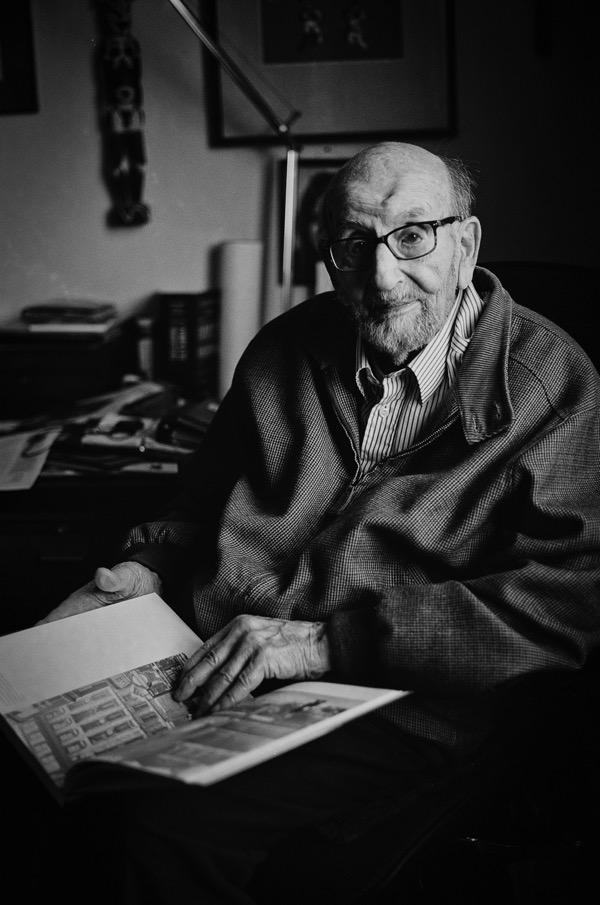
Wolf Suschitzky, aged 104, at his flat in Maida Vale – taken by Mark Richards using Ilford XP2 film
Photographs copyright © Estate of Wolfgang Suschitzky
You may also like to read about
The Old South Bank
Contributing writer, Gillian Tindall is currently celebrating forty years since the publication of her first foray into the history of cities, The Fields Beneath, and it is my pleasure to publish this missive from Gillian regarding that unknown land on the other side of the Thames known as the ‘South Bank.’
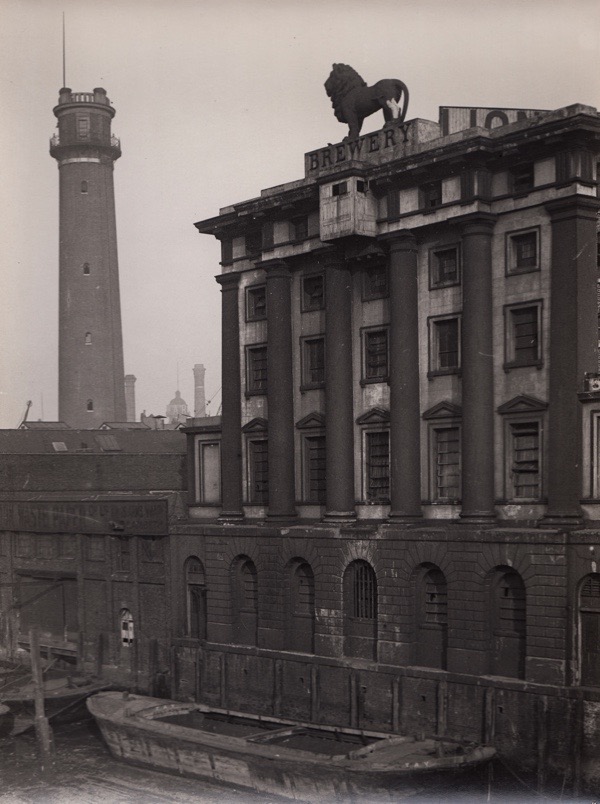
Lion Brewery and the Shot Tower by William Whiffin c1900
Many years of research and writing have taught me that when people survey a densely packed townscape, often with glassy towers rising above sooty older buildings, they love knowing that this same space of land was once a meadow occupied by cows, or an orchard, or yet the bank of a stream full of fish. What is not always so readily perceived is that, over time, one acre of London soil may have had many different incarnations.
Hundreds of years ago, the long stretch of the South Bank, all the way from London Bridge and Borough Market to Lambeth Bridge and the Archbishops’ Palace was a riverbank of bull-rushes and waterbirds’ nests, that had been built up with mud to try to keep the Thames out of the low-lying lands behind. A section at the eastern end had a proper wall constructed earlier than anywhere else along the Thames – the old name Bankside, dating from the thirteenth century, indicates this. Yet attempts to create a permanent causeway to keep the waters at bay were only partially successful and, further west, most of Lambeth remained a marsh into the eighteenth century. Occasional floods invaded buildings all along the riverfront until late-Victorian embankment and drainage got the better of the situation.
None of this stopped the citizens of London and its outlying parishes from making the most of their southern shore. In Elizabeth I’s reign, there was already a row of waterfront inns and places of entertainment stretching as far as where the Oxo tower stands today, just before the river takes a big curve southwards at Waterloo Bridge. Houses with gardens were built too, favoured by those who wanted to live outside the City jurisdiction, and some of these were given elegant new fronts in the time of Queen Anne.
Wharves were already creeping up river from the Pool of London to take over this flowery suburb then. Timber, stone and coal, all heavy loads that could only be carried in any quantity by water in the days of unmade roads, arrived via the Thames estuary and were off-loaded up-river of London Bridge. At the beginning of the nineteenth century, when the Industrial Revolution was sweeping through England and sending more and more of its products to London, the river front all the way to Lambeth was effectively privatised, partitioned among wharf-owners, importers and traders. By the twentieth century, there were over fifty privately owned wharves between London and Lambeth Bridges, many of them occupying one-time gardens.
In those days, well-to-do merchants did not live far from the source of their income and the tradition of a big, elegant house next to the works was still maintained. Just one of these survives, beside the Globe Theatre on a preserved stretch of old cobbled Bankside, with two smaller, rebuilt ones alongside. Another old house, even grander, stood till the fifties a little further along at Honduras Wharf – past the Bankside Power Station that became Tate Modern – approximately where the utilitarian Founder’s Arms pub is today. The house’s fine doorway and beautiful staircase were documented in the Southwark volume of the Survey of London, which was published after the war. Yet, in the destructive atmosphere of post-war planning, this did not stop it from being swept away for `improvements.’
The wharf buildings that hemmed in these elegant houses for two hundred years have gone now too as if they had never been. Fortunately, the desert of concrete blocks with a road in front that the planners envisaged for this stretch of the river did not get built. Instead, the idea of a public walkway to join up with Lambeth, where the Festival of Britain was held in 1951, gained more and more support. Yet the public were slow to realise what a wonderful present they had been given in a promenade with unimpeded river views that had been denied to their ancestors for centuries. Even twenty years ago, when the walkway had been completed – but had not yet been discovered by the café-owners, strollers, foreign tourists, exhibition-viewers, skate-boarders, performers and all the others who now throng it – I used to walk there alone and wonder why more did not know of it. Beware what you wish for!
On the one-time site of the Festival of Britain, the transformation over the decades has been even greater. I am one of that diminishing generation who remember visiting the Festival in childhood. In what was still the period of post-war austerity and rationing, it seemed to me be a fairy-tale of colour, lights, and a promise of a new time to come – especially when I was taken to a restaurant overlooking the river and saw people dancing at night in an open square. Goodness how foreign and exciting!
In reality, the Festival had been a contentious venture, crammed between Waterloo Bridge, Waterloo Station and Blackfriars Rd, with the railway line from Hungerford Bridge crossing over it. The whole site was summarily cleared in order to build transient exhibition pavilions, the Dome of Discovery and one permanent structure – the Festival Hall. The only old building that was not swept away was the Shot Tower, an elegantly tapering tall brick chimney built for dropping globules of lead down into cold water. Disused, it was done up for the Festival with glass bubbles at its top. I loved it for its mysteriousness and was very sorry – as were many people – when it was destroyed the following year in the interests of modernity. It stood next to the Festival Hall, in the space now occupied by the unsatisfactory Queen Elizabeth Hall and Hayward Gallery. A tree is said to have been planted in its memory, but I have never been able to find it.
The road that runs past this line of buildings and under Hungerford Bridge, with the late-fifties Shell Centre a little further along on the other side, is still called ‘Belvedere Rd,’ a name that dates from long before the area’s wharf-and-industry time. It was christened in the eighteenth century after a gentleman’s house called the ‘Belvedere’ standing by the river in its own garden. Nearby there was also `Cuper’s Garden,’ dating from the previous century, which by-and-by was opened to the public and, acquiring a raffish reputation, became known as `Cupid’s Gardens.’ Similarly, there was a `Temple of Flora’ and `Apollo Gardens.’ Evidently, Greek names were felt to bestow a picturesque quality on places of dubious encounter.
All the sinful, pretty gardens had disappeared by the mid-Victorian era. Waterloo Bridge Rd obliterated Cuper’s, which became a wine depot and then a vinegar works before in was obliterated. On the site of Belvedere House, the huge, rather elegant Lion Brewery rose, with a locally manufactured Coade Stone lion decorating the top of its classical façade. The brewery survived till the Festival swept it away to build the Festival Hall. Yet a few other time-tested buildings lasted till after the war. Numbers 55 and 59 Belvedere Rd had elegant porches and wrought iron gates that survived even after their one-time gardens had disappeared under wharfs and storage sheds.
I feel an curious personal link to No 59, since it became the fictional location for a set of characters derived from my Anglo-Irish ancestry. In 1946, my father’s sister, Monica Tindall, published her only novel, The Late Mrs Prioleau, which was based on the last two generations of our shared relatives. Although the plot, revolving around an ill-omened marriage in 1900, was invented, Monica placed this unhappy couple in 59 Belvedere Rd which she had visited during the Second World War when it was a hostel for women war-workers.
“It must have been a fine house in its time, and a pretty house too, with its wide doorway and rows of symmetrical windows. The [water] tank covered what must once have been a tiny lawn, and the stanchions of window boxes still protruded from the sooty walls, and round the corner in the back peered a discouraged tree that might once have been a lilac… Over the baffle wall against the door, I could just see the fanlight… Its centre was a fluted plaster shell with delicate curves and the first floor window above repeated the motif. … I pitied that bride who came fresh from her Irish home with its trees and clean sunshine to live there with an unloved husband.”
Buildings which furnish the settings of entire lives can vanish so completely, along with all their memories, that it is cheering when one finds an afterlife in a book, however obscure. Bricks and concrete are destroyed as if they had never been but sometimes literature lasts longer. Even if the old South Bank of marshes, of pleasure gardens, of gentleman’s houses, of breweries and of lead-works, is utterly gone, The Late Mrs Prioleau was reissued by Dean Street Press earlier this year.

St Mary Overy’s Dock, London Bridge, photographed by Henry Dixon for the Society for Photographing the Relics of Old London, 1881 (courtesy of Bishopsgate Institute)
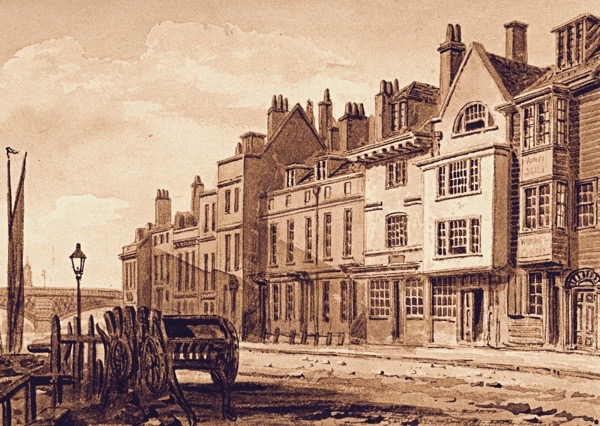
Bankside in the eighteen-twenties, some of the houses still dating from Tudor times
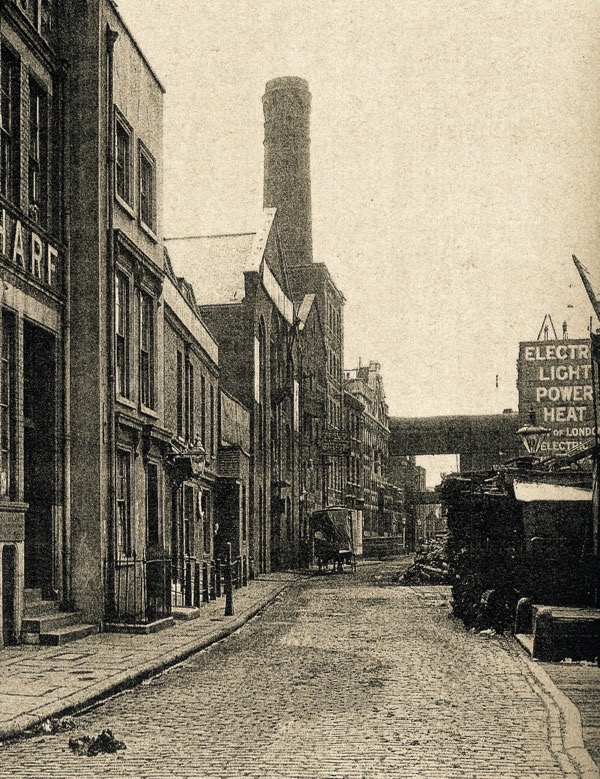
49 Bankside (the subject of Gillian’s book The House on the River Bank) in 1900 with the chimney of the earlier power station in the background
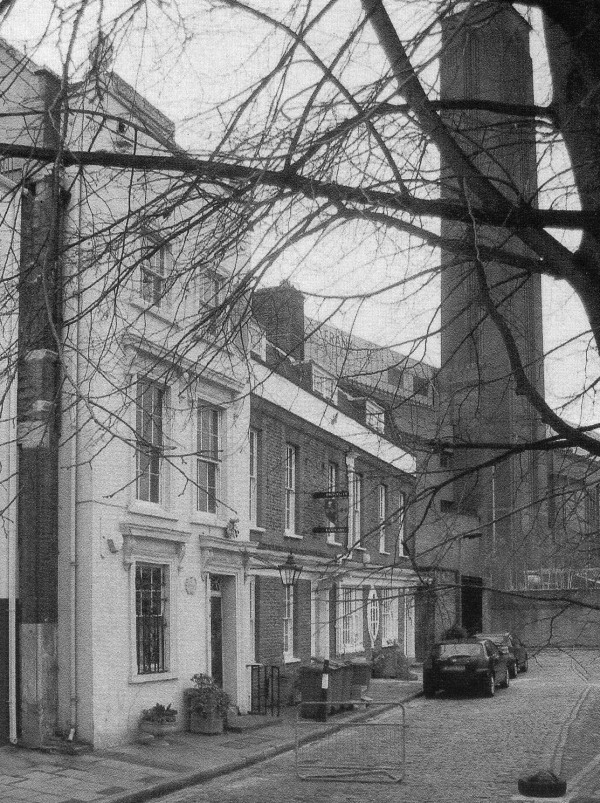
49 Bankside with the Bankside Power Station beyond, photographed by Richard Lansdown in 2004
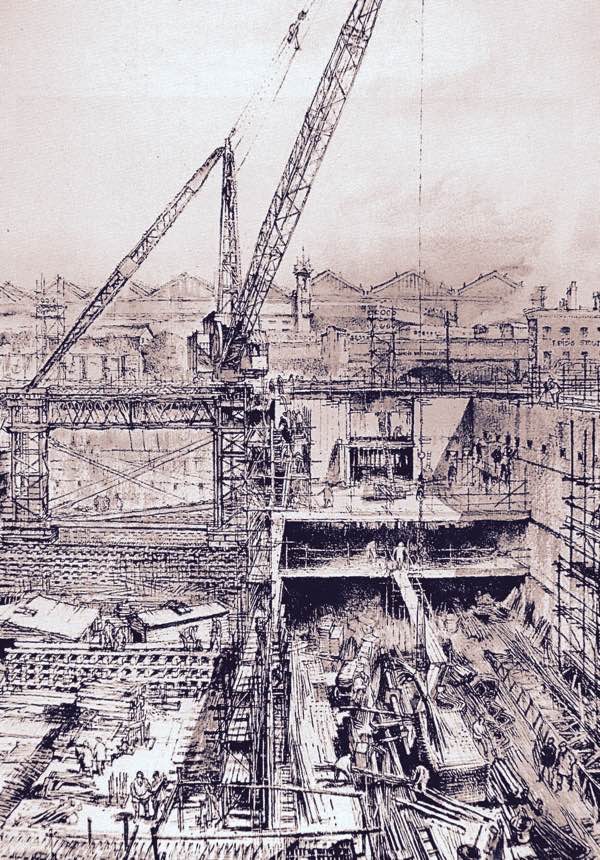
The Shell Centre being built in the late fifties by Charlotte Halliday (courtesy of the artist)
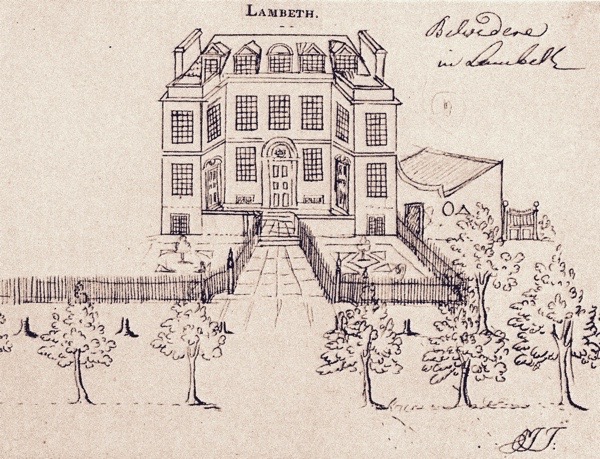
The Belvedere in the early eighteenth century (courtesy of Lambeth Borough Archives)
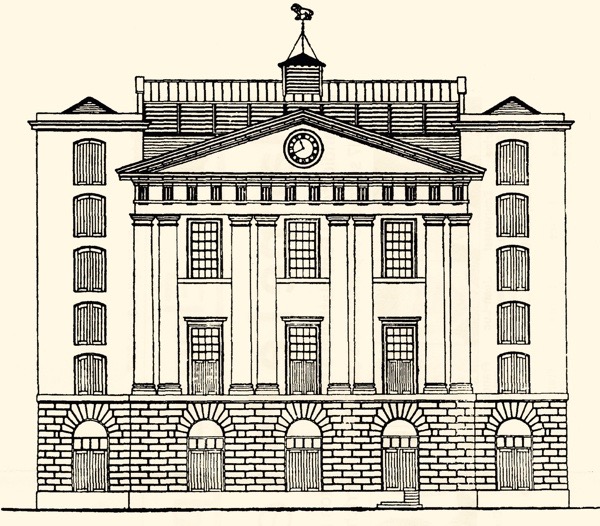
The Lion Brewery, mid-nineteenth century measured drawing
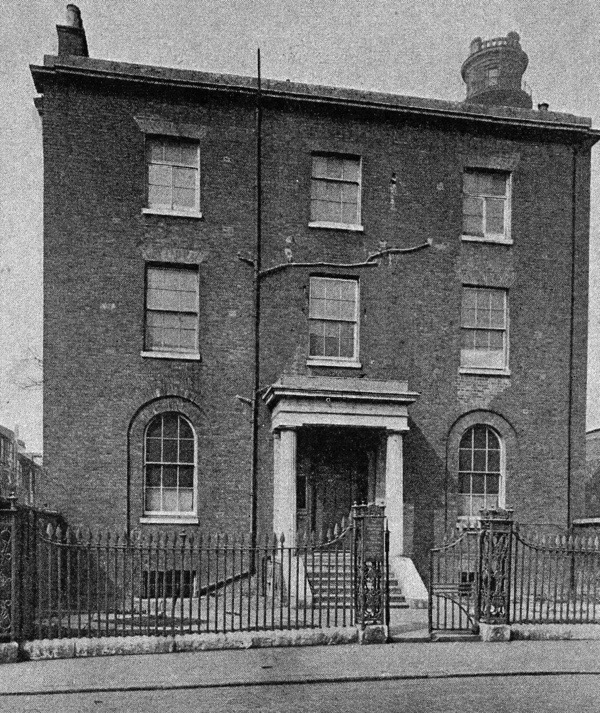
59 Belvedere Rd, 1946 (courtesy of Lambeth Borough Archives)
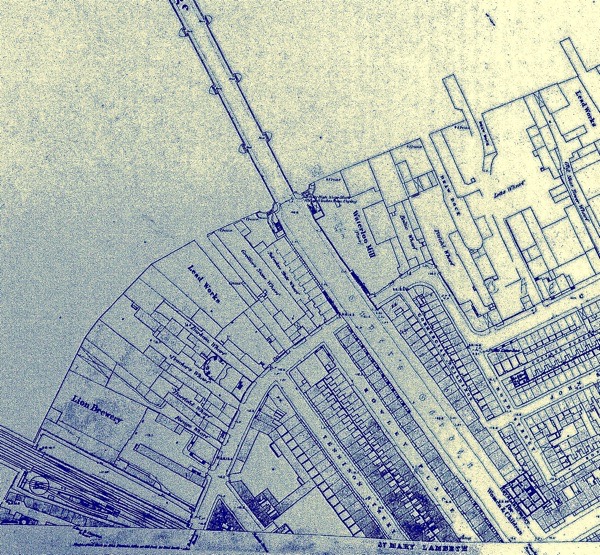
1900 map of the area that later became the Festival of Britain. The half-moon shape of the back of 59 Belvedere Rd, with the house in front and assorted sheds behind, is visible half way between Waterloo Bridge Road and Hungerford railway bridge, mid-way between the Lead Works and the Lion Brewery.
Gillian Tindall’s The Tunnel through Time, A new route for an old journey is out as a Vintage paperback edition this September and The House by the Thames is available in paperback from Pimlico
Dicky Lumskul’s Ramble Through London
Courtesy of the late Mike Henbrey, it is my pleasure to publish this three-hundred-year-old ballad of the London streets and the trades you might expect to find in each of them, as printed and published by J. Pitts, Wholesale Toy & Marble Warehouse, 6 Great St Andrew Street, Seven Dials

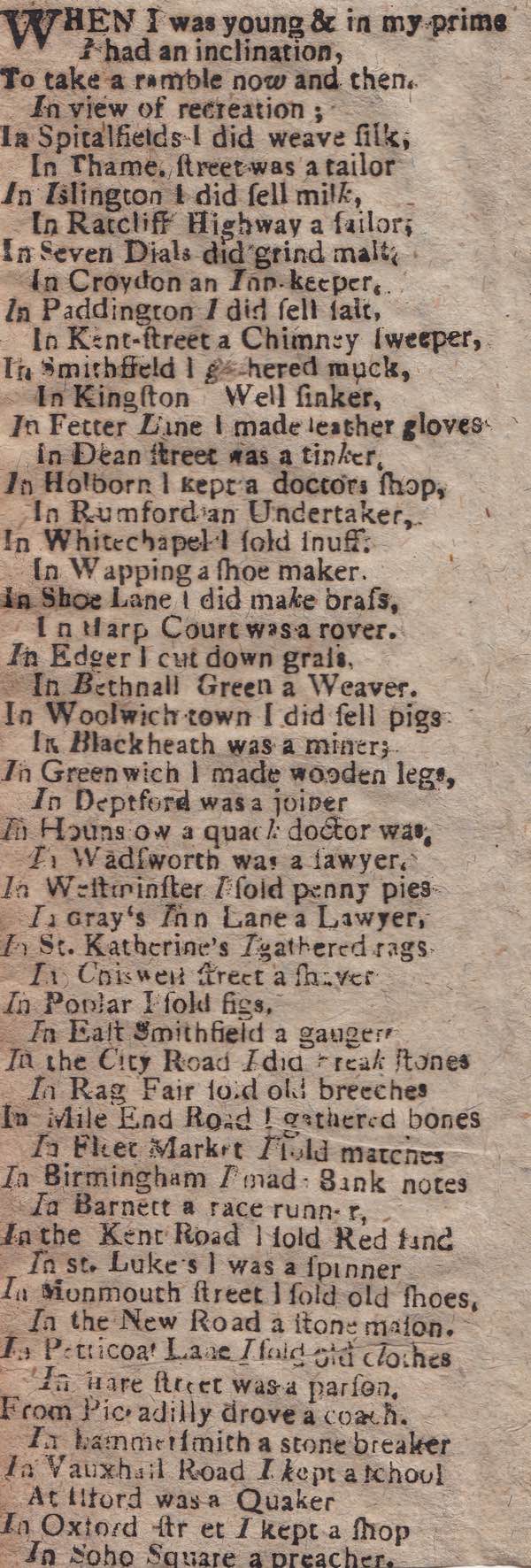
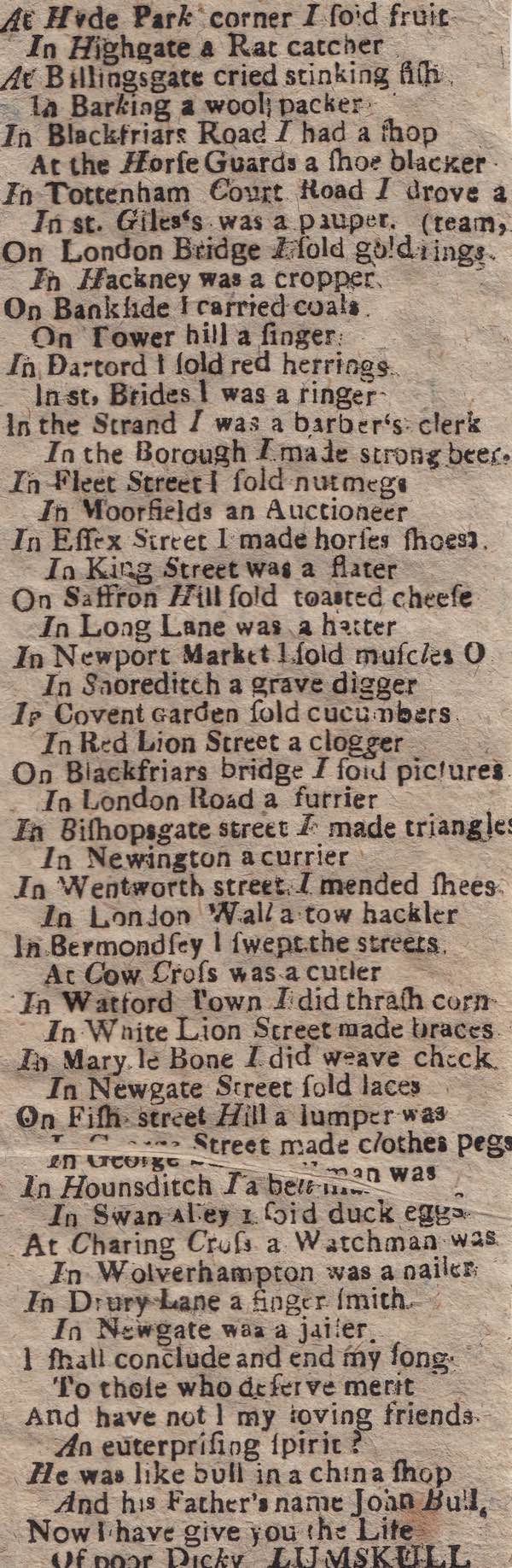
Copyright © Mike Henbrey Collection
GLOSSARY
by Spitalfields Life Contributing Slang Lexicographer Jonathon Green
You may also like to read about
Edith Tudor-Hart, Photographer
Mark Richards explores the controversial work of photographer Edith Tudor-Hart and her secret life as a Soviet agent in London during the Cold War
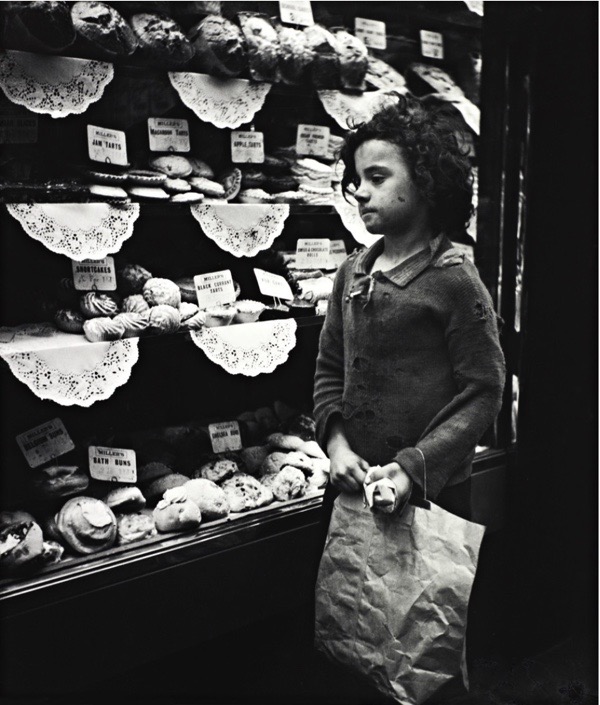
Child staring into a bakery window, Whitechapel, 1935 (Courtesy of National Gallery of Scotland)
On a wall in a flat in Maida Vale hangs this small photograph. It is a window into a world of social unrest, poverty, espionage and insurrection. The photograph and the story behind it add weight to the view that there is often little truth in photography. What we see is what the photographer wants us to see.
I saw the photograph when I visited the late photographer Wolfgang Suschitzky for an interview and portrait session in 2016. It was not taken by him, but by his sister Edith Tudor-Hart (1908–1973). The picture had pride of place on a wall of well-known photographs just inside the entrance. Edith Tudor-Hart was one of the most talented documentary photographers of her time, but has now faded into obscurity after being being blacklisted for her Communist activity.
For me, it is one of the strongest photographs of its era. One of those pictures that all photographers hope to be able to capture one day. Its ability to tug the heartstrings and generate strong emotion remains even eighty years after it was taken. On face value, it is a photograph of a poor child staring into a bakery window in Whitechapel in 1935. The disparity between the hungry child and the plentiful display has an enduring poignancy, inspiring a futile desire to intervene.
This photograph was first published next to another of a baby chimp in a zoo, which was much better fed than this girl. The message was clear, as was Edith’s ability to use her camera as a weapon for social justice. The picture was subsequently reproduced widely in Communist leaflets, representing a call to action. Yet to grasp the nature of this phenomenon and understand the other photographs that Edith took of the East End, we need to appreciate both the social context and her personal motives. None of the photographs that she took at that time can be taken at face value.
There is no doubt that this photograph was staged – the bundle clutched tightly in the girl’s left hand is evidence of that. We shall never know who the girl was or how she became to the subject. Edith destroyed her photographic records in 1951 for fear of prosecution, so the background to most of her work is now lost. She used photography to highlight social inequality and deprivation, realising early on – while studying at the Bauhaus – that photographs have the power to alter people’s beliefs and change the world. In her time, photography had become a medium for social change, ideal for the promotion of political views to a large audience, affecting them through the impact of the visual image more powerfully than by the written word.
Edith was acutely aware of the potential to use photography to break down social barriers and influence an audience like never before. For her, photography represented a move of the locus of control into the hands of the people, offering the possibility of self-representation for everyone. She understood that those who press the camera shutter can control the story that a picture tells.
As well as being an accomplished photographer, Edith was also a committed Communist and a Soviet agent who used her power to further her hidden agenda. Born in Vienna in 1908, she had grown up during a period of unprecedented political and social upheaval which shaped her beliefs. Her radical views are probably best summed up in Das Eland Wiens by the Marxist writer Bruno Frei, which attacks the inequality of capitalism and demands a commitment to revolutionary activism and change. Unusually, the book contained photographs and this was probably a decisive influence in Edith’s choice to become a photographer.
Edith’s father ran a Socialist bookshop which stocked Bruno Frei’s work and she mixed in radical Jewish circles in Vienna. In 1927, she trained as a Montessori teacher in England until she was deported to Austria in 1931 after being photographed at a Communist rally. Once in Austria again, she worked as a photojournalist for the Soviet news agency TASS, but in 1933 she was arrested there, again for being a Communist activist. At this point, Edith fled from Austria with her husband and was exiled in England.
Back in England, she continued her affiliation with the Communist party, both as an activist and a Soviet agent. It is likely that she had been recruited by the NKVD (the predecessor to the KGB) as early as 1927. Edith is often portrayed as a low-level agent yet she spotted and recruited Kim Philby. He was one of the Cambridge spy ring with Anthony Blunt, Guy Burgess and Donald Maclean, who caused damage to British interests and threatened its intelligence relationship with America during the Cold War. Edith knew Kim Philby’s wife Litzi Friedmann and was the one who introduced Philby to Arnold Deutsch, the Soviet Agent who managed the Cambridge spy ring. Her recruitment of Kim Philby was a seminal moment in her espionage activities.
In 1964, Anthony Blunt described Edith in his confession as being ‘the grandmother of us all.’ Yet, although she continued to be monitored by the security services until her death in 1973, she was never prosecuted for spying due to lack of evidence.
She had planned to produce a book of her photographs called Rich Man, Poor Man, after the nursery rhyme:
Daisy, daisy, who shall it be?
Who shall it be who will marry me?
Rich man, poor man, beggar man, thief,
Doctor, lawyer, merchant, chief,
Tinker, tailor, soldier, sailor…
The ambition of the book was to highlight the contrast between rich and poor in British society and it would have featured her photographs of the East End, together with a series she took of mining communities in Wales. The shocking juxtaposition of her ‘Poodle Parlour’ photograph with the picture of the Clerkenwell slums at Gee Street in Lilliput in 1939 demonstrated he power of her approach. However, the book was never published. Eventually, the difficulty of being a woman photographer as well as being blacklisted for her Soviet connections led Edith to abandon photography altogether at the end of the fifties.
Some of the images that were intended for this book are incredibly powerful and reveal the nature of her talent as a photographer. Her method included talking to her subjects instead of photographing them from a distance and she showed a real ability for putting people at their ease.
Bakery Window was to have been the cover photograph of Rich Man, Poor Man and what a book it might have been. Today it lies unconstructed among the negatives of her photographic archives held by the National Gallery of Scotland which were given to them by her brother Wolfgang in 2004.
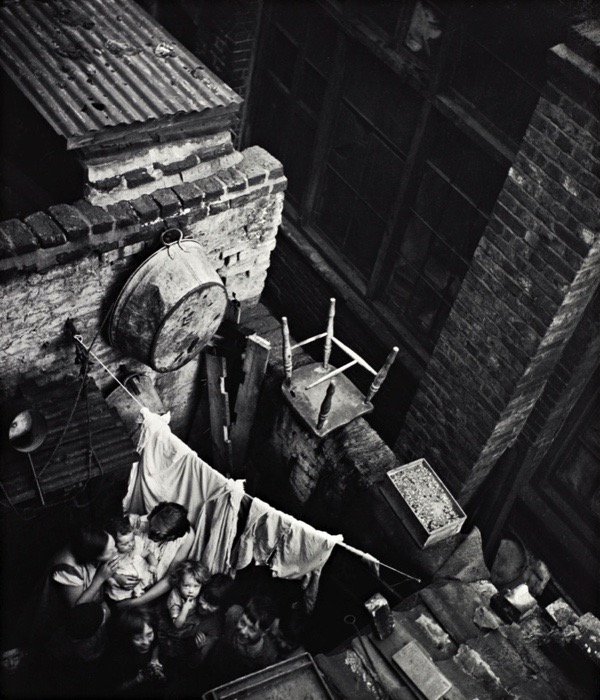
Slums at Gee St, Clerkenwell 1936
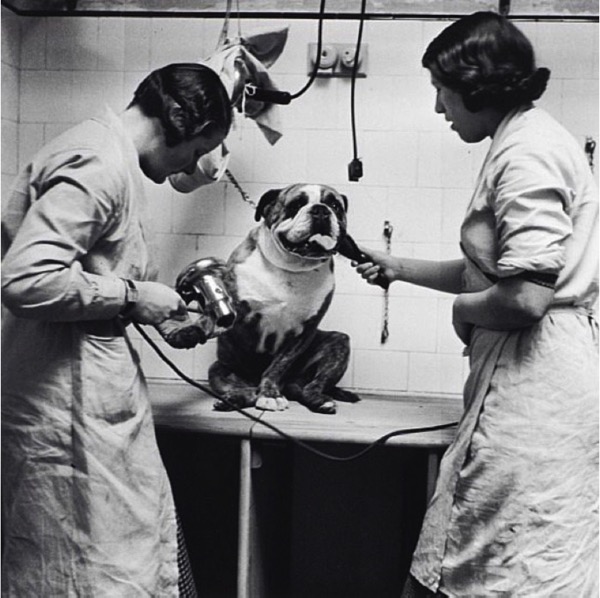
Poodle Parlour, West End, 1935
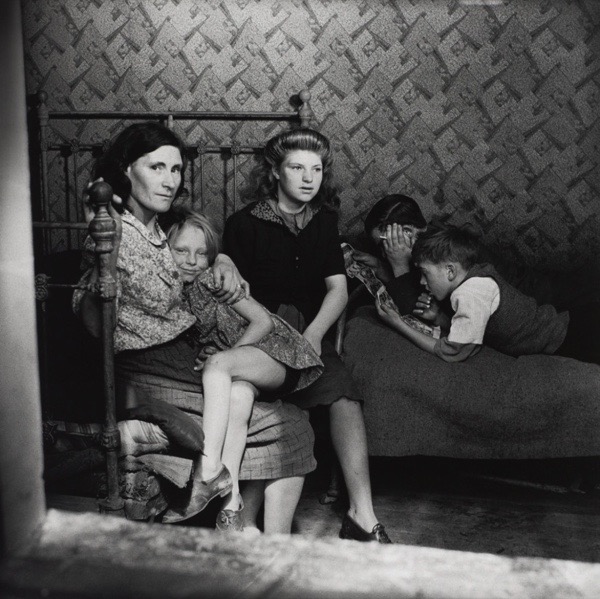
Family Group, Stepney, 1932
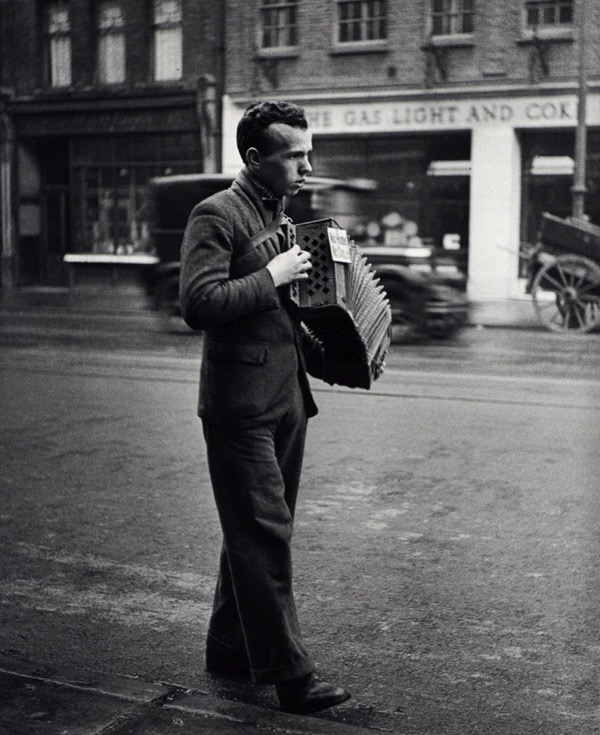
No Home, No Dole, London 1931
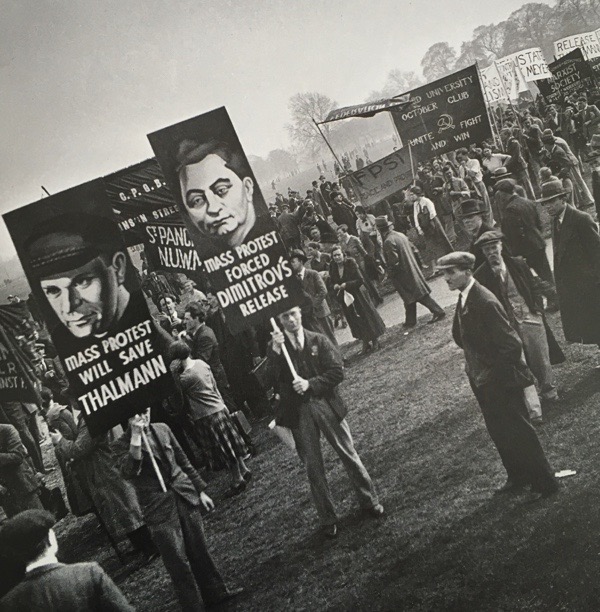
Communist Party demonstration, Hyde Park, c.1934
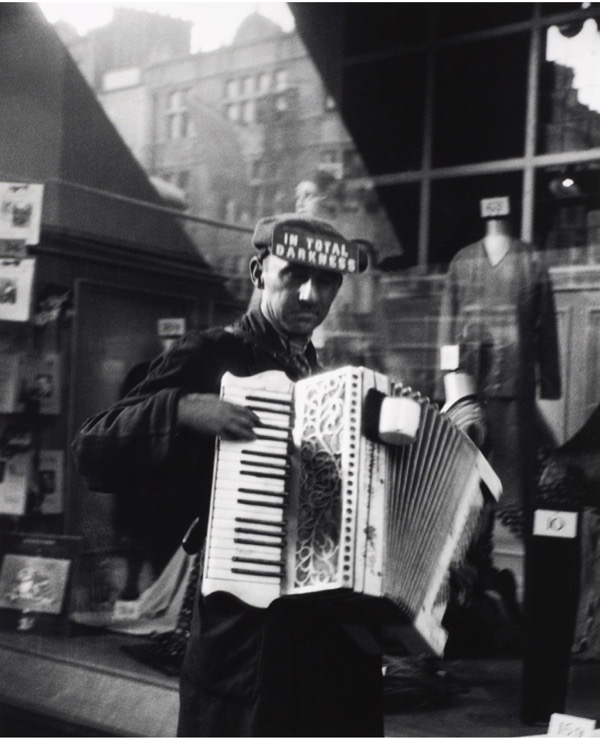
In Total Darkness, London 1935
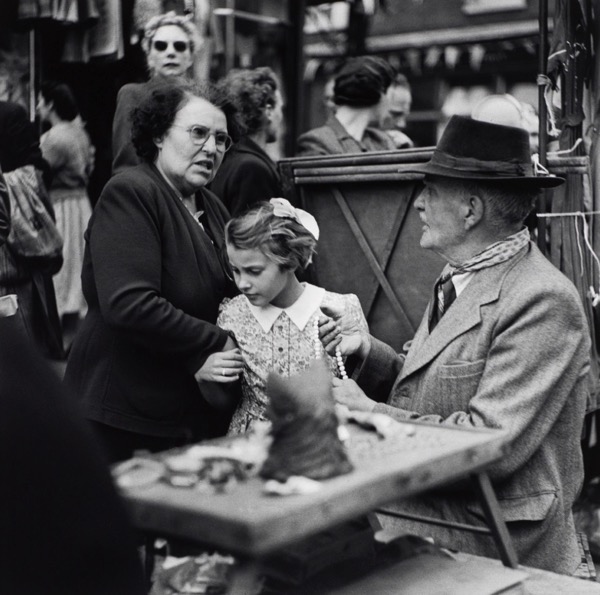
Caledonian Market, 1931
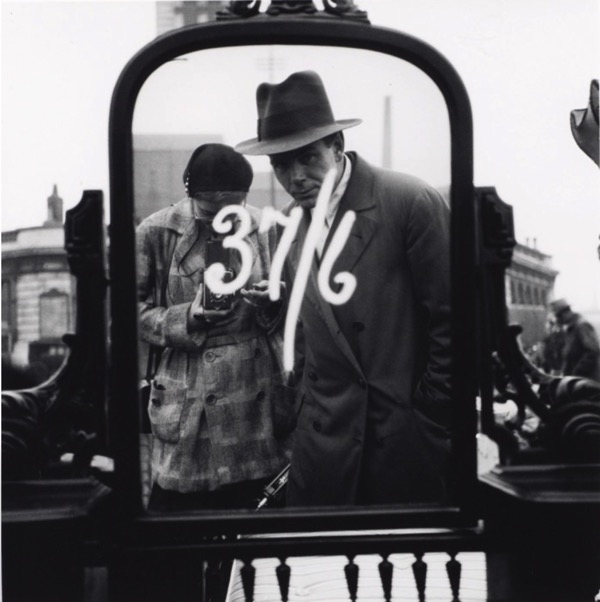
Self portrait with unknown man, Caledonian Market c.1935
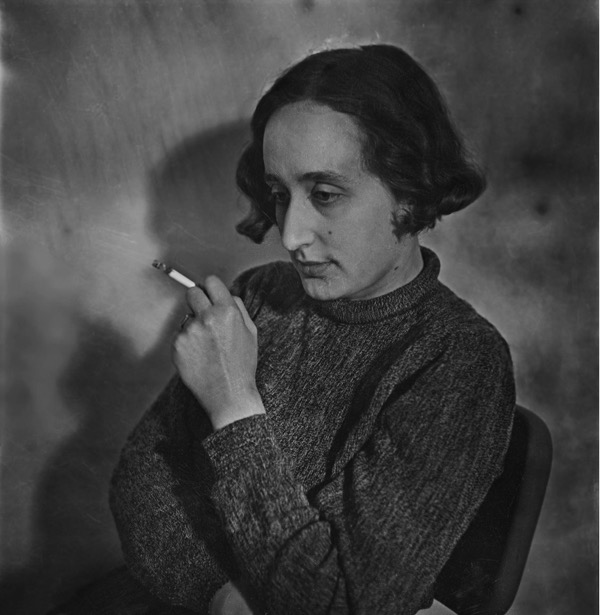
Edith Tudor-Hart, self portrait 1936
Photographs courtesy National Gallery of Scotland
You may also like to read about
Roy Reed At Billingsgate Market
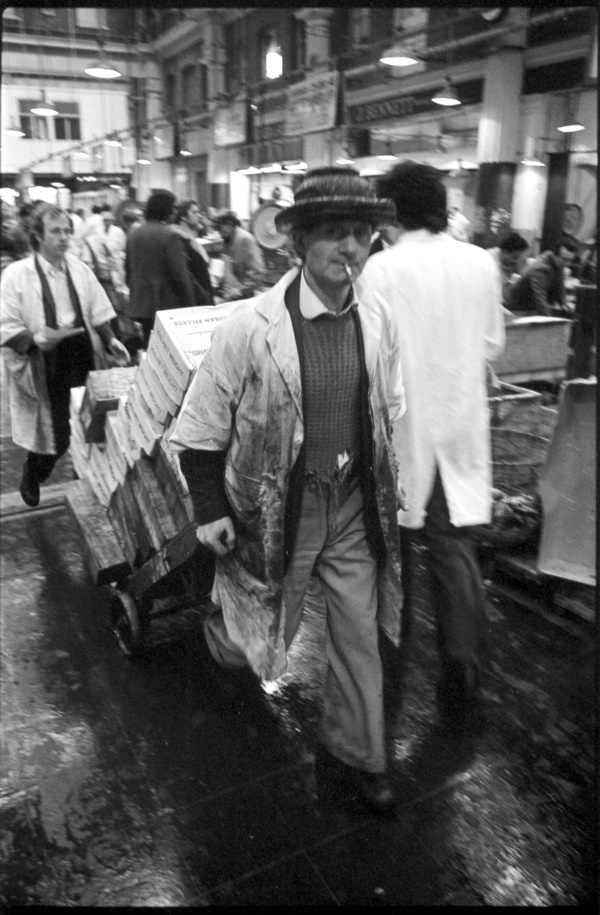
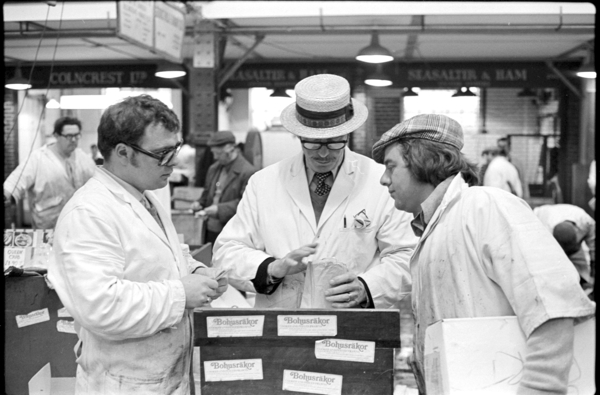
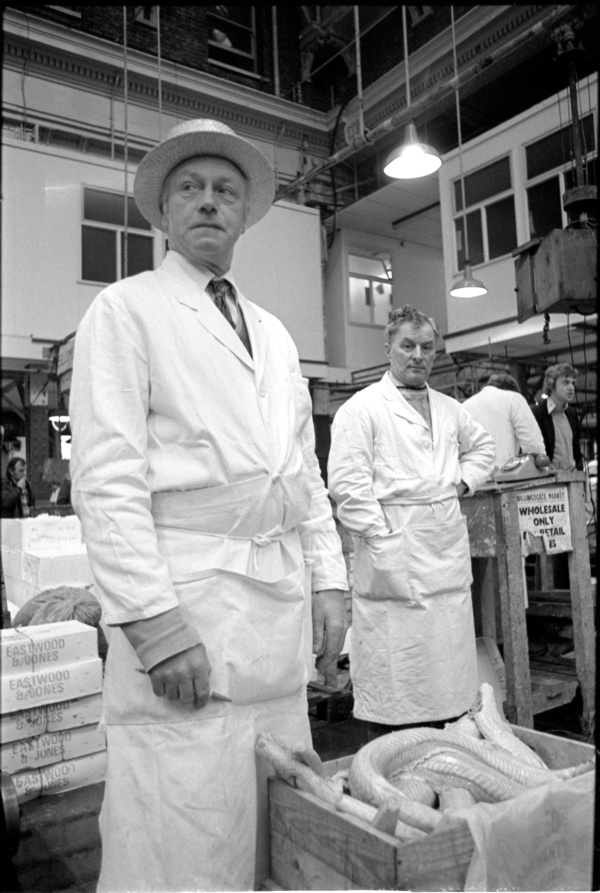
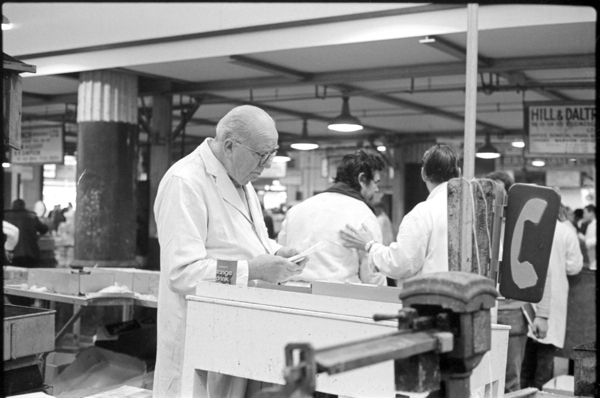
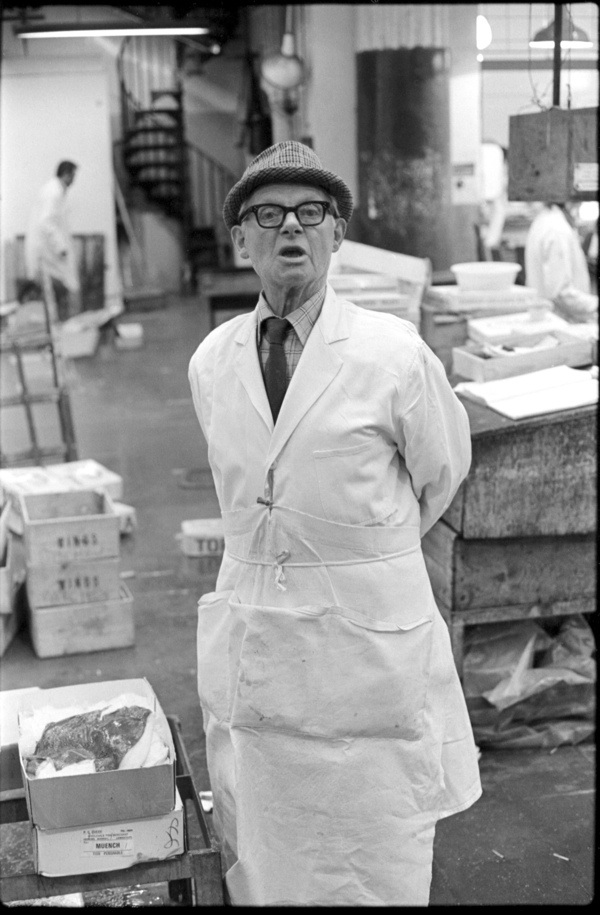
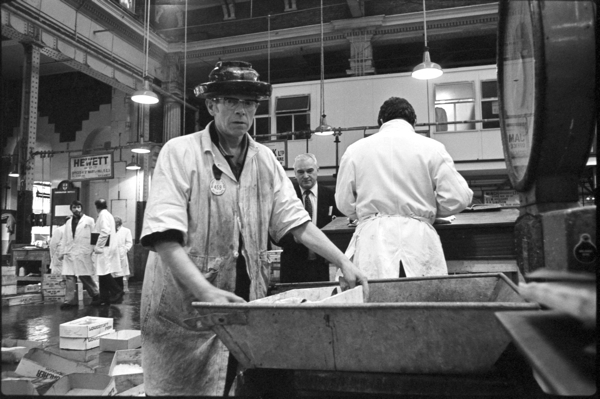
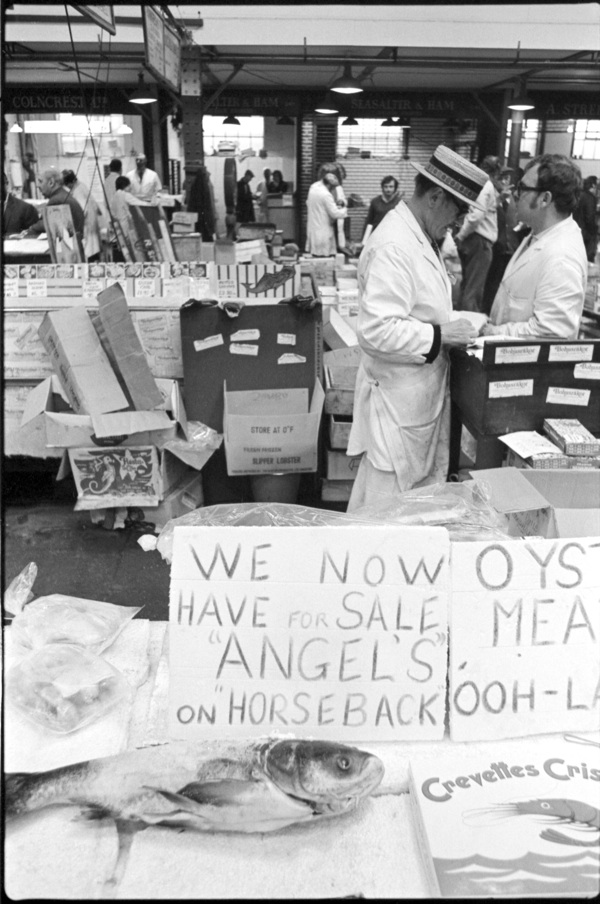
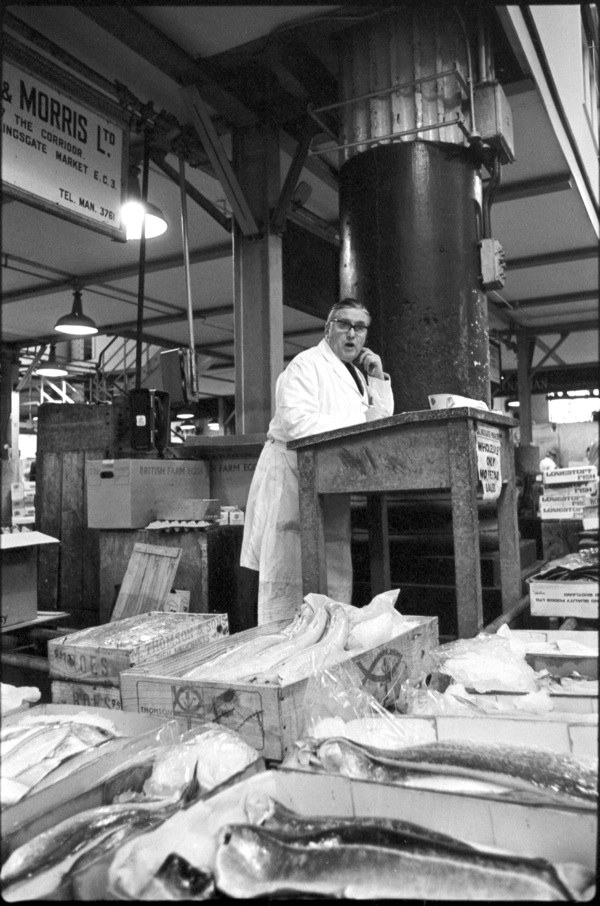
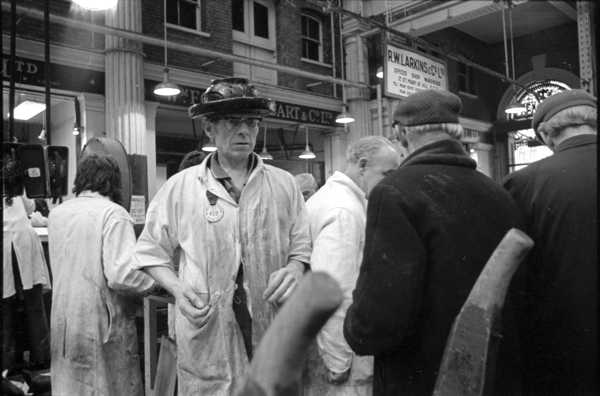
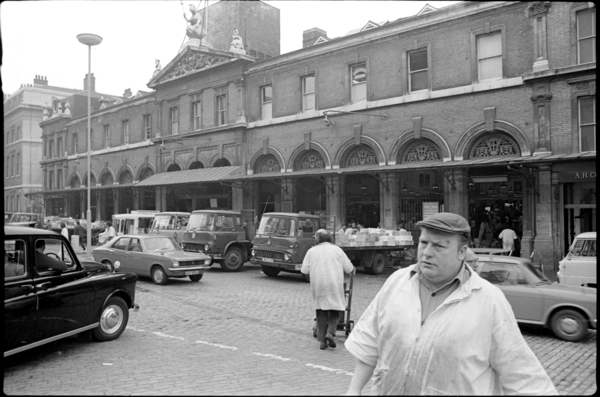
Roy Reed took these pictures of Billingsgate Market when he was a twenty-three-year-old documentary photography student at the London College of Printing in 1975 and they are seeing the light of day for the first time now.
Roy’s enthusiasm for the subject was greater than the interest of the student-journalist who asked him to take the pictures for a project on London’s dying markets. “When I suggested we get there early, she said, ‘See you there at eight,'” Roy recalled, rolling his eyes significantly. In the event, Roy got there at seven-thirty on a February morning and took his pictures just here as business was winding up at the nocturnal market. Forty years later, any disappointment Roy might harbour that the project was never written up and published is outweighed by his satisfaction in having taken these rare photographs of a lost world.
“It was nice chatting with the porters,” Roy remembered fondly, “No-one seemed to mind having their photograph taken – except maybe the guy in the tweed hat, you can see him looking at me suspiciously in the picture.” Taken at the time the market was already due to leave its ancient location next to London Bridge, Roy’s lively photographs comprise a fascinating record of a seemingly recent era in market life that grows increasingly remote.
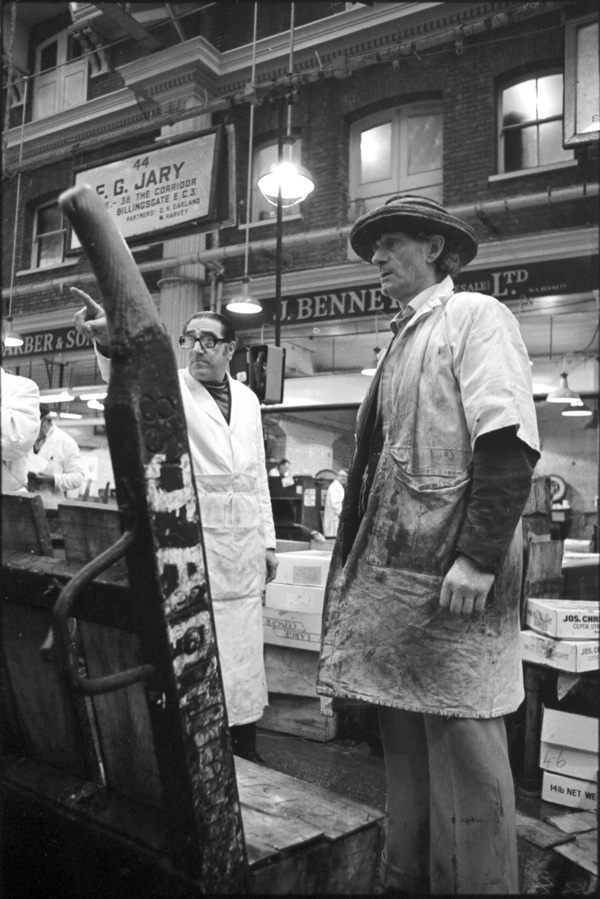
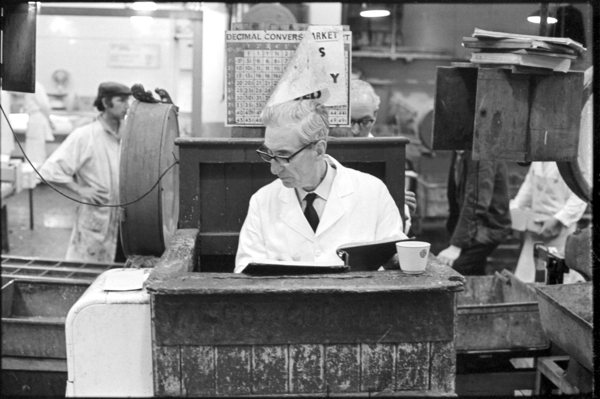
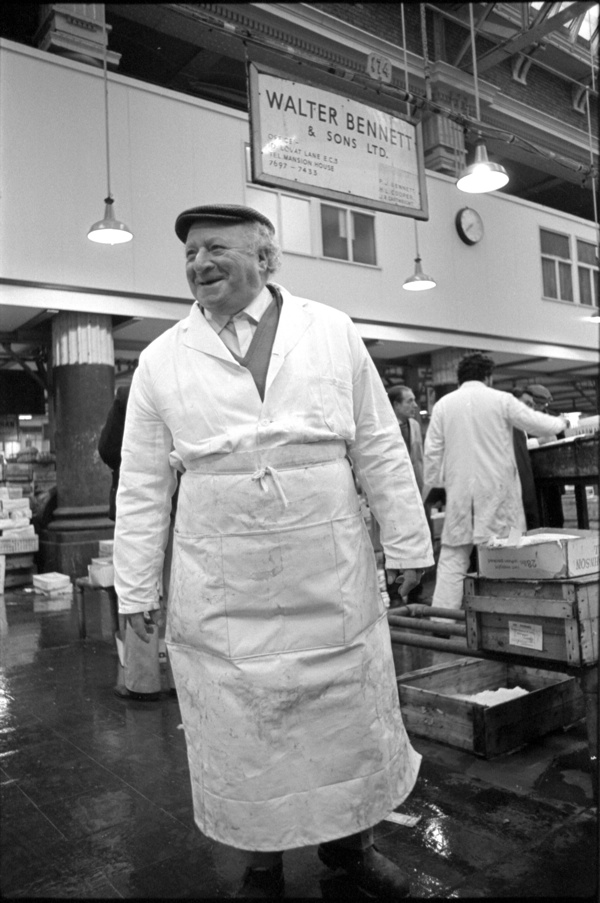
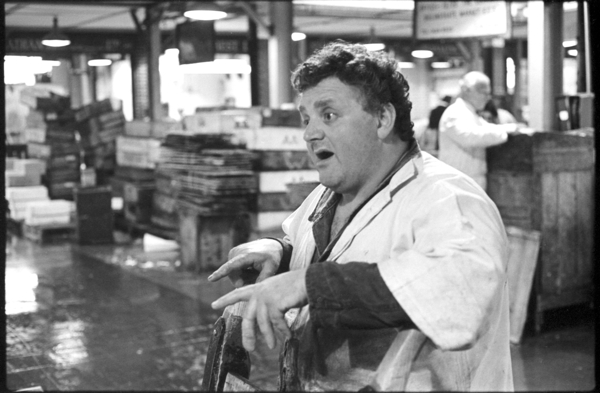
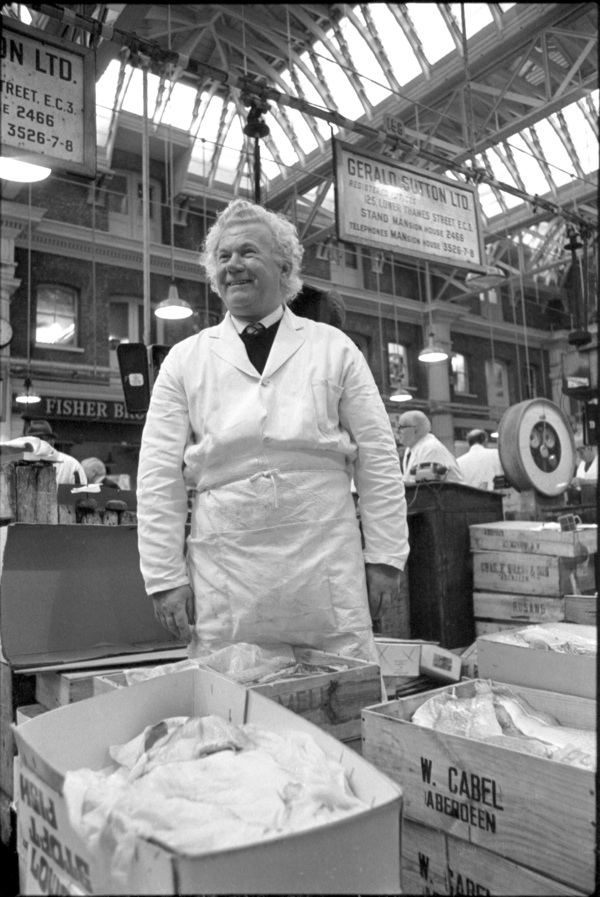
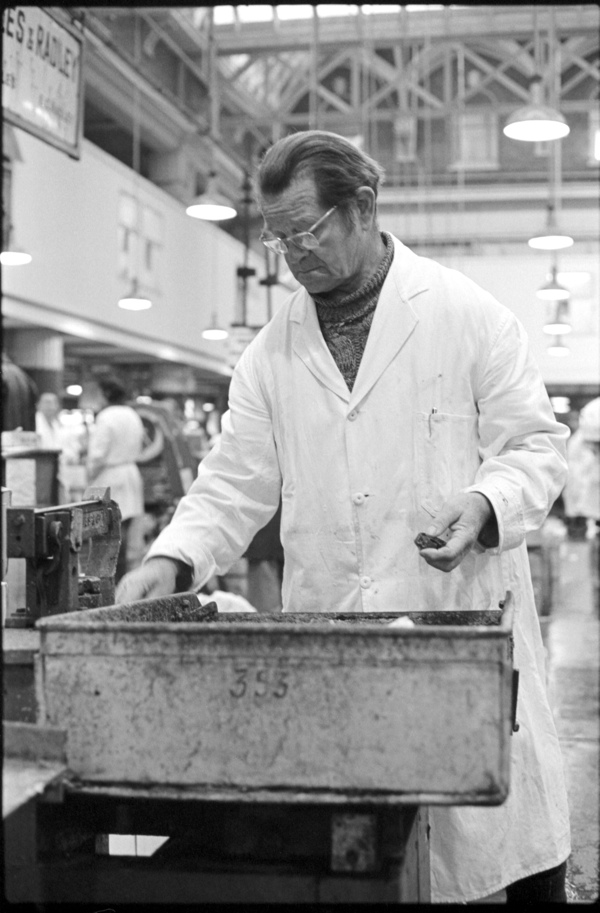
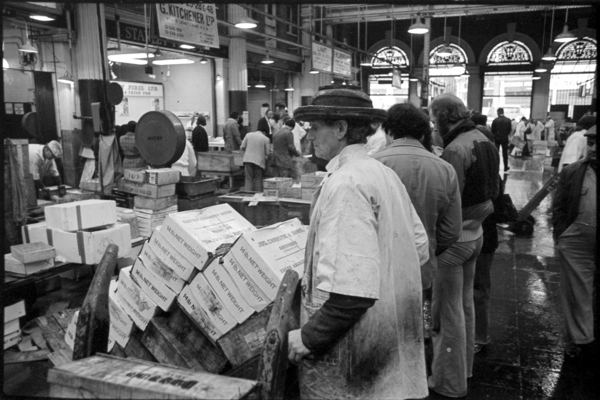
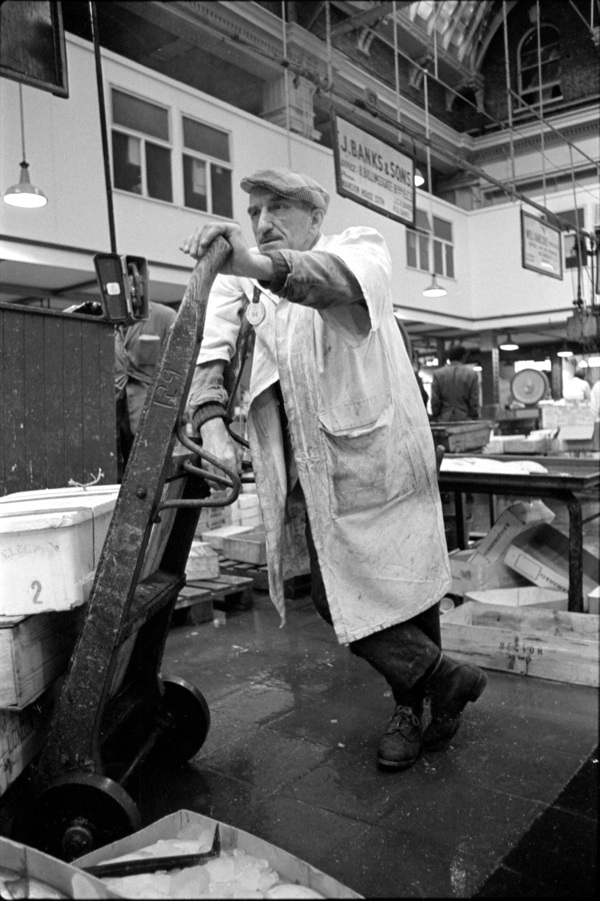
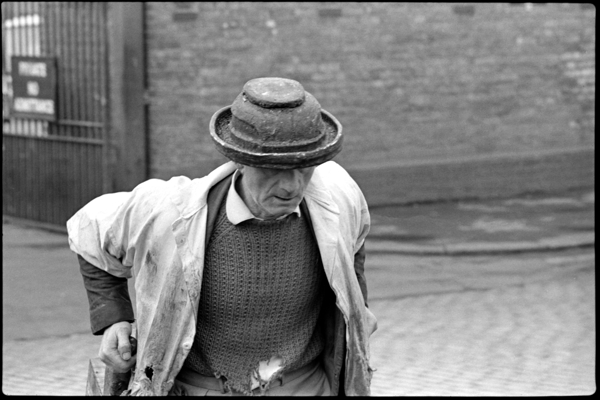
Photographs copyright © Roy Reed
You may also like to read about
Charles Ginner In Bethnal Green
In today’s extract from my forthcoming book EAST END VERNACULAR, Artists who painted London’s East End streets in the 20th century I need your help to identify the exact location of this painting in Bethnal Green. Click here to preorder a copy of EAST END VERNACULAR
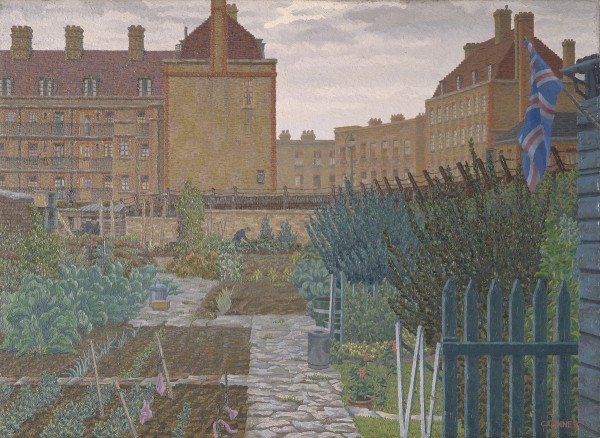
Bethnal Green Allotment (Courtesy of Manchester City Art Gallery)
How neatly aligned are the leeks in this allotment painted by Charles Ginner in 1943. They are almost as tidily organised as the council flats, assembled in towering brick mansions and each dwelling connected to its neighbour by a balcony, thus granting tenants the opportunity of both privacy and community as they feel disposed. And how convenient for the residents to have an allotment on the doorstep, encouraging them to spend their leisure time in the fresh air as well as ensuring a regular supply of fresh vegetables and soft fruit in season. A prominently placed Union Jack flutters over the allotment for all to see, serving to rouse the patriotic spirit of the gardeners and encourage them to contribute to the war effort through their horticultural labours. Observe the nettles on the right, opposing the well-ordered vegetables on the left. We know which is going to prevail.
When this picture was commissioned by the War Artists’ Advisory Committee, Charles was in his mid-sixties and a veteran Official War Artist of two world wars. Born in Cannes to British parents, he made London his home from 1910. Starting out as a young painter in France, his inspirations were Vincent van Gogh, Paul Gauguin and Paul Cézanne, but in London he joined the Camden Town Group. He shared their concern with representing everyday life and adopted their New Realism for which he wrote the manifesto, yet he brought his own post-Impressionist sensibility to it, as evidenced by his use of thick paint and bright colours.
Fellow artist Marjorie Lilly observed Charles at work at this time, noting his painstaking method, by which he “drew in his picture, faintly but carefully, then applied a thin colour wash of approximately the right colours, using turpentine so that it dried quickly. Then he started his real painting with a quantity of rather small, flat brushes and in his methodical way working from left to right across the canvas, finishing the picture in one very thick coat of paint. His aim was to complete this second coat without any corrections.”
Celebrated for his street scenes in the West End of London, Charles also painted street markets and circuses, before travelling north to portray industrial scenes, factory interiors and hospital wards. “Each age has its landscape, its atmosphere, its cities, its people. Realism, loving Life, loving its Age, interprets its Epoch by extracting from it the very essence of all it contains of great or of weak, of beautiful or of sordid, according to the individual temperament,” he wrote in 1919, “Realism is thus not only a present intimate revelation of its own time, but becomes a document for future ages. It attaches itself to history.”
Bethnal Green Allotment is a fine example of his meticulous technique and composition, dignifying the commonplace through authoritative and sympathetic representation, and delighting in a harmonious image of social order. A nineteenth century street can be seen in the background but Charles chose to view the East End as a location of recent social improvement, looking from the foreground of a communal garden.
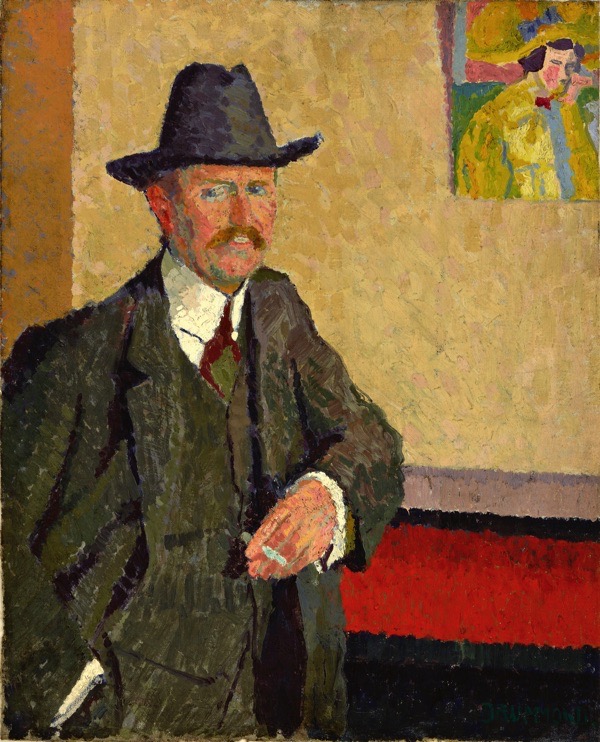
Self portrait by Charles Ginner (1878–1952) Courtesy of Tate Gallery
Take a look at some of the other artists featured in East End Vernacular
John Thomas Smith’s Antient Topography

Bethelem Hospital with London Wall in Foreground – Drawn June 1812
Two centuries ago, John Thomas Smith set out to record the last vestiges of ancient London that survived from before the Great Fire of 1666 but which were vanishing in his lifetime. You can click on any of these images to enlarge them and study the tender human detail that Smith recorded in these splendid etchings he made from his own drawings. My passion for John Thomas Smith’s work was first ignited by his portraits of raffish street sellers published as Vagabondiana and I was delighted to spot several of those familiar characters included here in these vivid streets scenes of London long ago.
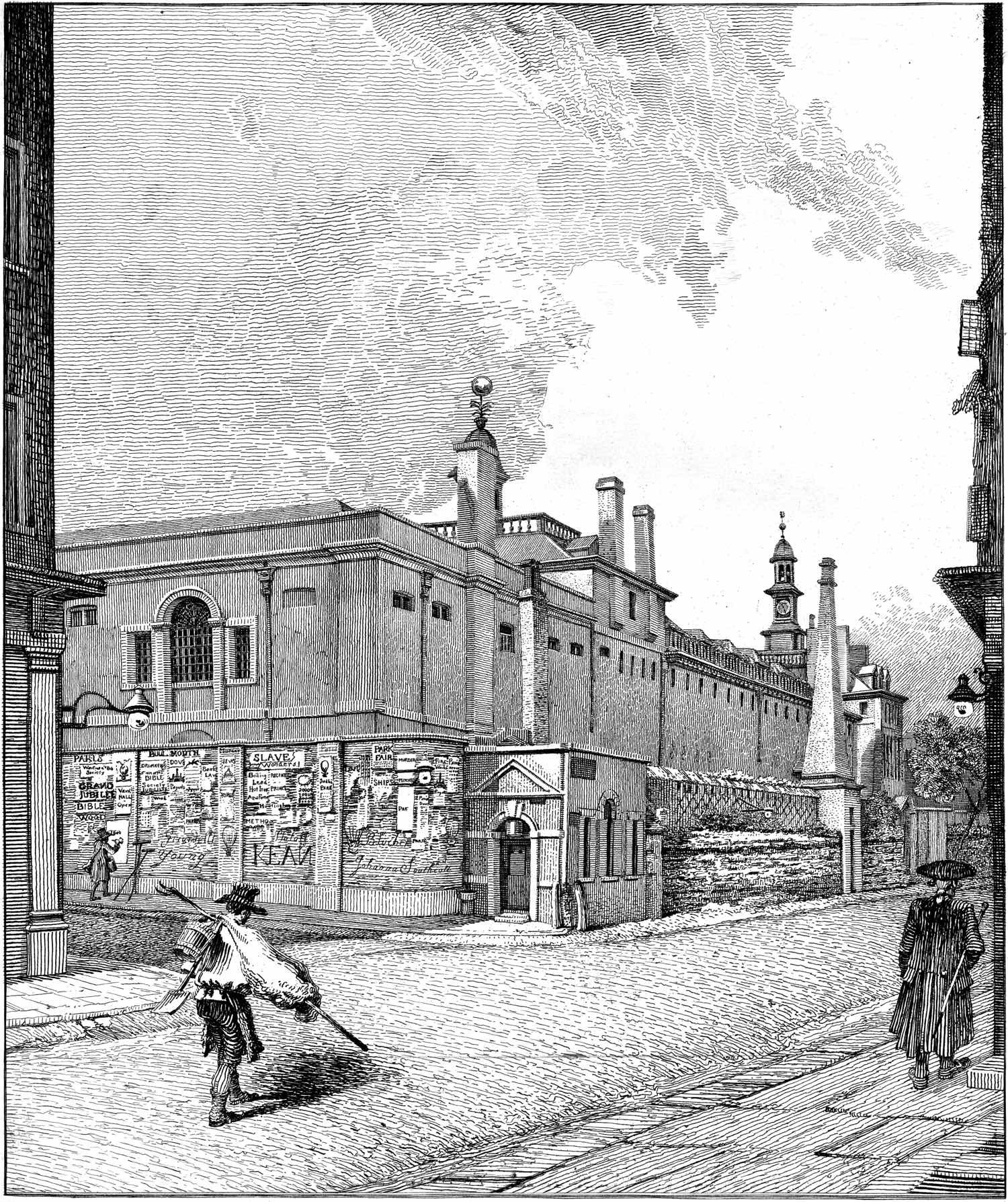
Bethel Hospital seen from London Wall – Drawn August 1844

Old House in Sweedon’s Passage, Grub St – Drawn July 1791, Taken Down March 1805
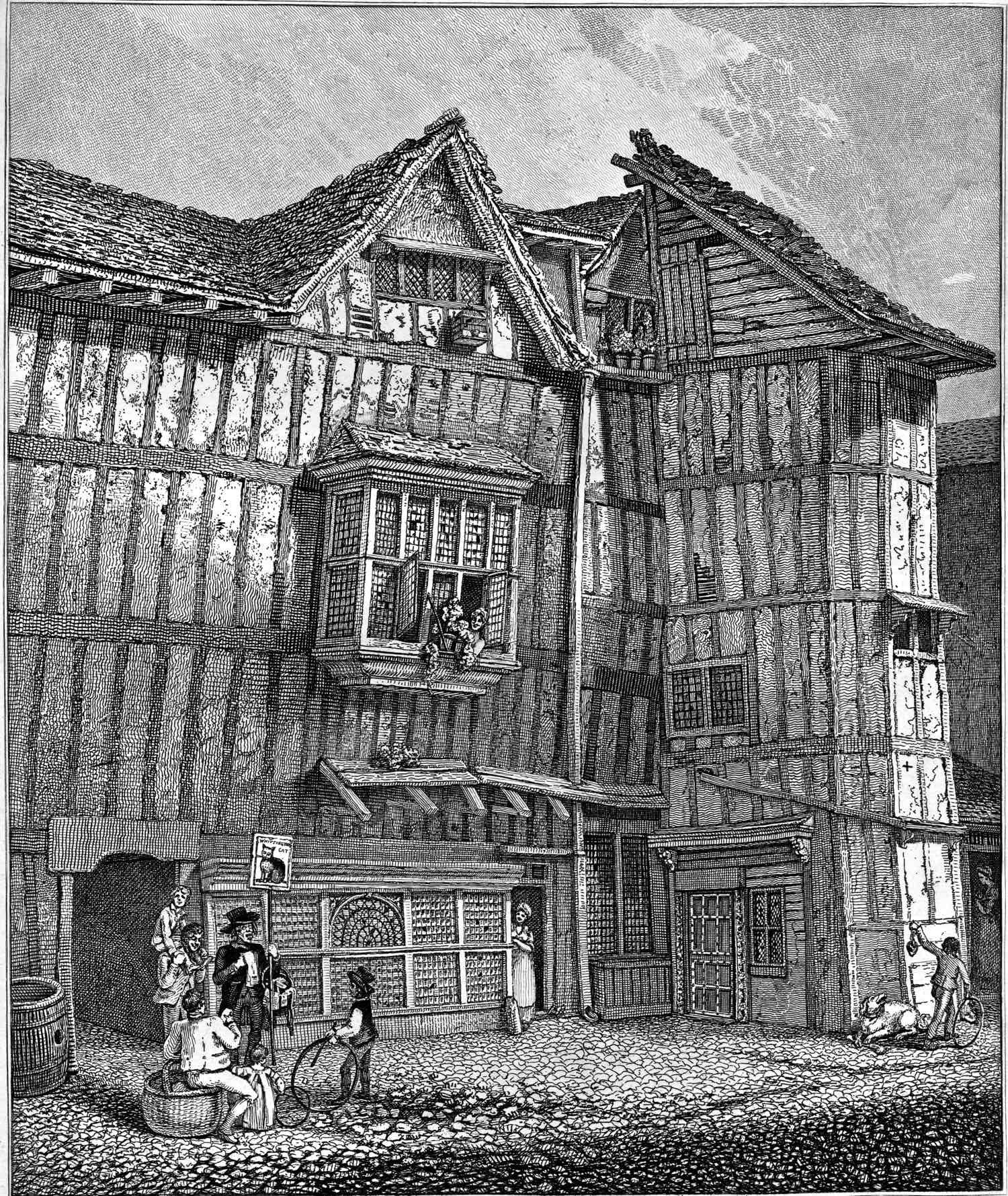
Old House in Sweedon’s Passage, Grub St – Drawn July 1791, Taken Down March 1805

London Wall in Churchyard of St Giles’ Cripplegate – Drawn 1793, Taken Down 1803
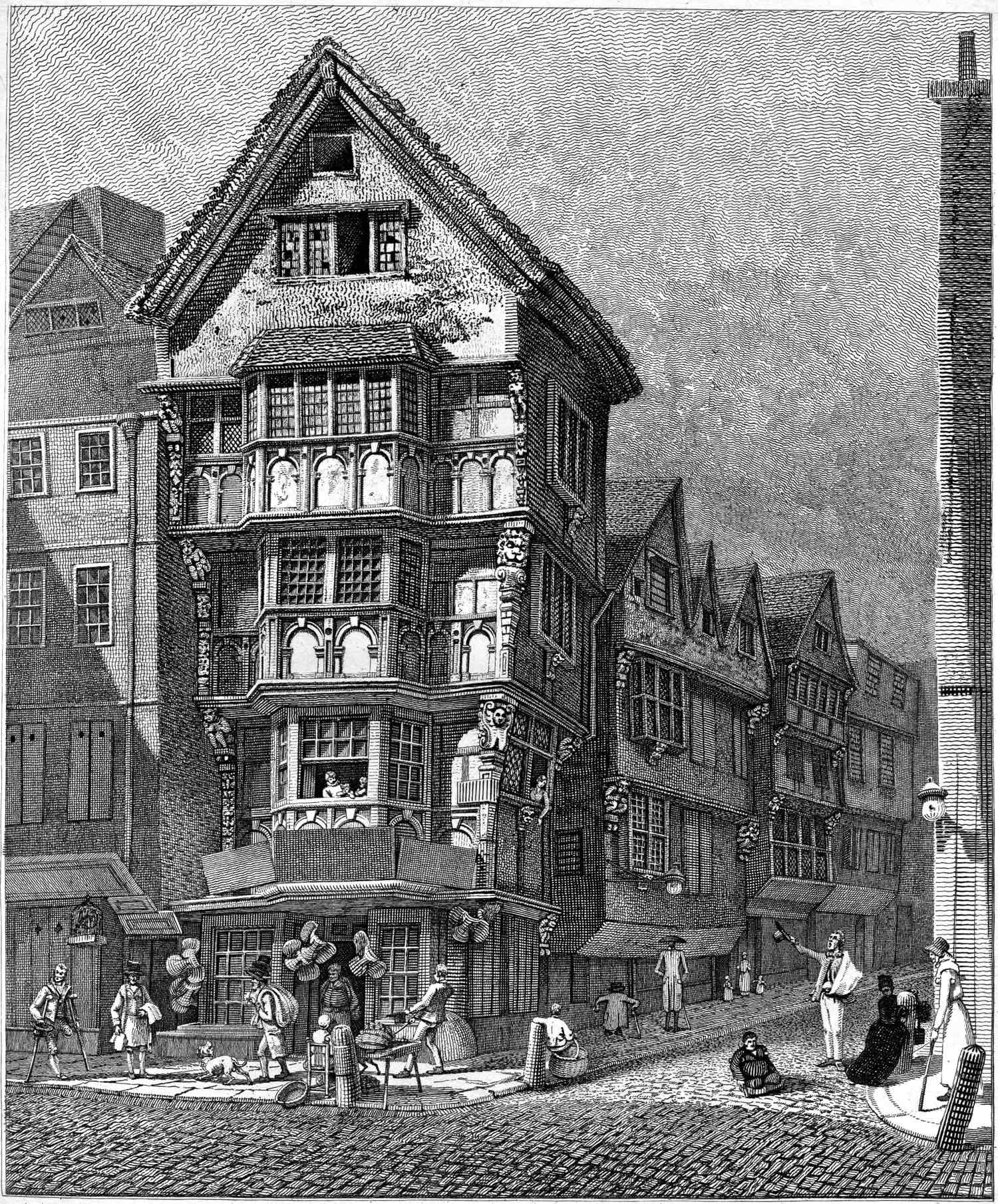
Houses on the Corner of Chancery Lane & Fleet St – Drawn August 1789, Taken Down May 1799

Houses in Leadenhall St – Drawn July 1796
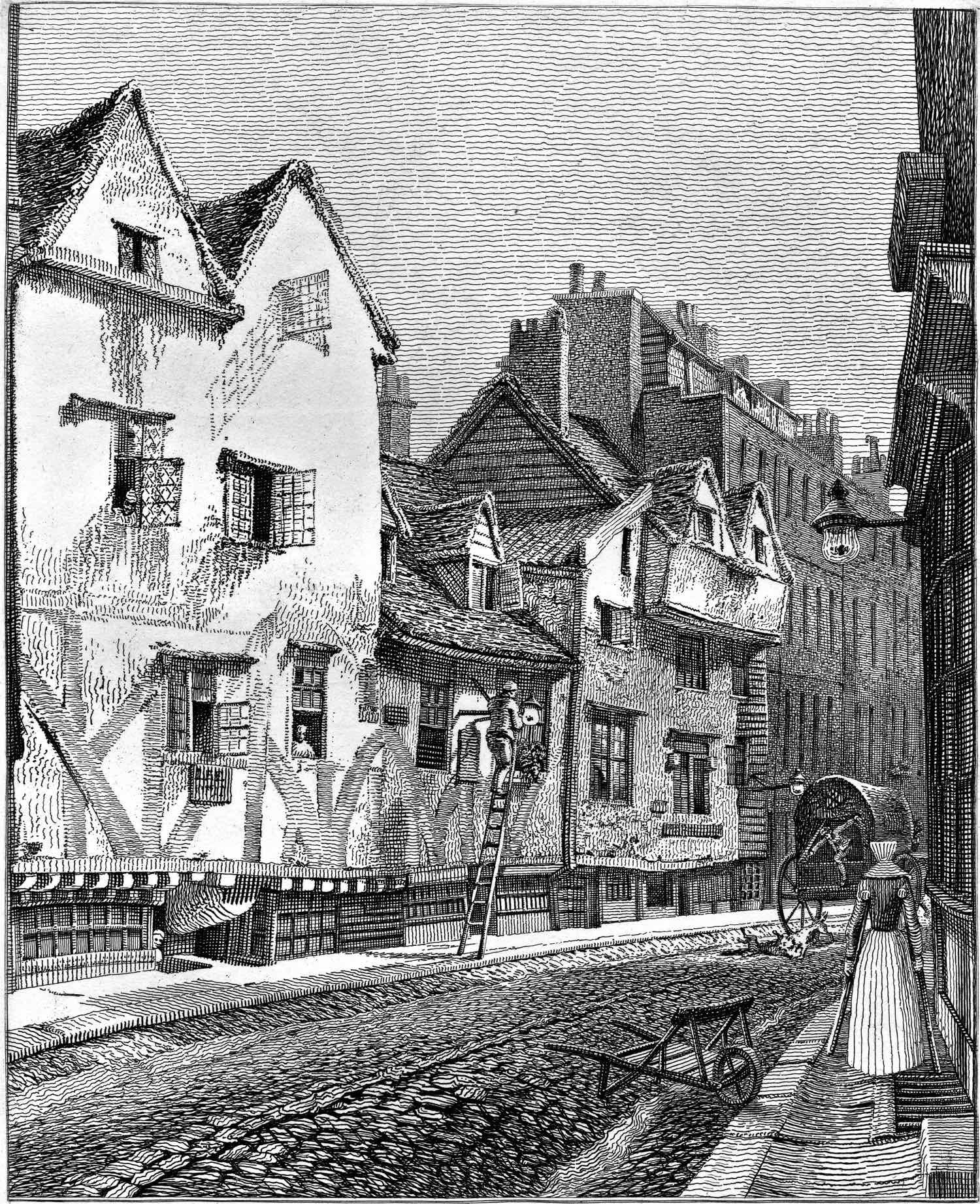
Duke St, West Smithfield – Drawn July 1807, Taken Down October 1809

Corner of Hosier Lane, West Smithfield – Drawn April 1795
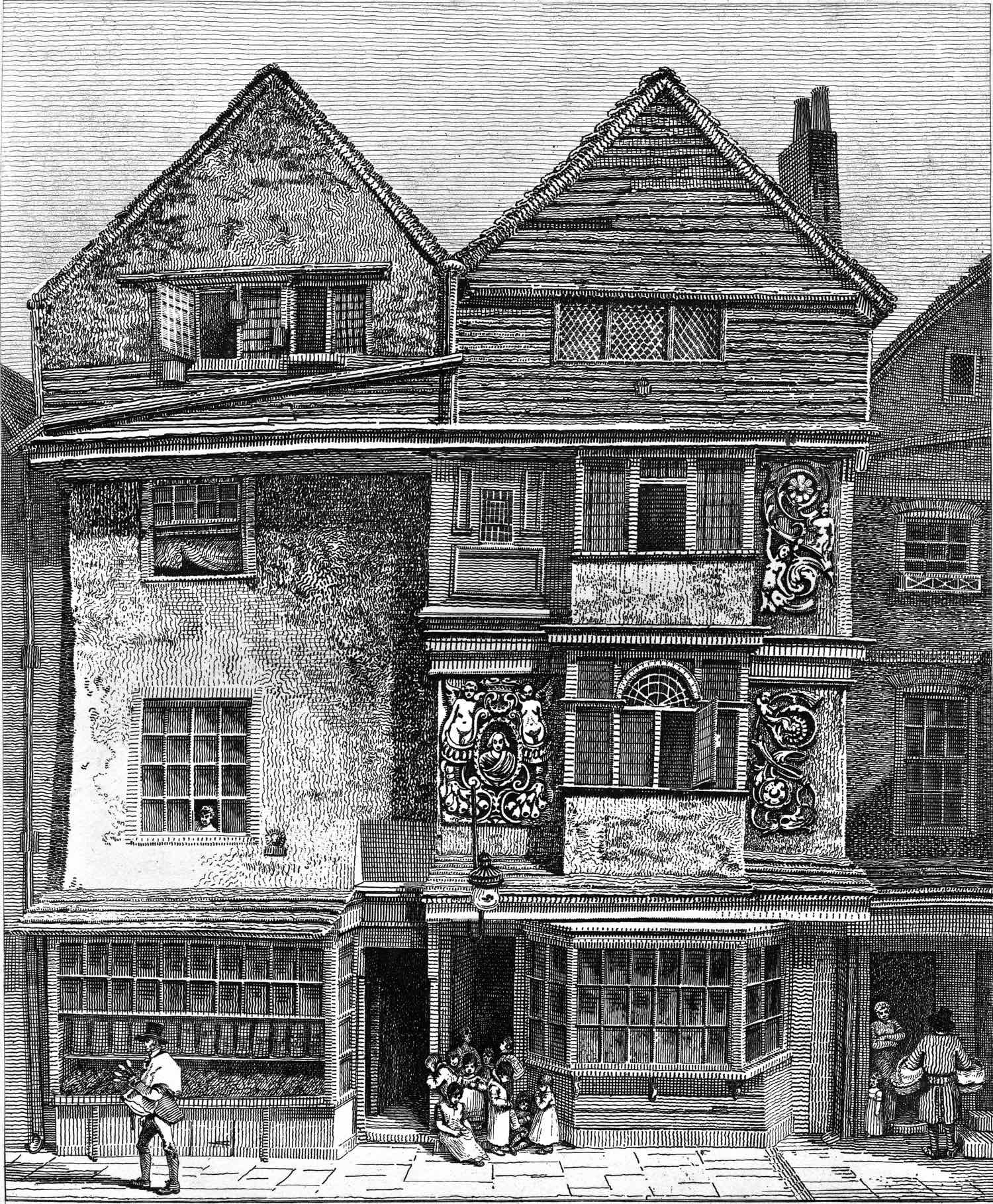
Houses on the South Side of London Wall – Drawn March 1808
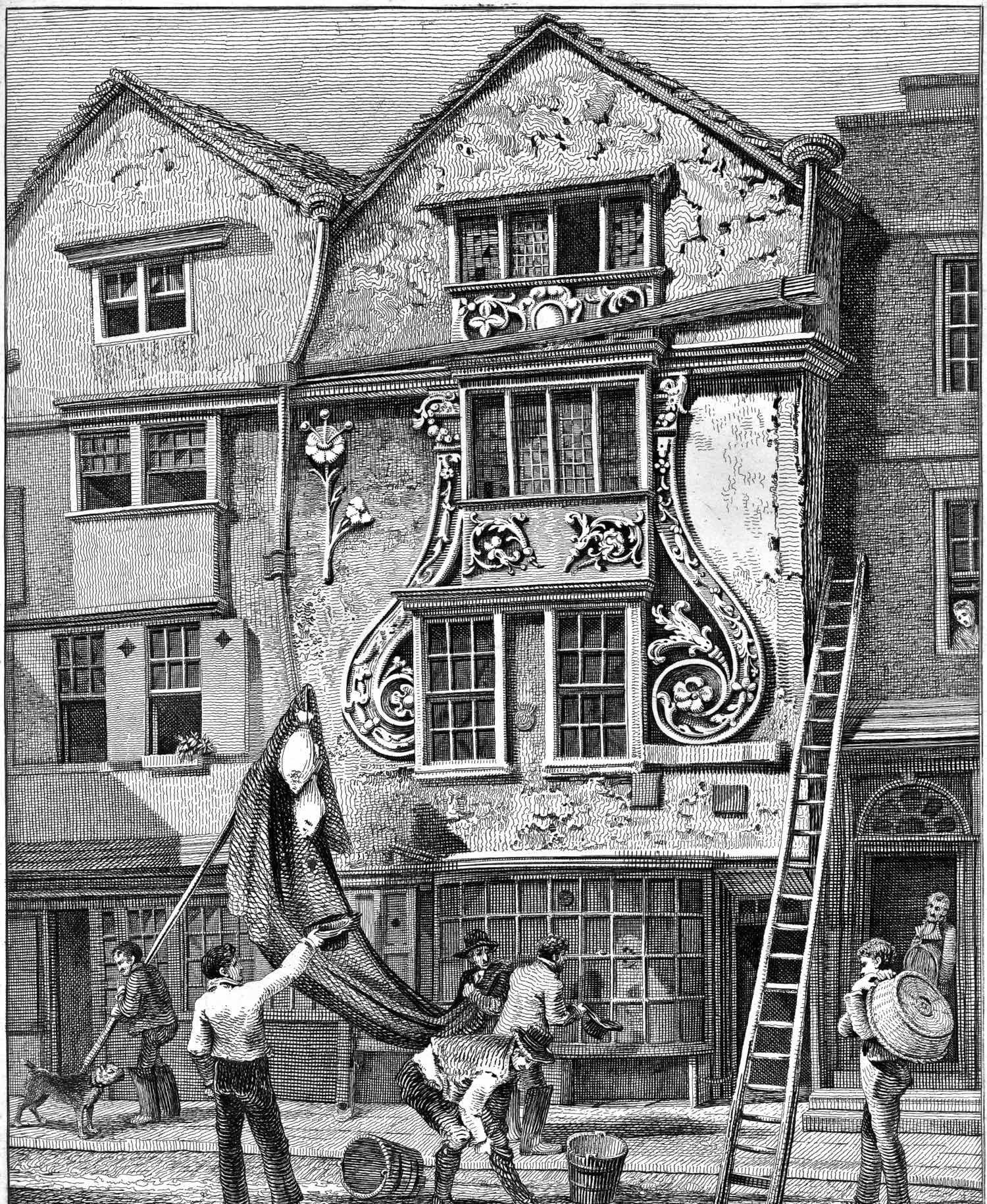
Houses on West Side of Little Moorfields – Drawn May 1810
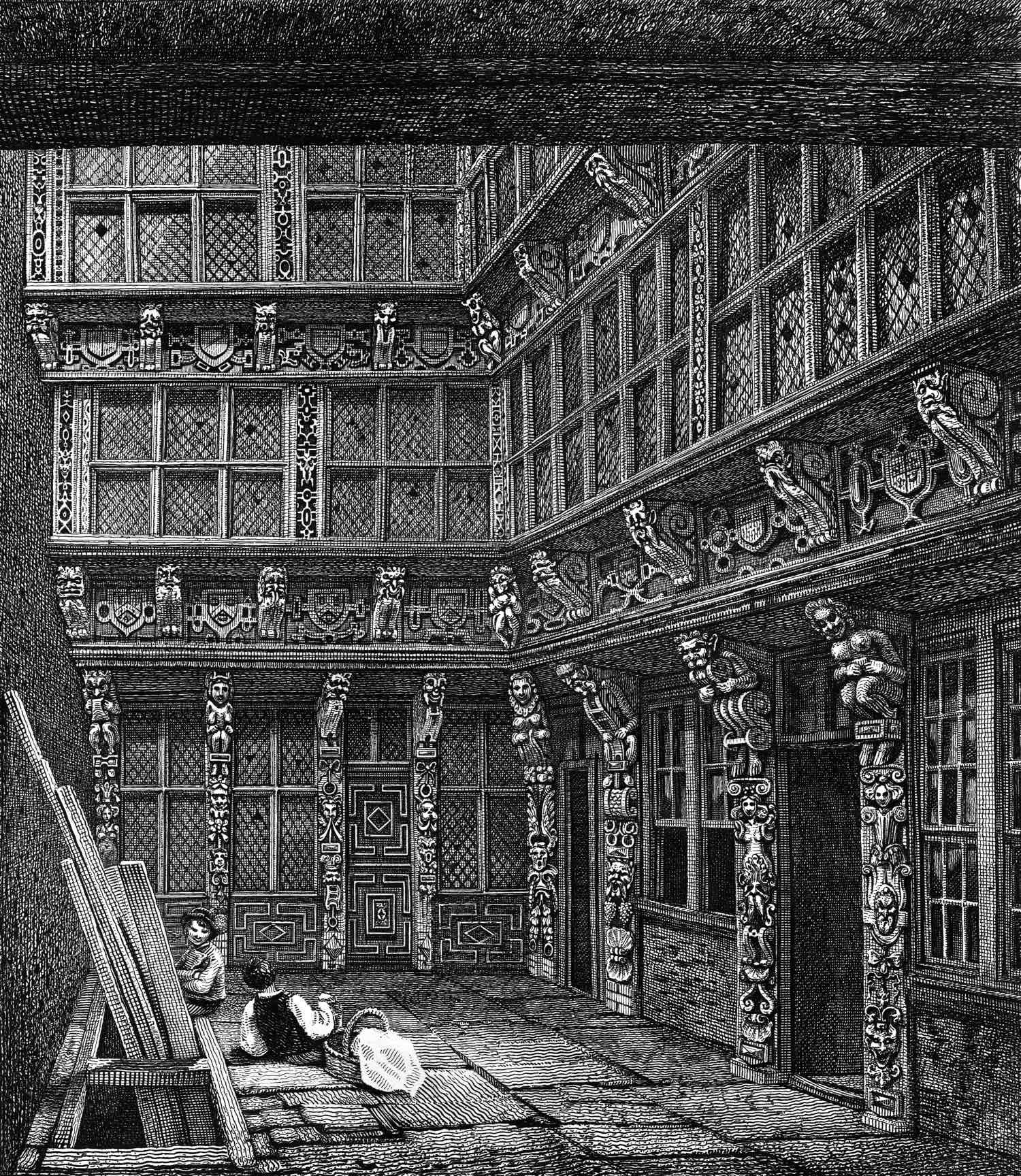
Magnificent Mansion in Hart St, Crutched Friars – Drawn May 1792, Taken Down 1801
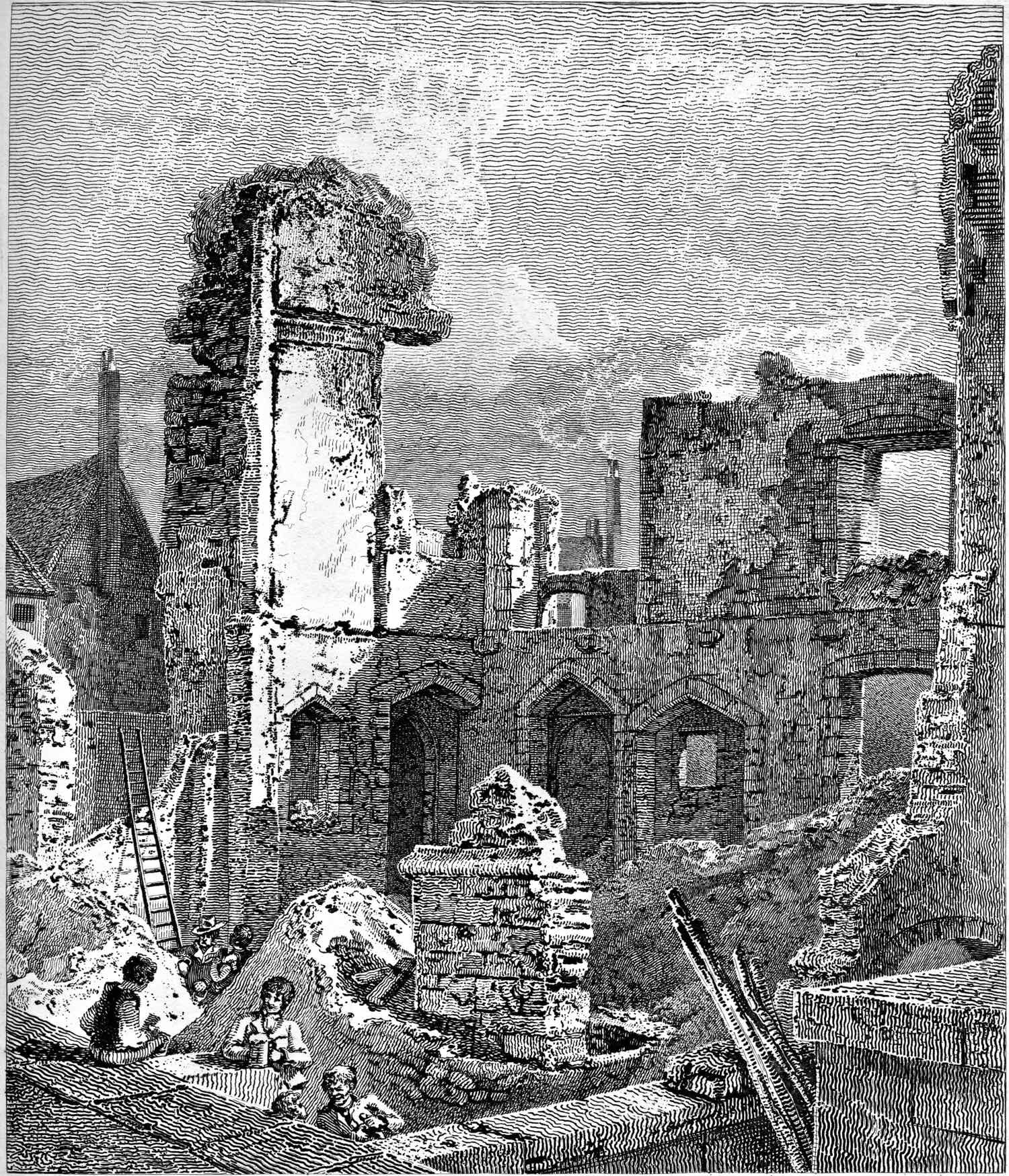
Walls of the Convent of St Clare, Minories – Drawn April 1797
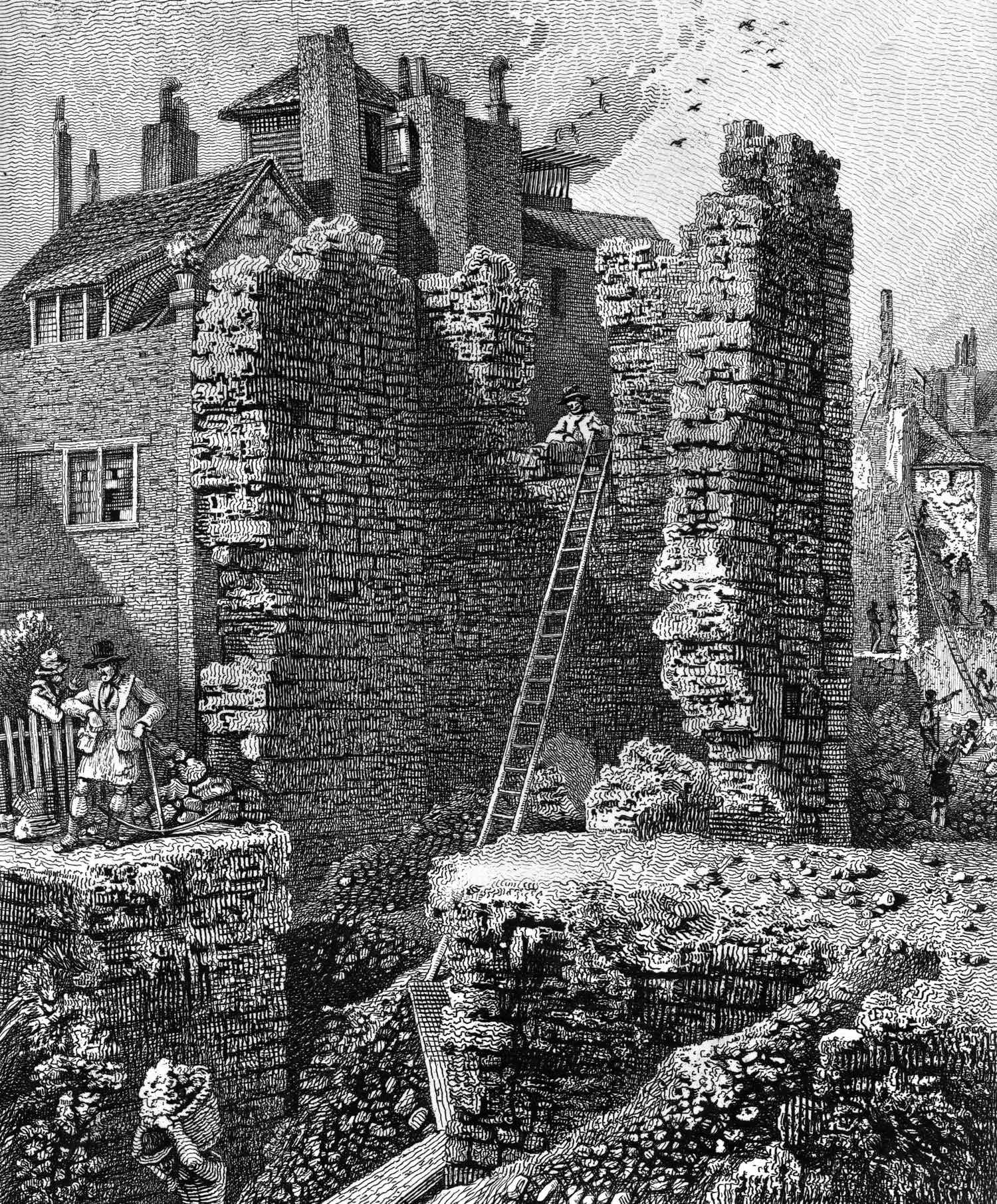
Watch Tower Discovered Near Ludgate Hill – Drawn June 1792
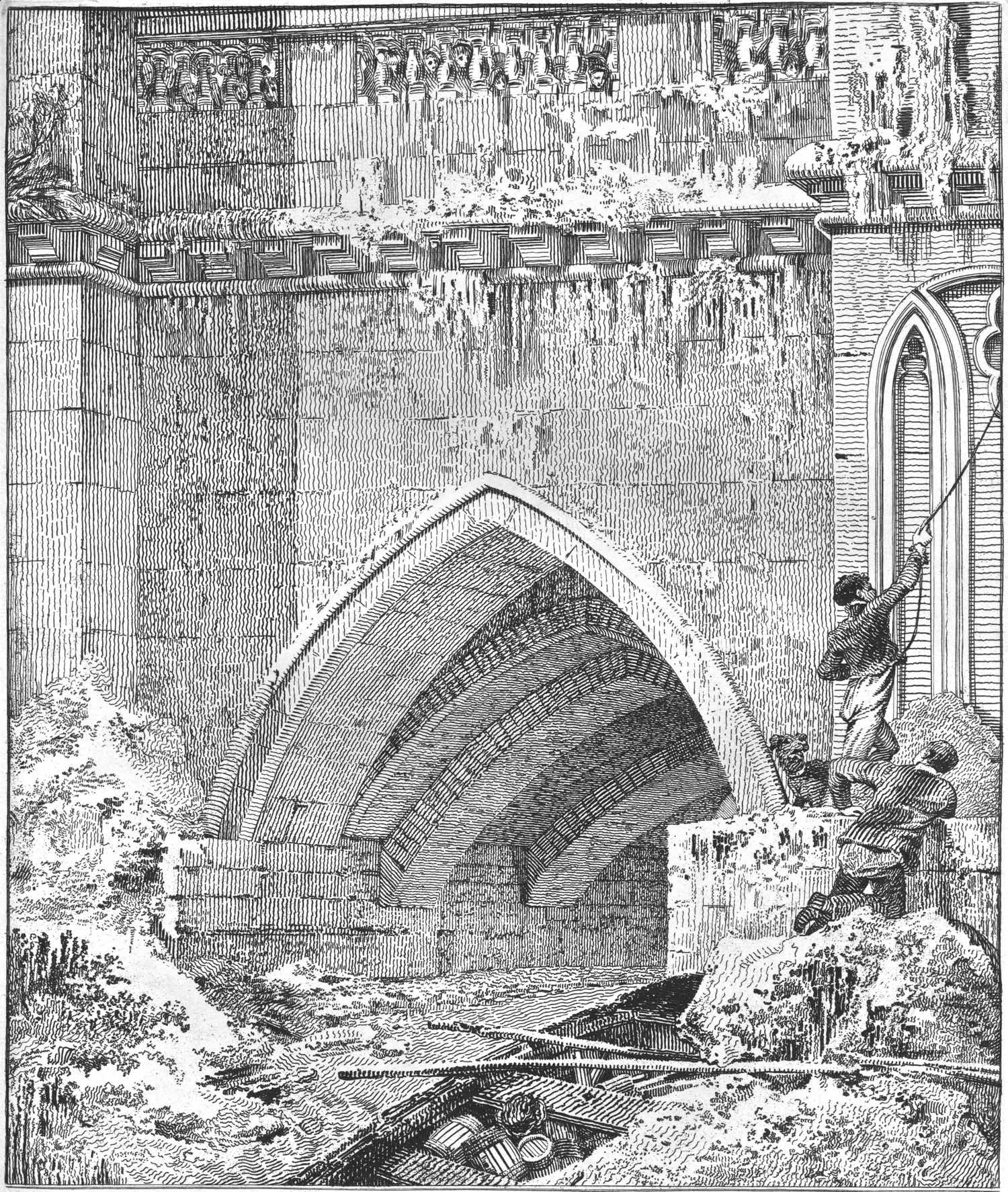
An Arch of London Bridge in the Great Frost – Drawn February 5th 1814
Images courtesy Bishopsgate Institute
You may also like to take a look at
John Thomas Smith’s Vagabondiana












