Dorothy Bishop in Bethnal Green
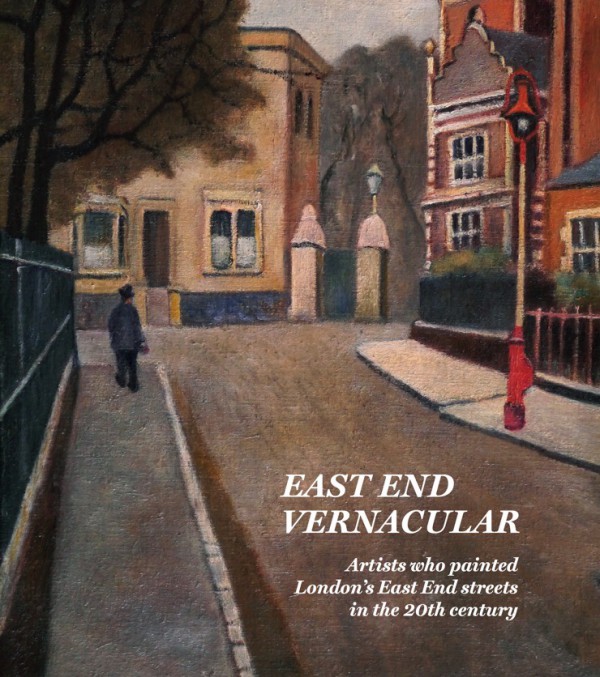
Today I present another extract from my new book EAST END VERNACULAR, Artists who painted London’s East End streets in the 20th century to be published by Spitalfields Life Books in October. Click here to preorder your copy
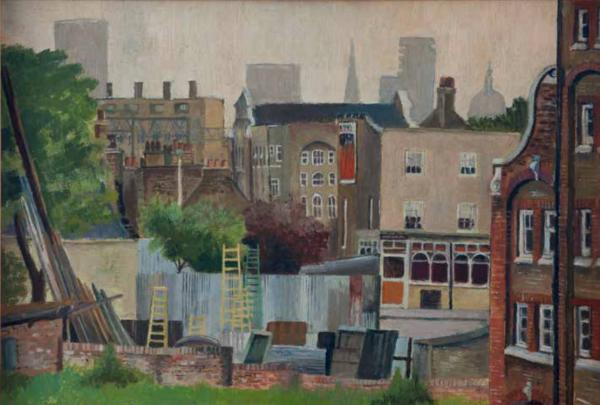
Looking towards the City of London from Morpeth School, 1961
This painting shows the view from the Art room at the top of the school in Bethnal Green where Dorothy Bishop taught for twenty years. It was a formative experience that Dorothy treasured and this painting – which her friend Ruth Richardson kindly brought to my attention – is one of only a few pictures of hers that are known to exist. Although she painted throughout her life, she did not consider herself a professional artist.
Born in Brockley, Dorothy lived with her parents, her elder sister and younger brother for most of her life. After training as an Art teacher, she taught at a school in the north west of England for the duration of the war, returning south to live in Harefield, Uxbridge with her parents afterwards. In 1947, Dorothy took a job teaching evening classes Stewart Headlam Recreational Evening Institute in Morpeth Street, an employment which was to occupy her until 1968. Recording her memory of these years, Dorothy wrote a diary of her impressions of the people and the place from which we include these excerpts.
“I was there for twenty-one years and it was one of the best things in my life. Now I am old and I must lead a quiet life, I would give much to be back at Stewart Headlam School. I really loved the cockney boys and girls, especially the wit and vitality of the boys. The whole atmosphere was full of life and rough kindness. I loved the wildness of the boys, once it had snowed and they made for me with snowballs and I saw their dark eyes dancing with joy, shining in the lamplight. They did enjoy things. The layabout boys tended to come to Art as in football training you had to do something, whereas in Art you could just sit and exercise your wit on the teacher and thus show off to your friends. The girls then were almost a different tribe and provided me often with members of the class who would work and were also friendly. They always supported me in any trouble with the boys and, on the whole, sex solidarity was more powerful than class solidarity.”
“The class was from 7:30pm to 9:30pm with a quarter of an hour’s break to go to the canteen for a cup of tea. The second half of the class was the most difficult as the boys would become restless, even to throw pencils. Sometimes I was utterly exhausted at the end and thought, ‘Why am I doing this?’ but then I thought, ‘Why should they drive me out?’ also I really loved them and there were some gentle quiet boys and girls who would talk to me. The next week they would be quite different and ask, ‘Did we upset you, Miss? We was only having a bit of a giggle.’”
“I was not approved of by the L.C.C. inspectors. Once they found my class copying Mickey Mouse and painting him in bright colours. I told them I could not change the taste of Bethnal Green for such things, but did not add – as I thought – that it would be impertinent to try to do so. In their report they said I was ‘defeatist’. I got a letter which said, ‘While your qualifications remain at their present level you are not suitable for employment by the L.C.C.” I was devastated. I was not terrific but I had had a full art training. As to drawing Mickey Mouse, the Pop Artists were doing this a few years later.”
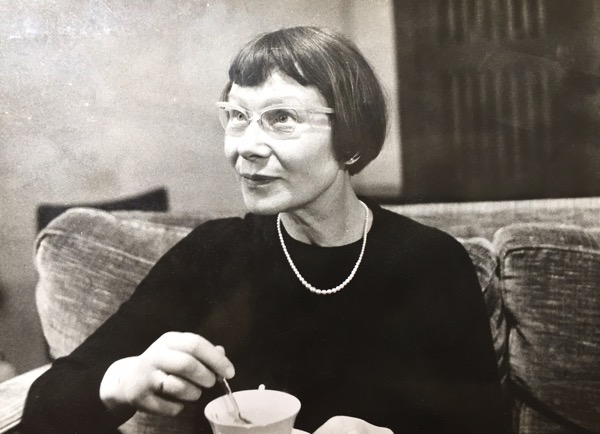
Dorothy Bishop (1913-2005)
Painting copyright © Estate of Dorothy Bishop
(With thanks to Esther North, Dorothy’s niece)
Take a look at some of the other artists featured in East End Vernacular
Lost Spitalfields

Looking towards Spitalfields from Aldgate East
London can be a grief-inducing city. Everyone loves the London they first knew, whether as the place they grew up or the city they arrived in, and everyone loses it. As the years pass, the city bound with your formative experience changes, bearing less and less resemblance to the place you discovered. Your London is taken from you. Your sense of loss grows until eventually your memory of the London you remember becomes more vivid than the London you see before you and you become a stranger in the place that you know best. This is what London can do to you.
In Spitalfields, the experience has been especially poignant in recent years with the redevelopment of the Market and the demolition of the Fruit & Wool Exchange. Yet these photographs reveal another Spitalfields that only a few people remember, this is lost Spitalfields.
Spital Sq was an eighteenth century square linking Bishopsgate with the Market that was destroyed within living memory, existing now only as a phantom presence in these murky old photographs and in the fond remembrance of senior East Enders. On the eastern side of Spitalfields, the nineteenth century terraces of Mile End New Town were erased in ‘slum clearances’ and replaced with blocks of social housing while, to the north, the vast Bishopsgate Goodsyard was burned to the ground in a fire that lasted for days in 1964.
Yet contemplating the history of loss in Spitalfields sets even these events within a sobering perspective. Only a feint pencil sketch of the tower records the Priory of St Mary which stood upon the site of Spital Sq until Henry VIII ‘dissolved’ it and turned the land into his artillery ground. Constructing the Eastern Counties Railway in the eighteen-thirties destroyed hundreds of homes and those residents who were displaced moved into Shoreditch, creating the overcrowded neighbourhood which became known as the Old Nichol. And it was a process that was repeated when the line was extended down to Liverpool St. Meanwhile, Commercial St was cut through Spitalfields from Aldgate to Shoreditch to transport traffic more swiftly from the docks, wreaking destruction through densely inhabited streets in the mid-nineteenth century.
Look back at these elegiac photos of what was lost in Spitalfields before your time, reconcile yourself to the loss of the past and then brace yourself for the future that is arriving.

Spital Sq, only St Botolph’s Hall and number 37 survive today

Spital Sq photographed in 1909

Church Passage, Spital Sq, 1733, photographed in 1909 – only the market buildings survive.

17 Spital Sq, 1725

25 Spital Sq, 1733

23 Spital Sq, 1733
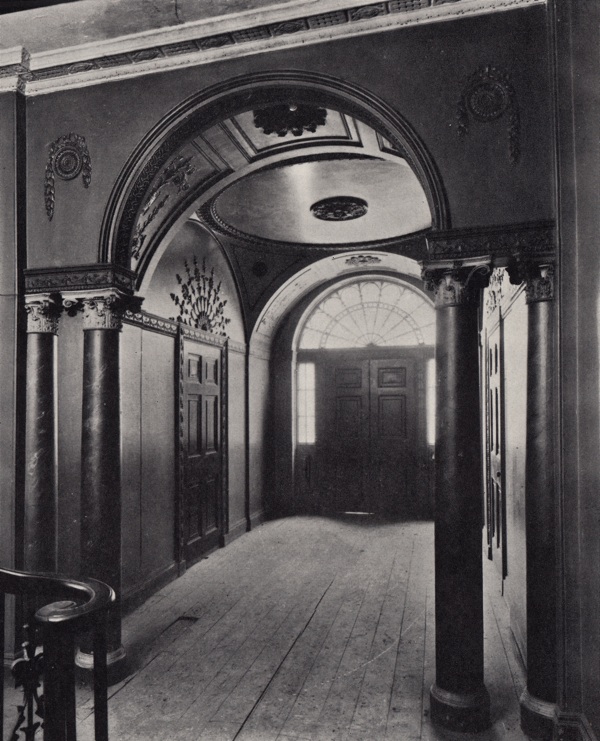
20 Spital Sq, 1723

20 Spital Sq, 1723

20 Spital Sq, 1732

32 Spital Sq, 1739

32 Spital Sq, 1739

5 Whites Row, 1714

6/7 Spring Walk, 1819

Buxton St, 1850

Buxton St, 1850

Former King Edward Institution, 1864, Deal St

36 Crispin St, 1713

7 Wilkes St, 1722

10 & 11 Norton Folgate, 1810 – photographed in 1909

Norton Folgate Court House, Folgate St, photographed in 1909

52 & 9a Artillery Passage, 1680s

Bishopsgate Goods Station, 1881

Shepherd’s Place arch, 1820, leading to Tenter St – photographed 1909
You may also like to read about
Lawrence Gowing In Mare St
Today I present another extract from my new book EAST END VERNACULAR, Artists who painted London’s East End streets in the 20th century to be published by Spitalfields Life Books in October. Click here to preorder your copy
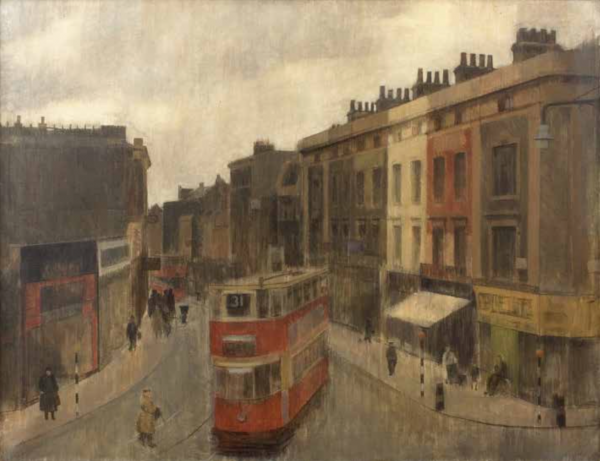
Mare St, 1937
“I set to work at once on the flat roof of a furniture shop facing the corner of Dalston Lane (to the right of the picture) where my father and his father before him had his drapery business, until it failed shortly before in competition with the multiple draper down the road,” wrote Lawrence Gowing (1918-91), “I had lately helped behind the cash desk, not all dependably, at the closing-down sale… The next tenants who had failed in their turn, covered the fascia, which was inscribed in gold on brown glass, R.H. Gowing & Son, The Busy Corner.”
Painted when Lawrence was just nineteen years old, this painting embodies the moment when his artistic career took off and carried him away from the East End forever. His grandfather Robert Henry Gowing had opened the drapers’ shop at 419 Mare Street (on the far right of the painting) in the nineteenth century and lived above the business, but Lawrence’s father, Horace Gowing bought a house in Stamford Hill where he brought up his family. Lawrence was sent away to a Quaker boarding school at Colwall in Herefordshire where art teacher Maurice Feild recognised his ability and encouraged the young artist to paint landscapes in the open air.
When Lawrence returned to London after failing his school certificates, his father arranged for him to become an insurance clerk but, through an introduction by Maurice Feild to William Coldstream, Kenneth Clarke, Director of the National Gallery bought one of Lawrence’s paintings and, fortunately, this was sufficient for Lawrence’s father to permit his son to pursue a career as a painter. A photograph of the time shows him as pale faced young man in a felt hat, nicely dressed in a well cut tweed jacket and trousers, wielding a paintbrush and poised behind an easel in the open air.
William Coldstream persuaded Lawrence that, “as the existence of painting depended on people wishing for it… it should represent subjects of interest to them,” and the result was this picture of Mare Street undertaken for an exhibition of views of London at the Storran Gallery in Albany Courtyard, Piccadilly in 1938. Lawrence adopted the broad perspective to which he had become accustomed in painting rural landscapes and employed the technique that Maurice Feild taught him, of cutting a rectangular frame from a cigarette packet and looking through it to establish a composition. Subsequently, when the work was shown three years later at the Ashmolean Museum in Oxford as part of an exhibition of paintings by the Euston Road Group, the critic Clive Bell acclaimed it as “the surprise of a surprising exhibition.”
In later years, Lawrence revealed an ambivalence about the picture. “My own purpose was not elegant,” he wrote, ”I privately thought of the subdued but respectful manner in which I painted as in some way identifying with people deprived of the fruits of their labour, among whom I should have counted the entire population of Hackney. I think a debonair, failed draper-master was regarded as more laudable than a successful one, but I took my father no more seriously, alas, than most sons.”
Irrespective of Lawrence’s questioning of his own artistic motives in retrospect, his choice of subject matter, painting a location that was familiar to him in childhood and of major significance for his father and grandfather, memorialised his own family history. The picture counterbalances a sense of departure with a private elegy for the lives of previous generations. Yet the irony is that it was the closure of the Gowing family drapery business which granted Lawrence the opportunity to leave and seek an artistic career instead.
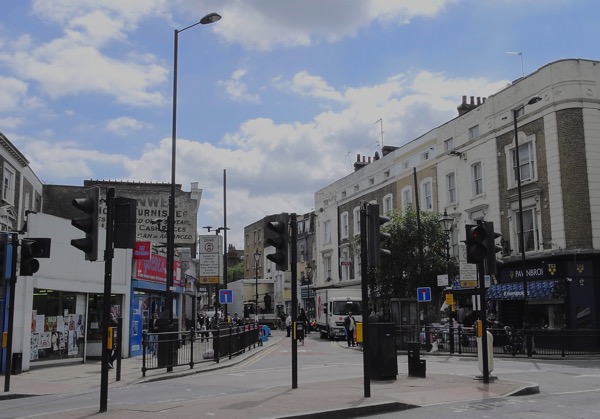
Mare St today
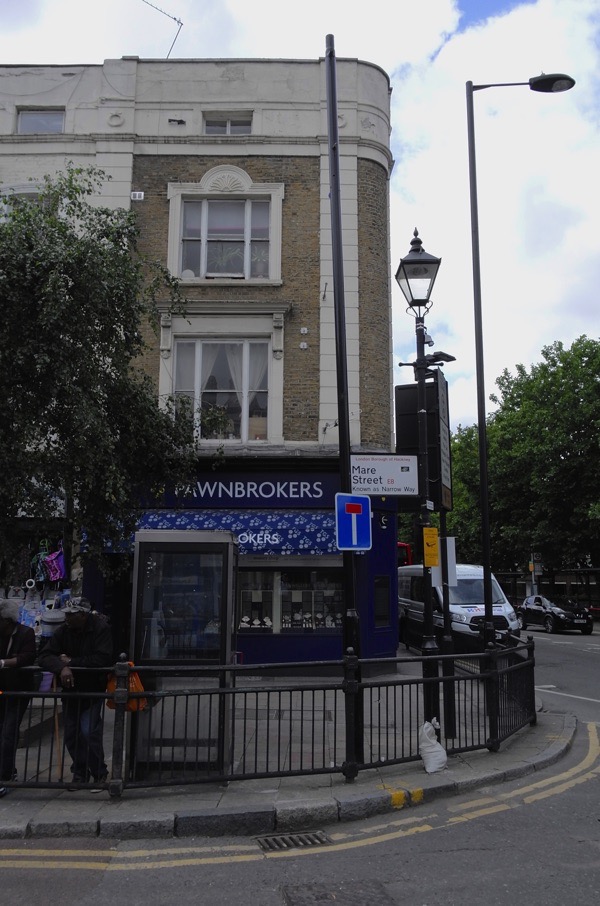
419 Mare St, formerly R.H. Gowing & Son, The Busy Corner
Lawrence Gowing’s painting reproduced courtesy of Jonathan Clarke Fine Art
Take a look at some of the other artists featured in East End Vernacular
Old Signs Of Spitalfields

Commit no Nuisance
I am the keeper of the old signs in Spitalfields. I have embraced it as my self-appointed duty, because although many are “dead” and others have become “ghosts,” disappearing into ether, they are all of interest to me. By “dead” signs, I mean those that no longer have a function, where their useful life is over, and by “ghost” signs, I refer to the next stage in the afterlife of signage where the text fades into illegibility until eventually no trace remains.
Some old signs are prominently placed and some are hidden in obscure corners but, irrespective of their locations, their irrelevance has rendered them invisible – yet I welcome them all into my collection. The more shabby and disregarded, the more I like them, because, as the passing years have taken away their original purpose, these signs have become transformed into poetry. In many cases, the people whom these notices address are long gone, so unless I am there to pay attention to these redundant placards and grant them dignity, they can only talk to themselves like crazy old folk rambling in the dark.
Given that the street name was altered generations ago, who now requires a sign (such as you will find at the junction with St Matthew’s Row) to remind them that Cheshire St was formerly Hare St, just in case of any confusion? I doubt if anyone can remember when it was Hare St. And yet I cannot deny the romance of knowing this older name, recalling the former hare marsh at the end of the street.
Ever since someone pointed out to me that “Refuse to be put in this basket” could be interpreted as an instruction to reject being placed in the basket yourself, the literal netherworld implied by signs has captivated me. Now when I see the sign outside the travel agent in Brick Lane with the image of Concorde, I yearn to go in and ask to buy a ticket for Concorde as if – through some warp in reality – the sign was a portal inviting me to a different world where Concorde is still flying and this office in Spitalfields is the exclusive agent. I am fascinated by the human instinct to put up signs, craving permanent declarations and desiring to accrete more and more of them, whilst equally I recognise it is in the survival instinct of city dwellers that we learn to exclude all the signs from our consciousness, if we are to preserve our sanity.
To my mind, there is an appealing raffish humour which these old signs acquire through longevity, when they cock a snook at us with messages which the passage of time has rendered absurd. “Commit no Nuisance” painted discreetly in Fournier St on the side of Christ Church, Spitalfields, has long been a cherished favourite of mine. I wonder what genius came up with this notion, which if it were effective would surely be emblazoned on every street in the world. It could solve many of the problems of humanity at a stroke. Although, unfortunately, it does rely upon a certain obedient compliance from those most likely to offend, who are also those most unlikely to pay attention. In fact, I am reliably informed that this sign is actually employing the language of euphemism to instruct customers of the Ten Bells not urinate against the church wall. Almost faded into illegibility today, with pitiful nobility, “Commit no Nuisance,” speaks in a polite trembling whisper that is universally ignored by those passing in Commercial St.
Even in the face of evidence to the contrary, signs can still propose a convincing reality, which is why it is so perplexing to see those for businesses that no longer exist. They direct me to showrooms, registered offices and departments which have gone, but as long as the signs remain, my imagination conjures the expectation of their continued existence. These old signs speak of the sweatshops and factories that defined the East End until recently, and they talk to me in the voices of past inhabitants, even over the hubbub of the modern city. Such is the modest reward to be drawn from my honorary role as the keep of old signs in Spitalfields.

Generations have passed since Cheshire St was known as Hare St.

This sign at the entrance to Dray Walk in the Truman Brewery, closed twenty years ago, was once altered from “Truman’s” to “Truman Ltd” when the company was sold, and, with due respect, the name of successive company secretaries was updated in stencilled lettering. These considerations are mere vanities now upon a dead sign surrounded by ads for the shops and bars that occupy Dray Walk today.

Travel agent on Brick Lane offering flights on Concorde.

Steam department works office in Fashion St.

Today’s top prices at the former scrap metal dealer in Vallance Rd.
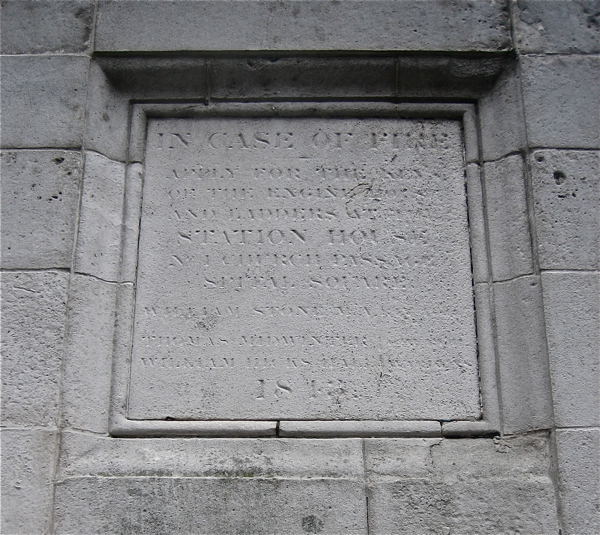
Incised on the side of Christ Church Spitalfields: In case of fire apply for the men of the engine house and ladders at the Station House, No 1 Church Passage, Spital Square. 1843. A precaution adopted after the great fire of 1836.

No more enamelling on Brick Lane.
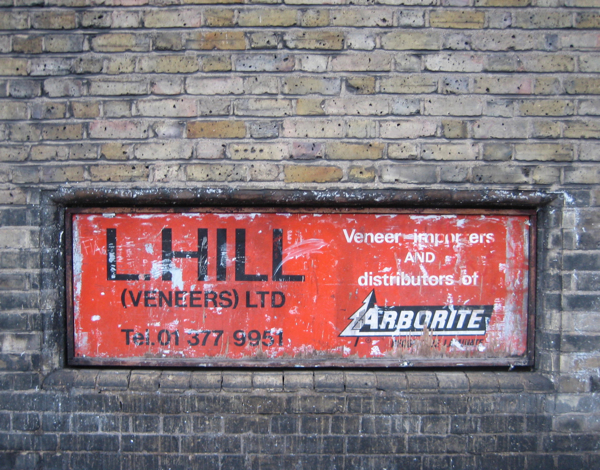
No more veneers on Great Eastern St.

Car Park on Petticoat Lane.

Registered Office in Commercial St.

Charlie’s Motors once offered services from £30 in Brady St.

On Christ Church, Spitafields: All applications about Marriages, Burials & c. at this church must be made to Mr Root. Note the reference to Church St – renamed Fournier St in the nineteenth century.
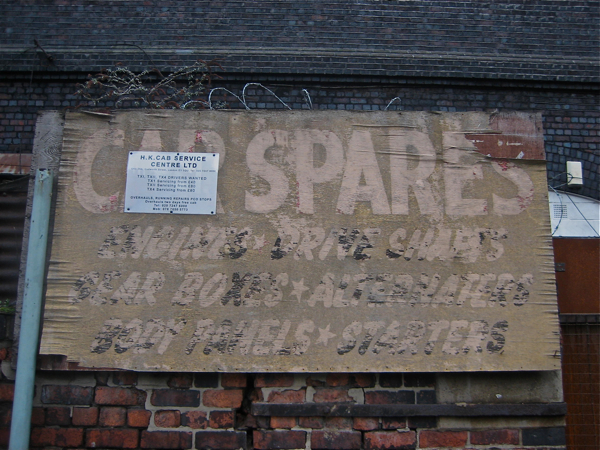
Car Spares on Three Colts Lane.

On Commercial St, “Woollen” overpainted onto “Glass Globes”

In Aldgate, Ben Eine adorns Stick ‘Em Up! sandwich bar.

Off Charlotte Rd, a courteous hand directs you to non-existent showrooms.

Diaphanous oblivion on Commercial St.
Harold & Walter Steggles, Artists
Today I present another extract from my new book EAST END VERNACULAR, Artists who painted London’s East End streets in the 20th century to be published by Spitalfields Life Books in October. Click here to preorder your copy
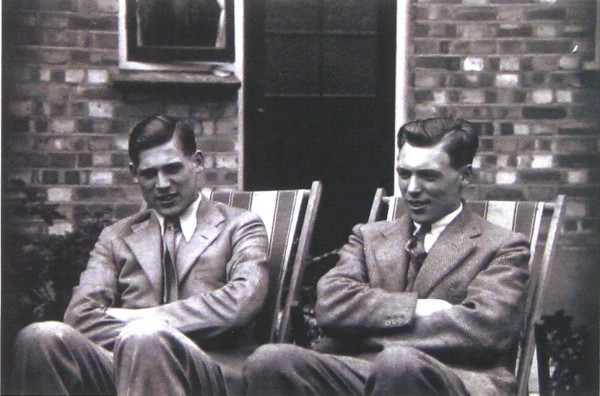
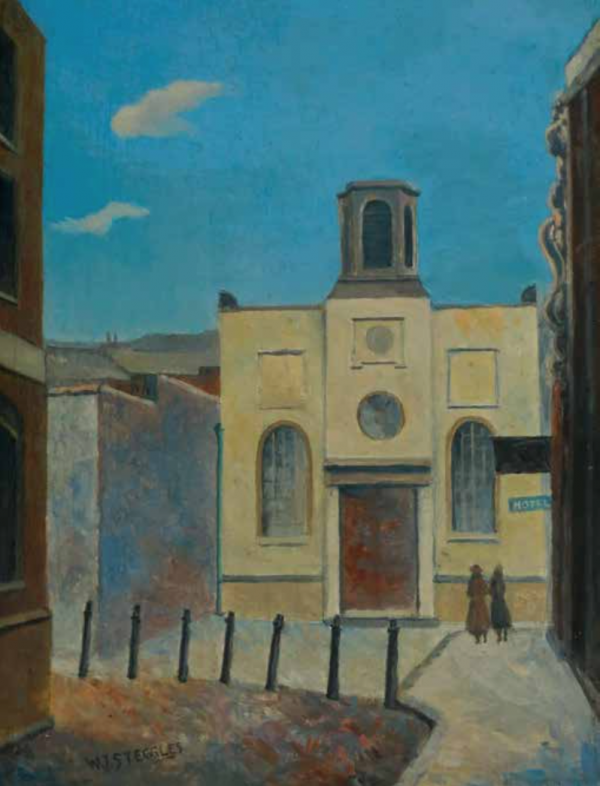
Harold Steggles (1911-71) and his elder brother Walter were precocious artists who found early success as adolescents. Harold was the second of five children and grew up in Ilford with a father who managed a specialist shoe shop in the Strand and a mother who worked as dressmaker but had always wanted to be a painter.
When Harold left school and found employment as a clerk with a solicitor in Grays Inn at fourteen years old, he and Walter took to visiting galleries and viewing the national painting collections together. Soon they were undertaking sketching trips to pursue their shared passion, and reading widely about art, discussing the writings of John Ruskin and Joshua Reynolds.
In 1925, they visited an exhibition of paintings by the Bethnal Green Men’s Institute Art Club at the Bethnal Green Museum and signed up for lessons at the Institute, aged fourteen and seventeen respectively. However, the brothers were quickly disappointed with the tuition and they transferred to John Cooper’s art classes at the Bromley & Bow Institute where he encouraged them to paint scenes in the vicinity of the Institute in Bow. Under his tutelage, both brothers flourished as artists and they were to become the youngest members of the East London Group.
When Harold was just seventeen years old, John Cooper hung eight of his paintings at the East London Art Club exhibition at the Whitechapel Gallery in 1928, and Charles Aitken, Director of the Tate Gallery bought one, offering twice the asking price of one guinea.
Photographs of the brothers at this time show them as a pair of smiling handsome youths with short, neat haircuts and near-identical matching suits, sometimes worn with plus fours. Enjoying the fruits of their artistic success, they took motoring trips together and expanded the range of their subject matter to include the rural landscapes of East Anglia.
“All my brother’s pictures found buyers,” wrote Walter in excitement at his younger brother’s triumph when they showed with the East London Group at Lefevre Galleries and, over successive years, Harold contributed more than sixty pictures to these exhibitions. Before long they found themselves sought after by other galleries and Harold became a protoge of the flamboyant aesthete Eddie Marsh who lived near his office in Gray’s Inn as well as accepting a prestigious commission from Villiers David to paint the gentlemen’s clubs of St James.
The climax of this run of success for the brothers came with Harold & Walter Steggles’ joint exhibition at Lefevre Galleries in 1938, yet Harold continued his work as clerk apart from some time in hospital being treated for stomach ulcers which he attributed to malnourishment in childhood.
When the war came, both were excluded from service for health reasons and applied to become war artists but were turned down. Instead, Harold was asked by Muirhead Bone to contribute paintings to an exhibition at the Ashmolean Museum in Oxford which were to be sold to benefit the Red Cross.
In 1943, when he was thirty-two, Harold married Lilian Wood, the widow of a Spitfire pilot, even though her father did not approve of Harold being an artist. It was a curious union of contrasting personalities, Harold considerate and quiet, and Lilian, outgoing, keen on tennis and uninterested in art. Harold took legal exams and advanced in his work at the solicitors but considered himself lacking in the necessary education and temperament, confiding to his daughter Elizabeth that, if it had not been for the war, he might have carried on with commissions. Twenty-five years after Harold died at the age of sixty, Walter wrote, “I have not yet recovered from the shock of losing him.”
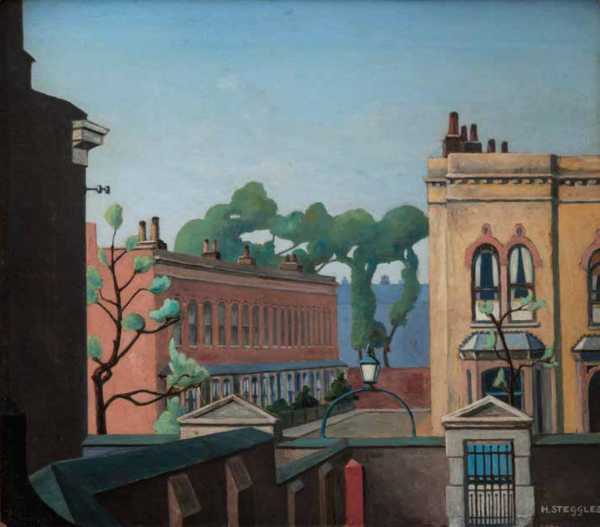
Grove Road, Bow

Warner Street, Clerkenwell, 1935
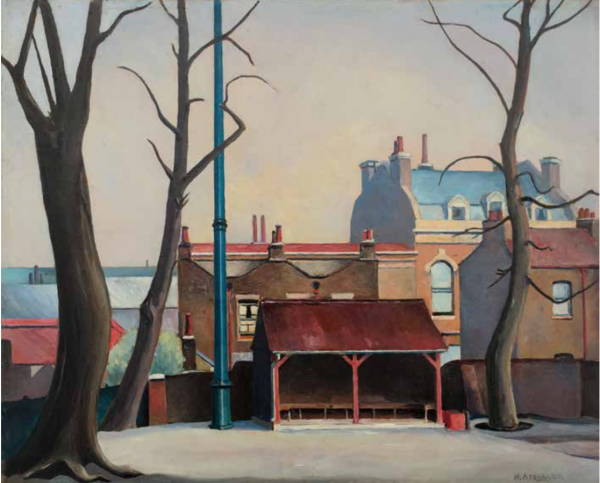
Grove Hall Park, Bow, 1933
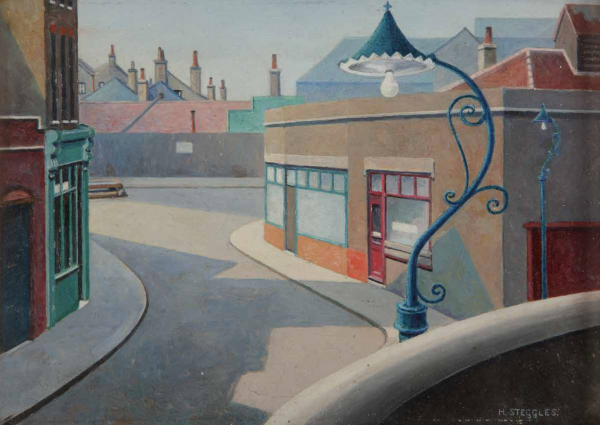
Blackwall
When Walter Steggles (1908-1997) left school at fourteen, he joined a shipping firm in the City of London, working, “as dogsbody in the superintendent’s department which meant spending periods in the drawing office.” Once he and his younger brother Harold started regular art classes in 1925, such was his enthusiasm that he would take the train from Fenchurch Street Station back to the family home in Ilford for dinner before returning to the East End.
Like Harold, Walter enjoyed the encouragement of John Cooper at Bow, whom he described as “probably the best teacher I ever knew,” recalling how “He would always find a good point to remark on in someone’s work and would say, ‘You are trying to imitate someone not as good as yourself.’” Walter also appreciated the participation of established artists at the classes in Bow, writing “Sickert’s advice has been constantly with me,” and was both challenged and flattered when John Cooper sometimes asked him to take over the class.
At twenty years old, Walter contributed eleven paintings to the East London Art Group Show at the Whitechapel Gallery in 1928, three of which were then hung in the Tate. With admirable lack of ego, Walter wrote, “I do not like one man shows, my pictures look better mixed in with others.” He and Harold both exhibited at all the East London Group shows at the Lefevre Galleries between 1928 and 1936, followed by a joint show in 1938, and the two brothers found themselves part of a cosmopolitan artistic milieu that included Ben Nicholson, Charles Ginner, Philip Wilson Steer, George Braque and Raoul Dufy. In the midst of this success, Walter’s crowning achievement was having a painting in the British Pavilion at the Venice Biennale in 1936.
In 1939, excluded from military service due to asthma and not chosen as a war artist, Walter was transferred to the Ministry of Transport for war work but continued his art studies at Central School of Art. Offered a job as an art teacher by London County Council after the war, instead he returned to work at the shipping company in the City.
After Harold’s marriage, Walter’s sister Muriel sometimes accompanied him on painting trips and she remembered that when he found a scene that he liked, he would sketch it on the spot and then work up the painting at home, also Sickert’s preferred method. Walter wrote, ”sketching is better than a camera, I only did one painting from a photograph and it was dead.”
Inspired perhaps by the presence of Stanley Spencer, Walter moved to Cookham where his parents came to live with him, much to his father’s regret, declaring “We should never have left Romford!” By now his mother was painting prolifically. “My son has his own studio,” she boasted to Stanley Spencer. “He’s lucky, I paint in my bedroom,” replied the old master.
Still working into the nineteen-nineties, Walter wrote, “I sometimes wonder what makes us pursue the arts. It is not money as people in insignificant jobs usually do better.” At the end of a long and sustained painting career, he wrote proudly, “It is sixty-five years since I sold my first picture at a public exhibition. It was bought by Sir Joseph Duveen and was hung at the Tate Gallery in 1929.”
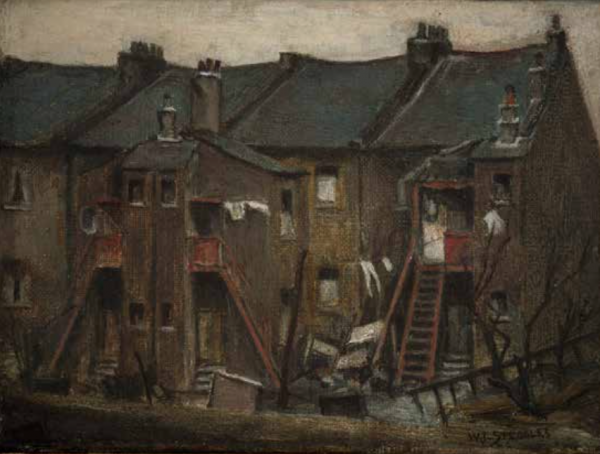
Old Houses, Bethnal Green, 1929
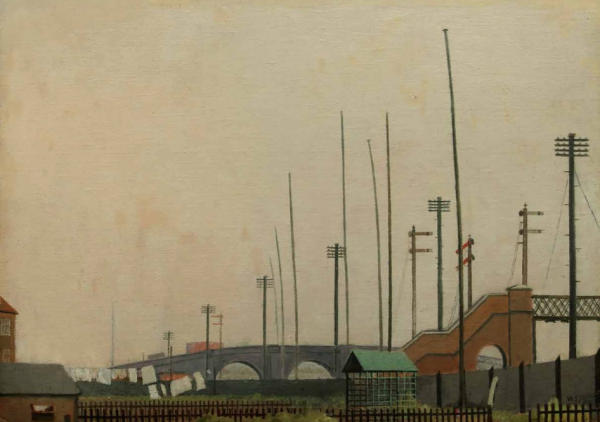
The Railway Fence
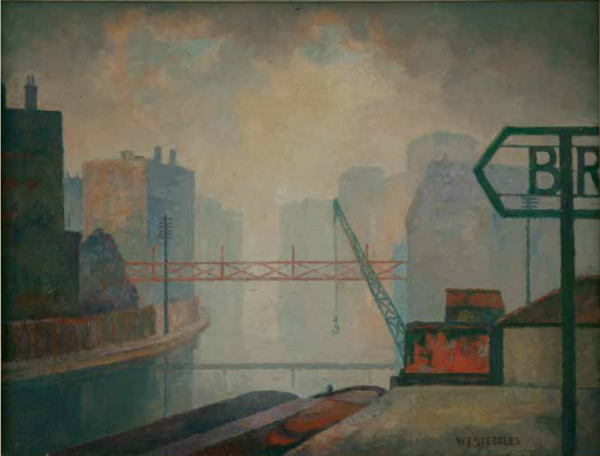
Bryant & May Wharf
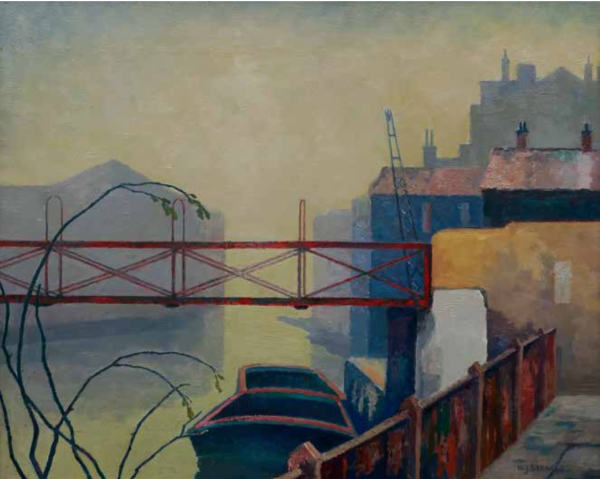
The Red Bridge
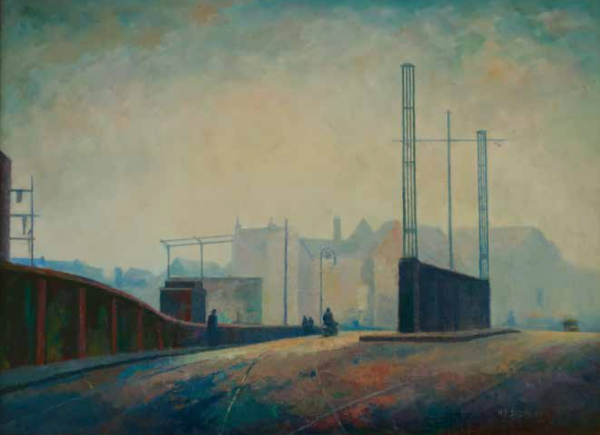
Bow Bridge
The Chapel, Minories
Take a look at some of the other artists featured in East End Vernacular
Click here to preorder a copy of EAST END VERNACULAR for £25
Manhole Covers Of Spitalfields

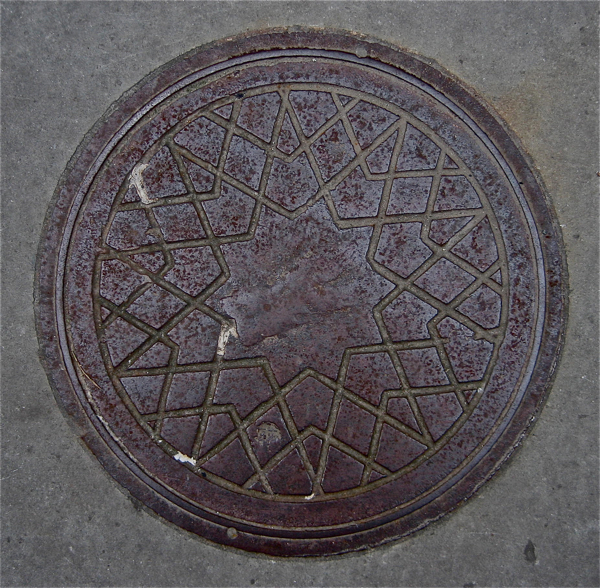
Ever since I wrote about sculptor Keith Bowler’s Roundels, describing how he set new manhole covers into the pavements of Spitalfields with motifs to commemorate all the people, cultures and trades that have passed through, I have been noticing the old ones that inspired him in the first place. This one from the eighteen eighties in Fournier St is undoubtably the most fancy specimen in the neighbourhood with its dynamic sunburst and catherine wheel spiral. So much wit and grace applied to the design of a modest coalhole cover, it redefines the notion of utilitarian design. In Bath, Bristol, Brighton and Edinburgh, I have seen whole streets where each house has a different design of coalhole cover, like mismatched buttons on a long overcoat, but in Spitalfields they are sparser and you have to look further to find them.
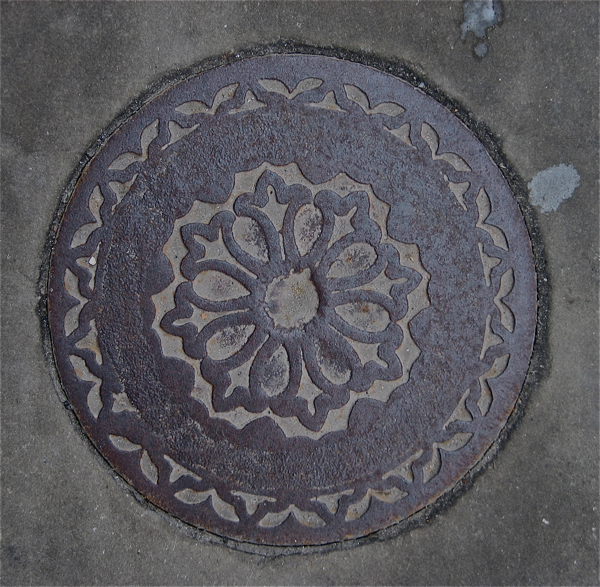
There is a second example of this Clark, Hunt & Co sunburst, that I like so much, in Redchurch St, just a hundred yards from the former showrooms at 159/60 Shoreditch High St of this company who called themselves the Middlesex Iron Works – founded in 1838, proud contractors to the H.M. War Office, the Admiralty and London County Council. And like many local ironworks, gone long ago, but outlived by their sturdy cast iron products. Alfred Solomons of 195 Caledonian Rd is another name I found here in Spitalfields on a couple of manhole covers, with some rather fetching, almost orientalist, nineteenth century flourishes. I discovered that the Jewish Chronicle reported the birth of a son to Alfred’s wife Celia on 18th December 1894 at the Caledonian Rd address, so these plates commemorate them personally now.
Meanwhile Hayward Brothers of 187 & 189 Union St, Borough, are the most ubiquitous of the named manufacturers with their handsome iron artefacts in the pavements of our neighbourhood. They were founded by William & Edward Hayward, glaziers who had been trading since 1783 when they bought Robert Henley’s ironmongery business in 1838. As glaziers they brought a whole new progressive mentality to the humble production of coalhole covers, patenting the addition of prisms that admitted light to the cellar below. You can see one of their “semi-prismatic pavement lights” illustrated below, in Calvert Avenue. Such was the success of this company that by 1921 they opened a factory in Enfield, and even invented the “crete-o-lux” concrete system which was used to repave Regent St, but they ceased trading in the nineteen seventies when smokeless zones were introduced in London and coal fires ceased. Regrettably, Spitalfields cannot boast a coalhole by the most celebrated nineteenth century manufacturer, by virtue of their name, A.Smellie of Westminster. The nearest example is in Elizabeth St, Victoria, where I shall have to make a pilgrimage to see it.
Unfailingly, my fascination with the city is deepened by the discovery of new details like these, harbouring human stories waiting to be uncovered by the curious. Even neglected and trodden beneath a million feet, by virtue of being in the street, these ingenious covers remind us of their long dead makers’ names more effectively than any tombstone in a churchyard. There was rain blowing in the wind yesterday but when the sun came out afterwards, the beautiful old iron covers shone brightly like medals – for those who had the eyes to see them – emblazoned upon the streets of Spitalfields.
In Old Broad St.

In Fournier St, a nineteenth century coalhole cover by Alfred Solomons, 195 Caledonian Rd – I am reliable informed there are similar covers in Doughty St and around Bloomsbury.
A more minimal variant on the same design by Alfred Solomons.

Hayward Brothers’ “Patent Self-Locking Semi-Prismatic Pavement Light” in Calvert Avenue.

A more recent example of Hayward Brothers’ self -locking plate.

In Gunthorpe St, this drain cover commemorates Stepney Borough Council created in 1900 and abolished in 1965.

At the Rectory in Fournier St, this early plate by Hayward Brothers of 187 & 189 Union St, Borough, which is also to be found in Lower Richmond Rd.

Another by Haywood Brothers in Spitalfields – although unlabelled, it follows the design of the plate above.

Bullseye in Chance St
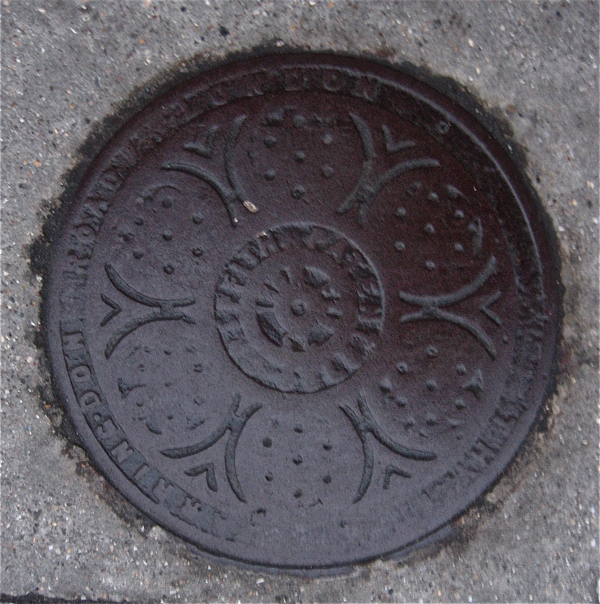
In Commercial St, at the junction with Elder St, is this worn plate is made by Griffith of Farringdon Rd, Clerkenwell

In Middlesex St. LCC – London County Council was abolished in 1965. Can it be only co-incidental that this old manhole cover in Petticoat Lane Market, in the former Jewish quarter, has a star of David at the centre?
Harry T. Harmer, Artist
Today I present another extract from my new book EAST END VERNACULAR, Artists who painted London’s East End streets in the 20th century to be published by Spitalfields Life Books in October. Click here to preorder your copy
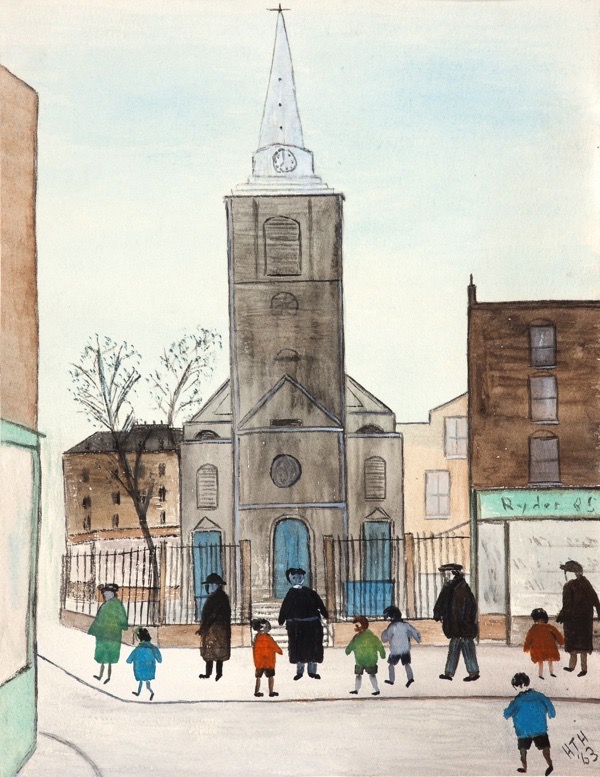
St Botolph’s Without Aldgate, 1963
The facts of the life of Harry T. Harmer (1927-2013) are scarce yet his distinctive paintings speak eloquently of his personal vision. Born in Kennington, Harry was afflicted with epilepsy and married his wife Ruby when they were both in their adolescence. Ruby offered Harry emotional support in the face of a father who did not recognise his disorder and the couple enjoyed a marriage that lasted through eight decades.
Disqualified from military service, Harry worked in the parks department and, possessing a strong sense of justice, he fought for the rights of fellow workers through many years as a union representative. In the mid-fifties, Harry discovered an ability to draw and paint, travelling around Kennington and north of the river to the East End, making sketches of places that embodied the living city he knew intimately.
Harry had his first exhibition in 1963 and continued to paint and show his works for the rest of his life. Although sometimes described as a naive artist, it is obvious that the sensibility behind Harry’s painting is far from unsophisticated. His compelling pictures are concerned with more than straightforward representation of places, offering instead emotional landscapes of the lives of working people rendered in his own individual style.
Ruby keeps Harry’s treasured copy of the drawings of L. S. Lowry in two volumes as a token of his major artistic influence. Yet Harry forged a visual language of his own, placing his curious bird-like figures strategically within a delicately painted streetscape that appears on the point of dissolving.
For most of their married life, Harry and Ruby Harmer occupied a council flat in a dignified Victorian terrace in Kennington, where Ruby lives today tending to an appealingly unkempt garden and a posse of neighbourhood cats. In the back room overlooking the garden where Harry did his paintings, his small formica topped work table still stands by the window where now a box of his ashes sits beside a bunch of fresh flowers that Ruby changes each week. The popularity of Harry’s works means that Ruby is the devoted custodian of just a few of her husband’s paintings, and a suitcase of his pencil sketches, press cuttings and exhibition catalogues.
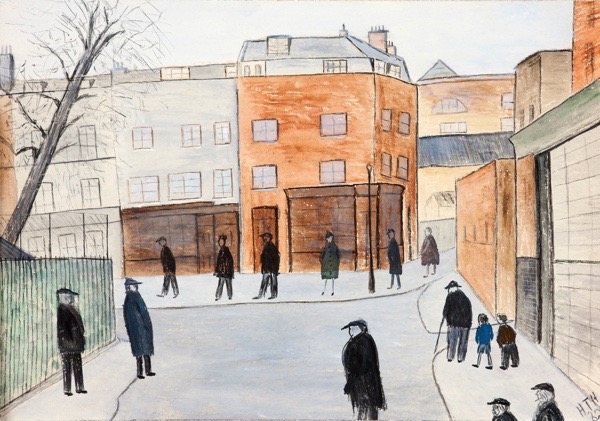
Wellclose Sq, 1962
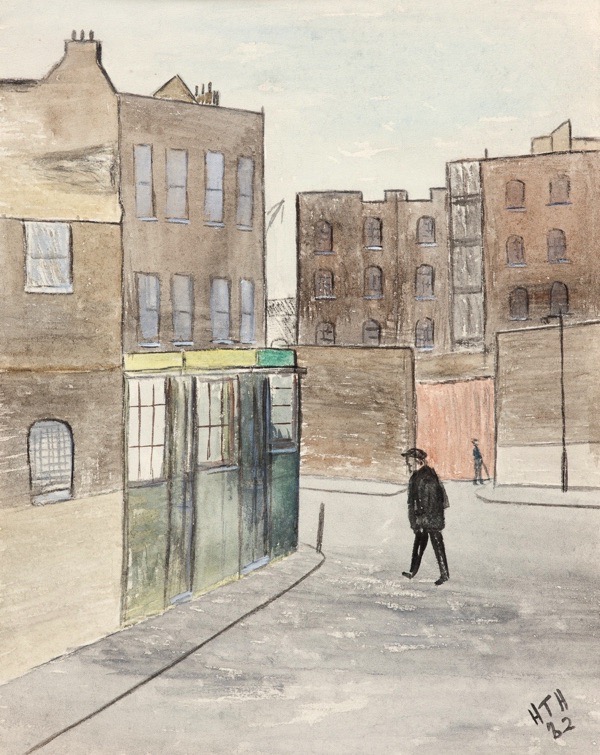
St Katharine’s Way, 1962
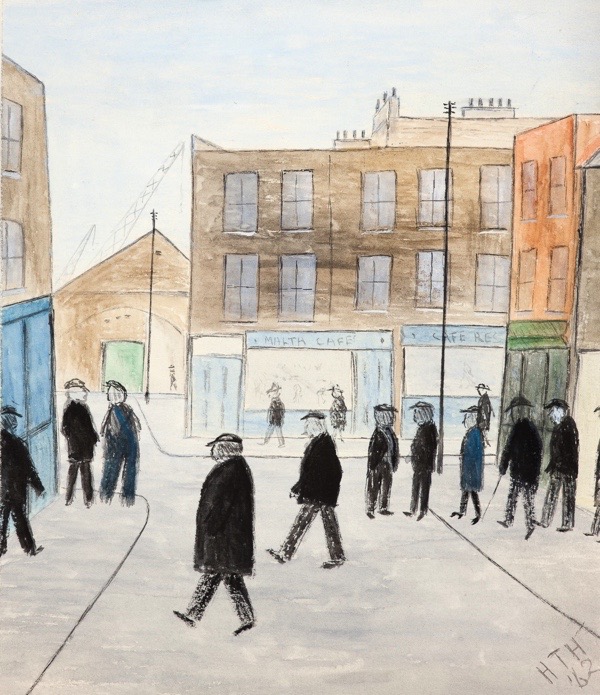
Cable St, 1962
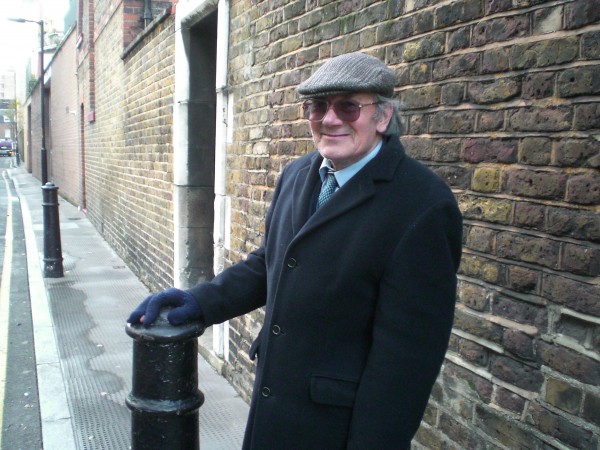
Harry T. Harmer, 2009
Paintings copyright © Ruby Harmer
Published courtesy of Tower Hamlets Local History Library & Archives
Take a look at some of the other artists featured in East End Vernacular