
Henry Mayhew, The London Vagabond
Chris Anderson introduces his new biography of Henry Mayhew, The London Vagabond
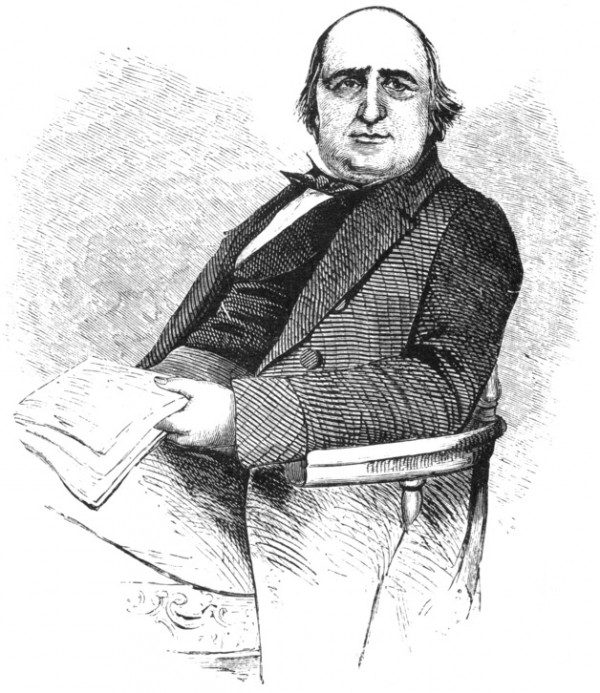
When Henry Mayhew died in 1887, one newspaper noted ‘The chief impression created in the public mind was one of surprise that he should still be alive.’ Yet nearly forty years earlier, his London Labour & the London Poor had gripped the country, confronting it with the voices of those who had been overlooked. His masterwork began as a series of ‘Letters’ commissioned by The Morning Chronicle and, from 1849 onwards, these grew into a panoramic survey of London’s poorest workers, a long exposure snapshot of mid-nineteenth century life.
The Spitalfields silk weavers were the first group of the working poor Mayhew reported on. Descended from Huguenot refugees, their livelihood was undermined by free trade after the abolition of import tariffs on French silk. Their experience was common among many highly-skilled London workers, as their quality of life deteriorated from the early years of the century, eroded by technological and social change. Late at night, in a narrow Shoreditch street, Mayhew mounted the stairs to a top floor room and visited an old weaver, sick in bed. The weaver lived and worked in a shared top floor room, cobwebbed with sagging clothes lines, where three looms jostled among several beds. The old man asked his daughter, Tilly, to pull up a chair for Mayhew, then began his tale.
“Yes, I was comfortable in ’24. I kept a good little house and I thought, as my young ones growed up – why I thought as I should be comfortable in my old age, and ‘stead of that, I’ve got no wages. I could live by my labour then, but now, why it’s wretched in the extreme. Then I’d a nice little garden and some nice tulips for my hobby, when my work was done. … As for animal food, why it’s a stranger to us. Once a week, may be, we gets a taste of it, but that’s a hard struggle, and many a family don’t have it once a month … Tilly, just turn up that shell now and let the gentlemen see what beautiful fabrics we’re in the habit of producing – and then he shall say whether we ought to be in the filthy state we are. Just show the light, Tilly! That’s for ladies to wear and adorn them. And make them handsome’”
(It was an exquisite piece of maroon coloured velvet. That, amidst all the squalor of the place, seemed marvellously beautiful, and it was a wonder to see it unsoiled amid all the filth that surrounded it).
Mayhew formed a close bond with the Spitalfields silk weavers. Yet The Morning Chronicle fired him after a year – for asking for more work, they said – for speaking up for the workers, Mayhew said. He revived the Letters as his own weekly serial, entitled London Labour & the London Poor. Increasingly, he focused on street folk, costers and other itinerant traders, yet he continued to support the silk weavers cause, even after London Labour ended abruptly in court over unpaid printer’s bills.
On Tuesday 4th May 1852 at the school room, St John’s St, Brick Lane, The Trade Society for the Protection of Native Industry convened a mass meeting to ‘adopt resolutions condemnatory of the present unregulated and stimulated system of competition, which is reducing the working classes of this country to the continental level’. Mayhew came on stage to loud cheering. He told how he had commenced his ‘inquiries into the state of the working classes, being at the time an inveterate Free-trader’ with The Morning Chronicle, but his research among the poor had converted him to protectionism.
Mayhew returned to Spitalfields for a very different occasion four years later, as part of his second major series, The Great World of London. On the evening of 8th April 1856, he summoned a gathering of professional villains, the ‘Swell Mobsmen’ at the White Lion Tavern, Fashion St. Entry was by ticket only, signed by Mayhew and stating the police were barred. A hundred crooks gathered in the well-lit, comfortable room where a ‘free and easy’ atmosphere prevailed.
“A stranger would have had no suspicion that the men there assembled were at war with society. They one and all appeared well fed, well clad, and at ease with themselves. In the course of the evening several showily-dressed youths, who were evidently the ‘aristocracy’ of the class, walked into the room. These were mainly habited as clerks or young men in offices, some wearing gold guard chains, others with pistol keys dangling from their waistcoat pockets, and having diamond pins in their cravats. They were, however, all ‘mobsmen,’ as they are called – men who in some instances, we are assured, are gaining their £10 or even £20 a week by light-fingered operations. Indeed, several present were pointed out as ‘tip-top sawyers,’ ‘moving in the best society and doing a heavy business’. Beside those there were a few notorious ‘cracksmen’ (house-breakers) and one or two ‘fences’ (receivers of stolen goods), who were said to be worth their weight in gold.”
Mayhew proposed a society to help these people to go straight. In the event, most of the Swell Mobsmen seemed appreciative but unpersuaded.
“A few candidly stated ‘they didn’t seem to care’ about reforming themselves, but they would gladly assist any of their body who was desirous of so doing.”
A unique exploration of working Londoners, London Labour & the London Poor influenced an entire generation of writers, Charles Dickens among them. A pioneering work of social science, criminology and oral history, it was a century ahead of its time, yet within a few years of Mayhew’s death the work was all but forgotten, along with its author.
Only when the great metropolis that Mayhew loved lay in ruins after the Blitz did London Labour & the London Poor resurface. By the late sixties, all four volumes were available once more, riding the wave of a Victorian revival. ‘It is a book’, wrote W. H. Auden in 1968, ‘in which one can browse for a lifetime without exhausting its treasures.’ Yet a veil remained over Mayhew and, by the seventies, as academics fought over the meaning of his legacy, the historian E. P. Thompson observed:
“He was the subject of no biography and there is something like a conspiracy of silence about him in some of the reminiscences and biographies of his contemporaries … Mayhew remains a puzzling character and some final clue seems to be missing.”
By the eighties, when London Labour & the London Poor had become established as a fixture on the reading list for courses on literature, history, criminology, culture studies and more, the Penguin edition could still open with, ‘It is strange that not more is known about the life of Henry Mayhew.’ Today, Mayhew crops up on the National Curriculum, feted as a philanthropist. His work inspires novels and films exploring the lost world of Victorian London. Terry Pratchet dedicated his final novel, Dodger, to Mayhew. Even so, his life has remained shrouded – until now.
Born into a wealthy family, Mayhew’s public school years were cut short and he was shipped off to Calcutta as a midshipman. Taken on at his father’s law firm upon his return, he left when – absentmindedly – he got his father arrested. Then he became a journalist and dramatist in eighteen-thirties London, neither considered respectable occupations, crowning the decade by founding Punch. It became the most successful magazine of the century and should have set him up for life.
Instead, his path led to bankruptcy and prison. He spent years in exile in Guernsey and Germany. In between, he became famous for his revelations about the poor and brought out London Labour & the London Poor in 1851. He was a respected children’s author, a popular comic novelist, a criminologist who gave evidence to Parliamentary Select committees and a war correspondent. He wrote for the stage, tried to enter politics, the darling of both radicals and conservatives for attacking the liberal mantra of Free Trade. He was known as a philosopher and as a scientist, who revered his friend Michael Faraday, and sought to bring electric lighting to London decades before it arrived.
Mental illness haunted him though, his periodic peaks alternating with deep troughs. He mixed with Charles Dickens, William Makepeace Thackeray and stood at the centre of the burgeoning literary world, met with government ministers to advocate social reforms, and mingled with costers, dockers and the underworld too, keeping an open house for thieves and paroled prisoners. His closeness to some of them backfired in blackmail and death threats. His wife, Jane Jerrold, who dealt with the bailiffs for him and secretly co-wrote much of his work, left him when their children had grown up and insisted on being buried under her maiden name. Forgotten, Henry Mayhew spent his last decades moving from one Bloomsbury bedsit to another, plotting new schemes and new books, even until the very last.
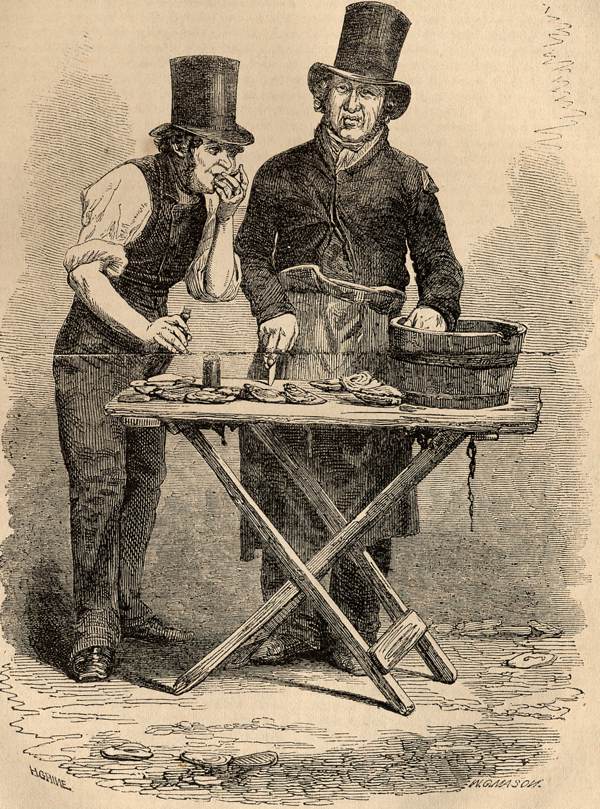
The Oyster Stall. “I’ve been twenty years and more, perhaps twenty-four, selling shellfish in the streets. I was a boot closer when I was young, but I had an attack of rheumatic fever, and lost the use of my hands for my trade. The streets hadn’t any great name, as far as I knew, then, but as I couldn’t work, it was just a choice between street selling and starving, so I didn’t prefer the last. It was reckoned degrading to go into the streets – but I couldn’t help that. I was astonished at my success when I first began, I made three pounds the first week I knew my trade. I was giddy and extravagant. I don’t clear three shillings a day now, I average fifteen shillings a week the year through. People can’t spend money in shellfish when they haven’t got any.”

The Irish Street-Seller. “I was brought over here, sir, when I was a girl, but my father and mother died two or three years after. I was in service, I saved a little money and got married. My husband’s a labourer, he’s out of worruk now, and I’m forced to thry and sill a few oranges to keep a bit of life in us, and my husband minds the children. Bad as I do, I can do a penny or tuppence a day better profit than him, poor man! For he’s tall and big, and people thinks, if he goes round with a few oranges, it’s just from idleniss.”
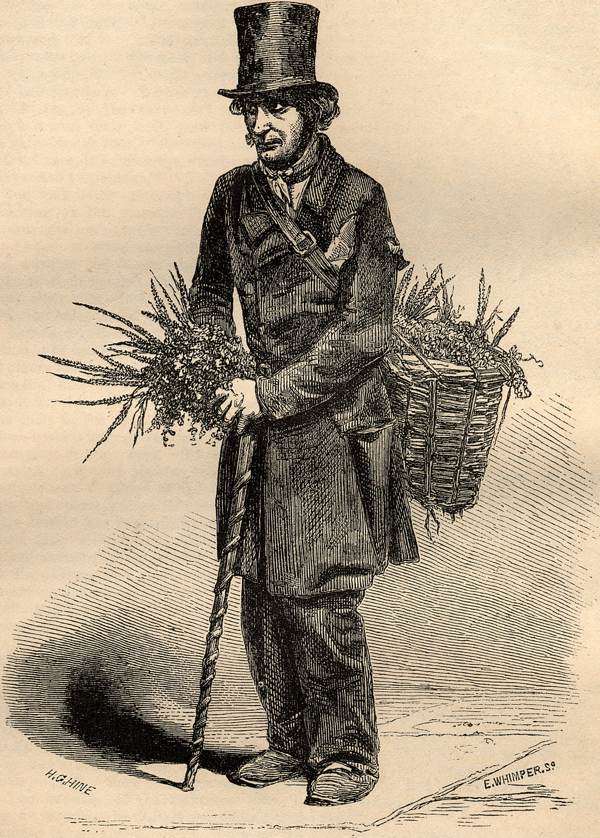
The Groundsel Man. “I sell chickweed and grunsell, and turfs for larks. That’s all I sell, unless it’s a few nettles that’s ordered. I believe they’re for tea, sir. I gets the chickweed at Chalk Farm. I pay nothing for it. I gets it out of the public fields. Every morning about seven I goes for it. I’ve been at business about eighteen year. I’m out till about five in the evening. I never stop to eat. I am walking ten hours every day – wet and dry. My leg and foot and all is quite dead. I goes with a stick.”
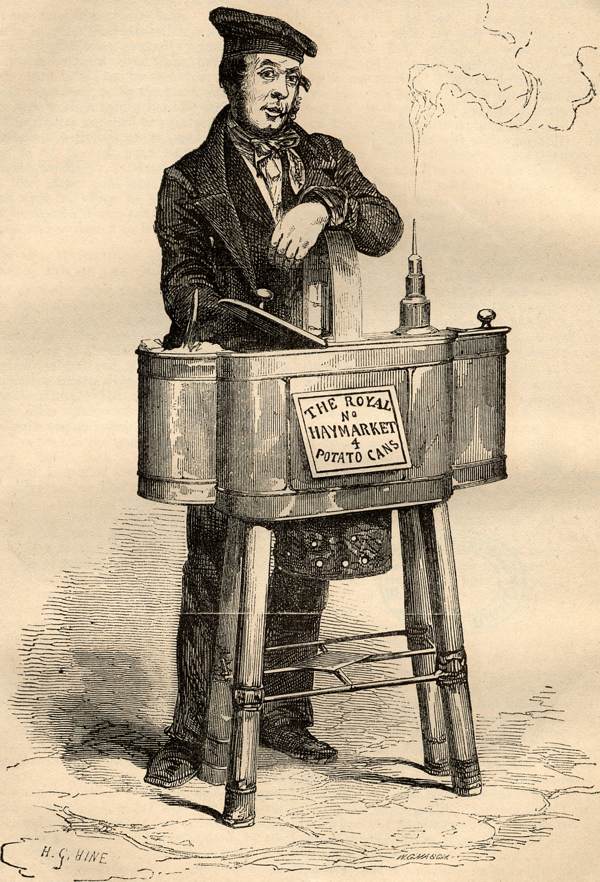
The Baked Potato Man. “Such a day as this, sir, when the fog’s like a cloud come down, people looks very shy at my taties. They’ve been more suspicious since the taty rot. I sell mostly to mechanics, I was a grocer’s porter myself before I was a baked taty. Gentlemen does grumble though, and they’ve said, “Is that all for tuppence?” Some customers is very pleasant with me, and says I’m a blessing. They’re women that’s not reckoned the best in the world, but they pays me. I’ve trusted them sometimes, and I am paid mostly. Money goes one can’t tell how, and ‘specially if you drinks a drop as I do sometimes. Foggy weather drives me to it, I’m so worritted – that is, now and then, you’ll mind, sir.”

The London Coffee Stall. “I was a mason’s labourer, a smith’s labourer, a plasterer’s labourer, or a bricklayer’s labourer. I was for six months without any employment. I did not know which way to keep my wife and child. Many said they wouldn’t do such a thing as keep a coffee stall, but I said I’d do anything to get a bit of bread honestly. Years ago, when I as a boy, I used to go out selling water-cresses, and apples, and oranges, and radishes with a barrow. I went to the tinman and paid him ten shillings and sixpence (the last of my savings, after I’d been four or five months out of work) for a can. I heard that an old man, who had been in the habit of standing at the entrance of one of the markets, had fell ill. So, what do I do, I goes and pops onto his pitch, and there I’ve done better than ever I did before.”

Coster Boy & Girl Tossing the Pieman. To toss the pieman was a favourite pastime with costermonger’s boys. If the pieman won the toss, he received a penny without giving a pie, if he lost he handed it over for nothing. “I’ve taken as much as two shillings and sixpence at tossing, which I shouldn’t have done otherwise. Very few people buy without tossing, and boys in particular. Gentlemen ‘out on the spree’ at the late public houses will frequently toss when they don’t want the pies, and when they win they will amuse themselves by throwing the pies at one another, or at me. Sometimes I have taken as much as half a crown and the people of whom I had the money has never eaten a pie.”

The Street- Seller of Nutmeg Graters. “Persons looks at me a good bit when I go into a strange place. I do feel it very much, that I haven’t the power to get my living or to do a thing for myself, but I never begged for nothing. I never thought those whom God had given the power to help themselves ought to help me. My trade is to sell brooms and brushes, and all kinds of cutlery and tinware. I learnt it myself. I was never brought up to nothing, because I couldn’t use my hands. Mother was a cook in a nobleman’s family when I was born. They say I was a love child. My mother used to allow so much a year for my schooling, and I can read and write pretty well. With a couple of pounds, I’d get a stock, and go into the country with a barrow, and buy old metal, and exchange tinware for old clothes, and with that, I’m almost sure I could make a decent living.”

The Crockery & Glass Wares Street-Seller. “A good tea service we generally give for a left-off suit of clothes, hat and boots. We give a sugar basin for an old coat, and a rummer for a pair of old Wellington boots. For a glass milk jug, I should expect a waistcoat and trowsers, and they must be tidy ones too. There is always a market for old boots, when there is not for old clothes. I can sell a pair of old boots going along the streets if I carry them in my hand. Old beaver hats and waistcoats are worth little or nothing. Old silk hats, however, there’s a tidy market for. There is one man who stands in Devonshire St, Bishopsgate waiting to buy the hats of us as we go into the market, and who purchases at least thirty a week. If I go out with a fifteen shilling basket of crockery, maybe after a tidy day’s work I shall come home with a shilling in my pocket and a bundle of old clothes, consisting of two or three old shirts, a coat or two, a suit of left-off livery, a woman’s gown maybe or a pair of old stays, a couple of pairs of Wellingtons, and waistcoat or so.”
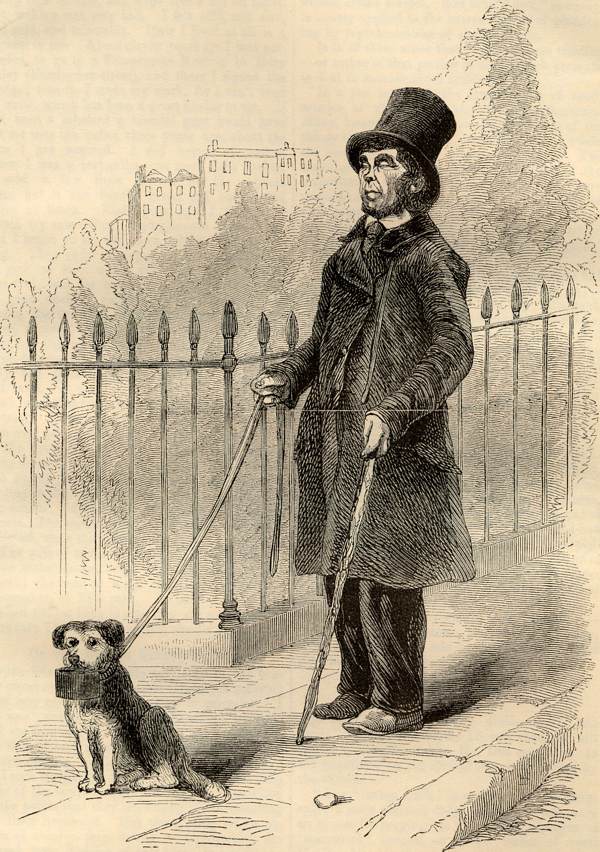
The Blind Bootlace Seller. “At five years old, while my mother was still alive, I caught the small pox. I only wish vaccination had been in vogue then as it is now or I shouldn’t have lost my eyes. I didn’t lose both my eyeballs till about twenty years after that, though my sight was gone for all but the shadow of daylight and bright colours. I could tell the daylight and I could see the light of the moon but never the shape of it. I never could see a star. I got to think that a roving life was a fine pleasant one. I didn’t think the country was half so big and you couldn’t credit the pleasure I got in going about it. I grew pleaseder and pleaseder with the life. You see, I never had no pleasure, and it seemed to me like a whole new world, to be able to get victuals without doing anything. On my way to Romford, I met a blind man who took me in partnership with him, and larnt me my business complete – and that’s just about two or three and twenty year ago.”

The Street Rhubarb & Spice Seller. “I am one native of Mogadore in Morocco. I am an Arab. I left my countree when I was sixteen or eighteen years of age, I forget, sir. Dere everything sheap, not what dey are here in England. Like good many, I was young and foolish – like all dee rest of young people, I like to see foreign countries. The people were Mahomedans in Mogadore, but we were Jews, just like here, you see. In my countree the governemen treat de Jews very badly, take all deir money. I get here, I tink, in 1811 when de tree shilling pieces first come out. I go to de play house, I see never such tings as I see here before I come. When I was a little shild, I hear talk in Mogadore of de people of my country sell de rhubarb in de streets of London, and make plenty money by it. All de rhubarb sellers was Jews. Now dey all gone dead, and dere only four of us now in England. Two of us live in Mary Axe, anoder live in, what dey call dat – Spitalfield, and de oder in Petticoat Lane. De one wat live in Spitalfield is an old man, I dare say going on for seventy, and I am little better than seventy-three.”
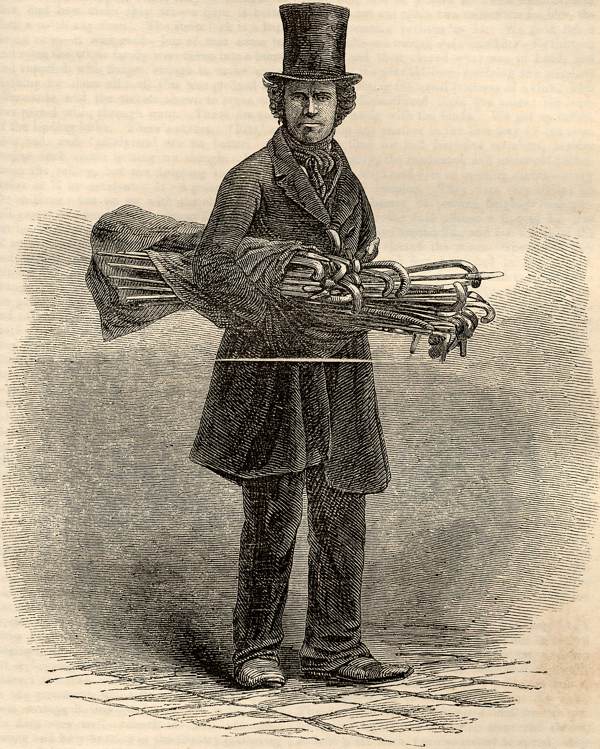
The Street-Seller of Walking Sticks. “I’ve sold to all sorts of people, sir. I once had some very pretty sticks, very cheap, only tuppence a piece, and I sold a good many to boys. They bought them, I suppose, to look like men and daren’t carry them home, for once I saw a boy I’d sold a stick to, break it and throw it away just before he knocked at the door of a respectable house one Sunday evening. There’s only one stick man on the streets, as far as I know – and if there was another, I should be sure to know.”

The Street Comb Seller. “I used to mind my mother’s stall. She sold sweet snuff. I never had a father. Mother’s been dead these – well, I don’t know how long but it’s a long time. I’ve lived by myself ever since and kept myself and I have half a room with another young woman who lives by making little boxes. She’s no better off nor me. It’s my bed and the other sticks is her’n. We ‘gree well enough. No, I’ve never heard anything improper from young men. Boys has sometimes said when I’ve been selling sweets, “Don’t look so hard at ’em, or they’ll turn sour.” I never minded such nonsense. I has very few amusements. I goes once or twice a month, or so, to the gallery at the Victoria Theatre, for I live near. It’s beautiful there, O, it’s really grand. I don’t know what they call what’s played because I can’t read the bills. I’m a going to leave the streets. I have an aunt, a laundress, she taught me laundressing and I’m a good ironer. I’m not likely to get married and I don’t want to.”

The Grease-Removing Composition Sellers. “Here you have a composition to remove stains from silks, muslins, bombazeens, cords or tabarets of any kind or colour. It will never injure or fade the finest silk or satin, but restore it to its original colour. For grease on silks, rub the composition on dry, let it remain five minutes, then take a clothes brush and brush it off, and it will be found to have removed the stains. For grease in woollen cloths, spread the composition on the place with a piece of woollen cloth and cold water, when dry rub it off and it will remove the grease or stain. For pitch or tar, use hot water instead of cold, as that prevents the nap coming off the cloth. Here it is. Squares of grease removing composition, never known to fail, only a penny each.”
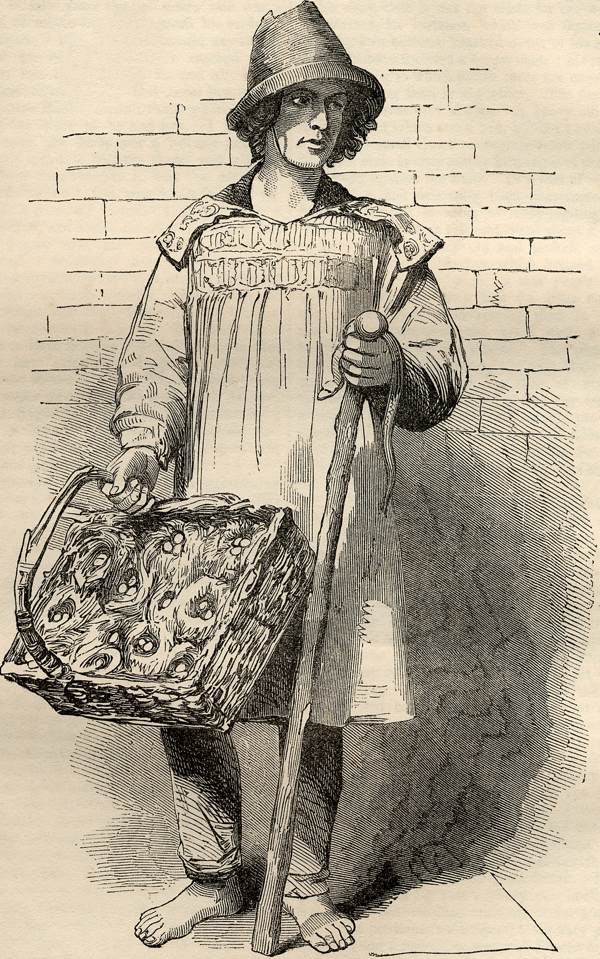
The Street Seller of Birds’ Nests. “I am a seller of birds’-nesties, snakes, slow-worms, adders, “effets” – lizards is their common name – hedgehogs (for killing black beetles), frogs (for the French – they eats ’em), and snails (for birds) – that’s all I sell in the Summertime. In the Winter, I get all kinds of of wild flowers and roots, primroses, buttercups and daisies, and snowdrops, and “backing” off trees (“backing,” it’s called, because it’s used to put at the back of nosegays, it’s got off yew trees, and is the green yew fern). The birds’ nests I get from a penny to threepence a piece for. I never have young birds, I can never sell ’em, you see the young things generally die of cramp before you can get rid of them. I gets most of my eggs from Witham and Chelmsford in Essex. I know more about them parts than anybody else, being used to go after moss for Mr Butler, of the herb shop in Covent Garden. I go out bird nesting three times a week. I’m away a day and two nights. I start between one or two in the morning and walk all night. Oftentimes, I wouldn’t take ’em if it wasn’t for the want of the victuals, it seems such a pity to disturb ’em after they made their little bits of places. Bats I never take myself – I can’t get over ’em. If I has an order of bats, I buys ’em off boys.”
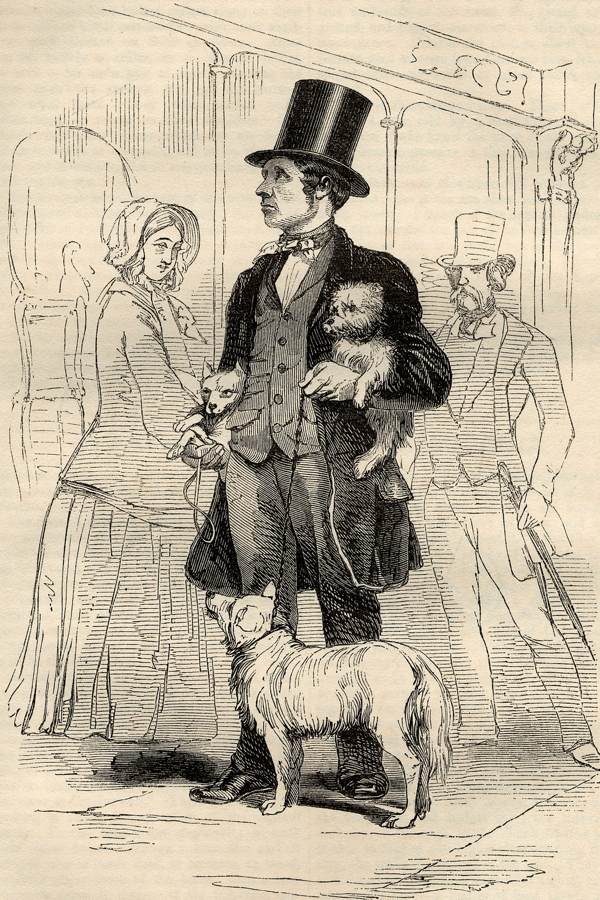
The Street-Seller of Dogs. “There’s one advantage in my trade, we always has to do with the principals. There’s never a lady would let her favouritist maid choose her dog for her. Many of ’em, I know dotes on a nice spaniel. Yes, and I’ve known gentleman buy dogs for their misses. I might be sent on with them and if it was a two guinea dog or so, I was told never to give a hint of the price to the servant or anybody. I know why. It’s easy for a gentleman that wants to please a lady, and not to lay out any great matter of tin, to say that what had really cost him two guineas, cost him twenty.”
Images courtesy Bishopsgate Institute
New Hope For Trinity Green Almshouses
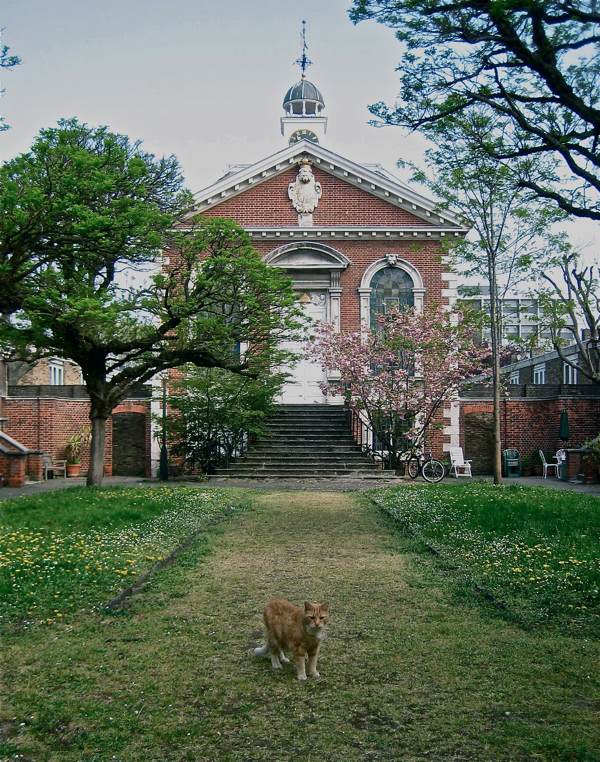
Three years ago, I reported upon the sorry neglect that has occurred in recent years – under the stewardship of Tower Hamlets Council – of the Grade 1 listed Trinity Green Almshouses in Whitechapel designed by Sir Christopher Wren. The outcome of my article was the formation of the Friends of Trinity Green which has been instrumental in challenging Sainsbury’s plan to build a tower of luxury flats overshadowing the almshouses.
Yet no improvement to the maintenance of Trinity Green has resulted. Buildings that were decaying then are decaying still and the vacant Council-owned flat remains empty after all this time.
At the Cabinet Meeting today, Tower Hamlets Council members are discussing selling off the empty cottage at auction. In response, The Spitalfields Trust is offering to buy it and the entire site from the Council, taking on complete responsibility for the maintenance of Trinity Green and giving it a sustainable future. They propose creating an independent buildings preservation trust that would use income from rents and grants available to such heritage trusts to maintain the property and manage it in perpetuity.
Below you can read The Spitalfields Trust letter and, if you wish to support this initiative, please write today to John Biggs, Mayor of Tower Hamlets: john.biggs@towerhamlets.gov.uk
THE SPITALFIELDS TRUST
18 Folgate Street,
London E1 6BX
Cabinet Meeting – 20th March 2018
Regarding the disposal of 2 Trinity Green, Mile End Rd
Dear Mayor Biggs & Cabinet Members,
I am writing to you in relation to Trinity Green, one of the most important groups of Grade I listed buildings in London; buildings which are critical in the architectural history of London and which played an important role in the development of the conservation movement in Britain.
I attach our previous letter dated the 13th April 2016 in which we outlined our concerns surrounding the condition of the buildings and the lack of a comprehensive plan for their future management – a concern which is also shared by a number of other conservation and heritage groups.
Subsequent to this letter, we met onsite with Council officers and encouraged them to produce condition reports which we saw as an important first step to finding a comprehensive solution.
We are surprised that paragraph 3.17 of the report issued last Thursday 15th makes no mention of The Spitalfields Trust, nor of our initial approach which has led to this outcome. Indeed we would not have been aware of the report’s existence but for the intervention of The Friends of Trinity Green.
The Spitalfields Trust are still ready, willing and able – for the reasons set out in our previous letter – to engage with the Council. But we feel that there is a lack of understanding on the part of officers of the complexity of the situation and a lack of willingness to work with us to find a potential solution. It seems that this will now require direction and leadership from Councillors and the Mayor.
We feel that the proposed sale will impact adversely on finding a strategy for the site as a whole. It is obvious that only one comprehensive strategy can produce a durable solution, thus relieving the council of its significant obligations.
We estimate the restoration of the Chapel will cost £500,000, while the street frontage and green will cost £100,000. The notion that the Council will be able to cover this cost or be able to carry out the specialist work required is not realistic.
Consequently, The Spitalfields Trust would like to propose a comprehensive plan for the restoration and protection of Trinity Green which will be cost effective to the Council and will relieve it of its current and long-term obligations.
- We are prepared to purchase the site as a whole from Tower Hamlets Homes, to restore it fully.
- We are prepared to take on responsibility for the common parts of Trinity Green and to develop and carry out a comprehensive restoration plan for the common parts (e.g. the gates) of the buildings.
- We would transfer the common parts to a newly created buildings preservation trust, including the current owners of the buildings, which would be responsible for their long-term maintenance.
The Council is obliged as a best value authority under section 3 of the Local Government Act 1999 to “make arrangements to secure continuous improvement in the way in which its functions are exercised having regard to a combination of economy, efficiency and effectiveness.”
Selling No.2 at auction, with no provision to mitigate the short-term repairs or future expense of maintaining Trinity Green would be a short-sighted move. The Trust would not be prepared to purchase No 2 in isolation and instead proposes an overall strategy which takes into account the considerable cost of restoring the chapel and common areas which have been badly neglected.
We would like the opportunity to continue the dialogue begun in 2016, to meet and find an effective and durable solution.
Yours faithfully
Patrick Streeter
Chairman, The Spitalfields Trust
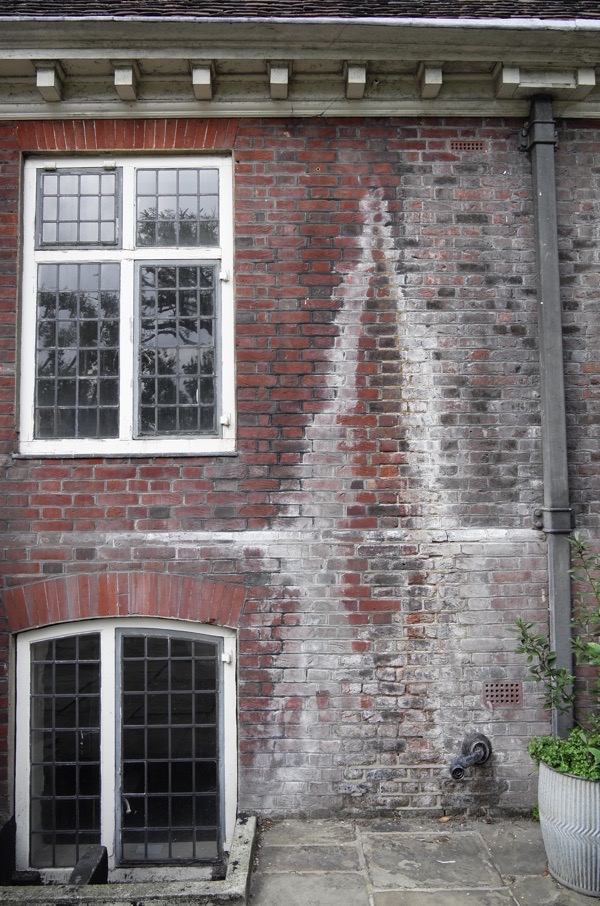
While this council owned cottage sits empty, the water tank has leaked for years damaging brick work
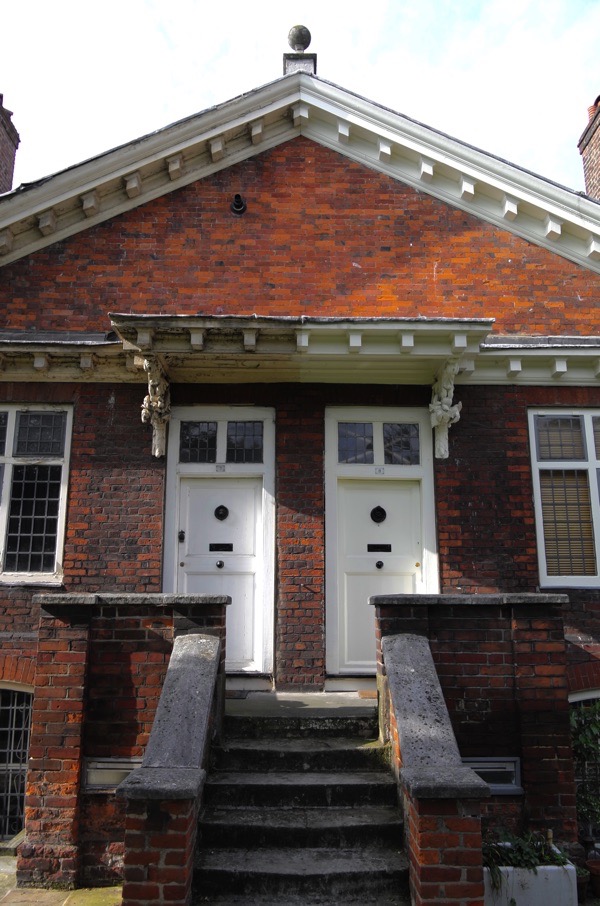
Council owned cottage to the left and privately owned cottage to the right reveal comparative levels of maintenance
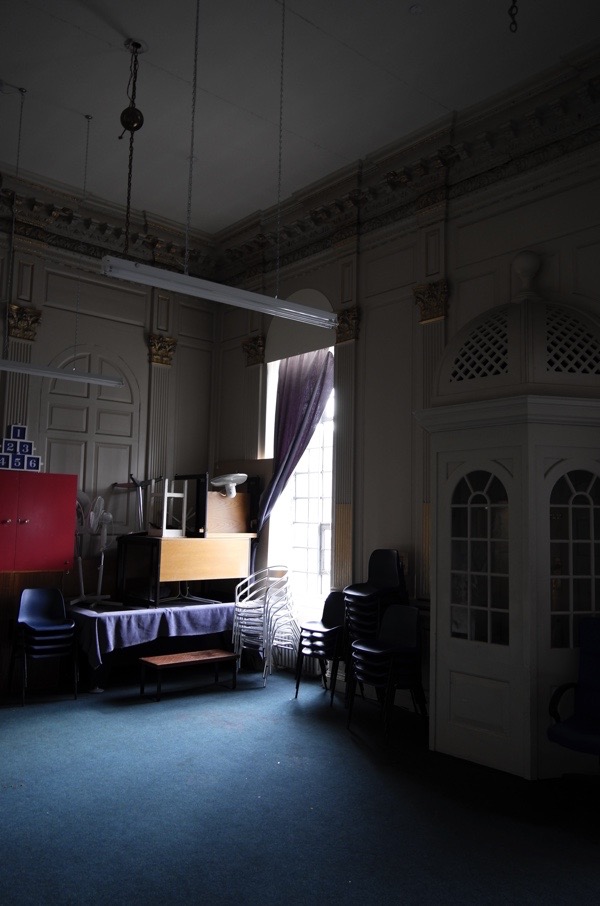
Unappreciated interior of the chapel, where seventeenth century chandeliers have been removed leaving just the chains
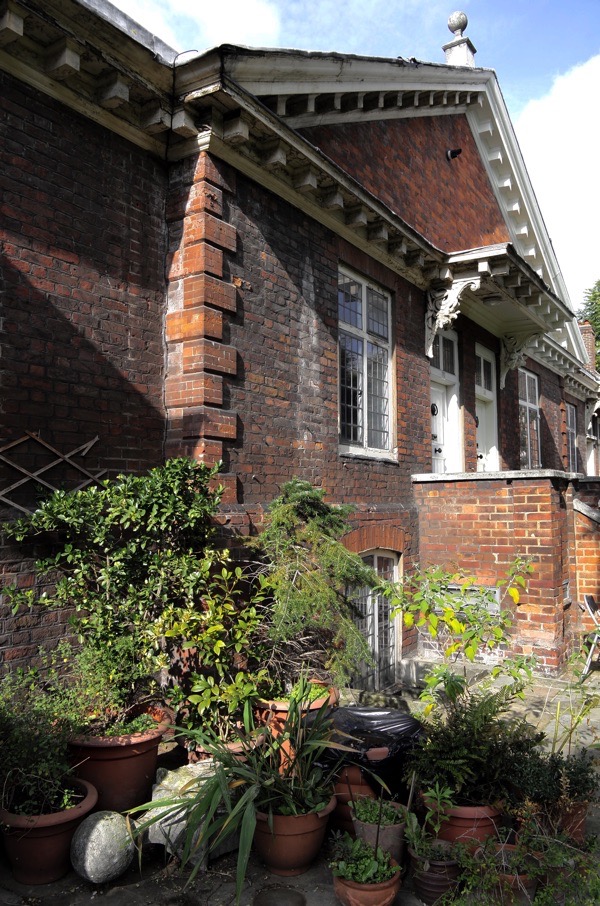
This stone ball was removed from the roof of a council owned cottage and never replaced, meanwhile a vent punctures the cornice of this grade 1 listed building
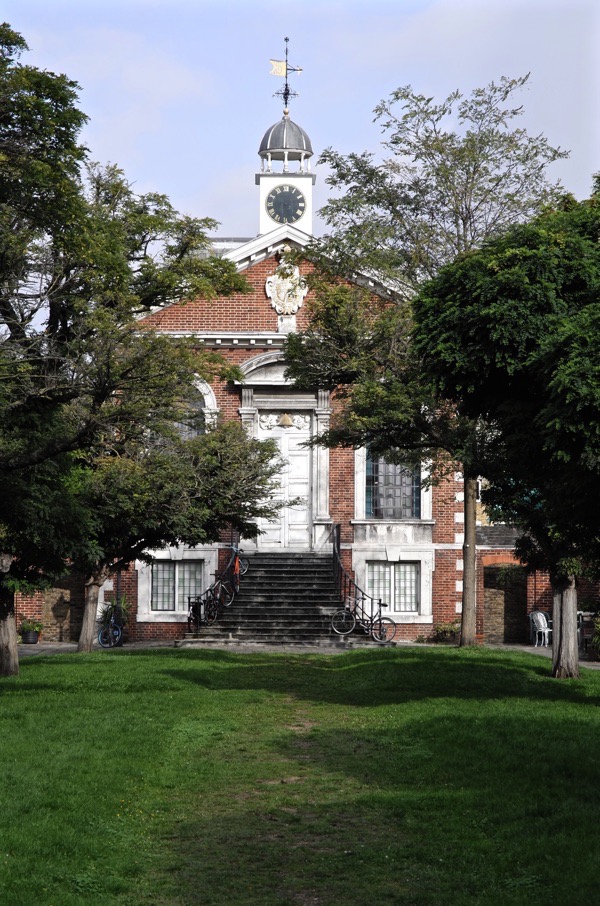
After three hundred years, the hands have been removed from the clock face
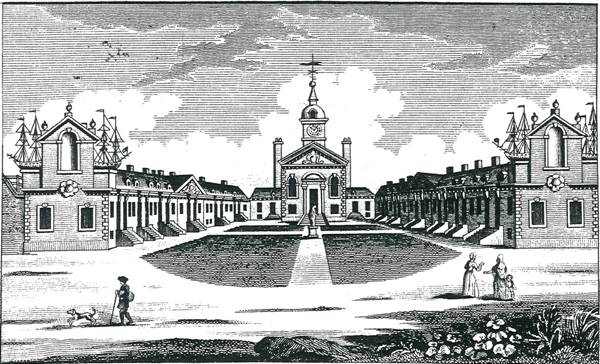
Trinity Almshouses, Mile End Rd, 1695
Click here to learn more about the FRIENDS OF TRINITY GREEN
You may also like to read about
A Walk Through Time In Spitalfields Market
Once upon a time, the Romans laid out a graveyard along the eastern side of the road leading north from the City of London, in the manner of the cemetery lining the Appian Way. When the Spitalfields Market was demolished and rebuilt in the nineteen-nineties, stone coffins and funerary urns with copper coins were discovered beneath the market buildings – a sobering reminder of the innumerable people who came to this place and made it their own over the last two thousand years. Outside the City, there is perhaps no other part of London where the land bears the footprint of so many over such a long expanse of time as Spitalfields.
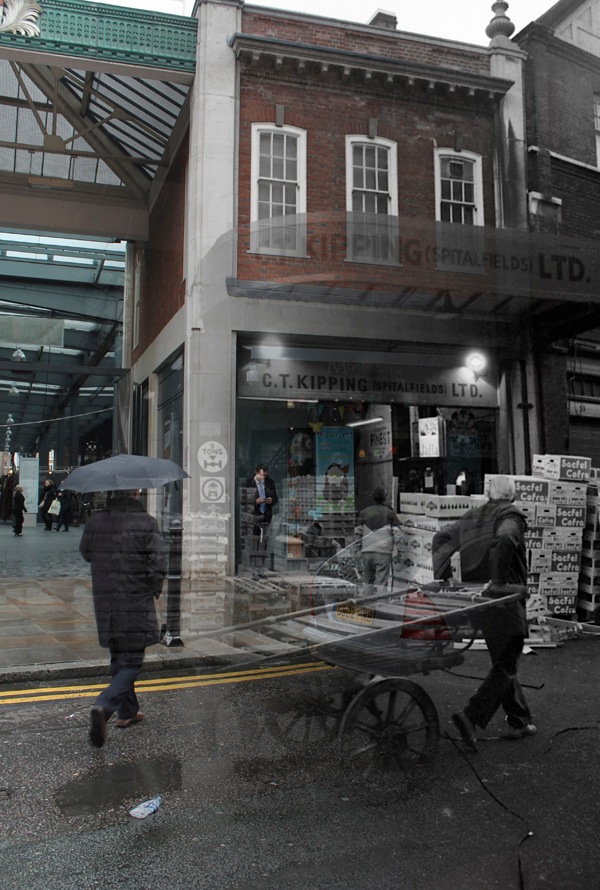
In his work, Adam Tuck plays upon this sense of reverberation in time by overlaying his own photographs upon earlier pictures to create subtly modulated palimpsests, which permit the viewer to see the past in terms of the present and the present in terms of the past, simultaneously. He uses photography to show us something that is beyond the capability of ordinary human vision, you might call it God’s eye view.
Working with the pictures taken by Mark Jackson & Huw Davies in 1991, recording the last year of the nocturnal wholesale Fruit & Vegetable Market before it transferred to Leyton after more than three centuries in Spitalfields, Adam revisited the same locations to photograph them today. The pictures from 1991 celebrate the characters and rituals of life within a market community established over generations, depicted in black and white photographs that, at first glance, could have been taken almost any time during the twentieth century.
In Adam Tuck’s composites, the people in the present inhabit the same space as those of the past, making occasional surreal visual connections as if they sense each others presence or as if the monochrome images were memories fading from sight. For the most part – according to the logic of these images – the market workers are too absorbed in their work to be concerned with time travellers from the future, while many of the shoppers and office workers cast their eyes around aimlessly, unaware of the spectres from the past that surround them. Yet most telling are comparisons in demeanour, which speak of self-possession and purpose – and, in this comparison, those in the past are seen to inhabit the place while those in the present are merely passing through.
Although barely more than a quarter cenury passed since the market moved out, the chain stores and corporate workers which have supplanted it belong to another era entirely. There is a schism in time, since the change was not evolutionary but achieved through the substitution of one world for another. Thus Adam’s work induces a similar schizophrenic effect to that experienced by those who knew the market before the changes when they walk through it today, raising uneasy comparisons between the endeavours of those in the past and the present, and their relative merits and qualities.

Brushfield St, north side.

Lamb St, south side.
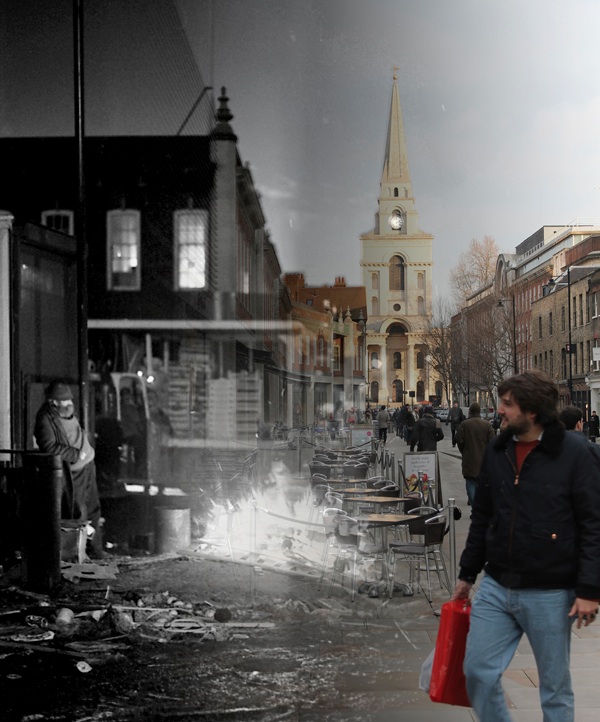
Brushfield St, looking east.

In Brushfield St.

In Gun St.

Brushfield St, looking south-east.

Looking out from Gun St across Brushfield St.

In Brushfield St.

Market interior.

Northern corner of the market.
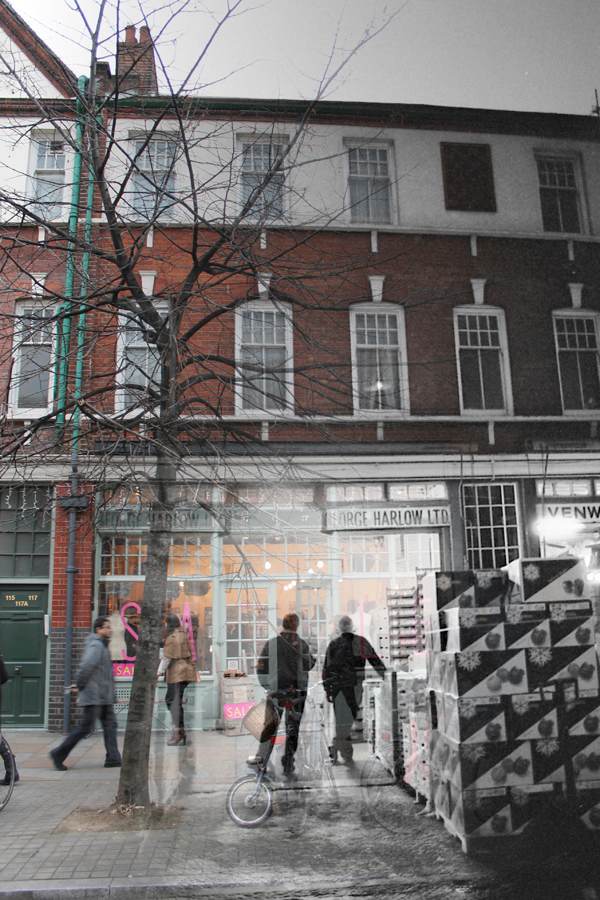
In Lamb St.

Lamb St looking towards The Golden Heart.
Photographs copyright © Mark Jackson & Huw Davies & Adam Tuck
Mark Jackson & Huw Davies photographs courtesy Bishopsgate Institute
You may like to look at more of Adam Tuck’s work
A Walk Through Time in Spitalfields
and Mark Jackson & Huw Davies pictures of the Spitalfields Market
Spitalfields Market Portraits, 1991
Night at the Spitalfields Market, 1991
Mark Jackson & Huw Davies’ Photographs of the Spitalfields Market
At The Pet Cemetery

Now that I have recovered from my chill, I thought I might venture an excursion on a rare day of sunlight last week and fulfil my long-held ambition to visit the pet cemetery in Ilford.
While I lay sick in my bed, watching the snow falling outside the window, I was keenly aware of the empty space at my feet and, when I rose and sat by the stove, there was an absence at the hearth where my old cat Mr Pussy once lay. Six months since his demise, I discovered a curiosity to view the garden of remembrance where more three thousand of his fellow creatures lie interred and see how they have been memorialised by adoring owners as a means to assuage their sense of loss.
It is a commonplace to observe the peace that prevails in a cemetery yet this was my first impression, provoked by the thought of the cacophonous din that would result if all these dogs, cats, pigeons and budgies were confined together within this space while they were alive. On closer examination, the collective emotionalism of so many affectionate elegies upon the gravestones expressing both gratitude and grief for dead pets is overwhelming. Especially as most of the owners who placed these monuments are dead too – including Sir Bruce Forsyth whose beloved collie Rusty is interred here.
Between the twenties and the sixties, animals were buried continuously in this quiet corner of Redbridge but then the cemetery was closed and fell into neglect until 2007, when it was reopened with a celebratory fly-past of racing pigeons and a military ceremony by the King’s Rifle Corps. Especially noticeable today are the white marble headstones for heroic animals, carrier pigeons that delivered vital wartime messages, dogs that rescued survivors from buildings in the Blitz and ships’ cats that killed rats on naval vessels.
Yet in spite of the heroism of animals in war and the depth of feeling evinced by domestic pets, the cemetery is quite a modest affair, just the corner of a field hidden behind the People’s Dispensary for Sick Animals. Curiously, many of the owners attribute themselves as ‘Mother’ and ‘Father’ on the gravestones, declaring a relationship to their pets that was parental and a bereavement which registered as the loss of a member of the family.
Animals surprise us by discovering and occupying a particular intimate emotional space close to our hearts that we did not realise existed until they came along. They forge an unspoken yet eternal bond, entering our psyche irrevocably, and thus while we consider ourselves their custodians, they become out spiritual guardians.

In memory of Binkie, an Adorable Little Budgie Who Died

In Memory of our Dumb Friend, the Dog that God gave us, Trixie

Peter the Home Office Cat – Payment for Peter’s food was authorised by the Treasury thus, ‘I see no objection to your office keeper being allowed 1d a day from petty cash towards the maintenance of an efficient office cat.’ It seems that the money was requested not because Peter was underfed, but rather that he was overfed because of all the titbits that staff provided. It was felt that this ‘interfered with the mousing’, so if food was provided officially, the office keeper could tell staff not to give Peter any food.

In Loving memory of Our Boxers, Gremlin Gunner, Bramcote Badenia, Bramcote Blaise, Bramcote Benightful & Panfield Rhapsody

Be-Be, Our Little Dog So Loyal and True, Now He is in Peace God Bless You

In Loving Memory of our Darling Sally & Our Greyhound Swan & Our Cat Brandy Ball

In Loving Memory of Benny, a Brave Little Cat and Constant Companion to Those he Loved

Mary of Exeter, Awarded Dicken Medal for Outstanding War Service – A pigeon that made four flights carrying messages back from wartime France, returning seriously injured each time. On her last return, shrapnel damaged her neck muscles but her owner, Charlie Brewer an Exeter cobbler, made her a leather collar which held her head up and kept her going for another 10 years.

In Memory of Our Dear Pal Wolf

Mickey Callaghan, Here Lies Our Darling and You Always Will Be

In Memory of Simon, Served as ship’s cat on HMS Amethyst – Simon’s heroic ratting saving the crew from starvation during the hundred days the ship spent trapped by Communists on the Yangtze River in 1949. Simon was originally the Captain’s cat, a privileged creature who fished ice cubes out of his water jug and crunched them, but after he survived being blown up along with the Captain’s cabin, he was promoted to ‘Able Seacat’ and became pet of the whole crew. Unfortunately, the decision to bring the feline hero back to Britain proved the end of him as he caught cat flu in quarantine and died.

In Memory of Good Old Brownie

Memories of Our Faithful Doggie Pal Sally

My Babies Always In My Heart, Dede, Nicky, Sophie & Scruffy

In Memory of Rip DM, for Bravery in Locating Victims Trapped Under Blitzed Buildings – Rip was a stray who became the first search and rescue dog

In Memory of Jill who Adopted Us and Gave Us 15 Years of Loving Companionship

Shane, Bobby & Tina

In Loving Memory of Whisky, We Loved Him So, Mummy & Aunty Flo

Rusty, A Magnificent Irish Setter, We Were Better For Having Known Him, He Died with More Dignity Than That Most of Us Live – Rusty lived with Sir Bruce Forsyth in his touring caravan and performed on stage at the London Palladium. Rusty was a truly lovely fellow who performed all sorts of fantastic tricks, his favourite was to flip a biscuit off his nose and catch it in his mouth,’ recalled Sir Bruce, ‘But one day his back legs gave up on him. It was awful to witness – almost overnight he had become this pathetic, helpless animal. The only way I could take him outside for exercise was to grab hold of his tail and lift his back legs up, allowing him to walk on his front legs with his back end gliding along. This didn’t hurt him at all and he loved to be outside, but people in the street gave me filthy looks.’

In Fond Memory of Tops & Tiny Tim

In Loving Memory of Scottie Tailwaggger & Muffin

Our Buster, Faithful Intelligent Beautiful Golden Labrador

In Memory of Our Little Dog Sonny & Our Beloved Shandy, Quietly You Fell Asleep Without a Last Goodbye

In Loving Memory of Our Darling Poppet

Our Most Precious Snoopy

In Loving Memory of Perdix Crough Patrick, Bulldog

To the Dear Memory of Patch

In Loving Memory of Dinky & Dee-Dee

Beautiful Memories of Binkie, Golden Cocker Spaniel & Tender Memories of Joey, Blue Budgie

Nanoo, Sally & Rags

In Memory of Punch for Saving the Lives of Two British Officers in Israel by Attacked An Armed Terrorist

In Memory of Tiger & Rosie, Two Dear Old Strays

Peter, Loved by Everyone

Tim, Out Little Darling


Unfortunately, the Ilford Pet Cemetery is currently closed to visitors due to safety concerns after a Eucalyptus tree was brought down by the snow, but you can contribute to a fund to remove the tree and reopen the cemetery by clicking here
You may also like to read about
Viscountess Boudica’s St Patrick’s Day
On St Patrick’s Day, we celebrate our dearly beloved Viscountess Boudica of Bethnal Green who once entertained us with her seasonal frolics and capers but is now exiled to Uttoxeter

Beannachtaí na Féile Pádraig oraibh
In the East End, we owe a debt of gratitude to Viscountess Boudica of Bethnal Green and we miss her inspirational example in observing each of the festivals of the year with passion and gusto. On St Patrick’s Day, I always found her togged up like a cheeky Leprechaun and swigging Guinness as if she was born to it, and when I enquired further I discovered this was precisely the case.
“My people were landowners near Dublin but when Elizabeth I sent her army into Ireland, we were forced to flee to France and then we returned to live in Gloucestershire,” she admitted to me with the melancholy refined smile of one from an ancient aristocratic lineage.“Once when I was a child, we were on holiday in Wales and I stared out to sea – I always felt there was something out there for me,” she continued, getting lost in contemplation as she surveyed the magnificent green and orange decorations that adorned her pink living room.
It was only as an adult that the Viscountess Boudica discovered her true origins. “Even before I found out I was Irish, I knew I was different from everybody else in relating to English culture, ” she confessed to me as she stroked her ginger locks and sipped her Guinness thoughtfully, “I need to go to Dublin in search of my roots…”

Éirinn go brách


Cá mbeidh tú ag fliuchadh na seamróige?


Sláinte!

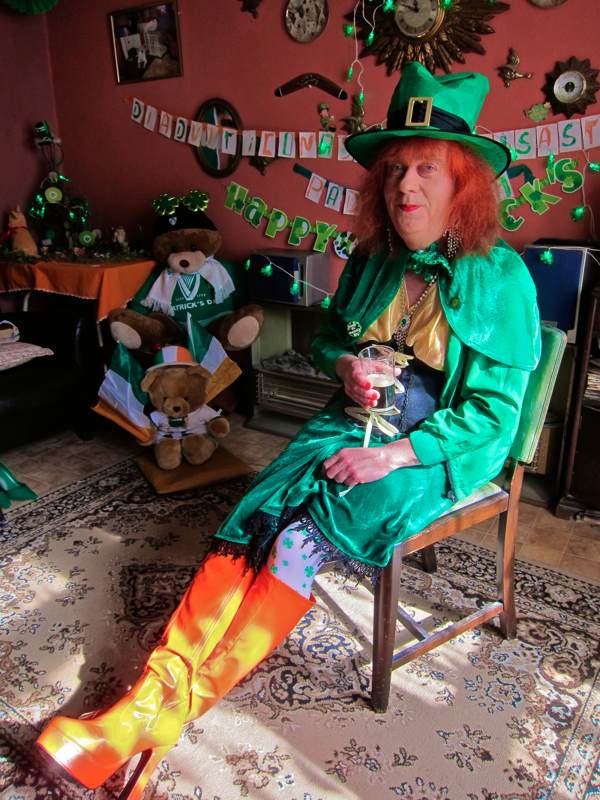
Tabhair póg dom, táim Éireannach.


Viscountess Boudica’s jacket with Irish badges from the days she hung out with skinheads

Viscountess Boudica searches for St Patrick’s Day music

Viscountess Boudica recommends The Nolans and Sham 69 for your St Patrick’s Day listening


Viscountess Boudica pulls out one of her old Irish themed coats


Viscountess Boudica models the outfit she has designed for her trip to Dublin in search of her roots
Be sure to follow Viscountess Boudica’s blog There’s More To Life Than Heaven & Earth
Take a look at
The Departure of Viscountess Boudica
Viscountess Boudica’s Domestic Appliances
Viscountess Boudica’s Halloween
Viscountess Boudica’s Christmas
Viscountess Boudica’s Valentine’s Day
Read my original profile of Mark Petty, Trendsetter
and take a look at Mark Petty’s Multicoloured Coats
David Granick’s Spitalfields
Stepney Photographer David Granick (1912-80) has been receiving well-deserved recognition recently thanks to an exhibition at Tower Hamlets Local History Library & Archives which runs until 5th May and a book The East End in Colour 1960-80 edited by Chris Dorley-Brown and published by Hoxton Minipress.
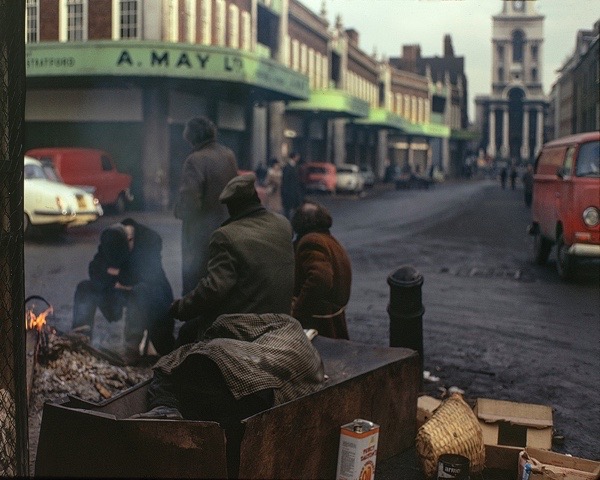
Spitalfields Market, 1973
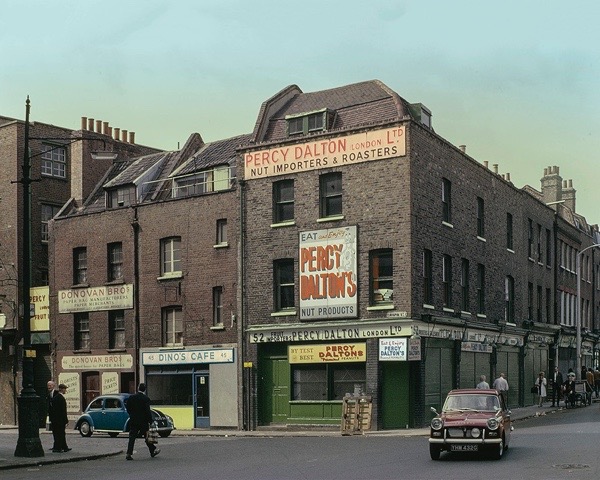
Brushfield St, 1970
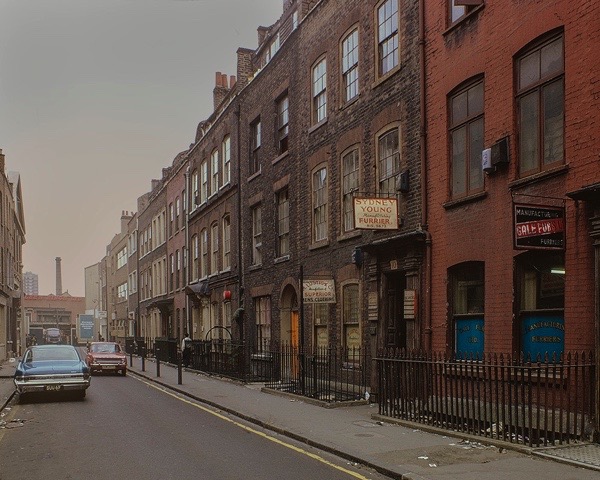
Fournier St, 1968
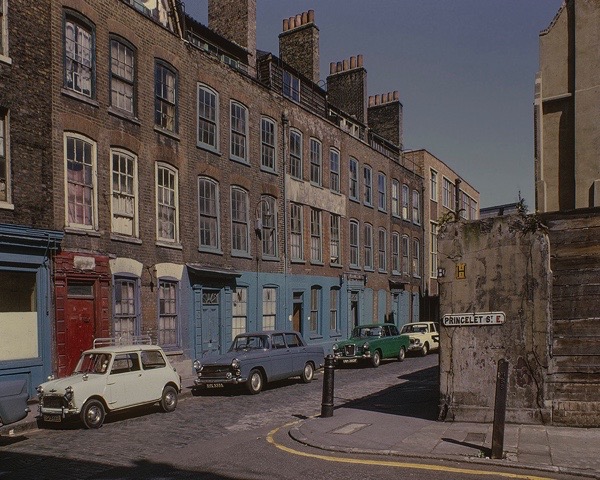
Princelet St, 1968
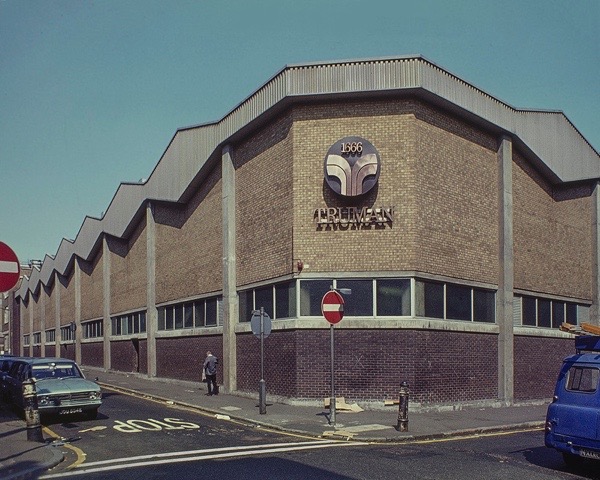
Brick Lane/Hanbury St, 1976
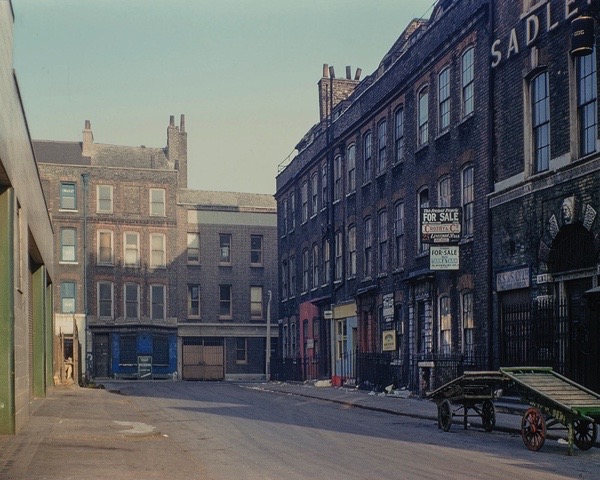
Folgate St, 1979
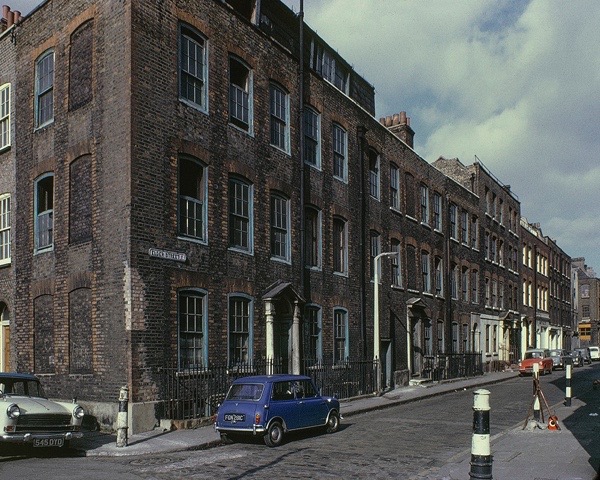
Elder St, 1968
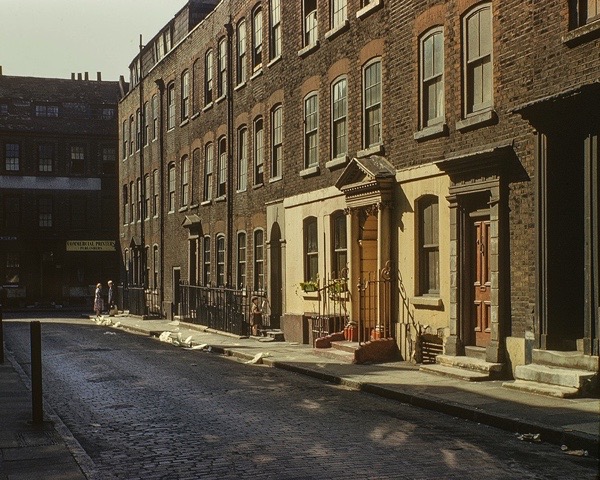
Elder St, 1965

Fleur de Lis St, 1966
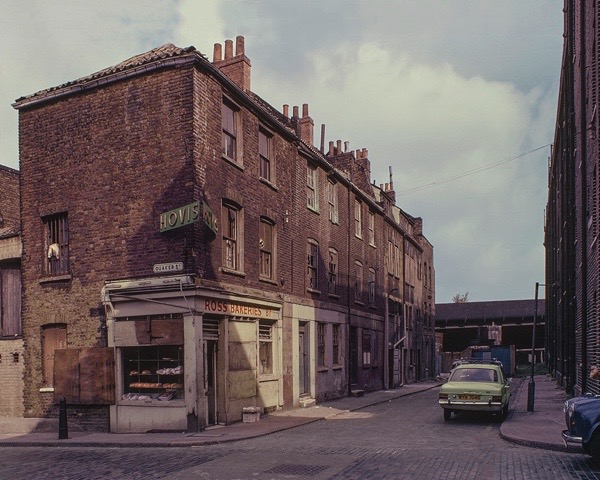
Quaker St, 1970
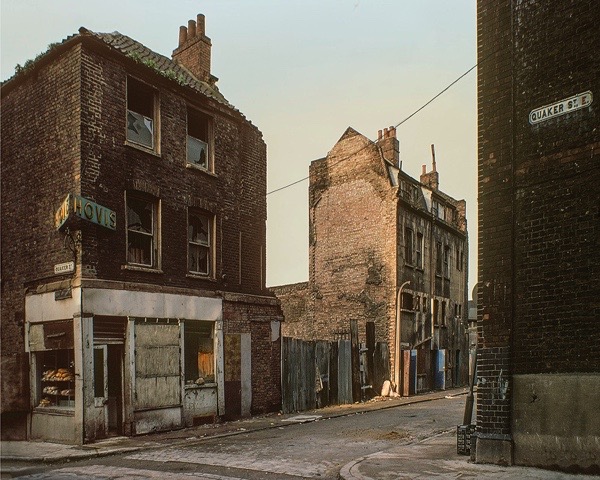
Quaker St, 1978
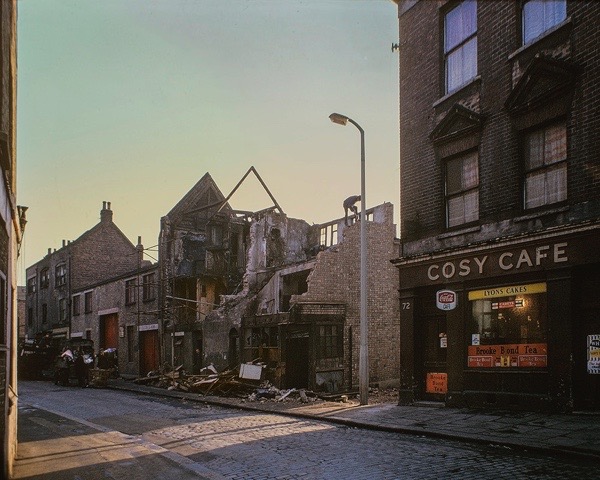
Cheshire St, 1969
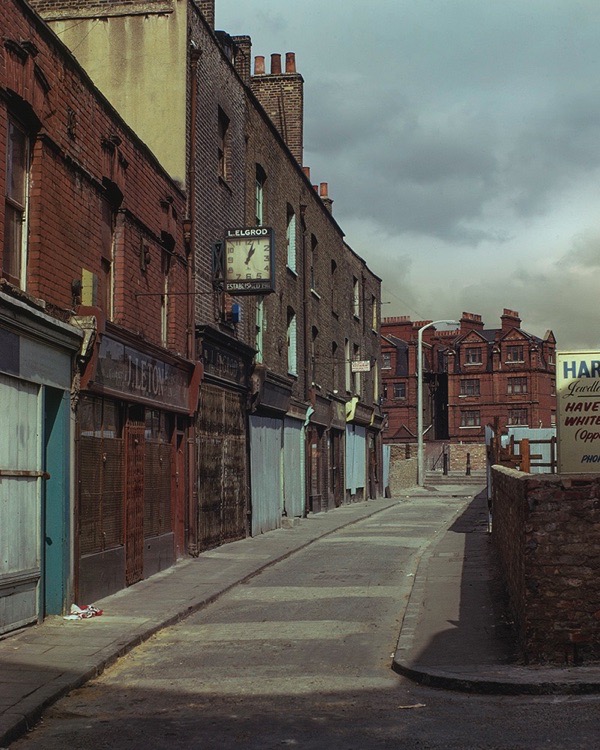
Black Lion Yard, 1966
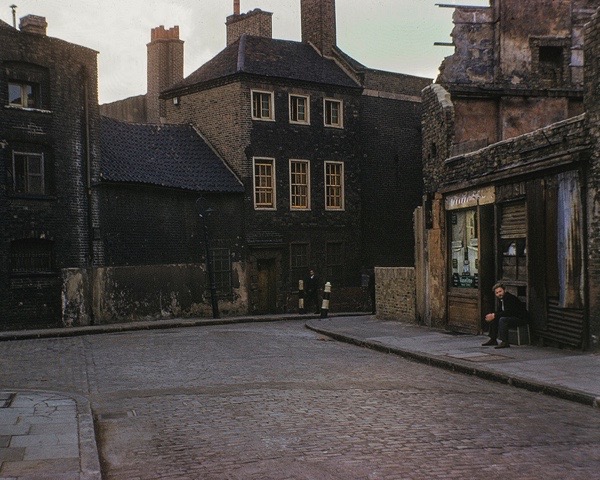
Whitechapel Bell Foundry, 1969
Photographs copyright © Tower Hamlets Local History Library & Archives
You may also like to take a look at
Vivian Betts At The Primrose

Vivian & Toto outside The Primrose
You will not meet many who can boast the distinction of being brought up on the teeming thoroughfare of Bishopsgate but Vivian Betts is one who enjoyed that rare privilege, growing up above The Primrose on the corner of Primrose St where her parents were publicans from 1955 until 1974. Yet it was a different Bishopsgate from that of the present day with its soaring glass towers housing financial industries. In her childhood, Vivian knew a street lined with pubs and individual shops where the lamplighter came each night to light the gas lamps.
Living in a pub on the boundary of the City of London, Vivian discovered herself at a hub of human activity. “I had the best of both worlds,” Vivian confessed to me, when she came up to Spitalfields on a rare visit, “I had the choice of City life or East End life, I could go either way. I had complete freedom and I was never in any danger. My father said to me if I ever had any trouble to go to a policeman. But all my friends wanted to come over to my place, because I lived in a pub!”
Vivian knew Bishopsgate before the Broadgate development swallowed up the entire block between Liverpool St and Primrose St. And as we walked together past the uniform architecture, she affectionately ticked off the order of the pubs that once stood there – The Kings Arms, The Raven and then The Primrose – with all the different premises in between. When we reached the windswept corner of Primrose St beneath the vast Broadgate Tower, Vivian gestured to the empty space where The Primrose once stood, now swallowed by road widening, and told me that she remembered the dray horses delivering the beer in barrels on carts from the Truman Brewery in Brick Lane.
In this landscape of concrete, glass and steel, configured as the environment of aggressive corporate endeavour, it was surreal yet heartening to hear Vivian speak and be reminded that human life once existed there on a modest domestic scale. Demolished finally in 1987, The Primrose had existed in Bishopsgate at least since 1839.
“My brother Michael was born in 1942, while Bill my father was away in the war, and Violet my mother got a job as a barmaid, and when he came back she said, ‘This is how I want to spend my life.’ Their first pub was The Alfred’s Head in Gold St, Stepney, in about 1946, and she told me she was washing the floor there in the morning and I was born in the afternoon. We left when I was three and all I remember of Stepney was walking over a bomb site to look at all the caterpillars.
In 1955, we moved into The Primrose at 229 Bishopsgate, directly opposite the Spitalfields market – you could look out of the window on the first floor and see the market. My first memory of Bishopsgate was lying in bed and listening to the piano player in the pub below. We had three pianos, one in the public bar, one in the first floor function room and one in our front room. On Sunday lunchtimes at The Primrose, it was so busy you could hardly see through the barroom for all the hats and smoke.
I used to go to Canon Barnet School in Commercial St and, from the age of seven, my dad would see me across Bishopsgate and I’d walk through the Spitalfields Market on my way to school where the traders would give me an apple and a banana – they all knew me because they used to come drinking in the pub. It was a completely Jewish school and, because no-one else lived in Bishopsgate, all my friends were over in Spitalfields, mostly in the Flower & Dean Buildings, so I spent a lot of time over there. And I used to come to Brick Lane to go the matinees at the cinema every Saturday. Itchy Park was our playground – in those days, the church was shut but we used to peek through the window and see hundreds of pigeons inside.
My dad opened one of the first carveries in a pub, where you could get fresh ham or turkey cut and made up into sandwiches and, in the upstairs room, my mum did sit-down lunches for three shillings – it was like school dinners, steak & kidney pudding and sausage & mash. She walked every day with her trolley to Dewhurst’s the butchers opposite Liverpool St, she got all her fruit and vegetables fresh from the Spitalfields Market, and she used to go to Petticoat Lane each week to buy fresh fish.
Every evening at 5pm, we had all the banks come in to play darts. On Mondays, it was the ladies of The Primrose darts team and on Wednesdays it was the men’s darts league. And, once each year, we organised the Presentation Dance at the York Hall. Every evening in the upstairs function room, we had the different Freemason’s lodges. Whenever I came out of my living room, I could always see them but I had to look away because it was part of my life that I wasn’t supposed to see. After I left school, I went to work for the Royal London Mutual Insurance Co. in Finsbury Sq – five minutes walk away – as a punchcard operator and, whenever it was anyone’s birthday, I’d say ‘Come on back to my mum’s pub and she’ll make us all sandwiches.’
Then in 1973, Truman’s wrote to my dad and gave him a year’s notice, they were turning the pub over to managers in April 1974, so we had to leave. But I had already booked my wedding for July at St Botolph’s in Bishopsgate, and I came back for that. Eighteen months later, in 1976, my mum and dad asked me and my husband to go into running a pub with them. It was The Alexandra Hotel in Southend, known as the “Top Alex” because there were two and ours was at the top of the hill.
Three months after we moved in, my dad died of cancer – so they gave it to my mum on a year’s widow’s lease but they said that if me and my husband proved we could run it, we could keep it. And we stayed until 1985. Then we had a murder and an attempted murder in which a man got stabbed, and my husband said, ‘It’s about time we moved.’ And that’s when we moved to our current pub, The Windmill at Hoo, near Rochester, twenty-eight years ago. We had a brass bell hanging behind the counter at The Primrose that came off a train in Liverpool St Station which we used to call time and we’ve taken it with us – all these years – but though we don’t call time any more, we still use it to ring in the New Year.
I’ve only ever had two Christmases not in a pub in my life, when you’re born to it you don’t know anything else.”
Vivian told me that she often gets customers from the East End in The Windmill and they always recognise her by her voice. “They say, ‘We know where you come from!'” she confided to me proudly.

The Primrose, 229 Bishopsgate, as Vivian knew it.

Toto sits on the heater in the panelled barroom at The Primrose.

Vivian at Canon Barnet School in Commercial St.

Bill and Vi Betts

“My first Freemason’s Lodge night when I was twelve or thirteen in 1965. My brother Michael with his wife Valerie on the right.”

Vivian stands outside The Primrose in this picture, looking east across Bishopsgate towards Spital Sq with Spitalfields market in the distance.

Vivian was awarded this certificate while a student at Sir John Cass School, Houndsditch.

Vivian on the railway bridge, looking west towards Finsbury Sq.
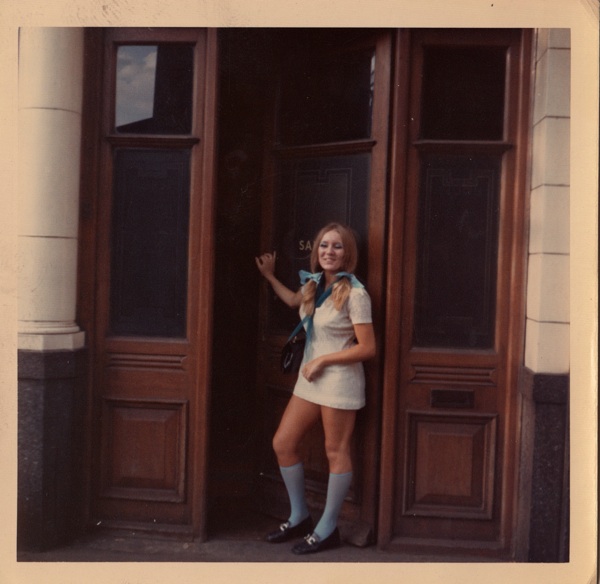
Vivian outside the door which served as the door to the pub and her own front door.

Vivian’s friends skylarking in Bishopsgate – “They always wanted to come over to my place because I lived above a pub!”

“When I was eight, we went abroad on holiday for the first time to Italy, we bought the tickets at the travel agents across the road and, after that, twelve or fourteen couples would come with us – my parents’ friends – and I was always the youngest there.”

Vivian prints out a policy at the Royal London Mutual Insurance Co. in Finsbury Sq.

“And what do you do?” – Vivian meets Prince Charles on a visit to Lloyd Register of Shipping in Fenchurch St.

“Harry the greengrocer and Tom the horse, they used to get their fruit & vegetables in the Spitalfields Market. My husband Dennis worked for this man when he was about twelve years of age, driving around the Isle of Dogs. He loved horses, and we’ve got a piece of land with our pub now and we’ve kept horses since 1980.”

Bill & Vi Betts in later years.
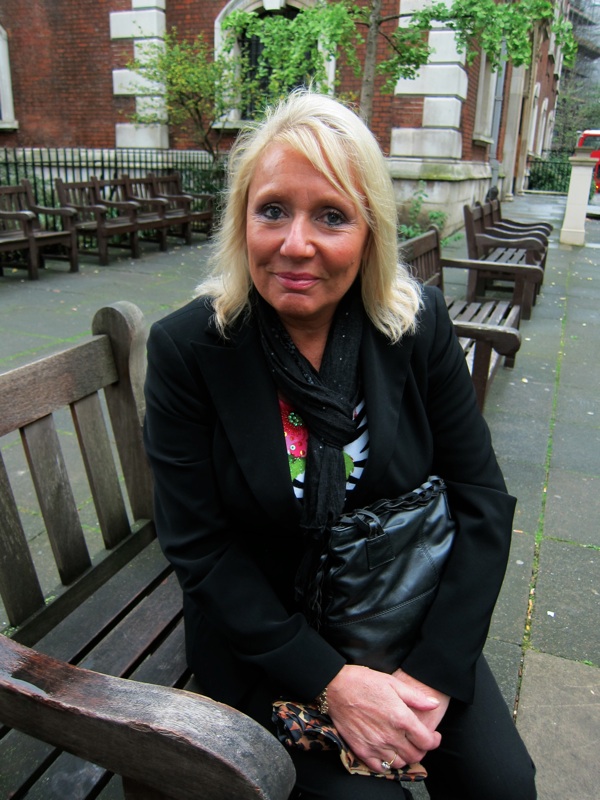
Vivian Betts at St Botolph’s Bishopsgate where she married her husband Dennis Campbell in 1974.

The Primrose in a former incarnation, photographed in 1912.

Bishopsgate with The Primrose halfway down on the right, photographed in 1912 by Charles Goss.
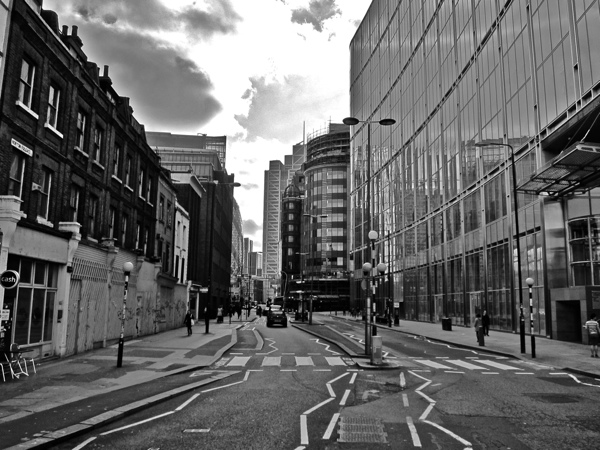
Bishopsgate today.
Archive photographs courtesy Bishopsgate Institute
You might also like to take a look at these other Bishopsgate Stories
The Romance of Old Bishopsgate












