
William Whiffin, Photographer
William Whiffin (1878-1957) is one of the great unsung London photographers, which makes it a rare pleasure to present this gallery of his pictures from the collection of his granddaughter Hellen Martin. Born into a family of photographers in the East End, Whiffin made his living with studio portraits and commercial commissions, yet strove to be recognised for his artistic photography.

Lion Brewery and the Shot Tower, South Bank

The photographer’s son Sid Whiffin at Cooper’s Stairs, Old Queen St

Off Fetter Lane

The Pantheon, Oxford St

In Princes Sq, Stepney

Figureheads of fighting ships in Grosvenor Rd

At Covent Garden Market


Milwall & the Island Horse Omnibus, c.1910

St Catherine Coleman next to Fenchurch St Station

In Fleet St

In Buckfast St, Bethnal Green


At Borough Market


In Lombard St

Rotherhithe Watch House


Wapping Old Stairs

Junction of Cambridge Heath Rd & Hackney Rd


Ratcliff Stairs, Limehouse

Ratcliff Causeway, Limehouse

St Jude’s, Commercial St

Farthing Bundles at the Fern St Settlement, Bow

Houndsditch Rag Fair

At the Royal Exchange, City of London


Weavers’ House, Bethnal Green Rd

Off Pennington St, Wapping

Borough of Poplar Electricity Dept


Pruning in the hop gardens of Faversham

Photographs copyright © Estate of William Whiffin
Hellen Martin & I should be very grateful if readers can identify any of the uncaptioned photographs
You may also like to read about
Faulkner’s Street Cries
These cards produced by W. & F. Faulkner Ltd and issued with Grenadier Cigarettes in 1902 are a favourite discovery in my ongoing exploration of all the versions of the Cries of London created down through the ages. Even the most sentimental images can reveal something of the reality of the working lives of hawkers, and I especially like this precisely observed set of surly, cantankerous portraits which convey the relentless nature of street trading with a mixture of wit and affection.

Flypaper seller.

Cats’ meat man.

Ice cream seller.

Chimney sweep.

Knife grinder.

Coalman.

Baked potato seller.

Dairyman.

Lavender seller.

Newspaper seller.

Novelties seller.

The muffin man.
You may like to take a look at these other sets of the Cries of London
William Craig Marshall’s Itinerant Traders
H.W.Petherick’s London Characters
John Thomson’s Street Life in London
Aunt Busy Bee’s New London Cries
Marcellus Laroon’s Cries of London
More John Player’s Cries of London
William Nicholson’s London Types
Francis Wheatley’s Cries of London
John Thomas Smith’s Vagabondiana of 1817
John Thomas Smith’s Vagabondiana II
John Thomas Smith’s Vagabondiana III
Thomas Rowlandson’s Lower Orders
More of Thomas Rowlandson’s Lower Orders

East End Vernacular At Abbott & Holder

It is my great pleasure to curate a room of paintings from my book EAST END VERNACULAR, Artists who painted London’s East End streets in the 20th century, alongside a room of previously un-exhibited watercolours from the thirties by East End artist Henry Silk (1883-1948) at Abbott & Holder in Museum St, Bloomsbury. The exhibition opens at 6pm on Thursday 18th January and runs until Saturday 10th February.
As a complement to the work of Henry Silk who was one of the leading figures of the East London Group in the thirties, I have chosen a selection of paintings by post-war and contemporary artists who took the legacy forward. My selection includes a picture by Roland Collins from the fifties, rarely seen works by John Allin and Dan Jones from the seventies, Doreen Fletcher’s and Peri Parkes’ paintings from the eighties and concludes with recent works by James Mackinnon and Nicholas Borden.
Together these pictures illustrate an extraordinary and vital continuum of painting in the East End which spans the twentieth century and extends into our own time.
If you would like to attend my gallery talk at 6:30pm on Thursday 25th January, please call 020 7637 3981 to reserve a place.
WATERCOLOURS BY HENRY SILK TO BE EXHIBITED FOR THE FIRST TIME

Railway from Rounton Road, Bow

Factories in Bow

Street scene, Bow

Street scene

Approach to Victoria Park

Pond, Victoria Park

Boat Houses, Victoria Park
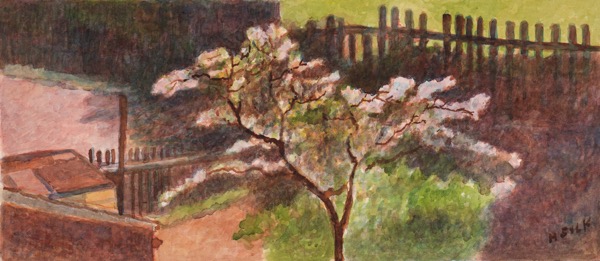
Blossom in the garden, Rounton Rd, Bow
If any readers can further identify the locations of any of these Henry Silk watercolours please get in touch.
ABBOTT & HOLDER, 30 MUSEUM ST, BLOOMSBURY, WC1A 1LH
You may also like to read about
So Long, Arthur Of Arthur’s Cafe
I am sorry to report the passing of Arthur Woodham of Arthur’s Cafe, a legend in the Kingsland Rd, who died over the weekend having reached his ninety-first birthday on Christmas Day

Arthur Woodham (1926 – 2018)
This is Arthur of the celebrated Arthur’s Cafe – in the Kingsland Rd since 1935. Even at ninety years old, Arthur was still running around his magnificent shining cafe, taking orders and serving customers with sprightly efficiency. Possessing the grace, good manners and handsome features of a young Trevor Howard, he was a charismatic figure, venerated in Dalston and throughout the East End.
Imagine my excitement, when I paid a visit, to see Arthur waiting in the doorway of his cafe in anticipation of my arrival. My heart skipped a beat and I ran across the road to shake his hand. Then, taking advantage of the lull between the late breakfast trade and the early lunch trade, we sat down at the window table to enjoy the sunlight, and I found myself close up to his neatly styled grey locks and immaculately shaven jowls, while Arthur fixed his liquid grey eyes upon mine and commenced his story.
“I was born in Bethnal Green, and in 1935 we moved over to the Kingsland Rd and opened the cafe. My father was Arthur too and his cafe used to be further down the road, opposite the Geffrye Museum. If you was trying to buy a cafe, you tried to buy one with accommodation above, so if things got quiet you could rent the space, but I’ve always lived up there all this time.
Once I left school at fourteen, I worked with him behind the counter and I helped out before that too. I was the eldest son and you had no choice – you had to go into it whether you liked it or not. In those days, my father used to make his own ice cream and sarsaparilla, and my grandmother helped out in the kitchen with the washing up. At first, when the war came, I didn’t want to go into the shop but I have no regrets. I was about fifteen when war broke out, and I worked in the cafe all through the war. They dropped a bomb on the shelter across the road at the Geffrye Museum and my father kept open all night to make everyone a cup of tea. I’ll always remember one man was very bad, he lost thirteen in his family.
When I was a boy, it was either coffee shops with wooden floors or cafes that were more like sandwich bars, but after the war cafes starting doing hot dinners, roast beef, steak pie, lamb chops. I run my cafe the old fashioned way, we don’t do frozen stuff, it’s all fresh. I get up around twelve thirty/one o’clock, but people won’t believe you if you tell them that. I cook my own ham and cut all my chips by hand. My grandson gets in at five fifteen and we open at seven, serving breakfast until eleven thirty. No toast after eleven thirty and no chips before twelve. At eleven thirty we clean up and put serviettes and glasses on the tables, and I go upstairs and put on a clean coat. We have a different class of people for lunch. This is a working class cafe, we serve plain English food, we don’t serve pasta like some do.We’ve got a good mixed clientele, a nice class of people, white people and black people.
I like it, this is my life. You’ve got to like it to keep in it. I meet people. I speak to people. In the cafe, if you like it, you make a lot of friends. I’ve been serving people for over fifty years, people I grew up with. I opened up here when I was twenty-one in 1948, my father gave me a hand for a while and then he closed down the old cafe. I’ve been here ever since, four hundred and ninety-five Kingsland Rd. It’s been a cafe as long as I can remember and I’m ninety-one this year. It was me and my father, and now it’s me and my grandson – since he was a boy, he’s worked for me – that’s three generations. I’ll go on as long as I can, I’m ninety-one on Christmas Day. The Pelliccis, they’re friends of mine – I’m the oldest cafe in the Kingsland Rd and they’re the oldest cafe in Bethnal Green.”
Then it was eleven thirty. No more toast would be served, and it became imperative that Arthur go upstairs at once to change his coat in the time-honoured fashion, whilst serviettes and glasses were swiftly laid upon the tables, as the tempo of the day’s proceedings went up a notch in anticipation of luncheon. Yet this flurry of activity allowed me the opportunity of a snatching a few words with Arthur’s grandson James, who in spite of his youthful demeanour revealed he had been there twenty years. “Since I was twelve, I worked here in my school holidays,” he confessed with a shy smile of pride,”And then my grandfather asked me to work with him, and I did.”
“My grandfather is an actor, and this is the stage where he performs best,” James continued, as if to introduce Arthur who appeared on cue from upstairs, now changed into an identical but perfectly clean white coat and seemingly revived with a new energy. “Do you think you will still be here at ninety?” I whispered to James across the table. “If I’ve got my grandfather’s energy, I’ll still be here!” he replied with an emotional smile as Arthur breezed past, making sure that everything was in order before assuming his heroic position at the head of the steel counter – as he did each day since 1948 – tea towel over one shoulder, ready for whatever the lunch service would bring.

“I remember those custard tarts my dad was holding, they were threepence each” – Arthur at at twenty-one years old when he opened his own cafe in 1948 with the assistance of Arthur, his father. Inset shows, the third generation Arthur and his son James at Arthur’s Cafe.

Arthur and his grandson James

Arthur arranges serviettes in readiness for the lunchtime rush

James rustles up a mean sandwich

“My grandfather is an actor and this is his stage where he performs best.”

Arthur’s wife Eileen lent a hand

The lull between late breakfast and early lunch when Arthur went upstairs to change into a fresh coat

Arthur with his old friend Terry Dunford

[youtube qaHh3FNG8OU nolink]

Arthur Woodham (1926 – 2018)
Hester Mallin, Artist & Autodidact Polymath
Since the publication of East End Vernacular, Artists who painted London’s East End streets in the 20th century, several notable artists whose work has never been seen have been brought to my attention, including Hester Mallin whom it is my pleasure to introduce today

Langdale St leading to Cannon St Rd
Like the princess in the tower, at ninety-one years old Hester Mallin is confined to her flat on the top floor of a tall block off the Roman Rd in Bow, where I had the privilege of visiting and hearing her story. From this lofty height, Hester contemplates the expanse of her time in the East End. Born to parents who escaped Russia early in the last century, Hester spent the greater part of her life in Stepney, where she grew up in the close Jewish community that once inhabited the narrow streets surrounding Hessel St.
Of independent mind and down-to-earth nature, Hester took control of her destiny at thirteen and has plotted her own path through life ever since. When the Stepney streets where her parents’ sought their existence emptied as residents left to seek better housing in the suburbs and demolition followed, Hester could not bear to see this landscape – which had such intense personal meaning – being erased. So she began to photograph it.
Decades later, when her photographs were all that remained, Hester transformed these images, coloured by memory, into the haunting, austere paintings you see here. Of deceptive simplicity, these finely wrought watercolours of subtly-toned hues are emotionally charged images for Hester. Even if the streets and buildings are gone and even if Hester can never go back to her childhood territory, she has these paintings. Today, she keeps them safely beside her bed to cherish as the only record of the place which contains her parents’ lives, their community and their world, which have now all gone completely.
In later years, Hester discovered a talent as a gardener, celebrated for her flair at high-rise gardening, exemplified by her thirty-five foot balcony garden on the twenty-third floor in Bow, where the great and the good of the horticultural world came to pay homage to Hester’s achievements. Feature coverage and television appearances brought Hester international fame and demands for lectures, including a trip to the Falkland Isles to inspire the troops with horticultural aspirations.
Yet in spite of her remarkable life and resources of creativity, Hester modestly considers herself a ‘typical East Ender’ – as she confided to me recently.
“I never got married and had children. In my experience, marriage for the working class girl was horrible. If she was unlucky, she met a man who she thought was nice, she would marry and he would change and become a wife beater. It was not for me. I saw so much of it. I thought ‘I’d rather stay single than get beaten up every time my husband gets drunk, Jewish or not.’ It never appealed to me. I never wanted to be married. Other people wanted to marry me but I never wanted to be married.
My father, Maurice Smolensky, came in his early twenties from Lomza which is part of Poland now and I think my mother came from Russia too, but I am not quite sure. Her name was Rachel Salzburg – what was she doing with a German sounding name like that?
It was very sad, she was sent on her own at fourteen years old. Can you imagine? A very beautiful young girl, illiterate, speaking no English and knowing nothing. There must have been a reason why they chucked her out to England. She was in terrible danger. She stood staring in bewilderment and grief. This was the time of the white slave trade when young girls were packed off to South America to be prostituted, yet she was luckyecause there was a gang of Jewish men looking out at the port in London. If they saw any young girl travelling alone, they would ask ‘Have you been sent?’ They would look after these girls and this is what happened to Rachel, my mother. They took her to the Jewish shelter in Aldgate and from there she spent a bewildering youth, working as a servant when she could get work. She was always pure. Poor girl. She was beautiful, with blonde teutonic looks.
Apparently, her family came to the East End years later and she was in touch with them but only loosely. There must have been some big family goings-on, but I know not. They were bombed out of their house in Sutton St, off Commercial Rd, and disappeared, they did not take her. There must have been a falling-out.
My father was a journeyman baker, who learnt his trade in Russia where, apparently, his father owned a mill. He worked in all the local bakeries around Hessel St, Christian St, Fairclough St – all those adjacent streets in Stepney where there were lots of little Jewish baker’s shops. He worked in the basements.
My parents were put together by a Jewish matchmaker, that was how they met.
At Raynes Foundation School, when I drew, my teacher used to say I was copying it from somewhere – but where would I copy it from? I remember we were all asked to draw a biblical scene. So I drew a picture of Moses leading his people out into the desert in chalk, with all these figures disappearing into the distance led by Moses with a long stick. I remember it clearly, the teacher stormed over to my desk and said, ‘Where did you get this from?’ Of course, I was flummoxed, I did not know what she was talking about so I could not answer. ‘No answer!’ she said, ‘You didn’t draw this.’ I was a shy child, I was absolutely silenced and defeated. That was my introduction to Art.
I grew up in Langdale St Mansions, a block of two hundred flats of the slum variety and almost entirely occupied by Jewish people. It was horrible but my mother was exceptionally clean, she was fighting dirt all the time. I had a brother, Harry, he died a few years ago. He turned Left and became Communist, and that wrecked everything. He was lured into it by shameful people.
My mother was a brave, brave woman. She went along to the Battle of Cable St to see what was going on. She was an amazing lady. When she came back, I asked ‘What was it like?’ but she would not answer me. It was obviously horrible. Even though she was illiterate, my mother knew what was happening in the world. Jewish people felt under threat.
I left school at thirteen and a half just as the war began. Nobody bothered about me because they were doing their own thing. I found any old job – odds and ends of work in an office for six months. Then I started as an Air Raid Precautions messenger girl but that was not good enough for me – it was not dangerous enough – so I decided I wanted to be warden. I persisted and I became Britain’s youngest Air Raid Warden. I chose to do it because I wanted to do my bit and it was interesting because there was always action – Stepney was bombed and bombed and bombed. People got used to the sight of this little girl in warden’s uniform. I was not frightened, I was excited.
Some of the elderly Jewish men who were too old for the armed services would come with me and we would stroll through the streets with bombs falling all around us. Our job was shutting doors. Street doors would pop open every time a bomb fell and we would put out a hand and shut it, and on the way back we would shut the same door again. There was a lot of looting going on.
Towards the end of the war, I was moved into doing office work for Stepney Borough Council on the corner of Philpot St and Commercial Rd. It brought some money into the house and relieved my poor dad. He worked like a slave and died of overwork at seventy-one. He worked all night.
I taught myself photography, I am a self-taught woman – an autodidact polymath. During the war, I realised the houses were all going, so I started to photograph them. I thought, ‘Why aren’t more people doing this?’ I photographed architecture and out of my photographs came my paintings. The houses were being pulled down and I wanted to make a permanent record. So I took a lot of photographs and later on I thought, ‘That would make a good subject for painting.’ It was one of those things, I just started painting because it attracted me. I never went out in the street and did paintings, some are from photographs and some are from memory. I never exhibited my work.
I worked at the council until I was sixty when I retired because I wanted to concentrate on gardening and painting. I always wanted a garden when I was a child growing up in that slum flat on the fourth floor of hideous Langdale Mansions. I do not know how I knew, but I just knew I wanted plants. I never learnt about plants, it was instinctive for me. I used to buy seeds and little plantlets.
In 1980, I moved into this tower block and there was an opportunity to create a thirty-five foot long balcony garden. I looked for plants that were low maintenance, wind resistant, needed little watering and did not grow too big. I had to teach myself and learn by experiment. I did many exhibitions of my gardening including one at Selfridges. I did the whole thing myself.
I am always asked the same question, ‘Why do you speak so nicely?’ I do not know why I speak as I do. I listen to myself and I think ‘Where did you get that phrase from?’ I am self-educated, I have read a lot but anyone can do that. I am not a feminist, feminists have many faults and can be as vicious as anyone else.
I have always lived in Stepney, not by choice – it was just one of those things. I always lived in slum flats until this one. I am a typical lifelong East Ender of the old kind, I have never lived anywhere else.”

Entrance to Langdale St

Cannon Street Rd

Burslem St Shops (Demolished 1975)

Rear of Morgan Houses, Hessel St

Hessel St

Hessel St leading to Commercial Rd


Wicker St Flats


J. Symons, my mother’s favourite butcher, Burslem St

“The idea of making a garden on the topmost twenty-third floor of a council tower block in East London might be compared with a brave, but astonishingly foolhardy attempt to make a garden in a crow’s nest of an old fashioned sailing ship” – Hester Mallin, 1980

Hester Mallin & Joe Brown in 1988

Hester’s father Maurice Smolensky stands centre in this photograph taken early in the last century
Paintings copyright © Hester Mallin
You may also like to take a look at
The Signs Of Old London

The little wooden midshipman outside Solomon Gillis’ chandlery, 157 Leadenhall St
Even though most of the signs of old London were destroyed in the Great Fire of 1666, a few created just after that date survive today in the City as anachronisms affixed to modern buildings. Yet in the Bishopsgate Institute archive, I found plenty of atmospheric pictures of curious stone plaques which lasted into the era of photography, only to be destroyed by the blitz and subsequent redevelopment.
It was Charles I who gave people the right to hang out signs as they pleased, when once they were restricted to innkeepers – “for the better finding out such citizens’ dwellings, shops, pubs or occupations, without impediment, molestation, or interruption to their heirs or successors.” An elaborate language of symbols quickly grew in the common understanding, such as a dragon for an apothecary, a sugar loaf for a grocer, a wheatsheaf for a baker, a frying pan for a confectioner, and – as still seen in Spitalfields today – a spool for a silk weaver.
As time went by, the meanings of the signs became more complex and arcane as shops changed ownership but retained the signs as identifiers of the buildings. James Maddox, the coffin maker at St Olaves had the symbol of three coffins and a sugarloaf, the sugarloaf because it was a former grocers and three coffins as his personal device. Opposite St Dunstan’s in Fleet St, a sign of three squirrels first put up by Henry Pinkley the goldsmith in 1649, was appropriated by the bankers who moved in afterwards, and this symbol of the three squirrels continued to be used by the National Westminster Bank until the mid-twentieth century.
Lombard St was once famed for its array of magnificent signs, and eighteenth century prints show quaint symbols hung upon elaborate wrought iron brackets outside every single premises in Cornhill and Cheapside. Anticipating our modern concern with brands and logos, these devices suited the city before streets were numbered and when many of the populace did not read. But during heavy weather and in strong wind, these monstrous signs creaked and groaned – and, in 1718, a huge sign in Bride St collapsed killing four people and taking part of the shop front with it. Such was the severity of the problem of the forest of hanging signs crowding the streets of London, that a commission was appointed in 1762 to take them all down and fix them onto the shopfronts – thereby creating the modern notion of the fascia sign declaring the identity of the premises.
“The Commissioners are empowered to take down and remove all signs and emblems, used to denote the trade, occupation or calling – any sign posts, sign boards, sign irons, balconies, penthouses, show boards, spouts and gutters projecting into the streets etc, and all other encroachments and projections whatsoever in the said cities and liberties – and cause the same, or such parts thereof as they think fit to be affixed or placed on the front of the houses, shops, alehouses or buildings to which they belong.”
Street numbers were only in partial use at the beginning of the eighteenth century, becoming widespread by the end of the century as a standardised system to identify properties. Although many were reluctant to give up the language of signs and symbols, by the middle of the nineteenth century, the signs were commonly replaced by the familiar pattern of a board with signwriting above the shopwindow. Most of the decorative signs to found in the City of London today are pastiches created a hundred years ago as nostalgic tributes to a bygone age, though two favourites of mine are the golden owl on the House of Fraser, facing South over London Bridge, and the figure of Atlas holding up the globe on the exterior of Barclays in Cheapside.
Just three signs remain in common usage, the barbers’ pole (with its bloody red and white stripe recalling when barbers were also surgeons), the chemists’ pestle and mortar, and the pawnbrokers’ three balls – originally blue, they turned gold in the early nineteenth century and are said to be based upon the crest of the Dukes of Medici, itself derived from coins taken by Crusaders from Byzantium.

At the sign of the Fox in Lombard St.

At the sign of the Three Kings in Lombard St.

At the sign of the Half Moon in Holywell St, off the Strand.

A physician.

A locksmith.

At the sign of the Lamb & Flag


The grasshopper, symbol of industry and personal emblem of Sir Thomas Gresham who founded the Royal Exchange, is to be found all over the City of London even today.

At the sign of Three Squirrels in Fleet St.


At the sign of the Bull & Mouth in Aldgate.


This was the symbol of the Cutlers.

Child’s bank at the sign of the Marigold in Temple Bar.


In Ely Place, off Hatton Garden – this mitre came from an episcopal palace and was set into the wall of a public house.


The maid of the Mercer’s company is still to be seen in Corbet Court off Gracechurch St.

An old sign that remains in situ outside St Paul’s tube station.“When ye have sought the Citty round, yet still this is the highest ground. August 27th 1698”

Archive photographs courtesy Bishopsgate Institute
You may also like to read about
The Gentle Author At Bishopsgate Institute

Bishopsgate Institute
For anyone who missed my lectures on the subject of EAST END VERNACULAR, Artists who painted London’s East End streets in the 20th century last year, you have a chance to catch me at Bishopsgate Institute where I shall be speaking at 7pm on Wednesday January 17th, showing the paintings and telling the stories of the artists.
My presentation includes work by John Allin, S. R. Badmin, Pearl Binder, Dorothy Bishop, James Boswell, Roland Collins, Alfred Daniels, Anthony Eyton, Doreen Fletcher, Geoffrey Fletcher, Barnett Freedman, Noel Gibson, Charles Ginner, Lawrence Gowing, Harry T. Harmer, Elwin Hawthorne, Rose Henriques, Dan Jones, Nathaniel Kornbluth,Leon Kossoff, James Mackinnon, Cyril Mann, Jock McFadyen, Ronald Morgan, Grace Oscroft, Peri Parkes, Henry Silk, Harold Steggles, Walter Steggles & Albert Turpin.

John Allin – Spitalfields Market, 1972

S.R Badmin – Wapping Pier Head, 1935

Pearl Binder – Aldgate, 1932 (Courtesy of Bishopsgate Institute)

Dorothy Bishop – Looking towards the City of London from Morpeth School, 1961

James Boswell – Petticoat Lane (Courtesy of David Buckman)

Roland Collins – Brushfield St, Spitalfields, 1951-60 (Courtesy of Museum of London)

Alfred Daniels – Gramophone Man on Wentworth St

Anthony Eyton , Christ Church Spitalfields, 1980

Doreen Fletcher – Turner’s Rd, 1998

Geoffrey Fletcher – D.Bliss, Alderney Rd 1979 (Courtesy of Tower Hamlets Local History Library & Archives)

Barnett Freedman– Street Scene. 1933-39 (Courtesy of Tate Gallery)

Noel Gibson – Hessel St (Courtesy of Tower Hamlets Local History Library & Archives)

Charles Ginner – Bethnal Green Allotment, 1947 (Courtesy of Manchester City Art Gallery)

Lawrence Gowing – Mare St, 1937

Harry T. Harmer – St Botolph’s Without Aldgate, 1963 (Courtesy of Tower Hamlets Local History Library & Archives)

Elwin Hawthorne – Trinity Green Almshouses, 1935

Rose Henriques – Coronation Celebrations in Challis Court, 1937 (Courtesy of Tower Hamlets Local History Library & Archives)

Nathaniel Kornbluth – Butcher’s Row, Aldgate 1934 (Courtesy of Tower Hamlets Local History Library & Archives)

Dan Jones – Brick Lane, 1977
 Leon Kossoff – Christ Church Spitalfields, 1987

James Mackinnon – Twilight at London Fields

Cyril Mann – Christ Church seen over bombsites from Redchurch St, 1946 (Courtesy of Piano Nobile Gallery)

Jock McFadyen – Aldgate East

Ronald Morgan – Salvation Army Band Bow, 1978 (Courtesy of Tower Hamlets Local History Library & Archives)

Grace Oscroft – Old Houses in Bow, 1934

Peri Parkes – House in the East, 1980-81

Henry Silk – Snow, Rounton Rd, Bow

Harold Steggles – Old Ford Rd c.1932

Walter Steggles – Old Houses, Bethnal Green 1929

Albert Turpin, Columbia Market, Bethnal Green

Take a look at some of the artists featured in East End Vernacular
Harold & Walter Steggles, Artists

“A fragment of the riches flowing from a continued fascination with London’s topography” – Evening Standard
“Harvested from the thirties to the present day, Spitalfields Life’s gorgeous collection of East End paintings is more knees-up than misery-fest” – Hackney Citizen
Click here to order a copy of EAST END END VERNACULAR for £25


