The Last Days Of Shoe Repair

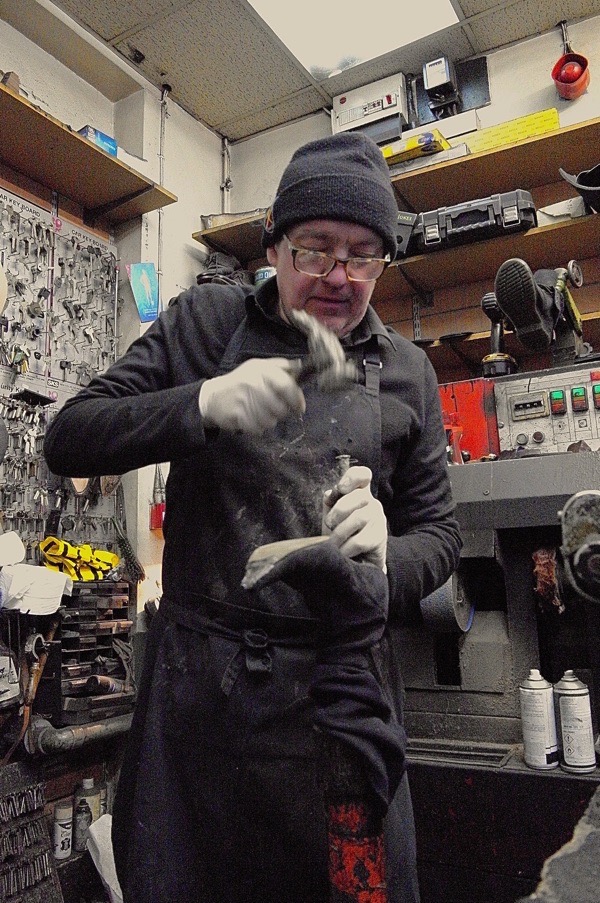
Dave opening up at 7am for the last time at Liverpool St
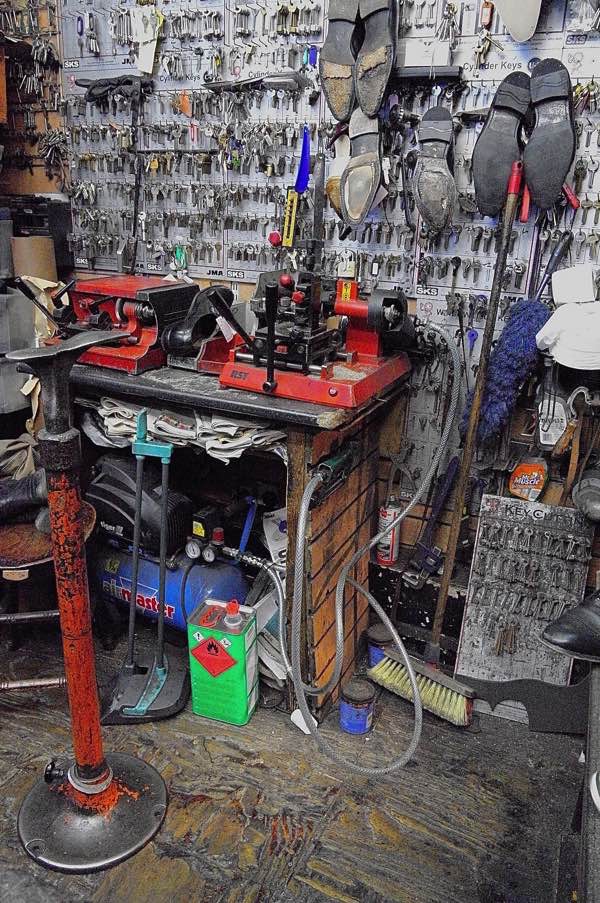
Just a couple of years ago, there were five places to get your shoes repaired at Liverpool St Station. I barely noticed when the first three disappeared because I always took my shoes to Dave Williams at his booth in Liverpool St. When Dave told me he was quitting on the Friday before Christmas prior to the redevelopment of the terrace, I learned that he would leave only his brother-in-law Gary Parsons at Shoe Key Services – round the corner in the Liverpool St Arcade – as the last man standing. Yet he has also been given notice because his booth is being redeveloped in a year’s time. These are truly the last days of Shoe Repair at Liverpool St Station.
‘I asked about coming back but they don’t want me back, they told me it’s going to be high end only,’ Dave admitted with a frown of disappointment as he swept the pavement outside his shop. For the past twenty years, he has been repairing shoes from seven until six for five days a week at Liverpool St, supplying a vital service with astonishing resilience.
In the week before Christmas, I accompanied Dave through his last days, arriving when he was opening up and sitting in the corner of the booth to observe the rhythm of the day as dawn broke and dusk fell again, as the rush hour ebbed and flowed, as customers brought worn shoes and collected them repaired.
With feverish expertise, Dave worked constantly, repairing several pairs at once – as many as fifty in a day – hammering, sanding, gluing, cutting, spraying and polishing. While waiting for the glue to dry on one pair, he would be tearing the old sole off another and then trimming the new sole once it adhered. Keeping his head down and his eyes on the task, Dave was absorbed in his activity yet maintained a constant stream of banter, thinking out loud. Three generations of skill and craft, and over a century of hard work, culminated in this degree of accomplishment which met its end last week.
In Dave’s stream of thought, those who had gone remained present. ‘My brother-in-law John Holding worked with me here for many years and never had a day off sick but then he went home one day, had a heart attack and died at forty-one,’ Dave confessed in sadness. I sat in the yellow glow of the booth as the afternoon light faded to blue outside where the taxis lined up. ‘They should switch their engines off but they all keep them running ,’ Dave commented over his shoulder, ‘It’s amazing I am still breathing, with the air quality in this booth.’
Dave was constantly interrupted, ceasing work in an instant and emerging from behind the counter to greet each customer and hear their request. There was an intimacy to these conversations, admissions of human failing and fallibility expressed in terms of shoes. Reliably and with magnanimity, Dave delivered his panacea to the worn-out soles of City workers, returning their shoes shining like new. I learned there are many who share the sense of consolation I draw from getting my shoes repaired. In the anonymous City where thousands pass by, the repair booth is an unlikely haven of kindness.
Consequently there were gasps of alarm and disbelief when Dave told his longterm customers of his imminent departure. An accumulating stream of gifts passed over the counter as the week passed away. ‘So many bottles, I could open a bar,’ quipped Dave as he stacked them at the back of the shop.
Dave’s emotions were equivocal. He was angry at the loss of his business, being pushed out by landlords with the insult of replacing his necessary trade by ‘high end’ retail. A community of long-standing small traders in this terrace at Liverpool St, including a jeweller, a barber and a lawyer is no more. Yet after decades of early mornings and long days, Dave is relieved to take a break too. I witnessed these conflicting feelings tempered with visible delight at the appreciation shown by his many long-standing customers. It was a poignant spectacle.
As people came and went, Dave revealed his family history in the business and his plans for the immediate future.
‘My grandfather Henry Alexander Williams was a saddler from Limerick who served in the British army in the First World War. His son Norman, my dad, was born in Ireland and trained as a saddler too but he settled here in the forties. Saddlers and shoe repairers work with the same tools, so he set up as a shoe repairer in Watney St Market and I am the only one of the grandsons who continued with it. Watney St Market was a different place thirty-five years ago, it was a lovely place to grow up.
I had a shop of my own in White Horse Lane and some other places around Stepney Green, but they demolished all the buildings and I could not make it pay. So I have been here since 1998 in Liverpool St, I have worked continuously and I have always made a living.
I do not know what I am going to do after this. My children are grown up, my mortgage is paid off and I have no debts. I have booked a couple of holidays, Jamaica in January, Marrakesh in February and then a wedding in Las Vegas. I will have a few months off. I will be glad of a rest. I would not have done more than another five or ten years if I had been given a choice.
Now it is coming to an end, I think ‘How tedious!’ How could I have been doing the same thing all this time? Yet I have really quite enjoyed it.’


‘You’ve just got to keep picking them up and putting them down’


‘I wouldn’t like to guess how many shoes I’ve done over the years’


‘How can I repay you? You saved my week!’
You may like to read my original story
Charles Goss’ Vanishing City

33 Lime St
A man gazed from the second floor window of 33 Lime St in the City of London on February 10th 1911 at an unknown photographer on the pavement below. He did not know the skinny man with the camera and wispy moustache was Charles Goss, archivist at the Bishopsgate Institute, who made it part of his work to record the transient city which surrounded him.
Around fifty albumen silver prints exist in the archive – from which these pictures are selected – each annotated in Goss’ meticulous handwriting upon the reverse and most including the phrase “now demolished.” Two words that resonate through time like the tolling of a knell.
It was Charles Goss who laid the foundation of the London collection at the Institute, spending his days searching street markets, bookshops and sale rooms to acquire documentation of all kinds – from Cries of London prints to chapbooks, from street maps to tavern tokens – each manifesting different aspects of the history of the great city.
Such was his passion that more than once he was reprimanded by the governors for exceeding his acquisition budget and, such was his generosity, he gathered a private collection in parallel to the one at the library and bequeathed it to the Institute on his death. Collecting the city became Goss’ life and his modest script is to be discovered everywhere in the archive he created, just as his guiding intelligence is apparent in the selection of material that he chose to collect.
It is a logical progression from collecting documents to taking photographs as a means to record aspects of the changing world and maybe Goss was inspired by the Society for Photographing the Relics of Old London in the eighteen-eighties, who set out to photograph historic buildings that were soon to be destroyed. Yet Goss’ choice of subject is intriguing, including as many shabby alleys and old yards as major thoroughfares with overtly significant edifices – and almost everything he photographed is gone now.
It is a curious side-effect of becoming immersed in the study of the past that the present day itself grows more transient and ephemeral once set against the perspective of history. In Goss’ mind, he was never merely taking photographs, he was capturing images as fleeting as ghosts, of subjects that were about to vanish from the world. The people in his pictures are not party to his internal drama yet their presence is even more fleeting than the buildings he was recording – like that unknown man gazing from that second floor window in Lime St on 10th February 1911.
To judge what of the present day might be of interest or importance to our successors is a subject of perennial fascination, and these subtle and melancholic photographs illustrate Charles Goss’ answer to that question.

14 Cullum St, 10th February 1910

3, 4 & 5 Fenchurch Buildings, Aldgate, 28th October 1911

71-75 Gracechurch St, 1910

Botolph’s Alley showing 7 Love Lane, 16th December 1911

6 Catherine Court looking east, 8th October 1911

Bury St looking east, 3rd July 1911

Corporation Chambers, Church Passage, Cripplegate, 31st January 1911 – now demolished

Fresh Wharf. Lower Thames St, 28th January 1912

Gravel Lane, looking south-west, 11th October 1910

1 Muscovy Court, 5th June 1911

3 New London St, 28th January 1912

4 Devonshire Sq

52 Gresham St, 17th September 1911

9-11 Honey Lane Market, Cheapside, 16th October 1910

Crutched Friars looking east from 37, 11th February 1911

Crutched Friars looking east, 28th October 1911

35 & 36 Crutched Friars, 28th January 1912

Yard of 36 Crutched Friars looking north, 11th February 1912

Yard of 36 Crutched Friars looking south, February 11th 1912

Old Broad St looking south, 24th July 1911

Charles Goss (1864-1946)
Photographs courtesy Bishopsgate Institute
You may also like to take a look at
and see more of Goss’ photography
Name The Landmarks Of Jewish Spitalfields
Following the success of his Map of Huguenot Spitalfields a couple of years ago, Cartographer Extraodinaire Adam Dant is currently at work on a MAP OF JEWISH SPITALFIELDS and we need your help to compile it.

Click to enlarge Adam Dant’s work-in-progress
Spitalfields was once known as ‘Little Jerusalem’ but today only fragmentary evidence remains of the thriving Jewish community who moved out in the twentieth century. Yet Jewish Spitalfields still exists in living memory and we need you, the readers, to nominate the public landmarks – the synagogues, schools, theatres, cinemas, pubs, shops, restaurants, markets, clubs, housing and more – that defined this lost world, so they can be included on the map.
Please list your suggestions as comments below or you can write to Adam Dant directly at atelierdant@gmail.com . The deadline for submissions is 7th January 2019.
Adam’s Dant’s map takes the form of a mythical placemat from Bloom’s Restaurant in Whitechapel.

Photograph of Bloom’s in Whitechapel High St taken in the seventies by Ron McCormick
You may also like to read these stories
Adverts from the Jewish East End

CLICK TO ORDER A SIGNED COPY OF MAPS OF LONDON & BEYOND BY ADAM DANT
Adam Dant’s MAPS OF LONDON & BEYOND is a mighty monograph collecting together all your favourite works by Spitalfields Life‘s Contributing Cartographer in a beautiful big hardback book.
Including a map of London riots, the locations of early coffee houses and a colourful depiction of slang through the centuries, Adam Dant’s vision of city life and our prevailing obsessions with money, power and the pursuit of pleasure may genuinely be described as ‘Hogarthian.’
Unparalleled in his draughtsmanship and inventiveness, Adam Dant explores the byways of London’s cultural history in his ingenious drawings, annotated with erudite commentary and offering hours of fascination for the curious.
The book includes an extensive interview with Adam Dant by The Gentle Author.
Adam Dant’s limited edition prints are available to purchase through TAG Fine Arts
Chamberlain’s East End Churches

Click on this image to enlarge
Inspired by this plate of engravings of East End churches in Chamberlain’s History of London, 1770, that I found in the Bishopsgate Institute, I set out on a seasonal walk yesterday to enjoy the winter sunshine and visit these enduring sentinels of the East End. Yet I found myself disappointed upon my journey by the recent loss of characterful landmarks, even as I took consolation from those that survive.

St Anne’s Limehouse

Revelopment of Passmore Edwards Library, Commercial Rd

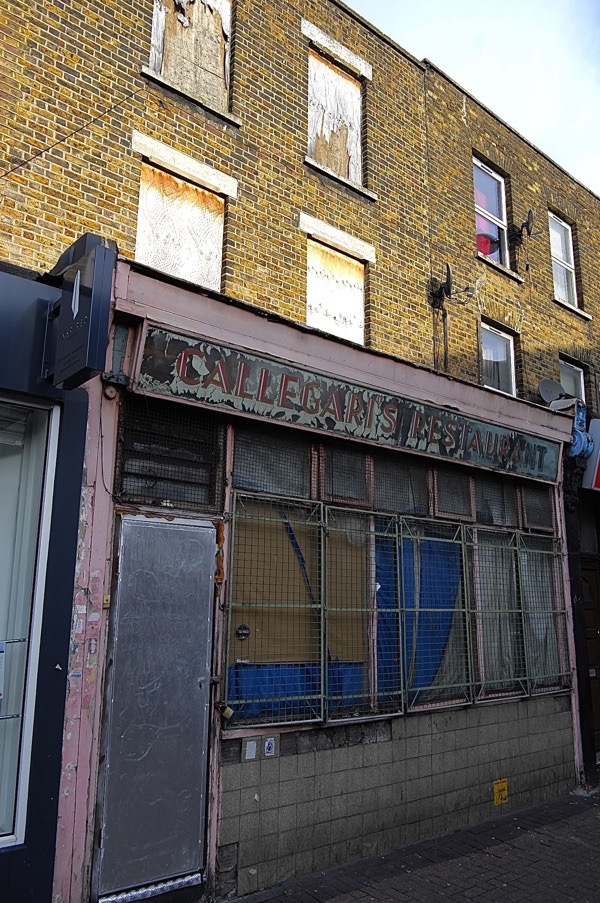
I wonder how long Callegari’s Restaurant will last?

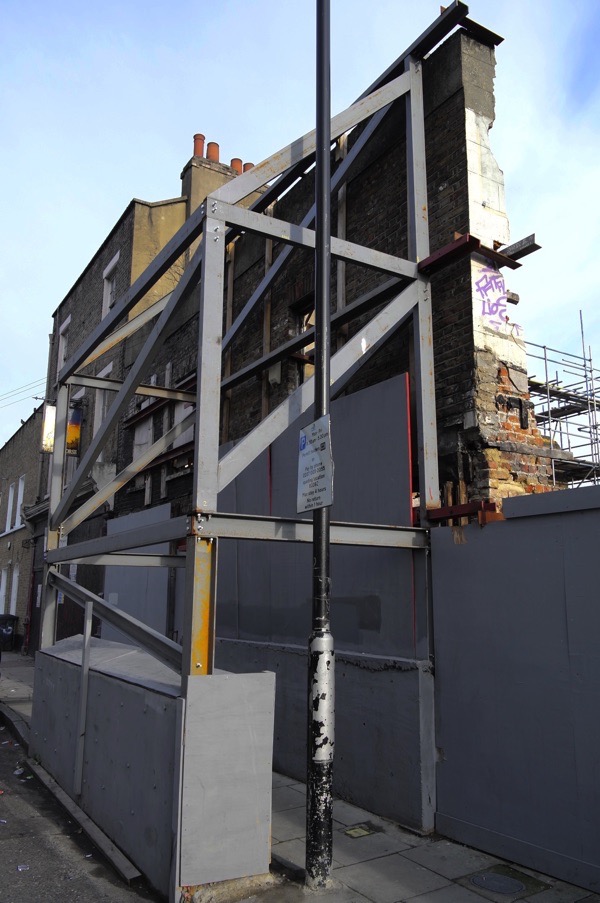
Imminent facadism on White Horse Lane

The White Horse is gone from White Horse Lane

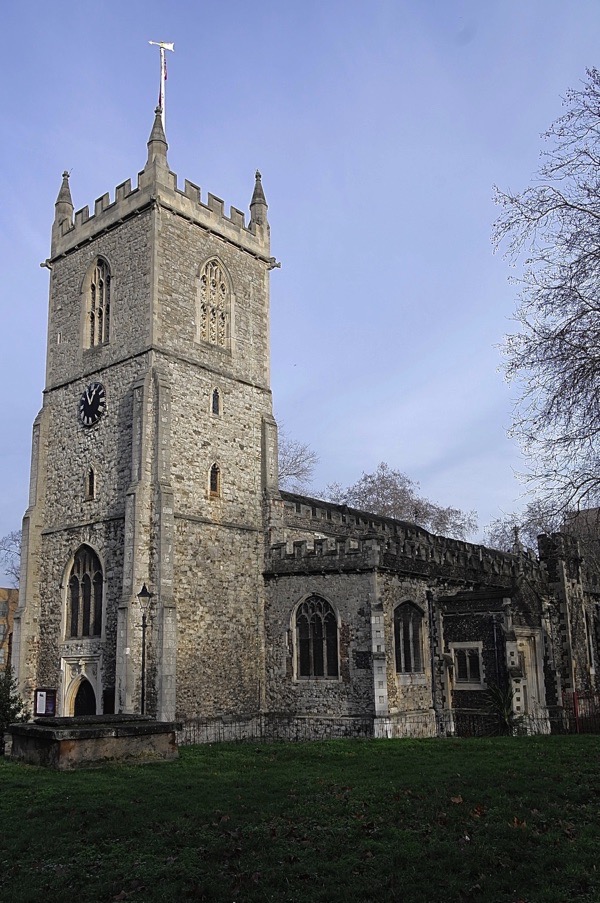
St Dunstan’s, Stepney

Old Mulberry Tree in St Dunstan’s Churchyard

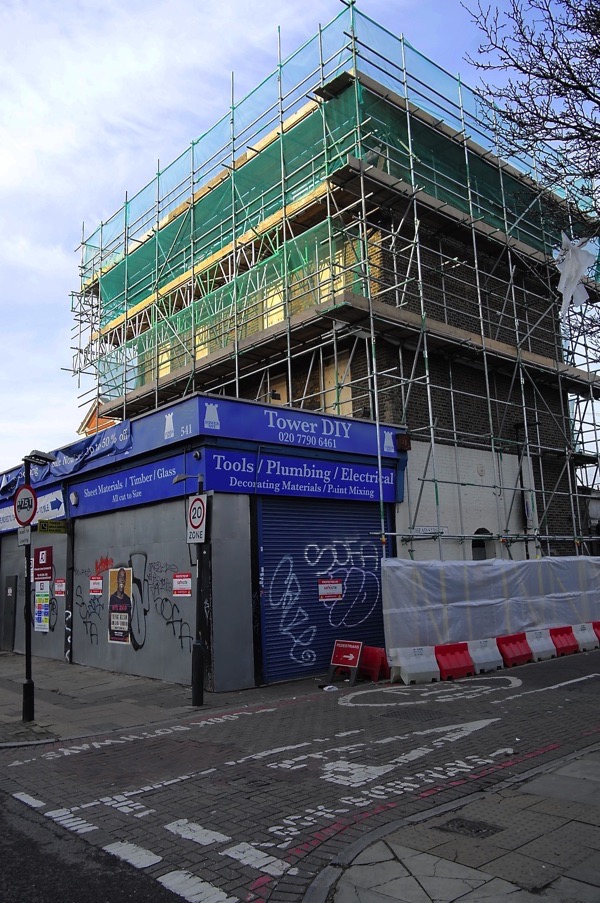
Tower DIY in Commercial Rd is being redeveloped

St Paul’s the Seaman’s Church, Shadwell

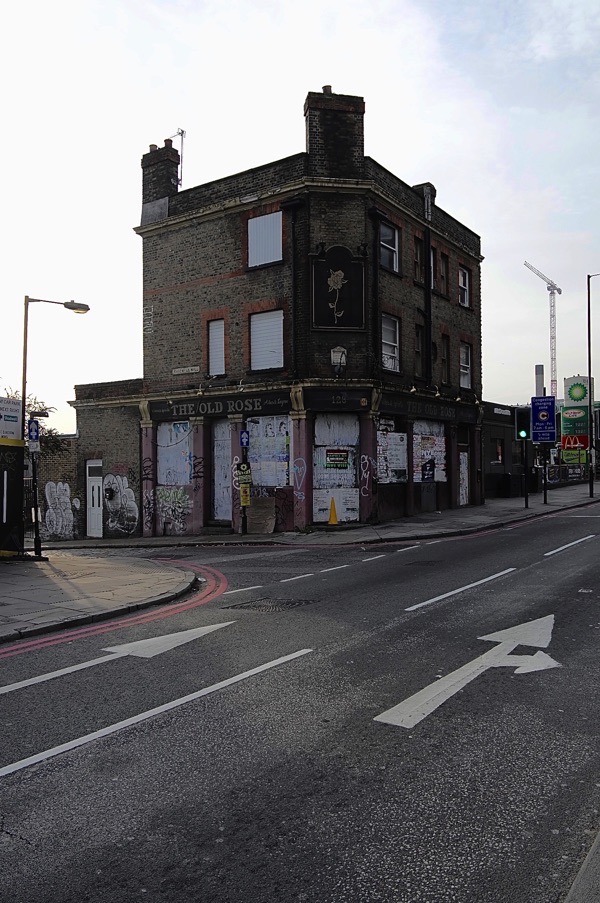
The Old Rose is the last pub standing in the Ratcliff Highway

St George in the East, Wapping

St John’s, Wapping

Parish School 1780, Wapping

St Mathew’s, Bethnal Green

Archive images courtesy Bishopsgate Institute
You may also like to take a look at
Fritz Wegner’s Christmas Plates
I discovered my delight in the work of illustrator Fritz Wegner (1924-2015) in primary school through his drawings for Fattypuffs & Thinifers by Andrew Maurois. Throughout my childhood, I cherished his book illustrations whenever I came across them and the love of his charismatically idiosyncratic sketchy line has stayed with me ever since.
Only recently have I learnt that Fritz Wegner was born into a Jewish family in Vienna and severely beaten by a Nazi-supporting teacher for a caricature he drew of Adolf Hitler at the age of thirteen. To escape, his family sent him alone to London in August 1938 where he was offered a scholarship at St Martin’s School of Art at fourteen years old, even though he could barely speak English.
A few years ago, I came across this set of small souvenir Christmas plates Fritz Wegner designed for Fleetwood of Wyoming between 1980 and 1983 in limited editions, which I acquired for almost nothing. They are crudely produced, not unlike those ceramics sold in copyshops with photographic transfers, yet this cheap mass-produced quality endears them to me and I set them out on the dresser every Christmas with fondness.

Journey to Bethlehem, 1983

The Shepherds, 1982

The Holy Child, 1981

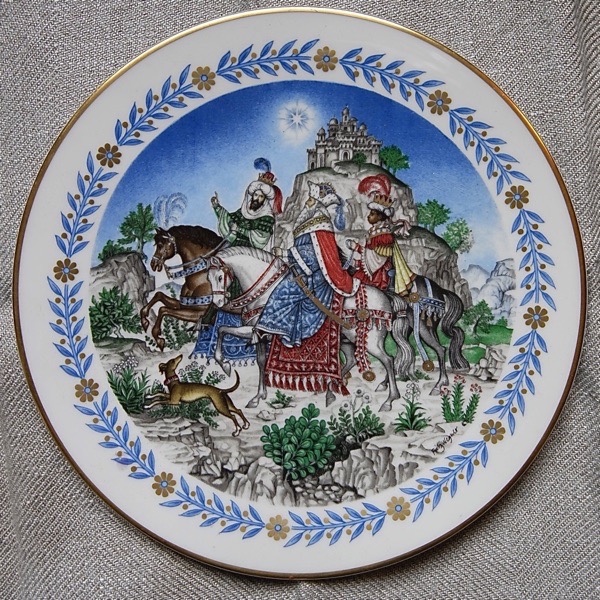
The Magi, 1980
You may also like to take a look at
Viscountess Boudica’s Christmas
On Boxing Day, we remember our dearly beloved Viscountess Boudica of Bethnal Green

Let it be said that if anyone in the East End knew how to keep the spirit of Christmas, it was the Viscountess Boudica of Bethnal Green. At this time of year, her tiny flat near Columbia Rd was transformed into a secret Winter Wonderland where the visitor might forget the chill of the gloomy streets outside and enter a realm of magic, fantasy and romance in which the Viscountess held court like a benevolent sprite or fairy godmother, celebrating the season of goodwill in her own inimitable style.
Boudica had already been at work for weeks when I arrived with my camera to capture the Christmas spectacle for your delight, yet she was still putting the finishing touches to her display even as I walked through the door. “You see these bells?” she said, reaching up to add them to the colourful forest of paper decorations suspended from the ceiling, “I bought them in Woolworths in Tottenham for 45p in 1984. When I think of all the people they have looked down upon – if only these bells could talk, they’ve seen it all!”
Evidence of the season was apparent wherever I turned my eyes, from the illuminated coloured trees that filled each corner – giving the impression that the room was actually a woodland glade – to the table where Boudica was wrapping her gifts and writing cards, to the corner where a stack of festive records awaited her selection, to the innumerable Christmas knick-knacks and figures that crowded every surface, and the light-up reindeer outside in the garden, glimpsed discreetly through the net curtains. “This is thirty years worth of collecting,” she explained, gesturing to the magnificent display enfolding us, “that set of lights is older than I am.”
In common with many, this is an equivocal time for Viscountess Boudica who does not have happy childhood memories of Christmas. “It was hell,” she admitted to me frankly, “We didn’t have any money to buy presents and, in our family, Christmas was always when fights and arguments would break out. The reason I have so many decorations now is to make up for all the years when I didn’t have any.” Yet Boudica remembers small acts of kindness too. “The local shops used to save me their balloons and give me scraps of fabric that I used to make clothes for the kittens in the barn – and that was the beginning of me making my own outfits,” she recalled fondly.
“People should remember what it’s all about,” Boudica assured me, linking her own childhood with the Christian narrative, “It’s about a little boy who didn’t have a home. They should think of others and remember there’s poor people here in Bethnal Green.” Naturally, I asked the Viscountess if she had a Christmas message for the world and, without a second thought, she came to back to me with her declaration – “Be kind to each other and get rid of discrimination!”


Boudica contemplates her Christmas listening – will it be Andy Williams or Jim Reeves this year?

“Whenever I hang up these bells, I think of all the people they have looked down upon over the years”


Wrapping up her gifts.


Filling her stocking


Nollaig Shona Dhaoibh!


Drawings copyright © Viscountess Boudica
You may also like to read
Viscountess Boudica’s Domestic Appliances
Viscountess Boudica’s Drawings
Viscountess Boudica’s Halloween
Viscountess Boudica’s Valentine’s Day
The Departure of Viscountess Boudica
Read my original profile of Mark Petty, Trendsetter
and take a look at Mark Petty’s Multicoloured Coats
My Pantomime Years

Longer ago than I care to admit, fortune led me to an old theatre in the Highlands of Scotland. Only now am I able to reveal some of my experiences there and you will appreciate that discretion prevents me publishing any names lest those who are still alive may read my account.
It was a magnificent nineteenth century theatre, adorned with gilt and decorative plasterwork. Since this luxurious auditorium with boxes, red drapes and velvet seating was quite at odds with the austere stone buildings of the town, it held a cherished place in the affections of local theatregoers who crowded the foyers nightly, seeking drama and delight.
Although it is inexplicable to me now, at that time in my life I was stage struck and entirely in thrall to the romance of theatre. Perhaps it was because of my grandfather the conjurer who died before I was born? Or my love of puppets and toy theatres as a child? When I left college at the beginning of my twenties, I refused to return home again and I did not know how to make my way in London. So I was overjoyed when I landed a job at a theatre in the north of Scotland. I packed my possessions in cardboard boxes, took the overnight train and arrived in the frosty dawn to commence my adult life.
As soon as it was discovered I had a literary education, I was assigned the task of organising the script and writing the ‘poetry’ for the annual pantomime, which that year was Dick Whittington. In the theatre safe I found a stash of tattered typescripts dating back over a century, rewritten each time they were performed. These documents were fascinating yet barely intelligible, and filled with gaps where comedians would supply their own patter. I discovered that the immortals, in this case Fairy Bow Bells and Old King Rat, spoke in rhyming couplets. Yet to my heightened critical faculties, weaned on Shakespeare and Chaucer, these examples were lame. So I resolved to write better ones and set to work at once.
Fairy Bow Bells:
In the deepest, bleakest Wintertime,
I welcome you to Pantomime.
Here is Colour! Here is Magic!
Here is Love and naught that’s Tragic.
‘You are here to learn the art of compromise, and how to pour a decent gin and tonic, darling,’ the director informed me at commencement with a significant nod of amusement when I submitted my work. I tried to raise an amenable smile as I served the drinks, but it was a line delivered primarily for the benefit of the principals gathered in the tiny office for a production meeting. These were veterans of musical comedy and summer variety who played pantomime every year, forceful personalities who each brought demands and expectations in proportion to their place in the professional hierarchy, with the ageing comedian playing Dame Fitzwarren as the star. Next came the cabaret singer and dancer playing Dick Whittington and then the television personality playing Tommy the Cat.
It was my responsibility to manage auditions for the chorus of boy and girl dancers, sifting through thousands of curriculum vitae and head-shots to select the most promising candidates. Those granted the opportunity were given ten minutes to impress the musical director and the choreographer with a show tune and a short dance sequence. Shepherding them in and out of the room and handling their raw emotions proved a challenge when they lost their voices, broke into tears or forgot their routines – or all of these.
The cast convened for a read-through in the low-ceilinged rehearsal room in a portacabin in the theatre car park. Once everyone had shaken hands and a cloud of tobacco filled the room, the director wished everyone good luck and, turning to me before leaving the room, declared loudly ‘Don’t worry, darling, they know what to do!’, employing the same significant nod I had seen in the production meeting and catching the eye of each of the principals again.
We all sat down, I handed round the scripts and the cast turned to the first page. The principals gasped in horror, exchanging glances of disbelief and reaching for their cigarettes in alarm. Dame Fitzwarren blushed, tore out a handful of pages and spread them out on the table, muttering, ‘No, no, no,’ to himself in condemnation. I sat in humiliated silence as, in the ensuing half hour, my sequence of pages was entirely rearranged with some volatile horse trading and angry words. Was this the art of compromise the director had referred to? I had organised the scenes in order of the story – no-one had explained to me that in pantomime the sequence of opening scenes are a device to introduce the principals in order of status from the newcomers to the seasoned stars. Yet even if I had understood this, it would have made little difference since the cast were all unknown to me.
On the second day, the floor of the portacabin was marked with coloured tapes which indicated the placing of the scenery and it was my job to take the cast through their moves. Dame Fitzwarren was keen to teach his comedy kitchen sequence to the two young actors playing the broker’s men. Once he had walked them through, I suggested we should give it a go. ‘No,’ he said, ‘That was it, we did it.’ I understood that, in pantomime, comedians only rehearse their sequences once as a matter of honour.
The little theatre owed its existence to the wealth of the whisky distilleries which comprised the main industry in the town and many of the directors of these distilleries were members of the theatre board. In particular, I remember a diminutive fellow who made up for his lack of height with an abrasive nature. He confronted me on the opening night, asking ‘Is this going to be good, laddie?’ My timid reply was, ‘It’s not for me say, is it?’ ‘It had better be good because your career depends upon it,’ was his harsh response, poking me in the gut with his finger.
In fact, Dick Whittington – in common with all the pantomimes at that theatre – was a tremendous success, playing to packed houses from mid-December until the end of January. The frantic energy of the cast was winning and the production suited the mechanics of the building beautifully, with brightly coloured flying scenery, drop-cloths and gauzes. The audience gasped in wonder when Fairy Bow Bells waved her wand to conjure the transformation scene and booed in delight when Old King Rat popped up through a trap door in a puff of smoke. They loved the familiar faces of the comedians and laughed at their routines, even if they were not actually funny.
Given the punishing routine of three shows a day, the collective boredom of the run and the fact that they were away from home, the pantomime cast occupied themselves with a rollercoaster of affairs and liaisons which only drew to an end at the final curtain. Once Dick Whittington unexpectedly stuck her tongue down my throat in the backstage corridor on New Year’s Eve and Dame Fitzwarren locked the door of the star dressing room from the inside, subjecting me to his wandering hands when I came to discuss potential cuts in the light of the stage manager’s timings. I found myself entering and leaving the building through the warren of staircases and exit doors in order to avoid unwanted attention of this nature. The gender reversals and skimpy costumes contributed to an uncomfortably sexualised environment which found its expression on stage in the relentless innuendo and lewd references, all within an entertainment supposedly directed at children. ‘Thirty miles to London and no sign of Dick yet!’
I shall never forget the musical director rehearsing the little girls in tutus from a local stage school who supplied us with choruses of sylphs on a rota to accompany Fairy Bow Bells. ‘Come along, girls,’ he instructed the children, thrusting his chest forward and baring his dentures in a frozen smile of enthusiasm,’ Tits and teeth, tits and teeth,’ using the same exhortation he gave to the adult dancers.
Our version of Dick Whittington contained an underwater sequence, when Dick’s ship was wrecked, permitting the characters to ‘swim’ through a deep sea world which was given greater reality by the use of ultra-violet light and projecting an aquarium film onto a gauze. This was also the moment in the show when we undertook a chase through the audience, weaving along the rows. Drawing on the familiar tradition of pantomime cows and horses – and perhaps inspired by the predatory nature of the environment – I devised the notion of a pantomime shark in a foam rubber costume that could chase the characters through the front stalls and around the circle to the accompaniment of the theme from Jaws. I had no idea of the pandemonium that this would unleash but, each night, I made a point of popping in to stand at the back to enjoy the mass-hysteria engendered by my shark.
The actor playing Old King Rat had previously been cast as Adolphus Cousins in Major Barbara, so I decided to exploit his classical technique by writing a death speech for him. It was something that had never been done before and this is the speech I wrote.
Old King Rat:
This is the death of Old King Rat,
Foiled at last by Tommy the Cat.
No more nibbles, no more creeping,
No more fun now all is sleeping.
This is the instant at which I die,
Off to that rathole in the sky…
Naturally this was accompanied by extended death-throes, with King Rat expiring and getting up again several times. Later, I learnt my speech had been pirated by other productions of Dick Whittington, which is the greatest accolade in pantomime. Maybe it is even now being performed somewhere this season?
In subsequent years, I was involved in productions of Cinderella and Aladdin, but strangely I recall little of these. I did not realise I was participating in the final years of a continuous theatrical tradition which had survived over a century in that theatrical backwater. I did not keep copies of the scripts and the fragments above are all I can remember now. I do not know if I learnt the art of compromise but I certainly learnt how to pour a stiff gin and tonic. And I learnt that in any theatre there is always more drama offstage than onstage.

You may also like to read about