On Mothering Sunday

Valerie
What are you to do on Mothering Sunday if you have no mother? My mother died in 2005 and each year I confront this troubling question when the annual celebration comes around.
All over the city in recent weeks, I have encountered cards and gifts for Mothering Sunday, exploiting the commercial potential of this medieval Lenten festival which, like St Valentine’s Day and Halloween, has been commodified into a retail opportunity.
If I was religious I might light a candle or lay flowers on a grave, yet neither of these is an acceptable option for me. Contemplating displays in shop windows, I deliberate privately over the tender question as my sense of loss deepens in the approach to Mothering Sunday, only for it to dissipate afterwards. This uneasy resolution brings no peace, serving to remind me how much I miss her. It is a feeling which grows with each Mothering Sunday that passes, as the distance in time that separates us increases and the memories fade. I do not expect or wish to ‘get over it,’ I seek to live in peace with my sadness.
I wish she could see where I live now and I could share the joys of my life with her. I have a frustrated instinct to communicate delights, still identifying sights and experiences that I know she would enjoy.
My picture of her has changed. The painful experience of her final years when she was reduced to helpless paralysis by the onset of dementia has been supplanted by a string of fragmentary images from my childhood – especially of returning from school on summer afternoons and discovering her at work in her garden.
I think of how she raised her head when she smiled, tossing her hair in assertion of a frail optimism. ‘Not too bad, thank you!’ she is admitting, lifting her head to the light and assuming a confident smile with a flash of her eyes. This was her default answer to any enquiry into her wellbeing – whether it was a routine or genuine question – and she maintained it through the years, irrespective of actual circumstances. When life was smooth, it was a modest understatement and when troubles beset her, it was a discreet expression of personal resilience. For her, it was a phrase capable of infinite nuance and I do not believe she ever said it in the same way. Yet although I could always appreciate the emotional reality that lay behind her words, I think for everyone but me and my father it was an opaque statement which efficiently closed the line of enquiry, shielding her private self from any probing conversation. From her I learnt the value of maintaining equanimity and keeping a sense of proportion, whatever life brings.
I realise that I was lucky to have a mother who taught me to read before I started school at four years old. Denied the possibility of a university education herself, she encouraged me to fulfil her own thwarted ambitions and – perhaps more than I appreciate – I owe my life as a writer to her. Yet there is so much I could say about my mother that it is almost impossible to write anything. I recognise that the truth of what she means to me is in a region of emotion that is beyond language, but I do know that what she was is part of who I am today.
Increasingly, I am aware that many of those around me also share this situation of no longer having mothers. Perhaps I should buy them all flowers this Mothering Sunday? Certainly if anyone enquires, I shall reply ‘Not too bad, thank you!’ with a smile and raise my head. In that moment, I shall conjure her robust spirit from deep inside me and she will be present, in my demeanour and in my words, this Mothering Sunday.
You may also like to read about
Blossom Time In The East End
Now is season to welcome the blossom back to the East End again for another year

In Bethnal Green
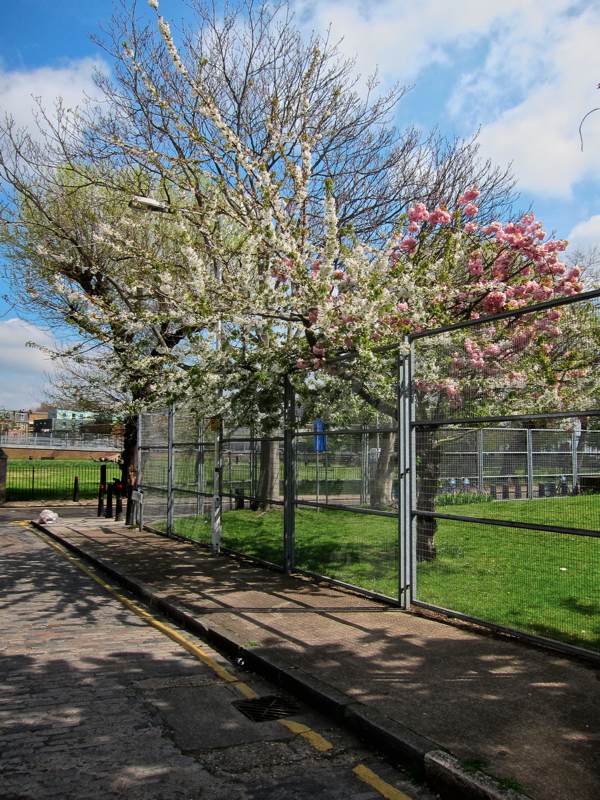
Let me admit, this is my favourite moment in the year – when the new leaves are opening fresh and green, and the streets are full of trees in flower. Several times, in recent days, I have been halted in my tracks by the shimmering intensity of the blossom. And so, I decided to enact my own version of the eighth-century Japanese custom of hanami or flower viewing, setting out on a pilgrimage through the East End with my camera to record the wonders of this fleeting season that marks the end of winter incontrovertibly.
In his last interview, Dennis Potter famously eulogised the glory of cherry blossom as an incarnation of the overwhelming vividness of human experience. “The nowness of everything is absolutely wondrous … The fact is, if you see the present tense, boy do you see it! And boy can you celebrate it.” he said and, standing in front of these trees, I succumbed to the same rapture at the excess of nature.
In the post-war period, cherry trees became a fashionable option for town planners and it seemed that the brightness of pink increased over the years as more colourful varieties were propagated. “Look at it, it’s so beautiful, just like at an advert,” I overheard someone say yesterday, in admiration of a tree in blossom, and I could not resist the thought that it would be an advertisement for sanitary products, since the colour of the tree in question was the exact familiar tone of pink toilet paper.
Yet I do not want my blossom muted, I want it bright and heavy and shining and full. I love to be awestruck by the incomprehensible detail of a million flower petals, each one a marvel of freshly-opened perfection and glowing in a technicolour hue.

In Whitechapel
In Spitalfields

In Weavers’ Fields

In Haggerston

In Weavers’ Fields

In Bethnal Green

In Pott St

Outside Bethnal Green Library

In Spitalfields

In Bethnal Green Gardens

In Museum Gardens

In Museum Gardens

In Paradise Gardens

In Old Bethnal Green Rd

In Pollard Row

In Nelson Gardens

In Canrobert St

In the Hackney Rd

In Haggerston Park

In Shipton St

In Bethnal Green Gardens

In Haggerston

At Spitalfields City Farm

In Columbia Rd

In London Fields

Syd’s Coffee Stall, Calvert Avenue
You may like to take a look back at
Cats Of Hackney Mosaic

(Click to enlarge)
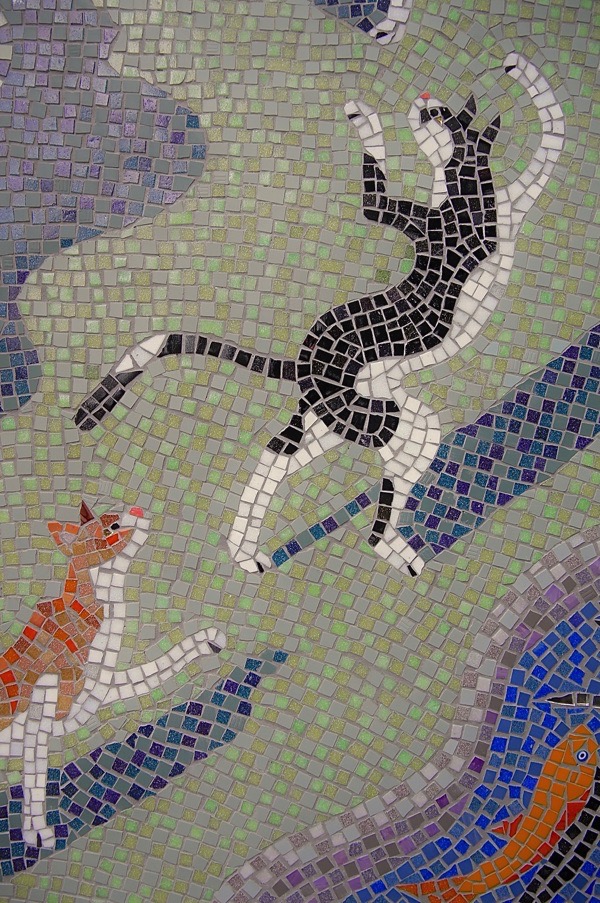
Taking advantage of yesterday’s spring sunshine, I took an excursion up to Hackney Downs to admire the latest masterpiece produced by designer Tessa Hunkin and the Hackney Mosaic Project. At the pavilion in the park, about a dozen mosaic artists were at work under Tessa’s watchful eye, but I persuaded her to accompany me to the private garden where her new commission has just been installed.
Complementing last year’s ‘Hounds of Hackney Downs,’ this mosaic features some members of the local feline population who stray into the garden where it has been installed. I was thrilled by the dynamic sense of movement with three cats leaping – much more exciting and ambitious concept than simply having them sitting around snoozing. In fact, I think I recognised the ginger cat sitting on the roof of the park keeper’s cottage next door.
If you would like to see more of the remarkable achievements of Hackney Mosaic Project under the leadership of Tess Hunkin, they have designed a map which I have featured below that gives you the locations of their public mosaics.

Is this the ginger cat in the mosaic?


A mosaic of thrushes at the same house

Work in progress at Hackney Mosaic Project

Click to enlarge this map of where mosaics may be found in Hackney
THE HACKNEY MOSAIC PROJECT is seeking commissions, so if you would like a mosaic please get in touch hackneymosaic@gmail.com
You may also like to read about
The Mosaic Makers of Hackney Downs
The Award-Winning Mosaic Makers of Hackney
A Dress Of Spitalfields Silk

In 1752, when Ann Fanshawe was twenty-eight years old, her father Crisp Gascoyne was appointed as Lord Mayor of London, and became the first incumbent to take residence in the newly built Mansion House. Since Margaret, her mother, had died back in 1740, it fell upon Ann to assume the role of Lady Mayoress and this spectacular dress of Spitalfields silk, which was purchased by the Museum of London from one of her descendants in 1983, is believed to have been made to be worn just once, upon the great occasion.
Born in 1724, Ann was the eldest daughter of Crisp Gascoyne of Bifrons House in Barking, marrying Thomas Fanshawe of Parsloes Manor in Dagenham at the age of twenty-one. In 1752, when she stepped out as Lady Mayoress, Ann had three children, John six years old, Susanna five years old and Ann four years old. Ten years later, Ann died at the birth of her fourth child Mary, in 1762. Parsloes Manor no longer exists but “The History of the Fanshawe family” by H.C. Fanshawe published in 1927 records this couplet engraved upon one of the windows there by Ann & Thomas.“Time ‘scapes our hand like water from a sieve, We come to die ere we come to live.”
Becoming Lord Mayor of London was an auspicious moment for Ann’s father (who had been Master of the Brewer’s Company in 1746) and he saw his eldest daughter step out in a silk dress that was emblematic of his success. The design contains images of hops and barley interwoven with flowers spilling from silver cornucopia, alternating with anchors and merchants’ packs in silver, all upon a background of white silk threaded with silver. It was a dress designed to be seen by candlelight and the effect of all this silver thread upon white silk, in a dress trimmed with silver lace, upon his eldest daughter adorned with diamonds, was the physical embodiment of Gascoyne’s momentous achievement. To crown it all, H.C. Fanshawe describes a lost portrait of Ann, “which shows her to have been strikingly handsome.”
As the Covent Garden Journal of 3rd November 1752 reported: “The Appearance at Guildhall, on Thursday last, was very noble, particularly that of the Ladies, many of whom were extremely brilliant, a Circumstance which in too great a Measure lost its Effect, their being mixed with an uncommon Crowd of Company… The Ball about ten o’Clock was opened by Mrs. Fanshaw (as Lady Mayoress, who made a most splendid Figure) …”
As everyone in Spitalfields knows, the Huguenot weavers here excelled at creating silk, both in their technical finesse and elegance of design. Such was the skilful incorporation of the expensive silver and coloured threads in the cloth for Ann Fanshawe’s dress that they were only used where they were visible, with very little wasted upon the reverse. According to the American critic, Andrea Feeser, the dye used for the blue flowers was rare indigo from South Carolina, where Ann’s brother-in-law Charles Fanshawe was stationed as a Rear-Admiral and had access to the indigo dye.
When Natalie Rothenstein, the authoritative scholar of Spitalfields silk, wrote to the curator at the Museum of London in July 1983 about the dress, she authenticated the fabric as being of being of Spitalfields manufacture, but also could not resist declaring her distaste for the design.“I am sure that the dress is Spitalfields and indeed the floral style is just right for the date 1752-3. I am sure too, that the design is unique – created for one rich lady. The bales and anchors ought to refer to a merchant, while the ears of corn and horn of plenty reveal the prosperity he brought to the city as well as his family’s execrable taste.”
Commonly, silks were woven in lengths of cloth sufficient for several dresses, but in this instance the design was likely to have been made solely for this garment. A customer bought a design from a mercer and six months was the lead time for the weaving of the silk cloth, which could have been made up into a dress in little more than a week. Natalie Rothenstein describes the chain of transactions thus, “silk was generally imported by a silk merchant. It was then sold through a broker to a silkman who, in turn, supplied the master weaver with the qualities and quantities required. Either the silkman or the master weaver had it thrown and dyed. The master weaver would normally obtain an order from a mercer and instruct his foreman. The latter, based at the master weaver’s warehouse, would measure out the warp for the journeyman, who returned it when completed.” Ann would never have met the people who made her dress and they may never have seen her in it.
When the culmination of this process arrived, once the silk had been designed, the dress manufactured and the great day came, Ann had to get dressed. No underwear was worn, just a shift of fine linen, probably with some lace at the neck, then silk stockings and garters to hold them up. Next came her stays of whalebone, that we should call a corset, and then her hooped petticoat, also with whalebone and cross ties to maintain the oval shape of the dress and not allow it to become circular. At last, Ann could put on her dress, which came in three pieces, first the skirt, then the stomacher followed by the bodice. There were no hooks or buttons to hold it all together, so pins would be used and a few discreet stitches where necessary. Lace sleeve ruffles were added and a lappet upon her head. Finally, diamonds upon the stomacher and around Ann’s neck, plus shoes and a fan completed the outfit.
Now Ann was ready for her appearance, except her dress was two metres wide and she could not walk through a door without turning sideways. Getting in and out of a carriage must have been a performance too. Ann was fully aware that her dress was not designed for sitting down but fortunately she did not to expect to sit.
What can we surmise about Ann’s experience in this dress? I was surprised at the workmanlike manufacture of the garment which was sewn together quickly and presented no finish upon the inside. The quality and expense of the materials was what counted, the tailoring of the dress was not of consequence. Almost like a stage costume, it was a dress to create an effect.
Maybe Ann was the apple of her father’s eye and she was proud to become his angel that incarnated the supremacy of their family in the City of London, or maybe she felt she was tricked out like a tinsel fairy in a ridiculous dress with symbols of brewing woven into the fabric, tolerating it all the for sake of her dad? No doubt her husband Thomas Fanshawe was present at the occasion, but maybe her children, John, Sukey and Nancy (as she called them) stayed behind at Parsloes Manor and did not see their mother wearing the famous dress. Did Crisp Gascoyne, her father, get sentimental on the night, shedding a tear for his wife Margaret and wishing that she had lived to see the day?
We shall never know the truth of these speculations, but everyone wants to have their moment of glory – looking their best at a significant occasion in life – and I should like to think that, on the one day she wore it, this dress delivered that moment for Ann Fanshawe.
You can see Ann Fanshawe’s dress for yourself at the Museum of London


The Gentle Author’s Spring Shirt

I pulled this shirt out of my cupboard this week in advance of the arrival of spring. If you look closely, you will see the collar is wearing through but this does not diminish my affection for this favoured garment that I have worn for years now, bringing it out just for these few months at the end of winter. Although most of the clothes I own are of undecorated design, there is a gentle lyrical quality about this pattern that appeals to me.
When I wear this shirt with a dark jacket, the colours really sing and I feel am doing my bit in participating in the seasonal change. This contrast of formal clothing with a sprigged shirt can express dignified restraint while at the same time revealing an attachment to flowers, plants, gardens and nature – a contrast that I recognise in my own personality.
I love the conceit of having violets on my shirt when those in my garden are in flower and I enjoy the subtle tones of all the flowers portrayed, remaining as recognisable species while artfully stylised to make a pattern. The evocation of the natural world in this simple design touches a chord for me and, as with so many things that trigger an emotional response, I discovered that my passion for these floral patterns from Liberty goes back a long way.
When I came across the familiar photograph of my mother Valerie as a child, which you can see below, I did a double-take when I recognised the pattern on the dress. It was a Liberty print, very similar to my spring shirt which I hold in such affection. In that moment, I recalled that my grandmother Katherine bought fabric at Liberty in London and had it made up into dresses for my mother in the nineteen-thirties. This was a gesture which made such an unforgettable impression on my mother that for her whole life she carried her delight in these cotton dresses, which were so magical to her as a little girl in Somerset. Floral prints fed her innocent imagination, nurtured by ‘Songs of the Flower Fairies’ and performing as one of Titania’s attendants in a school play.
A generation later, I grew up with the received emotion of this memory – a story my mother told me when I was a child. I thought I had forgotten, but I realised it was through an unconscious recollection of the photograph of my mother in the Liberty dress that I was attracted to this flowery shirt, without understanding the origin of my desire at the time.
The story was confirmed when my Uncle Richard moved out of the old house where he and my mother grew up and, in my grandmother’s dressing table, I found a small leather pocket diary from the thirties recording her London trip with the entry, “Stayed at Claridges. Ordered carpet and sideboard at Harvey Nichols and bought materials at Liberty.” My grandmother was the daughter of a diminished aristocratic family who married my grandfather Leslie, a bank manager, and adopted an autocratic manner to ameliorate her loss of status. Consequently, my mother, with admirable resourcefulness, ran away from home at nineteen to escape my bossy grandmother and married my father Peter, who was a professional footballer – an act of social rebellion that my grandmother never forgave.
Nevertheless, the taste I acquired for these old-fashioned designs reflects the fondness my mother carried for that special moment in her childhood which she never forgot, when my grandmother showed maternal kindness to her little daughter in the gift of flowery cotton dresses. An act which came to represent everything about my grandmother that my mother could embrace with unqualified affection, and she encouraged me to remember the best of people too, a prerogative I claim in this instance as the sole living representative of these characters.
Today, I wear my shirt as the sympathetic illustration of a narrative which extends over three generations, culminating in my own existence upon this earth, and as I button my spring shirt, before walking out to celebrate sunshine and a new beginning, I am reminded that I alone carry these emotional stories now, clothing me in the humble affections of my forebears.

The Gentle Author’s mother ‘Valerie’ in the nineteen-thirties

Liberty of London
You may like to read these other stories of The Gentle Author’s family
Isabelle Barker’s Hat

Even though I took this photograph of the hat in question, when I examined the image later it became ambiguous to my eyes. If I did not know it was a hat, I might mistake it for a black cabbage, a truffle, or an exotic dried fruit, or maybe even a specimen of a brain preserved in a medical museum.
Did you notice this hat when you visited the Smoking Room at Dennis Severs’ House in Folgate St? You will be forgiven if you did not, because there is so much detail everywhere and, by candlelight, the hat’s faded velvet tones merge unobtrusively into the surroundings. It seems entirely natural to find this hat in the same room as the painting of the gambling scene from William Hogarth’s “The Rake’s Progress” because it is almost identical to the hat Hogarth wore in his famous self-portrait, of the style commonly worn by men in his era, when they were not bewigged.
Yet, as with so much in this house of paradoxes, the hat is not what it appears to be upon first glance. If it even caught your eye at all because the gloom contrives to conjure virtual invisibility for this modest piece of headgear – if it even caught your eye, would you give it a second glance?
It was Fay Cattini who brought me to Dennis Severs’ house in the search for Isabelle Barker’s hat. Fay and her husband Jim befriended the redoubtable Miss Barker, as an elderly spinster, in the last years of her life until her death in 2008 at the age of ninety-eight. To this day, Fay keeps a copy of Isabelle’s grandparents’ marriage certificate dated 14th June 1853. Daniel Barker was a milkman who lived with his wife Ann in Fieldgate St, Whitechapel and the next generation of the family ran Barker’s Dairy in Shepherd St (now Toynbee St), Spitalfields. Isabelle grew up there as one of three sisters before she moved to her flat in Barnet House round the corner in Bell Lane where she lived out her years – her whole life encompassing a century within a quarter-mile at the heart of Spitalfields.
“I was born in Tenterground, known as the Dutch Tenter because there were so many Jews of Dutch origins living there. My family were Christians but we always got on so well with the Jews – wonderful people they were. We had a dairy. The cows came in by train from Essex to Liverpool St and we kept them while they were in milk. Then they went to the butchers. The children would buy a cake at Oswins the baker around the corner and then come and buy milk from us.” wrote Isabelle in the Friends of Christ Church magazine in 1996 when she was eighty-seven years old.
Fay Cattini first became aware of Isabelle when, in her teens, she joined the church choir which was enhanced by Isabelle’s sweet soprano voice. Isabelle played the piano for church meetings and tried to teach Fay to play too, using an old-fashioned technique that required balancing matchboxes on your hand to keep them in the right place. “I grew up with Isobel,” admitted Fay,“I think Isobel was one of the respectable poor whose life revolved around home and church. She had very thin ankles because she loved to walk, in her youth she joined the Campaigners (a church youth movement) and one of the things they did was to march up to the West End and back. She enjoyed walking, and she and her best friend Gladys Smith would get the bus and walk around Oxford St and down to the Embankment. Even when she was in her nineties, I never had to walk slowly with her.”
Years later, Fay and Jim Cattini shared the task of escorting Isabelle over to The Market Cafe in Fournier St for lunch six days a week. In those days, the cafe was the social focus of Spitalfields, as Fay told me,“Isabelle was quite deaf, so she liked to talk rather than listen. At The Market Cafe where she ate lunch every day, Isabelle met Dennis Severs. Dennis, Gilbert & George, and Rodney Archer were all very sweet to her. I don’t think she cooked or was very domestic but walking to The Market Cafe every day – good food and good company – then walking back again to her small flat on the second floor of Barnet House, that’s what kept her going.”
In fact, Fay remembered that Isobel gave her hat to Dennis Severs, who called her his “Queen Mother” in fond acknowledgement of her natural dignity, and he threw her an elaborate eightieth birthday party at his house in 1989. But although nothing ever gets thrown away at 18 Folgate St, when we asked curator David Milne about Isabelle Barker’s hat, he knew of no woman’s hat on the premises fitting the description – which was clear in Fay’s mind because Isabelle took great pride in her appearance and never went out without a hat, handbag and gloves.
“Although she was an East End person,” explained Fay affectionately,“she always looked very smart, quite refined, and she spoke correctly, definitely not a cockney. She had a pension from her job at the Post Office as a telephonist supervisor, but everything in her flat was shabby because she wouldn’t spend any money. As long as she had what she needed that was sufficient for her. She respected men more than women and refused to be served by a female cashier at the bank. Her philosophy of life was that you didn’t dwell on anything. When Dennis died of AIDS she wouldn’t talk about it and when her best friend Gladys had dementia she didn’t want to visit her. It was an old-fashioned way of dealing with things, but I think anyone that lives to ninety-eight is impressive. You had to soldier on, that was her attitude, she was a Victorian.”
When Fay showed me the photo you see below, of Isabelle Barker with Dennis Severs at her eightieth birthday party, David realised at once which hat belonged to her. Even though it looks spectacularly undistinguished in this picture, David spotted the hat in the background of the photo on the stand in the corner of the Smoking Room – which explains why the photo was taken in this room which was otherwise an exclusive male enclave.
At once, David removed the hat from the stand in the Smoking Room where it sat all these years and confirmed that, although it is the perfect doppelganger of an eighteenth-century man’s hat, inside it has a tell-tale label from a mid-twentieth century producer of ladies’ hats. It was Isabelle Barker’s hat! The masquerade of Isabelle Barker’s hat fooled everyone for more than twenty years and, while we were triumphant to have discovered Isabelle’s hat and uncovered the visual pun that it manifests so successfully, we were also delighted to have stumbled upon an unlikely yet enduring memorial to a remarkable woman of Spitalfields.

Dennis Severs & Isabelle Barker at her eightieth birthday party with the hat in the background

William Hogarth wearing his famous hat

Barker’s Dairy as advertised in the Spitalfields Parish Magazine in 1923

Fay and Isabelle in 2001
Suresh Singh’s Tank Top
Stefan Dickers and Suresh Singh will be in conversation at Bishopsgate Institute next Wednesday 3rd April at 7pm, showing Suresh’s family photographs and discussing his book A MODEST LIVING, MEMOIRS OF A COCKNEY SIKH.

Suresh Singh has been wearing this tank top since 1973
Perhaps everyone has a favourite piece of clothing they have worn for years? I always admired Suresh Singh’s jazzy tank top and I was astonished when he told me he has been wearing it for nearly half a century.
Suresh’s father Joginder Singh came to London from the Punjab in 1949 and the Singh family have lived at 38 Princelet St longer than any other family in Spitalfields.
In our age of disposable fashion, the story of Suresh’s treasured tank top is an inspiring example of how a well made garment can be cherished for a lifetime.
“My mum made this tank top for me in 1973 when I was eleven. She had friends who all knitted and they had bits of wool left over – what you would call ‘cabbage’ – so mum collected all these balls of different coloured wool. Otherwise, they would have been chucked away. She kept them in her carrier bag with her needles that she bought at Woolworths in Aldgate East. They were number ten needles.
Mum said to me, ‘Suresh, I’m going to knit you a tank top.’ I never asked her because dad had taught me that I should always be patient, but I think mum saw the twinkle in my eyes and she knew I wanted one. I had asthma, so it was to keep my chest warm. She knitted it over the winter, from November to January. Mum never had the spare time to spend all day long knitting, she had to do it in bits as she went along and keep putting it away.
Mum did not follow a pattern, she just looked at me and sometimes took measurements. It started getting really huge, so I said, ‘Mum, it’s going to be too big.’ She had a sense of scale, she did not draw round me and cut a pattern. Mum never did that. She replied, ‘You’ll grow into it.’ The idea was you would slowly grow into new clothes.
When my tank top was finished, it hung down to my knees and the armholes were at my waist, but Mum was adamant I would grow into it. I loved it because it was all the rainbow colours. There was red, then yellow, then black, then pink and that really beautiful green. It was so outrageous. No other Punjabi kid had one like it. They all wore Marks & Spencer or John Collier grey nylon jumpers, but I had this piece of art. To me, it was a masterpiece. It was so beautifully made, it was mum’s pride and joy. When I wore it, people would exclaim, ‘That tank top, mate, it’s classic!’ I would say, ‘Yeah, my mum made it.’ Sometimes, because it was too big, I could pull it up and tie it in a knot at the front.
Mum made it with such love that I have always kept it. Eventually, my children wore it, but I am claiming it these days. It is a one-off. What made the tank top special for mum was that she was making it for her son. People often say it is a work of art but mum never went to art school. She picked up the tradition of making something for your child. She put so much love into it and I wear it today and it is still really nice. It gives me comfort and it keeps my chest warm.
It has got swag, you know what I mean?
It fits me now.”

Suresh and his mum at 38 Princelet St

Suresh Singh aged four

Suresh Singh & Jagir Kaur at 38 Princelet St last summer (Photograph by Patricia Niven)
You may also like to read about

Click here to order a signed copy of A MODEST LIVING for £20