Chapter 7. Three Wise Magistrates
If any of my readers would care to join me for a socially-distanced guided walk through the history of Spitalfields on New Year’s Day at noon please drop a line to spitalfieldslife@gmail.com

At St Paul’s Shadwell, where the murdered Williamson family were interred at Christmas 1811.
On Christmas Day, the three Shadwell magistrates paid a call upon Mr Vermilloe, the landlord of The Pear Tree, residing in Newgate Gaol where the Old Bailey now stands. The mysterious package they carried was not a gift, it contained the iron bar used to murder Mr Williamson and the maul found at the scene of the Marrs’ murder. Mr Vermilloe confirmed both items as originating from the tool chest of John Peterson kept at The Pear Tree. However, Mr Vermilloe, who was imprisoned for debt, had his eye upon the reward money and this must cast a shadow upon his testimony.
It is unlikely that John Williams, the principal suspect, now residing at Coldbath Fields Prison in Clerkenwell, could have committed these crimes alone. Two men were seen running up towards the Ratcliffe Highway from the King’s Arms at the time the alarm of the murder was given. The shorter of the two was lagging behind and the taller man remonstrated “Come along Mahoney (or Hughie), come along.” Consequently, a suspicious Irishman by the name of Maloney had been arrested and another Irishman by the name of Driscoll, who had the misfortune to lodge near to the King’s Arms, was being held after a pair of his trousers were found to be blood-stained.
On Boxing Day, as the court convened in Shadwell, it began to sleet. Most likely based upon a tip-off from Vermilloe, John Williams’ room-mate John Richter was examined on account of a pair of his trousers that had been found hastily washed yet still stained with blood. Richter was questioned about his relationship to two Irish carpenters, Cornelius Hart and Jeremiah Fitzpatrick. Hart was the subcontractor who had worked for Mr Pugh and requested the chisel to create the new window for Mr Marr’s shop. He had been seen calling on Williams at The Pear Tree a few nights before the Marr’s murder but he denied it. Richter said he had seen Hart, Fitzpatrick and Williams together on the Sunday following the Marr’s murder.
After an adjournment, John Cuthperson, the other room-mate at The Pear Tree, revealed that on the morning after the murder of the Williamsons, he complained that a pair of his socks had been worn by someone else and caked in mud. It was John Williams who then took them into the yard and washed them.
At the end of the second day, the accumulation of statements had not clarified the picture at all. The magistrates were by no means certain that John Williams was their man and it became apparent that the case might unravel like string around a Christmas parcel. The strategy for the third day was to question Williams in relation to the stories of his confederates and see if he would betray himself, revealing guilt through inconsistency with the new testimonies. But just at the point that the judiciary were beginning to establish control of the case, all their speculations were about to be confounded for ever by something entirely unanticipated – an appalling event that would be revealed next morning.
We shall continue tomorrow, reporting upon the second day’s court proceedings in Shadwell.


Click on Paul Bommer’s map of the Ratcliffe Highway Murders to explore further
I am indebted to PD James’ ‘The Maul & The Peartree’ which stands as the authoritative account of these events. Thanks are also due to the Bishopsgate Institute and Tower Hamlets Local History Archive.
You may like to read the earlier instalments of this serial which runs throughout December
The Gentle Author’s Christmas
It has become a tradition to publish this memoir of my childhood Christmas each year
Over successive Christmases, as I was growing up in Devon, I witnessed the disintegration of my family until today I am the lone survivor of the entire clan, the custodian, charged with carrying the legacy of all their stories. Where once I was the innocent child in the midst of a family drama unknown to me, now I am a sober adult haunted by equivocal memories of a conflict that only met its resolution in death. Yet in spite of this, whenever I examine the piles of old photographs of happy, smiling people which are now the slim evidence of the existence of those generations which precede me, I cannot resist tender feelings towards them all.
I was an only child and, though I wished for playfellows occasionally, I do not regret my childhood solitude because the necessity to invent my own amusement gave me my life as a writer. Since there were just the three of us, I had quite separate relationships with my mother and my father, and I never perceived us as a family unit. My father’s parents and my mother’s father died before I was born, and so it was only when we went to visit my grandmother at Christmas that we were forced to confront our identity as part of a larger tribe.
Even the journey to my grandmother’s house, a mere forty minute drive over the hills, was fraught with hazard. As I lay in bed surrounded by my presents newly-unwrapped on Christmas morning, I could hear my parents in the kitchen below discussing which was the greater risk – of skidding on black ice on the upland roads or getting washed away in floods surging down the valleys. Though, throughout my entire childhood, we never encountered any mishap on this journey, even if the emotional dangers of the visit were immense.
In the week before Christmas, my mother would have her hair ‘done’ in hope of passing her mother’s inspection on Christmas Day and as we climbed into the car, even as she closed the door, she would be checking in the mirror and repeatedly asking, “Do you think my hair looks alright?” Complementing my mother’s worry over her hair was my father’s anxiety over his engine. As the owner of a series of secondhand wrecks bought on the cheap, he was reluctant to undertake any journey that involved an incline, which proved to be something of a problem in Devon. Consequently, journeys of more than a few miles were uncommon in my childhood and our rare summer holidays were taken at seaside resorts less than twenty miles from home.
While my parents sat consumed by silent dread in the front of the car on Christmas morning, I was naively entranced by the passing landscape, with its bare fields sparkling in the frost or puddled by rain, and the old cottages punctuating the hedgerows. Over the years, I grew to know this journey intimately and experienced a child’s delight in the transformation wrought upon the landscape by the changing seasons. Yet the final steep descent into the small town of old stone buildings where my grandmother lived was always accompanied by a corresponding rise in tension. My father’s palpable anxiety about black ice coinciding precisely with the approaching ordeal. Invariably, we arrived as late as he could manage and, parking in the yard in the back of grandmother’s house, pass through the wooden garden gate and walk slowly down the path in trepidation to arrive at the kitchen door.
Inside the house, my grandmother would be discovered at the scrubbed wooden table, beating something vigorously in a mixing bowl, smoking a cigarette and still dressed in the fur coat and velvet turban she wore to church that morning. One memorable Christmas, she cast down her wooden spoon as we entered. “You look a fright, Valerie! What have you done to your hair?” she exclaimed, advancing and running her fingers through my mother’s hair to dishevel it. My mother ran through the hallway, up the stairs and along the passage to lock herself into the bathroom, as she re-entered the emotional drama of her childhood in the place where she had grown up.
It was the last house in the town, a late-Victorian villa at the end of a line with only fields beyond, and I was entranced by its gothic architecture. The stained glass porch with colourful encaustic tiles was the threshold to a dwelling which contained mysteries from the years before I came into the world. This was an effect compounded by the hallway, with its ancient grandfather clock whose chimes conjured an atmosphere of stately gloom and dark wooden staircase ascending in a spiral to the upper rooms where the ghosts of the past dwelled. Halfway up the stair hung an old oil painting in a gold frame of sailboats emerging from the mist like apparitions coalescing from the miasma of time. Yet even this also contained a mystery of its own, since I was led to understand that there was another painting that might be discerned beneath this nineteenth century nautical scene, which had been overpainted upon a seventeenth century Dutch interior.
Dominating the hallway at Christmas was my grandmother’s spectacular annual display. Each December, she arranged winter foliage in a gleaming copper jug upon the oak hall table as the climax of her year’s endeavours in competitive flower-arranging. When the carpet crunched beneath my footstep once, I lifted it to find beech twigs pressed between sheets of The Daily Telegraph. My discovery occasioned a complex explanation of the alchemical magic of standing beech branches in jars of glycerine to preserve the leaves which might then be flattened beneath the carpet until November, when they could be sprayed gold to serve as the flourish in my grandmother’s festive arrangement of holly, scots pine, ivy, and Christmas Roses.
Of equal fascination to me were these Christmas ‘roses’ which were like no other roses I had ever seen and grew close to the ground beside an old wall in my grandmother’s garden. With their curious, pale wax-like petals which came into flower when all the other plants died away, I believed they were unique to her and their extraordinary qualities were an expression of her mastery of nature itself.
My grandmother occupied a prominent position within her immediate community. It was a status that was confirmed when she undertook the role of Elizabeth I, enthroned upon a float in the town carnival, outfitted in a starched lace ruff and a dress of embroidered velvet and satin spangled with pearls. The other members of the Women’s Institute dutifully enacted the supporting roles of ladies in waiting, clad in second rate outfits and offering obeisance to their omnipotent monarch.
Naturally, she had conscientious reasons for wrecking her daughter’s hairstyle that Christmas morning. The act was an expression of the burden of responsibility that fell upon her and she could not avoid it. She had been brought up to be particular, educated into the expectations that are the birthright of the privileged, and she wore her fastidiousness as a badge of honour. As the youngest daughter of a declining aristocratic family without any inheritance, my grandmother gamely overcame the obvious disappointment in her marriage to a bank manager and still hoped to reassert the fortunes of her noble line by marrying my mother off to local land-owning gentry. She felt it had been churlish of her daughter not to co-operate.
Yet my mother’s most cherished possession was a copy of Cicely M. Barker’s ‘Book of the Flower Fairies,’ inscribed by my grandfather “To the little girl who loves all the wild flowers” and she dreamed of going to university to study Botany. She had no interest in cultivating the attentions of boorish yeoman farmers. Instead she escaped, climbing over a wall with her suitcase at night and fleeing from the typing and secretarial college where she had been sent when the possibility of higher education had been denied her. Running away to the nearest market town, she took a room in a lodging house, found employment at the local library and married my father, who was the handsome centre-forward in the city football team and worked as an engineer at a foundry.
Consequently, my mother’s marriage was the death of my grandmother’s social aspirations. And since my grandfather gave up his position as a bank manager to go on the stage, pursuing an energetic career as a conjurer in vaudeville that led him to an early grave, she became a lone sentinel of her class. Mercifully, the bank granted her the right to stay in the house that he had rented from them on favourable terms, leaving her domestically secure yet struggling to keep up appearances for the rest of her days.
She displayed no photographs of my mother or my father or me anywhere lest visiting Rotarians might see them, but once a year she invited us over at Christmas as an act of Christian charity, thereby ameliorating her own sense of loss. The truth was that, even in relation to my grandmother’s straightened circumstances, we were the poor relations. My father laid out the bills next to his pay packet each week and often wept in helpless anger when his meagre earnings as a mechanical engineer were insufficient to cover our modest living expenses. One day, I came home from school for lunch only to discover my mother in despair because her housekeeping money had run out and we had nothing to eat. Yet at Christmas, we wore the best clothes we had and, maintaining solidarity, did our best to keep up appearances and resist my grandmother’s insinuations.
Once emotions had subsided and I had persuaded my tearful mother from the bathroom, we all convened in the drawing room for an aperitif. My Uncle Richard would be arriving back from the pub full of cheery good humour after drinks with his friends in the amateur dramatics and the cricket club. Seizing this moment to light another cigarette, “Would you like a glass of sherry?” my grandmother announced, filling with sudden enthusiasm, before adding with a significant glance in my father’s direction, “I think I have bottle of beer for Peter.” Reminding us of her impoverishment since the early death of my grandfather who indulged her aristocratic spending capacities, “We’ve had to cut back this year, I haven’t been able to do as much as I normally do,” my grandmother always informed us, catching my eye to indicate that I should not expect much from her. With saintly self-control, my father would open a newspaper with a sigh and take a seat by the fire, doing his best to maintain dignified silence in the face of this humiliation.
It was my grandmother’s custom to deliver her turkey to the baker on her way to church on Christmas morning and collect it again after the service, almost roasted, so that she could finish it off in the oven at home, thus permitting her to give full attention to the serious business of vegetables and, of course, the pudding. Shedding her fur coat when it came to moment of serving, she nevertheless maintained her hauteur in a well cut tweed skirt, silk blouse, pearls and crocodile court shoes, with only the addition of an apron casually slung around her waist to indicate her culinary responsibilities.
My uncle sat at the far end of the table, facing my grandmother at the head, while my mother and father sat together on one side and I sat opposite them beneath a mezzotint of Jean-François Millet’s ‘The Angelus.’ I sometimes wondered if this sombre image of a pair of down-trodden peasants praying in a field reflected my grandmother’s perception of my parents’ life. When I gazed across the table, I could see my mother sitting under a print of George Frederic Watts’ ‘Hope,’ depicting a blindfolded woman trapped on a rock in a rising tide while plucking upon the single string left on her makeshift harp. In spite of their obvious sentimentality, both of these pictures demonstrated stoic attitudes in the face of adversity which suited my grandmother’s temperament and circumstances.
Placing her cigarette carefully between her pursed lips, she leaned forward with intense short-sighted concentration to slice the turkey on the table in front of her. We each passed up our plates and, when it came my father’s turn, she would cast her eyes down the table to him and my uncle would catch her eye before reaching out to give him a playful shove. “Are you a breast or a leg man, Peter?” he asked with a chuckle and a lewd grin. This annually repeated gesture was a source of enormous amusement for him and my grandmother, but a cause of deep embarrassment for me and my mother and father.
I can only assume this jibe was a reference to my father’s supposed sexual prowess, as the only possible explanation they could entertain for my mother’s attraction to a man beneath her class. They did not wish to appreciate that my mother’s curiosity about life beyond their limited social milieu had opened her eyes to recognise sympathetic qualities in people of all kinds, rather than simply to assess the social status of new acquaintances.
It was only after my father’s death that I discovered he had been born as the illegitimate child of a young housemaid who contracted tuberculosis and had no choice but to give him up for adoption. Then, at the tender age of just eleven years old, denied a proper education, he was put to work in a foundry. As an adult, his disadvantaged origins were such a source of shame that he chose never to reveal the truth even to my mother.
Among his own mother’s surviving letters that I found preserved in a padlocked box I broke open after his death, I read her account of being committed to a sanatorium on Dartmoor where patients were exposed to the elements in a belief this treatment could clear their lungs of infection. “I don’t think I shall be home for Christmas. Must tell you it is a bitter cold place here in winter. We sleep out in the open, and when it rains it comes right in and you are not allowed to shut any doors and the wind nearly blows you out of bed,” she wrote in an unlettered cursive hand.
When I read these letters, I wondered if her words from so long ago haunted my father at these Christmas feasts. “I don’t know what sort of Christmas they spend here,” she confided in a note written from the sanatorium in the months before her death, “Have you made your Christmas pudding yet? I hope you will send me a little bit to taste. It will seem more like a Christmas to me if I can taste a bit of pudding.”
Accompanying the letters was my father’s birth certificate, confirming his father as ‘unknown.’ This single word contained a personal tragedy which grew into a lonely secret. His desire to overcome this deep sense of shame became a motivating factor which led him to marry my mother. Just as she wanted to escape the pretensions of her family, he wanted to better himself by taking a step up in the world. In this sense they fulfilled each other’s desires perfectly, even if they wanted quite different things from the union and their contrary wishes were a source of occasional conflict. This was the nature of their marriage.
“I always wanted to be a close family,” he confided to me once in a moment of weary confession, “but they weren’t having it.”
After my grandmother had carried in the flaming pudding, the crackers had exploded and my mother had done the washing up, we were able to escape the house for an afternoon walk through the cool air in the damp lanes to recover our senses. Returning for tea at dusk, I would take this opportunity to slip away from the fireside, leaving the adults to their conversation and climbing the staircase to explore the dusty attics at the top where my grandfather’s stage properties and conjuring tricks were stored. In these chilly abandoned rooms, I discovered a wind up gramophone and was happy to wear his silk top hat and play alone among the mirrored cabinets until it was time to leave.
As a child, I was spared the pain that my parents endured when confronted with the social disparity of their marriage by my grandmother. “None of these people have ever worked a day in their lives,” my father repeated to us in the car, every year on the way home, venting his vituperation at last and drawing further tears from my mother. In spite of the tensions of the day, she was always reluctant to leave her childhood home that held so many happy memories buried beneath the recent conflict.
On one of the last Christmases before my grandmother died, when I returned for the holiday from college, she insisted that I play her at Scrabble. It was already late in the day. We had had our tea and cut the Christmas cake, and we were preparing to leave. My father, who hated driving in the dark, was getting worried about the possibility of lethal black ice on the upland roads. Yet I knew my mother realised that this was a challenge I must not walk away from, even though my grandmother was county Scrabble champion of several years standing. She had memorised all the obscure yet permitted words, using unlikely letters and winning high scores. At eighty years old, she needed to prove her mind was still as sharp as a razor and she wanted to find out what I was made of too. It was a rite of passage.
Once my grandmother and I were set up on opposite sides of the dining table with the Scrabble board between us, my parents retreated to the drawing room in silence, unable to bear their suspense at the outcome. Although my grandmother generously offered to share her list of permitted words with me, I declined. I did not want her help. By now, I knew the weight of history. In fact, I would not even compete with her. Instead I chose to apply my creativity to contrive the most ingenious words I could make with my letters, without pursuing a high-scoring vocabulary or keeping an eye on the score card total. Although I knew it was a test, I persisted in the thought that it was a Christmas game.
I won. My mother and father entered and stood in the doorway with blazing eyes of unspoken elation. Withholding her emotion and describing it as ‘beginners’ luck,’ my grandmother commenced another game immediately. I maintained my non-competitive strategy while she played to win. This time, my grandmother won. Yet when we added up our scores in both games, which ran into hundreds, we discovered we had both won exactly the same number of points.
It was a strange moment of intimacy and mutual vindication. A certain truth had been revealed by Scrabble, even if it was an epiphany capable of entirely contradictory interpretations. My grandmother believed it confirmed that, in spite of my mother marrying my father, the family spirit persisted in me, while my parents believed she had been taught a lesson and could not look down upon us any more.
My uncle never left his childhood home or, to my knowledge, ever formed any significant emotional relationships beyond his immediate domestic world. Brought up with aristocratic expectations, he was a dilettante who stood apart from life, never working but passing his time in amateur dramatics, county cricket scoring and collecting jazz records. He suffered from meningitis as a child and my grandmother doted on him, favouring him over her daughter. She waited upon him until she died, knocked over by a swinging coal house door one dark winter’s night shortly before Christmas when she was eighty-four.
At the funeral in January, my uncle asked my mother, “Would you like to take anything, Valerie?” Eschewing the valuables in the house, she found a trowel and unearthed the cherished Christmas Rose, transplanting it to her own garden where she nurtured it as a living memento of her mother.
After the death of my grandmother, my uncle was left to fend for himself. He did not know how to make a bed or boil a kettle and he let the house go to pieces. He ate only microwaved frozen food and grew so fat that he could not bend over to reach the floor, living ankle deep in rubbish. The last time I visited, I discovered he had worn a path in the carpet through to the floorboards in the drawing room between his armchair and the television. Meanwhile upstairs, in his room on the first floor, he had worn the mattress through to the springs and, entering the next room, I found he had done the same in there too and in the next.
I remember telephoning him to break the news that my father had died. “Well, I never did like Peter,” was his immediate response. Eventually, an organised gang of thieves broke in and stripped the house – when he could no longer get out of bed – and he lay there helpless as they carried the silver, the grandfather clock, the old Dutch painting and the rest of the family heirlooms out to the truck.
There was only one childhood Christmas when we did not visit my grandmother. It was the year that a particularly virulent form of gastroentiritis struck. My mother, my father and me, we were all afflicted with flu and lay in our beds on Christmas Day, engulfed by fever and drowsy light-headedness engendered by lack of food. I recall lying awake with my cat in the half-light of drawn curtains, clutching a hot water bottle, and feeling overwhelmed by the weary languor of my body. Yet at three in the afternoon, we convened in the kitchen in our dressing gowns and we drank a cup of hot water together. I think it was the sweetest drink I ever tasted and I cherish the memory of that day, isolated together in our intimate cell of sickness, as my happiest childhood Christmas.
As years pass, each Christmas conjures the memories of those that came before it, until eventually the experience of recalling these memories of the past overtakes the present. Then Christmas becomes a time which contains all the former Christmases gone by. Apart from my flu Christmas, I can barely distinguish any particular years and, looking back, all those visits to my grandmother blend into the one eternal childhood Christmas which I have described here.
When I grew up and left home, I always returned for Christmas. Now that I live in the city and no longer have any relatives left alive, I have no family obligations at Christmas and I have no reason go back to Devon. Yet I miss them all, I even feel nostalgic about their fights and their angry words and I cannot resist the feeling they are all still there – my parents in their house, and my grandmother and my uncle in their house – and I wonder if they are having Christmas without me this year.
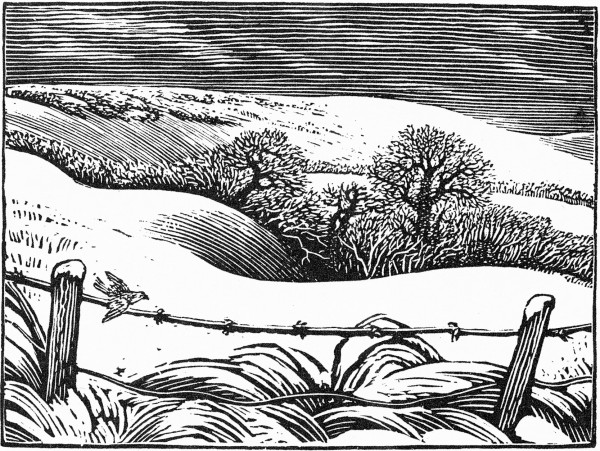
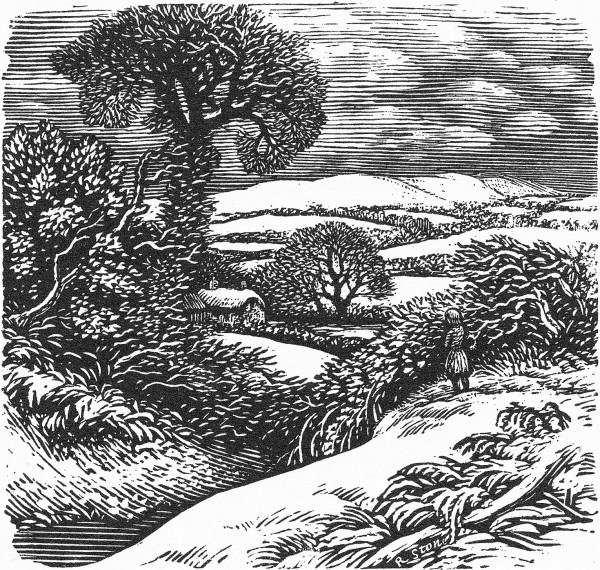
Wood Engravings by Reynolds Stone
Chapter 6. The Prime Suspect

On Christmas Eve, a vital break in the case came when the maul used as the weapon to kill the Marrs was recognised by Mr Vermilloe, the landlord of The Pear Tree. He reported that the initials I.P. were those of its owner John Peterson, a German carpenter from Hamburg who had recently lodged at The Pear Tree and left his tool chest there for safe keeping when he returned to sea.
This breakthrough led to to John Williams. He was twenty-seven, an ordinary seaman who had once sailed with Timothy Marr on the Dover Castle. Upon his return from sea, he had taken lodgings down by the river at The Pear Tree in Cinnamon Street, Wapping – still cobbled today as it was in 1811. Although superior in education to his colleagues and possessing a fastidious, even foppish concern for his appearance, he was of quick temper and easily provoked into brawls. As well as the connection to Mr Marr, he had been seen at the King’s Arms on the evening of the murder of the Williamsons and returning to his lodging that night after twelve, he requested his room-mates to put out the candle. This circumstantial evidence was enough to lead to his arrest and remand at Coldbath Fields Prison in Clerkenwell, pending further investigation.
That very evening, John Williams was brought to Shadwell for interrogation in front of the magistrates in a crowded courthouse. John Turner, the Williamson’s lodger who had seen the killer standing over Mrs Williamson’s corpse was there but although he recognised John Williams as a regular at the King’s Arms, he could not positively identify him as the killer. The questioning moved on to the laundress who washed John Williams’ clothes. She confirmed bloody finger marks upon a shirt but was unclear of the date of this discovery. Then Mrs Vermilloe took the stand (her husband was confined to Newgate Prison for debt) and when she was overcome with emotion at being asked to identify the maul, two little boys were sent for who had been playing with it.
At this moment, John Williams was questioned about his bloody shirt only to describe a fight he had with a number of Irish coal-heavers over a card game at The Royal Oak. Next, his fellow lodgers were asked about Williams’ mysterious request to put out the candle, and it became unclear which night this incident occurred. Next, one of the boys who had been playing with the maul, William Rice, aged eleven years old, arrived. He confirmed that the maul used to kill the Marrs was the same one from The Pear Tree and he had not seen it for a month.
It was now late on Christmas Eve, and the magistrates decided to adjourn proceedings until after the holiday. At this point John Williams could contain his frustration no longer and attempted to speak – calling out a question – but was forced to desist. We shall never know what he tried to ask. Instead, he was taken back to Coldbath Fields Prison and residents of the neighbourhood were able to sleep peacefully in their beds for the first time in many weeks, secure now in the widely-held but entirely tenuous assumption that the killer was under lock and key.
You may read a further report upon the resumption of the hearing on Boxing Day.

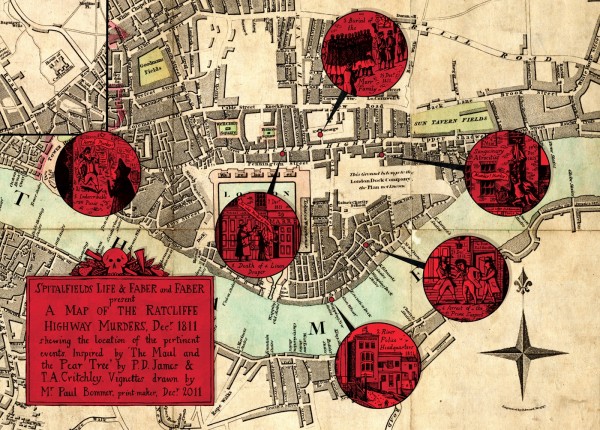
Click on Paul Bommer’s map of the Ratcliffe Highway Murders to explore further
I am indebted to PD James’ ‘The Maul & The Peartree’ which stands as the authoritative account of these events. Thanks are also due to the Bishopsgate Institute and Tower Hamlets Local History Archive.
You may like to read the earlier instalments of this serial which runs throughout December
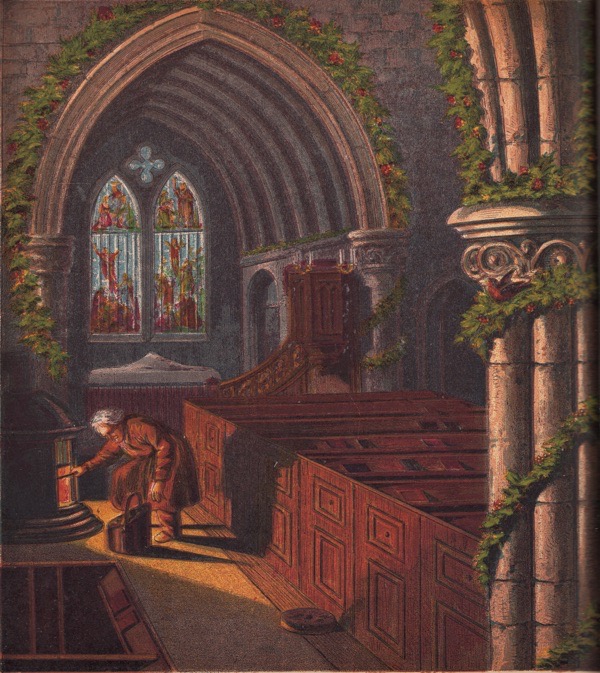
The Robin’s Christmas Eve
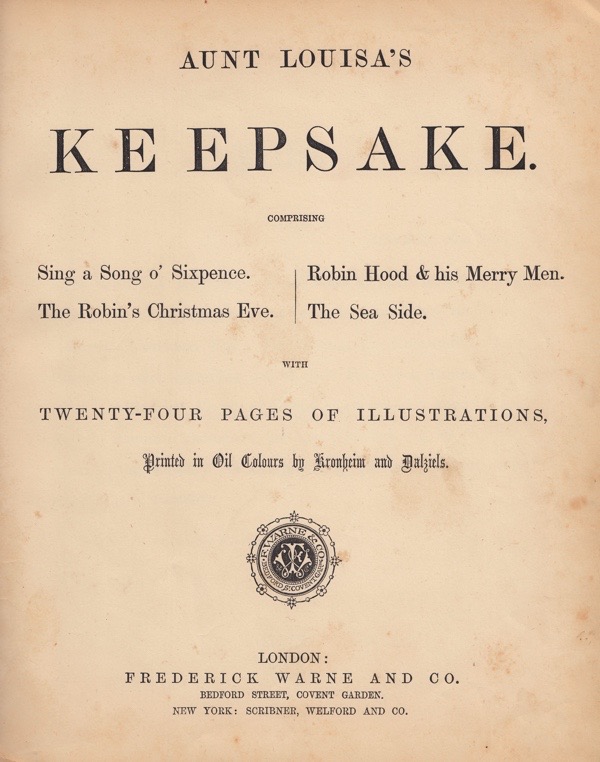
This extract is from ‘Aunt Louisa’s Keepsake’ published by Frederick Warne which was given to me by Libby Hall. The copy is inscribed ‘Christmas 1896’ inside the front cover.
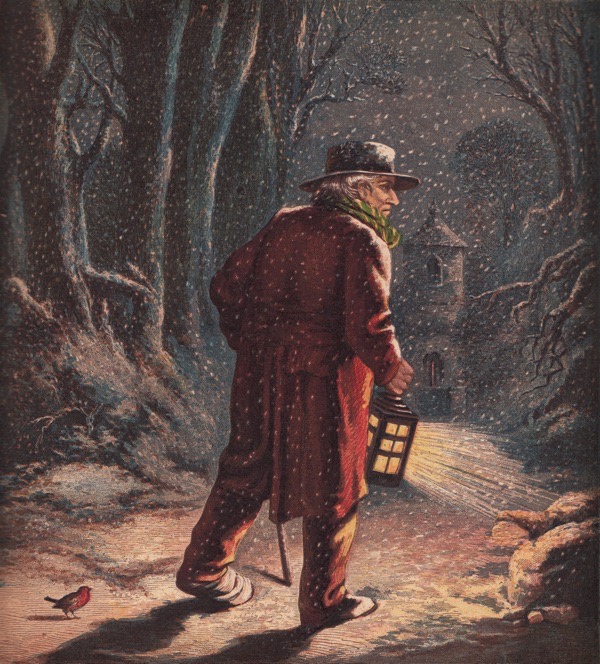
‘Twas Christmas-time, a dreary night,
The snow fell thick and fast,
And o’er the country swept the wind,
A keen and wintry blast.
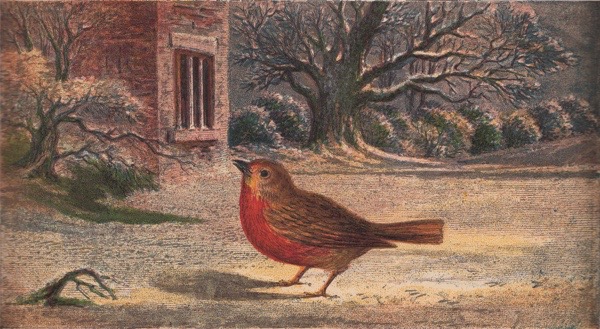
The Robin early went to bed,
Puffed up just like a ball,
He slept all night on one small leg,
Yet managed not to fall.
No food had touched his beak,
And not a chance had he
Of ever touching food again,
As far as he could see.
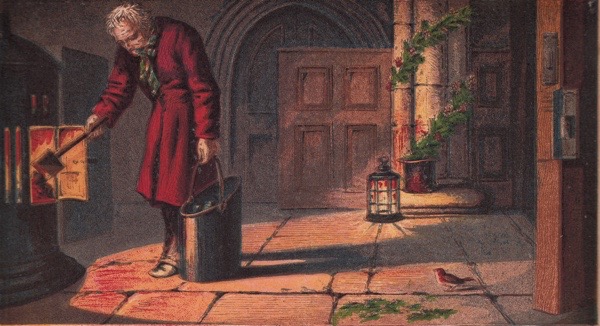
The stove had not burnt very low,
But still was warm and bright,
And round the spot whereon it stood,
Threw forth a cheerful light.
Now Robin from a corner hopped,
Within the fire’s light.
Shivering and cold, it was to him
A most enchanting sight.
But he is almost starved, poor bird!
Food he must have, or die,
Unless it seems, alas! for that
Within these walls to try.
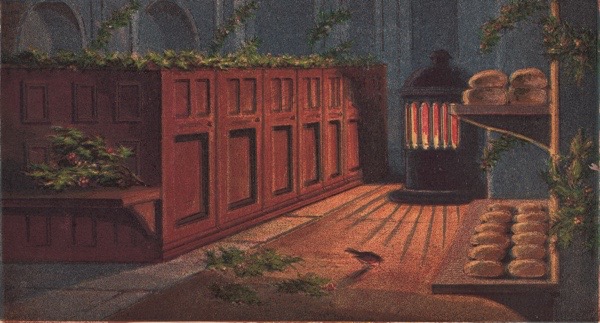
Perhaps ‘t is thought by those who read
To doubtful to be true,
That just when they were wanted so
Some hand should bread crumbs strew.
But this is how it came to pass,
An ancient dame had said,
Her legacy unto the poor
Should all be spent on bread.
Enough there was for quite a feast,
Robin was glad to find.
The hungry fellow ate them all,
Nor left one crumb behind.

You may also like to take a look at
Chapter 5. Indescribable Panic

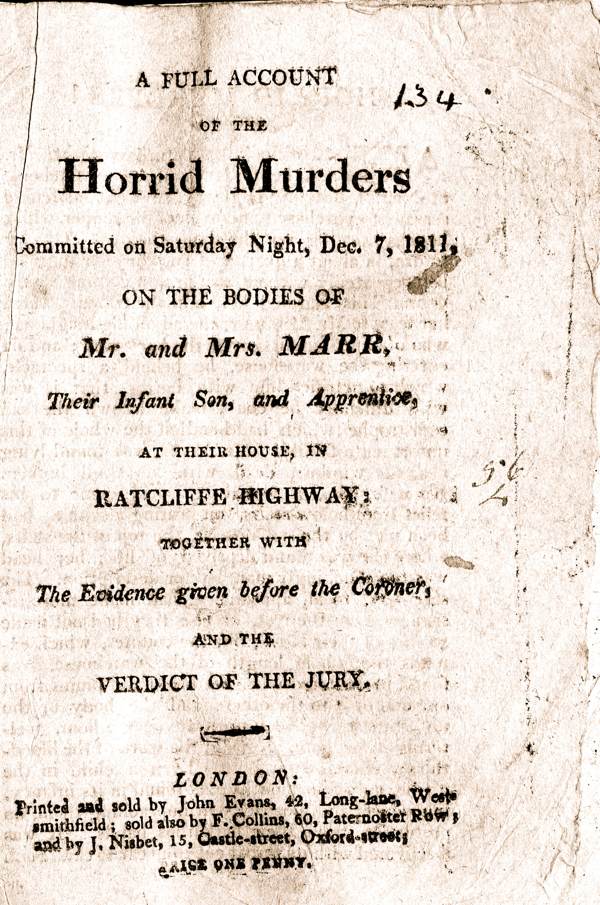
At Dove Cottage in Keswick, three hundred miles north of London, Robert Southey and Thomas de Quincey were reading the national newspapers with feverish excitement, as – like thousands of others – they followed every turn in the saga of the murders in Shadwell in December 1811. Southey declared it a rare example of “a private event of that order which rose to the dignity of a national event.” De Quincey wrote “the panic was indescribable. One lady, my next neighbour, whom I personally knew, living at that moment, during the absence of her husband, with a few servants in a very solitary house, never rested until she had placed eighteen doors (so she told me, and indeed satisfied me by oracular proof), each secured by ponderous bolts, and bars, and chains, between her own bedroom and any intruder of human build.”
In London, the question was raised how John Turner, the lodger at the King’s Arms, could have seen the murderer and then abandoned the infant Kitty Stilwell to her fate in seeking his own escape from the building. But De Quincey, having read the newspaper reports, launched into a powerful imaginative identification with the lodger. In justification of leaving the child sleeping, De Quincey surmised that the lodger “felt sure that sure that the murderer would not be satisfied to kill the poor child whilst unconscious. This would be to defeat his whole purpose in murdering her at all – to be an epicure of murder.” A startling creative leap.
At the inquest, Turner explained in his own words, “I went to bed and had not been there above five minutes before I heard the front door being banged to: very hard. Immediately afterwards I heard the servant exclaim ‘We are all murdered’ or ‘shall be murdered’ two or three times, I cannot be exactly sure which of the expressions she made use of. I had not been asleep. I heard the sound of two or three blows, but with what weapon I cannot say. Shortly afterwards, I heard Mr Williamson cry out, ‘I’m a dead man.'”
Although he knew of the murders a week earlier, astoundingly, Turner unlocked his door and crept downstairs where he spied through a doorway upon the murderer in the dark rifling through the pockets of a victim. “I did not see his face, and I only saw that one person. I was fearful and I went upstairs as quick but as softly as I could. I thought first of getting under the bed, but was fearful I should be found. I then took the two sheets, tied them together, tied them to the bed post, opened the window and lowered myself down by the sheets.”
No-one knew where the murder or murderers would strike next. “Many of our readers” wrote Thomas Macaulay years later, “can remember the state of London just after the murders of Marr and Williamson – the terror which was on every face – the careful barring of doors – the providing of blunderbusses and watchmen’s rattles. We know of a shop keeper who on that occasion sold three hundred rattles in ten hours.”
Regular reports will be forthcoming here during the Christmas holidays.

Robert Southey

Thomas de Quincey

Click on Paul Bommer’s map of the Ratcliffe Highway Murders to explore further
I am indebted to PD James’ ‘The Maul & The Peartree’ which stands as the authoritative account of these events. Thanks are also due to the Bishopsgate Institute and Tower Hamlets Local History Archive.
You may like to read the earlier instalments of this serial which runs throughout December
Scenes From Dennis Severs’ House
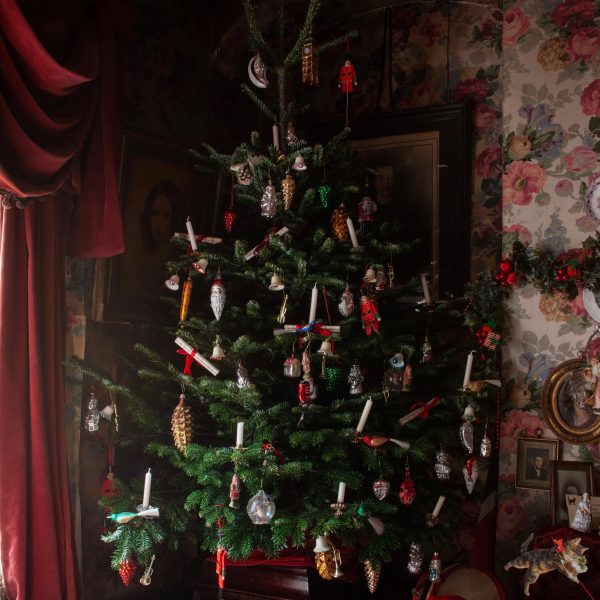
Over the past year, it has been my delight to work for the Spitalfields Trust at Dennis Severs’ House, devising the new Dennis Severs’ Tour and rehearsing the actors, Joel Saxon and Lisa D’Agostino who are hosts. Here I present a few vignettes of the life of this celebrated house in Folgate St.
If you would like to visit over the festive period , please check www.dennissevershouse.co.uk because cancellations mean tickets can become available at short notice
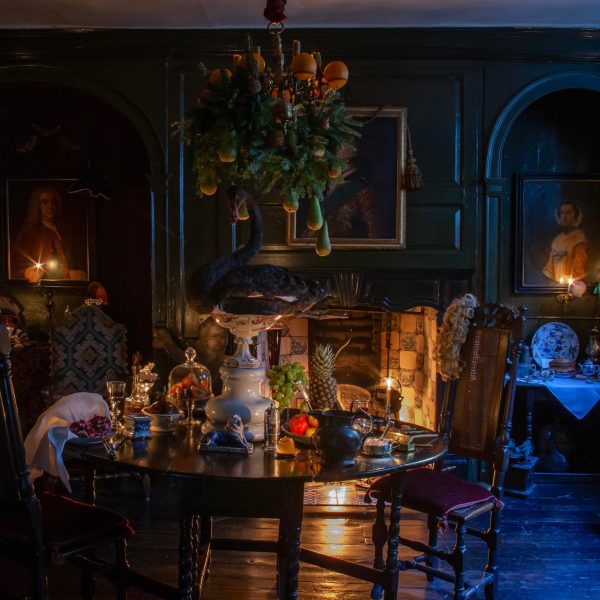
The Dining Room at Christmas
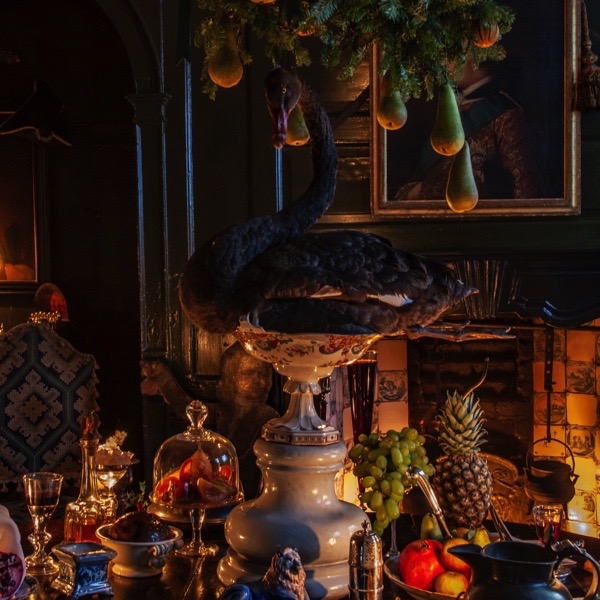
‘Mrs Jervis prefers a roast swan at Christmas. It suits her aristocratic sensibilities as it was a favoured dish in the courts of Henry VIII and Elizabeth I, particularly when skinned and redressed in its feathers and served with a yellow pepper sauce. Sometimes she serves it stuffed with a series of increasingly smaller birds, in the style of a turducken.
Mature swans have little subcutaneous fat and their flesh is exceedingly dry, making them a tough and entirely unsuitable meat. Consequently, eating an adult plumed swan was more of a statement than a culinary treat. Mrs Jervis chooses a cygnet hatched in June, plump and tender by December, as the perfect Christmas meat – still tender and fatty.’
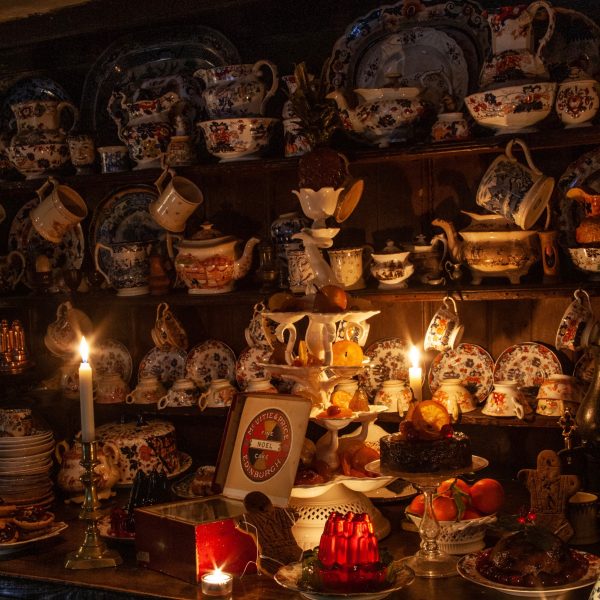
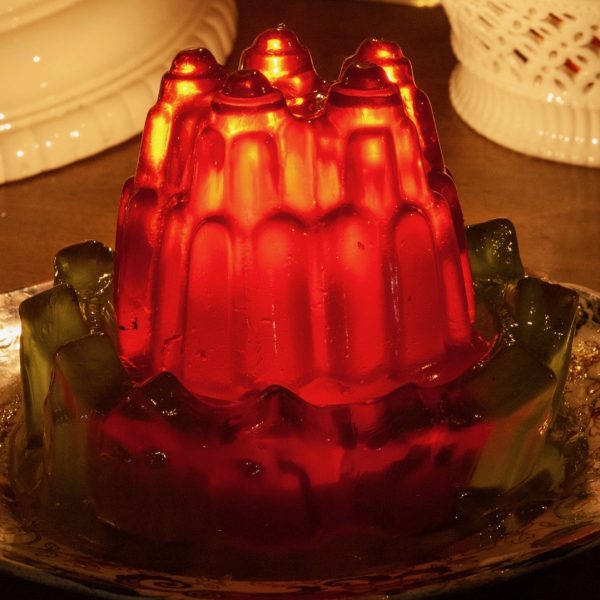
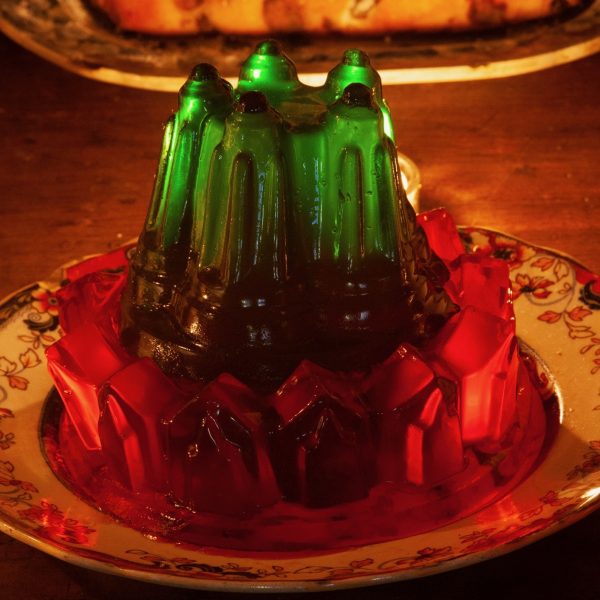
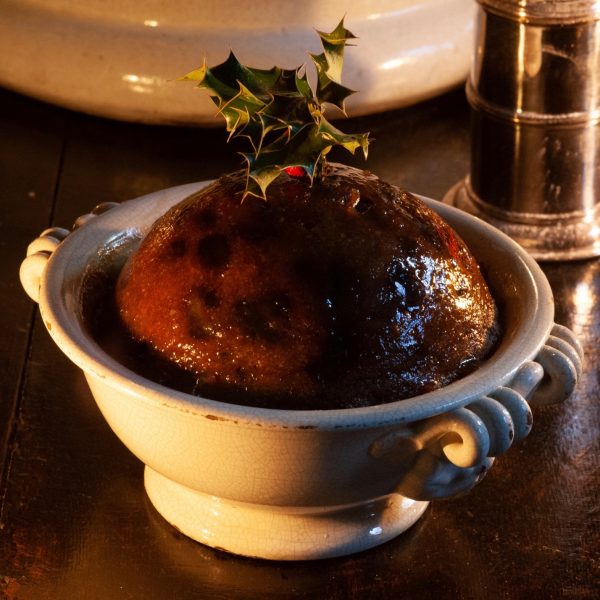
The kitchen dresser groans under the proliferation of jellies, puddings and pies at this time of year
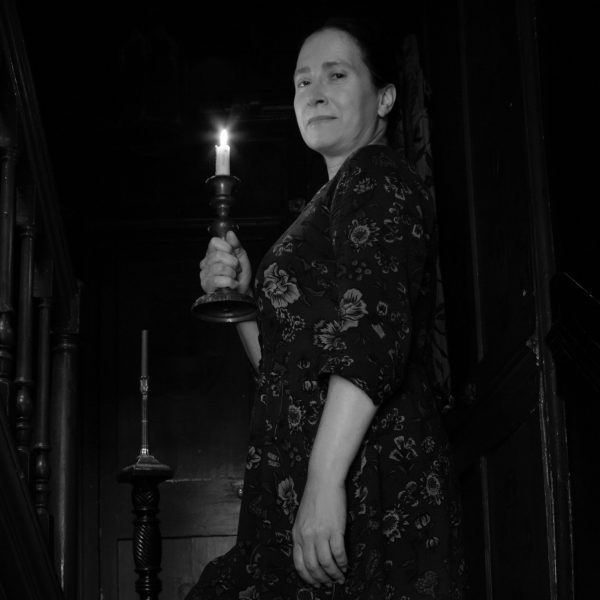
Lisa D’Agostino has been hosting tours since November
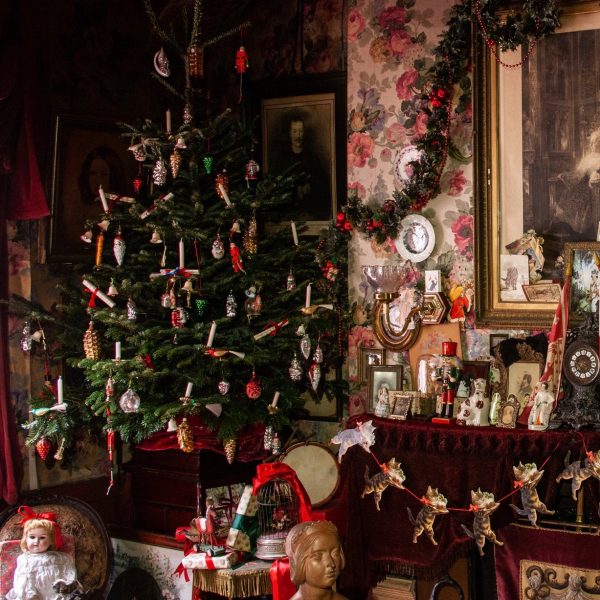
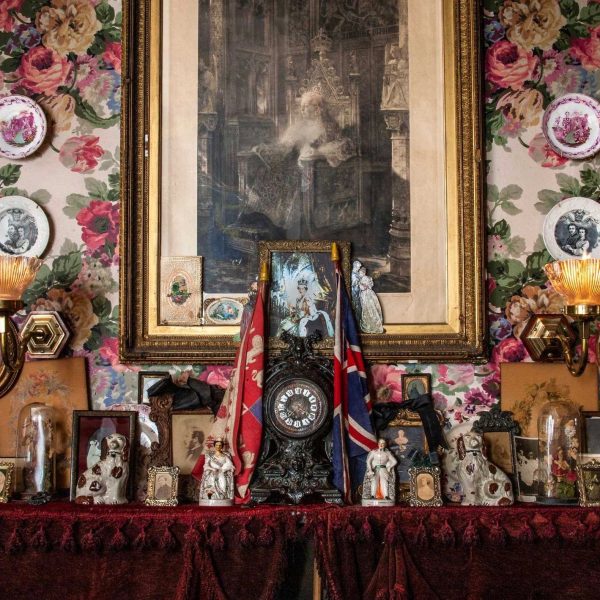
‘At twenty seconds to midnight on 31st of December 1899, the old house holds its breath. Miss Isabel Jervis waits by her fire. She is all alone now. She gazes at Queen Victoria’s portrait and she wonders what the twentieth century will hold. Next morning, when she opens the shutters, the streets are silent and empty.
When Victoria died in the arms of her German grandson, the Kaiser, at Osborne House, the Lord Chamberlain knew what to do. As long as there were remnants of a silk industry in Spitalfields where the fabric of her wedding dress was made, the Queen wished that the black crepe for her funeral pall was woven there too. And it was.’
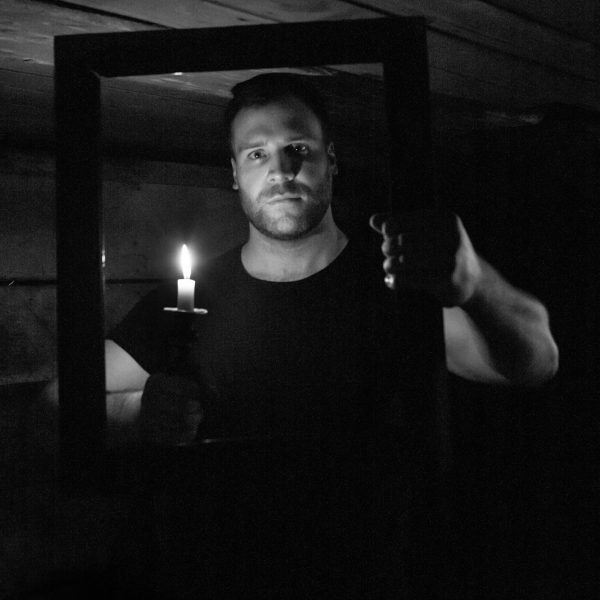
Joel Saxon has been hosting tours since the house reopened in the summer
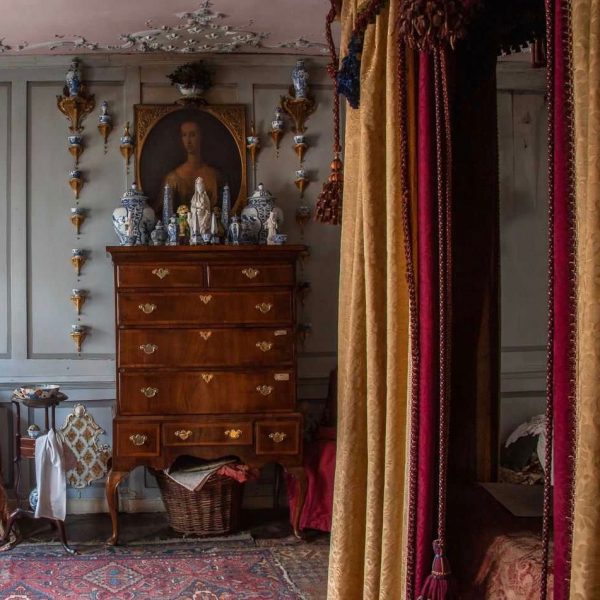
‘Now our journey to the heart of the house arrives at the private place that holds its owner by night, the master’s bedchamber. Here society ends and intimacy begins. At the centre of the room stands the grandest upholstered four-poster bed imaginable, hung with braided damask.
Here Edward and Elizabeth Jervis conceived their children. They wedded at Christ Church on 2nd June 1761 and shared this bed throughout their marriage. They were the first generation to do so, for theirs was a love match.’
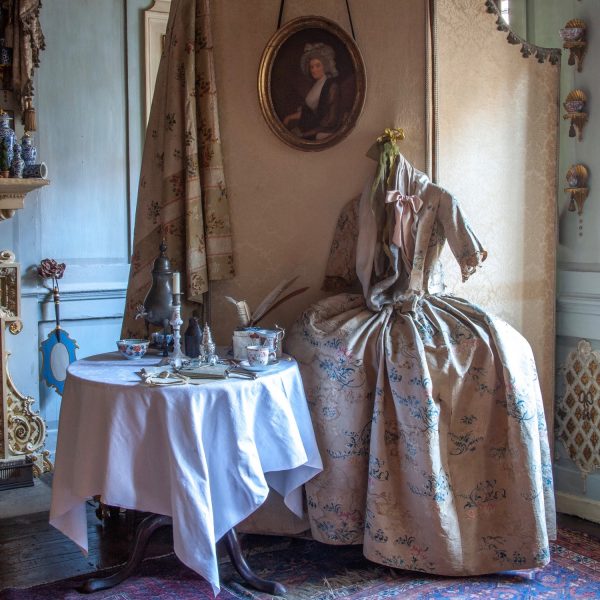
‘Mrs Jervis wore no underwear, just a shift of fine linen, then silk stockings and garters to hold them up. Next came her stays of whalebone, that we should call a corset, and then her hooped petticoat, also with whalebone and cross ties to maintain the oval shape of the dress and not allow it to become circular. Finally, Mrs Jervis could put on her dress, which came in three pieces, first the skirt, then the stomacher followed by the bodice. There were no hooks or buttons to hold it all together, so pins would be used and a few discreet stitches where necessary. As a finishing touch, lace sleeve ruffles were added and a lappet upon her head. Shoes and a fan completed the outfit.’
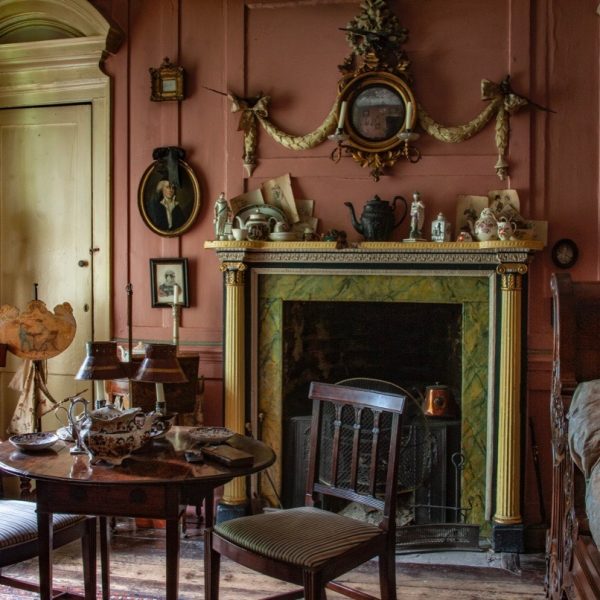
‘Here we enter the boudoir – a powerfully feminine space where fresh, soft colours prevail. The room is as warm as toast. A newly installed hob grate has been fitted to the fire to accommodate coal and it burns more efficiently than ever before. The ladies are halfway down the stairs, but their chairs are still warm and their tea is still steaming in their cups. The chairs encourage a more relaxed posture and the daybed offers an unspoken invitation to recline. How tempting it is to remove our shoes? Just in from the past, we are more than glad to meet such comfort.’
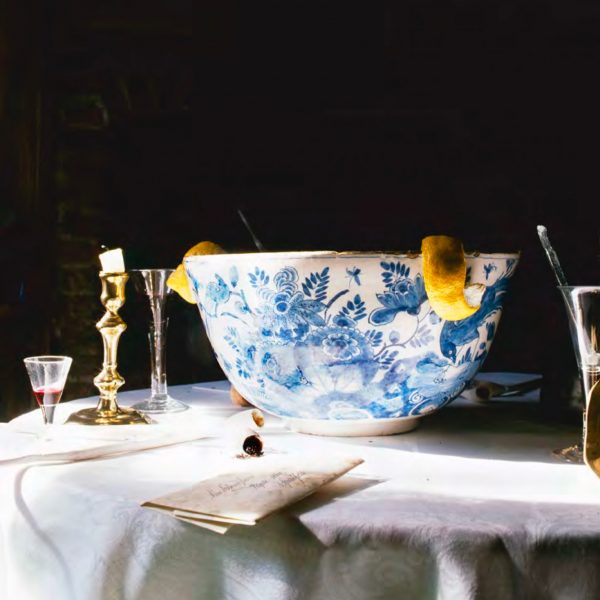
‘Admire Mr Jervis’ punchbowl – ‘punch’ is the Hindu word for five which is why there are always five ingredients. Oddly enough, when someone punches you in the mouth it also has five ingredients.’ (Photograph by René Stoeltie)
All photographs by Lucinda Douglas Menzies except when credited otherwise
Fritz Wegner’s Christmas Plates
A few years ago, I came across this set of small souvenir Christmas plates Fritz Wegner designed for Fleetwood of Wyoming between 1980 and 1983 in limited editions, which I acquired for almost nothing. They are crudely produced, not unlike those ceramics sold in copyshops with photographic transfers, yet this cheap mass-produced quality endears them to me and I set them out on the dresser every Christmas with fondness.
I discovered my delight in the work of illustrator Fritz Wegner (1924-2015) in primary school through his drawings for Fattypuffs & Thinifers by Andrew Maurois. Throughout my childhood, I cherished his book illustrations whenever I came across them and the love of his charismatically idiosyncratic sketchy line has stayed with me ever since.
Only recently have I learnt that Fritz Wegner was born into a Jewish family in Vienna and severely beaten by a Nazi-supporting teacher for a caricature he drew of Adolf Hitler at the age of thirteen. To escape, his family sent him alone to London in August 1938 where he was offered a scholarship at St Martin’s School of Art at fourteen years old, even though he could barely speak English.
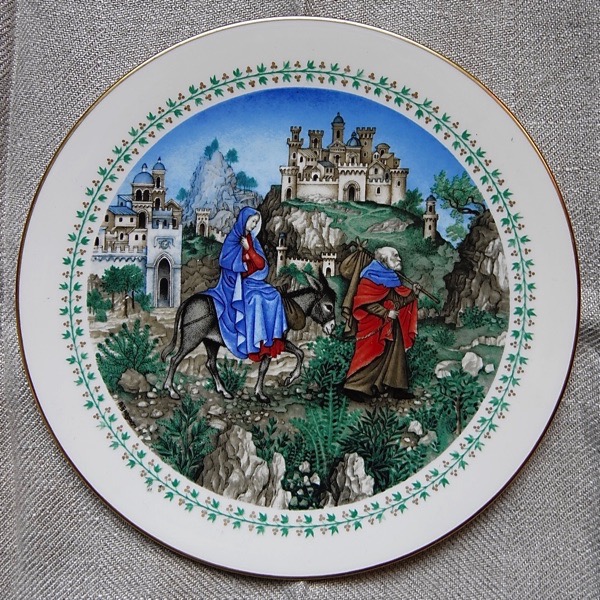
Journey to Bethlehem, 1983
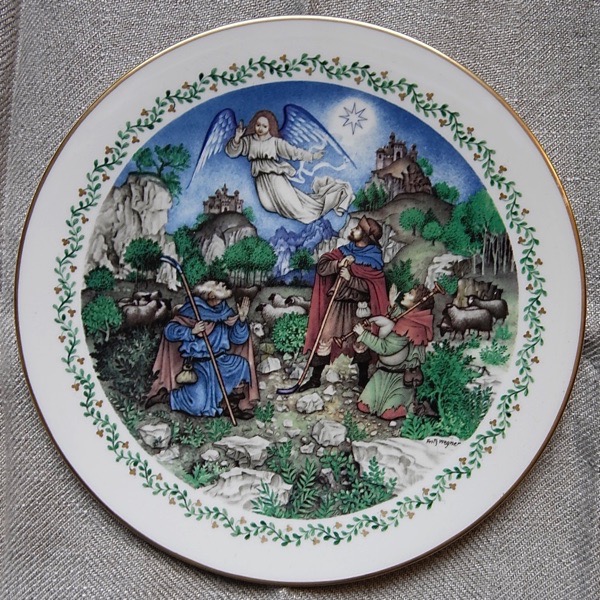
The Shepherds, 1982
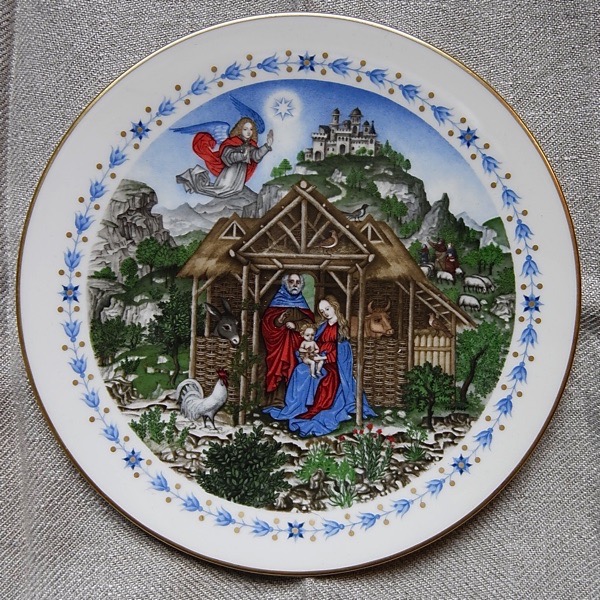
The Holy Child, 1981
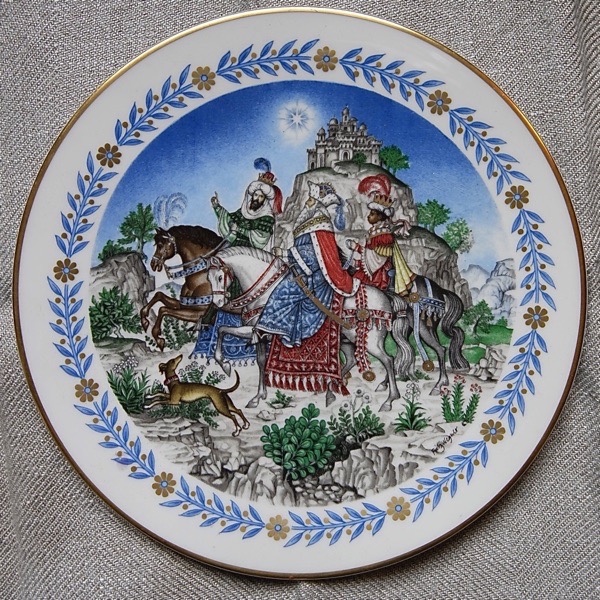
The Magi, 1980
You may also like to take a look at