The City Churches Of Old London
Discover the wonders of the City of London Churches in the company of celebrity guides (including Spitalfields’ own Dan Cruickshank) this Thursday 10th June. Click here for details.
St. Michael, Cornhill, 1912
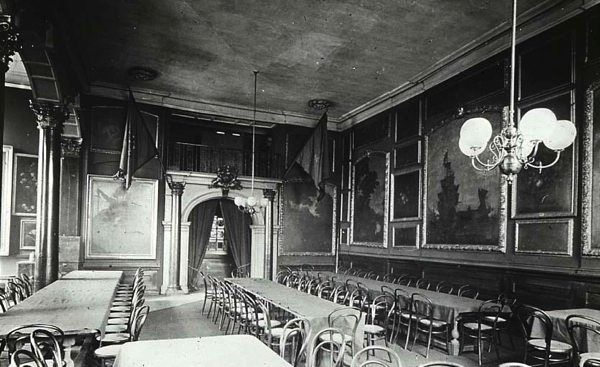
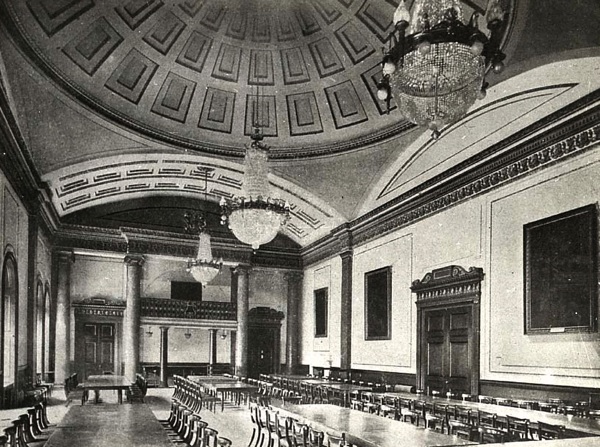
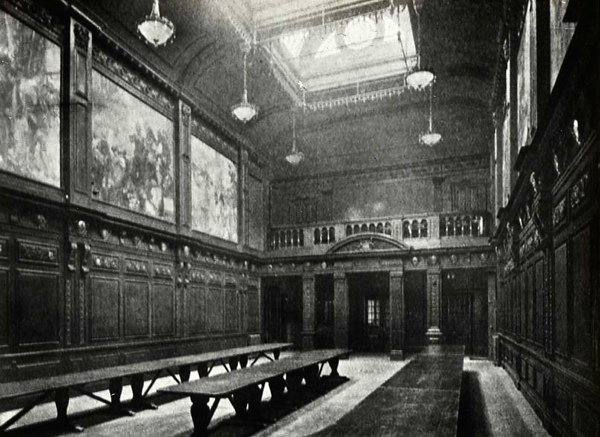
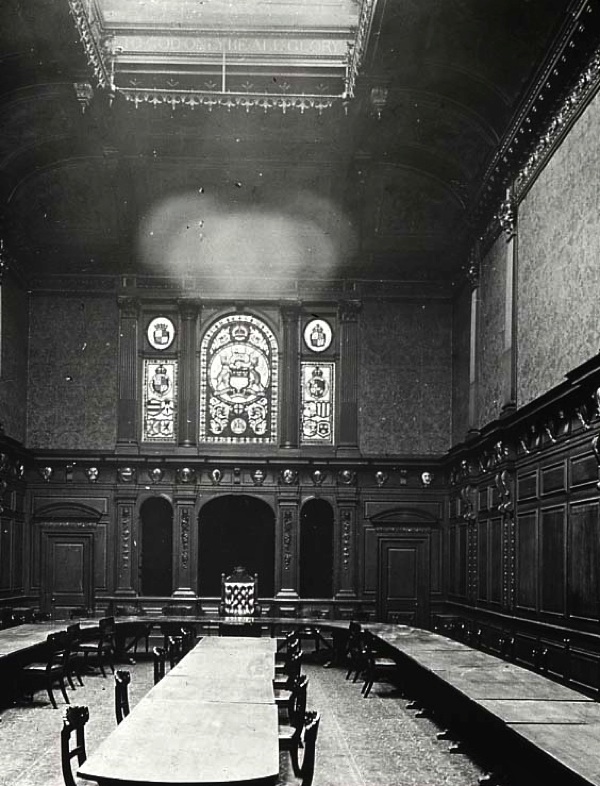
As shabby old residents that have survived from another age, the churches speak eloquently of an earlier world when the City of London was densely populated and dozens of places of worship were required to serve all the tiny parishes crowded up beside each other. Yet in spite of the encroachment of towers around them, these intricately wrought structures stubbornly hold their own against newcomers today.
In the process of getting to know them, I acquired a literary companion – John Betjeman, who knew these churches as well as anyone and was refreshingly candid in his opinions. While grieving the loss of seven Wren designs to the German bombers in World War II, he managed to find a silver lining.”They did us a favour in blowing out much bad Victorian glass,” he declared with unapologetic prejudice.
Yet I could not but concur with his estimation of the contemporary significance of these churches when he wrote – “As the impersonal slabs of cellular offices rise higher into the sky, so do the churches which remain in the City of London today become more valuable to us. They maintain a human scale…” And that was in 1965, before most of the financial towers were built.
St Mary le Bow, Cheapside, 1910
St Augustine, Watling St, 1921 – now part of St Paul’s School
St Andrew Undershaft, St Mary Axe, c. 1910
St Mary Abchurch, c. 1910
St Margaret Patterns, Eastcheap, 1920
St Mary Woolnoth, Lombard St & Bank Tube station, c. 1920
St Stephen Walbrook, 1917
St Clement Danes, c. 1910
St Alban, Wood St, c. 1875 – only the tower remains
St Clement Danes, c. 1900
St Margaret, Lothbury, 1908
St George the Martyr, Borough, 1910
St. Katherine Coleman, Magpie Alley, c. 1910 – demolished in 1926
St. Magnus the Martyr, c. 1910
St Magnus the Martyr & the Monument from the Thames, c. 1920
St Dunstan in the East, 1910
St Dunstan in the West, Fleet St, c. 1910
St. Michael Paternoster Royal, 1922
St Bride, Fleet St, 1922
St Dunstan in the East, 1911
St Mary Le Strand
Images courtesy © Bishopsgate Institute
Happy Birthday Milly Abrahams!
Join me in sending birthday wishes to Milly Abrahams, 100 years old today!

Milly Abrahams (nee Markovitch)
Photographer Martin Usborne & I took the trip to Wembley to visit Milly Abrahams, whose late brother Joseph Markovitch was the subject of Martin’s book I’ve Lived In East London for Eighty-Six & A Half Years. Milly left the East End over seventy years ago but, still hale and hearty, her childhood remains vivid to her today.
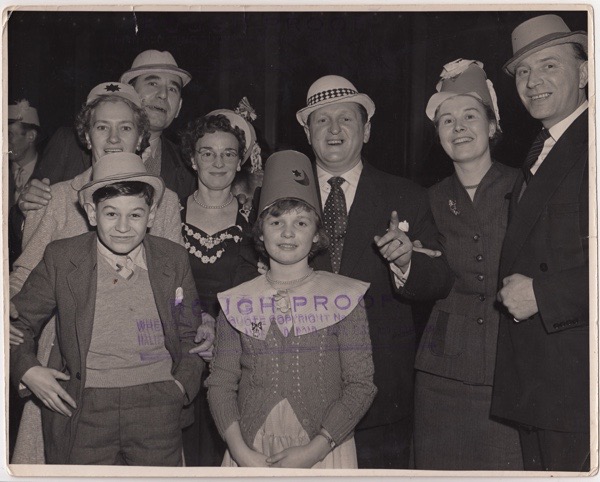
“I was born in a tenement house in Gosset St, Bethnal Green, but my mother got very ill and we were taken to Mother Levy’s Maternity Home in Underwood Rd, and we stayed there a little while – so my mother told me. In those days parents never told you much. If you asked questions, they’d say in Yiddish ‘What do you want to know for?’
I asked my mother, ‘How did you come over here?’ Somebody brought her over from Krakow and left her here and she went into service – that’s what she said. Krakow was Austria when she was born, but now it’s Poland. Neither of my parents knew what age they were when they came over. My mother had nobody here, though my father came over with his sisters and a brother who died, so I knew all the aunts. My father came from Kiev, which was Russia then and now it’s Ukraine. He tried to trace my mother’s side of the family because she said something about them going to America, yet he never found anything. So she had nobody.
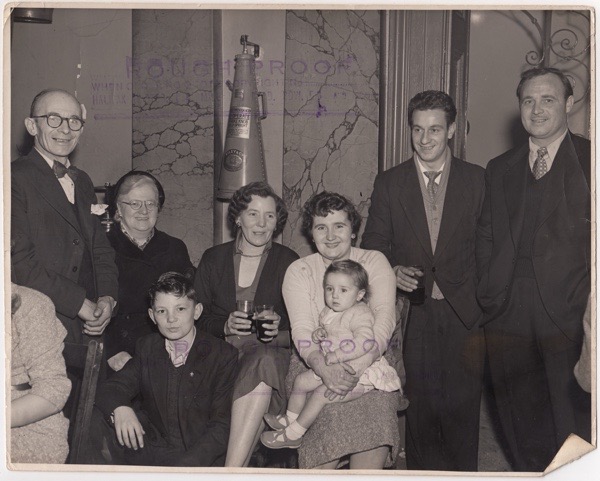
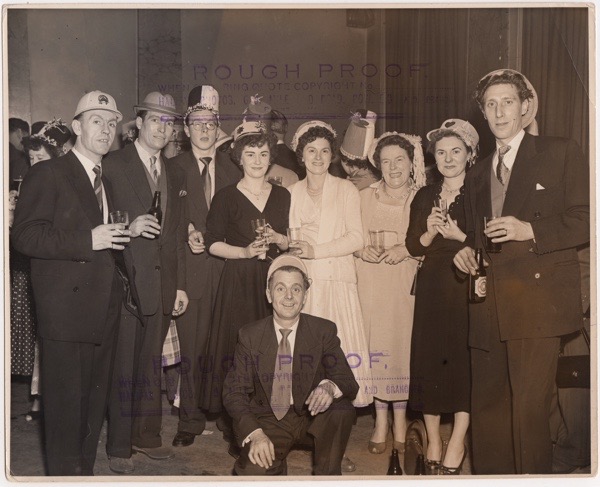
They met here when she was in service and he lived next door with his sisters. They liked chicken soup but they had to water it down to make it go round. My parents got married with nothing. My father was a sick man who was always ill, he was a presser in the tailoring trade. He had trouble with his hands and I remember my mother putting cream on for him and bandaging them up. So he never really worked, but the Jewish community in the East End were very good. We were never a burden on the State, because we had all these Jewish charities – the Jewish Board of Guardians, the Jewish Soup Kitchen and all that. I went to the Jewish Free School in Bell Lane where I got free uniform, meals and seaside holidays. We used to stay in these big houses by the sea and they brought kosher food from London
Where I lived, we had the Catholics, the Protestants and the Jewish but we were all together. Nobody had any money. The non-Jewish people were very good, they used to sit outside in the street and drink tea with us. We were so happy, we didn’t know anything else. Nowadays people expect to have bathrooms ensuite and three toilets, we had a toilet in the yard. Among Jewish people, if you lived next door and you had a little bit more, you would knock on your neighbour’s door on Friday or Saturday and give them some money, yet nobody would know about it. It was kept quiet.
My father wasn’t religious at all, he was a Communist more-or-less. When we used to smell the neighbours’ bacon and want to run upstair to have some, my mother would tell us we couldn’t have bacon. When the Yiddish Theatre in Whitechapel staged benefits, we used to go along. My parents only spoke Yiddish or broken English and, even now, sometimes I mix up my words. We saw plays with well-known actors entirely in Yiddish but we all understood it.
My mother had four children and she lost one – two girls, Leah and me, two boys, Morrie and Joey, Joseph. Leah was the eldest and I was second, then Morrie and Joey, he was the last. I have to say, my mother did the right thing with Joey. He couldn’t speak clearly, but we understood him because we were used to it. They called them ‘backward’ in those days. My mother sent him to a special school and that’s where he learnt to read and write, but people used to say, ‘Why are you sending him there? It’s the madhouse!’
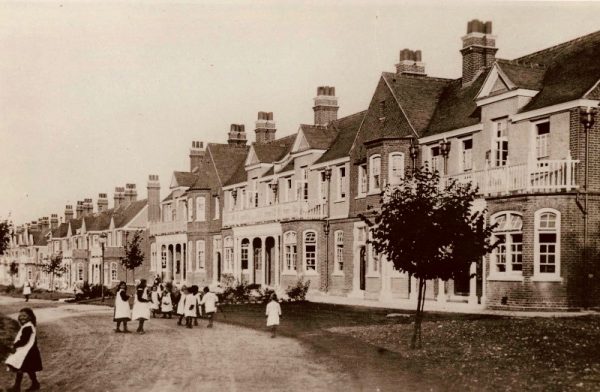
From Gosset St, we moved to Sonning Buildings on the Boundary Estate where we had more room and it was much better. In Gosset St, we slept in one room, my mum and dad and the four of us children. In bed, two of us slept one way and two the other. On Fridays, we used to get out the bath and all have a wash. My father used to help my mother, bathing us with the same water – that’s how it was then.
After I left school at fourteen, I worked as a machinist in a factory in Fournier St making ladieswear. The manager was a nice young bloke but it was hard work. If you talked, they said, ‘Stop talking and get on with your work.’
I belonged to the Brady Club in Hanbury St. We were kept separate and the boys’ club was round the corner somewhere, yet they used to come on their bikes to meet us and take us home on the crossbar. We only got together on Sunday nights when they had dancing.
I met my husband, David, after the war and we married when I was twenty-seven. He was a gunner and he had been in the army for six years, fighting. He was wounded, he went deaf from the gunfire and he got dysentry, but he never had a penny in compensation or a war pension, just a basic state pension.
David was a tailor in ladies tailoring, he didn’t want to be one but in those days you did what your parents told you. So when I got married, I helped my husband as a machinist because his family had a factory. At first, we lived with my mother-in-law in Old Montague St because we couldn’t afford a place of our own.
At last, when my son Alan was three, we moved here to Wembley. I missed the East End but I got used to it here, all these houses were brand new and inhabited by newly-weds from wealthy Jewish families – although we weren’t in that category. They all started having babies, and I had my second son Anthony and my daughter Shelley. The grandparents used to come to visit and bring expensive toys and, as the gardens were open, the children ran into each others’ gardens, saying ‘This is was what my grandma and pa brought me!’ My kids weren’t jealous, they just used to say, ‘Bubba and Nanny are poor.’
Joey never left home, he lived with my mother in Sonning Buildings and they used to come here to visit at weekends. He was lovely little kid, he was the only one of us that wasn’t ginger, he was blond. He never had a proper job, only odd jobs. It was very difficult, but my mother never put him in an institution like a lot of people did in those days. He was always unwell, with chest problems, yet he was always chatty speaking to everyone. He was very interested in Politics and always talking about Money and the Country. Joey and me used to go to the cinema in Hoxton together to see Dick Powell and Ingrid Bergman films. We saw Gone With The Wind and came out crying.”


Milly is on the left and her sister Leah on the right of this family group from the twenties

Milly is in the centre, Leah on the right and Maurice on the left of this family group

Joseph is in the centre, Milly on the left, Leah at the top and Maurice on the right


Milly as a young woman

Milly and her husband David Abrahams, as photographed by Boris of Whitechapel

Milly Abrahams, Dressmaker
Portraits copyright © Martin Usborne
You may also like to read about

Sebastian Harding’s Architectural Models

Part of Sebastian Harding’s model of the Truman Brewery
Sebastian Harding’s model of the Truman Brewery is the centrepiece of the Battle for Brick Lane exhibition at Annetta Pedretti’s House, 25 Princelet St, E1 6QH, from noon until 6pm this Saturday 5th & Sunday 6th June and Saturday 12th & Sunday 13th June. If you would like to volunteer to invigilate this weekend, please email spitalfieldslife@gmail.com
Here are some of Sebastian’s other creations.

Foyles Building, 113-119 Charing Cross Rd
In 1929 William Foyles opened his newly expanded bookshop here after trading on the same street since 1906 and it soon became known as one of the largest of its kind in Europe.
The Charing Cross Rd facade dates from the early nineteen-hundreds and boasts a simple asymmetric design built of plum red brick with classical columns. The building ran back the length of Manette St with a bolder Art Deco facade dating from 1929 and these two facades were charmingly interrupted on the corner of the building by an early Victorian stuccoed facade.
For generations of book lovers, this huge building provided a haven of tranquility in the noisy and chaotic hub of central London. For over eighty years Foyles, with its labyrinthine layout, sprawling floors and large cafe was far more than just a bookshop. Full of oddly-shaped spaces and quiet corners, the place exuded an irresistibly-inviting atmosphere.

The Marquis of Lansdowne, Cremer St, Hoxton
Opening before 1838, The Marquis of Lansdowne was a typical East End pub which became the focus for workers in the cabinet-making trades which filled the surrounding streets for over a century. After drastic slum clearance and redevelopment in Hoxton in the mid-twentieth century, the pub fell into decline and closed. In 2013 David Dewing, Director of the Geffrye Museum (now the Museum of the Home) announced the demolition of the pub for the sake of a concrete cube restaurant as part of a multi-million pound revelopment of the museum designed by Sir David Chipperfield. However, largely thanks to a campaign by readers of Spitalfields Life, Hackney Council refused permission for demolition of the historic pub. Subsequently, the Heritage Lottery Fund supported a new scheme by Wright & Wright which requires no demolition, expanding the museum’s galleries by opening up unused spaces in the existing buildings and restores the Marquis of Lansdowne.
The Saracen’s Head, 4-7 Aldgate High St
The Saracen’s Head public house was demolished in 1913. Even in the late nineteenth century, Aldgate survived as a slice of sixteenth and seventeenth century London until the developers moved in from the eighteen eighties to modernise these streets. It was one of the few places to avoid the Great Fire of 1666, where the locals gathered to watch the conflagration. This makes the Saracen’s Head all the more important to the area’s history and, though long gone, there is a plaque at No. 88 Aldgate High St commemorating its existence.
It operated as a coaching inn with a service that departed from the yard at the back, transporting Londoners to East Anglia – hence the building’s location on the main road eastward out of the city. The frontage holds wonderful early examples of Baroque decoration and the ornate moulding echoes the decoration seen on the Baroque post-Fire churches – including St Paul’s – that emerged throughout London at the time. When the building was demolished, it was functioning as the Metropole Restaurant with the Ladies Select Dining Room housed on the first floor. After its destruction, the Guildhall Museum bought the intricate wooden pilaster capitals for their collection, confirming its aesthetic importance.
Nicholas Culpeper’s House, Red Lion Field, Spitalfields
In 1640, when Nicholas Culpeper, the herbalist, married Alice Field, aged fifteen, he was able to build a substantial wooden house in Red Lion Field, Spitalfields, with her dowry. Here, he conducted his practice, treating as many as forty citizens in a morning, and in the land attached he cultivated herbs – collecting those growing wild in the fields beyond. Since Culpeper never finished his apprenticeship, he could not practise in the City of London but chose instead to offer free healthcare to the citizens of Spitalfields, much to the ire of the Royal College of Physicians. In this house, Nicholas Culpeper wrote his masterwork known as Culpeper’s Herbal which is still in print today.
After Culpeper’s death, the building became the Red Lion public house, surviving into the nineteenth century when it was demolished, as part of the road widening for the creation of Commercial St to carry traffic from the London Docks.
186 & 184 Fleet St
If you were to take a stroll down Fleet St today, you might like to take a closer look at the buildings that stand at 186 & 184. They perch immediately to the right of St-Dunstan-in-the-West on the north side of the Street in a row of inconspicuous turn-of-the-century buildings. On closer inspection each appears distinct, but all three are somewhat tall and somewhat narrow. Their cramped proportions are explained by the fact they were built, like much of London, on the site of two ancient pre-fire buildings.
The history of the nineteenth century buildings that occupy the site today relates directly to the rise of the newspaper trade that proliferated in the area. Indeed, Fleet St is still synonymous with British journalism despite all major publications now being headquartered elsewhere.
Today the site of 184 & 186 is home to the Scottish firm D.C. Thomson & Co., who claim to be the last newspaper group to retain a base on Fleet St, and the titles of their publications, The Sunday Post and The Dundee Courier, are still proclaimed in mosaic on the façade of their neighbour at 188.
Part of Rothschild Buildings, Spitalfields
Before their demolition in the seventies, the Rothschild Dwellings were visited by historian Jerry White whose first impression of the buildings was that he had “never seen tenements, so starkly repulsive” and “so much without one redeeming feature” in his whole life.
The Rothschild Dwellings were erected in 1888 by the ‘Four percent Industrial Dwellings Company’ and stood on the sight of what had once been respectable middle class residences in the seventeenth and eighteenth centuries, which had degenerated into lodging houses and slums. In the mid-nineteenth century, the old filthy streets with their myriad alleyways and courts were swept away. In their place, came the wide thoroughfare of Commercial St and large housing blocks such as the Nathaniel Dwellings (1892), the Lolesworth Buildings (1885) and, of course, the Charlotte De Rothschild Dwellings (1887). The tenants of these buildings were respectable working class tradesmen and craft workers able to pay the slightly higher rent.
The Fortunes Of War Public Tavern, Cock Lane, Smithfield
Smithfield Market’s proximity to St Bartholomew’s Hospital betrays a lot about the British public’s distrust of the medical trade. It is fitting therefore to focus on one building that catered to both trades – The Fortunes Of War Public Tavern.
Let us place ourselves in the eighteenth century as we watch a student of anatomy making his way into the tavern. He is here, not as you would expect for his leisure, but for his studies. He is led by the landlord down dank mouldering stairs to the cellar. Rows of sacks give off a pungent smell of rotting meat, yet these are not the carcasses of swine or cattle but the bodies of recently dead Smithfield residents.
This was the secret trade of the Body Snatchers or Resurrectionists that supplied students and professors of anatomy with fresh corpses. For a God-fearing public, it was immoral and barbarous in the extreme, for this was a time when many believed a soul would only be granted into heaven if their corporeal body was intact, while being dissected meant an eternity in purgatory.
John Aston’s House, Charterhouse Lane
John Aston was a priest in the parish of Smithfield, arrested at the same time as the influential protestant leader John Rogers. Queen Mary’s secret police randomly inspected any priests who had been advocates of protestantism before her ascension to the throne in 1553.
Unsurprisingly, the inspections would usually find a protestant bible or a mass being held. Typically, the raids were held on Sundays and John Aston’s misfortune was to be found eating meat in one of these raids. The tyrannical catholic religion of the sixteenth century forbade any consumption of meat on Sunday and he was burnt at the stake for this trifling pretence.
20 Cock Lane, Smithfield
The name of this street can be traced to its proximity to the market, where poultry would once have been traded, but it also serves also as a risqué innuendo, since for hundreds of years it was the preferred haunt of prostitutes. It was on this street that fraud, haunting, murder and sex were all intertwined in one story.
Late one November night in 1760,William Kent was away on business in Norfolk. His wife Fanny, wishing to alleviate the loneliness of her nights alone, invited Betty the youngest daughter of the Parsons – the landlord’s family – to sleep in her bed. In the night, Fanny was disturbed by scratching sounds like claws on wood and lay frozen with fear. On appealing to Mr & Mrs Parsons, she was told a shoemaker lived next door and her fears were assuaged. But the next night was Sunday when no good Christian would ever work, yet the scratching came again, brought to a terrifying end by a loud bang.
After William Kent returned the next night the sounds were not heard again. Then, two months’ later, after a furious row, Mr Parsons threw the Kents’ possessions out onto the street, even though William had not received a penny of the money he had loaned to his landlord the previous year. Subsequently, Fanny succumbed to smallpox and died on February 2nd 1761.
Some time later, the Parsons family began to hear the same scratching again and made sure it became a talking point for superstitious members of the community. The methodist preacher John Moore held a séance and ,when he asked if a spirit was present, a knock rang out. A second question followed – “Was the spirit that of the late Fanny?” Another knock. “Was Fanny murdered by her husband?” the reverend asked and then followed the loudest banging the party had heard.
Subsequently, William Kent was hanged, but afterwards the events were revealed as a fraud motivated by the feud between Mr Parsons and his tenant over the loan. Parsons was sentenced to three years in prison and three days in pillory, but later became regarded as something of a celebrity.
Mother Clapp’s Molly House, Field Lane
This was not a coffee house as we would know it, but rather a private club for gay gentlemen, where they could meet and form relationships without fear of discovery. The discretion of fellow members was crucial and entry was only permitted to those who knew a password. There were even gay marriage ceremonies conducted in locked rooms between men, with one donning a bride’s dress and the other a groom’s jacket. Mother Clapp herself presided over all, only leaving to get refreshments from the pub across the street.
Everything we know about this secret sub-culture stems from the raid by The Society For The Reformation Of Manners which had placed secret police inside the house. One man, a milkman, was hung for being found in the act of sodomy and Mother Clapp was sentenced to a day in the pillory. The crowd was so furious that they ripped the pillory from the ground and trampled it, and Mother Clapp died from the injuries sustained.
Sebastian Harding
Illustrations copyright © Sebastian Harding
You may also like to read about

The Broderers At St Paul’s
There is a display of Embroidery Treasures featuring vestments and a demonstration by the broderers each day this week in the south nave aisle at St Paul’s Cathedral, until Friday 4th June

Anita Ferrero
Like princesses from a fairy tale, the Broderers of St Paul’s sit high up in a tower at the great cathedral stitching magnificent creations in their secret garret. Contributing Photographer Sarah Ainslie & I climbed up one hundred and forty-one steps to pay a visit upon these nimble-fingered needleworkers.
‘There are fourteen of us, we chat, we tell stories and we eat chocolate,’ explained Anita Ferrero by way of modest introduction, as I stood dazzled by the glittering robes and fine embroidery. ‘It’s very intense work because the threads are very bright,’ she added tentatively, lest I should think the chocolate comment revealed undue levity.
I was simply astonished by the windowless chamber filled with gleaming things. ‘There are thirteen tons of bells suspended above us,’ Anita continued with a smile, causing me to cast my eyes to the ceiling in wonder, ‘but it’s a lovely sound that doesn’t trouble us at all.’
Observing my gaze upon the magnificent textiles, Anita drew out a richly-embellished cope from Queen Victoria’s Jubilee. ‘This is cloth of gold’ she indicated, changing her voice to whisper, ‘it ceased production years ago.’
‘There are still wonderful haberdashers in Kuala Lumpur and Aleppo,’ she informed me as if it were a closely-guarded secret, ‘I found this place there that still sold gold thread. If someone’s going to Marrakesh, we give them a shopping list in case they stumble upon a traditional haberdashery.’ Next, Anita produced a sombre cope from Winston Churchill’s funeral, fashioned from an inky black brocade embroidered with silver trim, permitting my eye to accommodate to the subtler tones that can be outshone by tinsel.
In this lofty chamber high above the chaos of the city, an atmosphere of repose prevails in which these needlewomen pursue their exemplary work in a manner unchanged over millennia. I was in awe at their skill and their devotion to their art but Anita said, ‘As embroiderers, we are thankful to have a purpose for our embroidery because there’s only so many cushions you can do.’
I walked over to a quiet corner where Rachel Rice was stitching an intricate border in gold thread. ‘I learnt my skills from my mother and grandmother, and I always enjoyed sewing and dressmaking but that’s not fine embroidery like this,’ she admitted, revealing the satisfaction of one who has spent a life devoted to needlework. Yet she qualified her pride in her craft by admitting her humanity with a weary shrug, ‘Some of the work is extremely tedious and it’s never seen.’
‘We are all very expert but our eyesight is fading and a few of us are quite elderly,’ confided Anita, thinking out loud for the two of them as she picked up the story and exchanged a philosophical grin with Rachel. Nowhere in London have I visited a sanctum quite like the Broderers chamber or encountered such self-effacing creative talents.
‘We not so isolated up here,’ emphasised Anita, lifting the mood with renewed enthusiasm, ‘Most people who work in the Cathedral know we’re here. We often do favours for members of staff, taking up trouser hems etc – consequently, if we have a problem, we can call maintenance and don’t have to wait long.’
I was curious to learn of the Broderers’ current project, the restoration of a banner of St Barnabas. ‘He’s the one saint I’d like to meet because he’s called ‘The Son of Encouragement’ – he looks like a nice guy,’ confessed Anita fondly, laying an affectionate hand upon the satin, ‘We’re restoring the beard of St Barnabas at present and we’re getting Simon the good-looking Verger up here to photograph his beard.’

Rachel Rice – ‘I learnt my skills from my mother and grandmother’


Sophia Sladden


Margaret Gibberd

‘As embroiderers, we are thankful to have a purpose for our embroidery because there’s only so many cushions you can do.’


Judy Hardy

‘We chat, we tell stories and we eat chocolate..’


Virger Simon Brears is the model for the beard of St Barnabas


View from the Triforium
Photographs copyright © Sarah Ainslie
You may also like to take a look at
London’s Natural History
Contributing Photographer Lucinda Douglas Menzies kindly gave me a copy of LONDON’S NATURAL HISTORY by R S R Fitter published in 1945, in which I discovered this splendid gallery of colour plates by Eric Hosking and other distinguished photographers of the day.

Feeding the pelicans at St James’s Park (Eric Hosking)

Backyard pig farming (Eric Hosking)

Coldharbour Farm, Mottingham – the last farm in London (Eric Hosking)

Feeding the pigeons in front of St Paul’s Cathedral (Wolfgang Suschitzky)

The New River & North-East Reservoir at Stoke Newington (Eric Hosking)

The nearest rookery to London, at Lee Green SE12 (Eric Hosking)

Allotments on Barking Levels (Eric Hosking)

Sand martin colony in a disused sand pit near Barnet bypass (Eric Hosking)

The Upper Pool at sunset with London Bridge in the background (Eric Hosking)

River wall at the confluence of the Ingrebourne with the Thames at Rainham (Eric Hosking)

Cabbage attacked by caterpillars (P L Emery)

A magnolia in the grounds of Kenwood House (Eric Hosking)

The Thames at Hammersmith with mute swans (Eric Hosking)

Sheep grazing at Kenwood House (Eric Hosking)

Teddington Lock (Eric Hosking)

A plum orchard near Chelsfield, Kent (Eric Hosking)

A black-headed gull feeding in St James’s Park (Eric Hosking)

A bold red deer at Richmond Park (C E Maney)

South-African grey-headed sheld duck, pair of mallard and a coot in St James’s Park (Eric Hosking)

Mute swans nesting on the River Lea, Hertingford, Herts (Eric Hosking)

Crocuses at Hyde Park Corner (Eric Hosking)

Roses in Queen Mary’s Garden, Regent’s Park (Wolfgang Suschitzky)

Anglers on the River Lea near Broxbourne, Herts (Eric Hosking)

Almond blossom in a suburban front garden, Ruislip, Middlesex (Eric Hosking)

Pear Tree in Blossom, Crouch End (Eric Hosking)

Rosebay willow herb and Canadian fleabane in a ruined City church (Eric Hosking)

Coltsfoot on a blitzed site (Eric Hosking)

Berkeley Sq plane trees (L Dudley Stamp)

Cress beds at Fetcham, Surrey (Eric Hosking)

Glasshouses in the Lea Valley (Eric Hosking)

Hainault Forest, Essex, from Dog Kennel Hill. The whole of this area was ploughed up a century ago (Eric Hosking)
You may also like to take a look at
So Long, Ron Goldstein
Ron Goldstein died last Saturday 29th May at the fine age of ninety-seven

If – like Ron Goldstein – you were your parents’ tenth child, growing up in a tiny terraced house with a clothing factory on the top floor in Boreham St, Brick Lane, and sharing a room with your three elder brothers, then you might also be impatient to join the boys’ club round the corner in Chance St and have somewhere to let off steam and have fun. Even though strictly you had to be eleven, Ron was able to join the Cambridge & Bethnal Green Boys’ Club in 1933 when he was only ten, because his older brother Mossy was a Club Captain and pulled a few strings.
At this moment a whole new world opened up to Ron. For the price of a halfpenny a week subscription, each night he would be in the front of the throng of boys waiting impatiently in Chance St for the seven o’clock opening of the Club, hungry for fulfilment of the evening’s promise. Squeezing past the office where membership cards were checked, he went first to the canteen in the hope of wolfing a tasty saveloy, while others were already getting stuck into a quick game of table tennis, before the photography class started at seven-thirty. This was the primary focus of the evening for Ron – because as you can see from the picture above, he was the proud owner of a box brownie that he bought for two shillings from Woolworths. Harry Tichener, who ran the classes, was a West End photographer who inspired his East End pupils by teaching them how to use and develop colour film before most people had even seen a colour photograph – encouraging a lifelong enthusiasm for photography in Ron. At eight-thirty sharp the photography class was over, and it was time for Ron and the others to enjoy a brisk run down Bishopsgate to the Bank of England and back again without stopping, followed by a refreshing shower at nine-thirty, then a prayer in the gymnasium before going straight home to bed in Boreham St.
And so at ten years old, life acquired a totally new momentum for Ron. It was so special to him that even today, more than seventy years later, he remains close friends with many of the boys he met then and they are still enjoying regular happy Club reunions, celebrating the lifelong friendships that were forged at the Club.
Opened in 1924 by altruistic undergraduates as a Jewish Boys’ Club, the Cambridge & Bethnal Green Boys’ Club had an ethical intent from the beginning, adopting the motto, “serva corpus, cole mentem, animam cura,” – keep fit, cultivate your mind, think of your soul. These lofty ambitions were reflected in the lively range of activities on offer, including, boxing, art, photography, gym, travel talks with lantern slides, dramatics and play reading, harmonica classes, health lectures, first aid lessons, hobbies, science lectures, swimming, shoe repair, philately, essay writing and debating.
In retrospect, Ron fondly appreciates the raising of expectations that the Club encouraged, “Half of the boys would have ended up as the next generation of gangsters and criminals if it had not been for the Club. It was our first time to mix with people who never had to work from an early age and our first chance to consider the ethical side of life. We were a bunch of young tearaways. The Club managers from Cambridge had a very upper class way of talking and we used to take the mickey, but it was different at the weekend camps, everyone dressed the same and we all mucked in together.”
The photographs speak eloquently of the joy engendered by the Club and of the easy affectionate atmosphere, creating a warm playful environment in which the boys were able to feel free and enjoy the respect of their peers. Each weekend there were rambles when the boys took their cameras and enjoyed afternoon hikes within striking distance of London, stopping off at pubs to quench their thirst with half pints of shandy. During Summer weekends there were camps, when everyone travelled down to the country together, set up their tents, cooked meals and enjoyed outdoor pursuits, returning to the East End weary and sunburnt on Sunday night. Once a year, this was extended to a week’s Summer Camp at a more exotic location such as Frome or Banbury or Wimbourne. Ron only attended two Summer camps but he also recalls with delight the year he was disappointed, when he was unable to go due to a strained heart muscle that confined him to the Royal London Hospital. To his everlasting delight, a basket of fruit from Fortnum & Mason arrived from one of the Club’s wealthy patrons and no-one in the hospital had ever seen such a generous gift to a teenage boy.
When the twin Lotinga brothers, George and Rowland took over in 1936, they removed the Jewish prerequisite of membership of the Club, opening it to everyone, as a radical and egalitarian response to the rise of antisemitism, manifested by Oswald Mosley and the fascists in the East End. In this context, the playful Club photographs take on another quality, because there is something noble in the existence of a social space devoted to nurturing human sympathy, created while others are setting out to breed hatred. The boys were not unaware of the value of their freedom either, as evidenced by the seventeen year old lad that Ron remembers, who told his mother he was going on a weekend camp with the Cambridge & Bethnal Green Boys Club but ran away to fight in the Spanish Civil War instead.
At thirteen years old in 1936, Ron started in Fleet St as a runner for the Associated Press Picture Agency which required working evenings and limited his opportunities to attend the Boys’ Club. But he remained a member until war broke out in 1939, attending the Camp at Greatstones, Hythe at the age of sixteen, during that famously beautiful last Summer before hostilities were declared. These photographs are especially poignant, recording the final moments of a carefree youthful world before it was destroyed forever.
When war commenced, Ron’s father moved the family out of London to Hove and before long Ron and many other members of the Club found themselves enlisted. Some achieved heroism in the service and many died, while others came to prominence in post-war civilian life, yet although the Club finally closed in 1990, there are still enough members of the Cambridge and Bethnal Green Boys’ Club around to remind us of this honourable endeavour which set out to encourage the best in people, despite the tyranny of circumstance.

Waiting in line in Chance St on a Winter’s night for the club to open at seven o’ clock.

George and Rowland Lotinga surrounded by members of the club in Chance St, with Harry Tichener extreme right.

On a visit to Parliament in 1935 as guests of Sir Percy Harris, Liberal MP for Bethnal Green, seen on the right. Ron is the second boy standing to the left of Club manager, Derek Merton.

On a Sunday ramble through the outskirts of London.

Fourth from the left in the front row, Ron cradles his camera on this ramble led by photographer Harry Tichener, who ran the Club all through World War II when the younger managers were enlisted.

At Summer Camp, Ron is riding in the rumble seat at the very back of this car belonging to Harry Moss of Moss Bros. Passengers from left, George Lotinga, Harry Moss, Ronny Coffer, Dave Ross, Mick Goldstein, Syd Curtis and Ron.

A happy scene at Greatstones Summer Camp 1939 with Dave Saunders (bending at centre) and Monty Meth, current chairman of the old boys’ club (bottom row, right, in a dark blouson)

Mealtime at Greatstones Summer Camp 1939.

A race in Victoria Park in 1938, with Odiff Fugler making headway on the left and Dave Saunders in the centre.

High jinks at the Greatstones Camp Tuck Shop 1939.

The cook makes dough in a field at Greatstones – note the makeshift stoves in the background.

Cecil Bright, Dave Ross, Sid Tabor, Freddy Oels, Dave Summers, Monty Griver and Mick Goldstein (Ron’s brother).

More recently, Cecil Bright, Dave Ross, Sid Tabor, Dave Summers, Monty Griver and Mick Goldstein.

Ron was part of the Club’s Harmonica group named “The Four Harmonica Kids.”

Ron Goldstein (1924-2021)
You may also like to read about

At the Cambridge & Bethnal Green Boy’s Club 86th Renuion Dinner
At the Cambridge & Bethnal Green Boys’ Club 89th Annual Dinner
At the Cambridge & Bethnal Green Boys’ Club Final Dinner
and my interviews with members of the Cambridge & Bethnal Green Boys’ Club
and watch
Hope For The Whitechapel Bell Foundry

It was a dark moment when I heard the news that the Planning Inspector who oversaw the Public Inquiry into the future of the Whitechapel Bell Foundry had made a judgement in favour of the boutique hotel.
An even darker week followed as I awaited the news from the High Court of the verdict on Tower Hamlets Council’s decision to permit developer Crest Nicholson to dig up the four-hundred-year-old Bethnal Green Mulberry. With the Council’s decision upon the Truman Brewery’s application to build a shopping mall due in June, I feared I was presiding over a hat trick of catastrophes for the East End.
Yet Sir Duncan Ouseley ruled Tower Hamlets’ decision to grant permission to dig up the Mulberry tree was unlawful and the planning application for the bad redevelopment of the former London Chest Hospital was quashed. I was overjoyed and sat at my desk shedding tears of relief. The hat trick of catastrophes was averted and there is hope.
Under paragraph 175c of the National Planning Policy Framework, a veteran tree such as the Mulberry cannot be destroyed without ‘wholly exceptional reasons.’ In this instance, there are no ‘wholly exceptional reasons’ and, if the tree is dug up, the obvious risk of killing it cannot be denied. The law has been clarified at the High Court and, after four years of fighting, the Mulberry is now safe.
We expect Crest Nicholson to come back with a revised and better development plan but they cannot touch the Mulberry. We hope they will take public opinion into account and build with less density, more affordable housing, and not sacrifice mature trees. Developers’ generous profit margins are sufficient for their scheme to be entirely viable without the necessity of maximising to such an exploitative level.
The day after the news of the Whitechapel Bell Foundry decision was announced by Luke Hall, a junior minister in Ministry of Housing, Communities & Local Government, there came a tweet expressing regret at the closure of the foundry from Robert Jenrick, Secretary of State, revealing that all was not quite as straightforward as first appeared.
In June 2020, Christopher Pincher MP misspoke on record in the House of Commons, saying that the Secretary of State had called in the Whitechapel Bell Foundry application to stop the boutique hotel. If, in October 2020, the Planning Inspector had made a judgement at the Public Inquiry against the boutique hotel and the Secretary of State had ratified it, then this would be open to the charge of predetermination. By deciding in favour of the hotel, the Inspector asserted the integrity of the Planning Inspectorate and avoided any exposure for the Secretary of State. Yet if Robert Jenrick supported the boutique hotel, he would not have called the Public Inquiry at all.
So this leaves an almighty mess which can only be resolved within parliament. There has always been strong cross party support in Westminster for saving the Whitechapel Bell Foundry, especially since it is where Big Ben was cast. In 2019, Sir Edward Leigh MP recognised the significance of the foundry, writing publicly to encourage Robert Jenrick to call the Public Inquiry and urging his party ‘as Conservatives’ to save the Whitechapel Bell Foundry. Equally, John McDonnell, Shadow Chancellor wrote, ‘London should never countenance the loss of such an iconic national and international business.’
In response to the recent decision, Rushanara Ali, MP for Bethnal Green, wrote, ‘It was a source of pride to have Big Ben and America’s Liberty Bell made right here in Whitechapel. This short-sighted decision destroys the hopes of it ever returning to a working foundry and is a tragic loss of a really important part of our local and national heritage.’
Two major projects already in the pipeline emphasise the need for the Whitechapel Bell Foundry to cast bells that meet important moments in our cultural and political history, as it has done for centuries past.
Artist Grayson Perry has designed an ‘End of Covid Bell’ in support of our campaign which will be produced by Factum Foundation. We plan this will undertake a national tour to major NHS hospitals, starting in Whitechapel. Those who have been bereaved by Covid will be invited to toll the bell and leave a message in remembrance.
Whitechapel was where the Royal Jubilee Bells were cast which now hang in St James Garlickhythe. 2023 sees the 70th anniversary of the Queen’s Coronation and we need the Whitechapel Bell Foundry operational again to cast the ‘Elizabeth Bell’ to celebrate this moment. At the time of the Diamond Jubilee, the bell tower at Westminster was renamed the ‘Elizabeth Tower’ and the Elizabeth Bell would be hung there, replacing a broken nineteenth century bell which has not chimed in over a century.
It is easily within the power of government to save the Whitechapel Bell Foundry for the nation and we hope that all those supporters in Westminster will come together to deliver this outcome.
Beyond the Mulberry Tree and the Whitechapel Bell Foundry campaigns lies the Battle for Brick Lane to prevent the corporate redevelopment of the Truman Brewery in disregard of the needs of the community. It is evident that the current proposal for a shopping mall is the thin end of the wedge and, if consented, would create a precedent permitting the transformation of the entire brewery into another Broadgate, Spitalfields Market or Fruit & Wool Exchange, with a plaza of large office buildings including possible towers.
Despite an all-time record of over seven thousand letters of objection, Tower Hamlets Council appear set on approving this development. At a recent meeting, the Development Committee considered the application but deferred their decision to allow further discussion of the 106 agreement, which outlines the community benefits of the scheme. Councillors recognised that there is a problem with the development driving out existing businesses in Brick Lane and the lack of any housing provision, which is the priority for the local community. Yet their superficially well-intentioned initiative attempts to placing a sticking plaster over a gaping wound.
Jason Zeloof, owner of the brewery, is proposing that he will discount 10% of his workspace to local businesses and offer 20% of his shops to independents. Yet the reality is that the cost of his expensive development will require high rents, which even at a discount will be unaffordable for local businesses, and that his shopping mall will be 80% chain stores.
The increase in land values in Brick Lane resulting from the redevelopment of the Truman Brewery will mean a rise in business rents, driving out the independent shops and the curry restaurants which give the place its identity. Additionally, the rise in already high housing rents will drive out all but those on the highest incomes. Brick Lane is the heartland of British Bangladeshi culture but this development will mean the death of this community in Spitalfields.
For centuries, Brick Lane has been the point of arrival for migrants, representing centuries of struggle by generations of people seeking to build a life and belong, creating the multicultural Britain of today. In this sense, it is of the greatest cultural significance as the closest we have to an ‘Ellis Island’ in this country and it needs to be protected.
Tower Hamlets Council must reject the current application and commission a Planning Brief for the entire brewery site, based on local consultation, which responds to the needs of the community, especially for genuinely affordable housing and workspaces.
The Whitechapel Bell Foundry, the Bethnal Green Mulberry and the Truman Brewery have been fundamental to the identity of the East End for centuries, and we cannot let them to be taken from us and destroyed for the sake of exploitative corporate monetisation.
Visit www.battleforbricklane.com. The accompanying exhibition is open at 25 Princelet St from noon-6 each weekend.

Grayson’s Perry maquette for his ‘End of Covid’ bell